Friday, 22 May 2020

Lasagna Cat Part 1: Season One (2007-8)


Directors: Zachary Johnson and Jeffrey Max
Screenplay: Zachary Johnson and Jeffrey Max
Based on the newspaper comic strip by Jim Davis

[Note: Yes, back last year I covered this web parody series in a two part blog piece. Bluntly, this is a return to this peculiar long gestating production about everyone's favourite orange cat. Unlike last time, there will be more time on each piece of this work because, unlike the last review, I realise I should have given more thought to each piece]

How does one explain Lasagna Cat? Well, the question extends back to not even where the first "season" of this web parody series came from, as I feel the work changed as it entered its unexpected return, but to another - how does one explain Garfield? Who actually read Jim Davis' original newspaper strip when it started in 1978, and what is the appeal of a lonely guy named Jon Arbuckle, his yellow dog named Odie, and an orange cat that loves lasagne and hates Monday called Garfield? Here's the thing, even if Garfield dissipates in pop culture, for a certain generation if you say "I hate Mondays" or evoke lasagne, Garfield will be there. I grew up in an era where you did not have to read any of the strips but could see the animated tie-ins and merchandise, so the character could transcend the original strips. That they are still being published however means he is now more than the sum of his original premise. The initial idea, presumed, in Lasagna Cat is that these strips are not inherently funny, and the premise is to recreate the panels exactly, followed by a "tribute" to Jim Davis.

As the project continued, and creators Fatal Farm (Zachary Johnson and Jeffrey Max) found as they worked over ten years on these jokes, this initial premise has been muddled. Frankly, I have always been of the belief that a lot of popular work that is successful in the mainstream, the true mainstream of ordinary people, is not going to be understood in how it succeeds, as is underground material is not going to be understood by the mainstream, and inevitably these types of arguments of artistic merit are going to be subjective. From the panels used in Lasagna Cat, Garfield is innocuous but at times quite ward and idiosyncratic, merely slithers of it in banal humour which plays a factor in this adaptation.

For "Season One", this was only three years into YouTube's existence when these videos were uploaded in 2008, following a trailer in 2007, the site virtually alien to the dominant form more likely to be watched by kids than actual television in the 2010s. They are, in all honesty, merely basic parodies, but I have softened to them in knowledge of Fatal Farm at this point were going to develop and build to more elaborate work afterwards. The duo created work before, but it was this project that got the attention of the likes of Adult Swim, letting them on to bigger work on Tim & Eric Awesome Show, Great Job! (2007-10), even Old Spice commercials with Terry Crews. Before however, they were doing alternative title sequences to old television. During the production of their take the Disney animated show Ducktails (1987-1990) in which Webby Vanderquack gets catfished online and kidnapped as a sex slave, they found a grotesque adult sized Garfield costume; sunken eyes, giant head, a thing perfect for a CreepyPasta of Garfield eating your soul. Certainly, for subverting the original comic strip, a natty costume like this would suffice.

For me, the recreations are the most interesting aspects of Season One, because controversially I think acting out the strips presents some fascinating ways filmed images can add to the material. I am thinking specifically of co-creator Jeffrey Max as Jon Arbuckle, who is actually providing a great performance as a naive, wide eyed individual. Having the character being acted, in a very fluffy wig and trademark blue sweater, means that facial expressions and eye movement adds to what are some frankly generic jokes in the original material, adding odd levels to them as seen as the panels themselves are shown after the recreations for comparison.


Obviously most of the fan base is about the tributes, which are effectively their versions of a trend at the time of fan made music tributes taking existing footage and editing it to music. Fatal Farm follow these restrictions fully, in that they only use the footage from the recreations, manipulating it which can get really perplexing when (set against "Suicide is Painless" from the M.A.S.H soundtrack) Garfield is depicted with a third eye and even crucified on a cross. The music is a lot of big mainstream pop hits, surprisingly with only one real case of copyright violation being raised by the short using Desperado by The Eagles1 having to be deleted officially in the 2010s.

It can be argued, even by accident, that some of the songs chosen are being questioned as much for their mainstream success as the strips. I have to think of a song like Bailamos by Enrique Iglesias and wonder is it has actually been remembered fondly, or whether it was just the chorus being stuck in your head as it did for me from Lasagna Cat. It was originally on the soundtrack for Wild Wild West (1999), a notorious cinematic flop, a detail that few would remember, and as much as a fake Garfield dancing to it with Adobe After Effects being used a plenty is a critique of the newspaper strip, it can offer a critique on these songs too. Likewise, is Ebony and Ivory, the Paul McCartney and Stevie Wonder collaboration, held highly, as it sits over time over Garfield and Odie (in a ridiculous homemade costume) hug. Like Garfield itself, if people love these songs sincerely, even if it was just one person in the world, then they are loved. But the spectre of what is perceived as accepted because we have presumed so, an issue with mainstream media, as much clings to these examples. If they are mostly perceived to be great or important, that is a form of purgatory, a symbolically appropriate metaphor for a web parody series that will run with this when we get to Sex Survey Result's ending all the way in 2018.

At this stage, these are really just parody videos, released in a whole batch in 2008. Fatal Farm originally had plans to do a Garfield strip a day, only to find this was impractical, so this does work in its places a peculiar form of filmed performance art. One of the most famous, set to the score from Jurassic Park (1993) whilst increasingly low pickings in terms of reviews to Garfield (2004) and Garfield: A Tail of Two Kitties (2006) are shown, starting with positive reviews for both by Roger Ebert but eventually getting to an Amazon review, is more of an extended gag than how ambitious they eventually got. This is particularly the case as, if you go to these after seeing the 2017 work, these do not really have a dynamic conclusion to any of them. The tributes do not really get ambitious later on, and the only dynamic change is the sole female cast member, hired to play the vegetarian Dr. Liz Wilson, for a single strip used about Garfield eating her handbag. What does predate where the second season would head is that Jim Davis' strip has odd touches belying it as an innocuous and for some unfunny work. The closest to a grandiose tribute is the one which uses original footage, Jon Arbuckle not having a romantic life turned into a sad monochrome tribute of his crying on the kitchen floor with the telephone receiver by him.

Arbuckle was originally a stand-in for his creator, who in the first strip was also a cartoonist, only to grow into a man in his thirties or so who is perpetually single, isolated and eccentric. Some of it is absurd, like his glee in a toaster popping which is turned into a brash USA tribute, but the romantic life one is dark humour for a very silly comic strip. If I ever did a "Books of the Abstract", I would have to cover the strange history of Garfield Without Garfield, a parody which just took original strips and removed Garfield, and anything else out the ordinary, so what was left were just Jon being insane and isolated. It is a project that Jim Davis clearly liked as the rights owners officially released the strips in paperback form, thus making it canon and adding layers to this character2.

As I will get to in the later parts, the snark and irony that has been welded to Garfield in parody, which this is the biggest example of, became paradoxically as it became a way for the franchise still to live, although it will take a while before we get to this in terms of where Fatal Farm themselves ended up being. The result here is merely a stepping stone to a bigger project, not to be dismissed but that it was the first stage to a project Fatal Farm which grew from this version's virtues and evolved into something considerably weirder. It would take ten years, but it would happen.

TO BE CONTINUED...


=========
1) The Big Lebowski (1998) perfectly sums this up - "The fucking Eagles..."

2) This is not to mention the likes of Garfield: His 9 Lives (1984), a collaborative comic, or any of the TV animation and animated specials which suggest that, even if occasionally, the newspaper strip's reputation for being banal belays the whole story.

Thursday, 21 May 2020

That Most Important Thing: Love (1975)


Director: Andrzej Żuławski
Screenplay: Andrzej Żuławski and Christopher Frank
Based on a novel by Christopher Frank
Cast: Romy Schneider as Nadine Chevalier; Fabio Testi as Servais Mont; Jacques Dutronc as Jacques Chevalier; Claude Dauphin as Mazelli; Roger Blin as Le père de Servais; Gabrielle Doulcet as Madame Mazelli; Michel Robin as Raymond Lapade; Guy Mairesse as Laurent Messala; Katia Tchenko as Myriam; Nicoletta Machiavelli as Luce; Klaus Kinski as Karl-Heinz Zimmer

Warning - Major Plot Spoilers

That Most Important Thing: Love comes in a very important point in Andrzej Żuławski's career, his first film in exile from his native Poland. The Devil (1972) had been banned under communist era authority of Poland, and whilst he would return in the late seventies, that would lead to On the Silver Globe, which would only get a release in 1988 because notoriously this adaptation of his granduncle's pioneering science fiction novel was shut down by authorities mid way through its making, believing it had subversive messaging. That film would only be completed with Zulawski himself narrating the missing pieces between surviving footage and filming modern scenes of ordinary members of the public in a city. He would make many films outside his country of origin as a result, only returning to Poland in his cinema in Szamanka (1996), long after the Iron Curtain fell.

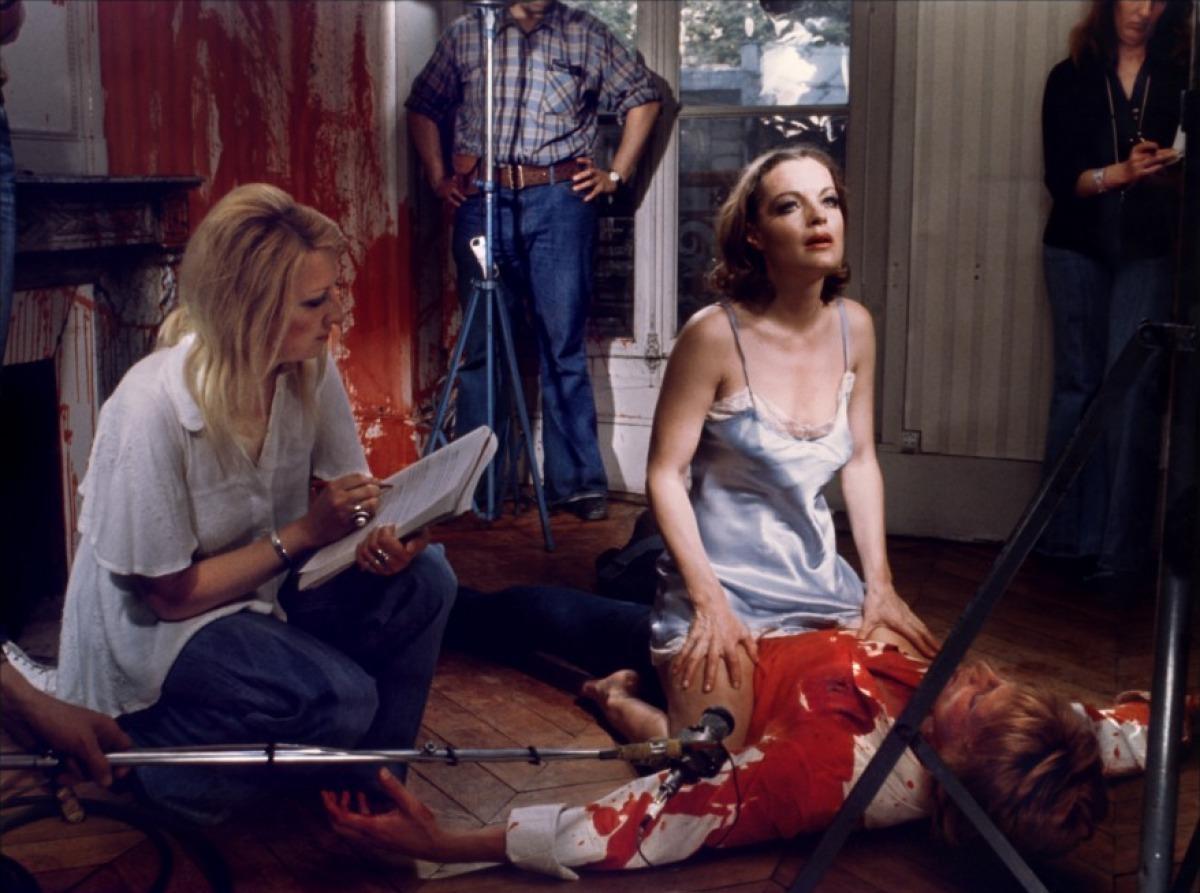
Out of the Żuławski films I have seen, this is very easy to follow, a love story but a very tragic one as it is a doomed romantic triangle between an actress Nadine Chevalier (Romy Schneider) stuck in making sex films to survive, a photographer Servais Mont (Fabio Testi) who is obsessed with her, and her husband Jacques Chevalier (Jacques Dutronc), a guy whose life is to just buy film memorabilia (mostly photos) and cinephilia, but is visibly aware his wife is falling in love with Servais. Love does finally succeed, but it is a painful and agonising route towards it. Żuławski, even when he made a comedy in his last film Cosmos (2015), demands the fullest spectrum of emotion and this is the same. Servais works in the fringes, in debt to a shady elderly mob boss, paying back his debt through under-the-counter pornographic photo sessions, sneaking in the midst of one of Nadine's films in the first scene, being bullied by her female director into acting out a sex scene with a corpse. He tries to help her out of this mess, by pulling strings with a friend, a chronic alcoholic, and getting her into a production of Richard III. Unfortunately, when you see the production, where infamous German actor Klaus Kinski is playing the lead actor Karl-Heinz Zimmer in full samurai armour howling his lines like a maniac, it is clear the stage production is not going to work for anyone. Servais will be in debt, Nadine will be going nowhere in her life, and Jacques will feel both the tragic outsider but also glad, unable to fulfil his wife's sexual and emotional needs, feeling himself trapped in the midst of this.

Oh, and yes, Klaus Kinski in samurai armour is a reminder that this is still a Żuławski production, as whilst this is not as delirious as other films of his for me, narratively driven to the point I do not consider it "abstract" as any of the others, it is still a frenzied experience that is yet structured between sombre and haunting emotional drama. He has always walked a dangerous tightrope between the absurd and the profound, and this is a significant case study of this risk at hand. Already in the first few scenes, you have a staged necrophilia scene that is not working, Servais getting into a fistfight with production crew, gangsters out of a cartoon and a hyper-intense acting style which is interjected with moments of stillness.

Kinski does not even appear until part of the way through, and of all things, for the man notorious for his work with his fellow countryman Werner Herzog, he is the most restraint figure in the cast. He still beats two men up, for one touching his coat, out of the angst of having his performance on stage damned in a review, taking the two women they were with back home to sleep with, but the film unlike the madness of anything between the films before this or to Cosmos is so much subdued in comparison to Żuławski's other work. Even in a film which will violent cut to a sex orgy with very explicit nudity, like this has turned into a European softcore film from the period, the film frames it from a very emotional aspect of Servais being stuck having to photograph this material. Likewise, Kinski's Karl-Heinz, an actor from a wealthy background who takes a charm to Nadine and even tries to help her through the stage rehearsals, is for the most part the most sympathetic figure in opposite to Kinski's real life persona. Their stage director, who decks himself out in ridiculous costumes and is mashing very eras of iconography into his Shakespeare production however is definitely one of the weirdest aspects of the film, and the doomed nature of the production is painted as being inevitable the moment you first encounter him dishevelled on the floor of Karl-Heinz's hotel.


What differs Love from the Żuławski's films I have seen are a couple of factors. Here, he had camera operator/cinematographer Andrzej J. Jaroszewicz follow him from Poland, the man responsible for the director's trademark prowling camera scenes as Jaroszewicz would literally run with the camera handheld in work like The Devil. However, the main cinematographer for Love is Ricardo Aronovich1. Whilst Żuławski's trademark of the prowling camera is here, here it is contrasted by many still scenes, generating melancholia. The look of the film as well, with its muted colours, emphasises a palpable sadness to the story, co-written by Christopher Frank, and for all the outer film's peculiar nature, it is also deeply heartbreaking.

The film ends with the likelihood of Nadine and Servais finally being together, but it is only possible because Jacques kills himself to avoid being a barrier between them, taking rat poison in a public bathroom. Whilst he has had his dark moments, mocking Nadine for working in porn but also being prudish at a dinner with his cineaste friends, Jacques comes off as a clownish young boy in a man's body, obsessed with classic Hollywood and literally a clown at one point, actor Jacques Dutronc shuffling along in many scenes like a stereotypical penguin. He is sad to see as someone clearly meant to be pushed to the side and knowing this, and even between Nadine and Servais, the film ends with Servais beaten to a pulp in the finale scene.

It is fascinating as a transition for Żuławski, working outside of Poland (and mainly in France) for a large part of his career, much of the later work likewise being heavily reliant on emotion. Those later films could be extremer in their tone and content, such as the next film he was able to finish, a work by the name of Possession (1981) that has made his reputation by itself for good reason. Of note is that even that film stems from heartbreaking emotion, more so it was directly channelling a divorce from his wife, whilst even the absurd and funny Cosmos follows a plot point with a male character committing suicide. Even if it is by way of grotesqueness, be it big cartoonish body builders with muscles like cannon balls or how decrepit the mafia boss' entourage can be, the heart is still here in Love in-between all this absurdness.

I have not even talked about Romy Schneider, but befittingly she should have the last paragraph. Fabio Testi, Kinski et al are memorable and do an incredible job in their roles, but That Most Important Thing: Love is her film. Whilst there are clear compromises for her (mainly that nudity is obscured when other scenes with other actors are exceptionally explicit), the legendary actress does absorb the tone of Żuławski's acting style of letting the emotions possess her. She won her first César Award (France's equivalent of the Oscar) for this film, and from anger to passion, she makes every change completely believable. It is quite shocking, and sad, to realise she passed only in her early forties in 1982, only seven years from this production, a startling moment of fate that is sobering1. We can thankfully look to a film like this, where she is the centre of the film and its heart, and find that it was the right way to end any review of Love by talking about her performance.

Abstract Spectrum: Bizarre/Grotesque/Manic/Melancholic
Abstract Rating (High/Medium/Low/None): None


============
1) If confirmable, one of the oddest connections to my taste in cinema is that Ricardo Aronovich was the cinematographer on Christmas Evil (1980), which in spite of that dull title is a Christmas horror film that is mostly a psychological drama. It is a very strange discovery to find.

2) Even Jean-Luc Godard in his obscure TV movie for a TV series, Rise And Fall Of A Small Film Company (1986), remarks of this himself in a small cameo, felt with a huge melancholy as part of many things of how the French film industry was felt to have changed for the worst. I think we can say that even if it influenced one of Godard's experimental productions, the effect of Schneider's passing was significant.

Sunday, 17 May 2020

Rubber's Lover (1996)


Director: Shozin Fukui
Screenplay: Shozin Fukui
Cast: Nao as Kiku; Norimizu Ameya as Hitotsubashi; Yôta Kawase as Shimika; Mika Kunihiro as Akari; Sosuke Saito as Motomiya
Re-Review

[Review contains some plot spoilers]

Set in the claustrophobic world of an unknown urban Japanese city, between the back alleys there is an underground basement accessed by a massive industrial lift, where experiments are transpiring that cross the line to violent scientific malpractice. Rubber's Lover follows alongside 964 Pinocchio (1991) as one of two of Shozin Fukui's films that may be known about in the West, entirely due to Unearthed Films releasing them in the United States in the DVD days. They are an interesting company in that their stock in trade in very transgressive cinema, be it releasing the notorious Japanese Guinea Pig films or something as notorious as Philosophy of the Knife (2008), only that among some odd curveballs* they also released these films, very much in the transgressive side of cinema but also very alien to it at the same time. That alienness comes from the fact that Shozin Fukui, working as an assistant director on Tetsuo: The Iron Man (1989), he is less fixated on the transgressive but a kinetic intensity in these films.

Rubber's Lover is meant to be a prequel to 964 Pinocchio (1991), though it is best to imagine that co-existing in the same world, the future of that earlier film (of a brainwashed male sex toy who gains his consciousness again) is built from the fall out to this, Motomiya (Sosuke Saito) and Shimika (Yôta Kawase) two male scientists who are being backed in experiments to use psychic powers, having progressed to human test subjects. Their tools are "ether", not the gas used in early surgery as an anaesthetic (but an apt choice of name for symbolism) but a drug that is highly addicted, alongside the "Direct Digital Drive" technology. Motomiya has become a body building sociopath which has not helped matters, with Shimika easy to manipulate into this work, between them having a habit of killing their test subjects with their nurse assistant Akari (Mika Kunihiro). Their breaking point comes when an about-to-be-wedded secretary to their benefactor Kiku (Nao) comes to them informing the pair the project is going to be shut down. Things do not turn out that way as Motomiya snaps and she is held hostage.

Both films for Shozin Fukui transpire on the idea of the extremity of physical and mental agony eventually leading to a transcendental, and usually violent, power. The experiments here also involve the titular rubber, BDSM full rubber costumes which block out external stimuli as subjects wear them, are injected with ether and have their minds blasted out with noise until psychic power is induced. The film originates from both Fukui's fascination and research into psychic powers, having met people claiming such powers, and the connections he found when he also started talking to people in the burgeoning BDSM scene in his homeland1. Among his research, including trying one for himself1, was the use of rubber outfits and the fact that, yes, the material blocks the ability of the skin to sweat and breath, making them both dangerous to wear as a costume for a long period of time, and in context to this film the costume is used by the scientists to induce a further state of mental agony.

With one of their last subjects being a potential success, Hitotsubashi (Norimizu Ameya), the pair has made the unfortunate decision to use someone who was researching this subject matter and they stole his work from, all alongside erased memories proving an ill advised idea especially as he has nothing for contempt for the scientists. That Kiku is an open conduit for his mind as two people glad to take revenge on their torment, set up in hints early on, proves where this will lead to. The latter plot point is of note as, whilst I am an admirer of the film, I confess that there is at least one moment of extremity which has dated even if it is treated as the uncomfortable scene it should be, named that the kick off for Motomiya snapping and holding Kiku captive is the evil scientist committing sexual assault, uncomfortable to witness though it fits the darkness of the premise.


I will, having been an admirer of the film, confess that there is a least one moment which does not hold up as a good choice even for a film which is dealing with extremity, namely that the kick off for Motomiya snapping and holding Kiku captive is the evil scientist committing sexual assault, uncomfortable to witness though it fits the darkness of the premise. It is the one moment in a film, which does deal with explicit kink and titillation, which does jar in the modern day. Thankfully, it is depicted as horrifying, as it should be, and doesn't mar what Rubber's Lover escalates to in terms of a visual and audio assault worthy of being seen. That Kiku does have that plot point, which in this world where people have some semblance of confirmed psychic power, helps soothe the scene. It at least means, whilst it could have been done differently, there is a sense that it will be building to something of worth, she connecting literally to a male test subject who has been left a drug addict and tortured for a prolonged amount of time, Hitotsubashi once a talented chemical scientist reduced to this, and thus two damaged figures getting their revenge in a literal devastating power.

Shot in extreme monochrome, this is not a "pleasant" film but it is a thing of a vile beauty, compelling from the get-go in its deep black and white visuals. You can feel the dankness of the environments, even in a DVD standard release, just for the grain in the scenes. It was, humorously, due to it being perceived that the rubber suit would look terrible in colour1, but that little change helps the film have a distinctive style which adds to it. One scene later on, which actively hurts the eyes as Hitotsubashi awakens with his new powers and lashes out, has flashing imagery and turns into a combination of Peter Kubelka's notorious advert for a beer Schwechater (1958), of black and white figures in flashing edits,  and Paul Sharits' short film T,O,U,C,H,I,N,G. (1968).

For the most part, this is a kinetic mood piece, which as a result means that any theme for the film, as talked of, is told through the action. The effect, the experience, of the film is through pulp storytelling where the atmosphere takes you in and pummels the viewer. Even when the film returns back to society, Shozin Fukui likes to depict an urban reality through grime and the lived in environments he probably lived in himself, particularly as between this and 964 Pinocchio he has an obsession with Japanese supermarkets and their septic white decor, a location with their paths and shelves which is very cinematic in its own way.

Rubber's Lover is a great example of how, for me, Japanese locations in their genre cinema, from wasteland behind wire fences to ordinary stores, have an inherently unique mood that is inherently cinematic, even if you do not take into consideration the distinct cultural aesthetic behind their public environments like their pedestrian utility signs to crossing light systems having a specific sound when people can cross that have poor eyesight. This could all stem merely from watching so many films from Japanese that had to shot on existing locations, but never was there an environment usually ignored in cinema, ordinary public environments, which even in their animation (as replicating real locations is common) Japanese film and television filmmakers have breathed a life into. In other country's cinema, like mind, there was always a danger of it coming off cheap; probably because films like this use them in resourceful ways, one back alley could lead to such peculiar sights like those you witness in Rubber's Lover.

The film also manages to carve its own distinction in the tiny subgenre of Japanese cyberpunk, creating its own startling imagery. The full rubber suit, with a head set obscuring the entire area above the neck and two cameras on each hip showing the wearer's eyes, is startling, and once the physical and metaphysical nature of the piece comes about, the style of the film which was already extreme even becomes poetic in its extremity, when such incidents like it "snowing" inside an apartment transpires. Tragically, Fukui's career whilst continuing onwards became obscure in terms of access.  This is a shame as, together with 964 Pinocchio, they are very idiosyncratic films by themselves, worthy of rediscovery and startling experiences separately.
Abstract Spectrum: Atmospheric/Intense
Abstract Rating (High/Medium/Low/None): Medium


=======
1) The Unearthed Films release offers a small interview with the director-writer which provides these interesting titbits.

Saturday, 16 May 2020

The Real Cancun (2003)


Director: Rick de Oliveira
Screenplay: Brian Caldirola
Cast: Benjamin "Fletch" Fletcher; Nicole Frilot; Roxanne Frilot; David Ingber; Jeremy Jazwinski; Amber Madison; Paul Malbry; Marquita "Skye" Marshall; Laura Ramsey; Matthew Slenske; Alan Taylor; Heidi Vance; Casey Weeks; Sarah Wilkins; Jorell Washington; Adam Miller
Ephemeral Waves

Ephemeral Waves is for everything, from big films to scrapping at the back of the DVD rental shelf, all that exists in this strange world of moving images. Today, a curiosity in Reality TV's attempt at dominating the theatrical box office...

To my surprise, this was released by New Line Cinema, a detail I might have merely forgotten finally getting to this obscurity, but nowadays provides a perverse delight upon realising this, with their logo represented as a necklace above a faceless bikini bust on the DVD menu just cementing their claim over this project. Never was there a studio, even when the Nightmare on Elm Street franchise made them a lot of money and the Lords of the Rings trilogy bolstered them to a respectable award winning company, which indulged in projects that are strange to hear of or eventually killed them, as many were not financial successes in the slightest. This particular project is neither fiction nor a documentary, but a "reality" film produced with Bunim/Murray Productions, the creators of the early reality television show The Real World and Keeping Up with the Kardashians. "Screenwriter" Brian Caldirola worked on The Simple Life (2003-7), a multi season reality show where Paris Hilton and Nicole Richie slummed it as socialites put into the real working world. So yes, this is the kind of film that was ahead of its time, would have induced fear in critics when it was first made, and yet flopped at the box office.

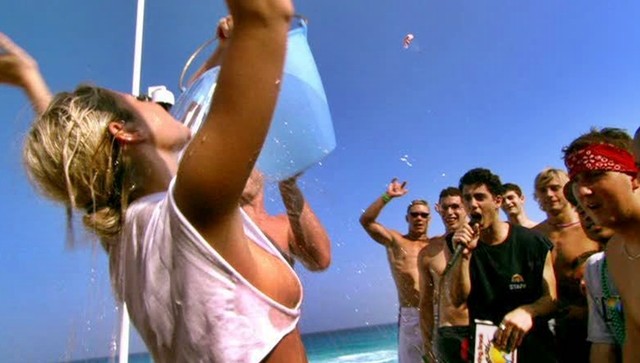
Released only a month after principal photography, this cast a group of young adults and films them in scripted events at a spring break event in Cancun, Mexico. In the current day, since it was birthed fully into the 2000s, reality TV is everywhere but, not watching television on a regular basis since my early twenties, it is a culturally alien format to me when it is all intrusive for anyone else. Part of The Real Cancun, where we see a wet t-shirt competition to massive drinking sessions, are caught as transpired, but it would be delusional to not see that the editing and how the footage is constructed is also manufactured.

It begins with the casting interviews three weeks earlier. The cast for the most part are, honestly, indistinguishable from each other with a few exceptions. Two guys, buddies and played as a comedy duo, stand out with having wisecracks before one will be attracted to a girl nicknamed "Skye", where the relationship will not necessarily be successful. There are a pair of male and female friends who have a clear chemistry which creates tension between them. There is a pair of female twins whose brazenness makes them stand out. And there is Alex, who manages to become the most interesting figure from being the awkward nerd in the midst of this group. Then we get to Cancun, where barring the natural wildlife we never see any of the culture of, the only indication of Mexican culture we ever see being a mariachi band hired to wake up everyone. As a result, it does feel like a Mexican coastal town has been invaded by a mass of Americans with the intentions of drinking, fucking and twerking before leaving a mess to clean up afterwards.

In terms of an actual plot, there really isn't one. Reality TV usually follows some major plot or a series of events for dramatic tension, emphasised with extensive editing and didactic music cues which are meant to keep a viewer distracted like a cat with a toy. The Real Cancun, despite its structure, is a prototype of this with many of these details not existing here. The little plots I have mentioned - the will-they-won't-they of the male and female friends, the romance with Skye that will go nowhere - never progress to anything. The only aspect which does grow significantly is Alex, who is a nerdy guy who never drinks, causing one to wonder how someone who practices straight edge philosophy (i.e. no drugs or alcohol) would handle being there, getting out of his shell eventually. Partially it's awesome, because he enters a male "Hot Bod" competition where he dances in a thong, only to win it over more hunky muscular men out of charisma and bravery, getting the interest of many ladies in Cancun as a result. However he is also peer pressured to drink by everyone, which is uncomfortable in the modern day, a difference between the courage to do a shot with knowledge of one's limits, and having an arm bent and being forced to do a tequila salt lick off as a woman's bust even if he's into that.


Beyond this, not much happens and no one here is particularly interesting. This is without any malice to the cast either. Barring some obnoxious bro-speak about women in a gym, everyone is naive and has not really thought about anything meaningful even about the art of partying. Even in the DVD extra about the premiere screening, one of the guys in that gym scene feels embarrassed about the talk but defends it as male speak, which is telling about human behaviour as is Alex being pushed into drinking because it makes the guys especially uncomfortable he stands out like a sore thumb. This is a group without any real sense of individualism, barring Alex, so it feels even pointless to use names as no one really stands out. The only person who did in real life was Laura Ramsey, who got a small career in film and television into the 2010s.

There is no progressive or melodramatic turn in The Real Cancun, just a vague world of partying which is barely covered. The most dynamic scene is a girl getting a jellyfish sting from an above-water bungee jump, which involves a trite attempt at replicating the intense pre-attack mood of Jaws (1975) with a mere single jellyfish and a terrible music cue, and a romance sparking for her with the guy willing to pee in a cup behind a wall and pour the fresh urine on the wound to heal it. It is also, in a time where amateur porn flourished afterwards and covered many college dorm parties as their subject, completely tame as a film nowadays. The sex when it happens takes place under bed sheets, the more alarming thing that they were happy to have secret cameras in the bedrooms able to film it in the dark. This becomes less a proud Dionysius rampage of free libido and the power of wine, but a lame corporate created voyeurism.

In the time that transpires, many of the major events are in the middle of the film, like the wet t-shirt scene or Alex's triumph, leaving The Real Cancun to dwindle in momentum when it gets to the Spring Break celebrations winding down. Even a potential lasting romance introduced by the end feels like an afterthought, the result as it stands ahead of its time in context, but a flat production which does not fully commit to its promise. It also becomes another example which causes me to ask about New Line Cinema and how they managed to sustain themselves as long as they did. Between this, the notoriety of The Island of Doctor Moreau (1996) and various bizarre projects they yet managed to survive in the late 2000s until The Golden Compass (2007) has been said to have finished them.

If I had ever had the chance to see this film in an American cinema at the time, I would have gone but just out of curiosity of who went to it, as it only grossed $5.3 million from a budget of $7.5 million1, and how they reacted to it. The best symbolic way to describe The Real Cancun is to compare it to its own soundtrack, one foot in the new trends but also very much to be subsumed in its time. Surprisingly there is no nu-metal outside the DVD extras, where it is inexplicably scoring a full version of the wet t-shirt contest, as apparently there is nothing more erotic than down tuned guitar riffs and post-Taproot angst lyrics. That genre would soon vanish as a "New Wave of American Heavy Metal" came about and the mainstream took an interest in other music.

Beyond this, it is a time capsule of the era, as whilst there are song from the likes of Gorrillaz and Basement Jaxx on the soundtrack, there are songs by bands like Simple Plan, pop punk that would soon morph into the emo grew whilst Green Day, who helped popularise this type of music, got serious and released the huge hit album American Idiot a year later in 2004. The growth of pop rap and RnB was present but barely touched upon, befittingly represented in the fact that the closest thing to any of it is very sexually suggestive songs and Snoop Dogg performing in concert, a scene only a few minutes long that it qualifies as a cameo, long before he ever considered reggae or a Gospel album. The world depicted here, the trends and habits of the young adults here, changed eventually, and especially so a decade later when you consider most of the people starring in this like Alex are approaching their forties and may have reflected back on this time in thought. Likewise, reality television would shift and change, evolving as it went along for new trends. Bunim/Murray Productions did not stop working back in television when this failed, whilst New Line Cinema has not survived the 2000s. The Real Cancun as a historical document is interesting, but like a really bland song from that era that no one bought, it's not particularly memorable.   


======

Wednesday, 13 May 2020

Our Lady of the Turks (1968)


Director: Carmelo Bene
Screenplay: Carmelo Bene
Cast: Carmelo Bene as The Man / Narrator; Lydia Mancinelli as Saint Margareth; Salvatore Siniscalchi as The Publisher; Anita Masini as Holy Mary / The Woman

[Plot Details and Spoilers]

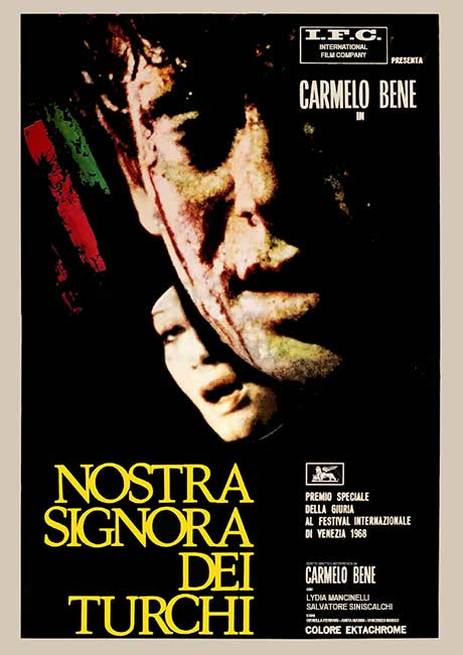
All careers begin somewhere, and the cinematic debut of Carmelo Bene as director was here. I had thought to my surprise, in lieu to his future trademark of hyper-exaggerated acting and artificially rich environments, of how subdued the prologue is. This will change, but Our Lady of the Turks for a large portion of its length is a calmer production, beginning with the narrator (Bene himself) elaborating the tale of the Martyrs of Otranto, inhabitants of the Salentine city of Otranto in southern Italy who were killed on 14th August 1480 by an invading Ottoman force who took the city, described here as being massacred as they refused to convert from their Christianity to Islam. From here, Bene builds to a delirium very common to his other work but with a different tact.

In this context provided by his voice over, Bene plays a nameless man, a personification of a figure whose bones are part of their surviving form, the Cathedral of Otranto having the bones of the martyrs built into an alter of skulls in their memory, Bene a man who prayed to the Madonna during the Ottoman force's attack. In this form however, said man is now a figure who wanders both the landscape and between time, in the modern day region of Apulia, Italy and in the past including as a knight. Bene has used real locations later, but it is a jolt to see him use far more naturally decorated locations, including the startling sight of the Alter of Otranto housing those skulls, and environments whose natural lightning and form are a vast contrast to the sensitory overloading stages of films into the seventies like Salome (1972).

The pace is also more subdued for a long time, taking its time to escalate as, in the midst of his aimlessness, the Man has rejected his initial faith and is even trying to flee the Madonna he once beckoned to, something which is proven difficult for him as he manages to court the influence of the of the female saint Santa Margherita (Lydia Mancinelli), who is there under the presumption that under her (wire) wings and halo he can become a noble figure. Plot wise, it is a film of tangents, including a period of trying to publish the writings he made of her to a publisher and being stricken by an illness which proves a hindrance to Margherita's desire (and romantic interest) in this lowly mortal and his holiness. Eventually, finding a way with her influence to effectively get his leg over with a woman, proves the breaking point for her in this relationship.

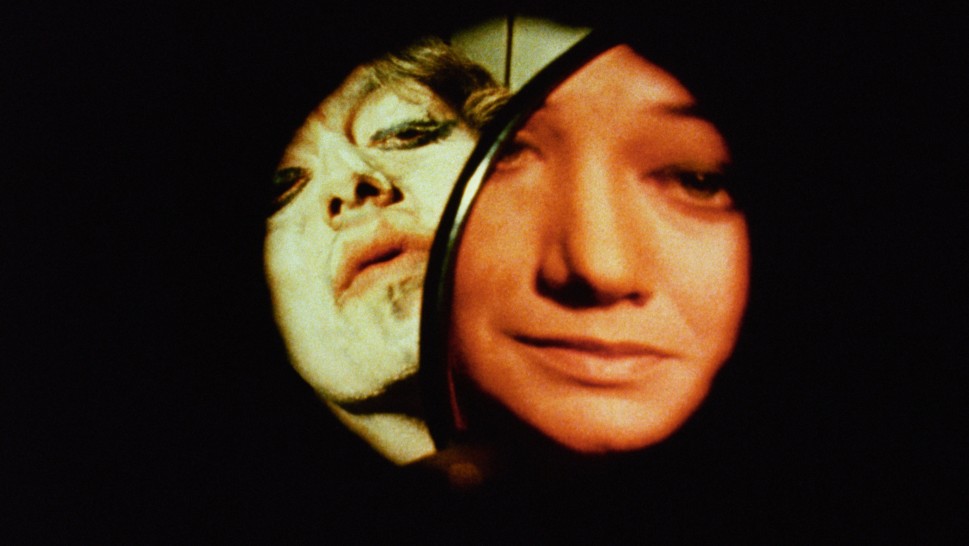
It is a difficult film eventually to grasp, at least within one viewing, as it shudders into tangents and extremes. Our Lady of the Turks even passes into territory with Bene playing Carmelo Bene, at least evoking the real man as audio of an interview is eventually heard about his relationship with cinema and desire to break from Italian neo-realists like Roberto Rossellini. Reality is disrupted anywhere between his sleep being intruded upon when his bed is unexpectedly near pedestrians and a passing car, or when (using a very grotty stove) he looks like he is injecting heroin (or something) into a buttock in the middle of the outdoor area at a cafe. He even hunts down and shoots himself in one of the first scenes of the film after the prologue, imagery which can be interpreted many ways but could be seen the fragments of this figure, clearly a soul lost in purgatory as his remains are in the Altar of Otranto, stuck in the scenario of not wanting Santa Margherita to follow him but that, if she leaves, he will die fully and she will not be allowed by up-above to resurrect him.

If there is any coherent through line to what any of this means, one monologue does grow in hindsight, where Bene in voiceover talks of how rarely people see the Madonna, that "idiots" who see the Madonna become her, a madness which brings them to a saintliness inside themselves, whilst those "idiots" who do not wander from alter to alter, to people and women, trying to find her, possible to get to Heaven but (as perfectly used as a metaphor) like dragging oneself to the gates with one's feet amputated, the onlookers looking on at the blood trail behind oneself and realising that will eventually prevent a person from getting there. Religious faith is, truthfully, a subjective thing and, if one believes in Gods, a very unpredictable thing which does not come to one's disposal at a beck and call at a moment's notice, not even needing to be more than a subtle change of mood anyway and not requiring a burning bush unless to get the message across in very significant situations. 


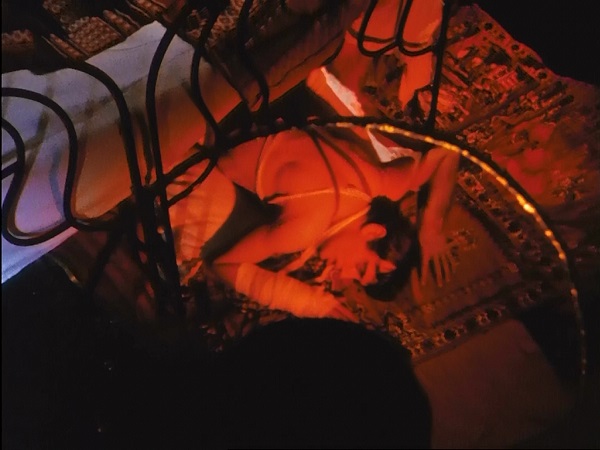
In his character's rejection of Catholicism and his roots, and knowing the director-writer-star is Italian, a Roman Catholic country, I cannot help but see the one clear plot thread in this having a greater weight, the utter difficulty of raising oneself to a holistic good or a holistic virtue an issue, even if he was not rejecting it, found in how the Man succumbs to temptations and dicking about to a Saint's frustrations. Ironically, at the moment when he rejects her, the Man finds the Madonna, and she is not a vague figure constructed from puritanical objectification either. She is not perfect, hinting that she was not a perfect person even in Heaven but getting sainthood still means she at least earned it, a sympathetic and beautiful figure with her homemade (theatrical stage) prop halo and wings who is disappointed that her knight figure. Whilst it might have been a blasphemous scene on purpose, the moment she first appears it is very much implied Santa Margherita sleeps with him, the next morning undressed in his bed baring her halo reading a fashion magazine and smoking. It also offers something sweet in itself, a Saint who is still human, still has desires and is depressed when he is eyeing another woman instead, but still earned the halo.

It is to the point she has decided to tow along with this shambolic "jerk", even taking a boat and rowing it for him as they travel over the sea, only to have the Man find an excuse to merely shag a woman, a homely earthy figure with infant who is just an innocent bystander in his madness and not villainized either. In fact, the earthy description is more than apt, she is literally shot bare breasted as a figure of Mother Nature at one point in a disorientation close up from inside the soil upwards, a figure of beauty too. Literally, at one point he is the knight, his soul trapped in the bones preserved as decorations in the Altar of Otranto, just wanting that same woman to release him, to bury his bones, but that is just a ploy to seduce her.

The sequence that shows the breaking point for this character of the Man, and how far he has gone, capable of some humanity but also lost permanently, is also evidence of how good Carmelo Bene in terms of his performance and sustaining such a hyper intense acting style, when he eventually becomes two people briefly, an older monk and a younger one, not depicted in duplication technique but Bene acting out both by himself, occasionally with a fake beard to differentiate the two. Acting like this is not giving as much deserved respect as it should be, as to even perform at this level of intensity regardless of the type of film would be difficult and a strain physically. It is a frenzy onscreen here, this character reduced to a gibbering idiot, between a cruel and older figure who lashes out at the other and that younger monk who squeals in pain between the pair trying to eat. By this point, the aesthetic from its naturalistic locations has aspects that are utterly grotesque and grim, the least sanitary cooking stove in any film at least witnessed here, whilst Bene shows both an incredible way of cracking an egg on his own head, without looking the yolk, only to start eating it raw when his monk character is meant to be making an omelette. It is a cacophonous sequence, played by only one man who sparks with a thunderous, scary energy.

The production has a heavier reliance on real life locations - in the middle of the day in idyllic locations no less too - which changes Our Lady of the Turks from Carmelo Bene's later films. Those later productions had a tremendous visual palette but an artificial one, the aforementioned Salome even predating eighties underground films like Dr. Caligari (1989) for neon colours, or One Hamlet Less (1973) being a work of elaborate costume and visual work. The greater emphasis here on naturalistic and ornate set design is a striking change, especially as Bene eventually shifts the tone to a far more grimier and gothic tone, even himself transforming at one point in a revenant like figure with eyes rolled back into the head and affecting a cavernous voice. It lives up to his intensity still, and you will eventually find one lost in the delirium, but the change in aesthetic allows this film to have uniqueness among his filmography.

Out of all of them, Bene's debut was successful in terms of that, at the 1968 Venice Film Festival, Our Lady of the Turks won the Special Jury Prize, sharing it with the Robert Lapoujade film Le Socrate (1968). The Special Jury Prize is just below the main Golden Lion that was won by another director not easily available as he probably should be, West German figure Alexander Kluge for a collage structured film about circus performers Artists Under the Big Top: Perplexed (1968), which I openly confess to have never have heard of before researching this. Considering the competition had Pier Paolo Pasolini's Teorema (1968), who Bene would be cast in his 1967 adaptation of Oedipus Rex, and John Cassavetes' Faces (1968), that was a pretty big success for Bene to have accomplished1.

It's worth mentioned Amos Vogel's Film as Subversive Art (1974), as if anything is partially responsible for these reviews, that and all the podcasts and tomes championing cult cinema made an impact for myself in combination with Vogel's championing of subversive and unique productions. Seeing the image of Bene in the book, as that almost undead figure with the pupil-less eyes, I did not realised that, in a bizarre future, I would be watching this unique film on Amazon Prime streaming, but the aura around this film has thankfully become even stronger as a result of actually seeing this. It lives up to that initial discovery, the text review of the book I found in the university library, and a reminder of this very different era of cinema of the sixties and seventies that Carmelo Bene existed in. He could be able to create an almost improvised, stream-of-consciousness like tale like this with this level of theatricality. It is apt to talk of his career from the first film as, by the late seventies to the end of his life, he would be mostly filming TV movies and documentaries after a fever dream of films to 19732. He started here perfectly, with Our Lady of the Turks, and Bene would not disappoint after his initial success either.

Abstract Spectrum: Avant-Garde/Delirious/Intense/Surreal
Abstract Rating (High/Medium/Low/None): Medium


===
1) Whilst IMDB is not always reliable, their source as of 10th May 2020 [HERE] also had Maurice Pialat's first theatrical film L'Enfance Nue (1968), D.A. Pennebaker's concert film Monterey Pop (1968), and films by Miklós Jancsó and Juraj Jakubisko among those screening. Time has made other films more acclaimed since the decades have passed, but it's fascinating in itself to see such idiosyncratic productions jostled together like this, causing one to wonder how in the future Cannes and Venice Film Festival premieres of the 2000s and 2010s will be seen.

2) All, having yet to see Capricci (1970), deserving a box set that both art house and cult cinema fans would by enraptured by.

Friday, 8 May 2020

A Countess from Hong Kong (1967)


Director: Charlie Chaplin
Screenplay: Charlie Chaplin
Cast: Marlon Brando as Ogden; Sophia Loren as Natascha; Sydney Chaplin as Harvey; Tippi Hedren as Martha; Patrick Cargill as Hudson; Michael Medwin as John Felix; Oliver Johnston as Clark
Obscurities, Oddities and One-Offs

Released in the late Sixties, Charlie Chaplin's last film is that of an exile out of time. Beforehand, the last film he made was back in 1957 with A King in New York, to which ten years later, this final curtain in his career was seen as a notorious ending. I can see the film in this context out of sympathetic, that also at least the attitude to the film, alongside its visible issues, stem from the fact that this was a period of considerable change for Hollywood that would have repercussions for the seventies in American cinema. The weight of expectation would have to have been considered too, as this is not the film of the happy little tramp of yore. He is still, kind and thoughtful, but time has passed and his cinema had aged as well.

Chaplin is of course legendary, still iconic into the modern day from his image, before you even consider the films he made and starred in from the silent era to The Great Dictator (1940), a film itself that was considered controversial to make as, uncomfortably, there was a period before the United States entered the Second World War that Hollywood were even keeping themselves open to marketing films in Nazi Germany. During and after World War II however, things did not go well for the real life Sir Charles Spencer Chaplin. His affair with Joan Barry, an aspiring actress, would lead to a series of trials which would severely harm his public reputation alongside that it would involve a paternity suit. His next film Monsieur Verdoux (1947), an incredibly dark film based on a real subject, was not the highly regarded film in decades after, but a reviled and unsuccessful one as it was a critique of capitalism, and also had Chaplin playing a man who weds and kills off older rich women. Then there were the accusations of being a Communist, on the tip of the Red Scare and McCarthyism that would burn through Hollywood in the fifties but had already had an effect in the late forties, which finally lead to him becoming an exile in 1952 when United States Attorney General James P. McGranery revoked Chaplin's re-entry permit and Chaplin cut his ties to the country when he would only be allowed to re-enter if he submitted to an interviewer concerning his political views and moral behaviour.

His exile led to three films - Limelight (1955), A King in New York, and A Countess from Hong Kong, the last in the sixties and virtually out of place of the times. Based on a real life experience, in which Chaplin met a stateless Russian ballet dancer in the 1920s, the film had existed as far back as the 1930s as a script called Stowaway for his then-wife Paulette Goddard The film feels of an entirely different era in general, even beyond this origin, with the only detail that suggests its actual time being that he can be explicit in discussing that the titular Countess Natascha (Sophia Loren), the child of Russian exiled by the communist revolution to Hong Kong, has had to even become a mistress as a teenager to survive, a detail that might have had to be implied back when Will Hays and his Production Code would have effected Chaplin's American productions.

The production is alien in its nature, alien to the time period it finally came to. Its story feels from the decade before - Marlon Brando as the heir of an oil tycoon's success, hostile to the fact Natascha has snuck into his room and refuses to leave until she can be snuck into the States, before turning into a romance between them. There is an extreme minimalism, where the camera rarely if ever moves and editing it perfunctory or quiet to be polite. The only touch, a charming one, which shows there is still experimentation is Chaplin's obsession with blurring the line between diegetic and non-diegetic music as the score we hear turns out to be music being manipulated or turned off on the radio. Aside from the fact Chaplin helped with the score, so had a bias for it to stand out for the viewer continually, it is a spark of charm in a film where the camera remains static and everything else is put together without fuss.


This is also Chaplin's only colour film, and this opens up the question of what the Sixties was actually like. By 1967, the trend of American cinema changed, leading to some of the biggest vitriol to the film in a year where Bonnie and Clyde (1967) would have a tremendous impact on the landscape alongside later films. The film's aesthetic, when the cruise gets to Hawaii by way of a British production not shot in the United States, is Sixties gaudy chic. As much as we imagine this the time of subversion and psychedelic, I cannot help but think that Quentin Tarantino's Once Upon a Time in Hollywood (2019) may have asked an important question of whether the underground artistic movements and films, barring some crossover hits, were having the real grip on the culture or whether we have accidentally presumed it to be. Even in context of this being a film by a man unstuck in time, there was a lot of this especially by the Hawaii scenes, and the rich colours, that evoked exotica and lounge album covers. It shows nothing of what would be considered trendy and "down" with the youth in its story of countesses or this type of comedic slapstick.

One of the film's biggest divisive factors however is the casting a man whose style of acting would influence the films that would be becoming more popular, the biggest issue for any viewer for me personally what you make of Marlon Brando. Brando in a comedic role is such a perplexing difference, and Brando and Chaplin did not get on well in the damndest. Even Sophie Loren was not impressed by the method actor, which made the film much more difficult to work on. Brando's legacy of great roles for me has been tainted by his legacy for being utterly obstinate and a pain to work with - be it asking for less scenes in Superman (1978) despite being paid a great deal of money to star in the production, or the notorious history of The Island of Doctor Moreau (1996), which has its own documentary* just to deal with the nightmare that New Line Pictures production was, but had Brando getting his own way among the many problems that production had, such as demanding that the titular Moreau and God to his created beast people have his lines giving to him over a hidden receiver and having an ice bucket on his head onscreen.

You can argue the film is mainly quaint, but Brando is going to be a huge divisive factor as he is not an actor used to broad romantic roles, but stiff and continually perturbed by what he is dealing with. On one hand, it feels palpable he was not comfortable here, whilst on the other it does work as comedy to see such a self serious and wound-up actor not being able to have peace to take a bath, stuck in dressing gowns or being unable to find clothes for Loren that are not five times her size. Loren in contrast is fully alert and captivating as a lovable figure. Even if the film feels stuffy at times, she alongside a cast full of scene stealers keeps the production afloat. Chaplin for all the holes that can be dented in his own personal life was still a humane individual, and you can see his utter sympathy for this character of Natascha. It helps so much that Loren is a needed energy.

Trust me in saying A Countess from Hong Kong is not a trendy film, at times soaking it in a film with the sentimental emotion of a soft jazz ballad which I was honestly won over even though it is syrupy. The very little use of camera movement, minimal and conventional editing, and its general aesthetic is disappointing in the knowledge of Charlie Chaplin's legacy, fitting what people warn of when it comes to directors' final films, where as older (even elderly) figures their work is entirely changed. This notion is not really true, when figures like Martin Scorsese makes the profane The Wolf of Wall Street (2013) in his seventies, but there is also the fact that, when he makes his cameo, Chaplin is an old man. He will not be able to have done the pratfalls of youth, and I would argue that sentimentality was always there. Even The Great Dictator, which had a significant political message at a profound time, plays its heart on its sleeve in the same way as this final film. The dynamic nature of his early comedic work is the notable change, where this no longer had the dynamic nature of before. A lot of its humour instead is from comic timing and a bit of raciness, actor Patrick Cargill as the valet Hudson stealing scenes when he is roped in to being Loren's hastily arranged husband and finding a thrill to it though there is little chance of anything transpiring. It is a curiosity, in the truest sense, as these are the type of films by legends which show them waver, to be human, to which I feel nothing but a pure fondness whether it is cool to admire nowadays or not. Such signs offer warmth in knowing a human being like me made these films and not an indistinguishable entity.


======
* Lost Soul: The Doomed Journey of Richard Stanley's Island of Dr. Moreau (2014)

Tuesday, 5 May 2020

Slashers (2001)


Director: Maurice Devereaux
Screenplay: Maurice Devereaux
Cast: Sarah Joslyn Crowder as Megan Lowry; Tony Curtis Blondell as Devon White; Kieran Keller as Michael Gibbons; Jerry Sprio as Rick Fisher; Carolina Pla as Rebecca Galley; Sofia de Medeiros as Brenda Thompson; Claudine Shiraishi as Miho Taguchi; Christopher Piggins as Doctor Ripper; Neil Napier as Chainsaw Charlie / Preacherman; Takaaki Honda as The Announcer / Hideo; Koichi Yano as The Technician
A Night of a Thousand Horror Movies #153

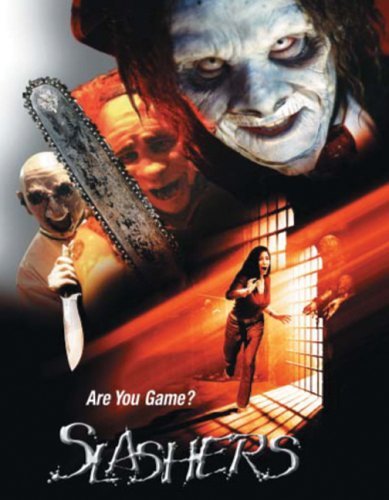
Slashers has been a film I have been interested in since I really ever got into cinema, ten years plus at least for this intriguing premise of a television show about surviving killers. It aptly fits within a period of horror cinema which were keeping their eyes peeled to the growth of reality television. Kolobos (1999), My Little Eye (2002), (which in the early era of DVD had an alternative version where you could change the camera angles with the remote), even Halloween: Resurrection (2002), which was not held as a good film in the slightest but still tried to continue the franchise through reality television tropes. Not a horror film, but worth bringing up to compare Slashers to, is Series 7: The Contenders (2001), in which they are both fictional television shows where the competitors can die. Series 7, in which its cast were chosen by lottery against their will to enter a competition to kill each other, was shot and edited like actual episodes of the show. Slashers, set here as a single episode of a Japanese game show, has willing participants playing for a cash sum where, in the vague premise, you have to survive against three killers or try to kill them if you can for extra money.

Immediately, whilst I will be very positive about Slashers as an idiosyncratic take on slasher film clichés, I will be upfront that the setting has dated and problematic depending on how you view it. Contextually it falls into the exoticisation of Japan as a culture of the perverse and weird, which cannot helped but be noticed in its premise inherently. Japanese game shows can be weird and very painful to their participants, which is something worthy of parodying. I grew up with a repackaged version of Takashi's Castle, when Takashi Kitano wasn't a legendary director/actor but a popular comedian who hosted this show, where just the skipping stones game, with rocks on a pond which occasionally sunk when stood on, could be painful to witness for the competitors who failed. (I also vividly remember clips of another involving inappropriate use of a cactus or two, but sadly, I cannot provide a good enough memory for citation). Providing examples like this does not help still in this one creative choice of Slashers I have reservations of, which really could have been avoided with some tweaks beyond surface aesthetic. This is sad as the film does at least have the decency to cast Japanese actors, who speak in Japanese with onscreen subtitles unless necessary, as this is the first American broadcast which has American participants in the game, a plot in itself that could have negated this issue for myself is we emphasised (even off-screen) how the duplicitous nature of this show is international.

Slashers gets more weight and redeems itself, building up this world in a limited budget first before playing out this game. From the female host in elaborate costumes to their own in-house DJ, the setting works even with the concern I have made. It also has the perfect touch of there being an unseen camera man whose eye is what we see through entirely, not having to worry about being chased or any scenario where it is questionable why he would still be filming as, with even the killers wearing electronic collars, no one is allowed to interfere with his work. The film itself is the entire episode in its entirety.


Its biggest virtue is that this is a subversion of slasher films. It is signalled early on by one female character, a young woman wanting to make a political message, being toyed with by a killer by having her top ripped off, which comes off as lurid until immediately afterwards you realise this is because a) the killer in question Dr. Ripper is a pervert too, and b) the game show is deliberately pacifying its viewers with sex and violence, where another character realises she could survive longer if she strips down to her bra and increase her betting chances. Throughout Slashers the game show, talked of by an ex-soldier who has watched it and knows the rules, it shows itself to be a manipulative programme which forces out the luridness, even having a sex room with a bed where cast can win free time to be safe if they have sex on camera. They are even prompted to explain their back story to add to the experience for viewers. Beyond the environments being designed to separate the players or trap them, Slashers to its credit goes further in mocking the genre, where even the trope of the music becoming more tense for the viewer is talked of, and that the DJ is tirelessly working and is heart by the players in the midst of this to cause them paranoia and panic.

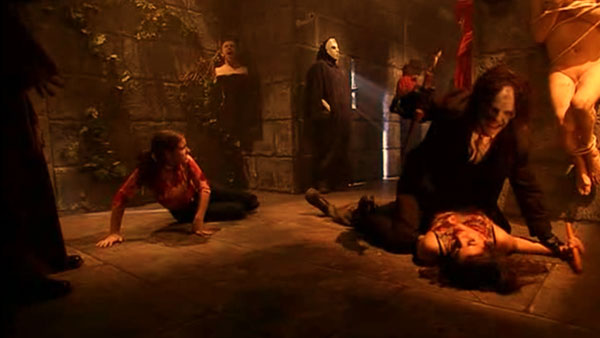
The production value is also perfect, low budget but befitting a fake TV show that has to watch its budget and bear in mind the blood has to be cleaned up. It is a compliment that, if I could have walked on these sets, I would be happy. From creepy clown rooms, to a literal dungeon or a corridor of horror icons, or the main area which looks like a warzone set for a paintball game, the look of Slashers in terms of the sets fit, This is especially as some, like the room all in black with the photos of previously killed players, are as meant to cause psychological effect as they can have actual pits of spikes over a rickety bridge or provide improvised weapons.

The acting, in truth, is shaky. Everyone tries his or her hardest, but almost all the cast never made a film afterwards. The exception, who has appeared in many usually as an extra but has had a healthy career, is Neil Napier who plays two of the killers, the psychotic Preacherman and Chainsaw Charlie, who is providing one of the best performances in both roles. He even gets one of the best scenes, in which in account to those electric collars the cast are frozen in the spot when there is a commercial break, forcing them to interact and even leading to periods of breaking character and arguing as happens with the Chainsaw Charlie figure over the rickety bridge. The tension that scene, where no one can kill each other and a debate of their existence happens, is something you would not have in a Friday the 13th film but is fascinating here.

Details like this are what I like immensely about the film. It still plays with slasher tropes and there are some dark aspects to it - such as a warning to some viewers that there is an attempt sexual assault - but it also toys with them, prodding many which have been pushing me at arms distance from appreciating it as a horror sub-genre. Even when it becomes obvious one of the characters is a bit of a psychopath himself, Slashers' structure is able to turn this on its head too. It overcomes a lot of its limitations by being clever with the structure, far more interesting by deliberately subverting slashers as artifice than Wes Craven's Scream (1996) trying to question them in a normal plot. It was a pleasure. A grim one at times, but never tasteless, the material finding the right balance and succeeding more than my initial interest over the years would have expected.