Showing posts with label Obscurities. Show all posts

Friday, 12 February 2021

Cool World (1992)


Director: Ralph Bakshi

Screenplay: Michael Grais and Mark Victor

Cast: Brad Pitt as Detective Frank Harris; Kim Basinger as Holli Would; Gabriel Byrne as Jack Deebs; Charlie Adler as Nails; Candi Milo as Lonette; Deirdre O'Connell as Isabelle Malley

Obsurities, Oddities and One-Offs


I'm allergic to clouds!

In Les Vegas 1945, Frank Harris (Brad Pitt) returns from World War II service only for a tragedy to transpire, losing his mother when on a ride on his new motorcycle they are knocked off the road. In the aftermath of this trauma, he is accidentally sucked into the strange realm of Cool World, where cartoons lives. For decades, he lives there as a detective, appointed to stop "Noids" (humans) from having sexual relations with "Doodles" (cartoons). A current problem is with the ambitious doodle Holli Would (Kim Basinger), who has machinations to seduce Noid comic book writer Jack Deebs (Gabriel Byrne), a former convict with mental health issues who will help her escape Cool World and experience the real world. Thus is the strange and curious premise to a film that was meant to be a major Paramount produced box office smash, a follow on from the success of Who Framed Roger Rabbit? (1988).

The entire production of Cool World, as a major release with video game tie-ins to a giant standee of Holli Would being placed on the Hollywood sign, causing protests from the local community1, makes even less sense if you stop and think about this film's very adult premise and who the director was. He was Ralph Bakski, a veteran starting in a small position at Terrytoons and eventually turning into a figure who made very adult, independent animated productions through the seventies like Heavy Traffic (1973). Paramount, because of Roger Rabbit, taking a chance on Bakski when, desiring to get back into work, he came up with a premise of a human comic book writer being terrorised by his illegitimate half human, half cartoon daughter. Bakski, never conventional yet somehow able in the seventies and eighties to have a long filmography, clearly had in mind a smaller horror hybrid of animation and live action which would have been tantalising to see in a mirror universe.

Where the production loses any sense of logic is that the deputy head of Paramount at the time Frank Mancuso, Jr., son of Paramount president Frank Mancuso, Sr., replaced the original narrative with one by Michael Grais and Mark Victor, a PG-13 release the result. Bakski was angry, still recounting how he punched Mancuso, Jr.in the face decades later even if this scene has been debated in whether it actually happened or not2. In lieu to Mancuso, Jr's decision, we know in hindsight the final result, but bear in mind all I have mentioned, including the video game tie-in, or that this even has David Bowie perform the song Real Cool World for the soundtrack. The first song post-Tin Machine and even pre-Black Tie White Noise (1993) he recorded in a significant moment of his career, on a soundtrack that included Ministry, a favourite band of mine, inexplicably together to promote this film. All for a film, regardless how chastely it dances around the subject, about humans having sex with cartoons.

The result was and still is a hot mess. Bakski's Cool World, stuck helming the film in a form of purgatory, still had creative control in terms of the animation where he effectively told his staff they had carte blanche to be strange. The plot of Cool World is not as bad as it could have been for half its length. The film for that half is not actually that bad in terms of escalation. Pitt, young and like James Dean, adapts himself to Cool World, a nightmare in flesh where, with incredible background illustration, the forties man naturally becomes a detective, with the subplot that, as humans are banned from sexual relations with "doodles", his romance with his cartoon girlfriend Lonette (Candi Milo) as is an angst ridden one despite their chemistry. It is a shame, frankly, the layering of live action actors with animation is visibly sloppy, the actors not clearly acting to stand-ins, alien to a production which for the most part is actually exceptional. The strange hellscape of violent nonsense, cardboard two dimensional props and back screens have a distinct weirdness, the animations (probably too much at times) layering scenes with violent cartoon mayhem even in exposition sequences. Including the exceptional background art, where buildings are spiralling toothed monstrosities, and where even objects held by characters or driven in can turn two dimensional cardboard cut-outs is a compelling aesthetic, but one that is awkwardly met with.

Cool World itself sadly does become secondary to a plot that, by its ending, suffers the issue of so many Hollywood films of the third act devolving into events without any sense to them. Everything in Cool World itself is compelling, effectively if Toon Town from Who Framed Roger Rabbit had its own Pottersville from It's A Wonderful Life (1946), where everyone is drinking and partying or trying to kill each other. It works with a visible dankness, a mashing of the likes of classic American animation like Tex Avery to a deliberate perverseness to contrast the age rating, underscored by Pitt's sincere love for Lonette and Nails (Charlie Adler), his spider partner who comes off as one of the most charming characters for being just a lovable clutz. Even if this could no longer have been an R-rated horror film, cartoon noir openly borrowing from Who Framed Roger Rabbit would have sufficed.

The problems begin with finishing the actual main plot, a contrived and plot hole laden narrative to work with which at first works but never reaches anything interesting. Gabriel Byrne, who always deserves better in many films, has a lot he could have done as a comic book author Jack Deebs, who believes Cool World is his creation when it is Holli Would, a spoilt Marilyn Monroe pastiche, manipulating him, taking advantage of his mental state. It is never brought up, after the initial reference like a loose plot thread, he had been in jail for murdering his wife and her lover, and the entire potential edge for his character is taken away despite being something else that could have been lent on.

The premise that, together, his and Would's coitus could disrupt and blur the lines between Cool World and the real world never makes sense and is weird, in a bad way. The conclusion, in real Las Vegas, loses any of the memorable perversity of the Cool World, and it feels like a contrived failure, a great example of a major Hollywood production that feels rushed, put together for profit and only kept interesting by Bakski and the animators indulging in the finale. The result is both compelling but a frustrating experience, time leaving the animation more admirable than the film's plot. It does overload in distraction, cartoons mucking about in every Cool World sequence, but the clear sabotage done by this is the memorable detail.

An additional irony is that Basinger, as the human version of Holli Would, really does not stand out despite being the huge star being sold, practically (awkwardly) brattish when, originally, Bakshi wanting Drew Barrymore3.  The sense of trying to make Would a Jessica Rabbit figure is felt, alongside the overt sense of reference famous Hollywood blondes, Marilyn Monroe's image projected in one background scene, without the executives likely releasing the Holli Would character is a parody of such figures too. Basinger in voice acting as Would does work, with an interesting idea of a femme fatale, a doodle wanting to be human, finding whatever she can to achieve this. That the film ends with her awkwardly role-playing this character in the flesh, crow barring in a McGuffin plonked on top a Las Vegas casino weather vane, kills this though.

Cool World marked, sadly, Ralph Bakski's last theatrical film, a strange cut off point baring the cancelled one-season animated series Spicy City (1997) and the likes of the Kickstarter funded short Last Days of Coney Island (2015). What is more miserable is that, despite his reputation, his work is as not readily available outside the United States as it should be, Cool World for many beyond Fritz the Cat (1972) or The Lords of the Rings (1978) one of the first people like myself to have likely seen. That in itself is a perverse thing to consider. This final theatrical film is not as bad as its reptuation suggests but it is a not a lost classic in the slightest.


========

1) As documented HERE

2) As documented HERE

3) As documented HERE

Friday, 8 May 2020

A Countess from Hong Kong (1967)


Director: Charlie Chaplin
Screenplay: Charlie Chaplin
Cast: Marlon Brando as Ogden; Sophia Loren as Natascha; Sydney Chaplin as Harvey; Tippi Hedren as Martha; Patrick Cargill as Hudson; Michael Medwin as John Felix; Oliver Johnston as Clark
Obscurities, Oddities and One-Offs

Released in the late Sixties, Charlie Chaplin's last film is that of an exile out of time. Beforehand, the last film he made was back in 1957 with A King in New York, to which ten years later, this final curtain in his career was seen as a notorious ending. I can see the film in this context out of sympathetic, that also at least the attitude to the film, alongside its visible issues, stem from the fact that this was a period of considerable change for Hollywood that would have repercussions for the seventies in American cinema. The weight of expectation would have to have been considered too, as this is not the film of the happy little tramp of yore. He is still, kind and thoughtful, but time has passed and his cinema had aged as well.

Chaplin is of course legendary, still iconic into the modern day from his image, before you even consider the films he made and starred in from the silent era to The Great Dictator (1940), a film itself that was considered controversial to make as, uncomfortably, there was a period before the United States entered the Second World War that Hollywood were even keeping themselves open to marketing films in Nazi Germany. During and after World War II however, things did not go well for the real life Sir Charles Spencer Chaplin. His affair with Joan Barry, an aspiring actress, would lead to a series of trials which would severely harm his public reputation alongside that it would involve a paternity suit. His next film Monsieur Verdoux (1947), an incredibly dark film based on a real subject, was not the highly regarded film in decades after, but a reviled and unsuccessful one as it was a critique of capitalism, and also had Chaplin playing a man who weds and kills off older rich women. Then there were the accusations of being a Communist, on the tip of the Red Scare and McCarthyism that would burn through Hollywood in the fifties but had already had an effect in the late forties, which finally lead to him becoming an exile in 1952 when United States Attorney General James P. McGranery revoked Chaplin's re-entry permit and Chaplin cut his ties to the country when he would only be allowed to re-enter if he submitted to an interviewer concerning his political views and moral behaviour.

His exile led to three films - Limelight (1955), A King in New York, and A Countess from Hong Kong, the last in the sixties and virtually out of place of the times. Based on a real life experience, in which Chaplin met a stateless Russian ballet dancer in the 1920s, the film had existed as far back as the 1930s as a script called Stowaway for his then-wife Paulette Goddard The film feels of an entirely different era in general, even beyond this origin, with the only detail that suggests its actual time being that he can be explicit in discussing that the titular Countess Natascha (Sophia Loren), the child of Russian exiled by the communist revolution to Hong Kong, has had to even become a mistress as a teenager to survive, a detail that might have had to be implied back when Will Hays and his Production Code would have effected Chaplin's American productions.

The production is alien in its nature, alien to the time period it finally came to. Its story feels from the decade before - Marlon Brando as the heir of an oil tycoon's success, hostile to the fact Natascha has snuck into his room and refuses to leave until she can be snuck into the States, before turning into a romance between them. There is an extreme minimalism, where the camera rarely if ever moves and editing it perfunctory or quiet to be polite. The only touch, a charming one, which shows there is still experimentation is Chaplin's obsession with blurring the line between diegetic and non-diegetic music as the score we hear turns out to be music being manipulated or turned off on the radio. Aside from the fact Chaplin helped with the score, so had a bias for it to stand out for the viewer continually, it is a spark of charm in a film where the camera remains static and everything else is put together without fuss.


This is also Chaplin's only colour film, and this opens up the question of what the Sixties was actually like. By 1967, the trend of American cinema changed, leading to some of the biggest vitriol to the film in a year where Bonnie and Clyde (1967) would have a tremendous impact on the landscape alongside later films. The film's aesthetic, when the cruise gets to Hawaii by way of a British production not shot in the United States, is Sixties gaudy chic. As much as we imagine this the time of subversion and psychedelic, I cannot help but think that Quentin Tarantino's Once Upon a Time in Hollywood (2019) may have asked an important question of whether the underground artistic movements and films, barring some crossover hits, were having the real grip on the culture or whether we have accidentally presumed it to be. Even in context of this being a film by a man unstuck in time, there was a lot of this especially by the Hawaii scenes, and the rich colours, that evoked exotica and lounge album covers. It shows nothing of what would be considered trendy and "down" with the youth in its story of countesses or this type of comedic slapstick.

One of the film's biggest divisive factors however is the casting a man whose style of acting would influence the films that would be becoming more popular, the biggest issue for any viewer for me personally what you make of Marlon Brando. Brando in a comedic role is such a perplexing difference, and Brando and Chaplin did not get on well in the damndest. Even Sophie Loren was not impressed by the method actor, which made the film much more difficult to work on. Brando's legacy of great roles for me has been tainted by his legacy for being utterly obstinate and a pain to work with - be it asking for less scenes in Superman (1978) despite being paid a great deal of money to star in the production, or the notorious history of The Island of Doctor Moreau (1996), which has its own documentary* just to deal with the nightmare that New Line Pictures production was, but had Brando getting his own way among the many problems that production had, such as demanding that the titular Moreau and God to his created beast people have his lines giving to him over a hidden receiver and having an ice bucket on his head onscreen.

You can argue the film is mainly quaint, but Brando is going to be a huge divisive factor as he is not an actor used to broad romantic roles, but stiff and continually perturbed by what he is dealing with. On one hand, it feels palpable he was not comfortable here, whilst on the other it does work as comedy to see such a self serious and wound-up actor not being able to have peace to take a bath, stuck in dressing gowns or being unable to find clothes for Loren that are not five times her size. Loren in contrast is fully alert and captivating as a lovable figure. Even if the film feels stuffy at times, she alongside a cast full of scene stealers keeps the production afloat. Chaplin for all the holes that can be dented in his own personal life was still a humane individual, and you can see his utter sympathy for this character of Natascha. It helps so much that Loren is a needed energy.

Trust me in saying A Countess from Hong Kong is not a trendy film, at times soaking it in a film with the sentimental emotion of a soft jazz ballad which I was honestly won over even though it is syrupy. The very little use of camera movement, minimal and conventional editing, and its general aesthetic is disappointing in the knowledge of Charlie Chaplin's legacy, fitting what people warn of when it comes to directors' final films, where as older (even elderly) figures their work is entirely changed. This notion is not really true, when figures like Martin Scorsese makes the profane The Wolf of Wall Street (2013) in his seventies, but there is also the fact that, when he makes his cameo, Chaplin is an old man. He will not be able to have done the pratfalls of youth, and I would argue that sentimentality was always there. Even The Great Dictator, which had a significant political message at a profound time, plays its heart on its sleeve in the same way as this final film. The dynamic nature of his early comedic work is the notable change, where this no longer had the dynamic nature of before. A lot of its humour instead is from comic timing and a bit of raciness, actor Patrick Cargill as the valet Hudson stealing scenes when he is roped in to being Loren's hastily arranged husband and finding a thrill to it though there is little chance of anything transpiring. It is a curiosity, in the truest sense, as these are the type of films by legends which show them waver, to be human, to which I feel nothing but a pure fondness whether it is cool to admire nowadays or not. Such signs offer warmth in knowing a human being like me made these films and not an indistinguishable entity.


======
* Lost Soul: The Doomed Journey of Richard Stanley's Island of Dr. Moreau (2014)

Saturday, 28 March 2020

Ghost Chase (1987)


Director: Roland Emmerich
Screenplay: Roland Emmerich and Thomas Kubisch
Cast: Jason Lively as Warren McCloud; Tim McDaniel as Fred; Jill Whitlow as Laurie Sanders; Leonard Lansink as Karl; Paul Gleason as Stan Gordon; Ian MacNaughton as Frederick McCloud; Chuck Mitchell as Mr. Rosenbaum
Obscurities, Oddities and One-Offs

Yes, I am covering a Roland Emmerich movie, which is bizarre even for me to consider. But Emmerich long before his big budget films had to begin somewhere. His first known film is arguably Universal Soldier (1992) as it had Jean-Claude Van Damme in his popular Hollywood years and led to sequels off the back of financial success. I hold some good to that film, entirely for a scene of Dolph Lundgren as a Vietnam soldier, brought back to life,and having gone insane, holding a supermarket hostage and beginning a crazed monologue about the war whilst a colleague, also a resurrected soldier, is eating frozen meat. Stargate (1994) was after, though I'd argue that whilst it is an important step in his career, the TV series has subsumed it culturally just for being over ten seasons without the spin-offs. After that was Independence Day (1996) which was a smash hit, starting Emmerich's course to blockbusters to the modern day.

Before then, he started with West German/American co-productions, such as a Malcolm McDowell starring sci-fi Moon 44 (1990), or this, which looked like a horror themed E.T. rip off but is Roland Emmerich making an eighties horror tinged comedy with cast members from the cult film Night of the Creeps (1986). Nothing is inappropriate in the film for a family audience baring  the surprising amount of swearing, an affinity for "Goddamn" in particular and an occasional "shit", all about two horror loving guys Warren (Jason Lively) and Fred (Tim McDaniel)  alongside the put upon female lead to their amateur horror films Laurie (Jill Whitlow). The E.T. stand in, in lieu to Steven Spielberg's famous 1982 about a diminutive alien being a huge mega hit, is here the ghost of a diminutive English butler of one of the guy's late grandfather, acquired when Warren is the benefactor of a will. Said butler Lewis wishes his body to finally rest, taking advantage of Fred being a wunderkind with film practical effects by hijacking an animatronic version of himself as a corporal body, which in fair due to the film itself is a very well made puppet creation who never comes off as unintentionally creepy with his big eyes and stereotypical English accent.

Ghost Chase is just an okay film, but I must confess this is a Roland Emmerich film I have seen that I have enjoyed. Unfortunately the German born director became a pretentious one, bombastic and yet bland, who puts messages about climate change in films like The Day After Tomorrow (2004) only for there to still be the problematic nature I have always had with disaster films of them gleefully killing off whole populations as statistics in elaborate catastrophes. His cinema does not appeal to me at all, but not without a concern that he simply followed spectacle without risk and with pseudo gravity to the material.  Ghost Chase, co-written by Emmerich, is a simple and silly tale where two goofball male leads and female character being the grounded one cross paths with an evil movie mogul who wants the inheritance too.


I like the tributes to horror throughout the film, as they fell from a sincere place and not stumbling into anything that would be ridiculed. One of the leads Fred is the aforementioned talented director/tech head jack of all trades who has turned their home into a giant haunted house, even creating a breakfast preparation system which the creators of Wallace and Gromit would be proud of. When you get an actual haunted house, it has all the clichés like superimposed actors as ghosts, sentient suits of armour and a giant spiked crushing device, all done with a loving sense of playfulness that is not to be found in later films from the director I have seen. Even the fact they take advantage of Night of the Living Dead (1968) being in the public domain is for good, such as splicing it in-between a meta slasher opening inside the film, starting as being part of the trend of the films in the eighties only for it to be a production being shot the leads in their house.

Lewis himself is interesting the main selling point of this entire production, one of the many miniature beings who exist in the eighties, many of which were as mentioned in the shadow of E.T.: The Extra Terrestrial being such a big blockbuster hit. Not annoying in the slightest, there is an added side to this being a film by German born Emmerich in which one of the villains is an incompetent German henchman who looks like a glasses wearing middle aged man, felt with a wink. Lewis even evokes fighting the "Hun" in World War I in one set piece against him, which does not feel offensive when you consider this is a German production that is probably taking glee in all this.

Beyond this, it is a predictable movie. As a depiction of Los Angeles in the eighties however, shot in Hollywood, it is interesting to see Emmerich's take on Hollywoodland before he would be a permanent member, even if his shots show it as a crowded urban sprawling epicentre more than its glamorous facade may suggest. The story plays up to this place's inherent oddness, where turn of the century houses hide knee-deep between studios and undistinguished buildings, and where it subverts the stereotype of the drunk doing a double take at a strange sight by revealing a drunk homeless man as a former star, offering Lewis information for a very important location he needs to get to off camera.

The irony is not lost of Roland Emmerich eventually becoming a big Hollywood director  considering how much of the film is about the leads, especially Fred, wanting to get their as creators. He should be happy he got his dream, the one Fred wants whilst Warren is in love with his off-and-on again female lead, almost suggesting the Fred character is a take on himself as a wide eyed wannabe director with so many ideas in his head. It is annoying that this dream however includes a film like 2012 (2009) in the reality, a bloated and unsubtle experience for anyone. This admittedly could come off as extreme mean to write, and anyone wanting to defend that film is welcome to try to me, but a person's life is long enough for him or her to change over the years into an entirely different person. It would be interesting to see how the helmer of Ghost Chase ended up being the man he did in the later decades. One possible issue is that, whilst I may maintain an open mind to his work, not a lot of Emmerich's work is exactly appropriate to cover for this type of review, which not even his greatest defenders would argue against. Possibly one exception is Anonymous (2011), his ill advised period film suggesting William Shakespeare did not write his own plays. In comparison, something as innocuous but joyful like Ghost Chase comes off as more charming.


Monday, 6 January 2020

Rise of the Animals (2011)


Director: Chris Wojcik
Screenplay: Chris Wojcik
Cast: Greg Hoople as Wolf; Stephanie Motta as Rachel; Adam Schonberg as Jake; Nikki Preston as Samantha; Charles Bigelow as Grandpa
Obscurities, Oddities and One-Offs

Around the seventies, there were a lot of killer animal films. Sharks, bears, lepus, bees, piranha, supernatural bears and just every animal going nuts. Beyond the seventies, the Italians tried with Wild Beasts (1984), directed by one of the co-directors of the infamous Mondo Cane (1962), but beyond that the idea of the killer animal film these days usually have a whiff of Sy-Fy original film or a Sharknado sequel, a genre which appears mainly in shark films but is more common among the lower budget productions nowadays.

Rise of the Animals, envisioning this tale in Rochester New York, is however a micro-budgeted production which leads to immediate questions of how director-screenwriter Chris Wojcik was able to pull off a genre which, if clips of Night of the Lepus (1972) and its giant superimposed bunny rabbits say anything, wasn't easy to pull off back in a Hollywood film let alone here well. Some CGI animals, and many puppets is the answer. A gleeful amount of puppets are involved, to the point even someone who might find this all to be cheese, in which a pizza delivery guy with a male friend and a tough young woman find themselves in a zoological apocalypse, will still admire the chutzpah and fake blood being liberally split here. From the moment the film properly kicks off, in a scene of dear puppets attacking a house in the middle of the woods, it kick-starts film which already had its tongue in its cheek and charm fully.

It's a ridiculous film, but the experience of Rise of the Animals is of a micro budget film that, whilst isn't one of the most remarkable, does deserve a pat on the back for facing an obvious paramount obstacle (its budgetary restrictions), and manages not only to succeed over them but become more rewarding because of how. The film doesn't try to hide its silliness, not ironic but with humour set out when you see the first scene. A middle age woman having to fight her own cat, flinging a visible plush toy into a sink, alerting you that a lot of fake blood is going to be sloshed everywhere when the in-built trash compactor is used. Trying to rescue her son after this, there's the amusement of a Labrador dog, clearly gentle and playing in the scenes, covered in fake blood and being edited around to look like a killer chasing a child at the end of it. It sets you up for the restrictions at hand but how resourcefulness isn't going to stop the production. It's why these type of films win over fans.

The film doesn't try to hide the CGI either - a gorilla who is from a nineties edutainment video game if he went feral is a major set piece after all - but when used in this context, it works with a charm. And the amount of puppets and fake animal props, even though a surprising number used actual animal materials to built them, are great leading to some of the funnier and more rewarding scenes between a deer bellowing a death scream to killer turtles assaulting a canoe. There's a sense of cleverness and resource at hand happening parallel to absurdity, so that when the protagonists' go on a road trip to local a crush the lead has, there's enough to keep the attention of the viewer. Sometimes it's really captivating too, like the a horse attack that even if it uses a CGI one for the female lead to martial arts kick off its hooves, involves an actual horse riding alongside the actress in a surprisingly bold creative choice for the film.

Plot wise, its simplistic but in a quirky way. Our adventure starts with a pizza guy, having gotten to a party and meeting a very attractive young woman, having probably one of the most awkward and considered takes on a sex scene involving a premature conclusion, not played as a laugh at his expense but a surprising sympathy involved. I will say the film does have a moment where it gets a bit sexist in some of the comments, but it also has a female lead, another woman at that party, whose the most reliable and dangerous person in the midst of the animal apocalypse, someone who when manure hits the fan will fight to protect herself and gladly eat cooked rat off a stick if need be, a tough as nails character who is done without overdoing it as it common in significantly more high budgeted films, just an ordinary person able to strike a horse out cold in a way Arnold Schwarzenegger would be proud of. Even our lead's sometimes creepy lad friend obsessed with sex eventually becomes sympathetic as just a jokey guy in the midst of the lunacy.

Due to the budget, a lot of the film is restricted to empty country roads and woodland, following our trio, but thankfully there's both a cast who are likeable and have good banter to work with, and the location in New York state is very cinematic, so it fits for a film where every animal is dangerous to there to be some dread in wandering desolate countryside environments and fields. When it does get ambitious, it's something like the suburbia sequence which has cops dragging along a post covered in squirrels they've had to cull, a significantly good layer of the blackest humour to the film's open silliness. Even if the logic of the film, where one wonders if the insects have turned too among other things, is vague as a film, it has enough to make this premise work for a splat stick comedy.

Also in Rise of the Animals' favour is that it's only an hour or so long, which is a huge virtue for the film, managing to still have a fully formed narrative without any chaff. Considering disaster films, like Roland Emmerich's 2012 (2009), are notorious for padding and dull exposition, that this without the end credits manages to economise on its length in telling a story better is a blessing. That's also in knowledge that some micro-budget films, even though padding can be a virtue for fans of the work, can just drag even at one hour. Maybe this film was a one-off, but there's a delight in how with such severe limitations, you can still turn out a film like this high concept premise with the economy the restrictions face, and significantly more prudence in using said resources even in terms of not being a two hour film and straining itself.

Friday, 15 November 2019

Hell House (2001)

From https://images-na.ssl-images-amazon.com
/images/I/41qFfKYoAdL._SY445_.jpg


Director: George Ratliff
Oddities, Obscurties and One-Offs

As a documentary unfortunately under seen, Hell House offers the curious counterbalance to Halloween in the "hell house", which were innovated within American conservative Christian culture through Jerry Falwell in the late seventies, to which the Presbyterian church Trinity Church Youth Group is the subject of this film, making a haunted house for Halloween that depict the worst in humanity and the fires of Hell to scare people to Jesus. Director George Ratliff first tackled the subjects in a short documentary (1999's The Devil Made Me Do It) before expanding it into a feature.

Notably, and probably the huge virtue of Hell House the documentary is that it doesn't take a bias viewpoint but an entirely subjective view to a very controversial subject, significant in that we confuse debating religious and moral ideas for troublesome qualities for anti-religious attitudes and a lack of collected, thoughtful opinion. Make no bones about it, a trigger warning is required for watching the film as, even whilst they have fake blood and cheesy amateur acting from the church's youth members, these hell houses can be unsettling for their subject matter and take on, as in this case, conservative attitudes which are problematic.

The idea of taking the modern world, in its harshness, and scaring people to thought rather than just goose bumps is a thoughtful concept; Christianity has a tenant of wanting to help people to salvation, and they do so by bringing up the worst of a society that lacks compassion and virtue, which is something which can be implemented by a person secular or religious to bringing about contemplation. The issue, which is where I'd argue has become a huge factor into religion losing ground in importance especially in the late 20th century onwards, is that as modern society has taken on more reflective viewpoints on these subjects, the ideas particularly seen in this particular hell house are offensive, insensitive and naive.

The Trinity Church Youth Group got controversial, and had media attention, because they recreated the Columbine high school shootings of 1999. To take a controversial stance, if done with sensibleness and respect to those who had die, you could recreate such an event if you intended to show people the perilous slippery slope leading to the horror and tragedy of the event; here however, even referencing the media scare fear that video games were responsible, with Doom (the old one) playing on a TV, there's a complete lack of subtlety, mere shock tactics made even more startling as, in mind that blanks are still dangerous to use, the Church use actual fire arms and fire them into the ceiling. Then there are the other exhibitions.

A gay man dying of AIDs and going to Hell, including the idea that he became gay because he was abused by his uncle, is homophobic and in the last part arguably childish, in how it comes off as an immature attitude that does not comprehend a far more complex worldview and adult would develop, thus falls into a problematic stereotype that has rightly been written off over the years1. A girl who is date raped in a nightclub commits suicide and goes to Hell is another pronounced example, which has become far more problematic as mental health has become a greater issue in the current times, the attitude of suicide immediately condemns a person is itself becoming an abhorrent attitude to many. Arguably, its examples like those two I have mentioned that has helped pushed people away from Christianity and religion in general, due to a viewed lack of empathy or even humanity, even without anyone asking if they actually believe in a God or not. Also the general tone of the hell house you witness, recorded by the production from its planning for that year to the final act opened on Halloween, has a sub current of patronisation, in which the last part of the house is a room where people only have a few minutes, if that, to go into a prayer room or to symbolically be walked out the hell house with a sense of shame.

What's fascinating with Hell House the documentary, and why it's such a virtuous piece of film making in a time when unfortunately the genre became weighed down by bias and lack of clarity, blameable on people like Michael Moore who went to tubthumping his ideals, is that whilst all the following can be plucked from its material, it also finds that sense of complexity too in them, that the creators of these hell houses are still human beings who are not one dimensional monsters, but figures with their own complex emotional baggage and moments where you can even still sympathise with them.

If you can get past of the troublesome ideas they pass on, you see that the naivety, as a result of where they've closed themselves off to the point of having their own Christian schools, is a factor in where the problems with their ideologies originate, how that without fully connecting to ordinary live outside the Church their ideas seem antiquated if not offensive. A poor female secretary is lost when the head who puts together the hell house, Bob, tries to explain to her what Magic: The Gathering is with neither of them clearly knowing what it is, a fantasy card game that was popular at the time which goes into their black magic, Satanist exhibit which is woefully misinformed. Full on Satanic panic, its literally a black magic human sacrificing ritual which, briefly seen, if comedic and completely neuters the entire hell house, envisioning that reading Harry Potter and playing Magic: The Gathering is enough to become one with Satan. Something as simple as the guy who plays the nightclub DJ having to actually bring in knowledge of night club life, because he felt it was woefully inaccurate, is a reminder that this is "middle America"; other times its something as woefully misguided as wanting to decorate sets with a 5-pointed pentagram, but accidentally putting up the 6-pointed Star of David, where one goes from the gut without clarity and lead to howlers like this.

From https://image.tmdb.org/t/p/w500_and_h282_face/
gZbxHzUSgCYEvFZ9OLI3okIiF18.jpg

Yet the film also succeeds in even gaining sympathy for these people, because the little we get from when they speak complicates them. Hell House is a standard documentary but one that succeeds as a document rather than cinematic in a way that shouldn't be an insult, doing so much that even if you see this group of Christians as a community, even speaking in tongues at one point, you also have them as ordinary people rather than the stereotypical villainous zealots. Particularly as simplifying sides has become a huge issue regardless of political belief, made worse in the late 2010s, the greyness of these figures is fascinatingly radical. Personal stories are interspersed in direct-to-camera interviews, and a few are eye raisers, such as one woman who discusses that she was raped when she was younger and, playing the teen date rape victim who commits suicide, saw her rapist among the patrons there, an emotionally complex issue which led to her forgiving him, a controversial but really powerful concept which is one of Christianity's best virtues that it is possible to even forgive someone who has committed the worst transgression to you.

The man who runs the Hell House, Bob, is also such a complicated figure with so much emotional baggage left unpacked in what we see he should've eventually had gone for therapy even if he felt his faith was enough. Single, his wife walked out with someone she met on the internet and left him with four kids, his youngest son also an infant with cerebral palsy, a fit caught on camera one of the most harrowing moments. Whilst he comes off as an emotionally steady person at first, focused entirely on the Hell House attraction, he notably wrote part of his own life into an exhibition of domestic abuse. Specifically even referencing the dalliance on the web of the wife, whilst it comes off as part of the healing process, seeing him suddenly in tears watching this performance realises many issues in his person.

Even if you cannot get past their beliefs, one scene is there where one person makes the most powerful agreement against the hell house, in one sentence, in how it lacks the complexity of the outside world. It's a thought made by a young woman in a red Slipknot hoodie and hits the nail on the head fully and potently. The scene in question was wisely the only one where the director ever shows a criticism of the Church's work, in which her male friend in a Fear Factory is emotionally angry and, despite using "faggot" a lot, is actually offended by the blatant homophobia, between him and his two friends actually referencing liberal Christian ideas.  That his female friend hits upon this argument of hers with full impact makes the point for their side fully, whilst the staff member debating with them can merely say their work is a subjective exhibition meant to encourage thought. It was the entire documentary ever needed to do and it adds more to ponder alongside the great material it shows around the scene from the Church's side.

If I am to bring in my own opinion, than let me admit one thing, that I have always found the concept of Hell in itself in Christianity always had a logistical flaw I found problematic. As someone who isn't part of an organised religion but does believe in a deity and human soul of an unknown form, Hell has always as a concept come both as a) a mere scare tactic which it always was in terms of being a threat to force people to be good, like a bogeyman to scare children to go to bed, and b) very simplified to the point that if you over think it, there are paradoxes. No complex deity would want to let a Devil have most peoples' souls, through damnation, and would provide forgiveness and eternal life instead, and no sane Devil would encourage an image of themselves as the punisher of wickedness when, if you go by the more human version painted in Thomas Milton's Paradise Lost, the more subversive ideal would be to band as many souls together to slight God.

These are ideas which people do hold as real and to be respected, but a very simplified view of Hell does exist in most people's mind which doesn't presume the actual complexities of human emotions. Likewise, Jesus Christ dying for the sins of all humanity as the Son of God so they could all be forgiven, through the most agonising death of crucifixion in the mortal human flesh, completely negates both the idea of Hell as a concept. A huge, problematic elephant of how a lot of conservative Christian culture from the United States worship, even if you have to first content with the likes of their homophobia, is faintly found here as well in the documentary, in how the Church can be said to argue that you have to worship the right God under the right Church, not as severe as an Estus Pirkle piece but still to be found in these hell houses. There is an irony to this as the Church itself is quaint - they are ordinary people, who say that their ideas are their own and they are open to be thought of by outsiders. It also doesn't ignore that, when casting, most of their youth group is a lot more excited to play the teen suicide or a devil than say an angel, a tantalising vicarious pleasure clearly had in the dark side even from these people meant to be virtuous. Hell is apparently more creativity rewarding than Heaven, which is a question in itself to ask
.
As for the director himself? George Ratliff went into fiction cinema, including a 2018 work Welcome Home that, by all accounts, is a soft-softcore thriller with not a lot of softcore. It's a weird tangent to end up in after making such a great documentary a decade earlier.

From https://dr56wvhu2c8zo.cloudfront.net/hellhouse/assets/
5b4d8716-6635-4e28-8e1a-b3bf905e2182/02_abort_color_1200.jpg

=======
1) Reflecting on the Church's clear disconnect from the world around them, a lot of anti-gay Christian rhetoric clearly comes from people that don't understand the ordinary life of an LGBTQ person, and this kind of rhetoric is clearly where a split between more liberal Christians (and gay Christians) from more conservative ones came to be. Personally I blame the fact that, in lieu to also how the ancient texts have been translated over millennia, if we're just sticking to the New Testament its particularly the likes of Romans 1:26–27 and 1 Corinthians 6:9–11 which are the biggest offenders for this attitude, in how even explicit in their tenants they were influenced by millennia of translation and just the viewpoints of their scribes. Then there's the confusion to what "sodomite" in lieu to the original sings of Sodom and Gomorrah actually were, which has not helped.

Saturday, 9 November 2019

How Fernando Pessoa Saved Portugal (2018)


Director: Eugène Green
Screenplay: Eugène Green
Cast: Carloto Cotta as Fernando Pessoa / Alváro de Campos; Manuel Mozos as Moitinho de Almeida; Diogo Dória as Ministro da Saúde; Alexandre Pieroni Calado as Mourinho; Ricardo Gross as Padre Marinheiro / Bicha da Horta; Mia Tomé as Modelo; Eugène Green as Pintor
Obscurities, Oddities and One-Offs

A short one, not to be called a short film but a "mini-film" by Eugène  Green, an American born French director whose work I wish was more readily available and seen. Green is an idiosyncratic auteur, but in this day and age you can split a few of them off, not all of them, into two categories - those who can get films or even a Netflix/Amazon Prime series in the current day, and those who are still thankfully productive but whose work exists in film festivals and/or their home lands rather than available for a country like the United Kingdom. Green is definitely in the later camp, heavily indebted to Robert Bresson, but if he did a Nicolas Winding Refn and made a crime TV series I'd be compelled to witness it just to wonder how he would go about making one.

That's definitely a joke to consider seriously as the only conflict I have ever seen in one of his films is in Le Monde vivant (2003), a reinterpretation of fairy tales where the brave knight wore jeans, his trusted lion was played by a dog, where he rode a motorbike and the tropes of fairy tales were retold in a matter-of-fact realism. (Though Green, in the one overt piece of conflict, still had a confrontation with a giant see only from the furry shins down). Green's also neither as nihilistic as many directors and openly spiritual to the point of religious; not the Kevin Sobo way mind, but the introspective one who has clearly read the Bible and religious texts; one with a light contemplation of what those ideas actually are meant to be. (In this case, he even plays off the divide between Jesuits and Jansenism as ideologically apposed sects of Christianity for a really esoteric joke). He can be humorous and light-hearted, yet with his very unconventional style and numerous high art references, Green's a tricky one for some to "get", but he never comes off as pretentious or elitist, too softly spoken in his films and warm for this accusation to stick.

The trademark is that, inspired by Bresson, his acting from actors is very minimalistic, though not as extreme as, say, Jean-Marie Straub and Danielle Huillet who practically minimalized acting to the point of non-actors reading off texts in still shots in a film like Workers, Peasants (2001) against woodland trees. The only film to get a British theatrical release, A Portuguese Nun (2009), was testament to this through How Fernando... does take a huge risk when, for a considerable chunk of its mere twenty six or so minutes, it devotes itself to its opening credits, still scenes of the Portuguese location to a song of existential emotional angst that is beautiful.

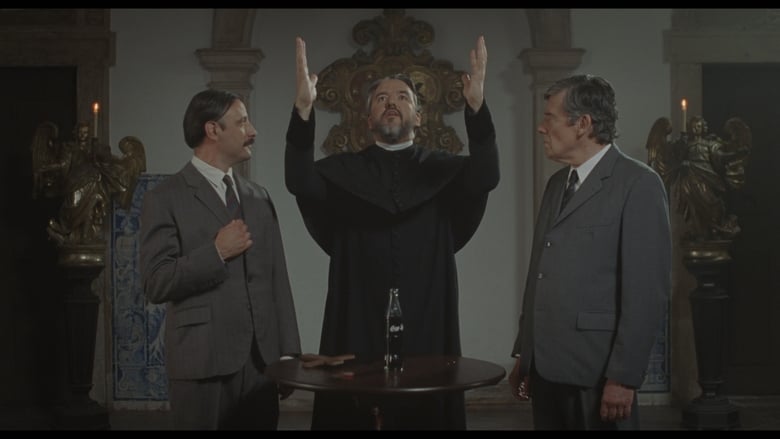
After this, the film gets a bit more idiosyncratic; Fernando Pessoa, played by Carloto Cotta who has already making a name for himself playing the simple child like footballer of Diamantino (2018), is a real poet of considerable high regard in his homeland but, as transpires here when a merchant desiring to import a Coca Cola stand-in to Portugal and have him write an advertising slogan for it, did also desire to go into business for financial success. In fact, the story this mini-film uses is real:  slightly different, Pessoa did write a slogan for Coca-Cola in 1928, "First, it is strange. Then it gets into you", only for Coca-Cola to be banned by the Portuguese authorities, and Coca-Cola was banned in the country until 1977.

Fernando here, by way of a doppelganger based on one of his real life heteronyms, does come up with the perfect ad caption - "First you will be surprised, then you will be possessed" - but that just helps the subsequent banning of the drink by government officials. On one hand, as this is where Fernando himself realises he has saved Portugal, this could all come off as a cheap swipe at American consumerism. What complicates it is twofold. First, the government officials are clearly played for comedic effect - they literally consider the possession literal, so they hire a Jesuit priest to exorcise a bottle, probably one of the strangest versions of such a scene you will ever see. Even if Green is entirely against the "United-Statesian" import, he's aware enough to prod at his own characters' absurdities at the same time.

Complicating this further are the references. There's the notion of the "encoberto", which Fernando is referred to including by himself; the Portuguese king Don Sebastiao at the end of the 16th century disappeared during the 1578 Battle of Alcácer Quibir in northern Morocco, only to develop a mythological status that he would come back to help Portugal at a time of need. Fernando does so by pure accident, and whilst it's a good thing in the end, probably the bigger concern in theme is when the merchant admits it was a bad idea to try to mix poetry with commerce. Fernando Pessoa here learns that his greater virtue is to stick to poetry rather than helping a drink he even thinks tastes disgusting be sold for commerce. Even if the advertising text was potent, and the poster itself is too, a cameo by Green himself as the artist, in context rather than appreciated as art they're disposable and suppressed. The real Fernando Pessoa certainly wasn't known as an advertising slogan writer, as one of his best known poems about a specific form of melancholy, The Bell in My Town, where the past and the future are the same, is heard at the beginning before the opening credits.

Altogether, a new Eugène Green work is always appreciated, a director I wish was better known. Short enough to see repeatedly, the slogan is apt for the entire feature itself, and having been able to watch the mini-feature multiple times for the review, there's a lot of subtext that can be found and dug up in such a simply told work. And again, cola exorcism is something you don't see every day.


From https://image.tmdb.org/t/p/w780/j2VSIJVjX1LNzxqqdr2gD0e72cK.jpg

Saturday, 7 September 2019

Otley (1969)

From https://img.moviepostershop.com
/otley-movie-poster-1969-1020255091.jpg


Directed by Dick Clement
Written by Ian La Frenais and Dick Clement
Based on the novel by Martin Waddell
Cast: Tom Courtenay as Gerald Arthur Otley; Romy Schneider as Imogen; Alan Badel as Sir Alec Hadrian; James Villiers as Hendrickson; Leonard Rossiter as Johnson; Freddie Jones as Philip Proudfoot; Fiona Lewis as Lin; James Bolam as Albert; James Cossins as Geffcock; James Maxwell as Rollo; Edward Hardwicke as Lambert; Ronald Lacey as Curtis; Phyllida Law as Jean
Obscurities, Oddities and One-Offs

Released in the wave of influence James Bond had on cinema - regional interpretations, rip-offs, spy films in general - alongside the more grounded adult versions of espionage especially coming from the United Kingdom like The Ipcress File (1965), Otley is what happens when even these low key and realistic spy dramas were taken further when a snarky former university graduate, coach surfing, has to be the central protagonist in a spy war and web of conspiracies when he's accidentally sleeping in the room when an acquaintance is assassinated. Waking up the night after inexplicably in an empty football/soccer field, he has by fate found himself in the midst of two rival factors in London.

Speaking as someone who actually likes the franchise, I find that Bond has always come off as a stereotype of British culture, an elitist figure for the government of an entirely different type of the cinema viewing audience, reflected as the sixties films were as much tourist documentaries for exotic locations as they were action films. Even the idea of creating a female James Bond that have persisted wouldn't be able to cover the fact that, as an institution, all the potentially problematic cultural baggage of that fact would still be found. Otley's noticeably different as our lead's as working class as you could get. You don't have Sean Connery fleeing police with a bacon sandwich in one hand over canal boats. Even the Roger Moore years, when the franchise got sillier, even Diamonds Are Forever (1971) with Connery, weren't this openly absurd rather than accidentally. An entirely different language is to be found here visually and in content that pops the balloon of spy adventure as a farce.

A very big factor to mind for Otley is that in the director seat is Dick Clement, who co-writers this novel adaptation with his regular collaborator Ian La Frenais. For the British, the pair is more than likely known as writers than filmmaking as, with the many reruns and TV programmes about old British television we still have in the 2010s, they have a legacy of huge hits. Specifically it's Porridge (1974-7), (an institution I even saw episodes of growing up decades later), Whatever Happened to the Likely Lads? (1973-4), (and its 1964-6 prequel The Likely Lads), and Auf Wiedersehen, Pet, (1983-2004 for all its tie-ins), which are huge cultural signposts in British TV. Porridge is the only one I know of so far, but apt with Otley as, shot in a matter-of-fact and following Ronnie Baker as a prisoner, that style of black humour with a lot of dialogue based humour is felt here only with a cinema budget, more ambition and humour that is a lot more caustic.

Barring one offensive comment against a Chinese masseuse, a lot about Otley has aged a lot better when a lot of British humour of the past will wilt in the fires of political correctness, not even from a perspective of a snowflake social justice warrior but that sixties and seventies Britain is an entirely alien to decades later1.. Instead, Otley is amazing nasty and black humoured in a way that hasn't dated but is pretty stark, especially as this is rated "PG", suitable for family viewing in spite of how sharp the witticisms are. This isn't a nice, cuddly British comedy of old, but proudly sharper, as the titular Otley is surrounded by men in suspicious groups who callously call their wives a bitch, or include the bizarre but scene stealing character of an assassin whose day job is a tour coach driver who owns a farm. Even one important side character, who could've easily been a crass gay stereotype, is more interesting with nuisance and because his actor relishes the pithy remarks of his. Even the fact the plot gets confusing does a favour as it adds to our somewhat hero, somewhat anti-hero, being completely lost.

Said Otley is of course played by Tom Courtenay, and he's tremendous. Otley at times is a prick, but he's also a charming one even when he pickpockets valuable possessions throughout the narrative, Courtenay a huge lynchpin among many for this film to actually work. He does nothing amiss, and barring that one offensive one liner, every comment or joke at the expense of his situation is amusing and usually self deprecating first. Drifting through life, it's a fascinating character to dump into this scenario, still a handsome charming figure because of Courtenay's prescience, even making the fact that he woos Romy Schneider's female spy credible as well as in depicting his cluelessness of what is happening. It also adds credibility to what happens even in the context of a comedy which exaggerates this genre, more credible in realism arguably than many spy films to this day.

Again, returning to even the romantic subplot having credibility, this manages as a PG rated film in Britain to be quite frank about sex, so it never feels like it is undercutting verisimilitude by being prudish, instantly showing this as Otley is first found sharing his older landlady's bed, she happy with the night together but still kicking him out for not paying the rent, immediately making even some of James Bond's innuendo childish in comparison from the era. Schneider's prescience is a surprise, a huge actress of European cinema abruptly appearing in this British film, more so as by this point she was already cementing a legendary reputation. This was not the last time she was in a British financed film, Bertrand Tavernier's Death Watch (1980) with Harvey Keitel set in Scotland, but certainly given the role that, frankly, has a lot more nuisance than most Bond Girls, (all?), it was a hell of a casting choice.

Shot in London and out in the countryside, played to humour when the coach driving assassin has Otley as a prisoner but still has him do farm labour to pass the time, the film's verisimilitude does stand out and not just for nostalgia, also adding a lot of character to create some excellent scenes. A lot of this is taking advantage of the locations for humour and effect. A chase on the intercity canal is made between as it involves actual canal boats. The Notting Hill Gate subway becomes a place of a trade where a suitcase may be a trap with sickly humoured results, all with additional historical interest in how the posters of the era look. The countryside, isolated, offers a surrealism of an assassin who'll still offer his prisoner a cup of tea and force them to clear out pig muck in their stay there. And then there's the central scene where Otley tries to take a driving test only for it to abruptly turn into a car chase, which is magnificence and shouldn't be spoiled.

Its amazing Otley is an obscurity, but in general the sixties and seventies could be seen as a lost era for British cinema; for every great film, the likes of the British Film Institute's "Flipside" project took years to uncover a lot of forgotten and underrated gems, not even getting around to this one. This was a Columbia Pictures release, which made it a pretty big production for the era, which was probably not a help in the damndest. Among all the spy parodies, or straight up spy films, Otley could've have easily been lost in the crowd. A shame hopefully to rectify as this was an excellent discovery, a film I knew of for years and could thankfully see.

=====
1) I mean, good God, for all the stick we could level at the Americans, they didn't have a primetime minstrel show, about white performers doing numbers in actual blackface, called The Black and White Minstrel Show that lasted between 1958 to 1978. One which had fucking merchandising and novelty records at that.


From https://i2.wp.com/cinemaderien.fr/wp-content/uploads/
2018/05/Otley1969.jpg?resize=850%2C468&ssl=1

Wednesday, 14 August 2019

Naked Desire (2015) [RE-REVIEW]

From https://images-na.ssl-images-amazon.com
/images/I/81MahA2gLZL._SY445_.jpg


a.k.a. Onanie Sister Tagiru Nikutsubo
Director: Hideo Sakaki
Screenplay: Kôichi Miwa
Cast: Ui Mita as Akane Kanzaki; Shô Nishino as Kayoko Fukuya; Yasuyo Shiba as Rina Sendô; Shigeru Harihara as Kanzaburô Yamanami; Yûta Kogiri as Shinji Okada; Tadashi Mizuno as Kensuke Saitô; Matarô Umeya as Shigeyuki Kimura; Ayumi Tomiyama as Junko Machioka; Kôichi Miwa as Tejima
Obscurities, Oddities and One-Offs

I know what you're thinking reader - why am I re-reviewing a film just covered a month ago which I didn't like particularly? Simply put, I can write better. Also, there's something more meaningful in returning to a film with hindsight of what already happens in the plot, with the context of what it is, and review it again without discrimination. In fact, contrasting it with the previous review I will link HERE will provide a surprising contrast.

[Spoilers Throughout]

The history of pinku cinema from Japan, as Jasper Sharp has written about in his book Behind The Pink Curtain: The Complete History of Japanese Sex Cinema, attests to its virtues. Designed for pure titillation, it however had the advantage that, made on a low budget and creative control being possible, a filmmaker like Kōji Wakamatsu could make the most striking and transgressive films as long as they still qualified as erotica. There are many films made afterwards, such as from the likes of Takashi Zeze, that can attest to the fact you could make cerebral and adult dramas from them, even erotic musicals as Shinji Imaoka can attest to with Underwater Love (2011). There is, however, as much of the cinema which is still titillation and titillation alone, so it varies in quality. OP Eiga, behind the production of Naked Desire, is one of the oldest pinku companies and arguably the producers of the first, Satoru Kobayashi's Flesh Market (1962), so after all these decades they've both a huge historical importance and have made a lot...

Certainly from a premise perspective is fascinating - a pinku that explicitly references the issue of Japan's rising elderly population, the malign yet increasing aging populous depicted in the disabled Sabu, a former political protestor who is being taken care of by Sister Akane (Ui Mita), a literal Christian nun who means that the premise will also involve dealing with Christianity, a small but significant religious minority in Japanese culture, and the issues of said faith against one's sexual desires. Also aesthetically, the fact it's very low budget to the point they a) have to visibly blur out a car license plate and b) blur out cup noodle, with onscreen digital effect, is actually appealing for me in how the lowest budgeted of cinema, far from being detracted from in terms of technical hurdles to climb over, offers a vaster wealth of potential imagination due to these limitations.

I confess a growing fascination for the raw flaws of this type of work in general. Even if the DVD transfer from the DVD I viewed, a 2019 Redemption Films release even on an old TV and old Blu-Ray, is probably one of the worst I have seen, many might be put off by the frankly gristly depiction of sex. Here is a world where a classroom is apparently a set in a roofless shack with a picture of an egg and sperm on a white board and an (uncensored) Adidas football inexplicably near where the sex between school teacher Rina (Yusuyo Shiba) and her student lover Shinji (Yuta Kogiri) takes place,  where even for them, when they flee to the coast with the police after them as he's the dean's son, they first seen sleeping in her car until luck shows they're outside Sabu's house.

An ultra-love budget sex drama set in one main house at the coast could've led to so much interesting creativity, especially as the house is distinctly elaborate and the coastal setting is invocative in its isolation, from the vast plains of browned wild grass to the elaborate stone sea barrier Sabu is found wandering upon later, but I also perversely find as a charm in the grimy, realistic banality as well. Where the female police officer, having an intimate moment by herself watching porn in the office, visibly has a hole in the toe of one of the black socks she is still wearing, or even the perversity of Kayoko (Shou Nishino), a self-proclaimed nymphomaniac free spirit who ends up in the life of Sister Akane and, wanting to bring (sexual) pleasure to Sabu's life, will even consider doing so whilst first helping him on the toilet.

There are obviously two transgressive topics here, that Rina and Shinji are a teacher and her male student which raises a lot of potentially controversy. There's also the fact, as Sabu is through most the film a decrepit old man in his own world, that Kayoko's desire to sexually pleasure him crosses a line of consent that also Sister Akane raises; Kayoko's philosophy, openly speaking of previous examples as a former carer, that a person regardless of age should be allowed to be human and have sensual pleasure, the film potently attempting to tackle this in mind of Japan's growing elder population, does even in a less than intellectual form raise questions about standards of life for a person incredibly incapacitated by illness/age even if the result would obviously be uncomfortable for many viewers. If Naked Desire had been openly transgressive with a purpose, it would've at least been interest even if still uncomfortable. Even if it had been a comedy, it could've done a John Waters and deliberately been bad taste. The issue is that, for its good moments, Naked Desire by its ending falls on an empty conclusion which makes these two plot points, and Akane's existential issues, more trivial.


On another viewing, I like that a lot of the film is a quiet work, literally as there's minimal music on the soundtrack and, barring a porn music bass line that'd be an embarrassment to its ancestors, it's used sparingly. It's a slow burn light hearted drama which has a lot of obviously problematic content to try to juggle, but slowly builds towards what you hope is an ending that deals with all this, at least being compelling and of interest. This is especially the case as the three main woman are the strong central figures who have most of the scenes, the two male figures Sabu, who is a disabled figure, and Shinji the side character whose trajectory is realising he has a fetish for the buttock, not only Rina's but his own being touched which turns into a surprising progressive end reveal.

This isn't concluded upon. In mind, as well, the British DVD removes what is apparently a rape scene, which is an uncomfortable thought even if the film's trying to be a lot more complex and on the side of the female cast, there are aspects that just shoot the film's best virtues in the foot. Say in contrast to Ui Mita actually playing her nun character with a charmingly innocent chastity and yearning to do good, even if there' something odd about her suddenly undoing her hair and masturbating in front of a statue of the Virgin Mary, you have the two male cops, who are absolutely unbearable. Even without the tasteless joke of the pair constantly groping their female side kick, they're played as broadly and sex obsessed as possible, like two obnoxious teenagers whose gurning is embarrassing; one scene, shot in a city centre, where they are lulled by two female sex workers is painful in how broad the duo are. In contrast, you immediately have sympathy for their meek, thin faced female fellow officer, who puts up with them and at least can have a scene of beating up a pervert and the bizarre moment, with the same actress, when she realises a woman in a porn video she is watching looks exactly like herself.

All of this may put off certain readers anyway, a stigma attached to many erotica that it's crass and really gauche. Some of the descriptions of what transpires may have put you the reader off already, and knowledge of what was excised, probably in relation to Kayoko's introductory scene of gladly having sex with two men in a countryside ditch only for her comments that they're practically useless in bed not going down well, doesn't help with the image I have painted of Naked Desire even if the film itself is much more interesting than the synopsis. Naked Desire isn't terrible but you'd feel embarrassed to recommend it, mainly because it never resolves its complex themes at all or hit its fullest potential. Any genre, type and form of cinema and motion images should be defended, all capable of great work, all capable of at least entertainment too. Pinku cinema is the same as, when intelligent and risk taking, it is, when fun and titillating, it is, and in the case of The Glamorous Life of Sachiko Hanai (2003), which became an unexpected cult hit in the West for its many aspects including then-president George Dubya Bush's finger being an unexpected plot point, even hitting a cultural zeitgeist. But it can also miss the mark, as seen in Naked Desire, even if the ending tries its hardest.

It's impossible to forget. The old man, awoken by the police outside his home triggering his memories of being a protestor, suddenly turns into Yukio Mishima during his fatale attempt at a coup d'état in 1970, becoming alive again when the two male police men's arsing about with a megaphone stir up his youthful strength. (The film even references the 1960 Treaty of Mutual Cooperation and Security between the United States and Japan that caused incredible outcry and political demonstrations as part of Sabu's back story, which should've been ran with further). In probably the most unexpected scene, the youngest cop and Shinji  decide to have sex, in probably the most progressive moment of the whole film as, rather than for comedy, it's seen as two guys regardless of sexuality finding themselves enjoying jumping each other on the kitchen floor, Shinji further finding a higher state of pleasure in his anus, having included a scene earlier of him asking for his to be licked scored to what appeared to be baroque music, and the younger cop finally after all his desperation to get laid getting his wish too. And the main female cast take an actual risk as, on even a very slow moving car, Shou Nishino and Yusuyo Shiba posed naked hanging out the open passenger doors and Ui Mita posing naked in the open car boot, still impressive in allowing themselves to be in such a position on a moving vehicle (and probably freezing as it doesn't look like the scene was filmed on a hot day). It still doesn't completely work mind. That female trio literally become posed models, improvised "artillery" in a sex display in front of open windows, which completely undercuts the fact that they were the strongest and most in control figures of the entire movie and comes off with a demeaning end with Sabu barking orders at them as subservient when there's an obvious, more liberating conclusion where everyone's in control the cops (baring one) are left the losers and sans working car.

Altogether, Naked Desire is slight. A curiosity, completely so, but a reminder (again to Jasper Sharp's tone) that considering how many films are released in the pinku genre still to this day, consistency is variable. This is pertinent as, early in their DVD releases, Redemption Films were releasing some fascinating titles. Films like Tokyo X Erotica (1999) are very idiosyncratic, but it seems that sadly, barring a few fascinating choices I want to visit, Redemption Film's choices have sadly slid into sex films which don't live up to their potential, an utter shame as the British company for a long time (before they focused as much on the US market) did a lot of admirable things, such as their Jean Rollin releases to even debuting Valarie and Her Weekend of Wonders (1970) on DVD in the UK, all in spite of their utterly cheesy Satanic lesbian vampire aesthetic. Naked Desire is more than the sum of its pink DVD cover hidden in the World Cinema DVD section of HMV here in England, and in honestly I have developed a fascination for it as a result of reviewing it twice, but even for titillation, it still the kind of film lost in memory due to some very obvious flaws.