Showing posts with label 1990s. Show all posts

Tuesday, 18 March 2025

The Phantom of the Opera (1998)


Rewatched Monday 10th March 2025


Director: Dario Argento

Screenplay: Dario Argento, Gérard Brach (and Giorgina Caspari)

Based on the novel by Gaston Leroux

Cast: Julian Sands as The Phantom of the Opera, Asia Argento as Christine Daaé, Andrea Di Stefano as Raoul, Baron de Chagny, Nadia Rinaldi as Carlotta Altieri, Coralina Cataldi-Tassoni as Honorine, István Bubik as The Rat Catcher, Lucia Guzzardi as Madame Giry


Somehow because of Gaston Leroux, I can connect Lon Chaney Sr., Claude Rains, Dario Argento...and Andrew Lloyd Webber together among the many who've adapted or starred as the titular Phantom, Leroux's 1910 work first creating this figure terrorising the Paris. This is in mind I forgot Julian Sands was in this now taking up the role, emphasising alongside being a very idiosyncratic casting choice for Argento that this entire project was more idiosyncratic than I remembered. With the prologue suggesting Batman Returns (1992) in the origin of the Phantom as a baby Sands being floated across the waters of a cave in wicker basket, only with rats replacing the penguins, Argento's take with co-writer Gérard Brach taking its own direction with the source material. More so as I thought that Batman Return reference as a joke to myself as I re-watched the opening, only to forget a rat drags the wicker basket to safety and an animatronic rat puppet head in close-up is depicted as their friendship as human to rodent is shown.

Considering his 1987 film Opera, it makes sense for Argento to tackle this setting again, especially as he was always apparently adamant to Leroux's novel at some point. With the Budapest Opera House in Hungary used for the shooting location, designed as a copy of the Paris Opera House central to Leroux's story, alongside scouting real caves in Italy for the underbelly the Phantom looms in, this feels like a passion project and a really ambitious film even for Argento in terms of production. I'd argue the production value is great as a result, a period horror romance tragedy which is one of the few times in his career he went back in time. This also stands out considering this was made at the same time there was sadly the declining end of the Italian genre industry. Argento, even if also filming in Hungary, clearly had some influence least enough for the production values here to depict everything from the back stage areas full of props (even a huge life-size ship stage in one shot) to the washrooms for the linen to the caves below the Paris Opera.

It focuses on the Phantom fully as a romantic anti-hero, one who brutally kills people but has his own moral code, including one most would understand in dealing with an older male creeper of young girls obsessed beyond wanting to force chocolate on them. He is not physically disfigured, which is a significant change, arguably progressive in its own way, as the scarring is psychologically for good reason in being forced to like with rats. Sands is also really appropriate for a figure that compels Asia Argento's lead Christine Daaé, an aspiring opera singer, with the chemistry that would be found between them. As the film goes, the story finds itself deviating into differences such as explicit psychic powers that force a rat catcher to put his hand into a trap of his own set up, or the sense of humour which is that and deliberate.

A gorier and more sexually explicit take is found, feeling like Argento's full blown Gothic period horror which fully embraces its dramatic weight and doesn't suffer the many issues, particularly budget, that afflicted Dracula 3D (2012). The tonal changes and production style actually move this film in Argento's career closest to a wave of films from the nineties, such as those by Jean-Pierre Jeunet and Marc Caro like Delicatessen (1991), of tonally shifting genre films which embraced their practical production values and weren't above very strange moments of humour. This will put some off, but Argento's cinema was already getting weirder by the eighties, where Saxon randomly blares out in the middle of Opera with their heavy metal riffs, and probably the "weirdest" of his films, Phenomenon (1985), involving Jennifer Connelly being able to psychically communicate with insects and a chimpanzee with a razor blade.


It befits that era of baroque genre films with arguably its more lurid and tonal shifting moments helping the film from becoming too dry, be it the strange early CGI effects like Julian Sands seeing a mouse trap in the full of nude men writhing in pain superimposed in the full moon, or the bombast in style even for humour like a close-up of a singer's tonsils out of artistic creativity. Some of this does feel ridiculous but more often than not it feels like for deliberate humour - like a stint in an all-welcome sex bath house with, the potential second love interest for Christine, where equal opportunity nudity of all ages and sizes is contrasted by clothed men arguing philosophy violently in the pool.

There's the potential discomfort with this film's throw-in-the-kitchen-sink tone, if you connect the dots, with the more sexually frank moments knowing Asia Argento is Dario's daughter, though she has worked with him over the later decades to a film like Dark Glasses (2022), so thankfully theirs has felt more a happier familial relationship. Even if films like The Stendhal Syndrome (1996) before had a really deliberately uncomfortable thriller dealing with sexual violence, there's a feeling of greater trust between them which thankfully makes the pair comfortable in collaborating as they have as family in such films. Also she fits here as Christine - dubbed with another's singer voice, she does to Asia Argento's credit fit the role as a period horror lead who is meant to present the pure hearted singer an outcast like Sands would fall for. Including her conflict, when she starts to question if he is trying to dominate her as much as the reality that theirs is to be as much a tragic love, she thankfully feels like an appropriate casting choice. I like Julian Sands too, someone who befits this more glamorous version of the Phantom as much as someone who would also bite a person's tongue out for trying to steal his underground treasure.

In general, the film is over-the-top in a way that might put purists of the source off. It's not enough to have the famous scene of the huge chandelier being dropped mid-performance as a warning, but shirtless Sands sledge hammering its stone support to justify his warnings, and for it to bloodily maim a baker's dozen of the theatre patrons below. The completely abrupt tangent of a rat killing proto-golf kart would not be included in other adaptations, nor so much other Argento productions, but I can't help but think it feels broad on purpose, becoming a flex in Argento's career which you rarely see and with hindsight is appreciated for the heightened delirium of this particular film. The closest thing to this in Italian genre cinema I've seen in general was the directorial work of former actor Michele Soavi from this era, his tragically short filmography for this period even when it was more explicitly serious horror like The Sect (1991) deliberately cutting to a rabbit being able to operate a television remote for a humour jolt.

The curious mix of romance, horror, style and silliness of The Phantom of the Opera feels like the culmination of Argento's more absurd touches, and one thing that has made me be won over by the film is knowledge that this is still at the time before his most divisive, lower budget films came to be. Everything after The Card Player (2004) up to Dark Glasses are his most maligned works and projects where he was having to work with lower budgets. Here, there is the budget, and its sincerity in shifting between romantic tragedy to gore to absurd comedic shifts is feels less like many compromises have come to play, but are the point. As a result, I feel the film's been unfairly maligned in Dario Argento's career and have come to appreciate it.

Wednesday, 30 October 2024

Coven (1997)


Director: Mark Borchardt

Screenplay: Mark Borchardt

Cast: Mark Borchardt as Mike, Tom Schimmels as Steve, Miriam Frost as Sharon, Robert Richard Jorge as Goodman, Sherrie Beaupre as Daesa, Jack Bennett, Mark Nadolski, Scott Berendt, Barbara Zanger, Donna McMaster, Mike Schank, Cindy Snyder, Nancy Williams, and Wayne Bubois as support group members.

A Night of a Thousand Horror (Movies)


For all the infamy of the film pronounced “oven”, from the acclaimed documentary American Movie (1999) about this film and its director-writer-lead Mark Borchardt, what about the film at the centre of that story? What about the short film Coven itself?

Coven is actually great and, even as someone who has defended shot-on-video and no budget films which have wavering acting and questionable plot tangents, it is actually one of the best I have seen. It is not perfect, but is a moody tale where our lead Mike, played by Borchardt, ends up in a hospital after using prescription drugs to help him reach a writing deadline, only to have overdone it to severe bodily harm. Shot in stark monochromatic 16mm film, he ends up pressured by a friend to join a small addicts anonymous group he is part of. It ends up with a more pulp turn – they are set up as a literal coven whose methods of helping their members stay sober involve questionable spiritual transcendence – and whilst it might be criticized for contradicting the sympathetic nature of the members, as I’ll get into, I have softened to this especially as Borchardt for a film that goes for a more complicated psychodrama in its tiny length and tiny budget.

A part of this is also the possibility, whilst leaning to there being a real cult holding sway in an addict’s consolation group, that as much of the paranoia is caused by the lead Mike’s own fed by his drug use, even using stimulants like speed when already part of the group and meant to be overcoming this substance abuse. This sense of all that what is not it seems, whilst not perfect, is set up to the director’s credit when he leaves the hospital from his initial incident, as he witnesses a woman on a gurney suddenly goes into a fit in the elevator, all before he even meets the coven. Even going to a dealer for said speed when he is meant to be on the recovery wagon, it becomes explicit that, even if the cult is real, our lead is already on the edge and there is still a sense of him adding to his own terrors. With a celebratory sole drink with the group where they’ve likely spiked his, his hallucinations like seeing the members confess to murder or starting speaking gibberish, or seeing a male priest on the floor of the public building bathroom they are in starting to mutter apocalyptic babble, there is as much felt this time seeing the sequence with the sense his own demons are feeding them as much as the cult feeding on them.


The mood helps with Coven even when it is literal and those are real hooded cultists the lead is seeing in the Wisconsin woods even high on speed. The opening surreal scene for a film less than forty minutes establishes Borchardt had more on his mind even if American Movie depicted the production’s difficulties, Borchardt running on a rural road with an old guy ranting in a passing car about religion and dead bodies on a road depicting a subjective nightmare. Helping considerably is the shooting within Menomonee Falls, Wisconsin where the rural small town as seen here in stark black and white adds the best production values for a tiny budget film. Not just for the advantages of woodland for any micro budget film where you don’t mind permits, but that, shot at a time when the trees were bare of leaves in winter and look skeletal, with the sky at times washed out white, it looks appropriately ominous for a film which struggled with taking a long time to be completely finished. It has a naturalism with the locations Borchardt shot, likely with local non-actors or local actors in dialogue roles, in real bars and public buildings, but with the choice of monochrome and the production choices, like using post-synched dialogue and sound for moments where the lead’s sanity is slipping, allowing its more fantastical moments to not feel out of place. Without hyperbole, but utmost sympathy, it evokes the front LP cover, let alone with the music itself, of one of my favorite albums Spiderland by Slint, a post rock band from Louisville, Kentucky, and not that far geographically from Wisconsin, nor where its famous cover was photographed at in stark black and white at a quarry lake in Utica Township, Indiana. Spiderland is held as a great album for indie music, but in one of my favorite songs ever Nosferatu Man, you have a potentially cheesy lyrical choice of having a song about a Dracula like vampire living in a rural American community, where he lives with his brides in a place where he constantly has to suffer from the trains running nearby from his castle. That sense of working class, non-metropolis Americana especially when it comes to regional American horror cinema is close to this ideal even with cheesy lines of dialogue and fake red blood, but Coven to its credit manages to allow the unnatural to bleed into blue collar Americana without it feeling tonally wrong. When you have hooded cultists destroying a car with random clubs in weed filled wasteland, possible because the production got hold of an actual car to destroy, it feels not as cheesy as other regional horror films, but like a gang attack where the inappropriate uniform choices without being able to see the faces feels more disturbing.

Helped by the music by Patrick Nettesheim, ultra low budget synth, adds to the atmosphere of an earnest, imperfect but heartfelt attempt at a film, as helped by the naturalism forced onto a film without the budget to have staged locations but shooting in friends’ rooms instead. Coven ends up less subjective at its end in story with the ending becoming a bloody affair in a kitchen, but even that befits the tone of a film that is largely a stripped back homemade drama, especially as one of the more compelling aspects of the entire production are the addicts’ anonymous meetings. Even if they were an actual coven, Mark Borchardt still sets up that its members are there for legitimate reasons, which also feel like real anecdotes that deal with addiction honestly. There are extensive monologues of people talking of their reasons for their addiction, and they all sound painfully real, even the guy who says he started cocaine at twelve or the more explicitly humorous one of another man who tells with deadpan, to prove a point to an official about being stoned, coming to a meeting on the subject whilst high on acid. There are wives whose husbands who stuck out miserable jobs for benefits, people with depression, and men and women of all ages and concerns in their addictions. It all violently contrast the reputation I first learnt of Coven as being a butt of jokes as a disastrous low budget production in their severity, and they add a moral side to the short I have to praise fully. Even our lead Mike, having to make the rent by writing, which caused the damage to himself, is salient in the idea that, in the coven recruiting members, they literally brought in the desperate and the miserable with real problems they could easily bend to their will.

Even with its finale, of the cult wanting to create new members but never explicitly saying anything sinister about their souls and still concerns of enlightening, adds to a different sort of sinister to the story in terms of interpretation. With one cultist having their head caved into a kitchen drawer, it is a sinister that suggests that our lead may have presumed to have fended for his life, but just killed some innocent people in his own kitchen in a cultist fed mental breakdown. That is the things that I can legitimately say Mark Borchardt was able to pull off with Coven, and credit to American Movie, whilst that film became the iconic part of Borchardt’s own career, it thankfully led to people like me wanting to track the original short down. American Movie is a film I want to return to as its own work, even if tied to this fully with a symbolic umbilical cord, but Coven itself is something I wish with hindsight gets more attention. More so especially from the communities which grew, decades after especially in the United States, for shot-on-video and ultra low budget genre films, where they get Blu Ray releases even if preserved on VHS transfers with visible distortion from age and the materials used. It feels like one of the grand tent poles for this fan base that needs more recognition for its virtues with hindsight.


Sunday, 27 October 2024

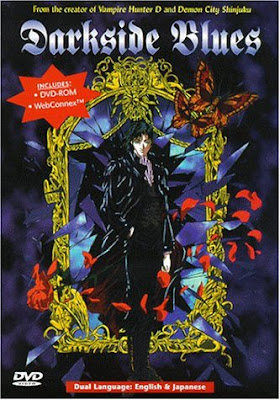
Darkside Blues (1994)


Director: Nobuyasu Furukawa

Screenplay: Mayori Sekijima

Based on the manga by Hideyuki Kikuchi and Yuho Ashibe

(Voice) Cast: Akio Ohtsuka as Kenzou; Hideyuki Hori as Gren; Kotono Mitsuishi as Mai; Kouichi Yamadera as Enji; Masako Katsuki as Tamaki; Maya Okamoto as Selia; Natsuki Sakan as Darkside; Nozomu Sasaki as Katari; Shinichiro Miki as Chris; Yasunori Matsumoto as Tatsuyairector: Viðar Víkingsson

A Night of a Thousand Horror (Movies)/A 1000 Anime Crossover


Darkside Blues isn’t really horror, though it has plenty of supernatural and Gothic touches worthy of the season, and I am glad to have revisited this, as this is a fascinating genre hybrid between dystopian sci-fi about corrupt corporations, which is still salient as a theme, that however has magic exist as well as a titular figure who rides around on a horse drawn carriage which can fly. It is fascinating, even with less than ninety minutes to try to depict this world, and a source manga which did not last long enough either to expand it further, to see what interesting things this depicts, be it a titular figure who acts more like a supernaturally powered advisor for freedom fighters to the sight of someone being tortured by being turned to gold whilst alive with alchemy. From the same author of Vampire Hunter D, and the infamous Wicked City as per its own animated adaptation, you see the threads for those here too, but in this melancholic and fascinating one-off.


For the full review, follow the link HERE.


Sunday, 20 October 2024

Games of the Abstract: Darkstalkers - The Night Warriors (1994)


Developer: Capcom

Publisher: Capcom

One to Two Players

Originally released for: Arcade


The history of Capcom's other beloved fighting game is split into two differing origins. One is that, in designing a new fighting game, the team assigned wanted to create a title entirely about monsters, taking advantage of existing ones of folklore and mythology as templates1. The other original is that Alex Jimenez, a producer at Capcom USA, suggested a licensed game based on the Universal horror movie characters, tied to the iconic creations that began properly with 1931's Dracula with Bela Lugosi2. or me personally, I think the truth is within both differing tales, as there is at least detail which suggests Universal horror films were someone's favourite at Capcom, but that the ball was rolling in terms of creating a monster themed game, including knowledge this was explicitly meant to have more yōkai, the Japanese folklore entities, than we got such as a nurikabe, a living wall that would have allowed the developers to create a character which never needed to move and require very little animation1. Whatever the case was, it feels inevitable with how Capcom started to push for the more fantastique and unnatural in their games, as the technology and the creative teams let their imaginations fly with genres like the fighting or beat-em-up genres in terms of monster and figures that would push their talents throughout the nineties. Also, such a project was part of a huge moment where Capcom, in the fighting game genre, suddenly created the gold standard for the genre and that, with others soon after wishing to create their own successes in its wake, they naturally wanted to follow up with titles to improve on what they did with that game.

That game was Street Fighter II (1991), which was a huge seismic change to video games. Despite the fighting game had existed beforehand as far back as Heavyweight Champ (1976) by Sega, let alone titles which pushed the genre further like Yie Ar Kung-Fu (1985) by Konami in the eighties including the original Street Fighter (1987), the sequel cemented the fighting game genre fully in form, and naturally Capcom wanted to expand on its success not only with that franchise, but with others. Even if the origins are vague, it is not a surprise someone wanted to see a Frankenstein's monster in a fighting game, and thankfully able to be played again 2022 with a Capcom Fighting Collection retro compilation, let alone previous non-arcade releases, the Darkstalkers franchise is also one people wished Capcom brought back, and for good reason. Even non or casual gamers, who are horror fans, would dig even the original 1994 game as, whilst this series would evolve in gameplay style and the beautiful artistic style, we got from the gate already a strong horror fighting game in both aspects.

With new arcade hardware to push, Capcom would also need to capitalise on its advancements in terms of their games too, Street Fighter II changing from its original 1991 version through multiple revisions, until Super Street Fighter II Turbo (1994) looked an entirely different game let alone with new mechanics from the original. That was made for the CP System II arcade board as Darkstalkers: The Night Warriors was, and whilst by its last game it would improve and add to the original template, we were already entering this new territory of a horror themed fighting game with already a strong atmosphere. At a time when the arcade fighting game genre was becoming huge, this even applies to innovations in ideas that seem obvious for the genre decades later, like the ability to block in the air that were introduced in this game. That the aesthetic and presence were already strong helped so much, like Street Fighter in Halloween town but with its personality its own, and it begins and is central to the cast Capcom created for the original game.

A huge factor for me being interested in these games is that Capcom were insanely great for their character designs, and even how they play has made me really start to fall in love with them now I have. From the get-go, one of the really cool touches to the original Darkstalkers game is that each character was designed by their own person, and these designs were figured out with care to work in the final production. Darkstalkers has, even the attempt at a new hero who was quickly rejected after the initial sequel, one of the strongest rosters just in terms of everyone standing out between its three games. How they managed to make characters distinct to each other already in the first game, in terms of gameplay feel and personality, even if later sequels would add more to them including iconic moves and touches, really means a lot. The sense of this still being fleshed out in those sequels, as only the original game follows Street Fighter II in having these figures represent countries, actually makes what was accomplished here more praiseworthy, the choice to follow a horror/mythological/folklore trope, and flourishing each archetype out in really idiosyncratic choices being a masterstroke. The closest to a traditional martial artist in this game is a werewolf, which is where the Universal monsters link feels apt, as he is in the Western localisation named Jon Talbain, clearly after the lead character Lawrence Talbot who Lon Chaney Jr. played in The Wolf Man (1941), and even a character who was not drastically altered from the tropes like Demitri Maximoff, a traditional vampire and original (anti-)hero for the game here, still has a distinct style to him.


The characters mirroring their Universal horror counterparts all have their distinct personalities, both faithful to the icons, whilst having their own clear distinctions. Frankenstein's monster, by way of Victor, is a great example of this for his visual distinctiveness as a natural powerhouse character, the developers pushing for his limbs (even his head) to expand out in his attacks in cartoon stretch-and-pull effect, and that, infamously, this even applies to his ability to use his buttocks to grab and throw enemies. That feels less bizarre for the sake of it but the fascinating mix of grotesque horror, as there is blood and macabre sights in these games, against pure slapstick cartoon touches in the animation. Be it a Sasquatch who is an adorably fluffy and big goofball, to a take on the Creature from the Black Lagoon (1954) who is a vain sexy fish man, completely ahead of its time and Guillermo del Toro's The Shape of Water (2017), everyone has something distinct to them. This even is in terms of their attack styles, whether playing the samurai possessed by cursed armour, Bishamon, which is clearly based around needing to counter and using his blade as one would expect from a samurai, to Anakaris being the representation of an Egyptian mummy, the slowest and potentially most awkward character to use, who literally floats slowly in the air, but has one of the most idiosyncratic move sets even in the original Darkstalkers game before he could be expanded upon. Briefly turning his opponents into cute, tiny versions who cannot attack briefly, dropping sarcophagus from the air, and moves which really emphasis the need to choose the special or regular move depending how far or close an opponent is, he because a really cool figure by himself and just one character like him in a game would have left it having fans, let alone a twelve entity roster for all distinct figures.

Tellingly, even the female character of the original game, whilst sexualised, overcame this to be adored, and that shows the real success of Darkstalkers even from the get-go in how its first two female characters became iconic regardless of that initial aspect of the character design. Introducing one of the first prominent cat girls into the West for games, Felicia was not merely marked for her character design, but for her characterisation as a goofy and likable cat-woman entity with blue hair who just wanted to become a huge star in Las Vegas, and by the end of the franchise becomes a nun to help children. And Morrigan Aensland eventually became the true protagonist of this franchise and its most well known character, and likely the one pop culture take on the succubus for many that entirely represents this mythological figure. A frankly problematic and misogynistic figure of lore to some, she completely upturned this with the history that came afterwards, all the cosplayers who have portrayed her over the decades, and becoming a figure of merchandising for Capcom, alongside cameos in other games, that may have even sadly overshadowed other Darkstalker characters, all without any sense that she is a figure that isn't powerful. This is really cool as, as many of us probably don't realise unless you played this original game, she is meant to be Scottish and thus, as one of Capcom's most beloved characters always in the fighting game collection cover art, one of the most well known video game characters from Scotland.

It is a legitimately virtue how none of the initial roster, even if some would not be as popular as others, feels lazy. They all stand out, all with distinct ways in their fighting styles and even in terms of personality, as Capcom embraced both the horror but also overt cartoonish nature of them. Even a character like Morrigan herself, or one meant to be seriously like the final boss, a planet collecting alien named Pyron, will be animated in dumb poses when knocked off their feet, electrocuted or turned into a cute little critter by Anakaris' Royal Judgement attack temporarily. The animation, with its emphasis on these cartoonish flourishes in even how strikes are thrown, is legitimately beautiful with hindsight, and the same is for the character specific locations in both their look and their little pieces of animation. You find yourself fighting at night in the middle of London with Talbain, scenery in the background like wine barrels if you hit the right moves, spotting the iconic "happy" dog that moves about in Bishamon's stage, or ending on a finale in Pyron's unnatural dreamscape made from all the worlds he has destroyed and reassembled into his collection. The music too by Takayuki Iwai and Hideki Okugawa is as distinct, appropriately evocative even when Felicia's stage, set in Las Vegas with all bright lights and cats loping around in the background, is partially set the cat meowing.

The thing that changed over time, when the bar was set this high already, was that Capcom pushed the visuals further, making far more incredibly phantasmagoric stages even if not character or geographically specific. The music would become even more evocative with the time passing, and the characters themselves alongside newcomers would get more personality and even some of their most iconic (and infamous) special moves and animation ticks, like Lord Raptor. Already a cool design of an Australian rock star who sold his soul to Satan, and now is a strange bony zombie with even the ability to move crawling crouching on his bony knees only he can do, future instalments of the games let him be able to literally slam dunk his enemies as basketballs.

And this is all in mind that, as iconic as Street Fighter II, it did come from the original Street Fighter, a game which is not held as a good fighter at all in the modern day, and that Capcom, able to suddenly leap in terms of quality for their iconic blockbuster hit, didn't slouch either from Street Fighter II's success and kept improving themselves, both artistically and in terms of ramping up the mechanics of the fighting game. To even get to the original version of Street Fighter III, Street Fighter III: New Generation (1997), which was seen as a disappointment and even irrelevant when polygonal fighting games were all the rage, it was still a game which would eventually became as acclaimed for the quality of its artistic creativity over its multiple versions, let alone the game play from experts in the genre due to Capcom pushing themselves over and over. By the end of the franchise I am talking of her, you get the magnum opus of this horror fighting franchise Vampire Savior: Darkstalkers 3 (1997), which is an exceptional game, but even if Darkstalkers: The Night Warriors had been tragically just a one-off from Capcom, it would have still been seen as a great game for many including myself for how much it does well let alone how fun it is.

=====

1) Darkstalkers – 1994 Developer Interview, translated for shmuplations.

2) Darkstalkers’ – The Monster Movie Origins of Capcom’s Fighting Game, written by Luiz H. C., and published for Bloody Disgusting on September 6th 2023.

Saturday, 12 October 2024

Science Crazed (1991)


Director: Ron Switzer

Screenplay: Ron Switzer

Cast: Cameron Scholes; Tony Della Ventura as The 'Fiend'; Robin Hartsell

A Night of a Thousand Horror (Movies)  /An Abstract Film Candidate


I Suggest nerve gas tests in the following countries...[Long pause] France...[Even longer pause]...Canada...


Where did this Canadian SOV film come from? Chronologically even Science Crazed's date of birth is confusion. Some say 1991, others 1989 thus making it a film from the year of my birth, and I have belief it was at least shot in 1987 or around that period, due to a Toronto telephone directory book and how, with all the horror posters on the walls, some like Evil Dead 2 (1987) and Creepshow 2 (1987) time stamp the period. What cannot be denied that, between this and Things (1989), Canada in its dips into micro-budget cinema could get weird, Science Crazed one of those true oddities from this world with the added strangeness of disembodied voices, strange pacing and random tangents.

The notoriety of this film is immediately established when you notice how everything is s-l-o-w. Not Leonardo DiCaprio reduced to a bag of meat crawling to his car due to out-of-date Quaaludes as in The Wolf of Wall Street (2013), nor even slow minimalist cinema, but a perplexing one-off form of minimalism. Half suspecting, with a shot of a book on Hegel on the left and a horror book on the right of the table, this was made on purpose like this at times, and at other times clearly by accident and by an unknown psychological influence. The opening is full of pregnant pauses, as a doctor researching a serum that causes quick pregnancies is told by the board funding him to stop the research, represented by one man. Both have dubbed over post-synch voices. The doctor, rocking sunglasses, still continues the experiment with a willing female subject where, in exactly three hours, she will become pregnant, and in twenty one hours, give birth. The unfortunate issue of a bloody aftermath transpires where the woman dies, and the male and female assistants have to cover up the incident whilst keeping the baby. Said baby gestates, rapidly, into a full grown man with a bloody bandaged head, elf ears, a bloodied white shirt and jeans, and a taste for strangling random people to death including the doctor himself, unhappy about his existence.

Science Crazed takes a very simple premise and runs it into a form of ultra minimalism. Said son, looking like Marlon Brandon in A Streetcar Named Desire (1951) after a horrifying shaving accident, making insanely deep breathing noises (especially in how they are mixed on the soundtrack among the disembodied and repeated synth) and drags himself along with a lame leg. Anyone, anyone, he encounters he chokes, sometimes with one hand, and kills in his random path in a building complex which is a stand in for a lab and a variety of environments. Science Crazed for those who know it is notorious for its strange narcoleptic tone, the set up a traditional one for any horror, only to drift off between the VHS hiss silence between music strings. It is a film set in its own world of logic due to budgetary restrictions - when the cocky detective is called at a Video Shed rental store, looking at a Rambo VHS tape, and takes the call as if at a police station whilst the clerk makes funny faces during the conversation. And of course, the film places its gonads on the table by how extreme this gets through a ten minute exercise sequence. It is what this sentence suggests - two woman, one in a pink tutu whilst the other in a form fitting piece, exercising in-between shots of the monster limping along in a corridor for what does last ten minutes of running time. Maybe because I was prepared for this notorious sequence, it did not beat me down, and was amusing instead, but it is literally the scene that makes or breaks a viewer's experience because it early on in the production. It warns you how more random, and how prolonged and dragged out, the film will get.


It is abstract? Science Crazed does eventually ware you down into a daze, as in terms of a plot, it is barely one baring the detective and the doctor's assistances tracking the Fiend down. The production feels improvised but in a peculiar way as a result. You can struggle in padding out a film, as has been found in micro-budget genre cinema, but how does one explain the scene where a woman, behind a desk, says extremely slowly with length pauses names of countries to start nerve gas tests in, which is never explained or elaborated upon, baring that it is the definition of random improvisation? Or the prolonged scene that does make sense in context, but lingers, of a woman approaching the Fiend calmly in a room with silhouettes drawn on the white wall, caressing the heavily breathing monster for a prolonged moment, avant garde film levels in pace, all for a backbreaking bear hug as a receipt? Or the other woman with a very Canadian accent, as the camera spins around her in the dark, speaking to herself (without sound) in prayer despite looking like an eighties day glow punkette? The accidental minimalism of this monster film is its own strange experience.

The film in its final act, by the time the fiend has terrorised an indoor swimming pool with wooden panelling, does feel the burden of its weight if you cannot engage with its tone, as liable as it did when I first saw the film to cause the viewer to drift off into the visuals. Ultimately, between this and Things, Things is so consistently strange that you do keep alert once you understand its logic. Science Crazed in its own way is just as fascinating, but in terms of being a film that is a repetition of shots, of the fiend limping along or watching bystanders at the swimming pool, which are stretched out to an extreme. Not a lot actually happens in terms of a film, one which could have been less the sixty minutes or shorter, and as a result it is closer to a monster film distorted beyond recognition. Even for a horror fan, there is not a lot of the luridness of gore either and any practical effects, barring some fake blood, with a lot of the film following an old b-movie trope of a monster strangling a person, sometimes with one hand, which is very easy to act out but for most people is usually a sign of a terrible horror film. It is an acquired taste.

As a film openly hostile to a conventional viewing experience, this is in itself strange and unconventional, which is, ultimately, why it has developed the reputation over a decade it has. It is abstract though? There are as potentially strange concoctions done on purpose you could imagine - if Michael Snow, the Canadian avant-garde film maker, or a slow cinema director had helmed a b-movie horror film but kept in Bela Tarr length long takes. One can imagine, shot from a distance the exercise sequence, in a one take ten minute sequence, in real time before a monster killed the participants, and whilst not for everyone, that would have been memorable in the annuals of horror cinema in itself. Science Crazed itself, for all the moments clearly intentional in structure, is not intentional at other times, and thus is something else, and part of its legacy as an obscure oddity, which is the entire micro-budget genre where some due to their form and budgetary restrictions leads to perplexing distortions in audio-visual content as much as ones which fully succeed. Many, frankly, most people would not find appealing in the slightest; however for someone like me, whether shot on videotape camera or a digital one from the early 2000s, with just limited resources, they seem to exist in their own little worlds with their own rules that are compelling to witness and their own form of abstraction. That the film promised a sequel in the end credits, the "Revenge of the "Fiend"" is almost a cherry on top to this particular example. That, with its director having disappeared entirely, it is the ultimate what-if mystery of what the blue hell a sequel to Science Crazed would have turned out like if he kept making films.

Abstract Spectrum: Minimalist/Psychotronic/Random/Slow

Abstract Rating (High/Medium/Low/None): Medium

Wednesday, 9 October 2024

Dark Waters (1993)


Director: Mariano Baino

Screenplay: Mariano Baino and Andrew M. Bark

Cast: Louise Salter as Elizabeth, Venera Simmons as Sarah, Maria Kapnist as Mother Superior

A Night of a Thousand Horror (Movies)


A British-Italian co-production shot between Ukraine and Russia, predominantly in Ukrainian locations, this does follow on from many Italian genre films by the end of the golden era of Italian genre cinema where they were more pronounced in their international productions. Probably the most unconventional I have seen, whilst really obscure, is the action film The Ultimate Mission (1988) starring Mark Gregory, who most will know for 1990: The Bronx Warriors (1982), which was shot in North Korea. Dark Waters is something very different from that example, setting itself up as an incredibly atmospheric Lovecraftian-like religious horror tale. This is even established in the prologue, even when set in the daylight, where on an island, a priest nearly drowns only to be impaled in the neck on a statue like in a Lucio Fulci film set piece. A nun sacrifices her life, seemingly pushed off a cliff or jumping off it deliberately, to destroy a demonic talisman. Unfortunately, the pieces are collected back up by the others nuns, and it will come back to haunt the entire environment.

Twenty years later, a young woman named Elizabeth (Louise Salter) goes back to the island where this all transpired, where the convent was being sent payments from her recently passed father. It should immediately set alarm bells for her when she is even about to reach the island, passing hooded monks carrying burning totems in a field at night for one of the first strong images of the production. Not in terms of this writer being anti-religious but, considering what ungodly blasphemy has transpired on that aforementioned island near them, the monks had the hindsight to have the break out the most ominous looking ritual, all to purge any influence creeping inland. To even get to the island, Elizabeth struggling to, the only person with a boat willing to take her on a rainy night is a man explicitly saying he is not afraid of death, and whose closest thing to a cabin boy is a half feral man who eats raw meat straight off the poop deck.


Dark Waters does have some cheese, some slow passages needing to set the plot up, and feels the limitations that literature or a video game could have dealt with. This film has atmosphere through the gills, but unlike those mediums, the issues of limited film budgets or production difficulties can plague cinema, and it feels like Mariano Baino's sole theatrical length work had teething issues off-camera alongside the oppressive nature of the premise. I am fully aware director Baino had a difficult production cycle making Dark Waters, at a cost of the distinct on-location sets in Ukraine which add so much production value, so as much of the issues could have come from this messy cycle. When the film is focused, cutting into Lucio Fulci's more morbidly gorgeous horror movie moments, it really crawls under the skin. The broken talisman established in the prologue, and its connection to an unknown evil of a beast, "the alpha and the omega", leads to a religious convent on the island which has slowly unravelled the longer this beast is there radiating its evil. Something like a whole group of nuns flagellating themselves in the candle lit underground caves is pure Catholic Gothicism, but even without one of the nuns being murdered when investigating the convent, there are clear signs of madness here which make of a lot of the film's best aspects and show more is hidden here for Elizabeth to accidentally find out about.

The beast apparently takes the sight of those who see it, and evoking the ending of Fulci's The Beyond (1981), Elizabeth will encounter a lot of blind individuals, including the matriarch of the nunnery, evoking this alarm. Even when the beast is rendered, if still lovingly, by a rubber monster effect, there are the disturbing sights which are far more potent, such as the image of the beach covered entire in dead fish, never explained but is the type of production detail that adds far more than explicit sights. It is the type of sight, perfectly executed here, where atheists and Christians, even the Satanists, would join forced to stop the influence causing it, and a huge virtue and the most disturbing parts of Dark Waters are the slowly creeping dread than the explicit horror. As Elizabeth slowly regains her memories of the island, having been born there, the filming locations add a great deal to the production as does the almost atonal score by Igor Clark, catching you off guard at times with its hair rising and at times unpredictable spikes in the soundtrack.

As Elizabeth realises her direct connection to the beast, even if the practical effects for once are more ridiculous for the tone, the mood is what bolsters the film fully. The sense of the peace having long been unravelled is found in the odd touches, like one of the few men on the island, alongside the weird one in a beach cabin, being a blind painter who seemingly depicts the future in his craft. Details like this adds so much to the proceedings and really made this a compelling horror story in the best of ways, even if this would be the sole production by its director/co-writer, the only other being The Trinity of Darkness (2014), a compilation of three of his older short films. This is a shame, and with what Dark Waters manages to accomplish by its final images, we could have had many potent horror films if Mariano Baino had been allowed/or wished to continue in theatrical film productions.


Wednesday, 2 October 2024

Singapore Sling (1990)


Director: Nikos Nikolaidis

Screenplay: Nikos Nikolaidis

Cast: Panos Thanassoulis as Detective Singapore Sling, Meredyth Herold as the Daughter, Michele Valley as the Mother

An Abstract Candidate


It is special to see this film without burnt-in Greek subtitles, a title whose infamy means it finally got a high definition release in 2024 from the American physical media distributor Vinegar Syndrome. It is the one film by Greek filmmaker Nikos Nikolaidis to ever get any traction in the wider world, but that is not this film's fault, just a curse the others did not follow Singapore Sling. Thankfully, for whatever reason, Singapore Sling did, and even if it was out of how transgressive it was, it is good to see it happened even if other films from Nikolaidis' career, like See You In Hell My Darling (1999), a film set in a purgatory with genre tropes, showed he was as idiosyncratic after this production. Originally having to import the US Synapse Films release, this is a work of a director who was always provocative, and a production here which despite its innate transgressive between mother and daughter incest, puking, and a close-up of sexually rubbing a kiwi fruit on one's bared crotch, I do not consider this part of the line of very nihilistic and deliberately shocking films which feel grim for the sake of it, where even a director like Gaspar Noé has accidentally fallen into for all the times he has also impressed me. Whilst it may mortify people to even consider this if they have seen Singapore Sling, there is a sense of humour to all this film, even if very grim.

Singapore Sling is also indebted to cinema, a literal perversion of Otto Preminger's Laura (1944), a film noir about the titular Laura, who is seemingly dead and becomes a fixation for the men with only her portrait the visual image representing her. Here, the film noir detective archetype played by Panos Thanassoulis, washed up and drunk, is an unnamed sleuth who finds himself with a bullet in his shoulder and at the manor his own Laura was said to be working at where a mother and daughter live. In searching for her, however, the soon-to-be christened Slingapore Sling, after the cocktail recipe found on him, has also found himself with two women who are sociopaths. An incestuous family, the late father also involved, they are truly sadeian in the Marquis de Sade template in their complete disregard for morals, which we are first introduced by having killed their chauffer before the film started, trying to bury him in the garden on a rainy night when they are introduced. Though the daughter (Meredyth Herold) looks like Laura, she and her mother (Michele Valley) killed Laura when she visited, and decide to keep Sling hostage, as a torture/sex pet under the idea to know how he learnt of Laura being at their home.

The family can also break the fourth wall and talk to the viewer, which presents the immediate sense this film is more than shock value, and oh boy, this has not lost any of the transgression over the years I have been able to see this. It is a film which juxtaposes really shocking imagery against the absurd, which is arguably more uncomfortable but also adds a greater sense of nuisance. Between the re-enacting of Laura's meeting, with daughter taking the role and her mother with a strap-on involved first, and the daughter talking of having sex with her father, as portrayed by a mummy in the attic, this film is not recommended for everyone, but in even these scenes or details like an actual bandaged mummy representing said patriarch, you find already this film is also off-kilter, that it is juxtaposing the horrible with the strange. Juggling sexual perversity and violence, and explicit gruel in details like real animal organs representing Laura's being carefully placed into jars and on the kitchen top at one point, it also adds overt slapstick which might sound a bad decision but emphasises a tone which is more alarming but also means this never feels miserable for the sake of it.


Specifically there is even an influence, as Nikos Nikolaidis was a huge cineaste, from comedian/filmmaker Jerry Lewis, as described in the documentary on the director called Directing Hell (2011), which might be the hugest eyebrow raising to suggest, but has been confirmed in that work as one of his heroes. Burying the chauffer in the rain when we are introduced to them, even if Michele Valley is baring all as an actress in her nudity whilst wearing lace night clothes, as Meredyth Herold as her mother is too, she is especially more obvious as having been guided to make her sociopathic daughter character overtly wacky. She is playing the film between a farce and pratfalls just to bury that corpse like a manic sidekick, and her manners are over-the-top throughout as she bumbles about. Valley as a result becomes the best thing about Singapore Sling, even if the other two actors Herold and Thanassoulis commit to this as much, because the horror of scenes like the women torturing Sling with electroshock therapy, whilst one of them takes advantage to reach the perfect orgasm with him, is undercut by the ridiculous manners she has.

It sets up an upper class family who fell into madness, as the daughter starts to view Sling as a way out of her current place in life, whilst he becomes less a hostage to both but their sexual partner. It is helped too that Singapore Sling even on a DVD let alone restored was always visually gorgeous, becoming one of its weapons in terms of its transgression. Due to the work of cinematographer Aris Stavrou, it is a film shot in monochrome which is evocative and matched by an elaborate production design and costuming, including the work of Nikolaidis' own wife Marie-Louise Bartholomew, as a few of his films including this one, as Directing Hell talks of, were shot at Nikolaidis' own home. As she discussed in a featurette for the 2024 Vinegar Syndrome Blu Ray release, he worked on lower budgets, funding a film like this with his work in commercials, and despite the horrors onscreen paints a wholesomeness to the perversions, even the vomit which the daughter throws up on Sling mid sex revealed to have been concocted by Bartholomew from food substances that were actually delicious1. Considering the film also has one of them urinate on him after sex, we are still talking of a very twisted film, if one where the magic of film makes these scenes legitimately dumbfounding for those unprepared for the film, if also emphasising a sense of deliberate bad taste more in the John Waters territory of cinema than dragging the viewer's face into the worse of humanity.

It means Singapore Sling has to be approached with caution, but alongside the make believe - as there is no explicit real sex, everything implied and fake, and no use of real atrocity imagery as other transgressive films have done over the decades - this feels more wickedly perverse with that sick humour always there. Juxtaposing visual splendour and decadence against the grotesque is also poignant to the film, where one of the more gruesome scenes for myself, despite all the things I have described, is a dinner table scene involving the consuming the contents of a real sheep's head in elegant dress, using fingers, eating brains and eyeballs, and throwing up or playing with the food. Having seen other films by Nikos Nikolaidis as mentioned, which I was lucky to have done, this is more explicitly transgressive than others but still feels on point for him, especially as this is in mind to the explicit pastiching of the film Laura, a film about a man obsessed with woman beyond existence which this plays to, as Michele Valley's daughter character, looking like this film's Laura, starts to use this as mind games between her and her mother, with Sling, symbolically unable to tie his shoe laces for most the film, slowly gaining his composer as he learns the real events. [Huge Spoiler] The ending may turn off some even next to the rest of the content, even potentially coming off as misogynistic, as with the deaths of the women in their betrayal of each other using Sling, this predates David Fincher's Seven (1995) for a knife strap-on, but it is telling for a noir protagonist, a genre known for bleak endings, he neither leaves unscathed, a wounded archetype who finishes the film starting the bury himself in one of the leftover open graves among the others, unable to leave. [Spoilers End]. This film will be divisive, undeniably, but as it focuses on the psychodrama, the shock value alongside Nikolaidis' cinema in general predates the New Greek Wave that Yorgos Lanthimos became the figurehead for, predating the transgression but also the sense of perverse humour that films like this had. It is a film which is striking even next to a Dogtooth (2009), where even its use of fourth wall breaking, not the breaking of taboos, will be too much for some viewers, but it is a far more rewarding film for how brave it is. It does indeed in mind to Dogtooth, and the other Greek films following its lead, feel like the older aunt to them to, making its place much more important by its existence.

Abstract Spectrum: Eccentric/Grotesque/Moody

Abstract Rating (High/Medium/Low/None): Low


=====

1) The Vinegar Syndrome release includes a 12 minute interview with Marie-Louise Bartholomew, where these details are revealed.

Monday, 23 September 2024

Halloween H20: 20 Years Later/Halloween: Resurrection (1998/2002)


Director: Steve Miner [Halloween H20]/Rick Rosenthal [Halloween: Resurrection]

Screenplay: Robert Zappia and Matt Greenberg [H20]/ Larry Brand and Sean Hood [Resurrection]

Cast:

Halloween H20

Jamie Lee Curtis as Laurie Strode / Keri Tate, Josh Hartnett as John Tate, Adam Arkin as Will Brennan, Michelle Williams as Molly Cartwell, Adam Hann-Byrd as Charlie Deveraux, Jodi Lyn O'Keefe as Sarah Wainthrope, Janet Leigh as Norma Watson, LL Cool J as Ronald 'Ronny' Jones, Chris Durand as Michael Myers, Lisa Gay Hamilton as Shirley 'Shirl' Jones (voice)

Halloween: Resurrection

Jamie Lee Curtis as Laurie Strode, Brad Loree as Michael Myers, Busta Rhymes as Freddie Harris, Bianca Kajlich as Sara Moyer, Sean Patrick Thomas as Rudy Grimes, Daisy McCrackin as Donna Chang, Katee Sackhoff as Jennifer 'Jen' Danzig, Luke Kirby as Jim Morgan, Thomas Ian Nicholas as Bill Woodlake, Ryan Merriman as Myles 'Deckard' Barton, Tyra Banks as Nora Winston, Gus Lynch as Harold Trumble

A Night of a Thousand Horror (Movie)


Trick or treat...motherfucker!

It might seem blasphemous to cover both of these films together, as Resurrection is considered a huge drop after H20, what was considered a great sequel/return to the iconic 1978 film, but there was always a sequel planned when H20 was filmed, so this reboot of the Halloween franchise was tragically sealed in having a sequel that undercut whatever H20 accomplished. It is the curse of any film franchise, to always try to sustain it whether it would work or not, as the three part Thorn trilogy beforehand ended as badly as it did, after The Curse of Michael Myers (1995) and its theatrical cut. Also, as much as H20 is rightly viewed as a great way to continue (and supposedly end) the franchise, Resurrection as a result of watching the previous films before, with the Thorn trilogy sadly having some of the least interesting entries, became a guiltless pleasure this time around without the burden that it ruined a great film's conclusion from before. For a film notorious for rap artist Busta Rhymes calling Michael Myers a killer shark, I accepted the absurdity and got (unintentional) joy from the proceedings.

Resetting the world, to the point that parts four to six now became their own alternative dimension, we begin with a prologue that re-establishes that we are following from Halloween II all the way back in 1981, in which Michael Myers one night in a suburb in Haddonfield killed a series of people. That first ever sequel is still canon because one of the survivors from that night, Laurie Strode (Jamie Lee Curtis), was made into his sister as he went for her again in the last moments of that night, and thus H20's prologue follows on from the logical conclusion that, if he cannot be stopped, he will try to find her even under witness protection. There is a sense of glibness from the dialogue provided by Robert Zappia and Matt Greenberg, with the screenwriter of Scream (1996) Kevin Williamson in a producer's role on this film. Scream, also helped into existence with its director Wes Craven, was an important film to the slasher genre and its influence here cannot be ignored as for other films from after its release, as this does wink in its plotting of slasher tropes whilst still having an actual story. We can find humour in a young Jason Gordon-Levitt as a teen helping himself to a few beers secretly whilst helping a nurse whose home has been broken into, but notwithstanding someone getting an ice skate blade embedded into their face, there is still a serious story set up.

The calm, almost bloodless tone of the original John Carpenter film was gone by that first ever sequel, but co-producer Williamson, alongside the screenwriters and director Steve Miner, who came from the Friday the 13th franchise, brought back the focus onto a small chamber piece rather than the sprawl out into a higher body count that the films onwards from Carpenter's original did. The Thorn trilogy of three films before is gone, and even the additional cast to off in the 198q sequel are nowhere to be found, instead envisioning Laurie Strode under a new name has a new life, as the headmistress of a school, trying to get on with her life. It is still a brisk horror film in length, focusing on the stalking around the campus by Myers halfway through, but we establish so much characterization with a surprising level of effortlessness. We establish Laurie having nightmares from the attacks of a time before, and all the medication she has even under a new name to cope, with alcoholism to match a teaching career. A loving son played by Josh Hartnett, who is passing his seventeenth birthday, due to her over protectiveness is also starting to be at his tether with her, and only this time viewing the film did I ever consider that we never hear anything about his father. Even if the screenwriters forgot to include details of this by pure accident, the gap of the previous husband as a single mother itself raises so much potential unheard back-story to set up how she has had to deal with so much psychological damage due to her brother trying to murder her decades earlier.

On October 31st, her son rather than at a Yosemite camping trip for the whole school has some friends and his girlfriend together, planning their own secret Halloween at the school, whilst Laurie herself is also there with only a male teacher, one around her age, who she is romantically connected with and starts to opens up about the truth of her life finally to him. LL Cool J, a seminal rap artist known for the likes of Mama Said Knock You Out having started in the early eighties, has a small role too but adds a much needed side character as the school campus' guard, entirely for the detail that he is writing erotic novels in his spare moments even if his beau (Lisa Gay Hamilton, only heard by her voice) criticises his lack of decent metaphors for the female chest let alone getting anything published. Even Will (Adam Arkin), Laurie's fellow teacher and lover, gets as much for a minor character just for the fact he is a likable guy, getting time to become fully aware on this fateful night of Laurie's trauma as much as her concerns with her own protectiveness over her son, all in context of Michael Myers having found her and planning a family reunion.

This was why I appreciated the film the first time, and in context of the films that came before which struggled, this is such a breath of fresh air still to this day. Slasher films are usually fun and over-the-top as a horror subgenre, so there is less chances for moments of introspection, which this however still allows and provides an efficient slasher flick to enjoy. It was also made with clear love, Jamie Lee Curtis clearly making this with interest of the character dynamic, but also in how her real life mother Janet Leigh, of Psycho (1960), is a minor character as one of the minor school staff in a beautiful nod to Alfred Hitchcock's film and its legacy on the slasher genre, as much as one woman who defined horror herself being there in a nice interplay with her daughter, who defined horror as well as cinema in her own career. Even the self aware humour has aged well; one joke, whilst actually subversive because it is the female cast who say it, is very edgy and would not exist in a future slasher film, but the snark does not invade the tension, so actually counts as proper character layering. It is seen in how, whilst he has a tiny role, LL Cool J comes off as one of the highlights due to his easy going charisma. It is noted that, a year later in the shark film Deep Blue Sea (1999), his character with more scenes also became a huge highlight. He has a prolific career in cinema and television, beginning long before the Halloween franchise, but it is a shame we did not get any really prominent horror films beyond these two from him, as he could have been a wonderful shot in the arm for a few from the period I was getting into the genre at that time into the modern day.


H20 even when it become fully of its genre, because of all its build, really succeeds and it is noticeable too, after the film before had more gruesome deaths added in the theatrical release, this has only a tiny cast, only a few deaths, and a lot of its pace as a slow burn entirely based around Laurie Strode being forced to face her past. Barring some post-grunge yarling in the diegetic song, this does not feel as dated next to the film before (or after) even with the fashion and lack of mobile phones. The real issue, not the film's fault, is that there was always going to be a sequel. The ending is extreme, Laurie Strode breaking the law to end the horror once and for all, and there are hints that all is not as it seems where a sequel can happen, but if Halloween ended here, [Spoilers] Laurie decapitating her brother [Spoilers End], it would have ended on a high. However, they had intended the sequel from the get-go, even if it took four years to get to, and had to reverse the ending. Whilst I hinted that it could be done, the result as the back-story is explained in a convoluted way, with a newly created medical staff member involved, which gets things off to a bad start.

The huge spoiler, which cannot be dodged with a [Spoiler Warning] is that Halloween: Resurrection kills off Laurie Strode in the prologue, which is a very controversial thing to do, with her in a mental asylum for a few years waiting for Michael Myers. It feels however like a necessary curtain call to allow the series to continue, as she is allowed to be clever and only caught by her hesitance to not make the same mistakes again, if with the conundrum of how the story continues if a huge catalyst for Michael Myers' motives has vanished. It would have been fascinating to see the aimless epilogue of a horror film killer, Myers feeling emptiness, but realising that sounds like it is full of snark as a comment, what made Resurrection infamous was arguably what happened after the prologue as a whole film. Including the muffled noises Busta Rhymes makes in a pale William Shatner mask, I suspect what most people think about with this film was how the attempt to create a new chapter in a franchise, a new beginning from the grave, accidentally shut the doors so much a reboot was required.

Resurrection is trying itself with the bludgeoning trends of horror films, dealing with the new fad called the internet and also reality TV, the era of Yahoo! Chat and the first examples of Big Brother to Survivor breaking trends in television. The Blair Witch Project (1999) as the abrupt micro budget horror film which came out of nowhere, not as a Hollywood production, has to be mentioned too in having prod people and help cement the found footage genre; the idea as Resurrection has of horror as depicted in cameras found on people recording the world around them definitely feels under the shadow of that film even if not a direct influence. Three friends, including lead Sara Moyer (Bianca Kajlich), and three others are invited to an internet company named DangerTainment to star in their new reality special screening online on All Hallow's Eve, filming at Michael Myers' family home with the intention by Busta Rhymes and Tyra Banks, who run the group, to get the six to investigate his origins over one night. With credit to the film, even explicitly referencing Michael Powell's Peeping Tom (1960) even if by accident, with a death involving a film camera with a spike on the tripod, there is an interesting idea here of Michael Myers in the reality television world. A metatextual prod at how these type of figures are fascinating to culture for their gristly crimes is inherently compelling, even in just imagining a Halloween film where the events transpire over the net including the real deaths, with a person who met Sara watching from afar at a costumed party and there to help her when the DangerTainment broadcast collapses into a real bloodbath.

Attempting to reach a new audience off the back of H20 with the new tech being exploited in the story, casting rapper Busta Rhymes in a major role, and playing out the story without the burden of previous films in a claustrophobic, there is still the issue of how you could sustain Halloween as a franchise after, but I see the logic of all this. Even in this story, there is a justification for Myers to be here if sillier - even serial killers care for their family home, and do not want people tampering with it, especially as DangerTainment are planting items in his home to distort the truth, like a baby chair with chains to lock the nipper to the seat. Where the film goes south into comedic territory, and the infamy, is even before Rhymes martial arts kicks Myers, as there are so many absurd moments between intentional humour and unintentional choices undercutting the seriousness. Once not a fan of Halloween: Resurrection, my realisation that I might fall in love with this goofy sequel began when freshly bought fennel in the Myers' spice rack is an early warning which was hilarious, especially as if Michael Myers has a spice rack, I would presume he would prefer thyme.

After the Thorn trilogy, I think I grew a fondness for this after two films as a viewer I found a drag, and with The Curse of Michael Myers in its theatrical cut, and its entire production cycle, a chaotic mess in a way which did not lead to an unintentional gem of surreal but just compromises. There is something more pleasant, with its early 2000s DNA shown even in the drum and bass music in the score, to something which is this consistency ridiculous, directed by Rick Rosenthal, who made the original 1981 Halloween II where Myers boiled a nurse to death in a Jacuzzi which inexplicably was a) in the basement of a hospital, and b) has the temperature reaching up to the "Scalding" with a gauge to show this. As I said in a paragraph before, slashers tend to be more playful and silly, even if unintentional, and this is a great example of the unintentional camp. From dialogue like "Besides, screwing a music major is tantamount to lesbianism", to Myers' family home having an impromptu sex dungeon which requires a giant key from a MS-Dos point and click video game to access it, Resurrection is a goofy movie, and that was the doom sealing for this ever continuing the franchise. An entire section is dealt with Tyra Banks not even seeing something being clearly killed on a CCTV camera due to her being more busy with the portable cappuccino machine in her broadcast room, which emphasises that at times, whilst a lot of this is unintended, there are intentional moments of humour which also fan the fires of camp to all of this. Literally the haunted house version of the franchise, we had reached a time in American horror I remember where ghoulishness met an open sense of silliness even if there was gore - Dark Castle Entertainment's films like the 1999 House on Haunted Hill remake to the Friday the 13th sequel Jason X (2001) which shot Jason Voorhees into outer space - and Resurrection missed the balance for many if you wanted a film to follow H20's more respectable tone.  

Filled with stereotypes and one dimensional figures, from the sex pest who is thankfully the first character in the main crew to die to one whose character dynamic, as a cook, is believing serial killers exist due to lack of protein and bad diets, Resurrection is just as ridiculous as slasher films before that were made independent in the original waves from the eighties. However by the time Rhymes compares Myers to a killer shark in the aftermath, this was not the film to sell to a wider audience without it coming off as unintentionally camp. I found it entertaining with hindsight to previous films, and more so now that Rob Zombie's two films from afterwards, which I soften to once before, are inconsistent noble failures undercut by their attempts at severity. Because I kept finding absurd moments I missed or forgot before, even if in context to Halloween H20 and how this ruined a new chapter in the franchise, there is so much to make it consistently entertainment to find Halloween: Resurrection utterly charming in its variously dumb ways.