Showing posts with label TV Pilot. Show all posts

Wednesday, 19 October 2022

Ghosts of Fear Street (1998)


Director: Ken Kwapis

Screenplay: Karl Schaefer

Based on the book series by R.L. Stein

Cast: Christopher Rich as PJ Murphy; Talia Balsam as Anne Murphy; Vincent Berry as Joe Murphy; Alexandra Breckenridge as Kit Murphy; Azura Skye as Cricket; Cameron Finley as Mickey; Red Buttons   as Grandpa; Alan Wilder as Safety Czar; Rick Overton as Fred the Bugman

A Night of a Thousand Horror (Shows)


Metamorphosis must be a rush!

Whilst Fear Street is a book series for young teens I had never heard of, I am fully aware of R.L. Stein, whose Goosebumps series was one I grew up on. Arguably, the first tastes of horror I got into as a small boy, and meaningful for all that means, I have nothing but admiration for him, alongside the vague recollections of the Goosebumps television series, screened in the United Kingdom, and the Goosebumps board game which, whilst with so many mechanical parts to it, I wished I still had and would have been something someone would have relicensed as a niche product for my age group. Prolific, Stein's book series Fear Street returned in 2021, when director/co-writer Leigh Janiak was able to put together a trilogy shot side-by-side and set in three different time periods, made over a period of multiple years beforehand. The films - Fear Street Part One: 1994, Fear Street Part Two: 1978 and Fear Street Part Three: 1666 - ended up being a Netflix streaming exclusive in 2021. This review is not those films, but a fragment which, as a twenty minute television pilot, barely shows what it would have been, which does present a potential challenge in reviewing, but is worth talking of.

It also presents the most mid-nineties thing from the get-go, for the opening credits, imagining the famous Dancing Baby meme, a piece of early animation from that era, re-imagined by very crude CGI dancing skeletons over the opening credits. I found it amusing, but it is definitely an acquired taste. More likely to interest is that, not wasting time, a young boy discovers his friend has turned into a spider creature due to a science project going wrong. With web shooters now under his arm pits, as he has already petrified his family and others, even a group in the middle of a game of Twister, threatening to suck out his friend's juices with a bendy drinking straw.

This is of course the story being written by PJ Murphy (Christopher Rich), a horror author for teens, an R.L. Stein stand-in, who has a family. This is where there not being any other pieces to this version of Fear Street, or a longer pilot, does become an issue, as you are left with questions to where this would this have gone. This sets up a wacky horror sit-com where Fear Street, which exists in this world, is a real place the family intends to go to so the wife's father can be moved, closing down the ghoulish bed and breakfast he was running with his late wife. The place is clearly haunted, where PJ was clearly basing his tales with some exaggeration on real things there, the snippets here offering a silly but potential rewarding work. Sadly as mentioned, you barely scrape the surface of the premise due to the quick pace of this short pilot.

There is the legacy of an uncle who just one day, out of curiosity as grandpa tells the kids, stuck a lightning bolt into his heart one day. In the background, someone has clearly antagonised the God of Crows for a one scene joke. There are the moments of seriousness too. Of the wife coming here initially wishing to close the bed and breakfast out of fear her children will be bullied as she was for living in Fear Street, the show that never was one which could have ran with her coming to terms with this place when she changes her mind, or that one of the sons, able to see ghosts, not only finds them an invisible ghost dog named Spooky, but can see her recently passed mother. There are also the characters I wished would have had a sitcom. They are namely Kristina, who prefers "Cricket" (Azura Skye), the cool Goth girl who names her spiders after Gigantor and Rodan who the older daughter of the family immediately finds is the best friend forever, even a possible sudden crush, in her cobweb and insect collection filled bedroom. Or there is her father Fred (Rick Overton), the bug man who PJ grew up with whose panic attacks cause him to turn into a bug.

The show, including some very crude CGI, could have been something I watched on Fox Kids or Nickelodeon, the potential Sabrina the Teenage Witch substitute, another show I openly was binging as a kid, in combining the supernatural with comedy. This was shown on television unlike pilots which never did, but never got to be successful however. Instead, it feels like an obscure marker for people involved who would progress in long careers before and after. Fear Street itself would resurface through Leigh Janiak's project as a director, and a co-writer, in the three films, but the director Ken Kwapis would be prolific in television and film, a man you may know for License to Wed (2007) with Robin Williams, one of the divisive Williams film, or The Sisterhood of the Travelling Pants (2005), or Follow That Bird (1985), a Sesame Street film, a journeyman if in the type of programming I openly I do not pay attention to. Everyone here was already in careers, and so ahead, in television, and if you were among the teenager/kid cast here, you could have been Alexandra Breckenridge as the eldest daughter who started here, who would go on in the lives of The Walking Dead and American Horror Story. The one exception, but showing how footnotes like this weave a variety of different media together, is that the grandfather is Red Buttons, a comedian/television and film star, and Oscar winner, who would still be working close to his 2006 passing, connecting this to classic Hollywood and the early forties/fifties era of American television in his presence.

Even the writer Karl Schaefer, who created the cult favourite Eerie, Indiana (1991-2), and was probably looking for an equivalent horror show for kids here, was producing and writing shows decades later, leaving this the alternative time line piece where, if it had been picked up, it would have been interesting what the show had become but also what it would have done for people beyond a potential audience with nostalgia for it decades later. All these figures' lives would have had this be prominent in their careers, and you could speculate how many other people we could tie to its legacy even if it had gotten only a single series. Sadly, it never got that series, and the content onscreen is not enough to really judge the virtues, only offer a tempting taste, a fun and breezy comedy horror production that would have likely been a sitcom in tone. The better world would have had at least one season or a feature length TV pilot, if anything, come to be, but that sadly was not meant to be.  

Wednesday, 10 August 2022

Out of Time (1988)


Director: Robert Butler

Screenplay: Brian Alan Lane, John J. Sakmar and Kerry Lenhart

Cast: Bruce Abbott as Channing Taylor; Bill Maher as Maxwell Taylor; Rebecca Schaeffer as Pam Wallace; Kristian Alfonso as Cassandra Barber; Leo Rossi as Ed Hawkins; Ray Girardin as Capt. Krones; Adam Ant as Richard Marcus

Ephemeral Waves


One among many feature length television pilots to shows that never came to be, Out of Time instead exists just as an NBC TV movie, one which never became the series it intended to be, and opens up with matte shots of a cyberpunk state in 2088. Thermo vision/night vision glasses are standard for police, looking like a pair of 3D paper glasses, in a world where there was a nuclear ban in 2012 and police work has changed radically to using technology and cerebral methods of stopping crime. Unfortunately, the great grandfather of Channing Taylor (Bruce Abbott), the man who innovated this new policing system and is held as a divine figure in police work named Maxwell Taylor (Bill Maher), is a shadow whose weight it too heavy for Channing. Channing is also a classic cop who shots first and asks questions later, now as a result in this different world a a "departmental hemorrhoid" suspended for not living up to a grandfather who was more careful in his police work. When trying to catch Richard Marcus, who in the many curious casting choices here is played by Adam Ant of all people, he first is suspended, then when Marcus is found having tried to acquire experimental time travel technology, Channing tracks him down and ends up back in 1988 as a result trying to find his man.

The cast is one of the most prominent aspects of the entire production. Born Stuart Goddard, Adam Ant's music went over in the USA, but here in Britain, a certain age group will have to think of songs like Prince Charming and Stand and Deliver, will know him as a musical icon at one point, and may not known Ant went into acting. Channing as our lead, who will be transported from 2088 to 1988 by a time machine Adam Ant wants to use for nefarious leads, is Bruce Abbott, who most know in cult circles for Re-Animator (1985), and his grandfather Maxwell is Bill Maher, an actor-comedian who would go on to be a political pundit, in hindsight a strange choice for a geeky put-upon cop his own colleagues laugh at, also played like a frankly sexist man who will use the sci-fi x-ray glasses on a woman's clothes, and is meant to be the underdog promoting non-violent and cerebal policing techniques.

Leaving behind a girlfriend, an NBC news reporter, for the past, Channing is going to effectively play out Star Trek IV: The Voyage Home (1986) of a future person being befuddled by the then modern world. That when there was the Big Library Fire in his timeline, with books a rare possession, and 107 Stephen King books having been written, suddenly he returns to 1988 where a library exists. Plutonium batteries from the future are naturally unavailable and even pre-marital sex and cigarettes baffle Channing. Honestly, barring the sombre finale, where it becomes clear he will not see his girlfriend far in the future, Out of Time does pad its length with a light comedy tone which for some will not be that interesting, unless you look at this as another curiosity of weird television premises. There was an obsession with cop shows in particular, over decades, in having cops' souls transmogrify into British bulldogs, cops who can grow toys with their dead son's souls in them really big, or serious cop shows which are also musicals, all examples of real premises and pilots which came to be, coming off as attempts to refresh a genre which on television was recycled greatly. Watching more of these, I wish a new program existed that remade all these premises within it in the same world. The grandson from the future is apt among the same police division, even if in its original context of Out of Time, some will find it a sluggish production.

It is a work whose sci-fi tropes are also clearly worked around by setting it in 1988, jettisoning most of all the opening quarter barring the sci-fi guns. The one aspect which tries to fit its sci-fi premise are some of its odder techniques in editing, especially with the time travel, where the screen distorts and shakes for long periods at a time as if, having to view this from a VHS rip, the version a viewer may see effected the content unintentionally. It is trippy, and it is the one aspect to a conventional narrative, in the end, of a nerd cop and a future cop left partially dim-witted in the past which plays out very conventionally. Even that Adam Ant is here, a flamboyant factor as an English musician dressed as if he should be in Alan Rudolph's Trouble in Mind (1985) does not really stand out, and only a sombre ending, involving a copy of Shakespeare's' Sonnets with a torn page which will travel through time, which does have a surprising level of tragedy to it, has anything which stands out as strong or distinct here. The TV movie exists as a fascinating curiosity, but as that, one which managed to get even a British VHS release, but is an obscurity nowadays.

Whether it could have lead to a good series or not is up-in-the-air, though there is sadly a grim reality at hand that the romantic female lead, Rebecca Schaeffer, would be killed by a stalker a year after this premiered in 1989, which adds an uncomfortable "what if" to history that is to be discretely ignored.  As it stands, there was the true likelihood, in one reality, Out of Time would have still been cancelled after one season, as unless more science fiction tropes were brought in, the time travel machine is erased as a quantity by the end of this pilot, with only the idea of Maxwell beginning to design the technology his great-grandson Channel would use, as well as find his true brave self, the last semblance of the prologue. Again, so many of these types of productions exist, were never successful, and end up fished off of YouTube and VHS rips, and with only speculation to consider, just from this one entry, it is watchable but a production which is, to use one word, "okay" with all the average connotations that suggest.

Wednesday, 9 June 2021

Legally Blonde (2003)


Director: Charles Herman-Wurmfeld

Screenplay: Rachel Sweet

Inspired by the novel by Amanda Brown

Cast: Jennifer Hall as Elle Woods; Paul Korver as Casey Whitehouse; David Moscow as Oscar; Caitlin Mowrey as Keaton Wescott; Christina Pickles as Professor Abbott; Harve Presnell as Henry Whitehouse; Celia Weston as Mrs. Ingrid Tolleson

Ephemeral Waves


My nicotine patch is wearing off.

Countless films have had television series made of them - even Casablanca (1942) with a 1983 one season with a young Ray Liotta in a tiny role. Legally Blonde, after the success of a 2001 film, starring Reese Witherspoon plays Elle Woods, a sorority girl obsessed with style but also wishing to become a lawyer, led to 2003 a sequel Legally Blonde 2: Red, White & Blonde but also a television pilot. (There would be two sequels in total, the third a direct-to-video sequel, a planned "official third film, and the musical). The television pilot was obviously meant to capitalise on the success of the films, created the same year as the first sequel, but never went beyond an unsold pilot lost to fuzzy bootlegging.

Which is not surprising is that it is not a great pilot. What is strange is the knowledge that its quirky premise as a franchise could have been something special. Even without context of the films, which have their own following, there is a fascinating premise here of the stereotype of women upturned to have empowerment. Elle Woods has the natural blonde hair, is enthusiastic and obsessed with fashion, the stereotype of the ditzy natural blonde yet especially with this version coming to law school with knowledge and the legal mind that undercuts the insults she gets from others presuming she is dumb. It is inherently a feminist idea to imagine here, that for her pink clothes and a Chihuahua called Bruiser Elle is intelligent, just however someone who is atypical to the image of a female lawyer, whatever that exactly means. Instead, this one also loves Dido and tries to claim to know Tom Cruise to get a rented apartment.

Replacing Reese Witherspoon, Jennifer Hall as Elle Woods is the best thing in the pilot with her peppy enthusiasm. Mainly an actress for television, sadly her cinematic filmography is not as large, a shame as she has the enthusiasm, certainly managing to make this caricature a fun and likeable figure. I do not joke with the idea of this being able to subvert ideas of feminism, least in the sense that appearance is in the eye of the beholder. Likewise the stereotypes of a fashion obsessed glam figure is itself a potential cage unfairly put on women when, whether their preferences in dress and style, they have the capability to be very intelligent and skilled people. It is not really a joke either even in this pilot's broad form, with Elle as capable and potentially sharp in her ability to be a defence attorney or prosecution as she is in her choice of shoes. That the premise is playing with the stereotypes of natural blondes as well is something to bear in mind, as it is pretty obvious (and in itself problematic to know does need to be spelled out repeatedly) that stereotypes can apply to anyone and all of them are cruel.

Clearly, the premise worked for one theatrical film, even if because of Reese Witherspoon as a lead actress carrying it on her shoulders, but here you have an example that any premise can work, but bad or flat execution fails them regardless. I think of a later day Anthony Perkins television pilot from just before his death, The Ghost Writer (1990), which had him as a horror writer whose newly wedded wife and new step children had to adapt to his creeping haunted house, but the execution there was a broad and flat comedy. Here, with unremarkable early 2000s pop punk and pop on the score blaring, the vibrant fruit of the premise dies on the vine too.

The scenario depicted, a mock trial about whether a larger male student is allowed to play on the women's hockey team or not, is reduced to wearing pink and convoluted arguments rather than a potentially more subversive ideal of Elle being a damn good lawyer in the making who just happens to be overtly "girly". That, and to draw the longest bow for the review, is that this would have been the closest you probably got to a show tackling transgender politics we would have to talk about in the late 2010s, but again, anything profound is lost, especially as in over twenty minutes, Legally Blonde zips by on a surface level.

Legally Blonde the pilot barely gets through the initial setup of its premise, as much around Elle finding an apartment, and an inkling of a friendship with the original antagonist named Keaton, before it finishes never to be seen again as a world. Neither does it help the pilot that, whilst she is meant to be sympathetic as a young woman belonging to a rich privileged family wishing to stand on her own, a black sheep for wanting to become a lawyer, Keaton is really not a nice character, an obvious one who is cruel and blunt for the sake of it. Even their female lecturer, after insulting Elle originally, least shows a sardonic wit and appreciates her students when they think smartly.

It leaves one envision an alternative world, or the truth that the idea of television pilots can be more enticing than the results. I can see in these unsold or cancelled pilots, for their abruptness, fragments of realities which never find a conclusion, fragments like dreams, like how we cineastes obsess over fragments of films, unfinished projects or even lost ones like the segments of the Dead Sea Scrolls partially broken into fragmented sentences. It is in this one, or at least I, cannot help but think of how you could take this format of the unsold pilot and transform them into surreal dreamt fragments. Even releasing them even officially as DVD extras would have made sense if the rights were possible to wrangle.

But you also have to realise that, with this pilot's flat look, it really does not stand out. Neither does it help the show, baring its lead, does not have a supporting cast to really stand on. Keaton is not really likable; the male love interest is only interesting when first seen wearing an eye patch for sight issues, only for him to discard it; even attempts at adding minor personality to characters likely to never reappear, like the older woman who ultimately gives Elle an apartment as much as being a natural blonde once, get lost in the pilot's generic form.

The only thing that really stands out is a feint hint of early 2000s nostalgia with the music, but alongside the pilot clearly being paid by singer-songwriter Dido with its constant praise of her in one scene, even that is merely a fragment. I may have been born in 1989 but my adolescence proper was in the early 2000s, where the soundtrack was nu-metal's last gasps, pop punk bands like New Found Glory and the beginnings of streamlined emo by the mid-2000s, which really do not really appear in this pilot at all. This pilot's light colourful sheen only can carry it along so far too, and honestly, it is not a surprise it never was picked up for a full season.

Tuesday, 16 February 2021

Poochinski (1990)


Director: Will Mackenzie

Screenplay: David Kirschner, Brian Levant and Lon Diamond

Cast: Peter Boyle as Stanley Poochinski; George Newbern as Det. Robert McKay; Amy Yasbeck as Frannie Reynolds; Frank McRae as Capt. Ed Martin; Brian Haley as Sgt. Shriver

Obscurities, Oddities and One-Offs


That's when you were making collars, not wearing one!

Poochinski is pretty infamous - the TV pilot where character actor Peter Boyle, playing a scruffy ill kempt cop, is killed only for his soul to transmigrate into the body of a smelly bulldog he found and befriended. People have written about this twenty one minute or so television pilot before I have, until the cows come home but I will follow them in adding my two pence. To think this was just once an unsold pilot which produced and co-written by David Kirschner, producer of the Child's Play horror series, nowadays when it has gained its infamy is charmingly weird. It was once an NBC premiere shown just before a re-run of Poor Little Rich Girl: The Barbara Hutton Story (1987) on the taped copy I saw, a Farah Fawcett starring mini-series (made into a TV movie cut) based on a real debutante and socialite in American history. In the midst of a night's screening, when the version I watched was taped off television, you might have encountered an attempt to cash in a spade of cop with dog partner films by having the dog also talk.

Boyle, with as varied a career as Martin Scorsese's Taxi Driver (1978) to Alex Cox's Death and the Compass (1992), plays a slob of a cop named Stanley Poochinski. He eats hotdogs, is crude and orders pizza in the midst of an important stake out of an ATM machine robber, yet nonetheless has a record of catching notorious criminals which defends him in the eyes of his peers, such as the North Hill Strangler. One person who defends him even for the crime of heavy flatulence to his cop partner includes Frank McRae, famous for playing police chiefs, playing a police chief here and probably not batting an eye to the weirdness on display for all he has gone through. One of the roles he had includes Last Action Hero (1993) where strange cop partner double teams was an extended joke, so Poochinski's existence adds more to that gag in hindsight for me.

Even when Poochinski threatens children with his gun, it is to rescue a stray bulldog from their torment and only after one of the boys, who only looks ten years old or so, threaten him with a flick knife. In the midst of his newfound friendship with said bulldog, Poochinski is killed only to occupy the body of the bulldog in a spiritual cock-up. Where the dog's spirit goes we never learn in this curious example of transmigration, leaving his already frustrated younger partner George Newbern now having to live with him in his apartment as a wacky comedy duo. This is ironic considering a couple of years later Newbern would voice the titular Theodore Rex in the 1996 film of the same name, a sentient dinosaur cop teaming up with Whoopi Goldberg playing the human detective herself.


For me personally, no idea is too stupid or dumb or offensive if done properly - the problem is that most of these ideas are not done well, and thus the three descriptions above are acceptable to use when the tone is misfired. If you are careful and can take the risk, any strange idea can work but it depends on presentation, tone and the quality of the material. I openly admit I have developed a guilty pleasure to Poochinski as a pilot, wishing this managed to get one season at least to see how in the blue hell it would have succeed if ever. As a conventional cop show from the era with one of your main cast members being either acted by real dogs or an animatronic for talking (or singing) scenes, this would have been fascinating to witness, especially as Cop Rock (1990), a musical cop series which was still incredibly serious as a show, managed to get a full season the same year. Probably the safest way to have deal with the material would have been animated, this pilot giving me flashbacks to an obscure Disney animated show I saw as a kid, Bonkers (1993-4), about an anthropomorphic bobcat and former cartoon star now becoming a cop and having a human partner to solve crimes with together. It would have been helped at least because of the self reflective, quirky era of nineties animation, where the animators started making shows as much for adults as for themselves and could have these odd premises.

Or, and this is the huge reason I think Poochinski would have been dreadful as a series, it should have not been a conventional cop show from the era which is more interested in silly jokes than playing to the actual weirdness of this premise, even if it still failed as a show. The film is co-written by Brian Levant, a producer/writer/producer of the likes of Jingle All the Way (1996) and Snow Dogs (2002). I will not bury them or suggest he is the biggest influence on the show, but they are broad family friendly programming which Poochinski is clearly trying for itself, even it is has a bit of sex humour including Poochinksi being a perverted dog, nuzzling into a female staff members chest when being cuddled. Moments show how odd this could have been, especially as people can actually hear Poochinski (convincing a man in an elevator, without seeing him, to push a button), and there is a dark (furry) underbelly, when Poochinski laments about having to accept his new animal form, leaving a girl he once loved and slowly picking up the behaviour of a dog.

This pilot is too short to really get anywhere with the premise, and a large portion of it is a romantic comedy between Newbern and a widow living in his apartment, with her cute kid, he is smitten on. Even if that leads to the joke of his trying to train Poochinski with his gun for wrecking his bedroom, it still suggests most of the show would have been very broad humour rather than really embrace this premise, of being a traditional cop show but with a weird touch, one which would have disrupted the conventions greatly. It was clearly meant to capitalise Turner & Hooch (1989) and K-9 (1989), two films inexplicably released on the year of my birth which partnered cops (Tom Hanks and Jim Belushi) with dogs for cute hijinks, Poochinski playing for innocent laughs despite its few adult winks to the camera. In particular, whilst those two theatrical films had actual trained dogs, Poochinski in reincarnated form is played by an animatronic bulldog for large portions of it which many will find freakish, the kind you would expect from a weirdo series cancelled after one season rather than its soft natured slapstick.

Technically, this is a perfunctory pilot1, solidly made by the director of A Hobo's Christmas (1987), spending most of its length despite its premise, Poochinski tracking down the ATM robber who killed him once, as a comedy of manners as his younger partner puts up with his furry partner. Arguably, if this had gone with the strangeness of the premise, Poochinski could have worked if just as an even weirder cultural item for us to have dug up decades later. Most of my enjoyment of the pilot as it has grown is more a "what if", accepting that this stands as something with not a lot to go for it in reality. This is likely why this has developed a cult status, because of feeling like a strange premise cooked up after a hangover.


=====

1) The only touch of note is the music by Andy Summers. Yes, the guitarist from The Police, who went on to compose music for films after the band, which adds another surreal touch to this pilot. This is something I only learnt of for this review, just to mention that one of the guitar licks he uses is clearly "borrowed" from Mannish Boy by Muddy Waters and was worth mentioning.      

Friday, 16 October 2020

The Ghost Writer (1990)


Director: Alan Rafkin

Screenplay: Alan Spencer

Cast: Anthony Perkins as Anthony Strack; Leigh Taylor-Young as Elizabeth Strack; Joshua John Miller as Edgar Strack (as Josh Miller); Juliet Sorci as Cindy Strack; Pam Matteson as Miss Blasko

A Night of a Thousand Horror (Shows) #33


Let me have a bit of man to hanged man talk.

Looking for some horror television ephemera, I spotted an unaired Anthony Perkins project, a pilot for a horror tinged sitcom two years before his death shot in front of a live audience and written by Alan Spencer, who worked on the Dirty Harry/Action film cop comedy parody Sledge Hammer! (1986-88). It is intriguing on paper and, with Anthony Perkins in the limelight as Anthony Strack, a successful horror author with his newly married second wife attempting to adapt to his macabre lifestyle, it offers a lot to a talented actor who was sadly type casted by Norman Bates in Psycho (1960). The irony is that Bates was an incredible performance from him if you return to it, so the typecasting was tragic entirely because people did not consider his acting talents could be stretched beyond such characters. So if anything, the show even if what reminded was an unfinished and un-premiered television pilot could still show Perkins doing comedy, which was enticing.

It definitely gives him a great entrance, for this pilot which is only available even with a clock on the left, from its surviving video source,  when he walks in to his new wife Elizabeth (Leigh Taylor-Young) carrying a medieval axe nonchalantly. Strack is an author who, living up to his reputation, lives in a gothic mansion where he earnings have helped acquire the spookiest atmosphere, full of occult objects, books, and even torture and execution devices as ornaments like an Iron Maiden. After the tragic death of his first wife, falling down the stairs, his new wife is trying her hardest to deal with her new surroundings whilst his new step-daughter, a child, is immediately creped out by the new location. It does not help his biological son Edger (Joshua John Miller) is a strange and morbid new sibling, and the housekeeper is a buxom witchy woman with striking red/orange hair able to squeeze an orange into juice directly in a glass without tools. That and her weird relationship with Edger which gets into sexual innuendo that would be far more inappropriate in the modern day; that and the one weirdly incestuous joke where Perkins' Strack comments his son is one of the only people happy to be spanked for bad behaviour.

This is on paper what happens when a suburbia yuppie remarried into the Addams Family, with more for an adult audience or at least jokes meant to get a reaction from the live audience whilst not going too far. As a sitcom, it is shot with fixed cameras on sets, though there is some creativity on display, showing Strack trying to come up with new ideas in one scene by having actors play out a plan for one in the background, the background entirely in darkness until a light illuminates a brother at the funeral of the other sibling in a creative touch. For the most part though, it is mostly the production design which is elaborate, even in the VHS fuzz, appropriately atmospheric and fur for a show playing to ghoulish laughs, like Edgar playing with a guillotine in the background with magic show effects transpiring. They even created a cooked pig puppet for one scene, spitting out an apple at Perkins, all for a single gag of why you need to cook your meat thoroughly, or an entire graveyard set for father-son reconciliation involving a gravedigger too fond of wanting to show Strack around at all the graves of people who died in interesting ways.

Tragically, The Ghost Writer is also full of cringe worthy material. Under thirty minutes, you get some truly creaky and corny moments, where one pun was so bad you can audibly hear an audience member groan. I speak as someone who really cut himself off from television as a constant stream, so there is an inherent interest in these genres now I do not have them as a continuous form. There is however with this a lot that is contrived and is terrible. The actual plot is that the first wife still looms over Strack, like a comedic version of Rebecca (1940) with a painting also involved, but large parts of this show is just a lot of unfunny puns which drag on relentlessly. It is a shame, as the one virtue is that Perkins is good.

He is an older man here and, sadly, it does not seem a surprise he would pass soon after this production in a couple of years, but he is dynamic in this role. It is one of the funnier aspects of the show that Strack is a really charming figure, actually a sweet person despite his morbid household, which Perkins taps into fully, barely batting an eye when his son plays the old trick of a pair of false legs hanging off the ceiling to scare his new sister into believing he has hung himself, or when his first wife reappears as a skeleton. And the premise could have still worked, only with the writing drastically improved upon. This did not get a release however. Instead of exterior shots, you get "Exterior house shot to follow", and there are not even end credits. The internet has thankfully made this available, even if as a preservation archive it and digital hard drives are not as wise to use as people may presume. Hence that, even if I thought this was a terrible piece of cheese at times, a perfect world would have had this as a restored DVD extra, and a better world would have made this even just last one season series with significantly better writing because the premise could have worked immensely.

Thursday, 20 August 2020

Heil Honey I'm Home! (1990)


Director: Juliet May

Screenplay: Geoff Atkinson and Paul Wayne

Cast: Neil McCaul as Adolf Hitler, Denica Fairman as  Eva Braun, Gareth Marks as  Arny Goldenstein, Caroline Gruber as  Rosa Goldenstein; Patrick Cargill as  Neville Chamberlain; Laura Brattan as  Ruth

Obscurities, Oddities and One-Offs


I'm a very, very bad Hitler!

Just after Dad's Army (1968-77), a famous British television series in which an aging home guard in the middle of World War II train to protect Britain under the leadership of Lindsay Anderson regular Arthur Lowe, the satellite television station Galaxy followed up with a pilot which that announcer states "And unless Arthur Lowe defeats him, it's the man himself in a few moments in Heil Honey, I'm Home!, as the Galaxy Comedy Weekend continues.". Thus, almost haphazardly, the male voice over narrator for the station perfectly set up the last words for what was to be one of the most infamous TV pilots ever to be created and broadcasted. What never really is documented, at least in materials I learnt of this show as I grew up, was that the show was meant to be subversive, not merely a misguided idea to image Adolf Hitler and Eva Braun as stars of a sitcom, with a canned laughter track and Jewish neighbours the Goldensteins, without meaning to intentionally play this as the dark joke. It was also designed as a found footage project - that, in a fictional content, a producer named Brendan Thalbury had created at least eight episodes, only for it to disappear and be rediscovered on the Burbank back lot. With its all bright and cheery sitcom theme tune, the premise clearly was designed with a purpose.

The issue, and why it misfired so badly, is tone. This, if anything is the perfect example I can now point to for a pet theory of mine - that, with possible exceptions, no idea is too offensive or dumb or weird to work but execution is such an important factor. Premise wise, this is subversive - it is perverse to imagine Hitler having the pet name of "Mr. Sausage" by his wife Eva, the disgruntled housewife continually annoyed he is late to dinner constantly, all whilst the Goldensteins are even more fractured in terms of their married relationship. The men in this world do not come off well - lazy, drunk, ego driven - whilst the housewives, Eva and Rosa Goldenstein bond over Eva letting Rosa know Neville Chamberlain, the current Prime Minister of Britain, is coming over for dinner in a mischievous and improvised game of charades. Again, one of these people is Eva Braun, the other Jewish, which leaves an uncomfortable edge, but in among the wholesome but trite sitcom clichés. Hitler and Eva even have New York accents, despite being a British production, adding that sense, in a perverse alternative world, that this is not that different from when The Flinstones were created as a nuclear family sitcom depicted with animated cavemen. We in this actual world realise this is not the case, and it is uncomfortable, and there is meant to be a point to this.

And Hitler is still a putz here. Also the main plot is that Chamberlain is coming over, hoping over dinner to reprimand Adolf for being a naughty man for invading Czechoslovakia, thus adding a political edge that this pilot is a scathing take on Chamberlain's 1938-9 attempts at peace talks with Nazi Germany which backfired. Neville Chamberlain since his death has had the man whose peace talks were useless, leading to Hitler signing a treaty but still invading countries, and WWII still transpiring. This is still what he is known for nowadays and this pilot buries him and kicks him whilst down for good measure. Chamberlain, as old foolish man Rosa Goldenstein wants to push her dull niece Ruth onto, immediately shows how out of place he is when, asked about tea, he starts singing "I'm a little tea pot..." with the gestures like a child. It is broad, but it is subversive that, using this strange genre choice, the entire "Peace for Our Times" aspect of his career which doomed Chamberlain's reputation after his death is perfectly depicted by Hitler first trying to hide the treat in the fridge and, when Chamberlain finds out, just coxing him with nice words and signing it, as Adolf Hitler effectively did in real life whilst still invading countries.

The problem with Heil Honey is that most of it is not funny. It is a broad, deeply silly piece of characters being too deliberately comical when, for a darker turn, staying fully in the confines of the sitcom with significantly better jokes, whilst still tasteless, would have worked. The writing is not great for most parts of it, which is why so much of it instead comes off as awful on multiple levels. The tinges of darkness, even if depicted as light humoured, are still here like Hitler having to dismiss his own Aryan Nazi soldiers as being a gag by Joseph Goebbels for when Chamberlain first came to the airport, Goebbels off-screen even more incompetent for one of the funnier jokes, hand written sign for Chamberlain and all. I doubt the show could have lasted long, because just showing this pilot after Dad's Army, in a time slot where one is not warned of a subversive piece, was as much an ill advised decision, but as much of the issue, with knowledge that only a few titbits of the rest of the series made available online, that the production missed the delicate target completely.

There was discomfort shooting the production from those involved, and even after that Galaxy screening, which is the version that was recorded on tape and allowed people to see the pilot, you hear the announcer being caught off guard about how political it got, just expressing perfectly how one reacts to the show. It was uncomfortable to watch, even if aspects were difficult not to admit were amusing, but the result is a testament to the fact that, when handling delicate subject, taking risks but also tact is necessary. As much of my experience, only being twenty or so minutes long, was with grimacing as it was bemusement. In fact, I would have not been surprised if a tasteless take on the material, in a different time slot and era, might have been more successful and politically stronger in making the point it had, rather than arguably a more problematic work here that lost many immediately. This pilot, as a result, is never known as a failed experiment as political satire, but the misguided decision in, well, creating a light hearted sitcom about Adolf's home life that rightly offended many.

Friday, 15 February 2019

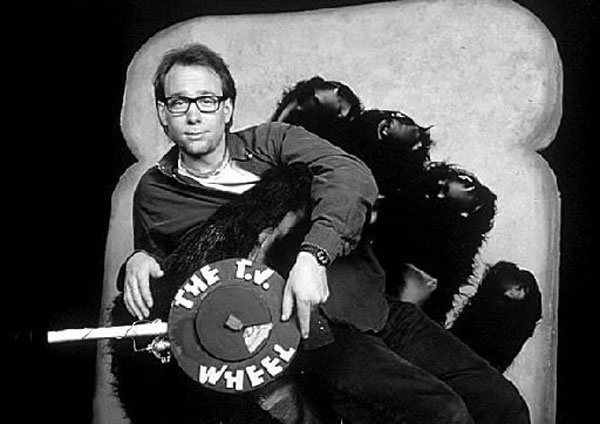
The TV Wheel (1995)

From http://www.timidfutures.com/wp-content/
uploads/2012/09/tvwheel__span.jpeg


Screenplay: Judd Apatow, Nick Bakay, Morwenna Banks, Paul Feig, Joel Hodgson, Nell Scovell
Cast: Joel Hodgson, Nick Bakay, Morwenna Banks, Steve Bannos, Doug Benson, John Carney, Lilly the Chicken, David Cross, Clark the Dog, Paul Feig, Andy Kindler, Melissa Samuels, Fred Stoller, Lawrence T. Wrentz

Synopsis: Devised as a return to live comedy where mistakes were part of the thrill of viewing them, the creator of Mystery Science Theatre, Joel Hodgson, divised the "X-Box", a giant segmented wheel where various sets are built upon whilst the camera is fixed in one place, the audience witnessing a flurry of sketches as the cast have to move quickly as the wheel does.

So let's begin with the obvious, that barring their infamous episode covering Manos: The Hands of Fate (1966), I've never seen Mystery Science Theatre 3000, the legendary cult series where trashy films were commented on by its creator Joel Hodgson, playing a janitor on a space station forced to watch "bad films", at least for four seasons, and a gaggle of robots. For better and for worst, MST3K is legendary, beloved, but also with the stigma of having birthed the idea of ironic viewing of films where improvising jokes rather than watching the film is encouraged. I don't think its Hodgson's fault for that one, just a minor slight out of his hands as - after ten original seasons, a 1996 theatrical film, and two Netflix series so far from 2017 - his creation gained a fan base with a lasting effect. Hell, I have to thank him just for bringing Manos to existence, no one knowing of the film until it was dusted off for an episode, where even the jokes themselves were losing to that feature's madness, and helping that creation of a literal fertiliser salesman with a camera have a cultural legacy. After Hodgson left the series mid-way through, he would devise The TV Wheel, an attempt to recreate the unpredictability of live comedy he grew up with, involving a very curious piece of set sized equipment known as the X-Box, and an ideal to literalise the television screen as a window.

The premise isn't as convoluted as the twenty or so minute introduction by Hodgson himself makes it. Originally, this was a HBO project before Comedy Central picked it up and screened the one-off pilot with a newly filmed segment where the creator explains his premise with literal diagrams; the introduction nearly killed my engagement with the episode, a long and utterly convoluted elaboration by Hodgson which, as much as I admire his love for his idea, echoes the sentiment "kill your darlings" in how long he goes with the premise. It tries, the playful almost Michel Gondry nature of the diagrams and boards moving in front and behind him, alongside the funny attempt at livening the segment up by having puppets staging a strike in the midst of his introduction, complaining CGI is going to replace them, but the intro takes too long and would've immediately killed the chances of the idea getting a whole series as it'd put viewers off.

As simply as I can try to explain the actual TV Wheel, he built a revolving "carrousel-like" stage originally called the X-Box which, whilst the camera stayed perfectly still in one fixed place, which rotated with segmented and various different sized sets, some merely a window, some larger, and one great running gag about ridiculous mini-golf courses in the gag off the stage itself, which interchange when the wheel itself spins. The point was that the performers and their stage itself, rather than camera edits and movements, were dynamic and changed quickly. In the midst of this, many recognisable figures from in front and behind the camera for comedy in the next few decades - including future director Paul Feig and with material written by Judd Apatow - have to hastily switch between costumes or improvise as they have a set time limit for the episode. Any cockups would be included, any sense of ad-lib welcomed, and Hodgson's obsession with puppets is found here alongside all manner of optical gags and (Gondry-like) inspired set production with paper signs and windows.

It's far from perfect, and the humour isn't as punchy as it should've been, especially as the live audience heard is more bemused at points then on-board with the concept, but the result is gleefully weird. As much as there are compromised to Hodgson's own introduction, not one single take but cutting to the top of the wheel and figures like the live orchestra to show its mechanics, it's a fascinating experience which I think could've worked. Its definitely one of the strangest sketch comedies I've seen in a while in structure and aesthetic design, knee deep into the nineties and (even in fuzzy VHS sheen) with bright plastic colours and moments weirdly reminiscent of Cafe Flesh (1982) but with significantly less porn. That doesn't stop it from having moments which could've come from such a cult film, such a robot which recommends drinks only to seduce a guy's girlfriend, the miniature golf gag starting from the Mouse Trap board game to heaven itself, and those aforementioned puppets.

Whether it's a snide comment on racism, as red robots claim their servant race will be inferior because they're green robots, or the Thunderbirds piss-take, everything has a jaunty and off edge tones to it which for its moments of light humour and pure silliness also gets dark, helping with even the failed gags. One of the female comedians, when her gag immediate fails before it starts, takes her top off with the creepy darkness found in her desperate question to the camera "Is this what you want?", follow by one of the male comedians in his way to also say the exact same words and take his shirt off, as if the TV Wheel is some perverse trap for comedians. That a man is later naked and being tortured on a giant pinball machine for one gag is also pretty bizarre just as an image, more so as it turns into the machine being used to get him to confess to an alcohol problem.

Not all the humour is this weird - the KISS sketch, where everyone is just heads on mannequin bodies and Gene Simmons is annoyed everyone has a gimmick in the band unlike him, is one of the best including the Foghat reference - but even apparently innocuous jokes get odder. Paul Feig, whilst not a great director if Bridesmaids (2011) is an indication of his work for me, is great onscreen as a charismatic magician welcoming the audience to his living book of gags and tricks, all the while his monkey sidekick warns us that he's been locked in the book like it's a horrifying Lovecraftian never space. The joke is among the best as it uses the TV Wheel and the production design to its advantage, like the Thunderbirds sketch, in both having the wheel move backwards and forwards but, in using the various windows and paper craft, creating clever live tricks of manipulation with special effects, the Thunderbirds one switching between live actors and puppets for a perfect live close-up of someone accidentally sabotaging a test craft with coffee on the control panel. Sometimes in other sketches, they just resort to actual magic tricks like the unfortunate, connected to Feig's sketch, which turns his dog into a chicken with one of his items but doesn't know how to change the dog back.

Clearly, the premise, the literal TV Wheel, is a prop which had to be carefully put together and probably the other factor which might've doomed it is that sketch comedy shows can be made with merely a host and guests trading off jokes to an audience, doing away with prop comedy for the most part. This is a shame to consider as, with fine tuning or even a simplified version of the premise, The TV Wheel itself was a unique viewing experience which, by itself including the end credits being literally taped onto the screen and rushed through, was charming enough but could've gone further than this.

Abstract Spectrum: Handmade/Quirky/Weird
Abstract Rating (High/Medium/Low/None): Low

Personal Opinion:
Just by premise along, it's a peculiar creation from mid-nineties American television, and in spite of the over long introduction it has a lot to admire as a concept. Even if it was an idea to weird and complicated to get off the ground, a few more polished examples of the show would've sufficed at least.

Sunday, 10 February 2019

Non-Abstract Review: The Elvira Show (1993)

From https://m.media-amazon.com/images/M/MV5BNzlkYzM0ZmUtMTA1MS0
0ZjNlLWJlYzMtNjE3Y2RmODA2NjhmXkEyXkFqcGdeQXVyMTM2Mzg4MA@@._V1_.jpg


Screenplay: Anne Beatts
Cast: Cassandra Peterson as Elvira, Mistress of the Dark; Katherine Helmond as Aunt Minerva; Phoebe Augustine as Paige; Cristine Rose as Lindsay; Ted Henning as Chip; John Paragon as the voice of Reinfield

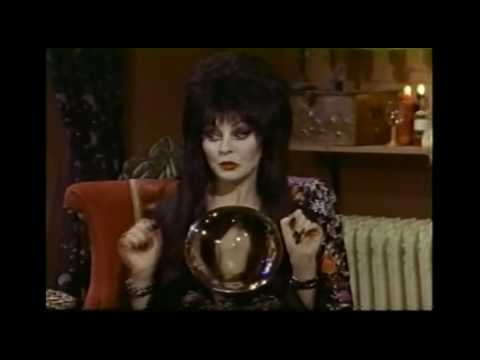
Synopsis: Elvira (Cassandra Peterson), posing as a fake medium despite being an actual witch and living with a relation Aunt Minerva (Katherine Helmond), lives in peaceful existence in Manhatten, Kansas until their niece Paige (Phoebe Augustine) arrives and the police are trying to catch her out for fake love potions.

So Cassandra "Elvira" Peterson was involved with an unaired pilot for a sitcom in which her character, created as the host for a show showing old b-movies only to become a cult institution all by herself, gets to be in the central of the kind of popular television from this era. The pilot, made by CBS, was never released - stories abound that the level of sexuality to the Elvira character, Cassandra Peterson more than happily using her busty figure for comedy and sharp with sexual one liners, was something unprepared for by certain CBS executives which killed the pilot's chances immediately. A further irony is to be found, as I researched this pilot, was that in 1996 a show with a similar premise (two aunts and a niece, all witches, and a talking black cat) would go forth as Sabrina the Teenage Witch and be incredibly successful, a series I watched a lot in my own youth and is probably as big an influence on me as an Englishmen as for many Americans growing up in the nineties.

I'll be brutally honest in saying The Elvira Show wasn't for me. Immediately the laugh track, recorded live in front of an audience, welcomed me into the strange and unreal world of sitcoms again, where each line (no matter how cheesy or bad) has to illicit a laugh unless a "sweetened" fake laugh track was included. Having not encountered one for a long time, pawing over each line, I felt its strange contrivance placed up a barrier, not like how with the BBC Red Dwarf series at its best where the laughs were won, but uncomfortably mannered. Here it reminds me where the rabbits sequence from David Lynch's INLAND EMPIRE (2006) was drawing its influence for laughter appearing for the most abrupt lines.

From https://i.ytimg.com/vi/c-P6bHZc7ZY/hqdefault.jpg

A funny premise is had in the idea Elvira, the character built in films as well having actual magical powers, is pretending to be a charlatan to keep her head down whilst Aunt Minerva (Katherine Helmond) is more inclined to enchant a shopping trolley blithely to follow her in public. (Their talking cat Reinfield, voiced by regular Peterson collaborator John Paragon, sadly doesn't work and feels like a bad Garfield stand-in). With this in mind, the pilot pushes the sexual innuendo as far as it could, "stiff cop" and all pushing the material to the point the talking black cat Reinfield has to double check one line as if almost an apology for the smuttiness; in the modern day however it is fairly innocuous stuff. It's still a sitcom episode which contrives a tiny, bit sized plot which easily resolves - in this case a hunky male cop under cover to help bust Elvira's love potion ring, Petersen's character gladly trying to seduce him. With a niece raised in a convent, the aunts attempt to hide their abilities throughout the episode only to establish said nieces are like themselves more than she knew. It's pretty predictable stuff and when the comedy is mainly from obvious sexual humour and lame puns, it did become tiring.

The production for early nineties television doesn't help. The staged nature shouldn't be detraction in the slightest, especially when there's one gag about the carpet flipping up to swallow dust Elvira sweeps underneath it, suggesting it could get away with some magical weirdness for laughs, but it adds to the flatness to the material, the aforementioned predictable sitcom. There's a sense, having no previous experience of Petersen's work, it was the sitcom format for me that caused the problems rather than the character herself. It's still an amusing curiosity but a little innocuous for my tastes.


From http://nightflight.com/wp-content/uploads/ELVIRA-SHOW-9.jpg