Showing posts with label Director: Jan Švankmajer. Show all posts

Tuesday, 29 October 2024

Little Otik (2000)


Director: Jan Švankmajer

Screenplay: Jan Švankmajer

Cast: Veronika Žilková as Božena Horáková, Jan Hartl as Karel Horák, Kristina Adamcová as Alžbětka, Jaroslava Kretschmerová as Alžbětka's Mother, Pavel Nový as Alžbětka's Father, Dagmar Stríbrná as Pani spravcova (the caretaker), Zdenek Kozák as Mr. Žlábek

A Night of a Thousand Horror (Movies)/Canon Fodder


Jan Švankmajer’s tale of a couple who merely wanted a child, but cannot, opens with such strange images like the husband envisioning a fishmonger wrapping a baby up in newspaper outside the pregnancy clinic. Unable to have children due to medical sterility, the couple’s life takes a drastic turn when, as a sweet joke, the husband Karel Horák (Jan Hartl) finds a tree stump that looks like a child vaguely and dresses it up as one, only for Božena Horáková (Veronika Žilková) to literally take the carved and varnished stump as a literal child to his horror. After a contrived nine month pregnancy they fake, a be-careful-for-what-you-wish-for tale transpires when after this pregnancy the tree stump now christened Otik comes to life.

Švankmajer had nearly three decades as a stop motion animator before this film, working on shorts and even one music video for Hugh Cornwell named Another Kind of Love (1988), before he made his first theatrical film with Alice (1988), an Alice in Wonderland interpretation which is whimsical, if surreal and embraces macabre horror tropes, more so as he used real taxidermy animal and bones to create some of the denizens of his Wonderland. Švankmajer made his craft from his native Czechoslovakia/Czech Republic literally animating anything from paper furniture to paper, his later films after Little Otik going onto real cow tongues (Lunacy (2005)) to photo cutouts in Surviving Life (2010), and his work here embraces a macabre humour contrasting the tragedy that will transpire.

For the Horáks, children are what are important for their community in the apartment complex as much as they sincerely want kids, not just take the cat out on a leash for walkies. Whether a good thing or not, it is turned into an obsession that is not just that of Alžbětka (Kristina Adamcová), the one child in the complex lamenting the lack of other children, and overenthusiastic to the point of reading medical texts about sterility and “slow semen”. The set up is from a fairy tale, of the Otesánek by Karel Jaromír Erben which is retold in fairy tale illustrations animated onscreen, but it is streaked by Švankmajer as a card carrying surrealist skewering the weird ritual of proud parents and those around the Horaks who celebrate their consummation of parenthood. Alžbětka’s obsession is as an over inquisitive child, but her mother celebration of the fake pregnancy cycle in the first act is as odd when viewed from afar, as is Mr. Horák being congratulated at work with drinks. Children are a positive thing in the right context, an important moment for any parent even with adopted sons and daughters to undertake, but the ritual is seen as having existed for its own sake. With Mr. Horak’ early hallucinations of babies being everywhere before the tree stump is literally dug out, their wish for parenthood is arguably one as much pressured and forced onto people even when they wish and feel lost without this in their lives.


Švankmajer uses his career to prod at human behavior in its curiosities in the theatrical and short length films. Virile Games (1988) mocked the sport of soccer as a television event as much for an excuse for significant food consumption as much as violence, whilst Conspirators of Pleasure (1996), the theatrical film before this one, whilst sympathetic to its anthology cast was about sexual fetishes, done with the least conventional ones where his own hand crafted pieces for the film, like kitchen utensils like rolling pins fashioned to give pleasurable massages with artificial tongues, matched how all the pieces within itself showed these men and women painstakingly crafting the items and costumes needed for their elaborate sexual fantasies, even the man who dresses up as a papier-mâché bird creature to swoop on a woman who has a stand in he also built.  With Alžbětka’s father always watching adverts on TV and getting drunk constantly, or the really twisted joke you normally would never get, that the old man in the complex is a pervert eyeing up Alžbětka, you see Švankmajer turning ordinary Czech lives into his creations to scrutinize them, as he did literary sources. His obsession with food, the destructive act of eating and its strangeness, is the most prominent example of this from his entire filmography and perfect to see here, as Otik when he comes alive is very hungry and, as he grows, even the post man isn’t safe. Food has been one of Švankmajer’s obsessions for his whole career, continuing it even in one-off surreal moments here like nails being seen in a broth or a sentient breathing pancake.

This is one of his most robust narratives too, where the first act fully sets up the sick humored turn to Otik’s parents having to hide his consumed victims. Little Otik at that point definitely belongs to the horror genre among others as, stripping his food down to freshly bloodied bones by his crib, or guts and blood split on the glass of his bedroom’s windowed door, we will see Otik move from an incredible piece of stop motion magic to a giant practical suit and off-camera implications. Otik himself, let alone the rest of the animation in the film, is visibly the craft of a veteran animator (and all his collaborators on this production) who had four decades before the film to hone his skills, let alone is an acclaimed artist in his own right in various forms of materials shown in galleries over the decades after. Just Otik himself in his initial living version is the result of having to find and put together real pieces of wood visible for all the titular child’s mannerisms and facial expressions in his initial form. All the stop motion in general, whilst at this point in his theatrical career fully focused on making sure his human actors and their performances also suit, had to be painstakingly put together even for pure gags, with the knowledge Švankmajer’s trait of not using conventional items for the motion would have added new challenges for him and an animation team to work with. Even if giant Otik becomes an entity not shown fully onscreen when his parents finally lock him down in the coal cellar of the apartment complex, I see they depict his hands with real twigs that had to be painstakingly collected and likely led to multiple hands needed to accomplish the whole film.

Švankmajer is truly an artist but, whilst Alice is a masterpiece in its own right, the real turn by Conspirators of Pleasure and this film is that he fully embraced these longer films for being dramas too. Whilst Alice focused on one young girl in the lead and his stop motion, here he has a full cast and it feels he felt completely comfortable there too. Actors did exist in his short films, and one The Garden (1968) is entirely around people without animation its central focus, but you see here he found a new side to filmmaking he embraced as he made more theatrical length films which had longer stories. A corpse humour, even pure silliness, is found in the performances too to be as dynamic as the animation, the tragedy matched with the farce. He finds humour in, say, a man pretending to be the postman your child ate and post his mail deliveries at night, even if it leads to questions from far away onlookers of why the postman is late posting his mail. Or the nonchalant conversation that, if forced horrifically to cut your tree child to pieces, you can just ask your soused neighbor for his chainsaw with no questions asked.

Because of this, the story is as good, with its own twisted turns as, with the naivety of a child but her innocence causing as much harm, Alžbětka in the second half befriends Otik in his cellar confinement. Feeding the local pedophile to him is one thing the viewers will applaud, but when she has no qualms in debating to feed anyone including her family members to him, when she cannot get any food for him anymore, you see a nasty little parable about how childhood for all its innocence has a naivety which does not process the consequences of life and death. This can be revealed in as a subversion of proper etiquette but it also shows that, like with Otik himself, our perceived notion of the beautiful innocence of children is just as strange and deserves to be subverted as seen in both children we follow here, all needing to be resolved by the elderly female neighbor in the end. Tellingly the film ends before this inevitable finale to stop all this is seen onscreen, as Švankmajer has already told his parable in its fullest with the fairy tale sequences telling Karel Jaromír Erben’s original story. The parable is this strange tale of wanting a child regardless of the cost, and its sickly humored morals close us out before the unfortunately meeting of an Otik with a garden hoe because that was always inevitable, whilst the journey itself is the delirious and impressive ride we had just experienced over two hours.

Monday, 10 April 2023

Surviving Life (Theory and Practice) (2010)


Director: Jan Švankmajer

Screenplay: Jan Švankmajer

Cast: Václav Helšus as Evžen and Milan; Klára Issová as Evženie; Zuzana Kronerová as Milada; Emília Došeková as Super-Ego; Daniela Bakerová as Dr. Holubová

An Abstract Candidate


I am the Chinese melon!

Ever since I discovered the short films of the Czeck filmmaker Jan Švankmajer in college, borrowed from the private stash of DVDs in the office of the Film Studies tutors, I can say he is one of my cherished filmmakers.  Having seen most of his career’s work too, the through line from the famous short works to long form movies is a fascinating progression. One of the best living animation directors, his knowledge of traditional techniques (puppetry, stop motion etc) is matched by a distinct use of everyday objects – toys, wood, metal, animal bones, even pieces of meat – that are moved and crafted in ways that pushes the films into the areas of texture as well as sight and sound, allowing the viewer to ‘feel’ them by their nature and the grain and details you can see. This trademark, through decades of shorts, was combined with various types of ideas, from adaptations of Edgar Allen Poe and fairytales to satire, and his idiosyncratic obsessions such as childhood to food and the act of eating. The later is one of his most idiosyncratic trademarks, and going into a Švankmajer work, you will both witness food as a beautiful substance and utterly vile, which Surviving Life continues with the new addition of projectile vomit.

With his first feature film Alice (1988), Švankmajer would incorporate live action, but not in just having actors in front of the screen but having them being as much figures for the director to animate as well as actual people. Švankmajer incorporated this in short films, 1983’s Down To the Cellar a predecessor of his debut Alice, but after he started to concentrate on feature films, this has become a central part of his work. With Lunacy (2005), the film before Surviving Life, the live action would have completely taken over were it not for the continuous scenes of animated cow tongues that are intercut between plot points. With Surviving Life, Švankmajer's fan base met with an experimental tangent even from his previous films, his bitterly humorous opening monologue to the camera introducing the film as a result of a lack of money for production, though with the advantage that, since they only needed to shot with the actors in a shorter span of time, they did not need to pay for catering because “photographs don’t eat".

Created using cut-and-paste photographic images, ‘like old children’s cartoons’ as the director compares it to in the opening introduction, Surviving Life follows an older man Evžen (Václav Helšus) whose life is punctuated by dreams of a beautiful, red dressed woman whose name continually changes and exists in a dream reality which continually fluxes out of his hands. Becoming a patient for a psychoanalytic doctor, and delving into other methods of guiding his dreams, he tries to understand the images he sees every time he sleeps. The plot sounds quite common and paradoxically, this is the closest for me yet Švankmajer has gotten to a ‘conventional’ story - including the layer of clues and images you discover on a second viewing - but is one of his least conventional works in a filmography that would be viewed as abstract against traditional views of animation. The cut-up images that make up the entire film, spliced with live action moments (usually close ups of intricate actions or gestures), is incredibly different from what I have encountered in cinema. If anyone, like I did as a child, used to cut out images from magazines or comics and either moved them about like toys, or spliced pieces of them together to create new ones, this is what the entirety of Surviving Life feels like, only taking to it to an entire feature length film, from the backgrounds to most of the moments, being created from two dimension images cut out and finished digitally on computers.  Just from the initial set up in one of Evžen's dreams – where giant female heads blow out watermelons from between their lips, and buildings switch sides on human feet, where teddy bears have long furry phalluses and chicken headed nude women run around – I am reminded of what an actual surrealist artist is as Švankmajer shows his skill with the craft.

This style of animation has been used by Švankmajer previously, including outside his film work, but here it is allowed to breathe out into this entire construction. The results are surreal, human beings and their photographic copies alive and mixed with a story where dreams are in the centre of the narrative. Švankmajer has played with the concept of dreams in his filmography, but this is the first one where they are the central subject as well, which is another distinct part of the production. With this, expect Freudian images of everything from eggs to flowers, giant hands coming out of windows to drag bystanders up to their doom, a dog with a suited office worker’s body, and an entire film where reality and the dreams, while separated, still bleed into each other, continuing Svankmajer’s message at the start of the film, through quotation, of how only by combining the both of them together can a human being be full.

The result is unconventional even for animation, incredibly creative with its imagination and technical production, and with a wonderful sense of disgracefulness in Švankmajer's old age as a veteran, an acquired sense of vulgarity that did not even come out in Conspirators of Pleasure (1996), his take on sexual fetishes, but erupts in this wonderfully in its sex obsessed, puke filled, poodle fucking mentality filtered through the obsessions with childhood, food and the fantastical. This may have started in Lunacy, with its combination with the Marquis de Sade with stories by Edgar Allen Poe, but while that film was serious in its takes of blasphemy and of the concepts of freedom, the self proclaimed follower of Surrealist Art Švankmajer properly added a sliver of crudity to his repertoire with Surviving Life and uses it perfectly. The film is also abstract in that, it does not only look at dreams but incorporates psychology. The plot is incredibly idiosyncratic if graspable already, as Evžen fixated on this Eva/Eliza figure in his dreams, trying to dream more to fall in love with her, but by invoking the ideas of Sigmund Freud and Carl Jung. Alongside having to literally fight a father personification who looks like himself and a variety of various neurosis to unpack, Freud and Jung are paid with respect if personifying their real life combative and disagreeing views of psychology through living portraits which fight each other; Surviving Life introduces layers that, while very easy to grasp, cause the scenes you see to take on new and peculiar lights to them. Touches taken from psychology can add entire memorable side characters, the old woman in Evžen's dreams who is his superego, who collects all and is God/Brahma/Karl Marx/whatever is a symbol of all-knowing. There is also an entire layer of how depressing the real world is, both in the relationships in the real world, such as Evžen's wife thinking he is having an affair, to the reoccurring plot point of lottery tickets being the false hope for the better in real life and the dreams.

I am biased for Jan Švankmajer, but it is through his skill of an animator and as a creative figure, still able to create such imaginative and stimulating work after fifty years or so since his first projects, that you see within Surviving Life. It is a film that came and sadly went without enough praise for it as it deserved, and wished his career gained more praise for how distinct productions like this were. To step into a Švankmajer film, while part of a rich culture of animation (especially European animation), is to encounter a truly unique voice, driven as much by ideas behind the images as by the creations on screen. Surviving Life combines a full narrative with this, as seen in his other features, and gets the best of both worlds. That it is also humorous and, by its ending, deeply poignant also adds to its quality. Surviving Life is, far from a work compromised by its budget as Švankmajer self decapitating says, but a masterpiece in a career already full of them.


Abstract Spectrum: Surrealist/Weird

Abstract Rating (High/Medium/Low) – High

Saturday, 30 April 2016

Alice (1988)

From http://lehu.pt/attachments/thumb600/tmdb/tt0095715
/poster/xxmkOc9kypgin1sMttV5mgQDXl6.jpg?w=400&h=594
Director: Jan Švankmajer
Screenplay: Jan Švankmajer
Based on the original story by Lewis Carroll
Cast: Kristýna Kohoutová (as Alice)

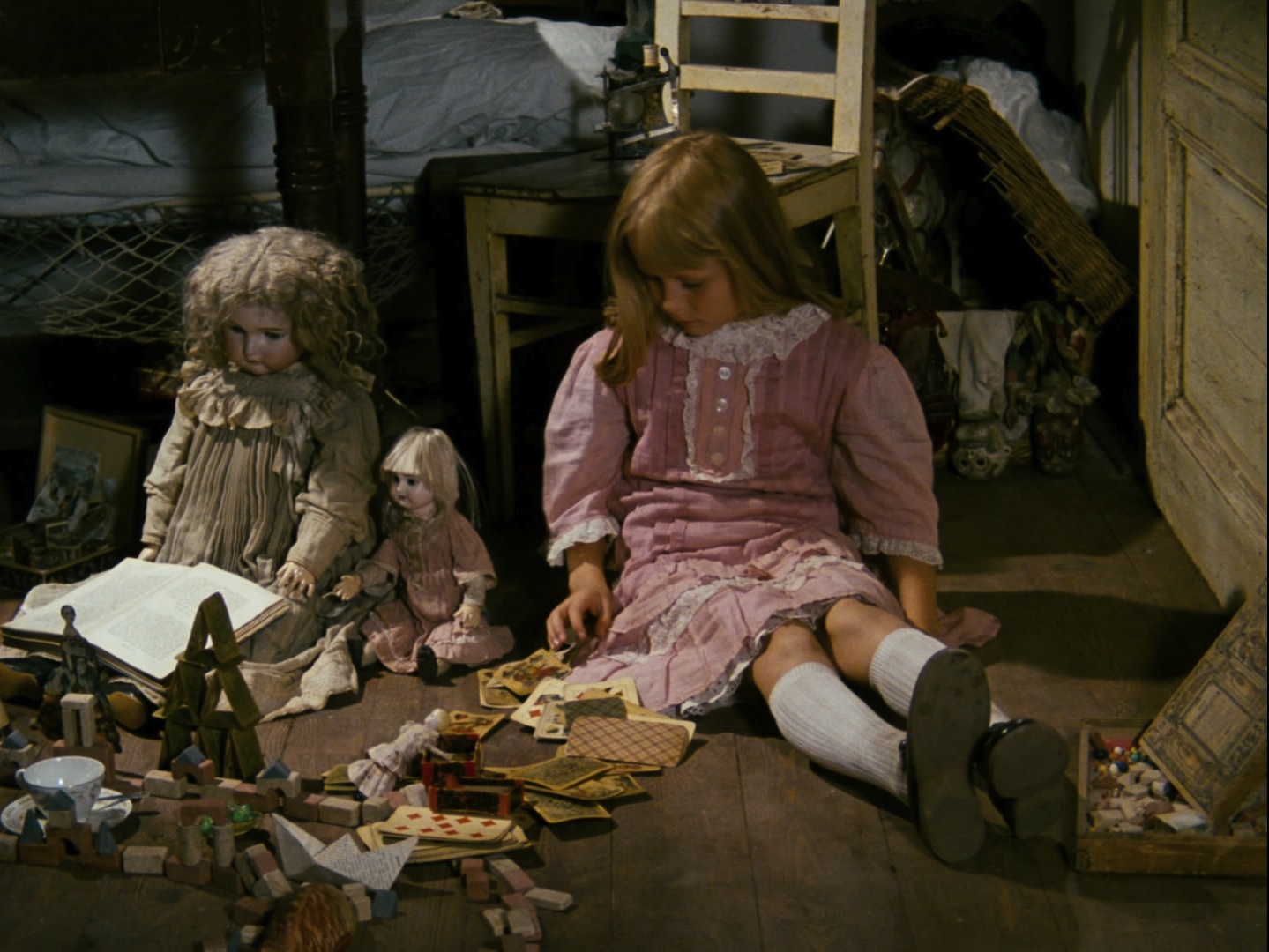
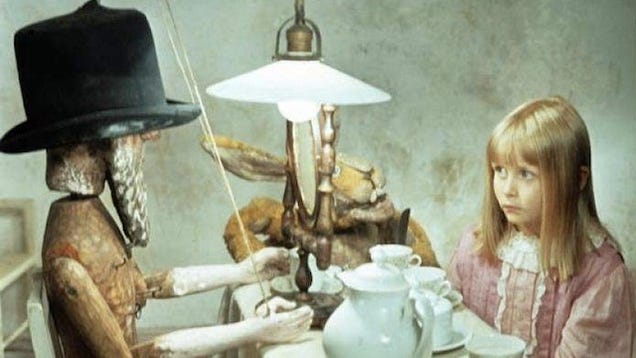
Synopsis: Bored, Alice (Kohoutová) notices that the taxidermy rabbit in the room she is in starts to move in its glass case, putting on a jacket and hat, and then dashing off with his eye continually on the pocket watch he keeps in his sawdust filled chest. The journey that takes place, following him, leads Alice on a strange trip through corridors, rooms and various outdoor environments, encountering a sock puppet caterpillar, a tea party with a Mad Hatter and March Hare, a malicious and decapitation obsessed Queen of Hearts, and various objects not found in the normal world such as nails growing out of breads and drinking ink that shrinks a person.

As a card carrying, self proclaimed surrealist, it isn't a surprise that animator/director/puppeteer Jan Švankmajer eventually adapted Alice's Adventures in Wonderland (1865) - a proto-surrealist work, Lewis Carroll's tale of a young girl named Alice is a series of absurd anecdotes, strange sights conjured in the mind, and limericks and verses where there is complete unpredictability in the world of Wonderland. Common objects are reinterpreted, puns are made and there's a logic of Wonderland's own that has entered common folklore. What's testament to Carroll's writing style is that when his work is toned down from the original text, a mainstream adaptation like the 1972 version with Peter Sellers as the March Hare is still incredibly strange to watch because of how Wonderland has to depicted in most adaptations. What's significant with Švankmajer's adaptation however - while very faithful to the text, down to little touches, barring some minor changes and pieces like the Mock Turtle segment being removed - is that it removes the tone of whimsy that is prevalent in the original story. The story's on the cusp of being mischievous, Alice quite a sarcastic if lovable and smart figure, a lot of whit in the extensive amount of dialogue and Alice's internal thoughts she has; Švankmajer strips most of the dialogue out and almost everything, including other characters' voices, is spoken by Alice herself in narration.   

From http://www.whitechapelgallery.org/wp-content/uploads/
2015/08/alice-jan-svankmajer.jpg
The other factor is that Švankmajer is paradoxically a legitimate surrealist who yet depicts his worlds through a grounded reality using everyday objects and locations. He wanted to make what he felt was a far more accurate depiction of the story, not a fairy tale as others had but a dream, and this is both why this is one of the most faithful adaptations in existence and yet it is entirely his own take at the same time. He is the most tactile filmmaker ever to exist baring Stan Brakhage and a few others; even in his last film Surviving Life (Theory and Practice) (2010), with paper cut-outs, he sculpts his films with his own hands alongside other animators and technicians, using any object he could easily have acquired from a tool shed or an antique shop and bringing their own textures and history with them into his work to create lived in, unique environments.

As a result of this, the adaptation is not the fantastical Wonderland of most adaptations, that which is usually multicoloured and require elaborate costumes and painted sets. Instead Švankmajer's Wonderland is the cellars, corridors and gardens of everyday life, dust ridden cluttered, old wooden chairs and drawers given a new life as Alice enters Wonderland not through a rabbit hole but a study desk drawer lined with rulers and drawing utensils. Every figure Alice encounters has been built by objects remoulded by Švankmajer, many of which become far more grotesque as a result; the caterpillar is an actual sock with denture teeth and big glass eyes, the white rabbit spilling sawdust from his open chest cavity, and his friends who try to get an overgrown Alice out of his home a bizarre menagerie of constructions from animal bones and googly eyes. Ordinary objects in Švankmajer's world are inherently made new and alien even when they're un-tampered with physically - scissors in bulk collection in a drawer, the rabbit's home built from wooden blocks with a rabbit hutch interior of wire fencing, Švankmajer's obsession with eating and food depicted in elaborate detail  - creating a very tactile cinematic environment.

From http://38.media.tumblr.com/tumblr_mcb45ou6mC1qaxxv7o1_1280.png


Technical Detail:
The animation - having spent two or so decades in his career making short films, including a take on the Carroll poem Jabberwocky (1971), before he decided to transition into making feature films - is exceptional from Švankmajer, but an important factor to his work is that not only are you sometimes asking how certain scenes were pulled off, amazed by the skill involved, but that anything obviously faked is part of the aesthetic choices. The obvious handcraft down to the animation's flaws is as much part of his films' worlds, such as the novel interpretation of Alice's constant growing and shrinking being depicted by her smaller self being a stop motion moved Victorian doll. The fragility of many of his creations, broken and remade, add to their life; that which evokes the possibilities of imagination when given only the long forgotten objects of an attic or an antique shop to work from.

Sound is also important to Švankmajer and easy to neglect with his films. The narration, thus making it easier for the English dub to exist and be added to the visuals, has an innately ghostly tone to it as well, particularly as repetition in dialogue alongside certain Wonderland behaviour is common. Sound effects in general are also as audio textual as the materials being sewn, chewed, broken or generally manipulated. Rather than the March Hare merely smearing "the best butter" on the cogs of a pocket watch, you hear the squelch of butter meeting clockwork in full detail. The awkward sounds of these stop motion creations as they come to life is neither ignored in the soundtrack, an entirely constructed world of each twitch or attempted movement of these beings is as important for an entirely constructed Wonderland; this as much as the intentionally weird moments such as a piglet going down a flight of stairs crying like a human baby are important to the film alongside its visual content.

From http://s3.amazonaws.com/auteurs_production/images/
film/alice-1988/w1280/alice-1988.jpg
Abstract Rating (High/Medium/Low/None): High
Lewis Carroll's two Alice novels - Alice's Adventures In Wonderland and the neglected Through the Looking-Glass, and What Alice Found There (1871) - are canonical works of literary abstraction and absurdity, easy to understand and originally written by Carroll to amuse the real Alice Liddell, a young girl, but majestic in how strange they are, relishing bizarre verbal pins and digressions, arguments over insignificant details and incompetence in official figures alongside a heartfelt ode to childhood imagination. There are so many adaptations - from the silent era to Disney, Hollywood adaptations to seventies porn, an anime adaptation to a BBC adaptation where the creatures of Wonderland are depicted by actors without any costumes - that it's going to be a drastically sliding and varied scale of what each one will be like in terms of abstraction.

Jan Švankmajer's Alice is likely the most abstract adaptation and will be difficult to knock off the top of the list in this area. Not only is there faithfulness to the tone of the story, but the drastic change in terms of tone that counteracts this, that which is Švankmajer's own influence, adds to its odd mood perfectly and becomes, in being extremely different, a more faithful attitude to the material. In comparison to the Quay Brothers, who idolise him, Švankmajer does not share their dreamlike mood, entirely grounded in a reality even if it's strange to witness. In contrast to Walerian Borowczyk, who touched upon the same style of animation in his early career and kept the same fixation for objects and textures in his later live action films, they took on different ideological ideals even in how they used and sculpted objects even if they were both subversives; Borowczyk makes a biscuit box in the shape of a Bible in one film, Švankmajer would animate the biscuit box into a sentient creature or have it become a trap door to a whole manner of strange occupants, whilst Borowczyk was obsessed with performances from actors in contrast to Švankmajer turning his actors, including himself in cut-out form in the prologue of his last film, into objects as much as people to manipulate.

There is also a misanthropic vibe to Švankmajer's work, fitting a surrealist whose other literary adaptations have included Edgar Allen Poe and the Marquis de Sade, a more critical view of the world even next to someone like Borowczyk where anything can be twisted - like the jar of fruit jam which Alice discovers has drawing pins in it. With Alice, even though its suitable for children, it's intentionally jarring in look and tone to the innocent fantasy nature of most interpretations, where you can linger over screenshots and imagine every splinter in a chair leg or the loose threads of garments, the brittleness that undercuts the fantasy. His completely unhesitant attitude to depicting the original story's more black humoured material - the Queen of Heart's obsession with execution is made more grim because objects don't bleed when they're decapitated - adds a morbid humour even when not directly tackling obsessions like his like the repulsive, destructive nature of the act of eating.

From http://4.bp.blogspot.com/-FwkSDroHT1g/Taxs-k2nZMI/
AAAAAAAABFE/-X_zzz-i7oE/s1600/tumblr_laz3a2nZcj1qdaig4o1_500.png


Abstract Spectrum: Grotesque/Surreal/Weird
Abstract Traits: Object being brought to life; Stop Motion; Decapitation and Unexpected Violence; References to Alice's Adventures in Wonderland (or Straight Up Adaptation of); Juxtapositions of Objects that are Strange Bedfellows; Verbal Puns; Taxidermy Animals; Animal Bones; Grotesque Depictions of Eating and Food;  

From http://3.bp.blogspot.com/-q9NX7Z1Zu7U/Un65IylVJ9I/
AAAAAAAAMas/9MSZSkdBPHM/s1600/a9.png
Personal Opinion:
As someone who only read Alice's Adventures in Wonderland only a few years ago, and instantly fell in love with it and its sequel story, my growing admiration of the story means that I've also developed an obsession with any other works which directly adapt it or reference it. Already a huge fan of Švankmajer's films before this, his take has grown to be even greater knowing its source material very well, to the point it is one of his best feature films if not the best work of his alongside a short like Dimensions of Dialogue (1982). It cannot be stressed enough how it manages to be Švankmajer's own creation yet the most faithful in terms of attitude to the material, only lacking the whimsy and replacing it with a world entire built from objects and textures that drags the viewer as much into Wonderland as Alice herself. 

From https://i.kinja-img.com/gawker-media/image/upload/s--MG4JJHtn--/c_fill,fl_progressive,g_north,h_358,q_80,w_636/17z8tci2o56oujpg.jpg

Monday, 3 August 2015

The Death of Stalinism in Bohemia (1991)

From http://1.bp.blogspot.com/-rtUL6hJZR6I/TryULR0w5yI/
AAAAAAAAAO4/QrYtotRedeU/s1600/death+of+stalinism.png

Director: Jan Švankmajer
Scriptwriter: Jan Švankmajer

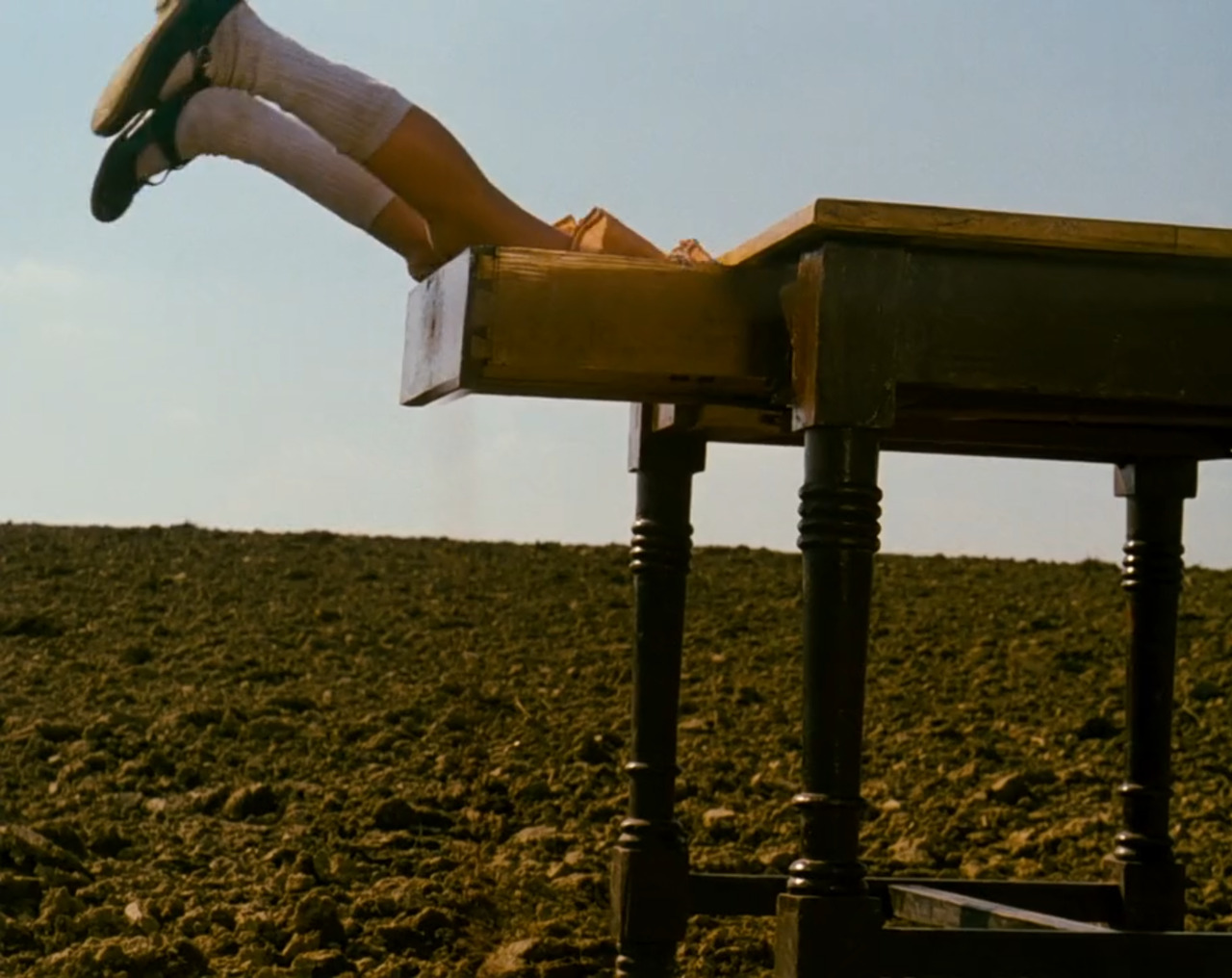
Out of all of Jan Švankmajer's short and feature length animated and live action films, The Death of Stalinism in Bohemia is the only one that has been openly political. Christened a work of "agitpop", it stands out in the Czeck surrealist's career when his themes are usually universal in theme. Originally I feel in love with his films for turning everyday objects into living entities: animal tongue slithering along onscreen, tables enjoying picnics in the countryside, and people made of vegetables in reference to the art of Giuseppe Arcimboldo amongst other images that are only seen in his work. Soon after I found appeal in how he used to tackle themes such as sexual taboos (Conspirators of Pleasure (1996)) to conformity (The Garden (1968)), or transformed literature from Lewis Carroll to Edgar Allen Poe into his own vision. The Death of Stalinism... is still very much a surreal work as his other films, juxtapositions that should not be coming to life and reflecting subjective symbolism. But in depicting its theme of the history of communism in Czechoslovakia from the later 1940s to the Velvet Revolution of 1989, this becomes the most openly political work he had made yet with detailed references to real events and political figures.

The film begins this journey through history with the statue of Joseph Stalin being placed on an operating table, his head opened up and the bust of Klement Gottwald, head of the Communist Party of Czechoslovakia from 1948 until 1953, being birthed from inside his head. The film despite its more noticeable political content is still unequivocally Švankmajer's interpretation of them, his trademarks of stop motion animation representing the emotions about his country during these decades and the then-future, the statue of Stalin still haunting the Czech Republic disguised in the country's colours at the end. The 1968 invasion of Czechoslovakia by Soviet tanks is depicted by rolling pins for example, moving on mass in various sizes from giant to small one crushing stones and other things in their path down a hill. If one had a good knowledge of the history of Czechoslovakia during the later forties to 1989, or was born in the country, this short would have immense meaning, a matter-of-face absurdity to these images which do not trivialise the severity of them.

Far from didactic it still presents the material through Švankmajer's grim if quietly black humoured tone, a grotesqueness in the ordinary. The farcical nature inherent within this real history, images of bullet holes suddenly appearing in brick walls, is comparable to Juraj Herz's The Cremator (1969), both difficult to laugh with in their humour knowing real people died outside of the cinema screen. The film succinctly depicts the end result of the history with a prolonged scene of gloved hands, faces not seen, crafting workers out of clay and moulds, the creations going on conveyor belts to their own executions by hanging, the bodies falling back into the bucket of clay used to create them. A skull eating through pictures of Stalin or the infamous Soviet leader developing eyes emphasises the director's visible rage at what took place during his lifetime, but it interconnects with acts of violence that take place in his other short films like Dimensions of Dialogue (1982) or Virile Games (1988), in the most innocuous of places like the latter's depiction of a football match as much as in political events that shape a whole country. If there is a danger of the meaning of the short being lost as people forget the history being retold, there is still this general absurdity and violence in normalcy that runs through many of the director's films, linking with his Surrealist views.

From https://wondersinthedark.files.wordpress.com/2010/11/death-of.jpg

Technical Detail:
Openly, Švankmajer is one of the most profound influences on my film tastes as they were developing. With this comes a knowledge as well of the incredible determination and exhausting hours of time that were likely spent to create a ten minute short like this. Even his last feature film Surviving Life (Theory and Practice) (2010), which used paper cut-outs, looked like it was laborious and time consuming to get each scene and moment done right. Švankmajer even more so then the similarly talented Quay Brothers is concerned with aesthetic textures in his films as part of depicting his ideas. The camera is usually static for each shot but he channels the cinematic qualities deprived from the restriction to the content onscreen in the animation and production design.

A statue of Stalin is given threatening life, and when the two birthing sequences happen, you get the disgusting texture of entrails being moved aside by gloved surgeon's hands to birth the child of Stalin's politics, right down to an umbilical cord being cut and a slap on the back of the statue bust's head to make it cry. What Švankmajer learnt, in his life as a puppeteer, an animator, an artist, and a film director, with the many skills he learnt over the decades, is deceptively simple yet ignored to a horrifying extent in a lot of cinema, that in real life the world as a person views it in texture and "coarseness" is as much part of our existence as our thoughts and relationships are. That a floor can be dirty or clean, a hand can have arthritis or dirty finger nails, that objects are chipped or splintered, details you rarely get in realistic drama and fantasy films equally. Far from mere surface detail, it is instinctively part of people's perceptions of their environments, and it's important here in this film too. The starkness of the film in these small details adds to the importance of its message, the rudimentary decoration of where the clay workers are made and hung, the knife used to cut the nooses the same one used to spread mustard on the godlike hands' meal, to the intersplicing of images of propagandist sporting activity with De Sadian illustrations of orgies.

Abstract Spectrum: Surrealist;  Expressionist
Abstract Rating (High/Medium/Low/None): Low
The overt political tone of The Death of Stalinism... does reduce the abstract tone of this film compared to others in Švankmajer's filmography. When he is dealing with more universal themes or adapting other artists' work like in Jabberwocky (1971) he allows it to be starting points for very unconventional imagery and juxtapositions, which are simple in their execution of the ideas but still startling and uneasy to the viewer. The surrealism that does exist in this particular film is still poignant, used to emphasis the message of the film.

Personal Opinion:
Originally I was cold to The Death of Stalinism in Bohemia for many years compared to other Švankmajer short films. I'd recommend, if you explore Švankmajer's short films, to begin with Jabberwocky and Dimensions of Dialogue, while personal favourites like Food (1992) to Virile Games also stand out as the next ones to watch. The Death of Stalinism... would've had greater power originally if my knowledge of Czech history was stronger, but it has grown in significance as a stronger production. Inherently the level of quality in the creation of the short and it's execution of ideas is as strong as in all the other films, and as the one overtly political film in his filmography, it stands out greatly on its own terms.

From http://2.bp.blogspot.com/-tISPdmVwM00/UCjC-X0dUAI/AAAAAAAAE1M/
KEsPXXZRiLU/s1600/The+Death+of+Stalinism+in+Bohemia.jpg