Showing posts with label Director: Lucile Hadzihalilovic. Show all posts

Wednesday, 5 April 2023

Innocence (2004)


Director: Lucile Hadžihalilović

Screenplay: Lucile Hadžihalilović

Based on a novella by Frank Wedekind

Cast: Zoé Auclair as Iris; Lea Bridarolli as Alice; Bérangère Haubruge as Bianca; Marion Cotillard as Mademoiselle Eva; Hélène de Fougerolles as Mademoiselle Edith; Olga Peytavi-Müller as Laura; Alisson Lalieux a Selma; Ana Palomo-Diaz as Nadja

An Abstract Candidate


Innocence begins with a casket...in which a young girl named Iris (Zoé Auclair) is brought to a school cut off from the world and entirely for the education of young girls. Iris is our introduction to this world of changing coloured hair ribbons, violet for the eldest girls and red for the youngest, and where they are designated into houses with five each maximum, with curfews that are enforced at night. Thus begins the debut theatrical film for Lucile Hadžihalilović, a figure whose actual filmography so far has been tiny but has made an impact. Her work with her husband, as a regular collaborator to the controversial filmmaker Gasper Noe, should be taken in mind too, as she has worked as producer and editor for his productions from the nineties as well, but her own filmography is just as distinct if with only four works so far from the nineties into the 2020s. La Bouche de Jean-Pierre (1996), probably the most difficult one to access. At fifty plus minutes a micro-feature, it is the most grounded and the most difficult as it tackles the subject of sexual abuse of a young girl, but her work in full theatrical length from the 2000s onwards, more readily available, are insanely idiosyncratic productions.

And all of them involve children as central figures in them as well. Earwig (2021), adapted from a Brian Catling novel, is the ritual of one man to tend to a girl who has teeth made of ice, a ritual we barely get a great deal of, and whilst it is arguably the most conventional of the trio, it is still an idiosyncratic work to absorb. Evolution (2015), an original tale, covers one boy in a matriarchal community which is linked to the sea and aquatic entities, and then there is Innocence itself, which is as elusive as it is blatant in its own truly unique mood, a metaphor for reaching adolescence as a young girl if full of additional aspects to unpick. It is exceptionally obvious, even in layers, what its metaphors are about, and the film is explicit about this at times, but the tone is still eerie from the get-go as we go through an entire year or so of this mysterious school. This boarding school for girls, where their parents cannot communicate with them and they graduate once they reach the violet ribbon age, is ritualistic including rumours of the cruel punishments that can be dished out if you do not follow the rules. This includes having to serve the girls over years until you are an old woman, something which likely links to Mademoiselle Edith (Hélène de Fougerolles), the teacher we see, and Mademoiselle Eva (an early Marion Cotillard role) their ballet teacher, friends beyond their roles and in Eva's case, especially, with emotional burden from having been part of this contrasted world that educates these girls into puberty. The macabre nature of this school is through this, and other rituals such as how each New Year, the school's head comes and takes one of the blue ribbon girls away as a "chosen" one, or that when one girl dies attempting to leave, she is deliberately forgotten as if she had committed the worst taboo possible.

Contrasting this is the magical air of the film's world, prominently using nature itself for the metaphors and visual splendour onscreen - snails, cocoons (a metaphor here treated), the entire seasonal changes from snow to flowers in full bloom, even frogs half dead or sleeping in icy lakes among visuals seen. The production likely took time and patience as this goes over seasons in the narrative, from winter to spring purposely. There is, due to the subject at hand, aspects which will make some viewers uncomfortable as this is a frank film about this idea of adolescence without ever becoming lurid, close to an actual fairy tale in tone. From a female filmmaker, there is no sense of this being voyeuristic, and the discomfort some viewers may feel may be entirely the few moments we see these young girls bathing in a lake which could be considered taboo for many simply for depicting nudity even if entirely without sexual gaze whatsoever. Considering what the film is about, that the film is about young children being taught until they are teen girls, when they leave the school in the finale, the discomfort some viewers may feel does come into how the film, with "innocence" as its title, does challenge that term in its own may, both whimsically and in nodding to the sinister machinations of the school itself.

What the girls are taught, including the biology lessons about evolution, are contrasted by the stereotypical subjects they are learning, ballet especially, which are considered "feminine" subjects to study from a child's age. Menstruation is explicitly talked of, as one girl learns what to do from one of the teachers about this, and the discomfort in certain scenes for a viewer likely comes from how we have made this uncomfortable, both because of unfortunately how we have brought a corrupting gaze on childhood and yet also how we do not like to talk about how children do not vanish and merely return as adults, but at a time from around ten to twenty slowly changed through adolescence from children we view as innocents to adults. The film also has threads which suggest things which are gross in the school's structure too; ballet performances the older girls have to perform, which pay for the upkeep of the school, involve having older adult viewers fawn over them in the seat and even throwing flowers to those who are the most beautiful to them, explicitly nodding to how adults can corrupt innocence as much as we feel uncomfortable imagine children not as metaphors of innocence in real life.

The production, in contrast to the later films which are steeped in their settings' mood, feels tranquil even when it will nod to this disturbing aspects, from these performances to the use of coffins to bring the students into the school, and the lack of a traditional narrative as this splits its emphasis on different characters prevents the material from merely being a demonstration of metaphors being spoon fed to the viewer. It takes patience as a result, as this work despite being structured around a very accessible narrative drive, over all the seasons through an entire school year, leaves many aspects of its logic unexplained. This school, lost in unknown woodland cut off from the world, is still fantastical even if the environment is vividly real woodland, and whilst we learnt gossip and truths about how the school works, it is still so vague that the metaphorical interpretation, that this is all a metaphor for growing from childhood to puberty, is completely justifiable. The film, unlike the other films, does without a lot of genre tropes particularly in horror (Evolution) or actual gore (Earwig), fairy tale apt if itself a term which can be questionable in whether it really explains the tone for Innocence.

Certainly it is a film which could have failed completely, the confidence alone to make a film where baring two adult actress it is entirely on the shoulders of its cast of young girls, and cinematographer Benoît Debie to help bring the world alive alongside the production team, brave for Lucile Hadžihalilović. Alongside short film work, arguably, La Bouche de Jean-Pierre was her debut, and that was tonally just as brave for its bleakness without a realistic tone and setting, but as a film which caught notice, Innocence fully succeeds in its tone, its ideas and even in not presenting all the answers explicitly. All that I the reviewer have suggested as the meanings may not be enough or right, and this is factoring in its source material Mine-Haha, or On the Bodily Education of Young Girls by Frank Wedekind, which could change the entire tone as much as what was interpreted for this filmic reinterpretation. (And considering Wedekind wrote the "Lulu" cycle, including Pandora's Box which was made into the legendary Louise Brook film of the same name from 1929, his source book adds an entire viewpoint of this film if viewers are knowledgeable of both). Personally, as well, finally reaching a major part of Lucile Hadžihalilović's filmography, its reputation was also deserved, and among the films which came after, that term "idiosyncratic" is truly apt for this. Not even in terms of it being avant-garde or extreme in how its presentation is, as this has a glacial and quietly atmospheric mood, but in how it finds a simplistic in telling a tale which is both clear to understand themes from, but also elusive altogether, it would happily grow and gain more weight per the many times it was seen, and especially by who the viewer is and what they bring to it emotionally. That it in itself a rare virtue this managed to achieve among its many others.

Abstract Spectrum: Atmospheric/Eerie

Abstract Rating (High/Medium/Low/None): Medium

Thursday, 19 May 2016

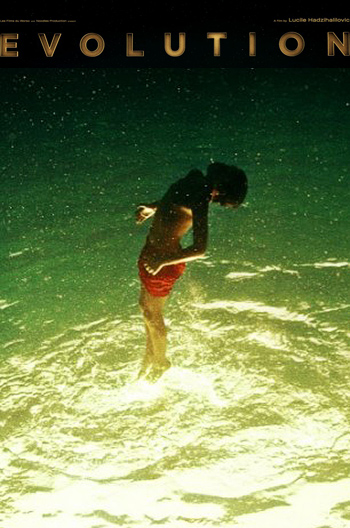
Evolution (2015)

From http://www.canaryislandsconnection.com/
wp-content/uploads/2015/11/cartel-evolution.jpg
Director: Lucile Hadzihalilovic
Screenwriter: Lucile Hadzihalilovic, Alante Kavaite and Geoff Cox
Cast: Max Brebant (as Nicolas); Roxane Duran (as Stella); Julie-Marie Parmentier (as La mère); Mathieu Goldfeld (as Victor); Nissim Renard (as Franck)


Synopsis: In an isolated coastal community, consisting of only adult women and young boys, one "son" Nicolas (Brebant) starts to question his environment and those of their "mothers", whether his own mother (Parmentier) is actually his mother, and witnessing strange sights around him.

Evolution is naturally going to be difficult to talk about because to discuss the plot, it will invoke spoiling a lot of the first viewing of it. I went into Evolution with only two small pieces of knowledge about it. One - it's director/co-writer Lucile Hadzihalilovic is the wife of Gaspar Noe, who worked on the production of his early films and eventually came to directing her own film in 2004 with Innocence, making the eleven year sabbatical whether intended or not to her second feature film Evolution an incredible wait. Two - that it's about a young boy in a mysterious community where there are no adult men or young girls, mother and son families which in the trailer immediately suggested a potential body horror or sci-fi plot; (thankfully) it never spoilt a single thing within its few minutes, instead leaving the enticing air to view the film you rarely find in other film's trailers. To read even further into this review, even without reading parts marked as spoilers, could be too much information for some though. This type of storytelling on display in the film, elusiveness and vague answers, has immense danger both of being mired in obscurity without a deliberate point to it and, when you know what the secret is, the rewatches being marred by a lack of rewatchability and mystery after. The real goal of such a plot structure - be it a film, a book, a comic - is to create an unsettled mood, where the lasting effect is not answering a mystery only but the metaphorical meaning, creating an alien reality and/or inducing emotions perturbed by what you witness alongside answering the mystery.

Nautical symbolism stands out as a unique trait of Evolution, the serenity of the coastal environment by the sea, populated by pure white buildings, undercut by how cold the film's tone is, beginning with Nicolas' obsession with a bright red starfish that he discovers during the first scene of the film, it's beauty as a creature alarming and as appropriately alien as many things you witness in the film, especially with how Nicolas comes to find said starfish originally. The creatures that occupy the oceans of the world are amongst some of the most alien to us, reflecting images of our greatest nightmares as much as they can be stunning to witness, their tentacles and mollusc limbs startling to see alive and move. Aspects of this filter in vague glimpses in Evolution between the tranquil underwater photography, suckers of a squid and outright body horror, when seen, offering an alarming connection.

The "normal" human interactions as well are strange to the viewer. Baring one of the younger nurses (Duran), red haired and youthful, who develops sympathy with Nicolas and starts showing concern for him in either an motherly or compassioned way, every other woman that Nicolas interacts with including his "mother" almost looks identical, brown dresses or nurses clothes, with similar shaped faced and slicked back brown-blonde hair, looking like clones of each other. The symbolic nature of the medical equipment - as the boys are subjected to unknown surgery, injections, being fed on drips - brings an immediate clinical nature, a hospital despite any attempt at being warm and friendly evoking the baseness of human bodies being medicated and opened with scalpels.

[Spoiler Warning]

The women are revealed to be possible half aquatic, half human figures who may be using the boys as surrogate mothers to breed further children, subverting gender as the boys "birth" others instead of women. The film is very oblique to what is exactly happening, but as it becomes immediately clear in the first ten minutes that a ritual or form of experimentation is taking place - the exact green mass of watery substances fed to Nicolas at every meal, the checkups with the female doctors and nurses, the instructions of his mother stern. Instead it becomes more of a film from the perspective of a young boy who will not know exactly what is going on to the events, the result leaving the viewing having to accept this obliqueness to the structure. Everything as a result is felt through the information that is not available to the viewer, that all he can learn as we do following him is from the most visceral images that startle him and the viewer likewise, more so as like him we are in his perspective as a young boy without any context for the sights and having to accept them as they are.

Within a film that doesn't pull punches, and hints at things that would people would hesitate in depicting in a mainstream English language film, this includes issues such as sexuality, within a fifteen rated film for its UK release the unexpected sight of a ritualistic combination of an orgy and dance chorography by the mothers witnessed from afar by Nicolas on a nearby sand dune, their nude bodies in a starfish formation writhing and smearing an unknown slime on themselves which evokes incestuous trains of thought as well as the boundary between human and other species. Without context to why such an act is carried out by the women, the mystery is the underlying power of the scene as it is with every other discovery Nicolas finds. When he is freed from the island by the kind nurse, whose name is revealed to be Stella, he is freed of their alien coastal world but that doesn't mean the questions of who he is will not appear especially as he grows older and rumination on his life takes place.

[Spoiler Warning Ends]

Technical Detail:
Following a lot of current, European cinema Evolution uses static camera shots with limited movement, adding to the eerie stillness of the environments and the performances. The problem I have with this common aesthetic style,  a two dimensional lifelessness, is negated here as its as much part of the cold atmosphere; within the clinical medical and bare homes, with no decoration in Nicolas' bedroom baring a fish bowl with the red starfish in it, there is intentionally disconnected visual that make the choice of cinematography logical. That the underwater and beach shots are still beautiful and colourful with the aquatic life on display also means that in limiting the camera's ability to move across screen, that doesn't mean the cardinal sin of making a film drab for the sake of realism is on display either, showing a better use of this style especially as the setting is shown in its fullest. There is an uncomfortable sensuality to the film as well, a dark sensual tone due to the use of light and the lack of it in night scenes. A golden hue of light becomes both unbelievably atmospheric but also is used for some of the most explicit material of a sombre, minimalist work, be it shocking to Nicolas or to us.

The almost complete lack of music furthers this. Baring a few strands of unconventional notes - including a Cyclobe track - the rest of the film is mostly silence and is given a suffocating air as a result. Emphasis on sound effects instead makes up the tension of the film, especially that which is implied, the gristliness of the some of the scenes because of what is only implied than rather seen.

Abstract Rating (High/Medium/Low/None): Medium
Evolution follows the plot structure of an innocent existing within a community that, when the veneer is peeled back by them, reveals a conspiracy or horror that they struggle to escape from. Stories like this allow for speculation - I was continually thinking of any specific biological aspects of aquatic life that could be symbolically referenced - but they are as much dependant less on a plot reveal but their pervasive mood.

Significant to Evolution is that as a film created by a woman, there is an entirely different perspective of gender that should be considered than if the film was made and co-written by a man. While the mothers and nurses are "others" to Nicolas and the viewers, the film explicitly deals with gender especially in themes of birth and pregnancy. One of the most visceral scenes is what looks like real footage of a caesarean birth, at first not revealed but eventually witnessed in graphic detail, the reality of a human belly being open and the fat layer under the skin being peeled back evoking more Stan Brakhage's The Act of Seeing With One's Own Eyes (1971) than a splatter horror film, leading to a new life being birthed from the incision. While the film is placed in body horror, the female figures are not stereotyped as monstrous, which could've made the film entertaining in a more open way but would've compromised this film's specific tone completely, more so as with the presence of the red haired nurse who befriends Nicolas and becomes a sympathetic figure, even one with a presence of a fairytale figure in a later scene underwater together.

The fact that the film is not necessarily a horror movie in terms of the stereotypes of the genre and yet is quantifiably part of the genre is a significant factor to its abstract tone alongside it's content, from the inherently eeriness of the aquatic imagery to the medical content. This type of story structure is greatly helped by the blurring of what exact genre it is, undermining expectations of the genre usually seen and leading to an unpredictable tone. It also means, for the sake of the film's deeper meaning and artistry, fluxuations to the genre are liable to inherently happen but also whilst still retaining plot stylistics becoming incredibly unreal in mood.

Abstract Spectrum: Expressionist/Weird
Abstract Tropes: Nautical/Aquatic Symbolism; Child Protagonist; Medical Symbology; Psychosexual References; Gender Subversion; Body Horror; Pregnancy Metaphors; Lack of Music Score; Static Cinematography;

Personal Opinion:
A rewarding surprise for the year 2016. More so as someone who has yet to see Innocence, her critically acclaimed debut, the absence from directing for over eleven years is hopefully one that will be corrected if Lucile Hadzihalilovic is able to get more films made from this one on. This means a great deal as this film is the kind of horror film that I gasp for as a man thirsts for water, rather than the clichés being wrung out something that feels like stepping into an alien environment that forces you to re-examine concepts such as the human body. At nearly eighty minutes only, its elusive tone makes it an outsider to other, more conventional horror films that would get more publicity, but in this exhibits all the potential over more viewings to compensate for its short feature length with so many emotions and images it will leave in my mind. 

From http://www.nosologeeks.es/wp-content/
uploads/evolutionbanner-620x400.png