Showing posts with label Director: Kei Fujiwara. Show all posts

Sunday, 1 November 2020

Ido (2005)


a.k. I.D.

Director: Kei Fujiwara

Screenplay: Kei Fujiwara

Cast: Kei Fujiwara as Ryo; Eiji Hayashi as Riki; Yoshiaki Maekawa as Yoshio; Yasuyuki Mineta as Yamada; Masamitsu Mizuguchi as Michi; Kenji Nasa as Numata; Tojima Shozo as Shimomura; Sakae Yamazaki as Yamazaki

A Night of a Thousand Horror (Movies) #200 / An Abstract List Candidate


Father is not a pig!

Following on from her directional debut Organ (1996), Kei Fujiwara sadly made only one other film with Ido, together anomalies in Japanese genre cinema for how distinct they are. This also has a distinct nature to it that it almost acts as if it is Organ 2, a long gestating project which directly connects to the previous film, a main character from that story returning as a traumatised homeless vagrant, introduced "borrowing" a harmonica from a young boy, a survivor of the previous film who finds himself on a pig farm.

Beginning with a voice talking of how a person can say "Amida Buddha" and be saved, the film in its genre bending, weird and grotesque form is nonetheless trying for something more distinct. With this character a bystander on the farm, the pigs are a metaphor for beasts' ungodliness, doomed to be because they cannot speak out in prayer. A controversial statement for some animal rights campaigners in the modern day, as is the comment heard also in voice over as they were created to show human beings their virtue, but bear in mind that human beings unfortunately, at least these ones on the farm, can also be beasts who just eat and fuck about, even arguably worse in how they live then the aforementioned animals here to eventually be processed into meat. Animals, whilst in Ido are meant to teach humans the value of life, do not become as dysfunctional as the group of people we see. One character is sympathetic, a near murder victim who surviving her family killing his whole family, but the main family that we follow, who squabble and get into arguments, are scraping in their own world of mess and squalor. Members are also idiosyncratic, like Yoshiro, a tall male character with a moustache and goatee who yet dresses with a schoolgirl's ponytail, kawaii schoolgirl accessories, plush toys and even a rucksack, at first meant to be an eccentric (and sympathetic) figure who is almost childhood, in spite of his hulking form, but also capable of awful behaviour like everyone else, with director Kei Fujiwara also among the cast of mainly male characters. Fujiwara herself will probably most recognised from Tetsuo the Iron Man (1989), playing the lead female character, but was also the co-cinematographer and working on the production of the Shinya Tsukamoto debut. Her own career after Ido, whilst finished in cinema from the 2000s and 2010s, would be in her own experimental theatre company, something to bear in mind with how this narrative work plays out.

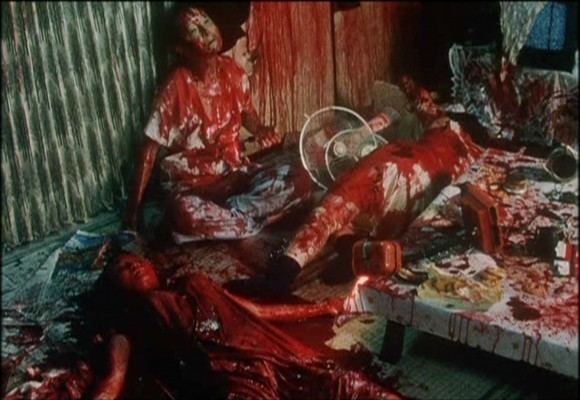
Split into chapters, of three stooges-like male figures (born from stop motion goop) wander about with a blank paged text they obsess over and tell the main narrative, Ido is a weird film. It is also, like Organ, a grimy and gross film full of degradation, liquids like blood and goo, and a dark view of humanity. In terms of an actual plot, we merely follow this multi-family group at the pig farm with a growing sense of chaos, which by Chapter 5 leads to a dead body which escalates everything to a full blood bath and justifying the horror genre tag.

A lot of the film is dealing with trauma as a large part of its subject. The survivor of her father, who after something disastrous in his career decided to kill himself and his family, still has a mental breakdown in spite of even joining a religious group who goes door-to-door to make proclamations about it. Fujiwara's character is likely a victim of trauma due to her father, seen in her memories and hallucinations as a sexual deviant, which suggests a really bleak way he traumatised her. Then there is the one figure that gets the worse of it, a schoolgirl. At first, revisiting Ido, I had presumed Yoshiro was this character himself, who had happened to be cast with a male actor, as is the case of the nine year old boy Riki being played by another adult man for a clear deliberate effect. In truth, the real character I was thinking of, and is a poor character in terms of what they go through, is a schoolgirl character played by a man, transgender as she is clearly comfortable as she is, who is introduced being peeked at undressing in her room as the others in the multi-family clan stroke phallic substitutes in part of Ido's deliberately broad and artificial tone.
This character never becomes a subject for its own subplot, and what happens is going to be uncomfortable for many, but in this bleak world, she joins the list of the few people in the cast who are sympathetic figures dragged down in the mire of this environment. Tragically beaten up when a would-be rapist, Yoshiro, learns whom she is, getting a rougher shake when forced to go back to he, to dress as a man, including having his hair forcibly cut off. Their very violent reaction, including demolishing a policeman's booth, is naturally understandable if extreme, especially as said police officer was involved in their entire trauma.

Ido is not an easy film to digest. It is a film more of mood, balanced by its intense mood and exceptional music by Ken Shimizu, who tragically did not do any other cinematic work, ramping up to the conclusion...which gets to the point of literalising its themes in a surreal extreme, as someone eats the face off a character which suddenly peeled off without prompt. Ido, to its credit, does have more to mind, this notion that society in its rot will drag people down to a lower state than beasts, following Organ taking a pulp horror thriller about illegal organ trading and adding a greater emotional conflict. Feeling as if characters from a Shohei Imamura piece here, the pig farming clan are isolated and breakdown, with the patriarch being killed and Fujiwara herself turning into a pig-human hybrid, it feels distinct and not pointlessly nasty for the sake of it.

It is worth this paragraph just to talk about the blood in Fujiwara's only two films, and violence in general, as it is horrible and visceral in a unique way to her, including how its aftermath is depicted. She herself, as a character, ends up so beat up due to an argument, bloodied giant bandage over one eye to contrast a bloody red dress, she looks like a literalisation of a Bloody Mary, part of the film's heightened extremity. Symbolically the film's deranged ending makes sense, where she is pushed to her limit and turns into a literal monster, infected as much by one of the other characters from Organ, who returns, who became a violent evil form himself in that film.

It is still something you would need to think about in greater detail in meaning, especially with context of Organ, but Ido does reach a manic power sided with a fascinating optimism at the end in spite of all that is endured. It is neither a contrived, conservative religious edge either, but the idea anyone, all these characters, could have found salvation in terms of release from pain, and the issue is more how utterly monstrous human society can be. It is definitely a film, like Organ, in dire need of revisiting and reappreciation, though one to follow with from Organ first to appreciate it fully. Again sadly, its director-writer did not make any other films, but thankfully, she was able to still create work in a field, more than likely, where it would not take years just to be able to make a film like this as was the case.

Abstract Spectrum: Eccentric/Grotesque/Weird

Abstract Rating (High/Medium/Low/None): Medium

Sunday, 12 November 2017

Organ (1996)

From https://media-cache.cinematerial.com/p/500x/
168frykf/organ-japanese-movie-poster.jpg

Director: Kei Fujiwara
Screenplay: Kei Fujiwara
Cast: Kei Fujiwara; Kimihiko Hasegawa; Kenji Nasa; Ryu Okubo; Tojima Shozo; Shun Sugata
A Night of a Thousand Horror (Movies) #149

[SPOILER WARNINGS]

Synopsis: An attempt burst an illegal organ transplant ring by two detectives turns into a disaster. One, Tosaka, becomes a puppet for Saeki, the brother of a one-eyed woman Yoko who helps run the organ ring, a schoolteacher at an all girl's school with psychosexual desires. Locked up in a secret room of Saeki's school office, Tosaka is slowly turning half plant. Numata, the senior detective, is thrown off the case, wandering the streets half drunk in despair of the scenario that took place only to be drawn back in. Tosaka's twin brother wants to find out the truth about his brother, beginning a search with great bloodshed.

Tetsuo: The Iron Man (1989) was a significant film when it was first released. Whilst great cinema was coming out of Japan in the eighties, neglected still to this day, Tetsuo had a momentous impact globally when it premiered in the West. What is also of worth with Tetsuo is that it wasn't just one person of notice came from the film but three instead. Director Shinya Tsukamoto himself is underrated even still, in the sense that his career is a vast and complex one which went from the energised brutality of his debut to more psychological, introspected and fascinating work to match his debut, films arguably as good as Tetsuo and in the cases of Tokyo Fist (1995) and A Snake of June (2002) even better. One of the crew Shozin Fukui went on not so long after, having made short films beforehand, to have his own film career. Sadly only two of his films have ever made an appearance in the West but thankfully those films are the ones that need more attention to them, 964 Pinocchio (1991) and Rubber's Lover (1996), cyberpunk films where in contrast to Tsukamoto he pushed the notion of Tetsuo of physical ferocity even further - in acting, in camera movement and editing - and made it part of his plots, the extremes of human trauma taken their furthest when Rubber's Lover is about an underground experiment where a combination of sensory deprivation (including rubber costuming depriving the skin its ability to breath) and drugs leads to powerful psychic abilities.

The least known and most unsung is sadly, considering how we are still in an era where female directors are underappreciated, co-cinematographer, costumer and main actress of Tetsuo Kei Fujiwara. In Tetsuo, even if it leads to an unfortunate moment involving a penis drill, Fujiwara is immediately striking in appearance and how she acts. Her sole two films as director are even more striking, the extremity of the other two by way of spirituality, Cronenbergian body horror, and horrifying, grimy degradation.ID (2005), which was originally meant to be a sequel to her first film Organ and includes characters from the first film played by the same actors, took the spirituality further, based upon the concept that even the most sinful of people can be redeemed if they pray to Buddha for salvation, and that animals can not due to being unable to do so. It followed people around a  slaughterhouse as madness, poverty and violence leads to a woman (played by Fujiwara) turning into beast for horrible consequences.

Organ is more of a gristly crime-horror film of its era, Japanese cult cinema where genre is polymorphous and people like me viewed them both for how almost dangerous they were. That these films were more sexual, more weird, more kinky, more transgressive - and yet had seriousness and actual intelligence running through their veins in the best examples. These films could be unpredictable in how well made they were and how they lingered with you. Organ is probably to grimiest of the lot even next to what Takashi Miike at his more extreme moments did in the nineties. It evokes his yakuza films of the period, like Shinjuku Triad Society (1995), which were virtually by also feeling like a microcosm of an unknown Japan, an underground of yakuza to the poor, but manages to be more gross and grim.

It's a film which is already bound to cause people to need to take a hot shower afterwards before the body horror takes place. Fujiwara shoots a film where there's scenes taking place in rubbish strewn back alleys, in dank warehouses or amongst homeless, drunk men in a shell of a building. Where, as Numata wanders in his own cloud of anger in slum, his wife is left at home to pee just to the side of her bed whilst the son is on the stairs playing a handheld videogame. A sense of rundown, degraded Japan that a lot of these genres were quick to depict, bringing entirely distinct views of the country, genre cinema in Japan even today at the lowest budgeted films always feeling like travelogues at ordinary urban and country life, from the weed covered back alleys and isolated petrol stations. This is before you get to the illegal organ transplant organisation, done in filthy warehouse rooms even if there's sterile plastic sheeting around the improvised operating table, or the yakuza spilling people's blood in an underpass tunnel. The violence itself is gristly and utterly painful to witness, never done with a desire to please the viewer but fill them with disgust.

Then you get to the stranger aspects of Organ, such as one unfortunately police detective after the prologue having all his limbs hacked off and kept in Saeki's secret room in his school office, becoming a rotted hybrid of flesh and plant with festering ooze coming off him, something Saeki himself is suffering from. The surreal dream sequence where Fujiwara is birthed from a cocoon like a butterfly, writhing from it. Even the tone of the film is slow burn, intercutting between sequences and with a sense of the film at points falling into chaos with sometimes the slower pace will be replaced by a frantic sense of editing. The sense of a place on screen that feels melancholic and disturbed is felt throughout, bodies just appearing next to a countryside road or a schoolgirl floating in a river.

It's a work that's filthy and bleak but also concerned for its human characters. Even the villains, siblings Saeki and Yoko,  are created from a traumatic childhood even when their mother, enraged by their father's likely adultery, attempted to cut off the son's genitals and blinded the older daughter who tried to stop her. Death is horrible in Organ, not an aesthetic pleasure, and whilst that will be off putting for most surface level cult film lists, like the best of this Japanese cult cinema it's actually a drama with complexity that just happens to exist in a genre, one that's willing to push boundaries of violence and sexuality to make the viewer step back and actually react viscerally. There's even a tinge of psychodrama to attack the viewer mentally with Saeki's subplot, his office already a place of suspicion with butterflies on mass pinned to boards on the walls before anything else comes to mind. His own dark sexual desires have to be kept in check with his female students or a female teacher who's suspicious of him.

It's a film which feels like it came from the underground, able to stand out more due to how the Japanese industry allowed these types of films to thrive for cinema or straight-to-video. In Fujiwara's work as much as Fukui and Tsukamoto, you get cinema which reflects a wider scope than most cinema, even if bleak still a snapshot of the down-and-out, a lot of it feeling like its from the perspective of filmmakers who came from the working class, or at least ordinary families and decided to use the ordinary locations due to practicality but for a point. (Tsukamoto and his constant obsession with urban environments, Fukui having actors running around a supermarket in a constant frantic one-shot, or running through a busy and crowded urban centre pulling a prop stone pyramid along on a chain, to Fujiwara's ID feeling like a perverse domestic drama of a family of working class slaughterhouse butchers who live in near poverty). Whilst they decided to show their ordinary worlds through a hyper-fantastical extreme, ironically with a film like Organ you get as much a continuation of the type of cinema Shohei Imamura explored. Human entomology that just happened to inexplicably (but brilliantly) filter itself in extreme and/or idiosyncratic genre films, not that strange considering Takashi Miike himself was a student of Imamura's who worked on his film sets. Whilst sadly Japanese genre cinema has filtered through less interesting tangents, the post-irony of Sushi Typhoon the biggest culprits in recent decade in removing this type of realistic snapshots through irony, the best of these films from pinku cinema to horror hybrids like this feel like they're actually scrutinising the human condition under a microscope, one here in Organ leavened in nastiness but never feeling repugnant without reason.

Abstract Spectrum: Body Horror/Dreamlike/Grotesque
Abstract Rating (High/Medium/Low/None): None

Personal Opinion:
A film that understandably can put people off from it, but like Kei Fujiwara's in career in general, but is in dire need of reappraisal. Particularly when there are issues about the lack of women directing horror in general, Organ needs the re-evaluation drastically especially as Fujiwara escapes the confines of what a lot of female directors still have to be put through. That their work doesn't get lionised necessarily because of its virtues but because of their gender, and film critics tend to praise these films because they tackle the surface of subjects engendered to female creators rather than tackle them (and subjects beyond) with risk and a willingness to shake a viewer. Particularly with a film like The Babadook (2014) which, for all the interesting things it brings up that only its director could've brought to it, is stuck with all the clichés of jump scare horror and plot structure, a film like Organ is so alien to the stereotype of what a film directed by a woman could be in the whole, token irritance of critical praise. One that however is clearly made by this one woman with an obsession between this and ID is spirituality found even in the nastiest, bleakest of circumstances and overcoming even full body rot. Something so much more rewarding, so much more awesome and better because it's not nice, it's not pleasantly tackling obvious things, but a gruesome genre film which however feels like a female director-screenwriter putting onscreen only what she could. 

From https://horrorpediadotcom.files.wordpress.com/2016/03/organ-2.png