Showing posts with label Mindbender. Show all posts

Friday, 19 March 2021

Black Night (2005)


a.k.a. Nuit noire

Director: Olivier Smolders

Screenplay: Olivier Smolders

Cast: Fabrice Rodriguez as Oscar; Yves-Marie Gnahoua as La femme africaine; Philippe Corbisier as Oscar enfant; Iris De Busschere as Le petite fille; Raffa Chillah as Le petite fille; Raymond Pradel a sLe taxidermiste; Marie Lecomte as Marie Neige; Luc David as Le médecin

An Abstract Film Candidate


“I was afraid to sleep, the night seemed so peopled with ghosts. My fear and my desire to see them caused events which I recognized very well without really understanding them.”

[Major Plot Spoilers Throughout]

Set in a world which is permanently dark, where the sun only shines for fifteen seconds a day, Black Night is firmly among the vein of surreal films which exist in their own logic. Immediately we are in the position where everything is subjective when we are introduced to protagonist Oscar (Fabrice Rodriguez). In the middle of a therapy session with his doctor, examining his thoughts for himself, we see a back-story of a happy childhood with his sister which was cut short by a shape shifter who ripped her limbs off, only with the factor that it was with his own hands (and scissors) she died afterwards. The therapist dismisses all this, the dream in a subjective image set in a theatre, with two creepy identical old men loom over the top as puppet masters. Reality for Oscar in an already abstract world is distorted for him.

An entomologist, one who specialises in filming insects, his days are greatly subverted when a woman (Yves-Marie Gnahoua) is found one day in his bed, pregnant and ill, his perspective of reality drastically under suspicion in what happens. Whilst shot in digital, Olivier Smolders' film is steeped in an atmosphere that is distinct, feeling at times likes the work of an installation filmmaker. His world even in the digital camera lens (and a CGI moon) is approaching chiaroscuro in its use of darkness and shadow. Set in a time in the past, it certainly looks of an old world, befitting its content. Animals will play a part, but especially with the real insects interspersed throughout. Some moments, like one pinned on a board, will upset but you get to the many, from stag beetles to insects, which in intercutting to will build the strange mood of the film with vibrancy. Magnificent creatures, they themselves are not creepy for me at all, though there are scenes of actors with them crawling on them, but their prescience are living objects alien to reality, such as those whose look like living dried leaves among examples, creatures a sense of they are the occupants of a dream the viewer has watching this film that actually from the reality of nature.

One aspect which does need to be addressed, as it is far more complicated, is that heavily layered aesthetic of African culture which could boarder on pure exoticism, including that a huge part of the film being that the woman in Oscar's bed is African, part of a narrative turn where his true childhood is exposed by a film he is provided, not like the one he fetishises in a shrine to his sister. Just a decade later to the 2000s the use of other cultures became more of an issue and Black Night's use of an aesthetic of an imaginary Africa could likely have become a problematic appropriate in another film. One immediate thing of note however is that Olivier Smolders was born in Leopoldville in the Belgian Congo, a city and country that would no longer exist only a few years after his birth, and are now known as Kinshasa in the Democratic Republic of Congo respectively. Only declaring independence in 1960, this becomes a more troubling subject in how, under King Leopold II, the Belgium colonisation of the Congo is steeped in a horrifying and bloody history, but at the same time I do not suspect Smolders came to this film's content ignorant of any of this, or that even merely evoking this past is not without meaning in not even hiding its existence.

In fact, learning this detail adds an even ominous edge to the film, one that I highly suspect is intended when, for Oscar's place of work at a Natural History Museum, Smolders is clearly filming in the Royal Museum of Central Africa in Tervuren, Belgium. Erected by Leopard II, and naturally as much a source of controversy in the decades that past as his statues erected of him from after his 1909 death, it is naturally an institution stepped in a moral crisis in that it was originally a museum to colonialism, which it has had to deal with in its own renovations over the dexades. Whilst there is a danger in Olivier Smolders having his film play out with a lens of an imagined Africa as a European film, or that he never addresses the violent colonial past, this context adds a great deal especially as the film's dreamlike narrative disrupts itself. A huge plot point reveals the woman in his bed as his sister, evoked from his father's past in the African continent, and for all the potential issues of its fetishism, the film's nightmarish qualities push for Oscar being a man with layers to him. None so much as an unhealthy fascination with his sister, specifically a perceived image he had of a sister beforehand, a white girl, who even haunts his real sister briefly and may have likely shot her in the head in one scene.

Black Night pushes further into the surreal when, faced with the body of his sister, Oscar decides to create a human cocoon. This does lead to another moment depending on how one interprets the narrative where Black Night could be problematic - as the black sister turns into a white woman leaving the cocoon - but even how this moves on in itself is significantly more complicated. The other actress, with striking eyes and visibly cast both for her willingness to do nudity and to look completely alien even to this world, plays a figure who is both is Oscar's fantasy but also meant to be his sister, the perverseness of the narrative turn address in one casting choice. His obsession with his sister is inherently held as a fixation, one where the versions (his idealised child one, the real one and this cocoon one) blur at one point.

Said cocoon sister also has a stinger to impale men, so Black Night is as much stoking in horror as much as its own form, particularly as among its other aesthetic aspects including is taxidermy, one of Oscar's colleagues in his own world of preserving animals and letting this woman see his mural of preserved frogs set to drinking absence in a bar which is, with real ones, as macabre as that suggests. The fact that Oscar tries to turn his real sister into his idealised one is itself political as it is psycho dramatic - if you were to consider that even evoking Belgium's colonial past is itself a metaphor for the European subconscious with its own past, something Belgium has still had to struggle with and is something many countries have had to, be it after the Black Lives Matter protests of 2020 or times of questioning the representation of that past, Oscar rejecting his own life is problematic with the act in a literal sense, only for it to be impossible to erase the real life. That this is also psychodramatic, that his psychosis and the obsession with the idealised sister are there, complicates things. That his new cocoon sister, baring a leopard print coat, more of a cloak of fur, is eroticised and naked, with her striking red hair, adds a further layer of complexity in this character's mind, a representation or a character or both.

Certainly, even if the themes this film have become more sensitive to the Belgian based director's country of living, which is had to still deal with and for some may have not even properly addressed, the context means that this film cannot be dismissed and now gains new complications in its favour to mean something. Black Night is hallucinatory and meant to keep one as a viewer off guard, with a world where Oscar is haunted. A strange man is haunting a man in a leopard pelt in the park, a white man who is a child killer, the same one evoked in Oscar's idealised childhood who mutilated his sister, and when the sun comes out for longer and purges the world in light, not only does the museum come in disarray due to film no longer being possible to shot, least to one of his colleagues, wild animals suddenly roam the streets. Real ones, be it a zebra in a back alley, a leopard and even an elephant. The ending becomes entirely in Oscar's mind as reality, and even when it comes to one key aspect I have wrangled with, the director himself has described in an interview that this past he refers to "in spite of historians’ efforts, stems from a kind of fantasy-ridden delirium sometimes actually quite far removed from the real Belgian Congo"1, he himself aware of the fantasy that this world evokes, including an awareness of its fiction. The tensions of the film, entirely in dream logic, are found everywhere, even in a scene of a schoolgirl, visiting a museum and played by an actress, randomly coming into Oscar's room and seducing him, only for it to merely scratch him and for her to disappear. A sense of this film having an unreality that forces the viewer out of their comfort, even in the mid-2000s digital sheen, is completely successful, and even if there are questions to still ask in terms of the subjects Black Night evokes in its images, it is a compelling film that will unpack more layers and interpretations when seen over and over.


Abstract Spectrum: Dreamlike/Mindbender/Ominous

Abstract Rating (High/Medium/Low/None): Medium


======

1) The full interview can be read HERE.

Saturday, 6 March 2021

Three Crowns of the Sailor (1983)


Director: Raúl Ruiz

Screenplay: Raúl Ruiz

Cast: Jean-Bernard Guillard as The Sailor; Philippe Deplanche as Tadeusz Krasinski, The Student; Jean Badin as The First Officer; Nadège Clair as María; Lisa Lyon as Matilde; Claude Derepp as The Ship's Captain; Franck Oger as The Blind Man; Diogo Dória as The Sailor's Sister's Fiancé

An Abstract Candidate


Don't stare or you'll end up like me.

Initially, I could almost view Three Crowns of the Sailor as being more subdued than some of the other productions I have seen just from Raúl Ruiz's eighties period, but then again his films can be subjective, and as this French production continues its world becomes more and more dreamlike as it continues. It is certainly one which is structured carefully and simple to grasp - a student (Philippe Deplanche), after murdering hsi professor, encounters a nameless sailor (Jean-Bernard Guillard), who will help him escape onto his ship providing he provides him three Danish crown coins before dawn and listens to his tale. Set in (mostly) black-and-white, this bookend follows on, in full colour to the sailor's experiences when he encountered the crew of the Funchalense and left home. The ship, naturally, is mysterious, travelling on its way from Singapore to Tangiers, the sailor encountering various people who will become memories to create a new family from when he has left his.

The crew themselves are eccentric and alien. The captain is obsessed, even in his dreams, of singing Beethoven's Ode to Joy, and there is a cruel hierarchy including that those loyal to the ship have letters marked in tattoos to their skin, connected to a tapestry the captain is sewing with the letters on in his spare time. When one crew member decides to throw himself overboard in disgust to his lot, he immediately appears the next day obvious to what he has done. They do not even use the bathroom; at least defecate, as the sailor learns when instead they sweat maggots from their skin. Obviously, something is amiss, [Spoilers] as Ruiz is adapting the Chilean legend of the Caleuche, the ship of the dead, from the Chilean director. [Spoilers End] But he is less interested in the obvious narrative then the sailor's journey, which in itself is an ode to the world of storytelling, where Ruiz himself in his career would have tangents, diversions and layers of stories upon layers which is continued here.

The sailor's life on the ship will lead him to encounter in Singapore a doctor in the body of a young boy, aging backwards like Benjamin Button if not fed, to a young woman in a Columbian brothel called Maria whose meek manner is contrasted by her living quarters, a bedroom where on the bed and even hung on the ceiling are many dolls, with glowing ominous eyes, and where she keeps her possessions in a full sized coffin, including marking all the men who come to her on the lid in chewed up multi-coloured gum she has had. To see Ruiz's work, especially in the rare moment you are graced with a fully restored version than the VHS hazed rips that a lot of his career exist in, shows how exceptional he is as a filmmaker but also how unconventional. The eighties was his most prolific and weirdest part of his career, and with the legendary Last Year in Marienbad (1961) cinematographer Sacha Vierny with him, Ruiz's world here is a thing of eerie beauty. Rich coloured gels and lighting dye the world, filmed in natural locations, from the purplish of purples to the reddest of reds. One thing, seeing his work as it should, which stands out is his curious and inspired framing of shots which keeps one off-guard, inspired by his love of Orson Welles and his use of the visual frame. He is obsessed with objects and figures in the foreground and background, taking advantage of the three dimensional space in the two dimensional image, whether a hand buttering food, a cup or even a scabby wart covered foot.

The most amazing thing about this beautiful aesthetic is that Three Crowns of the Sailor was originally commissioned as a made-for-television film. That is not a bias against made-for-television films, as if anything with a man who made moving images in all mediums as one breathed oxygen, Ruiz here with Vierny, ­his wife and frequent editor Valeria Sarmiento, and everyone who collaborated on the project effectively show the a television commission is good enough to be shown on even a theatrical screen. This style is, also, where Ruiz can wrong foot a viewer. Sometimes it is overt - a bravado first person shot from the captain of the ship playing cards with the sailor, giant hands with cards greeting one in the image - but as the film becomes more and more haunted, and weirder, the style is able to effortlessly bring this about in mood. Three Crowns is subdued at first, a slow burn as the sailor enters the world of sailing, but even this is marked in oddness. The celebration for his leaving by his family and the neighbourhood is heightened, even before a frame or two is edited in of men with masks on, and whether a result of damage of the restored negative/film source or intentional, it starts the many scenes with blue faded marks on the image itself.

The introduction to Maria, in her oblique and apologetic tone and her collection of dolls, introduces more of the surreal in the sailor's tale. His story is less overtly bizarre, fed on the influence of classic storytelling Ruiz will gladly even evoke in a library shelf of such titles in one scene, but in exaggeration. A scene with a young boy who saves his life has many globes of the world in the room, and when he does become overtly surreal, the sequences are more striking. The most striking is Mathilde (Lisa Lyon), the erotic dancer the sailor becomes fixated on, until the point he learns that beyond her mouth, her body is literally like a doll's. This can be interpreted in a crass way, that she herself blatantly says she has to do everything with her mouth, but even to the point of fake female genitalia we discretely see placed on the table, the most surreal of scenes in Three Crowns of the Sailor, and its most extreme, also is definitely one few would have expected to find in a film. It also still means something as, in his search for something real, the sailor's finds himself trapped in another illusion again as a result than what he wanted.

On a surface level, Three Crowns of the Sailor was just a wonderful, strange pleasure of storytelling itself. A work which is entirely about the spun stories of the sea, the sailors exchanging them and spiralling out in their elaborateness as they are retold by others. The only consistent, between the ship sinking only to return in another harbour to a blind man who lied so much one cannot gather truth from him, is money which proves the sailor's downfall. Even said money, in various currencies, blurs into each other in what it is. Said film, by itself, is a thing of utmost beauty even in its strangest and unnerving aspects, for the story of the student returns and, in his hasty and violent reaction to the sailor's stalling, he realises the trap he has found himself in. As a film, part of the tapestry I found myself submerged in years ago, tales-within-tales, it is an experience I am ever grateful to have had finally.


Abstract Spectrum: Dreamlike/Surreal

Abstract Rating (High/Medium/Low/None): Medium


Friday, 5 March 2021

Jesus Shows You the Way to the Highway (2019)


Director: Miguel Llansó

Screenplay: Miguel Llansó

Cast: Daniel Tadesse as Agent D.T. Gagano; Agustín Mateo as Palmer Eldritch / Batfro; Guillermo Llansó as Stalin / Roy Mascarone / Agent D.T. Gagano (Cartoon Version) / Stalin's Assistant; Solomon Tashe as Batfro; Gerda-Annette Allikas as Malin; Rene Köster as Captain Lagucci; Lauri Lagle as Alfons Rebane; Carlo Pironti as Mr. Sophistication

An Abstract List Candidate


Stop sodomising me agent, and try to find a way to wake up.

I think it says a lot about Llansó's film that even its country of origin is bisected into many. A Spanish filmmaker partially filming in Ethiopia, which was the backdrop for his theatrical debut Crumbs (2015), but also Estonia and Latvia. The one thing we can confirm is that the resulting product, helped into birth by Kickstarter funding, is eccentric.

Effectively imagining if the Cold War existed in a pop culture morass, this has the C.I.A. against the Soviet Union in cyberspace over the Psychobook, an imagined world in tech accessed in chunky old virtual reality helmets. As expected, the virtual world is not so safe, as is to be found with the unfortunate end for a C.I.A. agent whose eyes get burst. Instead, Palmer (Agustín Mateo) and Gagano (Daniel Tadesse), the later the star of Crumbs and the lead, have to take over. The later, planning to retire with his girlfriend Malin (Gerda-Annette Allikas) to fund her kickboxing academy, and maybe take his obsession with pizza margherita to creating his own restaurant, has however to do one last mission. Tragically, this leads to his consciousness being lost in the Psychobook whilst a computer virus in the personification of Joseph Stalin, by way of a paper cut out which is stop motioned to speak on an actor's face, is trying to acquire power through hacking his enemies.  

It feels apt that, in this genre mash-up, that two of the co-producing territories are Estonia and Lativia, formerly two Soviet controlled territories behind the Iron Curtain, time having turned real history into Cold War pulp stories which Llansó has deliberately bastardised here. The other espionage films, though, may have not had Ethiopian kung fu masters named after pasta dishes, post-dubbed voices, and Batfro (Solomon Tashe), a man in an Adam West era Batman costume (with the insignia blurred on his chest), who is probably a villain but definitely hates drugs, in spite of the fact a Soviet propaganda film playing on a "Better-Ethiopian" television shows him snorting blow at his swanky mansion. A film like this, in the modern form of cult film, can be a double edged sword in that they skirt the line between reward and the danger in their style and weirdness, where after their fifteen minutes of fame they can disappear after being hailed as new cult films. This film to its credit has the advantage that, just two films in his career, Llansó has a style entirely of his own. Something which depends on whether he can, even if he decides just to make pulpy weird genre films, sustain a compelling world of his own from the virtues he has here.

A huge thing in his favour is that, having to work with a low budget he had to sustain with a Kickstarter fund, Llansó's solutions are completely unique. The world of the Psychobook for example, whilst in reality and having real actors, brings in a curious form of stop motion where some actors move with herky movements, encapsulated by the bizarre and even profane decision to have their faces paper cut-outs, rendered to speak, of famous figures. Palmer and Gagano for example, though the later becomes himself trapped in the virtual world, compete their spy work with the faces of Robert Redford and Richard Pryor as talking masks, the former in hindsight Llansó showing some savvy, or even unintentionally, by evoking Three Days of the Condor (1975), a "proper" conspiracy thriller fed from an era of disillusionment and paranoia whose lead's face is replicated here. It feels befitting, rather than trivialising the true sadness of the Stalinist regime, that Joseph Stalin, a despot behind many purges, is now reduced to the visage jerkily moving, and visibly wearing Nike shoes as one zoom in shows. Once a figure whose visage was likely seen on many framed pictures in Soviet Russia, that he is now surrounded by Mr. Sophistication (Carlo Pironti), a man so cartoonishly accented in his Italian accent to compensate for being an elderly man, and Batfro, is an apt punishment in terms of being embarrassed in death.

A lot of the film does feel of a post-ironic era of weirdness for the sake of weirdness, which I have become more averse too simply because too many of these films come about, get praise, and then suddenly disappear because they are not with much after the initial reaction, even if you are fond of them in the initial afterglow of the theatrical experience. Truthfully, the intentionally absurd edge means Jesus Shows... is not abstract to me at all, because it shows its hand in being ridiculous immediately and never really comes off as dumbfounding in what weird thing it does. What it does however, and I am hopeful for Llansó in regards to, is that this is made by someone willing to be brave in their work, including the fact there are moments from its three directors of photography where they clearly shot on film, 16mm to be precise, which is a surprise to think was done for production value and adds a texture to the world onscreen.

Llansó also clearly knows the references he is winking at, as he even has the Adam West Batman, uncensored, in the film even if it is a bizarre television advertisement playing in the background with Batgirl talking about finance. Pre-existing footage of submarines jars with chiptune music, and old archaic tech matches with video game logic, where an unseen voiceover says "Round 1" when the pasta named kung-fu masters fight an Ethiopian Shaolin monk protecting the "Ark of the Covenant".  An old portable television, now housing a man trapped without a body, evokes melancholia and sadness in the same think where, returning to the kung fu fighters, suddenly one has to think of Wakaliwood in Uganda, and that one day we will be getting even more martial arts films from the various African countries with all the people who can perform actual high kicks in the continent as we also see here.

There is a danger, if a hundred years passes and cinema lives still, where one has to ask who will get any of these references but in a way Llansó is treading into references some people even now do not get, like Redford being a face, or that inexplicably fly men with laser eyes appear to evoke old b-movies, one of which may have been Jesus Christ trapped in a controlling monster costume full of variety box chocolates of enlightenment. Inexplicably in the middle of writing this review, I am thinking of Quentin Tarantino's Once Upon a Time in Hollywood (2019), a film full of references most will have not heard of in just forty to fifty years, both films subsuming the viewer into the past and forcing them to rethink symbols, and even if Jesus Shows You the Way to the Highway has to be released with a glossary of references in a hundred years, like a Penguin Classic film release, it at least is a film of its own quirks as much as references. It is distorting the references, and even if you do not get any of them, the film sustains a logic and compelling nature that, if it wins you over, then digging into the references will grow and nurture your admiration for it. Even if I strongly suspect it is closer to the pastiche films of now then a legitimate alien oddity I am drawn to, to the film's credit Jesus Shows... has so much I admire that I did love it, so much to see Miguel Llansó one day pulling out a real alien on me when I least expect it.

Certainly, he does so much right. The thing which won me over was that, whilst there is chiptune in the score, also good in a soundtrack made by three different people, he has for the score mostly jazz. An exceptional jazz band soundtrack, between cool jazz to avant-garde, which is not a score you usually have in a wannabe-neo-cult film, would have needed time to composer, and is beautifully idiosyncratic. His casting is also something unique and admiring. Daniel Tadesse, who is a compelling screen figure, is in real life a hunchbacked man with dwarfism, whose character whilst called a dwarf at times or worst (by the villains mostly) once or twice is never played off his appearance but his acting charisma. His girlfriend Malin is a big, statuesque woman, not a conventional thin figure but a big sturdy figure, and there is never a joke about Tadesse and Allikas' visible physical differences as characters as a joke. The Ethiopian setting, even if the cast are cartoonishly post-dubbed, is still people from the country, including the aforementioned individuals playing kung fu experts who are competent, making the comment earlier about wanting African martial arts films something likely to happen one day and being prayed for. Llansó's decision to even have the film partially set in Ethiopia, like a curious Werner Herzog of gonzo weird cinema, is felt with love and with none of the film being patronising, taking in the natural locations and locals as something to admire. Even if the film has characters named Spaghetti and Ravioli, said film is paradoxically also going to make its weirdness progressive and encompassing the world in all forms at the same time.

And returning to the idea earlier, one has to ask what will people reflect in the historical books on the Cold War in a century's time? Here it is reduced to conflicts between unseen figures, where even the C.I.A. will make their agents disposable, burying the bodies in the beach and cremating them in the sand, with the paper masks literally leading to a mask hiding other masks. Will anything from history of that era mean much, as here Llansó has to express it through video game fight scenes and post-dub silliness? Spirituality is strangely more relevant as, whilst he is proven not to be the Messiah, the Jesus here with his boom-box crucifix is the path to freedom and as much shows the meekness not to presume Himself a divinity, merely a guide to help another. More so especially as the film gently falls into subjective reality twists Philip K. Dick might have raised a thumbs up with, as naturally reality as is can be questioned with reality-within-reality-within-reality concerns.

In fact deciding to put everything into the blender like most neo-cult films, with the danger still there of this not having lasting impact, is at least helped because Miguel Llansó has a film which, straightforwardly told for all its weirdness, does have an emotional current and characters we like. With Daniel Tadesse's Gagano as a figure we follow in this farce and feel for, it helps the film especially when it brings in its own weird logic, like the human mouth being used for a credit card machine or Batfro, and having something to follow having to adapt to all this. Certainly, after seeing this film, I have nothing but positivity and optimism for Miguel Llansó as a filmmaker and can see him, if he can, staying in relevance if he works from the virtues here and hones them.


Abstract Spectrum: Eccentric/Weird

Abstract Rating (High/Medium/Low/None): None

Wednesday, 13 January 2021

The Trial (1962)


Director: Orson Welles

Screenplay: Pierre Cholot and Orson Welles

Based on a novel by Franz Kafka

Cast: Anthony Perkins as Josef K.; Jeanne Moreau as Marika Burstner; Romy Schneider as Leni; Elsa Martinelli as Hilda; Suzanne Flon as Miss Pittl; Orson Welles as Albert Hastler; Akim Tamiroff as Bloch; Madeleine Robinson as Mrs. Grubach

An Abstract Film Candidate


Adapting Franz Kafka's tale, in which a man named Josef K. (Anthony Perkins) is charged for a crime he had no prior knowledge of and is never told the charge at all, The Trial opens with a prologue based on a passage from the text. Of a man who waits outside "the Doors of the Law", aging and dying whilst both never being allowed in and the guard to inform him the doors were for him only. Dreamlike and of an unknown subtext, director Orson Welles himself narratives over the evocative hand drawn illustrations of this miniature narrative by Alexandre Alexeieff, a melancholic and strange one apt for a Kafka adaptation.

As a director who continually evolved, Orson Welles here was in total exile from Hollywood, immediately changing to a new world in terms of cinema. Whilst this is a French-Italian-German production, I ended up thinking of Mickey One (1965), as much because both used jazz in their scores but because, the later an Arthur Penn production in Hollywood influenced by European cinema, both exist in abstract worlds where the leads are in continuous paranoia of unknown forces. In Mickey One, it was a young Warren Betty as a stand-up comedian; here, it was Anthony Perkins, a clerk who suddenly wakes up in his introduction with a police officer in his bedroom.

There is a huge distinction in casting Perkins. Tragically his career was shadowed by Psycho (1960) and Norman Bates, which is worse because that was an incredible performance in itself, but here you can see his talent. He is perfect as a Kafka character, the nervous twitch of a man confused by a world which is based greatly on misperception. It is certainly, undoubtedly, an idiosyncratic film, for were it not for the fact he would move to even more experimental work like F For Fake (1973) in the seventies, this would be Welles' proudly entering into abstract cinema. An eerie one, where Perkins' Josef K. finds himself pin ponged between unknown forces, from large courts which amass a crowd, to Welles himself playing Albert Hastler, an advocate who could help Josef were it not for the fact that these cases are endless, Josef eventually meeting old people, half dressed with numbers hung round their necks in a hall, he is effectively among. That Bloch (Akim Tamiroff), one of Hastler's clients, has been in his shadow for years, effectively part of his furniture sleeping in a spare room, emphasises eventually the Advocate is just a figure who toys with his clients.

The film has an inherently surreal nature to itself, but interlaces it with an oppressive tone from the opening scene, not only with Josef being woken up in bed but with other policemen in his room, trying to steal shirts from him as impounded goods and even his co-workers in the lounge. The world, through a very distinct script, is full of traps, where authority can (in this scene) try dominate Josef by claiming a word does not exist is one, to describe an oval marking on his bedroom floor from where a dentist's chair used to be, only to question when he talks of this word as if he said it first. That those police, who tried to steal his clothes, when he makes a charge of misconduct, find themselves in the broom closest of his work place being punished by whipping shows how perverse and dog-eat-dog this existence is.

In a world where there is seemingly no tangible authority, not even a precise explanation to how it works let alone why Josef is even on trial, the film is also befittingly strange in appearance. Shot in Italy, France and even Croatia, the architecture looms over Josef as one man in the centre, and the locations created for the film contribute as much for this. His work place is a vast hall of desks, his superiority only shown in having a raised platform for his desk, not even having walls. Environments at one point do bleed into each other. Some are created locations of dreams and nightmares, from winding and endless corridors of files on shelves, to a room where the floor is entirely covered in manuscripts and documents. Even some of the aspects dated of the early sixties now have an appropriately weird aesthetic, like a giant wall expanding computer the male engineers have naturally christened female like a boat.

That is before you considering the characters and the cast, populated in legendary French stars even in minor roles, from Jeanne Moreau as Marika, as Josef's next door neighbour or a tiny cameo by Michael Lonsdale as a priest. Romy Schneider, making her role in That Most Important Thing: Love (1975) with Andrzej Żuławski merely an escalation, plays the maid and mistress to Hastler, who is attracted to guilty men and, for no reason, has webbed fingers on one hand which never becomes a plot point. Then there are specific characters, from Welles' corrupt figure of power, given his commanding voice and prescience, to a painter who specialises in commissions for the judges, already a figure with an eeriness to him as, predating Beatlemania, he is inexplicably hounded by young (teen) girls who would mob his home/work place, a merely cage of wooden pallets, if he had left the door open. There is a lot of explicit sexual and political layers, and flat out innuendo, including questions of Josef's behaviour such as the presumption, when his young female cousin visits as a sympathetic voice, that he is going to "corrupt" her. And Schneider, whose character of Leni is the other most prominent character, is at once fascinating if her own curious figure due to her fetish.

That is before the ending, rewritten by Welles as a co-writer, with unexpected death by dynamite. This is all in mind that, throughout, The Trial is still sombre, that its weirdness is contrasted by a sumptuous production with dread inducing atmosphere and exquisite dialogue, a melancholic conclusion as, by the time Welles himself in the end credits lists off the production crew in narration, he befittingly gave the author of The Metamorphosis both an alien yet profoundly atmospheric adaptation.

Abstract Spectrum: Atmospheric/Paranoid/Weird

Abstract Rating (High/Medium/Low/None): Medium

Thursday, 22 October 2020

Limbo (1999)


Director: Tina Krause

Screenplay: Tina Krause

Cast: Barron; Suze Daufler; Sean Farrell; Vincent Hager; Jessica Krause; Tina Krause; Mike Lisa; Susan McAnnich; Mike Sand

A Night of a Thousand Horror (Movies) #191 / An Abstract List Candidate


E=MC2 Hammer

Dug up and rediscovered by the American Genre Film Archive and Bleeding Skull, I will add context to Limbo as I go on, as my experience with this film as much is based upon this knowledge as much as the content. What I will say immediately though it that this is a rare shot-on-video film by a female director, Tina Krause was more prolific as a horror Scream Queen even into the currently, including working with W.A.V.E Productions, a company who filmed scripts sent in by their audience which could lead to a lot of fetishes. It is also a film partially originating, literally, from Krause around that era as an actress accidentally ingesting drug laced cake, carrying over her own hallucinogenic experience to Limbo1.

Limbo, openly, is a one-off which will be difficult for many to appreciate. After a prologue where two people are running at night through the streets, you are thrown into an audio visual barrage which begins at a bar, completely alien to what is usually expected from a shot-on-video film from before, namely a narrative work on a micro-budget. Instead, at the beginning you see this film go in a different direction - cuts to chauvinist bar patrons, where gender politics is a common concern throughout; erratic sound design and the layering of it; eeriness, especially when the film freezes to a long pan past a pool table and its players; and film reel sounds that cut to footage of a stone statue but also a man writhing near a white wall.

In the midst of this is Katherine. She is a haunted woman and those around her are haunted by what is pursuing her. A man only she can see in the bar tells her she has nowhere to hide anymore. It is, plot wise, very difficult to discern as Krause was more interesting in making an "Art House Symphonic" production, actually sold as a vampire film just to be able to push the production ahead even on a micro-budget. What the plot in its few slithers are is vague, but you can see Katherine as a figure from the afterlife, chased by it or once part of, even maiming or killing bystanders deliberately or unintentionally along the way.

The film has its flaws. It is not necessarily the non-linear structure, closer to an art piece than a plotted narrative, and certainly evoking the infamous Nine Inch Nails project Broken (1993), a promotional video that was never released which was a fake snuff film intertwined with music videos for songs. Most of the issues here are in knowledge Limbo took two years to make, on a micro budget, largely filmed in an old abandoned tobacco factory Krause squatted and lived in for ten years, even having to chase out drug dealers mid-shooting with a 2x4 with a nail stuck in it. A film which, for a first time director with some ambition, has to be admired even if with flaws. For me, the only egregious issue in production quality is the sound design, a cacophony between inaudible dialogue and noise which betrays the film, tragic as well because the music throughout is eclectic and memorable, such as a gothic blues rock song that is impactful in a seduction scene which leads to Katherine clearly being a dangerous figure without her realising.

What it is is an art piece and a haze dream smashed together. Krause shows some inspired visual motifs throughout alongside the lo-fi homemade quality, like televisions spiralling within televisions as the camera turns in canted shots, contrasted by material which feels improvised like a digression in a women's bathroom in the bar, feeling closer to behind-the-scenes footage as one of the cast compares herself to Neve Campbell. It is a mood piece whose plot is honestly difficult to describe. It has enough to stand out; there is also a lot that vastly contrasts the kind of films Krause worked in, closer to performance art and underground culture in tone, such as a hellish sequence for Katherine with phosphorescent body paint covered dancers in a darkened room. A lot of the film is drawing on the kind of imagery in other more cohesive horror films, such as the mental asylum sequences with writhing patients likely shot in her tobacco factory home, which Krause makes more weirder and scarier, even if still over-the-top, because of the film looking more homemade and due to time having made the surviving videotape master grimy.

It does come from the heart. It is definitely a bizarre viewing experience, a fever dream on VHS which spits you out at the other end rather than be watched by a viewer. It also has personal details which mean more, including a lot about sexism, of male bar patrons who are ogling the female customers, to one drunk pervert kicked out for molesting the female staff. Sadly, this aspect came out into even making the film, as Krause even had to promote it under the alias "Stephen Krause"to get anyway with this. Particularly with what works here, she is interesting behind the camera. Seeing the later short The Answering Machine (2001) is further evidence of this - a series of answering machine messages between a man and a woman, no one onscreen but just with shots of two phones as a date planned turns sour when just selecting where to eat - and how she could have progressed in her filmmaking.

Limbo is, again, also one of the few of this realm directed by a woman at this time, one of the only other exceptions in the micro budget world being Phobe: The Xenophobic Experiments (1995) by Erica Benedikty, a Canadian cult sci-fi film. Limbo whilst a mess at times is, among a mass of SOV films which can be utter messes too, one with a distinct dark edge and a lot of aspirations. For all that betrays it, a scene of conversation in the public difficult to hear because of the wind, there are also really grotesque but effective moments such as a near nude woman, in a ballerina pose in an open doorway, possibly an actual dancer, having her guts removed. Throughout it does evoke the dark edgy period post-Marilyn Manson and Nine Inch Nails, but it is also very evocative at the same time, something I have not actually seen in these types of films from the decades before in terms of inspiration. The film is an anomaly even in terms of when it was made, adding a greater appreciation. The late nineties into the Millennium was my childhood, and how odd it is at the time I was growing up, with films like Idle Hands (1999) with Seth Green, the pop punk and the nu metal of the new decade, and other such pop culture, this film came and went too in the midst of all this. I was ten when Limbo barely came out, and preserved on a fuzzy transfer, it is strange to see a work completely alien to my childhood memories but definitely of that era, a Goth near-Millennial art genre film in its own erratic pocket.

Abstract Spectrum: Hazy/Mindbender/Non-Linear/Weird

Abstract Rating (High/Medium/Low/None): Low


========

1) There will be many references, from the AGFA Blu-Ray release's extras, of the Fantastic Fest Q&A when this film was premiered in 2019 with the director. Rather than just keep tagging this at the bottom, just be aware the really candid and evocative behind-the-scenes gossip in the review is all from Krause's own testimony in this questions and answer session after the film was screened.

Monday, 25 May 2020

Lasagna Cat Part 4 - Sex Survey Results (2017)


Following on from Part 3.

[Updated 25/07/2021 - Out of sympathy for a comment posted in regards to this review, an additional note has been created.]

Major Spoilers Throughout

We conclude Lasagna Cat - from Garfield being crucified to shampoo bukkake - to an ending which somehow managed to top the following. If you the reader can forgive me for once making pop culture reference, if episode 07/27/1978 covered last time was the television ending of the anime series Neon Genesis Evangelion (1995), Sex Survey Results is The End of Evangelion (1997). It makes senses, to explain the reference to those who do not know what I am talking about, if one considers how the original Neon Genesis Evangelion started off with lighter tone for its darkness, and became progressively bleaker in the second half, as seasons one and two for Lasagna Cat were. 07/27/1978 is the equivalent of the very divisive final two episodes, pushing for the unexpected and esoteric, but with one leading to a male protagonist finally accepting himself and finding happiness; 07/27/1978 was Fatal Farm admitting even with some cheek that having made a parody of Garfield for over ten years, they could not hate it still after all these years.

The End of Evangelion was infamously the alternative ending which manages to be even darker than what transpired, scarred viewers which what transpired in one of the early scenes with beloved characters, had extreme avant-garde (and even live action) moments, and was a bleak ending with a cyclical nature to it. How Lasagna Cat decided to finish an alternative ending for itself was a four plus hour experimental piece repeating the same knock knock joke with sex survey information polled by fans. That was followed by a conclusion bleaker than anything before, and managing to scar viewers with what happens to beloved characters even after what had transpired in the two seasons before.

At the start of Season 2, when creators Zachary Johnson and Jeffrey Max had sat on new episodes for years and decided to use them, they had created a trailer where they included a gimmick for Season Two, providing a toll free number and asking viewers to call, providing a name and the number of sexual partners. The mechanics of Sex Survey Results itself, having so much to work with and not even using all the calls they got, is exceptional when learnt of, including a programmed Excel spreadsheet to time and plan out what they were to do with what they acquired. The work is split into two parts, the first four plus hours of a never ending cycle. Jon Arbuckle, than Garfield and then Odie are reading a newspaper only to answer the door.  A male or female mannequin answers from the other side for each of the trio, a call from the toll free number becoming a knock knock joke, repeated until all nine hundred and ninety nine used are concluded.

Honestly, I did struggle to get through the entire first half, simple because four hours of this is long. I will get into a lot of the interest of this segment, but as an extreme form of avant-garde cinema, and it deserves that genre tag, it is difficult and between the times I have covered this web series, I have had to break it up into pieces over weeks. And it is not a joke either to say "avant-garde" because when Andy Warhol could film Empire (1964), six plus hours of a continuous shot of the Empire State Building, this is in the same area of endurance. Technically, Sex Survey Results is also an achievement in resourcefulness by Fatal Farm, acquiring a full motiom camera rig1 to film the material in a set built as a living room, meant to be a continuous shot as each knock knock joke becomes the newspaper comic for each character. Baring the set itself, they recorded outside footage beyond the door too for an extended time period that goes from day to night in real time, leading as well to a cameo by an ice cream truck early on alongside other sights.

It was a spectacle in spite of the moments of frustration trying to finish the first segment. I  do not consider it a piece of "trolling" either, intentionally meant to annoy people, but a thank you to fans, like thank you credits, turned into something offbeat and playful. All the voices calls from men and women vary. Some are jokes, including Donald Duck making a call or Monday telling Garfield (in one of the few times he shows emotion) he has been his partner every day of his life. One cast member from the animated series RWBY (2013-)  calls in, and also unfortunately Max Landis. Hindsight has shown a time when Max Landis, son of director John Landis, was growing into a pop culture figure as a screenwriter and commentator, only in December 2017 for accusations of sexual assault to become known, making his call and number of sexual partners eerie to listen to. Fatal Farm themselves cannot help time taking an effect on their work.

The amount of phone calls, nine hundred and ninety nine as mentioned, are arguably too much to digest. Practically this is closer to an installation piece where you should drift in and out of it, particularly as when you isolate messages, for everyone which merely states what is asked of, many do have things of note. Many exaggerate fake numbers of sexual partners, usually the number sixty nine, and a few go for jokes that Garfield especially groans at for us, such as when Adolf Hitler calls in. The interactions to the callers are all unique, filming Jeffrey Max as Jon Arbuckle, with even Oodie pronouncing each name in dog barks.

The choices, even before you get to certain figures, make a fascinating analysis in themselves among those who are stoned or being honest after trying to pass off a lie. Whilst some of the female callers make joke calls and exaggerate, for the most part you could argue that the high numbers of partners many state are entirely true as, in vast contrast to many male callers, there is not as much a case of them not taking the call seriously or trying to be funny. Quite a lot more male callers use fake names, make ridiculous voices or even impersonate Donald Trump, a vast contrast in a lot of the calls being longer and more likely to fall into tangents. Also to the person who did a call entirely in Morse Code (which is thankfully translated), they deserve extra brownie points*.

There are of course a few choice inclusions, to which the caller who has gained the most notoriety has to be "Raymond", who three calls eventually get towards him elaborating on his history with early online forums online where he would role-play scenarios with other uses including vore. To some viewers, how explicit he is as he narratives this is enough, but it is also a fascinating anecdote of a type of sexual kink from the perspective of forums where that was a lack of restrictions preventing it.

The endurance of the first half, even if split into bite sized pieces, is an acquired taste. Baring violent distortions of the mannequins over time, it stays as this for over four hours until the last ten or so minutes. Then things go south quickly for Jon Arbuckle...


The trailer for Season Two, asking for the calls, set up its finale in that Jon himself was the first caller, the one thousandth at the conclusion to the first segment, greeting himself at the door. It might seem odd he says he has had two sexual partners, especially as just from the comic strips used in the web series the character is an isolated bachelor. It gains weight knowing Jon was originally a stand-in for his creator Jin Davis originally, Davis marrying twice and having children from both marriages. Jon inside the house corrects the other, that he has had zero, shutting him out.

An old Jon is there now, Max in old age make up and balding hair piece, a real orange-reddish furred cat in the window a stand in as Garfield before he walks away from the house. Here it must be stated that a) I originally did not like this finale, perceiving it as empty shock value, only to come to a greater appreciation now, whilst b) Fatal Farm openly admitted there was no profoundness to what transpires, that it was to be their equivalent of 2001: A Space Odyssey (1968) and The Holy Mountain (1973) combined1.  Unintentionally or subtly deliberately, there is a meaning to read. What transpires infamously is the death of Jon Arbuckle, by way of a naked shaman painted as Garfield2, to his resurrection when a girl in a public bathroom gives birth to him into a toilet.

And when I describe that, the level of explicitness includes (as documented) the creative duo acquiring the bottom half of a very realistic sex doll and shooting a certain shot3. It is ridiculous. Probably the most over-the-top detail is what the girl says before leaving the child there. Originally intended to be spoken in English, the actress cast informed Fatal Farm she could speak fluent Polish, and thus the following (un-subtitled) is what is spoken:

This child isn't mine. This child is from the darkness. I bore the humanity's curse. I can ask for mercy, which I won't get. My soul will be consumed and thrown up and then consumed again. Forever. Sick joke, but no one's laughing. My blood will stay. Death isn't the end. I'm in hell. This is hell.

I was a sourpuss about this originally; now it is intentionally either silly or the lyrics to a Norwegian black metal album. Take your pick. In all seriousness though, they clearly were touching upon a theme even if playfully. I mentioned in a previous part how Garfield has continually been resurrected, and this is a literal extreme of this. The old Jon we see cannot be anyone else but his creator Jim Davis, looking in on a permanently ageless version of him, now entirely separate. An alternative version is suggested in two mannequin people giving him a taxidermied cat, a version of Garfield, his creation now decrepit and kept alive as a dead cultural object, evoking a comment I made back when talking the music used in the First Season. Namely, that any pop cultural item that is presumed to be popular and made an institution, rather than actually loved, is effectively in purgatory.

But, whilst gruesome and lurid here, even when Davis passes Garfield will survive. It has already reincarnated multiple times. The eighties animation where Lorenzo Music as the voice of Garfield became for most the iconic version is one form. Another, love it or mock it, is Bill Murray voicing a CGI version. From 2009 to 2016, an animated series The Garfield Show has probably been what children of the next generation have grown up on. Davis is old, and Jon Arbuckle (the original main character in the first strip) is maligned as a side character, but even Lasagna Cat itself is a reincarnated form which keeps the property alive, arguing that irony (though not accusable against Fatal Farm) and parody does not kill hated properties but helps them thrive. Even here, a form of resurrection that will keep people talking about the comic strip took place, only it involves Jon now being a foetus in a blue sweater opening his eyes in the final shot, watched by a real Garfield, before cutting to orange.
******

Conclusion:

Maybe the sex survey segment was too long, but that is more an issue that it was never designed to be sat through as a four hour plus film. With the ending though it is definitely a climax to end the series on. Whether the Lasagna Cat project was ever resurrected itself is entirely now with the issue that, between this and 07/27/1978, it had two perfect endings and it will be difficult to ever follow them up.

The other question to ask is whether Lasagna Cat is abstract or not as an entire project. Absolutely. Having returned to the web series with more positivity, I cannot help but see this as ambitious and weird just from what I have referred to during this four part review. The first season is just a parody web series, still one of the better ones from the early days of YouTube but something I would not have covered unless as a bonus to another stranger project by Fatal Farm. Between the additional material I have no covered, to the entire premise and structure of Sex Survey Results, it is the second season where creators Zachary Johnson and Jeffrey Max completely turned the web parody inside out. Comedy tends to be ignored for how absurd it can be, the weirder it can be more easily accepted, but if you stop to think how Lasagna Cat, whilst conventionally structured, has taking a popular American comic strip character and put them through a shot-by-shot Miami Vice parody to an intense epilogue, then this project can be viewed as a parody web series taken to its extreme. All playing with its own structure and having a significant amount of hard work from the creators on a project they were aware they could never gain monetary results from.

Abstract Spectrum: Absurd/Avant-Garde/Comedic/Grotesque/Mindbender/Parody/Weird
Abstract Rating (High/Medium/Low/None): Medium


=======

2) Played by a returning actor from their segment of Our Robocop Remake (2014), as he was comfortable doing full nude scenes.


*) To the person who called in to Sex Survey Results in Morse Code, this review will provide them imaginary brownie points, and a thank you, if Fatal Farm themselves did not.

Friday, 3 April 2020

Wicked World (1991)


Director: Barry J. Gillis
Screenplay: Barry J. Gillis
Cast: Barry J. Gillis as Grant Ekland; Maria Delgado as the Nurse; Eddie Platt as Harold

What was my interest in Wicked World? Of course this all stems from Things (1989), a shot-on-video film whose most prominent onscreen figure Barry J. Gillis was the lead, here directing and writing a film. Things is notorious, its entire production stemming from a notion of improvisation, where it was built on limited resources of what was felt to be "cool" or engaging for a group of Canadian horror fans. Improvisation like this on a micro-budget can lead to idiosyncrasies, but Things took this notion to an utter extreme impossible to top. Stemming from wanting to shock a viewer or to keep them on their toes, to seem profound as Gillis has a speak about reading a sci-fi novel about a boy who was as "big as a fridge", because they managed to hire porn actress Amber Lynn and needed to improvise scenes for her, and honestly because I do not think they knew what they were doing for large swathes of it. Alcohol probably played a part, but I do not want to speculate out of respect for everyone in that production as, honestly, it is accidental surrealism in a rare form.

This is pertinent as Wicked World is just as unpredictable. The plot is supposed to be about a serial killer played by Eddie Platt, who is an older man with white hair, that has been left lobotomised after being finally caught, but still likes to spin stories of death in his brain as he is now pushed around by a nurse he does not particularly like.  The corrupt cop who got him finally, played by Gillis, is still grief stricken over the killer having murdered his girlfriend from then, and is not going to take his release kindly. That the killer might be fabricating the truth adds subjectivity to the proceedings but Gillis' cop is still there and tormented by the "Wicked World". Following on from Things having a tribute to Tony Iommi from Black Sabbath, the title is a reference to one of their song, and is the theme in the nutshell about the world being a hostile, miserable place of continuous murder and death. The film itself is not so straight forward and would leave most on the floor trying to accept its logic and technical issues.

Suffice to say even the official release of Wicked World is complicated. Made in 1991, it never had a proper release. With mostly a trailer on YouTube in 2006 the only sight of it, it was only until 2019 that American Genre Film Archive in collaboration with the website Bleeding Skull got the film a Blu-Ray/DVD release with a new director's cut. The Blu Ray format has an irony as, shot on 16mm but edited on video, Wicked World does look like it was shot with Vaseline smeared on the camera lens, there a befitting additional layer of weirdness to a film that could have sufficed on mere DVD.

Its biggest difference from Things is also its biggest hindrance as well as its most compelling detail. Complicated? Yes, but this film is a peculiar one, where it is necessary to bastardise the philosophical term "the banality of evil" by suggesting this movie perfectly encapsulates a curious concept of "the banality of exaggerated evil", where for whatever reason human beings like the exaggerate the worse even outside of art and pop culture. We cannot help to make a fictionalise crime or atrocity more extreme and nihilistic, sometimes with real problematic but even in terms of edgy culture in trying to be bleaker and "more real". Not surprisingly, whilst we never got Wicked World properly until in the next decades, it was being made in the early nineties, about the time after lurid horror films in the eighties on VHS, right around the time just before the controversy over video games like Mortal Kombat, bands as notorious like Cannibal Corpse taking things to an extreme, and controversial cultural items like the Traces of Death series of atrocity video compilations. The world of Wicked World, which is possibly trying to the United States but clearly is Canadian, is one with little happiness, just death. It is not enough for a character to say they have lost faith in the world due to their parents divorcing violently, but that they witnessed one commit suicide by hanging. It might not be blackly comical to some viewers to imagine this in this film's ham-fisted tone, and frankly some of it is bleak even for a desensitised person like myself, but imagine this for a whole hundred plus minutes with the mad ramblings of having been spiked with a narcotic directly through the eyes, the result of which is not necessary funny in even in ironic way but is definitely not conventional.

This is a film where a group of young Canadians spout nihilistic platitudes in the middle of the countryside before their token male gets pervy on the women to take their clothes off for a swim, a film which thinks with its nihilism and its second head in fast succession of each other. It is a film, from Gillis who also wrote the script, that provides an almost showman's sense of over the top bravado in its message, even when the film at the end inexplicably has a text suggesting that some time into the nineties we would all have brain implants soon that would control our violent impulses for the better. God knows where that piece of onscreen text came from, but structure and logic is not worth arguing about, not to dismiss the film but admitting it was probably gestated from a haze. The production, which was documented in a behind the scene work that is on the AGFA release, shows that everyone including Gillis are just likeable ordinary people struggling in a production where an actor cannot stop smirking in a scene of a grocery store hold up, or the camera running out of film. What happens to ideas after creation though, as in all artistic mediums, makes them extremer, odder and more bemusing than their creators may have intended in their need to create, especially when they are making genre material to keep people in their seats.

So Wicked World is comically over the top and in the post-slasher film boom of trying its best to be lurid. The prologue does not suggest where the plot will go but definitely warns of what to expect, in which a party of four involves the brother of one female character watching her and her boyfriend having a very explicit lovemaking session from the nearby chair, the actress one comfortable with doing a nude scene down to merely the bottoms of her underwear being only pulled down at the back, which has to be mentioned because the scene of titillation is long and stretched further than in any other film. It has the absurdity of our killer, Eddie Platt in a gasmask, standing outside the window watching on but not having to get his hands too dirty as the brother decides to shot almost everyone else in a psychological breakdown. This exaggeration is the film encapsulated, but it will get nastier, and a lot more haphazard and chaotic with the editing and sound.

The story is a string of horror story tropes, really a collection of murder scenes strung together with only a bit of drama, not really connected together. A lot of dialogue was audibly post dubbed, and the soundtrack (the sound design, not the music) in general is cacophonous and a mess. The scene with the nihilists in the woods, to give an example, has geese noises so loud in the audio mix it could by itself cause a viewer without the fortitude of this cinema to lose their mind if they have not already.  It would be mean to talk about the technical issues or plotting in gory detail, but it does have to be warned (and alerted to) that they are a very distinct part of this film's personality, for better or for worse. Also, to be honest, this is still better put together than Things, so it is a subject which eventually becomes subjective in one's personal taste of films, especially as someone who has watched Things enough even its scenes of red lighting bleeding over the videotape images are part of the experience.

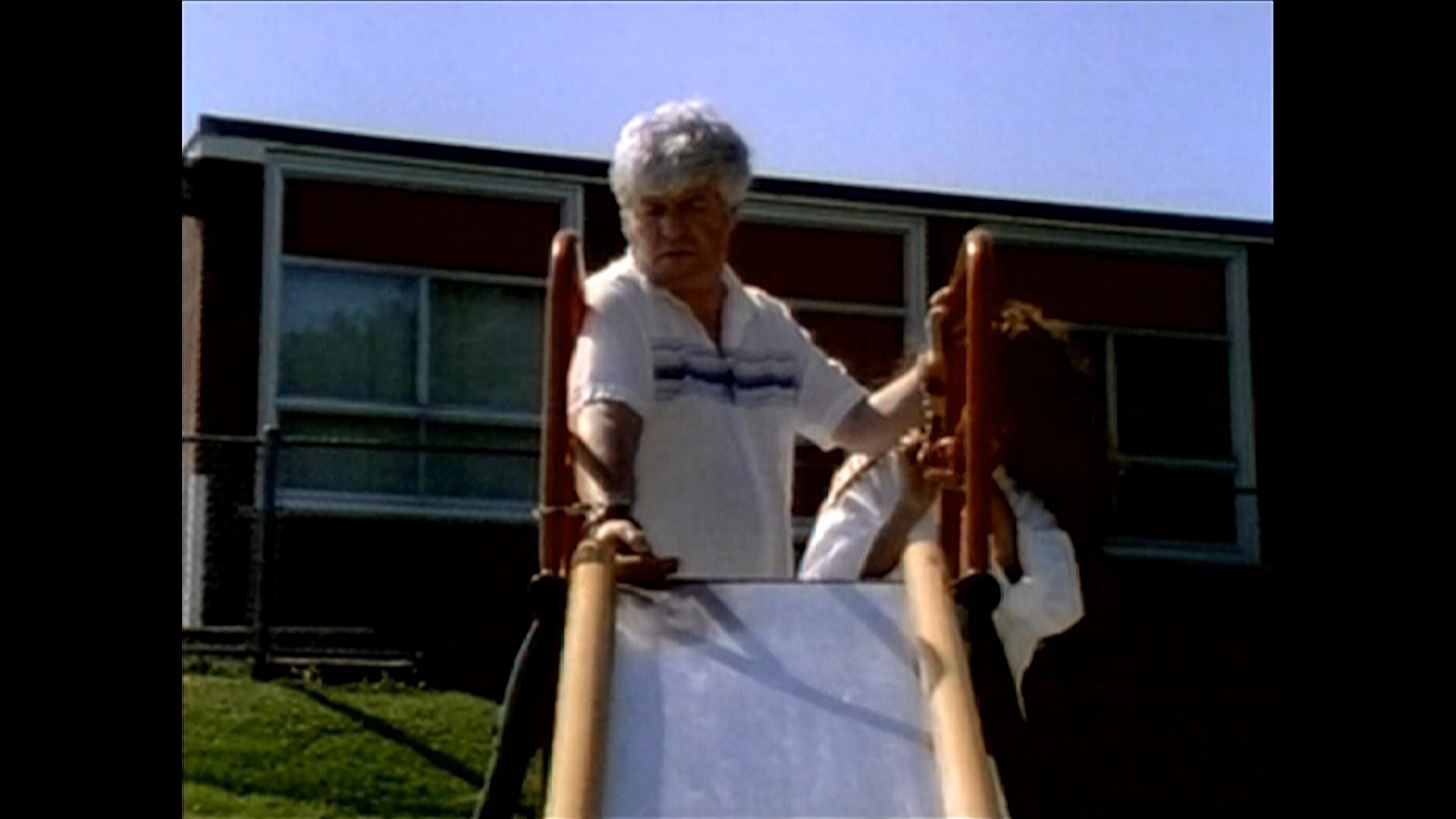
Whilst Things was continually funny to the point of whimsy in what strange idea it got fixated on, like a moth to a lightbulb, Wicked World has all its naive nihilism to contend with, which can be humorous when our killer confesses on a slide that "I hate slides. I hate helicopters. I hate life.", but also can be nasty in an off putting way with its attitude. It is here where moral issues come to mind. Gillis' film has the sense of baffled madness, but aspects which without stepping back or ironically view them are problematic if thought about. This is where a group like Bleeding Skull, the individuals who uncover no budget oddities like this, skirt a line in strange cult circle; that whilst we thankfully have an adult view of this material, coming into them with a caution of their potential issues, we can sometimes not fully deal with them in between cool sounding proclamations of them being fun cult films when it is vital to bare these concerns in mind.

One unsavoury and misguided aspect is the anti-political correctness speeches, which considering the film was shot in the early nineties was around the time when this subject was becoming a bigger issue. They were still on Gillis' mind however long after as, in one of the endless onscreen white text quotations on black that end the film, he quotes film maker Nick Palumbo (director of Murder Set Pieces (2004)) from the DVD box of his own work. I am someone who has concerns about political correctness when it dodges topics deliberately rather than discussing them frankly, but likewise especially from the late 2010s it comes evident that people hide behind the term "freedom of speech" without realising it both comes with responsibility and that it is an excuse for being an arsehole for many. It comes as a solipsistic childishness, especially as rants against PC culture are also juvenile, as a transgressive artist would just get on with their work even if it ever caused them difficult to work, whilst making really lurid and extreme splatter cinema is not the same as even a genre based filmmaker like Shinya Tsukamoto. That the killer says some of this, but other characters as well, makes it really confusing as well what the actual opinion is of this subject.

Circling back to the whole issue of the exaggerated evil, unfortunately alongside this there is one scene which comes off as misguided, not because anyone in the production has malice, but Gillis clearly thought of having a scene out of Abel Ferrara's Bad Lieutenant (1992), a year before it was even made, of a corrupt cop only for the presentation and tone to make the choice ill advised. Definitely not dressed as American cops, Gillis' character and another actor are playing the worse of police in as over-the-top fashion as you would expect, but with one little detail where they and their police chief are racists, targeting a trio of non-white characters, with racist language involved does become jarring in how nasty it is. It is a reminder that it is one thing to depict the worst in humanity in cinema, even if the result fails, but that it feels like Gillis was exaggerating as in the same way his characters' nihilism is, or in the decision for death scenes to cover the screen in digitally added gore and limbs. This raises some concerns.

This is the aspect which makes it difficult to fully appreciate Wicked World in general. I will say I enjoyed the film, but it is so obsessed with being bleak and "real" about the way the world truly is that it is not a charming film to get along with, curdled to an extreme. As with the scene mentioned in the paragraph before, or the anti-PC rants, the film is not going to be like Things, a film that for all its gore and attempts at nastiness was just fun. That is not to say the Wicked World experience is not mad as a box of frogs though, as it certainly joins the older film in mangling one's consciousness whilst experiencing it. With the exception of the music which, even the cheesy and sexist glam metal, is actually good from a group of composers, everything else in the film is just experiencing a series of hallucinations. Some of them are dark, like Gillis himself pounded on by a gang of people wanting to make him a martyr, or some deeply silly moments like the dialogue. Even the end credits are likely to drive people off the tipping point, a rarity in abstract cinema I have covered, as they are at least over five minutes long if not longer, with at least two songs used in full and in the director's cut continuous cutting to an image of a goose, going on the point of absurdity. Despite the film itself being difficult and to proceed to with caution, Wicked World is a dumbfounding experience in terms of wondering how it ended up as it did.

Abstract Spectrum: Atonal/Bleak/Chaotic/Illogical/Maddening/Mindbender/Weird
Abstract Rating (High/Medium/Low/None): High