Showing posts with label Director: Joe Dante. Show all posts

Tuesday, 19 September 2017

Masters of Horror Season 2 Part 3

From http://1.bp.blogspot.com/-QN6lcYItHlc/T488eTXvUgI/
AAAAAAAAAIQ/xtm8BZKXErQ/s1600/u33330w5y3z.jpg

Right To Die (2007)
Director: Rob Schmidt
Screenplay: John Esposito
Cast: Martin Donovan as Cliff Addison; Julia Benson as Abby Addison; Robin Sydney as Trish
A Night of a Thousand Horror (Shows) #21

For director Rob Schmidt, being chosen for a series called Masters of Horror is a deeply unfair situation for him; if this had a completely different series title, it would just be a great opportunity for him to make himself stand out, but the title of the series is rife for belittling. His only known film in horror is Wrong Turn (2003), not a work with a legacy yet and more known for five straight-to-video sequels that came afterwards. I give credit to Schmidt however here as, when others would have picked on him for being included as a "Master", few should care about his placement amongst legendary directors as Right To Die is a fun, gristly revenge tale from beyond the grave that makes up for a situation he got dropped into in the first place.

When the wife of an adulterous husband Cliff (Martin Donovan) is maimed in a car crash, an skinless figure in the hospital on life support, said husband is in the position that he can terminate her life legally. Said wife Abby (Julia Benson) however, whenever she flat lines, can haunt him and anyone else by spirit, leading to gruesome results. Why Right To Die succeeds is that, whist its not a deep take on assisted death, the resulting tale of a wife's scorn, especially in hindsight, is as sickly humorous as you'd hope and never falters in any scene. It exaggerates real life, of adultery and poisonous relationships, like many a great tale like this one with considerably more death and gore involved.

There's a streak of the misanthropic where everyone barring Abby's character, including her mother, is utterly loathsome adding to the macabre nature of the material. A sense of the immensely perverse helps Right To Die, immediately revealed when a supernatural seduction scene with a very voluptuous Julia Benson turns into something from The Shining (1980). Alongside the tangled web of cast involved, including the husband's mistress Trish (Robin Sydney) who works at his dentistry, it's spiced up with a lot of material to work with. With an utter coward in the male lead perfectly played by Donovan, as a bumbling individual with a darkness to him, you have the perfect centre for a narrative that can go from the intentionally ridiculous, such as the dangers of being in a magnetised room, to the gruesomely ridiculous in an improvise surgical operation near the end. Schmidt also, brilliantly, leaves the closure of the story off camera, rather than tying the loose ends together. Thus leaving Right To Die on an open ending that feels satisfying due to the final twists before and because the punch line hit the viewer just before the end credits despite this open ending. As a result, everything you'd want from a horror anthology episode...that just happens to be from someone who likely gained scorn for being included as a "Master of Horror". Thankfully, amongst legends of the horror genre, he pulled his weight and succeeded even above other episodes from said legends and made any controversy about his inclusion pointless to worry about.

From http://3.bp.blogspot.com/-uUaapXez_tM/TfeEW0rnP5I/
AAAAAAAAAI4/GGpTNoBj9yg/s1600/right_to_die.png

======

From http://4.bp.blogspot.com/-CblnlwduBOs/UzTbdUxScxI/
AAAAAAAAKB4/2ek2k6Q0-xg/s1600/screwfly_solution_xlg.jpg

The Screwfly Solution (2006)
Director: Joe Dante
Screenplay: Sam Hamm
Based on a short story by Raccoona Sheldon aka. Alice Sheldon
Cast: Jason Priestley as Alan; Kerry Norton as Anne; Linda Darlow as Bella; Brenna O'Brien as Amy; Elliott Gould as Barney
A Night of a Thousand Horror (Shows) #22

After the disappointment of Homecoming, not only do Joe Dante and screenwriter Sam Hamm redeem themselves with The Screwfly Solution, but they also create both one of the most disturbing episodes of the two series, and the most elaborate in terms of scale. Whilst Homecoming felt like a liberal love fest invading a strong universal nature, thus compromising it, the tone of The Screwfly Solution is successful and as a result is a bleak, gruelling apocalypse narrative. Out of the entirety of Masters of Horror, it's probably the most ambitious. Immediately the visible use of digital cameras, ones which could move in elaborate turns and extreme close-ups, provides a drastic change in look for immediacy alongside the larger use of resources in cast and locations the episode also has. The subject matter itself is vast, following a change in the male brain from an unknown cause that causes the entire gender to kill women when sexually aroused or provoked, almost a pathogen which slowly invades nearly all men in the United States. It's the one story of these two series so far that could've been released as a feature film, but does enough with just fifty five minutes as it stands.

It encompasses various nods to environmental and social concepts, but the main one in gender and sexuality is blunt. It's as unsubtle as Homecoming, but the more universal nature of The Screwfly Solution cuts to the bone. The author of the original short story Alice Sheldon was a female science fiction writer of great significance, who mainly wrote under a male pseudonym, and one who wrote The Screwfly Solution in 1977, in the midst of a huge feminist wave of that period. In terms of adapting the short story for this 2006 episode, aspects of the adaptation aren't perfect, flaws which can be picked at in terms of the logic and how the story is told, but particularly in this era it hasn't dated. Unlike Homecoming which is already a time capsule, this episode could actually be as frightening, even more so, for a male viewer than a female one in an era where the term "men's rights" has been tainted by toxic masculinity and questions of misogyny are in the mainstream.

Even some of the broader, less subtle ideas like this strange virus being shown through religious fanaticism, anti-female belief of men, don't feel trite when one considers the various ways religion has been tainted since its beginning through how men have headed their foundations and tampered with the scriptures for personal power. It would be absurd to think any of this farcical, even though it's an extreme fantastical depiction, because it touches upon real issues of misogyny and anti-woman violent that are sadly real. No sane viewer would dismiss this as politically biases as the topic is beyond left and right wing politics and touches on something much more real and disturbing. You could not paint this as being politically bias especially as in this world, even a loving husband like Alan (Jason Priestley), whose wife Anne (Kerry Norton) becomes the lead, could be infected by this virus. Instead The Screwfly Solution evokes a more disturbing idea for male viewers let alone female viewers that men (even I the writer of this) could all possess a reptilian, dark part of the brain if the wires in our brains were crossed. One where incredibly casual violence against women and even murder could take place on airplane flights or in the street without a bat of the eye.

The apocalyptic nature of the story is followed to its fullest, as miserable as such a story would eventually become, with an additional plot twist involving the episode turning into science fiction not a protective shield for the horror of the material but playfully shoving a knife in the viewer's back. Even the faintest of humour has a morbidness to it before being swallowed up in the bleakness. And helping is not only how confrontational and nasty the material is, but the performances. Kerry Norton is good as the main heroine, whose role is tougher as this story can only go to a grim conclusion. Also of significant mention has to be Elliott Gould, probably the biggest actor in terms of reputation to have appeared in the series so far and contributing one of the most memorable characters, the one completely sympathetic male figure never touched by the virus, who is the one sole lightness in his humour when everything is as twisted as it is, but also has the dramatic talent to play this character who has to watch the events unfold over the world as he tries to find a cure for it all. It's the kind of story which certain viewers may not be able to stomach, especially for those expecting the series to be entirely fun in tone, but Joe Dante in one of his darkest hours does manage to show so much ambition here that has to admired.

From http://a2.tvspielfilm.de/imedia/3973/3393973,Ub_+9k1WY0B512oVxrZLCf3JLXQ
PZOKaDtpbZ8th2WdwpWgi6UYEvgJgPeOS3+TzP7qqwCcLyODdR79920XjOw==.jpg

Tuesday, 8 August 2017

Masters of Horror Season 1 Part 4

From https://www.cinematerial.com/media/
posters/md/bg/bgi45iz5.jpg?v=1456219749

Deer Woman (2005)
Director: John Landis
Screenplay: Max and John Landis
Cast: Brian Benben as Dwight Faraday; Anthony Griffith as Officer Jacob Reed; Cinthia Moura as the Deer Woman; Sonja Bennett as Dana; Julian Christopher as Chief Einhron; Don Thompson as Detective Fuches; Alex Zahara as Detective Patterson
A Night of a Thousand Horror (Show) #10

By this point in Masters of Horror - at halfway through in my viewing - the first season is actually disappointing. There's a visible sense that, whilst it was an inspired idea to hire the most acclaimed horror directors to helm episodes, if the scripts aren't strong enough they don't work, more so as the restricted structure of this type of television production drastically limits the visual distinctions that many of these directors had for theatrical cinema for the small box. With this in mind, with a director like John Landis who only directed two major horror films and mainly has worked in comedy for his career, he manages to at least provide me with a laugh with Deer Woman. As his story's protagonist Detective Dwight Faraday (Brian Benben)  tries to picture multiple theories to how a truck driver was turned to mince by way of deer hooves, the same two metaphorical figures involved (the truck driver and the woman he went out a bar with) a repeatedly shown in each scenario, wearing different clothes, all of which end like the music video for Queens of the Stone Age's No One Knows. In a series where a major failing is that they're failing to provide eye-catching and memorable scenes that short form horror storytelling should provide, with the exception of one or two stand outs, this entire passage of Deer Woman is such refreshing change of pace.

It's as much, from the director of An American Werewolf in London (1981) and Innocent Blood (1992), that Landis is directing an openly comedic episode. Other episodes have had humour, but the entirety of everything I've watched so far has had a seriousness to them all. Landis with his son and future cultural commenter Max decided to pen a farce instead. It's a story whose explanation is already told to us the viewer in the title and the opening - that the figure behind random killings of men is a deer woman, an American Indian mythological figure of a beautiful woman whose half-deer.  The lack of mystery is replaced by one of the series many depressed cop protagonists having to catch up with us and being unable to accept the absurdity he's finding out. What's dismissed by a random American Indian character as an old, misogynistic tribe tale in the deer woman becomes something that utter jars with modern life, and that's where the story is actually concerned about alongside the gags.

Far from glib and insulting however, this is yet the same episode where you see the ghastliness of a Native American themed casino where patrons have to suffer through a mechanical deer's head telling god-awful pun jokes. The lack of a deeper message on the surface doesn't mean there's ideas still to read into Deer Woman, the inexplicable nature of mythological creatures running around modern civilisation far more appropriate than trying to rationalise them. It's befitting the Deer Woman, played mute by the utterly gorgeous Cinthia Moura, is a force of nature whose motif for targeting men makes little sense, barring hints at it happening centuries ago and always involving anything evoking colonisation of Native American land. That and how she's merely a force with no resolution either, a protagonist and his friendly ally Officer Jacob Reed (Anthony Griffith) always behind her. This is also an episode where a scene where Faraday confesses guilt for the death of a partner is seen as a metaphor for John Landis dealing with the aftermath of The Twilight Zone: The Movie (1983), the tragedy of the deaths of actor Vic Morrow and two child actors one which, alongside the reputation of that accident, would weigh heavily on a person's life if they were in the director's chair when the tragedy happened. If the case, that scene does bring a level of emotional depth that none of the other Masters of Horror can touch.

That's neither to dismiss the humour to which Deer Woman can be bizarre as it is slapstick - men crying over dead monkeys against muggers being stabbed by potential victims with their own knives. That tone where the only rationalise why to deal with these bizarre murders is to imagine a deer man carrying a woman off like a Universal horror movie monster is far more rewarding in dealing with mythology as someone to "modernise" and complete de-fang their iconography. Far from the insulting nature of codifying such figures, letting it loose into the modern world and leaving its cast baffled is more aspirated. And as this played out, I laughed and laughed a lot, and considering my eventual reaction to Joe Dante's Homecoming (2005), which wanted to be taken serious as a legitimate political polemic, Deer Woman is one of the strongest entries and an example of when not being blatant in one's messages means far more in depth.

From http://2.bp.blogspot.com/-oEXjy9j2yfE/Uh4wSrhRnMI/
AAAAAAAAJx0/woyQeNQBHYs/s640/deer_woman.jpg

=========
From https://mangpong.co.th/Product
Image/product/003749.jpg

Homecoming (2005)
Director: Joe Dante
Screenplay: Sam Hamm
Based on the short story by Dale Bailey
Cast: Jon Tenney as David Murch; Thea Gill as Jane Cleaver; Wanda Cannon as Kathy Hobart; Terry David Mulligan as Marty Clark; Robert Picardo as Kurt Rand
A Night of a Thousand Horror (Shows) #11

Out of all the Masters of Horror episodes, Homecoming is vividly remembered for me as the critical darling of the whole first season, all entirely in context of it being an attack on George "Dubya" Bush during a controversial period of his already divisive presidency. Before this sounds like a liberal cheaply attacking a Republican president again, it's potent in spite of my belief Homecoming has dated as a work with a message that I view it now during the Donald Trump era. Bush Deux was the president in the unfortunate position of having to react to the 9/11 Twin Towers disaster, one of the most monumental  events in my generation's life because of how tragic it truly was but also how the shockwaves from it (arguably) influenced events even still. Whether his decision to go to war in the Middle East was right is complex in lieu of an utter tragedy on American soil which no one could've been able to decide with difficulty. Certain people look on Trump as being Satan incarnate but also forget Bush Jr., whether it was wise for his party to have done in lieu of said tragedy, also brought in the Patriot Act in US law, allowing police greater power to protect their land but with all the potential for it to be as much abused.

This isn't even an era I lived through as a child that's entirely to do with the Americans either, as our Prime Minister at the time in Britain Tony Blair is still dogged by his ethics of joining the war on the Middle East with actual court investigations involved. All of this seems heady stuff some may find inappropriate to talk of, believing politics shouldn't be mixed into horror, but Joe Dante decided to take a pre-existing short story and reinterpret it as a direct comment on said political period at a bleak time, making it impossible to ignore its real life genesis. One cannot ignore either whether that message, when it was championed in context, has actually any depth beyond that period now with Trump in the White House and the effects of the wars in the Middle East leading to new concerns in the regions, whether it has any meaning still or like Michael Moore documentaries it's a fragile cultural fossil from only a decade or so ago already.

Homecoming is laborious to revisit, out of time context probably the most aged and overrated of the lot from the series. Its critical idea should've been played as a universal one, where as with the Monkey's Paw story a wish made is shown to be one to regret, in this case as political spin doctor David Murch (Jon Tenney) saves himself during a rare moment of hesitance on live television by coming up with an emotionally exploitative comment of wishing the dead soldiers who fought overseas could return back home and vote in the presidential election taking place. He lives to regret this decision when the aforementioned dead soldiers do return back but are far from please with the side he's been writing speeches for.

Whatever one's political beliefs, whether there's a "just" war in existence or not, if a morally good man or woman, one's neighbour or even yourself, wishes to serve their country in the military to protect their land and those of people in other countries, that's truly is noble and self sacrificing an act. The issues stories like this should tackle is always the moral ambiguity of said wars, or when to paraphrase Black Sabbath's War Pigs, if the generals are treating people like pawns in chess. If Homecoming had entirely been about the grief of these soldiers then we would've had a great story, figures of sadness who only bite and assault the living provoked, instead the zombie as the memories of the lost who can still influence the living. This is seen in the one good scene, where a decayed solder is welcomed openly by the owners of a cafe into their building, parents of a son off in war to treat him as someone in need of warmth and empathy, comforting him even when potential patrons are scared off by his appearance.

Instead, from the director of such manic, Looney Tunes inspired madness like Gremlins 2: The New Batch (1990), you get such a pretentious, bloated presentation for a one note gag, its humour entirely deciding to paint right wing Republicans, in Murch or political commentator Jane Cleaver (Thea Gill), as selfish, vain idiots. Even when Murch has back-story suggesting more complexity, it's cheap sympathy for him. Even Robert Picardo, as a Republican party member, is wasted as a villain just missing a moustache to twirl. Its unsubtle and when there's living cartoons in both left and right wing American politics to be embarrassed about, to merely throw faeces at one side with such obvious, clanging political comments is so simpleminded, even in the context of such a politically low period of 2005/6 a waste of material. It's amazing for me to think this was feared as being dangerous back when it was first produced as, nowadays, it completely misplaces emotional sympathy for moral superiority, so right its head's up its own arse and creases to be good horror or message.

From http://wickedhorror.thunderroadinc.netdna-cdn.com/wp-content/
uploads/2016/03/Masters-of-Horror-Homecoming.jpg

Wednesday, 28 October 2015

Halloween 31 For 31: Trapped Ashes (2006)

From http://www.creepercast.com/wp-content/
uploads/2014/03/trappedashesposter.jpg?b76ae6
Directors: Joe Dante, Ken Russell, Sean S. Cunningham, Monte Hellman, John Gaeta
Screenplay: Dennis Bartok
Cast: John Saxon (as Leo); Jayce Bartok (as Andy); Henry Gibson (as Tour Guide); Lara Harris (as Julia); Scott Lowell (as Henry); Michèle-Barbara Pelletier (as Natalie)

Another anthology but unlike The ABCs of Death (2012), there's only five segments including a wraparound tale to tie it all up. This is closer to the template of the anthology genre, closer to camp fire tales or a short story collection in paperback form where short films are connected together by the already mentioned wraparound, usually designed to both bookend the stories and have a plot within it that splits off into each one. The anthology, if multiple directors and/or writers are involved, can allow them to experiment or take a shot at a high profile piece. If its from one set of creators only, it can either be a way to use good ideas that may not necessarily work for a whole ninety minutes or as productions which can bring in a variety of actors and talents. You can go as far back to Waxworks (1924) for an early example, but the heyday for these films were the sixties and seventies, where there were even non-horror anthologies where directors like Jean-Luc Godard and Federico Fellini were hired to create a segment.

Trapped Ashes is an oddity though - shelved for a long time, it's a Japanese co-production I suspect was as much for a Japanese audience considering the amount of Japanese producers and technical crew on the project, including music from Kenji Kawai, most well known in the West for his acclaimed scores for anime like Ghost In The Shell (1995). Three of the directors are cult figures, Sean S. Cunningham a smaller cult figure with immense importance for what he produced as well as that he directed, and John Gaeta was known for the visual effects for films like The Matrix (1999), making his filmic debut here. The film was co-produced and had its stories written by Dennis Bartok, former Head of Programming for the American Cinematheque in Los Angeles

From http://www.deadchannels.com/images/Trapped-Ashes-Wraparound_-_.jpg
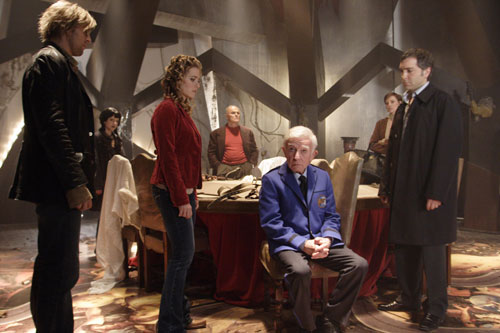
"Wraparound" (Dir. Joe Dante)
Trapped Ashes is set up by a group of visitors to a film studio being trapped in a haunted house stage set from an old horror movie. Their guide (Gibson) recommends they replicate the story of the film by recounting their real life horror stories to each other, each playing themselves or having a representative in the tales. Dante's segment in all its pieces is really just set up, which is disappointing considering his reputation. I've still not watched a lot of his work - though Gremlin 2: The New Batch (1990) is a magnificent thing to behold - so all I can say is that he was stuck with a perfunctory and practical aspect of the anthology only lifted up by the impressive set design and John Saxon being amongst the cast.

From http://1.bp.blogspot.com/-4G7XqtPa_QY/UuDmnYoEhmI
/AAAAAAAAAeU/5EQwL8EuWzw/s1600/Trapped+Ashes.png
The Girl With Golden Breasts (Dir. Ken Russell)
Actress (Rachel Veltri) recounts how, desiring more roles in films, she got breast implant surgery only to find that the innovative and natural implants she opted for had a vampiric tendency to them. Russell is an unsung gem in himself, his excesses as rewarding and at least as entertaining as his best work like The Devils (1971). That many of his films are mishandled still today or are unavailable makes my passion for his work more stronger. That said, I realise that after the late eighties is an unchartered territory I may be baffled by, reminded of my experience with The Fall of the Louse of Usher (2002), one of his last films, shot in his garage, which only the most hardcore Russell fans would like. I'll be honest in saying The Girl With Golden Breasts, one of Russell's last ever works, is cheesy and for the sake of tastelessness than anything substantial. Vampiric breasts, a plastic surgeon's building that's a shrine to the mammary gland, and photos of botched implants, all of which amongst the many things meant to be crass on purpose. That the short ends with Russell himself in a cameo wearing a wig and having a pair of falsies pretty much states what to expect. The short exposes a problem with the entirety of Trapped Ashes in that the cinematography is very bland, and while I hate blaming a single person, I cannot help but wonder what the decisions of cinematographer Zoran Popovic were as all the directors involved, including one making his debut, would have had very different styles. Because of this, the short suffers further in being merely an exceptionally silly story.
Abstract Spectrum: Psychotronic
Abstract Rating (High/Medium/Low/None): None

From http://drunkenzombie.com/blog/wp-content/uploads/
2013/07/trapped-ashes-toon.jpg
Jibaku (Dir. Sean S. Cunningham)
Cunningham, director of the first Friday the 13th (1980) and producer of Wes Craven's The Last House On The Left (1972), gets the segment in this Japanese backed anthology set in Japan itself. A married woman Julia (Harris) recounts a vacation to the country where a student monk hangs himself in a graveyard. He comes back from the bed, seducing her with the intention of dragging her into the Jibaku, Buddhist hell which for anyone who's seen Jigoku (1960) should evoke many gristly things. Sadly the flat visual look makes the segment feel like it's been filmed in the US instead with Japanese actors brought in, but this does try quite hard at something interesting in its story. It also manages to the most transgressive segment of them all; I did not expect to speak about necrophilia again in this season after Nekromatik (1987) but it gets depicted in Jibaku with suitably gristly eroticism. The short also uses animation, from a Japanese studio, to depict things that might've been too expensive to attempt and to add some additional luridness to the material. In fact, while no way near as explicit, this animation does evokes Urotsukidoji: The Legend of the Overfiend (1989) only with a gender swap.  Because of this sort of content, trying to stand out, this is one of the stronger shorts of the whole film.
Abstract Spectrum: Grotesque
Abstract Rating (High/Medium/Low/None): None

From http://www.festival-cannes.fr/thumb.php?sourceDirectory=/assets/
Image/Direct/&sourceFile=015469.jpg&predefinedSize=fiche_film_header
Stanley's Girlfriend (Dir. Monte Hellman)
Hellman has his own cult by himself, more known for other types of genre cinema, like Two Lane Blacktop (1971), westerns and the infamous Cockfighter (1974). Stanley's Girl itself, while again blighted by the flatness of its look at times, is the strongest segment and the least expected. Saxon's character Leo, a film director, recounts how his younger self (Tahmoh Penikett) had a friendship with a fellow filmmaker Stanley Kubrick (Tygh Runyan), Kubrick at this point has made films like Killer's Kiss (1955) and The Killing (1956), and just before he would go into exile in England, he met and fell in love with a young woman (Amelia Cook) who may be more sinister that her confident, erotic personality may suggest. The idea of a character drama based upon a legendary film director is a bold one. There's a danger in films referencing films where it becomes trite and egotistical for me, as it feels like in other parts of Trapped Ashes, but Stanley's Girlfriend was a pleasant surprise, something very different to find within a horror anthology and rewarding for this reason.
Abstract Spectrum: None
Abstract Rating (High/Medium/Low/None): None

From http://images4.fanpop.com/image/photos/18800000/
Luke-in-Trapped-Ashes-luke-macfarlane-18831480-700-377.jpg
My Twin, The Worm (Dir. John Gaeta)
The cocky, opinionated Natalie (Pelletier) tells of when she was conceived, a tapeworm growing in her mother's body at the same time of the pregnancy that couldn't be removed whilst the child was in the womb. As a result, Natalie grows up in her infancy and childhood thinking of the parasite as a twin sibling, desiring to call upon it when, after his father leaves her mother, she finds herself bullied by his new girlfriend. It's an interesting, dark fairy tale which with a few tweaks would've stood out further. It does suffer from lacksure CGI in depicting the daughter growing in the womb as well, and the flatness of the cinematography is a shame when, partially set in an American winery ran by French immigrants, this story could've done even on a low budget with a more evocative and idyllic sheen to it to mix with the grimness of its later content.
Abstract Spectrum: None
Abstract Rating (High/Medium/Low/None): None

Personal Opinion:
The finale of the wraparound and the film itself turns into a twist from the page of a certain Amicus anthology movie I've seen, very reminiscent and sudden which changes all the stories. Trapped Ashes however in general, like this twist, is a little disappointing in how it suffers from a lot of unused potential. Hellman's segment is a fascinating curiosity, and the others have plenty of interest, but it does feel impoverished at points to a negative point. Ending on an unexpectedly evocative and great end credit music by Kawai, this track suggests this could've been even better rather than flawed ridden if entertaining feature it turned out to be.