Showing posts with label Director: Joe Castro. Show all posts

Wednesday, 17 February 2021

Hell's Highway (2002)


Director: Jeff Leroy

Screenplay: Scott Leff and Jeff Leroy

Cast: Phoebe Dollar as Lucindia Polonia; Kiren David as Sarah; Hank Horner as Eric; Beverly Lynne as Monique; Jonathan Gray as Chris; Ron Jeremy as Jack

A Night of a Thousand Horror (Movies) #218


Author Note: This was originally written without prior knowledge, referencing Ron Jeremy, to the sexual assault and rape allegations that he started appearing in court for in mid to late 2020. Whatever direction history goes, the scene mentioned in this film may have taken on an unexpected irony. The review aside from one paragraph has nothing to do with this figure but this warning is in respect to any reader to let them know.


Your sense of humour sucks sister!

Today we turn to the American highway. Long before the automobile existed, as is explained in the opening narration, a couple is stuck in the American wilderness in the colonial past. He dies, whilst she has to eat his corpse, still doomed to die and praying to Satan whilst renouncing God. The other story is of the early 2000s micro-budget era - produced by David S. Sterling, who produced countless films into the modern day like Camp Blood (2000), and special effects by Joe Castro, which has a fondness to write about in name nowadays for me in spite of his M.O., as a filmmaker in his own right and as a special effects designer, being nasty gore. This era of cinema is one that is interesting for me to return to with a greater interest with, even if it might be an acquired taste for many. In particular, this is connected to a company called Brain Damage Films. Sadly, they do have one foot in edge lord transgression, as they produced the Traces of Death series, imagining if the notorious Faces of Death films had actual real scenes of death instead of many faked ones. Thankfully, they are the people who distributed and/or produced the likes of Rise of the Animals (2011), Terror Toons (2002) and Suburban Sasquatch (2004) over the years into the modern day. Maybe one day we will look to them in their own way with delight beyond the little community I have become a part of who like this type of micro-budget cinema too.

Our prologue sets up a supernatural side, something to remember, when a priest picks up a female hitchhiker (Phoebe Dollar), kills her and buries the body only for her to return and cave his head in with a shovel. Cut to young adults in a car drinking whilst driving, flashing the camera by pulling their top up to the camera, held by a passenger filming the scene we are seeing through, smoking and saying "rehab is for quitters". I do not know why these films populate themselves with characters that are not likable, the men obnoxious here, but I can only speculate that horror films, especially slashers, made them a trope and thus creators who grew up with these films a decade later or so decided to continue having them as part of the aesthetic beats. The self reflective nature of these later films having been made by people who watched those earlier products is found here, in one of the people in the car saying a horror film is going to start when they pick up Dollar's hitchhiker by the name of Lucindia.

Immediately I have to say, barring one dumb plot twist, the film is entertaining in terms of how unpredictable this is, part of this wave of early straight-to-DVD micro budget genre films. Unfortunately, I have to say too, as part of that, they really misfired in one scene, following from Dollar doing an impression of the hitchhiker from The Texas Chain Saw Massacre (1974), which involves her sexually molesting the female protagonist at gun point in the backseat, never seen but fingers between thighs explicitly evoked. It is tonally inconsistent to the film, and will trigger some, so it is a poor choice in High's Highway when the review will be more positive about the rest of the content.

Particularly for a film where, whilst gruesome, you have a cameo of adult actor Ron Jeremy as a low budget filmmaker picking up Lucindia; a scene which leads to her cutting off his penis before he realises it and, when she gets out of the moving care, he to run into a gas station and thus explode. One poor choice of bad edginess is out of place in a film which is tonally more playful then that and is interested in scenes with Jeremy more brazen and over-the-top. Thankfully, if you like this type of cinema, everything else is weirdly interesting. It will be interesting to see if the 2000s is reassessed as the 80s shot-on-video and low budget era has, the standard digital sheen of oversaturated light and colour which is yet fuzzy in detail its own aesthetic from its own decade. It will be curious to re-examine such a look in a 4k world, as fascinating as with the audio as, composed by Jay Woelfel, Hell's Highway has a score which sometimes turns into fantasy New Age music. We get a sex scene, also involving sharing beers mid-coitus, in blue lighting that washes over everything in a tent set to what sounds like an off-cut to Tangerine Dream's album Zeit (1972). That Jay Woelfel is also prolific in this area of low budget genre cinema, including as an editor/director/writer/actor among other jack-of-all-trade roles, really goes to show what a curious wilderness Hell's Highway belongs to, where everything is likely interconnected by everyone working on everyone's genre film.

It is also a rare production where the randomness is backed by a willingness to push itself for ambition and something memorable. Yes, it is contrived that someone brought a chainsaw in the car with them, even if it is part of their obsession with creating perfect campfire wood, but it is Chekov's and Joe Castro as your special effects man knows how to use it. For every effect that feels dated, such as superimposing a thrown knife aimed at a moving car, it still has to be painstakingly included and is to look back with admiration as even the early 2000s was a time with limited resources to work with even as more people could make films. This is also a film, showing its hard work, where they will have the gruesome gag of dragging half a headless and legless torso off behind the car, after accidentally having intestine being stuck in the car axel. That sort of scene is not for everyone, but requiring hard work to pull off just to even make a prop corpse, something we neglect is a construct requiring hours to create even for a low budget film.

And for none gore content, Hell's Highway has a bit. It dabbles, post The Blair Witch Project (1999), with a found footage section, when the leads locate a camera from their friends, showing an ill advised attempt at a demon summoning séance. There is also the scene which won me over to the film, in a production that also happens to have the female protagonist have a dream in an orange hued and fog covered hellscape with demon costumes and stop motion which could have been a show stealer. It starts as a scene involving a pager, when they were a thing, involving if a male character's brother is still alive by sending a message to it from a phone which is found in the wilderness. This scene then cuts to a telecommunications building, than to an actual satellite (a model superimposed in outer space) including a peek inside (built with the insides of computers etc.), a sequence which the film could have done without but the production team decided to have for artistic flair. It is inspired and shows the best of this cinema, especially as the crew had to put this all together on minuscule resources.

Some of the creative decisions do not work well. The one I mentioned earlier, a grim trigger warning, was not advised and aged badly just for being out of place in the film. The other is that the film takes a strange turn in how the plot resolves, one that is less a concern unless you wanting a cohesive plot. [Spoiler Warning] That for a film which has had an occult edge, where the lead heroine since her traumatic interaction with Lucindia has almost a psychic link afterwards, and has included the Hellscape sequence, decides "Nope, let us us have a plot twist involving Lucindia being cloned". This leads to a finale involving a secret government laboratory and rewriting the film around four Phoebe Dollars existing. [Spoilers End] The film for all its ambition does sway into a plot twist in the science fiction genre that is so out-of-place, and involving rewriting much of what we see, that it will completely knee capped the film badly for most viewers. For me, it was just a dumb plot twist and befittingly drawing the film closer to the bonkers territory, even if it should have not been there at all. Truthfully, Hell's Highway is a great template for these types of films, specifically an era of them from the early 2000s, in both their best aspects and the worst. Ultimately, the virtues, the best, stand out for those of us interested in these films, but the film does have some decisions you have to put up with too.

Wednesday, 27 January 2021

Blood Feast 2: All U Can Eat (2002)


Director: Herschell Gordon Lewis

Screenplay: W. Boyd Ford

Cast: J.P. Delahoussaye as Fuad Ramses III; John McConnell as Detective Dave Loomis; Mark McLachlan as Detective Mike Myers; Melissa Morgan as Mrs. Lampley; Toni Wynne as Tiffani Lampley; Chris Mauer as Mr. Lampley; Christy Brown as Bambi Deere; Christina Cuenca as Misti Morning; Michelle Miller as Laci Hundees; Kristi Polit as Trixi Treater

A Night of a Thousand Horror (Movies) #211 / An Abstract Film Re-Review


Decades after the events of Blood Feast (1963), in which his grandfather slaughtered women to create the titular feast for the goddess Ishtar, grandson Fuad Ramses III (J.P. Delahoussaye) inherits the old catering store he owned, finding the original Ishtar statue in the back, now less a gold painted mannequin but more of a stone idol. Immediately brainwashing him, it commands him towards the desire to recreate the blood feast again for the wedding celebration of Tiffani Lampley (Toni Wynne) and Detective Mike Myers (Mark McLachlan). In real life, Herschell Gordon Lewis did not make another film after 1972 beforehand, fully committing himself to the world of advertising where he made a huge success in his work. In this time, his films started to develop success for cult movie followers. We even got the unofficial sequel, Blood Diner (1987), where two brothers inherited their uncle's goal to create a feast of blood in her name.

There is an irony to be had that Herschell Gordon Lewis, never one to stay modest, confessed his contempt (in light heartedness mind) to the idea of art minded cinema, He nonetheless left a lasting mark on cinema through Blood Feast. Even if they were made just for money, the idiosyncrasies to how he made his films and his sense of humour to making them are one of his best virtues and are part of his DNA. This is more so the case as, when the long awaited sequel to Blood Feast came about, his most well known film, he would afterwards claim that it was never really his own project despite directing it and collaborating with his old producer colleague David F. Friedman. Yet my experience with some of his odder tangents beyond his gore films, the likes of How to Make a Doll (1968), suggest his fingerprints are still here. Symbolically this is perfect, as upon returning to film making, there had been enough time alongside his cult status for this to be put together with an entirely different mentality, drawn from the subterranean fringe culture that embraced his films in the first place.

It is definitely an interesting film for him, less a sequel than a remake set in the same world, one between the psychobilly music by Southern Culture on the Skids, and its jokey (and frankly weird) tone of his later work, which becomes a cultural signpost of alt-culture of the time of psychotronic cinema, rockabilly revival and early 2000s softcore titillation. It also means Blood Feast 2 is a tangent fest, the original film's premise replayed longer and with irony, liable to be off-putting unless you relent and accept those tangents are more interesting than the plot. One however not that different from his late sixties work and, ironically, is more focused than his own original gore films of yore.

And the type of ironic dithering here that came in low budget cinema from the 2000s onwards has grown on me, and especially in this case is far less an issue. I will openly admit here, to draw the curtain back that, I saw this film the first time in 2019, than revisited it only two years later in 2021, and what a difference two years makes. When you uncover the films of Lewis' career or even people working on the film like Joe Castro, the special effects creator on the production who made low budget films in this era from the shadow of the legend's career, it sheds a new light on the production in terms of how to digest it. This film also feels considerably wackier than wanting to come off as so-bad-its-good, which is close to Lewis' own career. This is the kind of film, to keep you on your toes, where one of the police detectives, the older veteran obsessed with food, suddenly breaks out into a weather report in front of a map just for one moment. It is never brought up again and such odd turns are numerous.

The plot is simplistic enough that this can get away with these weird moments of humour, closer to the camp mentality an overt parody from this period like Psycho Beach Party (2000) had, all whilst still between playing the plot straight as possible in spite of this tone. It helps the broad characters, one note, are at least fleshed out in terms of joke characters, and arguably in some cases a lot better in performances than Lewis' original films. Our food obsessed cop, sceptic about Ramses III being the culprit, and his younger partner, obsessed to bag Ramses III for the sudden string of murders taking place, are kept alive by these actors making them stand out as is the joke when they switch sides. That this older cop is quite good at his job, except eating over the corpses, adds to the humour in a positive way, or that their female secretary in the office turns out to be the smartest and most confident person in the room between them. The bride's mother, who is an overt stereotype for mother-in-law jokes, or even legendary film maker John Waters in a cameo as a Catholic priest, a life's goal as a fan of Lewis' work, playing as tasteless a joke in the role he would have been game for and visibly relishes.

And then there is J.P. Delahoussaye as Ramses III, who at first is actually given a great performance in context, at least a better performance over Mal Arnold as the original Ramses from the first Blood Feast, a "special" performance in itself in how arch it was. Normally I do not like including obscurer pop culture references without explaining them, so I apologise in having to draw from this one, but the exact comparison to what Delahoussaye's performance style becomes soon into the film, grandiose and almost nearing an accent, is when in the mid 2010s a veteran of American professional wrestling named Matt Hardy created an idiosyncratic persona from his previous one. An ageless mad entity obsessed with riding lawnmowers and shooting fireworks at his own brother, all to do something fresh, a "broken" character for a company called Impact Wrestling with a Cruella De Vil white streak in his grown out hair, and among the many other deliberately weird things using a manner of speech that can be described as Shakespearian wall chewing, gravitas of the hammiest sort Delahoussaye a decade earlier uses in Blood Feast 2 for humorous bombast.

All of this fits the film, one which saddles itself between this intentional humour and splatter, the raison d'être of Lewis' film. The original Blood Feast, despite its quirky kitsch, is important because it created the splatter genre of horror, back when on a limited budget Lewis had to use a cow's tongue and fake blood for the initial gore sequence. Decades later, and on the cusp of the new century, splatter and gooey special effects became more over the top and available in lowest budgeted productions. This is seen metaphorically here in how the main practical effects designer is Joe Castro, the director of the low budget series of Terror Toons films which started the same year as Blood Feast II, the third one of the last works Lewis did before his death playing himself as the narrator of gristly reinterpretations of fairy tales. The gore in Lewis' older films, even as sleazy as in a later work like The Gore Gore Girls (1972), was crude and deliberately silly even if utterly revolting, especially as he eventually started lingering on real animal offal as it was, for a lack of a better word, being fingered, to relish the exclamation point.

The same is the case here where, despite how gruesome it is, there are overtly farcical details like Ramses III using kitchen implements, even using oven gloves to hide his fingerprints, or the infamous scene of someone's face being peeled off, the skull underneath still looking around like a perverse animatronic. The gore is most accomplished here, keeping the sense of ickiness to it even when Delahoussaye is chewing the walls too. Even in mind Castro, to the detriment of some of his own films, can be too grim in some of how realistic his content looks, he was the right person to have when, despite Blood Feast's reputation, most of Lewis' films from the late sixties on became more deliberately grottier whilst being ridiculous

The softcore nature of the film is a distinction from before too as, even whilst Lewis made nudie cuties before he made gore films, and at least one porn film he denied making, Blood Feast II at times feels like it was a 2000s softcore film meshed in DNA with a splatter film which is distinct. Lewis' films do have the issue, which cannot be ignored, that he usually had female victims most of the time, one of the few exceptions Two Thousand Maniacs! (1964), but the softcore nudity is a caveat in itself and comes off instead as more ridiculous. There is an absurdity at points too when you have lead Tiffani and her friends have a lingerie shower party, of putting on and taking off negligee, which comes off as absurd.

The specific type of softcore here is I can pin point to the early 2000s straight-to-DVD film, like Jim Wynorski's Busty Cops (2004), which became common on the lower shelves of even British DVD rental stores and those I admit freely I have seen a few of, like the aforementioned one above1. Films which are on the verge of porn and are very statically shot even before they get to the nudity; films, from the few I have seen, that the likes of Misty Mundae (real name Erin Brown) starred in, which were low budget and in many cases strange. It is the same here, where nude scenes are paraded in their own separate space, where a woman wanders a house very naked to Devil's Stompin' Ground by Southern Culture..., or when the lingerie party happens and, for two of the people participating, the film is nearly looking to turn into a softcore sex sequence until Ramses III stumbles in.  

Eventually the film's strangeness becomes compelling. One of the strangest running gags compels this opinion from me - in which a minor character dies, the mother-in-law's husband, and his body inexplicably starts popping up in future scenes, even at the wedding reception at the end of the film. There is a sense of the film being self aware of itself and trying to top what it did previously in how genuinely eccentric it can be, even having a character correct the mistake from the original film that Ishtar is a Babylonian goddess, not an Egyptian one. Even one of those nude scenes, for the police secretary, is played as a bizarre dream for a police officer where her breasts become two iced deserts and for her, when he wakes, to chastise him. What in any other case would be a sloppy early 2000s production, a predecessor to Neo-Grindhouse in being too ironic and not taking itself seriously, instead in this case is camper than a boy scout conventional and genuine in its weirdness. My growing admiration for ultra low budget films too, this one with a lot more production value too, helps considerably as is the fact Lewis made a lot of low budget, weird films. Knowing he himself worked on the likes of Something Weird (1967), living up to that title among other grab bags of eccentricity, really argues that this film is more closely linked to the others, in lurid content for the sake of luridness,and weird characters. Characters in his old work, as here, would have not batted an eye either at the catering Ramses does even when having visible human fingers in rolls to snack on.

An outlier in the career of Herschell Gordon Lewis's filmography it may seem, it does not feel that much of one despite the claims of this. Tragically as well, probably for this reason, this film has be made obscurer and even lost when, in context, it was insanely entertaining whilst in very bad taste and ridiculous. One that, due to one of its songs having been played on the trailer for Arrow Video's promo reel in their early days, has grown on me considerably with fondness. Blood Feast II does feel like a feast, a vast contrast to the quick and sudden shocks of luridness of the director's first film of the two, but a long and peculiar thing for me to delight in.


Abstract Spectrum: Camp/Eccentric/Grotesque/Psychotronic/Weird

Abstract Rating (High/Medium/Low/None): None


===

1) And that particularly example, still irredeemable, did show how bizarre these films could get, with random nude egg breaking in a group shower and a talking lama as a police chief. Those scenes still linger with me despite being a long time ago.

Wednesday, 2 September 2020

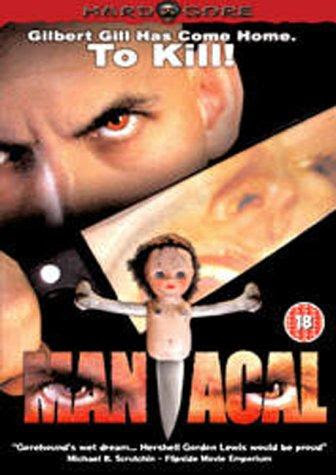
Maniacal (2003)


Director: Joe Castro

Screenplay: Eric Spudic

Cast: Perrine Moore as Janet Gill; Lee Webb as Gilbert Gill; Carl Darchuk as Garrett Gill; Brannon Gould as Lance; Heather Ashley Chase as D.J. Spiegel; Jon Prutow as Josh; David Ortega as Dane; Carol Rose Carver as Brooke; Deborah Huber as Nancy Gill; Mike Nyman as Officer Spiegel

A Night of a Thousand Horror (Movies) #165


No love for Gilbert! [Throws hammer]

Another Joe Castro film, and at this point, I am used to his work to the point that, for this slasher film with a lot of self reflection of the genre, it actually became a humorous experience even if the movie is meant to be taken seriously. Whether time does for all these reviews, this one comes at the point I have covered all the films of his which were released in the United Kingdom in the early days of DVD, which is important for me as, symbolically, the point of the watching experience was to cover these films and ascertain any thoughts. Baring if I can track down other films of his, the point was to assess a filmmaker normally never marathoned like this. I think this as much added to giddiness to a film, honestly, which is not great but I did find fun in.

It has a melodramatic opening - with some Dutch tilts, we have the home of a nasty alcoholic father, a step mother (the actress notably younger and with a greying wig or hair die on), a younger sister who will be the lead, and Gilbert, meant to be nineteen and in this film's ethos not really a considered depiction of learning disabilities and mental health. He is slow, he likes to mangle and melt dolls in his bedroom listening to horrorcore rap, and eventually one night snaps, trying to kill his father with a hammer, managing to with his stepmother with excessive hammer to rubber head trauma, the first in a lot of head related injuries and demolition throughout.

Sent to a mental asylum that would make Samuel Fuller's symbolic one in Shock Corridor (1963) more well run, with deeply unprofessional staff who joke about the cliché in horror films of mental institution inmates going on rampages, Gilbert is left in there for a year until someone made a fatal error to give a man with a history of violence a metal fork. By this point was where the humour was to be found, the tone not as dark and nasty as has been the case for Joe Castro for me thankfully. This has been a side of his, over multiple films, which has been a clear trademark of his which can be appropriate, sometimes black humoured, but also off-putting; here thankfully there was a sense of absurdity and, honestly, charm in that to create this asylum for mental health they just found a blank white walled building and had extras play inmates who wander about, including one female actress to play a nymphomaniac. That detail, an admittedly up-PC term and depiction nowadays, was where the comparison to Shock Corridor actually made sense. The music is so over-the-top and unintentionally amusing too, but not in a mean reaction to the film, just that it lightened the tone considerably.

Worth mentioning is that this was a film I had seen of Castro's a long time back, like Terror Toons but without remember a single thing baring the fact, finding a second hand disc in a charity store, that I hated it. Instead it feels like a film having to come from after both the original eighties slasher boom of the eighties and the late nineties return of the trend in self reflective (or just teen drama centric) films. Castro still has a misanthropic edge, as everyone at times baring the lead female cast can be arseholes, even a group of young children who play the trope of taunting people with chants about Gilbert coming back to get them. At the same time though, the self reflective nature is there as this is a world where everyone can refer to slasher film trivia, and even some deep cuts I have never seen and were not quoted in Scream (1996) either, like Dolly Dearest (1991) and Happy Hell Night (1992).

It does lead to the best moment for me for the film - Eddie Brandt's Saturday Matinee Horror Shop, a real film store in Los Angeles1, which here in this time capsule has walls of VHS up to the rafters on display, even though a nearby sign indicates that, at this time period, DVD was already here and ready to kill off the medium outside of avid collectors and a retro trend that would bring the format back as a luxury in the 2010s onwards. The nature of the film is that, in sincerity, some of it is clearly exaggerated too, such as Gilbert being able with his bare hands to rip hearts out, and hopefully for someone even calling their lead character Gilbert in the first place. Jokes like the "Last aisle on the left" pun or Gilbert creating a weapon by duck taping all the kitchen knives to a stick, and only using it once near the end, have a comedy to it that, for moments it feels accidentally silly, I sincerely hope was humoured here. From writer Eric Spudic, who is mostly known as an actor but also wrote a few low budget horror films in the early 2000s, this film is still immensely silly, but is thankfully a nice balm for me in comparison to The Hazing (a.k.a. Butchered) (2003) which was tedious to say the least.

The self reflective nature is the difference between the two films and such a huge improvement. Most of the film is openly riffling on Halloween (1978) for its plot structure anyway in references - Gilbert wearing a clown mask, the lead's best friend DJ (Heather Ashley Chase) being a stand in for P.J. Soles' enthusiast best friend character, that there are three female students as the leads in the first place - so it makes sense just to reference slasher films with a knowing nod. It is Halloween if with more hip hop, all original music created for the film, and with the children being so knowledgeable of horror they say Gilbert is scarier than Pinhead from the Hellraiser series.

In complete honesty, beyond this point it is just the many tropes of slasher films playing out, as Gilbert eventually terrorise the female leads (and three guys) at a slumber party starting in the afternoon. The father, now sobered, who is after his son is like many characters in these films doggedly pursuing the killer. The gratuitous shower scene has probably existed in another slasher film, or horror films which lingered on the actress soaping her chest clearly for a male viewership, and surprisingly has restrain not to just refer to Psycho (1960) either as others have. It does effectively remake a death in Halloween of someone being choked out from the passenger seat of a car, only with exaggeration as strangulation literally turns someone's head purple. The head trauma - squashed, blown off, crushed - is gross and absurd, and in one of Castro's best trademarks, that of his knack of special effects which have impressed me on low budgets, some of them are one takes, where with a little editing technique he can have the actor in shot only to jump to them sans head, which is legitimately impressive as a tiny little editing technique which catches you off guard as they managed to make the transition seamless.

It is cheap and cheerful. Baring an ending which is bleak in context - [Major Spoiler] how many have the killer kill themselves by drinking drain cleaner? [Spoiler Ends] - Maniacal is at this point, in my history with ultra low budget films let alone Castro's, harmless for me personally. It feels, thankfully, a befitting end to the run of films which were released and, through the "Hardgore" DVD sub-label, films I might have spotted on shelves of Poundland in my home place of England even in my neck of the woods. Not a lot of Castro's directorial work, baring a few that popped up on Amazon Prime, have ever come to the UK even among the glut of horror that is released straight to DVD every week at this point.  As a director, I will admit I have struggled with his films at times, but it says a lot about him that I kept to this cycle of reviews. It is also ironic that, if you know of him, it is likely for the Terror Toons franchise, which he is still making films for and has been the project he clearly held a lot of love for. Films like this or The Jackhammer Massacre (2004) have become obscurities, truthfully, although there is that question, as physical media labels have even minded the SOV releases of the eighties, whether one day when I am older Castro's going to have restored releases of his work as people dug up the straight-to-video/DVD films of the early 2000s as I have done. It would be intriguing if it did.


======

1) The store still lives. As of May 2020 at least, it unfortunately had to move from its original premise, sad especially as one of the most distinct touches it the wall mural of the store name which you see in the film.

Monday, 27 July 2020

Butchered (2003)

a.k.a. The Hazing

Director: Joe Castro

Screenplay: Eric Spudic

Cast: Susan Smythe as Lynette; Juliet Bradford as Barbara; Phoebe Dollar as Jenny; Elina Madison as Daphne; Christopher Michaels as Anthony; Adam Crone as Darren; David Alan Graf as Andrew Braxus; Ben Belack as Brent

A Night of a Thousand Horror (Movies) #157


Yeah, that's a big girl alright.

Butchered is not a good film. Actually, it is so bland that, whilst painful to see, I now consider The Summer of the Massacre (2011) from practical effects artist and filmmaker Joe Castro to be at least distinct. Near Death (2004) looks better now because it had moments and a personality. Butchered, well, at this point for me comes from a fondness for these low budget horror films, and for everyone who reaches this point as I have, there is a joy to these films as there is in the best of cinema, genre or not, and when that expectation for the minimum is not met, it feels unbearable. The worst thing is when a production is bland, does not feel like its creators were investing their personality, and feel pointless to have made regardless of resources.

The premise is a lot of tropes common in horror and will always be used unless human society changes drastically - a women's fraternity, two women here the sole figures representing it due to (understandable) budgetary restraints, testing two new people who want to join by having them stay in a creepy funhouse for a night. Said funhouse happens to have a monstrous giant woman inside killing people and generally haunting the location in secret rooms. The problem arises when this story is merely told as generically as possible.

The period before the main plot starts properly is much more interesting as a result. The frat sisters' boyfriends are perverts, secretly filming them changing or in the shower with the plan to extend these secret camera to the whole campus, yet still with these two male actors with their shirts off for pure beefcake only. There is the recreation of the opening from John Carpenter's Halloween (1978), the stalking scene done through a clown mask, reinterpreted by digital manipulation of the screen so you have only two eyehole sized images on the screen. You also learn, in a challenge before the funhouse, how uncomfortable (depending on the context) it could be to have to squirt whipped cream and chocolate sauce into one's bra, even before having to do press ups afterwards. (God knows whose carpet that this transpires on it, as alongside some cherries with juice, it is left a mess afterwards).

After that, it is merely a narrative which is told blandly. I learnt to my surprise The Slumber Party Massacre (1982) is not the only film where a dead man's pizza is consumed, this time admittedly less fresh and covered in worms, but aside from this, I am amazed how colourless this film was. Castro, for all the times I have not necessarily liked his work, is nonetheless someone with personality, between his more misanthropic qualities to his elaborate special effects. Even the practical effects here are below his high standards which have surprised me at times, only found with part of a severed hand with a finger twitching. Instead there are a lot of comical rubber heads replacing the actors', which is shocking because working on Blood Feast 2 (2002) before and making a film like Near Death after, the one virtue he has had was the quality of his practical gore work.

The rest of the film when it becomes the typical slasher film, where these characters and a stray pizza man are trapped in the funhouse and picked off, is really not worth discussing. Generic characters in darkened corridors is what you get, with the adding fact that the film is only 69 minutes or so, the other seven afterwards end credits. Butchered manages to drag onwards even at such a slim length with a lack of energy. There is even an egregious sequence of exposition from the aforementioned pizza man, of a potentially interesting background of the killer being the first daughter who murdered her siblings, aside from the fact that, if they cannot even afford an elaborate gunshot sound beyond a pop let alone resources for a flashback, it is pointless dialogue to have included.

Made with Cinemassacre Productions ("Proudly corrupting the Youth of America"), any film regardless of minimum resources could have been made including ones that would be good or at least fin. Castro as a filmmaker, though I have felt he is more of a set piece creator, did however co-write The Jackhammer Massacre (2004), a scuzzy little number but managing to pull something interesting off. Here, as with many films, it is not a good sign if you are setting it in bland corridors in the dark unless that is deliberately taken to an extreme or given some flair. Sadly instead this is as bland as paste. I do not necessarily blame the script either as, with subjective taste, screenwriter Eric Spudic, who has also been an actor, had made a film like Aquanoids (2003) which, whilst trashy, was at least a film with a bit more happening within it as Jaws with giant fish men. Butchered just emphasises that, for the sake of a viewer, it is probably not a good idea to make a slasher set within one location unless you really can make it idiosyncratic, as even slasher fans would have trouble with this unless they had an undying love for the horror sub-genre in general.


Wednesday, 22 July 2020

The Jackhammer Massacre (2004)


Director: Joe Castro

Screenplay: Daniel Benton and Joe Castro

Cast: Aaron Gaffey as Jack Magnus; Kyle Yaskin as Mike Fletcher; Nadia Angelini as Sam; Trudy Kofahl as Tori Magnus; Jill Moore as Bobbie; Bart Burson as Zach; Evan Owen as Brian; Desi O'Brian Wilson as Nelson; Christopher Michaels as Roger; John Sarley as Darren; Joe Haggerty as Borris; Scott St. James as Taylor; Staas Yudenko as Vic

A Night of a Thousand Horror (Movies) #156


If you don't understand, you need help!

The Jackhammer Massacre exists in an unfortunate time period - that, whilst films from the early 2000s have been restored by the likes of Arrow Video for Blu Ray, it is late enough that, whilst so many films from the eighties have been restored regardless of public consensus, this and so many from the early days of straight to video are in obscurity still and do not have the aura of their era1. In Joe Castro's career, this is a shame as this is arguably his most cohesive film, flaws and all, if you ever wanted a micro budget and equally bleaker take on Abel Ferrera's The Driller Killer (1979), at least for the first half, combined with a slasher film. Even if it is still with boilerplate plotting and restrictions due to his budget, I have to admire Castro and co-writer Daniel Benton, the later who I criticised for Near Death (2004), for a film that is interesting even if you feel dirty watching it.

And bleak is the right term as, set up to start at the middle of the tale only to go backwards to the beginning of his downfall, the film follows Jack Magnus (Aaron Gaffey), a newly successful businessman who is also unfortunately into drugs. Never was there an appropriate anti-drug horror film, as his friend ODs on a new narcotic at the dealer's, before Jack himself loses everything and becomes a vagrant, working as a dishevelled night time guard to a storage building. And here, the budget and aesthetic really help as, shot in Los Angeles, nothing looks glamorous in the slightest, casting unknowns as meth addicts and ordinary environments without any heightened glamour to them appropriately bleak. The result is far danker than its grim tone even initially suggests. Even when two female actresses, one of them adult star Rachel Rotten, are willing to act entirely topless in their small roles, everything is so seedy to the point even the casual nudity is uncomfortable.

Joe Castro has always had a greater visible affinity for more nihilistic tones, his practical effects realistic and grotesque, so having this premise is actually to his advantage. Daniel Benton, who only worked with Castro here and on Near Death, wrote one off episodes for television like Dynasty in the earlier part of his career, so a melodramatic tale where Jack is paranoid, in debt for his addiction, and eventually seeing the ghost of his friend telling him to kill people is just an exaggeration of plots Benton likely has worked with. It can be unbearably grim, hence The Driller Killer comparison is apt, only becoming absurd when a drug dealer shots him up with a concoction of PCP, heroin and meth to kill him, only to push him over the edge and grab a jackhammer. It is not dismissible to Ferrera, playing the central lead in him film, acquiring a drill powered by a backpack battery and assaulting the homeless as part of his own bleak film.

Alongside getting a forearm so swelled and malformed, due to how many needles have pierced the veins, that he has a gaping elbow with enough room to store things in, Jack also hallucinates about beings with needle faces and the D.E.A being after him, part of Castro's growing interest in computer effects alongside slowing down footage to show drug effects or have his best friend, as a hallucination, be transparent talking to him. When Jack decides to go on a rampage and kill anyone who enters the tool shop, his best friend informs him that his paranoia is right, leading to him fully going off the deep end....

....which leads The Jackhammer Massacre turning silly when it ends as a slasher film, where a removal team (a group of men and one woman) come to catalogue the contents of the storage building, but it is strangely charming. After all the darkness of before, and that this has been a slasher film which has actually built up its villain with for more detail than most films in this genre, it actually feels successful for the last thirty minutes to indulge with this genre shift. To have characters, even at work let alone with someone being missing, to suddenly make out, or the clear excuses for many shirtless muscular men onscreen, is still silly, but for once a slash plot is not padded out for ninety minutes and feels a nice change of pace.

Certainly in context this is far from a great film, but truth be told, this was a pleasant surprise from Joe Castro. That is in mind that two-thirds are as bleak as hell, but the sucker punch of what felt like a grim horror drama, only to spring out as a slasher film where the serial killer has been build out in depth, actually is interesting and applaudable. Aaron Gaffey's performance, as everyone else's, is shaky but the film does manage to go from a dishevelled drug addict stumbling over to a drinking fountain for water, than later this same character becoming a jackhammer welding manic ranting to a victim that he knows where the hidden cameras are, whilst making it all make sense. The premise, because drugs are a real concern, can be seen as tasteless, this film having a tightrope to walk, but it manages to succeed. Unlike the many contrived ways Freddy Krueger managed to come back, this at least had a (PCP laced) logic of some form.

=====

1) We got David DeCoteau's Final Stab (2001), his take on Scream (1996), on Blu Ray from Massacre Video, so anything could happen. 

Friday, 13 March 2020

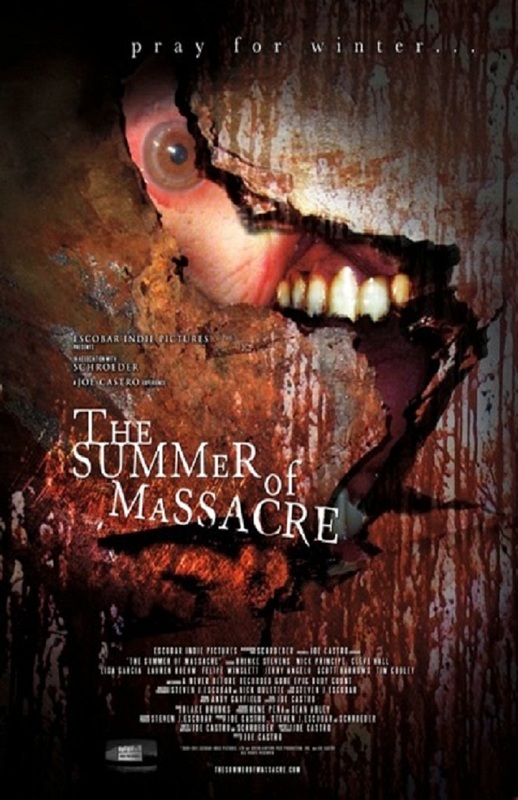
The Summer of the Massacre (2011)


Director: Joe Castro
Screenplay: Joe Castro and Schroeder
Cast: Tim A. Cooley as Chris, Nick Principe as Lori Williams, Brinke Stevens as Mrs. Williams, Lisa M. Garcia as Kimberly Ann Williams, Tchia Casselle as Melanie, Scott Barrows as Mr. Boogens, Lauren Boehm as Lisa, Felipe Winslett as Vinnie, Chris Staviski as Bradley, London Hilton as Conrad, Justin Marchert as Carmen , Joe Mannetti as Richard Khan, Bahram Khosraviani as George Vic, Dan Lovell as Dax Malone

In my decision to explore the films of Joe Castro, which I will continue, the idea was to be as non -partisan in my opinions without turning the reviews into puff pieces. The main ideas was to see if a director in any field, if they make many films, can be an auteur at least in reoccurring obsessions and motifs, to which particularly in micro budget cinema a director might actually read the reviews and be angry at whatever opinion you have.

Opinions should be allowed, and it was a good thing that whilst grotesque and nasty, Terror Toons 3 (2015) was actually compelling to witness. That said, the idea I had revisiting Terror Toons (2002) about Castro being very misanthropic comes to haunt The Summer of the Massacre, which I sadly have to confess was one of the most worst viewing experiences emotionally I have had just because of its relentless stream of violence and nihilism without anything to gauge with. For me, "worst" now is a rare nightmare where it's the attitude that I find worse nowadays than technical quality. Thankfully, this is not Darren Aronofsky's mother! (2017) where a creator makes a tool out of themselves, but sadly a case of a director I have softened to making a one off creative decision I am not found of in the slightest, where The Summer of the Massacre is most well known for having broken the Guinness World Record for highest body count in a slasher film, at 155, but through the perspective of a nasty attitude and a serial killer fixation doesn't work for myself well at all.

The anthology is four stories intercut by book ends, the first warning you how idiosyncratic Castro's style became into the 2010s where you have a warehouse full of extras in digitally mangled and desecrated corpse forms like the cover of Slayer's Reign in Blood. The comparisons to what Castro's style is, still doing practical effects but heavily computer manipulated to extra hyper digitalisation and green screen, is the paper animation of Jan Svankmajer's Surviving Life (Theory and Practice) (2010), where the Czech animator manipulated pictures, and the front covers of Carcass' Reek of Putrefaction (1988) and Symphonies of Sickness (1989) albums, their first two when they still were going "goregrind" and made collages from real medical photographs of death and disease to shock listeners. Joe Castro's style is gross and unforgettable in design but becomes too much, especially as I don't think he meant this to be as extreme as it is in this film but fun.

The anthology stories are also slim in content and long. The first, in which a guy is attacked whilst jogging and mutilated, leads to an endless stream of him killing extras as he has gone mad, picking off anyone in his rampage until he finds his assailants. Beyond the CGI, obviously fake but stylised to revel in all the gore and internal organs rendered onscreen, Castro's style is like many micro budget films if on a higher scale, a lot of location shooting in a very large cinema and casting ordinary folk off the street to star as part of the body count. It's an acquired taste, but it still continues because it has a charm, cast members regardless of acting quality you rarely get in Hollywood in terms of the variety of shapes and sizes getting a chance to scream and be killed, which I can respect. This segment, with barely any plot, however lasts too long.

The second story Lump is the most interesting of the lot because it has a story of a slasher film. A sister sick of her female sibling, an incredibly disabled and incapacitated girl with a pronounced lump and likely to die, pushes her off a cliff in the woods to the horror of her brother, even her boyfriend and friends who are actually against being part of this. The younger sister, the lump burst and somehow alive, wakes up and goes on a revenge spree against them all. It's not my thing, but it's an idea with a story. It is at least something of potential interest.

The third is where The Summer of the Massacre, alongside the book ending segments interspliced between the stories, show this is meant to be nihilistic on purpose, a really nasty tale of a father of a man, a bloated "bogeyman" who conceived him by raping his mother, coming back to torment and mutilate him when he is an adult. Here the edginess gets too much for me, also with a sense that with the interviews with fake serial killers that are spliced between segments of The Summer of the Massacre feels part of a period alien to me.

The film does have a view of "coolness" to its edginess, of grim horror and serial killers, Joe Castro someone old enough to have grown up figures who gained uncomfortable cult auras around them despite being mass murderers, still significant into the nineties with figures like John Wayne Gacy or individuals in jail like Jeffery Dahmer. It's a concept alien to me as an Englishman as, whilst we have tabloids go on about this, we've never developed this aura for our history of serial killers. Barring Jack the Ripper, there is very little chance of someone like the Yorkshire Ripper ever gaining such a reputation. For me as well, there is also the question of when was the last time a serial killer, as they sadly still exist, was talked about in pop culture a great deal. A part of me considers that since 9/11, and between terrorist attacks and spree shootings, a consciousness has come up that makes the notion of highlighting these figures distasteful.

Certainly The Summer of the Massacre feels of a tone I couldn't get into, and for me when you get to the end of the Bogeyman story, where the titular fiend massacres an entire hospital, Joe Castro unfortunately crosses a line of desensitisation that, like starting at the early Carcass LP covers for too long, just becomes dulling than shocking, oppressively so. This applies as well to the final story, about a group of campers being terrorised by a mutilated and burnt up fireman, which didn't linger once my senses had been burnt out entirely. The only thought that came by then, the one great interest, is that Joe Castro continues with LGBTQ content. There's another drag performer in the film, whilst sadly only briefly, and the fourth story surrounds two firemen who were in love, burnt to death, and the surviving one becoming a Jason Voorhees figure, still lurid and nasty but coming from a place of note1.

After this, the wraparound returns to the warehouse full of corpses, the serials killers interviewed (three of them) throughout the film hold up against the police with a cage full of people and inexplicably having acquired a nuclear bomb, turning in the end to a bleak post apocalypse where news broadcasters talk of Chernobyl for reference. Whatever Joe Castro was going through, a really bleak "fuck the world" mood and/or wanting to break a record of some sort, it's not a sombre nihilism but too much to digest at once. This opinion is not a condemnation of Castro's filmmaking, as Terror Toons 3 was a film you wanted to take a shower afterwards from but was also a bizarre film with a black humour to it. Instead, this was such an endless experience that I'd rather watch any Terror Toons film before it.

Abstract Spectrum: Grotesque/Nasty/Psychotronic
Abstract Rating (High/Medium/Low/None): None


==========
1) One film of Castro's I'd like to see is not even a horror film, a rare tangent in his filmography called The Young, the Gay and the Restless (2006), meant to be a parody of American daytime soap operas with a likelihood of a few shirtless men throughout. If it worked even slightly, that'd be a film worth seeing.

Thursday, 27 February 2020

Terror Toons 3 (2015)


Director: Joe Castro
Screenplay: Joe Castro and Steven J. Escobar
Cast: Herschell Gordon Lewis as Himself; Beverly Lynne as Cindy; Lizzy Borden as Candy; Lizet Garcia as Sheriff Hate; Jonah Nemetz as Red; Brashaad Mayweather as Bad Wolf

In 2002 director and practical effects designer Joe Castro made Terror Toons, an incredibly low budget slasher film about killer cartoon characters. Come 2007, Terror Toons 2 was pretty much a remake of the original, in which Satan (or Satan's son in that film) has decided to release deadly cartoon DVD compilations into the world. Terror Toons 2 was this premise with a larger cast, a significantly larger body count1, but still a micro budget production which relied on computer effects and superimposition, ones obviously artificial. The only real change was that the sequel introduced a desire to take fairy tales, Hansel and Gretel in that film, and pervert them. It's a film that, even though I confess that the original Terror Toons wasn't my cup of tea, does feel like under the shadow of the prequel which was at least the first and distinct. Literally it's a remake in many ways but trying to boost off an idiosyncratic work in itself I had a strange nostalgia for.

Terror Toons 3 is something completely different.

I had some inkling of this - I was intrigued by the trailer in its hyper artificial computer effects drowned form - but I wasn't expecting something this unpredictable, grotesque and utterly bonkers. The detail to bear in mind, which isn't promoted in the trailer, is that under seventy minutes the film has an unconventional structure, that it beings with the recapping of footage from the original Terror Toons, before attempting to set the film the same day of the events from a film made thirteen years previously. It was a challenge when Halloween II (1981) followed Halloween (1978) just in Jamie Lee Curtis' hair, but this was a considerable risk here. Castro went as far as cast all the actors, who were already clearly adults playing teens back then, even if it means bringing them back to life. Since we were last with them, Beverly Lynne has been in a lot of softcore, whilst porn actress/director Lizzy Borden had ended up in jail between the films, due the an obscenity trial against the transgressive porn films she was directing into the 2000s, to which she was released in 2010 and back to projects including this film.

Ironically, it's not even worth bringing up whether they have noticeably aged or not, as Terror Toons 3 is barely about those characters baring a cameo. Instead the film is divided into two. The first piece are the reincarnated antagonists of the original film, Dr. Carnage and his killer monkey assistant, going on a bloodbath rampage in a hospital. The second piece has splatter film innovator and exploitation legend Herschell Gordon Lewis, in one of his last onscreen apperances before his 2016 passing, narrate a twist on fairy tales where Red Riding Hood and the Big Bad Wolf are two male friends being targeted by the Three Little Pigs, i.e. a corrupt trio of cops.


The fairy tale is the actual film as it takes up most of the length and, amusingly, Terror Toons 3 leaves on a "To Be Continued" with the Dr. Carnage and Max Assassin story, which is just a string of gore and perversion. The fairy tale itself has Red Riding and his homestead, a group of red hooded gang members and a grandmother played by an old man, eventually getting into a brawl with the evil cops. I will get to the aesthetic of the film later on, but suffice to say it's a fascinating and perverse experience, absolutely not for anyone but one I found actually unique even if I felt dirty afterwards. Castro has an eccentricity which clearly grew over a decade, playing to both a desire for misanthropic humour and grotesque splatter, less torture porn now like the first Terror Toons but overt lunacy here, in which eventually not even cannibalising bodies to hide the evidence will work as they all collect together into an Eldritch blood blob monstrosity of CGI. Even the world of this fairy tale looks like a horrifying video game downloaded off the deep web, clearly aware that it doesn't look realistic in the slightest, and making the viewer want to feel queasy with distorting actors or a world of giant creepy teddy bears on the side of streets.

Terror Toons 3 as a result is significantly weirder than any before, here a film that is frankly grimy as Castro fully embraced superimposed sets and deliberately fake inserts and distortions over time after dabbling with them for the first two films. I originally referenced the Black Hole Sun music video for Soundgarden for the original Terror Toons, but now I can legitimately make a comparison to *Corpus Callosum (2002) and make it stick, a sadly difficult to see film by Canadian avant-garde filmmaker Michael Snow. *Corpus Callosum was a series of vignettes, set around mostly an office, where Snow deliberately used fake and cheaper looking computer effects to mutate and distort the human body, open to crude jokes such as an ever growing giant cock.

This exactly applies to Terror Toons 3 but even more rancid and nasty on purpose, not as despairingly nihilistic as The Summer of the Massacre (2012) thankfully, but the tone finally out of the trilogy fitting the darker streak Castro has with his splatter. Also aptly there's giant cock here too, giant werewolf cock as among the many things that will boogle the mind as it manages to come up with ideas even I had to have a double take on and admire in its sick originality. The Red Riding Hood story is proud of this, alongside also a clear camp edge belied that Lewis, who even here is a charismatic man who could wax lyrically about good business practice, was hired like a macabre horror show host holding a homemade evil looking text, or the cops (including a strict female leader) not just eat doughnuts when we first meet them, but have them cut in half and filled with chilli and cheese. There's another drag actor following on from a reoccurring trend in Castro's work, here playing a female Robocop, and probably the most overt homoeroticism I have encountered so far as, whilst there is some female nudity and a woman inflated into a giant skyscraper sized breast, here's a lot of topless manflesh and werewolf cock, the fake exaggerated kind or real. This even includes an actor superimposed humping a giant actress's leg in a moment so kinds of fucked up it has to be applauded even if it feels wrong to.

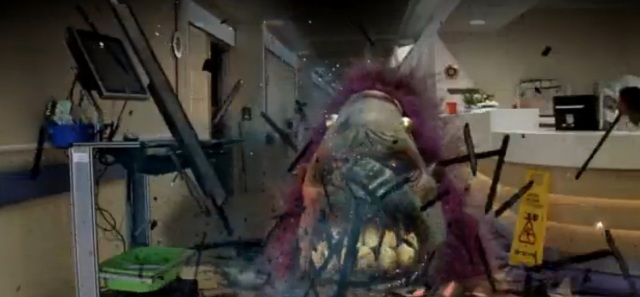
The story does get illogical - a random witch cameo near the end even gets a baffled reaction from the leads of the fairy tale segment - but it is a strangely compelling experience, the extremity of the aesthetic interspaced with practical effects. This applies as much to the other half, the massacre at the hospital which is really a series of CGI exaggerated set pieces with no conclusion, in which Dr. Carnage returns as a constantly reforming giant monstrosity, and the effects in the midst of the CGI tampering are spectacular, one in mind the creature inside Dr. Carnage's body making everything work whilst looking like a horrifying plus toy. That example is among the many that show Castro's work has jumped beyond what he was doing with the first two films, not dismissing the work he has probably done outside this trilogy since before the franchise, but that he's worked on it further in this context and world. Even the CGI, if you accept it, has an immensely surreal effect now, such as setting up a shot of a toy vehicle for a baby, only to have it later as a giant object ploughing through victims in a hospital corridor.

That it doesn't have an ending, baring carnage having taken place, does pose an issue as there never was a Terror Toons 4 in the 2010s. The fairy tale does end, with Herschell Gordon Lewis befittingly regretting trying to cook a pig's head, a final scene he'd have probably found great, but it's curious that Joe Castro clearly had plans to continue this series, like to pepper in more perverse fairy tales, only for that not to happen1.

Abstract Spectrum: Grotesque/Perverse/Psychtronic/Weird
Abstract Rating (High/Medium/Low/None): Medium


 ======
1) Joe Castro really likes to up his ante in body count numbers, as Terror Toons 3 shows and that The Summer of the Massacre would break a Guinness World Record for the largest body count.
2) At the time of this review, in February 2020, it does list on IMDB that Terror Toons 4 & 5 are in post production, with Lizzy Borden's twitter account informing readers that number four is actually about to be released in a moment of synchronicity at the time this review will be up. I will leave this review with curiosity of if they are released and what to expect....