 |
| From https://ia.media-imdb.com/images/M/MV5BNGUyMjVhZjctNWEyNC00MzBiLThmN GItMmU1MDE0NzQyOWZmXkEyXkFqcGdeQXVyMjI4MjA5MzA@._V1_.jpg |
Director: William Peter Blatty
Screenplay: William Peter Blatty
Based on the novel Twinkle, Twinkle, "Killer" Kane by
William Peter Blatty
Cast: Stacy Keach as Colonel
Vincent Kane; Scott Wilson as Captain Billy Cutshaw; Jason Miller as Lieutenant
Frankie Reno; Ed Flanders as Colonel Fell; Neville Brand as Major Groper; George
DiCenzo as Captain Fairbanks; Moses Gunn as Major Nammack; Robert Loggia as Lieutenant
Bennish; Joe Spinell as Lieutenant Spinell; Alejandro Rey as Lieutenant Gomez; Tom
Atkins as Sergeant Krebs
 Synopsis: In a Gothic castle in the United States, various military
personal with severe mental disorders and psychosis are housed together within
its walls under care. members of the military or high profile careers who
suffer from severe mental disorders and psychosis are placed together under
watch of the US military. A new psychologist Colonel Vincent Kane (Stacy Keach) arrives at the facility, offering
new and very unconventional methods of dealing with their treatment. He is
however troubled by memories of his brother, who become psychotic during the
Vietnam War murdering any bystander in his path, feeling the weight of the
world on his shoulders as he broods. His goal for salvation is focused entirely
on one patient by the name of Captain Billy Cutshaw (Scott Wilson), a former astronaut and Catholic who has begun to
doubt the existence of God and couldn't complete a rocket launch to the moon,
Kane deciding that he can help Cutshaw is he can prove that good exists innately
in the world.
Synopsis: In a Gothic castle in the United States, various military
personal with severe mental disorders and psychosis are housed together within
its walls under care. members of the military or high profile careers who
suffer from severe mental disorders and psychosis are placed together under
watch of the US military. A new psychologist Colonel Vincent Kane (Stacy Keach) arrives at the facility, offering
new and very unconventional methods of dealing with their treatment. He is
however troubled by memories of his brother, who become psychotic during the
Vietnam War murdering any bystander in his path, feeling the weight of the
world on his shoulders as he broods. His goal for salvation is focused entirely
on one patient by the name of Captain Billy Cutshaw (Scott Wilson), a former astronaut and Catholic who has begun to
doubt the existence of God and couldn't complete a rocket launch to the moon,
Kane deciding that he can help Cutshaw is he can prove that good exists innately
in the world.
The Ninth Configuration starts off deceptively. A country ballad
plays over a panoramic shot of a Gothic castle, meant to be on US soil but
clearly the European location the film was shot at in real life. With William Peter Blatty's pedigree - the
author of The Exorcist's source
novel and the 1973 film's screenwriter, director/writer of The Exorcist III (1990) - you expect immediately a rich, incredibly
well written tale with memorable dialogue. One with a very idiosyncratic take,
from his Catholic beliefs, of hope even in the most dire of circumstances. What
you get with The Ninth Configuration
is this, but also what happens when this first time director/writer, who
partially funded the film as its main producer, has to wrangle an already
complex premise into a feature. A premise even in the seventies, when very unconventional
films were made in Hollywood, which was deemed unsellable and he had to fund
himself, grappling with complex ideas in a dense script but also with his own novice
position at play. One which plays three-quarters of itself as a bizarre comedy
that crashes into deeply serious material later on.
 |
| From https://4.bp.blogspot.com/-ToDwszq--oA/Wh8MM72hnSI/AAAAAAAAAGs/CZTzHQaSw44Cyb79fUU QmR8WPTKrIetowCLcBGAs/s1600/DPvmhQpUEAApKqN.jpg |
The moment you get the parade of inmates at the beginning, you are aware that Blatty took the absurd comedy to its fullest. It's not an accurate depiction of mental illness, just a premise which becomes as mad as a box of frogs. How, as a first time director who had full control, he constructed the film is as much why The Ninth Configuration is as good as it is but also why it is difficult, potentially frustration and potentially divisive for many. A layered and frankly messy sound design is the first issue. Fascinating as dialogue is heard of characters off-screen before they even appear, but it is also dense due to how the film was made, especially with the naturalistic acting styles of the cast that means you can easily miss details with ease, distracted or because dialogue is too quiet in the sound mixing. The script itself is as complex, having to juggle elaborate and sometimes incredible artistic dialogue alongside moments of serious humane and theological ideas. It does succeed but I will not understate how much of a challenge it is on a first viewing. That's before the weirdness begins to pile up as well.
It terms of what The Ninth Configuration is, Blatty offered it as the official sequel
to The Exorcist. Rather than what we
actually got - John Boorman's utterly
ridiculous Exorcist II: The Heretic (1977)
- if The Exorcist was about evil
existing in the modern world, The Ninth
Configuration is about good in the modern world, especially as Captain
Billy Cutshaw is meant to be the same astronaut Regan in the first film
confronts when she is first demonically possessed. If The Exorcist is about the Devil existing, The Ninth Configuration is about God existing. How Blatty goes
about this is not what one expects, playing at first in pure absurdity at its
most extreme with flickers of suddenly moments of introspection with Colonel Kane,
a troubled man whose existence is revealed to be a nightmare for himself,
literally disconnected from himself.
 |
| From http://images4.static-bluray.com/reviews/10864_5.jpg |
Whilst the presentation is coarse and jagged, with a plot structure which will put many off, it does make an interesting choice in depicting the modern world, post Vietnam War, as a literal madhouse of chaos. As Cutshaw denies the existence of God, he yet lingers over Him as a Catholic, Kane ultimately a saint trapped within his own horrifying crimes against humanity, his own redemption (depending on the version of The Ninth Configuration you see) forced by martyrdom or self sacrifice. Whether the theological arguments work for the viewer, or they see them as flimsy, altruism ultimately is the idea central to the film. It still asks in this idea whether mankind is capable of self sacrifice without a need to do so except for good, the kind of material that you cannot help but be impacted by. Even the final scene, where a fully irrational moment happens to Cutshaw, a tiny but profound one, views existence as a complex beast the human species barely grasps on. Even if you find the film an utter indefinable mess, this is the kind of material many film viewers desire to see in their cinema whether your opinion is hopeful or nihilistic of these characters.
To get to this material though,
you also have the truly bizarre, evoking Joseph
Keller's Catch-22 as taking the
absurd to metaphorical delirium tremens. It happens to be acted out by a who's-who
of great character actors - Stacey Keach, Robert Loggia, Neville Brand, Jason
Miller from The Exorcist - but the density of this writing alongside the tonal
shifts keeps you on your toes as a viewing. When Dr. Kane decides to let the
inmates indulge in their desires the film reaches its zenith of madness. This
was already a film where Loggia's
first appearance is in black face, the future star of Innocent Blood (1992) and Lost
Highway (1997) imitating an Al Jolson
number whilst a black member of the
inmates Major Nammack (Moses Gunn)
looks on with bafflement, but when Kane lets them all act out their fantasies
it gets weirder from there.
 |
| From https://cdn-images-1.medium.com/max/ 1600/1*Ip_jh_dIWYgQungGrRiRuw.jpeg |
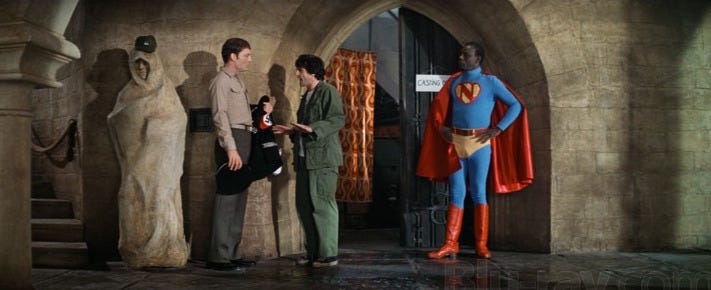
Whether The Ninth Configuration works entirely or not, you have to admire a film this ambitious. Especially when it includes so much to love and admire. Jason Miller relishing his role as Lieutenant Frankie Reno, not the sombre and lost priest of The Exorcist but an inmate obsessed with re-enacting the complete works of Shakespeare with dogs as the actors, getting most of the best lines from the role. Moses Gunn wearing a Superman costume and even arguing with Miller that Superman should appear in one of the latter's plays to rescue a character. The least expected appearance of a jet pack possible. Ed Flanders' Colonel Fell, who becomes a more tragic and emotionally complex figure played by Flanders incredibly, but begins as a hilarious figure who deals with inmates stealing his trousers and has to relieve himself by combining whiskey with Alka-Seltzer. Dialogue, from suicide pills with laxative qualities to even a shout-out to Alfred Hitchcock's Spellbound (1945), so ripe and so hilarious at times I will gladly rewatch the film to soak it all up. And then there's the dramatic bar sequence near the end of the film which is the denouement of the film. Strange in itself as Steve Sandor as a bike gang leader is dressed as a glam rock lead singer, (or Gerrit Graham's Beef from Phantom of the Paradise (1974)), with character actor Richard Lynch of all people adding to the cast as his right hand man, but ultimately an important moment for the tragedy that takes place when a certain character snaps. Whilst the film feels of its incredible flaws in structure, so much so there have been many cuts of the film from Blatty before his death, there is still a pertinent and powerful drama in the midst of all its oddness to go with. So much that stands out that it has to be admired.
Abstract Spectrum: Introspective/Surreal/Weird
Abstract Rating (High/Medium/Low/None): Medium
Personal Opinion:
Ambitious, ramshackle at points,
but ultimately admirable. The Ninth
Configuration has stayed with me since seeing it, and I cannot help but
think of so much that works within the film and also having gained so much even
from the challenge of watching the movie.
 |
| From https://ia.media-imdb.com/images/M/MV5BZDg4MzUwYTUtN2MwZi00NThhL WJjYjMtYTlhYWE1YmQ1YTc3XkEyXk FqcGdeQXVyMjUyNDk2ODc@._V1_SX1777_CR0,0,1777,736_AL_.jpg |


