Showing posts with label Letter: D. Show all posts

Monday, 31 March 2025

Diary of a Secretary (2007)


Watched Tuesday 4th March 2025

Director: Francesco Fanelli

Starring: Roberta Gemma, Julie Silver, Victoria Lanz, Veronica Belli, Rossella Conti, Marco Nero, Franco Trentalance, Johnny Montoya, Dieter von Stein, Leonardo Conti and Teo Mantera


I decided, like a mad man, to try to rent and watch every new release in 2025 on DVD or Blu Ray from the sole postal rental service to my knowledge that still exists. I made one exception, the later seasons of long running television, but this challenge whilst not likely to be finished also raises that I'll be out of my comfort zone greatly too, as this includes genres and television series I normally would not venture into.

The decision to even break the fourth wall and admit that, whilst this review will be written and completed in March 2025, is to be made available time after is telling. Its not out of embarrassment of watching a softcore cut of an Italian 2000s hardcore porn film, but because this is not a film of any kind to start this idea off with whenever published, the kind that feels disjointed to a negative point regardless of what you were watching it for. Released on Blu Ray in 2025 among imported CGI animated films for families and a David Attenborough documentary series about animals in Asian countries, watching this deliberately distancing yourself from its intended goal of arousal is a very weird thing to do, I admit that, if as a result strangely fascinating to ever do like a bizarre visual experience. However, with this particular one, director Francesco Fanelli's utterly exposes many problems with this on many levels, even if it feels cruel to bury any film for me nowadays.

Distanced from its intentions, the film feels like a series of choreographed rituals, rather than actual erotica, and it is confounded by the very little plot it intended to have, feeling like a distracting factor. The first question to ask, about this tale of a female secretary Roberta (Roberta Gemma) being hired by a male member of the mafia to document his family's sordid behaviour, is why softcore releases are still being produced. Considering the internet exists, that this let alone is available in a high definition version is a side of physical media in the UK of curious note. "Smug without smut", to borrow the term the American Genre Film Archive coined for screening (and releasing) pornography with cut versions in the United States, is a concept of being able to excise the actual sex, which is still divisive for people, and present the story around it as entertainment. Also, the United Kingdom still has stricter rules on pornography, and whilst the internet does exist, still so do the licensed sex shops which find themselves ostracised in the wasteland of cities next to petrol stations. Even without the possible shame, or disinterest, in viewing the extended real sex scenes, there may be additional income to selling these cuts still, and what has to be factored in with this version, and the modern releases in Britain, is that they almost all come now from Salvation Group. A significant company in the history of cult British VHS and DVD cinema under their label Redemption Films, they're behind most of these releases like today's review in the current day, and there's more to releasing this than the factors suggested already.

Salvation/Redemption is a multimedia concept founded in 1993 by Nigel Wingrove, who beforehand was involved in design and is also a man who managed to get one of his short films banned under British blasphemy laws, with Visions of Ecstasy (1989), the only film to only have been in the British Isles. Alongside its promos evoking the more explicit designer work for the metal band Cradle of Filth, who Wingrove has collaborated with, Redemption Film became an arm in making European horror and genre cinema onto British VHS shelves. In the DVD era, it became a way for me to first encounter Jean Rollin and various obscure titles from countries like Italy alongside the likes of Arrow Video's earliest releases. Wingrove has also since the start been fascinated with erotic filmmaking, distributing it in the United Kingdom. Be it softcore/sexploitation cinema through the Jezebel label started in 1994, to Japanese pinku releases and edited version of hardcore filmmaking, the company through its various labels has embraced these films as much as horror and other genres since the origin point. Even including edited versions of modern 2010s-onwards American pornographic cinema, these titles are still appearing in the high street here in Britain, and with Blu Ray releases coming out in 2025, there is a view here of celebrating these types of films too clearly felt.

The delay in the review is out of hindsight that, with respect for the cultural institution, this is mean to Redemption Films as much as to the creators of Diary of a Secretary, because this particular production is neither one thing nor another as desired. Mid-2000s modernist erotica shot in middle class Italian homes, likely rented out to adult productions, could be my thing with its stark, matter-of-fact lighting. Its style would befit a crime soap opera, something that even if sparse and clichéd could've at least gotten to something compelling. Sadly it never gets to this or whatsoever having a real story, not even a low budget aesthetic to depict this premise of the sordid criminal life and the sexual relationships of mafia, which would've least been interesting in itself. Someone in a flashback making life miserable by complaining about a Japanese restaurant's food and then sleeping with the owner's wife is the most dynamic moment, but it leads nowhere. Even if there's a charm to just staging it in someone's home masquerading as a restaurant with some sushi on a plate acquired, you could've had fun, for all the additional issues a lot of pornography still has for people, with the material.


Even with a lack of budget, there's a charm for this particularly viewer in micro budgets, and the idea of pornography with its rented out homes, wondering how much of the backdrop and items around the shelves belong to someone, is a compelling aesthetic if a curious one. Even if it leads to the most uncomfortable idea of having a person's bare torso pressed into the cold steel handle of a weight lift machine, whilst I won't kink shame anyone, at least the production had the wherewithal to hire a gym. None of these locations feel like they were needed, and could be removed, which presents the huge problem here that this all feels perfunctory regardless of the reason you came to it as an audience member.

If this film had entirely embraced being pornography and rested on its visuals, we could've had something interesting, and there is another film Redemption Films released that I still owe an apology for as an example, which was Michael Ninn's Cashmere (1999). Entirely a work about staged real sex scenes, what however stood out about it, and why I completely understand Nigel Wingrove releasing this on DVD back in the day even censored, was that he used it to tackle the sixties, specifically the early sixties where he has adult actresses dressed like Jackie Kennedy and cheerleaders, and fetishises fifties era diners and the colour pink as much as the bodies of his male and female cast. Diary of a Secretary, even if the English dub nearly pushes this into an episode of an old Channel 4 series Eurotrash, could have entirely played off even its look and tone like a televised gangster pastiche even if also erotic scenes only, playing up to this aesthetic and type of characters. The lack of prop firearms on the male cast by itself adds to the perfunctory nature.

The discrepancy in not doing more with the material is felt when this is definitely a softcore cut, as there are moments clearly reshot with clothing still worn obscuring details. Thus, literal dry humping, abstracting the content further as the amount of pouting, gurning and grunting become odd performative rituals here and are abstracting sexual desire. It is 99% of the film, the sex scenes, and without the salacious content, the issues of the film lacking spark is felt in that there is no flair or sense of idiosyncrasy to the footage. The film doesn't help when one woman is offered to mob goons as a gift, and the last line even if being jolted is a misogynistic barb, but I'd prefer women to be the ones to give the opinion on depictions of themselves, and damn specific films like this, whether it be the Andrea Dworkin anti-pornography side or the pro-sex feminists. The actresses here follow a type - all barring lead Roberta Gemma having blonde hair, and even she shares a similar body type to appeal to the targeted male audience - so there is absolutely an issue too that this is very perfunctory in how it depicts these idealised male and female erotic figures too, which I think I can criticise.

The women at least stand out more whilst the men, as is a problem for me even in regular films, are virtually interchangeable in themselves barring their hairstyles. Even if a form of objectification, even a film like this has its actresses in distinct clothes with prop jewellery, whilst the men could have their heads blurred and one would not care who was who, which raises issues for a film trying to be about gangsters and inherently meant to be of interest as cast members. It also raises an issue that porn as much objectifies men at its worse as much as it objectifies the women in the worse cases, if in different ways. Here, one guy is different because he has spiked his hair out with wax, whilst at least the actresses can have access to mesh body costumes, floral dresses, and exaggerated blue eyeliner John Waters would gush over. It is not enough to defend their generic depiction, but is at least something to cling onto, emphasising for me with the male cast in similar dark suits how limited and crap men's fashion can be in comparison.

It feels like shooting fish in a barrel, particularly as other Francesco Fanelli films have had Blu-Ray releases in 2025 and may offer works with more on their mind even in terms of titillation. However, this particular case was abrupt to witness in something which feels as blank as this. In this case, it's with a sense that, even on a purely crass level, there's a complete lack of aesthetics even on a horniness level, nor any sense of the film really revealing in its content. Roberta only starts writing in the first pages of the diary in the last act, as if an accidental metaphor the plot's lack-there-of, and if one has a mad roulette of films they want to see in a year like I want to, you really do feel gut disappointment, even on behalf of the director and cast, when the result feels like it is going through the motions in any medium and genre.

Sunday, 27 October 2024

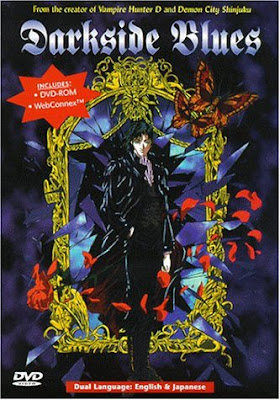
Darkside Blues (1994)


Director: Nobuyasu Furukawa

Screenplay: Mayori Sekijima

Based on the manga by Hideyuki Kikuchi and Yuho Ashibe

(Voice) Cast: Akio Ohtsuka as Kenzou; Hideyuki Hori as Gren; Kotono Mitsuishi as Mai; Kouichi Yamadera as Enji; Masako Katsuki as Tamaki; Maya Okamoto as Selia; Natsuki Sakan as Darkside; Nozomu Sasaki as Katari; Shinichiro Miki as Chris; Yasunori Matsumoto as Tatsuyairector: Viðar Víkingsson

A Night of a Thousand Horror (Movies)/A 1000 Anime Crossover


Darkside Blues isn’t really horror, though it has plenty of supernatural and Gothic touches worthy of the season, and I am glad to have revisited this, as this is a fascinating genre hybrid between dystopian sci-fi about corrupt corporations, which is still salient as a theme, that however has magic exist as well as a titular figure who rides around on a horse drawn carriage which can fly. It is fascinating, even with less than ninety minutes to try to depict this world, and a source manga which did not last long enough either to expand it further, to see what interesting things this depicts, be it a titular figure who acts more like a supernaturally powered advisor for freedom fighters to the sight of someone being tortured by being turned to gold whilst alive with alchemy. From the same author of Vampire Hunter D, and the infamous Wicked City as per its own animated adaptation, you see the threads for those here too, but in this melancholic and fascinating one-off.


For the full review, follow the link HERE.


Sunday, 20 October 2024

Games of the Abstract: Darkstalkers - The Night Warriors (1994)


Developer: Capcom

Publisher: Capcom

One to Two Players

Originally released for: Arcade


The history of Capcom's other beloved fighting game is split into two differing origins. One is that, in designing a new fighting game, the team assigned wanted to create a title entirely about monsters, taking advantage of existing ones of folklore and mythology as templates1. The other original is that Alex Jimenez, a producer at Capcom USA, suggested a licensed game based on the Universal horror movie characters, tied to the iconic creations that began properly with 1931's Dracula with Bela Lugosi2. or me personally, I think the truth is within both differing tales, as there is at least detail which suggests Universal horror films were someone's favourite at Capcom, but that the ball was rolling in terms of creating a monster themed game, including knowledge this was explicitly meant to have more yōkai, the Japanese folklore entities, than we got such as a nurikabe, a living wall that would have allowed the developers to create a character which never needed to move and require very little animation1. Whatever the case was, it feels inevitable with how Capcom started to push for the more fantastique and unnatural in their games, as the technology and the creative teams let their imaginations fly with genres like the fighting or beat-em-up genres in terms of monster and figures that would push their talents throughout the nineties. Also, such a project was part of a huge moment where Capcom, in the fighting game genre, suddenly created the gold standard for the genre and that, with others soon after wishing to create their own successes in its wake, they naturally wanted to follow up with titles to improve on what they did with that game.

That game was Street Fighter II (1991), which was a huge seismic change to video games. Despite the fighting game had existed beforehand as far back as Heavyweight Champ (1976) by Sega, let alone titles which pushed the genre further like Yie Ar Kung-Fu (1985) by Konami in the eighties including the original Street Fighter (1987), the sequel cemented the fighting game genre fully in form, and naturally Capcom wanted to expand on its success not only with that franchise, but with others. Even if the origins are vague, it is not a surprise someone wanted to see a Frankenstein's monster in a fighting game, and thankfully able to be played again 2022 with a Capcom Fighting Collection retro compilation, let alone previous non-arcade releases, the Darkstalkers franchise is also one people wished Capcom brought back, and for good reason. Even non or casual gamers, who are horror fans, would dig even the original 1994 game as, whilst this series would evolve in gameplay style and the beautiful artistic style, we got from the gate already a strong horror fighting game in both aspects.

With new arcade hardware to push, Capcom would also need to capitalise on its advancements in terms of their games too, Street Fighter II changing from its original 1991 version through multiple revisions, until Super Street Fighter II Turbo (1994) looked an entirely different game let alone with new mechanics from the original. That was made for the CP System II arcade board as Darkstalkers: The Night Warriors was, and whilst by its last game it would improve and add to the original template, we were already entering this new territory of a horror themed fighting game with already a strong atmosphere. At a time when the arcade fighting game genre was becoming huge, this even applies to innovations in ideas that seem obvious for the genre decades later, like the ability to block in the air that were introduced in this game. That the aesthetic and presence were already strong helped so much, like Street Fighter in Halloween town but with its personality its own, and it begins and is central to the cast Capcom created for the original game.

A huge factor for me being interested in these games is that Capcom were insanely great for their character designs, and even how they play has made me really start to fall in love with them now I have. From the get-go, one of the really cool touches to the original Darkstalkers game is that each character was designed by their own person, and these designs were figured out with care to work in the final production. Darkstalkers has, even the attempt at a new hero who was quickly rejected after the initial sequel, one of the strongest rosters just in terms of everyone standing out between its three games. How they managed to make characters distinct to each other already in the first game, in terms of gameplay feel and personality, even if later sequels would add more to them including iconic moves and touches, really means a lot. The sense of this still being fleshed out in those sequels, as only the original game follows Street Fighter II in having these figures represent countries, actually makes what was accomplished here more praiseworthy, the choice to follow a horror/mythological/folklore trope, and flourishing each archetype out in really idiosyncratic choices being a masterstroke. The closest to a traditional martial artist in this game is a werewolf, which is where the Universal monsters link feels apt, as he is in the Western localisation named Jon Talbain, clearly after the lead character Lawrence Talbot who Lon Chaney Jr. played in The Wolf Man (1941), and even a character who was not drastically altered from the tropes like Demitri Maximoff, a traditional vampire and original (anti-)hero for the game here, still has a distinct style to him.


The characters mirroring their Universal horror counterparts all have their distinct personalities, both faithful to the icons, whilst having their own clear distinctions. Frankenstein's monster, by way of Victor, is a great example of this for his visual distinctiveness as a natural powerhouse character, the developers pushing for his limbs (even his head) to expand out in his attacks in cartoon stretch-and-pull effect, and that, infamously, this even applies to his ability to use his buttocks to grab and throw enemies. That feels less bizarre for the sake of it but the fascinating mix of grotesque horror, as there is blood and macabre sights in these games, against pure slapstick cartoon touches in the animation. Be it a Sasquatch who is an adorably fluffy and big goofball, to a take on the Creature from the Black Lagoon (1954) who is a vain sexy fish man, completely ahead of its time and Guillermo del Toro's The Shape of Water (2017), everyone has something distinct to them. This even is in terms of their attack styles, whether playing the samurai possessed by cursed armour, Bishamon, which is clearly based around needing to counter and using his blade as one would expect from a samurai, to Anakaris being the representation of an Egyptian mummy, the slowest and potentially most awkward character to use, who literally floats slowly in the air, but has one of the most idiosyncratic move sets even in the original Darkstalkers game before he could be expanded upon. Briefly turning his opponents into cute, tiny versions who cannot attack briefly, dropping sarcophagus from the air, and moves which really emphasis the need to choose the special or regular move depending how far or close an opponent is, he because a really cool figure by himself and just one character like him in a game would have left it having fans, let alone a twelve entity roster for all distinct figures.

Tellingly, even the female character of the original game, whilst sexualised, overcame this to be adored, and that shows the real success of Darkstalkers even from the get-go in how its first two female characters became iconic regardless of that initial aspect of the character design. Introducing one of the first prominent cat girls into the West for games, Felicia was not merely marked for her character design, but for her characterisation as a goofy and likable cat-woman entity with blue hair who just wanted to become a huge star in Las Vegas, and by the end of the franchise becomes a nun to help children. And Morrigan Aensland eventually became the true protagonist of this franchise and its most well known character, and likely the one pop culture take on the succubus for many that entirely represents this mythological figure. A frankly problematic and misogynistic figure of lore to some, she completely upturned this with the history that came afterwards, all the cosplayers who have portrayed her over the decades, and becoming a figure of merchandising for Capcom, alongside cameos in other games, that may have even sadly overshadowed other Darkstalker characters, all without any sense that she is a figure that isn't powerful. This is really cool as, as many of us probably don't realise unless you played this original game, she is meant to be Scottish and thus, as one of Capcom's most beloved characters always in the fighting game collection cover art, one of the most well known video game characters from Scotland.

It is a legitimately virtue how none of the initial roster, even if some would not be as popular as others, feels lazy. They all stand out, all with distinct ways in their fighting styles and even in terms of personality, as Capcom embraced both the horror but also overt cartoonish nature of them. Even a character like Morrigan herself, or one meant to be seriously like the final boss, a planet collecting alien named Pyron, will be animated in dumb poses when knocked off their feet, electrocuted or turned into a cute little critter by Anakaris' Royal Judgement attack temporarily. The animation, with its emphasis on these cartoonish flourishes in even how strikes are thrown, is legitimately beautiful with hindsight, and the same is for the character specific locations in both their look and their little pieces of animation. You find yourself fighting at night in the middle of London with Talbain, scenery in the background like wine barrels if you hit the right moves, spotting the iconic "happy" dog that moves about in Bishamon's stage, or ending on a finale in Pyron's unnatural dreamscape made from all the worlds he has destroyed and reassembled into his collection. The music too by Takayuki Iwai and Hideki Okugawa is as distinct, appropriately evocative even when Felicia's stage, set in Las Vegas with all bright lights and cats loping around in the background, is partially set the cat meowing.

The thing that changed over time, when the bar was set this high already, was that Capcom pushed the visuals further, making far more incredibly phantasmagoric stages even if not character or geographically specific. The music would become even more evocative with the time passing, and the characters themselves alongside newcomers would get more personality and even some of their most iconic (and infamous) special moves and animation ticks, like Lord Raptor. Already a cool design of an Australian rock star who sold his soul to Satan, and now is a strange bony zombie with even the ability to move crawling crouching on his bony knees only he can do, future instalments of the games let him be able to literally slam dunk his enemies as basketballs.

And this is all in mind that, as iconic as Street Fighter II, it did come from the original Street Fighter, a game which is not held as a good fighter at all in the modern day, and that Capcom, able to suddenly leap in terms of quality for their iconic blockbuster hit, didn't slouch either from Street Fighter II's success and kept improving themselves, both artistically and in terms of ramping up the mechanics of the fighting game. To even get to the original version of Street Fighter III, Street Fighter III: New Generation (1997), which was seen as a disappointment and even irrelevant when polygonal fighting games were all the rage, it was still a game which would eventually became as acclaimed for the quality of its artistic creativity over its multiple versions, let alone the game play from experts in the genre due to Capcom pushing themselves over and over. By the end of the franchise I am talking of her, you get the magnum opus of this horror fighting franchise Vampire Savior: Darkstalkers 3 (1997), which is an exceptional game, but even if Darkstalkers: The Night Warriors had been tragically just a one-off from Capcom, it would have still been seen as a great game for many including myself for how much it does well let alone how fun it is.

=====

1) Darkstalkers – 1994 Developer Interview, translated for shmuplations.

2) Darkstalkers’ – The Monster Movie Origins of Capcom’s Fighting Game, written by Luiz H. C., and published for Bloody Disgusting on September 6th 2023.

Friday, 18 October 2024

Darna Mana Hai (2003)


Director: Prawaal Raman

Screenplay: Atul Sabharwal, Rajnish Thakur and Abbas Tyrewala

Cast: Nana Patekar as John Rodriguez, Saif Ali Khan as Anil Manchandani, Vivek Oberoi as Amar Vashisht, Sanjay Kapoor as Sanjay Joshi, Sohail Khan as Karan Ahuja, Shilpa Shetty as Gayatri Pandit, Isha Koppikar as Abhilasha Malhotra, Aftab Shivdasani as Purav Khandelwal, Boman Irani as the hotel owner, Sameera Reddy as Shruti Kapoor, Gaurav Kapoor as Romi Yadav, Antara Mali as Anjali Deshmukh, Raghuvir Yadav as Dayashankar Pandey, Anuj Pandit Sharma as Varun Goswami, Rajpal Yadav as the apple vendor, Sushant Singh as the serial killer, Malavika as Neha Bhatia, Rahul Singh as Dev Bohra, Peeya Rai Chowdhary as Mehnaz, Kiku Sharda as Amar Varma, Yusuf Hussain as Mr. Khandelwal

A Night of a Thousand Horror (Movies)


A Bollywood horror anthology, there were songs made about the stories within this production and a soundtrack release for this film, but they were left out as bonus features included on the DVD I viewed this through. Whilst I will be very positive about this film in general, thankfully the opening credits by themselves compensated for this and are adore as this film’s own idiosyncratic creative choice for this genre. That being, after a shot of black gore seeping over a blood red apple, a Eurodrance influenced song kicks in. Female dancers in black body suits dance against a red background, with motifs of all the story segments included, whilst the male singer croons the morbid ditty which is the central song. This is not something you would have gotten in a Amicus anthology from the seventies, but here is was a great way to establish its personality, follow the tradition of the subgenre by opening with the wraparound story first that will weave between all the other tales.

A group of college students, alongside one named Vikas with his apple cutting knife looking like he is about to snap at any minute, are driving in the middle of the night until a flat tire leaves them stuck in the jungle. Whilst there are some aged fat shaming at one of the men, who is not even that large physically, thankfully it sets them up stuck at an abandoned old house in the middle of the night whilst trying to find a phone. An improvised game of cricket or a sing-along of Hindi film songs are rejected for telling stories to each other, critiquing them in each cut back to the main cast as a secret figure is picking each one off as each story-within-a-story plays out. The first story is arguably the most conventional, and you need to think of it as more a starter before the main course, about a couple on their honeymoon driving at night. Their car also breaks, and the husband vanishes checking the engine to his wife’s horror. It is the shortest tale, with someone sinking into a bog and a doppelganger, with stab wound sound jump scares. Whilst an obvious one, it is a nice beginning tale to an anthology which gets insanely interesting immediately afterwards and never lost my interest from this point onwards.

The second story is of Anil, another taste of the perils of driving in the middle of nowhere, in this case reaching a hotel. This leads to a fascinating turn as it is about the least expected thing, Anil as a smoker who has ended up at a non-smoking hotel, one ran by a man who loves old Tom & Jerry cartoons and hates smoking, so much so he locks the entrance door and says at gun point he can cure Anil of his bad habit if he stays for six months. Here we have a bleak comedy about a man, forcing Amil to stay, with a seventy per cent success rate in his patients giving up, the other thirty per cent in the basement in plastic body bags. It is such a good, gleefully morbid tale to have, not what you would expect traditionally for a horror story.


The third story is just as good, about a male school teacher, a strict one who punishes the same young girl for forgetting her homework all the time. That is until she finally does, and then the guilt kicks in and spirals out of control. There is more to this, a guilt from pushing a school classmate to his death off a roof, who has seemingly possessed her, but even that plays to that sense of guilt over this poor girl in general. Using very stylish choices of editing and fast forward montage to ramp up this mood, this is a really interesting juggle of its central twist and this theme of the cruelness of a teacher. With “Aum” found on each page of her work, the sigh to him his school friend is involved from the grave, it is as much a psychological tale with a  sick sense of awkward humour as he is the one unraveling, even calling her mother to talk about doing her homework. Or even visiting the home at night to see of how she does the homework, disturbing the mother especially as his least conventional attempt at home intrusion is misinterpreted as nefarious threat on a small child. Even if supernatural as a tale, it is a well told tale with madness as the punishment which also works fully.

The fourth story is about a housewife and a sinister apple merchant, which is the strangest story of them all if the one with arguably the most macabre interpretation, as any who eats his apples, like her cricket loving husband, turns into an apple themselves. There is not a lot more to say than this, barring that this is fun and actually quite disturbing. It brings a new perspective on the Golden Delicious depending on what the merchant does with the new produce. The fifth story is more sobered, another man driving at night who picks up a hitchhiker in a churchyard. As Creedence Clearwater Revival’s version of Good Golly Miss Molly plays on the car radio, the hitchhiker says he has lost his wife ten days earlier, though he is the one who died. There are more twists to this nice little piece, turning between drama and humour, like the preferred term of “spirit” over “ghost” or one twist involving a hidden camera prank, making it a success.

The final main story is also a success, a guy doomed to be on the bottom of life at a college named Purab. That is until he finds a sacred statue in the hills he rants at for his lot in life, and gains the ability to stop time. Power immediately corrupts, and whilst there is a gross hint of what he could do, particularly with a woman he is attracted to at college when he briefly freezes her, but it is thankfully dealt with as wrong as it should be, with most of the story a naïve sense of true evil, thinking he can instead show her how he can stop the world without doing so to her to convince her to love him instead, whilst getting petty revenge on his domineering father and planning the crimes he could get up to. Gaining more and more megalomaniac tendencies, the punch line involves the danger of posing in front of mirrors that cements a strong series of segments. Arguably with the exception of the first, which still works as an introduction, it is one of the strongest anthologies I have seen in terms of consistency.

The wraparound itself is strong as well, as it effectively becomes a slasher film ending involving a killer who hates fear. It even ends on a melancholic note for everyone involved, even for the killer. The result is a very strong anthology altogether, with zero expectations going to this barring optimism. Even the pre-film DVD ads stood out as a fresh remainder, with hindsight, as a complete outsider to Bollywood cinema that I wish to actually dig up more films like this and for more of them to be readily available in terms of the later Blu-Ray era as much as streaming. By the time this film was first release we are already at the point this film’s distributor, Eros International, was celebrating twenty five years of distributing Bollywood films globally. They were still releasing VHS and V-CD releases, but also were also providing online and satellite broadcasting, even providing their own online DVD rental system on their website. It is a tangent, but considering all the very positive things I have said about Darna Mana Hai, and that it is the kind of horror anthology that a lot of people would really dig, the fact that this is a film you do not find on Blu Ray and not licensed from a distributor, when back in the day Eros International were doing their damndest to distribute an entire country’s cinema, speaks a bit from an outsider’s annoyance. That Bollywood is still something, whilst with its own huge audience, felt too separated even if as much my own ignorance is as much to blame too. That is not even taking into consideration this was the debut film for its director Prawaal Raman, which has to be praised for his first film being a really solid horror anthology alongside everyone else on the production.  


Wednesday, 9 October 2024

Dark Waters (1993)


Director: Mariano Baino

Screenplay: Mariano Baino and Andrew M. Bark

Cast: Louise Salter as Elizabeth, Venera Simmons as Sarah, Maria Kapnist as Mother Superior

A Night of a Thousand Horror (Movies)


A British-Italian co-production shot between Ukraine and Russia, predominantly in Ukrainian locations, this does follow on from many Italian genre films by the end of the golden era of Italian genre cinema where they were more pronounced in their international productions. Probably the most unconventional I have seen, whilst really obscure, is the action film The Ultimate Mission (1988) starring Mark Gregory, who most will know for 1990: The Bronx Warriors (1982), which was shot in North Korea. Dark Waters is something very different from that example, setting itself up as an incredibly atmospheric Lovecraftian-like religious horror tale. This is even established in the prologue, even when set in the daylight, where on an island, a priest nearly drowns only to be impaled in the neck on a statue like in a Lucio Fulci film set piece. A nun sacrifices her life, seemingly pushed off a cliff or jumping off it deliberately, to destroy a demonic talisman. Unfortunately, the pieces are collected back up by the others nuns, and it will come back to haunt the entire environment.

Twenty years later, a young woman named Elizabeth (Louise Salter) goes back to the island where this all transpired, where the convent was being sent payments from her recently passed father. It should immediately set alarm bells for her when she is even about to reach the island, passing hooded monks carrying burning totems in a field at night for one of the first strong images of the production. Not in terms of this writer being anti-religious but, considering what ungodly blasphemy has transpired on that aforementioned island near them, the monks had the hindsight to have the break out the most ominous looking ritual, all to purge any influence creeping inland. To even get to the island, Elizabeth struggling to, the only person with a boat willing to take her on a rainy night is a man explicitly saying he is not afraid of death, and whose closest thing to a cabin boy is a half feral man who eats raw meat straight off the poop deck.


Dark Waters does have some cheese, some slow passages needing to set the plot up, and feels the limitations that literature or a video game could have dealt with. This film has atmosphere through the gills, but unlike those mediums, the issues of limited film budgets or production difficulties can plague cinema, and it feels like Mariano Baino's sole theatrical length work had teething issues off-camera alongside the oppressive nature of the premise. I am fully aware director Baino had a difficult production cycle making Dark Waters, at a cost of the distinct on-location sets in Ukraine which add so much production value, so as much of the issues could have come from this messy cycle. When the film is focused, cutting into Lucio Fulci's more morbidly gorgeous horror movie moments, it really crawls under the skin. The broken talisman established in the prologue, and its connection to an unknown evil of a beast, "the alpha and the omega", leads to a religious convent on the island which has slowly unravelled the longer this beast is there radiating its evil. Something like a whole group of nuns flagellating themselves in the candle lit underground caves is pure Catholic Gothicism, but even without one of the nuns being murdered when investigating the convent, there are clear signs of madness here which make of a lot of the film's best aspects and show more is hidden here for Elizabeth to accidentally find out about.

The beast apparently takes the sight of those who see it, and evoking the ending of Fulci's The Beyond (1981), Elizabeth will encounter a lot of blind individuals, including the matriarch of the nunnery, evoking this alarm. Even when the beast is rendered, if still lovingly, by a rubber monster effect, there are the disturbing sights which are far more potent, such as the image of the beach covered entire in dead fish, never explained but is the type of production detail that adds far more than explicit sights. It is the type of sight, perfectly executed here, where atheists and Christians, even the Satanists, would join forced to stop the influence causing it, and a huge virtue and the most disturbing parts of Dark Waters are the slowly creeping dread than the explicit horror. As Elizabeth slowly regains her memories of the island, having been born there, the filming locations add a great deal to the production as does the almost atonal score by Igor Clark, catching you off guard at times with its hair rising and at times unpredictable spikes in the soundtrack.

As Elizabeth realises her direct connection to the beast, even if the practical effects for once are more ridiculous for the tone, the mood is what bolsters the film fully. The sense of the peace having long been unravelled is found in the odd touches, like one of the few men on the island, alongside the weird one in a beach cabin, being a blind painter who seemingly depicts the future in his craft. Details like this adds so much to the proceedings and really made this a compelling horror story in the best of ways, even if this would be the sole production by its director/co-writer, the only other being The Trinity of Darkness (2014), a compilation of three of his older short films. This is a shame, and with what Dark Waters manages to accomplish by its final images, we could have had many potent horror films if Mariano Baino had been allowed/or wished to continue in theatrical film productions.


Sunday, 21 July 2024

Dünyayı Kurtaran Adam aka. Turkish Star Wars (1982)


Director: Çetin Inanç

Screenplay: Cüneyt Arkın

Cast: Cüneyt Arkın as Murat; Aytekin Akkaya as Ali; Necla Fide as the Queen; Hüseyin Peyda as Bilgin; Hikmet Taşdemir as Sihirbaz


I considered films through a black and white viewpoint when I was younger. They had to have clear narratives and be well made, something which made “Turkish Star Wars”, as I first learnt of it as, one of the worst films I had ever saw when I viewed it at sixteen or so in a bender of Google Video viewings. Now my views have changed, where films of immense quality become greater but I can appreciate something like this, which comes in the context where Turkey’s film board was not allowing Western films like Star Wars (1977) into the country1, leading to one of the most infamous “Turkploitation” films to be produced by a director known as a “jet director” for getting films made within ten days1. Let us not kid ourselves, even next to other Turksploitation films, this is one of the more erratic I have ever seen, its infamy deserved for its shamelessness and how, honestly, it is an utter mess even if its unpredictability is something to also admire.

After centuries of change where atomic wars have decimated most of it and pieces of the continents have drifted off into space, Earth (which suspiciously looks like squashed Death Star) is under attack by an immortal wizard. With the planet protected by a force field created from human brainwaves, the wizard needs human brains, or at least one, to destroy it and attack Earth, forcing two Turkish space pilots onto his own planet where they must face his bizarre hordes of monsters and stop his plans of galactic destruction. Turkish Star Wars is infamous, as a low budget Turksploitation film, for taking footage from Star Wars and using music from everything from that film to Flash Gordon (1980). The montage of attractions theory created by Sergei E. Eisenstein is decimated by the slapdash editing of this, where even the use of music and sound clips is as hastily put together as the visuals, and yet has a drastic effect on the viewer when viewed together in this narrative. The difference is that, while Eisenstein wanted to elicit certain emotions from the viewer, this film causes stupefied amazement instead.

Turkish Star Wars, revisiting it, is a glorious mess, the plot synopsis my attempt to comprehend a film which can suddenly lunge forward, even into the middle of a fight without warning, to the next plot point, where monsters suddenly appear out of nowhere and the theme from Indiana Jones, used behind the main hero, suddenly battles with the villain’s Flash Gordon synth within the same scene. Random zombies or the fact there are nunchaku in space are the less strange aspects to this film, which is frankly a disaster in terms of the material being put together if you were to judge it severely for its technical qualities.  Even with the English subtitles over the years not being perfect, this as well in terms of the script feels an over-elaborate take, where its lead actor Cüneyt Arkın, a well regarded and prolific figure in his homeland, got to write the script too but it feels like everything he wanted to go with too ambitious for its production craft. For what is a simple tale of heroes versus a human blood drinking space wizard who just wants a human brain, not plural, to destroy the Earth he was once a person on, this lost a lot of the point with everything else Arkın wanted to include for profoundness. The result in watching it, and trying to understand it, is like becoming a paper bag in the wind which drops you off by the end confused and alarmed.


The decision to use so much pre-existing work is as much part of the confusion, as using the Star Wars footage for production value makes less sense as the film goes, a detriment to sanity as none of the re-appropriated Star Wars footage makes sense, especially if suggested (by the Death Star in another role) the Earth is destroyed at one point only to not. It is as much a collage of pre-existing science fiction and fantasy works beyond that film, in its premise and pieces, including things that were not directly included in the film but evoked for me accidentally, as the creators of the film could cram into a single movie and made into a cabinet of baffling curiosities. With our main hero (played by Cüneyt Arkın), who bounces around like Taylor Kitsch in John Carter (of Mars) (2012), and his womanising friend whose famous whistle to attract women accidentally conjures up skeletal horsemen to his annoyance, we see them fight everything from TV headed robots and cybermen from a fifties b-movie, toilet paper mummies out of genre, and to paraphrase a description my younger self used when he viewed this the first time, the bastard feral children of Elmo from Sesame Street. There are even henchmen clearly wearing budget Fu Manchu and Devil masks among the goons. My struggles with the film still are softened because of this, where the film does drag but, if you can tolerate its tone, is starling and hilarious in a positive way. Between the lengthy narrative exposition, it is effective a series of long, continuous fight scenes where anti-war philosophy and appropriated Western iconography is matched with a beast having its head karate chopped off or a severed head thrown at another so hard they explode.

The philosophy and mythology in the film adds the cherry to the top of its cake, where knowing its lead actor is writing this provides a sympathy for the film even if, from the first few minutes in with the narration trying to explain the world it is setting up, his script did not translate onscreen in a way that would be coherent for everyone. The film is a stream of consciousness of unconventional ideas, quaint ideas of hope, and erratic science fiction ideas that adds to the incomprehensible but delightfully creative mass you see (and hear and read) onscreen. That it includes religion, with an Islamic subtext, adds to the sincerity of the film that is an unexpected turn as well, even if it goes towards putting context to a sacred sword and a brain. There is also the bromance between the leads which also is admirable, one so strong your brains are psychically linked and, regardless of the running gag of one of them believing himself to be a womanizer, becomes the real romance of the production.

The flaws even in terms of this type of cinema is that it does rush through so much of itself with far more concern, for all things, for its lore about the “13th Tribe” of Earth’s ancestors blown off the planet, literally, rather than making sure the work is a little bit more cohesive to appreciate its simple premise. When it can stay for a minute and take a breath, even some of its goofier moments also become better for this, like the training montage of punching rocks, tying them to ones legs to run and jump, or just kicking then as projectile weapons. It is a film on a purely silly level something you are glad exists, because it has someone karate chop a monster’s arms off and then impale them claw first into their torsos, and it would be improved simply if this had been a little bit more cohesive then what we got. What you get nonetheless, as an artefact from filmmaking history is nonetheless compelling if you have the patience for this.

For those people, over eighty minutes, this is the kind of janky spluttering that would be a breath of fresh air for those willing to experience it. There is more pain to be experienced with something which is technically more cohesive but has no effect, whilst here the vividness of Turkish Star Wars and its own unpredictability is worth cherishing even if we all admit that would never win any technical awards for quality. It is a film you need to see once, even if you hate it, and now that my tastes have changed and I can see its virtues, I look back at my younger self who found it unbearable and ponder how much of a naive sourpuss he was.


=====

1) The strange case of Turkish Star Wars, written for Esquire Middle East.

Friday, 5 July 2024

The Da Vinci Virus (2005)


a.k.a. Cup of My Blood

Director: Lance Catania

Screenplay: Lance Catania and Kenneth Nilsson

Cast: Daniel Patrick Sullivan as Jack Fender; Janina Gavankar as Iona; Allie Smith as Tina; Roger Anderson as Sparky; Lance Mulvaney as Alex; Circus-Szalewski as Nibbles; John Turk as Memoli

Ephemeral Waves


The Da Vinci Virus is a film you the reader may have never heard of before. In reality, its real title is Cup of My Blood, a low budget religious suspense film with horror tropes, but I came to this when it was under an entirely different title to ride the coattails of another bigger film, something its director/co-writer Lance Catania probably did not know about for its British release. This is a tradition that has managed to last even into the streaming era, for better and for worse, in that in the past, of taking grindhouse/drive-in films and selling them under new names on the back of big Hollywood films, something which also found its way into the 2000s DVD era here, clearly distributed under a different name for British supermarket sells on DVD to sell off the back of The Da Vinci Code, the 2006 film adaptation of the big Dan Brown novel. With hindsight, there is remotely no connection to Brown's success, controversial and divisive 2003 novel at all, making the act of having read The Da Vinci Code and rewatching the 2006 adaptation starring Tom Hanks pointless. The context is important as, whilst an unofficial "mockbuster" title, this is the context of how I came to this film, and how it once came to be among the "worst I had ever seen", so it is worth establishing my history before returning to this.

For those who do not know, Brown's fiction novel became a huge seller but a controversial one, about a symbologist named Robert Langdon who finds himself in a conspiracy about the truth of Jesus Christ's legacy. It was accused for being blasphemous; it was challenged for the theories it was based on in premise; it was sued for "borrowing" said theories from the non-fiction book The Holy Blood and the Holy Grail (1982); and was challenged as being badly written. It however became a cultural zeitgeist that helped put Dan Brown on the map, and the decision to rename Cup of My Blood into the title I came to it as, when my parents bought it, was likely in mind to the hype behind the 2006 film, directed by Ron Howard and with Tom Hanks playing Langdon. Reading the book, it is fun if you take a pinch of salt every time Brown brings in facts of history and art, pulpy hokum in its page and adapted form. Truthfully, none of it connects at all to Virus, baring the likelihood to albino henchman briefly seen is connected to one from the book tentatively. Whether you think of the Da Vinci Code - love it, loath it, think it is the work of Satan - it does deserve to be canon in pop culture, and I have no shame in enjoying the thing with no expectations, as this pop culture phenomenon that blew up in my adolescence, never reading the tome until for this review, has the pace and tone of naive eyed silliness to it I could appreciate. With mind this segment was meant to be a prologue to the film I covered, only for them to be entirely foreign to each other in premise and tone, The Da Vinci Virus is a film which could have been something interesting as a low budget oddity, and is instead a curious schism of ideas of its own which awkwardly mismatch.

There is, before anyone asks, no references to Leonardo Da Vinci whatsoever in this film, the Italian polymath a huge part to the Da Vinci Code's premise, and the only connection to religion in its apocalyptic premise, which touches on a Book of Revelations style scenario, is the Holy Grail, the cup Christ drank at the Last Supper before his crucifixion. It is turned into a MacGuffin here in a curious mix of the profane, religious iconography, discussion about photography clearly of interest to Lance Catania, who beyond this film is primarily a cinematographer, and what he likely brought to the script on a personal level, cheesy horror tropes and a surprising level of sexual explicitness, with a pronounced level of green hue to everything in the DVD version we got in supermarkets.

The Grail is there to heed the apocalypse; with a touch of the Ark of the Covenant from the Indiana Jones films there is the issue when handling this sacred object as, if the person not chosen to protect it opens the box it is housed in, everyone who does is turned into a (CGI assisted) skeletal husk by the spectres of former protectors. The one chosen to protect this box is Jack (Daniel Patrick Sullivan), a former art gallery/art book photographer who has fallen into being the photographer for a porn website "2nd Cumming", which will later be revealed to be a (not so) secret cover for a religious conspiracy group. This was the aspect I remembered as the most idiosyncratic and likely to still be the most memorable thing of all this film, as that does raise an eyebrow as an idiosyncratic plot choice alongside naming a side character of importance "Nibbles". Jack's career choice, even if he will argue about the virtues of photo film over digital, is trauma over the murder of his girlfriend Tina, who died three years prior to the start of the film and is clearly a more suspect event from the get-go to its cause. Neither helping is that ghosts who have clearly been inspired by the 2000s boom in J-horror, terrified by images of black eyed spooky children and grey undead figures, are haunting him.

The religious may not appreciate the premise, including the mix of sexuality into this, although I should be frank in saying that this is not really a religious film with its apocalypse threat and talk of a chosen, more a secular pulp plot tone that could have changed the Christian iconography to high fantasy tropes and not changed much in the plot, which is one of the huge issues with this. When the double-double crosses and abrupt crucifixions with guts disembowelled out the body transpiring, it would have been appreciated if this had really taken the esoteric route further in referencing real dogma, even if in a profane direction, to make the plot more than the boiler plate one it does become. When it is proclaiming that the Second Coming will actually be by way of binary code, you see what a weird and interesting film this could have been, even as a low budget pulp one, but it feels instead a film which "could have" been this. This feels lost in all the plot it wants to get into, the reason likely I hated this back in the day alongside my dismissive attitude to low budget cinema, when the low budget cinema aesthetic and the clear idiosyncrasies, the sexuality and the obsession with photography, are the more compelling touches. Honestly its interest in sexuality is the one aspect to the film which could have sold it for luridness but actually becomes the most compelling aspect, especially as this is riffing on eroticism as found in photography art books, something distinct as a subject to touch on. Contrasting the porn site's blatantness with the erotic art of Jack, which does evoke real art book productions, even when being blasphemous with the melding of sensuality with Christian iconography you see that, in another world, Lance Catania and Kenneth Nilsson with the script could have jettisoned the apocalypse plot as this is clearly more interesting to the pair of them. Horror plot themes could have still been in this, of the figure named Iona (Janina Gavankar) who inspires Jack romantically and creatively, with the horror being that she is not who she may seem as the ideal. Even the starkness of the porn shots, actresses bluntly asking which dildo to use, as a nice contrast, whilst keeping the philosophical porn producer with shady criminal edges to him, is a more compelling idea than the conspiracy plot is wrapped within.

The plot itself is ambitious and convoluted, but also with the sense, even if you only had access to some locations including an indoor swimming pool, it feels far less interesting than being in this world of a photographer trying to find himself. In general, whatever budget, I find that the plot structures are less inteteresting than the tropes meant to sell a film, and here you have such a vague religious end of the world scenario, as you might find in a big Hollywood film, that is not interest, which means the Holy Grail or the ghosts to loomed around are of far less interest than the quirks. The gore that is split, some lower budget CGI and some fake guts, feels with a sense that if this had let its hair done and been more indulgent, embracing the absurd tone with its green hued corridors and apartments feeling like liminal spaces, I might have been able to appreciate this more. [Huge Spoiler] When it even pulls the twist Jack killed his own girlfriend by accident, but hid the body and had traumatising amnesia, it cements the curse this decided to put upon itself with trying to follow what is expected as compelling genre thriller tropes than just being indulgent. [Spoilers End]

The irony is that, whilst with little connection to each other, The Da Vinci Code managed to be compelling because for all the controversies about it showing real theories of the true nature of Christ, it was far more interesting as the adventures of the least conventional hero and his quirks, Robert Langdon, in a very over-the-top adventure where the clues and suspense where in the least conventional ways possible, by looking at all paintings and trying to find clues. All pretensions of its real theories was lost to pure old school storytelling when, whether tasteful or not, a Catholic albino monk assassin was brought in, and even Dan Brown's shoehorned attempts at profoundness in the cultural references in the novel had an eccentric charm. With hindsight, it became for me that weird and eccentric work which inexplicably caught fire, rather than stay an obscure work as an idiosyncratic author, and become a megahit. The Da Vinci Virus as I learnt of it as is as brazen in its own way, which I have to admire, part of an era of straight-to-DVD pulp cinema that will eventually get interest for how it led to curiosities like this, but with this one unfortunately a title which took too many clichés from bigger films than ride its own idiosyncrasies.

Thursday, 30 May 2024

Double Team (1997)


Director: Tsui Hark

Screenplay: Don Jakoby and Paul Mones

Cast: Jean-Claude Van Damme as Jack Paul Quinn, Dennis Rodman as Yaz, Mickey Rourke as Stavros, Natacha Lindinger as Kathryn "Kath" Quinn

Ephemeral Waves


With this, I can shoot the dick off a hummingbird.

Double Team is one of those "guilty pleasure" films from the past, a phrase which does not work for me because I feel no guilt for this enjoyment of Double Team, but is sadly the only one I know of in the English language to best describe a film which is not successful in terms of portraying a fully immersive world to engage with, whether for the action genre or not, but wins me over for the fact the film even inexplicably exists. There was a time this was deemed a bankable prospect, teaming Belgium action actor Jean-Claude Van Damme with then basketball bad boy Dennis Rodman in a film that takes its entire premise serious without irony, as nineties as you can get.

Double Team is late in Van Damme's blockbuster era, nearing the end, which stands out for how this is a big budget film in context with its production value, even with shots at a real architectural location, a real place of historical value, to represent the Roman Colosseum, alongside stunt work and some budget for something whose scene by scene synopsis is ridiculous. Van Damme is Jack Paul Quinn, a retired "hunter" for spies, with wife and an expected child, brought back in the game by the promise to finally catch the terrorist Stavros, played by Mickey Rourke in his wilderness years. Rodman, whilst it is only halfway through when he fully joins into the plot, is Yaz the arms dealer and inventor, living up to Rodman's reputation for unconventional dress sense on court and off it whilst living in Antwerp, Belgium in the district where everyone wears rubber, divers in fish tanks replace erotic dancers, and drum n bass music scores the streets if you stop to listen. The actual film beyond this is as mad as a box of frogs, but you can also see the talent of director Tsui Hark, who is the third noticeable figure here. This was when he briefly went to American, as a lot of Hong Kong filmmakers and actors did, due to the 1997 Hong Kong transfer to China, bringing his stylistic touches even when paying tribute to John Woo's Hard Boiled (1992) in a hospital shootout with babies when Stravos loses his own son and wife during a botched attempt to catch him alive at a carnival.

The tone takes everything seriously, but from Don Jakoby and Paul Mones' script, it gets increasingly more absurd as events escalate for Quinn, and the best comparison is actually a certain type of Japanese manga, and the anime adaptations you were more likely to get in the West at the time Double Team was released, which takes its story entirely seriously but has plot escalation serves which when scrutinised individually, or shown in a live action film as here, are ridiculous. In terms of structure, this is as basic a film as you can get, where the lead is merely a name for Van Damme, and that the stakes is the generic ideal of the beautiful wife, a cipher for a fully fleshed out person rather than the person, played Natacha Lindinger. Next to a film like The Blade (1995), one of Tsui Hark's last films before he left for this brief two part Van Damme period in the United States, which is a fully fleshed out remake of The One-Armed Swordsman (1967) that emphasises telling the story in its visual style, Double Team is paltry in comparison. Instead what we get here is a heightened fever dream, as over-the-top as you can get where my pleasure comes from what it was stringing together in its content, something which starts fully when Quinn is made officially "dead" after the botched Stravos mission, ending up in what feels like a tribute to The Prisoner (1967).

Evoking the legendary British TV series about actor Patrick McGoohan being stuck in a secret colony, here Van Damme ends up in a colony for covert operatives deemed too important to let back into society, Quinn stuck imprisoned on an island with other spies and agents who were too valuable to kill. It is a premise for a high concept film by itself, as they have to act as inspectors on high tech computers, analysing terror incidents around the world with timed watches to punish those who try to escape, but like those manga, this will casually have an elaborate set piece to ditch it, including a real stunt of someone hanging off a cargo plane. This has a surreal randomness like some of the best of the action genre, excepting their artificiality, and that eventually we will get more inexplicably details like the cyber team of Italian Catholic monks, in a gothic location with the skulls of their ancestors on display underground, who are a surveillance ring of Rome with advanced computer knowledge. For a film that is surprisingly marked for eighteen year olds only to see in Britain, despite being tame for the age rating, this is the broad stereotypical cartoon of the era, which gets more delirious as it goes along despite the structure and pace being conventional next to its peers.

Van Damme found himself in this world of films, as Hark's Knock Off (1998), where things always had an absurdity, some intentionally humoured and some not, with the likes of the 1994 adaption of the Street Fighter video game franchise, which became G.I.  Joe with one liners. Van Damme is being steered along in a film like this, even when he ends up wearing a wig and shades at a point, at a no-nonsense hero in a time which was incredibly chaotic for him and would eventually drift away from the mainstream. Rodman does feel stiff in performance including all the jarring basketball references in his conversations, which is a shame as I can see the charisma is struggling to get onscreen. He is not helped by the moments where he is the butt of jokes, including having a really tall man in a very tiny Italian car, details which can be raised as problematic as you have made the star of the show, specially an African American sports star, into a comedic side character despite the fact he would have been a huge selling point, his notoriety even leading to himself in World Championship Wrestling in 1997 at the same time. When this is not the case, you can see where the charisma is, even if he would have never been a huge film star unless he drastically became more comfortable with line readings. When he is allowed to be a living manga character, his stuff gets to be interesting in terms of a celebrity becoming a cinematic one. Insanely tall, towering over everyone else with his suits and face piercings, and with disregard for logic for the better as Yaz not only has constant costume changes per scene but different hair dye jobs too, Rodman was the selling point to the film even if times the movie wants to make him entirely a side kick, even appearing in vocal cameo for the end credit song, Just a Freak by Crystal Waters to emphasis this fact.

The story itself for Double Team is conventional, merely a pretext for the scenarios, which is the ultimate critique for a film like this were it not for the sense I really do not care. Hark's flair is visually here when it can be, such as precise use of slow motion in the baroquely staged carnival shoot out. Even something which is banal and cannot be defended, the prominent Coca Cola placement, is used with such a ridiculous extent it eventually is subverted by accident, one cola vending machine explicitly in the Roman Colosseum used as a defensive shield strong enough to withstand a bomb that decimates a major landmark. There is enough of a severity, with complete late of irony, to help the film along with an earnest nature, where even its goofy humour are less mocking itself but a wackiness from films from the nineties including Van Damme's own. If this had shown any irony whatsoever, rather than be so back accident in have comedic moments, I might have despised this, where if there is an illusion of caring for these archetypes in an absurd film, the film makers not even giving the decency to care for their fate, as sadly happens in others, would have made this unbearable. The sense of serious is found in allowing characters to goof off but not mock the film as flimsy, whilst Mickey Rourke, , in a period before Sin City (2005) brought him back into mainstream attention, helps with this whether he was acting his emotionally scarred terrorist Starvos with sincerity or pure professionalism.

This is film, in mind to this, that would need all the commitment you could get, and it pays off for myself in terms of how it has the most over-the-top ending you could find, ridiculous but what I have hoped others from the likes of Steven Seagal but never got. The finale takes place at the Colosseum, with a newly born baby in peril, landmines planted in the ground, Rodzilla entering on a dirt bike, and a real tiger with animal trainers involved in the production, because landmines and one-on-one combat were not enough to kill Quinn in what is. For a higher budget production, it is in context, a mad experience to witness, more so as this is not a low budget made with CGI production of decades later, where irony sadly becomes a more occuring trend in multiple genres, but with the aforementioned real tiger, a real motorbike stunt and real pyrotechnics alongside nineties era computer effects. And that is why, whilst I realise how cheesy the production is, I love the film in spite of itself because of this sincere batshit logic matched with the production values and cast. Even when they struggle, to make something more than a half arsed production with a sense of deliberately sabotaging itself in irony is appreciated. There is a pleasure, even if irrational, for managing to sincerely play with the strange set of selling points this did even if I admit this is a strange non-sequitur for those involved including Tsui Hark, who continued this with the equally weird Knock Off, before going back to Hong Kong cinema with a sense none of this happened.