Showing posts with label Satire. Show all posts

Thursday, 11 March 2021

Southland Tales (2006)


Director: Richard Kelly

Screenplay: Richard Kelly

Cast: Dwayne Johnson as Boxer Santaros; Seann William Scott as Private Roland Taverner / Officer Ronald Taverner; Sarah Michelle Gellar as Krysta Now; Mandy Moore as Madeline Frost Santaros; Justin Timberlake as Private Pilot Abilene; Miranda Richardson as Nana Mae Frost; Wallace Shawn as Baron von Westphalen; Bai Ling as Serpentine; Nora Dunn as Cyndi Pinziki; John Larroquette as Vaughn Smallhouse; Kevin Smith as Simon Theory

An Abstract List Candidate


We're a bisexual nation in denial....

As I consider it, every decade should have a notorious film like Southland Tales. They may not have to be a great film, or even in the science fiction genre, but they should be an attempt at capturing the zeitgeist of the era including the pop culture of the moment. There can be more than one per era, but Southland Tales definitely feels for better or for worse a nice exclamation of the 2000s.

It is worth bringing up another example for this idea of mine, a perfect example for capturing the nineties' zeitgeist being Kathryn Bigelow's Strange Days (1995), which juggle science fiction material (recorded memories alongside their voyeuristic nature) alongside pre-Millennium anxiety and an explicit parallel to the Rodney King riots of Los Angeles. Southland Tales, surprisingly, is also set in Los Angeles, also is mixing real life politics with science fiction, but is also at times intentionally funny. Like Bigelow's production, which hurt her career, Southland Tales became an albatross for Richard Kelly, the Donnie Darko (2001) director following up his cult hit with this, knee deep in the George Dubya Bush presidency of the Patriot Act and conflict in the Middle East, hovering up the music and pop culture stars from the era in a film which was not well greeted originally.

Talking about Southland Tales means, as well as admitting how weird it is, about addressing its notoriety. Richard Kelly's career, baring The Box (2009), has never really gotten going and Southland Tales was an insanely ambitious project, a six chapter tale with the first three graphic novels, followed by a two and a half hour epic starring a gamut of figures that exist between 2000s pop music and the World Wrestling Federation/Entertainment company. Said film, set in a time after a nuke is set off in Texas, leading to mass surveillance and a strange conspiracy involving an amnesiac action star Boxer Santos (Dwayne "The Rock" Johnson), premiered at the 2006 Cannes Film Festival and went as well as a zeppelin made of lead.

I openly admit that I hated the film when I first saw it, and even now, I will admit that until you embrace the film, it can be a perplexing mass of tangents, something I have grown to love now that has be passed. Set over three days, Southland Tales moves towards the end of the world, as described by Private Pilot Abilene who is played by Justin Timberlake, a physically scarred war veteran who mans a gun turret by the beach and deals in illegal liquid karma, part of a new energy source in this world where World War III took place and targeted oil rich companies in the Middle East, leading to an energy source based on ocean waves which has a side result of a new narcotic. With mind to the Cannes Cut and the Theatrical Cut being now able to be both seen, the later with a lot of exposition brought in to make sense of the world and the Cannes Cut not being as difficult to grasp, if missing key pieces, a lot of the issue with Southland Tales is less the film being difficult but that it throws so much onto the viewer. A television series, in a madder alternative world, would have had a time to bring in all this material too and likely have been cancelled after one season, as Kelly had the luck to be able to make this film in the first place but was burnt by this type of storytelling being an acquired taste for many.

Beyond this, many pieces are shown to us and rummaged about in a mass. Santos, married to the daughter of a Republican politician in the midst of a campaign trail, wandered out of the desert with no knowledge of he is, with a porn star Krysta Now (Sarah Michelle Gellar) his new girlfriend and co-author of a pulpy movie script with him that accidentally foretells the end of the world. This apocalypse involves two Sean William Scotts, that Liquid Karma's creator Baron von Westphalen (Wallace Shawn), and his cabal of assistants including Bai Ling and Poltergeist's Zelda Rubinstein, are sending monkeys through dimensional rips and are aware their sea powered energy is starting to slow down the Earth's rotations, and that pimps do not commit suicide. Add to this a neo-Marxist movement to try to overthrow the Republicans, including an underground severed thumb trade, and a plan to blackmail people through a staged racist cop shooting with an avant-garde poetry duo in comically big prosthetic noses, and this film does skirt a line between relevance even into the modern day and being ridiculous.

And Southland Tales is as mad as a box of frogs, but unlike other scattershot projects, this feels too perfectly focused to have been merely indulgent. For everything that feels like Richard Kelly's project was escaping out from under him, like the decision to have three graphic novels begin the tale, there are also intentional moments of real pathos and are legitimately hilarious, too well thought-out to have been stupid or bad creative decisions. Also of significance is how even the cast there is, whether on purpose or not, feels itself a deliberate mirror of the era. Pointedly, this reflects the era post 9/11, starting in a prologue (shown as a home video shot by two young boys) of a nuke being deliberately dropped on Abilene, Texas. This escalates to an extreme version of mass surveillance, which allows it always in case of possible terrorist activities, and where someone even has to monitor the cameras set up in the toilets at LAX airport as part of their job. Whilst pockets of seriousness are here, Richard Kelly finds the impending end of the world as a bizarre carnival.

In the centre of this is Dwayne Johnson who, sadly due to the failure of this film, was cautioned away from these types of projects. This is a shame as, if you had seen any of his work as a professional wrestler, Johnson was a bolt of pure energy where he finally showed his persona and he is exceptional here. His wrestling work if you were to look back on it sadly has dated in places, due to a lot of it being around a hero or villain who used bullying and homophobic/transphobic content in his speech, but Johnson also changed considerably when he became the film star, practically a different human being over the 2000s on who took his best virtues, his ability to cut speeches with energy and his body language from professional wrestling, and bring it to a new career. I remember watching in wrestling of him as a kid (and returning to it) which shows he was capable of being either the charismatic hero or the obnoxious heel. The time period I grew up with him was even when his dalliances with Hollywood would eventually take him away in the early 2000s, even incorporating it into an obnoxious arsehole that looked down on wrestling despite only having been in The Scorpion King (2002) as a lead. This is Johnson before he had fully become a Hollywood star and at that time, which is a fascinating sight to see, just after his pro wrestling career as a full time job and just before a full film career. Playing a nervous and clueless figure trying to rationalise the madness around him, he is good. Just in his nervous hand gestures, he is transferring his craft from one medium to another.

The cast in general flirts with other areas of entertainment, even in a limited time, and all of them stand out. Even minor roles being taken by the likes of Christopher Lambert, as an illegal arms dealer working out of an ice cream truck, or Jon Lovitz stealing a scene as a psychotic cop stand out. Seann William Scott, who would still have been seen as Stifler from the American Pie films, is probably the person who has the least scenes but manages to gain sympathy as a huge part of the film, playing literally two people, whilst Justin Timberlake gets arguably the best scene, a drug induced musical number where he lip synchs to The Killer's All These Things I've Done, a song whose vague lyrics go gain weight in this context. The only person who feels they have to stretch is Sarah Michelle Gellar. I have come to appreciate her role as Krysta Now, but the character itself could have actually been better if an alternative casting choice and/or a different characterisation had transpired. I can suspend disbelief of an alternative world where Krysta Now has a talk show, where she and other porn stars debate topics like teen horniness with full explicit swearing. Even the fact Christine Now has her own single is not that insane - an iconic disco song More, More, More is by real life adult star Andrea True - but probably I can see needed another television star who had a bit more salt to her personality take the character further. An actual adult film star from the era would have added to the weight of the character, and to the idea of Kelly bringing in a variety of pop cultural figures of the 2000s.  The touch of being a stereotypical simpleton, whilst leading to so much that is funny, does also feel like Richard Kelly's one mistake in juggling the serious and the comedic, which does not really equate with many female adult stars if you find interviews with them.  

Regardless, what makes Southland Tales what it is, a huge factor to how it likely became as decisive as it did but there were defenders even at that original release, was that it plays a merry farce of the material. It is very political, but the left wing characters are punch down to as being pathetic, ridiculous or petty as the conservatives are seen as tyrants, conspirators or just evil rich white people. Kelly can have a major scene, where the armoured police force raids the Marxist Anarchist group trying to overthrow the political system, only to both cast an actor with dwarfism as a SWAT member for a clear height contrast, but never ridiculed, but also having filmmaker Eli Roth have a cameo being shot dead on a toilet. As a result, there are moments of real sincerity, but also a fake advert for a liquid powered car literally fucking its competition through the tailpipe, which the characters in film even find bizarre.

Does this even work? That is difficult for me to say now as I have lived with the film so long it has won me over. Even a criticism early on of Sarah Michelle Gellar's character does not mean I do not love the film exactly as it is, more so as the theatrical version against the notorious Cannes premiere version is good enough as it is, with more initial exposition to set the world up and less odd tangents about Dungeons & Dragons which never plays out in the main narrative. If it is intentional how complicated the film's plot is, Kelly envisions the period he made the film as one of pure weirdness, as apt as scoring the film to music of the time such as the Black Rebel Motorcyclists or Muse, the NME magazine darlings of the era,  or having Moby compose the soundtrack. When it works, I find Southland Tales does succeed especially if you consider parts of it as comedy, to which it can be hilarious and plays as melodrama at times.

Johnson is great as mentioned, making his reaction stick to more mainstream roles sad, but you have many interesting roles. One, for example, is Wallace Shawn as Baron von Westphalen who gets to relish the lines and delivery before you also have to include Bai Ling, a very unconventional cult actress, adding her idiosyncratic acting or filmmaker Kevin Smith in so much prosthetic makeup to the point I have not realised all this time he was the character he was until this review. And there are many moments that stand out. Some are clearly indebted to others - in lieu to David Lynch's Mulholland Drive (2001), he hired singer Rebekah Del Rio to perform a rousing version of the Star Bangle Banner with a string quarter that would make anyone patriotic - but also a lot of sincerity.

Considering its opening, a tragedy, there is by the end of Southland Tales a melancholy. It is an insane film at times, juggling tones that many would find off putting, such as a woman demanding to give The Rock a blowjob at a crowded beach with a firearm at hand, but does not lose the fact, as Strange Days did, that its mania gives way to a lot of despair. As Kathryn Bigelow's also possessed in its darkness and chaotic finale, both films conclude around a giant party around the whole of Los Angeles with violence breaking out, coming off with exhilaration but loss. Strange Days in fact ended in hope, whilst in Southland Tales has the world end not with a bang, but with a pratfall, an ATM machine being dragged to Mexico, a floating ice cream truck, and a mirror image forgiving a man for his failures so he can find solace. Kelly sadly was hit hard by the film's notoriety, and did not make a film ever in the rest of the 2000s and 2010s, only produce or write a couple. It is a shame as, as is mostly the case, these notorious failures are usually compelling. Southland Tales for me is also brilliant.


Abstract Spectrum: Weird

Abstract Rating (High/Medium/Low/None): None

Thursday, 10 December 2020

The Bothersome Man (2006)


Director: Jens Lien

Screenplay: Per Schreiner

Cast: Trond Fausa as Andreas; Petronella Barker as Anne-Britt; Per Schaanning as Hugo; Birgitte Larsen as Ingeborg; Johannes Joner as Håvard; Ellen Horn as Trulsen; Anders T. Andersen as Harald; Sigve Bøe as Liten mann; Hanne Lindbæk as Vigdis

An Abstract List Candidate


One manufacturer's cool coral is another manufacturer's azure.

Beginning with a shot awkwardly watching a couple necking for way too long, we realise that this is transpiring on a subway platform and that the person watching them is Andreas Ramsfjell (Trond Fausa Aurvåg), who decides to jump in front of a train immediately afterwards. Structurally however, this is not the beginning, just a snippet of the strange situation Andreas is within in this deadpan satire.

After a presumed death, the afterlife he is in means being taken by a bus to an isolated outpost with a single welcome banner (a very basic one) pinned up waiting for him. Seemingly, in this Norwegian production based on a planned radio play, he has found heaven, an urban environment where he is immediately given a job in a comfortable office as an accountant, his own place and a life with the immediate sense of everything being handed to him on a silver platter, even a romance with a seller of kitchens obsessed with interior decorating.  

Things immediately raise alerts. A man in a pub bathroom laments how hot chocolate no longer tastes great or that whilst this comes up in the conversation Andreas himself is aware that he has drunk a lot but cannot get drunk. This can still be dismissed, but when a man commits suicide by falling onto spiked railings out a window below, with everyone merely walking past on the street and two mysterious men in a van carrying him off with his guts falling out, it becomes disconcerting.

So The Bothersome Man is arguably set in a very strange form of purgatory, where one is meant to be content with the ordinary life you should have only to be bored.  A place where there are no children and it is soulless in a way the best of Scandinavian cinema, especially thinking of Swedish director Roy Andersson especially, have been able to use still and grey locations to depict. This is blatantly a critique of modernity and middle class culture as being soulless. Someone certainly had an axe to grind with interior decorators as this becomes the main example for this criticism - it is the main obsession everyone has, in these minimalist grey environments, reading magazines, discussing sofa choices at lunch and constantly redecorating. Clearly, with their tennis and dinners, The Bothersome Man's target is middle class society, with the unintentional aspect of everyone (even the extras) all being white really emphasising this oppressive Euro-Western stereotype of bland neoliberalism.

It is obvious? Frankly yes, and The Bothersome Man's one potential flaw is stretching a surface level version of the premise without adding more to it, but it negates this by delighting in a satire where someone does not bat an eye to their other half cheating on them as long as they still attend a dinner at home on Saturday. That and how "go-karts" get referenced and manages to intrigue a person who has been run over by subway train over and over again, and now looks like diced mince, in a world where death is a non-entity preventing you from leaving and the tone's deadpan nature is perfectly depicted. That it can have some very dark humour, like the ill-advised attempt at suicide that leads one to being rammed along by multiple subway trains, is helped greatly by the calm state the film stays within. It even negates that the film does play the cliché of the existential ennui of a conventional heterosexual male - it does skate on ice when, deciding to have an affair with a female co-worker, he is perturbed during a fancy dinner date that she has been dating multiple people in the office, but it is aptly the moment where she is more concerned about being able to move out of a small apartment into a house with three bedrooms and a bathroom, again space and decoration, which is the straw which breaks the camel's back. When people do not like Andreas talking about his dreams, or when his boss leaves the room awkwardly when he starts lamenting the lack of children around in melancholy, is much more universal than a bland critique of modern masculinity.

The intrigue and emotional interest helps the film greatly, overcoming a potentially one note satire, as it runs with the aesthetic of calm blandness on purpose; when Andreas re-encounters the man he never saw complaining in the toilet, who found even sex and cheeseburgers no longer appealing too, he discovers he is is effectively living in a bunker in the basement where a hole in the wall he is keeping secret is a passage to another world. Said hole, where smells and sounds come from, is clearly to a place, maybe our own again, a paradise which is true happiness. It is, when see, symbolised by a countryside house with freshly baked cake and children heard, which in itself is a cliché but a cliché stemming from literature dealing with the stagnation of modernity, say, least over a century by now plus with the countryside always idealised.

And that adds to The Bothersome Man; more so as a film from the Norwegian film industry, from a country is not as talked of as much as Danish and Swedish cinema, to the long history of culture about the ennui of modern (European) society, throwing in former EU country Britain and the non-European United States in the canon. The difference here, and the joke which does stand out greatly, is that everyone is nice and pleasant, but when someone is not satisfied is when they get concerned, not with the usual dystopian attitude of disposing of them, but offering them something else to do and only then getting them to leave. They do not have a sinister evil side, or rebels who are against the world, just very concerned figures of public perturbed by someone not feeling satisfied. [Major Spoiler] The closest thing to a violent response from them is to ship the protagonist off in the luggage compartment on the bus he came in on, to a frozen environment briefly glimpsed at the end where classical music is heard during his bumpy travel which intrigues him. [Spoilers End]

The Bothersome Man is lightly surreal; close to eccentric in truth. I would not even say The Bothersome Man is about the soullessness of consumer society, of people finding symbols to represent oneself by buying a lifestyle, but that this is pleasantness and happiness boiled down to a template lacking of individualism or primary colours. You could rewrite this film to be about "hygge", the Danish lifestyle trend that became popular here in Britain at point and sold books as an attitude of pleasantness, curdled and turned into a communist state of being nice, and this idea the film had would still work, even when hygge was entirely about the rejection of the hectic modern urban society and fetishing a slow paced idealised life in the countryside. Considering here in the afterlife you get a job, with no sense of currency issues, and a nice home the moment you step off the bus, it even has a critique in itself of the utopian society where there is something for everyone, as there are no homeless people or mess on the streets baring one suicide occasionally, but a lack of personal achievement or true happiness of an individual form. That in itself is the way that The Bothersome Man intrigues and stands out.

Abstract Spectrum: Eccentric

Abstract Rating (High/Medium/Low/None): None

Saturday, 22 August 2020

In the Name of Christ (1993)


a.k.a. Au Nom Du Christ

Director: Roger Gnoan M'Bala

Screenplay: Jean-Marie Adiaffi, Bertin Akaffouand Roger Gnoan M'Bala           

Cast: Albert Ayatollah, Akissi Delta, Pierre Gondo, Martin Guedeba, Félix Lago and Naky Sy Savane

Ephemeral Waves

Full Plot Spoiler Throughout


You'll eat with your anuses...

From a country, Cote d'Ivoire, whose cinema is normally not see of in English speaking territories, at least in Britain, I am introduced to Roger Gnoan M'Bala, an Ivorian filmmaker who started in the seventies, progressing to making theatrical length films in the nineteen eighties, and despite being constant over to the 2010s in production, was utterly unknown to me until here. The state of how we access African cinema, as a vast continent let alone remembering it is many individual countries with their own cultures, is possibly one of the biggest embarrassments I would accuse cinema and film distribution in English speaking countries to having committed. It is a shameful state of affairs that, when we have shelves or sections on physical and virtual film selections for "World Cinema", we do really have access even to canonical titles from filmmakers like Senegalese filmmaker Ousmane Sembène let alone a film like In Search of Christ being only available say when a site like MUBI graciously makes it available to at least see. Preservation is a concern with this too, as whilst we can thank Martin Scorsese and the World Cinema Foundation for stepping in to help the cause among others, it is shocking for myself that this film from the early nineties, in the version I saw for this review, was still with damages to the print used. This is worse especially as In the Name of Christ is a strange, fascinating film worthy of interest.

This case is definitely unique, undoubtedly a film if you were able to see multiple times would develop complex layers, not so much a comedy as was advertised to me but a strange satire with a significant sense, as a former French colony with the film's main language of use French, that this is a native Ivorian director tackling the complexity of that influence on a religious and cultural level. Here is an insidious influence of Western culture I would argue you might not necessarily get from a Western culture, even if anti-religious, about the Western form of Christianity suddenly intrude on a small African village. A village which, even if set in the then-present day, is literally a tiny African village where the locals where their traditional dress and an occasional suit, have their own indigenous customs, and still live lives with farming and their community, one that feels separated from the rest of the country this village is set in even if outsiders may appear and the lead character, Magloire I, the self proclaimed “cousin of Christ" and founder of this Christian influence, eventually daydreams himself on an airplane preaching his take on the Gospel of Christ. Adding to the issue is that, whatever Magloire I actually has the blessing of a God or not, this is a perverted take on Christianity that adds additional problems as well.

One day Magloire I, a male swine herder who is bullied, and early on whilst attempting to castrate a pig is prevented from doing so by being pissed on, suddenly has visions which makes him believe he is the aforementioned cousin of Christ. Very quickly, very fast, this is not a good thing, as whether the visions are real, and whether he actually managed to blind a tormenter of his, and bring back the sight of, and removed the madness of a woman to cure her, when he wins over the village he has immediately turned this into a cult worshipping himself rather than anything beneficial. Everyone to his proclamation must worship him, part of the produce by the farmers must go to him, and any women are encouraged to go to him so he can have sex with them, enforcing the patriarchal ideal of motherhood and childbirth.

He definitely has a different take on Christianity alongside his followers; one follower, once a man who tormented him, argues that due to the Bible having too multiple interpretations needs to be reinterpreted, with Magloire I writing a "Final Testament" of his own. In the midst of this, two brothers split and represent the schism between this Westernised religion and local tradition, as one sides on Magloire I's system and the other stays in the outskirts as a critic who follows the original customs more strongly, brotherly love preventing them from breaking apart as the brother in the Christian faith still looks out for the other even if they represent opposite paths in beliefs and ideals. And, notable, whilst the satire is aimed squarely at this take on Christianity, the brother who joins Magloire I's side argues that the old customs did not help in the slightest, which have a pressing emotional weight to them as old idols and fetishes, the original term of magical objects, are thrown onto a mass bonfire, including a fertility statue with an exceeding large phallus by a woman who feels it has been utterly useless in helping her become pregnant with child.

There is a sense a lot is to be picked, scabs to open up, in how this represents Cote d'Ivoire's history of colonialism which is going to pass many of our heads if we, tragically, do not learn of the history of colonialism in African nations directors like Roger Gnoan M'Bala are clearly dealing with. His take on Christianity here also has to be unpicked as this is not even the version of a sacred, virtuous form that was the original representation, where Jesus Christ died for the sins of even those who sinned and effectively erased the old angry God of the Old Testament, but a sudden alien object dropped one day in this African village. The village takes to it as, after proving his miracles, Magloire I becomes really good at talking rhetoric, promising a better life which, frankly, is something even outside of religious figures as something anyone wishing for a better life would understandably listen to, even if you fall for it and end up effectively with a cult leader ruling the place.

If it is comedy, it is the driest imaginable, contrasting its matter of fact look and aesthetic, mostly set in the countryside and only betraying its time of making by a mood inducing synthesizer score. It is laced with that aforementioned oddness, where the material is a drama, but because of how Magloire I is depicted, with the tightrope walk that he is neither just a charlatan but not good person finding a new humanity, everything is peculiar in tone deliberately. It cuts the chaff of cheap anti-religious commentary, of building a corrupt religious hypocrite as you might find in an American or British film, by having a figure whose visions are never explained and ambiguous, the first of a young child like a vision of the burning bush for Moses, and later even wadding in the sea with Christ Himself, notably the White Westernised version rather than the Jewish prophet born in the Middle East in Judea. There is also the fact that, in the satire, even if the visions are true the swine herder has, after spending his life belittled and mocked, even spitefully killing a pregnant sow before the visions, found an excuse to have access to constant attention, food and a lot of sex. Rather than grow as a better person, he has indulged in base pleasures instead.

He is a fascinating anti-hero in the centre, very much a case of how religion is betrayed by the banalities of humanity most times than necessarily by blame of an omniscient being directly involved, with characters around the side circling around him. Be it the brothers, a woman (with her husband) from the outside world who comes to the village as, unable to have children, she feels she can with Magloire I, or even the former bully, a very diminutive man, who among them expresses his love to a woman in the midst of all this. Magloire I does eventually perform a ritualistic crucifixion where he is tied onto a wooden cross. When this is not enough, he does the same again but recreates the full crucifixion but with a firing squad of old (possible) soldiers aiming rifles at him to fire. This does not end well.

Even if you have read this whole review without ever watching the film, I would immediately recommend, if you can track it down, seeing In the Name of Christ as, only around eighty minutes, this is a fascinating film which never drags, speaks concisely, and even if more could have been done with the premise and characters, is so clearly complex already with what you have that it is not a film that would lose power if you watched it again over and over. Again, we do not support African filmmakers and cinema enough. Even if that comes from my own opinion from my own little world as an opinion, if we cannot even get a more vicious satire of Western influence on African countries like Djibril Diop Mambéty's Touki Bouki (1973) in the British Isles before the 2020s, beyond MUBI (again) being gracious in letting people see it briefly, this quietly perverse but reserved satire is even more marginalised as a result. 

Thursday, 20 August 2020

Heil Honey I'm Home! (1990)


Director: Juliet May

Screenplay: Geoff Atkinson and Paul Wayne

Cast: Neil McCaul as Adolf Hitler, Denica Fairman as  Eva Braun, Gareth Marks as  Arny Goldenstein, Caroline Gruber as  Rosa Goldenstein; Patrick Cargill as  Neville Chamberlain; Laura Brattan as  Ruth

Obscurities, Oddities and One-Offs


I'm a very, very bad Hitler!

Just after Dad's Army (1968-77), a famous British television series in which an aging home guard in the middle of World War II train to protect Britain under the leadership of Lindsay Anderson regular Arthur Lowe, the satellite television station Galaxy followed up with a pilot which that announcer states "And unless Arthur Lowe defeats him, it's the man himself in a few moments in Heil Honey, I'm Home!, as the Galaxy Comedy Weekend continues.". Thus, almost haphazardly, the male voice over narrator for the station perfectly set up the last words for what was to be one of the most infamous TV pilots ever to be created and broadcasted. What never really is documented, at least in materials I learnt of this show as I grew up, was that the show was meant to be subversive, not merely a misguided idea to image Adolf Hitler and Eva Braun as stars of a sitcom, with a canned laughter track and Jewish neighbours the Goldensteins, without meaning to intentionally play this as the dark joke. It was also designed as a found footage project - that, in a fictional content, a producer named Brendan Thalbury had created at least eight episodes, only for it to disappear and be rediscovered on the Burbank back lot. With its all bright and cheery sitcom theme tune, the premise clearly was designed with a purpose.

The issue, and why it misfired so badly, is tone. This, if anything is the perfect example I can now point to for a pet theory of mine - that, with possible exceptions, no idea is too offensive or dumb or weird to work but execution is such an important factor. Premise wise, this is subversive - it is perverse to imagine Hitler having the pet name of "Mr. Sausage" by his wife Eva, the disgruntled housewife continually annoyed he is late to dinner constantly, all whilst the Goldensteins are even more fractured in terms of their married relationship. The men in this world do not come off well - lazy, drunk, ego driven - whilst the housewives, Eva and Rosa Goldenstein bond over Eva letting Rosa know Neville Chamberlain, the current Prime Minister of Britain, is coming over for dinner in a mischievous and improvised game of charades. Again, one of these people is Eva Braun, the other Jewish, which leaves an uncomfortable edge, but in among the wholesome but trite sitcom clichés. Hitler and Eva even have New York accents, despite being a British production, adding that sense, in a perverse alternative world, that this is not that different from when The Flinstones were created as a nuclear family sitcom depicted with animated cavemen. We in this actual world realise this is not the case, and it is uncomfortable, and there is meant to be a point to this.

And Hitler is still a putz here. Also the main plot is that Chamberlain is coming over, hoping over dinner to reprimand Adolf for being a naughty man for invading Czechoslovakia, thus adding a political edge that this pilot is a scathing take on Chamberlain's 1938-9 attempts at peace talks with Nazi Germany which backfired. Neville Chamberlain since his death has had the man whose peace talks were useless, leading to Hitler signing a treaty but still invading countries, and WWII still transpiring. This is still what he is known for nowadays and this pilot buries him and kicks him whilst down for good measure. Chamberlain, as old foolish man Rosa Goldenstein wants to push her dull niece Ruth onto, immediately shows how out of place he is when, asked about tea, he starts singing "I'm a little tea pot..." with the gestures like a child. It is broad, but it is subversive that, using this strange genre choice, the entire "Peace for Our Times" aspect of his career which doomed Chamberlain's reputation after his death is perfectly depicted by Hitler first trying to hide the treat in the fridge and, when Chamberlain finds out, just coxing him with nice words and signing it, as Adolf Hitler effectively did in real life whilst still invading countries.

The problem with Heil Honey is that most of it is not funny. It is a broad, deeply silly piece of characters being too deliberately comical when, for a darker turn, staying fully in the confines of the sitcom with significantly better jokes, whilst still tasteless, would have worked. The writing is not great for most parts of it, which is why so much of it instead comes off as awful on multiple levels. The tinges of darkness, even if depicted as light humoured, are still here like Hitler having to dismiss his own Aryan Nazi soldiers as being a gag by Joseph Goebbels for when Chamberlain first came to the airport, Goebbels off-screen even more incompetent for one of the funnier jokes, hand written sign for Chamberlain and all. I doubt the show could have lasted long, because just showing this pilot after Dad's Army, in a time slot where one is not warned of a subversive piece, was as much an ill advised decision, but as much of the issue, with knowledge that only a few titbits of the rest of the series made available online, that the production missed the delicate target completely.

There was discomfort shooting the production from those involved, and even after that Galaxy screening, which is the version that was recorded on tape and allowed people to see the pilot, you hear the announcer being caught off guard about how political it got, just expressing perfectly how one reacts to the show. It was uncomfortable to watch, even if aspects were difficult not to admit were amusing, but the result is a testament to the fact that, when handling delicate subject, taking risks but also tact is necessary. As much of my experience, only being twenty or so minutes long, was with grimacing as it was bemusement. In fact, I would have not been surprised if a tasteless take on the material, in a different time slot and era, might have been more successful and politically stronger in making the point it had, rather than arguably a more problematic work here that lost many immediately. This pilot, as a result, is never known as a failed experiment as political satire, but the misguided decision in, well, creating a light hearted sitcom about Adolf's home life that rightly offended many.

Friday, 22 May 2020

Lasagna Cat Part 1: Season One (2007-8)


Directors: Zachary Johnson and Jeffrey Max
Screenplay: Zachary Johnson and Jeffrey Max
Based on the newspaper comic strip by Jim Davis

[Note: Yes, back last year I covered this web parody series in a two part blog piece. Bluntly, this is a return to this peculiar long gestating production about everyone's favourite orange cat. Unlike last time, there will be more time on each piece of this work because, unlike the last review, I realise I should have given more thought to each piece]

How does one explain Lasagna Cat? Well, the question extends back to not even where the first "season" of this web parody series came from, as I feel the work changed as it entered its unexpected return, but to another - how does one explain Garfield? Who actually read Jim Davis' original newspaper strip when it started in 1978, and what is the appeal of a lonely guy named Jon Arbuckle, his yellow dog named Odie, and an orange cat that loves lasagne and hates Monday called Garfield? Here's the thing, even if Garfield dissipates in pop culture, for a certain generation if you say "I hate Mondays" or evoke lasagne, Garfield will be there. I grew up in an era where you did not have to read any of the strips but could see the animated tie-ins and merchandise, so the character could transcend the original strips. That they are still being published however means he is now more than the sum of his original premise. The initial idea, presumed, in Lasagna Cat is that these strips are not inherently funny, and the premise is to recreate the panels exactly, followed by a "tribute" to Jim Davis.

As the project continued, and creators Fatal Farm (Zachary Johnson and Jeffrey Max) found as they worked over ten years on these jokes, this initial premise has been muddled. Frankly, I have always been of the belief that a lot of popular work that is successful in the mainstream, the true mainstream of ordinary people, is not going to be understood in how it succeeds, as is underground material is not going to be understood by the mainstream, and inevitably these types of arguments of artistic merit are going to be subjective. From the panels used in Lasagna Cat, Garfield is innocuous but at times quite ward and idiosyncratic, merely slithers of it in banal humour which plays a factor in this adaptation.

For "Season One", this was only three years into YouTube's existence when these videos were uploaded in 2008, following a trailer in 2007, the site virtually alien to the dominant form more likely to be watched by kids than actual television in the 2010s. They are, in all honesty, merely basic parodies, but I have softened to them in knowledge of Fatal Farm at this point were going to develop and build to more elaborate work afterwards. The duo created work before, but it was this project that got the attention of the likes of Adult Swim, letting them on to bigger work on Tim & Eric Awesome Show, Great Job! (2007-10), even Old Spice commercials with Terry Crews. Before however, they were doing alternative title sequences to old television. During the production of their take the Disney animated show Ducktails (1987-1990) in which Webby Vanderquack gets catfished online and kidnapped as a sex slave, they found a grotesque adult sized Garfield costume; sunken eyes, giant head, a thing perfect for a CreepyPasta of Garfield eating your soul. Certainly, for subverting the original comic strip, a natty costume like this would suffice.

For me, the recreations are the most interesting aspects of Season One, because controversially I think acting out the strips presents some fascinating ways filmed images can add to the material. I am thinking specifically of co-creator Jeffrey Max as Jon Arbuckle, who is actually providing a great performance as a naive, wide eyed individual. Having the character being acted, in a very fluffy wig and trademark blue sweater, means that facial expressions and eye movement adds to what are some frankly generic jokes in the original material, adding odd levels to them as seen as the panels themselves are shown after the recreations for comparison.


Obviously most of the fan base is about the tributes, which are effectively their versions of a trend at the time of fan made music tributes taking existing footage and editing it to music. Fatal Farm follow these restrictions fully, in that they only use the footage from the recreations, manipulating it which can get really perplexing when (set against "Suicide is Painless" from the M.A.S.H soundtrack) Garfield is depicted with a third eye and even crucified on a cross. The music is a lot of big mainstream pop hits, surprisingly with only one real case of copyright violation being raised by the short using Desperado by The Eagles1 having to be deleted officially in the 2010s.

It can be argued, even by accident, that some of the songs chosen are being questioned as much for their mainstream success as the strips. I have to think of a song like Bailamos by Enrique Iglesias and wonder is it has actually been remembered fondly, or whether it was just the chorus being stuck in your head as it did for me from Lasagna Cat. It was originally on the soundtrack for Wild Wild West (1999), a notorious cinematic flop, a detail that few would remember, and as much as a fake Garfield dancing to it with Adobe After Effects being used a plenty is a critique of the newspaper strip, it can offer a critique on these songs too. Likewise, is Ebony and Ivory, the Paul McCartney and Stevie Wonder collaboration, held highly, as it sits over time over Garfield and Odie (in a ridiculous homemade costume) hug. Like Garfield itself, if people love these songs sincerely, even if it was just one person in the world, then they are loved. But the spectre of what is perceived as accepted because we have presumed so, an issue with mainstream media, as much clings to these examples. If they are mostly perceived to be great or important, that is a form of purgatory, a symbolically appropriate metaphor for a web parody series that will run with this when we get to Sex Survey Result's ending all the way in 2018.

At this stage, these are really just parody videos, released in a whole batch in 2008. Fatal Farm originally had plans to do a Garfield strip a day, only to find this was impractical, so this does work in its places a peculiar form of filmed performance art. One of the most famous, set to the score from Jurassic Park (1993) whilst increasingly low pickings in terms of reviews to Garfield (2004) and Garfield: A Tail of Two Kitties (2006) are shown, starting with positive reviews for both by Roger Ebert but eventually getting to an Amazon review, is more of an extended gag than how ambitious they eventually got. This is particularly the case as, if you go to these after seeing the 2017 work, these do not really have a dynamic conclusion to any of them. The tributes do not really get ambitious later on, and the only dynamic change is the sole female cast member, hired to play the vegetarian Dr. Liz Wilson, for a single strip used about Garfield eating her handbag. What does predate where the second season would head is that Jim Davis' strip has odd touches belying it as an innocuous and for some unfunny work. The closest to a grandiose tribute is the one which uses original footage, Jon Arbuckle not having a romantic life turned into a sad monochrome tribute of his crying on the kitchen floor with the telephone receiver by him.

Arbuckle was originally a stand-in for his creator, who in the first strip was also a cartoonist, only to grow into a man in his thirties or so who is perpetually single, isolated and eccentric. Some of it is absurd, like his glee in a toaster popping which is turned into a brash USA tribute, but the romantic life one is dark humour for a very silly comic strip. If I ever did a "Books of the Abstract", I would have to cover the strange history of Garfield Without Garfield, a parody which just took original strips and removed Garfield, and anything else out the ordinary, so what was left were just Jon being insane and isolated. It is a project that Jim Davis clearly liked as the rights owners officially released the strips in paperback form, thus making it canon and adding layers to this character2.

As I will get to in the later parts, the snark and irony that has been welded to Garfield in parody, which this is the biggest example of, became paradoxically as it became a way for the franchise still to live, although it will take a while before we get to this in terms of where Fatal Farm themselves ended up being. The result here is merely a stepping stone to a bigger project, not to be dismissed but that it was the first stage to a project Fatal Farm which grew from this version's virtues and evolved into something considerably weirder. It would take ten years, but it would happen.

TO BE CONTINUED...


=========
1) The Big Lebowski (1998) perfectly sums this up - "The fucking Eagles..."

2) This is not to mention the likes of Garfield: His 9 Lives (1984), a collaborative comic, or any of the TV animation and animated specials which suggest that, even if occasionally, the newspaper strip's reputation for being banal belays the whole story.

Wednesday, 19 June 2019

The Phantom of Liberty (1974)

From https://www.calvertjournal.com/images/uploads/features/
2018/03/polish_poster/KlimowskiPB_055_1500.jpg


Director: Luis Buñuel
Screenplay: Luis Buñuel and Jean-Claude Carrière
Cast: Adriana Asti; Julien Bertheau; Jean-Claude Brialy; Adolfo Celi; Anne-Marie Deschodt; Paul Frankeur; Pierre Lary; Michael Lonsdale; Pierre Maguelon; François Maistre; Hélène Perdrière; Michel Piccoli; Claude Piéplu; Jean Rochefort; Bernard Verley; Monica Vitti

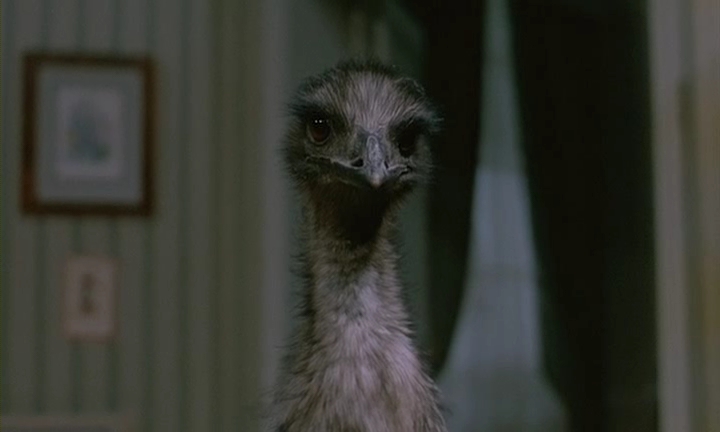
Rationality leaves the room when an emu enters it, something I first learnt from Luis Buñuel's The Phantom of Liberty. I've also learnt that, from his later films, I prefer the more overly scenario structured and stranger films to his dramas, not to dismiss the later, as they are excellent too, but that the director of Un Chien Andalou (1929) kept the talent of that legendary short film and showed it in these more overtly unconventional productions. Time has made the targets of his films far less subversive and funnier at points than others, but the absurd depictions of banal reality still stand out strong, his deliberately profane scenes less shocking than the cynicism of the modern world.

The Phantom of Liberty is one of his most experimental works from the end of his career, built from a series of dreams rattled off between him and screenwriter Jean-Claude Carrière which take on a vignette form. This is taken in a still radical direction however in how every segment is interlinked by following different characters that appear in previous segments, creating an ever widening web as they reoccur. In terms of any theme, this elaborate web featuring a sleuth of Buñuel alumni collects together numerous obsessions from morality to social behaviour, hypocrisy to his usual desire for the morbid.

The thing is that, like The Discreet Charm of the Bourgeoisie (1972), this is for me one of his best films as, reverting back to his older surreal work and hitting a great creative structure here, he manages some of the best moments in this particular work by merely changing one little detail in an ordinary circumstance and just happens to create something surreal as a result. An obvious joke, whilst more shocking today, is a man giving photos to two young girls in a playground. It is telegraphed early these photos will be banal but reacted to like they are obscene but, even now that in the modern day this joke would be quicker in being told, there's still a better result for me in letting the punch line drag out, especially as the answer is inherently weird in itself - why Buñuel and Carrière choose lewd photos of European architecture, and what that symbolises if anything, is itself truly stranger.

From https://archive.ica.art/sites/default/files/styles/banner-landscape/public/
images/phantom_libertyVHOIPd_0.jpg?itok=ICebMjPn

The simplicity of telling these jokes becomes inspired - the nocturnal nightmares of one man involve the emu, time rushing forwards and a postman who only delivers mail he's in bed, whilst the most famous sketch has people sat on toilets whilst eating is considered obscene. Then there are the more blackly humorous or just completely dark moments which add layers to the proceedings. As much as having priests, after consoling a woman over a lost loved one, eventually drinking and gambling with her is funny, as is Michael Lonsdale in arseless leather chaps wanting to be spanked in front of said priests, the darker and more poignant stabs stand out to as a sharp change of pace which stand out as much. They come in moments such as a male character realising his doctor's been hiding the fact he has cancer and slaps him, a reminder that, even at his lightest, Buñuel still descended into both the follies of human behaviour and its moments of bleakness. Then there are the moments which are unique his and Carrière's idiosyncrasies - most comedies don't have a prologue set in the past, in which a statue of a deceased lord takes offense to a knight lasciviously touching the statue of his late wife nearby, which is never resolved on purpose as it smash cuts to the then-modern day and gets to the main film itself.

Both in terms of the absurdity of life and, in the title, prodding at the general elusiveness of freedom, it follows Buñuel's long withstanding animosity with organised groups in general.  Not just an axe to grind with Catholicism but everyone - the police are literally children, posting pins on the teacher's chair, the upper classes are distracted or involved with nude incestuous piano playing, the middle class are too distracted to notice their missing daughter is right near them (even admitting her existence to her), and the only innocent characters there being the children and (occasionally) the lower classes. And it doesn't stop the film having politics - even if the ending is strange, because it's the police coming down on people to prevent them from moving about in a zoo, it's still the police in full riot gear charging unseen group of bystanders, violence heard off-screen whilst we see images of animals. And of course, even more troubling as a sketch in the current day, thre's the entire segment of the man who decides to find an isolated room in a skyscraper and start taking random bystanders out with a sniper rifle, an uncomfortable image for good reason considering the history of gun shootings that have taken place just in the United States in the 2010s, but pertinent in its darkness in how even when given a trial with a death sentence he merely gets to walk off (and sign autographs) as a figure for the public to look up to.

By this point, Luis Buñuel whilst at the end of his career was still learning new ways to make his films, a greater fluidity being found with this production alongside decades' worth of experience beforehand allowing him to make films like this with a greater ease. An awareness of how quickly ideas were being put together for The Phantom of Liberty for me as a viewer adds so much more to its original virtues I already adored. Certainly, his trademarks by this point - bright but calm aesthetic, minimal editing and camera movements, an absolute lack of a musical score - is digestible here alongside the episode nature of the film, but it allows him instead to focus on keeping the viewer on their toes with these ideas and absurdities. The humour's still incredibly dry, like one of Bunuel's beloved martinis, but openly it's both one of his darkest but funniest films as a result.

Abstract Spectrum: Surrealism/Weird
Abstract Rating (High/Medium/Low/None): Medium


From https://phantomvisions.files.wordpress.com/
2014/12/thephantomoflibertyavi0.jpg

Monday, 20 May 2019

The Discreet Charm of the Bourgeoisie (1972)

From https://cdn.shopify.com/s/files/1/1057/4964/products/the-discreet-charm-of-the
-bourgeoisie-vintage-movie-poster-original-1-sheet-27x41-4298.jpg?v=1534403343


Director: Luis Buñuel
Screenplay: Luis Buñuel and Jean-Claude Carrière
Cast: Fernando Rey as Rafael Acosta, Paul Frankeur as Francois Thévenot, Delphine Seyrig as Simone Thévenot, Bulle Ogier as Florence, Stéphane Audran as Alice Sénéchal, Jean-Pierre Cassel as Henri Sénéchal, Michel Piccoli as the Minister

In university, when I was tentatively discovering world and art cinema through the DVD shelves of their library, large enough to be its own building in a multi floor (?) book depository, it was Luis Buñuel and Jean-Luc Godard I once felt were completely overrated yet kept binging their films from the collection trying to rationalise why they were even popular. Over ten years later, I hold them in high regard.

It was a transitional period over these ten years where, without wanting to dismiss anyone's taste in film in these comments, I changed from the reader of Total Film magazine who once viewed The Usual Suspects (1995) and Memento (2000) as the best of cinema to becoming the person who read Sight & Sound who viewed the likes of Satantango (1994) to cult anime as some of my favourites. (Nowadays I read neither and am a fan of many films).  This is surprisingly a transition many cineastes have been said to go through, as much due to growing in age; I openly admit a form of Stockholm syndrome kicked in particularly with Godard too. One wishes I had this open-mindedness, slowly cultivated from getting used to unconventional and experience film styles, back in university when I had access to that library but hey hum.

Buñuel, particularly his final famous French period where his films were co-scripted with Jean-Claude Carrière, are also a lot more difficult for their apparent accessibility then you'd think; Jean-Luc Godard's work was always difficult on the surface before he even discarded narrative filmmaking by the 2000s, but Buñuel's more elusive. His films, despite being satires in the period from The Milky Way (1969), aren't exactly funny ha ha but an aloof lifts of the eyebrows which doesn't exactly come off as tight slappers. His films are paced slowly with minimal camera movement and editing. He also doesn't have a lot of non-diegetic music if none at all in The Discreet Charm...; in any film, if there's no score to subliminally affect a viewer, it drastically changes the pace considerably.

The Discreet Charm of the Bourgeoisie is nonetheless one of his most accessible films. It can be summed up in one sentence, a group of middle class bourgeoisie in vignettes who are constantly prevented from having a dinner party, arguably alongside its quality how it's become one of his most well known films, with a reputation even outside his filmography just from winning the 1973 Best Foreign Picture Oscar, but it's still a bizarre and subversive film, full of subplots to tangents and dreams within dreams which get increasingly perplexing.

Our bourgeoisie are as appalling group over-privileged figures as you could get; complimenting ex-Nazis as gentlemen, adultery with each other's wives, and in the case of Rafael Acosta (Fernando Rey), an ambassador to a South American country as corrupt as you could get despite his constant offense to this being pointed out to him. Yet they are strangely sympathetic, mainly because a) a cast including as legendary a cast of European actors like Rey to Delphine Seyrig is inherently full of the most charismatic of Euro-cinema, and b) because they are utterly banal people, the real satire in the current day, and more profound critique to have with the middle and high classes, is that no matter how corrupt they could be, this particular lot are as average and easily ruffled over a lack of tea in a cafe as you could get. From there, they are figures who look like deer caught in the headlights a great deal of the time, more concerned with sex and food whilst continually putting up with increasingly pronounced interruptions, beginning with visiting each other on the wrong day for a dinner part to a military troop in manoeuvres paying a visit. Their worst attitudes are witnessed, but so is how baring their privilege how mediocre they are too, profusely clueless as scenes have them wandering countryside road as a curious form of purgatory.

From https://scrapsfromtheloft.com/wp-content/uploads/2018/02/
Discreet-Charm-of-the-Bourgeoisie-1972-800x478.jpg

For a while the only truly sympathetic character, until a late period subplot twist, is Julien Bertheau's Monsignor Dufour, a priest who wishes at first to also garden. Much has been made of Buñuel's history of atheism, but alongside casting Édith Scob as the Virgin Mary in The Milky Way, there's a sweetness in a priest who wants to be someone else's paid gardener on the side even if their new employees are arseholes. It's only when that plot twist appears things are complicated; a loaded situation, literally, and a reminder Buñuel's jabs have a lot to do when religion had "organised" in front of the word. Noticeably how characters refuse to pay the priest any attention until he's actually in official uniform, rather than gardening dungarees, says a lot.

The moment The Discreet Charm... gets abstract is when scenarios not only get odder, but when the dreams appear. Scenes literally stop to let one character talk about their dreams, or in one case a solder at a cafe walks up to the female protagonists and sits at their table, talking about his childhood and how the ghost of his dead mother told him to kill his step father, all before saying goodbye and never being seen again.

Then entire scenes are dreams dreamt by the characters which are then dreams dreamt by their friends, and The Discreet Charm... truly gets weird. And these become overtly surreal. Some are worse case scenarios, such as Rafael Acosta shooting a dinner party host over saying his country is corrupt, but others follow the tropes of barriers in their desires, fake plastic chickens, and literal phantoms who roam the corridors. Their existence, baring farces with bitter humour, still expose the worst in these people, from the corruption of the police using electrified pianos to a general buffoonery of these strict middle class ideals. Buñuel even has a bit of Godard's tricks at hand as, in a comically brief cameo by Michael Piccoli, his phone call to a character (shot entirely separate from everyone else) is drowned out by the sound of a plane twice, both to use the viewer but even the character trying to communicate to him.

Any further attempt to analysis Buñuel and Carrière's work would spoil it. The Discreet Charm... may be cool and aloof at times in its presentation, but it's still funny, arguably the most overtly humorous of his work despite his tendency to be more funny peculiar in his career. The natural but brightly coloured world of French cinema is a good place for this perverse comedy of manners and a cast this strong to work within; obvious Rey stands out as the ambassador who'll sacrifice himself for a cold cut, and has to deal with a rebel group in his country constantly trying to send a female agent to him, but everyone succeeds in making these stereotypes have some personality. They all (even unintentionally) bring some sympathy to this miserable lot as, despicable as they are, they are shown as guided by ordinary obsessions like you and I, the awkward moment a husband and wife want to have sex but the guests have already arrived, or the moment you realise the proprietor's corpse for a restaurant is in another room as you are about to dine.

Even the most absurd moments are brilliantly staged by how calm or matter-of-fact they are, the military group coming for a large banquet, or the harsh efficiency of a group of machine gun welding intruders. If anything, it proved that Luis Buñuel, who has multiple phases of his career, had a virtue of always being this sedate and calm in tone whether here or in his earlier Mexican productions, his slow manner particularly for these final French films adding to the dark humour and allowing it to stand out proudly.

Abstract Spectrum: Humorous/Surreal/Whimsical
Abstract Rating (High/Medium/Low/None): Medium

Personal Opinion:
Returning to The Discreet Charm of the Bourgeoisie, it's a gem, an absolutely incredible work. A lot can be delved in further if you wish to dissect each segment, but it cannot be argued that the film's singular acclaim comes as much from how more accessible in structure yet so open to interpretation as it is.


From https://celluloidwickerman.files.wordpress.com/2016/02/
tumblr_nq9qz3ezzm1txum4do10_r1_1280.jpg?w=799

Monday, 27 August 2018

Rise And Fall Of A Small Film Company (1986)

From https://image.tmdb.org/t/p/w300_and_h450_
bestv2/3CmVcJhPYWcJCue3fs38SaiFyoi.jpg


Director: Jean-Luc Godard
Screenplay: Jean-Luc Godard
Meant to be based on the novel The Soft Centre by James Hadley Chase
Cast: Jean-Pierre Léaud as Gaspard Bazin; Jean-Pierre Mocky as Jean Almereyda; Marie Valera as Eurydice

Synopsis: The state of cinema by way of an adaptation of a James Hadley Chase crime novel, originally produced for the crime story series Série noire in France. Where producer Jean Almereyda (Jean-Pierre Mocky), once a matinee idol and major producer, is now reduced to TV movies and dogged by a case of stolen money from his past. All whilst Gaspard Bazin (Jean-Pierre Léaud), a director who now, after acclaim, spends his time in an obsessive ritual for casting extras that eats up their budgets, finds Almereyda's wife Eurydice (Marie Valera) a potential creative source when she desires to be an actress.

It's strange we can uncover lost films by Jean-Luc Godard, one of the biggest names in all cinema, but we can forget that even after ten years obscurer films in a director's filmography can be neglected absentmindedly. There is, of course, when new blood in the fan base don't know common knowledge that the older members do, something which can happen be it for horror fans to art house aficionados, and in that case we need to provide that information or doom ourselves to obscuring works of the past. Retrospectives are thankfully more common too as are physical released, but there are cases, with a director like Godard who made so much outside of theatrical screenings, that once it was a lot more difficult to access this material and a lot of it hasn't even been gotten around to until now. That even a great American director can have material not available means that the Swiss director, even if he is a legend in cinema, can have probably more as both being a director who worked in a foreign language to English, made very difficult work that contrasts his famous early sixties works immensely, and has experiments in television and short work more rife than many other filmmakers which always tend to be neglected with any auteur. So, yes, you have the clues to why we trip over these obscurities like so.

Even in the theatrical corner of Godard's wing, where for many his debut Breathless (1960) is his most well known film, there are productions neglected especially in the late eighties when, returning with his second "debut" Every Man For Himself (1980) after his experimental era, which are not available. Now which his Dziga-Vertov Group films (mostly) available in high definition, even if many are some of the most painful failures of his career, the Holy Grail alongside films like the controversial Hail Mary (1985) is his television work. Experiments like Rise and Fall of A Small Film Company.  From a time where he was going to return back to experiments until the unforeseeable day and was in-between various projects, a year before his infamous Cannon Films production King Lear (1987). One very much not taking his assignment with Série noire as intended.

From https://medias.unifrance.org/medias/252/193/180732/
format_page/rise-and-fall-of-a-small-film-company.jpg

Rise and Fall
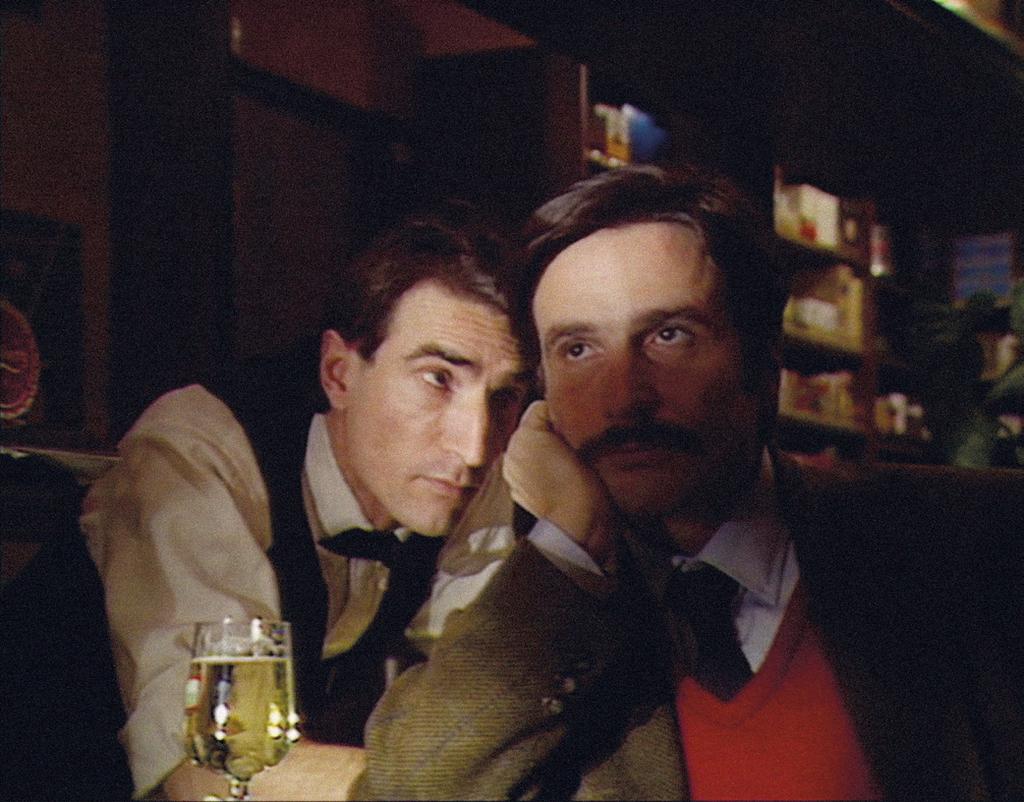
, rather than the adaptation of a crime novel as likely intended, is that meeting place between the return to narrative cinema in the eighties and the video experiments that would lead him to his career in the current day. The noticeable limitations - the TV screen ration, the limited aesthetic, the video sheen and digital text captions - are things that would undermine another director, but are like providing Godard with new tools to work with. He's someone, know to use VHS rips of old films on purpose still to this day, completely polymorphous when it comes to technology, already working on television productions in the seventies and, in the 2010s in his older statesman position, having his own 3D camera built by scratch and making a 3D feature in Goodbye to Language (2014). Here though he's still working with a plot, around one which contrary to his famous quote does have a beginning, middle and end in that order. The struggles of a TV movie company mid adaptation of James Hadley Chase's The Soft Centre, the novel Godard is meant to adapt, which he weaves his state of unrest cultural critiques in the midst of through the tired producer Jean-Pierre Mocky (Jean Almereyda), and the frankly deranged director Gaspard Bazin (Jean-Pierre Léaud).

Léaud, meeting back with Godard and thus evoking his many moments in the latter's work, could if you cheated a little be the exact character he would later play in Olivier Assayas' Irma Vep (1996). The same director hired to remake Les Vampires (1915-16) in that film, who decided to cast Maggie Cheung, once before with an entirely different name stuck in these wilderness years in the late eighties, his obsessive ritual with the extras of having them move through rooms in a  conveyor belt, quoting at one point the same passage contracted together between them, as much him attempting to find his creative sanity as a madness. He's less irritated by being stuck making television work, but as he confesses (and shows Godard biting the hand financing this feature) wishing he was adapting Dashiell Hammett instead. In a world where he and his producer sit in front of a television showing a fire, rather than a real one, to stay warm, the world has become stranger than the sixties they made their fames in. It's not an absurd comparison either between films as, whilst the ending of this suggests a happy ending for Léaud's character, the film making world is so different from France's before, where his arcane ritual with the casting is chewing up money for a company who can't even get a TV movie off the ground and shown.

From https://i.ytimg.com/vi/069Xaf__6nM/maxresdefault.jpg

Admittedly Godard's criticisms of the state of cinema and life, as he's been doing them since the sixties and hasn't stopped since, could dangerously fall into shouting into the wind, worse a man trying to joust windmills thinking they're dragons. (Even if that's the case for some now, I'd at least want to picture him as cinema's Prospero, in his magical tower in Switzerland creating his cinematic incantations, or like his character Professor Pluggy in King Lear with patch-cord dreadlocks in his hair). What doesn't allow this to be the case is that, generally, his philosophical concerns are not only enlightening but constantly evolving over time, the ones of yore still relevant to the current day or time capsules to new problems per era. Here, ironically when he was asked to make this TV film, he's practically spiting the producers by having the pair of Bazin and Almereyda as doomed figures of the past floundering even in commercial television. Their lives are small scale, the television budget and style of Rise and Fall... helping this. It is too rye to be an out-and-out comedy, but humour is to be found especially in characters like the accountant, who in deadpan just doing his job hands out paltry earnings to the extras discounting their social security. Or Léaud playing up his character's out-of-control behaviour, be it interrupting a phone call between a potential actress with acute abruptness, brought at what she suspiciously suspected to be erotic when asked to bring a bikini alongside her, or breaking into a Woody Woodpecker impression.

Godard's also one of the few directors able to get away with casting himself as the wise sage. Much of it, by this time, is because Godard was such an iconic name it was impossible to get around this, common in narrating his own films since the sixties and having a reputation as a figure outside of cinema, making his work (usually dialectic anyway) completely attached to him. Rise and Fall... offers him playing a character as himself, amusingly (as I want to picture it) living in Reykjavik in Iceland because he had to witness the greatest chess game being played there, here appearing to find a deal back in the left for him with a (fictional?) producer and Romy Schneider. Thus his scene also turns to an appropriate melancholic air about the period, when both said producer is dead and Schneider, in real life, passed in 1982. When that comes to pass it becomes one of the film's most meaningful scenes, more so because Godard is playing himself interacting with a fictional creation of his, two old pros lamenting their careers in cinema being affected by the change in tide and left adrift within it. Even if Godard would become more and more a legendary filmmaker who made films to the current day, he's eventually drift far from narrative cinema into experimental features entirely, all bolstered by the reputation he developed allowing him to leave mainstream cinema behind.

From http://media.flix.gr.s3.amazonaws.com/cache/
bf/17/bf17279cd12d76950b8214b952776420.jpg

His critiques are matched by a willingness to play with the form of film a way few would. The limitations, the flaws, of this television work are devices for him to exploit, superimposition to the hair-raising use of slow motion on a female extra's emotions mid-performance. He even deliberately has the sound abruptly halt as if the film's failed, followed by a technical difficulties screen, for a joke. Musically he picks interesting pieces like from Leonard Cohen to Janice Joplin, the latter's famous rendition of Mercedes Benz amusingly used on a moving computer square with the technical screen colourbars. The marriage between the two sides is like a very underrated theatrical feature Godard made within this era, Detective (1985) with Johnny Hallyday and Nathalie Baye, a small scale crime narrative confined to one hotel, perfect for Godard's experimentation as well as providing an actual story. Rise and Fall... still tells an interesting tale - for Jean-Pierre Léaud's Bazin, a spark of life is found in his producer's wife Eurydice (Marie Valera), who he compares to actress Dita Parlo known for films like Jean Renoir's Grand Illusion (1937). Theirs is not a romantic or sexual relationship, instead Bazin finding artistic clarity as, testing her, she is one of the only people when giving an old painting will not point out all the figures within it but say the characters are actually the most important themes of said painting. Sadly, apt for a small scale crime drama about a little company, it's the producer's shady past with stolen money that does them in.  

Abstract Spectrum: Avant-Garde/Diegetic
Abstract Rating (High/Medium/Low/None): Low

Personal Opinion:
Hopefully, restored and premiering at the 2017 Locarno Film Festival, the reappearance of Rise and Fall of a Small Film Company is not restricted from public access beyond being temporally streamable on MUBI. If Godard's Dziga Vertov years can be accessed, as difficult and un-cinematic in his career's work as you can get, an uncovered gem like this can have appeal. If anything it hopefully leads closer to the vast television and video work in his catalogue finally appearing in wider access.


From https://assets.mubi.com/images/notebook/post_
images/26139/images-w1400.png?1530550709