Showing posts with label Farce. Show all posts

Saturday, 16 September 2023

Number Seventeen (1932)


Director: Alfred Hitchcock

Screenplay: Alfred Hitchcock, Alma Reville and Rodney Ackland

Based on the play by Joseph Jefferson Farjeon

Cast: Leon M. Lion as Ben, Anne Grey as Nora, John Stuart as Barton, Donald Calthrop as Brant, Barry Jones as Henry Doyle, Ann Casson as Rose Ackroyd, Henry Caine as Mr. Ackroyd, Garry Marsh as Sheldrake

Canon Fodder


Sausage. Hit him over the head with.

Number Seventeen promises a lot as an early Alfred Hitchcock film immediately, of expressionist shadows as a homeless sailor enters a house for sale, only to find another man and also a corpse there. Already you have awesome compositions, almost like a supernatural drama, of looming shadow hands alongside jump cut editing to a train to show shock. It is however, just in its title too, a weird film for Hitchcock, the kind of “weird” in terms of not a positively delirious title but something that is absolutely curious in his career. It is an oddity with virtues but a lot of issues behind its creation.

Hitchcock had to make this film, part of his career with British International Pictures1. Despite the fact he had already made The Lodger: A Story of the London Fog (1927) and Blackmail (1929), and was becoming an acclaimed filmmaker, his career up to sailing to Hollywood and the United States for Rebecca (1940) includes films which stand out in premise (his personal project, the drama Rich and Strange (1931)), only to not become films which stand out the highest in his career, and titles which he made as a studio director whether he wanted to make them or not, such as the operetta film with Jessie Matthews, Waltzes from Vienna (1934). Number Seventeen, based on a thriller play by Joseph Jefferson Farjeon, has a suspense plot including one of the earliest McGuffins, if not for the first, for Hitchcock’s career in that it is a piece about jewel thieves swarming around this house alongside a detective, his daughter, a cop in disguise and the homeless man Ben (Leon M. Lion). Hitchcock however, in adapting this, decided to turn it into a farce on purpose tonally, which affects the final result.


The final film because of this is a really broad farce which does not really work. Hitchcock films can be legitimately funny, without becoming comedies but being suspense films which have incredibly dour winks at the banal mixing with the morbid – the cop in Frenzy (1972), one of his grimmest tales, whose wife is trying experimental cooking to his horror, or a key scene of Strangers on a Train (1951), whilst not played for laughs, being based on whether the lead can complete a game of tennis as quickly as he can – or incredible one-liners, such as the many Cary Grant has in North by Northwest (1959). This does eventually have charm, with Leon M. Lion as Ben, once you get past his initial gurning klutz performance, becoming lovable as a genial homeless man caught in the middle of this against his will, but a lot of the humour, being the slapstick to speed up fight scenes, goes over the head in actually landing. A lot of it being a pastiche of the suspense drama completely falls flat when it eventually gives up and becomes a more heightened crime film by the finale. Instead a lot of this feels like a stage play with Hitchcock managing to make it visually vibrant and soaked in shadows, entirely set at night, of a group of people ending up in this house all at once. The sense of this comes when one of its parodies, the female lead on the villains’ side who is so mysterious she is a deaf-mute, being jettisoned. When this character Nora (Anne Grey) just starts speaking, completely kneecapping one of its more idiosyncratic touches as quickly as it is introduced in a film only an hour long, you get the feeling Hitchcock made a legitimate mistake with his collaborators which effects the final quality.

Seventeen, by way of its finale with model trains, gets a really thrilling ending of escaping by train and the commandeering of a public bus to catch up with it, which shows how the film could have been cultivated into an ambitious and grander work by its director. The film had the potential to be a great production, full of McGuffins and plot points for the sake of getting to the next scene – corpses not quite dead, cops posing as lackeys, heroines secretly hiding in the villains’ side – as people fight over an expensive necklace. Even a scene of falling over a broken wooden railing does show how the comedic tone of the film could have mixed with suspense. What this feels like is a germ of a bigger work, and instead it is Hitchcock the master craftsman who sticks out than a successful result, still early in his career showing the mind which planned out his films carefully before they were filmed, compositions even here of the images which stand out incredibly. If it is a failure in Hitchcock’s career, but that does not mean you cannot appreciate the skills he shows here that would grow in his filmography.


====

1) Alfred Hitchcock Collectors’ Guide: Number Seventeen (1932), written by Brent Reid for Brenton on Film and published on August 16th 2019.

Wednesday, 9 October 2019

Tusk (2014)

From https://www.dvdplanetstore.pk/wp-content/uploads/2015/01/
Tusk-2014-movie-comedy-horror-dvdplanetstorepk.jpg


Director: Kevin Smith
Screenplay: Kevin Smith
Cast: Michael Parks as Howard Howe; Justin Long as Wallace Bryton; Genesis Rodriguez as Ally Leon; Haley Joel Osment as Teddy Craft; Guy LaPointe as Guy LaPointe; Ralph Garman as Detective Garmin; Jennifer Schwalbach Smith as Ms. McKenzie; Harley Quinn Smith as Colleen McKenzie; Lily-Rose Depp as Colleen Collette

[Major Spoiler Warnings]

Kevin Smith is a director I am openly alien to - the only film I saw in my youth was Dogma (1999), and when I saw Clerks (1994) it vanished from memory at a young cineaste's age. His entire "View Askewniverse" world and cult of personality however is one I will eventually have to return to; a distinct part of his career isn't just the films themselves, but that he has sustained a fandom just from recorded talks and podcasts when he wasn't making films, so there's a lot of personality to consider.

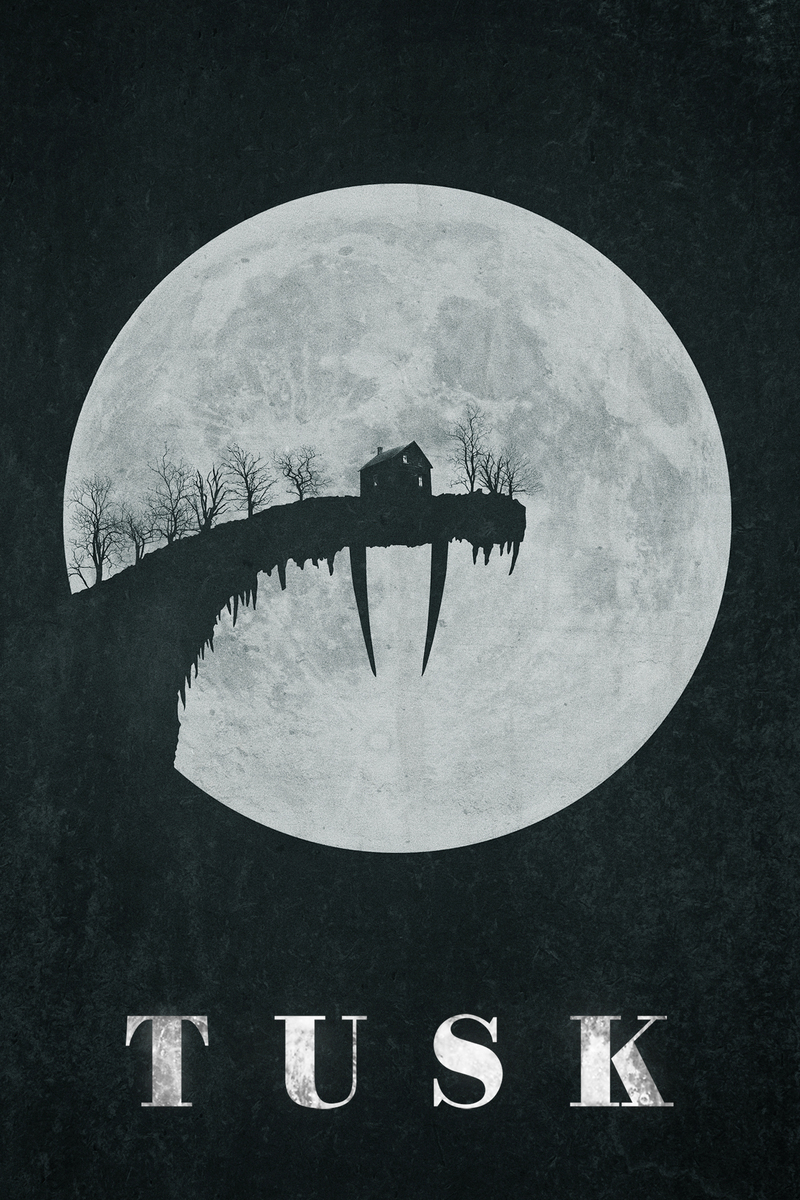
There was always one that would've been on my radar regardless of interest or lack of, when a podcast conversation about an imagined premise for a walrus tickled Smith pink so much he asked his fans to vote on whether the film or not. The result, unless you come from another dimension where people said know, is the tale of a podcaster being violently turned into a human walrus up in the Canadian wilderness, one that proved polarising and bloody weird.

Tusk's origins do suggest pure ironic existence, especially as a piece of the original podcast is laced over the end credits, but the idea of this being an ironic anti-film is undercut by actually watching Tusk, a strange tonal experience of a comedy horror which is still pretty gruesome, still pretty tragic for the characters, and yet is a peculiar and inherently funny premise matched by a suddenly jump into farce. Effectively it's The Human Centipede (2009) if it was made to actually engaging the audience than just making the most predictable results, as nothing in Tusk is boring even if a viewer hates it.

Justin Long plays a podcaster named Wallace Bryton, an edgelord for a lack of subtlety whose show 'Not-See", the name of which is meant to evoke another certain name when you pronounce it and is a plot point in the problems it causes. His show is meant to take the piss out of peoples' strange experiences and people on the fringes he meets, in hindsight really evoking the wave of problematic internet celebrities even if they turned out to be on YouTube and getting into actual accusations of glorifying Nazis ideals. Already this is setting up a karmic journey, especially as dialogue scenes with his girlfriend Ally Leon (Genesis Rodriguez) do evoke how he was once a kind person who became cynical; I have no issue with this character being utterly unlikable as it creates the route to his folly, where his original choice, a Canadian teenage who chopped his leg off by accident making a Kill Bill fan video for online, commits suicide before he can meet him and leads him to Howard Howe (Michael Parks). Howe is an old man whose tales of meeting Ernest Hemingway when he was prevented from joining the D-Day landings in World War II and marine adventure entice the younger man even if Bryton still wants to take the piss out of him. Then Howe proceeds to drug Bryton with his tea, leading to a story where you sympathetic with the agony even a person like Bryton will go through.

Here I immediately give the film credit as, in lieu to being a director-writer who likes his dialogue and famously the man who wondered (through his characters) what happened to all the construction staff on the Death Star, Kevin Smith does make the dialogue scenes in Tusk compelling. It was unexpected for him to remotely even have a tangent to Hemingway and nautical storytelling, but with the help of Park being the best performance in the film, it's a surprisingly mature thing rarely found in horror cinema to have the initial dialogue scenes between Park and Long, made even more surprising knowing Tusk eventually gets into diarrhea jokes too halfway through.

From https://static.rogerebert.com/uploads/review/
primary_image/reviews/tusk-2014/hero_Tusk-2014-1.jpg

And Michael Park does steal the film. The was not the first time he worked with Smith, another of the director's fascinating curiosities being Red State (2011), his first horror film and a condemnation of religious zealot from a man who was Catholic himself at the time, but Park's existence here adds some credibility to an odd premise. That Howe, when he drugs Bryton, is going to turn him into a human walrus companion, in context of a trauma involving shipwrecked with only such a mammal as company on an island. This is where I struggle with just believing Tusk was Smith just getting high and just making a dumb film, as having encountered examples of half arsed, intentionally "bad" films, Tusk plays seriously and only starts getting odd when a certain character appears. Even beyond that, when Park's character opens up as a psychologically and physically abused child who grew up into this serial killer with a twisted modus operandi, it's a dark film at its heart even when it gets intentionally silly, a tightrope between seriousness and comedy that is legitimately strange.

Certainly it gets nasty, where Long has to act in a walrus costume of flesh unable to communicate more than noises for dialogue, Smith to his credit not pulling punches in imagining his mad premise in full body horror grossness, be it the legs of victims being carved into tusks or Park constantly trying to force Long to eat raw fish. Where it gets curious is in mind to this having been a planned first film in a trilogy of Canadian set horror films. Smith apparently likes Canada, plants a lot of Canadian references throughout Tusk, and even sets up the second film, Yoga Hosers (2016), with the first appearances of two teenage girls who work at a convenience store. These two characters, the leads of the second film, are played by Smith's own daughter Harley Quinn Smith and Johnny Depp's daughter Lily-Rose Depp. And yes, Johnny Depp is in the film too, and this is where I'm certain Tusk's notorious reactions actually stem from.

This is the thing - Johnny Depp, as former French Canadian police detective Guy LaPointe, tracking down Howe over a long period of time, is still acting here. There's been a view that, in these later years, Depp has turned into a man who wears strange costumes and puts on mannerisms, but LaPointe is still a performance that required a lot of talent to even pull off. The issue is that LaPointe also sounds stoned with a stereotypical accent, the kind of man who'd be flatulent if you sat near him as he buys ridiculous amounts of food at a fast-food restaurant, and is the entrance way for the broader comedy for the most part. I will hold LaPointe as entirely subjective in terms of whether he's good or absolutely agonising for each individual viewer. Thankfully the most extreme of this ridiculousness is just one single scene - where Depp and Park's characters encounter each other in a flashback and Park takes on a bizarre half mumbled voice, in context to clearly hide himself, becoming near unintelligible as they discuss has poutine causes diarrhea. It's a scene in most films where I'd be goading my eyes out, but here however, it's sandwiched in the midst of a production that has been constantly undercutting itself with curious oddness like this throughout.

In fact, for myself, if it'd been a regular horror film, I don't think Tusk would've sustained itself even with its surprisingly bleak ending, Depp's appearance preventing the conventionality and banality of the middle act, where Genesis Rodriguez and Haley Joel Osment try to track down Long in Canada themselves, but bringing his character in. The abrupt inclusion of comedy through Depp, and Park even putting on his own walrus suit for his final plan, actually adds a jolt of much needed energy which allows Kevin Smith to play off the ending with even more powerful. Does it amount to anything? Honestly, it feels like a lark, but Smith ends the film as a tragedy, skirting jokingly around the idea of human versus beast by way of man versus walrus, only to push it to a conclusion where Justin Long's character is psychologically damaged to the point he becomes a human-walrus hybrid, one which leaves him in the final scene left in an actual zoo whilst his girlfriend in tears keeps appearing to try to get him back as a person. It's a powerful ending, with only the fact that Smith includes the podcast segment over the end credits arguably undercutting the moment. Smith for all the silliness at hand had the decency to still play the film seriously, and whilst this could all be ironic, it's an irony which thankfully isn't deliberately bad, but pointedly allows the film to be viewed seriously. One of the tragedy of a man, a bad man but one who could be redeemed, that is played out as a drama; even the humour with Depp and poutine has a dark edge to it which suits to the tone perfectly.

Tusk as a result is a lot more rewarding than many horror films in all honestly, Kevin Smith effectively taking a bad straight-to-video horror film, where the execution would be average, and everything was played as cheaply and lazily as possible, and plays it as well as he could. His filming style here is pretty basic in presentation, but even if he intended it to be laughed at whilst high on weed, he had the decency to film a premise with a level of quality and intention I wish more films like this had. Sadly, the Canadian trilogy has stopped short at Yoga Hosers, which didn't even get a UK DVD release here. At this current point, the plan is Jay and Silent Bob Reboot (2019) and a return to the View Askewniverse, which might be interesting or sadly a departure from this curious series of horror films in his career that caught me with immense interest.

Abstract Spectrum: Grotesque/Silly/Weird
Abstract Rating (High/Medium/Low/None): None

From https://24miles.files.wordpress.com/2014/09/52718274.jpg

Monday, 20 May 2019

The Discreet Charm of the Bourgeoisie (1972)

From https://cdn.shopify.com/s/files/1/1057/4964/products/the-discreet-charm-of-the
-bourgeoisie-vintage-movie-poster-original-1-sheet-27x41-4298.jpg?v=1534403343


Director: Luis Buñuel
Screenplay: Luis Buñuel and Jean-Claude Carrière
Cast: Fernando Rey as Rafael Acosta, Paul Frankeur as Francois Thévenot, Delphine Seyrig as Simone Thévenot, Bulle Ogier as Florence, Stéphane Audran as Alice Sénéchal, Jean-Pierre Cassel as Henri Sénéchal, Michel Piccoli as the Minister

In university, when I was tentatively discovering world and art cinema through the DVD shelves of their library, large enough to be its own building in a multi floor (?) book depository, it was Luis Buñuel and Jean-Luc Godard I once felt were completely overrated yet kept binging their films from the collection trying to rationalise why they were even popular. Over ten years later, I hold them in high regard.

It was a transitional period over these ten years where, without wanting to dismiss anyone's taste in film in these comments, I changed from the reader of Total Film magazine who once viewed The Usual Suspects (1995) and Memento (2000) as the best of cinema to becoming the person who read Sight & Sound who viewed the likes of Satantango (1994) to cult anime as some of my favourites. (Nowadays I read neither and am a fan of many films).  This is surprisingly a transition many cineastes have been said to go through, as much due to growing in age; I openly admit a form of Stockholm syndrome kicked in particularly with Godard too. One wishes I had this open-mindedness, slowly cultivated from getting used to unconventional and experience film styles, back in university when I had access to that library but hey hum.

Buñuel, particularly his final famous French period where his films were co-scripted with Jean-Claude Carrière, are also a lot more difficult for their apparent accessibility then you'd think; Jean-Luc Godard's work was always difficult on the surface before he even discarded narrative filmmaking by the 2000s, but Buñuel's more elusive. His films, despite being satires in the period from The Milky Way (1969), aren't exactly funny ha ha but an aloof lifts of the eyebrows which doesn't exactly come off as tight slappers. His films are paced slowly with minimal camera movement and editing. He also doesn't have a lot of non-diegetic music if none at all in The Discreet Charm...; in any film, if there's no score to subliminally affect a viewer, it drastically changes the pace considerably.

The Discreet Charm of the Bourgeoisie is nonetheless one of his most accessible films. It can be summed up in one sentence, a group of middle class bourgeoisie in vignettes who are constantly prevented from having a dinner party, arguably alongside its quality how it's become one of his most well known films, with a reputation even outside his filmography just from winning the 1973 Best Foreign Picture Oscar, but it's still a bizarre and subversive film, full of subplots to tangents and dreams within dreams which get increasingly perplexing.

Our bourgeoisie are as appalling group over-privileged figures as you could get; complimenting ex-Nazis as gentlemen, adultery with each other's wives, and in the case of Rafael Acosta (Fernando Rey), an ambassador to a South American country as corrupt as you could get despite his constant offense to this being pointed out to him. Yet they are strangely sympathetic, mainly because a) a cast including as legendary a cast of European actors like Rey to Delphine Seyrig is inherently full of the most charismatic of Euro-cinema, and b) because they are utterly banal people, the real satire in the current day, and more profound critique to have with the middle and high classes, is that no matter how corrupt they could be, this particular lot are as average and easily ruffled over a lack of tea in a cafe as you could get. From there, they are figures who look like deer caught in the headlights a great deal of the time, more concerned with sex and food whilst continually putting up with increasingly pronounced interruptions, beginning with visiting each other on the wrong day for a dinner part to a military troop in manoeuvres paying a visit. Their worst attitudes are witnessed, but so is how baring their privilege how mediocre they are too, profusely clueless as scenes have them wandering countryside road as a curious form of purgatory.

From https://scrapsfromtheloft.com/wp-content/uploads/2018/02/
Discreet-Charm-of-the-Bourgeoisie-1972-800x478.jpg

For a while the only truly sympathetic character, until a late period subplot twist, is Julien Bertheau's Monsignor Dufour, a priest who wishes at first to also garden. Much has been made of Buñuel's history of atheism, but alongside casting Édith Scob as the Virgin Mary in The Milky Way, there's a sweetness in a priest who wants to be someone else's paid gardener on the side even if their new employees are arseholes. It's only when that plot twist appears things are complicated; a loaded situation, literally, and a reminder Buñuel's jabs have a lot to do when religion had "organised" in front of the word. Noticeably how characters refuse to pay the priest any attention until he's actually in official uniform, rather than gardening dungarees, says a lot.

The moment The Discreet Charm... gets abstract is when scenarios not only get odder, but when the dreams appear. Scenes literally stop to let one character talk about their dreams, or in one case a solder at a cafe walks up to the female protagonists and sits at their table, talking about his childhood and how the ghost of his dead mother told him to kill his step father, all before saying goodbye and never being seen again.

Then entire scenes are dreams dreamt by the characters which are then dreams dreamt by their friends, and The Discreet Charm... truly gets weird. And these become overtly surreal. Some are worse case scenarios, such as Rafael Acosta shooting a dinner party host over saying his country is corrupt, but others follow the tropes of barriers in their desires, fake plastic chickens, and literal phantoms who roam the corridors. Their existence, baring farces with bitter humour, still expose the worst in these people, from the corruption of the police using electrified pianos to a general buffoonery of these strict middle class ideals. Buñuel even has a bit of Godard's tricks at hand as, in a comically brief cameo by Michael Piccoli, his phone call to a character (shot entirely separate from everyone else) is drowned out by the sound of a plane twice, both to use the viewer but even the character trying to communicate to him.

Any further attempt to analysis Buñuel and Carrière's work would spoil it. The Discreet Charm... may be cool and aloof at times in its presentation, but it's still funny, arguably the most overtly humorous of his work despite his tendency to be more funny peculiar in his career. The natural but brightly coloured world of French cinema is a good place for this perverse comedy of manners and a cast this strong to work within; obvious Rey stands out as the ambassador who'll sacrifice himself for a cold cut, and has to deal with a rebel group in his country constantly trying to send a female agent to him, but everyone succeeds in making these stereotypes have some personality. They all (even unintentionally) bring some sympathy to this miserable lot as, despicable as they are, they are shown as guided by ordinary obsessions like you and I, the awkward moment a husband and wife want to have sex but the guests have already arrived, or the moment you realise the proprietor's corpse for a restaurant is in another room as you are about to dine.

Even the most absurd moments are brilliantly staged by how calm or matter-of-fact they are, the military group coming for a large banquet, or the harsh efficiency of a group of machine gun welding intruders. If anything, it proved that Luis Buñuel, who has multiple phases of his career, had a virtue of always being this sedate and calm in tone whether here or in his earlier Mexican productions, his slow manner particularly for these final French films adding to the dark humour and allowing it to stand out proudly.

Abstract Spectrum: Humorous/Surreal/Whimsical
Abstract Rating (High/Medium/Low/None): Medium

Personal Opinion:
Returning to The Discreet Charm of the Bourgeoisie, it's a gem, an absolutely incredible work. A lot can be delved in further if you wish to dissect each segment, but it cannot be argued that the film's singular acclaim comes as much from how more accessible in structure yet so open to interpretation as it is.


From https://celluloidwickerman.files.wordpress.com/2016/02/
tumblr_nq9qz3ezzm1txum4do10_r1_1280.jpg?w=799

Tuesday, 19 June 2018

Non Abstract Review: Sextette (1978)

From https://hollywoodrevue.files.wordpress.com/
2015/07/sextette-poster-1.jpg


Director: Ken Hughes
Screenplay: Herbert Baker
Based on the stage play by Mae West
Cast: Mae West as Marlo Manners; Timothy Dalton as Sir Michael Barrington; Dom DeLuise as Dan Turner; Tony Curtis as Alexei Andreyev Karansky; Ringo Starr as Laslo Karolny; George Hamilton as Vance Norton; Walter Pidgeon as Mr. Chambers

Synopsis: The legendary actress Marlo Manners (Mae West), the greatest living Hollywood star, is celebrating her honeymoon with her newest husband Sir Michael Barrington (Timothy Dalton) in London. Her agent Dan Turner (Don DeLuise) has other plans, involving convincing her to woo a former flame and Soviet politician Alexei Andreyev (Tony Curtis), in the midst of an international peace conference at the same hotel she is at. Barrington's own miscommunications with the press, a pink audio tape of Marlo's scintillating memoirs, and various former husbands entering back into her life will make it impossible for the new couple to enjoy their honeymoon.

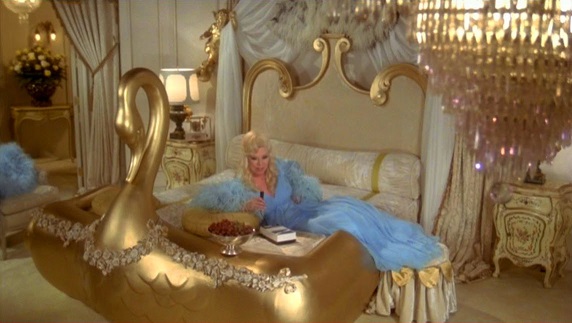
This, I confess, was the worse way to be introduced to Mae West, having never seen any of her films beforehand. The legendary actress of bawdy one liners, enraging the Hays Code and being proudly her own person in films like She Done Him Wrong (1933) is an iconic individual. Sextette, for my first West film, is a tragedy in terms of this image. An attempt by its producers to give her a last hurrah, but encumbered by the sad truth, alongside the general quality of the production, of her being fed her lines, robotic in delivery of them even if heavily made-up and, as a woman of eighty five, moving not as an elder stateswoman still proudly stomping around the sets, but lost in a production so off in style its perversely watchable for all the wrong reasons. The kind of production that, if I was one of the individuals who'd funded the film, would turn his head around in the midst the projection screening and tell the producers of Sextette that it was completely unsellable.

Sextette is part of the hidden underbelly of seventies cinema, where for all our love of the New American Wave it was always as much the era of films like this and disaster movies, both actual disaster films and film disasters. All decades of motion images feed on the popular trends of their eras, and feed on trends they've made up as being popular to the target audience's bafflement. The seventies however is strange as, straddled between nostalgia for the Hollywood studio system and after the studio system collapsed in the sixties, they could still have the (aged) stars of yesteryear return onscreen (or on the television tube) to evoke the old era. Yet this is a film trying to be popular with the young, particularly as this was already when Mae West was a gay icon and disco was popular, leading to intentionally camping up the production and reinterpretation old song standards into disco funk. Your cast can resurrect Walter Pigeon back onscreen, but have cameos as random as Alice Cooper to Ringo Star, in the midst of his solo career, as a European art film director and one of Marlo's husbands.

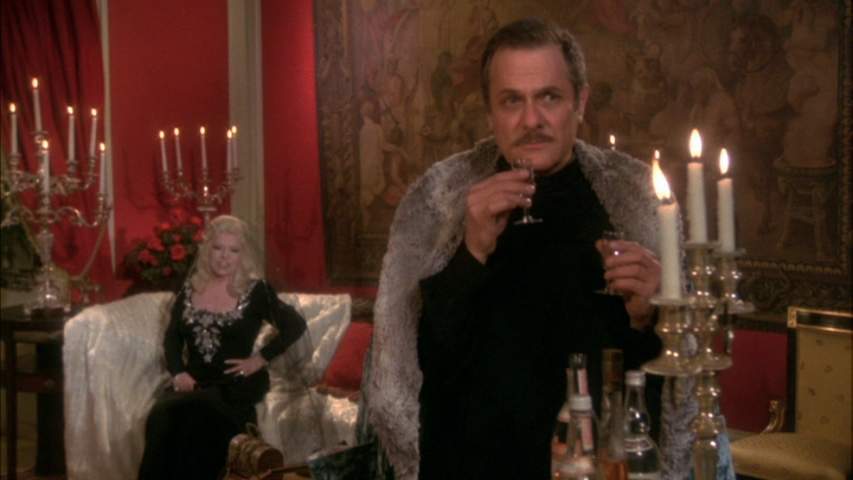
The casting itself is an anomaly worth a paragraph. West's appearance is sad, more so as in a world where her Marlo Manners is the most beloved figure, the ultimate sex icon who can bring about world peace in the end of the plot, everything feels like it is in an alien world or a perverse Twilight Zone episode without the punch line, characters laughing at her mechanically spoken one liners in ways that linger too long in the air, constant and awkward. DeLuise does better as her scuzzy, panicked agent. The rest of the cast, barring one who will get his own paragraph after this one, is a sorry lot of varying performances. Alice Cooper is a mere cameo near the end. Ringo Star, a year after a disastrous attempt at a disco album, tries an accent but eventually just sounds like Ringo Star in a cameo role. Tony Curtis being the stereotypical Russian, Walter Pigeon a nice sight, as a recent convert to Mrs. Miniver (1942) and his performance, but too slight a role. And then there's Keith Moon of The Who, of all people, playing a dress designer as camp as possible. Whilst the following will come off as a tasteless remark, the exaggeration he puts into the performance causes one to wonder if he was either/both game to be as ridiculous as can be onscreen or drunk during the performance considering how flamboyant he tries to be.

From https://upload.wikimedia.org/wikipedia/it/2/2d/Sextette.JPG

Timothy Dalton
, God bless him, manages to leave the film unscathed and with dignity. Even if it originally rests on dated gay humour, even the cringe worthy gag panic gags show Dalton has an incredibly good comic timing especially when it comes to being dead pan and playing a character utterly naive to what the press is misquoting him about. How the character becomes more serious as the film goes on, and the only one you care for, is entirely dependent on a charisma that shines even when he's thrown against the disaster around him. The film's reference to James Bond even comes off as an unexpected premonition, as whilst his Bond stint was only two films and divisive, the same virtues he shows here were to be found in those films (even Licence to Kill (1989)) fully. Also, as this is a musical where he does sing a duet with Mae West, he's a significantly better singer than another Bond actor Pierce Brosnan, as anyone who has watched Mama Mia! (2008) is aware of.

The film as an entity is within its own time lapse. Everything is truly that of a seventies film, in aesthetic and even the decor of its central hotel setting. There is a deliberate attempt at camp irony which yet hollow, as it's a construct of kitsch not properly formed and sincere. Considering the material here would've greatly suited this tone, West at one point surrounded by half naked beefcake, it's a neutered form of what it is attempt to sell. Aside from West's stiltedness the film, directed by the same man who helmed Chitty Chitty Bang Bang (1968), is completely flat in structure and appearance, perfunctory to an extreme especially as it also attempts to have dance sequences alongside musical numbers, none of which standing out in the slightest. The dialogue is rudimentary, the one line innuendo flat, and moments of bland un-PC humour cropping up which are merely pitiful rather than offensive (like a hotel kitchen full of multi-cultural chefs arguing, allowing for jokes about non-English or American food being inedible, and a solitary Chinese chef, dressed like a old man from fictional Chinatown with chopsticks, scored to stereotypical "oriental" music to emphasise his existence).

And the music's strange. Some is hummable, some especially when it tries to go disco awful. Some songs lyrically are peculiar in context, especially when West sings to the youngest member of that group of beefcake, Olympic athletes, a song about growing up, reminding you that many of these songs are "golden oldies", being forcibly crowbarred to be more sexually explicit when usually their innocence and casual tweeness suit more for other forms of subversion. The result in general, like Sextette as a whole, is a tug-of-war between the old films that made West's name and the new cinema, like many of these infamous seventies films, which are bastardisations of such tropes that cannot be even called antiquated. They are "Golden Turkeys", to reference the Medved brothers who ripped into them at this period of time and helped create the "so bad its good" phenomena of now, beasts not of anytime but created in pockets of their own hubris. Films like Sextette which are, in honestly, tragically naive, follies which wanted to commit to something but fail miserably. That Sextette took a while to even be distributed back in its era says a lot of the film; even if it's still with us and talked of, it was always a complete failure on paper as much in result that no sane producer would've bankrolled.


From http://www.mondo-digital.com/sextette4big.jpg