Showing posts with label Witchcraft. Show all posts

Monday, 24 July 2017

Masters of Horrors Season 1 Part 2

From https://static.comicvine.com/uploads/scale_small/7/
72819/2151218-masters_of_horror_04___00___fc.jpg

Dreams in the Witch-House
Director: Stuart Gordon
Screenplay: Stuart Gordon and Dennis Paoli
Based on the short story by H.P. Lovecraft
Cast: Ezra Godden as Walter Gilman; Jay Brazeau as Mr. Dombrowski; Campbell Lane as Masurewicz; Chelah Horsdal as Frances Elwood
A Night of a Thousand Horror (Shows) #6

After the immense disappointment of Cigarette Burns, Stuart Gordon's entry was a safe way for me to get my confidence back with the series. Based on H.P. Lovecraft, it was a welcome change of pace purely for telling a story which was interesting and, in spite of likely being the middle of all of them in rank, succeeding with said story. Its particularly successful as well as my knowledge of Stuart Gordon's career is an odd, patchy affair considering how fascinating his filmography is on paper. (Also I'll admit I haven't been a huge fan of Re-Animator (1985); I might change my mind on a revisit, but for a while I openly admit to having preferred Brian Yuzna's sequel Bride of Re-Animator (1989) instead.) Gordon's career in general upon reflection deserves a deeper investigation, as few could attest to having gone between experimental stage plays to Charles Band productions, adapting Lovecraft to adapting David Mamet. Gordon's entry for Masters of Horrors also emphasises how there's a sub current of the series deserving to be called "Masters of (Literary) Horror" as well as most of the material is adaptations from various sources, from HP Lovecraft to EC Comics, Clive Barker to even Mick Garris adapting one of his own stories for his entry. It's a nice reminder of the dept horror cinema has to the printed page as much as a visual-audio medium, these short horror stories finding the right idea on paper of adapting small scale, personal horror stories.

The actual episode of Dreams in the Witch-House is pretty conventional, in which a protagonist (Ezra Godden) stays at a dilapidated rental apartment only to suffer from dreams of a witch and her familiar, a human faced rat, that may be more real than he thought, having evil machinations for the baby of the female resident (Chelah Horsdal) next door to his room he's becoming smitten for. But that's not something to complain about in this case as Gordon makes sure to make a solid adaptation of the material which provides the idiosyncratic twist itself, rationalising witchcraft through arcane and hidden science. This provides one of Lovecraft's most curious and inspired ideas, influenced from learning of the concept in his private life from study, of non geometrical space in theory allowing reality to bend and transport people in environment. As a result, the witch tropes within the film have a strange, distinct edge that stands out especially as most of the story stays within the home, peppered with the creepy details from Lovecraftian lore including a cameo by the Necronomicon. Adding to this is also the bleak ending, possibly stretch to absurd gory lengths with multiple conclusions, but befits an episode that was a suitable pick-me-up after the disappointment with the previous one.

From http://images2.fanpop.com/image/photos/10000000/Dreams-in-the-Witch-
House-masters-of-horror-10067972-500-300.jpg

=========

From http://bloodsexcult.org/uploads/horror/
incident-on-and-off-a-mountain-road01.jpg

Incident In and Off a Mountain Road (2005)
Director: Don Coscarelli
Screenplay: Don Coscarelli, Joe R. Lansdale and Stephen Romano
Based on a short story by Joe R. Lansdale
Cast: Bree Turner as Ellen; Angus Scrimm as Buddy; John DeSantis as Moonface; Ethan Embry as Bruce
A Night of a Thousand Horror (Shows) #7

In vast contrast to Stuart Gordon and John Carpenter in these viewings, the director of the actual  first episode of Masters of Horror, (in terms of what was broadcast on television first), Don Coscarelli is someone I have no ideas upon. I have vague memories of watching the (then four) films of the Phantasm series when I was just getting into cult cinema but that's a century to myself now and the only clear image I have is a literal object, that I created one of the spiked floating spears from out of moulding putty and pieces from Warhammer 4000 sets that still sits on my window  years after now. For a long time it's only been Bubba Ho-Tep (2002) that gave me an image of Coscarelli as a director, but that was still a long while ago  as well. Aside from this, Coscarelli is an entire mystery for me, the time appropriate to correct that now Phantasm is a five film franchise currently and had all the bells and whistles thrown at it within 2017.

Incident On and Off a Mountain Road is a twist on a stereotypical horror trope seen many times before especially in modern straight-to-video chillers - a woman driving on an isolated midnight road finds herself the target of a deformed serial killer - the catch that, due to her previously having dated a survivalist, the relationship of a mirroring narrative, her ability to protect herself is something the killer nicknamed "Moonface" has never had to deal with. The result plays out as two separate stories connected by the protagonist Ellen (Bree Turner) having to deal with two male figures, one which is immediately dangerous as the stereotypical inbred rural sociopath, the other more insidious played by actor Ethan Embry, starting off as a charming man who just happens to have provocative opinions on the world burning around him but slowly is revealed to be more problematic, a paradox in how Ellen is both indebted to him for learning how to try to survive Moonface but with his back-story with her also leading to a breaking point for her as a human being. It's a less high concept premise from screenwriter/original author of the tale Joe R. Lansdale than his story for Bubba Ho-Tep - elderly Elvis and Ossie Davis as JFK fighting a mummy in a retirement home - but his taste for twisting conventions onto their head is the episode's best aspect, as is the fact the late Angus Scrimm completely goes against his cinematic image as the scene stealing figure Buddy, bouncing off his wheelchair like a hyper acting child wanting to engage in sing-along's with captive prisoners. He's a character you could easily find in one of the better Texas Chainsaw Massacre films, the first of many side characters in the first season of Masters of Horror who steal their stories outright whenever they're onscreen.

The one issue that decides whether a viewing will love Incident On and Off a Mountain Road is your reaction to the final plot twist, built up through the film but taken to a greater extreme than even the violence beforehand. The look and tone of the film viscerally fits the growing post-9/11, torture porn era of glossy scuzziness, a giant drill the killer's main weapon of choice and dead bodies more set decoration than objects of fear. The issue is more that, from a premise no matter how gristly it is thatfirmly stays within the entertaining for 90 percent of its length, the end twist does take on a greater severity including sexual violence which might come as an abrupt change of tone particularly with such content. Its less the use of such a scene, whilst itself a potential concern, but more the suddenness of it and intention, especially as this twist is like so many you usually find in horror story telling to create a jolt in a viewer for the end, but in this case uses something that levels the fantasy of the horror to rubble for something real and uncomfortable. It's a drastic twist, especially as its used at the end as a wraparound of the whole narrative, so your view on Incident On and Off a Mountain Road will change depending on one's reaction. For me personally, I'm on the fence as even without the provoking nature of how the twist's done, the sudden shift with how we should view the heroine is one I've still chewing on even if the potential trigger warning wasn't there. It's a rewarding episode, probably with the exception of Angus Scrimm however one which won't be at the top of the list when I think of the best of just this season of Masters of Horror. 

From https://wildinthestreetsblog.files.wordpress.com/2010/12/1225_19.jpg

Wednesday, 26 April 2017

The Witchmaker (1969)

From https://horrorpediadotcom.files.wordpress.com/
2015/06/the_legend_of_witch_hollow_1.jpg

Director: William O. Brown
Screenplay: William O. Brown
Cast: Anthony Eisley (as Victor Gordon); Thordis Brandt (as Anastasia); Alvy Moore (as Dr. Ralph Hayes); John Lodge (as Luther the Berserk); Shelby Grant (as Maggie)
A Night of a Thousand Horror (Movies) #96

You'd hope for the best with The Witchmaker. At least some sympathy for the movie as it's an early sixties horror film late to the party and arriving at the end of the decade instead. It starts promisingly for a regional horror film with its dank, atmospheric Louisiana swamp land and local colour in an amateur boatman, giving exposition about a long history of witchcraft in the area and a series of killings of women currently taking place. There's even a surprising amount of pep to the dialogue following a psychic researcher and his students as they lock themselves up in an isolated cabin without realising the danger they're in, a lot of pep to the dialogue in place of the usual bland dialogue I've had to suffer through in the past, giving The Witchmaker for the first twenty minutes a greater interest next to its peers, suggesting the best from it.

It's a film stuck in the transition to the grimier seventies exploitation films; the opening is of a fur clad "Berserk" (sic) named Luther (John Lodge), a Satanist who alongside practicing blood magic also likes to kill women and hang them up naked upside down off trees with a giant occult symbol painted in red paint on their bare stomachs. You don't however see any nudity and the gore's restricted, a drastic sense of prudishness to the film despite its date of origin, softcore without any scintillation and moments of sleaze which are fully washed away from imitating a Roger Corman movie in its bright colours and almost kitsch tone. The need to tease the viewer but not show anything goes as far as a sunbather having a strategically placed branch in the foreground covering their torso like an Austin Powers moment, adding an absurdity to it particularly as it goes out of its way to have this sensuality still there but not wanting to actually show it. Whilst its amusing to see, I have to wonder how films like it faired as product as the more notorious films of the seventies were starting to be released a year on from The Witchmaker's theatrical run onwards, its view of a witch's orgy in the finale being exotic dancers in skimpy clothes dancing on tables and actors pretending to drink and lull on top of each other. Even a year earlier when you have films like Witchfinder General (1968) or Night of the Living Dead (1968), this light fluffy tone even for classical tropes like witches was doomed to extinction or, as films would still be made into the seventies with this tone once in a while, as one off regional productions stuff in their own ghettos, likely having to up the ante in gore or sensuality to stand out even if they were still campy as hell. Even more family friendly films would still have to change with the times drastically from this type of movie.

Sadly the film not only starts to drag as Luther the Berserk starts to pick people off, recruiting an old witch turned into a youthful vamp through blood ritual to assist him, but becomes monotonously dull, Luther not living up to being an actual Berserker and the cast not reacting to having to bury at least a few people with greater intensity. It finally starts to become a cheap imitation of a Roger Corman movie as that pep to the dialogue starts to wear off; as one of the female psychics in the research group is being pulled to join the witch's coven and people are dying, the cast are just quoting exposition, becoming evidence to why most of those American International Pictures productions were less than eighty minutes rather than over ninety as The Witchmaker is. There's eventually a point in the middle half where my mind started to keel over in agony as the minutes stretched on and on without any sense of escalation. Considering its mix of a colourful interpretation of Satanic witches, psychic powers and parapsychology, aspects of sleaze and the perfect location of Louisiana woodland, a film like this shouldn't just have descended into asinine dialogue sequences but it's a common occurrence I constantly bump into with obscurer American horror movies. Even when it picks up by the end with the tamest Satanic orgy possible, even with lascivious whipping for punishment of a female member and colourful figures who can turn into cats, its perfunctory and only stands out as the script decides to beat the villains, in a nice touch admittedly, with old folk remedies involving wild garlic and boar blood, whether it's based on real folk lore or not still a difference I wish would've influenced the rest of the movie I suffered through before. 

From https://horrorpediadotcom.files.wordpress.com/
2015/06/witchmaker-1969-feast.png

Monday, 23 January 2017

Black Magic (1975)

From http://2.bp.blogspot.com/-g-TNqXUvvm8/U7W3aOrWUKI/
AAAAAAAAEgo/ycOAN5mzY-s/s1600/Black-Magic.jpg

Director: Ho Meng-Hua
Screenplay: Kuang Ni
Cast: Lung Ti (as Xu Nuo); Lieh Lo (as Lang Jiajie); Ni Tien (as Luo Yin); Lily Li (as Quming); Feng Ku (as Shan Jianmi)
A Night of a Thousand Horror (Movies) #73

The only real regret with this Shaw Brothers chiller is that it's a pretty basic morality tale with a very bland black and white morality behind it. Folklore and fairytales in general have a clear cut distinction between good and evil, which is something never to complain about, but it's always a nuisance whether it's a genre film from a country known for prolific amounts of horror cinema (Japan, the US, Spain etc.) and those which you dig up as you explore other country's film cultures (Indonesia, India, Hong Kong) that the leads, unlike those in fairytales who can by usually ciphers for the readers/listeners, are so bland you could put a mannequin in their place, where the villains and side characters are what make a film like Black Magic utterly entertaining nonetheless alongside its depiction of the titular arts. Aside from this Black Magic was an utter hoot, another Hong Kong horror film that's been recently released in the United Kingdom which opens up the stranger tastes of Hong Kong horror cinema.

From https://i0.wp.com/www.silveremulsion.com/
wp-content/uploads/2013/10/BlackMagic_2.jpg

The thing of greatest interest with Black Magic, why a film like it so much more better than a lot of modern horror films, is that it feels so much more transgressive in its viscous and lurid tone alongside having an internal logic mixed with this that's more compelling. Whether the mythology of the black magic is real or not, it's interesting that the good older wizard called upon to save the day, when the lead hunky male is brainwashed by magic for a rich and spoilt woman to have him as her boy toy, is also a black magic practitioner, suggesting evil here is dictated by an evil magician who provides death curses for gold jewellery and seduces female customers with his own magic. That and said logic in these Shaw Brothers horror films is one only found in their productions, the depiction of said magic is in its own distinct form you never forget.

The plot's got a few serpentine twists of interest - what starts off as a conman bum getting a love charm on the spoil rich woman leads to her hiring the same black magician for her own cause after the love charm works so successfully - but the real interest is witnessing the gruesome, strange sights of having to go to a graveyard to use the reanimated pus of a corpse for a spell, worms crawling under the skin next to someone's heart, bloody worms in a coconut used to curse someone with death if they don't pay up for the magician's services, and countless other macabre moments in a world where the worms are actual worms and even the plastic skull the villain has and waves around is still charmingly macabre, a sense of gross tangibility lost with CGI but found in international genre cinema from decades before.

From http://medialifecrisis.com/files/images/articles/201510-Octoblur
/Black-Magic-1975/Black-Magic-1975-00-44-18.jpg

It's curious to see a company in Shaw Brothers, having martial arts films as their bread and butter, attempt other genres and awaiting to see if they ever slip into their comfort zone abruptly, a car chase suddenly happening the middle of the plot when you normally don't expect it in supernatural horror, and the ending in a construction site which brings in rotoscoped lightning, something that'd unfairly get mocked but for me here is Black Magic pulling out all the stops in context for a seventies film. Also the sense of mythology that the Shaw Brothers' martial arts films had, of mysterious fighting techniques and lore, does cross over into these horror films for very unexpected results, such as centipedes being a cure for love potion charms or how one needs the footprints of the target of interest, in the mud, as part of said love charms. The thing most likely to be the most notorious for new viewers to the film is how, also for a love charm, a female customer always has to provide their breast milk as a vital ingredient, something that's an excuse for nudity (body double or not) but, ironically, even if it's a lurid plot piece has far greater verisimilitude with real world magic in how fertility and symbols related to it do actually find themselves used in magical rituals or part of their ideologies, particularly with the emphasis on a strong Earth Mothers in modern paganism.

Admittedly there's two obvious issues with this view point watching a film like this, that one it'll be a crass reading from a foreigner's point of view of a culture's pulpy genre cinema, and two whether it's based on actual mythology or whether it was merely made up or exaggerated for the target audience indulging of exploitation horror films; in either case particularly with trying to comprehend another film like The Boxer's Omen (1983), which is notoriously bizarre, just accepting the more eyebrow raising moments of Black Magic matter-of-factly actually adds to the appeal of them. Particularly in my case, having found I hate most British horror films from this era, and bored with a lot of modern mainstream horror movies, something like this for all its flaws is so much more compelling because of this type of content that you never witness in English language horror movies barring the more underground ones and how it's attempts at depicting this supernatural content through the means they had give them their own distinct aesthetic.

From https://i1.wp.com/www.silveremulsion.com/wp-content/
uploads/2013/10/BlackMagic_3.jpg

It's helps as well, in spite of the bland lead and his similarly bland love interest trying to claim him back as the figures the audience was meant to follow, it's still a Shaw Brothers film with their usual production value. It does emphasis more on-location exterior scenes rather than the built sets of their period films, which does give it a surprisingly gritty tone than to their usual work, but the fantastical sense of the artificial is still found from their films in the ways it tries to be creepy or just gross. This earthly sense of transformation and horror makes up for any issues with the plot because it taps into what horror as a genre should be, weird and utterly about the material in all its viscous form, and thankfully the plot's as melodramatic and surreally matter-of-fact about the events taking place as one would hope for, the fact that it comes from a region (Asia) where spirituality and mysticism are still held with great respect having a sincerity to the proceedings even if this is the pulp, deliberately gonzo take on witchcraft than a proper documentary. That and the best thing about Black Magic and the factor which punched me in the gut, the utterly unpredictable and incredible score by in-house Shaw Brothers composer Yung-Yu Chen. As erratic as it is eclectic, it's one of the most diverse and frantic scores I've come across in a long while; against a film as frantic as it, it seamlessly lunges from exotic lounge to psychedelic rock guitar, to literal electronic noise to what sounds like ambient whale song, every part of which especially through headphones compelling by itself. This type of production value puts a film like Black Magic films from various countries like Mystics of Bali (1981) because, rather than large passages of padding and less than stellar production value, Black Magic manages to both be compelling weird at times but have the technical quality that people praise Shaw Brothers for.

From http://medialifecrisis.com/files/images/articles/201510-Octoblur/
Black-Magic-1975/Black-Magic-1975-00-52-31.jpg

Thursday, 6 October 2016

Halloween 31 For 31: The Demon (1963)

From http://www.ivid.it/fotogallery/imagesearch/images/
demonio_daliah_lavi_brunello_rondi_001_jpg_snfi.jpg
Director: Brunello Rondi
Screenplay: Ugo Guerra, Luciano Martino and Brunello Rondi
Cast: Daliah Lavi (as Purif); Frank Wolff (as Antonio); Anna María Aveta (as Sister Angela); Dario Dolci (as Don Tommaso); Franca Mazzoni (as The Mother Superior)
A Night of a Thousand Horror (Movies) #31

Sometimes one is lucky enough to encounter a film completely anonymous to you - no previous knowledge of its existence let alone anything about the movie, no idea what the plot's going to be about, almost nothing barring checking IMDB to be able to write down what year it was released in and who directed it for this review - and find something that goes beyond your expectations completely. Discovering afterwards that director Brunello Rondi was more well known for screenwriting, including a large portion of Federico Fellini's films, gave a clue of why The Demon was as good as it was.

Very much an unknown entry to me in dealing with women who are in the position of witchcraft or demonic possession - evoking films like Mother Joan of Angels (1961) to Belladonna of Sadness (1973) - this follows a young woman called Purif (Daliah Lavi) who is in a cusp between mental illness and actual possession from a devil. The film is split between a rational grounded reality and the supernatural to the point neither side can be separated, Purif clearly troubled between being cast aside by local lothario Antonio (Frank Wolff), who's decided to marry another, and community that views her as a witch. You feel utter sympathy, especially from Lavi's incredible performance, in spite of her trying to hex Antonio or much later trying to throttle a nun in a fit of possible demonic control. She's an outcast, raven haired with deep eyes, a figure who feels more comfortable in nature than with society, the local community deeply superstitious and only held back from burning her because, set closer in the modern day, there's a thin uncomfortable border between modern Christian and pagan belief at hand keeping some sanity to the environment.

The most pronounced touch is The Demon's numerous depictions of ritual and folk custom so idiosyncratic that they have to be real or are so detailed they could be passed off as real history custom, the former likelier as the opening credits explicitly state expert assistance on Italian folk customs. The marriage bed of a newly betrothed couple has to be painstakingly made, a scythe placed under the bed frame and dry grapes on the sheets above to ward away evil that that would ruin the first consummated sex act. A large portion of the rituals seen, Christian and folklore so melded together it feels closer to medieval and further back to pagan culture than Christianity of the present day, is the attempts for Purtif to be cleansed of the devils in her, from carrying a heavy rock a great distance to a village square so she can confess her sins and channel them into the stone, to the conventional exorcism seen in cinema which includes a spider walk that predates The Exorcism (1973).

From http://s3.amazonaws.com/auteurs_production/post_images
/21249/vlcsnap-2016-04-26-22h44m54s136.jpg?1461707302
What possesses Purif is exceptionally vague, a person deeply troubled in mind but there's clear moments of the supernatural, such as the presence of a young boy by a lake, which force you to continually question what is taking place in her mind. Naturally the film comes off as very progressive for its time even if there's implication she may have cursed Antonio finally in the last part of the film; not only is subconscious hallucination an answer for what takes place but, barring malice to him, even Purif's blasphemies are clearly afflictions of a person in the worse community possible to be in within her position, people who believe they can move a black cloud off a field through joining in a mass chant, who immediately chase her after as a witch believing she's responsible for it being there. Even religion itself cannot be trusted as there's even an implication of possible rape having taken place and nuns in a convent Purif finds herself looking at her as inherently evil without any sympathy. And as a horror film still, there's plenty that raises the hairs on the back of your neck. An attack on Purif as she sleeps, whether it's real or in her mind, is worse from her spasms and screams. The aforementioned spider walk, which is a prolonged piece of athleticism by Lavi, just enforces how a simple change in the symmetry of the human body by gymnastics is absolutely unsettling.

The Demon is a beautiful film to look at, less a horror film than a drama with sociological content that delves into the supernatural and occult in theme. The rural community evoked in its monochrome depiction reminded me of an Italian director whose work is also exceptionally difficult to find Vittorio De Seta, an acclaimed documentary maker who also did fictional dramas, the rocky hills around the community town emphasising its isolation from everywhere else, where the act of banishing Purif would have real effect and that such a community would be stewed in its own paranoid. It also evokes the community of Michelangelo Frammartino's wonderful La Quattro Volte (2010), especially as The Demon briefly has a herd of goats in it, but whilst that later film celebrated small town folklore customs as part of a cycle of life, in The Demon it's a toxic mix of Christianity and pagan fears that leads to mostly elderly or middle aged people to fear someone as clearly off in her own world as Purif. Even when she throws a dead cat at someone to hex Antonio's future first child, the emotional felt by the viewer is sadness for her stuck in herself rather than the usually conservative attitude of these sort of films to vanquish the evil witch.

From https://enlalistanegra.files.wordpress.com/2013/02/daliah.jpg

Wednesday, 27 July 2016

The Curse of the Crimson Altar (1968) [Mini Review]

From http://3.bp.blogspot.com/_15RjvmMWygs/TSZRJVdgarI/AAAAAAAAAdk
/M4n_QJE5aX0/s1600/curse_of_the_crimson_altar_poster_03.jpg
aka. The Crimson Cult
Dir. Vernon Sewell
Screenplay: Mervyn Haisman and Henry Lincoln
Cast: Christopher Lee (as Morley); Boris Karloff (as Professor Marshe); Mark Eden (as Robert Manning); Barbara Steele (as Lavinia Morley); Michael Gough (as Elder); Virginia Wetherell (as Eve)
A Night of a Thousand Horror (Movies) #7

It's disappointing to think that the last film in Boris Karloff's career - paired with a star studded cast of Christopher Lee, Michael Gough and Barbara Steele - is a really bland attempt at British occult horror so out of time with the more psychedelic and darker movies creeping in at the late sixties. About a man looking for his brother at a suspicious manor only to be plagued by dreams of an ancient witch (Steele in blue body paint), this represents the worst aspects of British horror in being really sluggish and incredibly behind in quality to what was happening in the USA, Japan and European from countries like Italy. It's baffling to think as well that the same year Tigon Studio released this film they also released Michael Reeve's Witchfinder General (1968) - nihilistic, rich with natural landscape photography and violent, the complete opposition of this which sadly.

Here you have something only catching up to LSD acid-trip dream sequences that it was already beaten to in the early sixties by Roger Corman's Poe adaptations. While it includes the physically striking Barbara Steele, the reoccurring dream sequences where the protagonist is continually pressured under duress offers such absurd sights as a woman with plate steel pasties as a torturer, a farm goat stood around meant to be menacing and Gough sweeping the floor as if the trial the hero is put under continually in the dream, to sign his soul away through a blood signature, is like a regular one rather than that of a Satanic kind. I also suspect a lot of my grievances with many British horror films from the sixties and the seventies is that their structure and extensive use of dialogue is directly lifted from the dramatic tradition of British cinema including older films from before this period such as the forties and so on. This could still work but only if the dialogue is up to a high standard like with the best of British drama, and if the films aren't willing to invest at the same time in the more phantasmagoric than it's a case that I missed the opportunity to grow up with these films as a child and not be as damning of them as I am. Even the most talented actors, and Lee and Karloff especially have to be amongst the best for the charisma they have, need a film here that should've taken a page out of the atmosphere of their continental cousins in Europe and had more teeth or flair. The more rewarding parts of the film aren't the supernatural story  we're meant to invest in but small touches such as Karloff's face when the hero gulps a rare brandy and merely says its swell, the sense that it's in the characters of the actors rather than the story itself that's going to be of any reward for viewers, unfortunately not enough to sustain as a bland movie. 

From http://3.bp.blogspot.com/_15RjvmMWygs/TSYmNu0Q7PI/AAAAAAAAAcw/
pqOoGar_SOs/s1600/vlcsnap-2011-01-07-09h27m01s128.png

Thursday, 21 July 2016

Mother of Tears (2007) [Mini Review]

From http://stuffpoint.com/horror/image/
209537-horror-the-mother-of-tears-poster.jpg
Director: Dario Argento
Screenplay: Jace Anderson, Dario Argento, Walter Fasano, Adam Gierasch, Simona Simonetti
Cast: Asia Argento (as Sarah Mandy); Cristian Solimeno (as Detective Enzo Marchi); Adam James (as Michael Pierce); Moran Atias (as Mater Lachrymarum); Valéria Cavalli (as Marta Colussi); Philippe Leroy (as Guglielmo De Witt); Daria Nicolodi (as Elisa Mandy)
A Night of a Thousand Horror (Movies) #6

Kim Newman - the (rightly) acclaimed horror academic, film reviewer and fiction/non-fiction author - stated that the wait for Mother of Tears, the final of supposed triptych of films by Dario Argento about the Three Mothers he created in Suspiria (1977) and Inferno (1980), was like following up the first two Lord of the Rings films with Krull (1983). I find that the experience of Mother of Tears is significantly worse. Later Dario Argento films are an issue that plagues fans of his classics, but for me there was significantly less of a problem willing to accept their flaws as long as some personality was alive in them. Baring the nineties1, and one or two pieces from the seventies and noughts2, I've seen almost everything. Sleepless (2001) for its flaws is still strong, only the flatness of its look marring an interesting giallo. The Card Player (2004), in need of a revisit, was a film that was utterly ludicrous and somehow made cinematography master Benoît Debie create a flat looking palette, but it was certainly not the train wreck it's been described as. Giallo (2009), while laughably bad and clichéd  to an extreme level, was fun and had a great twist ending. It was only with Dracula (2012), for how entertaining I still found it, that I showed any real palatable concern as Argento not only made a silly film but sacrificed his trademarks on it. In hindsight however it's a great film next to the Mother of Tears, the last film I needed to see of the noughts which is the black stain in his career, making even Giallo look credible in quality.

The issue with Mother of Tears is that, even if it wasn't connected to the Three Mothers films of before or even to Argento, it would be terrible. There is a discrepancy to films after the Millennium where ultra schlocky, gory movies can come off as tawdry, repulsive and tedious whilst the older films can be charming and fun unless they are diabolically bad; but a lot of it here is to do with how lifeless and bleak the result is in the newer films like this. Without any of the hallucinatory look of Suspiria and Inferno, without the fairy tale and dream logic, this is a more straightforward story, about an outbreak of murder and chaos in Rome when the Mother of Tears claims a mythical artefact and gets her followers to create anarchy. With Rome becoming a pit of violence, infanticide and mass rioting on the streets, archaeology student Sarah Mandy (Asia Argento) finds she is the only one who can stop the Mother of Tears, her late mother Elisa Mandy (Daria Nicolodi) returning from the grave to inform her of latent abilities as a white witch inherited from her parent. The entire execution of this narrative, barring one or two moments, is terrible and is a completely style-less dabbling into pondering exposition and ultra-violent gothic horror without any grace to it.

Admittedly there are Italian horror films (from the eighties especially) that can be accused of this, but the layer of gloss and kitsch to them is lost here with the post-Millennial look and realistic palette, squandering the Catholicism of Rome as a location and the occult trappings of witchcraft. Instead the result looks cheap and delves into the kind of Gothic symbolism that would embarrass Goths with any sort of taste: the Mother of Tears is a model who lives in only her birthday suit and the apocalyptic riots in Rome are partially signalled by what appears to be a worldwide Goth conventional, people coming in on airplanes saying boo to the people within the terminal buildings. The earlier films, even if they were tasteless schlock, still had class even in poverty row in terms of style, this film meant to have a grandeur to match the first Three Mothers films but instead looking like a lot of bland American genre films from the same decade, Asia Argento looking lost as a protagonist while Nicolodi is re-enacting the ghost of Obi-Wan Kenobi in green hued CGI.

The worst part is that in its attempt to still be a competent horror film, it becomes the most violent film in Argento's career but manages to just be grim and too violence artistically for the tone. I would defend far more violent and disturbing films that this (Baise-Moi (2000), Ichi The Killer (2001) etc.) but there are cases of films that are far too violent for their tone, the result when they merely become desensitising and numb me rather than cause me to feel shock, revulsion or illicit laughter. The perfect spectrum for gore in horror is either in the absurd camp (literally) of a Herschell Gordon Lewis film or one that illicit shock and disgust; desentisiting violence exists completely outside of this spectrum and illicit no emotion whatsoever. CGI aided, it feels like Argento is trying too hard here and is creates an off-putting work in terms of how it was put together. Children are killed numerous times and it's not shocking, merely crass, and the film also has the lowest point in Argento's career in a scene involving a lesbian couple and a pike that is arguably misogynistic, not something to be debated like criticisms of his older work but completely offensive in its place in the film, tone and how the pike is involved. The result is disgusting but eye-rolling, this type of violence ultimately pointless, neither transgressive in real revulsion or ridiculous but merely a pointless escapade.

This entire tone can be felt throughout the film, the sense Mother of Tears was merely created to finish a triptych that really didn't need to happen, the duo of Suspiria and Inferno perfect as they are by themselves. As if to make things worse a terrible metal song scored by Claudio Simonetti, who should have known better, plays over the end credits, reminding me of a bad Cradle of Filth knock-off only to realise Dani Filth of the band, he of some questionable decisions in terms of films he's involved with, is actually singing the vocals. The ultimate disgust I have with Mother of Tears, when there's plenty of older Italian schlock I can still find entertainment in, is that this is a colourless, characterless and cynical work to have been created, less about continuing the Three Mothers trilogy but all the worst aspects of gothic horror and the legacy of the first films, misinterpreted and abused, dumped on screen. It neither feels tasteless in a fun way or something ridiculous, merely an exercise. It feels less like a b-movie equivalent of the first two films, to reference the opening Kim Newman quote, but a dreadful c-level cash grab.

From http://www.horreur.net/sites/default/files/upload/motheroftearspic4.jpg
==================
1 The films made in the nineties is the huge gap in terms of his horror films for me barring seeing Two Evil Eyes (1990) and The Stendhal Syndrome (1996). Revisiting the two mentioned films and catching up the others will be an interesting experience in lieu to what I think of his work in the noughties.

2Mainly the TV work. There is also the one non-horror film in his career, the exceptionally rare historical drama The Five Days (1973), which I still need to see but the prospects of seeing it considering how commercially unsuccessful it was will be difficult. 

Saturday, 28 May 2016

Mystics In Bali (1981)

From https://s-media-cache-ak0.pinimg.com/736x/b5
70/e8/b570e890a2c08e2041b6043e70ca4d3b.jpg
Director: H. Tjut Djalil
Screenplay: Putra Mada (novel), Jimmy Atmaja (scenario)
Cast: Ilona Agathe Bastian (as Catherine 'Cathy' Kean); Yos Santo (as Mahendra); Sofia W.D. (as Old Leák Queen); W.D. Mochtar (as Machesse); Debbie Cinthya Dewi (as Young Leák Queen)


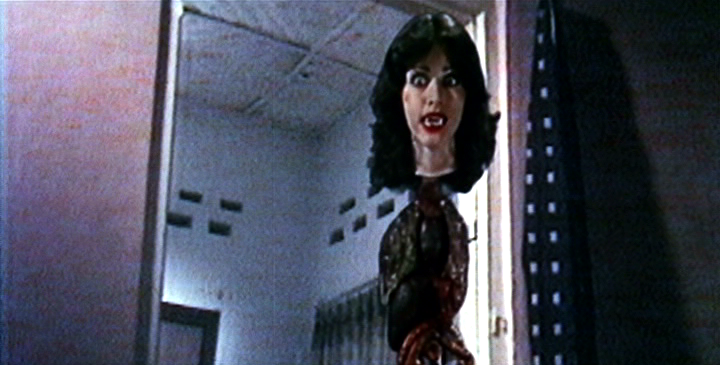
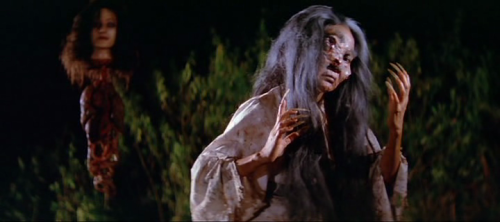
Synopsis: Travelling to Indonesia, an American woman Cathy (Bastian) is assisted by a local who is her boyfriend, Mahendra (Santo), in finding a witch who can teach her black magic for a research paper on the subject. Her training however turns her into a puppet for the witch who can transform her at will into a Penanggalan, a vampire whose head detaches from the body leaving a trail of entrails hanging off the severed neck, the head sent off to feed on the blood of pregnant women and devour their still unborn children so the witch can vicariously gain immortality and youth. Can Mahendra and his religiously pious uncle stop the deaths and what will become of Cathy?

One of my biggest compulsions is to see horror and fantasy stories from around the world. Mythology is an obsession which fits my other obsession, cinema, like a hand in a silk glove, bleeding into genre storytelling greatly and allowing one the curiosity of seeing how legends and bogeymen are depicted. With Mystics in Bali you have a representation of the Penanggalan, a completely unique figure not found in Western mythology as it's shown; floating heads and skulls are common, but the details of the entrails dangling from the neck and the connection back the body, not to mention the vampiric detail involving pregnant women, makes the mythological creature stand out greatly as something idiosyncratic to its country of origins. It's as much seeing another country's culture onscreen, even if liberties have been taken for the transition, as much as seeing genre tropes filter through the introduction of such a peculiar monster to the wide audience.

From http://2.bp.blogspot.com/_gsZ4xh0K_5Y/TRxy_Wmq4rI/
AAAAAAAAGvQ/T77L7bOlnMA/s1600/MIB-001.png
Mystics In Bali as a film turned out to be disappointing in some ways after hearing of it years ago - one of the many curiosities from around the world I learnt of and became desperate to see including its fellow Indonesian films like The Queen of Black Magic (1981) - only to find out viewing it that it's more of a garden variety horror film than one which lets the mythology take the plot into some interesting directions. This could turn out to be like another Indonesian film called The Devil's Sword (1984) where it took more viewings to appreciate it, but it's a surprise how truncated and minimal Mystics In Bali in terms of an actual narrative. Effectively a low budget horror film, it has a repetitive narrative once Cathy is turned into a Penanggalan where her head is sent off to terrorise the populous repeatedly. With only a few sets, only a few main characters and background faces, and a very tight plot  it has the presentation of an old American b-movie from the fifties or from someone like William Beaudine in style.

One of the potential issues with the delights of pulp cinema - psychotronic, weird, intercontinental - is that there's a huge balancing act that need to take place where just sticking to filming the plot will leave a film being a dull, plain viewing experience. The ones that have stood out for me, even if by accident, have had style or a personality to them. In Mystics In Bali's favour it does have an odd air around some of its scenes. Shot in what can vary between on-location places and sets, especially on a battered print, it looks less like real life than a purely fantastical environment onscreen with strong eighties lighting and bold colours. With an English dub that evokes having watched too many Godfrey Ho movies in my life, the world onscreen is caught between the individual edits of each frame than the film as recorded on the camera during the production.

From http://4.bp.blogspot.com/_gsZ4xh0K_5Y/TRx31EtJ0gI/
AAAAAAAAGwI/ScLjXCcLNDI/s1600/MIB-007.png
The problem with Mystics In Bali is that for me beyond this there are so many of the cardinal flaws of genre films regardless of their country of origin inherent in it. Where the film drags and, without relishing incredibly silly dialogue, characters don't know when to be quiet. Films like this are cursed with actors merely standing around and explaining the most rudimentary and disinteresting dialogue possible, a lack of pleasure in it that is matched by the unwillingness the opposite way to make the "action" scenes have a spice and fun to them. It also unfortunately has a nasty taste to it in how conservative it is. For a film infamous for its special effects - Cathy turning into the Penanggalan or into a pig by way of a rubber pig person suit, or puking up mice in the bathroom - the film is pretty restrained than lurid and devotes more of its time to the good guys against the evil women with the least interesting consequences as a result. This terminology is apt as it has a real discrepancy between the good religious men and the evil women in the witch and eventually Cathy, without kitsch or a strange vicarious joy in the villains' behaviour to soften this. Putting up with bland male leads is an issue in any genre work, but it can be argued some of the worst cases of sexism is when you cannot go against the original message and cheer on the villains. At least if the hero was memorable or if the film was more entertaining there would be a balance, even if it wasn't the filmmaker's intentions, where you could secretly cheer on both sides of the square jawed hero and the fatale. Especially when the boyfriend in Mystics In Bali is guilty of both being tedious to see and in bringing Cathy to the witch in the first place, and is pardoned of any guilt by his uncle, you wish the both of them were turned into frogs by the witch. If it wasn't for the fact that the Penanggalan feds off pregnant women, I'd wish the villainess won. If any virtue is to be found in this film for me of great substance in terms of this, I see now why people rooted for the Christian Satanists in the likes of Hammer horror films and why with more morally sympathetic figures, like the Universal horror monsters, you get figures of global popular iconography.

From http://4.bp.blogspot.com/-ztvpQgSA_KA/VLs9lhSDwwI
/AAAAAAAAMi4/G2oy2VWvPMQ/s1600/bali.jpg
Technical Details:
Like a lot of pulp genre cinema, unless one encounters a very artistic or radical change in cinematography and visuals, this type of cinema is based on there being a standard structure and presentation, emphasising instead the quirks. An innate issue covering this film on this site, with the blog title being "Cinema of the Abstract", is that I could easily slip into an accidental xenophobia by calling it "alien" because it's not like a western genre movie in presentation. Thankfully as I've seen plenty of low budget films from this era from other countries, Western and Eastern, that share similar production techniques, the issue is less about Mystics In Bali as a representation of an Indonesian film culture in general but what this particular production had access to in terms of technical resources and time.

The special effects are going to be the most memorable aspects of anyone's first viewing of the film, and barring the poor mice dunked in goo meant to represent them being vomited on a tiled bathroom flaw, you couldn't argue that the results are entertaining and a virtue in spite of the film's flaws. Basic blue screen is used especially in bringing the Penanggalan to life, a drastic change in the visual look of the shots when Cathy's head casually floats off the torso; in lieu to what the production could pull off, I actually admire them attempting this even though it might have been wiser to use more model heads and implied reference to show the creature. It would mean less of the shock of the head popping off or floating down an Indonesian motorway which would've deprived the fun from it.  When Cathy learns to turn into a snake and than a pig respectively during her training with the witch and subsequent transformation into an evil minion, I'm glad of the lo-fi prosthetics used as they are. Utterly strange to witness regardless - seeing an actress become graphically distorted to the point she becomes a mix of Pigsy from the Monkey King stories and a kaiju - it's why the term "psychotronic film"  was coined by Michael J. Weldon in describing the entertainingly bizarre in genre cinema. The texture of the rubber prosthetics, their inherent fakeness, is as important to how odd the moments are helping against the dreary material outside these scenes.

From http://3.bp.blogspot.com/_gsZ4xh0K_5Y/TRx3UwiFwaI/
AAAAAAAAGwA/wqa5Bg3SxaI/s1600/MIB-003.png
Abstract Rating (High/Medium/Low/None): None
Again, there is the issue for a blog that calls itself "Cinema of the Abstract" that I could accidentally espouse a racist viewpoint by saying this film is "abstract" (i.e. weird) because of its cultural heritage and that it speaks a different language even if dubbed in English. I've always had an immense concern with "weird [insert name of country]" rhetoric for pop culture; the use of "Weird Japan" has also always, for example, been undeniably racist for me as a term even as an outsider who has never set foot in the country, painting an entire culture let alone pop culture as weird, even if the examples are legitimately bizarre, when it could be seen as strange to those born in the country too and different from regular Japanese life. Likewise, depicting another country or continent's religious and mythological beliefs as alien is problematic; as Christianity to another land, especially the uncensored version where Cherubs are actually four faced multiple winged entities, would be just as strange to an Indonesian, than a Penanggalan would be weird to a Westerner. Instead if there's anything strange about these beliefs, it's that they belong to the general weirdness of the human concept of spirituality and folklore across the entire species, a head popping off a human body and carrying its entrails with it strange in any language. Depicting these legends and stories on camera leads to them developing dreamlike airs to them where you have to figure out what to do to depict them and whether you have the technical resources to even show a floating head.

Unfortunately Mystics In Bali is conventional in plot and style to the point it deadens a great deal of its potential strangeness. Despite having a final straight out of the aforementioned Godfrey Ho films, an inexplicable fight with added laser effects, I still can't put it on the Abstract List. You have to compare it to something like The Devil's Sword, an Indonesian film that starts with a man surfing a boulder in the air and keeps piling on moments one after another, and you realise Mystics In Bali neuters a lot of its strangest moments (puking mike, detached heads threatening traffic) with constant dull dialogue from unlikable male heroes. Also, with black magic its central theme, there's a white elephant in the room called The Boxer's Omen (1983), a Hong Kong horror film hybrid from the Shaw Brothers that lives up to its reputation as one of the strangest, disgusting and artistically inspired films about Asian black magic you could see. A film like Mystics in Bali doesn't need to be like it, but you see how plain and ordinary it is in comparison to such a film, especially as The Boxer's Omen amongst its other fits of madness includes a scene involving a Penanggalan that's done significantly better than in the Indonesian film.

Abstract Spectrum: Psychotronic
Abstract Tropes: Mythological figures and Black Magic; floating heads; obvious blue screen; unexpected puking up of animals;

From http://24.media.tumblr.com/tumblr_lp1xutalSl1qzgz32o1_500.png
Personal Opinion:
Fun can be found in Mystics In Bali, but personally this turned out to be a disappointment in how ordinary it turned out to be. I've become softer and more amused by aspects of the film since starting to write this review, but especially as it's one of the most well known Indonesian films with horror tropes to it, it doesn't hold a candle to something like The Devil's Sword which I would recommend readers to check out first instead.