Showing posts with label Japanese Sci-Fi/Monster Movie. Show all posts

Sunday, 27 October 2024

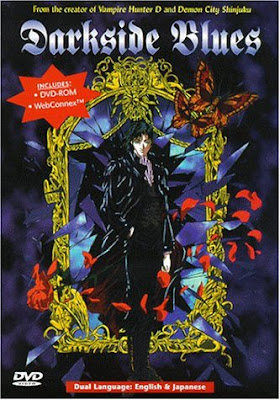
Darkside Blues (1994)


Director: Nobuyasu Furukawa

Screenplay: Mayori Sekijima

Based on the manga by Hideyuki Kikuchi and Yuho Ashibe

(Voice) Cast: Akio Ohtsuka as Kenzou; Hideyuki Hori as Gren; Kotono Mitsuishi as Mai; Kouichi Yamadera as Enji; Masako Katsuki as Tamaki; Maya Okamoto as Selia; Natsuki Sakan as Darkside; Nozomu Sasaki as Katari; Shinichiro Miki as Chris; Yasunori Matsumoto as Tatsuyairector: Viðar Víkingsson

A Night of a Thousand Horror (Movies)/A 1000 Anime Crossover


Darkside Blues isn’t really horror, though it has plenty of supernatural and Gothic touches worthy of the season, and I am glad to have revisited this, as this is a fascinating genre hybrid between dystopian sci-fi about corrupt corporations, which is still salient as a theme, that however has magic exist as well as a titular figure who rides around on a horse drawn carriage which can fly. It is fascinating, even with less than ninety minutes to try to depict this world, and a source manga which did not last long enough either to expand it further, to see what interesting things this depicts, be it a titular figure who acts more like a supernaturally powered advisor for freedom fighters to the sight of someone being tortured by being turned to gold whilst alive with alchemy. From the same author of Vampire Hunter D, and the infamous Wicked City as per its own animated adaptation, you see the threads for those here too, but in this melancholic and fascinating one-off.


For the full review, follow the link HERE.


Sunday, 18 June 2023

Tetsuo the Iron Man (1989)


Director: Shinya Tsukamoto

Screenplay: Shinya Tsukamoto

Cast: Tomorowo Taguchi as the Salaryman; Kei Fujiwara as the Girlfriend; Nobu Kanaoka as the Woman in Glasses; Shinya Tsukamoto as the Metal Fetishist; Naomasa Musaka as the Doctor; Renji Ishibashi as the Tramp

An Abstract Candidate


Our love can destroy this fuckin' world!

Coming to the film which stands out as a metal behemoth in Shinja Tsukamoto's career, his theatrical debut after the films made with his Kaijyu Theatre, I will gladly argue he has amassed an amazing number of masterpieces in his career, with so many layers to those he would make in the decades on. Tetsuo the Iron Man, a “Regular Sized Monster Series” production, is by itself however a true one-off, which you can return to and detonates with an incredible power to it. Even here, layers can be found in terms of this tale of a man’s transformation into metal, not just the obvious one of urbanisation and modern technology as a source of anxiety, something which will be returned to in multiple ways in this director-writer’s career. For starters, the body is a fixation as would be the case onwards, as we encounter a fetishist of metal (Tsukamoto himself) who has cut outs of athletes (track and field) among his coils and scrap in his hovel. Unfortunately, inserting metal into his own leg, the wound becomes infected and full of maggots after a while, and in his panic hobbling for help outside he is run over.

Tetsuo is also subdued in its pace for a chunk of its length - for those unaware of this film, Tsukamoto after a pair of short films created this independent production with collaborators, from their Kaijyu Theatre team, a film which will eventually kick into a hyper intensity but to its credit slowly waits before bolting for the rest of its hour plus length. The fetishist takes his revenge on the salary man (Tomorowo Taguchi) who ran him over, starting to turn into a metal machine man himself and already having an encounter with a woman who, turned into a monster, made the ill advised mistake to stab a weird bio-scrap thing on the subway floor with her pen. With Taguchi to his credit having to work in a giant suit of scrap metal, what can be at times like an ultra violent brawl out of a Power Rangers, shot in the streets of Japan, is yet also a legendary cult film regarded for how distinct and intense it is, a bolt out of the blue when it was released at the end of the eighties in Japanese cinema which caught on globally.

The film is legendary for its intense editing, for Chu Ishikawa's intense industrial score, its monochrome look, and moments which can be incredibly disturbing but forgotten until revisiting the film, such as an entire stop motion moment of a man being broken down (even his skull and flesh) into living wires and machinery in a stop motion sequence, but this can also be subdued, prickling in what is to come with cuts to factory machinery and snippets of Ishikawa's music, taking its time. Even our salaryman's transformation is banal, suddenly the first concern to merely a spike found sticking outward from his cheek when shaving. It can be strange, such as the scene where he merely repeating the same thing over and over on a phone to someone, and it can be funny on purpose. Even the score gets into the tonal change as you can also get sultry jazz sax when the fetishist is hit by the car in the first place, which I secretly hoped that was Chu Ishikawa too playing the instrument.


Throughout the one thing you do not get from the later film is this film’s more playful nature, even in scenes which are meant to be shocking or disarming, such as how that music returns for a proudly homoerotic love between two enemies, the gender subversions and ideas of the body Tsukamoto would elaborate on in his further films already here but matched by the energy of a homemade low budget film which set the bar higher than most for how well made and precise it was. Little details with hindsight cause it to have more edge over other good cult films like this, such as Kei Fujiwara as the lead's girlfriend, who though with a horrifying conclusion to her tale not a damsel not in the least. Partially this is with knowledge that Fujiwara herself, who would go on to direct two cult films in dire need of re-appreciation, was the co-cinematographer on the film with Tsukamoto and a collaborator, alongside how the character in how she is portrayed, the salaryman himself not an innocent in his crimes, is not a conventional archetype. There is even a fantasy scene of her character dancing like in a pagan ritual before a phallic tentacle she is wearing between her legs, like a vacuum cleaner tube, participates in explicit pegging long before the infamous penis drill of the film appears.

Whilst this is a mood piece for a large part of it, little pieces like this, or the sexual licking and castration of a sausage with metal sounds over the noises, do come across showing more to the film over multiple watches, alongside a sense of humour and whimsy that would leave as Tsukamoto would continue. “Whimsy” is an odd choice of word for Tetsuo, but considering this ends with a hybrid man-tank storming the streets of urban Tokyo, the creation of two figures loving each other wishing to rust the world into metal, it is perversely the best choice of word when returning to the film. The deliberateness of the plot, never explaining the transformation of man into metal, does not mean either there is complexity either, as flashbacks to the fetishist’s past which bleed in, such as about a piece of metal in his brain, can be caught out as abrupt and disrupting the plot in first watches, and fire up the imagination when you eventually put together the film over multiple viewings.

As much as I love what Tsukamoto became, this film as the climax of his Kaijyu Theatre work does feel of its own existence, as I miss the stop motion he brought in to this film for its effects, the speeding up effects to make himself and other actors travel at supersonic speed down streets gliding along, and that this does show itself as a genre film which has all the imagination of this type of low budget and creative cinema, not just from Japan, at its most impactful. Thankfully the unpredictability that you get here, and grows as the film goes along, grew in the director’s other work as these traits started to ebb away. Tetsuo the Iron Man is also still an audio-visual experience which has not lost its power – later Tsukamoto films still retained this, Tokyo Fist arguably his best work and matching the intensity (with Chu Ishikawa’s craft) to his greater focus on human drama, but this is nonetheless able to retain its power even after multiple watches.

Abstract Spectrum: Avant-Garde/Grotesque/Kinetic

Abstract Rating (High/Medium/Low/None): High

Saturday, 3 June 2023

The Adventure of Denchu-Kozo (1987)


Director: Shinya Tsukamoto

Screenplay: Shinya Tsukamoto

Cast: Nariaki Senba as Denchu Kozo; Nobu Kanaoka as Sariba Sensei; Kei Fujiwara as Future Eve; Shinya Tsukamoto as Kondo; Tomorô Taguchi as Hijikata; Mitsuru Saga as Okita; Kenji Nasa as Ryoma Sakamoto

Canon Fodder


Before Tetsuo: The Iron Man (1989), Shinji Tsukamoto was part of Kaijyu Theatre, the future film production company of his originally a tent where Tsukamoto, wanting to act more, performed plays of his and collaborators in what looked like a sex monster as a tent, hence “kaijyu” after the Japanese for “sea monster”. The Adventure of Denchu-Kozo, or The Adventures of Electric Rod Boy, was one of the first micro-features as a director Tsukamoto helmed based on plays of theirs, following the aforementioned teen boy born with a giant electrical pylon growing out of his back. Bullied, he is however protected by Momoko, a female friend who out of gratitude he offers a homemade time machine to her only to be sucked into a time wormhole himself.

This takes him into a future where vampires have turned civilization into a post-apocalypse where they rule the world, showing the ingenuity which would be found throughout Tetsuo here already. It is, for a forty minute plot, a delirious production in itself, where the vampires created “Adam Junior”, which allowed them to envelop the sky in darkness twenty five years from where our lead was taken from. Now they need to develop Adam Special for more power, before the sunlight returns, and it allows collaborator Kei Fujiwara to act as the virginal "Future Eve", reaching puberty, part of Adam Special who they are waiting to mature and allow her to become an encompassing and powerful force on their side. A female teacher there will help Denchu-Kozo, as well as another time travelling rod boy, in what is a delirious work which is proudly over-the-top in tone. I think how there is a child choir at one point, like a Japanese animated series from the seventies, emphasizes the more playful tone to this to later Tsukamoto films which is its own virtue, still with its foot in a type of storytelling that would not really be found in his later work. Humour can still be found, but he became serious in a great way, leaving this a rare work with a more absurd tone.


Even more a low budget indie production next to Tetstuo, with a young Tsukamoto looking like a Visual Kei band member alongside regular lead actor Tomorô Taguchi, this however presents already the fascinating creativity in terms of visuals and sounds he explored. The use of manipulating the screen, where actors are “moved” in stop motion outside to show rapid speed, is used here for the chase sequences, whilst the home made quality of the props is found, especially with Adam Special as a strange melding of sexuality and body horror which feels like a prototype to later Tsukamoto. This, absolutely, has tonal choices which left his filmography, but are admirable in the vast contrast to before, such as the abrupt use of Japanese punk music, or how the end credits is animated illustration of electric rod people which feels like a weird experimental anime made by one person in its presence.

It also still tells a story, which a dramatic conclusion with pathos, which does feel closer to his later work, including the surprising changes that came where drama became more important to Tsukamoto as well as the prominence of female characters as important (and even central) figures in his work, already present here. It is an early work,  in the sense that his style would become more refined even in the later film, less likely to have the eccentricities here such as having the vampires living in an apartment (for budgetary reasons) covered on the walls in softcore erotic photos. It does however like the best early work, even the best ultra low budget work, have the creativity and unpredictability I have to admire immensely even if I did not appreciate the director already.

Wednesday, 17 May 2023

M.D. Geist & M.D. Geist II - Death Force (1986/1996)


M.D. Geist

Directors: Hayato Ikeda and Koichi Ohata

Screenplay: Riku Sanjo

(Voice) Actors: Jason Beck as M.D. Geist, Dave Couch as Colonel Kurtz, Joan Baker as Vaiya, Kip Kaplan as Marsh


M.D. Geist II - Death Force

Director: Koichi Ohata

Screenplay: Koichi Ohata

Based on the original script by Riku Sanjo

(Voice) Cast: Jason Beck as M.D. Geist, John Hollywood as M.D. Krauser, David Fuhrer as Eagle, Greg Stuhr as Breston, Joan Baker as Vaiya, Vincent Bagnall as the Major


On the futuristic planet of Jerra, a member of an experimental super soldier project, christened M.D. Geist, reappears on the lands in the midst of a full blown war between the Nexrum Army and the Regular Army, alongside the threat of a robotic doomsday weapon called the Death Force being unleashed. And this begins one of the more infamous anime for a certain generation, which is not well regarded but for its distributor, Central Park Media, was so well selling (and well regarded) it even used one of its most distinct designs, powered armour, as their "company spokes mecha". Truthfully, the head of CPM John O'Donnell LOVED M.D Geist and used his influence to push the OVA, even turning the titular Geist as the company's mascot1. It is a sympathetic thing - we all have favourites - but O'Donnell had the virtue of owning a company which he used to fund a director's cut, fund a 1996 sequel and create the equivalent of a Criterion Collection DVD release1. And, personally, M.D. Geist is really nihilistic and ridiculous animation from an era of "violent cartoons", which is an acquired taste and CPM itself sold itself on until they closed out in 2009, at the time when this was no longer practical marketing as anime's perception (and audience) changed over the Millennium.

Now, it has to be established that I viewed the Director's Cut, the original version from Japan the debut of Koichi Ohata, a notorious director in anime for this and Genocyber (1994), a co-director (Hayato Ikeda) arguably included to contrast the perceived inexperience of Ohata1. The original version was haphazardly put together with screenwriter Riku Sanjo to the complaints of the animators themselves1, and also had some notorious animation faults, all of which the Director's Cut was meant to resolve. The Director's Cut draws out an actual plot and corrects the animation mistakes, but with jarring changes in the type of animation. The existence of the production has to be taken into considering with how M.D. Geist originates from the vast production line of 80s OVAs that this among so many, where the video tape market and the Japanese economic boom at the time meant the money was there to make animation for this market of all forms. At only forty seven minutes, the story here barely covers a lot. It is instead a post apocalypse tale, openly riffing on what the Mad Max films and Fist of the North Star brought to the table earlier in the eighties, but instead bringing in as its lead a sociopathic blond figure named Geist as the badass, imprisoned originally in stasis and crossing paths with the plot when he fights over sci-fi American football gear-like armour. The murkiness of his characterisation is one of the curiosities of the production, especially when you get to the sequel, but Geist is a cipher to archetypes from this era in pop culture.

Underserved, and an unfortunate in the entire two part franchise, is Vaiya who is a female leader of a gang who becomes enamoured to Geist, trying to seduce him only for this to be the rare anime to not have a chauvinistic male character with a libido. Her character, through both parts, is one of the most trodden on in terms of how visibly useless she's made, her monologue of the idiocy of war and soldiers as hyenas not exactly touching Toshiro Mifune's rant against the samurai in Seven Samurai (1954) no matter how hard it tries, particularly as the work, like other Koichi Ohatai productions like Genocyber, are insanely nihilistic in terms of hope being non-existent and death a constant in bloody detail. The production does undercut this seriousness in how, especially with the English dub, the plot terminology, the plot itself and line readings in the English dud contrast with some curious pieces, the "Brain Palace" where the Death Squad is a great example of this. One legitimate piece of praise, however, is the music. The songs by Hironobu Kageyama, famous for the Cha-La Head-Cha-La theme from the first Dragonball series and throughout that franchise, are bombastic, especially in the one solidly entertaining scene of Geist fighting the robotic death machine equivalent of a Russian stacking doll. I did not expect in M.D. Geist interesting synth jazz in the score, other times all the wailing guitar solos to fill a rock album from the era, graphic moments of intestines being split and robots exploding set to eighties saxophone and a nicely dense, odd score.

M.D. Geist's action scenes show some talent, but they are also part of a work which is a structurally messy, especially when you get to the finale, the sole plot drive inevitably the Regular Army (sic) attempting to stop their own doomsday device of killer robots (who look like robo centaurs) from wiping out the planet. It is documented that the context came from the creators coming up with cool scenes first1, which is not necessarily a bad thing, but it does in this context have a sense of not trying to tie them up together at all, particularly when the final plot twist is abrupt, when Geist turns the Death Force back on. I do not want to bother with a spoiler tag for it either; it will not rob the context for how absurd it is and an almost deadpan comedy to the scene in the English dub.


Ten years after M.D. Geist was made and became a successful release for Central Park Media in the US, head John O'Donnell helped both a Director's Cut of the original to be funded, and allowed Koichi Ohata to make a sequel, following the results of Geist, as a viscous sociopath with an erratic behaviour spectrum, setting off the Death Force of robo centaurs to destroy the world of Jerra in the prequel. Obviously everything is worse than before, as now robo centipedes which eat human beings to power themselves exist, and the survivors try to salvage what they can to survive. The last vestige of humanity is a fortress ran by M.D. Krauser, a blue skinned former super soldier whose nobility is unfortunately matched by a God-like ego. Things are already signposted to get very silly and with significant issues in the production just from the first scene - a car fleeing from robo centipedes, messily animated with the set-up exposition in the English dub a words-per-second stream of consciousness from a character we never see again, which as jarring as that sounds. This first sequence alone enforces just how this does arguably, if you want to enjoy this as a "bad anime", top the original even if you need the prequel’s context to make it work.

If the first M.D. Geist represented the notorious anime OVAs of the eighties, then befittingly its sequel is the representative of the nineties equivalents, where it belongs to the kind of gruel and absurdity that would get replaced in the 2000s onwards by the OVA market being phased out, the few exceptions a string in the 2000s, and mainly from then on tie-in to existing series or tie-ins which allow for more sexually explicit specials of shows. The English dub arguably adds a great deal, especially as Krauser has all his lines e m o t e d as to reach the back of the theatre. In terms of structure, it is far gorier than before but scenes are truncated with gaps in the plotting, all whilst it is now jazzy sax solos in the score from Yoshiaki Ohuchi. Death Force has the convoluted plot trajectory of whatever Geist himself is meant to be, the villain destroying everything in the end yet at times presented as meant to be an anti-hero. M.D. Krauser in contrast, who has erected the last bastion of hope for humanity, a moving fortress, is doomed for the hubris of believing himself to be a God, alongside hiring a scientist who unfortunately wants to capture Geist to experiment on. Vaiya is still lost as the lead heroine too, now with amnesia and with a sense of more rudimentary existence despite having a lot more to do with her romantic relationship with Krauser than she did last time.

Death Force, with its jarring plot twists, feels the more ambitious, with a larger plot by Ohata yet absolutely unable to tell it without shorthand. More vivid characters populate the environment (such as an evil scientist or his henchmen, a mere torso who uses robotic limbs that can be attached and detached to him), and just more gruesome in lieu of Ohata's reputation, but with the compromises and struggles to get it made more notable than even the prequel. Death Force even does a Gunbuster (1988-9), its last act abruptly cutting to black-and-white animation as M.D. Geist and M.D. Krauser have their final fight. Gunbuster, a well regarded earlier work from Hideaki Anno, the director of Neon Genesis Evangelion (1995) and co-director of Shin Godzilla (2016), had to use this for budget, but it worked for the drama of that story, whilst here there is some style, a little colour in the eyes, but it is contrasted by the messiness of the production. Ending in an abrupt child impalement that should not be funny were not it not for the voice performance in the English dub, followed by an even more abrupt death, the animation budget is even less existent and you see a work barely crawling out into existence. Certainly the sequel has the bright, gaudy colour of the era, not comparable in the slightest to the original's eighties production, even if the character designs and world has not changed drastically, but irony is found too in how far later the production was funded. Not because it was ten years exactly after or so, but because by the late nineties OVAs were past the boom of them during the bubble economy of eighties Japan and were about to see the righting on the wall the decade soon after.

As much of it is a sympathy for its weird history why I liked this sequel over the other original, but i appreciate the pair together as a one night double - some of it has to be derision from my part in an affectionate way, wondering how the hell the original M.D. Geist got a wider legacy than better or more schlocky OVAs, even without John O'Donnell's involvement still selling tapes. Some of it is admiring the car crash as a whole; all with a bad taste as its childish nihilism and how silly it can be. Ohata’s directorial career really came from that OVA era as, whilst he directed series and tie-in specials for other work, particularly the series Burst Angel (2004), past the early 2010s he has stayed in areas like storyboarding. His reputation does come from the notorious string of OVAs like this which came from the time, and particularly the reputation of M.D. Geist, and how it managed to become a mascot for a company which went the way of the dodo as anime fandom trends changed, is going to be the thing I will reflect upon between these two entries as, honestly, to anyone else but me showing sympathy for them, others will find them utterly absurd to watch.


======

1) As documented Justin Sevakis - Anime News Network founder, a former employee of Central Park Media, and founder of video/DVD/Blu-ray production company MediaOCD - about M.D. Geist's relation in the company HERE.

Wednesday, 23 November 2022

Dead or Alive: Final (2002)


Director: Takashi Miike

Screenplay: Hitoshi Ishikawa, Yoshinobu Kamo and Toshiki Kimura

Cast: Riki Takeuchi as Officer Takeshi Honda; Show Aikawa as Ryō; Maria Chen as Michelle; Richard Chen as Dictator Woo; Jason Chu as Prisoner; Josie Ho as Jun; Tony Ho as Ping

Canon Fodder


Among the three Dead or Alive films by Takashi Miike – three films only connected by V-Cinema megastars Riki Takeuchi and Show Aikawa - they all deserve their own coverage, but among them the third and final one always came off as maligned. The first was a film which helped Miike’s reputation, as much due to its out-of-nowhere ending, the second film is one of his best and a reminder of his emotional and dramatic side, and Final came to the United Kingdom in the wave of Tartan Video DVDs with a dull thud. It was neither helped that at this point, when Arrow Video decided to preserve the entire trilogy for a Blu Ray release, Final was shot on standard digital with burnt in Japanese subtitles, even having included a warning the preserved copy is less than perfect due to one of this film’s many quirks.

Old films onscreen, all fantasy wuxia with homemade monster costumes, open up the film with a melancholic air before we are sent to A.D. 2346 Yokohama, in a post apocalypse when the new major, Major Wu, has enforced the strictest of population and birth control rules. Pregnant women are incarcerated and it is implied they will outright shot children to keep the population down, with Wu’s own birth control pill is mandatory for all couples to take, with an enforcer called Officer Honda (Riki Takeuchi) as his right hand. Obviously there is a rebel group, refusing to take the pill and this introduces Ryo (Show Aikawa), who wanders in abruptly in this, preventing Honda’s men gunning down a young boy, and being introduced to the rebel group, mostly two figures that have made the ill advised decision to hire gangsters to help them stop Wu. Ryo thankfully is a replicant even able to stop bullets with his hands.

Whilst the premise sounds like horrible homophobic propaganda – when Major Wu is introduced having a shirtless sexy sax man, who preaches eternal love being only possible in homosexuality – Miike films, as usual, are more complicated, especially as whilst this is set in Yokohama, most of the cast are speaking in Cantonese, and the film was shot in Hong Kong, which evokes mainland China’s controversial one child policy than anything else. Implemented between 1980 and 2015, and thus still enforced when the film was released, it was a real life attempt at reducing population rates with strict laws, and I would not be surprised this came to mind for the production alongside the idea, set in a post-apocalypse, of imagining population issues being a subject the creators wanted to explore. Wu, played by Richard Chen, is less evil due to being gay but being a bastard, but one who feels the old world, of environmental disaster and chaos, can only be prevented from appearing in these extremes, Honda enforcing this law by the book of logic. The film, is there are any issues, plays its premise as a merely a context, not as fully fleshed out as it could be, but it feels less problematic than it suggests initially.


Contextually the origin in V-Cinema adds a lot to Final as a film, as with the whole trilogy. In lieu to cinema’s constant challenges such as television, Japanese cinema in the eighties gained a new format with videotape, which led to the likes of straight-to-video anime and the cinema Takeuchi and Aikawa made their names in, let alone this being where Miike started as a director originally. Dead or Alive as a trilogy, in hindsight to Miike’s earliest films before the 2000s, with some going to cinemas but others not, feels like a capstone to this period. The sense of its repetition of the two leads, always to cross paths, feels apt for the careers of the two too, as much as the lurid and strange moments in the trilogy coming from the unpredictability of Miike’s earlier films. Here for the last time Riki Takeuchi, Elvis pompadour and cool, and Show Aikawa, eccentric with his own idiosyncratic croaky voice and dyed blonde hair, got to revisit this world one last time. The first Dead or Alice is underappreciated, as it is known for its opening and ending, but with the central crime story being just as interest as a sad, melancholic tale where even the absurdity of the ending befits two men on opposite sides of the law literally destroying the world in their hatred. Dead or Alive 2: Birds (2000) was even more idiosyncratic and bittersweet, with the leads friends and hit men who knew each other from childhood, a drama in crime genre clothing of memory, nostalgia and purpose. In comparison to Birds especially, Final does feel a curious turn, a piece which connects to earlier films, specifically one of Miike’s best Rainy Dog (1997), as passages become Ryo bonding with a woman and the child he rescued in his introduction, but is also an imperfect production next to the other two just for the sense that this could have done with a few more minutes and grown from its virtues.

Shooting in Hong Kong adds something at least for starters, never trying to be futuristic baring some aesthetic details, like CGi giant dragon ships over tower blocks, and the replicant subplot, involving robots from a war far in the past able to eat and be empathetic as much as being dangerous to normal humans. Clearly the film had interest in the country’s history of martial arts cinema, even if it would be fed through CGI, with Show Aikawa trying his own stunts. Here I have to get to its standard digital shooting style too. This is thankfully something changing over the decades, especially with the work of the likes of American Genre Film Archive in preserving shot on video films has caused titles with imperfect technological appearances to be more readily available, but I did have a legitimate concern that an era of early 2000s digitally shot films would be lost. There was some sense of the issue being how something like this, shot likely for practicality, shows the technology in its softness and being out-of-place in a world of 4K and High Definition technology especially when it came to televisions. A production like MPD Psycho (2000), his great mini-series adaptation of the Eiji Ōtsuka and Shou Tajima manga, is something left obscure and with this concern, and here you can see, with its interlacing, Final has a fuzziness to it that will put some off immediately. Considering however though, with MPD Psycho still having huge censorship bars over gore, not for censorship but on purpose, Miike does feel like someone who has toyed with the style of his films deliberately. He is one of the few able to make very obvious CGI work, as here, and the green hue to this world is a slight emphasis on this being a dystopia without overdoing it, all felt with the sense of his usual trademarks of being one of the few directors to go out of the box fully.

This does jar with the beauty of the previous films in this series, but considering the crammed, waste and water logged world of futuristic Yokohama here, it also makes sense to have this style. The film’s hardcoded Japanese subtitles also come with the fact that, continuing his interest in multiculturalism, Miike has a mostly Cantonese speaking cast, with the leader of the resistance also fluent in English. It does not hide its Japanese setting clearly being Hong Kong, and it never feels out-of-place. The golden virtue of Takashi Miike – whilst even Sion Sono could spin his wheels in repetitious content – is that Miike unless you got him on a really bad day is a chameleon, always interesting, and here too, Final becomes more of a drama as Honda’s reality is shown to him and Ryo bonds with the survivors from when the rebels are caught off guard. Here is another film where, even with its absurd moments, it still however has emotional resonance regardless of how bizarre he can get, where even a botched rescue becoming an accidental kidnapping of a child leads to a friendship between two instead.

The film eventually refers back to the two films before by the ending, openly embracing the sense of these films existing within themselves whilst still being serious. Note that, yes, the ending of Final is bizarre, with a penis robot at the end as unexpected as you would presume, alongside the end credits just recording an older man on the street singing a song. This comes with him as a filmmaker - the profound and emotional against this openly silly and juvenile content - and it does not jar from the content from the previous two Dead or Alive films either. The film's true flaw, in truth, is that I have already mentioned, that this does fell slightly undercooked, not fully fleshed out as it could be with the importance of the film, the end of this trilogy, and the virtues already here when it is both serious and it is silly.

Sunday, 9 October 2022

Boogiepop and Others (2000)


Director: Ryu Kaneda

Screenplay: Sadayuki Murai

Based on the light novel series by Kouhei Kadono

Cast: Sayaka Yoshino as Tôka Miyashita / Boogiepop; Maya Kurosu as Nagi Kirima; Daijirô Kawaoka as Keiji Takeda; Ayana Sakai as Minako Yurihara / Manticore; Asumi Miwa as Naoko Kamikishiro; Mami Shimizu as Kazuko Suema; Kai Hirohashi as Kei Shinkoku; Tetsu Sawaki as Akio Kimura; Hassei Takano as Saotome Masami; Hideyuki Kasahara as Shirô Tanaka

A Night of a Thousand Horror (Movies) / An 1000 Anime Adaptation.


As a fan of Boogiepop Phantom (2000), one of the most unconventional anime series from the 2000s let alone in the horror genre, I was always intrigued by the existence of this. Released the same year, a lot of anime get live action adaptations, and so did Boogiepop, only with the hindsight being that Boogiepop Phantom, in one of the reasons why it structurally unconventional, is adapting a sequel light novel whilst this adapts the first. In 2019, an anime series covering the story of this live action movie, and others from that first source book, but this was a fascinating piece in itself to see the film attempt to adapt very unconventional material in a very unconventional manner.

For the full review, follow the blog link here.

Thursday, 14 July 2022

Guyver: Dark Hero (1994)


Director: Steve Wang

Screenplay: Nathan Long and Steve Wang

Based on the manga by Yoshiki Takaya

Cast: David Hayter as Sean Barker; Kathy Christopherson as Cori; Bruno Patrick as Crane; Christopher Michael as Atkins; Stuart Weiss as Marcus

Ephemeral Waves/A 1000 Anime Crossover


Next up, more Elvis sightings.

Guyver: Dark Hero is a vast contrast to the original 1991 adaptation of the Guyver. Aki Komine and horror legend Brian Yuzna are gone as producers; notable, and needing a paragraph to begin this review as this sequel, are the producers which took over, showing this from the get-go was where things got serious. Ken Iyadomi was Executive Vice President of Bandai Entertainment at its inception in 1996 to 2006, and VHS anime publishers LA Hero and Manga Entertainment beforehand, and from 2018 at Sunrise Inc., the legendary animation studio; he was involved as a producer for the likes of Ninja Scroll (1993), Ghost in the Shell (1995) and The Visions of Escaflowne (1996), just in three random choices three significant anime titles, Escaflowne a series, from that era, and he even involved as a producer for an episode of the 2021 live action Cowboy Bebop series. Hirohiko Sueyoshi, producer on Wings of Honneamise (1987), Nobuhiko Ôbayashi's adaptation of the Kazuo Umezu manga The Drifting Classroom (1987), and Macross Plus (1994), alongside being involved with Guyver: Out of Control (1986), the first attempt to adapt the original manga, as an executive producer. Yutaka Wada, with this one of his last productions as a producer, can at least credit in his small filmography being a producer on Mamoru Oshii's Angel Egg (1985), one of the most experimental theatrical anime ever made and a holy grail for Western fans to have, and being on the production committee for Nausicaä of the Valley of the Wind (1984), one of the first films Hayao Miyazaki made alongside The Castle of Cagliostro (1979) as the director, rather than in the animation department or directing animated television series.

Vivian Wu is gone, the romance between her and the lead character completely ignored, with Kathy Christopherson in the equivalent position here, an actress who would return in Steve Wang's Western interpretation of Kamen Rider, Kamen Rider: Dragon Knight (2008-9), and in terms of tone, this sequel changes a lot. Having watched this film multiple times before, having never seen the 1991 adaptation until much later, Guyver: Dark Hero is a b-movie but as a curious attempt to meld an older American monster movie with Japanese tokusatsu action sequences, one which wanted to get the tone of the source material right. Even with strange touches like the monsters having cat noises mixed into their grunts, this was a more successful production in terms of the premise.

It is still attached to the prequel, nodding to this existing after the end of the prequel but with the life of Sean Barker, now played by David Hayter, a troubled one afterwards. Having been able to watch this film without needing to know about the prequel, this feels severed entirely in that Sean is a figure possessed by an alien bio-armour called the Guyver, part of his form permanently, which now pushes him to stalk criminals randomly at night as the opening sequence has. When a television report, for a show devoted to fringe Elvis sightings and UFOs, brings up an apparent werewolf attack in Utah, Sean to his surprise sees images involved with this news report, near an archaeological dig, which are close to his experiences with the Chronos Corporation in the prequel and dreams from co-existing with alien armour in his body.  

David Hayter is now the Guyver, going on a journey to Utah where an archaeological excavation has found symbols on the wall similar to those found in his notebooks recording his dreams. The result is far more a no-nonsense sci-fi plot, ditching most of the comedy of the prequel as the archaeologists are working for a deeply suspicious company, with something in the woods killing any locals bumbling near the excavation site. Hayter, continuing the 1991 Guyver having a fascinating cavalcade of pop culture figures, is inexplicably linked from this to the future of American box office blockbusters as. Alongside his legacy as the voice actor playing Solid Snake in the Metal Gear Solid video game franchise, he wrote the screenplays X-Men (2000) and X-Men 2 (2003), arguably among the first films before the wave in the Millennium, before the Marvel Cinematic Universe came to be and Batman was revived with Batman Begins (2005), when superheroes dominated pop culture. Even at this time, Hayter was more a voice actor, from the 1996-7 Spider-Man animated series I grew up with, playing Captain America, to anime English dubbing for the likes of Fushigi Yûgi (1995), so it is befitting his legacy as Solid Snake in an iconic series is also one of his most important roles in pop culture, as important to the Hideo Kojima developed franchise as the gameplay in the West.

Baring badly dated computer effects, and some compromise for losing Screaming Mad George and the higher practical effects budget, there is however such a bizarre irony to be found in how Dark Hero was probably a lower budget production next to the prequel, but has such a drastically improved sense of production value and ambition in its smaller scale. Noticeable is Steve Wang's collaboration with Koichi Sakamoto and his Alpha Stunt Team, Sakamoto the fight coordinator, which is a huge virtue for Dark Hero. This film will recycle Michael Berryman's monster costume from the prequel for a random goon, to show some penny pinching, but this production ups the scale drastically in ambition and to fight scenes which are utterly exhilarating. Considering he has worked in a variety of roles after this film on Power Rangers, Kamen Rider, Ultraman and Japanese tokusatsu productions, the Tokyo born Koichi Sakamoto brought a huge weight to the film, and that is not ignoring others on the crew. Among those credited with stunts with Sakamoto - Ken Goodman, Tatsuro Koike and Akihiro Noguchi - you can connect dots before and after this film to Jackie Chan film from his early Hong Kong superstar era, Hollywood box office films to even stunt coordination for videogames like Sega's Yakuza series. You can argue the plot's a little flimsy, but seeing a man, even with the padding of a giant rubber monster costume, get propelled into metal scaffolding is still painful and striking to witness, rough but efficient fight scenes that replace the grace of Hong Kong martial arts for a more visceral nature of Japanese combat movies.

The result, mentioning that cross between the American monster movie and a martial arts film, does stand out more from its forest setting and exterior cave sets too, a sense of atmosphere in general the original adaptation of Guyver never had. For every line reading slightly under the mark or the clichéd plotting sticking out, I cannot help but admire the clear love put on display to make a great film, more so as the woodlands have a significant positive effect on the mood and that, even if the transformations are cut down and simplified, the production value is actually superior everywhere else in the film against the prequel. Even in mind that, yes, this is a low budget film where actors in rubber suits are fighting in the middle of the Angeles National Forest in California, posing as Utah, that in itself has a pleasure in itself that is simple, more so as this is a significantly more serious film in tone even with a few moments of weird humour. The gore, when there, is in its nastiest form, whilst the plot becomes the back-story of the Guyver's origins, leading to the film going as far as having an elaborate living interior of a spaceship for a set with multiple rooms. There is even an elaborate flashback to primitive times with stage bound sets, model work and almost psychedelic colours as cavemen dance around a bonfire and turn into monsters to explain the origins of the Zoanoids.

In the perfect world, the Screaming Mad George effects and David Gale would have been used in a film like Dark Hero rather than the 1991 Guyver film, making one better film, but in the real world this is still a superior work even if one sadly less easy to access. That is also unfair to Bruno Patrick, an actor who barely has a filmography with this the most well known of his films, as Crane, effectively the main villain though he serves a figurehead of the Chronos Corporation. One scene, a monologue even as an outright villain, has an unexpected choice of words to it, almost coming off as subtext in he and Hayter's Sean Barker being people with secrets that force them to be shunned from the world, wishing to be normal again. You can as a viewer indeed read a variety of different contexts in that sequence, even a queer one, despite this very much being a monster fighting film where Crane then turns into a monster a moment afterwards. Even how this deals with the idea of an evil Guyver, least taking the idea of what happens when a Zoanoid gets hold of a Guyver unit, is at least an escalation.

This is a film which stands by its technical qualities in the areas the production wished to focus on and improve from the prequel, and they stand out well. With these virtues, the foundations are prevented from collapsing like so many examples in the same areas do so easily, with a lot of these type of genre films of this ilk not being this well made. I say this in mind to the 1991 The Guyver, which is not a good film but I have nothing by sympathy for those on and behind the camera for trying; the problem with it was how it did not clearly has a consistency with the tone and material. If more films were like The Guyver: Dark Hero in genre cinema, despite its flaws in story and composition, the ideas and their recreation are beautiful to see by themselves, their macabre physicality evoking far more than a rush job, either with practical or CGI effects, would. Steve Wang's career is sadly smaller than it should be, though he worked over the decades, but he went on after this to Drive (1997), that production vaulting this film in terms of quality. Among comic adaptations like this, The Guyver: Dark Hero can climb out the pit of bodies, with its head held high and a severed spinal column of a weaker film of a higher budget, in its bloodied claws, managing to be more impressive to me for having to work with less and still getting so much right in the process.

Friday, 24 December 2021

MPD Psycho (2000)


Director: Takashi Miike

Screenplay: Eiji Ohtsuka, Gichi Ootsuka and Yumi Sirakura

Based on the manga by Eiji Ohtsuka

Cast: Ren Ôsugi as Tooru Sasayama, Naoki Hosaka as Kazuhiko Amamiya, Tomoko Nakajima as Machi Isono, Sadaharu Shiota as Masaki Manabe, Yoshinari Anan as Kikuo Toguchi, Rieko Miura as Honda, Lily as Yôko Yamamoto, Nae as Tomoyo Tanabe

A Night of the Thousand Horror (Shows) #39 / An Abstract Candidate


Reflecting on how I got into Takashi Miike as a director, I can think of a couple of titles in his filmography which helped shape the interest. Ichi the Killer (2001) - a very transgressive yet smart film, with greater layers than its infamy suggests. Rainy Dog (1997) - his sombre, compelling crime dramas, shot in Taiwan, arguably his best film or a strong contender for one. One I realise left a lasting mark early in getting into his career, and sadly in danger of being forgotten and unpreserved, is his 2000 mini-series based on a manga by Eiji Ohtsuka, who co-penned the series' script. From when Miike became big and notorious, and early DVD labels grabbed what they could of his career, this was a great example back then for me in showing Miike's workaholic mentality, constructing interesting productions in any medium.

It also, with fresh eyes, emphasises that despite his self professed "working director" viewpoint, that he works with others' material, he is an auteur. Truthfully, returning to MPD Psycho, its plot eventually becomes the weakest point, a strange mishmash from its manga source. It starts strangely but with a clear, intriguing beginning. Kazuhiko Amamiya (Naoki Hosaka) is a former police officer with split personalities. The show is not PC nowadays on this, confusing schizophrenia with multiple personality disorder, and sadly does not use this as much for Amamiya's character as it should; nonetheless he is someone with multiple personalities, one buried after the tragic murder of his wife. He killed the suspect as a cop, leading to a cover-up, and another personality to take over. That calm personality returns to the police as an outside help, for police detective Tooru Sasayama (Ren Ôsugi), when a series of perverse murders are taking place where, emphasising the manga's grotesque creativity, bodies are being buried with flowers growing out of their exposed brains.

The plot gets stranger, but stays the right side of compelling for the first half. The manga should be viewed as an entirely different work as, in the bit I have viewed, even from its first two volumes it is radically different in tone and content from this. The mini-series has that, stemming from an American hippy terrorist and musician Lucy Monostone, a sentient personality named Nishizono exists can transfer himself from host to host, invoking their homicidal side as he occupies them, another female sentient personality, able to also transfer through the web and phones, trying to stop him as Tooru and Amamiya with a female psychologist, effectively Amamiya's new boss and handler, have to deal with a variety of bizarre cases from school shootings based around brainwashed students to bingo games using severed body parts. The hosts Nishizono can occupy all have bar codes marked under one eye under the bottom eyelid, and he is directly connected to Amamiya and the murder of his first wife, alongside the kidnapping of his newest wife, all of which for the first three episodes, fifty plus minutes long to an hour, is compelling. The show does waver when it gets the final, with a convoluted exposition of artificially made personalities, to create killers, for a government project and trying to tie everyone together into the conspiracy. I do still love MDP Psycho, but I will admit the plot is ridiculous, more so when a huge exposition dump transpires near the end of the fifth episode, in a burning hospital, lasting long after the flames should have surely caused everyone to flee early in the exposition.

Where the show is still compelling is that, as a shot on digital production, Miike adds so much just as the director to this show in tone, improvising greatly. Even in the fifth episode, it ends abruptly with Tooru over the end credits, as a character who is with multiple women, wandering home to a miserable place with one of his romantic interests and her child, all slow burn tension as he tries to get a bath off-screen, broken by a moment of humour between the characters. The sense the mini-series has allowed Miike to improvise is felt throughout. The show, whilst the eventual need to explain everything does undercut it slightly, is idiosyncratic, and considering this is the director of the likes of Gozu (2005) and Visitor Q (2001), to say this is strange even for him at times tonally is a real crown of this show's virtues, more so as it is under seen. Miike was allowed to improvise around the narrative, without letting a low budget undercut him. The fact that I have always found the use of ordinary, grounded locations in Japan, in the streets and public places, evocative helps, but there are many of the flourishes, his impulsive, where Miike got his reputation for being unconventional but clearly showed his voice too. Little details stuck with me from the first time watching this mini-series and still do, such as there being green rain on beaches full of thrown away electronics, for example, with Miike one person whose use cheap and very obvious CGI always worked. Throughout, even using very creative placement of actors and props in scenes, this has the type of flourish outside of scripts that show the director's own creativity.

This goes as much in how, as a director with traits, his reoccurring actors are as much part of his style. Ren Ôsugi is the main reoccurring actor here, the stand out as the police detective and the one true friend of Amamiya, both as someone as talented to be able to be funny when need be for the comedy, but also to be serious when the narrative drama has to, a huge virtue as for the rest of his reoccurring actors in other films from the time for Miike. And when this gets wacky, Ôsugi gets a lot, an eccentric police chief who, when talking to his superiors about the latest murder case of strange spree killings, he will eventually have ones making comedic puns, with a Christmas tree in the background, and even playing a guitar. With his police assistant Tatsuya (Satoshi Matsuda), an otaku who, rather than presides over autopsies or real crime photos, creates intricate plastic figurines of the bizarre murders, and MPD Psycho does manage to slot itself as unique in the director's career, continuing his trend of idiosyncratic characters and an ability, without undercutting the drama, of having wacky humour that actually makes the characters distinct. Allowed to have tangents, Miike is allowed to breath, more so with a longer length of narrative to work with.

A huge virtue is that, even as a low budget production which embraces its style, but there is a lot of quality among those who are working with the director. The female personality is depicted in black 'n' white animation, a big aesthetic flourish among many that emphasis, even on low budgets, Takashi Miike is someone happy to embrace different aesthetic styles, such a stop motion in The Happiness of the Katakuris (2001), or his embracing on CGI regardless of how fake it looks. The music in particular for MPD Psycho by Tsugutoshi Goto and Yumi Shirakura, when it stands out, is striking. The main theme based as Lucy Monostone's, the death fixated Strange New World, is legitimate psychedelic rock which is haunting and strangely calm alongside the show's flourishes of audio aesthetic design. Considering this is a show that even defies how an episode should be structured, such as ending one after the end credits with an older woman calmly eating food in a cell, having the chance to direct a mini-series does show Miike alongside everyone working with him here, on or off-screen, are happy to take risks in terms of how this show presents itself.

The original world, as transported to this show, was already a distinct one to work with. Even if the plot has to try to wrap a lot up, it offers something intriguing connected to this format. The grotesqueness before, contrasted by the original manga's exceptional art style by Shou Tajima, elegant in appearance, is contrasted now by the surreality of early Miike when he worked with a lot of low budgets as a straight-to-video filmmaker who occasionally moved to theatrical films. One of the more contentious choices of the television mini-series, the censoring of gore by way of large blurred bars onscreen, is even deliberate, a weird touch to deliberately undercut how the narrative is perceived and not far from other times, whilst still being completely sincere, Miike has shown a trickster-like mentality to blur tone in his work or even undercut the mood of a film on purpose. Even in what the show looks like, it is helped that I have always found depictions of real Japanese locations, urban public sectors and on the street, compelling, always bustling or at least lived-in for many of these films rather than isolated in corridors.

It is also helped that, for the plot aspects which are absurd when revealed, of these personalities being the result of secret government experiments to have personalities that induce psychopathic behaviour just because, a lot is still startlingly relevant even if technology has evolved further from what this evokes. One major piece of exposition, a great example of pure colourful exposition than important, reveals the female personality is one of these experiments accidentally acquired off-line, a computer geek managing to update her better than a government in that, alongside being a benevolent personality also meant to be an artificial musical idol, she can enter any person through the internet and phones rather than the limitations Nishizono has, someone still able to enter people (and escape them) by modern technology. He even sneaks into a hospital at one point by way of floppy disc, and using anti-virus technology or just destroying a telephone tower have to be used to deal with the problem. Set at the time of the dying emperor, the end of the Showa era, this is still relevant in terms of how it plays with technology as much as it is a time piece in the best of ways, to the point that at one point a hospital staff member, a shut-in in a future life, is dragged into a war between these sides by way of his 2D girlfriend in a dating sim, when she is infected and develops an actual personality able to talk back to him. Even the hokeyness of the plot, more because it has to explain everything being rationally explained by technology, and having to make everyone related, has something salient as it evokes MK Ultra, a deeply troubling series of projects by the United States CIA in brainwashing and interrogating people, more so as this story stems from experiments by the United States in artificial personalities, but comes to Japan and its own history, including the left wing terrorist group the Japanese Red Army being evoked in the final episode.

MPD Psycho does still stand up even if the final narrative beats do go to directions it never should have needed. Only having some of the plot details being unnessary does not in the slightest undercut what virtues of here. In fact, it really emphasises that, whilst the narratives and drama in his work can be incredible, especially when he makes dramas, the virtues for Takashi Miike for me have come from when he has been allowed to match them with the creativity he shows onscreen. Returning to this mini-series, you have the perfect example to find in showing this virtue of his.

Abstract Spectrum: Bizarre/Grotesque/Weird

Abstract Rating (High/Medium/Low/None): Medium
Saturday, 7 November 2020

Meatball Machine Kodoku (2017)


Director: Yoshihiro Nishimura

Screenplay: Yoshihiro Nishimura and Sakichi Sato

Cast: Tomori Abe, Kensuke Ashihara, Yurisa, Satoshi Eishima, Goki, Yôta Kawase, Riri Kôda, Rima Matsuda, Masanori Mimoto, Maki Mizui, Seminosuke Murasugi, Takashi Nishina, Takumi Saitoh, Ririne Sasano, Eihi Shiina, Kentarô Shimazu

A Night of a Thousand Horror (Movies) #201


In what is effectively a larger scale remake of the 2005 Meatball Machine, by Yudai Yamaguchi and Junichi Yamamoto, we begin with an analogy of placing all the most toxic creatures in a jar and using what survives for the poison. Thankfully, whilst demonstrating this onscreen, you get the real frogs and scorpions etc. being handled but with no animal cruelty. There was an offer of something immediately interesting, imaging if aliens decided to recreate this metaphor over an entire urban area of a Japanese metropolis, with bio-mechanical parasites to turn human beings into death machines.

Our lead is a fifty year old man Yuji (Yoji Tanaka) which has to be a rarity, especially as he is not an action hero, but actually a regular older man. He works, is wary of his health, and is a JBA debt collector, so not in a great job either. Baring an odd figure, the woman with a white line roller for streets in an odd green and white stripe get-up, Kodaku in the beginning offered a legitimately compelling narrative for a splatter Japanese pulp film by following a sympathetic lead with his humdrum life for effectively a prologue. Our lead himself is compelling, looking his age with whiting, balding hair and awkwardly police in his manner. His potential love interest Kaoru (Yurisa) is significantly younger, but she looks like a shy woman working in a bookstore, whilst he is merely the polite customer who orders comedy audiotapes from their store, so it does not come off as creepy.

My issues with Sushi Typhoon will be a question I will ponder on throughout the review, but this quiet prologue is good, following a sympathetic figure with money problems and confirmed with cancer, drastically changing his view of the world immediately as there is now a sense he should try to live his life whilst he can. The first really weird thing in this long prologue is the cabaret, a place of eccentricity which just leads to him being tricked out of the debt money he was collecting, the final insult before thirty minutes in the real title screen appears. In this time, the film cuts to a giant glass jar floating towards Earth in space repeatedly, the change to the actual film after this emotional build-up when its falls eventually over the district Yuji is in, trapping the residents inside and preparing them to become bio-mechanical monstrosities to fight each other for nefarious alien forms. He himself is turned, but because of the cancer cells in his body, he retains his humanity as he goes on his way to find Kaoru in the ensuing chaos.

The film takes a tumble immediately from this, as maybe a black fake savage character for a loan parody was not well advised especially in the 2010s. The film, as mentioned, is a fleshed out version of a 2005 film, which here is what happens if Power Rangers villains fought in gory fights, the director Nishimura very much taking the Tokusatsu genre and providing its extreme version, having actors in elaborate body horror costumes, from severed head bolas made from freshly acquired victims, and a literal multiple fist punch, to another character, a stalker of Kaoru, becoming a stalker turned car hybrid.

The practical effects, especially the costumes, look rubbery and fake but they are impressive and in mind of Nishimura being as known as a practical effects designer, his craft is on hand. Originally this was meant to be as much a review asking why I had been so cold to the work of Sushi Typhoon, the collective under the studio Nikkatsu that Nishimura has worked with, but the irony is that they had only really started to produce work officially under that name by 2010. The films from before, like Nishimura's own Tokyo Gore Police (2008), always fell under their banner for me, and still do at heart, even if they were not officially part of them. The best way to go forth then is thinking of these latter gorier live action genre films from these specific figures as their own category, a period of these Japanese films with a self awareness and especially of Western viewers, at least in that we briefly used to be gaga about these films for a short while. Figures from eclectic backgrounds, such as Noboru Iguchi who originally started in adult cinema, all journeymen and working creators who I have nothing against, and all going in varying directions.

This period from the West started as a trend briefly in the late 2000s and dissipated into the mid-2010s. And most of the films I saw, honestly, I did not really like at all, even though their combination of hyper elaborate pulp with these practically effects and usually a lot of gore could be appealing. There was however, the issue, which I had with many of those films and this one, is that they always fell into the same manic tone, of throwing about many interesting and bizarre moments but never finding an unpredictability to them until it all blurs together. A film like Tetsuo: The Iron Man (1989), arguably, follows the exact same tone but was an entirely different and intense experience with a distinct aesthetic and a varying tone.  The same is to mind in wondering why I can enjoy anime with this exact tone, and other absurd Japanese genre films, but not this.

Honestly, after a while Kodoku became a drudge to sit through, the fake blood split in buckets and all the mad practical effects eventually losing their impact. It is inventive and perverse, from the body transformations to the bio-mechanical infectors actually being little cockpits for aliens, acted out with cute evil puppets, with arms for eyes to steer their infected hosts. The issue is the sense that Yoshihiro Nishimura likes to just barrage you with chaos of actors bashing into each other and gore, but with it all bleeding into each other. Whilst I have enjoyed films far more cheaper looking than this from Japan, in this same ballpark, there was always those moments where the pace slowed down to let one breath, always something truly inspired even in average work, or if you watched a film like Attack Girls' Swim Team vs. The Undead (2007), something legitimately bizarre and not contrived.

This is all in mind I am covering a film where topless car man horse riding transpires, as is a brawl in the cabaret with breast machine guns, but it bleeds together with a numbing effect as happened with Tokyo Gore Police. It is a case that, tonally, you need to relay more on gore and practical effects, even in terms of mixing them up or even slowing the film down, which it never does once it completely ditches the promising start. Ultimate this left the film on a sour note for me. [Major Spoiler] A cynical one, where everyone dies for an alien brand of energy drink made from the strongest. [Spoilers End]. One frankly, after the initial promise of its first thirty minutes, disappointed me more.