Showing posts with label Director: Luis Buñuel. Show all posts

Wednesday, 19 June 2019

The Phantom of Liberty (1974)

From https://www.calvertjournal.com/images/uploads/features/
2018/03/polish_poster/KlimowskiPB_055_1500.jpg


Director: Luis Buñuel
Screenplay: Luis Buñuel and Jean-Claude Carrière
Cast: Adriana Asti; Julien Bertheau; Jean-Claude Brialy; Adolfo Celi; Anne-Marie Deschodt; Paul Frankeur; Pierre Lary; Michael Lonsdale; Pierre Maguelon; François Maistre; Hélène Perdrière; Michel Piccoli; Claude Piéplu; Jean Rochefort; Bernard Verley; Monica Vitti

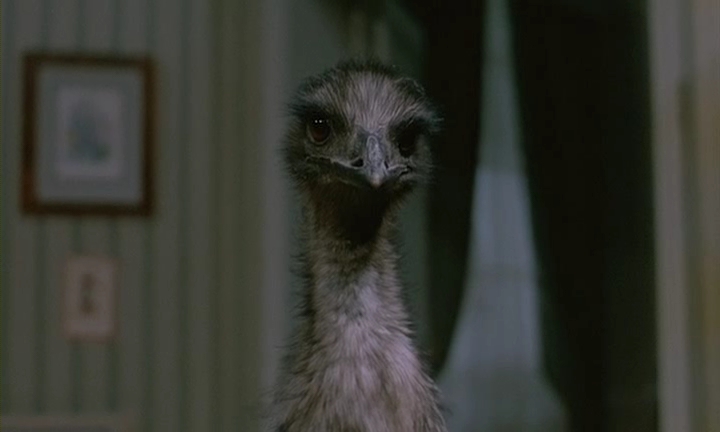
Rationality leaves the room when an emu enters it, something I first learnt from Luis Buñuel's The Phantom of Liberty. I've also learnt that, from his later films, I prefer the more overly scenario structured and stranger films to his dramas, not to dismiss the later, as they are excellent too, but that the director of Un Chien Andalou (1929) kept the talent of that legendary short film and showed it in these more overtly unconventional productions. Time has made the targets of his films far less subversive and funnier at points than others, but the absurd depictions of banal reality still stand out strong, his deliberately profane scenes less shocking than the cynicism of the modern world.

The Phantom of Liberty is one of his most experimental works from the end of his career, built from a series of dreams rattled off between him and screenwriter Jean-Claude Carrière which take on a vignette form. This is taken in a still radical direction however in how every segment is interlinked by following different characters that appear in previous segments, creating an ever widening web as they reoccur. In terms of any theme, this elaborate web featuring a sleuth of Buñuel alumni collects together numerous obsessions from morality to social behaviour, hypocrisy to his usual desire for the morbid.

The thing is that, like The Discreet Charm of the Bourgeoisie (1972), this is for me one of his best films as, reverting back to his older surreal work and hitting a great creative structure here, he manages some of the best moments in this particular work by merely changing one little detail in an ordinary circumstance and just happens to create something surreal as a result. An obvious joke, whilst more shocking today, is a man giving photos to two young girls in a playground. It is telegraphed early these photos will be banal but reacted to like they are obscene but, even now that in the modern day this joke would be quicker in being told, there's still a better result for me in letting the punch line drag out, especially as the answer is inherently weird in itself - why Buñuel and Carrière choose lewd photos of European architecture, and what that symbolises if anything, is itself truly stranger.

From https://archive.ica.art/sites/default/files/styles/banner-landscape/public/
images/phantom_libertyVHOIPd_0.jpg?itok=ICebMjPn

The simplicity of telling these jokes becomes inspired - the nocturnal nightmares of one man involve the emu, time rushing forwards and a postman who only delivers mail he's in bed, whilst the most famous sketch has people sat on toilets whilst eating is considered obscene. Then there are the more blackly humorous or just completely dark moments which add layers to the proceedings. As much as having priests, after consoling a woman over a lost loved one, eventually drinking and gambling with her is funny, as is Michael Lonsdale in arseless leather chaps wanting to be spanked in front of said priests, the darker and more poignant stabs stand out to as a sharp change of pace which stand out as much. They come in moments such as a male character realising his doctor's been hiding the fact he has cancer and slaps him, a reminder that, even at his lightest, Buñuel still descended into both the follies of human behaviour and its moments of bleakness. Then there are the moments which are unique his and Carrière's idiosyncrasies - most comedies don't have a prologue set in the past, in which a statue of a deceased lord takes offense to a knight lasciviously touching the statue of his late wife nearby, which is never resolved on purpose as it smash cuts to the then-modern day and gets to the main film itself.

Both in terms of the absurdity of life and, in the title, prodding at the general elusiveness of freedom, it follows Buñuel's long withstanding animosity with organised groups in general.  Not just an axe to grind with Catholicism but everyone - the police are literally children, posting pins on the teacher's chair, the upper classes are distracted or involved with nude incestuous piano playing, the middle class are too distracted to notice their missing daughter is right near them (even admitting her existence to her), and the only innocent characters there being the children and (occasionally) the lower classes. And it doesn't stop the film having politics - even if the ending is strange, because it's the police coming down on people to prevent them from moving about in a zoo, it's still the police in full riot gear charging unseen group of bystanders, violence heard off-screen whilst we see images of animals. And of course, even more troubling as a sketch in the current day, thre's the entire segment of the man who decides to find an isolated room in a skyscraper and start taking random bystanders out with a sniper rifle, an uncomfortable image for good reason considering the history of gun shootings that have taken place just in the United States in the 2010s, but pertinent in its darkness in how even when given a trial with a death sentence he merely gets to walk off (and sign autographs) as a figure for the public to look up to.

By this point, Luis Buñuel whilst at the end of his career was still learning new ways to make his films, a greater fluidity being found with this production alongside decades' worth of experience beforehand allowing him to make films like this with a greater ease. An awareness of how quickly ideas were being put together for The Phantom of Liberty for me as a viewer adds so much more to its original virtues I already adored. Certainly, his trademarks by this point - bright but calm aesthetic, minimal editing and camera movements, an absolute lack of a musical score - is digestible here alongside the episode nature of the film, but it allows him instead to focus on keeping the viewer on their toes with these ideas and absurdities. The humour's still incredibly dry, like one of Bunuel's beloved martinis, but openly it's both one of his darkest but funniest films as a result.

Abstract Spectrum: Surrealism/Weird
Abstract Rating (High/Medium/Low/None): Medium

From https://phantomvisions.files.wordpress.com/
2014/12/thephantomoflibertyavi0.jpg

Monday, 20 May 2019

The Discreet Charm of the Bourgeoisie (1972)

From https://cdn.shopify.com/s/files/1/1057/4964/products/the-discreet-charm-of-the
-bourgeoisie-vintage-movie-poster-original-1-sheet-27x41-4298.jpg?v=1534403343


Director: Luis Buñuel
Screenplay: Luis Buñuel and Jean-Claude Carrière
Cast: Fernando Rey as Rafael Acosta, Paul Frankeur as Francois Thévenot, Delphine Seyrig as Simone Thévenot, Bulle Ogier as Florence, Stéphane Audran as Alice Sénéchal, Jean-Pierre Cassel as Henri Sénéchal, Michel Piccoli as the Minister

In university, when I was tentatively discovering world and art cinema through the DVD shelves of their library, large enough to be its own building in a multi floor (?) book depository, it was Luis Buñuel and Jean-Luc Godard I once felt were completely overrated yet kept binging their films from the collection trying to rationalise why they were even popular. Over ten years later, I hold them in high regard.

It was a transitional period over these ten years where, without wanting to dismiss anyone's taste in film in these comments, I changed from the reader of Total Film magazine who once viewed The Usual Suspects (1995) and Memento (2000) as the best of cinema to becoming the person who read Sight & Sound who viewed the likes of Satantango (1994) to cult anime as some of my favourites. (Nowadays I read neither and am a fan of many films).  This is surprisingly a transition many cineastes have been said to go through, as much due to growing in age; I openly admit a form of Stockholm syndrome kicked in particularly with Godard too. One wishes I had this open-mindedness, slowly cultivated from getting used to unconventional and experience film styles, back in university when I had access to that library but hey hum.

Buñuel, particularly his final famous French period where his films were co-scripted with Jean-Claude Carrière, are also a lot more difficult for their apparent accessibility then you'd think; Jean-Luc Godard's work was always difficult on the surface before he even discarded narrative filmmaking by the 2000s, but Buñuel's more elusive. His films, despite being satires in the period from The Milky Way (1969), aren't exactly funny ha ha but an aloof lifts of the eyebrows which doesn't exactly come off as tight slappers. His films are paced slowly with minimal camera movement and editing. He also doesn't have a lot of non-diegetic music if none at all in The Discreet Charm...; in any film, if there's no score to subliminally affect a viewer, it drastically changes the pace considerably.

The Discreet Charm of the Bourgeoisie is nonetheless one of his most accessible films. It can be summed up in one sentence, a group of middle class bourgeoisie in vignettes who are constantly prevented from having a dinner party, arguably alongside its quality how it's become one of his most well known films, with a reputation even outside his filmography just from winning the 1973 Best Foreign Picture Oscar, but it's still a bizarre and subversive film, full of subplots to tangents and dreams within dreams which get increasingly perplexing.

Our bourgeoisie are as appalling group over-privileged figures as you could get; complimenting ex-Nazis as gentlemen, adultery with each other's wives, and in the case of Rafael Acosta (Fernando Rey), an ambassador to a South American country as corrupt as you could get despite his constant offense to this being pointed out to him. Yet they are strangely sympathetic, mainly because a) a cast including as legendary a cast of European actors like Rey to Delphine Seyrig is inherently full of the most charismatic of Euro-cinema, and b) because they are utterly banal people, the real satire in the current day, and more profound critique to have with the middle and high classes, is that no matter how corrupt they could be, this particular lot are as average and easily ruffled over a lack of tea in a cafe as you could get. From there, they are figures who look like deer caught in the headlights a great deal of the time, more concerned with sex and food whilst continually putting up with increasingly pronounced interruptions, beginning with visiting each other on the wrong day for a dinner part to a military troop in manoeuvres paying a visit. Their worst attitudes are witnessed, but so is how baring their privilege how mediocre they are too, profusely clueless as scenes have them wandering countryside road as a curious form of purgatory.

From https://scrapsfromtheloft.com/wp-content/uploads/2018/02/
Discreet-Charm-of-the-Bourgeoisie-1972-800x478.jpg

For a while the only truly sympathetic character, until a late period subplot twist, is Julien Bertheau's Monsignor Dufour, a priest who wishes at first to also garden. Much has been made of Buñuel's history of atheism, but alongside casting Édith Scob as the Virgin Mary in The Milky Way, there's a sweetness in a priest who wants to be someone else's paid gardener on the side even if their new employees are arseholes. It's only when that plot twist appears things are complicated; a loaded situation, literally, and a reminder Buñuel's jabs have a lot to do when religion had "organised" in front of the word. Noticeably how characters refuse to pay the priest any attention until he's actually in official uniform, rather than gardening dungarees, says a lot.

The moment The Discreet Charm... gets abstract is when scenarios not only get odder, but when the dreams appear. Scenes literally stop to let one character talk about their dreams, or in one case a solder at a cafe walks up to the female protagonists and sits at their table, talking about his childhood and how the ghost of his dead mother told him to kill his step father, all before saying goodbye and never being seen again.

Then entire scenes are dreams dreamt by the characters which are then dreams dreamt by their friends, and The Discreet Charm... truly gets weird. And these become overtly surreal. Some are worse case scenarios, such as Rafael Acosta shooting a dinner party host over saying his country is corrupt, but others follow the tropes of barriers in their desires, fake plastic chickens, and literal phantoms who roam the corridors. Their existence, baring farces with bitter humour, still expose the worst in these people, from the corruption of the police using electrified pianos to a general buffoonery of these strict middle class ideals. Buñuel even has a bit of Godard's tricks at hand as, in a comically brief cameo by Michael Piccoli, his phone call to a character (shot entirely separate from everyone else) is drowned out by the sound of a plane twice, both to use the viewer but even the character trying to communicate to him.

Any further attempt to analysis Buñuel and Carrière's work would spoil it. The Discreet Charm... may be cool and aloof at times in its presentation, but it's still funny, arguably the most overtly humorous of his work despite his tendency to be more funny peculiar in his career. The natural but brightly coloured world of French cinema is a good place for this perverse comedy of manners and a cast this strong to work within; obvious Rey stands out as the ambassador who'll sacrifice himself for a cold cut, and has to deal with a rebel group in his country constantly trying to send a female agent to him, but everyone succeeds in making these stereotypes have some personality. They all (even unintentionally) bring some sympathy to this miserable lot as, despicable as they are, they are shown as guided by ordinary obsessions like you and I, the awkward moment a husband and wife want to have sex but the guests have already arrived, or the moment you realise the proprietor's corpse for a restaurant is in another room as you are about to dine.

Even the most absurd moments are brilliantly staged by how calm or matter-of-fact they are, the military group coming for a large banquet, or the harsh efficiency of a group of machine gun welding intruders. If anything, it proved that Luis Buñuel, who has multiple phases of his career, had a virtue of always being this sedate and calm in tone whether here or in his earlier Mexican productions, his slow manner particularly for these final French films adding to the dark humour and allowing it to stand out proudly.

Abstract Spectrum: Humorous/Surreal/Whimsical
Abstract Rating (High/Medium/Low/None): Medium

Personal Opinion:
Returning to The Discreet Charm of the Bourgeoisie, it's a gem, an absolutely incredible work. A lot can be delved in further if you wish to dissect each segment, but it cannot be argued that the film's singular acclaim comes as much from how more accessible in structure yet so open to interpretation as it is.


From https://celluloidwickerman.files.wordpress.com/2016/02/
tumblr_nq9qz3ezzm1txum4do10_r1_1280.jpg?w=799