Showing posts with label Anime. Show all posts

Sunday, 27 October 2024

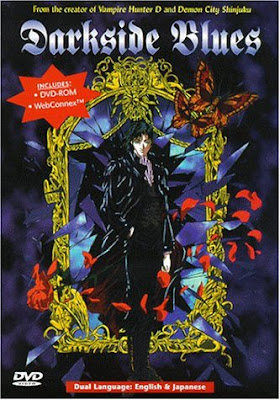
Darkside Blues (1994)


Director: Nobuyasu Furukawa

Screenplay: Mayori Sekijima

Based on the manga by Hideyuki Kikuchi and Yuho Ashibe

(Voice) Cast: Akio Ohtsuka as Kenzou; Hideyuki Hori as Gren; Kotono Mitsuishi as Mai; Kouichi Yamadera as Enji; Masako Katsuki as Tamaki; Maya Okamoto as Selia; Natsuki Sakan as Darkside; Nozomu Sasaki as Katari; Shinichiro Miki as Chris; Yasunori Matsumoto as Tatsuyairector: Viðar Víkingsson

A Night of a Thousand Horror (Movies)/A 1000 Anime Crossover


Darkside Blues isn’t really horror, though it has plenty of supernatural and Gothic touches worthy of the season, and I am glad to have revisited this, as this is a fascinating genre hybrid between dystopian sci-fi about corrupt corporations, which is still salient as a theme, that however has magic exist as well as a titular figure who rides around on a horse drawn carriage which can fly. It is fascinating, even with less than ninety minutes to try to depict this world, and a source manga which did not last long enough either to expand it further, to see what interesting things this depicts, be it a titular figure who acts more like a supernaturally powered advisor for freedom fighters to the sight of someone being tortured by being turned to gold whilst alive with alchemy. From the same author of Vampire Hunter D, and the infamous Wicked City as per its own animated adaptation, you see the threads for those here too, but in this melancholic and fascinating one-off.


For the full review, follow the link HERE.


Thursday, 10 October 2024

Vampire Princess Miyu (1988-89)


Director: Toshiki Hirano

Screenplay: Shō Aikawa

Based on the manga by Toshiki Hirano and Narumi Kakinouchi

(Voice) Cast: Naoko Watanabe/Anne Marie Zola (Manga UK dub)/Pamela Weidner as Miyu; Mami Koyama/Stephanie Griffin as Himiko Se; Kaneto Shiozawa/Zach Hanner as Larva

A Night of a Thousand Horror (Series)/A 1000 Anime Crossover

The personal project of its director Toshiki Hirano, as he is one of the co-creators of the source manga alongside his wife Narumi Kakinouchi, this definitely wins you over with its style and in terms of its melancholic tone. For the OVA anime period, it stands out for this, if with the issue like a lot of them that this feels slight for a premise which could have been taken further. This is emphasised when you know the original manga, not including the spin-offs, lasted from the year this anime was created to 2002.

Tellingly he would return to this in the late nineties for a full animated television series, but for what we got here, including the episode following the students being turned into marionettes which turned into the most successful story for its tone and emotional turns, I was glad to finally get around to this.

For the full review, follow the link HERE.

Thursday, 3 October 2024

Hellsing (2001–2002)


A Night of a Thousand Horror (Series)/A 1000 Anime Crossover

For a tangent, I return back to an anime series I had not seen until the 2000s when I got into the medium. Naturally, there was nostalgia in this one case, as the likes of the original Hellsing come from a specific period of anime which I got into by the mid-2000s and no longer exists. ADV Films, who released this in the United Kingdom, no longer existed by the end of the decade due to financial problems, and Gainax, the divisive anime studio who produced this, were a prolific studio whose titles came out at the time I was getting into anime, and also suffered from severe financial problems by the end of the decade too. They still exist, but they are not the same big budget studio who divided people in terms of the quality of their work. This was also the era, for whatever bizarre reason, someone thought releasing three to four episodes a DVD disc, at full price as separate releases, was a good idea until sanity prevailed and we just got box sets.

Hellsing is an action horror about a secret group of vampire hunters in England, with the really cool choice to cast actual British voice actors (or try for proper regional accents) in a rare moment of English dub acting where, even notoriously as with certain Manga Entertainment dubs, even British recording productions pretended to have American accents. The issue comes with the knowledge this was the "original" adaptation of the source manga. Gainax, as the review gets into, were seemingly cursed with an inability get stories properly finished, and this one was struggled worse because said manga had barely started with material yet to reach when the show was in production. It tries its hardest with wrapping together the plot threads already there into a new story and having to bring in new series only content. Sadly, one of the most interesting inclusions in terms a new villain, for a 2000s production, touches on problematic stereotypes in horror fiction of African mysticism, and it still struggles by its end. Now it also has been entirely wiped from the slate due to Hellsing Ultimate, a more faithful adaption for straight to video which had a high budget, the manga fully to work from, and didn't need to censor the gore whatsoever for television.

The virtues are here, least in style, and I learnt a long time ago, I can find things to appreciate even in really bad anime, but this is exactly the reason, for all the things I think are great, I don't believe in having nostalgia. I would rather return to these productions of my memories as new again, strike that nostalgia dead, and find virtues even in a work like this I admit has huge crippling flaws.

For the full review, follow the blog link here.

Monday, 30 September 2024

Hantsu x Trash (2015-16)


Director: Hisashi Saito

Screenwriter: Keiichirō Ōchi

Based on the manga by Hiyoko Kobayashi

(Voice) Cast: Maaya Uchida as Chisato Hagiwara; Yūma Uchida as Yōhei Hamaji; Kenta Matsumoto as Nakajima; Saki Yamakita as Maki Hayami; Shizuka Itou as Manami Miyoshi; Yurika Kubo as Mai Shinozaki

Ephemeral Waves


As an anime fan, as with other mediums and their sub-genres, you do find your coming against tropes which are not defendable. Do not expect a defense here with one of the more prominent ones in anime here, which studio Hoods Entertainment’s Hantsu x Trash really emphasizes, the type of sex comedy which includes content which would be viewed as sexually inappropriate conduct from male characters to female ones. This is however something you do not just find in Japanese animation but found in comedy from other countries, my British heritage bringing up the cases in our past in television and cinema which can be pointed to for this. The tropes in anime are those that have been commonplace - such as male characters peeking at girls in the shower, inappropriate groping and things we have rightly challenged as unacceptable in the modern day as time passed - which would be a struggle to explain to an outsider of the medium to stereotype. By the third episode of this curious straight-to-video fragment, this sadly fully falls into this type of comedy, but I also get an example where, even when I will gladly give the production a kicking for these aspects, I also find material even accidentally working in unexpected ways even if on a morbid level. In this case, like a lot of sex comedies in anime, how many no matter how tasteless feel like a young male character's sexual neurosis as a premise with that the gag to mock.

Deciding to choose this as a subject may surprise some readers, of all the titles to flag up in the non-anime reviews, except that I have always been fascinated by what I have called the "ephemeral" and strange, this an example which cannot be defended for most of its length, but is definitely a "curiosity". From the get-go, there will be the preface now to not have to repeat this, of it being very questionable content. I will also admit finding it fascinating in terms of a sex comedy that did get some morbid laughter from me, not spoken as a hypocrite but that, when it is not about objectifying its female cast, is also however a story about dumb horny men obsessed merely about the bared female breast who are the real butt of the humour. It is tame even in the 2010s when this was released next to what you could get on PornHub and other adult sites even animated, and does present this whilst the punch line is with the male characters being inadequate, pathetic and/or idiots who are punished for their behavior. The punishment is insufficient, even if one character does get a baseball bat up an intimate area, but how much of this feels swashed in the tensions of our lead becomes the central part of this.

It also presents my fascination with dragging up ultra obscure items you the reader may have never heard of, as this is obscure even for anime fandom and is likely not known of at all by many who even know some of the obscurer cult gems in film. These three episodes, two over twelve minutes, the third over fourteen, were just meant to be promotional items, part of a trend of creating tie-in anime that comes with the manga, the first bundled with the 8th volume of the manga on October 6th 20151, the second bundled with the 10th volume of the manga in June 6th 20162, and the third and final one bundled with the 11th volume of the manga on November 4th 20163. Together, they are not politically correct, a sex comedy about the high school male water polo team who is more interested in the female water team, though I will say ahead of time that I have suffered through far more tasteless and sexist content I have unfortunately come across than this. This does feel closer to American sex comedies of the past in tone, only with the presentation of the jokes seen in anime. The issue with this is not the premise but where the humour comes from, in that spying on the female team bathing, as in the third episode, is something that in real life would rightly be challenged. The other part of the humour is more interesting, and becomes more striking in what is barely more than one whole episode of a story which never gets any semblance of a plot until near its end. What little you get here is that these male characters are figures who even find the sight of seeing a bared breast a monumental moment of their life, the kind of joke that transcends history and is not problematic to do as a joke because the target, close to the bone, is the heterosexual males themselves.

The source material was originally published Weekly Young Magazine, originally also the home of the original Akira manga which became the legendary 1988 feature film. It is also a publication that in the 2010s published the likes of Does a Hot Elf Live Next Door to You? (2019–2021) by Meguru Ueno, which just emphasizes that sex sells. Let us get the elephant out of the room that, deliberately including the review outside of the anime sphere, there is a dangerous cliché to dismiss Japanese pop culture like anime for being perverted, where in reality pop culture in many countries, not even touching their fans’ interpretations, have their layers of explicit (or implicit) eroticism or horniness to them. A lot of the dismissal of Japanese pop culture for “perversity” is a red flag for implicit racism, even if we who love anime admit so much of it you would be embarrassed to be caught watching or if more for those with a greater open mindedness to fetishes and comfortable in their sexuality. Factor in too that, in Japan, Studio Ghibli films rule the roost and their longest running animated show, still going since 1969, is Sazae-san, a work by Machiko Hasegawa that follows the titular character, the matriarch of a family, and if about family situations for comedy. These really fetishistic and erotic works in anime and manga, whilst prolific, are an undercurrent to animation, with Hantsu x Trash a real obscurity. Hoods Entertainment made their bread and butter on titles like this, which might not help the argument, but for all the stuff an outsider would raise their eyes at from their catalogue, such as The Qwaser of Stigmata (2010), infamously the animated show about breast milk powering one’s super abilities, we forget that whilst titles like this are brazen and proud to tackle subjects like this, mainstream sex comedy can be as perverse if using humour a self defense mechanism to justify the scenes. Case in point, once ago in my teen years we had American Pie (1999) as a mainstream film, where the title comes as a punch line to someone actually fornicating with a pie as a joke. That film was done with a mocking sense of shame which just differentiates the line between comedic effect and proudly over-the-top sexual fantasies, especially when you consider the most explicit sequence, with actress Shannon Elizabeth as a foreign exchange student who has the prominent nude scene, is presented in the same tone as Hantsu x Trash would have had. That it allows the viewer reveal in the nudity, but ends with a male lead being so out-of-his-depth a potential loss of virginity is as abruptly neutered for him as it could have happened, with his bruised emotional state the joke.

Episode One introduces our protagonist Yōhei Hamaji, a poor guy doomed like many male protagonists in these sex comedies to have a crush on a girl in his school but be under the confused whirlpool of his hormones. He is an archetype that transcends various story types from one country to many, from Japanese animation to US eighties sex comedies, that of a likable prat who is less problematic than his peers, far unscrupulous in their horniness, but still curious about the opposite gender. It is to the point here that if any girl or woman was to show interest to him, his cluelessness will cause him embarrassment in his attraction to them. Like characters in any adolescent romance, his true love is his senpai Chisato Hagiwara4, one of the committed members of her water polo team, even if like the other men in his team he has hormones, and like them really has a fixation on the female breast.  This is the fetish of the anime, and these short episodes have no qualms in the slightest in their lewdness, and drawing them in various states, but it also is not that different again from other sex comedies from other countries. In British sex comedy, even in our more tame sex humour, alongside a lot of older and younger men who got bothered by the idea of having sex, many of the jokes with them included a fixation on busty female characters. This is the tamest of things for Hantsu x Trash to have a fetish with, even next to other more extravagantly made and longer anime which, even if not further explicit, a probably more lewd even when there is no nudity. If anything, especially writing this as a heterosexual male writer who can self critique himself, it causes one to look at the obsession with cleavage size by men with a surrealism to it. When you step back, it is peculiar a part of the body of a gender is an obsession symbolically in terms of desire, even in art let alone anime like this gunning for the low hanging jokes.

Episode One shows the trope common in Japanese anime that, whilst still objectifying the women, the men are punished painfully for comedic effect, which has always been a curious side to Japanese anime and manga in their sex comedy in that they constantly undercut their male characters. In work targeting men audiences in their gazes, they depict their stand-ins as completely immature figures a lot of times. Even what could be seen as a gay panic running gag undercuts itself in presentation here, where Yōhei keeps imagining erotic fantasies of Hagi-chan, whilst recuperating in the nurse’s room, only to keep envisioning Nakajima, a team member who looks in his late thirties with sunglasses permanently on, at the end as the one appreciating his caresses. It is the main joke for that episode, whilst for the rest of the three the crisis for him is that, whilst Hagi-Chan is the woman he loves, Yōhei is someone clearly who has both an obsession with large breasts, and is emotionally immature. It is to the point he finds himself coxed whenever any woman, with an ounce of confidence in her desires or an accidental situation, causes the hormones to kick in and turns him into an utter dimwit. What could seen a tasteless homophobic joke in the first episode, with imagining Nakajima every time he fantasies about women in his life, comes off more like a Freudian barrier to Yōhei’s desires, the Super Ego kicking but with an added accidental tone suggesting his denied bisexualility. In a smarter, and more creative anime sex comedy, this would have been a joke that would have been something to run with, here is just due to the strange tone in presenting it without thought to its accidental layers causing my mind to leap to these conclusions. That he loves Hagi-chan for her personality, whilst burning for her physical beauty and curvaceousness, but would not mind buffing his team leader’s nipples even if he tries to deny it. It is for reasons like this I find interest in these less great sex comedy anime, with how for so many even when they come from the crass side, to always objectify the female characters, to go for the crap joke, that there is however a rife amount of psychosexual neurosis to the humour that, if weaponised properly, would be great comedy in another context. That is the one thing that I can appreciate even for something which is quite a cheap production to tie-in to a manga, which does look of its budget in the minimal use of locations, and how the second episode does look the weaker in production in comparison.


One joke from the first episode exemplifies what this could have done if it was not going for the low hanging fruit, the lead’s mind envisioning Chisato being seduced by one of her teammates Shinozaki, someone who is very physical with her friends. In a more complex show than the fragments we got, this would have been compelling, even if tasteless, for imagining the sexual id of a guy who is confused in a lot of ways about his sexuality even if there is one girl he loves dearly. In context it can be viewed as a cheap ploy at lesbianism as a fetish for men than someone’s real sexuality, but could have been a joke that worked in imagining how absurd his desires are, especially as his own superego cock-blocks him every sequence in the first episode, the joke his own disjointed and confused fantasies than at the expense of the female cast. That is as much trying to stretch out a sex gag which most would roll their eyes by excusing it through a layer of amateur interpretation, but that becomes the most interesting thing, even if by accident, through how much of this does follow this. Constantly it becomes a curious gag anime about the strangeness of the male libido, even if the work is not great. It becomes instead less that actual quality of the work which is of interest, but what it accidentally does.

This is still an anime about the male water polo team being perverts, even with episode three having them trying to spy on the female team so Yōhei learn the nipple colour of the woman he loves, which is the episode where I was left with a bad taste in my mouth. It is where the loose string salvaging this anime fully snapped, even if it does led to one male character gets punished by having that baseball bat up a painful area. One recurring joke I will defend in these episodes, because they are all at the expense at the male cast, is the idea they have, because they are all sexually naïve, that they presume just touching a woman in the right way on their breast will cause them to orgasm. Even for a virginal reader of this review, I would hope they realized this is not something that would work; even presuming touching a guy on the chest would have a similar effect should be considered to, because anyone presuming that with the instantaneous effect is being an idiot and a terrible lover. One character who could been seen as problematic nowadays is the female teacher character, neither helping in breaking teaching ethics as in episode two, she even makes a promise to let the male team touch her breasts if they won a match, three seconds only each, and has a desire for Yōhei beyond the boundaries of teacher-student relationships. That set up for episode two, and the disappointment that the entire male water polo team are this stupid to think they can be romantic gods in just touching someone once, is however the one joke even in an un-pc anime which I will defend because it is entirely about her absolute disappointment, and what utter idiots the male characters are portrayed as.

Every time it was entirely when a clear theme was up front as the joke, of how every male character here is as thick as a brick, even Yōhei, is where you see a spark here. It is the kind of premise which, for all the content here with is clichés from previous anime and not aging well, still hits close to home as a joke at mocking the male heterosexual libido. More so, as I have seen titles which have casual edged into sexual violence and far more misogynistic content, this feels more antiquated. Plus with this Super Ego slant to how the joke always punished the male characters, even if the plots here are not defendable and yet reward with their explicitly topless nudity, does make this have a sick sense of humour against the audience who would have wanted these episodes for the casual nudity. Here there is a scene of all the swim team on the floor just from touching their teacher’s breasts, or that she has beaten them all up for not following the three second rule, the exaggeration here of these male character coming off as something itself ridiculous to laugh at, that image in itself the encapsulation of what is clearly the joke but also unintentionally the theme, even a neurosis, running through this.

I have not really even described the visual appearance of this show, and that is for a reason, as it is a cheaper tie-in production, where at times you do see it is a cheaper production. It also barely covers a premise, really a tie-in to the manga for that reasons. A story is hinted at, a romance between a sex fixated Yōhei who yet wishes to be a good person for Chisato, a romantic triangle set up in the finale episode with another girl on the water polo team with a crush on him. Her story is with the added touch though it does play it for a dubious reason; that being her appearance as a physically attracted young woman to boys has caused a huge emotional crisis, undercutting her confidence in herself unless she was able to get past that she stands out physically to men and be able to be self-confident and/or dismiss them. This is another moment that in another anime would have been the right moment to challenge, even in a comedy, the uncomfortable idea of guys even at a young age sadly getting into objectifying the girls in their classes without realizing it in their own clueless hormonal problems. Not many of the cast are set up beyond this, though the premise of a sap like Yōhei trying to balance between water polo and his libido is a premise that could be good, as most could, if focused and were trying for more than clearly here. That this is not really a water polo genre story, and likely is not in the source manga, is itself disappointing because, as a genre hybrid, a sports show combined with absurd sex comedy and romance would work, or least be something really original.  Even if it had stayed perverse and lewd, in a better world, and anime has been able to do this with confidence and without shame, you can have stories which are proudly horny but also emotionally rich and good. It can be to the point they could be dismissed by outsiders to anime as showing the medium as perverted, but in their existence anime can be proudly pro-sex, positive about that and equal opportunity in progressiveness.

The result, just over thirty minutes, could have been cut into a one-off straight to video tie-in, and it feels like a pilot to a series which never came to be, only establishing what is an initial set up. In terms of a comedy, I found aspects funny but with the caveat that this is going to put off someone who, understandably, cannot get past its tone and humour choices. Hantsu x Trash has one scene of a character losing his mind to the point he gropes a female character, which in another context would be offensive even next to the other scenes, but for the most part we are dealing with a type of humour here which has just aged badly. For the rest of this, the idea of someone being so clueless about the opposite gender, males here to women, but attracted to them that they do stupid things like spy on them, is something that can be covered but you could not portray with the same attitude that you still see in some anime like this. It was also something you even saw with 2000s sex comedies I grew up with from the West, even if you played the joke still as the males being idiots, so this problem was always not of just one culture. This particular example evokes a micro-series anime named Colorful (1999), and whilst the question of whether its content is defendable means revisiting it, it’s humour was less sex humour for the sake of sexualizing the female cast, but instead vignettes about men trying to see women in their underwear, or the garments under their clothes, but the jokes entirely about how ridiculous these men were, and the punch lines making them look like morons. Whether that has aged well or not is to debate, but you look to these works which are as much the joke is a guilt reflex of the creators, and they are fascinating even if Hantsu x Trash is very conventional even in the genre.

In the perfect world, these types of sex comedies would not involve this type of sexual harassment humour, and the depictions of sexual content even when kinky would be emphasized in terms of interesting character dynamics, psychological sides even for gags, or even positive depictions of sex. Hoods Entertainment even adapted a manga that would immediately come off as gross fetish material for anyone outside of the anime fan base but had a surprising level of depth to it as a deliberate contrast to this, showing they could do this. It was a work called Mysterious Girlfriend X (2012) about a young man who finds himself in a romantic relationship with a strange girl whose salvia is addictive to him, a strange fetishistic premise turned into a work around this fetish, brazenly, but where you still have a pair who really liked each other and embraced this quirk of the relationship.

You could have expanded Hantsu x Trash away from its questionable sex comedy humour into something as interesting, even if fetishistic, in terms of a sex positive comedy with a lot of goofy humour, but this is a slight production, obscure even by anime fan standards. It managed to produce far more here in typed words than what these thirty plus minutes should have. No premise, unless just undefendable as an idea, is not possible to make into something good and also without being tasteless, and sadly whilst one wishes there was an erotic water polo sex comedy out there which was more wholesome and progressive with this tone, even if still breast fixated, this review also presents another issue found in the Japanese anime industry. That, if you dig, you find so many animated fragments, usually built as tie-ins for manga and in some cases pure one-offs, which never had a conclusion and just exist as half-finished dreams. I can envision imaginary, superior takes on the stories, but the reality is that the actual animation is not this and barely in existence as was the case here.


======

1) Hantsu x Trash Manga Bundles Original Anime DVD, written by Karen Ressler and published by Anime News Network on August 23rd 2015.

2) Hantsu x Trash Risque Water Polo Manga Bundles 2nd Original Anime DVD, written by Karen Ressler and published by Anime New Network on April 24th 2016.

3) Risque Water Polo Manga Hantsu x Trash Bundles 3rd Original Anime DVD, written by Rafael Antonio Pineda and published by Anime News Network on September 9th 2016.

4) Maaya Uchida and Yūma Uchida, the voice actors for these lead characters, are siblings, which is somewhat an odd casting choice as romantic leads. That is not a slight against either of them, Maaya the older sister and both prolific in their careers. It is just an odd choice which I hope they found funny in hindsight to what happens in the show. 

Sunday, 3 March 2024

Bludgeoning Angel Dokuro-Chan (2005/2007)


Director: Tsutomu Mizushima

Screenplay: Tsutomu Mizushima

Based on a light novel by Masaki Okayu

(Voice) Cast: Reiko Takagi as Sakura Kusakabe; Saeko Chiba as Dokuro-chan; Ayako Kawasumi as Shizuki Minagami; Rie Kugimiya as Sabato-chan; Akeno Watanabe as Zakuro-chan; Atsushi Imaruoka as Umezawa; Ayako Kawasumi as Shizuki Minagami; Daisuke Kirii as Seargent/Zamuza; Fumitoshi Miyajima as Nishida; Reiko Takagi as Minami-san


"It can't be helped that the class representative has been turned into a monkey, so Dokuro-chan may sit next to Sakura-kun."

Bludgeoning Angel Dokuro-Chan, to use its full name, could be seen as a true stereotype of anime. A young teen male has a guiding angel, a cute girl, protecting over him, with wacky sex comedy hijinks ensuring. Even if a parody of these tropes, it might prove an eyebrow rising take on them for an outsider to the medium, so this title does come with a caveat that it is an acquired taste. However, considering immediately into the first episode she kills her charge with her giant spiked club the first moment she is introduced, caught getting changed in his room, only to resurrect him as she will do at least two more times that same episode, we are dealing with something more openly twisted in its humour than other anime parodies or sex comedies. It really works as a parody for people who have actually seen anime tropes it is parodying, but as much of my interest in this straight-to-video production, whilst slight in length is seeing it take the stereotypical love-hate romantic relationship found in many stories, not just animated, and take it seriously whilst with its macabre sense of humour, as if there could have been a version of this with a regular of romantic comedies, Jennifer Aniston, could constantly bash her love interest's brains out everywhere only to oops, resurrect and apologise for this over and over. 

The story of this production, and this theme of love even if the female lead will kill the lead, is also as much to do with its director Tsutomu Mizushima for me, who I fully believe has always approached his career as an animation director with a macabre sense of humour, which is more implicit as he is the screenwriter for this two series straight-to-video production too rather than just their director, adding a greater connection potentially to the material. Mizushima has fascinated me for a while. Arguably, as much of this may be for the wrong reasons, as his stints in horror after Dokuro-Chan have been divisive to say the least. This is where the question of what is intentional or not gets confusing, but also compelling, as there is a title like Another (2010), a supernatural mystery series, which violently contrasts its serious tone with over-the-top deaths that you could call comedic, such as the first being an unfortunate encounter with an umbrella and a staircase. The Lost Village (2016) really comes in as the production which raises this concern. With its main composition by the acclaimed screenwriter Mari Okada, a huge figure in anime, let alone a significant and prolific female screenwriter in the industry, who has even directed a theatrical work named Maquia: When the Promised Flower Blooms (2018), it was a very divisive television series, one which many would argue was terrible, but has been argued to have been a satire of the genre which took people by surprise. Between a character who has forever stayed with me and could have been a character here in Dokuro-Chan, Lovepon, a young woman even a tragic back story whose obsession with execution becomes delightfully absurd, and material that even for horror would be balked at, like a giant monstrous silicon breast implant, it emphasised the really unpredictable nature of the director Mizushima.

Because of how many tangents there are in his career, I have always been wary of dismissive some of these projects even if they were failures. Even for the work of his that is more wholesome, like the Girls und Panzer franchise1, Tsutomu Mizushima has also had a streak of misanthropy found in his career, especially in the comedies from his earlier productions in the straight-to-video format. These are the points, including how gory he could get with his horror work to a hyper-exaggerated form, which raised this question of deliberateness for me as an anime fan. An obscure set of shorts less than thirty minutes long for online viewing, Plastic Neesan (2011), is an absurdist comedy about a group of model making schoolgirls which never got to model making, and was instead about characters who could be really spiteful or just weird. There was also Magical Witch Punie-chan (2006-7), which envisioned a magical girl if she was the evil despot heir of a magical kingdom, an inspired and dark premise which went as far as a comedy as having her cute animal mascot as an indentured slave constantly trying to murder her. The infamous one of this trio is Bludgeoning Angel Dokuro-Chan itself, as whilst the USA also got Magical Witch Punie-chan, Dokuro-Chan was the one which gained a wider attention when it was released in the United States by Media Blasters back in the day, a straight-to-video work which is brazen with its tone despite juxtaposing it against its fluffy presentation.

This, including its source material, a light novel series, is clearly a parody of a couple of works. Ah My Goddess, originally started as a 1988-2014 manga by Kōsuke Fujishima, was about a young man who accidentally summons a titular goddess to his world as a new roommate; famously, as nodded to in a joke here, is Rumiko Takahashi‘s Urusei Yatsura, a legendary manga (including its animated adaptations) where a young teen male finds himself with a female alien named Lum living with him on Earth. Dokuro-Chan herself is an angel from the future with a halo and a giant spiked kanabō club called Excalibolg,  which she can use to both resurrect the dead unscathed as well as splatter a torso into chunks with one swing. The tone of the straight-to-video series, and why it may raise an eyebrow from anime fans as much as non-anime viewers, is that the initial set-up is legitimately twisted despite most of the story in these episodic episodes being more a sex comedy in the traditional sense from anime. In context to the fan base, even some of the lewder jokes are normal, but the cutesy tone occasionally gives way to jokes which with hindsight are quite transgressive, softened yet paradoxically heightened by the tone.

Dokuro-Chan was originally assigned to the past to bump off the male lead, the young teenager Sakura Kusakabe, as he was foretold to accidentally defy God by giving people immortality despite being the typical horny male lead, one whose hormones make it impossible to get past a girl he takes interest in without embarrassment. Where the joke might be more shocking nowadays, casually used as part of the humour, is that for the price of immortality, it meant finding immortality by accident by permanently stunting women from growing biologically from twelve years old. With very casual jokes of people calling Sakura a paedophile much to his horror, it never gets any further in terms of transgression, but is causally brought up to torment him quite a few times and emphasises that, whilst portrayed as a light hearted comedy, this is for the first "season", not conventional in episode number or length, it taps occasionally on bleaker humour whether it has all aged well or not multiple times. This is the kind of joke that occasionally appears within this, which means I would not recommend this series for most. It also falls back into a type of sex comedy which is common in Japanese animation, including a potential issue for anyone outside anime fandom that many sex comedies involve teen leads in general, as here, that will also not be for everyone either. A lot of this in this case, as per the genre's tropes, is usually the gag of embarrassment and the male lead being tormented for a mistaken comment or being in the wrong place of mind (or actual location) at the wrong time, and ending up being called a pervert, which is not for everyone even for anime fans. That idea of male sexual neurosis, whether intentional or not, is found in a lot of anime, and befits this story with hindsight. The difference here is that this has an outlier tone which affects this too, that a lot of it is very light and fluffy sex comedy, with the bright colours and tone of early 2000s anime, but contrasted by the twists of dark humour. The most prominent is that, even if played for light hearted chuckles in tone, we will be seeing a lot of Sakura’s intestines and guts being split over and over, lovingly animated in his repeated dismemberment by Dokuro.

The tone is perfectly set up in the opening credits song, redone with newer lyrics for the second set of episodes released in 2007, a charming ditty from Dokuro's perspective where even if she will maim, disembowel and mutilate her crush, it is out of pure love, infectious and completely setting up the cutesy misanthropic tone. Dokuro-Chan does not play safe with its humour when it wants to, its eight fifteen minute episodes for the first series placing itself in regular slapstick with added gory violence, and deeply weird one-off gags which are strange with clear knowledge that is the intended result. Dokuro decides, rather than kill him as assigned, that she will try to change Sakura whilst becoming smitten with him, but that this pretext is more that he is stuck with an impulsive id of an angel who likes him but also indulges her pure obsessions whether beneficial for him or not. Sakura will die a lot at her hands and the Excalibolg despite the initial promise to protect and change him, usually because of her reactions to his lewdness (or accidentally seeing her undressed), or even trying to get a mosquito off him at one point with the club. It is to the point permanent psychological trauma is likely from the many deaths and resurrections he has had.  The lack of consequence, or anyone else reacting badly to this even among his classmates, who at times do witness this carnage, is part of the joke, even if eventually there is the current that he is crushing on her despite being attracted more to other classmates.

The resulting work for the first "series", eight fifteen minute episodes compiled into four full ones, is to be honest one you would not show a person if they are new to anime unless you knew their sense of humour or taste in the perverse was strong. A lot of it inherently would baffle or even make someone uncomfortable, particularly many of the sex gag are about near nudity or perceived sexual innuendo with its teen cast, despite never showing anything actually explicit unlike some sex comedies have. It is the kind of work, out of context, which supports all the clichés that give anime a bad name, and one has to remember that Reiko Takagi, who voices Sakura, is actually an adult voice actress who however manages to make Sakura sound like he is actually voiced by a young teen boy, one who will be battered and smashed into chunks of meat repeatedly by Dokuro. Within context however, the really misanthropic humour actually softens the discomfort and a lot of it feels like it is playing up to clichés only to twist the knife into them. Dokuro is the lovable heroine if you can get into her headspace. Alongside the cliché of the female lead beating up the male lead for a perceived (even accidental) slight of perverseness being taken to an extreme, she is very much an anti-heroine, someone who can destroy for the sake of it, as much as lovable in her earnestness for Sakura and her growing crush for him.

It is, however, a relationship has its difficulties, whenever she will eventually even say very random and illogically things, and is suggested to have tortured a teacher to start a club entirely devoted to the sport of watching woodwork glue dry. In the wrong frame of mind, these characters including Sakura may put you off, but the clichés they are as characters meant to be add to the dark humour. Such as the fact, when his class is informed he will eventually cause the entire female gender to be stuck at the age of twelve, they do not defend him in the slightest, and were already going to beat him up or ostracise him beforehand. The sole exception is Shizuki, whose crush on him is countered by his to her, undercut by Dokuro blundering through, and their own chemistry as the leads who clearly have fondness for each other, playing to the cliché of a love triangle with actual seriousness. This does emphasis, at the end of the day, this was always going to play in the source as a conventional teen romantic comedy, but that the set-up is deeply surreal. Then there is another angel (with horns) called Sabato, who with an electric cattle prod powerful enough to kill a sperm whale is there to murder Sakura but you feel sorry for, as the joke is how to torment her over and over, forced to live in the streets, and under a bridge cold and miserable, to the point the end credits song is from her perspective as she is miserable and cold.

All these characters exhibit the tropes of their archetypes - Sakura is the typical "potato-kun" generic male lead, a term I am using from online slag as many male protagonists have a passiveness with a sense of being stand-ins for viewers, to the point they have the danger of being blander than a raw potato, contrasted by fighting against his puberty badly as a teenager whilst trying to be a good person. Dokuro is mostly depicted as a bright, light voiced ditz who happens to have a giant spiked club. The clichés of some anime and manga, the sex comedy, is contrasted by the hyper violence or the perverseness of some of the gags, even cruder ones like the fact that, in this series' dogma, if you remove an angel's halo (as razor sharp as a sword) it causes one to have continuous and life draining diarrhoea. For all its crassness, there are moments which are deliciously peculiar. Surreal anime comedy is distinct from surreal comedy in other mediums and other animation from other countries, and a production will win me over if it manages to use its visual style, the writing and/or pure strange ideas to least get a memorable highlight or two. No series, in one episode, is just dumb when it inexplicably references Franz Kafka's Metamorphosis, only with the protagonist Gregor Samsa waking up to discover, in a surreal dreamscape of a bedroom, he has grown a bug in terms of morning wood with the sexual anxiety metaphor apt for Kafka, as well as be a good joke when half of these sex comedies in anime, as alluded too, do end up being the existential nightmares of teen males when they reach and pass puberty.

There is, even for a work which clearly does not have a high budget, also moments of real experimentation too. The class rep, in the first episode when Dokuro is introduced to class as a student, is turned into a monkey, with a real stock image of a howler monkey used for his head in jerky stop motion. It is a joke paid off in further episodes on when she turns someone into a dog, or when the second series, just four more additional episodes, there is now a giraffe and a few others in their class from incidents we do not see. Little oddball flourishes, such as cutting to two wild bears looking nervously briefly watching at the carnage of Dokuro playing on Sakura in a river (with sweat drops signifiers for this), show even if the humour is crude and playing to vulgarity at times, it does so with a wink. Even those cruder jokes are helped by one of the huge advantages animation has, that you can exaggerate to an extreme, make even your female characters, no matter how cute and colourful, distort and even look corpse-like when the halos are unfortunately removed, including the strength of the voice performances from the cast.

This explains so much about its director Tsutomu Mizushima for me, even if all his productions are animation made by staffs of various collaborators. Working in comedy greatly, he likes broad and heightened extremes. When this applies to horror, even a goreless work like The Lost Village, the exaggeration is there and a dichotomy can arise in what was intentional or not with any work I will see of his in what was a success, what was not, and what was deliberately done as a joke or deliberately cutting the legs under expectations. Certainly as well, he does eventually lean further to absurd comedy through the first season, something to bear in mind even if still with the twisted logic of the original premise. The one crux for this production thought is that, for better and for worse, whilst this does have an ending in the first season, it really does not conclude the story. How you would conclude this premise I have no idea, and it would be compelling to know how the source material did so. Two years later, a sequel of four episodes (leading up to an hour's length) was created. It is, in honesty, bonus material. Set after the first series, with new characters fully introduced like Zakuro, Dokuro's nine year old sister who is yet in voice and appearance like an older sibling remotely not of that age, it is more a series of one-off scenarios with the cast even next to the first season, which was a set of one-off stories itself like Sakura being invited to the cinema by Shizuki on a date. Like the original, it is bright and cheerful in a good way in terms of appearance, but there is also clearly a sense of the series moving more to its sex comedy, lightly humoured tone than the first series, jettisoning most of the more twisted jokes entirely.

The first series had some weirder jokes, like explicitly referencing North Korea multiple times, and whilst the second series has its moments, including Dokuro trying to get Sakura is eat living chocolate versions of himself for Valentine's Day, there is a clear change in tone even if aspects, like dismembering Sakura at least once per episode, remain.  One of the things which does work in those later episodes favour is that they just emphasis some of the weird jokes from the first season, which feel weird even in context then from cultural differences, and let them be expanded upon. The entirety of the “Sensitive Salaryman” running joke grows thanks to these two series, a one off gag about a TV series (with a film spin-off) starring a man who emotionally and physically cannot live a day without his body riddled in hyper-sensation; I still do not get the joke in its full meaning, and the figure really only crops up in the background as a TV series character who got a film adaptation, but it works as a strange gag. More as it allows as well the multiple times the tie-in “Sensitive Sausage” branded food to be unfortunately in Sakura’s vicinity for ingestion for the second season, a tie-in probably requiring health warnings unless you want to be curled up in the foetal position with your body writhing in hyper-sensitivity, and hear that melancholic moaning that cues up in the score when the salaryman is evoked, which is what ultimately made the joke funny for me. And this feels deeply weird on purpose for any audience regardless of their native language and culture, and is one of the moments where the second series does have highlights to appreciate. For the most part, it feels like bonus material in the truest sense.

The original, even if the sequel still has Sakura being smashed to bits by Dokuro constantly, is in itself enough, especially if there was a sense of losing its misanthropic attitude. It feels too short as a fully fleshed out story, but the most subversive moment where the show there ends is trying for a dramatic conclusion, the cliché of the magical figure being forced to leave for her world which the show plays straight and has had enough time to have built up to. Knowing the premise is based on clichés eventually works in its favour as it is mixing the cute with the lurid and the serious. (More so, in the least expected scene, when the final episode even has a sombre and strangely ill-eased sequence of Sakura without memories of before and feeling he has lost something whilst spending time with Shizuki at a cafe). The entire running gag that this is effectively a male protagonist who is a submissive among more stronger and openly sadistic female figures, with the women in their twisted ways lovable and he the butt of the jokes, is pretty striking too from the first season, a trope that I have found finds itself in these sex comedies even if they still raise concerns for sexualising the female leads and, especially with the "harem" genre, the idea of all these female characters in a variety of romantic shapes all vying for the conventional male lead's affections. A lot of them end up, even if by accident, being about the male being entirely out of his comfort zone to confident figures, and here it is more obvious, so much so that whilst the episodes have grow stronger with hindsight, I do see the danger with the second series, if this had continued, of losing the female cast’s original tones in favour of more submissive fan service figures, which is no way near as entertaining. I see with the second series, when it spends an episode about the cast taking a bath together, that this even if you are a fan of the medium that can get past the sex comedy could have dangerously lost its initial spark if we got more from this narrative.

Whether you could have actually gotten this on to a further longer work, in mind to it likely needing to be censored for the television screenings for even the gore, is merely a guessing game. A title like this however presents, even in its own ballpark, the idea that you can parody the clichés of your genres but still be earnest in them. One joke far less palatable as the show aged, that Dokuro wishes to change Sakura because his older self would have lead half the world's population to being permanently twelve years old, has not helped, but most of this is a timeless joke which has aged well and allows one to still like these characters, the oddball couple who, even if one is not attracted to the other, will realise in the end he loves her as dearly even if he has yet to say "I love you" beyond friends. The reference to romantic comedies early on was a nod to this, as it is a joke as old as a screwball comedy from thirties Hollywood like Bringing Up Baby (1938), without Katharine Hepburn repeatedly bashing Cary Grant in the face with a club, but the exasperated male lead dragged along by the firecracker of a personality still found in many stories across mediums, and gender swapped, into the modern day. The idea of people who work together despite one being as much a frustration to the other is universal, and with Bludgeoning Angel Dokuro-Chan, the joke comes with a very sick sense of humour too in this case.

Abstract Spectrum: Cute/Dark Humoured/Wacky

Abstract Rating (High/Medium/Low/None): Low

========

1) Girls und Panzer might seem surreal still for outsiders to anime as a franchise about an all-high school female team of World War II tank drivers, in a world where they are kept and used for non-violent public activity, and it is considered a martial arts commonly practiced by women. To an anime fan, this is just Tuesday night viewing, so the bar for surrealism in premises is different.
Saturday, 28 October 2023

Le Portrait de Petit Cossette (2004)


Director: Akiyuki Simbo

Screenplay: Mayori Sekijima

Voice Cast: Marina Inoue as Cossette d'Auvergne; Mitsuki Saiga as Eiri Kurahashi; Kumiko Yokote as Hatsumi Mataki; Megumi Toyoguchi as Shouko Mataki; Rei Igarashi as Zenshinni of Shakado; Ikumi Fujiwara as Michiru Yajiri; Isao Yamagishi as Hiroshi Hakuta; Junpei Morita as Yukata Enokido; Mamiko Noto as Yuu Saiga; Masashi Ebara as Marchello Orlando; Shinnosuke Furumoto as Michio Hisamoto; Susumu Chiba as Naoki Katou; Yukari Tamura as Kaori Nishimoto

A Night of a Thousand Horror (Shows)/A 1000 Anime Crossover


As covered in the review linked to below, view Le Portrait de Petit Cossette as an interpretation of a troupe of Gothic horror, of a figure obsessed with a figure they are romantically linked to from beyond the dead, if interpreted through a hyper stylised three-part anime from a director with a career before and especially after with an elaborate eye for stylisation. Think of this as the pulpier, more bombastic take on Rebecca (1940) with genre tropes of Japanese animation and interpreting horror through action beats.


For the full review, follow the link HERE.

Sunday, 15 October 2023

Demon Prince Enma (2006-7)


Director: Mamoru Kanbe

Screenplay: Takao Yoshioka

Based on the manga by Go Nagai

Voice Cast: Yukitoshi Tokumoto as Enma; Saeko Chiba as Yukihime; Setsuji Satoh as Kapaeru; Yūichi Nagashima as Grandpa Chapeauji

A Night of a Thousand Horror (Shows)/A 1000 Crossover


I will admit I was a little disappointed by Demon Prince Enma, but because there was a lot of promise here still worth seeing. This is an adaptation of a Go Nagai work which has varied in tone over the decades, from morbid but family friendly kids show to lewd reinterpretations, taken seriously in a favourite trope of mine, supernatural figures having to deal with cases of the week, which has the interesting take that these figures baring the kappa are mostly clueless to the modern world. It also helps this has Mamoru Kanbe in the director's seat, an unsung figure for horror anime where, even if you do not like them all, he has made interesting work from the best of this to Elfen Lied (2004) in the genre for anime, and this has enough to further that opinion of mine. My disappointment comes, ironically, from when this tries in a short time scale to be a complete narrative. For the full review, follow the blog link HERE.

Saturday, 7 October 2023

Pet Shop of Horrors (1999)


Director: Toshio Hirata

Screenplay: Yasuhiro Imagawa

Based on the manga by Matsuri Akino

(Voice) Cast: Masaya Onosaka as Leon Orcot; Toshihiko Seki as Count D; Hiroshi Yanaka as Mr. Hayward; Kouji Tsujitani as Robin Hendrix; Miho Yamada as Q-Chan; Miki Itō as Louise; Mitsuaki Madono as Roger Stanford; Mitsuru Miyamoto as Kelly Vincent; Narumi Hidaka as Nancy; Ryūzaburō Ōtomo as the Kirin; Satsuki Yukino as Jill; Sayuri Yoshida as Alice; Sho Hayami as Jason Grey

A Night of a Thousand Horror (Shows)/A 1000 Anime Crossover


Among the many anime adaptations of horror manga I wish had lasted longer, as a one off four episode television production, Pet Shop of Horrors is a good example. An anthology series all centered around a supernatural pet shop, these four tales of “be careful what you wish for” fully commit to bleak endings and introspection as the choices made by the customers with their pets, always breaking the contracts, cause pause for thought as much as means Count D, our ethereal (and cake loving) androgynous anti-hero, is technically not culpable if anyone dies for breaking the rules that Gremlins also warned of in not feeding the mogwai after midnight. This original manga still continued over multiple series, but sadly the anime did not, in real need of another adaptation down the line to expand these tales.

For the full review, follow the link here.

Tuesday, 3 October 2023

Doomed Megalopolis (1991-2)


Director: Rintaro

Screenplay: Akinori Endō, Masayuki and Rintaro

Based on the novel Teito Monogatari by Hiroshi Aramata

Voice Cast: Masaaki Okabe as the Narrator, Kouichi Yamadera as Jun'ichi Narutaki, Kyuusaku Shimada as Yasunori Kato, Gorou Naya as Yasumasa Hirai, Kan Tokumaru as Dr. Makoto Nishimura, Kaneto Shiozawa as Youichirou Tatsumiya, Keiko Han as Yukari Tatsumiya, Ken Yamaguchi as Kamo, Kenichi Ogata as Shigemaru Kuroda, Kouichi Kitamura as Junkichi Amano, Naoki Tatsuta as Torahiko Terada, Osamu Saka as Viscount Eiichi Shibusawa, Takaya Hashi as Noritsugu Hayakawa, Youko Asagami as Keiko Tatsumiya, Yuusaku Yara as Shigeyuki "Rohan Kouda" Kouda

A 1000 Anime Crossover/A Night of a Thousand Horror (Shows)


Starting a series of Teito Monogatari reviews over this season, Doomed Megalopolis is the animated adaptation, one of the most explicit in the supernatural and adult content, and a fest for the eyes in terms of anime's phantasmagorical content. For all the years I had only heard of this as infamous for its content, rather than its virtues, it was a huge surprise to watch.


For the full review, follow the blog link HERE.


Wednesday, 7 June 2023

Kekko Kamen (1991-2)


Directors: Kinji Yoshimoto, Koji Morimoto, Nobuhiro Kondo and Shunichi Tokunaga

Screenplay: Masashi Sogo

Based on a manga by Go Nagai

(Voice) Cast: Emi Shinohara as Kekko Kamen; Arisa Andou as Takahashi Mayumi; Jouji Yanami as Principal Toenail of Satan; Kazue Komiya as Gestapoko; Kikuko Inoue as Yuka Chigusa; Kiyoyuki Yanada as Mizutamari Tsuyokarou; Mika Kanai as Tanaka Hanako; Mitsuaki Hoshino as Teacher Ben Kyoshi; Tesshō Genda as Shuwarutsu Negataro


My designer is a pervert.

At Sparta Academy, a strict system of punishment is carried out by the head master, a masked jester known as Principal Toenail of Satan. Openly uninterested in any of the male students succeeding in life, and a pervert alongside his sidekick and teacher Ben, he employs bizarre punishment teachers to sexually humiliate female students who fall behind in their studies. One by the name of Mayumi Takahashi is a specific target for them, taking the constant brunt of the staff's interest. However, there is always a mysterious female figure there to protect Mayumi named Kekko Kamen, who wears a mask, a scarf, gloves and boots... and completely nothing else. As the synopsis describes, and images of either the anime, the manga or the live action films show, this is one of those franchises which could be embarrassing to talk about, and has not aged well. Go Nagai himself from the 2010s has had a renaissance around him in the West, especially since an adaptation of one of his manga Devilman Crybaby (2018), distributed by Netflix, took the world by storm. His work has gained admiration even before then, whether his giant robot anime, or characters like Cutey Honey who, even if she has had version playing into her transformations in a sexual way, is a magical girl character many love and even had adaptations made for different audiences. Here though we are reminder that, even if his work has been celebrated as subversive he has his whims and some of them are like Kekko Kamen.

It also needs to be stressed to how Kekko Kamen was actually a joke Go Nagai created to send to his manga editor at the time thinking it was be immediately be rejected1. A parody of Gekkō Kamen, a legendary superhero figure and one of the first of Japanese superhero characters, it was meant to only get a reaction out of said editor only for that person to actually want to publish it as a continuing series. Nagai is not one to have shied away from the perverse in his work too. Between becoming a legendary figure in manga and anime, including his significance in giant robot stories, his first successful manga, Shameless School (1968-1972), was a sex comedy which made him a pariah of moral standards groups. However the fact that Kekko Kamen, this joke he created, managed to last for five volumes, had a 1991-2 anime for the video market, and eleven live action films, is probably something he is baffled about to this day as some viewers might too.

The premise, even if crass, makes sense for a sexy anime if with the notable concern in how this surrounds "punishment" and sexual humiliation, which is a contentious thing to deal with for this anime when experiencing it. There is an obsession in anime with the shame of public nudity, which is played for a joke in many cases and is still argued to be problematic, but is fascinating to scrutinise in terms of imaging anime high school being a melting pot of neurosis, hormones and these types of fears; here it is taken further than this. It is also an anime, whilst only four episodes long, under two hours altogether, which is a chore to sit through and is the worst thing to introduce as anime to someone who has never seen any, even if you were to choose one with sexually explicit content as the first. The fatal combination of how icky the premise is and how utterly lame it all becomes its downfall, as it tries to parody itself with four wall breaking gags and comedy that cannot overcome its icky subject. All four episodes follow the same template exactly. A new punishment teacher is introduced, they always torment the main female character Mayumi, and Kekko Kamen eventually steps in to save the day, usually with her nunchucks and with a finishing attack that cannot be described any more politely as nude spread legged suffocation.

Even with the Barbie Doll nudity, it is a fetish anime full of ripped underwear and titillation that is off putting because it is all at the expense of the female characters without their consent. This show was once cut for release by the British Board of Film Classification in fact because of this, only to be finally be released uncut on my shores in 2007 by ADV Films2, a company that no longer exists which, even with their less edgy anime releases, definitely feel of the era with stuff that has not aged well or is cheesy to consider just in their promo trailers. The Kekko Kamen anime in its original form is not a work, even if trying for cheek and a sense of humour, you can defend, particularly as the first punishment teacher would immediately put people off the show. She is Miss Gestapoko, a BDSM queen from (sic) Auschwitz Academy and ranked by fully uniformed Nazis, as offensive as you can get but quietly buried afterwards, something which comes from the point of deliberately going for the most tasteless idea but in the modern day making the worse introduction to the premise as people will find this material even more problematic than before. After that, a bodybuilder whose muscles are the heroine's kryptonite, a female android and a stereotypical ronin samurai seem normal, but you still have to work around its modus operandi being non-consensual. There are moments which can be fished out of virtue, but this will be a huge struggling point for many, especially as the humorous tone can make this more an issue than if the show took itself seriously. Considering the lightness of the end credit songs, with lyrics penned by Go Nagai himself and sung in earnestness by the female singer, it feels disingenuous to what from the song's tone should have been a more light hearted and cheekier sex comedy about a female heroine.

Production wise, it is a cheap show. As much as I reveal in this type of crackerjack, cheap anime from this period, with Kekko Kamen it has also the villain of the week structure which presents a huge issue to for anything to progress. The tone, in another production, would work but is at odds with the subject matter, be it the composer Keiju Ishikawa's score, of its time and low budgeted but still more interesting and diverse, or that the only progressive aspect is how Mayumi crushes over the girls around her, including Kekko Kamen herself. Jokes about Kekko Kamen's nudity and voluptuousness aside, this part of Mayumi's character, crushing over multiple female characters and the whole gimmick of the show could be subversive in another tale. That in itself becomes a thing to consider for this show, how even if with a gaze over young women, this sex comedy could have actually succeeded if one of its key aspects, the sexual humiliation, was removed, a trait that is clearly something more acceptable from a different time period which we look even more damningly on nowadays. A more light hearted and openly erotic tale, still about an evil school full of punishment, but where one girl's relief from it all is an older girl who is a literal superhero, who kindles your romantic longings even when she is brazenly nude all the time, would have worked. Arguably one of the punishment teachers without the content, the robot, would have worked in this tone too; the beautiful girl, the best in class, willing to help you study, only to suddenly start insulting you one night because your grades are still struggling can be one of the few serious and nightmarish aspects which could have been retained. Even the really crass joke that an off-switch is one of her breasts, because her creators were perverts, could stay, but it is when the show has to linger on a female character being restrained against her will and tormented, even if no way near as extreme as a Urotsukidôji title, where the work loses credibility. Controversially, even Urotsukidôji was meant to depict the horrors of demonic entities, and its problems were an undefendable bias to titillation than being proper ero-guro transgression, whilst Kekko Kamen should have been fluffy and silly, causes one to feel gross, and is arguably less defendable because of this attitude.

The origin of this premise does explain this adaptation's lack of legs, already burnt out by its halfway point, even though there is enough here which could have been salvaged. It is telling how Go Nagai views school for example, even with mind how he specifically named it Sparta Academy; even if you only known of the ancient city-state of Sparta through Frank Miller and Lynn Varley's 1998 graphic novel 300, or the 2006 film adaptation, it is damning even as a joke premise how the Japanese school system is viewed by Nagai as like a militaristic civilisation, where the weak perish and only warriors of education may survive. Aspects like this which make the work a little bearable and could have been good can be found, be it the parody of Gekko Kamen itself, that Toenail of Satan has nightmares of Kamen entering his bedroom while he is sleeping to give him permanent testicular pain, despite also having masochistic tendencies wishing for Kekko to be his dom, or the fourth wall breaking jokes which work, like the villains complain how Kekko is not using her theme music (which can be heard in this world), or how Mayumi's friend Chigusa Yuka can break the fourth wall, aware of the viewer and able to talk to the screen away from the rest of the cast.

The show even without its problematic centre can also be viewed as very sexist, such as the premise of Kekko being weak against a bodybuilder's physic, and that it takes her the whole episode to realise she can close her eyes to fight him, which would need to be factored in for this premise to ever work. It is juvenile, even if it was not a premise meant as a joke, and there is a sense that a lot of this comes off far more problematic nowadays than it already was as we have rightly reassessed how problematic content like this is. Coming from someone who believes that almost any idea, no matter how bad or tasteless it is, can work if the tone or point of the premise is exactly right, Kekko Kamen is completely misguided in presentation and point. It should be, even if an embarrassing anime to show others, a light hearted comedy. One without the Nazis, without the uncomfortable harassment fetish, without the awful jokey nature and something which, even if the idea of a super heroine who parades herself completely naked barring a mask and accessories is still juvenile, was fluffy and silly. A sex comedy with a farcical edge to it, even one which bordered into the pornographic area of anime, could have worked, everything that this anime never was sadly. Considering its origins as a gag, the chance of sustaining it was virtually slim from the beginning and the anime proves it, even in how that the final episode teases how, if the tapes sold well in Japan, more than what was released would be produced, something which never came to be. It is a bad work to consider Go Nagai from, but sadly for a time, this might have been one of the few adaptations, least in the United Kingdom, that existed from someone like him who is a huge name in the manga and anime mediums. Whilst examples like this in his career show his flaws, his well regarded reputation for when he created characters that could be emotionally attached to and be reinterpreted in so many ways is a far more interesting side to look at than something which is just tasteless and off-putting.


========

1) Conférence public de Gô Nagai à Japan Expo 2008 ! (in French). Written by Gemini and published by Review Channel on July 8th 2008. Archived from the original on August 22, 2008.

2) The Melon Famers page of Kekko Kamen for BBFC Cuts K: Kb-Km