Showing posts with label Horror. Show all posts

Tuesday, 18 March 2025

The Phantom of the Opera (1998)


Rewatched Monday 10th March 2025


Director: Dario Argento

Screenplay: Dario Argento, Gérard Brach (and Giorgina Caspari)

Based on the novel by Gaston Leroux

Cast: Julian Sands as The Phantom of the Opera, Asia Argento as Christine Daaé, Andrea Di Stefano as Raoul, Baron de Chagny, Nadia Rinaldi as Carlotta Altieri, Coralina Cataldi-Tassoni as Honorine, István Bubik as The Rat Catcher, Lucia Guzzardi as Madame Giry


Somehow because of Gaston Leroux, I can connect Lon Chaney Sr., Claude Rains, Dario Argento...and Andrew Lloyd Webber together among the many who've adapted or starred as the titular Phantom, Leroux's 1910 work first creating this figure terrorising the Paris. This is in mind I forgot Julian Sands was in this now taking up the role, emphasising alongside being a very idiosyncratic casting choice for Argento that this entire project was more idiosyncratic than I remembered. With the prologue suggesting Batman Returns (1992) in the origin of the Phantom as a baby Sands being floated across the waters of a cave in wicker basket, only with rats replacing the penguins, Argento's take with co-writer Gérard Brach taking its own direction with the source material. More so as I thought that Batman Return reference as a joke to myself as I re-watched the opening, only to forget a rat drags the wicker basket to safety and an animatronic rat puppet head in close-up is depicted as their friendship as human to rodent is shown.

Considering his 1987 film Opera, it makes sense for Argento to tackle this setting again, especially as he was always apparently adamant to Leroux's novel at some point. With the Budapest Opera House in Hungary used for the shooting location, designed as a copy of the Paris Opera House central to Leroux's story, alongside scouting real caves in Italy for the underbelly the Phantom looms in, this feels like a passion project and a really ambitious film even for Argento in terms of production. I'd argue the production value is great as a result, a period horror romance tragedy which is one of the few times in his career he went back in time. This also stands out considering this was made at the same time there was sadly the declining end of the Italian genre industry. Argento, even if also filming in Hungary, clearly had some influence least enough for the production values here to depict everything from the back stage areas full of props (even a huge life-size ship stage in one shot) to the washrooms for the linen to the caves below the Paris Opera.

It focuses on the Phantom fully as a romantic anti-hero, one who brutally kills people but has his own moral code, including one most would understand in dealing with an older male creeper of young girls obsessed beyond wanting to force chocolate on them. He is not physically disfigured, which is a significant change, arguably progressive in its own way, as the scarring is psychologically for good reason in being forced to like with rats. Sands is also really appropriate for a figure that compels Asia Argento's lead Christine Daaé, an aspiring opera singer, with the chemistry that would be found between them. As the film goes, the story finds itself deviating into differences such as explicit psychic powers that force a rat catcher to put his hand into a trap of his own set up, or the sense of humour which is that and deliberate.

A gorier and more sexually explicit take is found, feeling like Argento's full blown Gothic period horror which fully embraces its dramatic weight and doesn't suffer the many issues, particularly budget, that afflicted Dracula 3D (2012). The tonal changes and production style actually move this film in Argento's career closest to a wave of films from the nineties, such as those by Jean-Pierre Jeunet and Marc Caro like Delicatessen (1991), of tonally shifting genre films which embraced their practical production values and weren't above very strange moments of humour. This will put some off, but Argento's cinema was already getting weirder by the eighties, where Saxon randomly blares out in the middle of Opera with their heavy metal riffs, and probably the "weirdest" of his films, Phenomenon (1985), involving Jennifer Connelly being able to psychically communicate with insects and a chimpanzee with a razor blade.


It befits that era of baroque genre films with arguably its more lurid and tonal shifting moments helping the film from becoming too dry, be it the strange early CGI effects like Julian Sands seeing a mouse trap in the full of nude men writhing in pain superimposed in the full moon, or the bombast in style even for humour like a close-up of a singer's tonsils out of artistic creativity. Some of this does feel ridiculous but more often than not it feels like for deliberate humour - like a stint in an all-welcome sex bath house with, the potential second love interest for Christine, where equal opportunity nudity of all ages and sizes is contrasted by clothed men arguing philosophy violently in the pool.

There's the potential discomfort with this film's throw-in-the-kitchen-sink tone, if you connect the dots, with the more sexually frank moments knowing Asia Argento is Dario's daughter, though she has worked with him over the later decades to a film like Dark Glasses (2022), so thankfully theirs has felt more a happier familial relationship. Even if films like The Stendhal Syndrome (1996) before had a really deliberately uncomfortable thriller dealing with sexual violence, there's a feeling of greater trust between them which thankfully makes the pair comfortable in collaborating as they have as family in such films. Also she fits here as Christine - dubbed with another's singer voice, she does to Asia Argento's credit fit the role as a period horror lead who is meant to present the pure hearted singer an outcast like Sands would fall for. Including her conflict, when she starts to question if he is trying to dominate her as much as the reality that theirs is to be as much a tragic love, she thankfully feels like an appropriate casting choice. I like Julian Sands too, someone who befits this more glamorous version of the Phantom as much as someone who would also bite a person's tongue out for trying to steal his underground treasure.

In general, the film is over-the-top in a way that might put purists of the source off. It's not enough to have the famous scene of the huge chandelier being dropped mid-performance as a warning, but shirtless Sands sledge hammering its stone support to justify his warnings, and for it to bloodily maim a baker's dozen of the theatre patrons below. The completely abrupt tangent of a rat killing proto-golf kart would not be included in other adaptations, nor so much other Argento productions, but I can't help but think it feels broad on purpose, becoming a flex in Argento's career which you rarely see and with hindsight is appreciated for the heightened delirium of this particular film. The closest thing to this in Italian genre cinema I've seen in general was the directorial work of former actor Michele Soavi from this era, his tragically short filmography for this period even when it was more explicitly serious horror like The Sect (1991) deliberately cutting to a rabbit being able to operate a television remote for a humour jolt.

The curious mix of romance, horror, style and silliness of The Phantom of the Opera feels like the culmination of Argento's more absurd touches, and one thing that has made me be won over by the film is knowledge that this is still at the time before his most divisive, lower budget films came to be. Everything after The Card Player (2004) up to Dark Glasses are his most maligned works and projects where he was having to work with lower budgets. Here, there is the budget, and its sincerity in shifting between romantic tragedy to gore to absurd comedic shifts is feels less like many compromises have come to play, but are the point. As a result, I feel the film's been unfairly maligned in Dario Argento's career and have come to appreciate it.

Thursday, 31 October 2024

Thirst (2009)


Director: Park Chan-Wook

Screenplay: Park Chan-wook and Jeong Seo-kyeong

Inspired by Thérèse Raquin by Émile Zola

Cast: Song Kang-ho as Fr. Sang-hyun, Kim Ok-bin as Tae-ju, Kim Hae-sook as Mrs. Ra, Shin Ha-kyun as Kang-woo, Park In-hwan as Fr. Roh, Song Young-chang as Seung-dae, Oh Dal-su as Young-du

A Night of a Thousand Horror (Movies)


When I think about what helped me become a huge cineaste, the 2009 Cannes Film Festival was a huge turning point for this among other factors, a strong line up in terms of just the competition when I took interest in reading the coverage. That festival had the infamous Lars von Trier film Antichrist, and Gaspar Noe's Enter the Void, had acclaimed films likes Quentin Tarantino's Inglourious Basterds, Jacques Audiard's A Prophet and the eventual Palme D'or winner for that year, Michael Haneke's The White Ribbon. There are also the other fascinating films in the official selection, not even factoring in the other screening categories for awards or not, such as Hong Kong film maker Johnnie To collaborating with French actor/singer Johnny Hallyday on Vengeance, or Thirst, Park Chan-Wook making his way from the acclaimed Oldboy (2004), part of a trilogy on vengeance which premiered at Cannes, into a vampire film.

Chan-Wook, a decade later, has had a strong career, The Handmaiden (2016) another huge film alongside a career with a divisive American production (Stoker (2013)) that are mandatory, but also something I would have never had predicted on the bingo card when I first saw films like Thirst, a BBC mini-series called The Little Drummer Girl (2018) based on a John le Carré novel. Thirst comes from a time before this where I vividly remember Western audiences asking themselves what he would do next now the then-completed Vengeance trilogy had ended. Chan-Wook was helped considerably by the wave of interest in Asian cinema, including South Korean, that came in the early 2000s, and whilst the middle film of this eventual trilogy, Oldboy was the film which caught attention and could have won the Palme D'Or in 2004, the unofficial Vengeance trilogy as a whole was what was on peoples' minds especially when he finished it, starting with Sympathy for Mr. Vengeance (2002) and ending with Lady Vengeance (2005). Before Thirst was I'm a Cyborg, But That's OK (2006), a divisive but necessary move into a comedy with melancholic edges about a young woman in a mental hospital because she thinks she is a cyborg. Thirst took a further direction in being a horror film whose erotic and violent love plot centers on a Catholic priest Fr. Sang-hyun (Song Kang-ho) being turned into a vampire. It was a step confidently forwards, whilst absolutely staying as idiosyncratic as I remembered it even in terms of its sudden switches to comedy.

Kang-ho's priest Sang-hyun goes to a research lab tackling a near-if-not-fully fatal disease, and is the one man who survives as a willing test subject. He finds himself meeting a childhood friend as a result of his miraculous recovery, one whose adopted member and wife of this male friend, Tae-ju (Kim Ok-bin), is treated like trash by the mother. This is all in mind his survival comes due to a blood transfer of his involving vampiric blood and that he has fallen in love with Tae-ju; when he changes fully into his new form, alongside the taste for blood, so does the subtext of a man who lived his faith only to be drawn to earthly pleasures. It feels less like an anti-religious film, before one asks, but explicitly riffing on the French novel Thérèse Raquin by Émile Zola, his fight against his own Catholicism part of the psychodrama that this film has, one which just happens to involve vampirism, where it becomes the catalyst for both power but an unquenchable thirst.


The title is perfect for its themes where we sympathetic with our two leads who fall in love but see them slip into a downward spiral confusing between sensual pleasure and needing to murder the son, all amongst the reasons for a growing body count. It is a tangled web where Tae-ju was treated terribly by the mother, overprotective of her hypochondriac adult son, tormented to the point that, when power comes to her in her romance with Sang-hyun, simply running at night to avoid contemplating the son's murder is not enough. Even if she does love Sang-hyun, the tragedy is still there are the film escalates, and here I also have to credit co-writer Jeong Seo-kyeong who became a frequent collaborator from his final Vengeance film onwards, Lady Vengeance (2005). She is arguably a huge factor for the turn of his films from then on, as she worked with him on films like The Handmaiden to Decision To Leave (2022),. She could been seen as a huge catalyst for where his career would go in-between projects with other writers, alongside how she became acclaimed in South Korea for her work as a screenwriter not only his films.

The complexity has grown in this film when having returned to it. Faith exists but if you struggle with your emotions, you will suffer the infernal war, and that is not helped when you've been turned into a vampire that ramps up this war. Song Kang-ho plays his character as a priest that even to the end, when he has killed in horrible ways, is struggling with his real morals as a good person, neither helped that people close to him turn around him at his lowest. Even the priest who raised him spiritually, who willingly slices a wrist to feed him and listens with concern for his vampiric issues, just wants to be turned into one due to a life blinded in the eyes. Tae-ju too, whilst loving him dearly, has been twisted by her situation to effectively use him to get power in her household. It is a great performance from Kang-ho, but that it isn't a surprise, whilst Kim Ok-bin goes between sympathetic, disturbing and, when she becomes a vampire with the makeup and costume upgrade to match, devilish in a compelling way.

Reading the synopsis to Zola's Thérèse Raquin, a surprising amount of the narrative was transferred, a film like Zola's story about studying temperaments of its cast, even when it is reinterpreted in humorous ways here like the dead refusing to leave their murderers' lives even when it comes to the coital bed. Sensuality here is a vibrant, explosive act even in the joys of kissing bruises from self flagellation for sinful thoughts to toe and armpit sucking, the eroticism on display here something that would return significantly with The Handmaiden. The tonal flip-flops make sense in mind to this presentation of these complicated characters in terms of morals and their emotions, a melodrama between comedy and extreme violence for a film that was a huge hit back in its native South Korea. The emotional mind field here is what is central to the story, whilst the horror premise becomes itself the stylization, yet to the production's credit, how this is depicted still stands out. The plasticity of the special effects, in terms of depicting Sang-hyun being able to leap tall buildings and even crawl on walls, is great because it doesn't try to ground the unnatural power he now has. It has a major part to the emotions, like punching a lamppost in half in anger, or the least expected and abrupt neck break in the final act, and the tone of scenes alongside the bloodshed itself befits this hyper-stylized tone to the drama.

Winning the Jury Prize at that Cannes Film Festival where the film premiered, Park Chan-Wook didn't really have to worry in regards to his career after this, and from the strong acclaim he got from his earlier films in 2000s, he has continued on with a healthy career. Thirst itself would have stood out of interest for me just for the fact it was a director not known for horror tackling the subject, catnip for me for what he would bring differently to this area of cinema. Revisiting it this year again, a lot of that different and the surprise in the best of ways is what makes Thrist still a strong film, of tawdry, explosive passion and violence by way of its horror theming.

Wednesday, 30 October 2024

Coven (1997)


Director: Mark Borchardt

Screenplay: Mark Borchardt

Cast: Mark Borchardt as Mike, Tom Schimmels as Steve, Miriam Frost as Sharon, Robert Richard Jorge as Goodman, Sherrie Beaupre as Daesa, Jack Bennett, Mark Nadolski, Scott Berendt, Barbara Zanger, Donna McMaster, Mike Schank, Cindy Snyder, Nancy Williams, and Wayne Bubois as support group members.

A Night of a Thousand Horror (Movies)


For all the infamy of the film pronounced “oven”, from the acclaimed documentary American Movie (1999) about this film and its director-writer-lead Mark Borchardt, what about the film at the centre of that story? What about the short film Coven itself?

Coven is actually great and, even as someone who has defended shot-on-video and no budget films which have wavering acting and questionable plot tangents, it is actually one of the best I have seen. It is not perfect, but is a moody tale where our lead Mike, played by Borchardt, ends up in a hospital after using prescription drugs to help him reach a writing deadline, only to have overdone it to severe bodily harm. Shot in stark monochromatic 16mm film, he ends up pressured by a friend to join a small addicts anonymous group he is part of. It ends up with a more pulp turn – they are set up as a literal coven whose methods of helping their members stay sober involve questionable spiritual transcendence – and whilst it might be criticized for contradicting the sympathetic nature of the members, as I’ll get into, I have softened to this especially as Borchardt for a film that goes for a more complicated psychodrama in its tiny length and tiny budget.

A part of this is also the possibility, whilst leaning to there being a real cult holding sway in an addict’s consolation group, that as much of the paranoia is caused by the lead Mike’s own fed by his drug use, even using stimulants like speed when already part of the group and meant to be overcoming this substance abuse. This sense of all that what is not it seems, whilst not perfect, is set up to the director’s credit when he leaves the hospital from his initial incident, as he witnesses a woman on a gurney suddenly goes into a fit in the elevator, all before he even meets the coven. Even going to a dealer for said speed when he is meant to be on the recovery wagon, it becomes explicit that, even if the cult is real, our lead is already on the edge and there is still a sense of him adding to his own terrors. With a celebratory sole drink with the group where they’ve likely spiked his, his hallucinations like seeing the members confess to murder or starting speaking gibberish, or seeing a male priest on the floor of the public building bathroom they are in starting to mutter apocalyptic babble, there is as much felt this time seeing the sequence with the sense his own demons are feeding them as much as the cult feeding on them.


The mood helps with Coven even when it is literal and those are real hooded cultists the lead is seeing in the Wisconsin woods even high on speed. The opening surreal scene for a film less than forty minutes establishes Borchardt had more on his mind even if American Movie depicted the production’s difficulties, Borchardt running on a rural road with an old guy ranting in a passing car about religion and dead bodies on a road depicting a subjective nightmare. Helping considerably is the shooting within Menomonee Falls, Wisconsin where the rural small town as seen here in stark black and white adds the best production values for a tiny budget film. Not just for the advantages of woodland for any micro budget film where you don’t mind permits, but that, shot at a time when the trees were bare of leaves in winter and look skeletal, with the sky at times washed out white, it looks appropriately ominous for a film which struggled with taking a long time to be completely finished. It has a naturalism with the locations Borchardt shot, likely with local non-actors or local actors in dialogue roles, in real bars and public buildings, but with the choice of monochrome and the production choices, like using post-synched dialogue and sound for moments where the lead’s sanity is slipping, allowing its more fantastical moments to not feel out of place. Without hyperbole, but utmost sympathy, it evokes the front LP cover, let alone with the music itself, of one of my favorite albums Spiderland by Slint, a post rock band from Louisville, Kentucky, and not that far geographically from Wisconsin, nor where its famous cover was photographed at in stark black and white at a quarry lake in Utica Township, Indiana. Spiderland is held as a great album for indie music, but in one of my favorite songs ever Nosferatu Man, you have a potentially cheesy lyrical choice of having a song about a Dracula like vampire living in a rural American community, where he lives with his brides in a place where he constantly has to suffer from the trains running nearby from his castle. That sense of working class, non-metropolis Americana especially when it comes to regional American horror cinema is close to this ideal even with cheesy lines of dialogue and fake red blood, but Coven to its credit manages to allow the unnatural to bleed into blue collar Americana without it feeling tonally wrong. When you have hooded cultists destroying a car with random clubs in weed filled wasteland, possible because the production got hold of an actual car to destroy, it feels not as cheesy as other regional horror films, but like a gang attack where the inappropriate uniform choices without being able to see the faces feels more disturbing.

Helped by the music by Patrick Nettesheim, ultra low budget synth, adds to the atmosphere of an earnest, imperfect but heartfelt attempt at a film, as helped by the naturalism forced onto a film without the budget to have staged locations but shooting in friends’ rooms instead. Coven ends up less subjective at its end in story with the ending becoming a bloody affair in a kitchen, but even that befits the tone of a film that is largely a stripped back homemade drama, especially as one of the more compelling aspects of the entire production are the addicts’ anonymous meetings. Even if they were an actual coven, Mark Borchardt still sets up that its members are there for legitimate reasons, which also feel like real anecdotes that deal with addiction honestly. There are extensive monologues of people talking of their reasons for their addiction, and they all sound painfully real, even the guy who says he started cocaine at twelve or the more explicitly humorous one of another man who tells with deadpan, to prove a point to an official about being stoned, coming to a meeting on the subject whilst high on acid. There are wives whose husbands who stuck out miserable jobs for benefits, people with depression, and men and women of all ages and concerns in their addictions. It all violently contrast the reputation I first learnt of Coven as being a butt of jokes as a disastrous low budget production in their severity, and they add a moral side to the short I have to praise fully. Even our lead Mike, having to make the rent by writing, which caused the damage to himself, is salient in the idea that, in the coven recruiting members, they literally brought in the desperate and the miserable with real problems they could easily bend to their will.

Even with its finale, of the cult wanting to create new members but never explicitly saying anything sinister about their souls and still concerns of enlightening, adds to a different sort of sinister to the story in terms of interpretation. With one cultist having their head caved into a kitchen drawer, it is a sinister that suggests that our lead may have presumed to have fended for his life, but just killed some innocent people in his own kitchen in a cultist fed mental breakdown. That is the things that I can legitimately say Mark Borchardt was able to pull off with Coven, and credit to American Movie, whilst that film became the iconic part of Borchardt’s own career, it thankfully led to people like me wanting to track the original short down. American Movie is a film I want to return to as its own work, even if tied to this fully with a symbolic umbilical cord, but Coven itself is something I wish with hindsight gets more attention. More so especially from the communities which grew, decades after especially in the United States, for shot-on-video and ultra low budget genre films, where they get Blu Ray releases even if preserved on VHS transfers with visible distortion from age and the materials used. It feels like one of the grand tent poles for this fan base that needs more recognition for its virtues with hindsight.


Tuesday, 22 October 2024

Sweetie, You Won't Believe It (2020)


Director: Yernar Nurgaliyev

Screenplay: Zhandos Aibassov, Yernar Nurgaliyev and Daniyar Soltanbayev

Cast: Daniyar Alshinov as Dastan (Das), Asel Kaliyeva as Zhanna, Azamat Marklenov as Arman, Yerlan Primbetov as Murat, Dulyga Akmolda as Tarzan, Almat Sakatov as Kuka, Rustem Zhanyamanov as Petok, Yerkebulan Daiyrov as Kissyk, Bekaris Akhetov as Buzau

A Night of a Thousand Horror (Movies)


A horror film from Kazakhstan, Sweetie… is unconventional in that it prioritises itself as a comedy first for all its ghoulishness, presenting the worst day possible for poor Das (Daniyar Alshinov). With a TV in the background of the first scene, talking about the sex lives of chimpanzees and that, contrary to the belief fishing is about booze and gills, it is actually an important bonding ritual between men, the film already establishes its humour in the first scene, which is juvenile at times but done with a lot more sense of glee than laziness to it. It is apt for the tale itself, where Das is established in that scene as a stressed out guy.

Expecting a child, a credit card overdue, and a wife he loves but is the stronger voice of the pair, Das is just a guy drifting along, who just decides one day to run off with friends to fish to help sooth this issue. Despite two of them not knowing how to fish, and the van they travel in full of old school inflatable sex dolls, it will be a calming experience for him, and credit to the film, whilst this may have played up to the henpecked husband stereotype, when things go south for him, one of the reoccurring points is how Das is concerned for his wife and expected child. Despite his friends mocking him for being married, Das is clearly concerned about being there for his soon-to-give-birth wife even if he needed the brief break. Things just happen to go south beforehand.

With its deadpan humour, this feels like a crime comedy instead, as they accidentally bump into debt collectors, mostly related brothers, who were after a man they found hiding in a well. Despite the ominous gas station, with a Lenin poster in the back, which just gives off bad vibes, the immediate concern would be accidentally floating pass an accidental murder. It is embarrassing to have done so when you have improvised a floating vessel, attached to the main boat, using the sex dolls, but that you could be killed to hush up the mistaken murder just adds to the insult. Where this does become a horror film is that, within this premise, director and co-writer Yernar Nurgaliyev drops a Jason Voorhees-like slasher film killer into the midst of all this. He is a guy, with one entirely white eye and disfigured face, who wanders out of nowhere in the midst of the countryside, and introduces himself by doing some improvised optician work with a spike, and re-adjusting the human jaw to make the mouth wider.


With the closest thing to a resistance is one of the friends being a school enforcement officer, who is more likely to bolt it, Das finds himself in a farce between the likelihood of his wife given birth with him absent, and this Voorhees figure picking off the debt collectors one-by-one, leaving him and his friends last to pick off. With the debt collectors presuming they are responsible for the deeds as they are always there at the gristly murder scenes, there is an increased threat as well. Add to this the creepy gas station playing a part, as it involves someone being forced to become a husband and sire grandchildren to a grandfather who likes to watch his new grandson and granddaughter through the bedroom door, and for a film with some gruesome demises, it is played more with a sick sense of humour.

It is also a horror comedy which takes advantage of its resources, such as its wide screen presentation, where there is the great sense of isolation in the first two thirds in the middle of nowhere, contrasted by Yernar Nurgaliyev using some really cool visual flourishes. One of the best for me is a scene which extensively uses the camera attached to the actors, focused on their faces with the world moving around them whilst their panicked expressions are visually clear. The choice of music is also wildly varied, from rap to regional classic pop music, and it is used many times for perfect soundtrack cuts for jokes, like classical pop for an attempted hit and run that fails, or a beautiful use of a dream solo timed for a comedy moment of cowardice. The best way to describe Sweetie, You Won't Believe It is that this is the one slasher (adjacent) horror film where a fart nearly gets someone caught, and far from a moment of rolling your eyes at the childish humour, even the dick jokes and juvenile aspects work for the film. Especially with the one emotional current through this broad humour, this works, as Das has his friends calling him out for being a henpecked husband, to only at one point burst and proudly defend his marriage. This one emotional point in what is a purely comedic piece allows it to also be about older male friendship that just happens to have a body count.

Its director Yernar Nurgaliyev is someone who is prolific as well, which makes me delight in the film greater knowing this is not someone who was never able to make another film. He is someone whose career mostly is likely not getting picked up in the West sadly, as a figure who can juggle comedies and dramas in a clear willingly to make films for their own sake, but the one here which managed to catch attention did deserve it. It is obvious why, as beyond the nice sense of having a horror film from Kazakhstan which I would gladly revisit for its virtues, to add to the pin board of the genre from around the world, it clearly took distributors' interests for its nice plate spinning act of being as goofy as it is, with a distinct take on horror tropes, which everyone clearly did their best to make as good a film they wished it to be.

Wednesday, 16 October 2024

Visible Secret (2001)


Director: Ann Hui

Screenplay: Abe Kwong

Cast: Eason Chan as Peter Wong Choi, Man Kin-fung as young Peter, Shu Qi as June / Wong Siu-kam, Kelly Moo as young June, Anthony Wong as Wong-lin, Sam Lee as Simon, James Wong as Lo Kit, Wayne Lai as Peter's brother, Kara Hui as Siu-kam's mother

A Night of a Thousand Horror (Movies)


As a young girl, June (Shu Qi) saw a man is decapitated on rail lines, played by Anthony Wong, and whilst everyone was horrified by the body briefly wandering about headless, she learnt she could see ghosts when she found his head. Just because you can see ghosts however does not mean June has other problems to deal with, like ex-boyfriends, let alone when the karaoke room she wishes to use is haunted. A horror comedy, but with an emotional edge, it is noticeably by Ann Hui, an acclaimed female director whose career was sadly not that wildly available in the United Kingdom considering how well regarded she already was by this film in her long career. Behind such films like Boat People (1982), a sombre drama part of her acclaimed set of films about displaced Vietnamese refugees, she is also evidence of how Hong Kong filmmakers have developed the ability to switch genres with ease. Some legends found niches - John Woo with the heroic bloodshed genre, Wong Kar-Wai with doomed romances - but even those two examples changed tact and even genres occasionally in their careers too. In the case of Visible Secret, Hui is behind the camera for many dramas in her career, but has also made action films, comedies, and already had a film about people being able to see ghosts decades before called The Spooky Bunch (1980). By itself, it is noticeable how Visible Secret feels of its own in terms of mood and tone within a new decade.

You can see that, for a comedy, it plays with a sense of quiet emotion only to puncture it with moments of slapstick, ghoulish humour and bleak humour, where soon-to-be-fired hairdresser Peter (Eason Chan) encounters June during a one night stand together and find them entangled in each others' lives. Emotions are interrupted by how he lost his job, though the boy finds it cool to see blood even if it is his own, or the likes of one's uncle, meant to be in an old folk's home, appearing covered in red paint claiming to be attacked by ghosts and trying to bite someone's nose off. The possession of a single mother by two ghosts, arguing over the body within a spectacle of physical comedy for one of the film's stand out sequences, is contrasted by the sad final discovery after that sequence, and that tonal shifting by screenwriter Abe Kwong plays a huge part to the entire production. The drama is there, and many scenes this absurd humour is contrasted with sudden emotion, as Peter finds himself encountering the world of the supernatural, both learning too late people he has crossed paths with are already dead, or struggling through those many possessions and hauntings he encounters with June by his side. As the pair of slowly falling in love, June herself is not exactly as comfortable with her gift either, able to see the dead through one eye. Shu Qi stands out just in terms of her gothic appearance as the character, and the playfully flighty attitude June has at her happiest, but she also plays a young woman struggling with the sights in general, and is very captivating as the awkward co-lead with Eason Chan.


The world they exist in is also very distinct in terms of aesthetic. Of the early 2000s, with its digital effects and visual look, the film has an appropriately washed out mood to its urban landscapes. Colour is here, vibrant still, but within a Hong Kong city that feels stepped in melancholia and alienated young adults, it feels apt that among its docks and markets there are all the ghosts wandering about with all their stories. Random possession by a female ghost in a toilet, who committed suicide due to being jilted by a lover, makes sense with matter-of-factness in context to this world. Even when it has the least excepted reference to a Toblerone I was expecting to see, which would be unintentionally funny in another context as a Swiss chocolate popular in my home land, that is brought up in a deeply emotional meeting between son and his father that, seen twice in two different ways, is one of the scenes with the most heart in both versions. The comedic tone at times throughout Visible Secrets is clearly being used to emphasis the dramatic weight of its themes of loss and mourning.

In a world of muted green and blue lighting, the obvious theme for a story like this, with the ghosts when they possess people, is all the emotions and rage they dealt with in their lives they cannot get rid of. This is especially in mind to two of them being women spurned by men and heartbroken, and Antony Wong's character, whilst not returning in the full flesh, being a prologue figure important to the latter act but whose gruesome demise is entirely a bad luck of the draw in how it transpired. There is even a charlatan exorcist who finds himself embraced in June's case despite his open scepticism to his work, which just emphasises the tone and mood perfectly of the entire film, where the supernatural passe
s the weird lives of the living like ships passing in the night.

There is the one aspect of the film which may divide viewers thought, and that is the twist ending. To spoil two films at once - [Huge Spoilers] this is the same twist The Sixth Sense (1999) by M. Night Shyamalan had [Spoilers End]. It is on one hand a huge emotional gut punch, if one which has the potential to a) add a greater weight to scenes when revisited in terms of how characters interact, or b) just cause a tangled and confusing mess to rationalise it all. Taking it for what it is, then worry about this, it is the last dose of melancholia, emphasising the humour in Visible Secrets, even its scares, were always taking the backseat to the emotional drive of the film. It is for that reason, if with a caveat depending on the individual viewer's reaction to that twist, mine to the entire production was an admiration of Ann Hui's film in its entirety.  


Tuesday, 15 October 2024

CO/MA (2004)


Director: Mike Figgis (with Steve Hudson, Johnny O'Reilly, Hanna Slak and Jovan Arsenic)

Screenplay: Jovan Arsenic, Mike Figgis, Steve Hudson, Fabian Joest Passamonte, Johnny O'Reilly and Hanna Slak

Cast: Aleksandra Balmazovic as Susi, Aljosa Kovacic as Mickey Dortville, Thekla Reuten as Isabella, Fabian Joest Passamonte as Prof.Kurt, Jesper Christensen as Weissman, Lana Baric as Edwina, Isabella Parkinson as Joanna, Feo Aladag as Ellen, Vladimir Bouchier as Shukov, Doris Schretzmayer as Dorothy

An Abstract Candidate


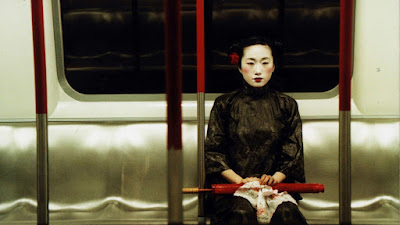
CO/MA is the kind of film which skitters between genres. For starters, it may be credulous, frankly questionable, to call this a "horror" film as I had intended to. For most, there is only the scene of one of the actress in this communal filming project being haunted by a ghost girl, and that is not enough to qualify for the genre. I would argue there are plenty of moments which do fit the tone even if this would be the most disappointing film to watch on Halloween. The rest of CO/MA is just as difficult to pin down, as for a work most would call a "documentary", even that is questionable. What we have instead is a curious tonally shifting chimera that is CO/MA, something truly peculiar and worthy of making excuses of, as tentative for a "horror" review or at any context, for me to get away with covering this during any season.

This belongs to an era I slowly crept into my cineaste hobby, which is growing up in the 2000s as a teenager and, by the time of 2008 when I became a young adult and had fully started to develop into this. This era, from when they were first released in the late nineties but especially the 2000s, is an entire "DVD era" of cinema which will hopefully get its own cult assessment. Despite the calls of its demise, in the streaming era and the existence of better formats for high definition images, DVDs are still being released, but I am creating a term for one specific era. One, even if they got very limited cinema runs, had many titles released on the format along straight-to-video titles which are forgotten and/or represent some of the era's greatest obsessions in terms of pop culture in general. In the case of CO/MA, I can completely understand this being viewed as pretentious if anyone has ever remembered this production exists. I did because, even before I was able to catch up with films like this, I was subscribing to a DVD review magazine. The review was pretty damning from memory, but this still lingered in my mind for decades before I could finally watch it and get rid of it from my mind palace To Get To List. Made in mind to reality television's popularity at the time, the vibes of horror are strong enough to also nod to as its genre, but there is also the comedy segments, the attempts to blur reality and fiction, the soap opera pastiche set in a hospital the commune in the centre which the central project of the production we follow, and other bits and pieces. In the end, CO/MA is neither and all of these.

It is also a Mike Figgis production, which adds a stranger air to all this, an English filmmaker who made films like Internal Affairs (1990) with Richard Gere, and Leaving Las Vegas (1995) where Nicolas Cage won the best acting Oscar. By 2000 however, he slowly started to move entirely away from larger budget films and increasingly experimental productions, both working with more digital filmmaking and also bold experiments like Timecode (2000) and Hotel (2001). Those two mark a turning point, effectively running with the four screen concept Andy Warhol and Paul Morrissey developed in Chelsea Girls (1966), having four separate screens showing different films at the same time, with Timecode telling the same film from four different cameras, Hotel entirely different stories running at the same time. With the exception of Cold Creek Manor (2003), Figgis ditched "conventional" filmmaking, openly embracing his interest in digital camera filmmaking and experimentation, and the comment I made earlier about the "DVD era" of cinema has Figgis' name in the unwritten encyclopaedia on the subject. Films like Love Live Long (2008), where he took advantage of filming at a Gumball Rally racing competition to make an improvised erotic drama, are productions most people have no idea of the existence of, lost to time unless an old DVD is found second hand or on streaming. CO/MA is among these, needing this comically long prologue to set off the review because it is the only way to properly explain where CO/MA came to be. It is a project told to us to start in November 2004 at a film studio in Slovakia, where Mike Figgis and a group of actors have started a filmmaking master class with him leading, one where everyone is to collaborate on this project we the viewer are watching.

Already it is confusing things when, in the first conversations we see recorded, Figgis raises concerns that he will be marked as the director legally on the film credits, but that is subject in the collaborative production as a truth. He says it might "be crap", and one of the collaborators considers if they might say it is not legal to screen this master class if they ever decide to once they have spent finishing the production. Making explicit reference to The Blair Witch Project (1999), and with reality television in its mind, you can time stamp this to the early 2000s. These extensive conversations are continuous through the film, where people in this collaborative effort are already staying outside in disagreement to the project's trajectory before they have even considered what to make, and it is all playing to the idea of whether this is all real or not. Figgis states onscreen that he wants to blur the lines between what is real and when an actor might be lying, but as the tone and genres start to blur in general, what even the significant point of CO/MA is becomes of debate. You can make the justifiable argument this was not a successful project. For me, fascinated by these out-pourings of human creativity and their emotions, faked or real, it was a compelling piece even if "indulgent" is apt too.


Considering the likes of Timecode, this was inevitable. That and, with the black and white scenes, including those of actors talking the screen to the viewers, Big Brother's influence alongside the reality television shows that came at this time are seen imprinted on this film, what was on the tip of everyone's tongue whether they wanted to admit it or not. A year before this, New Line Cinema took a risk on The Real Cancun (2003), a theatrical reality film which was shot at spring break in Cancún, Mexico. It was a box office bomb, and not a film I remember with fondness beyond just curiosity of its existence, but again "DVD-core", if I am to plague the world with a term to describe this era of filmmaking, is a compelling set of films for a variety of reasons. Their use of digital film cameras, with their aged aesthetics, and their attempts to redefine what a "film" meant are worth prodding, with CO/MA clearly looking for a possible outcome that was not the titillation of The Real Cancun, but a more intellectually based experiment.

It definitely breaks reality from the get-go, not really a documentary, and the first nods to horror are found when we have one of the actresses in a toilet cubicle feeling at ill ease of an unknown presence, beginning the hints of the building being haunted or at least the disconnect to the location even if this plot thread is one of many which feel unfinished. They all decide, in the main drive, as a collective to make a soap opera, in mind to strip anything interesting away on purpose. Alongside the strangeness of this, when one of the actresses complains later about the hollowness of her "soap opera performance" and that they apparently agreed to this project in the first place, the tangled web we get suggests otherwise, like a no-horror version of Lars von Trier's The Kingdom franchise if more absurd and less about the horror of that franchise. There are a couple of scenes in a film-within-a-film, with an actual audience, bored by the likes of cooking shows such as Jamie Oliver's, switching over to "The Clinic", with absurd touches coming in with its plot whiplashes, and over-dramatic music. It is one of the better aspects to CO/MA that most of what we get of this pastiche is just the introductions to each new episode, skipping ahead of entire plot cycles with drastic character shifts. Abrupt amnesia, lovers cheating on doctor to take his job and let the cleaner, studying to be one too, become the head of the hospital, secret half-sisters, fake twins for ones supposed to be dead and unknown leukaemia, all of which is deliberately silly. Add to this that there are two bystanders, a male older alcoholic and a British actress who is playing a pathological liar, watching on as the Greek chorus, and The Clinic as a project could have been something from this era of cinema that might have been a proper film you might find released from this era. This is less strange to consider when Lars von Trier once shot an office set comedy, with the digital camera instructed with artificial intelligence to shot however it wanted, called The Boss of It All (2006).

It feels hypocritical as a result, admittedly, to have a critique of soap operas yet playing one out whose strange presentation is actually interesting, but when the actors are flummoxed why they are doing a "bad soap opera", it is clearly another plot strand that is at play, with Mike Figgis playing his role at times as an odd puppet master. He is never cruel or manipulative, choosing soap operas as it is a genre and the most popular one globally in his words, but it is clearer he is trolling the cast. One of the biggest critiques I can make is that, for how long they had to produce the film, which feels like a short production of pure improvisation, it feels like a more fleshed out series of arches were lost in this and we could have gotten a much more complex yet precise work if it had been longer. It is aiming for something more complex but can merely add hints to these plot strands, such as when we get to one of the actresses being honest that she was comfortable filming Figgis' "porno". Truthfully, when the film uses the term "porn" the use is in mind to the fully improvised production with little script and minimal production crew instead, but there is a nod to the potential issues of lack of professional morals to get the right stories, such as a tale from a crew member who says, to cut costs on a failing soap opera, the script created a plague to bump off actors only for that to get high ratings. Nothing is explicit in CO/MA in terms of sexual content, but it is nodded to, with this actress' character in a relationship with a former patient of hers in The Clinic among other implications of the relationships between characters in the hospital setting. The sole explicit scene is a retake of a phone call between this actress and her former patient where, with only hints, she starts heavily breathing her invitation to the woman to go to a cafe whilst rubbing the mobile phone against herself, which with the ominous music used in the scene feels like they were suddenly trying to be like David Lynch.

Those music cues, and the more overt moments where the cast feel at ill-ease in the studio, are enough to justify the fleck of horror as a genre on this film before we get an actual ghost girl with her multicolour basketball in the costume department scaring one of the actresses. This is a movie with really not clear genre but shades of them in a spectrum. In truth, it is a film which does not really clear trajectory to itself, somewhat befitting the narrative it has where there is growing unrest from the group with Figgis as this goes. Some aspects of its trajectory are missing to fully emphasis the point - that there is a sense of discontent and a sense Figgis is antagonising some of them which should have had more scenes of, especially if CO/MA is playing with the idea of what is "real" and "reel". Even if that could be something difficult to capture in b-roll practically or morally, this especially becomes the case when the film starts talking about a conspiracy about who is who eventually, with paranoia growing, which could have added a greater weight to the production if more time was spend on this.

The sense the film drifts off is when it cuts into other tangents in the last half. The horror tangents feel like they are baked into the tone, set up from the start, but eventually we are looking into the production shooting a take on The Exorcist (1973) having managed to get Max von Sydow for one day, or the Jackass crew of the cult MTV series and Johnny Knoxville are brought up as about to appear in The Clinic. Obviously, these are joke moments, with none of these people about to appear, and instead it is all with a sense that as the production for real went on, the commune started to horse about and became less concerned about a serious meaning to the work. This is felt when we get another of the memorable pieces, a three plus minute comedy sketch where a man conjures up a woman in an abandoned film set, wanting to seduce her but with their collected ability to imagine anything they wish leading to legitimately fun comedic beats in a few perfect minutes. Is it enough to justify the whole film though? I think it is telling, when the ending epilogue text comes up, there is a reference (clearly for some humour) that some Slovakia filmmakers walked out the first ever screening, with the pervading sense that CO/MA was never meant to win over a large crowd, but Mike Figgis with these collaborators experimenting for the sake of it. He would become obscurer as a result of these projects, barring one music documentary or occasional TV episode in a whole, entirely focused in these lower budget productions where he would eventually become the editor and the cinematographer.  In this case, it feels less like a tragedy but more that he willing choose this direction, and to be brutally honest, barring my love for Nicolas Cage and some of the older films with enticing premises, these more obscure titles like CO/MA feel far more compelling to consider from him for their complete lack of compromise regardless if they are successful or not.

Abstract Spectrum: Avant-Garde/Metatextual/Stream-of-Consciousness

Abstract Rating (High/Medium/Low/None): None

Thursday, 3 October 2024

Hellsing (2001–2002)


A Night of a Thousand Horror (Series)/A 1000 Anime Crossover

For a tangent, I return back to an anime series I had not seen until the 2000s when I got into the medium. Naturally, there was nostalgia in this one case, as the likes of the original Hellsing come from a specific period of anime which I got into by the mid-2000s and no longer exists. ADV Films, who released this in the United Kingdom, no longer existed by the end of the decade due to financial problems, and Gainax, the divisive anime studio who produced this, were a prolific studio whose titles came out at the time I was getting into anime, and also suffered from severe financial problems by the end of the decade too. They still exist, but they are not the same big budget studio who divided people in terms of the quality of their work. This was also the era, for whatever bizarre reason, someone thought releasing three to four episodes a DVD disc, at full price as separate releases, was a good idea until sanity prevailed and we just got box sets.

Hellsing is an action horror about a secret group of vampire hunters in England, with the really cool choice to cast actual British voice actors (or try for proper regional accents) in a rare moment of English dub acting where, even notoriously as with certain Manga Entertainment dubs, even British recording productions pretended to have American accents. The issue comes with the knowledge this was the "original" adaptation of the source manga. Gainax, as the review gets into, were seemingly cursed with an inability get stories properly finished, and this one was struggled worse because said manga had barely started with material yet to reach when the show was in production. It tries its hardest with wrapping together the plot threads already there into a new story and having to bring in new series only content. Sadly, one of the most interesting inclusions in terms a new villain, for a 2000s production, touches on problematic stereotypes in horror fiction of African mysticism, and it still struggles by its end. Now it also has been entirely wiped from the slate due to Hellsing Ultimate, a more faithful adaption for straight to video which had a high budget, the manga fully to work from, and didn't need to censor the gore whatsoever for television.

The virtues are here, least in style, and I learnt a long time ago, I can find things to appreciate even in really bad anime, but this is exactly the reason, for all the things I think are great, I don't believe in having nostalgia. I would rather return to these productions of my memories as new again, strike that nostalgia dead, and find virtues even in a work like this I admit has huge crippling flaws.

For the full review, follow the blog link here.

Thursday, 12 September 2024

BloodRayne I and II: Deliverance (2005/2007)


Director: Uwe Boll

Screenplay: Guinevere Turner (BloodRayne); Christopher Donaldson and Neil Every (BloodRayne II)

Cast:

BloodRayne: Kristanna Loken as Rayne; Michael Madsen as Vladimir; Ben Kingsley as Kagan; Michelle Rodriguez as Katarin; Matthew Davis as Sebastian; Meat Loaf as Leonid; Billy Zane as Elrich

BloodRayne II: Natassia Malthe as Rayne; Zack Ward as Billy "The Kid"; Michael Paré as Pat Garrett; Chris Coppola as Newton Pyles; Chris Spencer as Bob, The Bartender; Brendan Fletcher as Muller; Sarah-Jane Redmond as Martha; Michael Teigen as "Slime Bag" Franson; Michael Eklund as The Preacher

A Night of a Thousand Horror (Movies)


People reading this will immediately think, if this is first review of mine they have read, that this will be a burial. With hindsight, I held these two as among two of the worst films I had ever seen once, so I was in that camp, but alongside the fact I liked the second film Deliverance, the tale I want to write specifically with BloodRayne is what happens when you can have all the resources at your hands but, if rushed, leads to something that gained the notoriety it did rather than present the entertaining film we would have all rather had. I would want to know what happened with the first BloodRayne specifically, and how it came as it did considering its resources include its cast - Michael Madsen, Michelle Rodriguez, Sir Ben Kinsley, Kristanna Loken, even a cameo by Meatloaf - in its writer Guinevere Turner, who will stand out for many as the one who adapted Bret Easton Ellis' American Psycho to the screen, and enough of the budget here to have gotten something as a video game film. Especially as I would be one of the first to defend the Street Fighter (1994) film with Raul Julia, and even find Super Mario Bros. (1993) a compellingly weird adaptation, videogame adaptations even if they are ridiculous are not something I will dismiss. Even in terms of hardcore, cult cinema niche, among the multiple roles he had in the production including the special effects team is Olaf Ittenbach, a German splatter film director I am aware of, as others may be, for the truly twisted pieced of no-budget gore cinema known as The Burning Moon (1992), and even if he barely contributed onscreen you can even see in BloodRayne splatter film influences in some of the gnarlier moments. There was enough here to adapt this videogame into something distinct.

BloodRayne was originally developed by Terminal Reality, who started in 1994 and worked through the computer era of the nineties videogames until the point the original 2002 game allowed them to spread their wings onto multiple consoles, and the game was clearly made under the shadow of Lara Croft of the Tomb Raider series of the attractive female lead who could actually be a pinup in magazines with real models. This comes to mind that, yes, Rayne appeared in a Playboy magazine as a fictional character, the first videogame character in October 2004, and that, published by Majesco Entertainment, they focused grouped the character to explicitly attract a young male audience at the time. Liz Buckley, product manager for Majesco from this time, had her designers learning what boys and young men in focus groups prefered1, which drastically revised how the character originally was from initial design2, all in mind to a time now washing away in the past as we have had sexually appealing female videogame characters become more of a contentious concept, even to the point Mortal Kombat, which was sexualising its characters in the 2000s games, have back peddled from this, and even Dead or Alive, a beat-em-up franchise infamous for this, had to include measures least in the costume choices suitable for videogame fighting tournaments.

After BloodRayne 2 (2004) however, the games also leaning on Terminal Reality having worked on horror games beforehand among other genres, there was a huge period of silence for this franchise, lost to the original Xbox/Playstation 2 era of games as a franchise. Alongside the original games being having remasters in the 2020s, there was then BloodRayne: Betrayal (2011), which showed how much changed in trends including with its 2021 enhanced version BloodRayne: Betrayal - Fresh Bites. Gone were the three dimensional levels, now a 2D side-scrolling platform game befitting the growing interesting in two dimensional and "retro" games of the past, and even a significant change in Rayne the dhampir. Whilst still the attractive vampire, gone is the voluptuous pin-up of Playboy, evoked in the two film adaptations by Uwe Boll too, but a version influenced by comic books and even Japanese animation and manga in appearance who is less explicitly sexualised.

This is worth bringing up as, with how Uwe Boll was making these films, he picked up upon not the biggest licenses but ones even from Sega (House of the Dead) which were cult hits, this review finding itself in his most controversial era between 2003 to 2008 when he was making these videogame adaptations, where Far Cry (2008) was adapting a game from its origins and not when it became the ultra-expensive Triple A franchise that would have been out of Boll's franchise nowadays to adapt. His infamous run, which barely covers a long career, is of this era, and taking an immediate change of pace from the first game, where Rayne is hunting Nazis, and starting in 18th-century Romania, he came to this clearly without heart for the material, not even the dangerous (but inventive) spinning camera scenes or Clint Howard from House of the Dead, and made a film which was not carefully through in its creation.

Immediately problems arise with the film in how there is no stop to the exposition and events, charging along without pace. There is the anecdote Guinevere Turner has talked of that, with her script late by two weeks, Uwe Boll had been angered by this and that, even when she still sent him a first draft after this moment, he worked from that version and even let the story deviate entirely from her work3. Honestly, so much more feels amiss with the film, even when one realises that most b-movies have little time to be produced and are rushed. The plot can be written on a napkin - evil vampire lord (Kingsley) clashes with the dhampir he sired (as played here by Kristanna Loken) over ancient artefacts which would allow him greater power, whilst vampire hunters led by Michael Madsen take her in as a potential ally - but it is amazing to feel and heard this film not take time to breath and coordinate itself.

It feels like a production which suffers at the hands of juggling all its variables, not just in terms of the screenplay anecdote, but also with the cast a great example of seeing this in a variety of ways. Billy Zane, who is on screen in only a few moments and has no ties to the end despite being a vampire, feels at ease, one of the more rewarding figures whilst others are hustled through scenes awkwardly, Michael Madsen, Michelle Rodriquez and Kristanna Loken among the noticeable examples. Geraldine Chaplin, daughter of that Charlie Chaplin, is a tarot reader for one scene, all her lines exposition, but feels at ease too, as does Udo Kier, who is also comfortable onscreen, whilst it feels like there is both the script and the lack of pause which forces the acting along with many of the bigger stars, who feel the most struggling with the scenario. With no time to step back and see how the mood is, as it hurtles along, and you cannot really gather yourself in both the content and the performances.

Which sucks as you can see the production design was trying. This is a rich world even on a budget where there is enough to stand out. Even in mind to its practical effects team, there is grotesqueness too, such as the monstrous helper of a monastery's secret, mallet in hand, or when we get to the Meatloaf scene and the best moment of the entire prequel. Meatloaf's hall of orgies and splatter film approved horrors, prosthetic effects and nudity crossing in ways normally not found in a more mainstream film, sticks out alongside the fact that Meatloaf, surrounded by naked actresses when introduced, came correct for the role and steals the entire production eating the scenery. Even this is rushed however, and there is a sense that Boll was forced to churn out a film against the right intentions he should have done. Some of this could not be helped, as it is clear they only had Ben Kinsley for a day or so, filming all his scenes in the same two rooms, but you see so much more to the production not being appreciated as a film has to be quickly put together within it. You can see this is in how the film skips past its plot points, skips through fight scenes, even when they have hired actors who have martial arts skills too, or the sex scene. Sold entirely on Kristanna Loken herself, after her role in Terminator 3: Rise of the Machines (2003), and sold off titillation, it does make little sense, beginning a romance with a male vampire hunter which is abrupt, and feels so cynically shoved in whether it made to or not, both in Loken's comfortableness to do the scene, and Rayne being sold as a sexual videogame hero back in that era.

In vast contrast, made after the BloodRayne games would go on their hiatus, BloodRayne 2: Deliverance is a film with none of the recognisable names, barring Michael Paré as Pat Garrett, but is actually an entertaining movie with a pace and reward. Set later in history in the Wild West, westerns are a genre cheap to make but that is not an insult in the slightest, as whilst they no longer exist as a mainstream genre, they are still being made straight to DVD and other mediums from this period on when this one was produced. Following the idea of what outlaw Billy the Kid would be like as a vampire, this with Norwegian actress Natassia Malthe now Rayne has also recast the pace with one which allows this film to breathe, with care to take in its plot.

It is a b-movie horror western, which not everyone will enjoy, but in contrast to the first film, I enjoyed a film immensely which was not heavily compromised, even if I miss the practical effects team from the first production. I can be happy to see Uwe Boll here make a genre film which is entertaining like this, which no expectations but the execution accomplished, working around its limited production and retelling western clichés only with significantly cruder dialogue at points. Even the slow-mo he uses was not that bad to experience, and the aspects which could have been fleshed out, such as a band of vampire hunters consisting of Pat Garret and a corrupt preacher conman, still crackle with personality. Even how Rayne herself is no longer the figure of the first film, but just a strong female lead, feels like a considerable change in pace, and whilst there is a third film, BloodRayne: The Third Reich (2011), that feels its own review to consider, particularly as that is also in a different time period for Boll as a filmmaker to these two. Set in World War II, made in mind to the original game having its lead fighting Nazis, that film deserves its own focus as three films came from one production - The Third Reich itself, Blubberella (2011), which is a terrible parody film I will say Boll should not have made, and Auschwitz (2011), which was a serious and grim depiction of the Nazis, all based around the locations built for the time period.

The only thing more interesting than this director making a watchable genre film was whenever Uwe Boll made "serious" films, the heavy handedness of a film like Hearts of America (2002), tackling school shootings, yet contrasting with material which do have interesting things to examine within them. By the point of the first BllodRayne, a German tax law, where the German Tax Fund makes film production costs immediately tax-deductible, was dashed from existence in 20064&5, and whilst it did not end his productivity, it was something he had clearly used and it makes for the unfortunate argument that, as with the first BloodRayne, he focused on a string of films, videogame adaptations, which were not made with as much interest from him as a creative figure. This was the  time when he was notorious as a bad filmmaker for many, not as a filmmaker to dissect, and in 2006 came the "Raging Boll" publicity stunt, competing with critics of his films in boxing matches which would be compiled into a 2010 documentary of the same name. It became less the Boll behind films like Seed (2007), which at least presented things of interest even if the viewer hated them, but this period would make his infamy rather than these more interesting films, entirely focused on video game adaptations in the mid-2000s which feels like a compromise. The irony is that his notoriety is based really on 2003 to 2005 films, not the video game films from the years after - House of the Dead (2003), Alone in the Dark (2005) and BloodRayne - whilst by the time of BloodRayne II, I am watching a film that, regardless of its video game license, is more a working director juggling genre films and dramas in the straight-to-video era. The worst part is that the later is far more interesting and arguably more focused, but not what we talk about with this German filmmaker. What made Boll's infamy, stepping away from filmmaking by the mid-2010s as things changed, with the streaming industry coming into being, is frankly the less rewarding side to him if the first BloodRayne is to be considered.  


=====

1) Fighting Women Enter the Arena, No Holds Barred, written by Michel Marriott and published for the New York Times on May 15th 2003.

2) Getting the Girl: The myths, misconceptions, and misdemeanors of females in games, written by Zoe Flower and published for 1UP.com on 18th December 2007. Retrieved 12th July 2009 by Web Archive.

3) Bloodrayne screenwriter explains the perils of working with Uwe Boll, written by Ben Gilbert for Engadget and published October 26th 2011.

4) Uwe Boll and the German Tax Code, written by Allen Varney and published by The Escapist on January 23rd 2007.

5) Tax changes threaten German film, written for the Guardian on November 9th 2005.