Showing posts with label 2012. Show all posts

Sunday, 13 April 2025

Mekong Hotel (2012)


Rewatched 28th March 2025

Director: Apichatpong Weerasethakul

Screenplay: Apichatpong Weerasethakul

Cast: Jenjira Pongpas, Sakda Kaewbuadee, Chai Bhatana and Maiyatan Techaparn


Damn, I forgot my own tune.

A film I've wanted to see for a long time, and not readily available, Mekong Hotel had a disadvantage of being less than an hour long, and that this was the follow up to Uncle Boonmee Who Can Recall His Past Lives (2010). The hype after Uncle Boonmee... won at the Cannes Film Festival its most prestigious award, the Palme D'or, may have been a disadvantage when this premiered at the festival in 2012, a work less structured on plot.

There's a weight knowing how the Mekong River in the north-east of Thailand, where this is set, has a lot of meaning for its director-writer. Set at a hotel by a river that is the border between Thailand and Laos, in real life his father's ashes were scattered there, gaining a greater significance for him1. You could argue Mekong Hotel is a very opaque film even for its creator, as with everything by Weerasethakul, defying expectations even for those who would've grasped his style previously. It starts from the get-go, opening with a conversation between two men without the first images seen, one a classical guitarist, Chai Bhatana, who provides the score. The first images seen are the titular hotel on the Mekong River, with the lush acoustic guitar music setting up the tropical atmosphere, guiding us through a series of conversations with the local denizens occupying the hotel.

Among them is the other idiosyncratic touch, with regular collaborators Jenjira Pongpas and Sakda Kaewbuadee involved in the cast, where there are phi pop spirits from Thai folklore. The first is introduced undercutting the tranquillity of a debate by one man of what clothes to wear, a woman just outside the rooms consuming bloodied raw meat. Mekong Hotel has been dubbed a drama and a documentary, but as with all of Weerasethakul's films, genre tags are a vague concept especially as the phi pop spirits are very important to the content here. The first is seen having killed and eaten the viscera of someone's beloved dog, but they are also cannibalistic. The touch here that you would only get from Weerasethakul, whose take on the supernatural has always been one of his most compelling touches, is that we get to see from their side too. We are able to hear from the pop's side of things especially when one is revealed to be someone's mother, having intimate conversations, knitting and apologising to her adult daughter for who she now is. In legend, they are said to possess their victims and, when they have made them hunt for raw meat, eventually eat their own intestines before moving on; we see in this one of the male cast being possessed by the phi pop at one point only to be exorcised. They are still in the consciousness in their homeland, with adaptations of the legends in the likes of Pob Pee Fa (2009), a TV series, and it is befitting that Weerasethakul would take these figures for Mekong Hotel and deal with them in a more humane banality.


They still kill people, but we also see from their sides their regrets of their immortality mixed with the hunger. Naturally, as with Uncle Boonmee... its matter of fact as that film dealt with someone's reincarnations returning to his memory, of the moment in Tropical Malady (2004) that stayed with me of a cow accidentally being shot but its ghost happily wandering off immediately in peace. Weerasethakul views the supernatural if it exists with this casualness of the ghosts merely intermingling with the daily lives of those also at this hotel, from the lovers, the friends, those with pasts involving the history of military action in the country of Thailand, and the pervading fear of flooding. Ghosts devouring peoples' guts is one thing, which happens here, but more ominous in tone is when the characters talk of how they need to be prepared for potential flooding in the area, reflecting how as we see in the distance excavators doing their work, the landscape by human and accidental influence in modernisation may influence the natural landscape too.   

A big factor to Mekong Hotel, making it a shame it is not readily available, is that this is quite important for Apichatpong Weerasethakul as a film maker. He made a film in digital also dying for a proper available release - the co-directed comedy-spy farce The Adventure of Iron Pussy (2003) made with Michael Shaowanasai I've always wanted to see. Here however marks the point he entirely moved to digital between 16mm celluloid in Uncle Boonmee to digital cinematography in Cemetery of Splendour (2015). This is a film which Weerasethakul shot, edited, directed and produced by himself to save costs, alongside a small budget financed by UK-based production company Illuminations Films1. Also among the producers is Keith Griffiths, one of the most important British producers to exist for me, for how much he has contributed in helping some of the most interesting filmmakers to exist. He is arguably someone I should lionise as he has helped figures I adore - stop motion animators Jan Švankmajer and the Quay Brothers, Apichatpong Weerasethakul - alongside his collaborations with the likes of Christopher Petit and Patrick Keiller, two really idiosyncratic British filmmakers, and his one-offs like Tsai Ming-liang's I Don't Want to Sleep Alone (2006) and Peter Strickland's Berberian Sound Studio (2012). He deserves so much credit for making cinema far more interesting just for these examples.

The intimacy this small budget and production explains, and adds greater reward, to Mekong Hotel's intimacy. It is an opaque film but not a difficult film in terms of plot because, arguably, there is no plot. It is a string of interactions where we get into the lives of these figures, and the ghosts too, ruminating on their lives. Slow content guitar over conversations is apparently my jam, even when it keeps playing nonchalantly over a pop ghost eating someone's entrails on a hotel bed, but you can miss without sufficient cultural knowledge of Thai history some of its more striking pieces of dialogue. One female character openly talks about being taught by the military soldiers how to use a rifle and be militarized, something viewed by her as fun and matter-of-fact of an ordinary life despite being unordinary out of context. The ghost of combat is here, and still was in-between the filming of Mekong Hotel, as between this film and Uncle Boonmee you had the 2010 military crackdown on Red Shirt protestors and the 2014 military coup transpire in Thailand. Details could be dismissed, as unfortunately might have been the case to critics at the Cannes Film Festival premiere, that ask so many questions especially if you are entirely unaware of Thai history but register this, from the detail from the same female character of having dated a US soldier stationed there, and to the nod to the Mekong River being a border to Laos of Laosian migrants entering the country. There's a sobering moment discussing this, where Laotian migrants had such difficulty in living in Thailand as documented in one scene, which becomes more meaning when migrants are still a discussion today.

Some harmony is however found within Mekong Hotel. The landscape is still beautiful despite the excavation in the distance. Friendships and bonding between ghost mother and daughter transpires. There is a machine, predating what you have in Cemetery of Splendour, which lets one leave their body as a spirit explore, looking like a VR headset with the humour that the out-of-body experience is only undercut by how much battery power there is. A ghost can still live, still knit, if locked to a hotel room or so for six hundred years and needing to feed a craving for flesh. Then there is the final scene, a prologue shot of the river with jet skis in the distance which feels closer to Weerasethakul's installation projects if with the sense of tranquillity felt from sitting and contemplating the environment that is close to Apichatpong Weerasethakul for emotional weight. As well, for an underrated film in his filmography, there's also the base pleasure of just watching people having fun on jet skis, a reminder that a lot of my appreciation of his films is as much for this sense of tranquillity that permeates all of his work too.


==========

1) His Particle, Somewhere: Mekong Hotel (Apichatpong Weerasethakul, 2012), written by Duncan Caillard for Sense of Cinema, and published June 2021.

Tuesday, 25 March 2025

Venus in Eros (2012)


Watched Saturday 15th March

Director: Takako Imai

Screenplay: Takako Imai

Cast: Miyavi Matsunoi as Venus (as Saori Hara), Alan Vincent as David, Martin Collins as Eros, Michael Barnes as Forest Lover Michael, Kavana Crossley as Angel Kakabel, Darren Ellis as the Sculptor, Daniel Fontannaz as Angel Gabriel, Carl Harrison as Forest Lover Carl, Freddie Ingles as Angel Michael, Alex Kovas as Venus Maniac Alex, Stefan Leadbeater as Angel Sariel


"A hundred years ago, in a deep forest" opens a film about a status of Venus, which is also one of the obscurest films I've wanted to track down and see at least once, being a nightmare to do so despite being a British-Japanese co-production which would have made it least have a slither of availability somewhere. Honestly, probably the thing that didn't help the film is that it feels like a low budget artistically minded production which is fully committed to its niche concept, something which contrary to suggestions in image of a softcore film is very artistically minded instead.

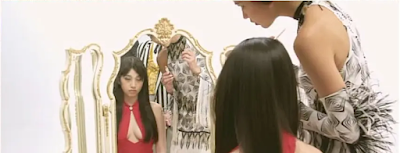
The story begins with its director, Takako Imai, which immediately presents a layer to the production as the vision of a female artist, born in Japan and moving to London, who worked as a music journalist but would go on to make a couple of films. This theatrical length film is the last of two, the shorter production Recordare: Days of Remembrance (2009) the first, which is a prelude to Venus in Eros as a collaboration with dancers in acting roles, depicting a romance between two men involving dancers from the Matthew Bourne Company1. Hers is absolutely a set of films belonging to this era, especially in the 2000s, of fascinating melding of cinema and other art forms, installation artists to dancer choreographers who took advantage of both the film making industry of the 2000s and, in other cases, the DVD medium when that was a popular way to make these projects available. Venus in Eros, far from an erotic film, is closest to the films on DVD I was lucky enough to see through my university library, be it the sole official release of Mathew Barney's Cremaster films, a segment of the 2003 Cremaster III dubbed The Order - Cremaster 3, and the work of Wim Vandekeybus. For the later I'm pulling from a really obscure figure from my memory, and old notes of what I've watched over the decades I've no shame I collect, especially he's the perfect comparison for Venus in Eros.

Vandekeybus, a Belgium choreographer, director and photographer made a series of dance based films over the years my university kept in a luxurious box set they acquired, and the difficulty with tracking down Venus in Eros comes with the realisation this belongs to that era of cinema, the art gallery and art installation area of moving images which, particularly in the 2000s and continuing in the early 2010s, was taking advantage of limited edition runs of DVD-only releases. The British Film Institute, even releasing a few in their early years of the DVD boom only to be more picky in the later years, have had these as well in their stores too, and whilst Venus in Eros is more sexually explicit, it fully fits into this type of artistically minded lower budget production if more likely to be lost in the cracks of cinema for the worst. Considering its initial tone, driven by its opening classical piano music over country woodlands in winter, the production from its poster and some screenshots online will jar for those expecting (or wanting) something salacious.


The most explicit thing comes from its central premise of living statues, particular a depiction of what will become the Venus de Milo, a legendary statue created in Hellenistic period which is iconic in having lost its arms in time. Because of the obscurity of this film, this review will be full spoilers to give you at least an abridged form of what Takako Imai's film is, a fantasy romance using dance to tell its tale, where Venus has her statue erected in the woodlands, there through all the seasons back to the next winter. Soon into the story having a statue of David one side to her, likely inspired by Michelangelo's legendary creation, the other of Eros the other side, the Roman counterpart of Cupid, both played by male actors body painted and erected as statues played by real people. The most explicit aspect, which makes the female titular lead a braver role, is that like many statues, their depictions of the likes of Goddesses to nymphs to leaders never shied away from natural nudity, and having seen statues in their real marble form, they are an incredible art form even from sculptors who are unknowns in their painstaking craft of human anatomy, something which this also plays too in turning real people into these living statues, blurring these lines.

The more lurid aspect of what this done, a casual eroticism but like a form of naturalism for the female lead, is the actress comfortable enough to take this lead, even if meaning being nude in full stone-grey body paint and standing still on a podium, being German-Japanese actress Miyavi Matsunoi. That is neither a criticism of her, nor her career choices in her career before this production, but central to images you find online, the immediate thing you would learn of her career before this makes this film a fascinating contrast to her previous work, when you learn of her career and that this became effectively a retirement from said turn in her early career. Miyavi Matsunoi, real name Saori Hara, whilst she would expand her career out into the live action tokusatsu, like the film Garo the Movie: Red Requiem (2010) as a villainess, and a later Garo franchise television series, started her career as a pornographic actress and model before moving into more mainstream films with the likes of Yuriko's Aroma (2010). Probably the most widely known film of this era would be Hara's role in 3D Sex and Zen: Extreme Ecstasy (2011), a remake of the notorious 1991 film Sex and Zen but now in 3D, which marks the moment where she fully leaves the adult industry in Japan entirely for the rest of her acting career. She is the central figure of this, and this marks a fascinating conclusion as an adult film actress and erotic model. With a film that premiered at the Cannes Film Festival in its market2 and, through a female director's camera, her natural sensuality is used in a very humane and matter-of-fact way for its love story. Certainly, considering there are points where she has to stand still in the full statue makeup in real snow and very cold temperatures, I have to admire Saori Hara going through this shoot before leaving anything erotic in her career for good for more mainstream productions for the rest of her career.

The film, bilingual in least the form I saw it, with written English text onscreen initially for Venus' thoughts, English dialogue and Japanese text onscreen to translate said dialogue, is a simple depiction of a romance that suffers through angst before it can reach a happy ending. It involves as well a male and female caretaker for the statues as, from winter to the next one, Venus and David out of their statue forms in scenes in their own reality start to fall in love, whilst Eros the archer looks on lovesick for Venus himself but not of interesting for her at all. The film, which has some of the performances struggle a little, and long moments of contemplation of these statues and the natural landscape, got a particularly damning review back when it premiered at the 2011 Cannes festival, from Hollywood Reporter's Duane Byrge, who described that the "best venues might be side rooms in under-funded museums" and that the natural shots could be "cut and re-marketed as screensavers"2. Those who could actually see the film may admittedly think the same thing, if his comments come off with cheap snark in that review, particularly as the cheap jab at museums does admittedly evoke what the film's tone clearly was as well as feels like an elitism against an area of moving images, whether good or bad, which is badly maligned in access or reporting.


The contemplative attitude of a few museum and art film DVD productions from that era I've seen if felt with this, those shot on the cameras of the era, with simple stories which are tent poles to place their contemplative moods, as it builds over the romance between Venus and David as Eros the archer looks on with a broken heart. The statues themselves are interacted with as if living people - there's a playful humour, especially in the spring section, where you've a young boy trying to get the statue of Venus to eat a vanilla ice cream cone, played off as a living statue without any sleaze involved whatsoever. There are also scenes outside of time which turn the statues in living people, alongside the caretakers, where the dance sequences come in. They are not elaborate musical number dances but symbolic choreography for the emotions of the moment, the most prominent in the summer section. Showing a more explicit version of Venus, Saori Hara plays a version closer to Sandro Botticelli's The Birth of Venus, without the giant clam and having veils instead of the longer hair in the painting. The scene involves her being dressed and helped to become human by the rest of the cast, from having make up applied to her face to being helped in learning to walk in high heels, all with the others on a white stage dressed in period costumes.

The film depicts most of the romance in choreographed dance, like the performance on a black stage between Venus and David, and applies to the conflicts too. Eros, eventually snapping unable to have Venus as she falls for another, eventually takes it out on the male caretaker, and this is the one sequence which requires a trigger warning, as this caretaker with an arrow in his back takes it out on Venus herself. The removal of her arms, with intercuts of her struggling under him as a person, in a dance choreography as a person, explicitly nods to the act as a sexual assault. The film could be criticised for how this concludes - the caretaker's cruelty, including drawing a blue tear on her cheek out of pure spite afterwards, becoming immediate remorse - but in knowledge of its female creator - Takako Imai, who is entirely on Venus' side, the depiction of her transformation into the Venus de Milo is entirely depicted with the weight of a horrible transgression of her as a being, which is treated as seriously as that should.

Some of the performances, as said, waver in quality in the line readings but suspecting the focus on casting actual dancers in these roles, it feels less meaningful to criticise and appreciate what the point was behind the choices. For me, Venus in Eros does succeed by its end, which makes Takako Imai's vanishing from filmmaking a disappointment. She had a project BBoy in a Dream, which was meant to be a documentary about breakdancing, a fascinating turn in her clear interest in dance as an art if it had ever come out. The film started shooting in 2014, but there's hope, doing an interview in closer or within 2024 about her career so far1, one where she talks of how breakdance was added to the Paris Olympics for 20241, giving hope that this ten plus year project finally comes to light and Imai herself wasn't put off as a creator in the moving images field. By the time winter to winter passes in Venus in Eros, where we even get a Christmas tree, Venus in a Santa top, and a boys choir in the snow saying Merry Christmas to her, we get a small story of love, conflict around love, and its eventual success which in its scrappiness as an unconventional art piece won me over. Lightning and a downed burning tree may knock over and leave Venus a lifeless statue, but as her male lover takes her somewhere safe in the woods as spirits, a happy ending is found in the end as the credits (in Japanese) are over the tranquil landscape.


=====

1) The Very Personal Reason Behind Takako Imai’s Breakdancing Documentary BBOY IN A DREAM, written for The Fan Carpet.com, and marks itself as posted in 2024 was references to the 2024 Paris Olympics.

2) Venus in Eros: Cannes 2011 Review, written by Diane Byrge for the Hollywood Reporter, and published May 31st 2011.

Wednesday, 3 July 2024

Eldorado (2012)


Director: Richard Driscoll

Screenplay: Richard Driscoll

Cast: Darren Morgan as Stan Rosenblum, Richard Driscoll as Ollie Rosenblum, Daryl Hannah as The Stranger, David Carradine as The Spirit Guide, Peter O'Toole as The Narrator, Jeff Fahey as "Doc" Martin, Michael Madsen as Ted, Patrick Bergin as Roy, Brigitte Nielsen as Angel, Steve Guttenberg as J.J., Kerry Washington as Tamara, Rik Mayall as Chef Mario, Sylvester McCoy as General Zwick, Caroline Munro as Lilly, Robin Askwith as Mick, Tyrese Gibson as David, Bill Moseley as Lemma, Robert Llewellyn as "Meat", Buster Bloodvessel as the Sheriff

Ephemeral Waves


Opening Eldorado, the late Peter O'Toole literally has to appear onscreen, as the narrator, to explain that he is hired to clarify the events of the film we will be seeing, which will be a first for me to witness in any production. Eldorado is not very well known, and my prior knowledge of British filmmaker Richard Driscoll is entirely based on The Comic (1985), his very odd little debut which got dug up by Arrow Films for Blu Ray restoration and release, the kind of cool trait of theirs to rediscover some oddball films like that particular one. His career at some point beyond this transformed into what Eldorado became, the curious results of when known actors from Hollywood and British television, when older and stepped out of the limelight, are offered some work, the era of 2010s cinema where production design like computer effects are more freely available, and a true sense of this particular film entirely existing because this is what Richard Driscoll wanted to make for himself, with absolutely not a wink of cutting any of the tangents out of this. It is also, infamously, one of his films used as evidence for his arrest and jail sentence for a £1.5m VAT fraud, when investigators from HM Revenue and Customs (HMRC) investigated the production and found he had falsified invoices1. This included how a purported production and promotion budget of £12 million was around about £750,000 instead2, or the fees for the stars in this film, including late comedian Rik Mayall's supposed £44,350 for four days’ filming was revealed as 6,000 for two days2.

He is definitely one of those one-offs in cinema, whatever you think of the films, certainly a man gifted with the gab as, not including other films before and after, only here is where you can get a credit list including O'Toole, Daryl Hannah, Mayall, Michael Madsen, Brigitte Nielsen, Steve Guttenberg, former Doctor Who Sylvester McCoy and others, including David Carradine even if likely here in outtakes. He also really wanted to remake The Blues Brothers (1980), which ultimate sets up why I really could not even appreciate the film in terms of a piece of delirium, that being for all its parts, its tantalising strange juxtaposing of actors from American cinema against British pop culture, its desire to indulge in areas I find not that interesting to see as a viewer instead transpired. There are aspects to the film which raise uncomfortable parts of Driscoll himself, but most of my experience of this comes from the one viewer who would have defended this for all the cheapest of CGI, the most random of tangents and the sense of self-indulgence, only to feel instead it did not progress to anything even if really an interesting form of self-indulgence. Remaking the John Landis film and paying tribute to others, in his own curious way, dragged Richard Driscoll's film down when one was envisioning stranger and more interesting ways to connect the disparate pieces altogether. This managed to get an article, written by Chris Bell and published in The Telegraph called Eldorado: the bizarre story of the worst movie ever made3, but I cannot even say my disinterest in the film is a vehement hate, but a long period of attrition where it loses me.

The set up is The Blue Brothers, only now following the Jews Brothers (director-writer Driscoll  and Darren Morgan), two Jewish musicians who are introduced having made the ill advised decision to perform for Neo-Nazis, leading to a tribute to the car chase from the John Landis movie with former Dr. Who Sylvester McCoy as a substitute Henry Gibson. Their name is an obvious if tasteless joke, but a pastiche to the original Saturday Night Live characters by way of musical numbers dubbed over the actors would have least been something, especially if this played to the lo-fi remake energy or even touched upon Yiddish music by way of local pub karaoke night. Their manager J.J. (Steve Guttenberg), in a room full of CGI flies in one of his only scenes, sets them up with a new gig, unfortunately this time for cannibals, explicitly getting into the premise of Two Thousand Maniacs by Herschell Gordon Lewis, of a group of people accidentally setting forth in a group of Southern Confederate ghosts. I suspect, rather than the original 1964, the version of the story nodded to is the 2005 remake as cult actor Bill Moseley is among these ones too as a cannibal southerner. It also shows how disquietingly easy it was, even in the early 2010s, to find Southern Confederate flags in the United Kingdom, as portions of the film were shot in Cornwall3, but cinema as well as other medium has referenced and even crossed paths with other productions and works from the past. The most obvious example to me, whilst not one of Wim Wenders' widely praised works in the slightest, is Palermo Shooting (2008), in which an acclaimed German director of highly regarded films effectively paid tribute to the filmmakers Ingmar Bergman and Michelangelo Antonioni, when they passed away, by crossing Blow-Up (1966) with The Seventh Seal (1957), and if an art house director as Wenders will pay tribute like this whilst creating new stories, there is nothing wrong in a lurid genre film here for Driscoll to do the same. Quentin Tarantino, he who is paid tribute to and recreated in Eldorado a lot, has done this himself so many times, but notable, even when overtly referencing images and dialogue from other films, he placed them in different contexts, which begins a concern with Eldorado itself.

This begins remaking the Blues Brothers with same songs used and lip synched by the cast throughout, as this is also a musical. This is then bolted onto 2001 Maniacs, as a horror-musical pastiche which is blasphemous to the former film but tantalising as a perverse crossover within itself, alongside the fact this was originally supposed to be seen in 3D as well at a time when the format returned in mainstream cinema into the early 2010s. Then there are all the other tributes which instead come off as if they are meant to be laughed at for getting the references, but not sewn into the context so they work without this in-joke. The opening of Reservoir Dogs (1992), with the George Baker Selection song Little Green Bag, is recreated with southern cannibals, there is a briefcase with glowing contents like Pulp Fiction (1994), and the Jew Brothers are confused as the Soggy Bottom Boys in reference to O, Brother Where Art Thou (2000). There is even an actor cast to play Johnny Depp's Captain Jack Sparrow from the Pirates of the Caribbean franchise, just to have an actor who clearly plays Captain Jack Sparrow in his regular career as an impersonator there, in a random back story involving a lower budget CGI kraken. It all amounts to the film focuses on referencing and recreating other films other than its own ideas. Or, if to continue this, to subvert them as one would presume.

It is also very English, attempting to hide itself as an American set film despite actors who are wavering in accents, and literally a Las Vegas set diner scene which is shot in someone's kitchen. The later however offered something beautiful as a film, a remake or tribute to these films with this literal homemade look, with the waitress having the exact accent for an American diner, and the kind of ornaments I would find in a Hollywood themed cafe for a seaside. This idea of recreating the US films in English rooms and kitchens on a low budget is something I could get into for a surreal spin on proceedings, imagining the way this could go in pastiching films in a curious hybrid and allowing the odd crossovers this has. Where I find myself as a film viewer feeling exhausted and disinterested one hour into a two hour film is that the things that interest Richard Driscoll do not match anything of this in context, as we get the Aretha Franklin scene from Blues Brothers in that cafe among others recreated with no sense of interesting for this particular viewer, only bemusement as they feel not properly tethered into the world. You can be pretentious and/or random in your films, but as long as they feel they match the beats of the moment, they least make sense even if it is up to the individual viewer to either appreciate or hate the moments as a whole, but Eldorado's biggest problem is that the scenes are fragments which do not seem to even connect together in their own logic.

There is also an uncomfortable streak of violence, in language and gore, against female characters which cannot be ignored, one of the moments where the indulgences of the film do reveal something negative in the director-writer. The risk of any personal creation is that it reveals your worse side if you yourself are guilty of anything in your thoughts that should be rightly damned, which is more prominent as a danger both in auteurs and even in micro-to-lower budget genre cinema where the creators have more leeway to create how they want, but can shoot themselves in the foot metaphorically by opening up their worldviews far more to the public in letting them see their neuroses, obsessions and/or their worse sides. Here, if by accident or an uncomfortable axe to grind, Richard Driscoll does end up with horror scenes having this misogynistic streak, or even dialogue between male characters arguing that they should date strippers but never marry them, and other such moments which feel pointedly spiteful for no reason. This is content which should be warned of for any viewer who is still morbidly curious about the film. Everything else beyond this, where these moments jut out with distaste, is entirely tame with their issues. Even when they involve prurient nudity and blood, the issue becomes that, even in terms of unconventional cinema, it really does not qualify in terms of "weird" accept for me in terms of awkward. For me a film like this should be the world where Robert Llewellyn, the actor I grew up with as Kryten in the cult sci-fi comedy TV series Red Dwarf, should have crossed paths onscreen with Moseley from The Texas Chainsaw Massacre 2 (1986) even if Driscoll had only a day's time with one of them, just to see how two actors from wildly different spectrums could have interacted and contrasted in performances, something sadly though we were never going to get in the presentation of the film we got.

This is where Daryl Hannah, even if she is still playing the ancillary angelic figure reciting Edgar Allen Poe poetry, where the Eldorado reference comes from, intervenes in a story which brings us Moseley and Jeff Fahey attempting to recreate the trailer battle she herself was in for Kill Bill Vol. 2 (2004). What we get is like when the bean eating scene from Blazing Saddles (1974) is recreated in this film; what in the original context was undercutting a classical Western shot with fart gags, this nods to it without the set up to the punch line, which is felt with a lot of the moments here, punch lines without the set up to really make the film something which, on paper, should have been one of the most gleefully strange and ambitious genre films to exist even just in terms of cast.

David Carradine is in footage recorded at another time in a random ghost fight with a woman with no context to the story, with no ties to the entire production as an actor who passed at the time it was being made, and one actress, a stripper accidentally sent the Bar Mitzvah the musical brothers were meant to in the opening, is immediately never seen again despite being established in a long topless conversation scene over the phone with Steve Guttenberg, an entire segment lost because the actress never returned. The director was even dating the main female lead, Rebecca Linley, only to break up mid-production and force him to re-cut the entire film3, which is a case of unfortunate bad luck out of his hands, but there are times where this neither works as a full story, as pieces are undercutting into each other, or even as a symbolic and/or random piece of filmic brain fever because it still wants to try to be regularly plotted film. It has the cannibals and the musical leads, but also the cheated-on wife of a strip club owner stealing a glowing briefcase, prompting him and Michael Madsen after her, yet it undercuts itself by having characters quietly disposed of messily or off-screen, and even the ending is abruptly ended, not with an ironic middle finger against expectations but a sense the film just hastily ended without thinking how to.

Within this, you find yourself stumbling over moments that, in another context, would be memorable for whether emotional response, an abrupt scene of Brigitte Nielsen in a sing-along of the song Respect with strippers, or Jeff Fahey's random Vietnam War flashback with green screen. Sometimes there were moments which did actually win me over, showing how the film could have been special, Rik Mayall as Chef Mario, as a cannibal cook, briefly appearing lip-synching gamely to a rock guitar version of Verdi’s La Traviata, or Fahey himself as a dentist without a license working on teeth in his trailer to a reggae version of Groove Me. However, most of the film does not stick in the mind, or is drowning in all the material this has over nearly two hours length. For all this film's odd cameos, luridness, and unexpected musical choices (like a cover of Born to Be Wild by Steppenwolf), nothing here ever reaches anything I myself as a viewer would find intentionally or unintentionally memorable. It feels not even with a real sense of the dreamlike or strange in the surreal sense. Despite everything about its production being shot between Cornwall and the United States, including the Wild West tourist attraction near Padstow The Spirit of the West for the cannibal's hometown of Eldorado, which could have really played this homemade tone to its advantage, it never wants this either. Even when it presents the bizarre sight of Michael Madsen lip-synching So Glad We Made It by Steve Winwood next to pole dancers, naked expect for Mexican lucha libre masks, it slipped out of the mind in the time after because the film continues on and on aimlessly. By the time of Fahey's Vietnam flashback, that was the moment too I learnt it had been fifty one minutes into Eldorado, and it already felt like I had wondered on for far too long. Eventually the film literally ends, without closure, with Daryl Hannah having her one single direct interaction with the main story, and even when Heaven is involved, which always symbolises a grand conclusion even if merely depicted with clouds here, there is not even the sense of a real conclusion. I write this review with no sense I am out to get Richard Driscoll but merely shrugging my shoulders wanting to know why the film, with all its interesting pieces, never got anywhere. All it feels like we got was, unfortunately, a group of what-ifs and jail time.

=======

1) Film producer Richard Driscoll jailed for three years for VAT fraud, written for BBC News and published on July 1st 2013.

2) How the ‘worst film-maker in the UK’ used Hollywood stars in huge Cornwall tax fraud, written by Lee Trewhela and published for the Cornwall Live on February 3rd 2019.

3) Eldorado: the bizarre story of the worst movie ever made, written by Chris Bell and published by The Telegraph on January 23rd 2017.

Tuesday, 27 February 2024

Wrong (2012)


Director: Quentin Dupieux

Screenplay: Quentin Dupieux

Cast: Jack Plotnick as Dolph Springer, Éric Judor as Victor, Alexis Dziena as Emma, Steve Little as Detective Ronnie, William Fichtner as Master Chang, Regan Burns as Mike

An Abstract Candidate


Sir, I took it upon myself to paint your van blue.

A fireman taking a dump in the middle of the road, reading a newspaper in front of colleagues, pretty much sets up the tone of Wrong perfectly from the first scene. Its director-writer Quentin Dupieux caught the attention of people in the wider world, as a French musician who became interested in cinema, as a filmmaker with Rubber (2010), his absurdist take on horror, with a fourth wall breaking aspect dealing with the fictional nature of cinema where anything can happen for “no reason”. Wrong premiered at 2012 Sundance Film Festival, and as a French-US co-production, it presents an absurd story befitting its “no reason” obsessed predecessor. Our lead Dolph (Jack Plotnick) wakes up one day and cannot find his dog Paul, starting a series of non-sequiturs as he tries to locate his beloved pet. Even if it has its moments of absurd abruptness from the get-go - the neighbor, on his way out of town forever, gets angry and denies he jogs in the morning, and thinks Dolph’s sleeping robe is filthy and disgusting - there is a progression to Wrong which, in its own logic, befits the tone later Luis Buñuel lent into for his last act of his career. The difference is that, Buñuel subverted religion and bourgeois culture in the likes of The Discreet Charm of the Bourgeoisie (1972). Here, we have to consider the leanings to more deliberately ironic comedy, expressed as one of the characters set up in the story, pizza staff member Emma (Alexis Dziena), is introduced over the phone to Jesus’ Organic Pizza when Dolph, trying to cope with the initial loss of Paul, ends up in a lengthy discussion about a logo of a rabbit on a motorcycle not making sense.

His story is the well worn one of a lonely man who struggles in life. Yes, it is absurd that at his work place it is raining indoors, but the more absurd detail is that he has been fired from the place for three months prior, and still goes to work for some semblance of connection to life. It is a bleak absurd humour to all this, as the world is conspiring against him in a variety of ways. Paul’s disappearance is revealed to be by a company lead by Master Chang (William Fichtner), revealed to be an organization that deliberately kidnaps pets, than returns them after time to create a sharper bond between randomly chosen owners, only for a mishap to cause Paul to become lost even if the driver of the van involved was killed instantly. As tragic for Dolph is the abrupt discovery, as his hired gardener Victor (Éric Judor), that his beloved palm tree has turned into a pine tree for reasons neither can explain. And for what could be seemingly a nihilistic story, as nothing makes sense for Dolph in his plight, what you also get is a work that manages perfectly to get the littlest deadpan joke to work without elaborate effects or a cartoonish pratfall. Even when things are stated they become funny.

The Luis Buñuel comparison is much more befitting, rather than a figure like David Lynch who Dupieux is not a fan of being compared to1. One joke even feels like something a beloved filmmaker of mine, the Chilean legend Raul Ruiz, would be proud of, where a character abruptly dies of a stroke, only to appear again without anyone asking about his passing and seemingly miraculous resurrection. Buñuel is the right choice in himself anyway, as between the pair you see staged dramatic scenes, as this follows Dolph’s journey to locate Paul, being undercut by the surreal invading the scenes. This is not particularly the same as David Lynch at all as many of his most bizarre and unsettling scenes are always set up with something very amiss. Shot in California, with a starkness from being set entirely in the day, conversations in Wrong follow logic only for an absurd touch to come in, plot threads layering into each other. Emma the pizza store employee falls for Dolph over the phone, only to think Victor is him, and vice-versa when they met in the flesh, and the attempts to track down Paul include both the potential to learn telepathic communication with dogs through Master Chang’s writings, and a dog detective so precise to track his missing pets, he has figured out a way to take dog feces and access its memories of when it was inside a canine.  


Honestly the closest thing to a Lynchian moment is when Dolph is offered an adopted dog whilst Paul is being located, only to be offered a small child as if nothing is amiss. Most of this, however, is more ridiculous deliberately, but I would not necessarily say either it is ironic for the sake of wackiness either. Neither would I say it is nihilistic for the sake of it despite having used that term earlier. As a viewer born on the autistic spectrum, there has always been a sense, in adapting to society in general, a greater acute awareness of the aspects seemed to be normal actually making no sense and becoming nonsensical in my day to day. This is something which is felt in how Quentin Dupieux with this film definitely is playing to the idea nothing makes sense for Dolph whatsoever. There is a happy ending to this story, which actually proves the more rewarding choice to have gone with, as this presents us the right mix between the anxious and the intentionally silly, finding a right balance in even having the missing object of love being a dog in the first place, something that he chose rather than a love story between a man and a woman which would have been disturbing with this scenario instead2.

With his wife Joan Le Boru as the production designer, the first with her as a prominent artistic director on her husband's films afterwards, Wrong as a distinct aesthetic, an American movie but with a sense of disconnect. Everything is sunny and picturesque, but contrasted by the back alleys and dog kennel locations which felt out of time. Even in the opening with the neighbor, who for reasons he cannot explains has to leave his home and drive off the end of the world, the scene between him and Dolph is noticeable, over just the road between their houses, in how they are shot with a sense they are so far away the neighbor cannot hear Dolph, and with them shot together the close ups feeling claustrophobic. White is a predominant colour but that is not a pleasant one, more disconcerting as Dolph himself is wandering along without a real grasp of control. Even that aforementioned happy ending is entirely out of his hands, a destiny as dreamt by another in precognition, as throughout too seemingly everyone else can be possessed by an unknown force to remind him to visit Master Chang at a specific time mid-conversation. The subplot with Emma even becomes overtly surrealistic, in the true classical art movement sense of this idea, in how it involves backwards footage being used, a child born on a beach who cannot tell the difference between a broken wine bottle neck and a sea urchin, and aptly for the Luis Buñuel comparison, someone waking up being buried alive in a casket without any context. What this means really is less a concern; surrealism was meant to shock one out of complacency, and as I have mentioned earlier, if there has to be a meaning to all this, just to experience a day in a life of an everyman who struggles to comprehend the world around him is justifiable as a meaning for an entire feature length story.

Wrong was a pleasure to witness, in mind that the earlier films like Wrong only really starting to be released in the USA when the interest in Quentin Dupieux started to exist. Thankfully over time that has started to change, but Wrong is still obscurer as a result of this. In mind that Rubber could have been a one-off, and no one would take interest in him if he suddenly showed none of the originality he had, thankfully Dupieux would become an auteur for the 2010s off the back of titles like this.

Abstract Spectrum: Eccentric/Surrealist

Abstract Rating (High/Medium/Low/None): Medium


========

1) Quentin Dupieux Explains Why He Doesn’t Like Being Compared to David Lynch, written by Greg Cwik for IndieWire, and published on May 4th 2015.

2) Writer-Director Quentin Dupieux Talks WRONG, Balancing Comedy and Anxiety, Links Between Random Elements, WRONG COPS, and More, written by Christina Radish for Collider, and published March 29th 2013.