Showing posts with label Thriller. Show all posts

Saturday, 26 October 2024

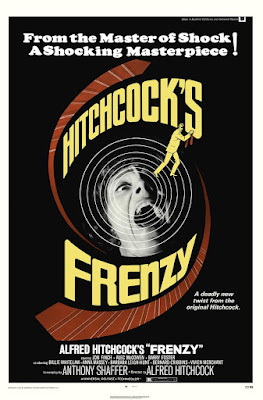
Frenzy (1972)


Director: Alfred Hitchcock

Screenplay: Anthony Shaffer

Based on Goodbye Piccadilly, Farewell Leicester Square by Arthur La Bern

Cast: Jon Finch as Richard Blaney, Alec McCowen as Chief Inspector Timothy Oxford, Barry Foster as Bob Rusk, Billie Whitelaw as Hetty Porter, Anna Massey as Babs Milligan, Barbara Leigh-Hunt as Brenda Blaney, Bernard Cribbins as Felix Forsythe, Vivien Merchant as Mrs. Oxford, Michael Bates as Sergeant Spearman, Jean Marsh as Monica Barling, Clive Swift as Johnny Porter, Madge Ryan as Mrs Davison, Elsie Randolph as Gladys, John Boxer as Sir George

Canon Fodder


One of the last Alfred Hitchcock films, Frenzy stood out in his career with its impact making sense in context. By the seventies, Hitchcock had not made that many films since 1964 next to his prolific golden period from 1950 onwards, having struggled with his attempt to be an independent producer of his own work in the late forties and failing. His golden era, which gave us films like The Trouble with Harry (1955) to Psycho (1960), and did not have producer David O. Selznick involved as his forties career, for good and for bad, ended in the mid-sixties with him considered a huge unreliability. Hitchcock is a controversial figure for how he depicts women, his obsession with the "Hitchcock Blonde", and for me, it is everything with actress Tippi Hedren where I agree is the uncomfortable moment where he crossed a line. I cannot defend what happened with how he treated her on both films they worked on, but it also clearly crossed a line to even alienate those close to him and studio executives at Universal. The first film, The Birds (1963), was a box office success, if one which would have got him cancelled for the story of what happened with Hedren on set, but Marnie (1964) was not, and was the straw which broke the camel's back.

Frenzy's genesis likely comes from a project Universal confiscated from him, Kaleidoscope, a proto-Frenzy which was meant to be very explicit, sexually and in terms of violence, influenced by the like of Blow Out (1966) by Michelangelo Antonioni, to be shot with handheld cameras, natural light and location shooting. Personally the films which we did get after Marnie have their virtues if their problems are felt in their sluggish paces and having his creative power pulled from - Torn Curtain (1966), as Hitchcock has to put up with Paul Newman, as someone who hated the method acting style, has this issue as does Topaz (1969) - but Frenzy feels alive and still disturbing decades later. As a lower budget film shot in his homeland, as someone who was an old man by that point, he nonetheless got carte blanche to make a film which does not feel antiquated and with a sick humoured tone. Frenzy is the most explicit and adult film in his career, but this tale of a serial "neck tie murderer" killing women in London, despite it being lurid subject matter explicitly invoking rape and strangulation of these victims, is more startling because of its sense of humour contrasting this premise. When members of the police trying to deal with the case in a pub talk of the psychology of said killer, only to say having a sex murderer is good for English tourism, it emphasises the gleeful misanthropy felt fully throughout this film.


This will make some very uncomfortable for Frenzy, but in context, what has aged is ye old seventies London, and that feels like a time capsule to what locations we still have, starting with the opening by London Bridge and the Thames, only to undercut them with from the get-go with a public gathering interrupted by a female corpse floating in the river. The set up is the traditional Hitchcock wrong man scenario, in which the obvious red herring is Richard Blaney (Jon Finch), a former lieutenant of the air force reduced to a bar man fired for drinking on the job and forced to sleep at a Salvation Army hall when he has no money. It is very obvious and not hidden who the killer is, his friend and market fruit & vegetables seller Bob Rusk (Barry Foster), with the reveal a disturbing one which places Richard as a suspect, as it involves the murder of his ex-wife. To the film's credit, and why it's more salacious and sick humoured aspects work rather than feel inappropriate, is that when it is about the awfulness of these murders of women, they are meant to lead to revulsion, whilst the humour is felt in terms of how, as throughout Hitchcock's career, he has an obsession with this twisted side of the human consciousness, its obsession with crime and murder, where the humour is the relieving puncture of the tension.

The parallel plot is Chief Inspector Timothy Oxford (Alec McCowen) who is investigating the murders, and this is where the humour especially comes in, that his wife is also into cuisine cooking. It is surprising in context to how explicit and grim the film is, the sole one to be fully able to in Alfred Hitchcock's career than imply such themes, and yet this is one of the most distinct parts of this entire film, funnier when you are aware of his and wife (and important collaborator) Alma Hitchcock's love for cooking and cuisine, thus presenting us with dishes of a solitary quail on a plate with a few measly grapes, or a soup full of fishes heads, when all Oxford wants is an English breakfast. There is still the style of older Hitchcock films here too, which was only briefly seen in both Torn Curtain and Topaz, the flashes of his deft hands when a tragic death of a main character is perfectly depicted with the camera in one take leaving the environment back out onto the street, without needing to show us what we know is going to happen. There is also the set piece with a truck full of Lincolnshire tates (potatoes) which mines tension against the sick humour from the act of disposing a corpse, including rigor mortis and a neck tie pin that needs to be retrieved, all despite the figure involved being a complete monster now in peril. You should not be laughing either yet the farcical nature of such a gristly scenario is felt to ease the tensions.

What is also felt particularly that here too, despite the character of Oxford who happens to be the one person, including the wisdom of his wife, to think, is Hitchcock's long standing paranoia and distrust of the police and the law, especially when people are quick to put the kicks in Richard as witnesses, like the male bar manager who fired him. Throughout Hitchcock's career, including adapting a real life case of a man put to trial as an innocent The Wrong Man (1956), ever since he was put in a jail cell as a child which created his long standing fear of authority, Hitchcock has always shown the frailty of the system. Even the murderers in his career do their acts for petty grievances, or here have compulsive sexual dominance obsessions but look like nice blokes who sincerely love their mothers, and that is probably the most misanthropic aspect of Frenzy as well as Hitchcock's career. Barring his forties work where he decided to fight real fascists by pitting his characters against reel ones, his work as always had this, and whilst the adult content here is strong, the more potent aspects are the gullibility of law and the matter-of-factness of such disturbing crimes taking place in a world where you could still smoke in pubs. The air of downbeat grungy London, like a lot of more lurid genre films from this era, makes its way here too, adding to the macabre nature, emphasising all these traits and adding to the atmosphere, and whilst I would argue his final film Family Plot (1976) is deeply underrated, I see why Frenzy is a late era Alfred Hitchcock film that is held in high regard for good reason.


Friday, 5 July 2024

The Da Vinci Virus (2005)


a.k.a. Cup of My Blood

Director: Lance Catania

Screenplay: Lance Catania and Kenneth Nilsson

Cast: Daniel Patrick Sullivan as Jack Fender; Janina Gavankar as Iona; Allie Smith as Tina; Roger Anderson as Sparky; Lance Mulvaney as Alex; Circus-Szalewski as Nibbles; John Turk as Memoli

Ephemeral Waves


The Da Vinci Virus is a film you the reader may have never heard of before. In reality, its real title is Cup of My Blood, a low budget religious suspense film with horror tropes, but I came to this when it was under an entirely different title to ride the coattails of another bigger film, something its director/co-writer Lance Catania probably did not know about for its British release. This is a tradition that has managed to last even into the streaming era, for better and for worse, in that in the past, of taking grindhouse/drive-in films and selling them under new names on the back of big Hollywood films, something which also found its way into the 2000s DVD era here, clearly distributed under a different name for British supermarket sells on DVD to sell off the back of The Da Vinci Code, the 2006 film adaptation of the big Dan Brown novel. With hindsight, there is remotely no connection to Brown's success, controversial and divisive 2003 novel at all, making the act of having read The Da Vinci Code and rewatching the 2006 adaptation starring Tom Hanks pointless. The context is important as, whilst an unofficial "mockbuster" title, this is the context of how I came to this film, and how it once came to be among the "worst I had ever seen", so it is worth establishing my history before returning to this.

For those who do not know, Brown's fiction novel became a huge seller but a controversial one, about a symbologist named Robert Langdon who finds himself in a conspiracy about the truth of Jesus Christ's legacy. It was accused for being blasphemous; it was challenged for the theories it was based on in premise; it was sued for "borrowing" said theories from the non-fiction book The Holy Blood and the Holy Grail (1982); and was challenged as being badly written. It however became a cultural zeitgeist that helped put Dan Brown on the map, and the decision to rename Cup of My Blood into the title I came to it as, when my parents bought it, was likely in mind to the hype behind the 2006 film, directed by Ron Howard and with Tom Hanks playing Langdon. Reading the book, it is fun if you take a pinch of salt every time Brown brings in facts of history and art, pulpy hokum in its page and adapted form. Truthfully, none of it connects at all to Virus, baring the likelihood to albino henchman briefly seen is connected to one from the book tentatively. Whether you think of the Da Vinci Code - love it, loath it, think it is the work of Satan - it does deserve to be canon in pop culture, and I have no shame in enjoying the thing with no expectations, as this pop culture phenomenon that blew up in my adolescence, never reading the tome until for this review, has the pace and tone of naive eyed silliness to it I could appreciate. With mind this segment was meant to be a prologue to the film I covered, only for them to be entirely foreign to each other in premise and tone, The Da Vinci Virus is a film which could have been something interesting as a low budget oddity, and is instead a curious schism of ideas of its own which awkwardly mismatch.

There is, before anyone asks, no references to Leonardo Da Vinci whatsoever in this film, the Italian polymath a huge part to the Da Vinci Code's premise, and the only connection to religion in its apocalyptic premise, which touches on a Book of Revelations style scenario, is the Holy Grail, the cup Christ drank at the Last Supper before his crucifixion. It is turned into a MacGuffin here in a curious mix of the profane, religious iconography, discussion about photography clearly of interest to Lance Catania, who beyond this film is primarily a cinematographer, and what he likely brought to the script on a personal level, cheesy horror tropes and a surprising level of sexual explicitness, with a pronounced level of green hue to everything in the DVD version we got in supermarkets.

The Grail is there to heed the apocalypse; with a touch of the Ark of the Covenant from the Indiana Jones films there is the issue when handling this sacred object as, if the person not chosen to protect it opens the box it is housed in, everyone who does is turned into a (CGI assisted) skeletal husk by the spectres of former protectors. The one chosen to protect this box is Jack (Daniel Patrick Sullivan), a former art gallery/art book photographer who has fallen into being the photographer for a porn website "2nd Cumming", which will later be revealed to be a (not so) secret cover for a religious conspiracy group. This was the aspect I remembered as the most idiosyncratic and likely to still be the most memorable thing of all this film, as that does raise an eyebrow as an idiosyncratic plot choice alongside naming a side character of importance "Nibbles". Jack's career choice, even if he will argue about the virtues of photo film over digital, is trauma over the murder of his girlfriend Tina, who died three years prior to the start of the film and is clearly a more suspect event from the get-go to its cause. Neither helping is that ghosts who have clearly been inspired by the 2000s boom in J-horror, terrified by images of black eyed spooky children and grey undead figures, are haunting him.

The religious may not appreciate the premise, including the mix of sexuality into this, although I should be frank in saying that this is not really a religious film with its apocalypse threat and talk of a chosen, more a secular pulp plot tone that could have changed the Christian iconography to high fantasy tropes and not changed much in the plot, which is one of the huge issues with this. When the double-double crosses and abrupt crucifixions with guts disembowelled out the body transpiring, it would have been appreciated if this had really taken the esoteric route further in referencing real dogma, even if in a profane direction, to make the plot more than the boiler plate one it does become. When it is proclaiming that the Second Coming will actually be by way of binary code, you see what a weird and interesting film this could have been, even as a low budget pulp one, but it feels instead a film which "could have" been this. This feels lost in all the plot it wants to get into, the reason likely I hated this back in the day alongside my dismissive attitude to low budget cinema, when the low budget cinema aesthetic and the clear idiosyncrasies, the sexuality and the obsession with photography, are the more compelling touches. Honestly its interest in sexuality is the one aspect to the film which could have sold it for luridness but actually becomes the most compelling aspect, especially as this is riffing on eroticism as found in photography art books, something distinct as a subject to touch on. Contrasting the porn site's blatantness with the erotic art of Jack, which does evoke real art book productions, even when being blasphemous with the melding of sensuality with Christian iconography you see that, in another world, Lance Catania and Kenneth Nilsson with the script could have jettisoned the apocalypse plot as this is clearly more interesting to the pair of them. Horror plot themes could have still been in this, of the figure named Iona (Janina Gavankar) who inspires Jack romantically and creatively, with the horror being that she is not who she may seem as the ideal. Even the starkness of the porn shots, actresses bluntly asking which dildo to use, as a nice contrast, whilst keeping the philosophical porn producer with shady criminal edges to him, is a more compelling idea than the conspiracy plot is wrapped within.

The plot itself is ambitious and convoluted, but also with the sense, even if you only had access to some locations including an indoor swimming pool, it feels far less interesting than being in this world of a photographer trying to find himself. In general, whatever budget, I find that the plot structures are less inteteresting than the tropes meant to sell a film, and here you have such a vague religious end of the world scenario, as you might find in a big Hollywood film, that is not interest, which means the Holy Grail or the ghosts to loomed around are of far less interest than the quirks. The gore that is split, some lower budget CGI and some fake guts, feels with a sense that if this had let its hair done and been more indulgent, embracing the absurd tone with its green hued corridors and apartments feeling like liminal spaces, I might have been able to appreciate this more. [Huge Spoiler] When it even pulls the twist Jack killed his own girlfriend by accident, but hid the body and had traumatising amnesia, it cements the curse this decided to put upon itself with trying to follow what is expected as compelling genre thriller tropes than just being indulgent. [Spoilers End]

The irony is that, whilst with little connection to each other, The Da Vinci Code managed to be compelling because for all the controversies about it showing real theories of the true nature of Christ, it was far more interesting as the adventures of the least conventional hero and his quirks, Robert Langdon, in a very over-the-top adventure where the clues and suspense where in the least conventional ways possible, by looking at all paintings and trying to find clues. All pretensions of its real theories was lost to pure old school storytelling when, whether tasteful or not, a Catholic albino monk assassin was brought in, and even Dan Brown's shoehorned attempts at profoundness in the cultural references in the novel had an eccentric charm. With hindsight, it became for me that weird and eccentric work which inexplicably caught fire, rather than stay an obscure work as an idiosyncratic author, and become a megahit. The Da Vinci Virus as I learnt of it as is as brazen in its own way, which I have to admire, part of an era of straight-to-DVD pulp cinema that will eventually get interest for how it led to curiosities like this, but with this one unfortunately a title which took too many clichés from bigger films than ride its own idiosyncrasies.

Wednesday, 26 June 2024

Grindhouse (2007)


Directors: Robert Rodriguez (Planet Terror), Quentin Tarantino (Death Proof)

Screenplays: Robert Rodriguez (Planet Terror), Quentin Tarantino (Death Proof)

Cast:

Planet Terror: Rose McGowan as Cherry Darling, Freddy Rodriguez as "El Wray", Josh Brolin as Dr. William Block, Marley Shelton as Dr. Dakota Block, Jeff Fahey as J.T. Hague, Michael Biehn as Sheriff Hague, Rebel Rodriguez as Tony Block, Bruce Willis as Lieutenant Muldoon, Naveen Andrews as Dr. John "Abby" Abbington, Julio Oscar Mechoso as Romy, Fergie as Tammy Visan, Nicky Katt as Joe

Death Proof: Kurt Russell as Stuntman Mike McKay, Zoë Bell as herself, Rosario Dawson as Abernathy Ross, Vanessa Ferlito as Arlene/Butterfly, Sydney Tamiia Poitier as Jungle Julia Lucai, Tracie Thoms as Kim Mathis, Jordan Ladd as Shanna, Rose McGowan as Pam, Mary Elizabeth Winstead as Lee Montgomery

A Night of a Thousand Horror (Movies)


About as useless as a pecker on a Pope.

Grindhouse was a fascinating one-off, and as time has passed, it feels for me like a project that was never going to be a big hit and always the cult title. Considering Quentin Tarantino prior to this created the Kill Bill project, which was split into two theatrical releases, and were tributes to genre cinema with even an animated sequence from a Japanese studio, that may seen questionable as a comment, but I see Grindhouse as more of a niche concept in principal. It was a tribute to certain types of cinemas of the past than necessarily the genre films churned in them 24/7 on the notorious 42nd Street of New York City and other locations, something which is more specific to get the references to in the project itself. Kill Bill had the advantage of being split into two halves, and riding the wave of interest of the likes of martial arts cinema, whilst this was a three hour double bill as a concept rather than the genres chosen by him and Robert Rodriguez. It appeals in principal, but in mind that this was a large budget project too, rather than a fictional double bill made on the lower budget, the project was always going to be in danger if it did not have the right amount of advertising and the right release, which it sadly did not.

The idea of paying tribute to this idea for a large budget projection was a risk, and if anything, when I was just getting into cinema at this time, it did at least catch a wave of interest in old genre and cult films that carried into decades after. It also lead to a wave of "neo-Grindhouse" films not really evoking the old exploitation films but replicating the template Grindhouse itself became, and it neither helped back then, whilst I want to return to them all, I hated most of those films when I watched them. The lack of box office success in the United States also lead to the films being split up into two theatrical features for the British market, including their initial DVD/Blu Ray releases. Contextually, Grindhouse itself came to me in its intended form with me more appreciative of its goal, whilst unfortunately, the lack of box office success when released in the United States lead to the Weinstein Company initally splitting the films up into two theatrical features for the British market. Death Proof, Tarantino's entry, was not a film I received well at all, to the point as a young lad who got into films like Pulp Fiction (1994) I thought he had lost his mojo entirely with this extended theatrical release when I caught up to this on DVD. What it was, remembering how divisive the responses from others at the time was as well, is clearly a transitional stage for his films.

But Grindhouse itself, when finally released as intended eventually, began with Robert Rodriguez’s than-fake trailer for Machete, imagining character actor Danny Trejo as a Mexican immigrant with governmental combat skills being double crossed, and thus going on a revenge mission. Fake trailers were one of the touches that were part of the Grindhouse project, though this one was kept for Planet Terror’s individual releases as here, the others lost in a project that was meant to recreate the experience of these cinemas, including some real ephemeral material shown at cinemas like the ones about age restrictions. They were touches more for a cult film crowd, but were cool to include, and whilst some of it has not aged well, entirely the stuff nodding to The Weinstein Company and the rightly disgraced Harvey Weinstein, the material is all interesting. Machete’s is interesting as it did become a film in 2010 through Rodriguez himself, with a sequel later that got more ridiculous, turning into an exploitation spin on US immigration politics. It also connects to how Planet Terror itself, as that later film, are both jokey over-the-top pastiches at their heart, full of stunt casting as Machete itself would have Lindsay Lohan as one of the roles in the trailer’s biggest gag, Trejo seducing a US senator’s wife and daughter at the same time, and inexplicably Steven Segal.

Planet Terror itself, which is about a bio chemical weapon causing a zombie outbreak, takes this further as we can have six degrees of separation games the TV series Lost, the Die Hard franchise, The Lawnmower Man (1992), and a member of the Black Eyed Peas. Planet Terror was a safer film of the two parts of this production, a pastiche with a budget to get away with violence which would have given eighties moralists a collective heart attack, with a name cast and a complete lack of seriousness meant for a crowd viewing. Planet Terror, as we set up the outbreak and the key leads, such as the mysterious traveller El Wray (Freddy Rodriguez) to ex-go-go dancer Cherry Darling (Rose McGowan), immediately shows the most contentious legacy of the Grindhouse project, that being the artificially created grain and celluloid print damage, more for all the other films which took influence to copy this aesthetic than necessarily being controversial for Grindhouse itself. If you watched any neo-Grindhouse film of the time, and this could even be found in micro-budget productions, between the late 2000s to the early 2010s, you would have seen digitally added film grain and damage, replicated from what Grindhouse did on a considerably larger budget. This is a tribute to how exploitation films in the original cinemas could be old, battered prints and as both halves play, the creators of these new films imagined the worse case scenarios where film reels went missing or salacious moments, as Planet Terror plays with, were cut out by the projectionists for keepsakes. With hindsight, this was preparing us for the tactile nature of any Blu Ray release of a title where the negative was lost and a film was preserved from a screening print, but this also makes one aware Grindhouse was always the imagined version of the thing the creators were paying tribute to. This was an imagined Grindhouse where you could have not really captured the real places, more so as Rodriquez’s is less the ideal of these types of films, from the seventies, but more the eighties films as they were coming to VHS and video rental stores.

Time is convoluted in both films, tributes to the past but made and set at the time they were produced in, and with Planet Terror, as an entire military platoon infected with the bio weapon end up in a deal gone wrong that unleashes the gas onto the local community, the tone also feels closer to a Return of the Living Dead (1985), and that era of cinema. What you get in a post-ironic form is something between the late seventies and a John Carpenter love-in, with the score paying tribute to his music, to the mid-eighties straight to video practical effects driven work. What between the gooey practical effects by Tom Savini, who gets an onscreen role too, and tributes between Lucio Fulci eye trauma, and possibly even Cannibal Apocalypse (1980) by Antonio Margheriti as an action horror film, and this feels slightly different to the goal Tarantino was after with his a seventies throwback. It is amazing to see a large budget tribute to all these, and also managing to get away with a child shooting themselves by accident, as a real taboo, but alongside Rodriguez’s trademark to make his films as independently as possible by his own hands, Planet Terror itself is purposely cool and deliberately absurd in construct.

Even when he has some really nasty gore, and sexual threat at one point, Quentin Tarantino in a cameo having a knack, between this and From Dusk Till Dawn (1996), for playing creepy sexual deviants, Rodriguez plays this with pathos and parody at the same time. You feel real emotional connection to Michael Biehn and Jeff Fahey as brothers in the end, but it surrounds Biehn trying to force Fahey to give up his secret barbecue recipe even in the midst of the zombie apocalypse. Even in mind that Freddy Rodriguez feels one of the weaker figures, because he had to play the mysterious and sombre tough lead, his character finds himself the straight man among everyone else and eventually having to ride a pocket motorbike in a scene deliberately done for humour. There are also the obvious stunt casting moments, like having Bruce Willis as the lead of the military platoon, and the little details of Rodriguez’s own interests, making the kind of film he would want as a viewer in the truest sense. Planet Terror can also claim to have its own obsession with male genital trauma, be it Naveen Andrews, the Lost series alumni as a shady scientist, being obsessed with collecting castrated testicles, to how Tarantino, as long as he gets to name check Ava Gardner and monologue, has his penis melt off before the film ends.

Planet Terror in context made sense to begin Grindhouse, the party starter even if, with hindsight, Death Proof as the film which got the most negative reactions initially became the more interesting to unpack. Planet Terror itself is fun and ridiculous, even if now with a melancholia of how, really, this is Rose McGowan’s film. This is the moment where we sadly do have to talk about Harvey Weinstein, as alongside the fact she drifted away from films very prominently advertised in the 2010s, she is one of the women named as one of his victims, accusing him for horrible crimes, when the MeToo movement came to exist in the 2010s, that finally led to him ending in jail. Rodriguez, who dated McGowan, has talked that he learnt of the trauma she went through, and deliberately cast her in Planet Terror as a rebuttal to her being effectively blacklisted by Weinstein for crimes he committed to her. Rodriquez argued the box office failure of Grindhouse was Harvey Weinstein burying the project for this by under promoting the film1. Whatever the circumstances for why the film was not a box office success, she is also the best thing in Planet Terror too, given Cherry Darling a playful spark between wanting to be a comedian and talking of all her useless little talents through the film. This is even before we get to her character spending most of the film without a leg, the special effects still great to this day, and leading to the image that sold this film even if it only happens near the end of Planet Terror, attaching a rifle with a rocket launcher attachment as an improvised false leg. It is the kind of role, one of two through both films, which should have been a platform for even bigger films but sadly was not to be.

The original way to see the two films that make up Grinndhouse meant we never got the trailers originally meant to split them up. Rob Zombie’s Werewolf Women of the SS, feeling like a pitch reel to an actual project, does encapsulate how exploitation films are historically contextualised and more complicated than Grindhouse itself, in this case the moral quandary that led to the Naziploitation genre. Most of those films got on the Video Nasties list in the United Kingdom and most are still not allowed to be released due to their perceived mix of sex, violence and Nazis by the British Board of Film Classification, the one exception being the one with the really infamous VHS cover, SS Experiment Love Camp (1976), which is just bad taste and inexplicably links to the theme of genital trauma as a male character has his surgically removed, to be given to a high ranking Nazi officer, and is naturally not pleased. How they came to be is not something I can adequately write, in mind they come twenty to thirty years after the fallout of World War II and were as much for illicit sexploitation scenarios as part of the lasting effect of that war, but Zombie’s take is broad and over-the-top. It is not portraying the completely exploitative aspect to an Italian film like SS Experiment Love Camp nor the serious takes on the subject, like The Night Porter (1974), also coming out at the time. Some may know this trailer for Nicolas Cage as the Fiendish Doctor Fu Manchu, another contentious exploitation concept we English, and Sax Rohmer, have to be blamed for, but alongside the fact they do not have him in yellow face as Christopher Lee did playing the character a few times in the sixties, the absurdity is there in the premise of Nazis having a secret werewolf woman project and yet also bringing in this character as a possible sub-contractor to the project. Could it have worked? It would have been highly stylised and divisive as Rob Zombie’s other work, especially as this was the time he helmed two Halloween reboots, though the trailer promised if they were able to make a film with Udo Kier, Sybil Danning and Bill Moseley as a mad Germanic doctor, let alone Nicolas Cage, I would have been interested.

Don’t by Edgar Wright was a really good parody of seventies horror. A tribute to the nastier side of British horror, the world of directors like Pete Walker, the nod to Video Nasties was appropriate in the last paragraph as, at one time, having “Don’t” in the title was seen as a good marketing tool at one point and lead to a lot of films on that Video Nasties list which fit this, such as Don’t Go Into the Woods (1981) to Don’t Go in the House (1979). Wright’s feels like it was meant to be a trailer and nothing else, perfect as it is as a cavalcade of seedy British horror from the seventies distilled into a short work, including the fact they had recognisable faces from our TV to films, making cameos from Nick Frost as a man baby in a diaper in a grungy basement appropriate as a stunt cameo on two levels. Thanksgiving from Eli Roth also pulled out a memorable trailer, though his in 2023 finally became a full feature by himself. How a thanksgiving slasher film never already existed is strange, but he clearly saw Don’t in the editing stages and felt he had to top it, having images as a tribute to murky independent slashers that will scar a few viewers. He gets the aesthetic of slashers, and for a director I do vary on, certainly, for the man who never held back for Hostel (2005) to The Green Inferno (2013), he made sure to make a work that was memorable. He took the type of film that came in the wake of Friday the 13th being successful, and lead to independent producers all jumping on the band wagon, and made the trailer to the imaginary one Roger Ebert and Gene Siskel warned viewers about. The ill advised decision of one girl to do strip trampolining to the human turkey is enough to claw into the human memory against a viewer’s will, but I can now thank Roth, with a human head on chicken for added grossness, for the snapshot of inappropriate use of poultry that will last.

These three trailers are a prelude, and honestly a palette cleaner, for Death Proof as whilst it is set around Quentin Tarantino wanting to stage a car chase in the tradition of classic seventies car chase films like Vanishing Point (1971), to which he and those involved pulled it off completely, his film is a literal gear change on purpose throughout itself. Death Proof for all its potential flaws, subjective to the viewer, is the far more complex film to dissect as the set-up, a tribute to car films without using CGI, however led to a deliberate shift onwards in how his films would be structured. It is close to a slasher premise too in how it follows a homicidal stunt driver named Stuntman Mike (Kurt Russell) who targets women with a “death proof” car, one reinforced as old car stunt vehicles were to allow him to survive horrible crashes, barring some injuries, but still drive head first into victims’ cars and kill them. Where this film did not originally work for me, and I found it a disappointment, is that this is a dialogue heavy work with a simple two act structure, very simple, but lets the dialogue linger far longer than it originally did in older films of his before.

I hated the extended cut, as many, because I came to Tarantino through work which was crime pastiches with sassy dialogue on a surface level, still found here in a different genre but with a clear change in tone. A spoiler has to be nodded to for two films at once, but this is the structure of Alfred Hitchcock’s Psycho (1960) entirely, following one group of women before the second act introduces another set. Tarantino focuses on characters, in a slasher template, you would only linger on for ten minutes for an entitled longer length, forcing one to live with them far longer than other films. It is not perfect: some of the dialogue caused me to cringe and think of how pissed off Spike Lee was with him for certain choices of words for black characters, though the debate about whether Tarantino can write female leads is subjective, as I am not going to dismiss the idea of women who are gear heads and watch Dirty Mary, Crazy Larry (1974) as they exist. I do also have an uncomfortable question of whether sexism ever came into the issue about this film getting a negative reaction from what I perceived of it having back in the day. Even from a male director-writer, it is almost entirely about women talking in the downtime between spectacle scenes, and yet was one of his most divisive films. Certainly there is a sense here we were moving away from monologues about what Big Macs were named in France, ebbing away in favour for the dialogue fully taking over as the prime mover of his stories. Tarantino was already reaching this with Jackie Brown (1997), entering more complex emotions, and I vividly remember Kill Bill Part 2 (2004) already being divisive, as it went against the high octane shock that was the first part, with its memorable sword battle finale, with far more tonal shifts, and even went out of its way to undercut the final revenge against “Bill” himself by having it being a languid character drama for the final act. What is changing from this point and Death Proof feels like the final gasp of the earlier part of his career, the moment he was no longer the “cool” cult director who was mainstream, but the esoteric director-writer who still spoke in cult films, and had the budgets to allow him to make the films he did on after Grindhouse, who instead wanted to play with structure and pace in dialogue driven movies onwards.

The importance of the women in the cast cannot be understated - Vanessa Ferlito, Rose McGowan again in another role, Sydney Tamiia Poitier, Tracie Thoms, Rosario Dawson, Mary Elizabeth Winstead – all giving great performances with dialogue which, whether you think of it, is a lot more dynamic than sadly could still be passed to actresses into films made after this, and by the second half, we switch to Stuntman Mike having the tables turned and the emphasis on a strong female cast in its centre integral to the production. From the cool character that showed Kurt Russell was always good, to being out of his depth and showing he is still good playing a snivelling weasel, he encounters a group including stunt women for that final act, such as New Zealand stunt actress Zoe Bell playing Zoe Bell, Tarantino in probably the sweetest moment of his entire career paying tribute to someone who worked on the Kill Bill project, and would continue to work with him throughout the others film onscreen as an actress. He lets her play herself whilst also getting to pull off an insane stunt involving playing "ship's mass", hanging off a car at fast speed for real on camera, and no less on the same car from one of the films ritualised lavished upon in the dialogue. The second half legitimately emphases this was always a film about strong women and symbolically castrating male ego, making that disconcerting thought sexism played into the reaction to the film’s lengthy dialogue more concerning if purely speculative. It is telling how even a seemingly pointless cameo by Eli Roth actually makes sense, as he makes a good sleaze ball in a more conventional sort, in a dialogue scene in the Grindhouse version where he plans with a friend to get women drunk enough they allow men to join them at a beach house for the weekend, still a scummy toxic male attitude. More examples of this are found in the extended cut, with one extended scene involving an "Italian Vogue" magazine being offered at a gas station, and it is contrasted by a legitimate psychopath in Stuntman Mike, whose modus operandi briefly evokes J.D. Ballad’s controversial novel Crash (1973), and David Cronenberg’s controversial 1996 adaptation, when someone suggests mowing women down in his car, an item symbolically connected to masculinity in a variety of pop culture, as a sexual thrill. The ending even plays to a symbolic act of pegging but with a female driver ramming the male driver's car from behind over and over.

The extended cut complicated this as it alters the pace. It has new scenes, and removes the "Missing Footage" section, tricking the viewer into not being able to see the clothed lap dance set up with Vanessa Ferlito in the first act. It also allows one to appreciate the music as, even when I hated the film, I still got hold of the soundtrack album as, between T. Rex's Jeepster to April March's interpretation of Chick Habit, a Serge Gainsbourg number she added new English lyrics to, Quentin Tarantino always was always good at choosing existing songs for his films. Though the extended cut itself adds scenes that now feel good and of worth in having, in Grindhouse, the pacing works entirely, and it feels as if, after Kill Bill and the car chase that succeeds triumphantly here, Tarantino was waving goodbye to his older films entirely. Action still transpires in films like Django Unchained (2012), but when The Hateful Eight (2015) was set up as a misanthropic chamber piece I saw at the cinema, set in the confines of a western and set in a cabin, I see something changed when we got to Inglourious Basterds (2009) with his attitude to his stories.

Grindhouse altogether is a compelling work, one which was a mad project to get off the ground at all, as unless they stayed with lower budgets, Tarantino and Rodriguez’s dream ballooned out into what it became always placed a harder target for it to reach due to a niche concept. That niche, the re-admiration of cult and genre cinema, did thankfully pay off as, whilst not a success and with half of it divisive originally, it followed a wave of things that happened for the better. The likes of “Ozploitation” became a concept for example, as one documentary Not Quite Hollywood: The Wild, Untold Story of Ozploitation! a year later helped Australian heritage to be celebrated, with this film in Tarantino's end credits thanking a big name in that documentary, filmmaker Brian Trenchard-Smith, in a detail predating this example. Eventually you will get Blu Ray (and 4K) restorations of even maligned filmmakers like Al Adamson in big special edition, and that is ultimately the real success of the Grindhouse project, which was a big and intriguing tribute to these projects which got fans even if the box office was not a success. That did become an industry, and grew into something great, making this a film I would still salute for helping with this trajectory. Also undeniably, in terms of my fascination especially with films which break the three hour plus lengths, as they can be very unconventional films in their own right even as stereotypical "serious dramas", there is something about a three plus hour tribute to an actual genre film double bill that is compelling, especially as so much is to be talked about and appreciated in all its moving parts. In turn, it makes one wish I had greater access to the modern day double bill retrospectives in cinemas which do not have the potential urine smell in the theatre.

======

1) Robert Rodriguez Says Casting Rose McGowan in ‘Grindhouse’ Was an F-U to Harvey Weinstein, written by Brent Lang and published by Variety on October 27th 2017.
Thursday, 21 December 2023

Psycho II (1983)


Director: Richard Franklin

Screenplay: Tom Holland

Cast: Anthony Perkins as Norman Bates, Vera Miles as Lila Loomis, Meg Tilly as Mary, Robert Loggia as Dr. Bill Raymond, Dennis Franz as Warren Toomey, Hugh Gillin as Sheriff John Hunt, Robert Alan Browne as Ralph Statler, and Claudia Bryar as Emma Spool

A Night of a Thousand Horror (Movies)


How do you follow up a legacy defining film? After Alfred Hitchcock passed in 1980, thus screenwriter Tom Holland, future director of Fright Night (1985), and Richard Franklin, director of Roadgames (1981) in Australia and openly an admirer of Hitchcock, had this challenge ahead of them when they collaborated on a Universal Studio’s follow up of Psycho (1960), with Anthony Perkins two decades on returning as Norman Bates. The opening reuses the legendary shower scene from the first film in the opening, but the Jerry Goldsmith score sums up the tone perfectly for a different film.

This does a good job in avoiding a poor rehash, with a plot to its credit playing to an idea, gas lighting someone, Hitchcock did use. Norman Bates is still a sympathetic figure, despite being a murderer, now with the context he has been rehabilitated, back at Bates Motel with all the repressed memories, those which caused his psychosis, and the potential vilification by the outside world as likely to prevent him ever atoning for his sins. Neither is it helping someone is trying to torment him, even with notes said to be left by his mother. With Dean Cundey as the director of photography, this feels like a grand film, when sequels existed but were not inherently expected for every title which were huge successes, and could be disasters regardless of genre and especially if the expectations of the original’s acclaim were at stake, something which can be attest to with the response to Exorcist II: The Heretic (1977). As an attempt to credibly follow up the original Psycho, presenting its own drama even if with awareness and influence of the slasher film boom Psycho itself helped inspired, the sequel does well. It is strange seeing Norman Bates near a Pac Man arcade cabinet, but that is as much the point, a man out of time from a film that hit like a lightning bolt, even among the heavy hitters of Hitckcock’s filmography, and returning in the midst of horror movies inspired by it.

What Psycho II is a horror film with the emphasis on a strong cast, provided with a weight for its thriller plot and having some gruesome scenes in the wake of Friday the 13th films. No one is giving a bad performance, Perkins about to return for a surge of recognition in this role that would lead to films like Crimes of Passion (1984), matched by the likes of Robert Loggia as his therapist, to Meg Tilly as a diner waitress who ends up at the old Bates home as a friend, subverting the original film in a willing guest of the hotel alongside both a shadow of doubt there for her and additional context that will pull the rug out of their relationship. The slasher influence is there – one scene befits the era, of a young guy and girl making the unfortunate decision to get high and heavy pet in the Bates home cellar – but what this becomes is closer to something you would find in an Italian giallo, the kind of storytelling influenced by Hitchcock too, especially as you have to factor in Vera Miles, in an inspired choice, returning as Lila Crane/Loomis, the sister of Janet Leigh’s character switching roles with the irony of hindsight, now the concerned person who wants Bates to stay in jail even if it leads her to doing something legitimately evil morally to punish him.

The film does recreate images from the first film, even the psychoanalyst explaining the plot at the end of the prequel, so there is the real sense of this being a film made by fans of the source returning to it. They have a Herculean challenge in a way – Hitchcock is a sacred figure, and barring one or two exceptions, a TV movie The Birds II: Land's End (1994), or Christopher Reeve post his tragic accident starring in a 1998 TV remake of Rear Window, readapting his work has not happen a great deal unless entirely out of coincidence. Psycho was an exception, and the sequels and re-adaptations are their own universe, where Anthony Perkins would direct one of the films, and there was a cancelled attempt to turn the series into an anthology series, by way of an unsuccessful 1987 TV movie, with a young Lori Petty. Barring one aspect which may be very controversial, a final twist about Bates’ family which I will not spoil, Psycho II does not take huge risks but does an admirable job in being a retrospective on Norman Bates himself, whether it would be possible to ever live a normal life, and succeeds when making a sequel to the Alfred Hitchcock film could have been an ill-advised mishap.

Thursday, 26 October 2023

Ebola Syndrome (1996)


Director: Herman Yau

Screenplay: Ting Chau

Cast: Anthony Wong as Kai San; Wan Yeung-ming as Yeung; Wong Tsui-ling (Angel Wong) as Lily; Miu-Ying Chan as Har; Meng Lo as Kei

A Night of a Thousand Horror (Movies)


There are some infamous Category III films from Hong Kong, where they used a rating that limited viewers to adults but fed a boom in exploitation, erotic and horror movies, and among them, Ebola Syndrome is one which lives up to the infamy, so much so it is worth having caution in terms of actually watching it. Contextually, when the Category I, II and III ratings were first devised for Hong Kong cinemas in 1988, it was dealing with content, not just gore but films were criminals were shown as heroic, which could have been controversial. The ultra-notorious Men Behind the Sun (1988), an exploitation film dealing with Unit 731, the overt research unit of the Imperial Japanese Army that performed lethal human experiments during the Second Sino-Japanese War, was the first film to get the Category III rating, and when this rating came in, the films which earned them were not necessarily cheap productions, but films with named stars. Even Wong-Kar Wai has had a Category III film in his career, as unfortunately, depictions of same-sex relations were qualifiable for the rating, leading to Happy Together (1997) being among them, a subject for a more complex dissection of what that says in terms of LGBTQ politics at the time.  

The Category III film however has an infamy for the notorious and bloodier entry among them, alongside the erotic works like Sex and Zen (1991), and Ebola Syndrome near the end of their peak in interest can be labeled with justification as the last blow out, for good and bad in offensive ways.  I would have to call myself out a hypocrite for labeling some of the content in this offensive and distasteful, as someone who has been intrigued by this film over a decade and went out of his way to see it, so moral high ground is a ridiculous notion to get into. Just be aware that, whilst it actually calms down in tone, this is pretty extreme as a film can get, starting off with an explicit sex scene introducing “Chicken” Kai San (Anthony Wong), a completely irredeemable villain who we follow as for a large portion of the film, which leads to him being caught with a mob boss’ wife. Threatened with castration, and urinated on beforehand, he kills everyone, including the wife, and nearly torches her young daughter, dowsing her with gasoline, only to have to leg it before the act is done. Already this film before it becomes truly extreme has already set up the tone of taking no prisoners in good taste and gruesomeness, with a streak of deliberately crass dark humour intermingled within it too whether appropriate or not.

It is feasibly big budget film shot in two countries, as Chicken hides after this in Johannesburg in South Africa, which is a disarming thing as usually a production value like this in a horror film would not get into some of the content here. Even if you can stomach when it gets into taboos like rape and cannibalism, it is extremely nihilistic about global connections, even without the moment, to be frank about it, the story properly begins when Chicken sexually assaults a female carrier of Ebola and starts to spread it over two countries. No one until the last half, where it somewhat tones down and the heroic Hong Kong police have to try to stop Ebola being spread by Chicken, is defendable expect as transgressive, sick humored or just purposely nasty to make the viewer squirm. The owners of the Chinese restaurant Chicken has been working in at Johannesburg are unlikable, a bickering husband and wife; the husband himself, among others with the Taiwanese and Chinese figures living there, is racist to the white and black Africans, exploiting cheaper meat from the local Zulu tribe of black Africans, who are suffering through the Ebola outbreak; and the white Africans can be racist to the Asian immigrants in a country where one cannot help but look at through the view of Apartheid ending only in 1994. No one in this half of the film is likable, and it is here where some of the most uncomfortable and transgressive details come in.

There is the obvious concern, shot in real locations, that this is an exotic exploitation of South Africa, finding to way to have real decapitations of chickens brought in watching a tribal Sharman try to cure the Ebola plague in the Zula village, viewing the community as a “foreign” other in their dress and appearance to our distasteful lead from Hong Kong. There is some sense of this, alongside exploiting a couple of 1995 Ebola outbreaks in the African continent, such as in Kikwit, Democratic Republic of the Congo, as it was called at the time,  which would have been clear influences, alongside the fact that, as a virus which has tragically had a lot of outbreaks in various African countries in general, Ebola is exaggerated here beyond just being a horrifying disease which can cause internal and external bleeding to literally causing the organs to melt and eat themselves in some of the more legitimately disgusting details, such as an autopsy sequence. There is however, to contrast this, a sense of general misanthropy all round, the idea of transcontinental travel and cultural exchange being a doomed affair, and it becomes less a problematic film in the tone of what “mondo” documentaries from Italy were accused of but its own twisted and transgressive film with some uncomfortable scenes in a variety of taboos, which says a lot when Category III became stereotyped for some extreme films in both gore and sexual violence when these films were being learned of in the West. Some goofy humour, more common in Hong Kong’s cinema, does appear but it is more thankfully to emphasis a sick sense of humour to this, that this film is deliberately emphasizing the transgression whether justifiable or not, in the inventive cursing or the ill advised decision to take a pee in the underbrush only to encounter a leopard, which involved actually placing Anthony Wong, already an acclaimed actor by this point in his career, near an actual leopard.

There are scenes which will be uncomfortable and un-defendable for many, such as the rape scenes, especially as they all involve murder, and it is completely understandable if that is enough to caution a viewer off ever watching this film. In general, the entire passage of the film when Chicken gains Ebola is going to shock even hardened viewers nowadays if just in amazement of a higher budget Hong Kong film managing to “go” where this does. This is a film where Anthony Wong uses raw meat as a masturbatory aid and puts it back in the kitchen to later cook, so there is a deliberate shock value to the film, whether justifiable or not, which was trying to go further than other films. Herman Yau, whose career started with late eighties and kept going into the 2020s, clearly wanted to make a film with some depraved scenes on purpose, as eventually you will get into cannibalism and, in deposing and feeding a body to patrons to the restaurant, Chicken unwillingly beginning to spread the Ebola virus in Johannesburg. Eventually, fleeing to back to Hong Kong, this will continue, if with less emphasis on these more shocking scenes and, with an exception of an explicit threesome scene with two female sex workers played both with horror and goofy humour, on the threat of this virus in a metropolis. Some of the post-contagion and even autopsy scenes are going to be shocking for some viewers in their extremity too, but it starts even playing like a more “tamer” contagion film in how, with slow motion scenes to emphasis whenever Chicken can or does spread his illness, as the ultra-rare case of someone immune to it, the tone becomes less grotesque horror but a virus thriller.

Once it reaches its final, with the police in Hong Kong trying to catch Chicken when they contact an Ebola outbreak, even those who do find the film tasteless will have to concede that this does things with a lot of considerable heft to them even if they themselves understandably do not have the tolerance for the film’s tone, such as having an insane fire stunt in the final scenes with a stunt actor. There is also Anthony Wong himself, who having worked with Herman Yau on The Untold Story (1993) and Taxi Hunter (1993) was not a stranger to extremity. He has been a prolific actor who here brings what is absolutely needed to make this film vaguely defendable – a character who is impossible to connect to as he is a horrifying figure, yet is both fascinating to watch and, when he tries to have a happy ending with an old flame, actually brings in a bleaker shade to the material as you come to realize even a sociopath could have kindness in his heart, despite the chance he will kill that person he cares for even by pure accident as a Typhoid Mary figure. Considering how diverse Wong’s filmography is – John Woo films, Yau’s work, Johnnie To crime films, Ann Hui dramas – like so many Hong Kong actors, it is not a surprise he can add a gravitas even to a sleazy, depraved film like this as being able to act in a variety of genres and tones for films is more commonplace in their cinema. In fact, Wong won an actor’s award, the Hong Kong Film Award, for The Untold Story, which would be like if suddenly a figure like Daniel Day Lewis made a controversial and extreme horror film, and had such a good performance within it he still won an Oscar.

This is the same for Herman Yau too, alongside those in front of and behind the camera here, as with a string of horror films throughout his career, including the long Troublesome Nights series, he has gone from comedies dealing with housing crisis issues (A Home with a View (2019)), action films and entries in the Ip Man martial arts franchise. Yau even co-directed a re-imagination on JB Priestley's An Inspector Calls for a 2015 film set in its own Hong Kong centric context, which makes his notoriety in the West for films like Ebola Syndrome, which does live it to its infamy fully, more fascinating with hindsight. It is a strong film, even in the current day, where time has not made it “quaint” and it is to be approached with caution. Knowing its director went on in a variety of genres, and continues working, places more on respecting him as a director and with a sense that, even if a viewer may find the film utterly irredeemable, it was with hindsight made with the likely hope at least a viewer or two would react like that.

Saturday, 16 September 2023

Number Seventeen (1932)


Director: Alfred Hitchcock

Screenplay: Alfred Hitchcock, Alma Reville and Rodney Ackland

Based on the play by Joseph Jefferson Farjeon

Cast: Leon M. Lion as Ben, Anne Grey as Nora, John Stuart as Barton, Donald Calthrop as Brant, Barry Jones as Henry Doyle, Ann Casson as Rose Ackroyd, Henry Caine as Mr. Ackroyd, Garry Marsh as Sheldrake

Canon Fodder


Sausage. Hit him over the head with.

Number Seventeen promises a lot as an early Alfred Hitchcock film immediately, of expressionist shadows as a homeless sailor enters a house for sale, only to find another man and also a corpse there. Already you have awesome compositions, almost like a supernatural drama, of looming shadow hands alongside jump cut editing to a train to show shock. It is however, just in its title too, a weird film for Hitchcock, the kind of “weird” in terms of not a positively delirious title but something that is absolutely curious in his career. It is an oddity with virtues but a lot of issues behind its creation.

Hitchcock had to make this film, part of his career with British International Pictures1. Despite the fact he had already made The Lodger: A Story of the London Fog (1927) and Blackmail (1929), and was becoming an acclaimed filmmaker, his career up to sailing to Hollywood and the United States for Rebecca (1940) includes films which stand out in premise (his personal project, the drama Rich and Strange (1931)), only to not become films which stand out the highest in his career, and titles which he made as a studio director whether he wanted to make them or not, such as the operetta film with Jessie Matthews, Waltzes from Vienna (1934). Number Seventeen, based on a thriller play by Joseph Jefferson Farjeon, has a suspense plot including one of the earliest McGuffins, if not for the first, for Hitchcock’s career in that it is a piece about jewel thieves swarming around this house alongside a detective, his daughter, a cop in disguise and the homeless man Ben (Leon M. Lion). Hitchcock however, in adapting this, decided to turn it into a farce on purpose tonally, which affects the final result.


The final film because of this is a really broad farce which does not really work. Hitchcock films can be legitimately funny, without becoming comedies but being suspense films which have incredibly dour winks at the banal mixing with the morbid – the cop in Frenzy (1972), one of his grimmest tales, whose wife is trying experimental cooking to his horror, or a key scene of Strangers on a Train (1951), whilst not played for laughs, being based on whether the lead can complete a game of tennis as quickly as he can – or incredible one-liners, such as the many Cary Grant has in North by Northwest (1959). This does eventually have charm, with Leon M. Lion as Ben, once you get past his initial gurning klutz performance, becoming lovable as a genial homeless man caught in the middle of this against his will, but a lot of the humour, being the slapstick to speed up fight scenes, goes over the head in actually landing. A lot of it being a pastiche of the suspense drama completely falls flat when it eventually gives up and becomes a more heightened crime film by the finale. Instead a lot of this feels like a stage play with Hitchcock managing to make it visually vibrant and soaked in shadows, entirely set at night, of a group of people ending up in this house all at once. The sense of this comes when one of its parodies, the female lead on the villains’ side who is so mysterious she is a deaf-mute, being jettisoned. When this character Nora (Anne Grey) just starts speaking, completely kneecapping one of its more idiosyncratic touches as quickly as it is introduced in a film only an hour long, you get the feeling Hitchcock made a legitimate mistake with his collaborators which effects the final quality.

Seventeen, by way of its finale with model trains, gets a really thrilling ending of escaping by train and the commandeering of a public bus to catch up with it, which shows how the film could have been cultivated into an ambitious and grander work by its director. The film had the potential to be a great production, full of McGuffins and plot points for the sake of getting to the next scene – corpses not quite dead, cops posing as lackeys, heroines secretly hiding in the villains’ side – as people fight over an expensive necklace. Even a scene of falling over a broken wooden railing does show how the comedic tone of the film could have mixed with suspense. What this feels like is a germ of a bigger work, and instead it is Hitchcock the master craftsman who sticks out than a successful result, still early in his career showing the mind which planned out his films carefully before they were filmed, compositions even here of the images which stand out incredibly. If it is a failure in Hitchcock’s career, but that does not mean you cannot appreciate the skills he shows here that would grow in his filmography.


====

1) Alfred Hitchcock Collectors’ Guide: Number Seventeen (1932), written by Brent Reid for Brenton on Film and published on August 16th 2019.