Showing posts with label Director: Jean-Marie Straub and Danièle Huillet. Show all posts

Monday, 21 September 2020

Sicilia! (1999)


Director: Danièle Huillet and Jean-Marie Straub

Based on the novel by Elio Vittorini

Cast: Gianni Buscarino as the son Silvestro; Angela Nugara as the mother; Vittorio Vigneri as the knife-grinder; Carmelo Maddio as the orange-seller; Ignazio Trombello as policeman; Simone Nucatola as policeman; Giovanni Interlandi as the traveler

Canon Fodder


Accused oranges.

One man journeys home from New York City to Sicily, encountering various people and with many conversations taking place. Thus begins the first Straub-Huillet film that won me over, as one of the only films that were ever released of theirs in the United Kingdom in the 2010s1. Sicilia is also one film that is fully of their aesthetic, without compromise, yet you could actually show to anyone with success possible of winning them over, because instead of dense philosophical ideas being upfront, their concerns are found in a text which is vivid in its depiction of life in a universal sense. Any film which begins with the text "for the marmoset and in memory of Barnabé the cat" stands out as even gracious and relaxed even if the film will not stray away from emotional confrontation, more so striking as the original source material was more dreamlike and seen as a parable against Fascism.

Adapted from Elio Vittorini's Conversations in Sicily, large portions of Sicilia the film are just admiring the Sicilian landscape and countryside in panning camera shots or on a moving train. It feels timeless. It does not seem paradoxical either a very political duo of filmmakers would make a film celebrating this world as, entirely around the lead Silvestro returning home, this is about the working class, the ordinary world of people who like those cast in the roles they have always had an empathy for. That it is Sicily is of note too as this is not Northern Italy - Sicily, in the South, is its own distinct culture compared to a metropolis like Rome, one which could easily be maligned in culture exported to the outside world when the image of Italy as a country usually points to the likes of Rome and Venice, not the uniquely distinct countryside of Sicily. Again, in light to this, it does not seem paradoxical either a very political duo of filmmakers would make a film celebrating this world as, entirely around the lead Silvestro as travels from New York City, almost as an amnesiac needing to remember his past.

Structurally, shot in black-and-white, Straub-Huillet continue their minimalism with still close-ups of the non-professional actors and quite, efficient editing. A lot of the pair's extensive minimalism can simply be put to the fact, even as admires of classic Hollywood cinema, someone like Straub also hated the artifice which undermined the power of the art form. This has, paradoxically, made the couple's much more difficult with some of their films then one would think, because we have adapted to cinema with quicker paces, "musical soup" for the scores when the work is not at its best, or even great production from the sets to the music being mishandled. But, until later scenes of drama, most of Sicilia is in name of universal parts of life that are more easier to digest than some of the content in their previous work, with philosophical and political content, material which due to the style, now perfectly attuned and crafted, actually resonates with connective tissue with ease as long as you are patient. Of oranges in salad with oil and bread, cooking hot pepperoni in summer and mackerel in winter, eating cicadas out of curiosity and being unable to sell or even unload all the oranges. Rejecting a bourgeois tale of glamour in favour of the rural working class and hardworking Sicilians, just these conversations you rarely see in dramas is itself political.

Notably for Sicilia, all the non professional actors are good. Everyone is distinct, such as the man on the train complimented for his baritone voice to the other before with strangely philosophical insights. This is notable as in one of their flaws depending on the film, Straub-Huillet could sometimes force their strict minimalism with a detriment where the actors performed without a complete lack of emotion with contrivance, a lack of the aimed ideal that Robert Bresson also exposed, probably (to be a heathen to the realm of art cinema attacking a sacred cow) because it will not also work just to film a non-actor reading aloud lines from a dense literary text. This has the perfect balance however, the directors opposed to the contrivances of other cinema and wishing for true verisimilitude, finding it when they strike the balance of casting non-actors and allowing them to bring gravitas to the work, greater connection as a result for this or Antigone (1992). Here, and there, you see what they had in mind and see how casting non-actors would be much more beneficial to cinema depending to the content at hand.

As a result, one of Sicilia's best aspects becomes Angela Nugara, as Silvestro's mother. The biggest sequence of Sicilia and providing its depth is when Silvestro finally reaches his mother to spend time with her. It begins softly - food and cooking conversation. It gets more complicated - talking about a grandfather who was a socialist who yet believed in St. Joseph and joined the festival procession for him, which Silvestro thinks is paradoxical but his mother fully believes made sense. Then it gets tense - exorcising conflicted views of his father, a womaniser whose flattery she considers worse than when her grandfather just slept around, he looking up to him as the idealised father. It gets emotionally visceral and vivid - her detailed explanation of giving birth to Silvestro. The sequence is exceptional, arguably one of the best in the directors' entire career, the weight of Sicilia in how, at sixty six minutes or so, there is completely no filler and every sequence means something even beyond this the best.

Such as the pleasant conclusion with the blade sharpener man who uses a contraption on his bicycle to sharpen his work. He in particular, wishing to sharpen swords and cannons, believing there is no knives and scissors in the town, shows how Sicilia is even pleasant and humorous in its own dry way. And that the point of the film, as he and Silvestro eventually conclude the film on a shared stream-of-consciousness going through things that delight them in life in general, or just the aspects that make of life give-or-take, arguably leads to a soothing moment in the directors' careers, even in mind that into the nineties they actually did make a comedy. Arguably leading too to something more symbolically profounder in how they celebrate in this final dialogue the real worth of life, rather than something contrived and forced upon us.


======

1) We must thank New Wave Films, a distributor who is an underappreciated group, mainly because they did not release even Blu-Rays extensively until the late 2010s, let along extra heavy ones with major restorations. They did however release a two disc set with Sicilia, Chronicle of Anna Magdalena Bach (1967) and Une Visite au Louvre (2004). This alongside the interesting current world films they released, such as Long Day's Journey into Night (2018) even with a 3D Blu Ray version, or their trio of Jan Svankmajer films make them unsung heroes of avoiding the popularist choices and getting the rewarding gems out.

Thursday, 18 June 2020

Antigone (1992)

Directors: Danièle Huillet and Jean-Marie Straub

Based on the adaptation of the Sophocles play by Bertolt Brecht

Cast: Astrid Ofner as Antigone; Ursula Ofner as Ismene; Werner Rehm as Kreon; Lars Studer as Wächter; Stephan Wolf-Schönburg as Hämon; Albert Hetterle as Tiresias; Mario di Mattia as Knabe; Michael König as Bote;     Libgart Schwarz  as Botin; Hans Diehl, Kurt Radeke, Michael Maassen and Rainer Philippi as Die Alten

Cannon Fodder

Are you posing me riddles you transparent fool?

[Cannon Fodder: Films or productions by individuals already on the Abstract Canon, or figures/genres/movements I hold in high regard, that would never get on the Canon itself.]

Adapted from Sophocles by way of Bertolt Brecht, Antigone follows a side of Jean-Marie Straub and Danièle Huillet's they had been perfecting over the decades beforehand. That for work like this, rather than their documentaries and other experiments, they were recording "performances". Minimal to an extreme and restricted to one or a handful of locations, they eventually had actors mostly standing still and speaking their lines. Nothing could be accused in such films as artifice that distracted from the words and their meaning.

They are difficult films in the directors' career, which is saying something. One for example, The Death of Empedocles (1987), stripped everything away to such an extreme that, far from clearing the words and adding clarity to them, actually made the film (as others) more challenging. Maybe I have finally come to Antigone fully used to the directors' attitude - it is still a production where actors in Ancient Greek costume (speaking in German) act out the work almost entirely stood in place - but there is something special with this particular example. There is something about Antigone arguably more accessible and that, in context of these works in their career and their work in general I have seen, it is also exceptional.

They play follows Creon, an old patriarch and current ruler of Thebes, who has mercilessly had Polynices, a song of Oedipus and brother of Antigone, slain during a conflict with Argos, proclaiming his body will not be buried but instead left for the birds and the beasts to devour. Antigone, a strong willed young woman, refuses this official decree and will try to get the body buried. Even though she is meant to marry Haemon, his youngest son, reacts violently to her transgression, punishing her by being entombed in a cave alive. He will banish said youngest when he challenges him, and he will proclaim victory in conflict and the treasures of Argos, even if the war is actually yet to be won and it is pointed out by blind prophet Tiresias, here an old man, that even if he does not have powers of precognition, he can still proclaim likely disaster is imminent as he still knows that spears are being made and shipped over to Thebes' solders for battle.

In the modern day, it would be understandable that Creon was just a delusional, egotistic patriarch and see his punishment is deserved. For me, this is true but it is also a tragedy whenever any character, patriarch or not, falls and destroys themselves, in this case of deeply ignorant behaviour (greed, wrath), delusion of grandeur and a willingness to lash out at even those tied to him by bloodline that will eventually lead to Thebes' destruction. It is not just politicians we can make comparisons to Creon about, but any man who falls in hubris and is lead to eventually losing it all as a result. An ominous quote also makes this universal as well, from Bertolt Brecht1, stating of how the wars of the past, over centuries, were merely practice for far worse, all scored to the sound of helicopter blades heard on the soundtrack.

In mind to the creators, you can see this as an adapt conveying the corruptive nature of power too. The strong, legitimately feminist figure of Antigone, played by Astrid Ofner, stands her ground, calling out the war with Argos a disgrace and challenging Creon rightly because her brother deserves a proper burial. Sadly Ofner did not act as much as she should, as in this is her only onscreen work in cinema; Ursula Ofner, playing her sister, in an amusing twist of cinema would have a slightly longer career including Beach Bikini Party (1999), a Canadian-American-German co-production.

Here in this film however, even if he is a villain, Creon deserves a form of empathy from the perspective that his delusion is one all can succumb to, especially as Werner Rehm (who had a longer career in acting) is allowed to play him with incredible dramatic pathos. The reason why I can even connect to his villain is that, unlike some of the others films in this style from Straub-Huillet, these performances are legitimately great here. A Greek tragedy of hubris like this can be seen from all angles as, alongside its text, everyone is allowed to have emotions, and unlike the toned down minimalistic acting of before from the directors, they have let the cast here stand out without it having clearly undermined their philosophical reasons to strip the artifice away. None of the performances are arch or exaggerated, which was probably a concern for the directors as much in their decision to even cast non-actors and have them read out text on paper in some of their productions, and here they instead have the gravitas to engage with whilst being able to convey the meaning of the work.  

Even for this type of minimalism, Straub and Huillet by all accounts were also exceptionally precise. They precisely choose their locations, Antigone all acted in an amphitheatre on a mountain cliff, the lingering remains of the ancient structure marked of the rock foundations still in the ground. Each "act", divided between by the Greek chorus of old wise men following Creon, usually cuts to the ground to switch between them as the chorus monologues for a few minutes each time. This is the most alienating aspect of the film except it leads to an effect in itself, when seeing a newly dead messenger on the ground in the background, or when the camera at the end finally pans out to the horizons beyond the mountain for the final monologue, effecting a viewer with a greater weight of impact to what is being heard through this simple repetitive structure. Likewise, it is a fascinating that, for all their preciseness, the directors still let the unpredictable and natural world have an effect especially in these ultra-minimalist films of their career, as whilst everything acted is heard perfectly, the wind is a strong prescience in scenes (as in other productions) and even they would not attempt to, say, prevent stray butterflies from wandering in shot, in fact feeling like a touch of the actuality films of the beginning of cinema in attitude. These films, where cinema was brand new, could barely muster more than a minute's length of reel and starting in the late 19th century, shot with minimal camera movements and had to take into account they shot what they could see unless it was Georges Méliès. I have found Straub-Huillet in their films, even when they were not making documentaries or didactic work, have let the naturalism of their environments be seen and heard without trying to manipulate and edit it out.

As a result, their extreme minimalism here, unlike before, feels more fluid, as the passions and emotions of the words are heard and sounded, with the added aspect that the subtitles, unlike others put together upon Daniele Huillet's request to not be entirely detailed, are full and efficient here. Any further detail would stepping on the creators' toes, as they have stripped what they have deemed the unnecessary, and the film is the barest of content but to the maximum of its intellectual concerns and emotional demonstration of them. The different is found that, even having become admirers of theirs, times before did show admirable experiments which did however have creative flaws or, if I am to later grow fond of them, were very obtuse to the common viewer, requiring more context or patience to delve into and fully understand.  Here, you could easily introduce Antigone to an outsider to their world, if they were able to engage with the work, winning a new viewer interested in their work as this manages the right balance between their filmmaking ideals and adapting material that is still relevant in its universal nature.


========

1) The memory of humanity for sufferings borne is astonishingly short. Its gift of imagination for coming sufferings is almost even less. It is this callousness that we must combat. For humanity is threatened by wars compared to which those past are like poor attempts and they will come, without any doubt, if the hands of those who prepare them in all openness are not broken.

—Bertolt Brecht, 1952

Saturday, 5 October 2019

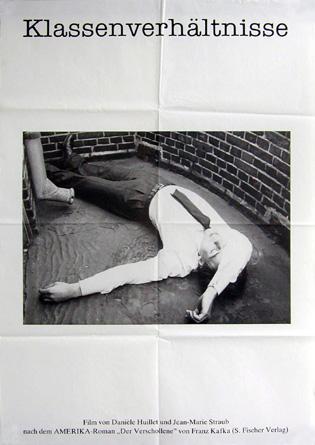
Class Relations (1984)

From https://pics.filmaffinity.com
/Class_Relations-694150712-large.jpg


Directors: Jean-Marie Straub and Danielle Huillet
Based on the novel Amerika by Franz Kafka
Cast: Christian Heinisch as Karl Roßmann; Nazzareno Bianconi as Giacomo; Mario Adorf as Onkel; Laura Betti as Brunelda; Harun Farocki as Delamarche; Manfred Blank as Robinson; Reinald Schnell  as Heizer; Anna Schnell as Line; Klaus Traube as Kapitän; Georg Brintrup as Student; Hermann Hartmann as Oberkassierer; Gérard Semaan as Schubal; Jean-François Quinque as Stewart; Villi Vöbel as Pollunder

Straub-Huillet adapting Franz Kafka? Yes, that did happen and this is the most accessible of their films as a linear narrative, whilst not losing an ounce of their difficult idiosyncratic style. Class Relations is based on Kafka's unfinished novel Amerika, where he notably never travelled to America but created a version based upon research and his fears, is still an unconventional production in that it is a minimalistic, slow paced work in which a German immigrant to the United States finds himself falling through an exploitative world that makes no sense, all depicted by the directors' stark static shots and precise formal style with an eye laser focused against this kind of capitalist environment.

Or at least the type of structure this calmly hellish, in which the protagonist is a prop from the get-go, when he drops his suitcase on the ship he is on to find his lost umbrella, only to get lost and find himself in an argument with the administration on the ship over the treatment over a minor staff member. In the midst of class bias, complete lies and people desiring to even force him into servant hood, all of it fits into Kafka's take on an illogical world but also suits Straub's Marxist viewpoint, the title change adamant to the issues tackled here. Thankfully, the acting is not the deliberately flat performances of a few early seventies experiments of theirs, but with a cast that occasionally break out into gravitas, usually from the middle management who are selfish and deceitful, whilst a lot of the performances are a minimalistic acting style common from the auteurs that does succeed completely.

Whilst Class Relations is a slow film in pacing, this has to be one of the most dynamic of Straub-Huillet's fictional films as they structure the film over dramatic vignettes where their lead wanders through like a deer in the headlights. No one barring a few people are truly kind, fellow wanderers raiding his suitcase or trying to force him into servitude, and even those who are kind to him can lose their respect for him if lies are said of him being a lewd, unprofessional employee without proof.

From https://blogger.googleusercontent.com/img/b/R29vZ2xl/AVvXsEj3QN2id17kDJRP5v8qHR5BejVZJVSw0FcVTzp9YkxyzrzKzfxzO7S1OR4extGIZ55AHYF4GB-GMumNtzwVHUww8C1d0qBitPj3BDZNPsPTNIlw6ABBsInsYGXetB5btsSbopLd4gDlbQls/s1600/1984+Klassenverhaltnisse+suitcase.JPG

"Kafkaesque" is the notion of an oppressive/nightmarish world of rules and orders which do not make sense. The Castle famously is about a man who cannot get to his goal due to rules and contradictions, which stalls his ability to even to get to the titular castle and befittingly, as another unfinished novel of Kafka's, ends halfway through a sentence. Class Relations imagines this as calmly as you can get, when Orson Welles had to create a highly stylised world for his 1962 adaptation of The Trial, but the notion of Kafkaesque is found here in a different way. Simply as one obstruction along the way is just being forced out on a balcony of an apartment as the mistress of the apartment changes, which means the protagonist is not allowed to re-enter unless told he can. The fact [a Major but subjective spoiler] the film ends with him on a trail on his way to a job suggests a happy ending, but the tone does suggest how it could easily fall into more illogical rules as he claws for even some wages to live off.

It makes Class Relations a faithful work but also succeeds for the directors as everything they depict, no matter how strange, could easily happen in real life in how they show it in a banal, matter-of-fact way. Straub and Huillet adapted Amerika with very clear reasoning and succeeded. In terms of the production, this marks a return to the monochrome films of their career of the sixties, when they had worked in colour for their documentaries and fiction films through the seventies. Possibly the choice was a) for period tone, or maybe even b) as a film shot mostly in Germany (with inserts of American locations) with the cast mainly speaking German to create their own version of America in lieu to possible practical restrictions; it nonetheless suits the tone entirely. Their style for non-documentary films was fully cemented by this time - fixed camera shots and a moderate pace, some Straub-Huillet trademarks found such as the contemplation of the environment or the abrupt introduction of actors, via editing, such as a policeman who adds further hassle for the lead character.

Is it abstract? Not particularly, but in terms of cinema, Straub--Huillet are unique, not a duo to merely say filmed cinema the same way as other art house filmmakers despite many following their example, and to adapt Kafka even this "realistically" doesn't negate the curious nature of an adaptation of a novel by a man who never set foot in the US, and constructed it partially from his own neurosis. Befittingly its own patchwork of European cinema with these themes, Kafka in general meeting these distinct and political filmmakers understandably creates something idiosyncratic. Its definitely a gem from them that could be a good gateway feature too for audiences hesitant to try their cinema.

Abstract Spectrum: Minimalist
Abstract Rating (High/Medium/Low/None): None


From http://deeperintomovies.net/journal/image11/classrelations1.jpg

Thursday, 8 August 2019

Moses and Aaron (1975)


Directors: Danièle Huillet and Jean-Marie Straub
Based on the opera by Arnold Schoenberg
Cast: Günter Reich as Moses; Louis Devos as Aron; Eva Csapo as Junges Mädchen; Roger Lucas as Junger Mann; Richard Salter as Anderer Mann; Werner Mann as Priester; Ladislav Illavsky as Ephraîmit; Elfriede Obrowsky as Kranke

[Full Spoiler Warnings]

In the cerebral, structuralist mood I have sat through with Straub-Huillet, Moses and Aaron for them is a sudden shock for a viewer like myself after very intelligent but dry work. They still shoot the story of Moses, the chosen prophet of God, and Aaron, his mouthpiece who argues with him about the representation of God, in their extremely formally rigid style, lengthy minimally edited work which ends segments of the three act film with long scenery tableaus. The sudden jolt of emotion comes from the fact the directors are directing an adaptation of an opera by Arnold Schoenberg, an experimental work which deals with Jewish mysticism, the central issue a transcendental invisible God versus one symbolised in form, an argument which descends, during Moses' forty days plus exile to talk to God, leading to the Israelites worshipping a Golden Calf and all manner of content from there you'd never expect from these directors - nudity, gore and animal sacrifice, even a synchronised dance sequence of all things.

Even before then, the issue I have encountered in a couple of their films, the monotone acting in some of the productions, is disregarded in favour of opera performances, which even if its two patriarchs bellowing at the top of their voices religious views is still thunderous and striking. Inherently the musician or the opera is abstract, whether a work is willing to push their format or content into the artifice of the material, but as most human civilisations didn't base communication on singing, it's a striking effect when you see a film which does. Arguably, the rigid style of the directors emphasises this as much, even if there's a sense you couldn't get monotone singing like the directors might've experimented with if they tried. Inherently as well, Schoenberg's music even to a novice's ear like mine is very unconventional, nearing atonality at times, also having choices like depicting the voice of God, unseen, as multiple unisex performances off-screen singing at once, almost hallucinatory even in context of this very naturalistic looking. There's also the concept of "Sprechtstimme", which is a concept created by Schoenberg's that has lead to the original Moses and Aaron opera being a challenge to perform, in that performers must sing and speak interchangeably - its compelling, and actually with a great nuisance that I have to admire especially as, merely presuming this would be a regular opera singing style, learning this details means I also know it would've been a challenge to the performers as well.

The result, even in light that Schoenberg's is already dense and esoteric before Straub-Huillet adapted it, has a sense of passion alongside the intellectualism. The film follows three acts - the attempts to convince the Israelites to rebel against Egypt, their growing despair in the desert and the third act resolution that I will get to later. It also has content you'd never expect from these directors, sudden stabs of mondo shock closer to a psychotropic genre film. Particularly Moses and Aaron's attempts to convince the enslaved Jews in the first act shows this, Aaron realising they have to show their side in greater power by having Moses' staff turn into a snake or Moses turning his spare hand into a leper's diseased one which even brings in a practical effects artists, again something I'd never expect from these filmmakers. That its underscored with the power of the music is a reminder how the more profound art and the more lurid/populist can sometimes embrace each other in surprising ways, easily intermingling with ease.

From https://assets.mubi.com/images/notebook/post_
images/28326/images-w1400.jpg?1560784477

And eventually, when we get to the existential despair of the second half, the unpredictable happens, that dance sequence for animal sacrifice between four male waving swords takes place. Animals are brought in on mass in a herd, and whilst we don't see any animal death onscreen, very real animal body parts are seen. A man strips a woman in lieu of sensual congress as a lyric literally sings "Holy is genital power!" with complete earnestness. It is somewhat ridiculous but it however with a meaningful purpose - the entire film, and the opera, stems from a hugely fascinating and profound centre to the text being adapted. Arnold Schoenberg, Jewish by birth and hence dealing with this material with great weight for him, is working with the idea Moses has of God being “unique, eternal, omnipresent, invisible, unrepresentable" and the obvious issues of how, trying to depict this figure in human language and our senses, this poses a problem. Aaron, as Moses has literally vanished into the mountains on what is revealed to be when the Ten Commandants, placates the fearful Israelites, who fall into crimes against each and lack of organisation, with a God they can see, a Golden Calf merely a representation, but unfortunately leads to a further slippery slope. You can argue in context Aaron is the one to have made a terrible mistake, his act even leading to human sacrifice, with the most coldly unnerving fade to the black with its implication you can get, but it isn't without the issue that Moses himself isn't perfect. He cannot convey his words well, hence why Aaron was assigned to him as the public speaker of his ideas, and hence we also have a populist in Aaron against the internal, rational Moses. Moses in his forcefulness and inability to help others understand God is as stuck with some of the blame.

The third act has a complication as Schoenberg himself never completed one himself, the final of the second half effectively the ending as, appearing to see all that has transpired, Moses in rage throws his stone commandants to the floor and is left effectively defeated. Pointedly, surprisingly, Aaron's comments back to his actions even includes the idea of a land for the Israelites, something which has been referenced through the film, something which has greater wontedness in lieu to future history. Straub-Huillet however include between them a segment that Schoenberg never finally, a non-sing final scene with their traditional minimalist acting which is however emotionally engaging due to what we have witnessed. This scene has Aaron on the floor, hands bound, ready to be made the guilty party for his decisions to placate people by Moses. Alongside the segments of long tracking shots of the desert locations found throughout, what the directors themselves add to the opera do help considerably without detracting from it, none of the issues an Othon (1970) had for me in any creative decision being flawed.

The result is a personal stand-out of Straub-Huillet's, an acquired taste for sure, but one I would sincerely love to revisit. It's certainly the one film of theirs I'd beg to see on a cinema screen, because it is just a complete one-off, a unique creation whose content due to the source material is rewarding, as the difficulties of worshipping an intangible God is a subject I find compelling, but is also in presentation unique to the film also rewarding. An avant-garde minimalist opera in general, when it's as successfully pulled off as here, is enough but one about spiritual existentialism which you can engage with on an emotional level is incredibly idiosyncratic to have created.

Abstract Spectrum: Avant-Garde/Existential/Grandiose/Minimalist/Religious
Abstract Rating (High/Medium/Low/None): Medium


Fromhttps://worldscinema.org/wp-content/uploads/2018/11/Dani%C3%A8le-
Huillet-Jean-Marie-Straub-%E2%80%93-Moses-und-Aron-19757.png

Monday, 22 July 2019

History Lessons (1972)

From http://sensesofcinema.com/assets/uploads/2017/
09/HistoryLessons-750x400.jpg


Directors: Danièle Huillet and Jean-Marie Straub
Screenplay: Danièle Huillet and Jean-Marie Straub
Based on a novel by Bertolt Brecht
Cast: Gottfried Bold as Der Bankier; Johann Unterpertinger as Der Bauer; Henri Ludwigg as Der Anwalt; Carl Vaillant as Der Dichter; Benedikt Zulauf as Der Junge Mann

Back with the Straub-Huillet connection and there's a sense, for every film so far that has succeed, there's examples like History Lesson which I am becoming fonder of in ambition, which is an odd pleasant sentiment to use for intentional didactic avant-garde cinema, but with the realisation that I would've done things slightly different if I could make these films, always a little detail which yet a huge construction flaw when amplified. Their structuralised forms don't always succeed as, in all due honesty, to completely remove a sense of sensation from a cinematic work, interest or/and emotional resonance, is to completely undercut one's work, a vast difference between challenging the viewer and a disconnect that loses most, and it's a shame here as the material, an unfinished Bertolt Brecht novel about a biographer of Julius Caesar being confounded by contrasting opinions, has so much that for the duo perfectly works in lieu of their political attitudes.

Like Othon (1970), ancient Rome reflects than then-modern day, and even today revisiting this film from the now past, as we have Julius Caesar turned into an unseen Charles Foster Kane figure, a being of power and stature who various Romans interviewed by a biographer tell differing versions of. From a banker to a former soldier who now lives in a hut in the countryside, these figures are all in period dress but being interviewed by a younger man who wears a suit and drives around the then-modern Rome in a car, the interview scenes inter-spliced between lengthy driving scenes that somewhat (a little) evoke Chris Petit's Radio On (1979) in slow contemplation of the driver dashboard and everything outside the front window.

From https://image.tmdb.org/t/p/w500_and_h282_face/
bDJ77aGMooIwUouKyQi573RdbWO.jpg

The problem begins in how entirely didactic History Lessons is, reminiscent to the issue between Jean-Luc Godard, who I once hated but have come to admire as an innovator, and the infamous Dziga-Vertov Group era of his career, where he renounced mainstream cinema and even his original experimental art films, and made entirely didactic films which History Lessons shares the same lengthy monotone dialogue sequences from, off-putting when there's a disembodiment to the material within them from the felt disinterest. This is worst as, even with this mute extreme Bressonian acting style, History Lessons (where four length dialogues exist in-between the driving scenes) is actually fascinating in its material, the four different views of Caesar between the military hero to conniving exploiter who worked for merely profit and for power, pertinently in an anecdote where he was captured by pirates, working with them and still had them executed after making a deal with them. It is fascinating text, more so as with modern Italy as the location there as juxtaposition, the timelessness of political powers and its many issues shining among the environments. Another issue is that, with knowledge that the source material had the biographer go through an existential crisis when he couldn't get an agreement on Caesar, I could've had more participation of the character even if he's still a neutral figure deliberately for the viewer to enter the story through. Again, it raises the issue of disconnect as such a character, even paper thin, is designed for the viewer to enter the film which the film itself belies in its obstructions.

The driving scenes, quiet and meditative, offer a calming form of slow cinema and are more successful, paradoxically more enticing as, if you can enter their tone, we see documentary footage effectively of Roman as the car passes along, camera in the back seat so we follow the vehicle along and watch outside the window. Bustling, crowded with cars, old women blocking the street and forcing the car to have to reverse, these scenes of Italian streets is strangely pleasant and somewhat amusing in very dried humour.

The issue though, again, is that the film puts forward a pointless structural tone, especially as with patience, the film can be understood and rewarding whilst still retaining the reason Straub-Huillet deliberately choose these problematic creative choices, of purposely removing an sentiment that might obfuscate their message in "cinematic" terms. Not Reconciled (1965), one of their most well known films, is an accomplished piece of art, compiling a dense plot into merely fifty minutes and yet not pointlessly obtuse, instead when watched repeatedly growing in weight as you understand what is going on. History Lessons however is like Orthon, which made sense (Ancient Roman drama in modern Rome) but made the mistake of mute acting for no distinct justification. Again, here, vastly different from Robert Bresson and Roberto Rossellini where muted acting was for clarity of meaning, one little aspect scuppers a perfectly sound construct.

Abstract Spectrum: Avant-Garde/Minimalist
Abstract Rating (High/Medium/Low/None): None


From https://assets.mubi.com/images/notebook/post_
images/28233/images-w1400.jpg?1559592043

Tuesday, 16 July 2019

Othon (1970)

From https://acmi.s3.amazonaws.com/media/thumbs
/uploads/images/Othon.jpg.0x600_q85.jpg


a.k.a. Eyes Do Not Want to Close at All Times, or, Perhaps One Day Rome Will Allow Herself to Choose in Her Turn
Directors: Jean-Marie Straub and Danièle Huillet
Based on the stage play by Pierre Corneille
Cast: Adriano Aprà as Othon; Anne Brumagne as Plautine; Ennio Lauricella as Galba; Olimpia Carlisi as Camille; Anthony Pensabene as Vinius; Jean-Marie Straub as Lucus (as Jubarite Semaran); Jean-Claude Biette as Martian

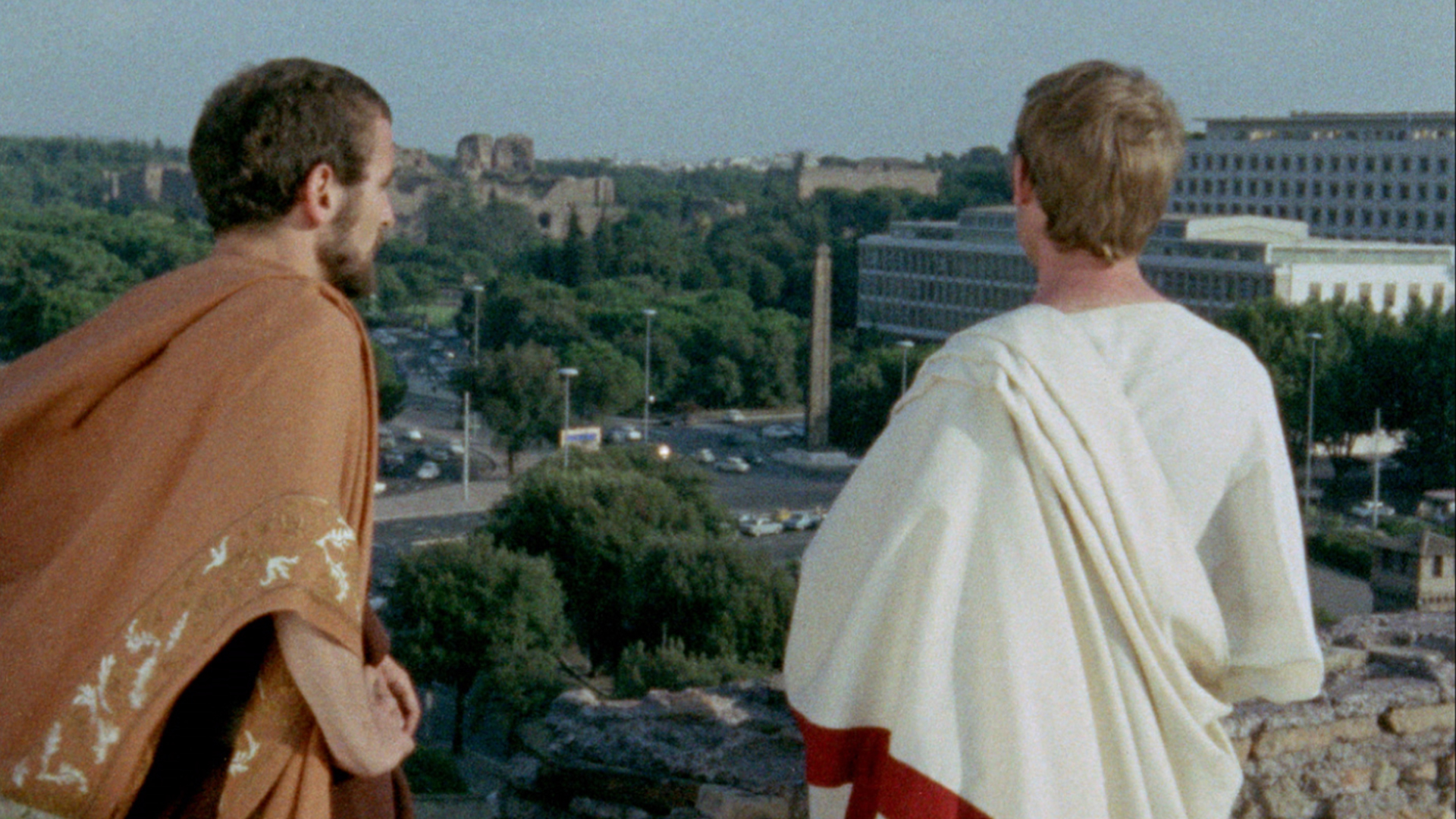
With Jean-Marie Straub and Danièle Huillet again, we have here a legitimately difficult film, an adaptation of a stage play by Pierre Corneille set in Ancient Rome, a series of political and romantic strafes set within the short-lived rule of Emperor Galba, in which ambitious senator Othon finds himself next in line in the power, his mind distracted by being unable to love the woman he desires, who has been forced into the arms of the infamous Roman Emperor Nero. Two young women, Camille, Galba's niece, and Plautine, daughter of the senator Vinius, are in love with Othon. Unfortunately a series of manipulations and power plays will everyone dissatisfied or corrupted, particularly as Lacus (co-director Jean-Marie Straub) wants to keep Orthon in power, and Plautine's father Vinius is trying to manipulate Orthon for his and his daughter's sake even if it means sacrificing both his daughter and Camille.

All that is witnessed is intentionally set as having universal illusions to the follies of people - emphasised as whilst the cast are actors in appropriate dress, they're filmed in regular Italian environments of the time, right in front of backgrounds of cars and streets below, immediately jarring and creating an effect on the viewer. The initial scenes on a hill overlooking the metropolis behind these characters, far from comical, actually have a great effect in showing these characters existing in a timeless state, like ghosts, whose ancestors would keep finding themselves in these scenarios regardless of time and dress.

From http://store.grasshopperfilm.com/mm5/
graphics/00000001/Othon_101.jpg

Orthon
, for me, is an artistic failure but with not want of ambition, an admirable attempt at breaking audience connection with the work to pieces and rebuilding the relationship. Orthon is dense - even next to Robert Bresson's minimalist (and amateur-cast) performances, the dialogue is quickly spoken here, even hastily spoken at a rapid fire, bluntly with little emotion, with the added factor that Danièle Huillet was interest in having the subtitles drop out of purpose which has continued on past her death in Orthon's screenings, leaving (in the version I saw) entirely un-translated scenes. It is almost all minimally shot, though tracking shots of the cast walking around do occasionally happen and stand out artistically as we follow their lengthy conversation in motion. There is also, unintentionally funny at times but also possibly an intentional influence from (of such unexpected a place) Straub's love of directors like Ernst Lubitsch and Charlie Chaplin, a tendency in the midst of long scenes for new participants to abruptly appear on camera as if they have waiting in the wings patiently, a technique that I have to confess is a distinct and creating style you would have to consider using as here rather than abruptly allow to take place. Again, despite the directors' reputation for sternness through the tone of Orthon, it still has a precise style. This is more so as, later on, the locations leave the city panoramas to within woodland, by old fountains, and locations which feel closer to these Ancient Romans even if jarring to our perceived image of them.

The issue is that, the cast always stood still or sat still, you need to engage the viewer even if you desire to obfuscate and/or frustrate them, or the art is pointless. This is another film from these creators which needed to be rewatched, which does help clarify the drama, but unlike Not Reconciled (1965), which innovated in narrative presentation, Orthon especially on another viewing feels pointlessly obtuse. There is no real sense of gain for them from being this flat, rather than minimal, when Robert Bresson's style lead to a stripping away of artifice to find real emotion. Orthon's visual style is still standing out, deliberately contrasting period drama to the then-modern day, but the issue for me is that, whilst a strange suggestion, so much of the cast is just sat or stood around when there should have been minimal drama just from some more movement or some attachment to the material beyond what is seen. Instead, the experience is like watching living statues with a lack of specific reason for their placement.

Again, I view Orthon as a noble failure, as it's a concept which I see the intention of, the universal nature of its drama not dissimilar to the modern day, the juxtaposition infesting to me too. Even the drops in subtitles, like Jean-Luc Godard's later 2010s work, force the viewer to focus on those you do have onscreen and the images when the text vanishes. The structural ideas meant to obfuscate the viewer actually focus one's attention, leading you to avoid the usual habit, which afflicts even me with some films, of drifting off in other thoughts and keeping one alert to properly engage with the material. The stiffness of the performances, however, feel inappropriate, especially as films like Not Reconciled have gained so much more from a minimal but still emotionally engaging acting style that suited Straub-Huillet and still kept to their desire to clearly strip it of all contrived heightened emotion. One little flaw is enough to mar a great concept with Orthon as a result.

Abstract Spectrum: Avant-Garde/Minimalist
Abstract Rating (High/Medium/Low/None): None


From https://jojud265nia2bj9sy4ah9b61-wpengine.netdna-ssl.com/
wp-content/uploads/2017/11/Othon-5-1600x900-c-default.jpg

Monday, 24 June 2019

Not Reconciled (1965)


Director: Jean-Marie Straub
Screenplay: Jean-Marie Straub and Danièle Huillet
Based on a novel by Heinrich Böll
Cast: Heinrich Hargesheimer/ Carlheinz Hargesheimer  as Heinrich Fähmel; Martha Staendner/ Danièle Huillet as Johanna Fähmell; Ulrich Hopmann / Henning Harmssen as Robert Fähmel; Joachim Weiler as Joseph Fähme; Eva-Maria Bold as Ruth Fähmel; Hiltraud Wegener as Marianne; Ernst Kutzinski/Ulrich von Thüna as Schrella

Not Reconciled is a film of significance in the Straub-Huillet filmography in that, on the surface, is an incredibly difficult movie. Adapting from Heinrich Böll again, who provided the source for their first creation, short film Machorka-Muff (1963), Not Reconciled's narrative could spin out an entire two plus hour feature, three generations of the Fähmel family told with World War I and World War II as their backdrop, their lasting effect on Germany depicted through this family. Straub-Huillet, forgoing the ordinary, crush this into fifty three minutes, a whole plot but so trimmed down to the point Not Reconciled (full title Not Reconciled or Only Violence Helps Where Violence Rules) is truly a film you need to see more than once to appreciate. This is a curious thing as, baring repeat screenings in repertory cinemas, this concept is an idea made more easily available decades later in physical media and streaming but a) Not Reconciled (like Straub-Huillet's body of work) was difficult to see once not long ago and b) it's a habit even I am blameable in not taking advantage of, the chemical disposition of the brain that demands "new" viewings and idleness a blight of mine. Thankfully, I watched Not Reconciled more than once.

Here is the paradox with the film - on a first viewing its abstract in how it completely negates the spare time usually denoted to make sense of the narrative, yet when you get what's happening on a repeat viewing, it's not abstract or even remotely avant-garde, just very modernist and precise filmmaking that was (and still is frankly) ahead of its time from the duo. Yet, again, that innovation is unique if not also abstract, so it adds confusion and frustration when most in my spot would say, absolutely, that it's "abstract".   

From http://sensesofcinema.com/assets/uploads/2017/09/
Cteq_HullietStraub_NotReconciled-750x400.jpg

The plot, once decoded, is very clear if the dynamic duo refuse to do beyond voice over or dialogue to describe certain events, leaving one to picture them in our minds or to use the images provided to built a greater emotional resonance attached to them. There are three generations - the first, the second and the third. The first are Heinrich Fähmel and Johanna Fähmell. Heinrich - is an architect who went on to help create a magnificent cathedral in the midst of his curious working habits including a taste for paprika in his morning breakfast; however his wife Johanna, as a result of personal trauma and hostility to the ongoing mania of World War I, openly starts saying anti-Kaiser sentiments in public causing social embarrassment. Whilst it is Heinrich's own son Robert who will help destroy his father's cathedral in his opposition to the Nazis, it is Johanna as an elderly woman who will take the only direct step in response to the collective trauma by acquiring an old gun at of a greenhouse. The second generation is Robert, the son who became a dissident, a trauma in his youth created due to persecution for his involvement with a religious group fixated on the lamb (and knitting) that led to him becoming a demolition expert against the Nazis, all whilst his history both involves having to smuggled to safety (by being wrapped up in a carpet and smuggled on a boat), and also the lost of a loved one as a result of the Nazis. The final generation is Robert's son Joseph, jaded from following on in his architectural studies, whilst in love with a girl, but traversing the site where the destroyed cathedral is with her, the destroyed environments left to be rebuilt and their scars left for us to glance over.

That's not, in the damndest, an attempt at an accurate synopsis, Not Reconciled a very dense and condensed take on Heinrich Böll's novel Billiards at Half-Past Nine, but I will give Not Reconciled so much credit that, like the perfect novella, once you figure out what is exactly going on (even on another viewing) it grows in heft in terms of its language and the emotional gravitas as you are finally able to digest it. There's also the fact that, whilst of the older style of European art cinema in terms of calm pace, a period in betwixt the French New Wave setting a firework under techniques like editing where there were still calm and mannered works like this, this film by completely subtlety is still innovative in forcing the viewing on their toes in ingesting said information. The director/writers would include even more overtly jarring techniques in other work, such as Robert Bresson levels of minimal acting and even having rules (to this day after Huillet's death) for the subtitles to drop out at certain points in certain films, but it's fascinating how in spite of their legendarily po-faced seriousness, to the point at a party thrown by the Italian filmmaker Bernardo Bertolucci people joked about hiding the booze the moment the Straub-Huillets appeared1, they were insanely modern and innovative in these films. This type of precise and matter-of-fact way in cutting the chaff pointed in its ideas, on the spectre of two World Wars on Germany, is entirely inspired the more you think about it.

It's also exceptionally well made, arguably an underappreciated virtue how a film like this was so carefully made and, even here, insanely stylish in a subdued formalism, not a paradox if you consider that, for Not Reconciled to work, the director/writers would've have had to plan out, adapting from an already experimental book no less rather than their own original ideas, what to keep and how to tell it in dialogue and the combination of images. The layering, to confuse one on the first viewing whether we're now in World War I and World War II, is subtle but even that would've been a logistical nightmare to edit together. Especially in lieu of the current day's extreme realism, post-Dogma 95 which requested directors almost stripping away every piece of artifice, this film also looks too stylised and carefully put together with images in mind to NOT be anything by aesthetically styled.

Again, it this truly avant-garde or, for here, even abstract? It's innovative, definitely. Abstract? Going to have to be yes, but with complete knowledge that due to the fact it grows in clarity if you watched it enough, a breeze at fifty three minutes, it's a low mark on the scale as a penalty.  Apt as one of the scenes is on a sports field near the beginning and, like the title, Robert tells his life story to a small boy over a personal game of billiards. Including probably as violent a destroying of a piece of wooden sports equipment as you could get, it's an act of sudden violence, stamping it and pushing down until it breaks in twine, that is bookmarked by the end by what Johanna Fähmell does with the old pistol, ending almost on a comedic note with the matter-of-fact fallout to it.

Abstract Spectrum: Avant-Garde
Abstract Rating (High/Medium/Low/None): Low

From http://sensesofcinema.com/assets/uploads/2017/06/
feature-Philippe-Image-1-750x400.jpg

======
1) HERE (Nice to know even high art European film makers can take the piss out of each other in humour)

Thursday, 6 June 2019

Machorka-Muff (1963)

From https://66.media.tumblr.com/74eb93ec8ddcd123be6593d
1ecff29c8/tumblr_pqmqfqlU7O1w7unbto1_400.png


Directors: Jean-Marie Straub and Danièle Huillet
Screenwriter: Jean-Marie Straub and Danièle Huillet
Based on Bonn Diary by Heinrich Böll
Cast: Erich Kuby as Oberst Erich von Machorka-Muff; Renate Lang as Inniga von Zaster-Pehnunz
Obscurities, Oddities and One-Offs

Straub-Huillet, Jean-Marie Straub and Danièle Huillet, are a duo that evokes weight. They are heavy weights of European art cinema but, in the many discrepancies where prolific names weren't available to us plebeians, are not as well known in English language cinematic culture in comparison to their reputation. Thankfully, knock on wood, the current restorations of their catalogue and widening availability (even physical releases in the USA by Grasshopper Film) will rectify this. Interestingly the first work they ever put together was a short named Machorka-Muff, a very straightforward fragment of narrative stepped in a thick morass of satire. This was far from the image of "difficult" filmmaking as has been presented, and eventually appears, in this duo's work.

Machorka-Muff the character (Erich Kuby) is a former colonel for the Nazi army who is to preside over an opening ceremony for a new institute, as much to salvage the reputation of another high ranking Fascist soldier of yore. He plans to marry Inniga von Zaster-Pehnunz (Renate Lang), in spite of her previous seven marriages and she being a Protestant to his Catholic, with interest in having an adulterous relationship with another's wife since he does enjoy "petty bourgeois eroticism". (Actually, in muted tone, a hilarious line the many times I've watched this eighteen minute short this year; again not expected from Straub-Huillet in the damnedest to be writing actual jokes in their scripts).

He gets the girl, gets to preside over the ceremony and political powers coinciding with public opinion may push for more pro-militarisation, the fragment of a world here, based on a short story by Heinrich Böll, entirely to his favor. And yes, made in 1963, this is only two decades after the defeat of the Fascists and World War II, and is made in West Germany, so this is all disturbing. Hell, this feels disturbing and close to the bone in the 2010s even if you the reader have more conservative politics to me the writer, as it feels the coolest of satires as Machorka-Muff gets all he wants without his past with the Nazis flashing consciousness of guilt.

From https://www.jonathanrosenbaum.net/wp-content/
uploads/2012/10/machorka-muff3.jpg

Straub
, in a written title card, calls this an abstract visual dream, but not abstract in what my view of avant-garde/weird cinema is, played as a narrative clear, calmly (but very well made) short film. It feels however, just into the 1960s, modern for the time, not needing to hammer its concerns home as it itself as a subject should alarm. This also shows their tendencies, within an accessible context, of the directors' trademark of very precisely put together films, cut and constructed so there's no fat to this particularly story; this is something to bear in mind as, with the same author, they also made Not Reconciled (1965), a story told in only fifty three minutes which weaves multiple time frames and situations into one of the densest films possible. Almost deadpan, Machorka-Muff has lines which should elicit perverse amusement as well as disbelief, such as comparing his seven war wounds to Inniga's former seven husbands. How banal all is, even her threat in the last dialogue, that her family's influence can alter politics, just a casual remark pouring tea, is a dark and more honest swipe at far-right wing politics, also itself satire as even these worse case scenarios of the upper class in power are utterly bland individuals if you stop and stare at them like here as zoo exhibitions.

It's not a surprise, when even after World War II former Nazis were said to just be able to go into German politics or the economy without fuss, that Straub-Huillet would make this short as a warning. I suspect all the newspapers they cut to in montage are all real, arguing for remilitarisation of Germany, even Christians arguing that violence can be necessary in opinion pieces, despite a) there being a clear cut difference between just war for soldiers to protect and rampant violent militarisation, and b) no sane Christian should argue for violence over benevolence, and c) this is just over twenty years from when Adolf Hitler was in power.

It's a nice, sudden and sly short to being from; Straub-Huillet, even Straub himself when his life partner passed, have a daunting and large filmography, going from ancient Greek texts to documentaries, a non nonsense almost-documentary view on the legendary composer Bach (originally their intended debut before falling onto Machorka-Muff) to even adapting Franz Kafka. It is nice to know though, like all interesting auteurs, that if they only had a short length of film, they could make something still compelling, and that they weren't averse to accessible cinema as long as it stuck in the craw of the viewer.


From https://assets.mubi.com/images/notebook/post_
images/28029/images-w1400.JPG?1556114804