Showing posts with label Family. Show all posts

Sunday, 16 June 2024

North (1994)


Director: Rob Reiner

Screenplay: Alan Zweibel and Andrew Scheinman

Based on a novel by Alan Zweibel

Cast: Elijah Wood as North, Jon Lovitz as Arthur Belt, Bruce Willis as Bruce Willis, Jason Alexander as North's Father, Alan Arkin as Judge Buckle, Dan Aykroyd as Pa Tex, Kathy Bates as Alaskan Mother, Robert Costanzo as Al, Faith Ford as Donna Nelson, Graham Greene as Alaskan Father, Julia Louis-Dreyfus as North's Mother, Matthew McCurley as Winchell, Reba McEntire as Ma Tex, John Ritter as Ward Nelson, Lauren Tom as Mrs. Ho, Abe Vigoda as Alaskan Grandfather, Keone Young as Governor Ho, Alexander Godunov as Amish Father, Kelly McGillis as Amish Mother, Scarlett Johansson as Laura Nelson

Ephemeral Waves


Before North, a film whose reputation likely exists more than as a film people have seen, director Rob Reiner had a streak of films so highly regarded it would be seen as a golden run - This Is Spinal Tap (1984), The Sure Thing (1985), Stand by Me (1986), The Princess Bride (1987), When Harry Met Sally... (1989), Misery (1990), and the film before North which was a huge box office success, A Few Good Men (1992). After North, his career still continues, but it is with much obscurer films, with North considered a film so notorious its negativity was spoken in shudders when I first heard of it.

The vivid toys of our titular lead's room, played by Elijah Wood, nods to the strange and whimsical story ahead, an adaptation of a novel by Alan Zweibel, co-writer and co-producer for the adaptation, an intentionally strange children's tale with the high concept you would expect for that audience. North is stressed out, and whilst he could be seen as an egotist, who is so good in school and life other children's parents use him as the guilt inducing symbol for asking their children why they do not floss their teeth like North does, it is clearly meant to be an exaggeration for a gag. Whether it works or not, at least Wood himself, before going on legendarily with the Lord of the Rings adaptations, showed his charisma here as a child actor, which is needed for this quirky premise. His story is still a universal one, that fear any child has where they feel their parents ignore them in their busy lives, even the smartest and most talented here finding himself so distant from them it even starts to knock his talents off course badly. He crosses path with Bruce Willis dressed as a pink Easter Bunny, and whilst it is explained he is an employee at an Easter holiday special at a local toy store, the strangeness of the meeting is certainly a set up for the whimsical tale where, when trying to let North know he should accept his parents as they are, Bruce accidentally plants the idea in the kid's head instead to divorce his parents and get new ones.

The film's reputation for being bad is overdone, with all its issues I have seen in comedies and family films, the saccharine touches and jokes not landed universal among them. The one true negative we sadly will have to get to, the stereotypes and jokes which have aged horrifically as time as past, are that bad with time passing, but most of the film is not beyond these scenes as pointless as I had always presumed it to be. This is not that hair pulling nightmare I had been told it was, and blasphemously, I would go to say the most infamous opinion, that of acclaimed film critic Roger Ebert, was melodrama with hindsight. His reaction was clearly sincere, justified in his legendary comment on North that "I hated this movie. Hated hated hated hated hated this movie. Hated it."1. The review itself however is still spoken from a critic famous due to his published but also television film review opinions, so a person who would have made snappy one-liners to sell or dissuade his viewers and readers over films without taking too long to dissect the thing he hated hated hated. In truth, the sins of North are ones we did not dog pile as harshly as other films, and beyond those stereotypes which are awful and cannot be defended, the rest of this comes off with the earnestness of a whimsical tale.

It is telling, to spoil the plot entirely, this is all a dream of North's, that old and sometimes despised cliché in cinema, but the set up if like a milder form of Alice in Wonderland sets up that the exaggeration of a feverish mind in at hand here, naive and viewing the world with the peculiar gags as envisioned by adult men in the co-writer and director's seats, imagining the circumstances when he goes about separating himself from his parents. His father literally works testing trousers in a variety of ways, even with a rabbi in one booth bowing to see if the seams tear in a variety of different scenarios the product could be worn within, setting up this sense of colourful absurdity from the mind of a child, and thus in this world, it is set up this is not a serious or realistic take on child divorce in the slightest, but the perception of what a child would presume would be possible. S child divorce is far easier to pull off then it should be when Jon Lovitz as a sleazy lawyer suddenly drives up to him in a car out of nowhere and can get all the ticks marked for the trial to be a success, quickly as North comes up with the plan. It comes with a hitch though - North has until Labour Day to choose his parents (or go back to his biological ones) to avoid going to an orphanage, and whilst he goes off into the world to find them, Lovitz and the bright but evil kid in charge of the school newspaper take advantage of this. As the children of North's town start rebelling against their own parents in response, this pair decide that even if getting rid of North has to be done, the power they now have with Lovitz potentially up to becoming the US president is too important for North to realise he always loved his biological father and mother. The obvious cliché that North will realise he loves his parents is something we find in so many family films in structure, so I cannot dismiss this as a hoary cliché either.

The premise, as the kids back home start to mutiny against their parents for their right to freedom, definitely is based on a fun sounding young teen/children's novel, and unfortunately where the problems I have with the film begin and end are the stereotypes that make up the meat of the film, the absurd takes on all the families that make themselves known to North they would take him as their adopted son. At first, there is more a playful absurdity to Dan Aykroyd and Reba McEntire being so Texan as a potential new family, their limoscene is longer than some trains, and includes an abrupt musical number about everything being big in Texas to the Rawhide theme. There is definitely a children's film dream logic at play here to, welcomed, more so as, following its final punch line of North waking up and how Bruce Willis both sets this up and is the narrator, he constantly re-appears seemingly as different people with the same face in every location North ends up at trying to find new parents. It is one of the aspects which works, and sets up someone thing if as fluffy and quick to consume as candy floss, which is not a bad thing, especially if the jokes about the parents North chooses between could play to the jokes of stereotypical nuclear family dynamics.


Where the problem lies comes with the idea that, in a grimmer work, you could touch on the uncomfortable subject of how stereotypes are ingrained in kids and thus their imaginations are imbued on them, a theme that could have been tackled with sensitivity if this had been not a straightforward children's film, but a grim comedy. That is not the case however, as these are played as straight forward jokes that you are supposed to enjoy; it is the moment I do agree with Gene Siskel, who brings this up in his review with Roger Ebert on the Siskel and Ebert review, where he said the "ethnic stereotyping is appalling"2, and they have aged like a fine murder. Parents from Hawaii leads to typical Hawaii imagery for a governor and wife unable to have children, if getting into the weird joke about the new promotional sign including North's butt crack being expose by an octopus for an uncomfortable gag. Worse however comes in Alaska and an Inuit couple, not called that, which involves Kathy Bates and others in brown face, which is absolutely cringe inducing when the joke could have worked. Beyond the grim one of sending grandpa out to freeze to death, which does continue into the stereotyping, there is a playful joke here of imaginary Inuit suburbia, where one needs to mow the icy lawn and the dog sledge goes into the garage of the stereotypical igloo suburban house, a production design joke I think is not offensive if it was mocking the stereotypical image of Inuit culture from their side positively. Sadly, that is clearly not the case, and more of these jokes get worse. By that point, then you get the African tribe joke about the women being topless, which fall into this type of terrible humour that we sadly still got into films decades after and other films should be found guilty of, especially as they are lazy as they are dreadful. China is reduced into the least expected reference to Bernardo Bertolucci's The Last Emperor (1988), and even the joke about the French wearing berets and Jerry Lewis films appearing on every TV channel just emphasise the lazy, toe curling tone of a film made for kids but clearly absorbing its adult creator's worse tendencies. That is the side of North which is as bad as it sounds, and is just bad comedy in general, especially as the obvious joke about an Amish family North considers just reminded me why "Weird Al" Yankovic's parody song Amish Paradise was actually funny.

This is all a shame as, whilst syrupy in the truest sense, a weird and sometimes sick humoured fantasy exists in this premise, literally the fevered dream of a young boy, which could have worked. Ebert's anger of how the film glibly plays with the idea of a child could with ease dispose of his parents1 does ignore that the point of the film, whether it succeeds or shoots itself in the foot by not hitting the tone successfully, that this is meant as a perverse fantasy from the perspective of a nine year old. He is angry at his parents, concocts the idea, plays it out and it is as ill-conceived as you would expect from a child still yet to fully mature, and develop through his teenage and adult years the weight of the ties to his parents. The narrative arch, whilst gleefully enjoying the idea, when North's divorce succeeds, of parents kowtowing to their children's every needs in role reversal fears, is about why North's divorce is not a good idea at all, conservative as a conclusion in its final but with that obvious, saccharine realisation the thing most of us, even the cynics, would admit is the right ending. Some may argue for a more twisted conclusion, but as a family comedy, the point is the humour from its weird journey until North realises his mistake.

When his parents are shocked by his actions and end up frozen in place, positioned behind glass at the Smithsonian Institution for exhibit for the momentous event they were part of, you see how none of this is anchored in conventional reality, but a picture book for the more quirkier of humour. Tellingly, the original author and co-writer Alan Zweibel was also a writer on Saturday Night Live from when it originally began, and a consulting producer on Curb Your Enthusiasm among his long career, so the more bizarre and more adult moments of humour fit the sense this is a stranger concoction of these earnest themes of loving your parents with the eyebrow lifts at the more twisted jokes.

The production design when allowed to play with this kid's logic in the real world, exaggerating the locations, works when allowed to be, even if one moment is a pop, in the evil corporate headquarters where the evil kid and Jon Lovitz are scheming, just because you get to see then-1992/4 arcade videogame cabinets all in a row to show their true decadence, including a bizarre (but great) animated cartoon tie-in from Konami called Wild West C.O.W.-Boys of Moo Mesa (1992). Bruce Willis, who did come from comedy originally and was once viewed as a weird choice for Die Hard (1988), fits as a phantom shape shifter who appears everywhere, as a beach comber to being a chain-smoking stand-up comedian hired for a smoke alarm manufacture's convention, one of the strangest jokes but in hindsight working for that reason it shouldn't. The Clarence Odbody/Guardian Angel role to push North to the obvious message at the heart of the film works, and when the North film itself plays to this whimsical tone, I think its reputation is not as deserved. Even when it gets really twisted, North ending up in New York City with a hit man hired to try to murder a child, the tonal shift fits as part of this era of mainstream nineties cinema which had these tonal shifts and sense of playful weirdness at their heart.

All my problems is that, at its centre, you have to suffer through jokes which are dreadful, but we can also look to films which were not failures and loved at the time, like the Ace Venture Pet Detective films I grew up with as a kid with Jim Carrey, and see that problematic and offensive jokes were everywhere. I deliberately choose an example with jokes far worse than those in North to point that out, even if I will not defend North's either. This feels like, for the most part, when a director in Rob Reiner managed to create so many films now considered iconic and beloved, and in a variety of genres in a row, eventually when made the one which falters, it gets a shock reaction from viewers who loved everything before. Were it not for the jokes which are problematic, the sin of North is that it is ill thought-out, the best version of this never coming to be when I find moments which work beautifully, but all from an idea that needed to be properly fleshed out. Maybe it needed to even offend Roger Ebert more by playing with the idea of a child gladly divorcing his parents, startling a target child audience and their parents with the fantasy even in a kid film friendly tone, before reaching that warming ending, like a perverse fantasy comedy take on when It's a Wonderful Life (1946) got to the Potter's Field version of its central town. The nineties, even in children's TV animation I grew up with, relished the more overtly adult and cynical sense of humour, and whilst North was clearly made with the theme of loving one's parents, the joke of children rebelling against their parents, and the wackier production design choices, should have been lent on.

North instead is a film we never got a DVD release of in the United Kingdom, let alone Blu Ray, a lost Rob Reiner film which was not a box office success at all even without the negative reviews, so thus quietly buried like a few of the more notorious films from the nineties which, due to coming from the VHS era, you cannot find a second hand DVD copy unlike the 2000s and 2010s equivalents of notorious pictures from major studios. Naturally it is a film tied to the Golden Raspberry Award, a contentious award ceremony for "bad films" in the sense they come from a more ironic time before, starting in the 1980 when Michael and Harry Medved's The Golden Turkey Awards was also published, but somewhat lost to how in the internet era now you can not only dig up much more "bad" cinema, but you get weirdoes like myself on blogs defending a couple of them as actually things we enjoyed. Hilariously another Bruce Willis film stole the Golden Raspberry Award from North at the 15th event in March 26th 1995. That would be the erotic thriller Color of Night (1994), which will not be elaborated upon as it would be inappropriate to in a review of a film targeted to a family audience, and because that film needs its own review to unpack.

=====

1) Roger Ebert's review of North, published July 22, 1994

2) Siskel and Ebert, Season 8 Episode 44, The Client/Lassie/It Could Happen to You/North/Barcelona, aired July 23rd 1994.

Wednesday, 26 October 2022

Children of the Stones (1977)


Created by Jeremy Burnham and Trevor Ray

Director: Peter Graham Scott

Screenplay: Jeremy Burnham and Trevor Ray

Cast: Gareth Thomas as Adam; Veronica Strong as Margaret; Peter Demin as Matthew; Ruth Dunning as Mrs. Crabtree; Iain Cuthbertson as Hendrick; Katharine Levy as Sandra; Freddie Jones as Dai

A Night of a Thousand Horror (Shows)


Make it a sherbet butty.

The main theme by music composer Sidney Sager - a breathless chorus of voices - is enough in its distinctness and unnerving form to signpost Children of the Stones, this unsettling ethereal theme to be heard as the main motif and the opening credits piece for all seven episodes of this West HTV Production. Sidney Sager - whose filmography is smaller than I would have presumed but does include episodes of The World About Us (1967-1987), a documentary series about geography, anthropology, and natural history subjects, befitting the tone of this series - did have an extensive career as a composer and conductor, so thankfully his work would have been appreciated in other mediums, here making his mark among many people here in Children of the Stones being a very rewarding dip into British supernatural television from the past.

For clarification, HTV Production is tied to ITV which, launched in 1955 as Independent Television, is a cultural landmark for television anyone from the United Kingdom. Everyone has grown up with unless born before 1955. ITV is the oldest commercial network in the UK, and wishing to let any non-British readers of this review have some context, they became for the early years of television the first big rival for the BBC. They were also a network of separate companies which provided regional television services and also shared programmes between each other to be shown on the entire network, which is where West HTV Production comes in. Eventually they became ITV Wales & West, until December 31st 2013, and thus afterwards being separated into ITV Cymru Wales for Wales and ITV West Country covering the both the West of England sub-region and South West England1.

The broadcasting area was divided into two sub-regions, Wales and the West of England, which is apt as Children of the Stones, whilst set in the made up community of Milbury, is shot in Avebury, Wiltshire, one of the locations covered in their broadcasting at the time. This series would have been broadcast across the country beyond HTV Production, unleashing this unconventional mini-series that, whilst a fantasy story with sci-fi edges, is befittingly dread inducing like a horror story. The "stones" is a stone circle, fifty three, part of the small village of Milbury, where astrophysics professor Adam (Gareth Thomas) and his son Matthew (Peter Demin) are to stay there for three months, part of the father's research on this pagan formation. The stones are the Avebury stone circle, viewed to have been built between 2850 BC and 2200 BC, and seen in this mini-series in aerial shots as a huge circular stone circle which in turn encloses two smaller stone circles2. Originally 100 stones2, there is an argument it is a worship place, but exists in the same way as Stonehenge, a legendary location further in Salisbury Plain in Wiltshire, as an ancient heritage site whose origins and reasons behind it are mysterious, befitting Children of the Stones' esoteric narrative flourishes. Since these incredible ancient monuments exist, why not use them onscreen too?

The entire plot stems from Matthew finding a painting of a stone circle involving a Pagan ritual and a light in the centre from the sky. The painting is enough to cause the elder female maid at the home they are living in to faint, but considering the landlord, and head of the village Hendrick (Iain Cuthbertson), is encouraging both to stay longer, Milbury is an immediately suspicious place. When the term "happy one" and "unhappy one" are used by even by the kids, it is a sign this community is strange, clearly a village of aliens or brain washing with regular people the dwindling minority, where even the classrooms are divided into high level mathematics and forcing the "normals" and the farm boys with simpler sums. What it is, where the locals can just disappear on nights leaving the newcomers alone, is knee deep into the esoteric fortean culture popular at the time, alongside what would become "hauntology" decades after in British pop culture from this time having an uneasiness stemming from the combination of the urban and the rural in our island country. The centre of fifty three ley lines, it is a place of astrological connections, a supernova in the time before Christ documented in Milbury, with a black hole where it is and where the rocks are pointed. Here we are in Pagan versus modern cultural territory, a bear cult in the past around this place and psionic powers involved, which Matthew develops after a glancing touch of one of the stones.

Children of the Stones does evoke fear of conformity; specifically the notion of village life, where everyone knows everyone, as a virtue is undercut, instead posing the chilling idea of everyone being without their real selves, with the juxtaposition of the metropolises in the leads being outsiders against this rural place. The thing I have not mentioned until now is that this is a show made for children, whilst makes Children of the Stones even more interesting as, barring some dialogue and exposition which is heavy handed, this never talks down to its target audience and has all this eerie content which is just as distinct for a viewer of any age group. The creators and writers Jeremy Burnham and Trevor Ray deserve their credit as everyone on and off-screen do. Jeremy Burnham was as much a prolific actor in television and film as a writer, whilst Trevor Ray was more of an actor, with only three credits to his writing career - this, another ITV mini-series Raven (1977), another children's show dealing with Arthurian legends which he worked with Jeremy Burnham for, and an unaccredited hand in The Ambassadors of Death: Episode 1, a Doctor Who episode. It is hilarious that Morris dancing, the most innocuous of folk traditions, is held as a sign of being brainwashed, but for a children's show to scrutinise the notion of an idealised rural community life, the "good old days" concept, as being a sign of being docile and without emotion, is a sticking point for the better, knowing this is family entertainment offering the notion, when we learn the secret of the village, that removing all sadness and permanent happiness is itself controlling.

The smartness of the show, working around its style, is really rewarding. Like a lot of British television dramas from this time, there are stage set interior scenes but a lot of on-location exterior ones, having to work around some aged effects but mostly a dialogue driven show with a creepy edge. The cast is full of people who would have been prolific at the time in various mediums, which includes the delightful appearance of Freddie Jones as Dai, a poacher and one of the few "normals" who has stuck around for a long time in the village, Jones' legacy as much for the likes of David Lynch's The Elephant Man (1980) and it is the ITV soap opera Emmerdale.

The music from Sidney Sager, the one main theme, really does enough in itself to being discomforting, and there are plenty of macabre and openly odd touches to the story. People turn into stone and/or die, and you cannot leave Milbury because, not only does it exist within a protective barrier, but is revealed to exist in its own time zone. Some of the content which is of its era, proudly sticking itself into the fascination with esotericism from the time, may be eyebrow raising for some viewers, but alongside the matter-of-factness the show has for it, taking it serious, but this is in mind to the period it was made. That, being between the British and the North Americans, if not anywhere else, the seventies if rife with the occult and the unexplained as pop cultural fascinating, this screening on television at a time Uri Geller would have already been famous for the likes of bending spoons with his mind and already being challenge by the likes of James Randi, alongside a lot of strange films from the era in the occult and horror which helped created the future Hauntology interest. This fully embraces psychometric themes including psychic powers, which as it is told sincerely is more rewarding than cheesy.

It also has a rare example of a father and son relationship with the leads, and with actors Gareth Thomas and Peter Demin, it is a good one. Matthew, barring his eccentric humour in eating bizarre combinations of fillings for sandwiches, transgressing the savoury and sweet food lines, is a teenager who is as smart as his father, who is neither played as a dolt. This is a horror story where they manage to outsmart the villain with something actually clever - using science to manipulate the clocks in their favour - and this intelligence, or least the sense of letting the characters being alert and act sensibly in this increasingly perverse village, is a huge virtue to Children of the Stones. It is a good show, a sci-fi thriller which does touch horror in its own way, telling even its more unconventional aspects straight faced, as serious drama which never drags over its seven episodes less than thirty minutes each, succeeding as a result .


======

1) ITV Cymru Wales news shake-up under new Ofcom licence, written by Huw Thomas for BBC.co.uk and published on July 23rd 2013

2) A small biography of Avebury for the English Heritage website.

Sunday, 14 February 2021

Standing Ovation (2010)


Director: Stewart Raffill

Screenplay: Stewart Raffill

Cast: Kayla Jackson Cruz as Brittany O'Brien; Alanna Polombo as Alanna Wannabe; Pilar Martin as Blaze; Kayla Raparelli as Cameron; Najee Wilson as Maya; Alexis Biesiada as Tatiana; Joei DeCarlo as Joei Battaluci; Bobby Harper as Mr. Wannabe; Austin Powell as Mark O'Brien; P. Brendan Mulvey as Gramps; William McKenna as Eric Bateman

An Abstract List Candidate

I feel like a sick muppet.

Children's films are an area where so many films are made, excluding animation and focusing on live action, I would not be surprises some strange productions were created and product was churned out like exploitation movies were. Naturally, the reason I am here with Standing Ovation is because of the reputation of its director Stewart Raffill, who helmed The Ice Pirates (1984) but also Mac and Me (1988), an infamous film following the success of E.T. the Extra-Terrestrial (1982) sponsored by McDonalds and Coca-Cola, and Tammy and the T-Rex (1994), already curious as a film where a young Denise Richard's boyfriend Paul Walker dies but has his brain transplanted into a full sized robotic tyrannosaurus rex, which came back into resurgence in the late 2010s when the original R rated version with gore was relocated.

Standing Ovation from the start did make me worry, about tween female singing groups competing in a competition where they have to create a music video, that his would send the wrong messages by accident seeing young girls in full makeup and dresses onscreen. Thankfully, baring a young belly dancer, this is just a peculiar children's music film. One, oddly, I did not get the reaction to I was hoping for, as this is a film which was a complete failure in its small theatrical release in the USA, getting a small cult of morbid adult cineastes who view this film as bonkers and became obsessed with this over the passing years online. I think because, from the get-go, I hold children's films as being more likely to be strange, cheesy and capable of scraping the bottom of a barrel, so the film alongside its pop aesthetic and music softened the construction of the production.

Boiled to its basis, the two teams are the 5 Ovations, including the lead Brittany O'Brien (Kayla Jackson Cruz), who have to face the Wiggies, a very sinister name for a legitimately mean group, daughters of a wig maker who, with his wealth, can fund them for an unfair disadvantage as well as their own tendency to cheat, such as bribing a stagehand to put pepper in the headset microphones. It is a simple tale of young teen girls aspiring to musical success, but this has some eyebrow raising content, likely to have a greater effect on some viewers not immune to this film's tone like I clearly was. Living with an older brother who is, to her horror, dating one of the Wiggies and writing their lyrics, the only adult in Brittany's is her grandfather, who also has the broadest Irish accent I have heard in a while. He also has a gambling addiction problem, spending the rent continually, which leads to a dramatic scene early on in a bookies watching horse racing on a screen, which you normally do not see in children's media.

Mostly Standing Ovation is very conventional in the narrative, even in terms of a character like Alanna Wannabe (Alanna Polombo), a younger girl who keeps invading everyone's groups and performances trying to crowbar her way to success, eventually with her father just creating her own music video with firemen as improvised back-up dancers. Far more idiosyncratic is Joei (Joei DeCarlo), the new child manager for the 5 Ovations and the daughter of a mob boss. She becomes the best character for me and part of the one legitimately strange aspect of this film, her entire subplot of regaining lost money stolen from her father which sticks out like a sore thumb in a film about singing competitions tonally. I like the character, a tough hearted asthmatic girl, including the bizarre detail she carried around with her exotic and dangerous animals with her, played by real ones (barring stand-ins) whilst still being as safe with them as possible on a production. They are even used to interrogate adults in his journey for the money, threatening one arcade owner and former criminal by trapping him in one of his own claw machines with a cobra. In close up with the actor, it is fake, but they got a real cobra for the job which is surreal to witness in a film from the 2010s, not an old seventies exploitation film for adults.

Aside from this however, Standing Ovation is sickly sweet and merely average. A lot of the reputation is that, whilst Stewart Raffill and the producers still had a bit of budget to work with, this is a low budget film in the then-new 2010s, and the infamous nature of the film comes from its production value and curious touches, like the amount of hats the young male cast wear, that feel unlikely to sell to the tweenager audience of this new era. None of this really added anything as the production values I have witnessed in other work were lower than this, alongside the knowledge so many children's films are made, which means I am not surprised there are very low budget ones in existence. Even the abrupt appearance of adult punks antagonising the child cast had no effect as I have a bias of children's films, or films for families, inexplicably putting material like this in their films which is antiquated in the modern day.

The tone is also the issue, where one film can perplex me and another like Standing Ovation does not. This is a very conventionally pace narrative, one whose style is the more eccentric even in mind of its genre allowing liberties like this but is not fully committing to this even by accident to win me over. In a more eccentric film, Mr. Wiggs (Sal Dupree), the father of the Wiggies and their funder, would be such a stranger figure in a different context, an exaggerated larger figured man who wears a variety of wigs and has a stand in his own home, with a jukebox onstage, to allow his charges to sing classic American bubblegum pop to guests. Neither will I bat an eyelid at something like Joei sneaking frogs into the Wiggies' soup in a restaurant, as that sort of prank is commonplace in this cinema to get payback.

As much of the review is influenced by being the person who does not want to cruelly dismiss the child casts' acting and singing ability, but at the same time nothing in the film was incredibly bad in my own tastes nor spectacular at all to point out.  Only an ending with finding Brittany's dad, skirting the idea money can heal old wounds, can count as a questionable production choice but it also feels rushed. If I have to call Standing Ovation anything, it does slowly reach a 21st century form of kitsch, still sincere but self reflecting of the past and the new technology of when it was made. It does play straight, with humour to a small child trying to get firemen to be sufficient dancers, marching in front of the line as a tiny girl as if she was Bob Fosse, and all the humour playful than thankfully anything remotely mean or cruel. An attempt at trying to sabotage the 5 Ovations's music video by the Wiggies turns into the kind of onscreen crude effects from the time whilst also evoking Nickelodeon I watched as a child. And there is a scene, where the 5 Ovations have to perform in a retirement home for extra cash, which includes old time jitterbugging, again something I highly doubt the target audience would be interested in. Again, this was a film which was not a success, critically panned and a curiosity for people who were not the target audience to latch onto by the end of the 2010s. It is an ironic ending for the film, to have an audience but not the one it was expecting, and the really mean critique if I have any is that this film, from the get-go, would have been a failure regardless of quality due to being a production entirely out-of-time and current culture in terms of the audience it wanted.

Abstract Spectrum: Eccentric

Abstract Rating (High/Medium/Low/None): None

Tuesday, 10 November 2020

Dracula: The Series (1990)


Directors: Allan Eastman, René Bonnière, Allan King, Randy Bradshaw, Allan Kroeker, Jeff Woolnough, Michael Sloan, Joe Dea

Screenplay: Glenn Davis, William Laurin, Philip Bedard, Larry Lalonde, Peter Meech, Stu Woolley, Sean Kelly, Pascal Bonniere, Sharon Corder, Michael K. Ross

Cast: Bernard Behrens as  Gustav Helsing; Geordie Johnson as  Alexander Lucard; Mia Kirshner as Sophie Metternich; Joe Roncetti as Christopher Townsend; Jacob Tierney as Max Townsend; Geraint Wyn Davies as Klaus Helsing

A Night of a Thousand Horror (Shows) #35


Call it very bad work, but between (on an estimate) a start in March to October 30th transpired to just watch one season of television that only lasted for one season and twenty one episodes. That is pretty lazy and could easily resoundingly prevent a decent review of a show being possible. Except that one of the biggest reasons behind this comically long delay between viewing episodes is what is part of this show's weird paradox, one of the show's biggest weaknesses, and yet a contributor to it generating an odd fondness too over this long time with the production.

Mainly, as a Canadian live action horror show for children, it is entirely episodic baring some references back to previous stories. Baring three episodes that link together, this show which is less than thirty minutes long per episode is so conventional that it is repeating the same plot point in new guises for the most part, that it introduces a crisis, runs through it swiftly, and resolves it with normalcy, even in terms of when major characters get turn into vampires. Because normalcy is swift, and the show is very repetitious, Dracula was not a series to try have binged in rapid succession anyway even if I had attempted it.

Premise wise, it updates the Bram Stoker character by making him a yuppie in charge of a huge European corporation, under the alias of Alexander Lucard, the show following two American boys, teenager Chris (Joe Roncetti) and his younger brother Max (Jacob Tierney), living with their uncle Gustav Hellsing (Bernard Behrens), whilst their mother travels for work, and being pulled into Gustav's world of vampire hunting and facing Dracula, who just lives a few blocks down from them in a castle. Add among them Sophie (Mia Kirshner), the young and smart friend of Uncle Gustav, and the resulting narrative is repetitious as a Saturday morning show I myself might have grown up with would have been, where until the final episode everything remains exactly the same with the variety of vampires and peril at hand. It does admittedly lead to the great aspect that, eventually never to get tingaround to killing each other, Dracula and the heroes will start to soften to each other, but this repetition is a huge factor to consider with the show.

Much of the show is populated by archetypes. Chris is a teenager, interested in girls and rock music; Max is meant to be the enthusiastic surrogate for an audience, becoming the one enticed by vampire hunting, but there are entire episodes that transpire only because Max did something dumb to let their household become terrified, like removing a sacred cross over the doorway designed to shot lightning at vampires. Sophie out of the three young cast members is the most dynamic, including a potential romance with Chris; between work with Atom Egoyan, only four later on Exotica (1994), and The L-Word (2004-9), Mia Kirshner's career went on. Her episode when Sophie is turned evil, which is not a spoiler to ruin frankly, does show one of the many scenes where she gets to stand out considerably.

Bernard Behrens as Gustav is also charismatic, playing a charming character in his own right. His is meant to be "vaguely" German, in this Canadian production shot in Luxembourg, which means he likes polka and especially schnitzel, which in this world in "Europe" can be ordered as a late night takeaway from a company with a slogan with too much innuendo involved ("Hot & Steamy") for a kid's show1. Thankfully Behrens as Gustav, in one of the show's best aspects, gets to play a character who can wiggle around in this stereotype, both the accomplish vampire hunter and the lovably bumbling figure without that even becoming a joke just to bury the character. In fact, for times the show even allows him to contemplate his fear of aging occasionally; sadly due to the short length of the episodes, usually split into a main and subplot, one of the most intriguing is about him meeting an old friend in a care home, who may have dementia but claims there is a vampire killing the residents, one that is left underused until Bubba Ho Tep (2004) tried for a feature with a mummy and Elvis on the premise.

The actor however, alongside the character, which really holds the show up from its many flaws, including the second-to-last episode being a clip show with some new content, is Geordie Johnson as the titular Dracula/Alexander Lucard. He does do a vague "Bela Lugosi-like" accent, but with Johnson, mainly a steward of television, you thankfully have someone who is in all the episodes and is a huge support to the show as a charismatic villain you secretly love. And it is not to undersell Johnson in how important he is for the show, especially with the sense now that sadly not a lot of his filmography would categorise for the material I usually cover, a shame as it would have been great for him to return as an obscure figure to become a fan of and discover more of. The version of Dracula he plays, whilst underexploited in premise, is also inspired - for those too young to know what a "yuppie" is, they came to be as a term during the economic boom in the United States during the eighties, of powerful and affluent businessmen, the term eventually carrying the idea of being corrupt and hateable. Hence, why it is inspired to imagine Dracula, whilst also still feeding off mortals and increasing his vampire servants, would own a vast economic empire which crushed its competition whilst he existed among mortal humans.

A connoisseur of art and cultured, even meeting Pablo Picasso and getting his portrait done by him, Dracula is a chad and a villain but Johnson makes him charismatic. Eventually the heroes keep invading his castle, almost if not every episode, until the point they all develop a mutual bond with each other. There are plenty of moments where this version of the Stoker character gains personality through this version. Such as talking about Stoker, when he and Gustav seem to be doomed to die in an explosion in a room they are trapped in together, finding it good for his career, but wishing Laurence Oliver played him over Lugosi. Admitting he always wanted a room where the walls crushed people after seeing a film, and having the funds to have it built. That he is obsessed with George Bernard Shaw play Pygmalion, about an intellectual transforming a common woman into an elegant lady, and deciding to try it with a woman who he encounters abruptly in his office. That one entire episode, one of the last, is built around him becoming involved due to his horror at another vampire making inferior zombies from his bitten victims.

The paradox with Dracula: The Series is that it was insanely repetitive and banal a lot of the time, very simplistic and a lot of cheese, yet I think of so many silly moments which hit the mark fully. The episode where Chris and Sophie decide to join forces to help his music career, leading to pretentious spoken word poetry and dancing to his guitar playing as the running joke. The character of Klaus (Geraint Wyn Davies), actually Gustav's son who was turned into a vampire by Dracula; at first it plays almost with homoerotic energy, when he is introduced without any back-story yet shown, where he and Dracula live in the castle together trading Shakespeare quotations, eventually becoming even worse a figure than Dracula and biting the scenery with aplomb. That it squanders many great ideas but still wrings something from them. Dracula helping in solving counterfeit art fraud, or the many vampires introduced wishing to take his power from him. Like this world having its own form of Nosferatu too, or in one of the more memorable episodes, a silent film actor living secretly in an old cinema, turned into a vampire in hope to be an immortal actor but instead a tragic figure as he can no longer be caught on film cameras and is averse to blood. One character is introduced in one episode only is a fascinating figure to have in vampire fiction, a vampire doctor, not defined as one himself, who treats a deathly ill Dracula, chastising him for eating mortal food, walking outside in the daytime, not getting enough sleep and biting anyone regardless of "bad blood".

Even something as utterly goofy can have an unexpected joy, such as an episode abruptly opening up with a parody of the ending of Casablanca (1942), of Humphrey Bogart and Ingrid Bergman on the airplane strip, but imaging Alexander Lucard as a Nazi vampire and still shot in black-and-white. All the bad aspects - its repetition, lack of threat and many lame plots hastily covered - are a huge detriment and why I hesitated to get through the episodes. Yet there was so much to admire, to the point I nonetheless gain a fondness for the show, like a friend who visited occasionally.

[Major Spoiler] After many episodic episodes, Dracula does at least have an ending. It includes an odd science fiction aspect, which using a gap in the space-time continuum, there is such a thing as "Dracula's space hole" (stealing that joke fully from the Cancelled Too Soon podcast, about cancelled one season shows where I first learnt of this series2). There is a major shift as, with their mother planning to take them back to the United States and Sophie joining them, there would have been a drastic location shift for a second season alongside Gustav entering the space hole, a blue void, with Dracula and Klaus. [Spoilers End]

It is a show which worked on a low budget, though to its credit it was shot in Europe, with the decency to use actual European Gothic locations. Its sense of its industry in found not even just found in figures like Kirshner having a long career as a Canadian actress, but how some episodes are directed by Allan King, a filmmaker of documentaries like Warrendale (1967) who has a following for some, even gracing the Criterion label of film releases to show his reputation, but here working as a journeyman on this Canadian family friendly production among other shows he worked on much later in his career. Again, this is not a great show ultimately, but it has a charm. Whether that is just because of how long it took to watch the series, digging into my thoughts, or with actual virtues is fifty-fifty in the end. Those pleasures were there whilst the experience lasted though.


======

1) And contrary to all these years believing a schnitzel was a type of sausage, out of ignorance, it is actually cutlets of meat usually breaded and fried, the equivalent which makes every German stereotype of them liking schnitzel also even more out of place and weird let alone offensive. I mean, yes, I am sure you could put a cutlets in a bun, but now knowing what a schnitzel is thanks to this show really makes the particular stereotype of Germans weirder, that someone choose a dish of theirs more practical to eat on a dish with sauces as a way to label Germans as one note.

2) HERE.

Friday, 1 November 2019

The Sweet House of Horror (1989)

From https://images-na.ssl-images-amazon.com
/images/I/51AHG170RML._SY445_.jpg


Director: Lucio Fulci
Screenplay: Lucio Fulci, Vincenzo Mannino and Gigliola Battaglini
Cast: Jean-Christophe Brétignière as Carlo; Cinzia Monreale as Marcia; Lubka Lenzi as Mary Valdi; Lino Salemme as Guido; Franco Diogene as Mr. Coby; Vernon Dobtcheff as The Exorcist; Giuliano Gensini as Marco; Ilary Blasi as Sarah; Dante Fioretti as Father O'Toole; Pascal Persiano as Roberto Valdi

As expected for a late period Fulci film, this has gore, kicking off with a thief who is discovered in a heterosexual couple's home deciding to silence them in particularly nasty ways, even involving eyeball trauma.

You'd not expect a Fulci film to have a tone closer to a family film after that however, in which their orphaned children, living with their uncle and aunt in the same house, stay in contact with the ghosts of their parents. That certainly leaves the film a difficult one to market, which it proved to be - The Sweet House of Horror was originally part of a planned four part TV anthology of feature length films, two made by Fulci (the second The House of Clocks (1989)) and two by Umberto Lenzi. All of them were deemed inappropriate to show on Italian television and weren't even released in Italian until the 2000s. They did however get worldwide release, as two shot on 16mm films, possibly why we got the benefit of Fulci's two getting UK releases through Vipco, an infamous company who held a banner aloft for Video Nasties in the 90s VHS, lurid TV ads late at night on the Sci-Fi Channel when I was growing up, and films with some exceptions now getting Blu-Ray releases which could even be VHS rips on DVD depending on the title.

The Sweet House of Horror also comes from the last period in Fulci's career before his 1996 death, in which even to the bizarre films he made before in horror, his cinema got stranger and much more difficult to pin down as his late period from the late eighties to nineties when they were not held considerably well at all. This was when A Cat in the Brain (1990) was released, in which he made a meta-film about himself being influenced by the gory horror films he was making using clips from his and others' work from the time. The tone is perfectly encapsulated by the funeral scene, in which the kids, two moppets who could be irritating to many, are sad their father and mother are dead but have been allowed to chew bubblegum throughout and mock the aging priest for his rambling in the sermon. From there they will have to go against a real estate man, mainly by tormenting him and breaking his leg with psychic stair manipulation powers, and a Rasputin-like medium, all whilst the film has this whimsical tone about them hanging around their parent's ghosts despite the tone suggesting Henry James ' The Turn of the Screw at first.

From https://m.media-amazon.com/images/M/MV5BODAwYjkzNGQtNmQyMS00NjFjLTgwZjctNmU4ZmYyYmVjZmJkXkEyXkFqc
GdeQXVyNzU1NzE3NTg@._V1_CR0,45,480,270_AL_UX477_CR0,0,477,268_AL_.jpg

These films at this point are difficult to define for their genre in Fulci's career*, particularly as the film is clearly meant to be a whimsical supernatural drama but there's the horror trademarks of his still pronounced throughout, looking like a film of the director's at the time right down to the obsession with fake fog on the set, to the gore which is only a couple of times but has his trademark. That, even if incredibly fake, that arguably makes it more disgusting and unsettling in how prolonged and pornographic his gaze at it is against the fake texture of the practical effects. Which is definitely out of place in the tone, where a lot of the film is also clearly meant to play off as comedic or charming - an attempt by the owners to leave the house leads to the car floating in the air with its wheels spinning, a practical effect I will admit I wonder how they pulled off, to the delight of the kids when the car's turned back. Even when the kids try to communicate to the dead and use black magic, in trick and treat costumes, it's meant to be light. But the presentation is incredibly jarring.

Tonally coming off like it is originally going to be the ghosts corrupting the children, its instead something curiously odder with the English dub having a sloppier air to it than usual in Italian genre cinema. Beyond this, there is a lot of tangents that are dishevelled in placement furtger. The theft responsible for the original murders does reappear, leading to an Omen-like scenario where Fulci returns to the dog-on-human violence. The buffoonish real estate agent, a complete caricature, is utter hateable but the malice the kids show, permanently damaging one of his legs, raises a lot of questions alongside the fact one of his only really defining properties is that he's overweight and obnoxious. Even our Rasputin-like medium, the true villain of the piece, is only introduced near the end trying to cast the ghosts out, screaming over the top proclamations as he does.

The result isn't an accessible film in Lucio Fulci's filmography at all, only for the diehard fans to which I am one of them. I liked the film, found entertainment in it, but in lieu to the fact that it's a curiosity, its source as a TV film that wasn't even premiered on television as they were planned to be adding to its weirdness. The film is still, in spite of the English dub, to the usual quality of this type of Italian genre film from the period, which in the eighties always had a bit of cheesy exaggeration to it, something of a perverse charm in how (in another scene I would like to know how it was executed) the ghosts appear to their children in bed as lit flames. The film altogether is peculiar to say the least, sometimes an unintentional joy, other times a head scratcher. And the surprise is knowing there were many more films like this and, even before his final period, films like City of the Living Dead (1980) were already weird; he was dabbling in this even in his seventies work with the likes of A Lizard in a Woman's Skin (1971), making this a fascinating progression when a genre to hang around his work disappeared entirely. (Try watching Conquest (1983), his sole swords and fantasy film, for an example of where genre gets distorted into his vision rather than the other way around). This is admittedly not a good place to start for this late era, but for me, it was an interesting experience to say the least.

Abstract Spectrum: Tonal Whiplash/Whimsical
Abstract Rating (High/Medium/Low/None):  None

From https://horrornews.net/wp-content/uploads/2012/06/
The-Sweet-House-of-Horror-1989-Movie-5.jpg

======
* Touch of Death (1988), which I've covered on the blog and had footage used in A Cat in the Brain, was an incredibly weird film I do actually recommend tracking down from this era.

Monday, 29 April 2019

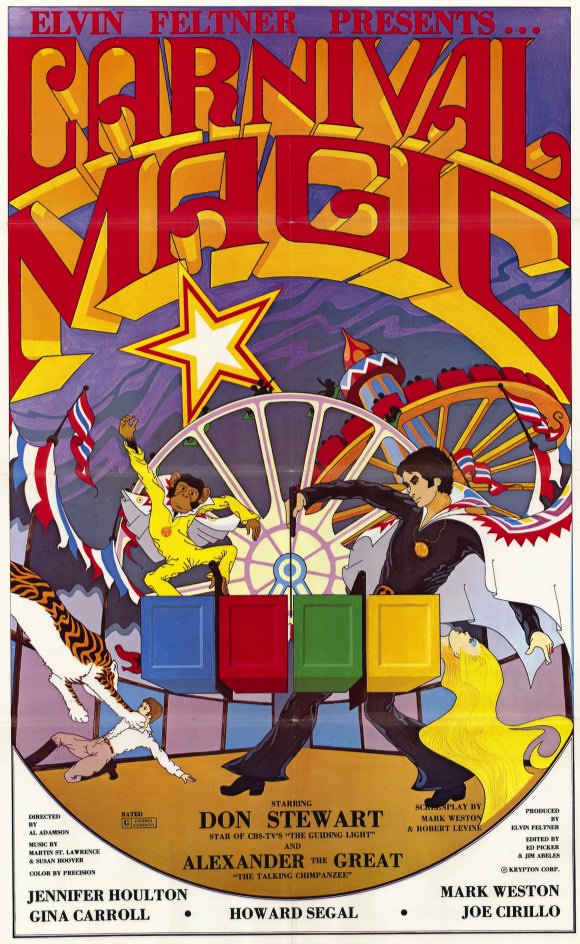
Non Abstract-Review: Carnival Magic (1981)

From https://www.grindhousedatabase.com/
images/Carnivalmagicpost.jpg


Director: Al Adamson

Screenplay: Mark Weston and Bob Levine
Cast: Don Stewart as Markov; Jennifer Houlton as Ellen; Howard Segal as David; Regina Carrol as Kate; Joe Cirillo as Kirk; Mark Weston as Stoney; Charles Reynolds as Dr. Poole; Diane Kettering as Kim

Synopsis: The Stoney Martin Carnival is hitting hard times, but their salvation and draw for larger crowds is already on their premises. One of the carnival's acts Markov the Magician has a friend named Alex he hasn't let anyone meet, who happens to be a talking chimpanzee.

Before we get to Carnival Magic, there is the unfortunate tale of director Al Adamson which hands a spectre over his work. This is something to remember whilst we have it shown on the 2017 reboot Mystery Science Theatre 3000, alongside the fact Adamson himself is a curiosity in cult cinema. The infamous director of Dracula Vs. Frankenstein (1971) is idiosyncratic but not from the context for many of being a loved director - infamously throughout his incredible tome Nightmare U.S.A, about American independent horror films, Stephen Thrower's reviews about Al Adamson films get a bit personal in their comments. Adamson to his credit is still talked of today, and thankfully not just for the unfortunate real life ending, that after he killed by his live-in contractor and had his body hidden beneath the concrete and tile-covered floor where his hot tub once sat in 1995.

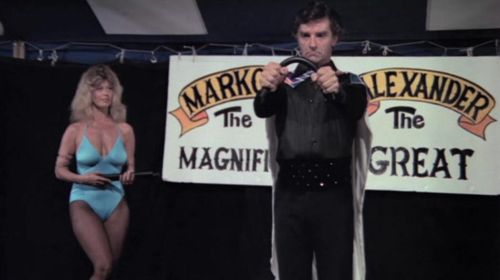
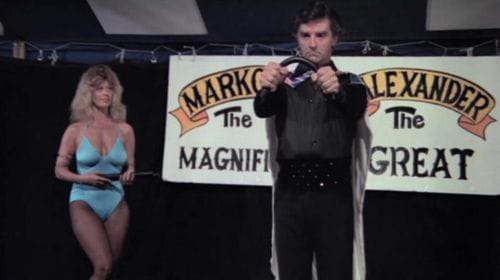
Thankfully the tale of Carnival Magic, including its real life tale, is light hearted and weird when, after a string of exploitation and horror films, Adamson wanted to make a family film. Just after Clint Eastwood struck box office gold with Every Which Way But Loose (1978), clearly Adamson decided to reinterpret this and the famous Beatles song Everybody's Got Something To Hide Except Me And My [Talking] Monkey by way of carnival related melodrama. Said "me" is Markov the Magnificent, raised as an orphan by monks in Nepal and taught supernatural abilities, from being able to talk to animals to bending iron bars and even being able to let others do so by touching them. The monkey is Alex or Alexander the Great, a talking chimpanzee that Markov has had living in his trailer in secret until the owner's daughter Ellen (Jennifer Houlton) convinces him to include Alex in his act. Said Alex, arguably the talking monkey who mumbles his words that most in cinema as a complete mush mouth, is talented but also slightly perverted when he steals the magic assistant Kate's underwear, played by Adamson's muse and wife Regina Carrol, and in lieu of another box office smash, Smokey and the Bandit (1977), even gets into a high-speed chase from the police.

It's the template you'd find in future family films, barring the stealing of lingerie, with Markov's show drawing both the patrons but also the envy of Kirk, the lion tamer jealous his status has been usurped. There's also the issue of Ellen wanting to grow up as a woman than a child nicknamed "Buddy" by her father, much to his concern when she becomes romantically linked to the carnival's accountant. Carnival Magic for three-fourths of its length is, to put it bluntly, painfully dull. Large portions of it consists of a lot of angst ridden drama which leads to characters approaching each other in a random location, especially the woods, and getting into moralistic conversations about overcoming the loss of loved ones or the responsibilities as a father. Adamson wants to convey a message in spite of being opposed to pace and entertainment; even its own genre, as there's no children in the main cast either, a family film mainly consisting of middle aged men and with Adamson's wife Regina Carrol showing a surprising amount, with her full figure and low cut tops, you wouldn't be able to get away in modern "family friendly" viewing.

From https://iv1.lisimg.com/image/15809843/500full-
carnival-magic----------------------------------%281981%29-screenshot.jpg

It's a slog, but then, as if to redeem Carnival Magic or to force it to exist for me as a film to remember, it gets increasingly weirder as the finale approaches. There is material which is absolutely too dark for children to see, when Kirk slaps his girlfriend around as response to kidnapping Alex to give him to a scientist, a scientist who explicitly wants to vivisect him despite even his staff showing remorse to the idea and seeing a visibly sentient animal strapped to the bed. The escalation from there becomes insane...

[Major Spoilers]

...when Alex tries to commit suicide with poison, which is a moment which cannot be described in anyway but dumbfoundment, regardless of the target audience, of how Carnival Magic has entered into this territory. For all the mind numbing content of before, this is where a madness takes place more so as everything is taken deathly serious. There's a perverseness, unsure whether to laugh or feel startlement, as Alex is taken to a human hospital and has a conventional death bed scene with the heart rate monitor used for dramatic effect. Even if he recovers, there's still a flat line, and the power of love and psychic ability involved just before smash cutting the end credits and a carnival parade in the streets. The emotional tugging of the heart strings, contrasted by it being an actual chimpanzee on the bed, regardless of Darwin's theories of evolution, is truly surreal and distorts how a viewer is meant to read all this.
[Spoilers End]

Does it redeem Carnival Magic? No, but what transpires in the final act puts a cherry on the bizarre experience and makes it unforgettable. Not surprisingly, Carnival Magic was lost in time until Alamo Drafthouse programmer Zack Carlson found a print and started showing it in the early 2010s. More prints actually existed then he presumed, but the discovery of the film was a brief jolt of morbid excitement for its perverseness, shown on Turner Classic Movies and even getting a Blu Ray release back before films like this, such as Adamson's own Dracula Vs. Frankenstein, were getting even 2k and 4k restorations. Even Al Adamson has benefitted from this resurgence through films like Carnival Magic, a happy conclusion that should outshine his tragic end. Again, Carnival Magic can be agony rather than pleasurable, but the car crash that was its conclusion is legitimately bonkers. If anything, the trajectory from inanity to this ending is a hell of a lot more emotionally compelling to experience as a viewer than anything more conventional. 


From https://adayon.com/wp-content/uploads/2018/09/
monkey-brain-at-the-wheel.jpg

Monday, 18 March 2019

Non-Abstract Review: Cry Baby Lane (2000)

From https://hiddenhorrors.files.wordpress.com
/2014/01/cry-baby-lane.jpg


Director: Peter Lauer
Screenplay: Peter Lauer and Bob Mittenthal
Cast: Jase Blankfort as Andrew; Trey Rogers as Carl; Larc Spies as Kenneth; Frank Langella as Bennett; Anne Lange as Ann Weber; Marc John Jefferies as Hall; Allison Siko as Louise; Jessica Brooks Grant as Megan; Sheri Drach as Kathy; Gary Perez as Gary; Steve Mellor as Dick Weber

Synopsis: In a small town, there is a tale of a pair of conjoined twins who, when they died as infants, were severed from each other, one buried in the cemetery and the other buried at a place called Cry Baby Lane. Andrew (Jase Blankfort), and his older brother Carl (Trey Rogers), have a mock séance at a grave to exploit this with a group of girls, only to release an entity that is significantly malicious.

The story goes, like any good spooky tale, that on October 28th 2000, a TV movie was shown on the American channel Nickelodeon that was deemed inappropriate for its young audience, and buried never to be heard of again. Over the decade or so that would follow, this work directed by Peter Lauer and originally meant to be a theatrical release, costing $800,000, was even questioned in terms of whether it actually existed. Some suggested, on the other side of the spectrum in a form of Creepy Pasta (online created urban legends) that it was suppressed for having incredibly disturbing material onscreen. Finally in 2011, a viral Reddit thread lead to a user ugnaught1, who claimed to on the "lost" film on a VHS copy, uploading it online. Having seen the original broadcast version, which began with an introduction by Melissa Joan Hart, who I grew up with watching Clarissa Explains It All (1991–1994) and Sabrina the Teenage Witch (1996–2003), I can attest that such a film did exist and, when that leaked VHS copy came about, Nickelodeon played into the hype by showing Cry Baby Lane again, claiming it was a "banned" film and then eventually showing it at Halloweens over the 2010s, particularly in a nod to a 90s nostalgia boom.

The fable of the horrible things said to exist in the film - as Creepy Pasta have included a SpongeBob Squarepants episode that was created by a psychologically disturbed figure which horrified the producers, or a cursed Mickey Mouse animation - is probably more horrifying than the actual TV movie, but it itself in the context of a one-off for a young audience is still weird, gruesome and frankly creepy in implied metaphors even for a crowd (like myself) who grew up on Goosebumps. Beyond the initial story told by the undertaker character Bennett (Frank Langella, who director Peter Lauer originally wanted to be played by Tom Waits) - where two conjoined twins (one good and one evil) die in infancy and are sewn away from each other - there's still a film here where which plays into a dark and fascinating premise. That, once the evil twin is accidentally released as a malevolent spectre, he infects people in the central town and makes them destructive and evil, particularly a group of girl scouts who become sadists, building off as well a central theme of our young male protagonist Andrew (Jase Blankfort) and his fears of puberty and masculinity.

And no, that's not between the lines either in the text, as he's shy and hates how he's scared all the time, at point confessing this and accusing his mother for having caused this by being over protective. His older brother Carl (Trey Rogers), obsessed with being macho and a diehard pro wrestling fan (1999 WCW and WWF merchandise on the walls), constantly picks on him and calls him a wimp, all whilst their father is a fascinating character, laid back and sardonically charming, also with one gag about him implying so much complexity when, watching monster trucks on the TV when his wife's in the room, one scene has him switch to coverage of supermodels on a catwalk when she's out the room.

From http://3.bp.blogspot.com/-xaz5GrH_-WI/Vh_YkulS3uI/
AAAAAAAAJ78/GR4AlB153n8/s1600/CryBabyLane5.jpg

Andrew's life is complex as he has a crush on a girl, who unfortunately is among those scouts possessed and becoming evil, among those tormenting him alongside his eventually possessed older brother and even trying to harm him; it reaches the point mid way through of him being stripped to his underwear, nearly being gored by a bull, and having to flee for his life half naked. Then there's the threat to kiss his beloved, whilst she's possess and threatening this or "chi chi", involving a significantly bigger and gigantic girl looking at him as if she'll easily break his spine in two. That's without his mother not believing him and even the adults, like a version of Invasion of the Body Snatchers, becoming possessed, where police will try to run you off the road, farmers with trying to run you over with a combine harvester, and guys for shits and giggles with beer will blow up their own boats in madness.

The eccentricity grows as a virtue. Whilst it would've been interesting to see Tom Waits in the role, Frank Langella, the major actor hired, also happens to be a great character actor who in his mere presence raises the material up. More so as, part of the film's sick sense of humour, he's openly a bad undertaker who will even replace coffins of those about to be buried with cheaper ones, as scummy as you can get despite still being a good, moral man at heart. His assistants include a stoner, (well an implied stoner who just acts sleepy), and another who digs the graves who pretends to always be ill but, when no one is looking, dresses up as a cowboy listening to country music in his home and prepares the dining table as if he's about to have a date there, never seen or even hinted at for a weirder twist. The production is as much like this, even if it evoked my childhood of watching shows like Goosebumps, with its moody atmosphere on such a low budget and the instrumental surf rock theme sounding like it's going to break into a song by The Cramps.

The result, appropriate for a more mature young teenage audience, is one I really liked and wished was more easily available. Yes, I admit the mythos is fun and there's something really rewarding in seeing old American commercials - alongside probably one incredibly weird and inspired mock "news report" that, barring one cringe worthy reference to Mexican food, is from a reporter inside a young boy's intestines, interviewing the staff within it just before it's about to blow with potent gestated fart gas. But, again, it'd be something great to see a proper release of just to learn more of its background - just to have witnessed a film which, far from below my expectations, provided its own interesting and blatant subtexts to its horror was enough for me to admire it.

From https://m.media-amazon.com/images/M/MV5BODQ4YjExM
jgtNjEyNi00YmY1LWI5NzAtMmZmNTlmYjhiZWU1XkEyXkFqcGdeQXVyMTM0ODAyOTc@._V1_.jpg

====
1. https://archive.is/20130204104051/http://www.thedaily.com/page/2011/08/13/081311-tech-news-crybaby-1-2#selection-345.12-345.20