Showing posts with label Superhero. Show all posts

Sunday, 4 April 2021

Black Scorpion (2001) Part 2


Creators: Roger Corman and Craig J. Nevius

Screenplay: Steve Gentile, Nick Guthe, Elijah Aron, Heidi Ferrer, Raly Radouloff, Lev L. Spiro, Malcolm Stephens and Mike Vitale

Cast: Michelle Lintel as Black Scorpion, Scott Valentine as  Det. Steve Rafferty, BT as Argyle, Enya Flack as Tender Lovin', Steven Kravitz as  Slugger, Shane Powers as  Specs, Guy Boyd as Capt. Henry Strickland; Shae Marks as  Babette, Robert Pine as  Mayor Artie Worth, Raye Birk as Dr. Phineas Phoenix

Ephemeral Waves

[The following is a continuation from the first half which you can read HERE. And yes, they were written separately over time, the first devoted to the first half of the one season of television and the later covered here to the final. You can tell a lot of additional emotion in the words what the final review and progression was.]

Halfway through viewing the Black Scorpion television series, you have a villain with dwarfism, more of a trickster who rides about on a hover board in the air (part of the show's then low budget CGI). He is dressed as Cupid firing arrows at bystanders that cause them to fall in love with the first person they see. He never returns after that one episode, and certainly is the most baffling moment of the whole season. He is not even the main villain of the episode, but there to cause mayhem in a scenario where the leads are paired with villains they had romances with, adding to the weirdness.

Black Scorpion, to be blunt, could have done with more of this as by the second half the sense of decline and numbness started to kick in trying to watch the show. It was doomed by the inherent structure of having to pad out forty plus minute episodes for its original station the Sci-Fi Channel, which would have been an hour with the advertisement breaks.  This is a huge crippling flaw, as you can feel the show having not enough to come up with in terms of good material, more so for a twenty two episode show, eventually draining for myself to see. It eventually has to rely on the same specific villains being brought up over and over even in cameos, as the show has established early in the season it can have even dead ones cloned back to life.

It is a programme where not a lot is sustained or memorable, and whilst the episodic nature could have been worked around, there is a sense too of the budget being way too small to really push into anything more than its template. It has to rely on a lot of dialogue and including all those poorly put together fight scenes with actors who (with sympathy for them) are clearly not trained even to do choreography. One episode is about virtual reality, which is strange as surely by 2001 the first wave of VR as a craze had died out in the late 1990s and would have waited to the 2010s for the tech to improve. It is mostly just to add production value in a fantasy medieval set or two for the deadly VR game, which allows Roger Corman to recycle his Deathstalker films for footage. Even then, the episode squanders cult actor and bodybuilder Lou Ferrigno as a fantasy grunt than a villain which could have boosted the show for a moment considerably. Set in a scenario where someone wants to use VR to help the homeless, by putting them in a virtual utopia, only for the mayor to use it for the prisoners in jail, Black Scorpion's political satire is still a mangled but fascinating mess even if less pronounced. Even a late running plot, of police chief Henry Strickland wanting to run for mayor, is quickly written off in two of the last episodes when it could have been rewarding to see where that went for the series finale.

A large part of the show, always and still the most compelling running joke, is that Mayor Worth is to blame for most villains due to his corruption. He even hires a band of female rockers, whose music is not as bad as everyone says but is grungy alt-rock with horror punk lyrics, to subliminally cause riots through their music for a mock morality campaign. That is satire the show had right in the palm of its hands and could have toyed with. That the show's humour instead is mostly bad puns, based on the villains' gimmicks, sadly becomes more and more the case in the last half of the season when before there was more playfully fun comedy. Even the villains themselves eventually become interchangeable baring one or two exceptions, like a hockey player that Mayor Worth accidentally has paralysed by his own team mates to rig a game, getting a robot suit from a mad scientist so brazen he enters a hospital room randomly and even has a glossy catalogue of his deadly tech.

Most of the time though the show is relying on buxom actresses in fetished costumes, neither helped by the fact the heroine's willingness to kill them is still there, even despite defending herself from accusations of this at one point. There are too many villains and too many killed off, preventing any from gaining traction through the series. Those that do sustain a bit of time are not really interesting either, baring their sidekicks of the opposite sex and common trademark of novelty themed bombs to throw out the back of the van like explosive ice cream scoops, as was the case in the first half of the series. Adam West, who was a stand-out in the early episodes as the Breathtaker, is reduced to a goon to eventually escape prison and is merely voiced acted, which is a miserable waste. The one figure who gets someone interesting is Stoney Jackson, as the Gangster Prankster, with an odd but memorable second episode where Jackson gets to stand out. That and the premise at least shake things up. That Argyle is forced against his will onto the side of the villains, actor BT one of the most charismatic of the leads, and where the plot eventually leads to. That, when Gangster Prankster is sick of a comedian mocking him on television, it leads to the creation of a device that causes people to expand like balloons and even explode when they laugh. It is bizarre, with a death-trap involving being tickled on the feet and Gangster Prankster wanting to cause mass explosions by dropping feathers on Angel City on a plane, but it is at least idiosyncratic for a series which is repetitive most of the time. If the show had kept to this warped, low budget pulp, it may have gotten more mileage for me.

Instead, I struggled eventually to even get through the series for writing a review, let alone to complete, all in spite of any episode by itself being innocuous. This is a show which, if shorter, would have been tolerable in spite of being very conventional, but as an episodic narrative where the characters will not progress it becomes harder to sit through for each episode's length and the amount of episodes. Michelle Lintel's lead has moments of conflict but really has no wiggle room to drastically evolve her character, whilst Scott Valentine, in-between directing one episode where we get an ice skating Black Scorpion for a memorable moment, plays a character who is pulverised all the time by villains. That also includes Black Scorpion herself, who usually kissing him afterwards, means that in-between their romantic chemistry, his character is also eventually going to be a masochistic if he was not before.

One of the few episodes to really take a challenge, and hence one of the only good ones, drastically upturns the show even in a scenario which eventually retcons this, bringing back normalcy by the end credits in a bizarre sci-fi twist. That Black Scorpion's identity is revealed and leading to everything getting darker - friends are forced to sleep in their cars due to their connections to Darcy, the police are after her, and Valentine's detective changes in his conflict of emotion. That this has to be amended by the lead getting a clone of herself, who is rapidly degenerating the moment she left the cloning tub due to an ever increasing brain, is weird yet gets into something compelling, including the continuous aspect of the lead having to fight against her alter ego, literalising it here.

It is one of the few compelling episode, and still in mind of having the bad puns and being around a villain from the first half of the series who is an evil photographer, the episode having to be forced out of all the series' bad creative decisions to be good. Even the two episode finale, which should be a major climax, feels brittle. Soupy Sales, famous among other aspect for his daily children's television show Lunch with Soupy Sales, plays a useless TV psychic who gets villains, abruptly just new clones than already in jail as they were, to cause crimes for him to predict. The resulting narrative has a lot of padding and does not feel like a jump in drama in the slightest. It becomes twisted in a way which is not dramatically compelling but just morally wrong too from one character, when Argyle has Darcy's dead father cloned to help her through a crisis of faith as a superhero. This would be the end of this version of the character, followed up by two compilation movies from episodes of the show, and frankly any semblance of this show working was clearly visible halfway through as not being there. Roger Corman whilst a man of huge talent is imperfect, and there is really a sense here, ironically, whilst he could make films cheaply and quickly in his golden era, that a television schedule is its own structure which could not be easily deal with. Black Scorpion had moments there were entertaining, but so much for a show I had to sit through for a long time I can gladly live without now.

Saturday, 3 April 2021

Black Scorpion (2001) Part 1


Creators: Roger Corman and Craig J. Nevius

Screenplay: Steve Gentile, Nick Guthe, Elijah Aron, Heidi Ferrer, Raly Radouloff, Lev L. Spiro, Malcolm Stephens and Mike Vitale

Cast: Michelle Lintel as Black Scorpion, Scott Valentine as  Det. Steve Rafferty, BT as Argyle, Enya Flack as Tender Lovin', Steven Kravitz as  Slugger, Shane Powers as  Specs, Guy Boyd as Capt. Henry Strickland; Shae Marks as  Babette, Robert Pine as  Mayor Artie Worth, Raye Birk as Dr. Phineas Phoenix

Ephemeral Waves

I've grown tentacles in funny places

[As television series, even one season wonders that were cancelled, can have a lot of episodes, it would be better to cover them in parts, starting here with a curious tangent in Roger Corman's history...]

If we were to look at Roger Corman, the legendary producer and filmmaker, he has worked for so long you can forget that, alongside a legacy of people who brought into cinema and key films, that his career has many properties and even arcs to them. His sixties Edgar Allen Poe films for example are very different to his eighties films he produced. The period after the eighties is an obscure era in itself not as talked about, in which after his last directorial production Frankenstein Unbound (1990), he spent the time just as a producer including readapting films of his from the past as television movies like Humanoid from the Deep (1996). This television show is a curious tangent for him, when he mostly stayed to films, a spin-off of two films made beforehand. Black Scorpion (1995), originally with Joan Severance as the lead, is sexy Batman without subtlety in the comparison, a film with a figure in tight black spandex like the Tim Burton and Joel Schumacher films, with the gadget leaden car, only with a very attractive woman as the hero with a nude sex scene at least in the first film. This was followed by Black Scorpion II: Aftershock (1996). Both were screened on the Horror Channel, a British channel devoted to horror movies which however screened other genres occasionally and where I saw these films. The TV series, when learning of it, felt like an obscure thing out of reach, but thankfully a lot has changed in that time.

Michelle Lintel replaces Severance, a female police officer named Darcy Walker who, inspired by her late father, dons the mask of the Black Scorpion as a rouge figure, even hunted by the cops, to stop super villains who terrorise Angel City. Helped by Argyle (BT), a former gang member as her genius tech man, she can take on the villains. One of the immediate issues is that Black Scorpion the series is very repetitious. Each episode a villain of the week, many having two henchmen (or usually henchwomen). Many of them, due to car chases being more easier for the show to produce, usually have a van to drop explosives out the back of at Walker's car when she pursues them, be it exploding clocks to exploding sports balls. Usually the villain is a buxom model or genre actress in an elaborate costume. The villainess Aerobicide for example, a feminist exercise guru with testosterone stealing beer and robot limbs, is Renee Allman, defying how lack of testosterone works in men in the episode but having a small filmography including Cyborg 2: Glass Shadow (1993) in her career. Her henchwomen are Ava Fabian, former Playboy's Playmate of the Month and actress, and Faith Salie, contributor to CBS Sunday Morning and journalist among other career roles, just to give you an example of the eclectic nature of these cases. There are exceptions, one a villainous male gardener with a giant green thumb, who even gets a tragic romance with the major's secretary and leading to a tangent, from Corman, where you get practical effect made monster plants which make weird noises for an episode.

On the police side, you have regular characters to prop up Walker's story. Scott Valentine plays Det. Steve Rafferty, the police officer who is trying to catch Black Scorpion. He has a complicated chemistry with Walker, including with Black Scorpion as a separate person, which comes to play when one villain uses hallucinatory gas and she is literally fighting herself. There is also a slovenly yet lovable police chief Capt. Henry Strickland (Guy Boyd), and two goofballs Slugger (Steven Kravitz) and Specs (Shane Powers), who I will admit will annoy some in the earliest episodes but do eventually stick with you. There is Enya Flack as "Tender Lovin", Argyle's girlfriend, who he has a loving if argumentative relationship with. When you have a work with a limited budget, you have to rely on the cast you have. This is something that I have especially seen in cancelled television shows I have watched where, especially with the episodic productions, it is always a virtue to have people with charisma to keep the show afloat. To the production's credit, Scott Valentine and Michelle Lintel do have a great chemistry with each other, though it is sad to know that Lintel's filmography is very tiny, with this show (and its own follow up film) one of the only prominent things within it.

Telling the narratives of each episode is pointless, as this is a wash and rinse show in the repetition of the same narrative, something which can work but is unfortunately worse here as the episodes are forty minutes long without advertising breaks, which feels too long in how they are usually structure. A reoccurring aspect, for most of the villains, is that most of them only exist because the mayor, Artie Worth (Robert Pine), is so corrupt it is comical and actually a funny piece of satire in itself. Cheating on his unseen wife with his buxom secretary Babette (Shae Marks), he can be involved with funding for toxic waste to be dumped into the sea, defunding the fire service and even paying a pyromaniac to burn things off the side, making it not a surprise many either try to kill him, kidnap him to the underground homeless person territory or break into his office almost every episode. Even his secretary has a plot for one episode, with the gardening villain who decides to create monstrous (practical effect created) muttering plants to exploit her attraction to power away from Artie. His character, to the credit of the show being deliberately broad, was a highlight in the first half of the series.

There are attempts at satire, where Angel City is built on many incompetent figures, but the show's various attempts at politics beyond their mayor do blunder along sadly the more it tries to be serious. It can be funny, such as the Black Scorpion mobile having some of its gadgets removed like the oil slick for being environmentally harmful, but many do radiate ill advised or confused tones. When tackling the homelessness issue, with cops taking them off street, they join the villainess in the episode even when Black Scorpion tries to convince them this is the wrong way to go. Any time this program deals with feminism, the show becomes awkward. That Walker has a tendency to kill her villains flippantly is common, especially with the knowledge that, with all the reused car chase footage of police cars crashing spectacularly, chasing Black Scorpion, there are likely a few officers who have at least retired from duty afterwards. The one running plotline throughout all the series is Dr. Phoenix (Raye Birk), a figure who can resurrect the dead villains to try to reform them, despite it clearly a misguided folly, even clone a character named Gangster Prankster from cremated ashes, a Joker stand-in he tries to turn into an upstanding citizen with a microchip implanted in his brain to induce electric shocks.

It is that episode, Episode 10, where the worse decisions involving the show trying to be serious are found. It starts off well, with a cop carnival to improve public relations with the police, so bad they have to dress up as clowns, but even the leads arrest Gangster Prankster based on presumption of him being a former criminal. This is not helped by the character is being played by an African American actor who, when he becomes a villain again, even says jokingly "Let my people go" whilst breaking out his henchmen. It is an episode difficult to love in the modern era in the worst vibes it portrays, which is worse as Stoney Jackson, an actor you may recognise from Walter Hill films or even being a prominent dancer in the Michael Jackson Beat It music video, is actually one of the best guest stars in the show, getting a Joker rip-off but making it his. He was already in the second Black Scorpion film before, and in terms of getting the most out of a character, including when he is a good guy and working for the police, in a comical cop outfit subduing armed suspects with pies, he is great.

For the first twelve episodes, this show has a cheese to it, knowing its own absurdity when one episode has an exercise bicycle that will electrocute the rider if they get under 25 miles per hour. Snippets of its co-producer, barring a Chopping Mall (1986) poster in alleyway fight, can be found if having to be toned down for television. The sensuality obviously had to be toned down, with a lot of cleavage if anything else the most titillating it can be. The fight scenes, regardless of what could be shown on television, are bad which makes the extended amount of them more of a chore as a result. When Black Scorpion relies on its comedy, you still have to put up with too many awful puns, but it helps bolster the show up considerably, even if this feels out-of-place at a time when superhero films where soon to be the juggernaut into the next two decade's worth of cinema. Lintel is okay, but it says a great deal that she stands out more when she gets to play Walker out-of-character when not showing a clear chemistry with Scott Valentine's character. Be it in hair curlers, dress and surly in a nightmare sequence as an annoyed trailer park wife for Valentine; as a ditzy gold digger undercover; or fighting herself as an evil Black Scorpion. Likewise characters like Argyle, with his argument heavy but loving relationship with Tender Lovin, or the police chief who is always close to retirement, are broad stereotypes but that is a pleasure to have. It argues that with a lot of television, the more I look at, they are the home for actors to really have to stretch themselves to keep their shows afloat if those programs were doomed from the start.

For this series especially, the surprise guests really add a bit to the production depending on the casting1. In lieu to the comparison to Batman, cast from the 1960s Batman do make an appearance in the first twelve episodes, with Frank Gorshin playing the Clockwise, wishing to steal people's time by aging them artificially. He is great here, which was not a surprise as, among the other pleasures in the 1966 Batman film spun off that show, his performance as the Riddler was one of the best things in said movie. Adam West, as the Breathtaker, a former doctor whose accident losing both lungs led to a mental breakdown and psychopathic tendencies, is in two episodes so far, and if there was ever one good thing to take from this usually average series, it is the hope that Adam West got to play more villains in his career or should have. His humour is still there, stuck behind an oxygen tent/jail cell as he informs a newly created villainess that she should always warm the public on the news of her plans to destroy the city as a standard custom, but there is quite a bit of this where he is legitimately creepy or menacing, something which is unexpectedly exceptional to witness.

There are some bizarre cameos too, and the two that particularly stand-out are worthy to end this part on, just to give an idea of what the time period was like for them to happen. Alongside the fact that Michael J. Anderson, a regular David Lynch collaborator, shares the screen with Frank Gorshin, throwing exploding alarm clocks at the pursuing Black Scorpion car behind, you also have Laura Harring play an assistant to Dr. Phoenix in the episode where Adam West first appears. This same year, the original footage an unused television pilot from 1999, Lynch's Mulholland Drive (2001) would be released to acclaim with her in a main role, making Harring's tiny role in a sexy nurse's costume bizarre. More so as this means that there is a scene of her helping a newly resurrected Adam West regain his ability to develop words by exposing her cleavage to him. That she played Babette in Black Scorpion II: Aftershock adds to the curiosity of this. Even more strange? That Dave Mustaine of the thrash metal band Megadeth, and its founder, inexplicably appears in Episode 5 as a pyromaniac called Torchy Thompson. This is emphasised as an instrumental bridge of Hanger 18, one of their most recognisable songs, appears in a fight scene between him and Black Scorpion. Not even the main villain for that episode, as that belongs to a fireman who Walker falls for, it is one of the least likely things to happen. If anything, a series like this will intrigue for these unexpected pop culture tangents to be crossed.


[To Be Continued]


======

1) Again, as earlier in the review, even an ultra obscure figure is fascinating especially if they were someone who stars in so much work their appearance was not a surprise. One personal highlight for one scene is Irwin Keyes, who I first learnt of as the monster in Frankenstein General Hospital (1988), an ultra obscure Frankenstein parody. He is easily recognisable even if he never has more than a cameo most of the time, and through his career he worked a lot so many have encountered him onscreen. Here he plays a man who is sick of the world and wishes to blow people up with a vest of cartoon dynamite, only for learning to juggle to bring meaning to his life even if he still has to be arrested.

Friday, 7 August 2020

Generation X (1996)

Director: Jack Sholder

Screenplay: Eric Blakeney

Based on the Generation X comic book series from Marvel Comics

Cast: Matt Frewer as Russel Tresh; Finola Hughes as Emma Frost; Jeremy Ratchford as Sean Cassidy; Heather McComb as Jubilation Lee / Jubilee; Agustin Rodriguez as Angelo Espinosa / Skin; Randall Slavin as Kurt Pastorius/ Refrax; Bumper Robinson as Mondo; Suzanne Davis as Arlee Hicks; Amarili as Monet St. Croix / M

Ephemeral Waves


You know I don't like Jello.

There for me is a dividing line between when superhero films meant just Superman and Batman, with the others for theatrical cinema and television a random assortment, with DC Comics in dominance and no standard template, and then the moment Marvel Comics managed to get its act together, leading to the current era which began as far back as Blade (1998) when they got their foot through the door, then the X-Men (2000) firmly planting their flag in the genre. Personally, I find the older era for more interesting, a lot of esoteric productions I am more inclined to watch, as decisions  even with great films like Batman Returns (1992) you get something idiosyncratic, whilst the template the Marvel Studios films have stuck to bored me to the point I have not watched them at all. Which is a shame as, open to American comics as a medium, Marvel have a fascinating history of figures and stories I would be interested to look, even the bad creative decisions, and whilst The Cannon Group did release Captain America (1990), the company were mostly regulated to television and had to also deal with rights issues in lieu to that company, hence why it took the 2000s when Spider Man finally had a theatrical movie.

That television should not be ignored though, and whilst the elaborate films of now sadly, from the few I saw up to the early 2010s, been very predictable, there is a greater joy in those titles which were not high budget films but attempts at hits like Generation X. It is ironic that the 2000 X-Men film had a huge significance on the way superhero films would dominate cinema globally, apt as this review is about the first attempt to adapt the characters to live action, a TV movie that acted as a pilot for a show that never came to be, trying to adapt these iconic characters created by Stan Lee and Jack Kirby at a time when they were a big seller in the nineties.

The X-Men, and I say this as an outsider with lack of knowledge on the actual comics, had to take a while to get to that success, steadily growing as a franchise since the sixties. Created in 1963, they were a metaphor for racial intolerance, as outsiders marginalised by society and even seen as a threat, one which has lasted as long as it has due to the fact the metaphor can still tragically relevant to the modern day and that, for a reader, that metaphor can also extend to anyone LGBT, trans, even just an outsider like the loners at a school could easily see themselves as these characters and have someone to represent themselves with. This was  especially when through the seventies onwards more characters were added, including the iconic Wolverine, and X-Men became an actual rainbow of figures of all ethnicities, men and women, even characters with disabilities, as the character of M here, just an overconfident girl with insane levels of invulnerability, was all this in the comics by accounts but also autistic.

By the time of this TV movie, we already had the 1992 X-Men animated series, which I have fond memories of watching as a young kid at the time. I would have been too young to know of this, especially as this is not based on the main series but the titular spin off, part of a time when the X-Men comics were very popular and these spin-offs could exist. This film however, which yet has a fitting connection or two with what came before and after in the franchise, was definitely a failure. A curious one, from the director of A Nightmare on Elm Street 2: Freddy's Revenge (1985), a film without his knowledge was coded with blatant metaphors of the main male character's struggle with his own homosexuality, and The Hidden (1987). Someone also clearly saw Batman Forever (1995), the Joel Schumacher films in that franchise with Batman & Robin (1998) closing off the old superhero films, as Batman & Robin was reviled and Superman was M.I.A since the Cannon Group acquired the rights and fumbled the character in the late eighties with Superman IV: The Quest for Peace (1987). I like the Joel Schumacher Batman films, and I will not try to defend them nor claim them as guilty pleasures. In fact, whatever you think of their erratic natures and ridiculous camp, you cannot just lift Schumacher's trademark that he wanted to make every location bold and distinct even in all the neon gels he used. He made more grounded films, but the former production designer had an eye for aesthetic which is an acquired taste but I admired.

Batman Forever was actually a hit, so Generation X borrows all the canted camera shots and coloured gels it can get. That is actually one of the best bits of the TV movie, alongside Max Headroom star Matt Frewer looking at Jim Carrey's performance, playing one of the villains in that earlier film, and thinking he can be even more over the top and a sex pervert too. What likely killed the show before it even got started were many creative choices which feel like the screenwriter was bored with the comic they had and decided to doodle off to the side. Writer Eric Blakeney, whose career before was writing television like 21 Jump Street, could have easily went with the main metaphor of these characters. For those who have no ideas what the X-Men are, or at least going to their origin to scrutinise where someone deviated greatly from the source material, in the world of the comic people have mutant genes which provide them superhuman abilities or drastic bodily changes when they hit puberty, also leaving a potentially subversive metaphor that the cruelty and bigotry the normal world has for them is a jealously as much as a fear that they are now evolutionarily inferior. It also leaves many metaphors of the existential and moral crisis teenagers and even adults have in drastic circumstances, as these "mutants", in coping with the changes few can share the equivalent of and affecting them physically and mentally.


In the world of Generation X, this has already lead to the darkest timeline as, when the comics had the likes of giant "Sentinel" robots created to hunt down mutants, where Frewer's evil scientist Russel Tresh tries to lobotomise a mutant, to get his pineal gland, just to only get a discharge for medical misconduct and the poor mutant victim gets shipped off to a mutant camp ran by the government. The nineties, as we neared the Millennium, even with a title like this speculated about the future ahead, where here night time in the setting is a neon soaked dark metropolis, and Tresh lands on his feet well after his dismissal. Now he has joined an advertisement company where he is paid to brainwash people with subliminal messages for Slick Lips Lipstick, Coffin Nail Cigarettes and, with wonder why Sega thought it was a wise decision contextually to allow this, the real life beat em up arcade game Virtua Fighter. He only comes off as going too far when he now wants to control people in their dreams.

With a little research, the production had to change and create new characters because of the budget being preventative from trying to bring certain characters onscreen, comics with a lot more ability to push imagination with fewer resources required. Set at the Xavier Academy where young mutants have been rescued from the camps and persecution, at the same real building used in the Bryan Singer X-Men films, the two adults in charge are Emma Frost, soap actress Finola Hughes wandering around in sexy leisure wear, and Banshee, played by Jeremy Ratchford who also voiced him in the animated show I grew up with, even though his Irish accent is terrible. The teens, a little group in a giant school are thus: Refrax (eye lasers), Mondo (a toned down gift from the source character of being able to briefly absorb the density of what he touches), Skin (one of the leads, with a super stretchy body), M (perfect, but does little, original a more interesting sounding character due to being with a learning disability), Buff (an interesting female character in this time period as, with a super muscular body, she is uncomfortable with her appearance before such body types were more accepted), and Jubilee, a character I also saw in the animated series who was clearly meant to be a character sold to viewers at the time. It is strange how Jubilee, standing out in the animated series is the mall rat teen who shot fireworks out of her hands, was a trend character who never became as big as the attempts to sell her did, especially as the character would appear in other live action films.

Inexplicably the screenwriter, like the one I have imagined in this review for a joke and build up, was much more interested in writing a premise about a fifth dimension, where dreams are a real life version of Plato's realm of perfect forms, and can be accessed with psychic powers and a dream machine. I am sure one mutant, maybe more, exist who could tap into dreams, and considering Dr. Strange in the Marvel back catalogue and all their creations there has to be a few, but baring every mutant now being a "little" psychic", someone got bored and accidentally created a premise befitting a director of a Nightmare on Elm Street sequel instead. I am not precious about accuracy to source material, the man who has no real investment in the X-Men, but there was a fine line between a drastic story risk which still played to the premise about adolescent mutants with powers, and a premise which limits this aspect almost entirely even in knowledge of the budgetary restraints.

Beyond this, Generation X has a lot of plot, but is vet limited to what actually transpires. Whilst X-Men gained so many parallels to keep the metaphor alive, this is instead the school of TV action, drama and exposition, a constant flux of event which when works is why television is compelling, makes the notorious oddities like Steel Justice (1992) (about a detective in a futuristic Los Angeles who can make a dinosaur robot toy a giant one with magical powers) more compelling, but also makes anything which does not really push the limited budget or characterisation less exciting. This story eventually becomes a group of over powered mutants against one normal man, more severe as a plot fault if you stop and think about it. Matt Frewer's Russel Tresh is a deeply creepy figure, who coxes Skin in dreams to become a voyeur to and [Trigger warning] threats to "mind rape" his little sister to get his to follow orders, but he never has any sense of threat to suggest this film, with no greater depth to it. There is no real sense of threat from this character even when he gets dream powers. The only time that he stands out in terms of how he should have been written as is when the film recreates the scene from Batman Forever where he kills his boss from a fall from a giant window in a tall building; using television budget effects to conjure dreamt shadows of birds, in a dream sequence surrounded by business people at conference table, it is one of the only moments  where the film gets vaguely imaginative as well.

The darker tone is surprising, as the release that came after, not for television but beyond on VHS, even has cursing, not dancing around the subject but a scene just created for Jubilee to say "shit" and "fuck" for go measure in the same sentence. The result however, in spite of this clear attempt at a darker and neon stained tone is something missing the mark. Definitely, with good reason, it never got the television series - tonally it varies drastically, where Tresh can be an uncomfortably menacing figure but who also auto suggested a board of potential investors beforehand in their dreams to fart at the same time at a certain hour mid-meeting. The only constant detail is the aesthetic, which is compelling even on this television budget as hyper-saturated. Even the teen protagonists are not likable, bickering and insulting each other to the point of being detestable. The only time, and the one plot detail that stands out, is when Refrax suddenly shows real nobleness, when in his affections with Buff, going on a date at a country fair, an ability to see through clothes finally clicks; he goes before anything transpires, with actual honour, only for her to think otherwise, his sincere attempt to tell the truth and show his love for her a good moment.

I admit I enjoyed Generation X, just as a failed curiosity sadly ignored, as it never had a DVD release. X-Men, the Bryan Singer film, came only a few years later and erased this title from existence. Ironically, it was Wolverine, a grizzled old vet, rather than the teenagers who broke out, all because the production hired an unknown named Hugh Jackman at the last minute that ran with the role and made his own career. X-Men has had a lot of films over the 2000s, from 21st Century Fox, to a varying amount of success but with the perverse tale of New Mutants (20??) as a fitting coda, an attempt to go back to young teen mutant characters which has been in limbo since it was first announced for release in 2018, between Fox being gobbled up by the House of Mouse and the COVID-19 pandemic. Generation X itself was meant to be a big title, causing one to wonder how the production and Marvel reacted to its clear failure; Stan Lee himself made the unfortunate comment, in an L.A Times article just before its television premiere1, that "[if" this thing doesn't create demand[...] I'll eat my hat!". One wonders whether he would have lived up to the bet and ate said hat, considering how gun-ho and passionate he was.

=======

1) Source HERE.

Monday, 23 September 2019

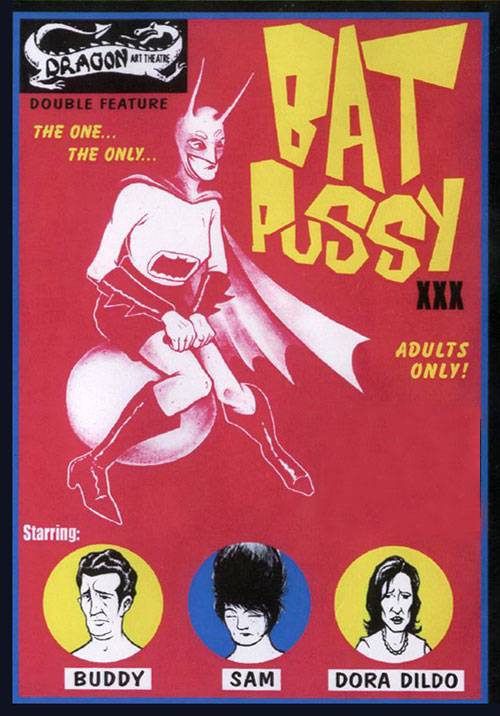
Bat Pussy (1973)

From https://www.thesnipenews.com/thegutter/wp-content/
uploads/2009/05/Bat-Pussy-movie-poster-1973.jpg


Director: Anonymous
Cast: Buddy; Dora Dildo; Sam
Obscurities, Oddities and One-Offs

This'll be an awkward review. Porn, whilst we are in a more open minded world, still has a stigma especially in the United Kingdom, where on one hand four mothers within the recent year have shot a porn film (Mums Make Porn (2019), a Channel 4 series) to promote a healthy interpretive, but we still have the laws dictating our porn is sold in sporadically located sex shops alongside the whole farce of the government trying to crack down on the online equivalent. Also there's the reason that John Water famously has never liked pornography, describing it as "gynaecologic", a vulnerability and messiness to the human body which is vastly different from the fantasy of erotica and, once you go beyond the glamour of large budgeted porn, is found in anything else, something we are yet to struggle with and is as much to even be found in society's issue of body objectification, as frankly the idealised images (especially forced onto women) goes against the reality of the body itself. Also, and let's be honest, even if that wasn't an issue, aesthetics are an important part, be it literal and emotionally, to sensuality, and today's subject isn't slightly in this ballpark...

...all because this is all a ridiculous over-the-top prologue to Bat Pussy, a work which doesn't deserve it. But it's also perversely a film the American Genre Film Archive have proudly released on Blu Ray, one that a) had its only surviving film celluloid found in the back room of the Paris adult movie theatre in Memphis, Tennessee by musician and filmmaker Mike McCarthy, and b) got a released through Something Weird Video beforehand in the VHS era to create its infamy.  In knowledge that c) it is restricted for them to where the AGFA can sell it, as it notoriously got pulled off Amazon US, and d) by their own work, they have also released a theatrical matinee film which culls non-porn scenes from porn horror films, deliberately for psychotronic reasons but possibly due to how trying to get people to watch porn is not appealing still for many, this is a pretty ballsy release even for a company who has also released SOV video cinema on DVD only format. It's more so as, whilst those SOV horrors have a fun factor to them, Bat Pussy is a truly misanthropic car crash of American paraphernalia where a group of people, three actors and the film maker(s), tried to cash in on making a porn film, only for it to go horribly wrong.

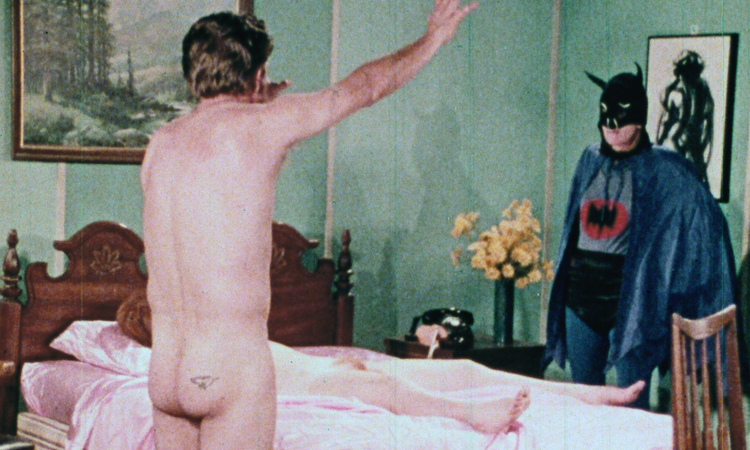
No one knows who made the film, but whilst it's no way near as feel-bad as I thought it'd be, its reputation for killing passion is truth in advertising, laced with a curious farce that leaves sympathetic for the cast. What transpires is that a man and a woman were hired to star in this film, set mainly in one bedroom. They may be a couple, and they are completely removed from a stereotypical image of porn stars. She is a full figured woman with hair nearly approved for a B-52s cover band (which is a compliment to say the least), he an older guy whose figure is both pudgy yet paradoxically thin, who notable can talk his way being a sexual tyrannosaurus but cannot back it up, which immediately sabotages the shoot whilst he just shows an oral fixation instead.

The notoriety of this film really comes from the fact that, as they cannot have sex, the pair bicker a lot and, for all the times the couple shows affection, it also gets nasty at moments too. The question about being an actual couple having a spat is felt as the forth wall is broke at numerous times. The actors have to coordinate themselves out of character, and where the titular Bat Pussy falls off the central bed in an attempted threesome, and may have bumped the back of her head, the male actor checks she is okay. Sound is turned down whenever the conversation clearly isn't meant to be on film, but some of it directly to the film crew is heard.

Bat Pussy, played by "Dora Dildo" (sic), is introduced in an outhouse feeling her bat-sense tingling that someone is making porn in her environment she is not involved in. The actress' looks like a woman across the street you might bump into on a regular day, trying her best and with the sense that she's got the most charisma out of the trio. Her character also travels to crimes on a Space Hooper, which is shown to be as cumbersome over long distances as it sounds. You have to see it to believe it, as it gives us rural footage to break up the film and can also be used as a weapon to batter a guy when he tries to harass a female bystander.

The result altogether is shambolic - the closest thing to hardcore is Dora's titular surname being involved, but the film is still grimy and seedy, more potentially embarrassing to be caught watching than most other porn. It's not inherently the sex either, which isn't even really there, but returning to that issue that porn also brings up the potential vulnerability of the human body, its growth in interest jarring against the innate embarrassment (especially in the United Kingdom) over the naked body too let alone any of its functions. When this film, which is halfway through before the titular star gets on the Space Hopper, takes it further by just having awkward, uncomfortable dry spots, it's even more likely to exhibit the vulnerability. Plus this is a film that, for all the affection shown between the main couple, is a bitter one which the male actor walking off the set never to be seen again whilst the actresses have to salvage a climax. (Forgive the crass pun).

Is Bat Pussy any good? No, this is entirely to be watched as a sociological item, or you'll be sorely disappointed or/and incredibly put off. It says a lot that I never had a sense of shame, shock or felt my libido had been permanently damaged watching Bat Pussy, thus undercutting the advertising. It's still to be approached with caution or as a sideshow curiosity to bemuse punters - a failure that still got a film print to try to salvage some money, and has inexplicably become a cult item since it was first released by Something Weird Video and then the AGFA. If anyone who made this film ever found out about this, if they are alive, who knows what'd they think but it'd be a baffled one in likelihood.


From https://www.americangenrefilm.com/
wp-content/uploads/2017/06/BatPussy02.jpg

Monday, 8 July 2019

The Spirit (2008)

From https://i.pinimg.com/originals/26/36/14/
26361421e21fa3ca4e36b9f18572e123.jpg


Director: Frank Miller
Screenplay: Frank Miller
Based on the comic book series created by Will Eisner
Cast: Gabriel Macht as Denny Colt/The Spirit; Samuel L. Jackson as The Octopus; Scarlett Johansson as Silken Floss; Eva Mendes as Sand Saref; Sarah Paulson as Ellen Dolan; Stana Katic as Morgenstern; Louis Lombardi as Phobos, Logos, Pathos, Ethos, Bulbos, Huevos and Rancheros, Mangos, Adios and Amigos, etc.; Jaime King as Lorelei Rox; Paz Vega as Plaster of Paris
Obscurities, Oddities and One-Offs

If American comic books were more value for money, like Japanese manga, or I could afford them I'd read more of this medium. I'd naturally scan the obscurer and idiosyncratic creations in the superhero genre rather than Spider Man and Superman - the failures, the cult heroes, the acclaimed work like Alan Moore's run of Swamp Thing, and significant figures of history deserving more eyes like Will Eisner's The Spirit. Annoyingly, Eisner's acclaimed creation is less available then his later era rejuvenation into a graphic novel writer, Eisner's legacy including the Eisner Award existing named after him as the standard of great comic book/graphic novel work based as much on his transformation into the likes of A Contract with God (1978) as it has been the man in the forties who created Denny Colt, The Spirit, and leap genres on those pages in a single bond. I have an unfortunate gut feeling, whilst this review isn't going to go down the route expected for the notorious adaptation by fellow graphic novel creator Frank Miller, that the 2008 adaptation of The Spirit for the cinema and its failure has left a spectre still needing to be exorcised.

The Spirit is no way near as bad as its reputation suggests, but let's not kid ourselves either that we have a film that is both all over the place but in this curious position of not being weird enough, inappropriately strange, and a mess. It does feel like the first film in a director's career, as I have always viewed his co-directing with Robert Rodriguez of Sin City (2005), based on his own comic series, was a faithful (even panel to screen transition) adaptation where the author was there more to bring it to life with his thoughts, a very different type of work than taking another creator's work and making an entirely new story for film from it. Using dominantly green screen as with Sin City, Miller does have a lot of room for improvisation, but he chooses directions that, for obvious reasons, raised many questions.

We will get to Samuel L. Jackson, as the villain the Octopus and beholder of some of the stranger creative choices, proclaiming toilets are funny and such things, later but the immediate curiosity with The Spirit is that its tonally scatterbrained, between Gabriel Macht as the hero speaking very sombre Miller style monologues of his true mistress being the city itself, against incredibly silly slapstick humour like The Spirit  losing his trousers down to his ankles in the midst of escaping a perilous drop off the side of a building, all with the Octopus (alongside Scarlett Johansson as Octopus' henchwoman) being played off as comedic villains from the get-go, what with their cloned minions (all played by Louis Lombardi) who are complete idiots wearing pun based black t-shirts. I see how, in a comic book, the passage of time would be clearer - for a film, where time is told different, the results here are hectic in its tonal shifts.

The humour itself is also not particularly funny, just perplexing in how odd it gets. You find yourself with a one scene kooky French sword fetishist called Plaster of Paris for one scene, in a skimpy Parisian belly dancer costume walking bare feet (and nearly bare) in the snow, having just skewered the Spirit on a whim, and you are wondering the hell was meant with the character. You don't get enough time to as ingest this as you immediately find The Spirit on death's door, his apparent immortality with limits as Death herself Lorelei (Jaime King) looks to claim him. Seriously, between this and the abrupt melting of a cat named Muffy a scene earlier, you don't get time to digest this material before another out of place joke or odd change appears.

And yes, let's go back to Muffy, as that's the scene that really encapsulates the issues and curiosities of The Spirit, at its most distilled. The one in which the Octopus, Samuel L. Jackson, is in full Nazi officer uniform among other details. The character, by all accounts, was an unseen figure whose name literally described a phantom whose tentacles were a metaphor for his control of the metropolis. Jackson, frankly, whilst he tries feels innately strained, a buffoon rather than menacing between his absurd costume changes (like samurai leisure wear) and obsession with eggs, neither feeling like a completely weird figure and pushing the absurdity further, in vast contrast to Johansson who, as the real brains of the operations, stands better out as a glib straight woman who just enjoys her work. Yes, Jackson in Nazi uniform is incredibly uncomfortable in imagining what was going on in his head during the take - thought I wondered more for Johansson, who is of Jewish descent, also in costume and at one point in front of a portrait of Hitler - though it's a scene where I don't think its Frank Miller being offensive but trying to be weird on purpose, a cack-handed attempt which misses the mark between this, Muffy appearing only to buy the farm, Plaster of Paris and admittedly one good idea in the film, that against a hero who regenerates chopping The Spirit up into little pieces and posting them separately in the mail might be effective against what is effectively an undead revenant.

From https://movies-b26f.kxcdn.com/wp-content/uploads/2014/08/Spirit.jpg

Where it does have the right tone, and why I cannot fully damn The Spirit, is when the tone is a gee whiz old pulp one. It leans heavily on the Sin City aesthetic, but its heart's clearly to an older, slightly silly type of pulp in which everything is meant to be a lark, emphasised as the plot McGuffin, alongside the Golden Fleece of Jason being discovered, being that of Hercules' blood which has been kept in a horn for millennia and can offer immortal strength. It's meant to be a bit over-the-top, somewhat saucy and making a deal that Denny Colt, whilst a good guy and a hero, has a wandering eye which is played to with some credible attempt alongside the character of nurse Ellen Dolan (Sarah Paulson), daughter of the police detective who helps the Spirit whenever he is harmed but, in love with him, has to put up with his constant womanising, more so as an old childhood friend has returned as Eva Mendes.  Even if the plot is predictable, I see what Frank Miller was after with these scenes.

Yet he decides, abruptly, to have Colt enter monologues of exposition to himself (to us? To the cat that keeps following him around?), which even when I can accept the transitions between serious protector of the city and a doofus do feel jarring. There's also the cheesecake, which I'd have to deal with as Miller is at least obsessed with Mendes' figure and dresses most of the female cast in very revealing costumes, even diving costumes with strategically unzipped areas. Frankly, Miller's other work could reveal more problematic content, but in what I have read (Daredevil, even Sin City with its obvious issue of sex workers and femme fatales in armed fetish wear) the man still comes off as a saint next to the unfortunate and more objectionable issues with gender politics in American comic books, the lesser of two evils for good and for worst between the "woman in the refrigerator" concept spun from the frequent horrible death of female side characters to extremer body dysmorphic inducing character designs. The issue for me with The Spirit is that Miller comes off as being more juvenile than sexist, with all the issues that beholds.

And I saw this again knowing the late 2000s was when a backlash was seemingly brewing against Frank Miller, emphasised by The Spirit's box office and critical failure by a major marker of this string of events starting the era, vastly contrasting the love for the cinematic adaptation of Sin City and the surprise box office success of Miller adaptation 300 (2006) was. Even with a minimal reading knowledge of Miller, I know enough he is a talented creator, seen in his drawings on the end credits reinterpreting The Spirit character, and the various issues that came about in the 2000s seem like a series of waves that at the same time suddenly made him a man out of step of time - Batman: The Dark Knight Strikes Again (2001-2) which became a divisive follow up to The Dark Knight Returns (1986); All Star Batman and Robin the Boy Wonder (2005-8), which may be as terrible as everyone says it is, but made "I'm the goddamn Batman!" a meme; the entirety of his negative views of Occupy Wall Street, which as someone who has entirely rejected both conservative and liberal sides, comes off more as petty arguing between sides; the belated, insanely late sequel to the first Sin City film in 2014, and its failure, where I still scratch my head, after the success of the first film, as to why it took so long to be green lit when the chance was clearly gone; the entire controversy around Holy Terror (2011), originally meant to be Batman versus Islamic terrorists until he had to create original characters, probably as offensive as its reputation suggests, but in mind that he regrets the work in the current day, seeing that it came from a huge swelling of extreme emotion and anger after 9/11 that, whilst still problematic, left a lot of spiritual injury on the USA that unfortunately led to a lot of ill advised ideas like that one. Suffice to say, unlike an Alan Moore or a Grant Morrison, a string of events like this didn't Miller bulletproof into the current day.

The Spirit at times does show this sense of being out of step, or at least a first time director biting too hard in ambition in terms of this jumble of genres and strangeness, something which Miller seems to deliberately play to as his own cameo is that of an older, gawky police officer. When he does focus, you get a moment like, falling to the bottom of a harbour, Colt floating pass the giant heads of all the women in his life rather than his life flashing before his, which is by far more artistically credible than from any of the Marvel Universe films I have seen. When the film is entirely riffing on old forties pulp, like its source material, what with Gabriel Macht playing the heroic but somewhat naive chad, The Spirit does actually start to have good humour and a sense of where it is going, and as much as the aesthetic of Sin City (comic and film) of monochrome with colour is superior, with more emphasis on the style rather than misguided comic beats, this almost sepia style would've worked.

Ultimately, it's a fascinating failure. It's not deserving of its reputation next to some utterly tedious superhero films over the years, but with honesty that it's not held highly for all its curious little mistakes for a very good reason. It really instead falls into my fascination for oddities, those films I don't necessarily defend but strangely find myself falling back to because they are so much more interesting in what they offer about their creators, as people rather than film makers, rather than a bland highly acclaimed work where the creator seems a blank slate.


From https://upload.wikimedia.org/wikipedia/it/c
/ce/The_Spirit_-_Trailer_2.jpg

Tuesday, 4 June 2019

The Amazing Bulk (2012)

From https://images-na.ssl-images-amazon.com/
images/I/914bBPKNKzL._SY445_.jpg


Director: Lewis Schoenbrun
Screenplay: Keith Schaffner and Jeremiah Campbell
Cast: Jordan Lawson as Henry Howard; Shevaun Kastl as Hannah Darwin; Terence Lording as General Darwin; Randal Malone as Dr. Werner von Kantlove; Juliette Angeli as Lolita Kantlove; Jed Rowen as Detective Ray Garton; Deirdre V. Lyons as Detective Lisa Tuttle
Obscurities, Oddities and One-Offs

This is the first of Obscurities, Oddities and One-Offs, which will retire the Non-Abstract Abstract reviews in favor of tidying the blog up and add more elegant style to the work, mainly aesthetically and a title for these non-abstract films I'm covering that rolls off the tongue more.

Made in 2012, I first learnt of The Amazing Bulk through Obscurus Lupa, a female web video host (real name Allison Pregler) who probably did the sardonic review of bad obscure films long before most; I'm not a fan of these types of videos, but to Lupa's credit, rather than soft targets she had the decency (and still does) to dig the deepest, to never given in to the obvious, once a huge fan (and still admiring her work to this day) just for how her reviews in particular covered the prolificness of cinema from the 2000s onwards, an entire cultural flotsam-and-jetsam few of us would probably watch unless by chance that she delved into deliberately, an entire catalogue that could easily be forgotten and lost but, chronicled by someone like Lupa, is just as strange as great canonical weird work if absolutely painful to sit through. Few of them will probably be remembers, and even the few know like David DeCoteau's A Talking Cat?! (2013) feel like they're skirting the fringes of fame, without judging their merits, based on irony only, but, whilst they exist, it's worth covering such examples to gauge what the 2010s in particular were like for these curious cheap creations that were released just before and during streaming becoming popular. So, like a perverse tribute to first learning of The Amazing Bulk from one of her videos, here I am much later covering it.

The notable thing about The Amazing Bulk is not the amazing coincidence that its similar to the Incredible Hulk, a comic book series of interest, but that barring the actors and an occasional prop (a fake purple monster hand too), the entirety of this film is set in green screen with animatiom which looks like it's from a mid nineties video game. It's not even Ralph Bakshi's Cool World (1991) in terms of the interaction between the actors and the sets as, shot only over five to six days, this feels equivalent to visual decor to a theatrical performance of a very peculiar sort rather than a great integration of the two sides.

The premise is generic, the kind that you can boil some superhero films down to, openly borrowing from the Incredible Hulk how scientist Henry Howard (Jordan Lawson) is like Bruce Banner, working for General Darwin (Terence Lording) to create an experimental super serum that, after many ill fated tests on CGI rats which caused an alarming amount to vanish into puffs of CGI smoke, finally works but turns Howard into a CGI purple monster of varying sizes, something just big and other times large enough to make a helicopter a toy he can pluck out the air. Whenever he gets angry or mildly constipated1, the Bulk causes destruction to CGI vehicles in the vicinity. Why this is not like most superhero films is that, looking like the world of an edutainment game from my past, The Amazing Bulk was created with a lot of pre-existing models and materials. Characters don't even run or walk for large amounts of time, only gyrate on the same spot as the background moves instead.

From https://i1.wp.com/psychodrivein.com/wp/wp-content/
uploads/2016/07/R3-Cops-blast-The-Bulk-03103629.jpg

The film never transcends to a state of true weirdness because, whilst many will already be put off by its quality, the worst part for me is that for all its irony, director Lewis Schoenbrun has openly admitted The Amazing Bulk was more a challenge to make an ultra-low budget superhero film and thus it plays itself safe in plot. The thing is, growing up once hating a lot of these no-budget films, now admiring them but picky, that it is never the technical or aesthetic quality now that was then and now the true issue with many of these films, but how so many feel so stridently obsessed with recreating plots that I found predictable in higher budgeted work, let alone with the factor of whether they could actually recreate them (if at all) on lower budgets. The Amazing Bulk does feel mercenary as a result in its creation, where even factors like its bizarre choices of animation, bought from the likes of eBay, Digital Juice, Animation Factory and Turbo Squid Inc. among others, are never implemented in a way showing actual risk or a sense that the director is an eccentric.

Probably the most fascinating thing about director Schoenbrun instead is his claim to have assisted on Richard Williams' The Thief and the Cobbler (1993), notorious an animation feature film which first started production in 1963 and, after a bastardised 1995 Miramax theatrical release alongside various re-edited versions in existed, had to have three bootleg "Recobbled" cuts made available by fans up to this current day to try and bring Williams' work to existence. I cannot help but wonder, speculate, if that ever had a subconscious influence on Schoenbrun's mix of various "found" props and a desire not to be stuck in a scenario of an endless, arduous production as, for better or worse, the production time was so short in terms of shooting everything.

Sticking to its plot, it does mean any real sense of eccentricity is lost baring a few grasps of pleasurable weirdness. It's thankfully not a pain to sit through, strong enough to tolerate this type of film now, but it's with good reason few would watch The Amazing Bulk without having an allergic reaction. This means that, in terms of the story rather than the production values, the few moments of eccentricity offer what I wish the film should've been in a drought for most of the film. Introducing our villain Dr. Werner von Kantlove (Randal Malone), with his fake German accent and beau Lolita Kantlove (Juliette Angeli), the film offers some much needed absurdity in how, for all his bad hamminess, in his best mock Dr. Strangelove/poor man's Tim Curry performance, you still have an interesting joke character who is explicitly impotent yet in a loving relationship with the simple minded Lolita, both having found a way around this by blowing up national monuments, depicted with stock photos with small CGI missiles turning into CGI explosions over them. Then there's General Darwin, the Thunderbolt Ross of this world, who at times sounds like he's an older man losing his marbles, either improvisation or the script, which as a result manages at least some actual laughs from his abrupt shouting of lines.

Between Darwin's abrupt hatred of dust to Dr. Strangelove and Lolita's ongoing love, the deviant scientist wanting to blow up the Moon (regardless of it destroying the ecosystem if he did) with his bubble headed girlfriend by his side, these joke characters are so much more interesting than a film that wants to be sympathetic with our lead and his romantic interest, a Betty Ross stand-in Hannah Darwin (Shevaun Kastl). And yes, Stanley Kubrick references in the text may stand out; Schoenbrun is a huge Kubrick fan, and whilst the references are embarrassing at times, it's at least a quirk of interest as, in one of the few virtues of the film technically, the director wisely chose good (and public domain) classical compositions2; anyone who wanted to heard Also Sprach Zarathustra over a CGI science bench being shaken about and a fake purple monster had popping up behind it will be able to knock it off their bucket list if they watch this film.

The idea of cinema which makes so many bad decisions it transcends and becomes unique is one I find has weight as the Millennium has encouraged a greater sense of irony to our viewing but also a greater sympathy for filmmakers, as technology allowed for more homespun productions which have to struggle and sometimes overcome their limitations or the circumstances in their making. The surrealist in me sees this in lieu of what is called the "marvellous", celebrating the try-hard as much as taste which transgresses middlebrow mainstream culture, but there's a difference between the absurd from the bland and merely bad. The Amazing Bulk is not Things (1989) or After Last Season (2009) sadly.

The closest moment is when the Bulk, when the US Army turn on him, goes on the run from explosions; its established early, as to get to Kantlove's CGI castle, a literal one barely guarded by male extras in mock Medieval helmets borrowed from a heritage site gift shop, our lead crosses past a golf course and immediately a leprechaun afterwards among details in the background, something which is taken further with Lewis Schoenbrun eventually using even the least appropriate animated figures regardless of tone and logic. Scored the 1812 Overture by Pyotr Ilyich Tchaikovsky, the chase scene is ridiculous but also compelling as a CGI Bulk flees across various (tonally different) locations. CGI tanks, CGI Robin Hood archer, CGI superhero, CGI pug dog superhero, CGI gecko using a CGI computer in a CGO desert, CGI submarine, CGI children playing with CGI footballs blissfully ignorant of the CGI Bulk nearby being attacked with CGI explosions, all CGI gaudiness but, whilst un-defendable in terms of good taste or quality, the only moment something actually strange takes place for an entertaining level of absurdity. The rest of the film, though, is a low budget superhero film that, whilst breezes past with pace that never slogs, is still a really bad and bland production. For every CGI car smaller than a cast member crushing them, The Amazing Bulk never finds a well of personality to compensate, never finding a charisma more interesting and instead more concerned with normal plotting despite that being innately the worst part of the production.

From https://i0.wp.com/psychodrivein.com/wp/wp-
content/uploads/2016/07/amazing-bulk-07.jpg

======

1) I apologize to actor Jordan Lawson for such a joke, probably too cruel for my usual writing, but with his stern look a constant, it cannot help but remind one that even two actors like Eric Bana and Mark Ruffalo probably had to struggle with even just making anger and repressed rage look credible in any movie, let alone ones where they turn into the Jolly Green Giant on steroids.  

2) Barring an awful MIDI version of Ride of the Valkyries, but that's the least of the film's issues.