Showing posts with label No Budget Cinema. Show all posts

Sunday, 3 October 2021

Las Vegas Bloodbath (1989)


Director: David Schwartz

Screenplay: David Schwartz

Cast: Ari Levin as Sam Butler; Rebecca Gandara as Wet & Wild Wendy; Barbara Bell as Barbara; Susanne Ciddio as Suzanne; Tiffany Heisler as Tuff Tiff; Leah Luchette as Bambi; Jennifer Quinn as Cherry Blossom; Elizabeth Anderson as Ruth Butler

A Night of a Thousand Horror (Movies) # 239


Ruth loved oil wrestling!

I advise caution with Las Vegas Bloodbath. Even for those who love micro and no-budget films, especially seen in the uncut version, this is a film that can be a very unpleasant experience. If it was not for the amateurish edge, this would be even scuzzier to experience, as was the case when I first saw the film and felt a really negative view of it originally. For those tolerant to this, well this is definitely a curious case, as never was there a film that was memorable as it was, as well as likely to make you wish to have a shower afterwards.

Shot in video, looking like homemade porn from the eighties, your initial set up is a yuppie about to return home to tell his wife Ruth about his recent success. Said wife, dressed with a Bonnie Tylor approved blond wig, which looks like an animal on her head, is having it on with a police officer, and he snaps and kills them both. Set to what sounds like 8-bit role playing video game music, this is a tale of a fragile male psyche as this one moment turns him into a psychopathic misogynist, driving around real Las Vegas locations at first causing mayhem. Carrying around Ruth's head, as depicted with a mannequin's wearing the same wig, the film is legitimately scuzzy in tone especially if you witness it through a low-resolution VHS copy, as it zigzagged between legitimately distasteful to being ridiculous. Distasteful when, despite hearing how much of a misogynist he is, a paid sex worker still goes into his car, only to end up murdered and having her leg ripped off being tied to his red sports car. Absurd when Ari Levin, playing the killer, decided to go to eleven in shouting acting. That and he is an erratic killer. He will randomly walk into a bar with Ruth's head, than immediately shoot the male bar keeper. One man raises a middle finger from his driver's seat in another car at him only to have it shot off.

Beyond this passage of madness though, this is a very sleazy film, but also one which has a lot of padding. It is what this micro-genre filmmaking can be as much as the gore or the films which innovate, a lot of working around and extending the length in this case as he drives around Las Vegas in the daytime, strangely a good time capsule in the midst of a transgressive splatter film, until he eventually encounters B.L.O.W., the "Beautiful Ladies of Oil Wrestling". This reminds you of the era this was made in as it is a reference of G.L.O.W., the "Gorgeous Ladies of Wrestling" promotion which many will know in the 2010s for the fictional reinterpretation as a television series. This means a lot of amateur performances where the female oil wrestlers hang out eating pizza, watching their show, and adding to the misanthropy of the film's tone by showing a complete lack of empathy of Barbara, a member (played by an actual pregnant woman) who they make jives at out of earshot about who the father is.

After this, you have a film, when I first saw it and still feel, is uncomfortable even if completely ridiculous. Simply because it is a series of scenes of the killer, despite there being enough of them to be able to subdue him, taking each of the women and murdering them in their own home in a hostage situation. Even if it is gnarly and cheesy - who calls nipples "silver dollars" for example - you are dealing with some pretty strong content. Very strong content as, with a tribute to their practical effects designer who passed, they did what they could with very limited means and made a very sick film. [Spoilers with Spoilers] Including a very fake doll baby being thrown against a wall and making a horrendous amount of fake blood mess. [Spoilers End]. It is, upon reflection, a ballsy film to have witnessed in how lurid and haphazard it is, actually even ending on something legitimately creepy as, alongside evil winning, a bathroom is revealed that matches the Leatherface family home of fake limb props and blood everywhere. It is also a grimy experience which is also frankly incompetent at times it is, possibly revealing a hypocrite in me but also a film which gets into a really bleak tone, affected by how stark the film looks contrasted by the moments where it is ridiculous.

If this had been a Herschell Gordon Lewis movie, which is really the best parallel, even his most extreme film The Gore-Gore Girls (1972), which has some really nasty content to match this, also had more colour and a tongue in cheek. There is humour, or stuff impossible to not find absurd, but the tone and the aesthetic, alongside this being a film mostly about a men torturing and killing women, is going to really put up a force for many to even be able to watch Las Vegas Bloodbath. Definitely, in context to this type of micro-budget genre cinema, it is a really strange film to witness, even among those few know of baring the hardcore aficionados, and this is absolutely a case even among this sub-genre where the term "acquired taste" really exists. I am not even really sure what I even think of Las Vegas Bloodbath. This time, when I absolutely feel miserable sitting through it the first viewing, I can find humour in Ari Levin's attempt at matching Nicolas Cage in hyper-action, the line quoted at the top of this review, even in among the later hostage and massacre passage showing this film is a deeply silly film which can be funny. Because of the content itself though, such as the uncomfortable amount of times "bitch" is used and gore, it is still a film probably time dirty, nasty and ramshackle for me to appreciate.

To find it a morbid curiosity to look at, probably the right way to explain what I feel about it.

Friday, 16 July 2021

Redneck County Fever (1992)


Director: Gary Kennamer

Screenplay: Gary Kennamer

Ephemeral Waves*


Humans make the finest bacon!

[Spoilers Throughout]

Welcome to no-budget filmmaking at its obscurest, a shot on video work which (depending on the version seen) starts with no opening credits and looks like a home movie.

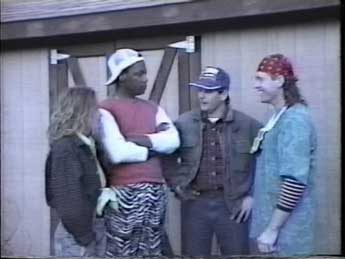
It is also, unexpectedly, a weird tangent for this form of cinema as, rather than horror or even a low budget riff on exploitation films which deal with the American South, this is a comedy. Two men, one African American and the other Caucasian, are in a car. Their accents are notable, because after the success of Bill and Ted's Excellent Adventure (1989), the accent of the latter is clearly the same surfer/stoner one that Keanu Reeves and Alex Winter had. Fuzzier than an unshaved bear, the film for a while had no IMDB page, not even guessed date of release, although it is clear from said fashions (including awful zebra print sweat trousers matched to a mauve top, and the Zubaz pants on display) that this was made in the early nineties.

The set-up is that, after their car breaks down, the pair find themselves stuck in "redneck" country in the American South, unable to pay for the repairs and having to find money to get to their destination in Dallas for Thanksgiving. What is supposed to happen over the hour length of the film is an aforementioned comedy, leading them to be more open minded about the region when they are finally able to leave, but this is as vague a comedy then you could imagine. Most of the film consists of our leads - one of them the most extreme in ending his dialogue with "Dude!" and "Hey!!" all the time - mucking about in the local Texas woodlands until they bump into a new character. It is very difficult to try to review Redneck County Fever when, even though events do happen, there is no momentum. Avant-garde films about characters just walking in the woods have more momentum and extravagance to this in comparison.

Were it not for my tastes and tolerance to this type of cinema, this would be a difficult film for many to sit through, even for myself thinking about how slow this is with little happening. Yet that is perversely the incentive for me to look at this with surprise, that this is a film that has this sluggish tone yet juggles between, in having to find the money to leave, the lead duo inexplicably getting involved with transporting cocaine in a possible stolen vehicle, throwing cocaine into a cop's face, and many peculiar references, between the singing Band on the Run by Wings aimlessly in the woods, enough for it to not be libel, to referencing The Most Dangerous Game.

The result is fascinating as amazing anti-excitement, which I had to admire for being so unintentional. Set in the South, banjo twang in the soundtrack, it is meant to be a comedy contrasting the city slickers mocking the Southerners, barely registering baring the accents however in terms of this culture clash. It does not help on such a low budget that most of the film is shot in generic woodland, on roads or by nondescript buildings. Static scenes of people talking is entirely the film's structure - if they were not there Redneck County Fever would fall to pieces or be entirely about walking - and the notion of this being a comedy is nonexistent unless this was a unique take on non-humour.

Even anti-humour have gags compared to this, whilst this languishes in their lack of. In what transpires, they meet a hitchhiker who turns out to be a policeman. A preacher whose gift to bless cars so they start working again is actually a con only really stupid people would fall for. And, closer to a traditional no-budget genre film, an encounter with a mad hunter in the woodlands who uses traps and is a cannibal, one who remarks on the virtues of human bacon. Moments do show the strange energy this film can touch at, such as the Most Dangerous Game reference, to the short story rather than an adaptation, being from the dynamic duo managing the cannibal to let them free to hunt them down, but it is subdued.  

You are stuck with a film that felt heavily improvised the most minimalist of filmmaking. You can even hear the director at one point, off-camera, giving directions when the actors get into a car. You expect, later on, the characters to relate the entire plot to the film's equivalent of a Southern Belle, as she artificially guffaws over each part, only for the film to thankfully cut to a caption suggesting time passed. An attempt at a shoot out at the end is played with a couple of actors, waving fake guns and hiding behind trees, Chekov's baseball being used for a second time in the film as an effective projectile weapon. Altogether...this is absolutely un-recommendable barring those who willingly trawl through the outer regions of cinema. It does not sustain itself even in sixty minutes. If it deserves to be preserved, to be watched a thousand years from now in the fuzziness of its VHS version, it is because of what an oddity it is even in no-budget cinema, all these films the more I encounter them, even the really undefendable ones like this, having a weird moment and/or energy to them.

Especially in that, for this type of cinema, you usually do not have a "comedy" like this when horror is usually common in the micro-budget field. If the Letterboxd credits, the end credits on the end of the version I saw the same, are accurate this was the only film director Gary Kennamer ever made. Its producer, David DeCoteau however is a name you might recognise. Someone who openly admits he churns out films, he has fans and enough different periods in his career to map a time line of: in the eighties, his most popular era, he directed cult films like Sorority Babes in the Slimeball Bowl-O-Rama (1988), and by the 2000s into the 2010s, as an openly gay man, he made many films (many likely shot at his own home) where the main attraction was nubile young men with their shirts off1. He did produce no-budget films like Todd Sheet's Sorority Babes in the Dance-A-Thon of Death (1991) in the early nineties, so he may have likely produced Redneck County Fever, adding to his curious career as a director and producer.

That background, and the film's weird anti-charisma, is as much part of the charm to an undefendable film, including the likelihood that this is tied to Reanimator Academy (1992), a film clearly made by the same people as one of the leads, the one most overtly influenced by Bill & Ted in his character's accent, makes a cameo in the other work. That film, a messy attempt to cash-in on the 1985 film Re-Animator, is more overtly entertaining with its bizarre mix of cartoonish gangsters, punching heads off and comedy, including the reanimated head of a bad stand-up, and unfortunately a bit of sexism, and again it is a strange history to know the duo bleed into each other. Just be aware however that for many, Redneck County Fever will be death to sit through for most sane film viewers, even if examples like this shown how odd cinema can be as a product.


======

* This is a re-published version of a 2018 review of mine, with new context from the film being re-watched and tidied up to my current preferences in presentation.

1) Then he made a reputation, with films definitely shot at his own home, with the likes of A Talking Cat!?! (2013), in which Eric Roberts recorded his lines over the phone, but that is for another review.

Tuesday, 14 January 2020

Brainblast (1987)


Director: Andy Nehl
Screenplay: Stephen Stockwell
Cast:  Julie Mitchell as Sally; Lisa-Jane Stockwell as Margaret; Cathy Jukes as Liz; Toby Zoatesas Kika; James Scanlon as Burgher Meister

I came into Brainblast not knowing it was Australian - in truth I had no context at all for what to expect, just a craving for a lo-fi and micro budgeted work. Probably the most fascinating back-story titbit to Brainblast is knowing its director Andy Nehl would eventually, in the grand scheme of Australian cinema, helm a documentary tie-in called Buried Country (2000), alongside a book and stage show, for an album about native-Aboriginal country music that all together became a huge cultural success in the country.

There is also an inherent fascination, stepping back to very early in his career, with Australian cinema in general. Australia is its own unique culture, a distinct one because of its history and natural landscape that makes any film, especially in genre cinema, of fascination. (Hence why a native son Mark Hartley, when he helmed the documentary Not Quite Hollywood: The Wild, Untold Story of Ozploitation! (2008), was probably helped as much in retroactively create a genre called "Ozploitation" because the culture's richness itself). Hearing the accents, after a punk dies on camera in the street from a comically large needle of super heroine in the neck, was an abrupt surprise and a delight fitting the dark humour of the scene, as a news reporter just wanders up to the corpse and bemoans the state of the world despite his crew providing the money for the smack. It's a perfect opening for any film to let you be ready for a very peculiar piece of cinema.

Brainblast sadly doesn't quite live up to this, suffering from a low budget production that is improvised to a detriment and padded with little resources. It's a shame considering snippets offer what it could've been. In future Australia, drugs are rife including a more lethal and cheaper form of heroin, one woman working at a research lab investigating that brain and finding a way to create a videotape that can induce a powerful narcotic effect. The result drags itself to a plot - there is a gang who sell drugs that eventually became aware of that tape, whilst there is also a secret and shady government group which allows the film to criticise the Australian conservative Christian community. This wouldn't be an issue, happy to see an improvised lo-fi production with this mix of ideas and schlock, if it didn't feel undernourished.

Aspects of Brainblast are charming, bits of Liquid Sky (1982) in its low view of life and hallucinogenic effects thrown around, Troma in its few moments of luridness and cheese, even an unexpected head implosion, alongside arty pretensions which are arguably a detriment. The later is odd in the mix, such as cutting to a man so he can spout poetry for a time until punks, including one wearing a metal trash can as a vest, can kick him down. The aspects of absurdity do better, slight lameness and charm to be loved, be it that particular punk's existence and the general display of peculiar fashion among the villains, to the effect of the narcotic tape to induce dreams, including a female character making out with a man in a frog costume.

It does drag though, a film I can only describe further in terms of just repeating plot details to be honest, or character like the elder hippy that looks at this period he's now in with less enthusiasm, something that's sadly a sign of a film that's slight for me. Aesthetically I have grown to appreciate films shot with what is available, the streets of an Australian city inherently interesting whilst the video hue to everything is potent. The soundtrack is also pretty good; your taste in indie rock needs to be positive to it, but it stands out considerably in terms of most films of this budget going for synths. Beyond this...well, it's charming but this is definitely a film which could've been more than it had.

The premise of audio-visual stimulus which causes narcotic highs is a good idea, the film even namedropping LSD's biggest gospel preacher Timothy Leary. The film itself could've gone further, especially as it intersects with sex (another connection to Liquid Sky) where certain erotic words are programmed by a very polite computer A.I. to have an effect on a viewer's senses. Even if played as a Troma film, it would've been a fun romp, between a sloppy brawl that takes place partway through to the general nasty wall chewing of the villains. I think, from a personal opinion, Brainblast's flaw for me is that it likes padding itself out way too much without a lot there. As a result, it's hard to really recommend the film, an utter shame as it'd been nice to have a peculiar Australian micro-budgeted film to appreciate.

Abstract Spectrum: Eccentric/Psychedelic/Weird
Abstract Rating (High/Medium/Low/None): None


Sunday, 4 November 2018

Non-Abstract Review: Reanimator Academy (1992)

From https://n2n7w2w4jmg4f5rtr2b482vt-wpengine.netdna-ssl.com/wp-content/uploads/2018/03/o0B3XQ0imjcW2w4sa1bLajy3ra0-238x357.jpg


Director: Judith Priest
Writers: Benton Jennings and Judith Priest
Starring: Steve Westerheit, Connie Speer, Richard Perrin

Synopsis: Divided into two segments, Reanimator Academy begins with frat house member Edgar Allan Lovecraft, a mad scientist out-of-place among the hard partying Delta Epsilon Delta Fraternity, developing a reanimation serum and bringing the burnt severed head of a comedian back to life. The second half, when this serum is wider known, unfortunately leads a pair of gangsters to Lovecraft's doorstep, demanding him to resurrect one of their prostitutes and moll Hot Lips.

[Spoilers Throughout]

Films are strange - especially when you accept that, for every legitimate piece of art, they are a produce that despite their expense are churned out like sausages and as a result, when that process goes amiss, it shows in films that make little sense or end up as peculiar viewing circumstances. Drop down into no-budget cinema, when you can have access to straight-to-VHS era cinema let alone when DVD came to be, and for those who try their hardest, and those who managed to succeed, there's stuff like Reanimator Academy that exists right at the bottom in the nebulous realm Bleeding Skull is usually an expert in rather than myself. I cannot believe I've stepped on a sibling of Redneck County Fever (1992), a "comedy" about Bill and Ted stoners standing by buildings with a southern accent or two, but here it is. Produced by David DeCoteau, if the credits are right, shot on VHS, and with one of the leads of Redneck County Fever having a small cameo, a frat house member who makes the ill-advised decision to drink the lead scientist's fish tank of chemicals. I hope it's the same character, creating a small multiverse of merely two films.

From http://1.bp.blogspot.com/-w7aV-cx3quE/UMo6s07R8zI/
AAAAAAAACQo/9YioHe9iPrI/s1600/reanimatoracademy-2.jpg

Openly, shamelessly, taking its ideas from Stuart Gordon's Re-Animator (1985), this would be the extreme of After Last Season (2009) if not for the fact that film had sets with cardboard MDI machines and a sterile, vague acting style contributing to its own unique atmosphere. Reanimator Academy is even below that film in style, a home movie where people pretend to be Herbert West from Re-Animator and, bizarrely, two 1940s gangsters from a slapstick comedy. As with Redneck County Fever, the tone is a stilted one where people act in ordinary environments and outside locations on the street - this has a little bit more budget due to the bit of prosthetic effects involved, but those are minimal or visibly papier-mâché. It's not an insult from my part to point that out, or the mannequin heads used indiscriminately for the series of decapitation punches that take place later on in the film which I will explain later, rather describing to you that this is the equivalent to a home movie with genre tropes added to the visuals you yourself might make, but was released in commercial form so took that aesthetic there as well.

In this case, our Jeffrey Combs stand-in resurrects a bad stand-up comedian - in this world Ed the head, as he dubs himself, is one of the funniest of his kind but, whilst he's funny occasionally, the stand-up routine definitely isn't. As the first half of the film is mostly about this plot point, this character's the one I have to talk about the most. Ed the Head, barring these scenes, is nonetheless the more animated, ironically in a cast of amateurs, who try but were given very broad comedic moments and odd characters to work with whilst the actor voicing the fake severed head gets the most from his material. The two gangsters feel out of place out of them all, just from their names from a Dick Tracy pastiche, one a clown who is naive and dumb, the other shorter and vicious. They, imitating gangster accents but very amateur in performance, emphasise the weird juxtaposition of inert filmmaking with broad comedy. Occasionally they work but only from charm of them being out of their depth, when the larger of the two confuses slang for offing a person continually in one sequence, but mainly it's with dead air as with a lot of the film's tone in general.

From http://kingsofhorror.com/wp-content/uploads/
2015/08/REANIMATOR-ACADEMY.jpg

Annoyingly a huge part of this comedy is sexism as well as, when the resurrection serum is used on women, such as the girlfriend of the lead Delta Epsilon Delta Fraternity member when she falls over on the street and dies instantly, it turns them into shrews. This emphasises this strange antiquated air to the material, a shrew an archetype of a nagging and snapping female character that is critical of everything the males in a story do, and has really died out in comedy over the decades for good reason. How this became the gag in this film is to debate, and I have to admit when it comes to Hot Lips as a resurrected zombie sex worker, the actress playing her takes the archetype and gladly chews the scenery in an entertaining way, but it does bring a nasty stain to the material. Its stranger as, due to the plot, the vicious shorter gangster ends up accidentally stabbed with the cure, a symbolically problematic idea of a feminising agent, which turns him into a weaker figure the moll can push around in her shrew state. It's weird itself, a problematic and curious aspect that in a film like this unfortunately stands out more as it's one of the only really big aspects to be able to talk about Reanimator Academy through in greater detail. If there's any semblance of entertainment, alongside the film in general, it's through Hot Lips and the plot point that, reanimated, she's angry and able to punch men's (fake) heads off with considerable ease; so many in fact that the men following her have to start collecting them in their car, an absurd progress the more it continues.

Most will find Reanimator Academy painful - even for no budget film fans, who have tempered patience with movies like this accepting their limitations, this does feel like an extreme too far in how little actually takes place, the second preview to set up the second half (as if both parts are two different exploitation films with Cookie Monster narration) having to repeat scenes from the first, not helped by not a lot in the slightest having actually taken place. If anything, Reanimator Academy is a reminder that, if you step outside the template of Hollywood cinema, even the standard of what we presume of cinema, filmmaking is an industry which has many individuals producing work within it through various strands and communities, some of which varies in technical quality to these extremes. It's a humbling experience...but when you suffer through Ed the Head's stand-up, you also realise this film is better to think of then actually experience.


Fromhttp://2.bp.blogspot.com/-tAo0r58g5s0/UMo6u2Q2jKI/
AAAAAAAACRM/JDbj_Gk7sZE/s1600/reanimatoracademy-5.jpg

Tuesday, 25 September 2018

Non-Abstract Review: Redneck County Fever (1992)

From https://a.ltrbxd.com/resized/film-poster/7/5/7/2/9/
75729-redneck-county-fever-0-230-0-345-crop.jpg?k=b8cdd8918c


Director: Gary Kennamer
Screenplay: Gary Kennamer
Synopsis: Two airheaded males, university students, break down in the middle of the rural American South, finding themselves caught between drug dealers, a cop and a crazed cannibal in the woods.

[Spoilers Throughout]

Welcome to no-budget filmmaking at its most obscure. Shot of video, abruptly starting with no opening credits, looking like a home movie. Two men, one African American carrying a baseball and the other Caucasian, are in a car. Their accents are notable, because after the success of Bill and Ted's Excellent Adventure (1989), these two figures' accents are clearly the same surfer/stoner ones that Keanu Reeves and Alex Winter had. Fuzzier than an unshaved bear, the film for a while had no IMDB page, not even guessed date of release, although its clear from the fashions including awful zebra print sweat trousers matched to a mauve top that this was made in the early nineties. These two guy's car breaks down, leaving them stuck in "redneck" country to their horror unable to pay for the repairs. What is supposed to happen over the hour length of the film is a comedy, leading them to be more open minded about the region when they finally are able to leave, but it's a comedy as vague then you could imagine.

From http://2.bp.blogspot.com/-mLYgcWzTxWo/ULJKDcVgy4
I/AAAAAAAABkc/XV8fVZFEuXM/s1600/redneckcountyfever-2.jpg

Most of the film consists of our two leads - one of them the most extreme in ending his dialogue with "Dude!" and "Hey!!" all the time - dicking about in the local Texas woodlands. It's very difficult to try to review Redneck County Fever when, even though events do happen, there's no momentum. Avant-garde films about characters just walking in the woods, like this, have more momentum and extravagance to them in comparison. Arguably, weren't it for my masochistic tastes, this would be one of the worst things I've covered in terms of completely lacking energy to it, and yet for the lunatics who find material like this like myself, that's as much part of the incentive to watch Redneck County Fever in the first place. In-between having to find the money to leave, inexplicably getting involved with transporting cocaine in a possibly stolen vehicle, and singing Band on the Run aimlessly, enough for it to not be libel, you'd think there'd be excitement but it's an amazing anti-excitement I had to admire for being so unintentional.

Set in the South, banjo twang in the soundtrack, it's meant to be a comedy contrasting the city slickers mocking the Southerners, barely registering baring the accents however in terms of this culture clash. It doesn't help on such a low budget that most of the film is shot in generic woodland, on roads or by nondescript buildings. Static scenes of people talking is entirely the film's structure - if they weren't there Redneck County Fever would fall to pieces or be entirely about walking - and the notion of this being a comedy is nonexistent unless this was a unique take on non-humour. Even anti-humour have gags compared to this in the end, whilst this languishes in their lack of. In what transpires, they meet a hitchhiker who turns out to be a policeman. A preacher whose gift to bless cars so they start working again is actually a con only really stupid people would fall for. And, belying more of a traditional no-budget genre film, the pair also encounter a mad hunter in the woodlands who uses traps, a cannibal who remarks on the virtues of human bacon among other food stuffs whilst he has them tied up. He does bring something vaguely more interesting happening as he remarks on the various ways to prepare human meat and when the surfer dudes manage to convince him, through an explicit reference to The Most Dangerous Game, to let them go like an idiot to hunt them down again.

From http://dailygrindhouse.com/wp-content/uploads/
2012/02/vlcsnap-2012-02-21-22h13m57s28.jpg

You are stuck with a film that felt heavily improvised the most minimalist of filmmaking. You can even hear the director at one point, off-camera, giving directions when the actors get into a car. You expect, later on, the characters to relate the entire plot to the film's equivalent of a Southern Belle, as she artificially guffaws over each part, only for the film to thankfully cut to a caption suggesting time passed. An attempt at a shoot out at the end is played with a couple of actors, waving fake guns and hiding behind trees, Chekov's baseball being used for a second time in the film as an effective projectile weapon.

Altogether...this is absolutely un-recommendable barring those who willingly trawl through the outer regions of cinema. It doesn't even in sixty minutes sustain itself. If it deserves to be preserved, to be watched a thousand years from now in the fuzziness of its VHS version, it's because of what an oddity it is even in no-budget cinema, usually not  "comedy" like this when horror is usually common in that field. At one point, the film had no credits at all, making it a phantom. If the Letterboxd credits, the end credits on the end of the version I saw the same, are accurate this was the only film director Gary Kennamer ever made. Its producer, David DeCoteau however is a name you might recognise. Someone who openly admits he churns out films, he has fans and enough different periods in his career to map a time line of. In the eighties, his most popular era, he directed cult films like Sorority Babes in the Slimeball Bowl-O-Rama (1988). By the 2000s into the 2010s, as an openly gay man, he made many films (many likely shot at his own home) where the main attraction was nubile young men with their shirts off. Than he's made a reputation, with films definitely shot at his own home, with the likes of A Talking Cat!?! (2013), in which Eric Roberts recorded his lines over the phone. He did produce no-budget films like Todd Sheet's Sorority Babes in the Dance-A-Thon of Death (1991) in the early nineties, so he may have likely produced Redneck County Fever, adding to his curious career as a director and producer. That background, and the film's weird anti-charisma, is as much how the film's going to get any entertainment value along its strange quirks. Just be aware for many it'll be death to sit through for most sane film viewers.


From http://1.bp.blogspot.com/-foXpPvY9awE/
ULJJ1HzAgfI/AAAAAAAABkQ/GwbWfHhgFA4/s1600/redneckcountyfever.jpg

Sunday, 1 July 2018

Tales from the Quadead Zone (1987)


Director: Chester Novell Turner
Screenplay: Chester Novell Turner
Cast: [Bookend Story] Shirley L. Jones (as the Mother); John W. Jones as Daryl; Richard Tanguy as 1st Police Officer; Dan Kugler as 2nd Police Officer; Patrick D. Tanguy as Bobby's Voice; Jamar E. Bankhead as Bobby

[Cast of Baloney Sandwich segment] W.J. Rider, Doug Daverport, Johnnie Tanguy, Chris Calloway, Kim Nichols, Tammy Nichols, Jeff Miza and Ronda Rider

[Cast of Brothers segment] Keefe L. Turner as Ted Johnson;  Larry Jones as Oscar; Lawrence R. Jones as Moby; William Jones as Fred Johnson; Tommy L. Miller as the Man in Coffin

Synopsis: A mother (Shirley L. Jones) begins to read stories to her ghost child. One is of a bizarre dinner ritual of a white Southern family, and how eventually one of the sons snaps. The other is of an African American man taking revenge on his recently deceased brother. The mother's own issues with her husband, however, come forth.

That Tales from the Quadead Zone as a title suggests four stories, because of "Quadead" represents four, but only has two and a bookend it itself the perfect introduction to this off-the-beaten-tracks production. Regardless of my ultimate opinion on the hour long video, which I will get into, the story of Chester Novell Turner is fascinating, a figure who deserves to be included in Shot-On-Video Cinema's encyclopaedia entry, with a portrait of him among a few others. An African American man who desired to make films, in love with cinema and the likes of the Twilight Zone, he had access to video recording technology as many did back in the eighties, alongside the advantage that, as that new technology also needed product for the VHS players, he could have his distributed as part of the constant need for new product.

Unfortunately his career (as of yet) consists of only two films. Black Devil Doll From Hell (1984) was taken away from his by distributors who re-edited it against his will, whilst Tales from the Quadead Zone itself was a self released title. Quadead in particular had such a low print run of his own distributed tapes that an original copy was on sale on eBay for $700, that same copy sold later for $1,300. The story of how he was tracked down by Massacre Video founder Louis Justin is itself a wonderful ending, the fear that he had passed away unknown thankfully not the case, found by Justin and gaining a fan base who he embraced with happiness as much as that fan base to him, alongside the fact his films were now known in cult circles and available to actually see.

And noticeably, when there is an inherent concern that the fan base for SOV (shot-on-video) films are predominantly white, there is thankfully no sense of irony or so-bad-it's-good attitude for a black independent filmmaker who shot in his native Chicago. These films are notoriously odd, but the appreciation for Turner even went as far as a New York Times article explaining his history and the search to bring back his two films for public consumption. Even if Quadead Zone is a peculiar experience with its technical limitations and unconventional personality, none of this reappraisal has a problematic moral to it in the slightest, especially as Turner clearly loved the rediscovery and appreciation of his creations. That we can even see the films is itself meaningful beyond irony.

With this in mind, Quadead by itself would lose a lot of its weight without the background detail behind it. Stripped away, it's not the incredible discovery its growing reputation has, especially when you compare it to the Canadian shot-on-video film Things (1989), the zenith of bizarre homemade filmmaking. Instead its  curious little no-budget production, built around three segments where Turner's ideas for creepy tales are very adult psychodramas rather than monsters and scares. This contrasts the opening credits - star (and Turner's girlfriend at the time) Shirley L. Jones contributing intentionally comic book haunted house art, the minimal synth music (by Turner himself) with high pitch vocals about chills and frights - whilst the film beyond it belies this set up immensely. Built from local participants and what he can access, the biggest virtue is not that the film really works even in a psychotronic way, but that he managed to make a film which touches on themes more grim and realistic even through the absurd, exaggerated ways.

The first segment is definitely the strangest both in structure and conclusion, in which a large religious family gather around a table everyday and have to be the first to eat a selection of baloney sandwiches, not enough for them all and thus leaving whoever is the slowest hungry. Even when circumstances reduce the number of family members at the table, the number of sandwiches will always be less than enough to feed everyone, leaving this segment to have an intentionally inspired absurdity to it. In fact, because of this strange but perfect little detail, it's the best and most memorable segment for myself due to its surrealist nature. Like the introduction with actress L. Jones and the ghost child that leads to this segment, you are aware how low budget the production is. Being shot on videotape produces a sharp contrast to conventional, higher budget filmmaking. Locals from the region, minimal framing and camera movement, the border between our everyday lives as the viewer and the film's only separate now because the eighties is a decade in the past. Onscreen, eighties computer text explains what happens to the family after one of the sons snap, with the term "on the hog" repeated more than in any film I've seen. The story, whilst brisk and crude, is perversely watchable. In fact, in all seriousness, you could adapt it by itself into an absurdist short, like a bastard offspring of Jan Němec's A Report on the Party and Guests (1966), without the political satire but that same closed in world of nonsensical (but strangely logical) behaviour, the kind of story better if you imagine there would only be one baloney sandwich even if there were three people at this table, always infinitely less sandwiches due to a cosmic will outside this family's grasp.

From https://trashfilmguru.files.wordpress.com
/2013/11/tumblr_lpu59kdogg1qzn0kbo1_500.jpg

The second segment is where Quadead's quirks really appear. The story of a man who, unable to kill his older brother because he has already died, still has the body stolen from the funeral to get his revenge. It emphasises, whilst scenes can linger on and on beyond what is necessary, and the audio for the dialogue is difficult to hear at times, that Turner's on the side of dramatic horror that the likes of his interest in the Twilight Zone has clearly left a permanent mark on him. Premise wise its eventually a good one at for the middle of it, even if in terms into a generic undead revenge tale by the end, as when unable to murder his brother the antagonist's still going to rob him of his grave by burying him in the cellar. Asking why he decides to dress the corpse in a clown costume is pointless, especially as questioning one of the memorable aspects of the entire anthology would mean we wouldn't have these quirks of Turner's onscreen. That and who the hell would bring a pitchfork at the bottom of the cellar to dig an improvised grave. It introduces another of his tricks in terms of depicting ghosts visibly, using a hazy primary coloured superimposition of an actor to interesting effect. Less appreciated, even if charming, is robotising the voices of the dead so you can barely make out dialogue admits the buzzing, more so when music will play over the dialogue at the same time.

The bookends of the Quadead are the most fascinating in terms of an actual film. Whilst I prefer the segment with the baloney sandwiches, the actual meat of the film is with Shirley L. Jones playing a working class mother with a ghost child. A bookend to this feature's credit with invisibility effects,  seats being compressed under a form and one floating mug, probably more effective and practical than all the CGI used in the likes of Hollow Man (2000). Even the ghost's way of speaking to his mother is memorable, where L. Jones's long hair is blow back from a hair dryer off-screen with ghostly whispers, because it feels like the most unconventional shampoo commercial you could watch. The segments with these two characters, before the finale after the stories in-between, remind me that the SOV cinema (unintentionally) was a violent rebuttal of glamorised cinematic aesthetic. Whilst it was used to make films like this, the same technology was also used to film home movies, meaning they eliminated the barrier of conventional cinema by having normal people in front of the screen rather than stars, the real decor and furniture of real rooms rather than sets, a prop book of the tales of the Quadead put together as a Blue Peter project than a Hollywood production designer. All whilst creating on a medium, VHS, which is a fraught and fragile material to preserve, fuzz mixing with a wobbling picture quality at the top and bottom of the screen that becomes hazy in image.

What you don't expect from said bookends is a grim ending involving the husband believing she is unstable after losing their son, a domestic abuse scene which turns uglier, and the bloody aftermath having a depressing conclusion. Even if it ends with the ghost superimposition effect and robot ghost voices, somewhat of a happy note, its sobering with the film's reputation within the crazy, strange world of SOV films that it concludes with someone committing suicide and a bleak tone. Material that could happen in a regular drama, even with the ghost child still part of the narrative, which says a lot about Turner's choices as director-writer-producer when he could have made gore or monster film, but instead chooses real life topics with supernatural edges added to them.

Is Quadead zone abstract? Not really. Calling it weird is in danger of trivialising Turner in itself, and bluntly its more appropriate to call Quadead strange. We blur the lines between "strange" and "weird", which I admit to having done in writing for these sorts of films, but here the term strange is apt and the only right choice of word. Something unfamiliar due to the stylistic choices and limitations involved, not "weird" as that has always implied something more extreme for me going further than that, the context something utterly understandable but the method Turner had to make the film, even how the film because a prized treasure going for insane amounts of money for the original and scarce videotape, bringing something out of the ordinary to the results. As a production, I couldn't call it "abstract" as it plays very straightforwardly with the shot-on-video aesthetic stripping away the potential weird mood needed. Even my beloved baloney sandwich segment, whilst abstract in premise, is made pretty conventional in mood because of how its presented.

Abstract Spectrum: Eccentric/Psychotronic/Strange
Abstract Rating (High/Medium/Low/None): None

Personal Opinion:
A fascinating production. It is, frankly, not the one-off and one-of-a-kind artefact of weirdness it has been described as. Instead it's a fascinating example of filmmaking on very little budget, a cultural artfact, which has thankfully gained appreciation in the 21st century.

From http://www.internalbleeding.net/wp-content/uploads/
2008/06/tales-from-the-quadead-zone-3.jpg

Wednesday, 30 November 2016

The Burning Moon (1992)

From https://image.tmdb.org/t/p/w1280/
c4Nij7L3wNvfZZIS3kGKjAEjIYQ.jpg

Director: Olaf Ittenbach
Screenplay: Olaf Ittenbach
Cast: Olaf Ittenbach (as Folterknecht/Peter); Beate Neumeyer (as Julia Sanders); Bernd Muggenthaler (as Cliff Parker); Ellen Fischer (as Linda Sanders); Alfons Sigllechner (as Vater)
A Night of a Thousand Horror Movies #66

Synopsis: Strung out on heroin, a jobless delinquent Peter (director-writer Olaf Ittenbach) tells his younger sister two bedtime stories. The first tells of a sociopath escaping from a mental asylum and posing as a young woman's blind date. The second, set in fifties Germany, follows a priest who rapes and kills members of the community, a local farmer and his friend viewed as the culprit by the local townsfolk with bloody consequences and a trip to Hell itself involved.

Sometimes, one is faced with not only crushing disappointment but a restless tedium, The Burning Moon even with its reputation as one of the bloodiest shot-on-video films in existence such a painfully dull viewing experience to sit through, all its gruesome violence merely for nothing. Realising its lo-fi style could be used unfairly against it, I'm not dismissing the film because of its budget, although its aesthetic will be a cause of concern later in the review for creative purposes, the issue instead with The Burning Moon that barring its gore and practical effects, Olaf Ittenbach's film is exceptionally lack sure in terms of creativity or any sense of interest. With bookends involving Peter, a layabout we first watch purposely sabotage one of his job interviews and get into a gang fight, the nihilistic tone of The Burning Moon is set up but ultimately it's a surface dressing without anything rewarding or even illicitly pleasurable to it onwards. None of the two stories that follow merit a lot to write about, the first a generic serial killer story which is merely for the sake of its gore without any shock to it.

From http://www.tasteofcinema.com/wp-content/uploads/
2016/03/The-Burning-Moon-1992.jpg

The second story is a little bit more interesting if more of the juvenile nihilism of the entire film, in having a priest kill people than be the one who delivers their funeral service. As with the first story, its rudimentary in style and plotting, eventually to the point its flat look and lack of personality bites into your patience. It takes over eighty of its ninety minutes or so for The Burning Moon to reach something of interest and get a reaction out of viewer when it reaches the infamous Hell sequences - a basement of practical effects horror of mutant demons, various forms of dismemberment from a drill through the teeth to being spread eagled to death, and a complete lack of hygiene with body parts and blood everywhere. It's the entirety of this sequence, certainly memorable, which created The Burning Moon's reputation in my mind. Whilst the rest of the film can be as bloody and schlocky in its lingered upon practical effects, here the barrage of effects each second is a brief moment of delirium when everything else is laboured. The only issue, however, is that it completely pales in comparison to two far superior depictions of Hell in psychotronic cinema - José Mojica Marins' This Night I'll Possess Your Corpse (1967), with its shift from a black and white film to lurid colour and snow in Hell, and Nobuo Nakagawa's Jigoku (1960), a depiction of Buddhist Hell no way near as violent as The Burning Moon but far and away more disturbing and gruesome in its aesthetic beauty and hellish imagery.

From http://viceland-assets-cdn.vice.com/blogs/en/files/2011/04/fire.jpg

The practical splatter effects in the end of the main point for The Burning Moon existing in the first place and at the centre of it all where my issues with the film stem to. They are particularly nasty but there's little else barring this string of gore moments to actually keep the film together. Barring an occasional moment which elicits some sort of a reaction, like a POV shot from inside someone's mouth as they're forced fed an eyeball, it eventually becomes desensitising violence for me, not causing any sense of revulsion or disgust but merely a numbing sensation sitting through it all. Films which end up doing this are for me the more problematic than something which causes a viewer to squirm, like Takashi Miike's Ichi the Killer (2001), as because there's no sense of cause-and-effect done to said viewer its merely seen as a pile of practically done atrocities, not to mention the fact that because of this deadening effect the shock scenes in The Burning Moon become utterly useless if I as a viewer don't feel any disgust to them. Add to this the aforementioned flat production style and this makes the sluggishness of sitting through these special effects worse.

From http://viceland-assets-cdn.vice.com/blogs/en/files/2011/04/hell.jpg

Technical Detail:
Shot-on-video is an area of cinema which is a fascinating niche. Not to be confused with films shot on digital or released straight to videotape (and eventually DVD), this is entirely the period of cinema shot on various forms of videotape media (Betamax, VHS etc.) which were dominant n the eighties and nineties (and still were until recently in news broadcast archives and Japan). I don't look down on the fuzzy look of the medium in the slightest. Baring the issues, having volunteered for a media preservation organisation, of trying to preserve a medium which wasn't necessarily designed for long term preservation like celluloid, the look of videotape is capable of having an incredible effect on viewers, something Harmony Korine's Trash Humpers (2009) and the Ringu franchise tapped into perfectly, how even its technical faults as a medium added to its virtues. It provides a potent waxiness in image which could be used to an incredible advantage and, for older films which used it for practicality like The Burning Moon, it certainly adds to the weirdness of films like Things (1989), effectively the Citizen Kane (1941) of this medium-based genre.

Unfortunately with The Burning Moon, the presentation is so perfunctory that this sheen merely comes off as lifeless. Because of this, the main aesthetic touch is the terrible hairstyles and clothes of early nineties Germany, which isn't enough to entice.

From https://i.ytimg.com/vi/Au_WQYrQuoU/hqdefault.jpg

Abstract Spectrum: Grotesque/Psychotronic
Abstract Rating (High/Medium/Low/None): None
Unless you touch on the Hell sequence, a montage of atrocity which visibly comes from the same school of Jack Smith's Flaming Creatures (1963) of filming a group of people writhing about in fake blood in a basement, The Burning Moon is a gore film by design, a gore film as a result without any touch of weirdness or unconventionality at all to it.

Tragically, what was meant to be a nihilistic, transgressive film made by scoundrels for scoundrels, made by people like the viewers on low budget videotape, feels like those brandless cans of foot on the shelves in Repo Man (1984), a budget brand of gore film which has no real transgression or daring to it, its lack of weirdness as much a visible sign of its blandness. Compare it to a superior, far more infamous German film from the period, Jörg Buttgereit's Nekromantik (1987), which takes on numerous flights or fantasy and (rewarding) artistic pretensions, then The Burning Moon looks even more inferior in comparison.

Personal Opinion:
An exceptional, tedious disappointment for me. Visible evidence of shock for shock's sake not being enough to make a film good.

Sunday, 18 October 2015

Halloween 31 For 31: Nekromantik (1987)

From http://www.filmsquish.com/guts/files/images
/1987%20-%20Nekromantik%20(DVD).jpg
Director: Jörg Buttgereit
Screenplay: Jörg Buttgereit, Franz Rodenkirchen
Cast: Bernd Daktari Lorenz (as Robert Schmadtke); Beatrice Manowski (as Betty); Harald Lundt (as Bruno)

Synopsis: Robert Schmadtke (Lorenz) works at Joe's Streetcleaning Agency, a company who who cleanup sites of murders and accidents, recovering dead bodies that are found. Robert however collects body parts from work, storing them in jars at home with his girlfriend Betty (Manowski). He later brings home the body of a man who was accidentally killed by an intoxicated neighbour taking pot-shots at the avian wildlife with a gun. The resulting festering corpse he takes home is more than welcomed immensely for Betty, as they are both necrophiliacs who practice sexual activities with the dead. However things soon start to go very wrong with their strong relationship when Robert loses his job. He finds himself struggling with the fact death and sex have been intertwined for him since his childhood, the image of his father killing and skinning a rabbit scared into his mind, the misery he feels from the resulting breakup with Betty leading to things getting bloodier for him.

From http://img600.imageshack.us/img600/1774/ggfx.jpg
Evoking the name Nekromantik will immediately get a reaction from some readers, many of us having grown up into cult film fans reading of its notoriety. In the British Isles especially it developed a reputation from being screened at the 1988 Shock Around The Clock horror festival in London, a popular title on bootlegs that would've been destroyed if customs got hold of them. Buttgereit's debut feature is still controversial, still banned in countries like Iceland and Australia, so for it to have been passed uncut in the United Kingdom was a shock for many British cult film fans like myself who read of its extremities in synopsises in magazines and books with screenshots. Actually watching the film is an entirely different scenario all together however from what was created in my mind reading those articles, with the cadence of shock from the writers as if they couldn't believe Nekromantik existed, the actual low budget film vastly contrasting in tone.

From http://www.stomptokyo.com/otf/Nekro/DzlItem324.jpg
It's absolutely not for the faint of heart, the film itself graciously pointing this fact out in an opening text written in punkish and rough handwriting, but I found the film far from shocking. The reputation was built up over the years, but this is not suggesting a macho nature to myself where I'm above being disgusted as a sign of being better. Nor is it that this film isn't raw, which is still is and is not recommended for everyone. In fact, I'm a shy guy who at the sight of vomit will immediately feel sick myself, and I'm emotionally engaged to some films to the point they can affect me far more immensely than for many. But from an early age before I could ever see these films, I learnt the difference between the content of films and reality, made up scenarios with special effects and props starring actors. No one is insane enough to record actual necrophilia on film unless they want to spend jail time, and while I have to praise the special effects team for building a very realistic, gross looking corpse, it's still a fake prop the actors are using. Also never brought up in any article I've seen is that there are only two, very short sequences of the infamous necrophilia content that got the film into trouble amongst other scenes, and that they are depicted very artistically and with far less of the gruesomeness of the other moments within narrative, with a romantic piano theme that adds a subversive tone to them and a superimposition effect where the actors' limbs blur and multiply covering the depicted act in a hazy sheen.

From http://www.flickeringmyth.com/wp-content/
uploads/2014/12/nekromantik1-600x404.jpg
The necrophilia is just a brief part of the film in fact, the rest of the events of the narrative about Robert after his relationship becomes sour. The transgression beyond the titular one is just as shocking, making this film one only for the strong of stomach, including real footage of a rabbit breeder carrying what he more than likely does for prepare a rabbit for meat that I must warn readers of. The film, barring a couple that feel like they're are from a splatter comedy movie, depict these moments with far more artistic mindedness than being for the mere sake of shock. The resulting film is a strange mix of the Cinema of Transgression films from New York like Nick Zedd's filmography, Peter Jackson's Bad Taste (1987), and with all seriousness the grim melodrama of Ingmar Bergman  when he went as far as having dream sequences and symbolism, only with the budget and roughness of the few Andy Milligan films I've seen. The film was a transition for Buttgereit from his short film work and it was a painful one as Nekromantik has the structure of various scenarios taking place after the halfway point rather than a single point behind it all. This makes it a difficult film for some to get into as much as the extreme content will, but this also proves to be a blessing as the result as its much more interesting as a film rather than if its controversial reputation was fully lived up to.

From http://4.bp.blogspot.com/-u28pS6noQo0/UP4MlM25uII/
AAAAAAAAAfU/GhiY38PYw_4/s1600/nekromantik+3.png
The real crux of the film is the idea of sex and death intermingling, and while it could be seen as convoluted, the fact the film is a character piece makes it far from a grab-bag of taboos but a far more fascinating movie. The film drifts along into various tangents - from a parody of slasher films in a movie-within-a-film, to Christ and nature imagery being juxtaposed together in the final act when Robert figures out how to deal with his malady - but this presentation keeps it all reined in if you can engage with its throw-everything-at-the-wall-to-see-if-it-sticks mentality. That the film is also very humorous, in the blackest sort of way possible, solidifies the film having a great deal of intelligence to it when moments are clearly funny, such as the death resulting from a drunk neighbour trying out his gun set to almost jubilant marching music and a close-up up of a smirking garden gnome.  The clear desire to shock and offend viewers is there but the willingness to try out more dramatic and serious content makes it more rewarding.

From http://cult-cinema.ru/pictures/screenshots/
nekromantik/nekromantik11.jpg
Technical Details:
An incredibly low budget film, shot on 16mmm with handwritten beginning and end credits, the muckiness of the film makes it even more unsettling in tone. The few details that reveal flaws in the film's logic are covered up in the grimy, filthy tone. The practical effects have a real, physically gruesome look to them that, even though I wasn't shock by it, are still alarming graphic, dripping and gooey body parts and visceral dismemberments are as nasty as you could imagine them being depicted in this type of cinema. Even the less effective props such as a dead cat still have sickliness to seeing them that causes you to be at least queasy witnessing them.

The music however is unbelievably rich. While the film's main theme is as lo-fi as you can get, it's an incredibly layered score by co-star Bernd Daktari Lorenz, Hermann Kopp and John Boy Walton that you don't find super low budget films like this at all. Juggling between beautiful compositions to a hair raising screeching noise for moments of stress and anxiety for characters, an entire well of emotional context is given to the film that drastically contrasts to the grubbiness of the material. It does, while with full credit to the director's own work, help in adding immense quality to the final product.

Fromhttp://4.bp.blogspot.com/-yKazHdzekr8/UP4Ml9rRW_I/
AAAAAAAAAfo/nZD81FHlxu4/s1600/nekromantik+6.png
Abstract Spectrum: Expressionist/Grotesque
Abstract Rating (High/Medium/Low/None): Low
A lot of Nekromantik is deceptively unconventional. Particularly when the moments of metaphorical imagery appear in the narrative, it becomes a lot more dreamlike in general for all its grubby realism, such as Robert imaging himself as a corpse skipping along with a woman on a field passing a severed head between them like a ball. Outside of this the uneasy mix of the serious to the humorous causes the tone to fluctuate into many at the same time. It's not just the transgressions that are disturbing but how you should react to them and the awkwardness you'd feel actually watching the film. It can go from the legitimately disgusting, such as seeing the juxtaposition of a pan cooking meat with body fluids dripping off the corpse, to the openly silly such as a semi-decapitation with a flapping tongue. By the end, Robert takes a very extreme line of action for his problems which is the most shocking part of the film but also places it into a heightened tone that you don't get in many films at all, as ridiculous and jaw dropping as you can get in cult cinema. Unlike other low budget films, which don't have this film's music nor its filthy atmosphere or the creativity shown, it also possess a real hypnotic presentation the more you think of what the plot actually consists of.

Personal Opinion:
Finally seeing this infamous film that miraculously got passed uncut in the UK on Blu-Ray and DVD, I was taken aback when the actual film in question was not a mere piece of shocksploitation. Its convoluted on a first viewing trying to get a grip of its various events, but at this point this presentation has grown on me, the willingness to step into this level of transgression but with skill to depicting it standing out immensely. That its also openly trying to offend with glee, with a clear black sense of humour and willingness to try anything, is also utterly praisable. I may have not been shocked by it, but I have to still warn many readers from viewing it because it's still edgy even on a widescreen television.