Showing posts with label H.P. Lovecraft. Show all posts

Saturday, 29 October 2022

Lurking Fear (1994)


Director: C. Courtney Joyner

Screenplay: C. Courtney Joyner

Based on the serialized short story by H.P. Lovecraft

Cast: Jon Finch as Bennett; Blake Adams as John Martense; Ashley Laurence as Cathryn Farrell; Jeffrey Combs as Dr. Haggis; Allison Mackie as Ms. Marlowe; Paul Mantee as Father Poole; Vincent Schiavelli as Knaggs; Joseph Leavengood as Pierce

A Night of a Thousand Horror (Movies)


He was nice to goldfish…

Two women, sisters, are locked in a building arming to protect them and the child of one from what is outside. Their concern is well heeded as there is an entity trying to get after the baby with horrible intentions…tragedy strikes when one of the women is pulled through the hole the abomination made, leading to a bloody mess.

This is the prologue; a set up to a Full Moon Production adaptation of H.P. Lovecraft’s serialized 1922 work of the same name. This is a very loose “adaptation” truthfully, Lovecraft’s tale of a local monster hunter obsessed with the macabre in a 1920s setting finding himself involved in a curious series of gristly massacres with monstrous results. Whilst also showing a hint of Lovecraft’s unfortunate racism, sadly to be expected alongside his very idiosyncratic use of description, it is however a macabre and compelling piece. Like the beautiful ring that is rigged with a fatal trap you can never disarm, most Lovecraft stories come with the issue that, a true one-off in talent, the man himself was as mortally flawed as you could get, which is almost ridiculous in this story’s case as it is casual racism off-the-cuff. The story itself in entirely the basic set up of a perverse family lineage that lead to troglodyte like figures who eat other humans, something timeless regardless of setting, something which has a befitting Americana morbidness to it and could be found as far forward Bone Tomahawk (2015), and is not an issue to see here if for budget reasons to set in the then-modern day.  

His tale is a different animal to Full Moon’s, which is fun but does open up how I have not really come to appreciate Full Moon truthfully. Only getting into their back catalogue long after my adolescence, their films are not opaque or complicated, not necessarily even weird, competent and frankly distancing for me in how they play their stories completely straight. This is a type of film, as I eventually came to enjoy the movie for what it is, entirely for its simple pleasures, not for reinventing the wheel. Lurking Fear is in the same scenario as the source, though this is thankfully a tale, around people trapped in one location, which brought in a few character actors too. A man imprisoned for four years, guided by Vincent Schiavelli for a brief cameo, inherits from his criminal father the other half of a map which takes him to Lefferts Corner, place of the original source material, and a cemetery where his father stashed away money in one of the graves. Criminals, led by Bennett (Jon Finch), are following behind him, but for those living in Lefferts Corner, they are a nuisance as they themselves are dealing with a band of baby eating, flesh devouring monstrosities living under the graves in caverns in the cemetery. It is here where the film is helped as, whilst basic for me, there is fun to be had with a solidly made horror tale with a crew of memorable figures.

Whilst it was only afterwards the film ended I recognized her, it was a delight to encounter Ashley Laurence again, famously the lead of Hellraiser (1987), a working actor as everyone else here who, with the figures Full Moon signed up to these films, had name recognition. Here as well you can also time stamp when the film was made as, playing the surviving sister who took the loss of the other badly, Laurence plays her character of Cathryn as a Sarah Conner. This is marking how Linda Hamilton, reprising the role of Sarah Conner for Terminator 2: Judgement Day (1991), a huge blockbuster at the time, was playing a character who had transformed into a hardened figure capable in context having prepared for the robot apocalypse in firearms and survival skills, a feminist figure and also one as seen here that other films were happy to evoke. Jeffrey Combs is thankfully here too, playing a doctor helping Cathryn, grizzled from having to treat the wounds of those who managed to surviving lurking fear attacks with only face disfiguring scars from their claws. Whilst a stereotype, the context makes it completely understandable why the doctor who drinks here is an alcoholic from the nightmare he has survived so far.

Add a pregnant young woman and a priest, and Lurking Fear pretty much goes from A to B as a plot. Full Moon are sticklers for telling their plots, and neither are they like horror films from even lower budgets or non-professional groups where “quirks” can accidentally slip in. Lurking Fear was entertaining, undeniably, but the moments which shone here were when there were a few eccentricities allowed to slip in. Jon Finch by himself was one of them, playing the gangster boss, an English actor whose accent stood out among the cast and whose role ended up with some additional camp to the proceedings. His is a fascinating get for the production very later into his career. The lead of Roman Polanski’s Macbeth (1971), a Hammer Horror and Shakespearian alumni who wandered into this, who plays his small role with a glorious amount of ham only Combs is getting into. Combs is eventually breaking out the communion wine and asking God forgiveness for this act, but still manages to be more straight laced than Finch, who thankfully managed to get dialogue, despite being the callous villain of the piece, that allowed him to start throwing out pithy remarks. The premise is far closer to Key Largo (1948), the famous film noir of people trapped in a single location which has likely influenced so many horror films without many realizing, than the original Lovecraft text, but there is a considerable amount to this film where it became entirely as enjoyable as it was because of the actors involved. I am not wishing to forget Allison Mackie, the mirror of Ashley Laurence on the villains’ side of the cast, someone who I swear had a prominent role in something that immediately made her recognizable to me, but sadly seems to have had a career not as prolific as it should have been considering she gives it her all here. Even Blake Adams, sadly the male lead who is cursed, as most do, with being the least interesting figure among character actors and figures like Ashley Laurence getting a lot to chew on being tough, still gets to throw in with the sarcasm and is not bulletproof from the monstrosities onscreen. As a horror film too, this gets suitably macabre when the creatures, a family mutated by inbreeding as the source text had them, are living underground among the corpses in a necropolis hellhole of caverns, with all the fake but appropriately morbid corpse and bone props the production could get their hands on.

It is not a perfect film, which could be seen as the worse discredit one could get, neither super negative or positive, but considering that I have had a cold reservation for Full Moon films I have seen, this one was fun, which in itself was entirely what the company has built itself upon, and why they have such a diehard following as the decades have passed. Certainly with its eye towards crime storytelling as well, this feels different as well from something like Subspecies (1991), and this is where one of the coolest back-story details comes into play in regards to its director-writer C. Courtney Joyner. He is a figure whose career as a regular collaborator with Full Moon Productions shows the positivity the company has, in how Charles Band its figurehead has directors and figures producing films for them over decades in various roles, but he also has this enticing second career in terms of westerns. As a writer of western texts, both actual western stories but also documents on western films, including audio commentaries on westerns like Blue Underground’s 2013 release for Grand Duel (1972). Knowing this adds a nice flourish to Lurking Fear, as whilst this is not an exact adaptation of the original Lovecraft text, he clearly added touches that are crime based but could easily, with its isolated rural location, have explicitly Western frontier vibes in the modern day. Little details like this will make me come to appreciate a film like this, and I had already really enjoyed Lurking Fear as the film it was.

Friday, 1 October 2021

Call Girl of Cthulhu (2014)


Director: Chris LaMartina

Screenplay: Jimmy George and Chris LaMartina

Based on the writings of H. P. Lovecraft

Cast: David Phillip Carollo as Carter Wilcox; Melissa O'Brien as Riley Whatley; Nicolette le Faye as Erica Zann; Dave Gamble as Sebastian Suydum; Helenmary Ball as Professor Edna Curwen; Sabrina Taylor-Smith as Squid; Alex Mendez as Rick 'The Dick' Pickman; Craig Peter Coletta as Wilbur; Elena Rose as Whitney; George Stover as Walter Delapore; Leanna Chamish as Detective Rita LaGrassi; Troy Jennings as Ashton Eibon; Stephanie Anders as Missy Katonixx

A Night of a Thousand Horror (Movies) # 237


It smells like the hippo house at the zoo!

My only knowledge about Call Girl of Cthulhu was its director Chris LaMartina was a collaborator on WNUF Halloween Special (2013), an admirable low budget genre film in tribute to public broadcast television, which is referred to in this film and is also the explanation, for a film which is serious but also has comedy, has an apt parody of a Viagra advert in the middle of one of its most over-the-top sequences. Call Girl... itself is interesting as this is not the wild and unpredictable film of the no-and-micro budget variety, which are an acquired taste but I personally enjoy, but one which does have some eyebrow rising, and amusingly twisted, ideas within its narrative but also something of a wonderful surprise. That this, with a higher budget but restricted in resources, is a narrative structured horror film arguably better than most films higher budgeted than it.

Carter Wilcox (David Phillip Carollo) is a virginal male artist, depressed and spending his nights masturbating to Missy Katonixx, a porn star whose name evokes that this film is also based on the work of H.P. Lovecraft, whose problematic personal views (which entered his work) does not stop his work from being incredible and such an influence in the Millennium. Here however, turned into a horror-comedy which still takes itself serious, a secret cult which has the Necronomicon wishes to summon the dark lord Cthulhu into our realm but needs an escort with a specific birthmark on her to become the sire of Cthulhu's child. Riley (Melissa O'Brien), who Wilcox hires and falls for, is that woman with the birthmark, but a female professor and her assistants wish to intervene, steal the Necronomicon first, to prevent the apocalypse.

The film's tone is interesting. I do not think the production is overly cautious in being respectful to the sources, what with "Deep One" condoms, in lieu to the Lovecraft oceanic race, but with ease, this manages to walk on the tightrope between knowing its absurd and still being serious with some drama. This is still a film which is deeply silly, in fact at times showing a clear influence from Frank Henenlotter, who would have admired a monster penis, as long as a snake, due to Cthulian STD, or that his roommate, a noise musician named Erica (Nicolette le Faye) has a boyfriend named Rick "The Dick". But I can still say you care for these characters, which is a rare thing even for the more erractic lower budgeted films than this I admire, helped that in context this is a well acted film. In fact, a lot of care was clearly taken with this, even if the most obvious restriction is the limitation of locations at hand, having to work with many closed rooms.

It is crass to say that, considering the restrictions many lower budgeted films have just in their technical side, you have a film with this scale of exploitation elements, nudity and the elaborateness of some of the gore, that feels of the eighties era of weird horror films, but alongside the fact the cast probably knew exotic dancers, that in itself can go further to a sense everyone here was invested in Call Girl... beyond a joke, so the production values to a point could be made their best, from the punk music in the score to the elaborateness of the gory effects. It has a sense of fun as a genre film, which is why this feels so much better than some of the genre films, including those more likely to get into film festivals, because the plot is interesting in context and, more importantly, you care for these characters and the strange details, including the villain's henchmen being a pair of faceless entities inexplicably with baby pacifiers blocking their humanless mouths.

Riley does take a back seat later on, when initially the plot is set up around her, but even for her that seems less an issue when, in a delightful twist, Erica takes on a more important role in the proceedings. This is a case where everyone is interesting, Wilcox actually likeable rather than insufferable, and the stakes with limited budget (and many rubber tentacles to please the b-movie fans) are still strong. More so, without spoiling things, as this film is still a Lovecraft narrative, with its bookmark structure of Wilcox being questioned after the events not really an issue, but heading up that, as is common in Lovecraft, the protagonist are either doomed or end up in an asylum. To explain more would spoil this film that, for the curious, was a pleasant surprise and worthy to see.

Monday, 24 August 2020

The Soultangler (1987)


Director: Pat Bishow

Screenplay: John Bishow, Lance Laurie

Cast: Pierre Devaux as Dr. Anton Lupesky; Jane Kinser as Kim Castle; Tom Ciorciari as Zack

A Night of a Thousand Horror (Movies) #163


At least eat before you smoke!

Let me make a confession - I have never been a huge fan of Stuart Gordon's Re-Animator (1985), at least growing up and even into my thirties. Never for any specific reason, but hung by its own petard, its acclaim in the horror canon leaving an albatross to be hung round its neck with too much praise to live up to. Personally, I have preferred the first sequel Bride of the Re-Animator (1989), where Brian Yuzna and a team of crazed special effect artists in tow managed to both have an eerie premise, the creation of the perfect woman and all the issues related to this idea, and insanely imaginative and gore effects that leads the film to get bizarre by its finale. The one thing I am grateful for, mind, is also how this premise has managed to lead to a lot of rip-offs, cash-ins and even micro budget productions, all with the amusement that the original H.P. Lovecraft tale that lead to this, Herbert West - Reanimator, is a story Lovecraft was not fond of, because he had to work in a serialisation style, and some scholars of the author do not hold highly in his catalogue, which is strange to consider due to how evocative it still is.

I would be curious how Lovecraft would have reacted to the likes of the bizarre shot-on-video oddity Reanimator Academy (1992), where alongside the resurrected head of a stand up comedian you had gangsters from a cartoon bumbling through a tale of a reanimating agent. Another is The Soultangler, shot in Long Island in New York, befitting as, whilst an entirely different state, Lovecraft himself was born as hair's breath away in Rhode Island, able to be reached by boat in fact with ease The Soultangler mind, set in a time with a lot of eighties hair on the female cast and so much smoking that was cut out of the sixty two minute "director's cut", completely drifts off into its own tangent.

No budget cinema needs to be approached differently, as for every film which becomes an acclaimed breakout, even a legitimate masterpiece according to mainstream culture, many from the micro budgeted realm (even those with their own cult followings) are usually curiosities which require their own logic to fully appreciate. I have said this in so many words many times before, but it should always be returned to as that in itself is where my pleasure laid in the end. Slow, long dialogue and exposition scenes, homemade synth scores, and drastic reinterpretations of genre filmmaking are among such tropes between them, in this case a crazed scientist named Anton Lupesky who has figured out how to let his soul leave his body and enter any other, even long dead or just the brain, as long as there are eyes within the remnants. All at the cost of being an insane butcher of the living, getting his two lackeys to kidnap young women for his perversions so he can experiment on and tangle his soul into theirs.  

From there The Soultangler is a languid experience, a slow drift along in the full ninety minute cut, following also a female reporter whose father was one of Lupesky's early victims and goes on a journalist investigation of him. Probably one of the biggest distinctions about no budget cinema is that shooting with one's environments, a surprising amount of verisimilitude collides with the chaos of a genre plot line. Large sketches of The Soultangler is dialogue with the distinct haze of its filmed form effecting all, a world where acting is in a coarse, sometimes shouted and sometimes hazy form, it having a naivety, with the exception of the cops at the end of the film who have to clear up the eventual bloodbath, none of which is stereotypically "wooden".

Long Island here actually looks nice - for every grubby environment, there are many trees even in the streets and a sense of a humble community, perfect for this type of locally sourced homemade film making. It is arguably, for any accusation you can say over a Hollywood horror film being more professionally made, actually superior in its real locations, from shooting in an airport to the reality of the New York environment, where a red Dodge kidnapping van haunts the suburbia and everyone is wearing jeans. Like in a serious drama, our lead Kim is in the struggle of being a journalist wanting to write good work for her paper The Daily Chronicle, only for her boss wanting to sell copies by leaving it a rag. A lot of stark, almost abandoned environments and buildings make up a lot of the eeriness of the environment, and even the one scene in the villain's home involves a nice setting, a wooden panelled home the production was lucky to get permission to film in. One which is appropriate as a contrast to the grubby basement where his horrible experiments on, where he just experiments on victims and leaves body parts hanging around because he is one jam sandwich short of a picnic. Not surprising from a man, alongside being an elitist and a misogynist, who thinks telling a woman her gender secrete a wonderful essence is a great pick up line.

The result is definitely an acquired taste even next to more well known no budget films, but that in itself lulls you into a false sense of security. When the heroine has her drink spiked, we are abruptly thrown into a nightmare sequence with a talking doll that, when crushed under foot, spills out butcher's offal, followed by zombies who could be the denizens of Carnival of Souls (1962) terrorising her. A film where, falling asleep, a person suddenly wakes up peeling her own arm off. It is moments like this you can use as a perfect example of this type of cinema's unpredictability. That, for all the lengthy scenes of shouted irritance and smoking, or the rock song played over scenes of the villain just being mad, you enter weird tangents like this that keep you on your toes. In fact, baring that song which just has the title of the film and moans over and over, or a rockabilly like punk song, the synth score itself can vary between dungeon synth and an Italian horror film score, which alongside the post dubbing and that the film was preserved on hazy 1'' master tapes, makes it a lot more atmospheric that it initially suggests.

In fact, out of the no budget or micro budget realm, The Soultangler is one of the more interesting as, whilst it is still cheese, it is a film with a bit more production value or just the luck to shot in a place where they had some personality to work with, rather than go isolate themselves in a couple of dull greyish corridors. It even uses Haxan (1922), Benjamin Christensen's seminal and unique horror-documentary hybrid on witchcraft, as a placeholder for a documentary about devil worship in the United States, taking advantage of it being in the public domain and good nightmarish imagery of witches kissing Satan's behind whilst it was available.

Of course, the ending gets ridiculous as a micro budgeted version of the ending of Re-Animator. Moving brains, head chopping, arguably a complete lack of logic from the villain of just jumping into bodies only to let them be willingly be disposed of, and absolutely absurd material made by devoted practical effects artists and with the cast eventually covered in fake blood. Within a film that manages to literally run with the premise of the eyes being the windows to the soul, or that someone in the script writing had bothered to read books, as this film both a) references glucose helping to improve memory and b) mentions French philosopher René Descartes' obsession with the human pineal gland being where the soul was location, I have to admire this somewhat silly film for having a lot more personality. In his career, Pat Bishow did make a few more films but not many over the decades. This film, released by the American Genre Film Archive on physical media and by Bleeding Skull beforehand, is the kind for the reason I have talked of which has led me to be charmed by these micro budgeted films regardless of their limitations. It is definitely entertaining if anything.  Having seen it multiple times now, all as much to write this review but ultimately out of a joy for the production, it a better film over other micro budget movies which have been torture to try to sit through for their lack of imagination in contrast.

Saturday, 14 March 2020

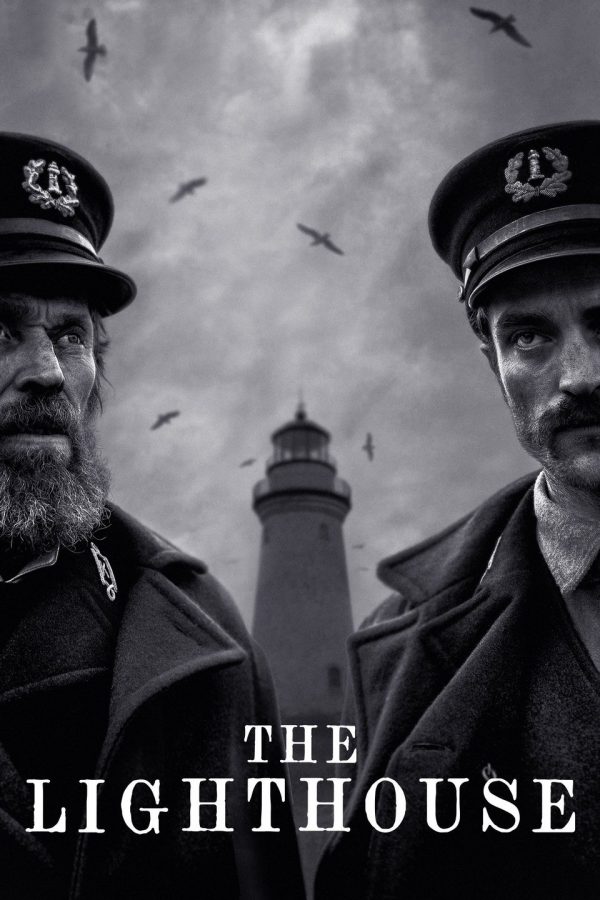
The Lighthouse (2019)


Director: Robert Eggers
Screenplay: Robert and Max Eggers
Cast: Robert Pattinson as Thomas Howard; Willem Dafoe as Thomas Wake; Valeriia Karaman as the Mermaid

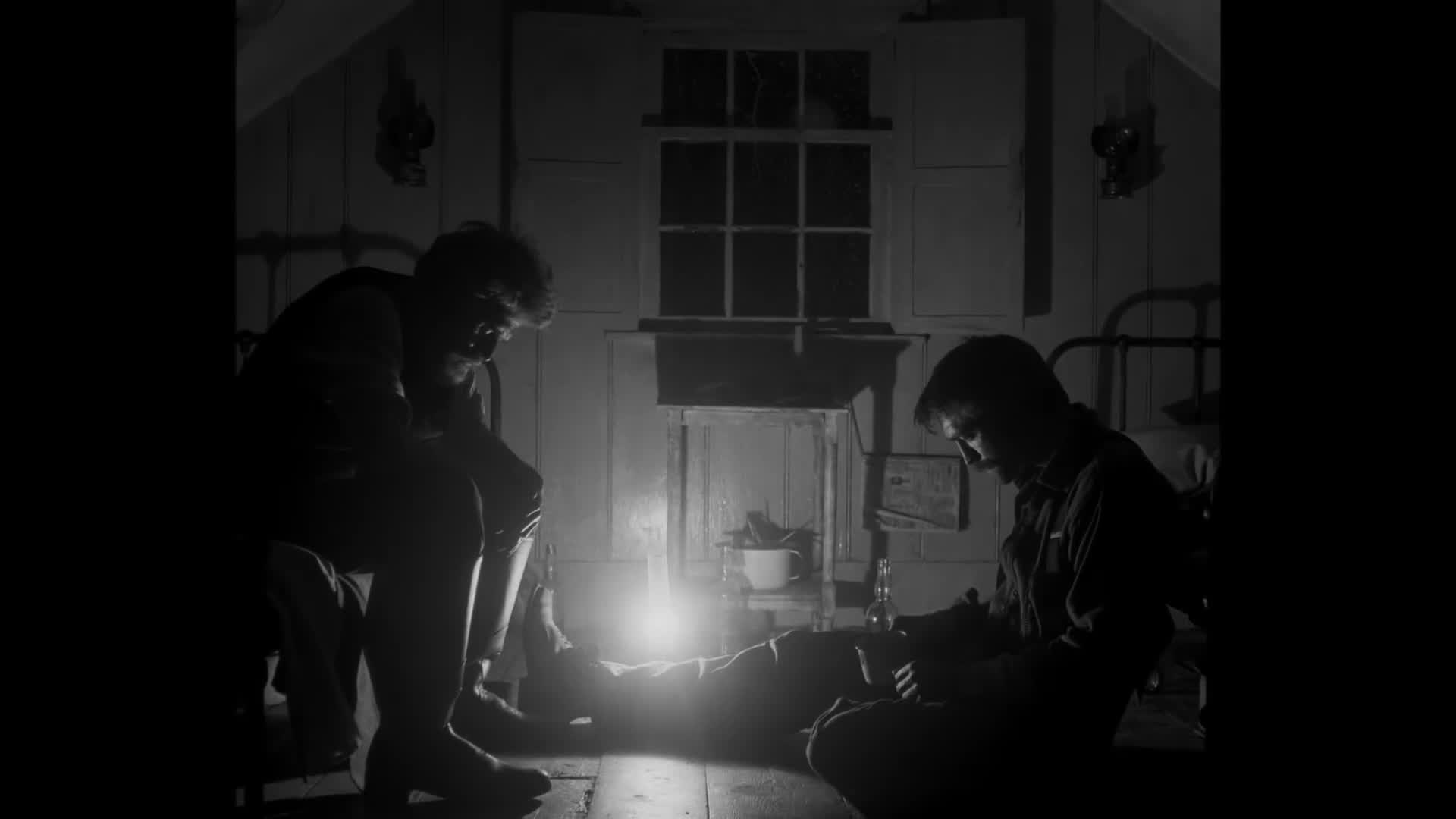
If cinema was dead, how does The Lighthouse exist and do as well as it did? Robert Eggers, after the success of The Witch (2015), was in the position of many filmmakers where after success they can crash and burn with projects where the producers allow them carte blanche to make whatever they want. I love such projects, but they rarely success. This could've been such a case, managing to be a monochrome film shot on 35mm celluloid about Willem Dafoe and Robert Pattinson going insane in a 19th century lighthouse, even shot in a 1.19:1 aspect ratio. What we got instead was a highly admired film that even got a Best Cinematography nomination at the Academy Awards.

Well The Lighthouse exists and upfront I loved the perverse weird thing completely. Dafoe is an old lighthouse keeper, introducing himself with a fart and sounding like the Old Sea Captain parody from The Simpsons, whilst Robert Pattinson is a new employee on an island. The Lighthouse from here is surprisingly simple in what it's about, namely that it makes a damn good argument about the dangers of getting shitfaced on alcohol continually. I'd argue there are explicit supernatural aspects, as I'll get to the seagull, whilst there is also the subplot that Dafoe is obsessed with keeping Patterson out of the top of the lighthouse*. Aside from this, this is a film about two men going insane. This is not helped by the fact the drinking water isn't great, being in the 19th century, and booze is found on the island with considerable ease.

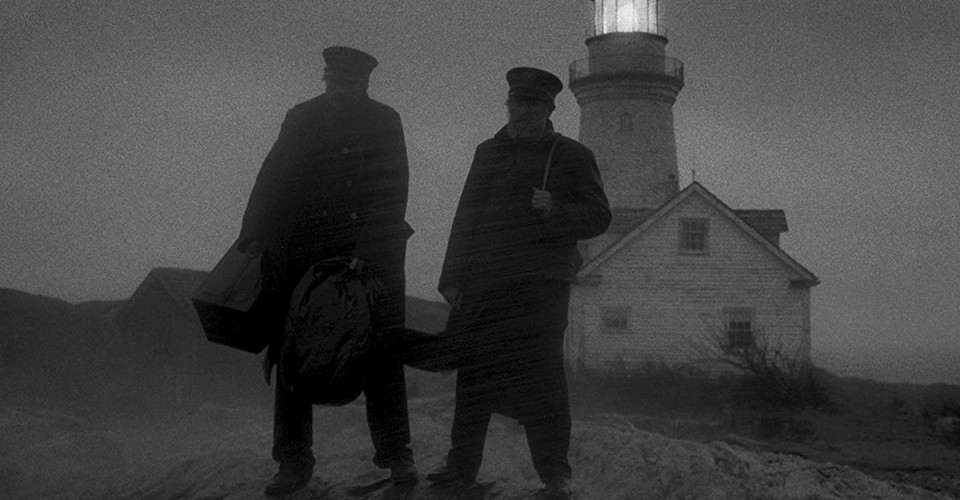
Eggers' style here is distinct. Shot in black and white, to the point the cinematographer Jarin Blaschke was working with a camera lens as old as from 19121 and had to figure out how to adapt it to modern cameras, this film looks truly unique. Adding to this nature, unique in text, is that the screenplay by the Eggers brothers comes from them having done their research and pulling from history for aesthetic, to the point of the lighthouse having been built for the film. This is distinct too as, referencing the supernatural, they pulled from folklore. Shrouded on an island in the middle of the sea, the film runs with nautical aesthetic of the kind where it would make perfect sense for characters to suddenly quote Moby Dick era Herman Melville. This is apt since the script openly admits it took quotation from Melville and Sarah Orne Jewett.

You can practically taste in the air and dirt being blown everywhere, the alien grotesqueness of this world in its use of squid tendrils, crustaceans and other aquatic life on and under the sea. Erotically too as, whilst Patterson's character is also a man hiding a secret, the first moment he starts to crack is when he apparently finds a mermaid (Valeriia Karaman). Thanks to the screenwriters' research on shark vaginas, you get a film here like Peter Strickland's In Fabric (2018) which manages to get away with stuff in a fifteen rated film in the United Kingdom which is gleefully transgressive.


The little supernatural details do suggest a bit more is going on in the island. There is a one eyed seagull, (played by three in a dying breed of trained birds from Britain who, alongside their trainer, should've gotten a Best Supporting Acting Oscar nomination2, a bird onscreen that is visibly antagonistic in their small role to Patterson in an unnaturally intelligent way. Dafoe wants him never to kill seagulls, as they are said to be the souls of the sailors who died at sea, which comes into play. The secret of what is in the top of the lighthouse is never ever seen by us; suffice to say that in how its shot, it cannot be something like a hallucination but nudges into cosmic horror, the area of H.P. Lovecraft or even a William Hope Hodgson in that there are things which are beyond the senses of human beings at the sea. There's even a religious strain as especially in one shot, a reference to Prometheus, the man who acquired fire for human kind of note due to how unfortunate his reward for that was from the ancient Greek gods.

Beyond this, the mood and style offers a dramatic weight for what is very clearly told in terms of story, especially as it swings upon the guilt that Patterson character is trying to suppress but failing to. Helping considerably is that the performances are excellent; Dafoe is a veteran who has always been reliable, whilst Robert Pattinson becoming as good as his senior. Patterson is in a fascinating position that, starting the 2010s in the last of the Twilight films where he really wasn't good, only to become a distinct and great actor, he is in the position of a figure like James Dean where his handsomeness has made him an idol but he himself wishes to become a great actor, which he has strived for and proven himself with. The script itself between him and Dafoe, a two actor film, helped considerably especially as The Lighthouse for all its darkness is rife in exceptional ye old English and is hilarious at times. The film is intentionally funny if you have an incredibly dark sense of humour; the longest monologue, performed by Dafoe that goes into godless intense vengefulness and even evokes the sea god Triton, is played for its over the top nature and language, and only happens because Patterson criticised Dafoe's cooking. Such brevity in the middle of what is a pretty dark film helps so much for it to grow.

Also worth noting is the use of the ratio, where a modern cinema would have to press the buttons to change the shape of the screen to show this film. It's smaller than even the Academy ratio of 1.375:1, one of the earliest in American cinema chosen to organise films to a specific one. It's a testament to how archaic this looks in that the last film I saw in the cinema with a similar square screen image before The Lighthouse was James Whale's The Old Dark House, a film from 1932 which was also a deeply strange and perversely humorous tale. Whilst it could be seen as distancing a viewer, this aspect ratio actually sucked me into this world, a rich one fully felt but the ratio perfect for three actors, a flock of seagulls and no one else onscreen at a single location. The incredible sense of craft on display for such weirdness is something to admire especially as it gets under the skin.

It's pointless to wax admirably about The Lighthouse beyond this, as the film is both a maximalist gem in terms of its craft but very simple to grasp and access, not needing to be scruntiased further. Eggers to his credit avoided both making an over ambitious bomb or trying to make a follow on from his first success, which can plague artists regardless of medium. The result's existence is miraculous and a much needed moment of positivity, showing that bold experimental filmmaking can exist outside the avant-garde. Usually it happens in genre cinema like this a lot, but this belongs to a fascinating series of films, whether each succeed or not, that have been lumped into "elevated horror". That name is problematic, coined by journalists who didn't want to admit praising a horror film, but the idea of horror cinema being a vessel for idiosyncratic oddness and artistic creativity has been with it since Georges Méliès' supernatural films3, making these leanings a rich vein in the genre which has thankfully returned and in the mainstream no less. That its lead to a cartload (boatload) of films over the end of the 2010s which are unpredictable and divisive, from Midsommar (2019) to even Darren Aronofsky's mother! (2017) no matter how I loathed it, is a good sign. And whilst horror cinema from around the world is eclectic, that this moment in the United States exists and makes a contrast to Blumhouse Productions, which disappoints me in every film I see squandering deep concepts for average productions, is only a good thing.

Abstract Spectrum: Absurd/Atmospheric/Bawdy/Grotesque/Weird
Abstract Rating (High/Medium/Low/None): Medium

=============
1) HERE
2) HERE
3) As of 2020, Eggers has been tagged to a reinterpretation of F.W. Murnau's Nosferatu (1922), which considering the film has been remade by Werner Herzog means there's no sense of hesitation to this idea, as it the promise that Eggers will likely be researching real vampire lore for his work if it ever was produced and made.

* [MAJOR SPOILER WARNING] Looking into the light up there was probably the worst thing Patterson could do, certainly evoking a Lovecraftian monstrosity especially when you end up seagull food. It does evoke, alongside an explicit depiction of Dafoe (naked) with lights coming out of his eyes, some real supernatural aspects. The contrast with all the stuff likely conjured to Patterson's character as his sanity goes for a walk is well balanced, allowing both sides to exist without a cheap compromise to either taking place [MAJOR SPOILERS END].

Monday, 24 July 2017

Masters of Horrors Season 1 Part 2

From https://static.comicvine.com/uploads/scale_small/7/
72819/2151218-masters_of_horror_04___00___fc.jpg

Dreams in the Witch-House
Director: Stuart Gordon
Screenplay: Stuart Gordon and Dennis Paoli
Based on the short story by H.P. Lovecraft
Cast: Ezra Godden as Walter Gilman; Jay Brazeau as Mr. Dombrowski; Campbell Lane as Masurewicz; Chelah Horsdal as Frances Elwood
A Night of a Thousand Horror (Shows) #6

After the immense disappointment of Cigarette Burns, Stuart Gordon's entry was a safe way for me to get my confidence back with the series. Based on H.P. Lovecraft, it was a welcome change of pace purely for telling a story which was interesting and, in spite of likely being the middle of all of them in rank, succeeding with said story. Its particularly successful as well as my knowledge of Stuart Gordon's career is an odd, patchy affair considering how fascinating his filmography is on paper. (Also I'll admit I haven't been a huge fan of Re-Animator (1985); I might change my mind on a revisit, but for a while I openly admit to having preferred Brian Yuzna's sequel Bride of Re-Animator (1989) instead.) Gordon's career in general upon reflection deserves a deeper investigation, as few could attest to having gone between experimental stage plays to Charles Band productions, adapting Lovecraft to adapting David Mamet. Gordon's entry for Masters of Horrors also emphasises how there's a sub current of the series deserving to be called "Masters of (Literary) Horror" as well as most of the material is adaptations from various sources, from HP Lovecraft to EC Comics, Clive Barker to even Mick Garris adapting one of his own stories for his entry. It's a nice reminder of the dept horror cinema has to the printed page as much as a visual-audio medium, these short horror stories finding the right idea on paper of adapting small scale, personal horror stories.

The actual episode of Dreams in the Witch-House is pretty conventional, in which a protagonist (Ezra Godden) stays at a dilapidated rental apartment only to suffer from dreams of a witch and her familiar, a human faced rat, that may be more real than he thought, having evil machinations for the baby of the female resident (Chelah Horsdal) next door to his room he's becoming smitten for. But that's not something to complain about in this case as Gordon makes sure to make a solid adaptation of the material which provides the idiosyncratic twist itself, rationalising witchcraft through arcane and hidden science. This provides one of Lovecraft's most curious and inspired ideas, influenced from learning of the concept in his private life from study, of non geometrical space in theory allowing reality to bend and transport people in environment. As a result, the witch tropes within the film have a strange, distinct edge that stands out especially as most of the story stays within the home, peppered with the creepy details from Lovecraftian lore including a cameo by the Necronomicon. Adding to this is also the bleak ending, possibly stretch to absurd gory lengths with multiple conclusions, but befits an episode that was a suitable pick-me-up after the disappointment with the previous one.

From http://images2.fanpop.com/image/photos/10000000/Dreams-in-the-Witch-
House-masters-of-horror-10067972-500-300.jpg

=========

From http://bloodsexcult.org/uploads/horror/
incident-on-and-off-a-mountain-road01.jpg

Incident In and Off a Mountain Road (2005)
Director: Don Coscarelli
Screenplay: Don Coscarelli, Joe R. Lansdale and Stephen Romano
Based on a short story by Joe R. Lansdale
Cast: Bree Turner as Ellen; Angus Scrimm as Buddy; John DeSantis as Moonface; Ethan Embry as Bruce
A Night of a Thousand Horror (Shows) #7

In vast contrast to Stuart Gordon and John Carpenter in these viewings, the director of the actual  first episode of Masters of Horror, (in terms of what was broadcast on television first), Don Coscarelli is someone I have no ideas upon. I have vague memories of watching the (then four) films of the Phantasm series when I was just getting into cult cinema but that's a century to myself now and the only clear image I have is a literal object, that I created one of the spiked floating spears from out of moulding putty and pieces from Warhammer 4000 sets that still sits on my window  years after now. For a long time it's only been Bubba Ho-Tep (2002) that gave me an image of Coscarelli as a director, but that was still a long while ago  as well. Aside from this, Coscarelli is an entire mystery for me, the time appropriate to correct that now Phantasm is a five film franchise currently and had all the bells and whistles thrown at it within 2017.

Incident On and Off a Mountain Road is a twist on a stereotypical horror trope seen many times before especially in modern straight-to-video chillers - a woman driving on an isolated midnight road finds herself the target of a deformed serial killer - the catch that, due to her previously having dated a survivalist, the relationship of a mirroring narrative, her ability to protect herself is something the killer nicknamed "Moonface" has never had to deal with. The result plays out as two separate stories connected by the protagonist Ellen (Bree Turner) having to deal with two male figures, one which is immediately dangerous as the stereotypical inbred rural sociopath, the other more insidious played by actor Ethan Embry, starting off as a charming man who just happens to have provocative opinions on the world burning around him but slowly is revealed to be more problematic, a paradox in how Ellen is both indebted to him for learning how to try to survive Moonface but with his back-story with her also leading to a breaking point for her as a human being. It's a less high concept premise from screenwriter/original author of the tale Joe R. Lansdale than his story for Bubba Ho-Tep - elderly Elvis and Ossie Davis as JFK fighting a mummy in a retirement home - but his taste for twisting conventions onto their head is the episode's best aspect, as is the fact the late Angus Scrimm completely goes against his cinematic image as the scene stealing figure Buddy, bouncing off his wheelchair like a hyper acting child wanting to engage in sing-along's with captive prisoners. He's a character you could easily find in one of the better Texas Chainsaw Massacre films, the first of many side characters in the first season of Masters of Horror who steal their stories outright whenever they're onscreen.

The one issue that decides whether a viewing will love Incident On and Off a Mountain Road is your reaction to the final plot twist, built up through the film but taken to a greater extreme than even the violence beforehand. The look and tone of the film viscerally fits the growing post-9/11, torture porn era of glossy scuzziness, a giant drill the killer's main weapon of choice and dead bodies more set decoration than objects of fear. The issue is more that, from a premise no matter how gristly it is thatfirmly stays within the entertaining for 90 percent of its length, the end twist does take on a greater severity including sexual violence which might come as an abrupt change of tone particularly with such content. Its less the use of such a scene, whilst itself a potential concern, but more the suddenness of it and intention, especially as this twist is like so many you usually find in horror story telling to create a jolt in a viewer for the end, but in this case uses something that levels the fantasy of the horror to rubble for something real and uncomfortable. It's a drastic twist, especially as its used at the end as a wraparound of the whole narrative, so your view on Incident On and Off a Mountain Road will change depending on one's reaction. For me personally, I'm on the fence as even without the provoking nature of how the twist's done, the sudden shift with how we should view the heroine is one I've still chewing on even if the potential trigger warning wasn't there. It's a rewarding episode, probably with the exception of Angus Scrimm however one which won't be at the top of the list when I think of the best of just this season of Masters of Horror. 

From https://wildinthestreetsblog.files.wordpress.com/2010/12/1225_19.jpg