Showing posts with label Japanese New Wave. Show all posts

Tuesday, 22 May 2018

Heroic Purgatory (1970)

From https://i.pinimg.com/originals/10/09/31/
100931e6ce48ecc1bfa542296d1a686f.jpg

Director: Yoshishige Yoshida
Screenplay: Masahiro Yamada
Cast: Mariko Okada as Nanako; Naho Kimura as Jyoko; Yoshiaki Makita as Shu; Kaneko Iwasaki as Atsuko; Tôru Takeuchi as Kiyoshi; Kazumi Tsutsui as Ayu

Synopsis: When Kanako (Mariko Okada) encounters a young woman named Ayu (Kazumi Tsutsui), who survives a lengthy and direct fall onto concrete, she brings her back home to live with her and her husband Shoda (Kaizo Kamoda), who works for the Atomic Agency. A man claims to be Ayu's father, and from there the film switches back and forth in time as Shoda is involved with a communist cell planning an assassination, whilst Kanako and Ayu interweave through the eventual destruction of said cell.

Quite soon into Heroic Purgatory we are unstuck in time, to paraphrase Kurt Vonnegut, transitioning back and forth between 1952 and 1960, where the renewal of the Mutual Security Act ensured the continuing presence in Japan of the U.S. Army, and beyond to the 1980s and the unforeseen future. In-between a paranoid psychodrama takes place where reality is subjective, the slow dissipation of a communist group as a spy is sabotaging them from the inside, one which might not even exist in the first place. As the communist group plan to kill an ambassador, they fall to pieces over time as compromise and paranoia take over, the only ones who stand being Kanako herself and Ayu, who Kanako adopts as a quasi daughter figure despite being close in age.

Whilst it travels far from her and includes various other figures, ultimately Kanako is our closest thing to a protagonist. Even if the film lavishes time over the naked female body in the one aspect that may date the film - obsessed with its beauty in contrast to the ennui inducing environments - the female characters are the ones who drive the narrative. Kanako, staying out of the chaos that dooms her cell eventually , is more concerned her newly adopted daughter is missing at points whilst the communists, constantly charging her husband for being the spy, ignore her or say they cannot see Ayu. Who Ayu is - with her incredibly thin figure and strange manner, such as her desire to kill all potential father figures - is unknown, be she real or a living metaphysical entity. Whatever the case, its significant she bookmarks the film. That even if she's sexualised at points, including a reoccurring film within the film of Shoda touching her nude body in an isolated warehouse, she feels like a silent but dominant figure.

From http://static.imovies.ge/m_posters/1280/142684098837.jpg

The only actions of the men in Heroic Purgatory is mindless violence. Shootings. A gang rape of a female member of the communist group, never seen baring the aftermath and with the character yet reappearing to explain her death to her fellow communists. What appears to be death by strangulation in another scene is either botched or a mere act, the woman meant to be the victim nonchalantly dismissing the action as if nothing. Even the nudity, whilst the one thing which could detract from the film is more complicated due to the look and structure of the film. There was a potentially crass edge to older art films made by men from this era which intercut politics and philosophy with distanced titillation, but it drastically stands out here as, within the angular and cold environments, it drastically contrasts with the natural, curved and living figures of the female characters. The contrast is so strong, as the mechanical world around them seems more alien in contrast, especially as these female characters are those who ultimately stand out. They turn out significantly more stronger than their male peers doomed to paranoia and their codes.

The film belongs from the deep well of the Japanese New Wave, experimental and/or idiosyncratic films which fully fleshed out in the sixties into the seventies. Heroic Purgatory was produced by the Art Theatre Guild, formerly importers and distributors  of foreign films who came in this time to represent independent films as their mantra when they produced films like this. Like a lot of these films, they were made with incredible prowess. Director Yoshishige Yoshida is obsessed with the extremes of blacks and whites in the monochrome of the film. Michelangelo Antonioni is felt in his used of manmade locations (warehouses, modernist buildings) which dwarf the cast, but the extreme use of white to the point it drowns the images out is entirely Yoshida's own. These are the whitest of whites, to the point it disrupts the image but bleeding shape away through the blinding use of white light against black.

From http://4.bp.blogspot.com/-O7HTSZZuh5A/UYcL-gJHSnI/
AAAAAAAAAKg/8KslLIbna5U/s1600/hp1.jpg

Even for a bleak film in tone, the aesthetic is beautiful even if it's meant to show a phantom world in and out of time, characters dead appearing with the living to explain their deaths or conferences with the press playing out in an empty tennis court like an avant-garde theatre performance. The film's dislodging from time evokes author/director Alain Robbe-Grillet, who specialised in this fragmentation out of chronology, especially as characters can suddenly be transported from one environment to another with the same movement (i.e. lay on a bed, only to be transported outside laying somewhere else). The characters are our anchors for events as their world and behaviour change, fluctuates, painting a complex picture between them if the pieces are rearranged.

A dream logic which is yet incredibly precise and, like Robbe-Grillet, structured onscreen with an obsession with composition close to painting and the positioning of figures and environments within them. (This means a lot both for when sexuality does appear, like figures of life drawing figures having entered modernist architecture, or how surrealism manages to slip into the grounded realism of these industrial environments with ease). Like Robbe-Grillet, who liked to play with genre structure, there's a sense even if Yoshida made this film with greater concern for political concerns that he's lapping at the edge, like the sea on a beach, on the paranoia thriller as guns are fired and there is a spy who may not exist, as poignant as when Seijun Suzuki had the mysterious No. 1 assassin in both Branded to Kill (1967) and Pistol Opera (2001) - not quite the type of films to compare to Heroic Purgatory but, with the former from the Japanese New Wave, both obsessed with the idea of a threat which may be a mere fabrication but is still destructive, evoking God knows what subconscious moods of Japanese society at this period thinking of how politically volitile the era was with the likes of the Japanese Red Army eventually coming to be a year after Heroic Purgatory's release.

From http://www.thenerdmentality.com/wp-content/uploads/
2017/06/Yoshida-Heroic-Purgatory-03.png

The meaning of Heroic Purgatory as a whole is more than likely through mood - the centre of three films by Yoshida about ideologies. Eros + Massacre (1969), his most famous film, was about anarchism through free love advocate and anarchise Sakae Osugi. The last Coup d’Etat (1973) was about nationalism through real life ultranationalist Ikki Kita. Heroic Purgatory is about communism, and whilst not about real life figures it uses real like context to depict such a group eat itself alive. That its English title is "Heroic Purgatory" feels pertinent, these figures doomed in their belief to change the world for the better only to have wandered into these various time frames, dying or afraid of being killed because of spies within their own.

The film ends with Kanako and Ayu at a literal dead end on a train station platform, and whether you fully grasp what happens, it feels like both women walk off having to find new purpose. The film throughout strips away what was presumed before. Where religious beliefs are questioned, science and Shoda's goal to innovate in technology useless and made obsolete the moment its born, and in whatever time frame the film takes place in the communists self destruct. It's both a bleak ending, yet considering how surprisingly dominant the female figures are within this tale, the two most distinct figures are the ones who start the film and end it, making something if not hopeful at least with the concept that new goals are to be found for the mother and adopted daughter beyond the film.
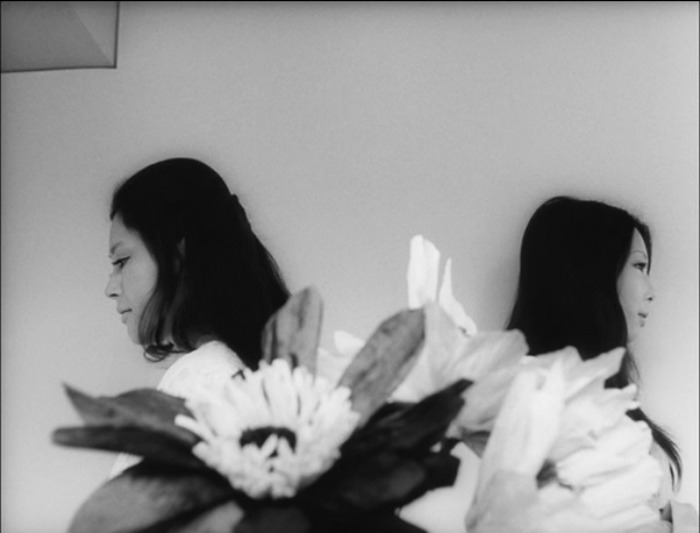
From https://oneperfectshot.files.wordpress.com/
2014/07/heroic-purgatory.jpg?w=700

Abstract Spectrum: Avant-Garde/Expressionist/Introspective/Mindbender
Abstract Rating (High/Medium/Low/None): High

Personal Opinion:
Difficult but with purpose, Heroic Purgatory having been made not so long after the Sixties feels like the dissection of what took place to communism as a principle within that time. A compelling one, one which I openly admit qualifies for the term "pretentious" were it not for the fact that it actually has an incredible sense of intelligence to it. Artistically alone, it's a work of art but also as an entirely constructed work which plays with narrative and logic, the craft's flawless and to be of awe with.
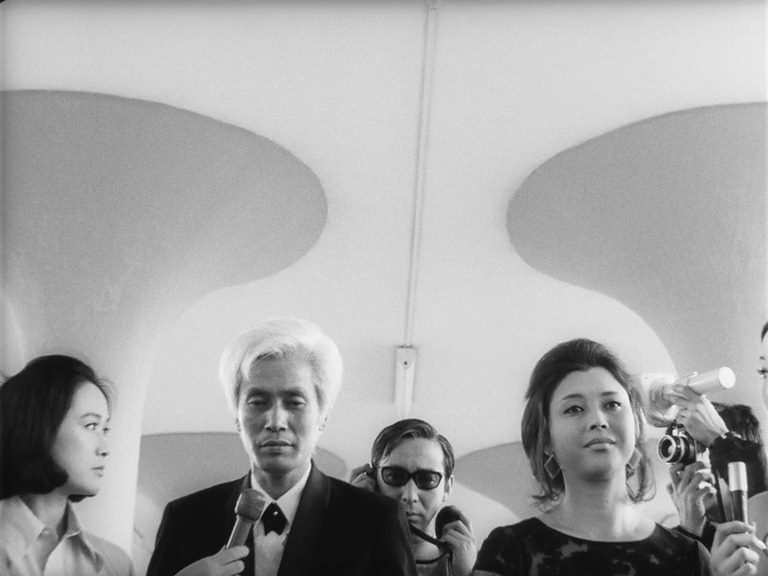
From http://rarefilm.net/wp-content/uploads/2017/03/
Rengoku-eroica-AKA-Heroic-Purgatory-1970-1.jpg

Saturday, 6 December 2014

Funeral Parade of Roses (1969)

From http://www.jposter.net/images/products/funeralroses.jpg

Dir. Matsumoto Toshio

I like to write about unconventional films, but there are some cases where the film in question has so much I could talk about, and are truly unconventional, that I feel daunted in trying to type this review. Funeral Parade of Roses is such a film. But, as with this film, there is a reason for this that I can write about if I am unsure what to say - that you could never get a film like these today, which is disappointing because a film like this feels more advanced and progressive than some of today, but a film like this is forty or so years old. Funeral Parade of Roses is playful and provocative in everything it does differently from other films. Set within the political and artistic hotbed of late Sixties Japan, the film follows Eddie, played by real life transsexual Peter, a male cross dresser who is in conflict with a rival drag queen over the affections of a drug smuggling cabaret manager Gonda (Yoshio Tsuchiya). Eddie is a psychologically complex person, flashes of his childhood and adolescence seen throughout the film which show what is bubbling under the surface of his makeup and elegant appearance. Shot in stark monochrome, the film is a hybrid of multiple cinematic forms, a narrative feature which yet has documentary interviews with drag queens and Peter the actor himself spliced in-between, a tone varying from the serious to the cartoonish.

From http://3.bp.blogspot.com/-PpcRKBVMEOE/TfcKDCfxSLI/
AAAAAAAAAQw/dgG1SmnIepk/s1600/vlcsnap-2011-06-11-22h47m04s254.png
The film never becomes stale or procrastinates despite its tangent heavy tone, always on an interesting point. It not only has real documentary footage, but porn shoots within the narrative, and reflective the director's avant-garde and installation film making, experimental films within the film that we see by themselves and being created by the avant-garde filmmaker characters that make up the people that Eddie interacts with. The fiction is designed to pull along the reality with it, while the fiction itself is layered and filled with various and different sorts of material shown to the viewer. The result disrupts but also creates a narrative structure which places further importance on story points when they are returned to, that of Eddie's complicated life, as well as flesh the real content, set with Japanese gay subculture, out. It allows the director to be more flexible, to have humour against the serious, to the point of ridiculous, sped up handbags-at-dawn spats and literal dialogue balloons, and have a tone that can even lean on exploitation-like uses of sex and grit. At times the sexuality is pronounced and close to a pinku film. 

From http://4.bp.blogspot.com/_rUyDhdZLna8/TIGfxWCzS4I
/AAAAAAAAahk/6VyFevxbXVA/s1600/funeralparadeofroses2.jpg
The open, matter-of-fact view of its gay subject matter is refreshing, having fun with subverting gender - three women at urinals for example - and is also unapologetically erotic and titillating. Peter, when made up in full make-up or when the camera lingers over his body in the shower like it does on actresses in other movies, is unbelievably beautiful, to the point as a heterosexual man I will add him, in this film, as one of the most gorgeous individuals filmed on a camera I've seen. That he is charismatic and a good actor makes this better, something to be proud of that he would later become the court fool, an important side character, in Akira Kurosawa's Ran (1985). (It is odd I can say his filmography also contains a Guinea Pig film, but that's why Japanese cinema and its ease in blending different areas makes someone like Sean Penn look lazy). Funeral Parade of Roses enforces on me particularly, as a viewer interacting with cinema in direct communication, that my own personal sexuality is an attraction to femininity, all the things stereotypically attributed to it and when it is reconstructed by women and transgender people - curves, heightened facial features like eye lashes, clothing and textures, the more open ability to express thoughts and emotions than many males etc. The film is as much on the nature of gender by proving beauty is pansexual, seeing the drag queens and transgender women in this, their lovers and clients as well, and how gender and sexuality is fluid even if many of them prefer acting and dressing as stereotypical images of women, wearing the most stylish boots and dresses they can afford, and being immensely glamorous unless a female gang makes derogatory comments and a fight breaks out between them.

From http://41.media.tumblr.com/89afa54a82055662dbc28204acd32c51/
tumblr_mt77nnFY1N1qzl6klo1_500.png
Structurally, the narrative is as playfully put together as the experimental sequences, chronology out of order for large portions of it, built up as more is revealed, a pastiche of Streets of Shame (1956) or A Woman Ascends The Stairs (1960) with a subversion of a famous tale I cannot actually name because it'll be a spoiler for the ending. Together they create an enticing character drama as it's build up with flashbacks in Eddie's life. The film throughout always feels bold, still daring today. It comes from an era that may have been terrible for many things, for things that feel quaint now - of pot smoking and equal opportunity nudity - but the film is as much a view of the melting pot of art, social interaction and sexuality that is vibrant. The direct references to real life art and subculture "happenings" in the film add a historical importance, documentary on the period in Japanese society, particularly footage of a protest/conceptual art piece in the middle of a street, the titular parade of the film's title involving men dressed in tinfoil gas masks and black clothes. It's also a film catching when the tide would roll back, to paraphrase Hunter S. Thompson, the spot where this parade becoming empty, paper banners left scattered on the ground, or the isolated and wounded protestor stuck in an apartment complex corridor by himself with no one of his group to protect him from the police. As we take interest in Eddie's life, we have as much interest in the (real) world around him in digressions on various topics. This is something badly missed in most art cinema of the present, the layers of culture that would be embedded in the background of the main narrative. Viewing this film, and those in the same vein like Throw Your Books Away, Rally In The Streets (1971), feels like an adrenaline shot.
 
From http://1.bp.blogspot.com/-PW-PuURq9dY/UTlZJ_xuPvI/
AAAAAAAAKNo/1DA4gGp1BbQ/s1600/fp10.png
Abstract Rating (High/Medium/Low/None): Medium
It's subject matter is still unconventional, in the climate that we still occupy where the notion of transgender, though respected, is in the realm outside of conventional gender politics rather than fully embraced as many would desire. But that is not enough for an abstract rating, as it could mean a film as good as this or a patronising drama with less than good quality filmmaking depending on what was made. What does so here is a presentation which, on another viewing, is still unpredictable and throws new angles on the material. It's a film with a lot to take in. It has a consistent, fascinating, and most importantly, engaging drama in its centre, but Funeral Parade of Roses is also different still in what you'd presume cinema is in the modern day, a difference somewhat needed again. Suddenly there are repeats of a man sneezing, in the middle of a dramatic beat, the frame almost slipping, unexpectedly in one moment, not connected to the main story, what would be seen as redundant in modern cinema, but fills and expands the tone of the film here for greater impact. Snippets of interviews and footage from other sources are intercut into scenes, disrupting and effecting them, adding texture and character. The blend of fiction, reality and artificiality creates an unpredictable tone, such as a dramatic scene suddenly turning into a Japanese period drama through a character's preferred dress and a specific music cue chosen, without becoming ironic, always empathetic to all the characters. Whilst retaining a straight forward narrative, the film's structure is inherently unconventionally.

From http://41.media.tumblr.com/tumblr_m3vd15BsmF1qb5tu1o1_1280.png
Personal Opinion:
What makes the Sixties in art in general enduring for me is, while a lot of it could be self indulgent and pretentious, it still possesses art that is still original and fresh today to see or listen to. The indulgence is enchanting, backing away from the predictable, and in cinema, even a wobble of a handheld camera feels like a flourish, accidents or things done on purpose bringing technical and aesthetic style rarely seen today. In the case of this film, it means a lot to take in on multiple viewings, a film that is easily accessible but also revealing new things on each viewing I have of it. Once it gets to the end, capping off with an unsettling yet poetic ending that reinterprets a legend in a pansexual light, it also succeeds as existing in its own type of cinema, the blurring of genre and tone you get in cult cinema, particularly art films like this, where it never becomes tedious even if one found it frustrating. Moments feel like they wouldn't be carried on into filmmaking of later decades but they stand out nonetheless as very distinct filmmaking which I wish was still frequently done. 

Friday, 19 September 2014

Archival Reviews: Branded To Kill (1967)

Booklet Cover for the Exceptionable Arrow Video Blu-Ray/DVD Release
(http://diversejapan.files.wordpress.com/2014/08/branded-to-kill-booklet-sleeve.jpg)

Dir. Seijun Suzuki

About
Since I wrote a blog before this one, it's wrong to erase the old material I compiled on it and, even if I may re-write many reviews from it with the practice I have now, there are others that still retain the opinions I have of the works covered perfectly, so why not include a link to the old page and go through the films in question through the new structure of my reviews? To begin this, why not Branded To Kill, a poster boy for unconventional pulp cinema which famously got its director banned from making films by the studio he was working for? A narrative about the No. 3 top assassin of an organisation (Joe Shishido) whose abrupt mistake during an assassination leads his group to try and take him out, a delirious film in monochrome with abrupt tangents that influenced many a filmmaker decades after,

Abstract Rating (High/Medium/Low/None): Medium
This might raise eyebrows, but from the few films I've seen, Seijun Suzuki could make even more unconventional films than this one. It's still attached to a very well worn narrative, contrary to its reputation, though that doesn't stop it, through its style, presentation and narrative turns from living up to its reputation as being a very off-kilter film. It's just that the director could go even further in this experimentation with great results.

Personal Opinion:
For that, go and read my original review here - Branded To Kill Review - for the final opinion and a longer write up.

From http://ishootthepictures.files.wordpress.com/2010/07/
fullscreencapture724201044204pm.jpg