Director: Fen Tian
Screenplay: Fen Tian
Cast: Jana Camp as Jana; Aneese
Khamo as Prince; Gloria Winship Ayon as the Mother; Shane Ayon as the Store
Owner; Michaelina Lee as the Friend
[Major Spoilers Throughout]
 The cover of this straight-to-DVD
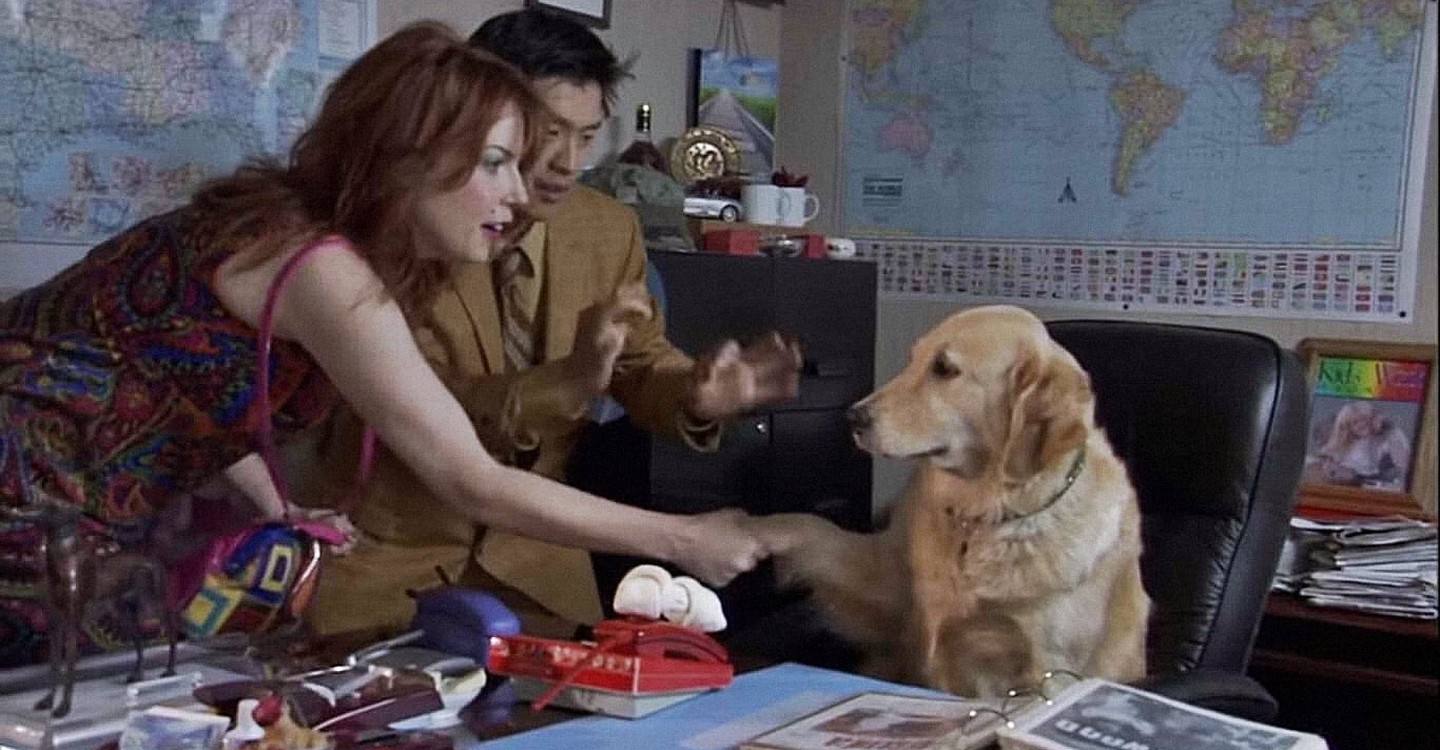
film looks ridiculous - a blonde woman hastily put together with a Labrador in
a suit, holding a leash in its mouth and extending a paw out. For whatever
reason, it's developed a little cult specifically on the film website Letterboxd, the reason why I even learnt
of this film in the first place. It's a dumbfounding project, and as the 2010s
leaves us it is littered with these oddities, this up there alongside The Evil Within (2017) and Flexing with Monty (2010) in the
level of strangeness, but when one was a Getty
using his millions to make a film, the other an unfinished psychodrama of perversity
and Catholic guilt, Love on a Leash
is a very low budget and haphazardly made interpretation of the Princess and
the Frog with a dog.
The cover of this straight-to-DVD
film looks ridiculous - a blonde woman hastily put together with a Labrador in
a suit, holding a leash in its mouth and extending a paw out. For whatever
reason, it's developed a little cult specifically on the film website Letterboxd, the reason why I even learnt
of this film in the first place. It's a dumbfounding project, and as the 2010s
leaves us it is littered with these oddities, this up there alongside The Evil Within (2017) and Flexing with Monty (2010) in the
level of strangeness, but when one was a Getty
using his millions to make a film, the other an unfinished psychodrama of perversity
and Catholic guilt, Love on a Leash
is a very low budget and haphazardly made interpretation of the Princess and
the Frog with a dog.
The first question to ask is who
director -writer Fen Tian is. There's
not a lot on Tian barring the fact
her IMDB talks of her having one
acting role, a tiny one, in The Joy Luck
Club (1993) and that she made one other film beyond her debut, Forbidden Kiss (2012). The production company Fenix Pictures who made the film is better known for many films of Ulli Lommel, the former Rainer Werner Fassbinder collaborator
who became a director but eventually made a lot of straight to DVD horror this
is not highly regarded. There's also a suspicion, beyond the many issues and
aspects of Love on a Leash to deal
with, that there's a cultural barrier at hand with this Chinese-American
production. Tales with this idea, of a man who is turned into a dog before the
film and can only change if he finds love, do exist in the West, but this type
of modern day folklore tale is not commonly adapted in Hollywood films anymore
barring a joke, let alone this elaborate and eventually getting into doomed
love. A lot of this is just admittedly that, even if the tone found in Chinese
cinema can be incredibly jarring in tone shifts for outsiders not used to it,
this film is just strange without any real logical reason.
Love on a Leash is also quite a film of tragedy, belying its silly
looking DVD cover. Before we even get into that however, you have a roughly put
together work, and that's an understatement. A lot of Love on a Leash is a Frankenstein composite of scenes edited
together with many improvised scenes surrounding a surprisingly well trained
Labrador. It's a mess to be honest, probably one of the most technically
disorganised I have seen even from someone who watches many low budget
productions struggling against adversity.
There's also the dreadful
decision to give the dog the voice, only heard by the viewer, of a chauvinistic
arsehole who is meant to be funny. Out of everything in Love on a Leash, I adapted to how technically bad the film
eventually but that creative decision to have a guy recording jokes at
inappropriate moments is egregious, especially as he is a sexist pig for most
of the film. Even when the character softens, and even becomes sympathetic as
he learns humility onscreen, the version voiced in the other scenes is only
acceptable when he abruptly starts to sing constantly.

Mostly this is egregious because,
contrary to the look of the film, Love
on a Leash is a depressing film whose tonal films are fascinating, ninety
minutes an emotional rollercoaster between the presentation and then the
various aspects of the film dramatically. It initially starts as the secondary
tale of Jana (Jana Camp), a meek and
henpecked young woman, on an incredibly peculiar start, where two tangents with
two possible suitors involves two potential separate films, one effectively Ang Lee's The Wedding Banquet (1993), when her Chinese co-worker is a gay man
wanting a fake marriage to hide his real self from his family, the other a
perplexing tale in itself of adoptive families of matriarchal women against
forced sterilisation and creepy Oedipal restrictions. That the film discards
both, in favour of a plot that's just as perversely compelling, is a sign of this
being something very different.
For starters, Jana's story gets
dark, even if an attempted suicide by pills is undercut by the talking dog
making jokes before and after whilst blundering about. The tone is a huge aspect
with the film you need to adapt to even after you accept it's been cobbled together
in post production to an extreme, with sound cutting around harshly or nonexistent
for added dissonant effect. This is where you have broad stereotypes, like a
broad foreign female neighbour trying to get the female lead to be hitched for
her mother's sake, only to get bleak.
Jana losing her friend, losing contact with her family, only because in spite
of eventually a romance where the dog is finally able to turn into a stud Prince
Charming, he can only become human at night because he wasn't sincere enough.
All of this is belied by the
chaotic tonal shifts. It gets kinky - can a woman love a man who becomes man's
best friend in the day, putting on a dog collar on him for sexy photos at some
point never explained - and played for slapstick, such as the diner with her
boss that goes amiss with her inexplicably falling into the swimming pool and
needing canine rescue. Its chaotic keeping up with the film, which unlike many
in this however never falls into a slump of predictable storytelling, which is
the aspect which redeems this mess in many ways; so much is roughly put
together, shots likely stolen and abruptly put together, even David Bowie's China Girl making an audio appearance with a sense it wasn't even
paid for. There's always something in terms of a twist or an emotionally
shocking plot point that is going to frustrate some viewers, be it all the
depressing material where lead actress Jana
Camp is continually crying or ridiculous, but is compelling nonetheless.
Production wise, many of the film
feels like it was shot on a store bought camera with the most distinct
trademark being the prominence of green in production design in Jana's
apartment and some low budget computer effects, mainly due to the mysterious
magical figure behind the dog's situation found at a duck pond in the park.
There's an unexpected rawness to the film, particularly with the locations used
in the film that in some cases do deserve credit for being distinct, particularly
as there are clear excuses to show Chinese American culture which I am all in
favour for, such as a gallery exhibition where memorably the dog is not allowed
in to his annoyance.
The other thing Love on a Leash does that few films in
this possible possess is to stick to its ambitions. "Bad" cinema,
when viewed ironically or not, can have really generic plots, many ultimately
bad in the truest sense as they have no convictions for taking risks. Love on a Leash is a rare exception
that Fen Tian is playing for a bitter
sweet tragedy, where a true love is stuck with a friction that cuts Jana off
from her friends and family, with the dog even being run over and dying. I'd
never expect a film like this, which is an utter mess, to suddenly warm the
heartstrings when, in old age makeup, Jana will meet her true love again in the
conclusion. There's clearly a story type here more in common with Asian cinema
of the normalcy of the supernatural, which actually has to be applauded for its
bravado. That's ultimately, somehow, why I admire Love on a Leash as one of the few films that can overcome such
crippling technical flaws, and misguided creative decisions such as bad talking
dogs making jokes, to be something honestly rewarding to sit through.
Abstract Spectrum: Bizarre/Psychotronic/Surreal
Abstract Rating (High/Medium/Low/None): Medium