Showing posts with label Director: Lav Diaz. Show all posts

Sunday, 4 September 2022

Genus Pan (2020)


Director: Lav Diaz

Screenplay: Lav Diaz

Cast: Nanding Josef as Baldo; Bart Guingona as Paulo; Don Melvin Boongaling as Andres; Hazel Orencio as Mariposa; Noel Sto. Domingo as Sarge; Joel Saracho as Inggo

Canon Fodder


Three miners are returning home. Andres (Don Melvin Boongaling), the youngest, hates his job, that people have been buried alive, that his money goes to others, that his brother's death is clearly suspicious. Another older worker, Paulo (Bart Guingona), tells him to keep his head down, whilst the third, the oldest Bardo (Nanding Josef), who Paulo knows well from their upbringing, comes off as authoritarian or at least is clashing with Andres. The setting for this Lav Diaz film is Hugaw Island, where we learn invading Japanese soldiers kidnapped women for "R and R" camps, alongside certain generation of people calling themselves "sons of Japanese people", alongside the sense the island has been cursed by the corruption that has still transpired there since. The miners are being exploited, forced to pay for even their own equipment to be stored, and is ran by a corrupt sergeant and his company who will use evil means for money.

As to be expected with a Lav Diaz film, this is going to be bleak, in this case a slow burn split into two passages, before an incident leads to two of these three dead, and the aftermath where a figure named Inggo (Joel Saracho) tries to exploit this in his own corrupt need for money. The title is explicitly painted out when, abruptly out of diegetic context, a voice over of a man and a woman talk of how most human beings have not fully developed our brains from the pan, like chimpanzee, those who did the likes of the Buddhas and Christs who helped the world in benevolence, those who did not possessing the selfishness of the chimpanzee. This, even for what is still a nihilistic production for Diaz, is a curious touch, that a grain of positivity is to be found in his cinema even if a rare one. Most of this, set in the nineties, is an endless cycle of corruption and greed, but this touch looks to something profound even if far away.

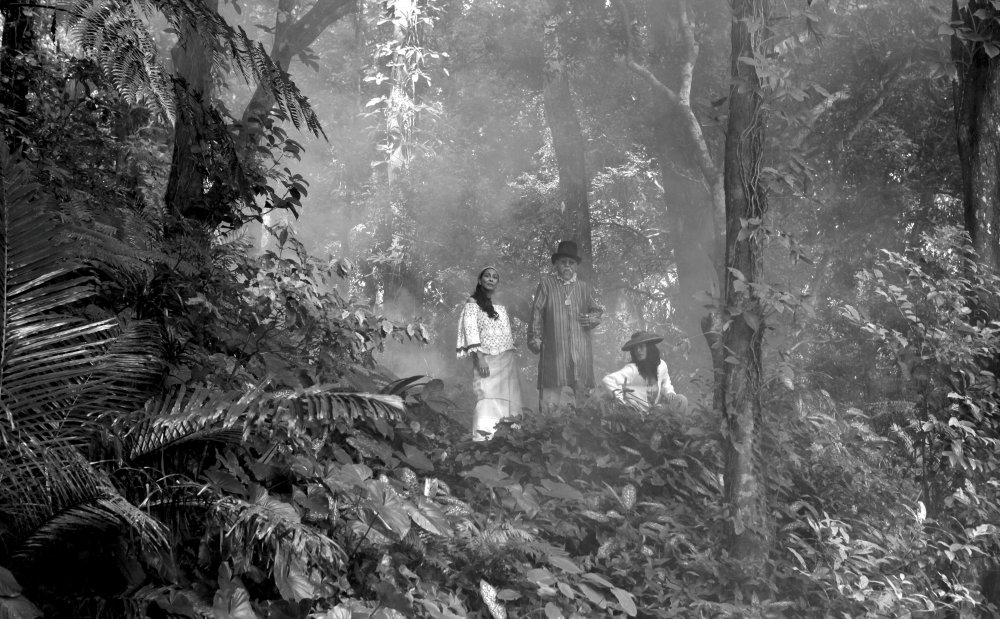
For most of the first act, it is a character drama of these three miners walking through the forest back home. Hugaw Island has its own people, with their own pagan beliefs contrasting Paulo's Christianity, the history of these people being attacked and treated horrifically explicitly talked of as a belief of theirs haunts the three and will appear onscreen eventually later. This is when Andres sees a black horse by a river, which is a curse of death, even if Paulo believes it is caused by bala fruit in that case, delicious to eat but intoxicating when heavily consumed with hallucinogenic effects.


The island, talked of as having legends fabricated by smugglers to keep others away,  of the likes of being a leper colony or a place for those with syphilis to go to, becomes the subject of the film as much as the plot's point, an ecosystem of corruption all around. Alongside the bleak reveal of Bardo and Paulo's past - initially set up as a rare moment of odd humour, as they were in a circus as the "Gecko Brothers", in glued costumes to led to objects being stuck to them, only to have trauma implied from the "Clown" who ran the group - this leads to the tragedy that marks the second act. Here Inggo, simply for money, also entirely as a demonic figure who wishes just to hurt people, learns of this, and even kills one of the widows grieving in an impulse just for some money, whilst threatening the mentally disabled daughter of one of the dead men, Mariposa (Hazel Orencio), who is already as a grown woman having to adapt to this tragedy with anger.

It is here, truthfully, in a film which follows the trend of Lav Diaz's other films - monochrome, long though this one is only two and a half hours long, and the slowest of burns of character pieces, the auteur having found and honed his style fully - where I still have to ask whether his nihilistic view of the world is actually constructive in the end for Genus Pan or leading to nowhere. Do not come to Diaz's films for happiness. It is the thing which causes me to ask (even critique) these films - at which point is his career of so many films this intermittently bleak, many justifiably dealing with the horrible political history of the Philippines, that this loses the point to certain titles like this one without this context? Is this unfortunately the truth, and wishing his films have a happy conclusion, or the closest to one, is taboo, wishing to hide from this film's truth? Considering the reign of Rodrigo Duterte, the 16th president of the Philippines who between 2016 up to June 30th 2022 has been a deeply controversial one for his human rights record, sadly one realises why Lav Diaz made these films as they are, so any criticism of them being too bleak is equally absurd as a critique when real life around him is miserable to consider.

The idea of altruism here is the one thing which contrasts this. Considering the nihilism of a work earlier like Season of the Devil (2018), yet here altruism, sacrifice and ritual exist, the religious practices, from Christianity to paganism, all viewed with respect by the older director, which is fascinating to see. This is contrasted, dangerously close to a cartoon villain depending on your view of him, by how evil Inggo is, the ultimate personification of someone who is just monstrous and selfish, all his deeds purely for money, even just stabbing men mid-religious ceremony just because, the many he kills at one point making him less a person, more a deliberate personification of humanity's demonic side. This offering of humanity, even if crushed under all this corruption and greed, offers a glimmer of light even if the final scene, the precursor of a murder we never see but know will transpire, shows that pointless death and misery by human hands will still transpire. This is still uncomfortable as a viewing experience as a result, as with many Lav Diaz films, but he makes these films when you are prepared for them that are meant to hit with an impact to think carefully of these things.

Monday, 17 January 2022

The Halt (2019)


Director: Lav Diaz

Screenplay: Lav Diaz

Cast: Joel Lamangan as President Nirvano Navarra; Piolo Pascual as Hook Torollo; Shaina Magdayao as Haminilda Rios; Pinky Amador as Jean Hadoro; Hazel Orencio as Martha Officio; Mara Lopez as Marissa Ventura; Noel Miralles as Father Romero

Canon Fodder

Lav Diaz from the Philippines is a director I have had an erratic relationship with. A great deal of this is, honestly, being prepared to watch a director who is very bleak in his work, which frankly is also something to emphasis with Diaz for as he has placed it upon himself to chronicle his country's history - an American colony, even after its independence it went under a military dictatorship and, referred to herein this dystopian sci-fi narrative, the future of his country - all whilst with just this film also writing the script, editing it, being a co-cinematographer, the composer and the production designer. The other issue is more subjective and an artistic issue which I do struggle at times with, that Diaz's trademarks include films beyond the conventional confines of running time. Directors, unless they devote themselves to epics or get the status of a Martin Scorsese, do not necessarily make films even up to three hours frequently anyway, but Diaz has been able, with the sacrifice a larger access until streaming, to make seven plus hour films throughout his career, to the point those under three are the surprise ones of note. The issue has been whether Diaz can sustain this length for me, but as a five hour plus theatrical film, The Halt has a worthwhile sense of expanse, over multiple characters, to work with.

Unfortunately coinciding in production just before the 2020 coronavirus outbreak, a combination of a devastating flu epidemic called the "Dark Killer" which decimates Asia, and a permanent darkness over the Philippines due to a volcanic eruption has left the country weakened in its setting of 2034. These are background to the real narrative, how in the midst of these circumstances a corrupt political leader named President Nirvano Navarra (Joel Lamangan), a mentally unstable and violent figurehead, has taken rule, bolstered by generals including one of his seconds Martha Officio (Hazel Orencio), a female second in command who leads the soldiers that execute and rid his enemies secretly. Contrasting them, in night scenes shot in regular urban areas in Diaz's trademark monochrome, are government drone bots patrolling the streets, cyborg sex workers and women like Haminilda (Shaina Magdayao), a former history teacher, working as one herself, and the underground resistance, including Hook Torollo (Piolo Pascual), a former musician who is called on to help cleave Navarra away even by trying to assassinate him.

This is still a Lav Diaz film, slow cinema drama with prolonged scenes of dialogue, picking here as much at the current day through a hypothesised world not dissimilar to the one this was made within, dealing with how one overcomes authoritarianism whilst having a very obvious but significant referrals to his nation's history and existence he has been documenting in his career, such as a female psychologist Haminilda goes to specialising in the idea that the Filipino people have forgotten their pasts in a form of amnesia, one with political ramifications. This is yet curious in how genre tropes have been broiled down to their perception within a Lav Diaz film, altered by his template. Sci-fi tropes are moulded to fragments, of mentions of sex robots but not seen, normal flying drones used for scenes alongside extras in military fatigues and staged explosions to represent the military's skirmishes on enemies. An attempted sniper assassination by Hook is a key event in his change in attitudes, questioning the true way to save people, and skirting a knife edge, Lav Diaz even has a lot more explicit sexual content here then other films as, seeing even the lives of the villains as complicated emotional people, Martha and her lover/female assistant Marissa Ventura (Mara Lopez), the later becoming conflicted by Navarra's actions and hiring Haminilda constantly, are explicitly gay.

As mentioned, The Halt even humanised the villains regardless of their moral evil. This, in contrast to a work like Season of the Devil (2018), a "musical" based on the era of Ferdinand Marcos which yet felt like prolonged anguished work which could have been more focused at a shorter length, marks The Halt with great weight especially its longer length, both in how it is willing to do this without hiding the fictional characters' evil, and contrasting the other side in Hook facing an existential crisis. Navarra is still a dangerous egotist, who claims to speak to God, but is here a more complex figure close to reality. The way Diaz and actor Joel Lamangan depicts him, even if Navarra could speak to God, the voices in his head overburden him so much in their negative views to him, maybe even as forms of all those he has had killed haunting him, that he has to put on noisy rock music to block them out. His stability is certainly to question, with a scene showing his mother in a mental health clinic and Navarra is emphasised as a child man, psychologically immature but tragically become a dangerous despot than an innocent. With his own private zoo of ostriches and crocodiles that are fed the meat of his victims, he represents the leader who, despite many eccentricities that would question their appropriateness, becomes the head of a violent institution, practical as the lynchpin for military figures who wish to gain power to support his violent impulses to lash out. Martha is arguably more evil, a sadist, and even she has a humanity in her own love for her assistant Marissa, who tragically to her own undoing develops humanity as well as a one-way emotionally connection to Haminilda after she and Martha hire her for a threesome. Criticisms can still be made, honestly, of these villainous characters, as morally irredeemable figures, being attempted to be fleshed out in a way that may prove crass in themselves - involving LGBTQ characters as evil or involved, how mental health is depicted - but at the same time the banality of these figures, the result of when people follow others on ideals regardless of whether morally good, is a really complex and bluntly honest concept for director-writer Lav Diaz which is not simplistic at all. These people are not defined by crass stock archetypes - their sexuality or their mental stability - and the scary thing is that any of these figures, as Diaz and the performers who play, could have been good human beings but, obsessed with nationality, the agenda to improve the country, the desire for power or infantile disregard for human life, all of them became tyrants.

For a director who wishes to have these long form documents of his country's scars, The Halt is a surprise in how it effectively a dystopian drama but he is being more upfront in even questioning how those who fight the morally evil should do so as well, where even Hook, a diehard radical, ultimately finds his own original ideas, or the notion of violent rebellion, as ultimately useless when helping the victims, especially children, grow up well and wiser than those before is a harder yet morally more powerful weapon he considers better to use, one that may actually break the cycle he is part of. This film was made in the late 2010s when a series of reactionary cult of personality figures were elected across the globe, including Philippine's own Rodrigo Duterte, a controversial figure whose decisions and opinions, including his approval of extrajudicial punishment (and execution) of drug dealers and criminals, does make him a figure whose influence on Lav Diaz, if there, becomes one of tiredness, a sense of an endlessness parade of figures who claimed for a greater path for their country under their ideas only for many deaths to happen, regardless of if justifiable or not. The Halt, for all the dystopian content and his history of documenting the worse in his country's history, has Diaz showing some hope, even if exasperated, for the ordinary person wanting a solution that breaks the cycles and constant deaths in real life even he has documented. The poignancy is found early on when a Christian priest Hook is friends with, a true hero in his empathy who will be crushed by Navarra's forces, wishes there were people playing angry metal songs to exorcises their frustrations. Diaz here even feels sick of the constantly dethroning of dictators, who can still be replaced, when growth of humanity to save people, to connect and learn from the past, is what he clearly wishes for. From Diaz, the philosophy from The Halt is as wise as you can get.

His filmmaking, as can be previously seen in other films before, are glacial still scenes between actors, almost always shooting in black and white in his career, which here adds emphasis to the nocturnal world, not hiding he shot in the streets (with real advertising around the locations) but playacting a scenario of the Philippines just a few years ahead being stuck in darkness. As a result, there is more verisimilitude and realism in a dystopia where cafes still exist for characters to dine within, but ever a chance of the military to stop your car and take you to your tragic end. Really only accessible by streaming due to the lengths of his films, I split viewings of Diaz films up, and yet never was there a director, whether he actually succeeds in each film or has had one that has not worked for me, where the novel structure really makes sense. When he succeeds as here, the lengths are for a good reason for numerous characters to be fleshed out. This is a shorter film for him, and even in five plus hours this feels as if there is nothing which feels like an expansion but still as concise as he could be with the narrative. Even how this resolves its narrative, where this concludes not through a revolution but Navarra trying to return a ball to children, adds a sense of greater weight in reality. This ends with a new beginning, but with an election talked of an radio, the end is open to suggest nothing changes and, even in mind to real life, killing for the sake of killing even if to punish enemies of the country will still happen, already too much as Lav Diaz has covered in his career. That there is a semblance of hope, and the final image is of a young boy dragging Navarra poster alongside a rural road, is not mainstream closure to the narrative, but instead looking on, as before, to those hopefully as for Hook in this narrative has wanted who will have a better life. The Halt is optimistic for the director-writer, but still is not going to ignore the bleakness of its ideas.

Sunday, 25 August 2019

Season of the Devil (2018)

From https://images.rankingfilms.com/movie/
poster/season-of-the-devil-2018-poster.jpg


Director: Lav Diaz
Screenplay: Lav Diaz
Cast: Piolo Pascual as Hugo Haniway; Shaina Magdayao as Lorena Haniway; Angel Aquino as Anghelita; Pinky Amador as Kwago; Bituin Escalante as Kwentista; Hazel Orencio as Teniente; Bart Guingona as Paham; Joel Saracho as Ahas

Another Lav Diaz film, and honestly, it was going to be a tough viewing experience even for fans of his work. Opening another wound in his country's history, Diaz recreates a situation that took place in the 1970s where, here, a group of soldiers meant to represent the Civilian Home Defense Forces, a non-standard paramilitary force supervised and deployed by the heads of the local government in the Philippines, in the middle of an era of martial law in the country who decide to terrorise and control a remote village by bringing back their fear in superstitions, witches and demons, whilst crushing their opposition. It is four hours long, incredibly short for the director's standards as he is known for films much longer than this, filmed in his usually preferred monochrome with still long takes. This time however it's a "musical". Not a "rock opera", as it's been inexplicably called in reviews, but specifically an a cappella musical in that (with Diaz writing the lyrics) the cast mostly sings without backing music.

On paper, it's inherently abstract and interesting as a structure, and to even tackle a bleak real life historical incident will be both miserable but a noble act. The result however, for me, raises furthers questions to do with Lav Diaz as a filmmaker, which has lead to him becoming even more frustrating as he's held in growing high regard for world cinema. Immediately of question, you never really get a wide picture of this story to provide context, entirely over four hours only really connected to the soldiers and a few characters - a poet and activist who travels to the central village where his wife, a doctor who takes the risk to tend to the sick in the small village in spite of the soldiers marauding within it, an actual witch not impressed by the soldiers' strategy, and an older man in the village. As a result, the village exists as a vague entity, possible due to Diaz working on a restrictive budget filmed outside the Philippines, filming in Malaysia, but probably deliberately. You rarely see this world beyond, say, an early scene showing the poet's urban life of poetry reading and costumes, and as a result a lot of missed out in terms of world building.

These figures mentioned in the last paragraph, then, are our centres, their songs elaborations of emotion but also analogies of the conflict at hand between the oppressive forces and the ordinary populous. There's an issue too here in that, whilst the horrors are felt for what is in store for these characters, they're not particularly distinct either. They have emotion, they feel pain, but as the dialogue is instead a lot of poetic and concept based, not a lot of four hours is truly felt for them to flesh them out. They are props in a political film which discards a psychological depth over four hours, and thus the misery of watching the film, which doesn't end wonderfully with almost everyone you'd want to care being dead, leads to a nihilistic note that feels pointless. It's vague, which raises questions when Norte, The End of History (2013), which I keep returning to, had this same length and imbued greater depth. Is it, dare I say it, a case where Norte was a deliberate attempt at being more commercially accessible, or an attempt with multiple screenwriters including Diaz, a deliberately narrative and plot heavier production. In comparison, is Season of the Devil unfortunately where the director has full freedom but cannot focus himself as much as he should?

The singing itself proves an issue too. When it succeeds, it truly succeeds, the most potent lyric just the sound "La la la" which is the mantra of the soldiers, an ominous mantra which is used to incredible effect. Other times the singers chosen, even if raw due to the production, stand out. But many of the lyrics, which replace the vast dialogue in his other work, are repetitious or don't register at all. The irony is that trying to not be a conventional musical in structure is a greater detriment than if this was to compromise as it doesn't feel fully connected to each other, the exception being mainly whenever the soldiers sing. It's strange, that the soldiers are the most interesting characters but at the same time they as they are the most interesting part of the cast, as they have the most grounded and distinct lyrics, openly understandable and evocative of their blind worship of dictatorship. They also have the one aspect where Diaz is really actually trying anything remotely unconventional in this entire film and creates a powerful image - that of the soldiers' leader, a man who babbles in an incomprehensible language, not translated in the subtitles I had probably on purpose, who has an entirely other face on the back of his neck, a grotesque piece of flesh wearing glasses that adds to the horror of this figure's evil power.

From https://m.media-amazon.com/images/M/MV5BYzEyYjhhYzgtZGFmYS00ZmNmLTg0Ym
UtMTZmMWE0YTBmYjM0XkEyXkFqcGdeQXVyNTc5OTMwOTQ@._V1_.jpg

The issue that our villains, the real life tyrants, have more interest in their horrifying behaviour than those we are supposed to care for is a huge failure for Season of the Devil even as a bleak metaphor of this historical event. The only other song of note is “Talampunay Blues”, which is over the drugging, rape and eventually murder of a female character by them, mostly depicted off-screen with the song a hypnotic trance as they drug her. Its horrifying but actually with reason, where you have utterly care for her and feel your gut as a viewer entangle in revulsion. Everything else however falls into a problematic issue with a lot of art cinema, from the 2010s especially for me, that it's deemed enough to show the worst of humanity to win awards or be "great" without a greater psychological context or insight. Even in context of non-linear, experimental cinema, a vein of trajectory should have a credible logic to it. It is very bad sign when I felt that the village could've easily ganged up on the soldiers and disposed of them, only to procrastinate against a tiny motley bunch of thugs, a far more problematic thought for me to have had as this is based on real history with actual death of innocents involved.

Undeniably, the film looks incredible, but that in itself feels dangerously a crux to fall back behind as a defensive shield. There is a potential backlash with this type of "slow cinema", which has already been talked of, whether it is truly inspired. I am a huge defender of the likes of Tsai Ming-liang or Bela Tarr, who used this style to absorb a world especially as fall all the long takes of nothingness there was still activity being held onscreen. There's a question to ask if shooting long takes in forest, as I have seen from Lav Diaz a couple of times now, is actually profound or just indulgent, a completely subjective answer to make as artistic opinion is not technological fact, but with a sense that one (I) have to ask whether four hours plus of misery actually teaches me about the worst of Philippine's dire, complex history. To be subjective, compare it to a fellow artist like Nick Joaquin, an author who paints numerous histories of his home land of the Philippines in a more expressive form, and it has to be asked whether this extreme minimalism can work as well or have we swallowed a placebo by accident?

Slow cinema definitely succeeds, but you take a huge risk even going up to three hours. Four hours is in cinema still viewed as an epic, eight hours plus a mini-series or an art installation. We build over four hours here with one character left in the bleakest way possible, alone and crying with a loaded gun left to them, but has the film before that strong final image actually used its form well enough to built towards it? It is not a practical concept to spend time watching an audio-visual construct called cinema over three hours let alone more physically but also in the sense that the focus needed for such a construct is difficult to maintain even for the most engaged of cineastes. Unless you intend to make a cinematic equivalent of a trance, length demands justification, and to be honest I'll give Lav Diaz much more grievance over his films just for this fact when over "difficult" cinema is significantly shorter than this.

Is Season of the Devil abstract? No, because far from the length and style creating an unconventional and emotionally relevant mood for this important material as a result, it instead creates instead a very matter-of-fact tone which is paced with extremely long per scenes. Beyond whether you could've told the film in half its length, does the length imbue resonance either? Sadly, even when my viewing experience was unfortunately cut up into awkward sections, as Season of the Devil's length even for one of Diaz's shortest films is a lot to take in, I have to say no. It feels, worse as I have seen this filmmaker make a legitimately incredible film, like an artistic dead end. Not the work, but the sense that a backlash could transpire one day the more his work is made available beyond film festivals and film critics. Even for fans of tough cinema, it has to be asked whether this as is radical as say Satantango (1994) in terms of structure and meaning behind it as, for me, it really feels miscalculated.

Abstract Spectrum: Avant-Garde/Minimalist
Abstract Rating (High/Medium/Low/None): None


From https://cf-images.us-east-1.prod.boltdns.net/v1/static/769341148/31a02c2f-f757-4e58-bfd5
-5492d02a8ce6/e00714af-995a-4718-be9e-a5e14236caf2/928x523/match/image.jpg

Saturday, 3 August 2019

A Lullaby to a Sorrowful Mystery (2016)

From https://m.media-amazon.com/images/M/MV5BOWNkMjQ5M2UtNTY2MC00OD
A4LTk0NTktMmVjOTFjZjcxMDc2XkEyXkFqcGdeQXVyNTE3MTMwNjM@._V1_.jpg


Director: Lav Diaz
Screenplay: Lav Diaz
Cast: John Lloyd Cruz as Isagani; Piolo Pascual as Simoun / Crisostomo Ibarra; Hazel Orencio as Gregoria 'Oryang' De Jesus; Alessandra De Rossi as Ceasaria Belarmino; Susan Africa as Aling Hule; Joel Saracho as Mang Karyo; Bernardo Bernardo as Lalake / Tikbalang; Cherie Gil as Babae / Tikbalang; Angel Aquino as Androgynous / Tikbalang; Sid Lucero as Basilio; Ely Buendia as Musikero

Lav Diaz is a figure who can exist because of where cinema is at in the 2010s; he started in 1991 and directed his first film in 1998, and together with a fellow Filipino director Khawn, has taken advantage of digital camera technology and international film festivals into the 2000s onwards between them. Diaz more so is the product of the 2010s as someone whose work would've been hellishly difficult to try to see beforehand, as one of his trademarks is an average film running time of over eight hours long and even longer. Not only is a film festival a more likely place to programme such an imposing work, never meant to be segmented as a mini-series but as a film, but also the world of internet streaming (i.e. MUBI for the most part) has offered a way for a film like A Lullaby to a Sorrowful Mystery can be seen even temporarily by anyone.

The initial concern is that, on a normal day, Lav Diaz makes a film up to ten hours long, stretching his dramas so long that a small production for him, Norte: The End of History (2013), one of the only films easily available, is still over four and a half hours long and would qualify as major epics in another director's hands. There is a question to ask, in all honesty, whether A Lullalby... really has to be eight hours long when a lot of its story could be told in half or even less the time. In this case, the follows the 1896 Philippine Revolution, in which as a colony the Spanish occupier of the country found themselves against a Filipino revolutionary society called the Katipunan, eventually culminating (but not part of this film's narrative) with Spain losing and ceding sovereignty of the Philippines to the United States. From there, there are two main plot threads - one of the wife of a rebel Andres Bonifacio, real life figure Gregoria De Jesus (Hazel Orencio), who is trying to locate him in the mountains, and Simoun (Piolo Pascual), an instigator of violence in this climate finding karma devour him as a slowly unfolding fatal gunshot to the stomach leaves him being dragged across the jungle full of regret. The eight hours is spent in an extensive form of "slow cinema", a concept fully gestated in the 2000s where extreme glacial pacing is used to forced to soak in the atmosphere of the scenes as these characters go through their existential states.

In the midst of this you also have among many: the search for legendary heroic figure; a pseudo Christian rebellion group in the forests; and three half-human, half-horse figures known in Flippino folklore as Tikbalangs, the only overt supernatural aspects to a realist film which nonetheless steal the film as a mischievous and freakish Greek chorus, figures who interact with everyone as strange eccentrics but stand out as the most memorable characters. Truthfully, I have to ask myself what I gained from this - film writer Nick Pinkerton wrote of these films being those you must surrender to, that you become part of them, but for me personally I factor for this to succeed for any long term motion image work is how it should take advantage of said length for an expansive, long form work. Satantango (1993) was the film that helped me become the person who watches films like this, or even create an amateur film blog, at seven and a half hours actually cramping so much into itself and reflecting a novel, adapted almost exactly, which was a dense work in small pages. This is just one example however and length choices, if unrestricted come from various reasons. The scope, that the content needs the length or just if you've involved audience participation you need to make sure as many people are credited or have their answering machine comments on the work2.

From https://www.bfi.org.uk/sites/bfi.org.uk/files/styles/full/public/
image/lullaby-to-the-sorrowful-mystery-a-2016-001-trio-in-jungle-canopy.jpg?itok=j6TtXU56

Diaz
does have a lot on his mind, and A Lullaby to a Sorrowful Mystery looks gorgeous, but do the long moments of stillness really represent emotion? Time is a huge influence, enough in itself to be abstract if used to force a viewer. However it is a potentially poisoned chalice as, if you even cross over three hours, the passage of time must be earn, something I have learnt developing a fascination with this type of cinema from examples I have watched and written about, "long form" films not that dissimilar to a mini-series barring the removal of an obstructing segmentation of pieces as continuous works whose scale change their form completely. With A Lullaby... we are dealing with real history, where real figures were killed, pointedly following the aftermath of the 1897 massacre of Silang, but I feel that, in honesty, Lav Diaz could've gone further with this material especially with the knowledge that Norte, half its length, is a legitimately great work which contains a great deal by itself. He also found a way on a clearly low budget to depict a century ago, with strategically chosen architecture and period costume, so a low budget experimental period film with this tone is fascinating to experience when on point.

Probably the segment which proves an issue, as the film can be split into multiple two hour segments, is where Gregoria De Jesus is searching for her husband in the forest and her group, including a couple of work and a man revealed to be slowly dying of a lung disease, spend the time in contemplation in a long glacial and deliberately meandering segment. A lot of the film beyond this is very interesting, and Diaz when his characters talk gives them the time to talk, a lot of incredibly potent dialogue and a willingness to even make apparent villains, barring the Spanish, actually so much more complicated, both in how one female character who sells out a village to be massacred in the most horrible fashion during the Silang  skirmish was at a younger age treated horrifically by their own elders, and Simoun was already having honest reflections on his contributions to the colonisation of the country. The film is beautiful to look at as well, Diaz shooting in monochrome as is his traditional choice and creating an incredibly beautiful film, the Filipino forests both ominous and haunted.

The film is ultimately good, a challenge but one which I have come to admire the longer I have thought about it, the exorcism of his country's past found in how the weight of regret permeates the characters. If I was able to see the film more, it could easily grow in quality. The pace, when it succeeds, allows everything to grow and the complexity is felt in real time. Again though, does eight hours constitute a weight, when this complexity was possible from Lav Diaz in four hours? Probably in terms of a sombre, existential haze, but a part of me still hesitates as I did, much more negatively a few years back, with his 2011 Century of Birthing, that the director is going to continue going to these long lengths unless he changes his style, but with the sense that it could easily become a dangerous indulgence we as viewers have let him fall into. If he makes the weight felt fully, that lack of restriction will be an incredible virtue, but one of the odd things about slow cinema is that it can even be less the ninety minutes and felt in longer time than most films, so it is a dangerous crux to think nearly a whole day's time is necessary unless you intend to fill it with an entire real history.

It is a pertinent thing to end on, in lieu to this, is how when Jacques Rivette's Out 1 (1971), which is over twelve hour, was finally available for people to see I suspect its mystical lustre was actually damaged. When limited amounts of people could see the film, it gained a reputation as a sacred work, but when anyone could, people like me were as quick to suggest that it could drag (the theatrical performance sequences) as it had so much to admire. As much of this is that, sadly, we're not prepared in our environment to treat films and most media as an expansive work that takes hours to ingest, not helped by the fact that, in the case of Lav Diaz films, its sometimes impossible to rewatch and absorb the work as it becoming much more a concern for myself. As much of it, though, is the knowledge some of these films are really taking a risk that, even if you admire the work, might mar its lustre knowing the length could be edited down without losing its imposing but necessary weight in length. The irony is that Rivette, despite his reputation for long films, originally intended Out 1 for television but, when that wasn't on the cards, the whole work was screened on a non-stop length at cinemas thus causing its legend to take place. A film like A Lullaby to a Sorrowful Mystery wouldn't lose any power if it was cut up into chapter headings, but the question arises whether even then the film could feel spun out at times still even for someone (me) who absolutely admires it. The ritual of viewing a film in a cinema mixed with an incredible length does have a profound effect, but likewise, time itself must be used to an advantage and it can be possible to be indulgent.

Abstract Spectrum: Minimalistic/Magic Realism
Abstract Rating (High/Medium/Low/None): None

From http://fredassets.s3-eu-west-1.amazonaws.com/
uploads/sites/4/2016/11/alullabytothesorrowfulmistery3.jpg

===
1) HERE
2) A Lasagna Cat reference in a Lav Diaz film review? Why not, I covered it here and here anyway. Insanely long cinema exists even in web video form as much as acclaimed art house director and deserve to be compared.