Showing posts with label Director: Sion Sono. Show all posts

Saturday, 20 April 2019

Strange Circus (2005)

From https://cdn3.movieweb.com/i/movie/6yRqpgAhGocA
a1LbcN2MPlreaBJgfY/384:50/Strange-Circus.jpg


Director: Sion Sono
Screenplay: Sion Sono
Cast: Masumi Miyazaki as Sayuri; Issei Ishida as Yuji; Rie Kuwana as Young Mitsuko; Mai Takahashi as Young Mitsuko; Tomorowo Taguchi as Taeko's Editor; Hiroshi Ohguchi as Gozo

Synopsis: Growing up, Mitsuko is the daughter of a male school principal who is a sexual deviant, his involvement of her causing further tension between her and her mother. In the other half of the film, all bookended by a carnival show, a wheelchair bond female author of such tales meets a young, youthful man asked by her publisher to scope her secret life out.

Revisiting Strange Circus, Sion Sono hasn't really changed over a decade - probably a testament to his single mindedness that, now the J-Cinema boom of the 2000s has changed from material for his home country to now an awareness of cult audiences outside Japan, the same obsessions are here but he transitioned from the aesthetic style from then. Mainly that he was still heavily reliant on ordinary on-location sets at this stage, leading later to more artificial sets and, when locations have to be used, a greater sense of saturation in colour and look.

Sono's transgressive streak is also here, and as always been as much a crutch too. Thankfully I've seen Love & Peace (2015), Sono's Christmas family film, so I've seen his soft and humane side, so Strange Circus' tendency to wallow in the worst in humanity, where the sexual degradation of a young girl through an incestuous relationship with her perverse father, where nothing but trauma is shown in the resolution, is not the only side of him. His tendency to make a lot of dark films - encapsulated in the Hate Trilogy (Love Exposure (2008) the first, but particularly Cold Fish (2010) and Guilty of Romance (2011)) - has left a stereotype of him as a filmmaker obsessed with perversion, trauma and depravity but with the blunt honesty that he tends to shout about it but in obvious ways. Barring the odd touches to Strange Circus, like being a tale told within a strange carnival at a pan gendered freak shown cabaret, it does fall down to the idea that humanity is shit which he'd probably admit is obvious.

Sono's transgression is drawn more from Western culture as I revisit these films, like Guilty of Romance in particular in how little references play a bulk of the psychological drama - here a classical piece used constantly alongside how the young girl we start off with is locked inside a cello case as part of her father's depraved voyeuristic tendencies. The stylised and artificial sets, here especially in their primordial state, are definitely Sion's own quirk, the late 1990s and early 2000s particularly distinct in Japanese cult cinema in how ordinary locations, the most benign like an allotment behind buildings, are a constant source for practical locations whilst Sono would eventually emphasis more overtly colourful, manufactured sets. More so here in the second half, following a female writer writing of this trauma of the young girl, herself presumed, whose home has a meeting room which is a carnivalesque sight of grotesquely distinct wall ornaments and decor; there's even the curious sight of a restaurant/bar that is designed as a Catholic church right down to the all-female waiting staff being dressed as nuns.

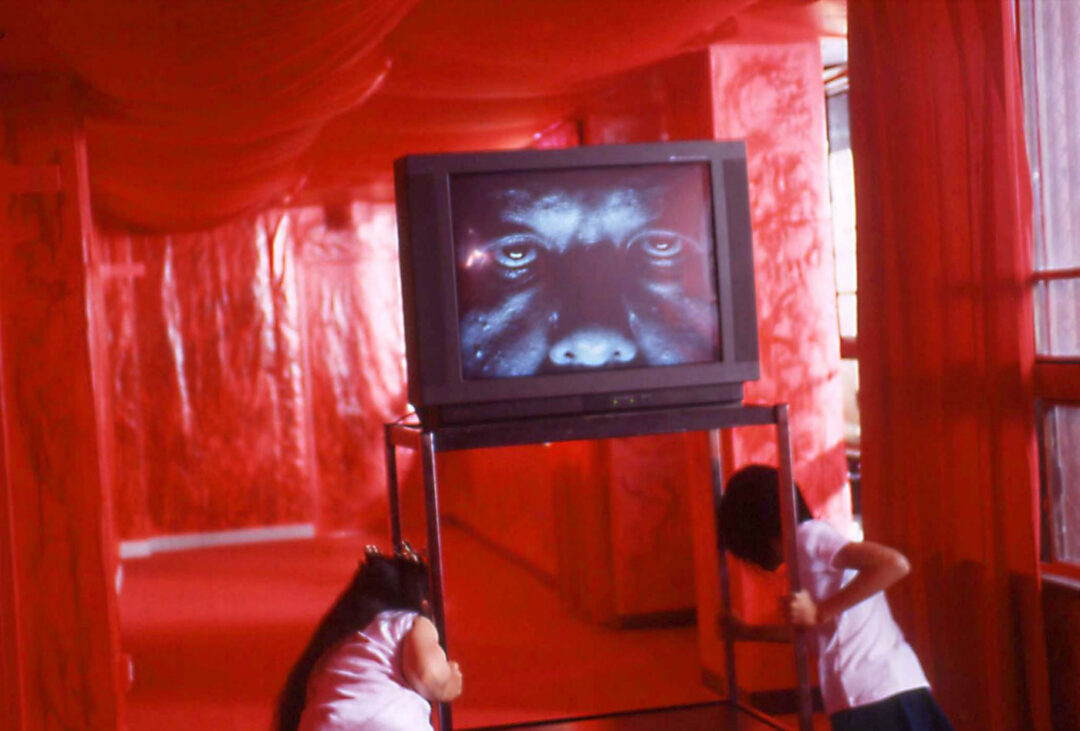
Sono's a primal filmmaker, not really that complicated and psychological in terms of excessive dialogue, but through the gut. There is as much a sense, as originally a genre director whose made his way through pinku softcore and films like this, he makes films as much with an eye on shocking or exciting the audience in luridness too that has to be barred in mind despite also his career including being an author and poet. Strange Circus still has a weird, distinct edge I admire - scenes of the young girl's school life as if the high school for Cenobites in fleshy blood red corridor walls and her head teacher father making speeches to her class as a giant set of eyes on a television pushed around by schoolchildren. And certainly as a psychodrama, it's vivid, taking in cruelty, parental abuse, physical and psychological trauma as the authoress is wheelchair bound, and twists as that's to question alongside what exactly she has hidden in the cello case upstairs, out of sight, in a garbage and waste food strewn room. All whilst the young, fey male assistant she has her eyes on isn't exactly conventional either, at least briefly joining a club meeting for individuals who practical body modification with his views that he had to change his body with implied psychological issues inducing it.
From http://inreviewonline.com/wp-content/uploads/
2016/08/Strange-Circus2-1080x731.jpg

The issue is the actual content of Sono's films is whether they've actual depth as his style tends to suggest. Here it's closer to Grand Guignol than thesis, but it has to be argued whether this film succeeds in this. Arguably, he's an emotional director more than the mind, only with the fact it's a place that rips your heart out constantly and bashes your skull in - the first half told in a form of flashback entirely set within a traumatised mind before the story of the authoress changes it completely. Sono is both sincere but rash in his bluntness.

[Major Spoiler Warnings]

As Strange Circus is designed to put all its chips on the table for the second half, all the first half is a complete distorted lens from the mother's perspective rather than the daughter's, becoming beholden to this structure more than Sono's other films barring the interest this film has in being a primal, feel-bad psychological drama. It still feels like where he would go in the 2010s, but he's someone who gets to this in his cinema whether tone by a lot of plot conventions, in this particularly case writing himself into a corner that he could've escaped from, here the mysterious young man whose actually more closely related to the authoress than she thought.

He decides to end on a really bad ending twist, confused in mixing both its all a dream plotting with just a garbled take, visibly, on how Takashi Miike's Audition (1999) ends, only with the added detail of a chainsaw. And this is sad as, whilst not a fun experience, Strange Circus is still an interesting and creepy tale, but a compromised one. It actually feels like a rushed ending surprisingly, still nearly two hours long, an argument to be made that Sono's decisions to have films climb over two hours, to the point international releases can be edited down as Guilty of Romance was, is actually a way for him to have these scenarios reach natural conclusions rather than fall into this contrivance.

[Spoilers End]

Probably the biggest surprise is that, contrary to my original opinion, Sono's improved in terms of this type of story over the years, the complete failure of the ending, making little sense and not likely to impress anyone, emphasising that for how agonising his work can be, utterly frustrating as well in cases like Antiporno (2016), he got rid of ill advised plot twists from his in favour of just embracing plot clichés and twisting them into more fascinating tangents. (One of his lighter hearted works, despite being bloody as hell and looking like it was doing to be a nasty for the sake of it work in the first episode, mini-series Tokyo Vampire Hotel (2017), emphasised that the invention can be found in just stretching vampire and action clichés in weird and memorable tangents). He can still fall into them - Tag (2015) a recent example - but whilst some of his films can be unbearable in their nihilism at times, he had the wiser idea even for his aforementioned Christmas movie for children to use slow burn character drama than an abrupt chainsaw death as shown here.

Abstract Spectrum: Disturbing/Grotesque/Mindbender/Psychotronic
Abstract Rating (High/Medium/Low/None): None

Personal Opinion:
Strange Circus is a film, one of the first of Sion Sono's I'd ever seen, which is still going to be close to my heart, aware how strange that sounds considering how nasty the film is, but it's not without some glaring faults. It feels like a dry run for future productions, and as a result, gets more worth in this as much as its successful virtues.


From https://a.ltrbxd.com/resized/sm/upload/cc/zp/o2/rd/strange-circus
-1200-1200-675-675-crop-000000.jpg?k=9814d6942d

Thursday, 18 October 2018

Non-Abstract Review: Tokyo Vampire Hotel (2017)


Director: Sion Sono
Screenplay: Sion Sono
Cast: Ami Tomite as Manami; Yumi Adachi as Empress; Megumi Kagurazaka as Elizabeth Báthory; Kaho as K; Shinnosuke Mitsushima as Yamada; Akihiro Kitamura as Gen; Ayumu Yokuyama as Dre

Synopsis: The last days of humanity are upon us, as a centuries old conflict between two clans of vampires, the Dracula clan and the Corvin clan, escalates when the Corvins plan to trap a small group of humans as their permanent, cultivatable food source. In the midst of this is Manami (Ami Tomite), who finds herself pulled from ordinary human life when she learns she has the blood of Dracula within herself.

[Spoilers Ahead]

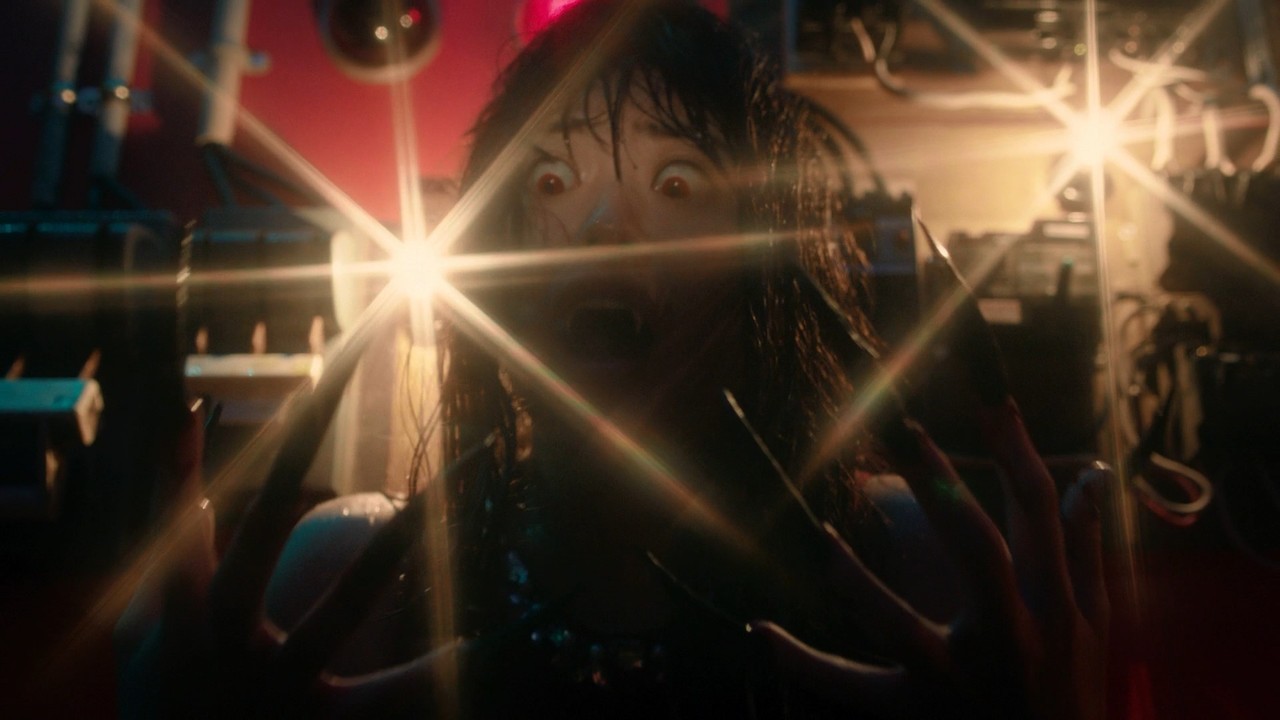
A great sense of excitement was felt finally seeing Tokyo Vampire Hotel. Also trepidation to be honest as, considering Sion Sono has had a spottier record from 2010 onwards, this could've turned into a dud. It neither helps that, out of the gate, the first episode of his Amazon Prime commissioned mini-series is terrible. It set up all the worst aspects of Sono that have come up in his work over the last few years, an abrupt jump into a world full of clichéd horror tropes made worse by the sci-fi touches added. The grotesque violence Sono has in his films is here too and is awful, problematic in how it gleefully delights in a woman in a Goth Lolita dress entering a restaurant with firearms and killing the human beings with relish after dealing with a group of vampires, the flippantness and "coolness" off-putting in works like this even as someone who defends transgressive and ero-guro tropes in art, boredom as well when she excessively stabs a person or two with a fork over and over to death. Thankfully, blissfully, Tokyo Vampire Hotel is not this pilot episode. It's still excessively gory, and gets more over-the-top in the amount of fake blood spilt, but it also returns to the type of films I liked by Sono in Strange Circus (2005) or Suicide Club (2001), strange tales with tangents where genre tropes get mangled in weird and fascinating ways.

From https://m.media-amazon.com/images/M/MV5BZDUwYTFhMDItMWM2Ny
00Y2FiLTk4ZmUtM2E5NTYyNGRjMDIzXkEyXkFqcGdeQXVyNjY5NTM5MjA@._V1_.jpg

It helps this is a mini-series. I have no idea what the feature length version, which cuts this ten episode series down to 142 minitues (!) would be like, but the mini-series as a whole feels less like the stereotype of cult content that is sold to Western viewers but closer to the sincerer Japanese genre films, ironic considering this was sponsored for Western viewers, but probably influenced by the length of the material, forcing Sono's hand in having to have more than the gore on display. At least from episode two onwards the series already gets interesting, skipping years earlier to a human girl given the blood of Dracula being raised in an adoptive family, specifically losers chosen by a literal neighbourhood of vampires to take care of her or they got quickly replaced with other foster parents. From there, weaving the life of Manimi, cursed to been changed by her vampire's blood on her 22nd birthday, and the conflict between the Dracula and Corvin clans, it used its length to expand to include more side characters and events. It can intercut the action and gore with more personality building dialogue scenes, drama which was found in the likes of Suicide Club and made Sono's films stand out as much as his lurid and bizarre set pieces.

The material itself is generic on the surface, vampires versus vampires with a special "one" figure in the centre. Unleashed onto an unsuspecting Amazon Prime viewership this would be weird by itself, especially as Sono now is decorating his films in bold primary colours post-Antiporno (2016), appearing especially for the main building the film is set in, the titular hotel which is actually the lower half of one of the Corvin vampire elders, her children feeding her through a hole in herself what cannot help but come off with vaguely sexual in connotations. What I was glad for however is that, lost in his films over the last few years but flourishing here again, is his eccentricity which is fed by the longer template for the storytelling. The actual plot - that the Corvin clan have humans trapped, pretending a nuclear winter has taken place outside to force them to copulate and breed as their cattle - is merely a backdrop for all these characters, even the villains, to have quirks and issues to deal with. Little touches, like the announcer at the Corvin's lair being way too enthusiastic as he order humans to procreate, or the fact he can still have moments of actual seriousness in-between, mean a lot more when in the last few films I've seen he's not been able to balance seriousness and humour properly as he could in epics like Love Exposure (2008). That this is a major step for Sion Sono in terms of the mainstream spotlight was likely a factor as, befitting the material, he convinced Amazon Prime to let the production shot in Romania too which proved to be in favour of the film, the use of real castles and the Salina Turda salt mine proving worthy production design without much hassle.

From http://altyazi.org/wp-content/uploads
/2017/06/tokyo-vampire-hotel-2017-7.jpg

The series could've been fewer episodes actually, as the middle episodes can lag at points or repeating events like the humans trying to escape the hotel multiple times, but the size of the cast allows interesting factors to come into play nonetheless. That even the villains have sympathies is successful even if it's a few more character details rather than in-depth - one of the main Corvin clan members, Yamada (Shinnosuke Mitsushima), was given by his father to the clan in exchange for a political career where he becomes president of Japan in the current time period, enforcing a hatred of life only softened by his romance with Elizabeth Báthory (Megumi Kagurazaka, Sono's wife and argubly muse). In contrast, the Dracula clan and others have an amorality which, despite my issues within the first episode, plays to interesting dynamics, such as with K (Kaho), a Dracula clan member with both sympathy but also utterly ruthless, making her relationship with Manami, the figure stuck with horrifying abilities about to grow on her twenty second birthday, more complicated. There's also humour, as in the case of Báthory's "mother", depicted rarely with the actress in normal form, but either as a head inside a practical effect or a shrunken stop motion not as tall as a doll's house. Even the whole factor of one of Corvin clan being the actual hotel is played with a legitimately (but well executed) spectacle in between her walls, witnessing the humans fed into her in a never ending orgy of stabbing and smearing blood on themselves that, barring one change in the lighting style, would be if you let Gasper Noe direct the Dante's Inferno.

The moment Tokyo Vampire Hotel fully succeeds however is when, out of ten episodes, episode seven has the actual climatic battle, most of the episode a bloody spectacle where almost every major figure dies at the end. The last three, less than thirty minutes each, leave survivors both of the human and vampire sides awkwardly picking up the pieces of their lives in the hotel, without masters and eventually eating at the makeshift restaurant in the centre hall with a comradery of friendship, staying locked in the hotel as their whole world. Even if there is still insidious plans afoot, these last three episodes are why I eventually liked the whole mini-series entirely, building upon characters (the tragic victim of circumstance in Manami, a new character who is the only teenager among adults who questions her environment) to a chamber piece which adds a great deal. Including a pitch perfect end twist which is hilarious, where the least expected people barge through a door, looking like an actual pair of old men than police officers, and an ending which dabbles in the metaphorical in a way that was completely perfect. This conclusion was exactly the right way to end Tokyo Vampire Hotel, and proved a relief having found myself disillusioned in terms of the quality of Sion Sono's recent output. This mini-series, probably the work more will see over others, has proven then successful for his reputation and for individuals like myself who yearned for those older titles in his filmography.


From https://66.media.tumblr.com/11fd99fcc671bed50edb5
787069c15f4/tumblr_p7tmcrcMFW1rw93m3o6_1280.jpg

Monday, 24 September 2018

Tag (2015)

From http://fr.web.img6.acsta.net/pictures/
16/03/03/12/40/436221.jpg


Director: Sion Sono
Screenplay: Sion Sono and Yûsuke Yamada
Cast: Reina Triendl as Mitsuko, Yuki Sakurai as Aki, Mariko Shinoda as Keiko, Maryjun Takahashi as Jun, Sayaka Isoyama as Mutsuko

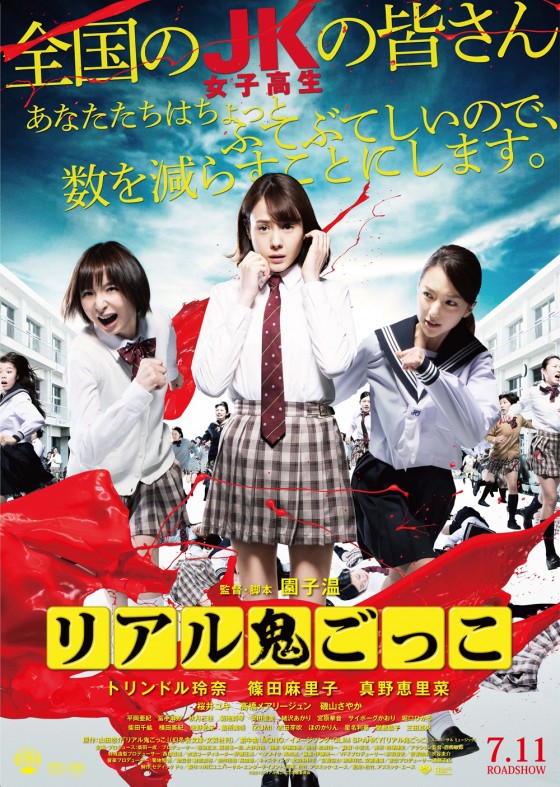
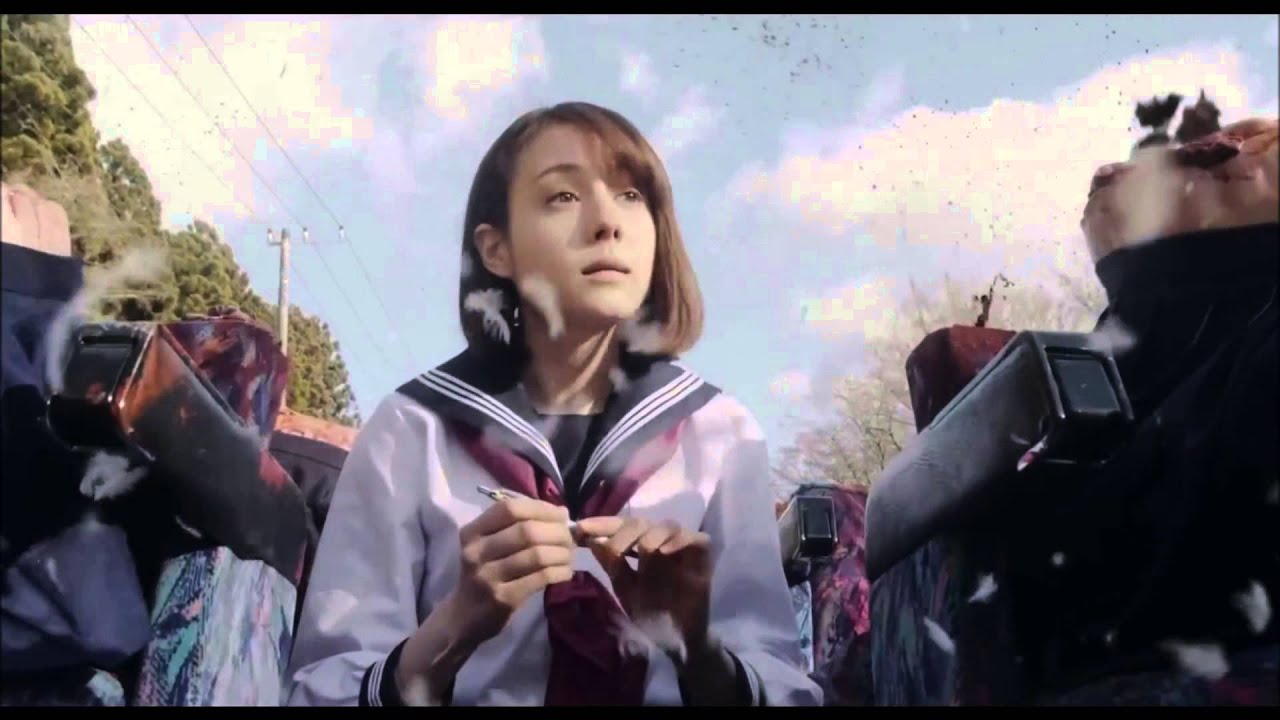
Synopsis: On a trip out for an all-girls school, Mitsuko (Reina Triendl) is the only survivor of a freak incident where a gust of wind bisects everyone (even the bus) in half. To her surprise, traumatised and wandering back to school, she finds everyone on said bus is okay and back there. This is the beginning of Mitsuko finding herself in increasingly bizarre circumstances...

[Major Plot Spoilers Throughout]

At this point, I really am clueless in my opinion on Sion Sono. The director has been making films for over two decades and change now, and has overtaken Takashi Miike for many as a buzz name for cult Japanese cinema. Miike however, for all his reputation, had clear obsessions with male-male friendships, with outsiders and various themes, alongside a willingness to step into numerous genres. Sono, unfortunately, hasn't really themes barring a liking for bright colour and transgressive gore, and in the 2010s, it feels at times as he's narrowing his genres to less rewarding circumstances. Before Love Exposure (2008), the film that is viewed as his magnum opus - it's over hours long, it was a glorious experience for me and many to witness - he was one of the many fascinating Japanese genre directors in the early 2000s making strange but compelling films like Suicide Club (2001). Now he's even directed a TV mini-series for Amazon Prime called Tokyo Vampire Hotel (2017) but he's also in danger of predictability.

This is a criticism I am willing to concede if a film like The Whispering Star (2015) blows me away. However, when he's been serious, he's also made Antiporno (2016) - I've softened on it, but making an anti-porn film for the Nikkatsu reboot of pinku cinema series was not only just being a contrarian for the sake of it, but it was still exploitive and pretentious as hell. Tag's a complicated case of being predictable to a fault eventually when it looked like it would succeed eventually. The reason is a very simple, one line criticism - that the plot twist Tag eventually builds to is clichéd and dumb. Once the film shows its cards, the story is revealed to be that of a living video game character, cloned like her friend and teachers to be constantly killed off in an interactive spectacle. So it becomes a clichéd tale of a puppet removing her strings which feels less interesting than that of a schoolgirl fighting against predestined events.

From https://i.ytimg.com/vi/qi88CjTRoiA/maxresdefault.jpg

For a while, before this problem comes about, Tag feels like it will have something much more to go with, feeling like a Sushi Typhoon film which decided to have more ambition barring being intentionally bad and prosthetic effects. The opening cannot match Suicide Club's mass teenage jump in front of a train, but the sight of half a bus trundling along with most of the occupants sans above their waist is something rare to see. You do suffer from bad CGI, and it's never explained why the wind's able to slice people in half (or like a perverted version of The Happening (2008) blowing up schoolgirl skirts at opportunistic times) but that becomes part of the sense of the irrational that seeps throughout the material. A participant in an utterly illogical world, Mitsuko is naturally traumatised, only that she'll find herself changing names and age as she goes along, the emotional anchor which helps her and the film her friends who act like guides to help her through the insanity around her.  

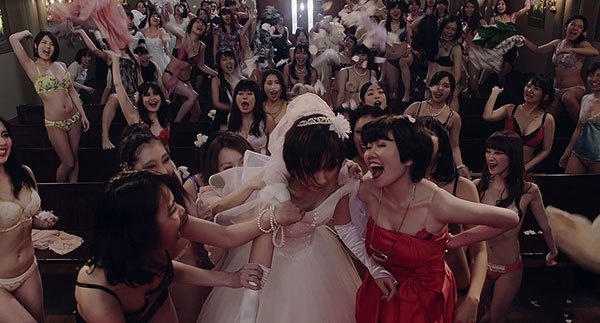
From there it is Mitsuko being thrown through various bizarre scenarios. The school where, after (admittedly) a sweet series of interactions between her and her friends, debating the idea of multiple realities and predestination, turns into the teacher recreating the Most Dangerous Game on the entire student populous. Or to a cross town race where, suddenly, leathered female assassins chase Mitsuko, or when Mitsuko is a bride at a wedding where the groom's a horrible pig man in a casket and the guests are all sociopaths to be fought. Noticeably as well, in one of Tag's cleverer aspects, there's a complete absence of men throughout three-quarters of its length, until the twist appears revealing the women to be characters with a game played by men. The film manages some semblance of logic in between before this twist where, truthfully, even if the segments make no sense together barring strange scenarios Sono came up with the characters are engaging enough for this to never matter. Reina Triendl as Mitsuko is perfect, being the listless and confused lead pulled from scenario to scenario whilst Yuki Sakurai as her closest friend Aki, by the end demanding Mitsuko to rip her in half to escape into the real world through a door opened between her, is sympathetic as the one figure who is a constant and helps Mitsuko through these maddening scenarios. So much so when, in one of the best moments of Tag, Aki's character was fleshed out enough that her male doppelganger and his recreation of her mannerisms, with the actor with similar eyes to Sakurai, is enough to convey who they are before the dialogue reveals it.

From https://i.pinimg.com/originals/d8/6f/e5/
d86fe5fb36f08831571f0cd46b436eeb.jpg

Production wise, bad CGI at the beginning excluded, even if it might've been deliberate for dark humour, Tag shows a lot of resource. The most noticeable is that Sion Sono discovered the drone camera, and if anything, the moment we've learnt to attach film cameras to flying remote control drones has proven to be one of the best things that could happen for an independent filmmaker. As Sion shows, the restrictions on creative ambition due to the expense of resources has been undercut by advantages like this, a drone camera having levelled the playing field to the point an aesthetics obsessive like myself can praise low budget films like this which use these drone shots, fluid movement as it sores across elaborate set pieces from below. It's an example of creativity that shows, when focuses, Sion Sono can be on-ball and be interest, rather than reliant of shock tactics like his least interesting films like Antiporno. Of note as well, in his good aesthetic decisions, is hiring a Japanese post-rock band named Mono to score Tag; it's the last type of score you'd expected for a cult film like this, but it adds a gravitas which helps the film out immensely.

Sadly, after that scene the disappointment sets it. Tag is compelling both as a weird cult film and also because, held together by an all-female cast, it is interesting to watch. The final act ruins this by leading to a very generic twist with pointless touches. That ultimately the creator wants to have Mitsuko reproduced with Aki's male doppelganger, and turning a fascinating take on a videogame character finding herself and escaping into the generic, obvious plot kind. That the game itself, scrolling between three scenarios at once, would be unplayable just emphasises that Sion Sono didn't think Tag as thoroughly as one would hope. So what for most of its length was hopefully building to something interesting from Sono, worth seeing still, does have the unfortunate lack of a decent ending.

Abstract Spectrum: Absurd/Psychotronic/Weird
Abstract Rating (High/Medium/Low/None): None

Personal Opinion:
Tag gave me some hope that Sion Sono is still making good films. Tag also gave me Sion Sono's bad tendencies which have become apparent within the 2010s. A shame really.


From https://asianmoviepulse.com/wp-content
/uploads/2016/04/post/sion-sonos-tag/wedding.jpg

Saturday, 23 December 2017

Antiporno (2016)

From https://1.bp.blogspot.com/-34j1S7FdAbI/WWe3ascZLrI/AAAAAAAAA8w/TAZO
-mrCYBMw7VLBRqnAtBbD-jMiZqn9ACLcBGAs/s1600/antiporno-cartel.jpg

Director: Sion Sono
Screenplay: Sion Sono
Cast: Ami Tomite as Kyōko, Mariko Tsutsui as Noriko

Synopsis: Kyōko (Ami Tomite) is a psychologically disturbed novelist/painter who one morning decides to start tormenting her older female secretary just as a group arrive at her apartment for an interview. Then a voice off-screen shouts "Cut!" with the camera panning to a director and film crew....

Knowing how Antiporno, within the context of Nikkatsu's recent reboot project of the Roman Porno line, is the one that is getting the most vocal interest and critical critique, I cannot help but roll my eyes at the idea this is meant to be a philosophically important film on misogyny in erotica. I intend to revisit Antiporno, and likely to rewatch it, even if this review is still the same in the future, out of fascination of more esoteric and unconventional film making which is my preference. But not only is it embarrassing from a director who was capable of better, but it's also from a film written and directed by a man a retroactive step back in terms of erotica critiquing itself. It's a self critique this Roman Porno Reboot project didn't need, a bigger concern which should've been tackled that there were no female directors chosen for any of the films. A film as obvious and unsubtle as Antiporno is galling as, whilst misogyny and erotica is still problematic, there's a growing source of women actually dominating and creating their own erotica. Photography, literature, comics, even pornographic films. Even pinku, whilst full of utterly offensive work, has its own actresses from the golden era championing their work as progressive and liberating. A film that names itself Antiporno feels like a betrayal of these women who have decided that a more constructive way forwards is to not just keep criticising the past but take control of the pornographic and make their own work surrounding women's desires. Against this Antiporno is not only irritating for me because Sion Sono should be better than this, but also its patronising view on a medium better off from women themselves taking it over, not such a bloody obvious and badly told message.

But God help us if Antiporno, screaming with no indoor voice, is seen as a clever feminist subversion of pornography when it feels like Sion Sono losing more of the qualities he had in his earlier films, effectively making a pretentious remake of a much better film in his early canon called Strange Circus (2005). He encapsulates a strange set of circumstances in modern auteurism where a lot of cult directors who gel the art house with exploitative genre machinations are actually not that different from each other technically or aesthetically - the bright colours, the use of fourth wall or alienation techniques, the extreme levels of violent and sex - and it's to debate whether they actually have anything original to their transgressions when I step back and really question them. As with Park Chan-Wook and Nicolas Winding Refn, Sono dangerously compares himself to earlier era subversive genre directors, even a peer like Takashi Miike, and is in danger of being found wanting.

The problem is the art house sensibility. It should equate meaning. Love Exposure (2008) was such a film. Even a messy film like Suicide Club (2001) is helped by the fact its origins, in Japan's history of churning out genre films in the nineties and early 2000s, films that were inventive and contrasted their naturalistic paces and locations with bizarre events, and were open to idiosyncratic and unpredictable flourishes from their directors. Now after Love Exposure every film I've seen from Sono, even with virtues, feels too deliberate and too serious. Too predictable and increasingly obvious. The violence in films like Cold Fish (2010) became too grim next to their contrasting tonal shifts, Guilty of Romance (2011) whilst a good film too front loaded with cliches, and with Antiporno coming off like a farce. Even if it's a deliberate moment of humour, when an actual cake is pulled out for lead Ami Tomite to smash her face into, whilst making philosophical comments on the sexism of Japanese culture, you get the nadir of Antiporno being something you can take seriously.

From http://filmanias.com/uploads/posts/2017-11/
1511027758-1920304818-antiporno-filmanias-2.jpg

The simplicity to Antiporno's screed on sexuality is the worst aspect, something that a sensible person would've figured out without the film. Wet Woman in the Wind (2016), the other film of this reboot series given as much distribution, does have its problematic moments in terms of its view of sexuality being aggressive and violent at points within its sex comedy plot, but it was also a film where the female protagonist beat up the male one and forced him to comply with her whims. Antiporno's premise and message is so simplistic that, once you brush past its dreamlike structure taken heavily from David Lynch's INLAND EMPIRE (2006), it's a whoring of old clichés. A young woman whose parents were puritanical about sex but sexually active themselves. Whose younger sister, never given any depth, committed suicide and plays a one dimensional bright spot for the lead. A life as an artist that is empty and bitter or, depending on how the twists in reality suggest, an assistant for an older, bitter female writer who tormented her as her character in the first scene does to the older woman. All of which feels asinine. An old view on transgression in film for sexuality (a character forced to crawl around like a dog while sexual insults are thrown at her) that feels utterly at odds with the modern day, something post-Salo which feels more like the acts of dictators than libertines. More so as a neglected pinku film like Marquis de Sade's Prosperities of Vice (1988) from Nikkatsu is so much more better made and thoughtful about transgression.

It also doesn't have the overlong first sequence of Antiporno, a cacophony of screaming and torture of the older female secretary as the lead spouts philosophical platitudes. An uncomfortably homophobic taste in how the group of interviewers include stereotypical butch dykes, one of which rapes the secretary with a strap-on until she enjoys it. Sono critiques this as being inherently problematic by being set within a film set, a world within a world where off-stage Tomite's character is a nervous woman tormented and even slapped about by co-stars and the male director. But its stained in a patronising air in how because its meant to be a critique the aggression of the content feels more pointlessly done. Antiporno doesn't deserve being seen as superior because its critiquing this type of scene because its idea that pinku is corrupting, the lead joining a pinku production because she wants to debase herself, is juvenile. In fact its in its own la-la land considering that we live in a world where Hollywood is a hot bed of horrifying sexual harassment and casting couch incidents against actresses.  When the message is obvious, the way Sono also tastefully depicts Tomite laid on a bed with her underwear just peeled under her buttocks or walking through a longue completely naked, following the Reboot project's rules of a sex scene every ten minutes, is such rank hypocrisy.

From https://www.ica.art/sites/default/files/styles/banner-landscape
/public/images/antiporno-web.jpg?itok=JsmoNBPg

As with Park Chan-Wook's The Handmaiden (2016) being somewhat useless as a critique of pornography for its one dimensional villains and gorgeously shot sapphire sex scenes between the feminist heroines, Antiporno is somewhat useless as a pinku critique when there's surely better examples. The comparison to Takashi Miike is especially pertinent. His 1999-2001 works were amongst his most controversial and criticised for their extreme content, especially Ichi the Killer (2001) and Visitor Q (2001), but those films for all their problematic depictions of rape, violence and even necrophilia never treated the content as pleasant, even if there was a sick sense of humour, and always repulsed the viewer. There was always a clearly defined and bitter taste which alongside the complexity of those two examples in how they affected the viewer - the return to a happy family in Visitor Q, how Ichi the Killer deprived viewers of an easy ultra-splatter end fight and reduced its two male anti-heroes as disappointed, psychological messes - which Antiporno doesn't have the courage to do. Whilst his earlier nineties work has some un-defendable content, the stuff Miike made from Audition (1999) onwards makes something like Antiporno amateur in provocative ideas of sexuality including its dark side and gender politics.

Aesthetically Antiporno is interesting. It feels like the uber low budget version of Seijun Suzuki's Taisho trilogy between 1980 to 1991 (Zigeunerweisen, Kagero-za and Yumeji) in their open artificiality. Moments of Antiporno do stand out, such as Kyōko being surrounded by versions of her younger self, but its unfocused symbolism which is not used to its fullest and expanded upon with other connecting symbolism. The bright colours also do not amount to anything but being a superflat postmodernism, a shallowness as deliberate artistry that instead accidentally brings up the film as empty. The political phrases used - such as ”1. This nation’s men are shit! 2. The freedom they created is shit! 3. The world they dream of is shit! “, statements made after Kyōko has her face in the aforementioned cake - are as shallow, the tone suggesting Sono is mimicking Godard for sharp, bullet like statements but forgetting Godard could also become introspective and elaborate with a vulnerability in his language. Its language of an obvious hardcore punk album, not rich enough as a feminist statement. A truly feminist statement has to be lengthier and as willing to wound a feminist back as it would damn misogynistic patriarchy.

Abstract Spectrum: Abstract/Expressionist/Grotesque/Mindbender
Abstract Rating (High/Medium/Low/None): None

Personal Opinion:
A embarrassing experience and a potential Emperor's New Clothes scenario if it gets a lot of critical praise. A critique of its own erotic film project aiming for the wrong target, not well done if pretty to look at. From a director like Sion Sono, seeing more films like this from him against his superior older films is a dire warning against directors becoming self aware of their critical recognition and trying too hard to appease that crowd.

From http://i.imgur.com/E29oAny.png