Showing posts with label Neo-Noir. Show all posts

Tuesday, 2 March 2021

Tough Guys Don't Dance (1987)


Director: Norman Mailer

Screenplay: Norman Mailer (with Robert Towne)

Based on a novel by Norman Mailer

Cast: Ryan O'Neal as Tim Madden; Isabella Rossellini as Madeleine Regency; Lawrence Tierney as Dougy Madden; Wings Hauser as Luther Regency; Debra Sandlund as Patty Lareine; Penn Jillette as Big Stoop; John Bedford Lloyd as Wardley Meeks III; Frances Fisher as Jessica Pond

An Abstract List Candidate


I'm a law enforcement officer, and it turns me on.

If I step back, I find the fact a Pulitzer Prize winning author helmed a Cannon Group released film, also produced by Francis Ford Coppola and Zoetrope Films, is a strange thing to even conceive let alone know the notoriety of the film. The oddest thing is knowing Mailer, of a school of American literature, came to cinema first in a series of low budget and ultra improvised films alien to Tough Guys Don't Dance, where infamously in Maidstone (1970) actor Rip Torn came at him with a hammer for real out of annoyance and the footage was kept in. The background is as appropriately strange for a very odd film.

Subdued and with a lush score from Angelo Badalamenti over the idyllic coast of Provincetown, this feels Lynchian and comes off as one of the more perplexing touches to a film which defies a lot of genre. Effectively, whilst there are likely films within this ballpark from decades earlier, Tough Guys predates the stranger crime films like The Big Lebowski (1998) and Inherent Vice (2014) that would get popular, where ex-con Tim Madden, as played by a very dishevelled Ryan O'Neil, is suffering through his wife Patty Lareine (Debra Sandlund) leaving him only to end up in a labyrinth of backstabbings, murders and a weird horror edge. Set up as a series of flashbacks, with a sombre reconciliation with his cancer stricken father, the film sits on a knife-edge. The horror-like edge is there, with talk of ghosts in his house, pirates off the coast of Massachusetts, O'Neil's blackouts especially when he finds that there are parts of two bodies in the basement he does not know the origins of. And the séance which his wife decided to have, leading to her deciding to leave him.

Tough Guys Don't Dance was not well regarded when it was first released. Few, when it was, liked the film with one of the exceptions being film critic Jonathan Rosenbaum. Personally, I think this is a grower for me in that, whilst bad taste does streak the film, just for the end credit song alone, this is a compelling film; one where, if he did not admit it was as much a dark comedy, would be a surprise from Mailer as, contrary to its reputation for ridiculous dialogue and moments, it feels on purpose to be this perplexing in tone. A huge factor to consider in that, over this elaborate pulp narrative, a large part of its obsessions is with masculinity, a huge factor in Mailer's obsessions as an author. The film is crass and offensive in places - women get a short shrift and the homophobic slurs are used - yet it feels on purpose, as the men are neurotic, psychopathic and deceptive. A large part of this film, as with the source novel, involves these male characters not being comfortable in their sexuality, where the fear of being gay is drastically contrasted by an obsession and openly homoerotic borders.

And even the women in this film get to sling forth and back zingers in an over-ripe, profane language such as Debra Sandlund, whose filmography is not large at all, as a Southern wife of Madden who clawed and schemed her way to riches (including leaving an Evangelical preacher husband played by, naturally, magician and known sceptic Penn Jillette). Crime stories can something be as overripe as melodramas are, one usually targeted to a male audience whilst the other to women; gendering genres and types of cinema is deeply narrow minded and crass in general, but especially as Tough Guys Don't Dance posits that crime stories can be just as much melodramas.


A large part of the film is a lot of male ego, contrasted by powerful women, who are fragile and lot of angst as a result. As much of the film, as Madden is pulled in a strange course of events involving drug money and severed heads, is him being loomed over by the new police chief Luther Regency among other figures, as played by Wings Hauser in a role surprising subdued for a man know for cutting loose. Never was a film where masculinity is bandied about and bombastic, with Hauser of all the cast the most restrained for the most part, doing well playing a man close to an edge, until a break happens and you get an over-the-top moment involving facial paralysis and ridiculous mumbling. The notorious nature of the film is just how crass and over-the-top the dialogue can be but, as a melodramatic production, everything feels ripe with a legitimately strange edge. I have mentioned this feels like a predecessor to films like Inherent Vice, more arch and knowing films of that ilk, and honestly I wonder if Mailer had have made the film in the nineties or onwards, we may have gotten a more positive reputation for the movie.

Certainly, it has strange and illogical touches. The first flashback, in a structure which coils in on itself in medias res backwards, is as eighties as a Cannon Group production could be when the narrative begins at a party. Cocaine in lines being snorted on a table; eighties hairstyles and synth drum programming pop; a woman taking her clothes off down to a skimpy g-strip to greet Wings Hauser at the door; Debra Sandlund randomly playing a trumpet and then saying her golden pubic hairs were burnt by the college football team. Infamously, many know this production just for one scene, held as the worst line delivery in cinema, where O'Neil flatly shouts "oh God, oh man...!" in a sequence Mailer kept in. YouTube unfortunately is a format which reduces history to one clip without any context, and whilst that moment is an odd creative choice, in context it fits a film which is openly absurd. Mailer, if he has not deliberately made a dark humoured narrative, must have been amazingly oblivious to it, as so much of this feels on point. It is a film where the line "Your knife is in my dog" is spoken sincerely, but the random appearance of a pet dog is more perplexing for myself than the line, when we have never been introduced to Tim Madden having pets before then. The dialogue in that scene itself felt like a zinger a Coen Brother might have penned, and a lot of the film feels openly going for moments to shock or cause a viewer to laugh in a crime story of broad people self-destructing.

Certainly in terms of a pulp genre film, where the narrative once it is all explained is fully entrenched in clichés and tropes of the crime genre, the more overt and out-there aspects gain a greater sense of meaning even if there are eyebrow rising moments throughout. The amount of references to sex and masculinity, taken from the source material by Mailer too, feel intentional and his dialogue, as a legendary author, is so idiosyncratic it is compelling. The unexpected connections to David Lynch, whilst fully its own creation, really add an additional level as well. Isabella Rossellini, as the love of Madden's life Madeleine who he lost, fits the film's world fully, one where when after a car accident and losing her ability to have children it may seem strange for her to request cocaine from O'Neil in her hospital bed but, with her conviction and the tone already set up, feels fleshed out in its own mad logic. The music by Badalamenti, as naturally melodramatic as for Lynch, fits the tone perfectly as a score so emotionally welled up it almost at times feels like it will collapse into itself. That it sometimes does hit madness at some point does keep you on edge.

This is a film helped by its production quality. One of the most disarming aspects finally watching Tough Guys Don't Dance, contrary to the legend I had built up of a shambolic production, is that Mailer (who never helmed a film after this) helmed a solidly put together picture. One where he was aware of cinematic language, as an evocative moment using the camera really stood out, exiting a police station office from Hauser by moving the camera aware from him and the filing cabinets around him. So much is very well made it does make the stranger content even stranger. Again, everything in Tough Guys, for all its madness and legitimately odd tone, feels on point rather than a randomly thrown together production. Even in mind to Mailer's brief dalliance with Jean-Luc Godard - both walking off King Lear (1987) as Godard was hinting at an incestuous nature to the characters Mailer and his daughter Kate Mailer were to play, and that this film was released only days around Godard's - ominous seagull sounds, like those throughout King Lear, appear in one scene in a perverse synchronicity between the films as a result. That this film itself, in its apparently idyllic ending, which abruptly happens, has an uncomfortable edge of O'Neil staring almost to camera as he closes a front door to his new house, with ghoulish (almost screamed) laughter in the audio track, adds a sense of this entire experience provoking the viewer and keeping them on their toes.

Whether this film is digestible for most viewers or not, it absolutely needs a proper re-evaluation as a film that was belied against its will. The Cannon Group's later reputation, goofy yet fun b-pictures and weirdness, whilst as much of their charm, has accidentally not helped these curiosities from their cannon get wider interest - the John Cassavetes film Love Streams (1984) notwithstanding, what of this, King Lear, Robert Altman's Fools for Love (1985) or Raul Ruiz's Treasure Island (1985)? -  but the apparent view this was just a bad folly without looking back at it is an imp that needs to be exorcised off its shoulders. I openly admit that, the longer I think of this, I might grow to admire Tough Guys Don't Dance more and more as time goes on. I might even fall in love with the perverse bastard of a film.


Abstract Spectrum: Eccentric/Grotesque/Weird

Abstract Rating (High/Medium/Low/None): Low

Wednesday, 17 April 2019

Under the Silver Lake (2018)

From http://www.vanessasnonspoilers.com/wp-content
/uploads/2018/08/Under-the-Silver-Lake-Poster.jpg


Director: David Robert Mitchell
Screenplay: David Robert Mitchell
Cast: Andrew Garfield as Sam, Riley Keough as Sarah, Topher Grace as the Man at the Bar, Laura-Leigh as Mae, Zosia Mamet as Troy, Jimmi Simpson as Allen, Patrick Fischler as the Comic Fan

Synopsis: Sam (Andrew Garfield) is a slacker who becomes fixated on his new female neighbour Sarah (Riley Keough), only for her to immediately vanish. His search for her across --- Los Angeles will include the King of the Homeless, conspiracies, a serial killer of dogs, and codes in Nintendo games.

Well, at least David Robert Mitchell was ambitious, which is not something you say a lot when, frankly, most American directors (and some beyond the States) when they have just made something interesting now get sucked into blockbusters with no creative control in the slightest. It's a view easily bias to how Under the Silver Lake is absolutely indulgent and not without faults, but God only knows how many filmmakers, when they've done well even in art house cinema, tend to now go for the blandest and predictable of routes with their newest films too. The comparisons to Richard Kelly have been apt - Kelly gained a reputation for Donnie Darko (2001), less when it actually debuted theatrically but from word of mouth, the follow up the notorious Southland Tales (2006). Tales was even more ambitious, comic book prologues and all tied in, and was also debuted at the Cannes Film Festival as Under the Silver Lake was, getting a good thrashing between them. Time is looking to potential give Southland Tales a chance, but Under the Silver Lake's too young to start asking about this.

Mitchell's journey is curious as, three films in when Kelly's was just a debut before he got to Southland Tales, he started with an indie The Myth of the American Sleepover (2010), then suddenly got a surprise hit by entering the horror genre, It Follows (2014) getting a lot of traction. So he decides to take his chips accumulated and gamble them all on this two and a half hour neo-noir pastiche which gets through so many weird tangents I don't know when to begin. Definitely, absolutely, the legacy of Thomas Pynchon is growing even outside of literature into cinema - amazingly, there's only been one official Pynchon adaptation in Inherent Vice (2014), but filmmakers like Mitchell have instead appropriated his style of numerous tangents and conspiracies interweaving into each other, loose ends, eccentrics and a lot of pop culture. Under the Silver Lake, whether you like it or not, is surprisingly faithful to his style even if by accident, even the length befitting some of his monolithic tomes like Gravity's Rainbow.

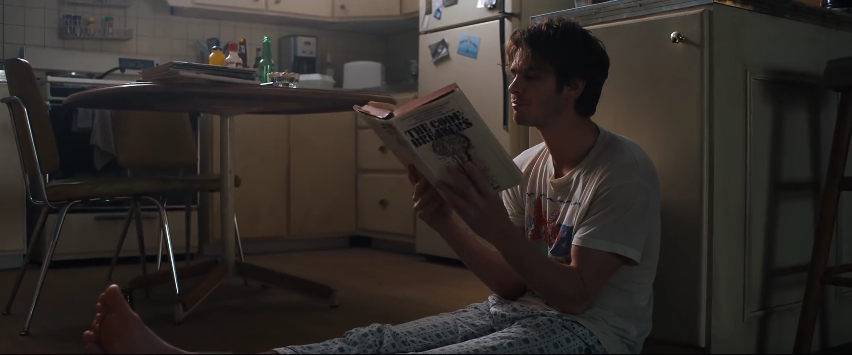
Mitchell's film is strange, a farce to be honest whose central figure, an obsessive compulsive conspiracy nut and slacker, is inherently a dick, who indulges in his old Playboys and Nintendo Power magazines, and is a peeping tom who gets distracted by eyeing up women. Andrew Garfield imbues him with some charisma, but he's having sex with an on-and-off-again girlfriend whilst having women's tennis on the television at the same time, beating up children for vandalising his car the next. The voyeurism has put people off with the film, and I'll admit that whilst we get to see Garfield's bared arse a lot for balance, the amount of female nudity is not helped by how the female characters really blur into each other; its far more problematic than the nudity itself, or that our protagonist thinks with his smallest head too much, or that it's roping in noir tropes of mysterious femme fatales. And Mitchell does make it clear he's flawed, a little pathetic, even sprayed by a skunk for a lasting plot effect, even having a voyeuristic scene involving a drone deliberately being a challenge to the viewer when the woman being spied on in a screen on screen is in tears.

Sympathy is to be had for him as much as failure, the film a long journey for him to potentially grow. A weird journey, crammed to the point it's wrong to follow the story as a concise one but, like Pynchon, a tangent factory. LA here is a place of odd events and mysteries, just from the outset with a squirrel dropping to its death off a tree in front of our lead and (visibly a puppet) gasping in a way that's sickly humorous, an immediate warning Under the Silver Lake is going to get silly on purpose. Independent comics talk of a spate of dog serial killers and killer owl women, that the secrets of the city can be found in an old fifties cereal's game on the box, or how the elite and rich are naturally getting up to hysterical hodgepodges out of boredom. The only sane ones, or in a way in control, are naturally the homeless or coyotes. The fact I first though the film was set in the nineties, because of the strange logic gap where our lead was able to see Kurt Cobain but is still young, does also suggest that, eventually, the nostalgia for the eighties is finally going to be punted off the throne in favour of a much more interesting and weirder nostalgia that is the nineties, where Cornershop is on the soundtrack side-by-side with R.E.M.

It's also, dangerously, riffing on the past whilst constantly undercutting it as being merely a distraction. It's an odd paradox that it gets a lot of humour from even a help guide for a video game being actually of importance, but that we also encounter a master songwriter who undercuts any sense even the most rebellious of pop culture is of actual subversion if it's mainstream. It comes off as bleaker, as a film, than anything I've yet read of Thomas Pynchon, and does show the real issue I have about Under the Silver Lake for all my enjoyment of it, a second viewing allowing any clouding of judgement to take place, that Mitchell's visibly crammed numerous obsessions together but the underlying idea that should tie it all together isn't cognitive enough. Even a much weirder, scattershot experimental film would at least lean on atmosphere and dream logic more, whilst Under the Silver Lake still plays out as a quirky mystery.

This also includes some of the mysteries and conspiracies as well, playing off coincidence or just an insane amount of planning for a New World Order to make reality - it does make an argument that such a conspiracy doesn't make sense in real life, due to how chaotic on a large scale it would be, unless one takes the idea that it's as shambolic of everything on the surface or that some really coordinated calculations make us all sheep. Either way, going for the obvious like the sexual suggestions of advertisement and such parts are the weakest moments in Under the Silver Lake, "duh" moments no way near as simple and crisp as when They Live (1988) just had signs everywhere, black text on white, just telling us all to marry and procreate.

This is more so as a lot is brought in - silent cinema, Hollywood itself, hobo sign language, fifties culture, and poignantly sixties and seventies cults alongside the type of modern art performances you'd get now. The centre of this film is, arguably, that nothing is resolved, which is a huge risk to take - details, without spoiling anything, allow for interpretation, such as Sam carrying dog biscuits and having dreams of women literally barking at him, or how the owl woman's identity is resolved. (Then there's the caged bird whose one word he says everyone including the viewer is trying to figure out). It's as much this why I liked Under the Silver Lake immensely, but I will be the first to throw out (if it hasn't already) that even Southland Tales, the notorious film it's compared to from a decade earlier, was at least circling the idea of how mad, chaotic and strange America had gotten and exaggerated it in terms of a plot. Whilst it took multiple viewings to get and love the film, which it at least went a direction with progression. Here, aware of its clear leanings to the idea of lack of resolution, or that the final scene at least has Sam finding a serenity seeing the apartment he's about to be evicted from through a new light, it was a gamble that a few people didn't like to be a lot more vaguer in terms of plot expectations.

A lot of this is as well why the languid pace and sense of nonsense is a good thing for Under the Silver Lake, less a mystery in the conventional sense but an Alex in Wonderland tale of Andrew Garfield encountering strange figures. A literal layabout, a semblance of (legitimate) skill to be a good detective when he's actually focused, but he's lead on a wild goose chase that we follow as confused as he is. This is the best way to view the film, and thankfully, it's a well made accomplishment technically to work in this direction, right down to the funny end credits animation. Bright, colourful and vivid in a way that's drastically different from It Follows. Disasterpiece, who made his name known to the public conscious through his score for that earlier work, comes with Mitchell here too and also takes a new direction, an orchestral score which does riff on Bernard Herrmann's work with Alfred Hitchcock but has its own playful richness to it.

Abstract Spectrum: Playful/Weird
Abstract Rating (High/Medium/Low/None): None

Personal Opinion:
The resulting film's a divisive one even for a defender like myself, just for the fact that it's decision to be a maximalist work in detail, but ensue a primary theme, is going to cause a lot of misreading or confused ones over multiple viewings. There's also just the fact it's a director going into his foibles despite the mystery/noir genre suggesting there'll be a conclusion at the end of everything.

What is there though, beyond this, is still a playful, very funny and sometimes poignant work. A brave risk which was worth taking, but what David Robert Mitchell is going to do next after this one is up in the air now.


From https://ilarge.lisimg.com/image/16416730
/852full-under-the-silver-lake-screenshot.jpg