Showing posts with label Sketch Comedy. Show all posts

Friday, 15 February 2019

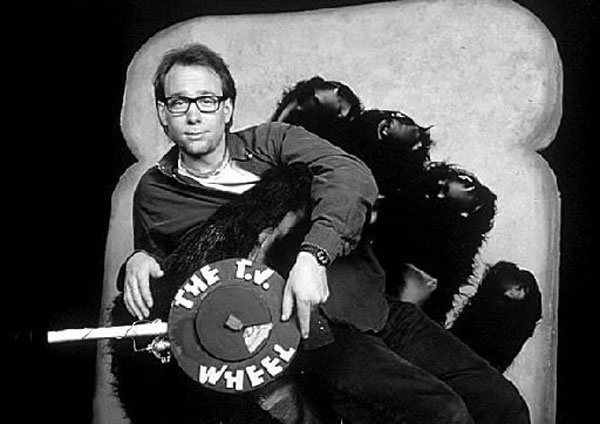
The TV Wheel (1995)

From http://www.timidfutures.com/wp-content/
uploads/2012/09/tvwheel__span.jpeg


Screenplay: Judd Apatow, Nick Bakay, Morwenna Banks, Paul Feig, Joel Hodgson, Nell Scovell
Cast: Joel Hodgson, Nick Bakay, Morwenna Banks, Steve Bannos, Doug Benson, John Carney, Lilly the Chicken, David Cross, Clark the Dog, Paul Feig, Andy Kindler, Melissa Samuels, Fred Stoller, Lawrence T. Wrentz

Synopsis: Devised as a return to live comedy where mistakes were part of the thrill of viewing them, the creator of Mystery Science Theatre, Joel Hodgson, divised the "X-Box", a giant segmented wheel where various sets are built upon whilst the camera is fixed in one place, the audience witnessing a flurry of sketches as the cast have to move quickly as the wheel does.

So let's begin with the obvious, that barring their infamous episode covering Manos: The Hands of Fate (1966), I've never seen Mystery Science Theatre 3000, the legendary cult series where trashy films were commented on by its creator Joel Hodgson, playing a janitor on a space station forced to watch "bad films", at least for four seasons, and a gaggle of robots. For better and for worst, MST3K is legendary, beloved, but also with the stigma of having birthed the idea of ironic viewing of films where improvising jokes rather than watching the film is encouraged. I don't think its Hodgson's fault for that one, just a minor slight out of his hands as - after ten original seasons, a 1996 theatrical film, and two Netflix series so far from 2017 - his creation gained a fan base with a lasting effect. Hell, I have to thank him just for bringing Manos to existence, no one knowing of the film until it was dusted off for an episode, where even the jokes themselves were losing to that feature's madness, and helping that creation of a literal fertiliser salesman with a camera have a cultural legacy. After Hodgson left the series mid-way through, he would devise The TV Wheel, an attempt to recreate the unpredictability of live comedy he grew up with, involving a very curious piece of set sized equipment known as the X-Box, and an ideal to literalise the television screen as a window.

The premise isn't as convoluted as the twenty or so minute introduction by Hodgson himself makes it. Originally, this was a HBO project before Comedy Central picked it up and screened the one-off pilot with a newly filmed segment where the creator explains his premise with literal diagrams; the introduction nearly killed my engagement with the episode, a long and utterly convoluted elaboration by Hodgson which, as much as I admire his love for his idea, echoes the sentiment "kill your darlings" in how long he goes with the premise. It tries, the playful almost Michel Gondry nature of the diagrams and boards moving in front and behind him, alongside the funny attempt at livening the segment up by having puppets staging a strike in the midst of his introduction, complaining CGI is going to replace them, but the intro takes too long and would've immediately killed the chances of the idea getting a whole series as it'd put viewers off.

As simply as I can try to explain the actual TV Wheel, he built a revolving "carrousel-like" stage originally called the X-Box which, whilst the camera stayed perfectly still in one fixed place, which rotated with segmented and various different sized sets, some merely a window, some larger, and one great running gag about ridiculous mini-golf courses in the gag off the stage itself, which interchange when the wheel itself spins. The point was that the performers and their stage itself, rather than camera edits and movements, were dynamic and changed quickly. In the midst of this, many recognisable figures from in front and behind the camera for comedy in the next few decades - including future director Paul Feig and with material written by Judd Apatow - have to hastily switch between costumes or improvise as they have a set time limit for the episode. Any cockups would be included, any sense of ad-lib welcomed, and Hodgson's obsession with puppets is found here alongside all manner of optical gags and (Gondry-like) inspired set production with paper signs and windows.

It's far from perfect, and the humour isn't as punchy as it should've been, especially as the live audience heard is more bemused at points then on-board with the concept, but the result is gleefully weird. As much as there are compromised to Hodgson's own introduction, not one single take but cutting to the top of the wheel and figures like the live orchestra to show its mechanics, it's a fascinating experience which I think could've worked. Its definitely one of the strangest sketch comedies I've seen in a while in structure and aesthetic design, knee deep into the nineties and (even in fuzzy VHS sheen) with bright plastic colours and moments weirdly reminiscent of Cafe Flesh (1982) but with significantly less porn. That doesn't stop it from having moments which could've come from such a cult film, such a robot which recommends drinks only to seduce a guy's girlfriend, the miniature golf gag starting from the Mouse Trap board game to heaven itself, and those aforementioned puppets.

Whether it's a snide comment on racism, as red robots claim their servant race will be inferior because they're green robots, or the Thunderbirds piss-take, everything has a jaunty and off edge tones to it which for its moments of light humour and pure silliness also gets dark, helping with even the failed gags. One of the female comedians, when her gag immediate fails before it starts, takes her top off with the creepy darkness found in her desperate question to the camera "Is this what you want?", follow by one of the male comedians in his way to also say the exact same words and take his shirt off, as if the TV Wheel is some perverse trap for comedians. That a man is later naked and being tortured on a giant pinball machine for one gag is also pretty bizarre just as an image, more so as it turns into the machine being used to get him to confess to an alcohol problem.

Not all the humour is this weird - the KISS sketch, where everyone is just heads on mannequin bodies and Gene Simmons is annoyed everyone has a gimmick in the band unlike him, is one of the best including the Foghat reference - but even apparently innocuous jokes get odder. Paul Feig, whilst not a great director if Bridesmaids (2011) is an indication of his work for me, is great onscreen as a charismatic magician welcoming the audience to his living book of gags and tricks, all the while his monkey sidekick warns us that he's been locked in the book like it's a horrifying Lovecraftian never space. The joke is among the best as it uses the TV Wheel and the production design to its advantage, like the Thunderbirds sketch, in both having the wheel move backwards and forwards but, in using the various windows and paper craft, creating clever live tricks of manipulation with special effects, the Thunderbirds one switching between live actors and puppets for a perfect live close-up of someone accidentally sabotaging a test craft with coffee on the control panel. Sometimes in other sketches, they just resort to actual magic tricks like the unfortunate, connected to Feig's sketch, which turns his dog into a chicken with one of his items but doesn't know how to change the dog back.

Clearly, the premise, the literal TV Wheel, is a prop which had to be carefully put together and probably the other factor which might've doomed it is that sketch comedy shows can be made with merely a host and guests trading off jokes to an audience, doing away with prop comedy for the most part. This is a shame to consider as, with fine tuning or even a simplified version of the premise, The TV Wheel itself was a unique viewing experience which, by itself including the end credits being literally taped onto the screen and rushed through, was charming enough but could've gone further than this.

Abstract Spectrum: Handmade/Quirky/Weird
Abstract Rating (High/Medium/Low/None): Low

Personal Opinion:
Just by premise along, it's a peculiar creation from mid-nineties American television, and in spite of the over long introduction it has a lot to admire as a concept. Even if it was an idea to weird and complicated to get off the ground, a few more polished examples of the show would've sufficed at least.

Tuesday, 14 August 2018

Gdgd Fairies (2011-13)

From https://www.anime-planet.com/images/anime/
covers/gdgd-fairies-4639.jpg?t=1405671522


Director: Sōta Sugahara
Screenplay: Kōtarō Ishidate [Season One], Kazuyuki Osabe and Taizō Yamamoto [Season Two]
(Voice) Cast: Suzuko Mimori as pkpk; Kaoru Mizuhara as shrshr; Satomi Akesaka as krkr
A 1000 Anime Crossover

Synopsis: In their magical forest, three female fairies - pkpk (Suzuko Mimori), shrshr (Kaoru Mizuhara) and krkr (Satomi Akesaka) - spend their time debating inane topics, from the virtues of deja-vu to the virtues of sleeping in, using their magic in the Room of Spirit and Time for bizarre games, or looking into the mystical Dubbing Pool, a mirror to the outside world and weird events.

How do you sell gdgd Fairies? In the 2010s, short form content has grown in popularity, from YouTube videos to short animation. Anime is the same, especially as original net animation (ONA) has grown as straight-to-video (OVA) animation has declined. Short anime, even as low as three minutes per episode, has become more common within this decade especially as the likes of Crunchyroll and streaming programming online has allowed such projects to be available in the West. I suspect as much this development is a way to let younger creators actually cut their teeth in helming a production, to experiment as well. Even the lowest of budgets, with minimal animation, doesn't stop these productions from finding ways around that. Many, like Inferno Cop (2012-2013) to the subject of this review, intentionally use their cheap production values for the humour.

Many of these works are comedies. Strange characters arguing and occasionally with bouts of action. They even have precedent before the 2000s in the "omake", a concept of extra skit animation or segments included as bonuses for works as far back as Gunbuster (1988-89) in the eighties, usually comedic segments that still exist into the modern day for shows, allowing the creators to take a break especially from serious series or franchises to have characters do something silly for a couple of minutes like pretend to be magical girls like Sailor Moon. The difference is now there's a market for parody series to be produced by themselves. On legendary franchises in Japanese anime like Gundam to Fist of the North Star that can riff (or take the piss out of) canonical characters and plot points with fully licensed characters involved. Then there are original projects like gdgd Fairies. Taking advantage of a very low budget, and public domain computer animation figures, this deliberately crude and cheap looking production is the first big work by the duo of Sōta Sugahara and Kōtarō Ishidate, who have made this type of short length comedy with usually three characters their bread and butter even when they separated before gdgd fairies' second season. The pair, even separate, have went their own ways, Sugahara with Hi-sCool! Seha Girls (2014), where the female trio are anthropomorphised Sega videogame consoles, whilst Ishidate has gone onto material like Q Transformers: Kaettekita Convoy no Nazo (2015), which as you guess from the "Transformers" in the title is where Optimus Prime and Bumblebee argue and bitch about their own franchise. Theirs is a very niche style, but why gdgd Fairies worked for me is that, as will be elaborated on, it's a farce that deliberately goes to the strangest of ideas and held aloof, made cohesive, by its three sole voice actresses.

From https://plainpastaandplainrice.files.wordpress.com/2016/11/gdgd02.jpg

Whilst rife in manga and anime references, especially in the mid-break eye catches and the parody next episode previews, most of gdgd Fairies is instead the tale of three likable characters, voiced by popular voice actresses, pissing about with magic or getting into conversations at their tea table which get increasingly off tangent as they go. pkpk (Mimori), the naive pink haired fairy who is nervous and frankly somewhat dim-witted. shrshr (Mizuhara), blonde ponytail and boisterous, at times exceptionally dumb and egotistical but balanced alongside her sense of enthusiasm. And krkr (Akesaka), purple hair with a orange mushroom hat, incredible morbid in saying deliberately gruesome things, or purposely saying weird things to get a rise out of her two friends. krkr is also my favourite not only to the character but because voice actress Akesaka, as I elaborate on the usual structure of the two seasons, not only has the funniest lines but, in the elaborate improvisation that the actresses are required to pull out, she has the most neck crack inducing turns into various voices out of her arsenal out of the three. She also has the tendency to burst out into song, which the creators and her co-performers clearly loved because that becomes a running gag that lasts both seasons.

gdgd Fairies, in one of its best aspects, screws with the viewer constantly in terms of expectations but there is a basic template in both series for each episode, usually split into three parts. Part one is the characters at a table, tea pot and cups unused in the centre, discussing a basic concept but reaching into peculiar tangents that are elaborated on by thought bubbles showing ridiculous, cheaply animated scenarios. Part 2 is the Room of Spirit and Time, where the fairies play very elaborate games, from how many old men they can jump over (the same model copy pasted), to within one of the last episodes an extended Mario Kart/racing game parody where a traffic officer is a weapon that can be fired out and the tortoise shell is instead an actual slow moving tortoise. Occasionally this is changed about, or even ignored, but Part 2 in any form, even when replaced with the fairies attempting to go camping, is among my favourite moments.

From https://i0.wp.com/sdsandwiches.com/
gdgdfairies-bathrobegorilla-small.jpg

Part Three is not that far behind, the Dubbing Lake the most curious of all the segments as, in which the fairies watch on at events, it's entirely improvised in dialogue when, after the first showing of the sequence, each one has the actresses themselves in character come up with dialogue over the scene depicted. You can tell its improvised as they break character a lot, slip out of their characters' voices and openly discuss their own careers. At one point Satomi Akesaka confess herself to be a terrible actress when in one of the many times the improvised joke bombs among the trio. There's a perverse joy, when Suzuko Mimori drops her squeaky accent for pkpk, or when the actresses nod to other shows they work on they cannot talk about, to this meta-humour, but it works as much because it's the human beings who work on these shows appearing in front and centre. There's a vicarious glee of them voicing these helium voiced characters, mucking about and finding their own jokes funny.

Season One is sustained by both the three voice actresses' charisma, and that Sōta Sugahara and Kōtarō Ishidatedo not let the low budget prevent them from being gloriously weird. Even without the anime references, the series is still hilarious. A game of apple dunking is turned into having to eat ramen from a bungee jump erected in outer space, and even another overt reference to Mario, buying a house that is effectively a death trap filled level from one of those games, still working as a joke in the prolonged agony of mushrooms versus flames. More so in the next season gdgd Fairies gets more resourceful in its material, but even in the first season this type of post-internet influenced humour is thankfully more directed to be deliberately silly and in inventive ways. It does argue that dated computer animation has the potential to be used in creative ways, the use of deliberately awful CGI character models and locations leading to elaborate gags that span the length of episodes. One such model, an older woman with purple hair wearing lingerie, even becomes the closest to a fourth main character in how much she is used, christened Fusako Mochida and eventually voiced by Satomi Akesaka, the model likely used as much as she is because she is where the running joke of Akesaka singing bombastic songs stems from each time the model's used.

Fromhttp://i.imgur.com/r7bpi.jpg

The cheap look helps gdgd Fairies to an advantage, colourful and cartoonish. There are end credits where more overtly realistic and feminised versions of the characters perform a dance, more elaborate as the series goes on and becoming a rap ballad in season two, but the lead trio are usually drawn as "chibi", an exaggerated style usually done for comedy where characters are short, squat and deliberately cute. It's also used for humour a lot in anime, particularly as here there's as much emphasis on the characters' voices and exaggerated facial expressions as there are prolonged skits, a surprising amount of them with a character (usually pkpk) being thrown across the screen, eaten or set on fire. Likewise the utter tackiness of the computer animation is exploited fully, an innate oddness to dated animation that has even been exploited by instillation artists to this type of animation. It's a testament however to the series that its humour varies a lot. Some anti-humour, usually a divisive concept for me in modern comedy, but used here to good effect. Non-sequiturs, more so in the second season as episodes start with random fake advertisements or have mid-episodes interactive games of trying to find krkr in odd Where's Wally/Where's Waldo environments. Perverse humour, both in its misanthrophic glee in moments of violent slapstick or krkr's grim proclamations, crude as well as, even when it is usually pretty innocent, by the second season the voice actresses start to find more excuses to cause each other to burst into laughter for real. Due to the nature of a season, a lot of gags are also the most innocuous of conversations getting out of hand. There's even word play, which could pose an issue due to the language and cultural barrier for a Western viewer, an issue some English dubs have deliberately switched the gags because of, but helped here due to the creators including visuals. (One of my favourite segments is based merely on the transition, just due to slightly altering the kaiji used to write them, from a car having regular wheels to irregular ones to even lions as wheels.)

Season one does end a little flat. The  final episode is played seriously, with pkpk dead and the other two adults, shrshr a washed up drunk, having to collaborate with Fusako Mochida in a larger role to bring pkpk back to life, all for an excuse of a punch line at the end. It's a good punch line, but you still have to sit through a somewhat sluggish drama before. (So far, unless it's a serious series with comedic moments, the only comedy that's gotten away with this is Excel Saga (1999-2000), all because its completely serious episode leads to a final episode that gets even more dynamic and unexpectedly conclusive). Thankfully Season Two takes all the works with the first and gets stranger, building on the characters and visibly slicker in animation even if the tacky computer animation is still proudly there. Kōtarō Ishidate may have left, but Sōta Sugahara by his own with two new writers is more ambitious, arguably more rewarding jokes and segments to be found including even a multi-episode time travel plot, one which is set-up and planned in early episodes fully. There are also, whilst they don't get as much screen time as I would hope, three new fairies (voiced by the same actresses) and a new dubbing segment with a strange sound the actresses have to imagine its origins of, funny as they get crude and even darker in their improvisations. A lot of the Dubbing Lake improvisations aren't necessary funny all the time for a Western viewer, more amusing for their banter, but there are moments like this (or the introduction of one of the actresses'/characters' fathers in the segments) where the improvisations also jump even higher in quality.

From https://vintagecoats.files.wordpress.com/2013/12/gdgd-fairies-the-
magic-speaker-manga-panel-heartbreak-pkpk-shrshr-
krkr-pikupiku-shiroshiro-korokoro.jpg?w=672&h=372&crop=1

Season Two is also when the desire to defy viewer expectations grows exponentially and when gdgd Fairies became a legitimately good show for myself. Even with the template of the show before, there are also more elaborate and episode long gags involved. The time travel plot. The fairies going on vacation, managing brilliantly to have a sweet and funny series of interactions which last for what feels like one single ten minute scene, all whilst a wooden ceiling is all the viewer is looking at throughout it. The Mario Kart parody. The abrupt running gag about a middle age woman inexplicably being hired for a baseball team, starring Fusako Mochida, that is returned to later on. References even back to Season One, and even changing the premise of the show to a high school comedy for a superior final episode. For material that is meant to illicit merely laughter from the viewer, there's a noticeable jump into funnier, wittier and just plain weirder gags, able to stretch a one scene joke for a long length, not until it stops being funnier as in anti-humour but adding quirks due to the fairies' eccentricities.

Eventually what started as a strange curiosity grew into something I liked immensely, appreciating the hard work just to put together these cheap pieces of computer animation together. It would be enough for some just to have a clip of a superhero punching a bear in the stomach and letting the actresses improvise over said clip, even stumble of over their own improvisations, but the two seasons get further and further with this material with a sense of progression and ambition. Its feels, absolutely, like a project done for fun. It especially shows the talents of Suzuko Mimori, Kaoru Mizuhara and Satomi Akesaka, giving me a greater respect for them and voice actors in general. This argues that comedy is especially where Japanese voice actors have to really be on their toes and the truly talented ones stand out. In its extremes you are forced to switch tones on hair pin twists, like Dragon Half (1993), and even in the less extreme examples there's still the need for flexibility, to be on your toes and even deadpan. A project like but even in the examples like this which are not as much of an endurance, you have to be flexible and on your toes, especially with a project like gdgd Fairies where Sōta Sugahara and Kōtarō Ishidate were probably coming up with their bizarre ideas giggling like mad men, the type of material even in the depths of weirdness anime in general can lead to being a lot to expect from three actresses who have no other cast members to bounce off from barring themselves.  

From https://vintagecoats.files.wordpress.com/2013/12/gdgd-fairies-
the-room-of-spirit-and-time-mario-kart-race
-pkpk-shrshr-krkr-pikupiku-shiroshiro-korokoro.jpg

Abstract Spectrum: Eccentric/Post-Ironic/Surreal/Weird
Abstract Rating (High/Medium/Low/None): Medium

Personal Opinion:
Even if the look of the series feels tacky and ridiculous, gdgd Fairies is arguably a series a non-anime fan or someone with no real viewing experience of Japanese animation could still get a lot out of. Especially in this era of animated sketch shows with this type of very limited or deliberately crude aesthetic, this one stands out for being very inventive and legitimately charming in its style. If anything because, for all its references to anime and manga, it's not only constantly funny but gleefully strange. Considering there are comedy anime about sentient farts (Onara Gorou (2016)), and jokes like a cat living in a vending machine who proclaims himself God can be tossed off as side gags in obscurer shows like Pani Poni Dash (2005), how gdgd Fairies gets and how merely three voice actresses by themselves can make it all seem more credible (and weirder as a result) is really an accomplishment.