Showing posts with label Lasagna Cat. Show all posts

Monday, 25 May 2020

Lasagna Cat Part 4 - Sex Survey Results (2017)


Following on from Part 3.

[Updated 25/07/2021 - Out of sympathy for a comment posted in regards to this review, an additional note has been created.]

Major Spoilers Throughout

We conclude Lasagna Cat - from Garfield being crucified to shampoo bukkake - to an ending which somehow managed to top the following. If you the reader can forgive me for once making pop culture reference, if episode 07/27/1978 covered last time was the television ending of the anime series Neon Genesis Evangelion (1995), Sex Survey Results is The End of Evangelion (1997). It makes senses, to explain the reference to those who do not know what I am talking about, if one considers how the original Neon Genesis Evangelion started off with lighter tone for its darkness, and became progressively bleaker in the second half, as seasons one and two for Lasagna Cat were. 07/27/1978 is the equivalent of the very divisive final two episodes, pushing for the unexpected and esoteric, but with one leading to a male protagonist finally accepting himself and finding happiness; 07/27/1978 was Fatal Farm admitting even with some cheek that having made a parody of Garfield for over ten years, they could not hate it still after all these years.

The End of Evangelion was infamously the alternative ending which manages to be even darker than what transpired, scarred viewers which what transpired in one of the early scenes with beloved characters, had extreme avant-garde (and even live action) moments, and was a bleak ending with a cyclical nature to it. How Lasagna Cat decided to finish an alternative ending for itself was a four plus hour experimental piece repeating the same knock knock joke with sex survey information polled by fans. That was followed by a conclusion bleaker than anything before, and managing to scar viewers with what happens to beloved characters even after what had transpired in the two seasons before.

At the start of Season 2, when creators Zachary Johnson and Jeffrey Max had sat on new episodes for years and decided to use them, they had created a trailer where they included a gimmick for Season Two, providing a toll free number and asking viewers to call, providing a name and the number of sexual partners. The mechanics of Sex Survey Results itself, having so much to work with and not even using all the calls they got, is exceptional when learnt of, including a programmed Excel spreadsheet to time and plan out what they were to do with what they acquired. The work is split into two parts, the first four plus hours of a never ending cycle. Jon Arbuckle, than Garfield and then Odie are reading a newspaper only to answer the door.  A male or female mannequin answers from the other side for each of the trio, a call from the toll free number becoming a knock knock joke, repeated until all nine hundred and ninety nine used are concluded.

Honestly, I did struggle to get through the entire first half, simple because four hours of this is long. I will get into a lot of the interest of this segment, but as an extreme form of avant-garde cinema, and it deserves that genre tag, it is difficult and between the times I have covered this web series, I have had to break it up into pieces over weeks. And it is not a joke either to say "avant-garde" because when Andy Warhol could film Empire (1964), six plus hours of a continuous shot of the Empire State Building, this is in the same area of endurance. Technically, Sex Survey Results is also an achievement in resourcefulness by Fatal Farm, acquiring a full motiom camera rig1 to film the material in a set built as a living room, meant to be a continuous shot as each knock knock joke becomes the newspaper comic for each character. Baring the set itself, they recorded outside footage beyond the door too for an extended time period that goes from day to night in real time, leading as well to a cameo by an ice cream truck early on alongside other sights.

It was a spectacle in spite of the moments of frustration trying to finish the first segment. I  do not consider it a piece of "trolling" either, intentionally meant to annoy people, but a thank you to fans, like thank you credits, turned into something offbeat and playful. All the voices calls from men and women vary. Some are jokes, including Donald Duck making a call or Monday telling Garfield (in one of the few times he shows emotion) he has been his partner every day of his life. One cast member from the animated series RWBY (2013-)  calls in, and also unfortunately Max Landis. Hindsight has shown a time when Max Landis, son of director John Landis, was growing into a pop culture figure as a screenwriter and commentator, only in December 2017 for accusations of sexual assault to become known, making his call and number of sexual partners eerie to listen to. Fatal Farm themselves cannot help time taking an effect on their work.

The amount of phone calls, nine hundred and ninety nine as mentioned, are arguably too much to digest. Practically this is closer to an installation piece where you should drift in and out of it, particularly as when you isolate messages, for everyone which merely states what is asked of, many do have things of note. Many exaggerate fake numbers of sexual partners, usually the number sixty nine, and a few go for jokes that Garfield especially groans at for us, such as when Adolf Hitler calls in. The interactions to the callers are all unique, filming Jeffrey Max as Jon Arbuckle, with even Oodie pronouncing each name in dog barks.

The choices, even before you get to certain figures, make a fascinating analysis in themselves among those who are stoned or being honest after trying to pass off a lie. Whilst some of the female callers make joke calls and exaggerate, for the most part you could argue that the high numbers of partners many state are entirely true as, in vast contrast to many male callers, there is not as much a case of them not taking the call seriously or trying to be funny. Quite a lot more male callers use fake names, make ridiculous voices or even impersonate Donald Trump, a vast contrast in a lot of the calls being longer and more likely to fall into tangents. Also to the person who did a call entirely in Morse Code (which is thankfully translated), they deserve extra brownie points*.

There are of course a few choice inclusions, to which the caller who has gained the most notoriety has to be "Raymond", who three calls eventually get towards him elaborating on his history with early online forums online where he would role-play scenarios with other uses including vore. To some viewers, how explicit he is as he narratives this is enough, but it is also a fascinating anecdote of a type of sexual kink from the perspective of forums where that was a lack of restrictions preventing it.

The endurance of the first half, even if split into bite sized pieces, is an acquired taste. Baring violent distortions of the mannequins over time, it stays as this for over four hours until the last ten or so minutes. Then things go south quickly for Jon Arbuckle...


The trailer for Season Two, asking for the calls, set up its finale in that Jon himself was the first caller, the one thousandth at the conclusion to the first segment, greeting himself at the door. It might seem odd he says he has had two sexual partners, especially as just from the comic strips used in the web series the character is an isolated bachelor. It gains weight knowing Jon was originally a stand-in for his creator Jin Davis originally, Davis marrying twice and having children from both marriages. Jon inside the house corrects the other, that he has had zero, shutting him out.

An old Jon is there now, Max in old age make up and balding hair piece, a real orange-reddish furred cat in the window a stand in as Garfield before he walks away from the house. Here it must be stated that a) I originally did not like this finale, perceiving it as empty shock value, only to come to a greater appreciation now, whilst b) Fatal Farm openly admitted there was no profoundness to what transpires, that it was to be their equivalent of 2001: A Space Odyssey (1968) and The Holy Mountain (1973) combined1.  Unintentionally or subtly deliberately, there is a meaning to read. What transpires infamously is the death of Jon Arbuckle, by way of a naked shaman painted as Garfield2, to his resurrection when a girl in a public bathroom gives birth to him into a toilet.

And when I describe that, the level of explicitness includes (as documented) the creative duo acquiring the bottom half of a very realistic sex doll and shooting a certain shot3. It is ridiculous. Probably the most over-the-top detail is what the girl says before leaving the child there. Originally intended to be spoken in English, the actress cast informed Fatal Farm she could speak fluent Polish, and thus the following (un-subtitled) is what is spoken:

This child isn't mine. This child is from the darkness. I bore the humanity's curse. I can ask for mercy, which I won't get. My soul will be consumed and thrown up and then consumed again. Forever. Sick joke, but no one's laughing. My blood will stay. Death isn't the end. I'm in hell. This is hell.

I was a sourpuss about this originally; now it is intentionally either silly or the lyrics to a Norwegian black metal album. Take your pick. In all seriousness though, they clearly were touching upon a theme even if playfully. I mentioned in a previous part how Garfield has continually been resurrected, and this is a literal extreme of this. The old Jon we see cannot be anyone else but his creator Jim Davis, looking in on a permanently ageless version of him, now entirely separate. An alternative version is suggested in two mannequin people giving him a taxidermied cat, a version of Garfield, his creation now decrepit and kept alive as a dead cultural object, evoking a comment I made back when talking the music used in the First Season. Namely, that any pop cultural item that is presumed to be popular and made an institution, rather than actually loved, is effectively in purgatory.

But, whilst gruesome and lurid here, even when Davis passes Garfield will survive. It has already reincarnated multiple times. The eighties animation where Lorenzo Music as the voice of Garfield became for most the iconic version is one form. Another, love it or mock it, is Bill Murray voicing a CGI version. From 2009 to 2016, an animated series The Garfield Show has probably been what children of the next generation have grown up on. Davis is old, and Jon Arbuckle (the original main character in the first strip) is maligned as a side character, but even Lasagna Cat itself is a reincarnated form which keeps the property alive, arguing that irony (though not accusable against Fatal Farm) and parody does not kill hated properties but helps them thrive. Even here, a form of resurrection that will keep people talking about the comic strip took place, only it involves Jon now being a foetus in a blue sweater opening his eyes in the final shot, watched by a real Garfield, before cutting to orange.
******

Conclusion:

Maybe the sex survey segment was too long, but that is more an issue that it was never designed to be sat through as a four hour plus film. With the ending though it is definitely a climax to end the series on. Whether the Lasagna Cat project was ever resurrected itself is entirely now with the issue that, between this and 07/27/1978, it had two perfect endings and it will be difficult to ever follow them up.

The other question to ask is whether Lasagna Cat is abstract or not as an entire project. Absolutely. Having returned to the web series with more positivity, I cannot help but see this as ambitious and weird just from what I have referred to during this four part review. The first season is just a parody web series, still one of the better ones from the early days of YouTube but something I would not have covered unless as a bonus to another stranger project by Fatal Farm. Between the additional material I have no covered, to the entire premise and structure of Sex Survey Results, it is the second season where creators Zachary Johnson and Jeffrey Max completely turned the web parody inside out. Comedy tends to be ignored for how absurd it can be, the weirder it can be more easily accepted, but if you stop to think how Lasagna Cat, whilst conventionally structured, has taking a popular American comic strip character and put them through a shot-by-shot Miami Vice parody to an intense epilogue, then this project can be viewed as a parody web series taken to its extreme. All playing with its own structure and having a significant amount of hard work from the creators on a project they were aware they could never gain monetary results from.

Abstract Spectrum: Absurd/Avant-Garde/Comedic/Grotesque/Mindbender/Parody/Weird
Abstract Rating (High/Medium/Low/None): Medium


=======

2) Played by a returning actor from their segment of Our Robocop Remake (2014), as he was comfortable doing full nude scenes.


*) To the person who called in to Sex Survey Results in Morse Code, this review will provide them imaginary brownie points, and a thank you, if Fatal Farm themselves did not.

Sunday, 24 May 2020

Lasagna Cat Part 3: 07/27/1978 (2017)


Following on from Part 2.

Directors: Zachary Johnson and Jeffrey Max (as Fatal Farm)
Screenplay: Zachary Johnson and Jeffrey Max
Based on the comic strip by Jim Davis
Stars: John Blyth Barrymore as the Speaker, Jeffrey Max as Jon Arbuckle

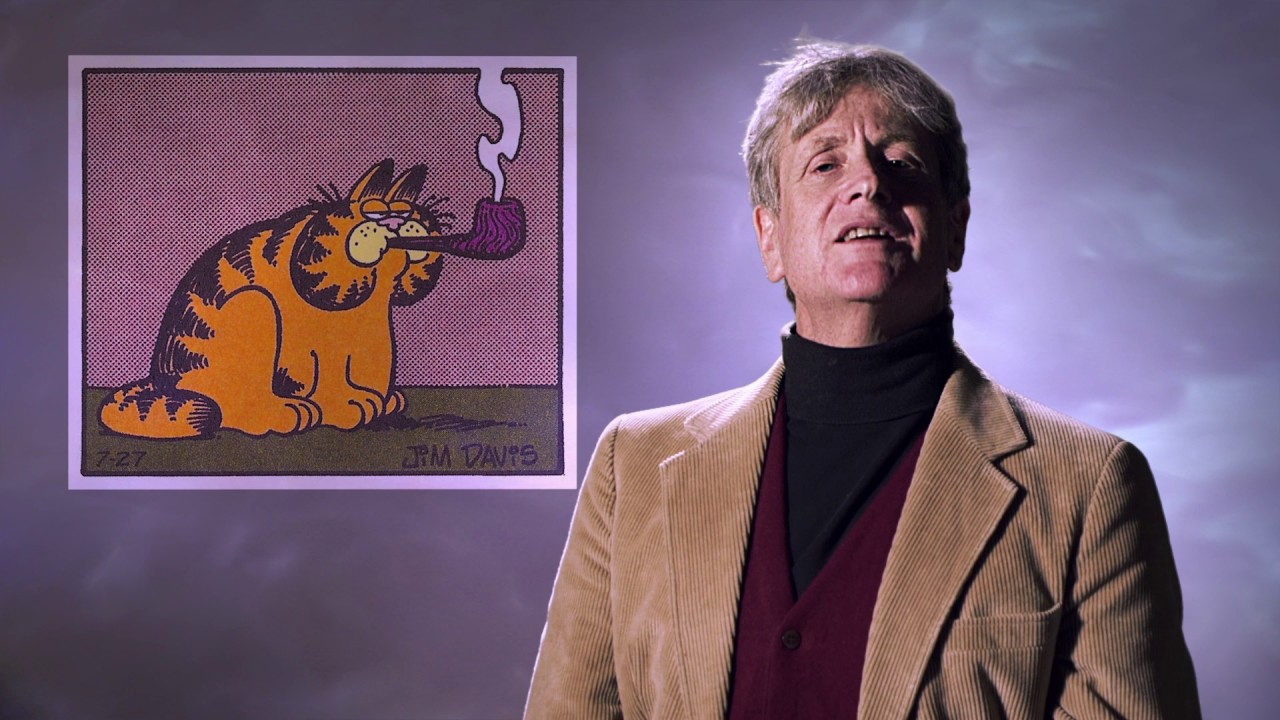
If the name is vague, this can also be called the Pipe Strip episode of Lasagna Cat, in which the following is recreated:

1st Panel: Jon Arbuckle (in his early, cruder design) reading a newspaper and extending his hand out to grasp for a smoking pipe.
2nd Panel: Jon staring straight at the reader, a thought bubble appearing saying "Now where could my pipe be?"
Final Panel: Garfield, significantly different and larger in his early design, smoking the pipe as Jon is read off panel shouting at him.

Then for an episode longer than all the others in Season 2 combined, as I view Sex Survey Results its own piece, we have actor John Blyth Barrymore, related Drew Barrymore and an actor in his own right, telling us of the philosophical and spiritual depth of this newspaper strip for over an hour whilst the entirety of Philip Glass' Kundun soundtrack for the 1997 Martin Scorsese film plays over his speech and images behind him in green screen.

Immediately of note, Fatal Farm duo Zachary Johnson and Jeffrey Max were not aware there was a sequel strip in existence which followed on from this joke. That strip can almost deflate this episode but is weirdly enigmatic to suit it. Namely that Jon takes the pipe from Garfield, is about to puff at it but reconsiders the idea, only to give it back to Garfield. On one hand, he probably does not want to taste what has been in his cat's mouth, but the final panel is the same one as before of Garfield smoking the pipe, as if inevitable.

I will argue this episode, the original final episode planned by Fatal Farm, was probably stretching the joke for an extreme, even in mind of the hard work and talent in the production feeling its girth at an hour. A clear reason why the length is necessary, though this is not probably the reason for this episode being an hour long, is that Philip Glass score. Glass himself is a unique figure whose work beyond his famous soundtracks is challenging to say the least - Einstein on the Beach anyone? - but the choice has more fascinating meaning. It is a soundtrack for a film where Martin Scorsese, a Roman Catholic, tackled a film about Buddhism, a film seen as extremely obscure in his filmography and idiosyncratic to have taking music from to say the least; it is a curious choice in Fatal Farm digging out soundtrack choices, and Glass' work of monkish chanting and repetition is naturally profound, making its use here even more inspired as a joke.

It sets the episode as being a pisstake. A person might find this tale of John Blyth Barrymore becoming obsessed with a humble Garfield strip a mean swipe at the Jim Davis creation's existence in pop culture. It can be viewed as anti-religious or at least a caution of reading into beliefs as it becomes a gospel for Barrymore. It hits close to home for me as this also entirely asks the question of critical thinking of any object, as it can be argued this joke can even be applied to "high art", be it the countless professional film critics who have talked of films like Citizen Kane (1941), or amateur opinions, such as the countless theories about The Shining (1980) that were numerous enough to create the documentary Room 237 (2012).  

What does it say when I am analyzing an episode on a satirical critique of the Garfield newspaper strips, which is about someone making a critique of its profoundness? It is an absurd thing to consider - yet this can apply to all work and all communication when you eliminate the notions of "high and low art". I cannot help but think of the fact I did a dissertation in university on David Lynch, an artist notoriously holding his cards to his chest to what his work means. Many a professional writer attempted to read his poker face, something I can attest to as I was reading such interpretations to write that dissertation. The idea of trying to dig deeper into a work is not something that comes from crazed theories and can be just as much a case of pot luck in actually succeeding in anything.

If I am to recreate this episode by comparing a Garfield strip to work talked of by intellectuals, how befitting it was a comic strip about a pipe. Here for once images are needed, as you dear reader should find the strip (the title is the date it was published for help, as for all the Lasagna Cat episodes), and René Magritte's The Treachery of Images (1929). Magritte's painting is a drawn image of a pipe but with text in French saying "This is not a pipe". The betrayal of images is that, yes, it is a representation of a pipe but it is not a pipe, as one cannot pick it up and smoke it. Knowing Magritte's history as a surrealist, it is a deliberate subversion of the onlooker's perception of image and reality. It also makes a metaphor for the issues of a person reading any object or symbol or concept in certain ways. This works both ways for me - if one reads too much into a concept, you can take questionable leaps of logic, but if you merely read the surface, even that which is presumed garbage culture, you can fall into a blindness. Obviously, the Garfield newspaper strip is clearly meant as a joke. However, the episode itself, even if it originates as a joke, turns into something more meaningful, which makes the idea it was the original final episode of Lasagna Cat more significant.


Copyright 1978 PAWS, INC. All Rights Reserved

One also thinks of is how much of the narration by Barrymore is actually true or not. Fatal Farm's script and Barrymore's performance deserve credit for being very convincing, where between material that is very over-the-top, they sneak in facts that sound credible and may not be scrutinised as carefully. Cats are not colour blind to red and green as suggested, but struggle within the spectrum of reds to pinks only. "Cat rage rooms", a term Barrymore says he learned from a veterinarian, when searched online just goes to Lasagna Cat or the fascinating concept of "rage rooms", built rooms for human customers to destroy to relive stress. This episode proves funnier in how it toys with this, suggesting a really convincing tone can even make the utterly ludicrous sound convincing still.

This episode also metaphorically is a light hearted take on the truth that, honestly, human beings require a faith to cling onto. Even in terms of entertainment, Star Wars fans, Star Trek fans, My Little Pony "bronies", many fandoms all belong to attempts at a faith even down to sacred objects and even uniforms. Barrymore's performance is tremendous. His character at times is a figure some might keep their distance from, but he also can be just an eccentric who has managed to find ideas as meaningful to him as the Bible or Karl Marx's Das Kapital would to another, his character talking of how he has both by a mere cartoon strip developed both a spiritual foundation to be virtuous and also be suspicious of capitalism, which is absurd from Garfield but would still be good if found from a real person. Also we don't bat an eye on humanist Gene Roddenberry creating Star Trek, the original sixties series exposing ideas of the united nature of mankind above war but still having William Shatner fight a lizard man with comical boulders.

Also, some of the ideas are sound to consider, especially imagining Garfield himself as a chaotic devil figure. Garfield, whilst meant to be the loved character over his owner, is regardless of being feline an arsehole if you think of all the moments of meanness and selfishness that have just been depicted in the strips used in Lasagna Cat. It is befitting that the only piece of Garfield merchandise I has as a kid was a second hand illustration, in a frame, of Garfield cutting up Jon's computer with a chainsaw out of spite.

07/27/1978's existence also has the emphasis that, as documented in the last review, Fatal Farm admitted they had grown fond of Garfield or found that it would cruel to just mock a newspaper strip that would be especially fond for children to read, the ten years devoted to this pointless if the point was to just make a joke. The episode, as mentioned, was meant to be the conclusion. It would have been perfect, as it ends on a fittingly sweet ending that contrasts all the darker jokes or moments of Jon having a shampoo bukkake from half naked men, Barrymore ending with the idea that in hundreds of years, when humanity changes and evolves, people (explicitly children) will still read a Garfield comic like the pipe story, and smile. Even if Garfield had went the way of a Francis the Talking Mule, a pop culture phenomenon that disappeared into the past, there would still be figures like myself resurrecting them out of curiosity if a reboot did not exist. Even the meaner jokes about Garfield online, the actual irony, is paradoxically sustaining the orange cat longer than just ignoring him, before you consider even into the 2010s he was still having animated series etc. to keep the franchise going.

Of course, this was not the final episode of Lasagna Cat Season Two. Feeling like it was its own beast, there is of course an alternative ending, arguably so, which presents a much darker take on this notion of resurrection after four plus hours of telephone knock knock jokes. That is for another time and the conclusion however...
To Be Continued...


Saturday, 23 May 2020

Lasagna Cat Part 2: Season Two (2017)


Following on from Part I.

Ten years after the original Lasagna Cat web series, a very big surprise came to be where when a new season abruptly appeared, beginning with a trailer in February 2017. This trailer showed a considerable jump in production since the 2008 web videos, in which Garfield is secretly a Terminator robot and Jon Arbuckle (and viewers) were requested to call a call connected telephone number for a survey, where you would provide your name and how many sexual partners you have had.

The episodes were recorded not that long after the original series in truth, sat in Fatal Farm's archive until they decided now than never to release them. In that time, however, they grew considerably in reputation. Season One, as mentioned before, caught the attention of the likes of Adult Swim, and onwards they created the likes of music videos, commercials, and various odds and sods. There is also Our RoboCop Remake (2014), a unique anthology of individuals remaking scenes from Paul Verhoeven's RoboCop (1987) in idiosyncratic ways. Fatal Farm remade the scene where RoboCop shoots a would-be rapist in the penis, multiplies in their many to multiple would be rapists and many (now explicit) exploding penises. It is also the sign of how Fatal Farm improved in that, whilst they are still low budget filmmakers, they are technically accomplished and a resourceful pair, as their segment involved finding a hardcore fan that had an accurate RoboCop suit and police car.

The second season of Lasagna Cat also shows the same considerably darker and bolder sense of humour. The structure is the same as before - how the Garfield strip is replicated exactly, followed by the original for comparison, and followed by a musical tribute to Jim Davis, which are significantly more elaborate in most cases than before. Immediately out of the gate for example, you got 10/20/1984 - same as before, new background colour and a change in music cue notwithstanding, about Garfield mistaking Odie in a picture frame as a mirror. Only this time it turns into a shot-by-shot remake of a famous scene from Michael Mann's famous TV series Miami Vice. Specifically a notable scene using Phil Collins' In the Air Tonight, the one song just by itself which does defend Collins' solo career whatever your opinion on it. Re-sung by Justin Roiland, pre-Rick and Morty, the recreation even with cardboard boats and background buildings is incredibly accurate. This does open an issue where half the joke does not work without the reference, which could post as a criticism of the short, but creating a visually accurate depiction of a very sombre and intense scene with Garfield is funny in itself, and if you do know the reference (or see the shot-by-shot comparison), it is exceptional right down to Odie having actor Philip Michael Thomas' earring on the costume.

The jump in production also means that the musical choices I would argue are also more ambitious. Some obvious choices, like 50 Cent's In Da Club for Garfield's debauched birthday with a mouse stripper, but even Kenny G is used in a perfect way, over a pleasant tableaux of Jon on the telephone, and idyllic scenes of hunky Garfield, in respect to their creator. Possibly the best, excluding the big epic episode using Philip Glass and the Miami Vice parody, is Lady Gaga's Bad Romance, played over the tale of Odie becoming a fashion icon for wearing a paper bag on his head...only to get into scandal, become depressed and commit suicide, and not be permitted into Heaven because of the paper bag, thus ending up in a hell populated by Jon Arbuckle-man scorpion hybrids. That is probably one of the darkest tributes, and there are a few, but the unconventional music choice is striking too, making the fact it is in copyright infringement sad as unless the license was paid for, this could easily be compromised, thus marring a visual-audio combination which works exceptionally.


Interesting only one was ever problematic, another deemed too extreme for YouTube. Of all the possible controversial decisions, it was including the address of Garfield's owners Paws. Inc. and asking to contact them about "having breakfast with Garfield", using an altered version of the Deep Blue Something song about Breakfast at Tiffany's; that video is available online but usually with blurring and not on YouTube, which is a shame because it is one of the most distinct, Jon in a breakfast themed world with houses and suburban life made from food before a giant Garfield sneezes it all away. Fatal Farm with these episodes were willing to spend money on work they could never gain financial revenue from, which is a shame but also admirable in their creative choices and that they clearly did this out of passion.

This is an important point to make, that it was with passion. With these segments there is also a drift away from the original joke, namely to take the piss out of Garfield as a property. One still refers back to the original point, turning into a 1920s set tribute of Jon playing a loop to loop joke for way too long in front of a bored audience, but we have to consider how Fatal Farm's attitudes might have changed when they have worked for so long in this world. They willingly combed through strips for two weeks for the shortest, a parody of a 2008 meme called Colin's Bear Animation, an animation project from a third year Game Development student at Ontario Tech University, where it is recreated with a CGI Garfield moving, dancing, and then a play on the famous dismissal of the original to the teacher "Thanks for nothing", which Fatal Farm willingly spent a long time in trying to find a newspaper strip with that line. The jokes may have gotten certainly darker, but at this point, the level of devotion to the work they did not need to do show their views of Jim Davis and his famous characters having clearly softened. If it had not changed, no sane person would spend two weeks for this joke*.

The banned YouTube video for example, stemming from a joke about Jon being a "madman" for wearing socks in bed and, set to Fergalicious by Fergie, has him in an asylum in the tribute, smearing on the wall (and eating) his own faeces, and getting a lobotomy with a drill. But it is not a joke at the creation, but just a dark joke, a juxtaposition of something you would never witness. Likewise there is the shampoo bukkake, which is arguably the most ambitious alongside the Miami Vice parody as, between the many additional elements these shorts had (a Twitter account for Odie or a fake porn site for this one) to co-creator Jeffrey Max having to speak phonetic Japanese among Japanese actors, it is impressive. Admittedly that short is, yes, a recreation of a fetish stemming from Japanese pornography only with men in loin clothes violently shaking shampoo over a receptive and grateful Jon Arbuckle, with even pixilation of the bottles for effect. Who knows what the extras were probably thinking acting this out, but set to a Prince song, it is a memorable eyebrow raiser for sure. It is not a short that insults the creation however, which is important to consider.

In terms of what they actually mean, the truth for me is that Lasagna Cat has always been a joke first, as with the Ducktales parody and others, Fatal Farm finding the humour in juxtaposition. The real message if any is the subconscious changes, that in spite of the darker content and occasional mocking, the episodes are less glib, more lavish and with little of the expense of Jim Davis' artistic work. Even the Breakfast with Garfield controversy was a light hearted joke that was accidentally too effective. There is one major episode I have not mentioned, not Sex Survey Results, but the original intended finale for the project which is a one hour piece and does leave on an actual message for the series. This however deserves its own review...

To Be Continued...

=====
*) Listen to the podcast HERE, an interview with Fatal Farm, where this entire change of heart of explained in detail from themselves.


Friday, 22 May 2020

Lasagna Cat Part 1: Season One (2007-8)


Directors: Zachary Johnson and Jeffrey Max
Screenplay: Zachary Johnson and Jeffrey Max
Based on the newspaper comic strip by Jim Davis

[Note: Yes, back last year I covered this web parody series in a two part blog piece. Bluntly, this is a return to this peculiar long gestating production about everyone's favourite orange cat. Unlike last time, there will be more time on each piece of this work because, unlike the last review, I realise I should have given more thought to each piece]

How does one explain Lasagna Cat? Well, the question extends back to not even where the first "season" of this web parody series came from, as I feel the work changed as it entered its unexpected return, but to another - how does one explain Garfield? Who actually read Jim Davis' original newspaper strip when it started in 1978, and what is the appeal of a lonely guy named Jon Arbuckle, his yellow dog named Odie, and an orange cat that loves lasagne and hates Monday called Garfield? Here's the thing, even if Garfield dissipates in pop culture, for a certain generation if you say "I hate Mondays" or evoke lasagne, Garfield will be there. I grew up in an era where you did not have to read any of the strips but could see the animated tie-ins and merchandise, so the character could transcend the original strips. That they are still being published however means he is now more than the sum of his original premise. The initial idea, presumed, in Lasagna Cat is that these strips are not inherently funny, and the premise is to recreate the panels exactly, followed by a "tribute" to Jim Davis.

As the project continued, and creators Fatal Farm (Zachary Johnson and Jeffrey Max) found as they worked over ten years on these jokes, this initial premise has been muddled. Frankly, I have always been of the belief that a lot of popular work that is successful in the mainstream, the true mainstream of ordinary people, is not going to be understood in how it succeeds, as is underground material is not going to be understood by the mainstream, and inevitably these types of arguments of artistic merit are going to be subjective. From the panels used in Lasagna Cat, Garfield is innocuous but at times quite ward and idiosyncratic, merely slithers of it in banal humour which plays a factor in this adaptation.

For "Season One", this was only three years into YouTube's existence when these videos were uploaded in 2008, following a trailer in 2007, the site virtually alien to the dominant form more likely to be watched by kids than actual television in the 2010s. They are, in all honesty, merely basic parodies, but I have softened to them in knowledge of Fatal Farm at this point were going to develop and build to more elaborate work afterwards. The duo created work before, but it was this project that got the attention of the likes of Adult Swim, letting them on to bigger work on Tim & Eric Awesome Show, Great Job! (2007-10), even Old Spice commercials with Terry Crews. Before however, they were doing alternative title sequences to old television. During the production of their take the Disney animated show Ducktails (1987-1990) in which Webby Vanderquack gets catfished online and kidnapped as a sex slave, they found a grotesque adult sized Garfield costume; sunken eyes, giant head, a thing perfect for a CreepyPasta of Garfield eating your soul. Certainly, for subverting the original comic strip, a natty costume like this would suffice.

For me, the recreations are the most interesting aspects of Season One, because controversially I think acting out the strips presents some fascinating ways filmed images can add to the material. I am thinking specifically of co-creator Jeffrey Max as Jon Arbuckle, who is actually providing a great performance as a naive, wide eyed individual. Having the character being acted, in a very fluffy wig and trademark blue sweater, means that facial expressions and eye movement adds to what are some frankly generic jokes in the original material, adding odd levels to them as seen as the panels themselves are shown after the recreations for comparison.


Obviously most of the fan base is about the tributes, which are effectively their versions of a trend at the time of fan made music tributes taking existing footage and editing it to music. Fatal Farm follow these restrictions fully, in that they only use the footage from the recreations, manipulating it which can get really perplexing when (set against "Suicide is Painless" from the M.A.S.H soundtrack) Garfield is depicted with a third eye and even crucified on a cross. The music is a lot of big mainstream pop hits, surprisingly with only one real case of copyright violation being raised by the short using Desperado by The Eagles1 having to be deleted officially in the 2010s.

It can be argued, even by accident, that some of the songs chosen are being questioned as much for their mainstream success as the strips. I have to think of a song like Bailamos by Enrique Iglesias and wonder is it has actually been remembered fondly, or whether it was just the chorus being stuck in your head as it did for me from Lasagna Cat. It was originally on the soundtrack for Wild Wild West (1999), a notorious cinematic flop, a detail that few would remember, and as much as a fake Garfield dancing to it with Adobe After Effects being used a plenty is a critique of the newspaper strip, it can offer a critique on these songs too. Likewise, is Ebony and Ivory, the Paul McCartney and Stevie Wonder collaboration, held highly, as it sits over time over Garfield and Odie (in a ridiculous homemade costume) hug. Like Garfield itself, if people love these songs sincerely, even if it was just one person in the world, then they are loved. But the spectre of what is perceived as accepted because we have presumed so, an issue with mainstream media, as much clings to these examples. If they are mostly perceived to be great or important, that is a form of purgatory, a symbolically appropriate metaphor for a web parody series that will run with this when we get to Sex Survey Result's ending all the way in 2018.

At this stage, these are really just parody videos, released in a whole batch in 2008. Fatal Farm originally had plans to do a Garfield strip a day, only to find this was impractical, so this does work in its places a peculiar form of filmed performance art. One of the most famous, set to the score from Jurassic Park (1993) whilst increasingly low pickings in terms of reviews to Garfield (2004) and Garfield: A Tail of Two Kitties (2006) are shown, starting with positive reviews for both by Roger Ebert but eventually getting to an Amazon review, is more of an extended gag than how ambitious they eventually got. This is particularly the case as, if you go to these after seeing the 2017 work, these do not really have a dynamic conclusion to any of them. The tributes do not really get ambitious later on, and the only dynamic change is the sole female cast member, hired to play the vegetarian Dr. Liz Wilson, for a single strip used about Garfield eating her handbag. What does predate where the second season would head is that Jim Davis' strip has odd touches belying it as an innocuous and for some unfunny work. The closest to a grandiose tribute is the one which uses original footage, Jon Arbuckle not having a romantic life turned into a sad monochrome tribute of his crying on the kitchen floor with the telephone receiver by him.

Arbuckle was originally a stand-in for his creator, who in the first strip was also a cartoonist, only to grow into a man in his thirties or so who is perpetually single, isolated and eccentric. Some of it is absurd, like his glee in a toaster popping which is turned into a brash USA tribute, but the romantic life one is dark humour for a very silly comic strip. If I ever did a "Books of the Abstract", I would have to cover the strange history of Garfield Without Garfield, a parody which just took original strips and removed Garfield, and anything else out the ordinary, so what was left were just Jon being insane and isolated. It is a project that Jim Davis clearly liked as the rights owners officially released the strips in paperback form, thus making it canon and adding layers to this character2.

As I will get to in the later parts, the snark and irony that has been welded to Garfield in parody, which this is the biggest example of, became paradoxically as it became a way for the franchise still to live, although it will take a while before we get to this in terms of where Fatal Farm themselves ended up being. The result here is merely a stepping stone to a bigger project, not to be dismissed but that it was the first stage to a project Fatal Farm which grew from this version's virtues and evolved into something considerably weirder. It would take ten years, but it would happen.

TO BE CONTINUED...


=========
1) The Big Lebowski (1998) perfectly sums this up - "The fucking Eagles..."

2) This is not to mention the likes of Garfield: His 9 Lives (1984), a collaborative comic, or any of the TV animation and animated specials which suggest that, even if occasionally, the newspaper strip's reputation for being banal belays the whole story.