Showing posts with label Eco-Terror. Show all posts

Friday, 14 May 2021

The Happening (2008)


Director: M. Night Shyamalan

Screenplay: M. Night Shyamalan

Cast: Mark Wahlberg as Elliot Moore; Zooey Deschanel as Alma Moore; John Leguizamo as Julian; Ashlyn Sanchez as Jess; Betty Buckley as Mrs. Jones; Spencer Breslin as Josh; Robert Bailey Jr. As Jared

A Night of a Thousand Horror (Movies) #223


We're packing hot dogs for the road. You know, hot dogs get a bad rep. They gotta cool shape, they got protein.

Spoilers Throughout

As time has passed, his career has been a rollercoaster of other films in his career that have both harmed his reputation and have raised him back in praise to cinema patrons, M. Night Shyamalan's The Happening is still in hindsight the film where he had shot himself in the foot. Films before were divisive - with the huge buzz from The Sixth Sense (1999), Shyamalan was pigeonholed for all his films having plot twists, whilst Lady in the Water (2006) was not well received. The Happening however was a film which became notorious, though the irony is that its premise, where plants decide to get their revenge on humanity, is a disturbing one rife in potential. As set up, suddenly waves of people in natural areas like parks are affected by an unknown force. Stopping, becoming disorientated, and leading to mass self-inflicted suicide. The scene, as Shyamalan restrains from showing a great deal barring an occasional shock, where construction workers are suddenly walking off the edge of a tall building they are working on, like how lemmings (fictionally) were meant to, is a legitimately creepy one that in itself sets up a compelling work.

Then, however, Mark Wahlberg is introduced as a science teacher, talking about the bees disappearing and being very heavy handed about environmental issues to his class, and the issue with The Happening and why it became infamous is entirely for me revealed to be the presentation. Yes, some will immediately get annoyed when his character talks about the unknowable science of nature, which would piss material rationalists off, but weaving the supernatural and religion into his work like Signs (2002), Shyamalan was always going to take on the wide eyed mysteries of the world. The issue with the film is that it clearly wanted to juggle a lot, including a knowing sense of humour as Wahlberg and Zooey Deschanel, the later playing his estranged wife, are meant to the wide eyed ordinary Americans trying to rationalise this grim scenario where mass death happens in the most abrupt of places. The tone misfires, with choices made, that lead the film to its infamy.

The premise itself stretches credibility, even as someone liberal in logic for his storytelling, in that once it is revealed plants are using a pheromone which blocks the human brain function of self preservation, an issue arises where it requires some very elaborate ways for people to kill themselves. It leads to another moment, one of the few perfect ones, of a cop's handgun being passed along in a street between people affected by the happening, but it does stretch into the absurd how abruptly people act, into actual comedy when the elaborate nature of the pheromones' effect include a man starting a drivable lawnmower, laying down and waiting for it to run him over. The story could have just been changed in one way, that the plants admittedly a hallucinogenic that caused chaos, and the premise would be helped. Imagining nature itself attacking humanity is a common theme, and whilst a plant might seem absurd on the surface beyond The Day of the Triffids as a threat, the notion of an entity which covers large amounts of the Earth, and can eventually grow over even manmade structures, is a striking one. Environmental issues are still sadly with us; a film like this, in the era of An Inconvenient Truth (2006), would be perceived as heavy handed, but the concerns this plays with are relevant with the idea of Mother Nature wiping the human species away one we return to in storytelling.

The infamy of the film is that, with the tone a mess, you also have so many misfires. It does want to juggle humour and being serious, which is perfectly possible, but The Happening is a step behind in the pace it needs to succeed in this, where a man having his arms eaten off by lions (as seen in a web video a character watches) is nasty but in position comes off as ridiculous. The dialogue is one of the biggest kneecappings for the film. The speech about the underrated nature of hot dogs, abruptly appearing, is ridiculous. The subplot that, with their marriage in a crucial point, Deschanel's character is hiding the fact she went for dessert with a co-worker, is closer to the awkward humour of a mumblecore comedy, with the rebuttal by Wahlberg about buying cough syrup just to talk to a female stranger being probably the most misfiring, illogical piece of the film. These moments of dialogue are worse knowing it is meant to be humorous and, in cases like the cough syrup, they are meant to build characters teasing each other and moments of levity.

Having characters running away from the wind, which pushes the pheromone, is also inevitably going to look silly, as even the scene of Wahlberg talking to a plastic plant is meant to be playful on purpose, in another rewarding scene of a model house for a building estate full of plastic goods. Confused looking actors running around in a field is inevitably going to look absurd. The worst aspect of this is that, upon reflection, aspects within The Happening itself have aged with some scary resonance, lost within the awash of its misguided aspects. With the attacks only place in one region of the United States, references to conspiracy theories come up in dialogue including the disbelief for some that it was anything else but the government responsible for this. More unfortunately relevant is that, for a sight joke of two older women in ye old gas masks, you also have people arming themselves with guns which leads to probably the most shocking moment (two young children being shot) that really has grown darker over time.

That the film, instead, has visibly slipped trying to juggle so many variables instead maims the film, which eventually does deviate into a pointless conclusion with a strange older woman with huge psychological issues, closer to a prelude to The Visit (2015) by the director. The abruptness of the conclusion, where the events end, fits in the sense of a profoundness of it merely ending, and that it can transpire in another country with ease, but by that point you have a film which is memorable yet for many bad reasons. It is compelling, truthfully, to revisit and a fascinating title which has good and the bad, but I am not surprised that this really did not help its creator with hindsight at all.

Sunday, 16 October 2016

Halloween 31 For 31: Rats - Night of Terror (1984)

From http://4.bp.blogspot.com/-sCWrm4Q1Z7g/Uc983UB454I
/AAAAAAAACcg/yYXiYqZ8jG0/s1600/posterRATS.jpg
Director: Bruno Mattei (with Claudio Fragasso)
Screenplay: Claudio Fragasso, Bruno Mattei and Hervé Piccini
Cast: Ottaviano Dell'Acqua (as Kurt); Geretta Geretta (as Chocolate); Massimo Vanni (Taurus); Gianni Franco (as Video); Ann-Gisel Glass (as Myrna)
A Night of a Thousand Horror (Movies) #40

Another pairing of Bruno Mattei and Claudio Fragasso, and considering how many times they worked together, one wonders if their relationship went beyond merely collaborating on a film set to a friendship. Imagine the kind of bond, the conversations at lunch between film shoots, that would've forged making films like Hell of the Living Dead (1980) and Rats: Night of Terror. Here, in the meantime from that thought, Fragasso touches upon a theme that does scare and creep many people out in the figure of rodents. Mostly this is due to symbology - a pet rat, for me and for others, would be exceptionally cute, whilst the fear of them is due to their centuries old image as disease carriers in the wild. Wild rats present a sense of unease, suggest general decay, their ability to breed quickly and even go as far as cannibalise their own to survive disturbing in how they spread in rundown environments, their cultural legacy as spreading the likes of the Black Plague still potent centuries on because, even if it was technically their fleas with spread the illness, it killed millions.

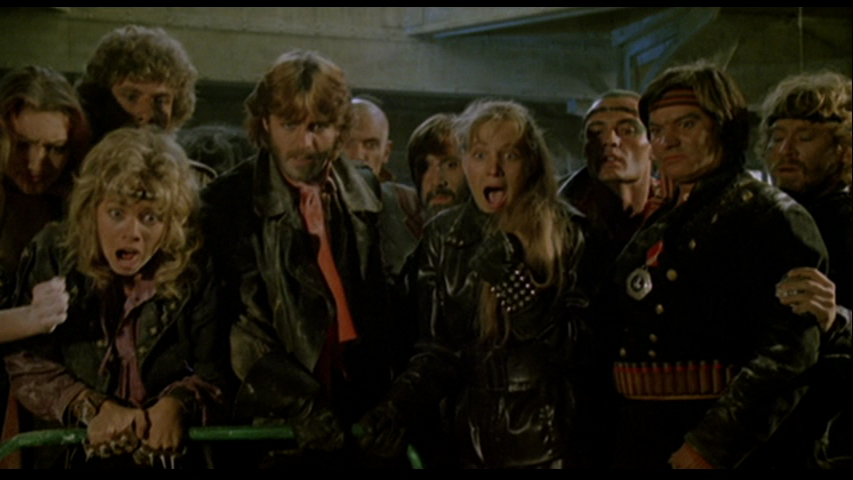
Instead of merely an animal attack film however, which would've continued on the seventies tradition of nature being vindictive and trying to kill human beings constantly, Rats - Nights of Terror takes on an unsuspecting twist that was clearly influenced, as many Italian genre films, by the success of the Mad Max films, setting itself in a post apocalyptic sci-fi future. Set long after society has blown itself up with nukes, a group of marauders male and female, trying to survive on their own as explained in a very complicated opening narrative, find an abandoned building. At first finding crates of still edible food is a joy to them but they immediately find rat chewed corpses littered around the place as well. Soon they'll eventually learn that the rats are only just responsible for cleaning the meat off the bodies' bones but have more than likely killed them beforehand too. The result is even more peculiar considering the style and tone of the material.

I had been tricked by Zombi 3 (1988), itself "special" in some of its dialogue exchanges, that Fragasso was more conventional in his screenwriting style than I had come to learn, something clearly wrongheaded of myself when you get to Rats. Far from a detraction, it does mean that you have characters with very unconventional names - Lillith (Moune Duvivier), Video (Gianni Franco), Chocolate (Geretta Geretta with possibly the biggest hair even seen in an Italian post-apocalyptic film) etc. Than beyond those names, at least in the English dub, to the type of dialogue his characters have, such as Chocolate promise the geeky Video that he can make her pregnant if he fixes a computer they find in the building amongst such brief moments strangeness. Fragasso's obsession with environment issues throughout his career is found here too, Biblical proportions even when you get to the dumbfounding final twist, the group discovering the likes of plants being carefully grown in the basement with a water purifier and realising that a project by scientists was taken place in there, only to be found abandoned with rats on mass everywhere.

From http://1.bp.blogspot.com/-T2oN4Bt6m1w/TV7F4ODkz5I/
AAAAAAAABZ8/j3YA2u7n-0E/s1600/ratscast.png
I have to confess though that, for all its moments of entertainment, Rats does suffer from being surprisingly conventional and repetitious at points. Were it not for the little details, from the groups' military vehicle to the rats being made intelligent through radiation, this could've easily been made an animal attack film set in the regular day. It's a severely restricted film in terms of plot too - the marauders sleeping in the building only to find themselves having to try to survive the night from the rats - meaning that it does repeat itself constantly, from people being slowly picked off to a lot of screaming particularly from the actresses filling the soundtrack. Eventually, despite the idiosyncratic nature of Fragasso's characterisation, where everything borders between the profound to the absurd, it eventually lacks the outrageous nature needed to make up for its sluggish moments, not completely able to have the same strange aura of other Italian horror films from this period. Certainly it has the gruesome practical special effects - an un-PC incident with a woman naked in a sleeping bad, rats exploding out of people let alone out of their mouths - but baring the sub plot where a cowardly member tries to undermine their leader to save his hide, its boiled down narrative does feel lacking in the excitable madness that some of the best of Italy, the legitimately great works of genre let alone the fun ones, had. In fact I prefer Hell of the Living Dead out of Mattei-Fragasso's period here from what I've seen, even in spite of how shambolic it is next to this one's more polished appearance, because of how wider in scope its ambitious story was.

Of course, Rats does have one of the best, most delirious ending twists of any Italian genre film of this period, worthy of seeing Rats and redeeming it greatly, but I cannot ignore that considering the promise it gives as a post-apocalyptic rat attack film, it does lack the maddened energy of other Mattei-Fragasso films I've witnessed. While being of a fly on the wall for their conversations about making the film would've been wonderful to hear, as would how they dealt will all the stunt rats (and guinea pigs and rubber rats masquerading for them) on set, this does feel weaker as a film even in the context of admiring its failures.

From http://horrornews.net/wp-content/uploads/2012/02/
Rats-night-of-terror-1984-movie-6.jpg

Saturday, 3 September 2016

Birdemic: Shock and Terror (2008)

From https://thereservoirblogs.files.
wordpress.com/2011/05/birdemic_web.jpg
Director: James Nguyen
Screenplay: James Nguyen
Cast: Alan Bagh (as Rod); Whitney Moore (as Nathalie); Adam Sessa (as Ramsey); Catherine Batcha (as Becky); Janae Caster (as Susan); Colton Osborne (as Tony)
A Night of a Thousand Horror (Movies) #23

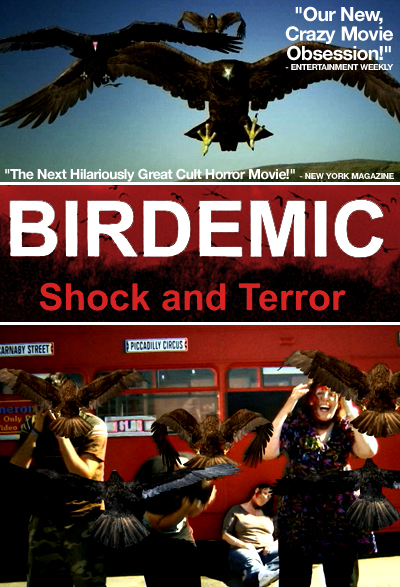
After viewing Birdemic, I've proven to myself unequivocally that I hate ironic film viewing. Admittedly it doesn't help I watch like this or Samurai Cop (1991) by myself, films which only really work in group situations preferably with alcohol involved, but the idea of celebrating bad technique in cinema to merely mock it is problematic and regressive. I openly admit to liking technically bad films myself - from the Canadian oddity Things (1989) to Batman & Robin (1998) - but I love them sincerely as much for their fuck-ups as for the few virtues they have, their failures causing me to laugh but also look on with delight as they go into strange, irrational directions either because of the technical decisions or the scripts. Birdemic makes Manos: The Hands of Fate (1966) look technically proficient in comparison and just a painful experience to sit through. A modern day bastardisation of Alfred Hitchcock's The Birds (1963), in which a small US town is invaded by CGI eagles, it felt better to just lift bullet points rather than try to make a cohesive set of paragraphs.

+  The experience was so tedious I immediately rewatched The Birds afterwards. It's completely unfair to compare the two but it's impossible not to when it comes to how long each takes to establish the characters and their drama until, forty plus minutes later or so, the killer birds are on them. Kicking Birdemic when its down is unfair but it's amazing how colourless and lacking the personality the dialogue is. The first forty minutes is meant to be a romantic film but most of the dialogue is about environmental concerns or the most rudimentary of content, short characterless verbs which don't lead to any colourful dialogue from the characters as it should in real life or a film with a fun script. None of the oddness sincerity of something like Plan 9 From Outer Space (1959) is there either to help avoid this robotic tone from these empty platitudes and statements making it worse.  

+ As someone who has watched a lot of low budget films, and can get wisdom from those who've watched even more of them such as the No-Budget Nightmare podcast, one of the biggest issues with very low budget films is how they build up an entire feature length beyond the main set pieces to link them together. Dialogue and establishing scenes can be the death of high budget Hollywood films let alone the likes of this, one of the biggest dangers especially in horror or thriller cinema like this when characters merely stand around discussing exposition without rhythm or dynamics to the glue of these scenes to connect set pieces.  Birdemic for a great deal of its length before and after the CGI eagles start to attack filled with non-entity dialogue either meaningful or funny to gain from them. A large part of it is that no one really wants to hear characters talk about their plans to set up a company to develop solar panel technology or be involved in software company meetings, but if you have to do so, it helps (which James Nguyen) doesn't if you actually have some depth to these conversations that sounds like the characters actually have knowledge on any of these subjects, not merely the most vague surface words about the topics.

+ The sound is an irritance in this fact as, while clear and audible, you can heard the transition in background noise from each shot being edited together to the point of irritance. In fact the constant abrupt changes in noise bring out the fact the film uses way to many edits just for single scenes.

+  Because of this, I have sympathy for the actors especially the leads Alan Bagh and Whitney Moore, who seem like likable people but are struggling without hope against dialogue that really doesn't allow them to even show charisma onscreen, turgid to sit through as a main plot threat is about environmental concerns and the lead hero wanting to create pioneering solar panel technology. Considering they are supposed to have a romance, even terrible purple prose romantic dialogue would've been a benefit and more rewarding, the more soppier and melodramatic the better.

+ A huge problem, which has been frequently talked of already, is the film's laborious, empty headed pro-environmental message which has no actual depth to it, merely screaming at the top of its voice about saving the environment but sounding like it's from someone who has no idea how to or what the subject involves. It actually comes off as a best-worst example of how not to do polemic messages in cinema. I'm the stereotypical left wing liberal but I hate follow liberals with probably more vitreous at times than even the extreme right, because of their lackadaisical, hypocritical and howled viewpoints, simplistic and misguided points on subjects that need greater tact to them to improve the world for the better. One of the biggest problems with messages in cinema, barring the fact that I find most social message dramas a waste of time and overrated, is that if the film is bland or terrible no progressive message within it, even if its applaudable morally, is of worth as its been compromised and squandered. This is more significant now as big companies in Hollywood, whether they have any progressive views in mind or are cynically doing so, are becoming more progressive on the surface in their choices, such as the plan to cast an African American actress as Mary Jane Watson in the next Spiderman film, applaudable ideas but in danger of being empty gestures if they're compromised by a bad film around them. Birdemic's the kind of film that'd put people off environmental concerns if they took it seriously at all, probably what some people think all those with environmental concerns actually sound like.

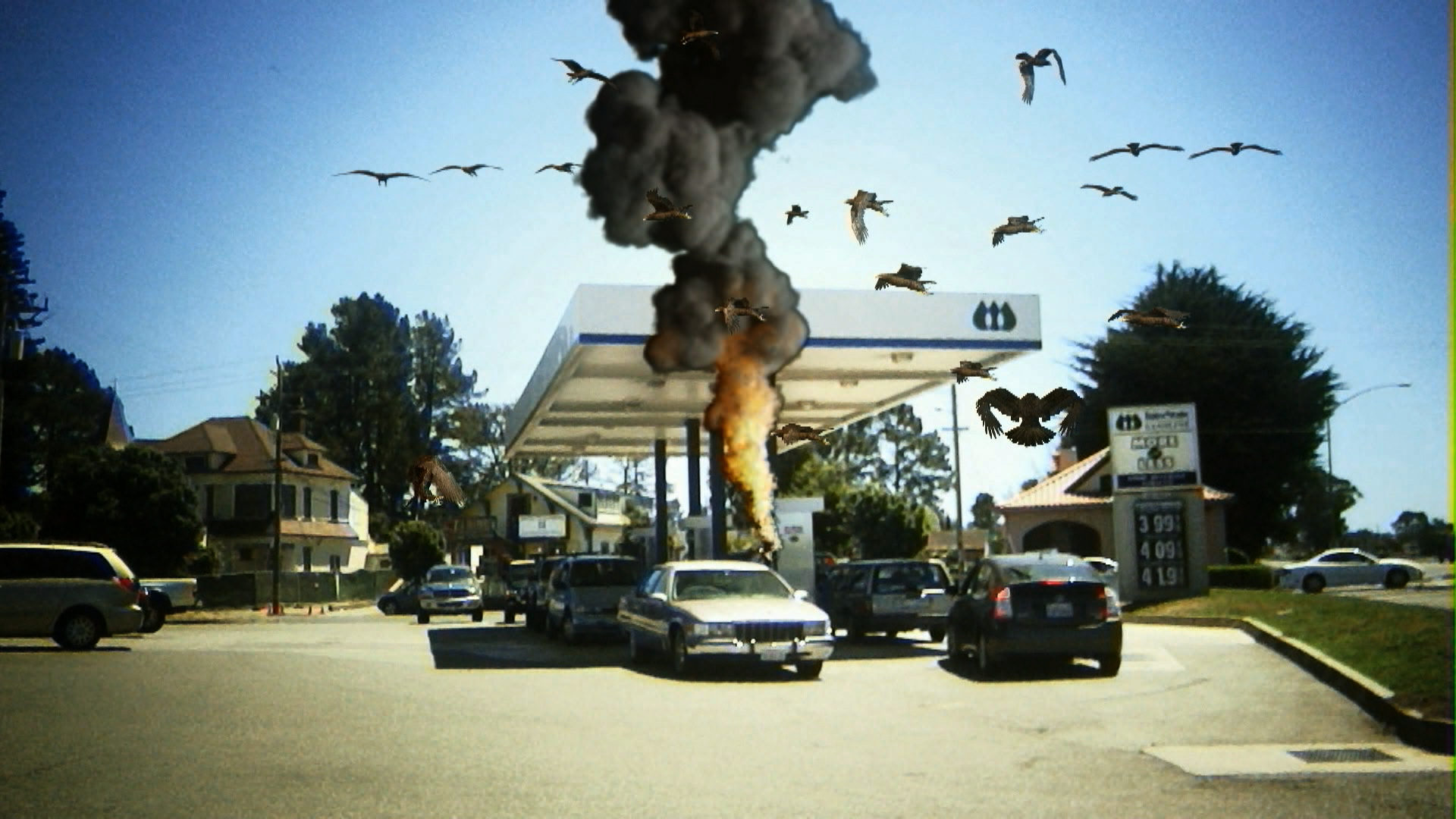
+ When the CGI eagles do actually appear after what feels like two hours already, the result isn't that spectacular still, most of it consisting of actors waving their hands randomly in the air with eagles superimposed afterwards. Even the inclusion of wire coat hangers as a self defensive weapon only lasts for a brief moment, not enough time to stick out, exceptionally disappointing when that was an "iconic" moment in terms of the film's cult reputation.

+ There were some virtues. The music by Andrew Seger at the beginning was surprising in how good it was considering the film's reputation. Unfortunately the film drags so much the music starts to feel the effect and became bland as the plot goes along, but at the beginning its surprising in quality.

+ There's one vaguely funny character, a tree hugger living in the woods, who reminded me of a low rent Woody Harrelson. That Harrelson has played a character like this in Roland Emmerich's turkey 2012 (2009) added humour to this fact.

+ The two children the leads rescue are comically absurd in their behaviour. Most of Birdemic as the CGI eagles attack consists of the characters going shopping and driving on country roads. Despite the dead bodies and people trying to rob them at gunpoint for petrol, there's no sense of trauma especially from the children and the only clear danger is that gasoline now costs $100 dollars because of this freak natural disaster. The children's complaint near the end, when they have to catch fish and fresh seaweed to sustain themselves, that they want a McDonald's instead is one of the most unintentionally spoilt and deluded things ever utter from child characters, so much so that even a viewer with no malice in them would want these fictitious characters to have their eyes poked out by the CGI eagles regardless of their ages.

+ The viewing experience altogether reminded me, while its be a long time since I've seen it, that there's a potentially more rewarding rip-off of The Birds from Mexico that should've had more attention. Beaks: The Movie (1987), directed by Rene Cardona Jr., the same man who made the Video Nasty Night of the Bloody Apes (1969), was far and away more entertaining back when I saw it, having the same delirious tone of the genre films the Italians were making in the eighties (being a co-production) and had, even if through crude effects, real birds involved. The idea of a character being mauled by a savage canary bird, one of many quite inventive scenes in the film, is a hell of a lot more rewarding than the CGI eagles in Birdemic.

In any other circumstance I'd have rated this merely a 2/10, never someone to condemn films any lower in rating, but the context and background behind Birdemic's public popularity and its tone as a movie is so disappointing to me that I have to call it a 1/10 film and one of the worst I've seen in content and attitude. It's not the technical deficiencies that stand out but its general mediocre attitude to being bad filmmaking, not even rewarding for its failure, and not having any of the charm of older infamous films. That there films made with less budget that are better than this, but this one got the cult status, is another reason I hate this film, something like Jennifer Help Us (2014) shot on an iPhone and managing to be a little gem in spite of its few flaws more deserving of this film's popularity. That it feels so pleased with itself in its hollow environmental message and cribbing of Alfred Hitchcock's film is utterly obnoxious and detestable. 

From https://thewolfmancometh.files.wordpress.com/
2010/03/birdemic-gas-station.jpg