Showing posts with label 1970s. Show all posts

Friday, 15 November 2024

The Gore-Gore Girls (1972)


Director: Herschell Gordon Lewis

Screenplay: Alan J. Dachman

Cast: Frank Kress as Abraham Gentry; Amy Farrell as Nancy Weston; Hedda Lubin as Marlene; Henny Youngman as Marzdone Mobilie; Russ Badger as Lt. Anderson; Ray Sager as Grout; Nora Alexis as Lola Prize

A Night of a Thousand Horror (Movies)


Lt. Anderson, one of my friends seems to have run into a bit of trouble... and lost her face.

Thinking he was ending on this film in terms of his film directing career, Herschell Gordon Lewis felt he wanted to go out with a bang, with more production value and shock as he was closing the door on his exploitation film career. Starting with the image of a woman, Suzie Cream Puff, "being creamed" by having her face hit through a mirror, he wanted to deliver on that premise. Here I will say, as one of the first Lewis films I had seen, I hated this film once. Hated it to the point it was actually held as one of the worst films I had ever seen. What changed in all the time that passed?

The immediate thing is this film embraces its sense of humour. Introducing our detective lead, Abraham Gentry (Frank Kress), stroking a pet cat in his lounge only to insert it into a cupboard when someone knocks outside, he is lured by a female reporter Nancy Weston (Amy Farrell) to investigate a series of gristly go-go dancer murders. The Gore-Gore Girls is a scuzzy and nasty little production, clearly influenced by the Italian giallo from the period as the unseen killer is even wearing black gloves for the job, but it is also a film so proudly with its tongue in its cheek it has pierced through the flesh. Gentry, as played by Kress, is immediately a stand-out even in terms of characters and acting performances in a Lewis film, playing a sarcastic dick but delightfully so, apt for the tone of the production with his many quips to people who irritate him during his work. He eventually even comes to like Nancy, despite their stand-off nature at first and questionable decisions nowadays; though he does nothing and makes sure she gets safely home, getting her drunk off her face on zombie cocktails repeatedly is not something we would consider heroic nowadays even if the joke back in the early seventies.

The film is a procedural where he investigates who the killer could be. Is it Grout (Ray Sager), the man at the Go-Go club bar who draws faces on vegetables and fruits, crushing them in a mania started on corpses in his Vietnam war service, or the leader of a feminist group, whose group storms a Go-Go club halfway through? Lewis even touching upon the Italian giallo genre by accident is a curious nod to this era Lewis would bow out OF, as horror cinema changed in the seventies and diversified further. This is including the fact he might have not been able to match the gore and splatter becoming more acceptable even in mainstream cinema from the period, such as The Omen (1976) having a full decapitation by way of pane of glass shown at multiple angles. Some of this film has aged and is of the era, as Gentry has no time for any woman, even when he is condescending to everyone, and eventually going to bond and have a romance with Nancy. Coming off as a chauvinist, there are many moments, before that romance too, Gentry feels like he is clearly not interested in women at all and could be read as gay.

Thankfully, a bit has aged well. Even with the feminists involved, the film never takes pot-shots with them even when their leader is a possible suspect, their huge storming scene more of a scuffle between actors then anything that comes off as offensive. It feels like Lewis, and his screenwriter Alan J. Dachman, who has a brief scene as a young male bystander asked where a suspect is, just took notice of the world around them and put in a touch for more interest. Gentry is also inclined to screwing with the male police lieutenant, hiding info and telling him the killer is a religious fanatic stealing the victims' Bibles, which is a legitimately funny running joke especially when the cast playing the fellow officers, who Gentry likes more, play it with their senior looking like an idiot.

One of the other aspects of the film was also one of the huge reasons I hated it originally, because I was offended by it, were the gore scenes, not used to the type of films Lewis made and the splatter genre. That they all involve female victims is going to be an issue for many, though Lewis was happy to have violence against men and women; the issue is entirely that, with the plot choice, some will find this uncomfortable whilst for Lewis, wishing to leave his career at this point as the inventor of the splatter genre, he decided to leave as gruesomely as possible. This is as extreme as Lewis could get, even next to Blood Feast 2: All You Can Eat (2002), with openly absurd shock value and violent about it, where one person dies to a wooden meat tenderizer to the buttocks followed by salt and pepper being added the wounds. A lot of handling organ meat is involved, and the one scene that is the most infamous was also the one which really shocked me back in the day, still out-there in Lewis' filmography when a female victim has her nipples cut off, one producing milk and the other producing chocolate milk, among the other things that already happened. These scenes, even if played for the bleakest of humour, are going to shock and make people uncomfortable, especially because the targets are all women, which was the aspect which caught me off-guard when I first saw the film back in the day and also could not see the intentional absurdity in its grossness. Details of the film do feel of their time, like this or Gentry getting Nancy drunk continually, but what is also felt is that Lewis is not taking anything serious and being mischievous at the same time. Particularly with the look of the film, shot in Chicago, The Gore-Gore Girls was a shock for me back in the day for feeling rancid let alone looking it, and that I did not appreciate this type of cinema at all, especially when it came to its very twisted sense of humour.

It has a clear witty, very dark humoured tone, which helps the film so much in the modern day, but in hindsight this film should probably be a later work for a newcomer to watch from Lewis, just in case the content leaves a bad taste in the mouth without seeing Lewis' sense of humour in context. Nonetheless I have changed my tune considerably to the film, and if this had been his last film, it would have been a good one to have closed the curtains of his career on, with all his quirks, all his divisive content, and a fitting final image. One breaking the forth wall, the screen being closed by a character as a literal curtain closer, feeling closer to a touch from a forties screwball comedy than a splatter film conclusion. That was not the end, as he would return to cinema in the 2000s after a very successful career in advertising, but for the original era, this was an apt closure.

When it comes into asking why he even decided to end his career at this point as he did, some of it is the fact he was struggling to make these films and felt he could have less stress in his life, especially as his advertising career for decades after made him a very well off man. Interviewed on The Incredibly Strange Film Show, a 1988-9 Channel 4 series by Jonathan Ross where he tackled "psychotronic" or B movie figures, the episode entirely devoted to Lewis had him absolute at bliss, happy to look back on his career with mirth but also, playing tennis and well off, a man who did well as a lucrative writer and speaker on the subject of advertising, his film career a well kept secret. He came back to cinema, which was a happy thing, but there was in itself a happy end there just as well. Lewis, in spite of his notorious gore films, has something sweet to his life in that he managed to have happy conclusions to his life and career in cinema twice. It is an odd thing to consider, as his career was devoted to make the audience throw up and throwing entrails around, but he would have found that hilarious.

Saturday, 26 October 2024

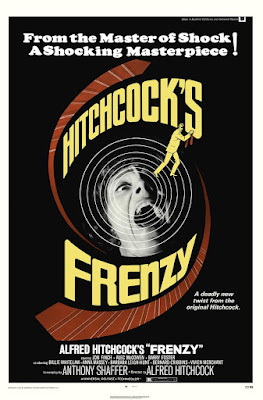
Frenzy (1972)


Director: Alfred Hitchcock

Screenplay: Anthony Shaffer

Based on Goodbye Piccadilly, Farewell Leicester Square by Arthur La Bern

Cast: Jon Finch as Richard Blaney, Alec McCowen as Chief Inspector Timothy Oxford, Barry Foster as Bob Rusk, Billie Whitelaw as Hetty Porter, Anna Massey as Babs Milligan, Barbara Leigh-Hunt as Brenda Blaney, Bernard Cribbins as Felix Forsythe, Vivien Merchant as Mrs. Oxford, Michael Bates as Sergeant Spearman, Jean Marsh as Monica Barling, Clive Swift as Johnny Porter, Madge Ryan as Mrs Davison, Elsie Randolph as Gladys, John Boxer as Sir George

Canon Fodder


One of the last Alfred Hitchcock films, Frenzy stood out in his career with its impact making sense in context. By the seventies, Hitchcock had not made that many films since 1964 next to his prolific golden period from 1950 onwards, having struggled with his attempt to be an independent producer of his own work in the late forties and failing. His golden era, which gave us films like The Trouble with Harry (1955) to Psycho (1960), and did not have producer David O. Selznick involved as his forties career, for good and for bad, ended in the mid-sixties with him considered a huge unreliability. Hitchcock is a controversial figure for how he depicts women, his obsession with the "Hitchcock Blonde", and for me, it is everything with actress Tippi Hedren where I agree is the uncomfortable moment where he crossed a line. I cannot defend what happened with how he treated her on both films they worked on, but it also clearly crossed a line to even alienate those close to him and studio executives at Universal. The first film, The Birds (1963), was a box office success, if one which would have got him cancelled for the story of what happened with Hedren on set, but Marnie (1964) was not, and was the straw which broke the camel's back.

Frenzy's genesis likely comes from a project Universal confiscated from him, Kaleidoscope, a proto-Frenzy which was meant to be very explicit, sexually and in terms of violence, influenced by the like of Blow Out (1966) by Michelangelo Antonioni, to be shot with handheld cameras, natural light and location shooting. Personally the films which we did get after Marnie have their virtues if their problems are felt in their sluggish paces and having his creative power pulled from - Torn Curtain (1966), as Hitchcock has to put up with Paul Newman, as someone who hated the method acting style, has this issue as does Topaz (1969) - but Frenzy feels alive and still disturbing decades later. As a lower budget film shot in his homeland, as someone who was an old man by that point, he nonetheless got carte blanche to make a film which does not feel antiquated and with a sick humoured tone. Frenzy is the most explicit and adult film in his career, but this tale of a serial "neck tie murderer" killing women in London, despite it being lurid subject matter explicitly invoking rape and strangulation of these victims, is more startling because of its sense of humour contrasting this premise. When members of the police trying to deal with the case in a pub talk of the psychology of said killer, only to say having a sex murderer is good for English tourism, it emphasises the gleeful misanthropy felt fully throughout this film.


This will make some very uncomfortable for Frenzy, but in context, what has aged is ye old seventies London, and that feels like a time capsule to what locations we still have, starting with the opening by London Bridge and the Thames, only to undercut them with from the get-go with a public gathering interrupted by a female corpse floating in the river. The set up is the traditional Hitchcock wrong man scenario, in which the obvious red herring is Richard Blaney (Jon Finch), a former lieutenant of the air force reduced to a bar man fired for drinking on the job and forced to sleep at a Salvation Army hall when he has no money. It is very obvious and not hidden who the killer is, his friend and market fruit & vegetables seller Bob Rusk (Barry Foster), with the reveal a disturbing one which places Richard as a suspect, as it involves the murder of his ex-wife. To the film's credit, and why it's more salacious and sick humoured aspects work rather than feel inappropriate, is that when it is about the awfulness of these murders of women, they are meant to lead to revulsion, whilst the humour is felt in terms of how, as throughout Hitchcock's career, he has an obsession with this twisted side of the human consciousness, its obsession with crime and murder, where the humour is the relieving puncture of the tension.

The parallel plot is Chief Inspector Timothy Oxford (Alec McCowen) who is investigating the murders, and this is where the humour especially comes in, that his wife is also into cuisine cooking. It is surprising in context to how explicit and grim the film is, the sole one to be fully able to in Alfred Hitchcock's career than imply such themes, and yet this is one of the most distinct parts of this entire film, funnier when you are aware of his and wife (and important collaborator) Alma Hitchcock's love for cooking and cuisine, thus presenting us with dishes of a solitary quail on a plate with a few measly grapes, or a soup full of fishes heads, when all Oxford wants is an English breakfast. There is still the style of older Hitchcock films here too, which was only briefly seen in both Torn Curtain and Topaz, the flashes of his deft hands when a tragic death of a main character is perfectly depicted with the camera in one take leaving the environment back out onto the street, without needing to show us what we know is going to happen. There is also the set piece with a truck full of Lincolnshire tates (potatoes) which mines tension against the sick humour from the act of disposing a corpse, including rigor mortis and a neck tie pin that needs to be retrieved, all despite the figure involved being a complete monster now in peril. You should not be laughing either yet the farcical nature of such a gristly scenario is felt to ease the tensions.

What is also felt particularly that here too, despite the character of Oxford who happens to be the one person, including the wisdom of his wife, to think, is Hitchcock's long standing paranoia and distrust of the police and the law, especially when people are quick to put the kicks in Richard as witnesses, like the male bar manager who fired him. Throughout Hitchcock's career, including adapting a real life case of a man put to trial as an innocent The Wrong Man (1956), ever since he was put in a jail cell as a child which created his long standing fear of authority, Hitchcock has always shown the frailty of the system. Even the murderers in his career do their acts for petty grievances, or here have compulsive sexual dominance obsessions but look like nice blokes who sincerely love their mothers, and that is probably the most misanthropic aspect of Frenzy as well as Hitchcock's career. Barring his forties work where he decided to fight real fascists by pitting his characters against reel ones, his work as always had this, and whilst the adult content here is strong, the more potent aspects are the gullibility of law and the matter-of-factness of such disturbing crimes taking place in a world where you could still smoke in pubs. The air of downbeat grungy London, like a lot of more lurid genre films from this era, makes its way here too, adding to the macabre nature, emphasising all these traits and adding to the atmosphere, and whilst I would argue his final film Family Plot (1976) is deeply underrated, I see why Frenzy is a late era Alfred Hitchcock film that is held in high regard for good reason.


Tuesday, 8 October 2024

The Bloody Exorcism of Coffin Joe (1974)


Director: José Mojica Marins

Screenplay: José Mojica Marins, Adriano Stuart and Rubens Francisco Luchetti

Cast: José Mojica Marins as himself/Coffin Joe, Alcione Mazzeo as Luciana, Ariane Arantes as Wilma, Geórgia Gomide as Lúcia, Joffre Soares as Júlio, Marcelo Picchi as Carlos, Marisol Marins as Betinha, Walter Stuart as Álvaro, Wanda Kosmo as Malvina

A Night of a Thousand Horror (Movies)


José Mojica Marins and his creation Coffin Joe, who came to be in cinema with At Midnight I'll Take Your Soul (1964), has been appreciated and preserved, both when Marins was still with us and after his 2020 passing. We are still missing one or two films however in his filmography, and one of the most prominent absentees is The Bloody Exorcism of Coffin Joe, which you would naturally presume would be a part of the Coffin Joe catalogue with all the others as, even if appearing in the end only, that character is central to its biggest selling point. If you are a fan of this character, then the set up for this is a tantalising one of Marins and Coffin Joe crossing paths. Marins as himself is first shown directing on a film set a home invasion going amiss for the robbers when they did not expect the young couple their targeted to become elderly ghouls, and calmly taking an interview in a nice green jumper and with even his trademark long fingers nails on display. This is his other film metatextuality poking at his legendary creation, if a pulpier crossover between creator and creation, less dealing with the character in the real world but imagining himself being terrorised by his own creation.

The first film which tackled this, Awakening of the Beast (1970), was a really metatextual production because Marins was tackling the growing notoriety around the Coffin Joe character in terms of backlash. That film is arguably more difficult to appreciate if you have not seen another film of his, as it is a commentary on the controversy over his morbid character and the success he was having in popular culture in Brazil. However, especially when it turns into a full colour wig-out with buttock faced creatures in Hell, it became more readily available outside his homeland and paradoxically a more sellable film for how bizarre it is even with context. Bloody Exorcism does get to the risqué content by the time of the Satanist cult torturing people in Hell in the final act, but this is a straightforward genre film. A lashing of haunted house/witch's curse premise is fleshed into this, all in setting up the meeting between Marins as himself and Coffin Joe as the ultimate antagonist against his own creation. There is moments where he gets to portray himself as a very intelligent man, who gets to comment with other characters about his beliefs on how horror works and is liked as it is, but he himself is not going to dissect his evil creation as a construction as Awakening of the Beast did, but have Coffin Joe scaring him instead.


José Mojica Marins is the director-creator going to an island where a friend lives with his family, all with the intention to plan his next script only to become embroiled with an evil aura terrorising the family. To his credit, the opening has an appropriately sombre opening of him travelling to the location by boat, set to haunting chanting in the score. This is also set at Christmas, with adds an amusing touch as things will start to turn amiss as soon as he gets there. First it seems merely mischievous, like a chair moving by its own will, then starts to become more an issue when the grandfather becomes the first person to get possessed, and it is established everything is (literally) going to Hell. It is cool to see Marins, whose films have been as much sold for their transgressive and blasphemous content over the years play with more traditional horror tropes. As much of the reason that he became as controversial as he was as a horror creator was that Coffin Joe the character is an atheist who thumbed his nose at religion and morality, and believed in finding the perfect women to breed the perfect offspring by any means necessary, even murder. This has Coffin Joe as a literal evil near the end that our protagonist, and has the director/co-writer take a shot for the first half of Bloody Exorcism at the classic horror tropes of haunted houses and curses, where even a toy piano being played by itself is ominous as is Marins himself being assaulted by flying books. Not even the Christmas tree is safe from snakes briefly materialising from it.

Though that side will appear later on, it may disappoint some expecting him to have the extremes that made him a controversial figure at this time do not really appear as prominently here, where there is the cute moppet daughter and Marins' film is entirely on the side on the good nuclear family, but it is interesting to see him go through this plot thread. Connected to an angry witch terrorising the family who he has wandered into the drama of, all because the wife requested her help to be able to conceive a daughter on condition the witch choose who she would marry as an adult, each member of the family becomes possessed, and sadly even the family dog is not safe, all whilst Jose is trying to rationalise the scenario. I wonder if The Exorcist (1973) came to influence this or not, or even got to Brazil at that specific time to even be able to do so, its slower pace and gleefully eerie tone suggesting this as initially a "safer" if still fun Marins film. The score certainly helps, and eventually the tone shifts into more extreme content.

By that point, there is nude possession with inappropriate self use of a poker and Marins in a lovely pink suit being a bystander to the horrors he the director would shot throughout his career. As he finds himself in Hell with demonic worships and Coffin Joe leading them, it leads to his trope as a filmmaker of hiring extras of both genders, in general state of undress, with ghoulish carnival haunted house gore effects like a man having his tongue cut out taking place. In what could be best described as theatrical performance hellscape scenes, if you have seen other films of his, like Awakening of the Beast, and how he let these moments stretch out for their ghoulishness for minutes, this is the same thing here to escalate the film closer to his other work from the time. The crossover between character and creators is not as complex as Wes Craven's New Nightmare (1994), where Wes Craven revisited Freddy Krueger as an entity terrorising the people who made his films, but here you at least have Marins forced to confront his creation. Bemused as a terrified bystander who only intervenes when a child is threatened, this is an example a good few decades earlier, involves the creator in actual debate with the figure he said he created directly. It also emphasises the idiosyncratic, even schism-like, knife-edge too in his work, between revealing in the anti-religious horror but also making sure it always win, which is prevalent even in mind to a politically tumultuous time in Brazil when these films were being made. Like Jose's friend being a Catholic who yet is studying parapsychology without any more issues, his cinema is curious in terms of faith and anti-faith, where he can make Coffin Joe almost a true anti-hero, even if he had to always lose, but also made a film like The End of Man (1970), a film which has Joe's total opposite, a virtuous man of miraculous gifts, even if with satirical edges mocking the world socially and politically around this character. José Mojica Marins certainly hated organised complacency in general, and if there is a sense this films seems a more safer film, it is and is probably one of the reasons it could be seen as a weaker film from the director, as it feels like a pure horror story without an edge to it even with the nastier content coming into it by the end.  He can prod at organised religion in the earlier films, and be more gruesome in Embodiment of Evil (2008) when he would be allowed to get away with it, but still create the kind of film here which have a happy ending to keep the audience happy or a twisted morality play for others, censorship or not. Certainly, as this review started with, it is strange this film is seemingly lost among those available beyond his homeland, especially as it is still a fun production among them.


Saturday, 5 October 2024

Beasts (1976)


Directors: Don Taylor, Richard Bramall, Don Leaver, Donald McWhinnie and John Nelson-Burton

Screenplay: Nigel Kneale

A Night of a Thousand Horror (Shows)


Nigel Kneale is famous for the character of Bernard Quatermass, created for the sadly lost BBC TV production The Quatermass Experiment (1953), which only has the first episode still in existence. Thankfully, the two other TV productions have survived intact, as do the three Hammer adaptations of all three stories for cinema, and the 1979 Quatermass, a TV series closing off the character. Kneale worked on other projects too, and this one was originally for Associated Television (ATV), part of the Independent Television (ITV) network before ITV became the British channel it is in the current day. To avoid confusion, as I am too young to have grown up in this era when Beasts was first broadcast, ITV was for decades since its creation in 1955, the first commercial TV station in Britain, actually a network of separate television companies who shared programming as well as created television for different regions. Nowadays, barring Scotland and Northern Ireland having their own distinct regional differences, and programming like the news being focused on different regions, ITV has mostly conglomerated all its networks in itself and is divided by having additional numbered channels. Whilst ATV, who provided a service to the Midlands all week from 1968 to 1982, is no longer with us, Beasts lingered and developed a high reputation as a British horror television series, enticing the likes of myself to witness its six macabre tales as a one-off.

The programming of the episodes varies per version, but going from the DVD version that was used for this review, Baby opens the series, about an expecting young woman moving to a country cottage. Alarm bells should be heard when the cat is mewing like mad and runs away from the premises, not the last time an animal is not stupid enough to stay where danger is. The husband, who hated being a vet in the city, is headstrong and patronises her, the idea of her pregnancy affecting her emotions a gendered bias that she suffers through here, as he is impassioned by working with cattle now and in the countryside. When, in one of the walls they demolished, they find a strange desecrated corpse of an animal in a jar which is unlike anything either has seen, he thinks it is a fascinating item to show to his senior college than a warning of such a creepy entity even being in that wall in the first place. Kneale is known for nodding to folklore, such as how the most famous Quatermass story in either TV or Hammer film adaptation, Quatermass and the Pit, links old superstitions to aliens found under a London subway construction. In Baby, the female lead hears from the locals that the fields around her new home were notorious for something which caused cows to abort and chased people off using the area, with the suggestion the strange sheep-monkey creature in the jar as a supernatural tool for hexing people. All six episodes are TV production chamber pieces, having to work around not having elaborate special effects, and here, it is a psychological tale where the emphasis is on implicit fears barring the final practical effect. The lead being patronised as a pregnant woman is explicit as a theme, leading her to be isolated when an overtly supernatural end that explains the jar creature is fully formed.

Buddy-Boy for episode two is the more idiosyncratic tale, a weird tale that takes full advantage of the lack of practical effects and carefully chosen locations this story had used. This is about dolphins in the past tense, specifically the titular one of an old attraction long gone and now with the building being considered being bought by the new owners, who are running a club cinema to show porn. This reveals a surprise in its own as, whilst this series is not that violent and little cursing, this episode jars from the rest for how adult it is to the other five, in terms of the presentation of its story, but also scenes in an adult cinema with the decor not censored and even brief female nudity. It is not a detraction to bring this up, but instead as much part of the episode's distinct makeup, Buddy-Boy the most esoteric of the series but also the one dealing with some pretty heavy themes alongside these brief moments of edginess which do not feel tacked on. Dave (Martin Shaw), the one potential buyer who wants to keep a respectable business even with erotica, whilst his partner is even supposedly weighing the breasts of women he wants to get into porn films, is suspicious of how the owner of the building Hubbard (Wolfe Morris) is driven to drink and triggered by talk of Buddy-Boy. Buddy Boy was the rare American dolphin Hubbard acquired who started to rebel followed by the others starting to die when he did, not from disease or malnutrition but as if following him in rebellion.

When Dave encounters a woman strangely obsessed with Buddy-Boy and squatting secretly in the building, it is clear in his interactions with her and Hubbard to Dave that Hubbard "punished" Buddy-Boy and is haunted by him, wanting to get rid of the place ASAP. With a growing interest in the woman for her child-like love for Buddy-Boy, it is revealed he is using her to get Hubbard to sell the building to him cheaply, but Dave is becoming obsessed with what exactly happened to Buddy-Boy, initially for any dodgy dealings in Hubbard's past but finding himself dragged into this strange psychodrama. Most of the story is entirely a drama, barring the touch that in the building where Buddy-Boy died, disembodied dolphin sounds are heard and they are not inside just the woman's head as Dave hears them too. Including its bleak ending, where her mind is entirely for Buddy-Boy even when Dave tries to love her as a romantic figure, Buddy-Boy is the oddest episode and the one which is going to divide viewers. For me, it is one of the better episodes because of this.


A great episode immediately arriving afterwards, The Dummy is set on a horror film production, a period chillier about a giant bog-pig monster. A follow up to a series of Dummy films that has not had a sequel in a long while, a female film journalist writing of the production arrives when the actor in the suit, Clyde (Bernard Horsfall) is struggling emotionally - his wife has run off with the actor in a smaller role, and taken their daughter too, during Clyde's out-of-work period. The director was unaware of their bad blood, and the production is falling off the rails as this is revealed, forcing the producer, Clive Swift, to be called in. A stalemate transpires - the other actor refuses to leave his small role, but the costume was designed for only Clyde - and it is when the journalist gives the producer the idea, when talking of Clyde imbuing the Dummy costume with his personality like a ritualistic mask, to get Clyde drunk and riff on this idea. It proves too effective, and Clyde as the Dummy beast murders an extra in a scene and goes mad, continuing on with an episode that is really good.

In general, the series after its first episode, which is just a nice start, is consistently strong as with episode four, Special Offer, in which we follow a meek female employee of a supermarket, hassled by her male superior. Unfortunately compared to the other young female employee, who he is clearly having a relationship with, this is Carrie-adjacent though explicitly linked to the concept of poltergeists tapping into the emotional energy of people, as this meek younger woman dismissed as ugly and dumb by her colleagues, Noreen (Pauline Quirke), is effecting the strange circumstances happening the store, like cans of food rolling by their own will, or eventually actually destruction of the produce. What she calls after the mascot of the store's own brand, and possibly seen as a rat infestation at first, becomes far more unnatural as this progresses, with her bullying lead wanting to initially fire her, stoking the flames. When her emotional state is told to him by his senior, who has to accept the unnatural as part of the issues as a regular crisis in a store as matter-of-fact, to be effected by her crush on him, this puts him and his wandering eye against the mill stone.

Episode five, What Big Eyes, has the added star power of Patrick Magee, a North Irish actor many will likely know for his small but iconic role in A Clockwork Orange (1971), or in a variety of other places from Joseph Losey's The Servant (1963), to even a Lucio Fulci horror film partially shot in England, The Black Cat (1981). Inspector Curry (Michael Kitchen) is a new RSCPA officer, the real life group using those initials to represent the Royal Society for the Prevention of Cruelty to Animals, and is eventually brought into Magee's experiments after the set up. Adamant to protect animals, Curry even ends up reading the records of an animal merchant he feels is suspicious, only to be surprised when Hungarian and Romania timber wolves are being sent to a tiny pet shop in town. He suggests to the pet shop owner herself, McGee's daughter, his suspicion someone is using their store name as a front for illegal animal smuggling but she, living absolutely devoted to her father without ever having her own life and being mocked by him, is complicit to his experiments which used the wolves. Magee is dubbed by Curry's senior officer as a crackpot scientist who believed Darwin got it wrong about evolution, and between being a specialist in lycanthropy and the title's Red Riding Hood reference, with his creation a "Grandma vaccine", it is clear what the episode is hinting at. The episode's decision to be very subjective of how this vaccine works, as Magee is using it on himself, becomes one of the best strengths of a strong episode.

Episode six, During Barty's Party, ends this series on a perfectly gruesome note, in which an older couple slowly grow paranoid in their house at night. The opening sets up that another couple, who were necking in the fields, are being attacked by some unknown form off-screen which the central female lead initially thinks is from a dream. The husband initially dismisses this as all her nerves, his pride felt when a rat is found under the floorboards of their home and refusing to be swallowed even when the situation becomes direr. However, as the radio tells them, there is supposedly a rat migration transpiring in the thousands on the march. Barty of the title is the unseen host of the radio show that plays through the story. Whilst there is one use of the word "retarded" which has not aged well, he is not dissimilar to modern hosts with their wisecracks and playfully goofy, which adds a nicely grim edge as, in-between a real pop song they licensed and the fake ads, he initially dismisses the rat migrations as more rats are heard under the central couples' floors. The additional touch, relevant to the time period but still disturbing, is a take on how species naturally adapt to resist poisons, only in this case the wife theorising the rats may have also developed a consciousness awareness of the humans who created the poisons and desired revenge. Without spoiling this episode, it is a macabre end to an insanely good anthology series. It comes with the knowledge that, just in the seventies alone when this one-off series came out, Kneale was also writing the likes of The Stone Tape (1972), so this was part of a decades' long strong career from that point between the fifties to the eighties, one where this would be a grand piece for any writers' career in television and film, but one of many that cemented his reputation.  


Monday, 26 August 2024

Axe (1974)


aka. Lisa, Lisa or California Axe Massacre

Director: Frederick R. Friedel

Screenplay: Frederick R. Friedel

Cast: Leslie Lee as Lisa; Jack Canon as Steele; Ray Green as Lomax; Frederick R. Friedel as Billy; Douglas Powers as the Grandfather

A Night of a Thousand Horror (Movies)


It is incredibly obvious why, when I first saw Axe, I could not appreciate this film as it was and once viewed it as one of the worst I had seen. As someone who grew up in Britain, naturally the Video Nasties was a concept I had learnt of as a teenager and gained a fascination for early on. Thankfully, this was also in the 2000s and the DVD era, when I was able to start watching these types of films and you could actually see them. One of the official members of the list, and among those which were actually prosecuted, I expected balls to the walls luridness, only to get this slow burn tale about a young woman named Lisa (Leslie Lee), living with her disabled grandfather in the middle of nowhere, terrorised by a gang of three member. It was a film I once found even at 66 minutes slow and dull to a painful extreme. Nowadays, I rightly see many of its virtues, the Video Nasties list a curious and at times motley crew of titles defining a lot of fascinating areas of genre cinema at the time, such as the Golden era of Italian genre cinema to this, among the regional American titles which flourished between the sixties and eighties.

With its more infamous title the one I prefer - it is snappy, yet fits the tone as well as befits the southern Gothic vibes the production has - it is interesting as a film not quite in the horror genre but in many at once. It begins as a crime drama, following a group of criminals - one the ruthless and cold leader, the second the sadist, and the last played by the director-writer himself as the one with morals, becoming more uncomfortable with that his colleagues are capable of. They are the kind of men, the two with a desire to harm, to put a cigar out in a man's mouth and dismiss accidentally killing him in his room whilst he was with his boyfriend. Even on the run, they terrorise a woman working by herself in a small store, tormenting her and even playing William Tell with a gun. Beyond this, due to the length of the film, and its succinct plot, there is not a lot to add to the premise, barring that it becomes obvious Lisa herself has mental health issues, with hallucinations and even contemplating suicide at one point, living by herself on a farm with a paralysed grandfather with only the chickens she tends to (and kill for food) there for her. She also, defying what they expect of her as a merely casual figure they can manipulate, someone more than capable with intelligence to get rid of their threat out of the house.

This is what one would think of a small regional production, made with a low budget, if you wished to have an example of this era of regional genre cinema, and with a premise which you could easily adapt into a short story or a radio drama. That is to its advantage as that does not mean the film has no personality. I could not help but think of a film which tried to recreate this era of seventies genre cinema but felt lacking for me personally. Ti West's X (2022), which attempted to be a seventies throwback by being set in the time period, in which a porn shoot at a farm ends up with the elderly owners finding out and starting to get violent, spring to mind and a lot of the reason why I felt it did not work was that it felt more like a horror film in terms of a series of shocks and gore moments than what Axe is, a drama which just happens to live in the skin of a horror film. A lot of modern horror films feel, for me, more inclined to a well worn series of sudden shocks rather than nestling in its mood, even if the point as with Axe originally, it felt like it dragged significantly with its dialogue scenes and lack of constant pervading threat in scenes until things escalate.

It does become horrifying, whilst in a way which makes the British prosecutors who viewed it as potentially harmful to British society ridiculous. Whilst not seeing many films like this would naturally cause one to feel shock for how intense this eventually gets, the Southern Gothic reference I made befits. Barring some extensive use of fake bright red gore, the gruesomeness is standard in horror films even from the Hammer horror films eventually when they had to catch up with their competition, or it is implied in an appropriately horrifying way. Blood on a pure white kitchen sink, which comes from a decapitated chicken, and the implicit idea of axe dismemberment, than explicitly show a fake mannequin being chopped up as Herschell Gordon Lewis would have in the sixties, is how Frederick R. Friedel depicts the violence. The most gore image onscreen is a simple prosthetic on the back of an actor's neck and a lot of fake gore, so it comes really apparent the notoriety this got on the Video Nasty list is a mass paranoia of what it suggests, evoking images of more gruesome dismemberment onscreen (like a few of the films which did get on the list) when it is merely perceived. There is even an ominous use of Campbell Tomato Soup which, whilst absurd out of context, fits for the scene in its shock.

The use of a tool which can be found in any D.I.Y. store was also clearly an additional fear at the time for being possible to have as a weapon in reality, not able to be separated from said reality. The idea of this being the film which got the name "Axe", like The Texas Chain Saw Massacre franchise getting chainsaws and fellow Video Nasty The Driller Killer (1979) for drills, befits as here, the axe feels like something, in a true crime tale spun out in stories in the modern day, as here someone would end up using if not to murder someone but to at least dispose of the body, the gruesomeness felt with a weapon you have in the shed as a viewer, which could happen with greater ease in real life and not just in a movie. Additionally, the film has an ill-ease provided by its droning electronic score, composed between George Newman Shaw and John Willhelm, which helped emphasised a woozy atmosphere which helped the film immensely. Axe among some notorious films in the Video Nasty collection was one of the quieter members, befittingly like its lead Lisa in that the film seems out of place among the unruly and more controversial of that list like the cannibal films, but it has its own strength which has to be admired, alongside the knowledge this was really a project made by Frederick R. Friedel where he wanted to make a film even if from his own resources.

Monday, 15 July 2024

The Lion Has Seven Heads (1970)


Director: Glauber Rocha

Screenplay: Glauber Rocha and Gianni Amico

Cast: Rada Rassimov as Marlene, Giulio Brogi as Pablo, Gabriele Tinti as the American Agent, Jean-Pierre Léaud as the Preacher, Reinhard Kolldehoff as the Governor, Aldo Bixio as the Mercenary

Canon Fodder


Shot in the Congo during a turbulent history, liberated in 1960 from Belgium, and in 1971 about to enter a dictatorship, renamed Zaire, until 1997, Lion has enough material to deal with the issues of colonialism and abused power. I will admit I was disappointed, as someone who saw Glauber Rocha's acclaimed trilogy of films in his home country of Brazil which blew me away at a younger age - Black God, White Devil (1964), Entranced Earth (1967) and Antonio das Mortes (1969). I still have admiration for a deeply flawed experiment with a noble heart, but it is flawed. Lion, originally called Der Leone Have Sept Cabeças, with the title an amalgamation of languages, is a director whose country was going through a dictatorship at the time, going to an African country which suffered through colonialism from the West, and visibly seeing the parallels from two different Third World nations of the turbulence of power and control.

This is a stream of consciousness from Rocha, which feels appropriate as, with the Republic of Congo formally a colonial country, you can dissect all the history with greater ease than trying to use a regular story framework. Though the emphasis on non-local foreign actors poses one of the biggest issues with Lion, it certainly feels apt to begin with Jean-Pierre Léaud as a mad priest, first introduced in a shredded and dirtied white robe, losing his mind with a wooden mallet in hand and talking of the whore of Babylon from the Book of Revelations to a befuddled group of local women. Alongside imaging how fascinating his career has been, able to go from this to Jacque Rivette's Out 1 (1971) just from a couple of films in a rich decades long career, Léaud is the one figure I would have kept even if I would entire rewrite the film's structure. As the literal import of Christianity to the country and continent, he is both captivating in how he commits to the role but apt, alongside cynically being a bankable actor for a very avant-garde film, appropriate as a character to have, dealing with those who joined the colonisation of Africa as a whole continent under the belief of noble causes, only to be left deranged by the truth. There is a lot you could unpack if playing to a series of sketches as this at times, and in mind to all the themes to unpack, it feels apt to see such sketches and the liberation of this fictionalised version of Congo as a sudden cloud burst of emotions.

Rocha stages the film like series of theatrically performed images and emphasises this point - the anti-colonial protestors carrying their own that have been slain, to the white soldiers wandering to-and-fro in choreograph in a scene with guns. This is clearly inspired by Jean-Luc Godard as well, with the Dziga-Vertov Group era felt here the most, all part of movements who found narrative a way to lie and not able to carry themes of great political weight to viewers, a symbolic essay form used within them even if this one still retains plot beats to thread them. Ironically, this style is far more difficult than stories, or even surrealist subversions of narratives which still flesh out the depth of characters and/or the scenarios.  


One of the biggest issues, which Godard's Dziga-Vertov films had, were how naive and simplistic they came off being without the sense the simplicity being on purpose. With Lion set around a revolution, its leader trying to amass locals and tribes to free themselves, alongside the evil white colonialists, none of the film does not try for the complicated and difficult issues of a revolution. Central to this is instead the comically broad villains who without moustaches to twirl instead of just maniacal. They, as I will get into, still work for me as pure evil, whilst a lot of the bigger concerns is the lack of priority in the figures meant to overthrow them, including the wife of one of them Marlene (Rada Rassimov), who is there to have Rassimov be nude for large portions of the film as the whore of Babylon stand-in. There is also the Latin Revolutionary, in capitals for emphasis, which raises the issues with Lion being set in Congo but not really telling the tale of its people, as this figure becomes integral for multiple scenes, including Léaud dragging him around with the mallet, when they should have been given to other characters.

As this is directly telling you what the meaning is, you really get a very simplistic work at heart, the earnestness of Glauber Rocha accidentally using his setting as a mere pretence for a film which could have been shot anywhere. Slithers do work, and open up the idea if this had focused on the local casting, as Rocha is not a fan of peaceful revolution, a jaded man in terms of where his country of birth originally was. The closest thing to peaceful here involves making a puppet first president, which becomes one of the strongest sequences. Though he has a wonderful saxophone trio with him for speeches, this black local presidential figure is tellingly depicted having bought a new suit like an 18th century French dandy, including the white wig, as a satirical nod to the idea that anyone can be bought by the colonial invaders. The revolutionary, the local leader and not the Latin exile, has some of the more interesting filmed theatre scenes, and should have been the central focus of the whole film and scenes which are instead given to the Latin figure. Be it being circled by dissenters, or his speech to a local chief explaining his string of miseries being unfair and unnecessary, and you see here what Rocha could get into, an equivalent to the raw energy Antonio das Mortes beautifully hit in using Western tropes, but here using more theatrical avant-garde pacing instead for a change of pace. This could have been the more experimental take on revolution, but the character who should have been the hero is a minor figure in his own film, which causes immediate issues.

What this accidentally becomes is Rocha the tourist, and whilst it does involve the least expected nude crucifixion transpiring in the final scene, I think the best moments of The Lion Has Seven Heads reflect its comically evil white colonialists for what they represent, mining all the resources and eating fruit off a dead local, contrasted against the actual country and citizens. Contrasting these broad, ridiculous monsters with their over-the-top acting and exaggerations from the Western nations against the real people of the country the film was shot in, seeing the real scenes of the local tribal dance rituals, and the local women looking on in amusement at Jean-Pierre Léaud screaming at the sky performance, is some of the more striking images. They show the figures that should have been central but were marginalized, whose scenes are all serious and thoughtful in contrast to the manic lunacy of the non-Congo figures that would have made a perfect contrast. I am glad to still see Lion, and as time goes on, I hope to grow a fondness for its virtues to admire here, but it is with having to accept this felt like a production compromised by how it was put together.


Thursday, 11 July 2024

Schizo (1976)/The Comeback (1978)


Director: Pete Walker

Screenplay: David McGillivray [Schizo] / Michael Sloan and Murray Smith [The Comeback]

Cast:

Schizo: Lynne Frederick as Samantha Gray, John Leyton as Alan Falconer, Stephanie Beacham as Beth, John Fraser as Leonard Hawthorne, Jack Watson as William Haskin, Queenie Watts as Mrs Wallace, Trisha Mortimer as Joy, Paul Alexander as Peter McAllister

The Comeback: Jack Jones as Nick Cooper, Pamela Stephenson as Linda Everett, David Doyle as Webster Jones, Bill Owen as Albert B., Sheila Keith as Doris B., Richard Johnson as Macauley, Patrick Brock as Dr. Paulsen, Holly Palance as Gail Cooper

A Night of a Thousand Horror (Movies)


Never mind symbolic sunshine...it was fucking here!

Immediately from the opening images, Schizo will not be a sensitive take on mental health, not just by the title but even in the opening narration, where even I without a psychology degree am aware schizophrenia and multiple personality disorders are separate concepts. It sets up a lurid thriller bordering on the horror genre, a snapshot not only of this era and how mental illness was depicted in cinema, but a snapshot of old England including the old Co-Op logo on a milk delivery float, or a supermarket with discounted baked beans. It sets up a distinct tone to this premise even if it is indebted to its American or Italian brethren, as we start with an older man incensed about a newspaper about a young "ice princess", ice skater Samantha Gray (Lynne Frederick), about to marry, taking a knife the size of a machete covered in dried blood and bloody pieces of broken glass in his travel case on a mission, to see her in London. One of the clear selling points behind Schizo, central to this, is Lynne Frederick herself. Her career has probably been shadowed by Peter Sellers, the legendary comedian she was married to until his 1980 death, and his own complicated career, whilst her filmography is full of cult films like this or Phase IV (1974).

She does okay in what is a film where the plot twists are obvious, but the lurid spectacle is emphasised, as this is from Pete Walker, a British filmmaker known for being one of the genre filmmakers of the era who made more edgier productions, infamous for films like House of Whipcord (1974) and Frightmare (1974), films which ramped up the gore and sexual content of old pulp genre tropes. He is merely adding to a story which is timeless, as premise wise this story is one you would have gotten in a thirties/forties production from Hollywood or an earlier British shocker. This belongs in the tradition of gristly thrillers which has been updated to the newer decades even if the seventies aesthetic here is charmingly quaint. The film leans into horror genre in terms of the more overt gruesomeness of the murders which begin as Samantha is being stalked, arguably in debt to the Italian giallo, even in terms of the black gloved killer. A subplot about the maid's psychic sessions with her daughter being telepathic feels like a British take on a scene from Deep Red (1975), where a psychic catches wind of the killer telepathically. Admittedly, Dario Argento would have not had a moment talking about the free tea and biscuits for four pence as found in this meeting.

Even when Samantha is stalked, it is obvious what the final twist is, its mental health plot set up with the factors of her family ties being very vague with no one at her wedding reception on her side of the family tree, or how the stalker is set up blatantly from the get-go as a prominent character. Instead, this becomes the tropes shot through its British personality, an intercontinental exchange of plot tropes found in similar films from others countries at the time if with pithier one-liners from characters. Some of the more rewarding scenes are with characters casually having extra marital affairs and even leaving plastic spiders in the soap dish to scare the newlyweds for a joke. The laxness of security for the wedding reception, comical in the modern day for a thriller as someone can casually get away with slipping a bloodied knife by the wedding cake, actually becomes one of the best scenes for casually touching on this sense of personality you only get in British films, less logical but in terms of morbid humour nestled against the ordinary locales. By the time someone can manage surviving being impaled on a bed of spikes, to the point an eyeball is hanging out from a spike going into the head, we are not dealing with a film to take seriously, but charming in its own perverse way as a film from my home country.

The Comeback opens up, coming after Schizo, with a nods to the slasher films whose tropes would be fully codified into the eighties, with a murder scene in the opening that certainly would have been censored for British VHS with a hand graphically lopped off with a scythe, followed by that person's death with the weapon by someone wearing an old woman costume. The film itself, whilst the plot is conventional in set up, is a lot more idiosyncratic than this though. The premise is that of an older American pop star, a former teen idol Nick Cooper (Jack Jones), returning to Britain to record his comeback album, and finding himself staying at a traditional British manor house whilst he is recording the album. Jack Jones himself is an American singer, which is a meta moment of casting I do have to appreciate especially as, befitting how lurid the story becomes, his casting is perverse on purpose for sick humour if you learn a little about him. Jack Jones sang songs like Lollipops and Roses, and the opening theme for the Love Boat American TV series, which makes his casting here, eventually dropping f-bombs and having a sex scene, adding a much more perverse touch to the film knowing that this man with a two time Grammy winner of wholesome music. This was naturally at a time in his recording career where he was doing renditions Little Feat's Dixie Chicken, and a tribute album to the band Bread, so this feels close to the bone of a man who could be like the Nick Cooper character as a star trying for one last grab at success after his sixties pop success.

The grotesqueness of the ex-wife's corpse being left in the old crib after the murder feels apt to the perverse melodrama this turns into, with not as constant need for such shocks as a giallo or a slasher, but with those moments coming when need be. Pete Walker clearly also had access to all the live maggots he could get to depict decay of gruesome corpses just to emphasise that fact. At its heart, this is the updated form of the gothic creepers of yore, where an older singer is effectively being tormented psychologically. It is not just creepy Harry (Peter Turner) who sets the tone, a minor character obsessed with getting Nick's items out of the penthouse, or women's breasts, which he will talk about at length menacingly to a potential love interest of Nick's, a man who makes woollen hats creepy due to osmosis to his personality. No, it is the gothic horror trope of the voices and horrible sights only Nick sees whilst at the manor, the crying and screams from a phantom woman at night, or the current occupants looking after him, "Missus B" (Sheila Keith), an older woman with ominous gravitas to her voice, or her husband who talks of the ancient tree in the garden he tends to screaming due to the carving of a couple's love for each other into the bark, or reading a book on Chinese mythology and Buddhist Hell because he cannot find his tree surgery book.

The plot twist is obvious in hindsight in The Comeback too, but this is a delightfully weird amalgamation of tones. This is a film where the potent red flag of this film having aged like one of the corpses, when a key character is revealed to dress as a woman in the privacy of his own home, is not a red herring even or proof of anything suspicious, but a character beat abruptly placed in the middle of this simple minded shocker of more going on in his mind, the weird sense this genre film with a few more of these turns could have become something even cooler if it had been more unconventional. Both The Comeback and Schizo are conventional, in pace and plotting, which are really the biggest issues with both, but like the best of cases, even weaker genre films as here can have these unexpected turns and delights in them worthy of praise. 


Monday, 15 April 2024

Abby (1974)


Director: William Girdler

Screenplay: G. Cornell Layne

Cast: William Marshall as Bishop Garret Williams, Terry Carter as Reverend Emmett Williams, Austin Stoker as Detective Cass Potter, Carol Speed as Abby Williams, Juanita Moore as Miranda "Momma" Potter, Charles Kissinger as Dr. Hennings, Elliott Moffitt as Russell Lang, Nathan Cook as Tafa Hassan

A Night of a Thousand Horror (Movies)


We have William Marshall of Blacula (1972) in a lead role here, so we are good from the get-go, an actor who I wished could have had the huger filmography, one to match Christopher Lee's, as they both have the commanding voices, the gravitas and the sense no matter how ridiculous the film around them is, as with Abby here, they stood proudly within them. When I saw a retrospective screening of Blacula, as much as it was the cape that made him alluring, a younger woman in the patrons afterwards admitted to a male friend she found Marshall irresistible, one of those overheard anecdotes that make one glad to go to the cinema. Shame this is a role for him in a film viewed through an old sock depending on the version you can find, as this is a mostly all-black cast reinterpretation of The Exorcist (1973) which was sued off the screens. Warner Brothers may have forgotten to retract the suit, hence why it is difficult to see, alongside actually film prints. It's director William Girdler had no shame in following trends, with his most known film Grizzly (1976) if Jaws was replaced with a bear on land, but in the world of far more blatant Exorcist copies, especially the likes of the Turkish film Şeytan (1974), it feels cruel this idiosyncratic take, shot on barely a budget, was the one that got blocked from released, preserved through bootlegs or theatrical screenings of old prints.

Girdler himself is a distinct figure in American independent cinema, tragically dying in a helicopter accident whilst scouting for locations for a film. He was at only the age of thirty in 1978 when this happened, but he managed from 1972 to 1978 to make nine films. He is a regional filmmaker/producer who shot in various states - Abby shot in Louisville, Kentucky - and alongside how impressive that run is, to image what he could have do when the shot-to-video eighties era came in would have been tantalising in mind to a film like Abby, made in mind to a huge hit undeniably but having its own energetic spin to the material.  

Abby itself, alongside being a riff on the Exorcist, was also riding the wave Blacula was part of when "Blaxploitation" cinema grew in the early seventies, making films about predominantly black casts, and started touching into horror. I credit Girdler, a white filmmaker, just entirely devote himself even if in mind to the market to a mostly all-black cast driven film here, even if you do have to accept that the film might be seen as crass in its premise. I am not the right person to speak of whether the film can be defendable or not, but I could have seen something far more problematic in this premise, rather than what is over-the-top and not subtle in the slightest. Our Father Merrin stand-in, William Marshall, whilst doing humanity work in Nigeria goes on to research a site of Eshu, a trickster deity from the Yoruba religion, originating from south-western Nigeria. This is the one thing really that has not aged well, as you have an actual worshipped God of the past turned into an ancient evil that possesses his daughter-in-law Abby (Carol Speed), a young churchgoing woman with a priest husband who takes on the Regan place but somewhat differently. The deity is turned into a libidinous sex demon, which is broadly painting a figure of ancient worship as you could get and would be frowned on in the modern day, which is ironic because you could have even in a pulp film with this one's tone explored this idea of repressed sexuality and Christian faith much more.

It ultimately becomes an issue in that the film really has less interest in this figure of Eshu than to have the idea of a figure who will cause Abby to fall into being a figure who literally loves someone to death, literally steaming the car up to the point it erupts in smoke and burns up the person she was necking inside. It is more of an issue of you have the calm and saintly Abby contrasted by a demonic figure that is lascivious and has a demonic male voice which is broad in his comments. What really neutralising this, and makes the film more ridiculous than anything, is how absurd this goes. There is some unintentional humour, the demon coming up with memorable one liners, Abby tormenting an old woman to the point of a heart attack by slapping her around, or her offering sexual advice as a marriage advisor by offering to sleep with the husband. What is potentially problematic is crushed in its own alien take on The Exorcist, becoming its own take where there is no knock off Tubular Bells, but funk and monotone drones instead.

It is still, undeniable, with an eye on a huge hit, but this strips out most of the iconic aspects of The Exorcist, such as there being no Father Karras and his crisis of faith. It is as much budgetary reasons clearly we do not get some of the more elaborate scenes recreated, though we get someone floating by the end. It nonetheless is fun to witness, working with the bare essentials to its own quirks, such as the exorcism itself taking place in a nightclub and involves one destroyed disco ball. For a film in the context it was made in too, all the potential issues I have described do not thankfully have anything to them in regards to demeaning its cast, all barring one detective and minor figures an all-black cast, working actors who if you dig into their careers have films and television work which stick out. Our titular lead Carol Speed's career was sadly mostly within the seventies only, with films like The Mack (1973), but it took me by surprise to realise that, playing her mother, is Juanita Moore, famous especially for her key part in Douglas Sirk's Imitation of Life (1959), an incredible film, whilst you have Austin Stoker from Assault on Precinct 13 (1976) too among others.

In terms of whether the film is actually "good" in terms of portrayals of these characters, rather than avoiding problematic stereotypes, one has to be blunt. It is in mind to whether you find Abby's foul mouthed, sex obsessed demon form against the saintly Christian archetype she begins as problematic or just ridiculous. It is, at its heart, openly cashing in on The Exorcist, and with the choice to spin it the way the film did, everything feels ridiculous instead. Everything feels unintentional in its mistakes than deliberately problematic stereotypes. It even attempts to bring in aspects of the Yoruba religion which, whilst not dealt with well, least gives us one good moment, with William Marshall mocking the demon, in a variety of languages between them, for pretending to be the real Eshu, and even moving into using non-Christian African religious rites to perform the exorcism. It is the scene that stands out as distinct even if one also wishes for a film which elaborated on this sequence more than here. If anything, it just makes me appreciate William Marshall more, who actually was not a fan of the film he was making1, but still committed a powerhouse performance. I wish he was as well known as other cult horror actors as, with one of the better scenes in what is a silly film made on a very low budget in that example, the comparison to Christopher Lee is perfect. He was someone who could have been incredible in so many films if he had the wider length of filmography as the later did. As with the rest of the cast, and Girdler himself as producer-director, I wish this had not been stuck in this lawsuit situation, as alongside the pointlessness of this when most of these films are clearly not like the big hit, which feels like a power game in committing to the lawsuit, Abby within the light of day cannot be taken seriously. It becomes instead a fascinating item from the past with figures involved within it who shine in spite of criticisms of the film itself.


========

1) Abby (1974): A Unique Blaxploitation Horror or Nothing More Than an Exorcist Rip-Off?, written by Neil Gray for Horror Obsessive and published 29th September 2022.