Showing posts with label Non-Abstract Review. Show all posts

Thursday, 2 May 2019

Non-Abstract Review: Aquanoids (2003)

From https://images-na.ssl-images-amazon.com/
images/I/81ItFXYSdfL._SY445_.jpg


Director: Reinhart 'Rayteam' Peschke
Screenplay: Mark J. Gordon and Eric Spudic
Cast: Laura Nativo as Vanessa; Rhoda Jordan as Christina; Edwin Craig as Frank Walsh; Ike Gingrich as Clint Jefferson; Laurence Hobbs as Jackson; Suzan Spann as Courtney McClure; Robert Kimmel as Stanze; Christopher Irwin as Bruce; David Clark as James; Doug Martin as Dr. Remsen

Synopsis: In the coastal town of Babylon Bay, a history of tragic deaths taking place in the summer of 1987 are soon to repeat when similar one take place in the modern day. The major wishes to cover up the truth for business reasons, that as heroine Vanessa (Laura Nativo) believes these deaths are the cause of a man-eating fish-humanoid who has returned for more.

Here's an idea to chew upon - what are the best time capsules in terms of cinema? Arguably, ephemeral cinema, the kind that in the United Kingdom the likes of the Central Office of Information (COI) made that has been preserved for historical prosperity. As well? Consider that even "timeless" classics aesthetically, whilst made from their eras, don't necessarily cover the culture around them as they carefully choose what clothes the cast wore, what was shot (especially for early Hollywood which used sets rather than many real locations) etc. They still show their eras, their attitudes and trends, but there's areas where one is forced to work on a tight schedule or with only what's around you thus leaving the result to absorb the environments the movies were made in. Exploitation, low budget work, TV and infomercial material, and no or very low budget work in this review's case has a surprising historical richness that, barring from cult film fans, rarely gets preserved or at least prodded at even morbidly for their depictions of the time they were made in.

A great example of cultural document, by accident, is no-budget cinema which has been with us fully since the 1980s, when shot-on-video work started to be released on video shelves, gaining a fond cult in the 2010s. Mainly this cult is in the US as, naturally, mainly US shot work were available on American video shelves; many of their fans as much appreciate them from the perspective that many depict the times they were made in as much as were in many cases amateur productions which took advantage of the need for product on VHS. From my perspective though, outside this, these types of films are more familiar for me from the early to mid 2000s when digital cameras became available and, in Britain, these later films were found in the early DVD era in horror compilations, DVD rental stores or cheap releases a lot. Aquanoids hilariously was part of a store tie-in Hardgore, a DVD series of horror films which, with Lucio Fulci and Jesus Franco were sandwiched next to these later works, were sold through Poundland, a chain store which naturally sold a lot for a pound. As with the older SOV works, since they had to work with what resources it had, what clothes the cast had etc., something like Aquanoids even in the type of digital camera it used and title typeface is probably more apt in showing you what the early 2000s was probably like rather than [insert famous 2003 film here].  

The starkness of the films in their lack of budget and the un-glossy eye of digital cameras has a lot of influence, influencing Aquanoids as one part Creature from the Black Lagoon, part Humanoids from the Deep, about a rampaging fish humanoid eating locals at a coastal town. The inherent obsolete digital filmmaking was shown to have an effecting mood when David Lynch deliberately used it for INLAND EMPIRE (2006) with its stark flatness, producing a flat lighting and moments of muddiness. In a film like Aquanoids it gives the b-movie material strangeness even if the film isn't one of the most memorable of non-budget cinema. When abruptly a character becomes pregnant and conceives dead on the autopsy table a fish-human baby hybrid, with squelchy practical effects and puke green lighting, it would have been once something to dismiss for its cheapness and schlockiness for me once ago, but now has an inherently weird vibe to as a scene, when the veneer of manufactured high resourced Hollywood cinema is stripped away, a film this low budget with instead an odd vibe when bringing in the unnatural by way of a lot of rubber, and surprisingly realistic and anatomically correct body parts.

The look of the film also immediately evokes, for good and bad, early 2000s softcore which was also released in DVD rental stores at the time. This is more so as almost every actress has a nude scene; the one exception, playing a news reporter, still has a sex scene when the corrupt major's henchman tries to seduce her for compromising footage, balanced thankfully out for her leaving him unsatisfied and throwing him some lotion to finish it off for himself. That weirdly minimalistic, stark look even looks different from 2010 ultra low budget films just from the lighting and the set decoration, and whilst it does feel sleazy as hell, it's still a style that stands out.

The sense of the resources being used is felt positively, in bedrooms and public buildings like bars that feel like they are as they were when filmed it, and in aspects that show the difficulties making such a film, meant to be set on the 4th of July and clearly "borrowing" footage of other peoples' celebrations whilst then cutting to a shot of actors in an isolated garden with celebration sound effects added over. No budget cinema fascinates me in details like this as, without a lot to work on, a film like Aquanoids has an unexpected distinction in how it was made; more so now its considerably more difficult in major productions to shot in certain locations due to cost, having to disguise Toronto as an American city usually, these films have unexpected naturalism to them. There is no ability to dictate costumes beyond what was available, no ability to dictate props unless available or already there, and here having to shot on Santa Catalina Island in California, using the location more than even Steven Spielberg's Jaws (1975), where it was only used (if IMDB was accurate) for underwater shots. That's an even more ironic connection as Aquanoids, in among scenes in its quiet shopping district, riffs on Jaws' plot too as the major, corrupt and openly in the street informing his minion they need to hush the conspiracy up, is concerned panic about a fish-man will kill off business deals. Strangely, you can, if patient with the schlockiness of Aquanoids, combine psycho geographic recordings of a lot of coastal shore and boardwalk alongside the history of aquatic horror films.

Which isn't just implicit but, in a charmingly naive scene, the least likely people to talk about them, the major's daughter and her friends, before they're attacked by the fish-men, weighing the merits between films like Alligator 2: The Mutations and Italian production Tentacles, Aquanoids' even having the decency to reflect on its own place in the annuals of this sub genre by having this scene. Now Aquanoids itself is a pop cultural artefact of just the early 2000s, arguably for myself having grown up within it vastly different from either the nineties or the late 2000s. As our female leads, our heroine and her female friend Christina (Rhoda Jordan) ride on scooters, and early digital film making is making its baby steps, it does offer a safety net to how utterly cheesy and ridiculous Aquanoids actually is whilst allowed one to gawk at what people were like at the time whilst play acting here. Back then, I would've dismissed a film like this as many others, but now they've become over ten years old, there's a curiosity to this lurid film for all its nudity and gore in other details. How the production managed to splash out for an actual fish-man costume only to depict the attacks in shonky, shambolic editing, or the curiosity, even in lieu of its coastal town setting, to how bright the fashion is.

The batty bits of earnest and tacky oddness are few but significant for me too - a shootout that splits the screen into three to represent the three participants; the aforementioned softcore vibe, not necessarily a virtue but a real sense of weird atmosphere where everything feels like its shot in someone's bedroom and a place shut off for a sex scene; a morgue attendant, bribed by the major to cover up fish-man attacks, who is so desensitised to his work that the cliché of him eating a sandwich is not enough, instead going one further with this one eating a sandwich in one hand, performing a gory autopsy with a tool in the other; and all the ridiculous details which are cringe worthy but part of the charm. Like random beachgoers going into the most unlikely a conversations, as mentioned, and the equivalent of Quint from Jaws being a sad older man here in his t-shirt and trousers drinking in the bar.

The sense of weirdness, if anything, should've been more pronounced but the issue is that, for a film like this, unless the creators have the knack to accomplish it well, it has to come from the accidental which makes the criticism a paradox. But it still stands, and moments still have this and were more desperately needed. It tries its damnedest in an inherently failed mission, to try to ape films even from the eighties era of Roger Corman New World Picture releases, by being completely obsessed with recreating their plots with significant lacking of resources rather than going their own direction. When you are sympathetic to these films instead of denouncing them, it leaves a more interesting viewing experience where the interest, and fun, comes from a film like this strays from that flaw. In a larger budgeted production, the scene when a cop is hired to bump off the heroine could be interesting or even bland, here its two actors in a boat and a near slapstick farce where an incredibly dump cop gets his groin twisted and then thrown into the sea to be eaten by a fish-man played by a camera in first person. The fact they even have the camera underwater numerous times adds to the fascinating schism between the creativity and cheese.

Honestly the only disappointment which Aquanoids in terms of this pleasure, not a guilt and also not any description that would be personally nasty to the creators, is that ultimately that misguided creative decision is what you for all the funny or interesting moments. Like a lot of these films and b-movies in general, they have to always end films on predictable plotting and spectacle when you wish they took more esoteric and peculiar risks. Here you are trying to have dramatic weight to an exploding barrel, a la Jaws, and a CGI explosion which was cheap looking even in 2003 which was the wrong creative decision completely. That's always been the greater sin of films like this rather than amateur acting or fault technical production, that so many do not embrace their curious place between genre, documentation and sense of being a sideshow cavalcade of schlock, instead always going for the predictable rather than the inventive or extravagant on a tight budget. As many look down on these films for being inadequate, others like myself feel a need to admire the underdogs, here the director never making another film, from still trying and steeping it in these curious details; there is still the fact, though, that many of them are cursed even with our little fan base for not fully transforming into weird artefacts and being mired in predictability that schisms with the technical issues.


From http://reviewsjpegs4.tripod.com/sitebuildercontent/
sitebuilderfiles/Aquanoids2.jpg

Monday, 29 April 2019

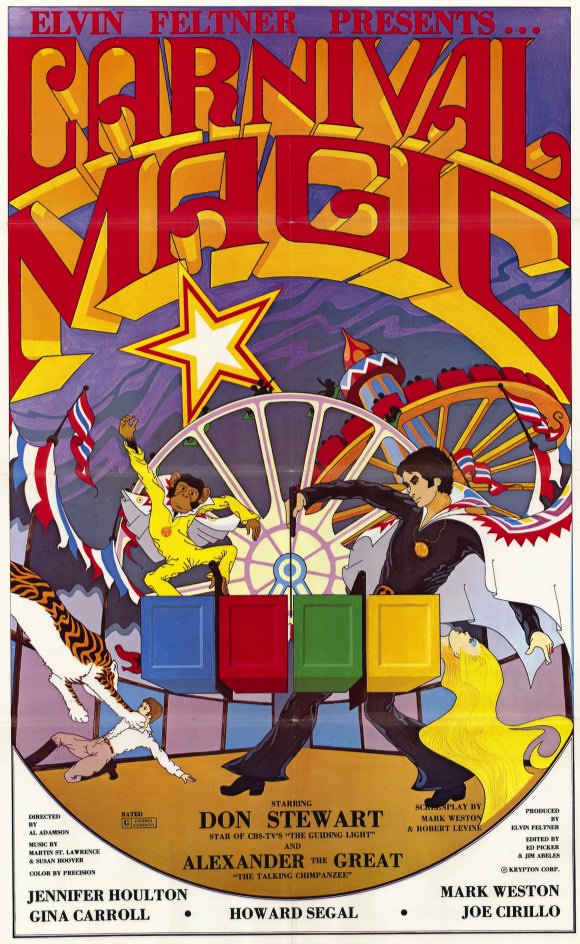
Non Abstract-Review: Carnival Magic (1981)

From https://www.grindhousedatabase.com/
images/Carnivalmagicpost.jpg


Director: Al Adamson

Screenplay: Mark Weston and Bob Levine
Cast: Don Stewart as Markov; Jennifer Houlton as Ellen; Howard Segal as David; Regina Carrol as Kate; Joe Cirillo as Kirk; Mark Weston as Stoney; Charles Reynolds as Dr. Poole; Diane Kettering as Kim

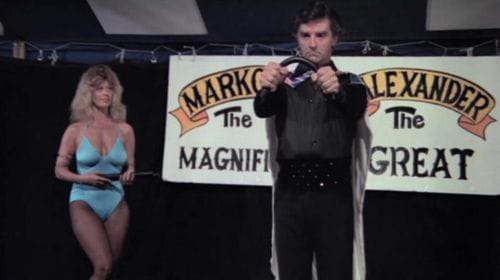
Synopsis: The Stoney Martin Carnival is hitting hard times, but their salvation and draw for larger crowds is already on their premises. One of the carnival's acts Markov the Magician has a friend named Alex he hasn't let anyone meet, who happens to be a talking chimpanzee.

Before we get to Carnival Magic, there is the unfortunate tale of director Al Adamson which hands a spectre over his work. This is something to remember whilst we have it shown on the 2017 reboot Mystery Science Theatre 3000, alongside the fact Adamson himself is a curiosity in cult cinema. The infamous director of Dracula Vs. Frankenstein (1971) is idiosyncratic but not from the context for many of being a loved director - infamously throughout his incredible tome Nightmare U.S.A, about American independent horror films, Stephen Thrower's reviews about Al Adamson films get a bit personal in their comments. Adamson to his credit is still talked of today, and thankfully not just for the unfortunate real life ending, that after he killed by his live-in contractor and had his body hidden beneath the concrete and tile-covered floor where his hot tub once sat in 1995.

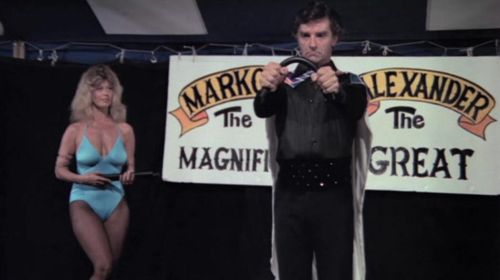
Thankfully the tale of Carnival Magic, including its real life tale, is light hearted and weird when, after a string of exploitation and horror films, Adamson wanted to make a family film. Just after Clint Eastwood struck box office gold with Every Which Way But Loose (1978), clearly Adamson decided to reinterpret this and the famous Beatles song Everybody's Got Something To Hide Except Me And My [Talking] Monkey by way of carnival related melodrama. Said "me" is Markov the Magnificent, raised as an orphan by monks in Nepal and taught supernatural abilities, from being able to talk to animals to bending iron bars and even being able to let others do so by touching them. The monkey is Alex or Alexander the Great, a talking chimpanzee that Markov has had living in his trailer in secret until the owner's daughter Ellen (Jennifer Houlton) convinces him to include Alex in his act. Said Alex, arguably the talking monkey who mumbles his words that most in cinema as a complete mush mouth, is talented but also slightly perverted when he steals the magic assistant Kate's underwear, played by Adamson's muse and wife Regina Carrol, and in lieu of another box office smash, Smokey and the Bandit (1977), even gets into a high-speed chase from the police.

It's the template you'd find in future family films, barring the stealing of lingerie, with Markov's show drawing both the patrons but also the envy of Kirk, the lion tamer jealous his status has been usurped. There's also the issue of Ellen wanting to grow up as a woman than a child nicknamed "Buddy" by her father, much to his concern when she becomes romantically linked to the carnival's accountant. Carnival Magic for three-fourths of its length is, to put it bluntly, painfully dull. Large portions of it consists of a lot of angst ridden drama which leads to characters approaching each other in a random location, especially the woods, and getting into moralistic conversations about overcoming the loss of loved ones or the responsibilities as a father. Adamson wants to convey a message in spite of being opposed to pace and entertainment; even its own genre, as there's no children in the main cast either, a family film mainly consisting of middle aged men and with Adamson's wife Regina Carrol showing a surprising amount, with her full figure and low cut tops, you wouldn't be able to get away in modern "family friendly" viewing.

From https://iv1.lisimg.com/image/15809843/500full-
carnival-magic----------------------------------%281981%29-screenshot.jpg

It's a slog, but then, as if to redeem Carnival Magic or to force it to exist for me as a film to remember, it gets increasingly weirder as the finale approaches. There is material which is absolutely too dark for children to see, when Kirk slaps his girlfriend around as response to kidnapping Alex to give him to a scientist, a scientist who explicitly wants to vivisect him despite even his staff showing remorse to the idea and seeing a visibly sentient animal strapped to the bed. The escalation from there becomes insane...

[Major Spoilers]

...when Alex tries to commit suicide with poison, which is a moment which cannot be described in anyway but dumbfoundment, regardless of the target audience, of how Carnival Magic has entered into this territory. For all the mind numbing content of before, this is where a madness takes place more so as everything is taken deathly serious. There's a perverseness, unsure whether to laugh or feel startlement, as Alex is taken to a human hospital and has a conventional death bed scene with the heart rate monitor used for dramatic effect. Even if he recovers, there's still a flat line, and the power of love and psychic ability involved just before smash cutting the end credits and a carnival parade in the streets. The emotional tugging of the heart strings, contrasted by it being an actual chimpanzee on the bed, regardless of Darwin's theories of evolution, is truly surreal and distorts how a viewer is meant to read all this.
[Spoilers End]

Does it redeem Carnival Magic? No, but what transpires in the final act puts a cherry on the bizarre experience and makes it unforgettable. Not surprisingly, Carnival Magic was lost in time until Alamo Drafthouse programmer Zack Carlson found a print and started showing it in the early 2010s. More prints actually existed then he presumed, but the discovery of the film was a brief jolt of morbid excitement for its perverseness, shown on Turner Classic Movies and even getting a Blu Ray release back before films like this, such as Adamson's own Dracula Vs. Frankenstein, were getting even 2k and 4k restorations. Even Al Adamson has benefitted from this resurgence through films like Carnival Magic, a happy conclusion that should outshine his tragic end. Again, Carnival Magic can be agony rather than pleasurable, but the car crash that was its conclusion is legitimately bonkers. If anything, the trajectory from inanity to this ending is a hell of a lot more emotionally compelling to experience as a viewer than anything more conventional. 


From https://adayon.com/wp-content/uploads/2018/09/
monkey-brain-at-the-wheel.jpg

Wednesday, 24 April 2019

Non-Abstract Review: Intruders (1992)

From https://upload.wikimedia.org/wikipedia/
en/5/55/Intruders_VideoCover.png


Director: Dan Curtis
Screenplay: Barry Oringer and Tracy Tormé
Based on the non-fiction novel Intruders by Budd Hopkins
Cast: Richard Crenna as Dr. Neil Chase; Daphne Ashbrook as Lesley Hahn; Mare Winningham as Mary Wilkes

Synopsis: Psychologist Dr. Neil Chase (Richard Crenna) is dealing with the case of Lesley Hahn (Daphne Ashbrook), a woman with deep psychological issues stemming from her claim she was abducted and experimented on by aliens. He will encounter Mary Wilkes, a housewife from Nebraska who will also claim to be an abduction victim, causing him to question his scepticism when details that are more inexplicable are uncovered.

Let's go to 1992 - by this year the craze over UFOs was decades long and still going. When Intruders was commissioned as a mini-series by CBS Television, even the thrash metal band Megadeth recorded a song about Area 51, Hanger 18, in 1990, this adaptation of a non-fiction book by Budd Hopkins, said to collect alien abduction testimonies, was just a year from The X-Files (1993-2002) becoming a cultural phenomenon.

Intruders is a slow burn to say the least, one which does have plenty of little grey men but could've easily been a domestic psychological drama fully confined on Earth. Your appreciation of this film, effectively one single three hour work even though it was originally split over multiple nights, is that it's a tale where its immediately established that the aliens exist in the prologue, but, even as someone who hates when you immediately crowbar a film as in metaphor, is all about the psychological damage to two women from trauma. Though it's not hidden the cause are aliens, this greater metaphorical touch, which is clearly wrapped into the story as it tries to show a greater psychological complexity and try to make the idea of alien abductions credible, is where Intruders gets a lot of virtue.

It's also the journey of sceptical psychologist Dr. Neil Chase to becoming a believer, one which there was clearly an attempt for the production to not blindly leap into it being pro-alien but at least, in its earnest attempts, leaving enough time and evidence in this world so its credible why Chase believes the UFOs are real. Intruders as a result is immensely dry, but the attempt to write this material as thoughtfully as possible is as much a positive as somewhat a potential issue for finding a modern audience.

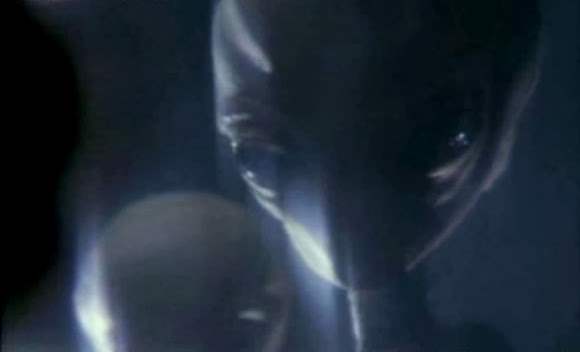
Of course you do get your aliens, early nineties TV budget CGI for flying saucers and grey alien costumes, very rubbery, alongside very minimalist alien ship sets. In terms of a time capsule, it does offer the stereotype of television from once ago - long dialogue scenes, edited at a moderate paced, idyllic Americana, both rural and urban, which is invaded by aliens. Notably director Dan Curtis is most well know for Trilogy of Terror (1975), a beloved cult horror trilogy notable for the segment where actress Karen Black is stalked by a possessed doll, which to my surprise was actually a TV movie despite coming from the seventies, where Amicus and others was very into releasing horror anthologies theatrically. Intruders does qualify for the horror genre as, even with the time passing and some datedness, the mini-series does get creepy. One scene is legitimately freakish, where telephone repairmen appear at night in front of someone's house, only to not be who they presumably are in uniform, but the really creepy aspect is how Intruders depicts these abductions and their repercussions.

Entirely from the perspective of two female characters, there is an implied sense of sexual violence to this abduction which is, [Spoiler Warning], proven to be true as they are being impregnated only to have their alien-human children stolen from their bodies after some time. The ending does leave a problematic issue in how, in an odd coda, the aliens are shown to be actually good, caring despite everything they've done to these human women and many others. [Spoilers End] Despite how the ending does leave on a troubling note in trying to write the aliens as anything but menaces, before then Intruders is completely concerned with chronically how these types of abductions would be horrifying. It is a dark story where these women are being abducted and the film thankfully tackles from their side as victims; we make jokes in popular culture about the various things aliens and UFOs do, but the idea of anyone (male or female) being a guinea pig in actuality is a horrifying one, the mini-series doing its best to deal with this.

It doesn't hide the aliens are real as mentioned - the prologue is of a cover-up at a military base when a general buries a discovery of a UFO on the radar - but the mini-series does talk about scepticism through Dr. Neil Chase, our protagonist. He does lead to ideas of these visions of alien being repressed trauma of molestation as a child, or how the abductee Mary Wilkes, from Nebraska rather than Chase's home in California, is mentioned to having miscarried earlier in her life. And, to its credit, his scepticism is nuanced, not a man just dismissing alien abductions out of contrivance or an egotism from the creators, but one which changes to him being out of depth when Mary's son is being targeted and his logical views are challenged completely. Like a good horror tale, there's a very good reason when he starts changes his tune.

If anything, Intruders gets really rewarding, in spite of the sense of caution trying to adapt this material before The X-Files and other dived head first into conspiracies, by using its overtly sedate tone to touch some interesting drama. Intruders gets ridiculous, but even when Dr. Chase confesses his new views at a psychology conference, that scene is carefully lead to and calmly depicted in what happens, with people willing to talk to him even if his boss is outraged. It pains itself to go through its subject, theories on psychological explanations talked of, and in arguably my favourite scene, even the idea of a government cover-up when that old chestnut is subverted, a military general meeting Dr. Chase and calmly, and openly, explaining their reasons to not reveal the truth about the aliens. The resulting dialogue, of struggles in research and the awkwardness of having the president speak about it on TV, is one of the best depictions of this subject in pop culture sci-fi, a scene in itself that could redeem Intruders for any faults you could have with it.

There is a sense of the mini-series being designed for a wider, ordinary (and potentially older) audience when it premiered. This is not "I want to believe" a la X-Files, but in the midst of a period where films like Communion (1989) and Fire in the Sky (1993) were made, looking to me like the era trying to calmly integrate these ideas from the fringes before The X-Files kicked the door open. Even when there's an exaggerated performance by Steven Berkoff, as an expert in UFO abductions who abruptly appears in Dr. Chase's life with Asian takeaway at his home, the character is still humanised, through a lot of humour befittingly, just in details like the character being a profession in anthropology who takes his work completely seriously from an open minded view. The emphasis in domestic drama is also an immensely rewarding one for me, an acquired taste in that slowness, but a nice change of pace in trying to tell this story through the day-to-day aftermath of trauma. Even for sceptics of UFO abduction culture, this story for two female characters and the families that have to cope with it with them is the kind of story I wish existed more from science fiction on this subject.

Still to this day, you have TV shows purporting real UFO and alien incidents, and whilst it's no longer the zeitgeist, especially as the 2016 reboot of The X-Files hasn't necessarily set the world on fire, this humane take on the subject was a breath of fresh air in discovering it.


From http://www.wickedhorror.com/wp-content/
uploads/2016/07/intruders-1992.jpg

Friday, 19 April 2019

Non-Abstract Review: Year of the Nail (2007)

From https://i2.wp.com/newcelluloid.com/wp-content/
uploads/2017/03/ano-una.jpg


a.k.a. Año uña
Director: Jonás Cuarón
Screenplay: Jonás Cuarón
Cast: Eireann Harper as Molly; Diego Cataño as Diego

Synopsis: Told entirely in photographs, of real people and family of the director, Jonás Cuaron tells a fictional story of a young American college student Molly (Eireann Harper) whose encounter with Mexican teenager Diego (Diego Cataño), whilst she is briefly in his country, leaves him smitten for her.

Alfonso Cuarón is a director I don't necessarily take interest in; the director who has done work in his homeland (Y Tu Mamá También (2001)) to the States (Gravity (2013)), a critical darling with the Netflix approved Roma (2018) just an example of someone whose constant praise in the mainstream unfortunately puts me off without actually judging the work. It's an unfair attitude and I will rectify it one day. (Gravity, though, doesn't work for its heavy handed and empty spectacle especially when not seen on a cinema screen). Here though, I finally am round to a film I've wanted to seen for over ten years, his son Jonás Cuarón making films into the current day too. Year of the Nail is told entirely in photos like Chris Marker's La Jette (1962), real documents in photo form, in montage and with voice over.

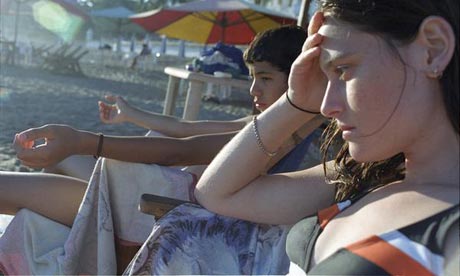
It has two different beginnings - an American named Molly is stuck in a lost twenties where she is aimless, unsure what to do with her life but going to Mexico twice, once for her studies and then again out of a desire for sightseeing, which mark a comfort for her to escape this dead-end. The second time introduces her to Diego, as she stays at his family home as a guest; Diego is a hormone driven male fourteen year old, obsessed with sex, intrigued to woo the older American girl, constantly dealing with an ingrown toe nail, interestingly where the English title comes from, but also serious issues like family fragmentation and a grandfather becoming stricken with cancer. Using real photos, rather than staged ones, means occasionally a background face is blurred out, and it ends with a tribute to a past relative, a sense the "actors" included actual Cuarón family in their day-to-day lives, turned into fictional characters. Even Molly herself, actress Eireann Harper, was the girlfriend of the director-screenwriter, who took these images between 2004-5 as the introductory text elaborates, a film built from reality that is emphasised just by the fact the camera used switches from monochrome to colour halfway through.

Year of the Nail weave a lot of interest beyond its style, the story interesting in this frankly problematic love story which yet avoids becoming icky in a natural, inevitable way. It plays on conceptions a great deal too - able to understand Spanish, Molly is aware of how she is perceived as an ignorant American, whilst for Diego and his family, preconceptions of Mexicans is also poked at, particularly as he tries to avoid his family (especially his grandmother) embarrassing him in his misguided attempt to flirt with Molly, which considering his idea is to laze about on the beach all the time can be seen as an immediate failure anyway.  

The film doesn't try to sugar-coat the obvious issue, more so ten years on, of an adult woman and a young teenage boy in a potential romance, especially as the character Molly does flirt with the idea of a relationship before, when he finds a way of meeting her in New York City, she sees the issues that have arisen. I do understand the real concern viewers can have with fictional tales which have these premises, but it's as much an unwanted avoidance of that transgressive issue that, in real life, the beginning of sexuality all of us went through after puberty is one that's very uncomfortable to deal with but should be tackled, especially in lieu to how this relates to the adult world and trying to consider the subject with thoughtfulness. The film doesn't step from why its taboo either, without being remotely explicit barring how much profanity and sex talk Diego himself uses especially in voice over. The subject of adult-teenage relationships and the idea that that they can be consensual for participants, even in a merely fictional realm, can now seen much more as too far, but the truth is I'd rather have a film tackle this subject in this particularly case frankly, and carefully, with the necessary complexity needed. Even if the moments of humour and farce may have become more uncomfortable for some in the last ten years.

Altogether, Year of the Nail was a good surprise, a really interesting experiment in limited resources. A lot of drama is surprisingly found even without moment, a greater sense of creativity required to establish a world, needing multiple photos for one scene to exist; even in mind that these images probably existed already before the idea to make a film did, you still had to find a way to connect them together in editing and careful use of the voice over and dialogue recorded over them, to which Jonás Cuarón never oversteps into heavy handedness in drama or the cultural clash that takes place with the main characters. To establish such a world, you have fleshed out experience of places in Mexico and outside of it like Coney Island in New York City in detail, which you rarely get in cinema due to the ease in using a camera has. Knowing real family is involved in the director's work is great, as is that he doesn't flinch away for details, from a hospital corridor to showing the actual neutering of a pet cat in a veterinarians' in lieu to the Diego family cat having the operation.

Jonás Cuaron manages so much in only less than eighty minutes, a fleshed out premise with emotional weight, that it does become a great representation for me of the fascinating underbelly of cinema that'll be uncovered over the next decade particularly for the maligned late 2000s, where one-offs and experiments are gathering dust on DVD copies waiting another evaluation...or in this case actually seeing the film after taking too long as I did.


From https://static.guim.co.uk/sys-images/Film/Pix/
pictures/2008/10/30/anouna460.jpg

Monday, 8 April 2019

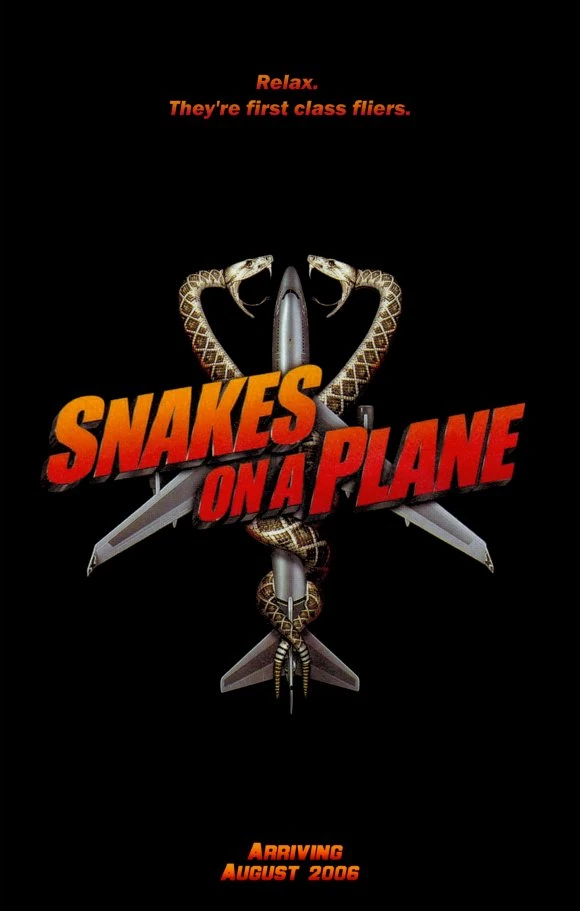
Non-Abstract Review: Snakes on a Plane (2006)

From https://vignette.wikia.nocookie.net/die-hard-scenario/
images/c/c6/62446.jpg/revision/latest?cb=20140107231012


Director: David R. Ellis
Screenplay: John Heffernan and Sebastian Gutierrez
Cast: Samuel L. Jackson as Neville Flynn; Julianna Margulies as Claire Miller; Nathan Phillips as Sean Jones; Rachel Blanchard as Mercedes; Flex Alexander as Three G's; Kenan Thompson as Troy; Keith Dallas as Big Leroy; Lin Shaye as Grace; Bruce James as Ken; Sunny Mabrey as Tiffany

Synopsis: Neville Flynn (Samuel L. Jackson), an agent of the FBI, has to take a witness Sean Jones (Nathan Phillips) on a commercial airplane to testify against a Hawaiian based mob boss. The crime lord however sets a trap to kill said witness and everyone on the flight to dispose of Sean Jones - countless snakes, pent up with a special hormone, almost all of them venomous and pissed off.

Being of the right age growing up in the Snakes on a Plane hype, it's bizarre someone at New Line Pictures thought this would've been a box office smash. Maybe if it had been a PG-13, but as has been commented on by other articles, including nudity and violence (alongside swearing) for an R to appease the internet hype was seen as an own goal in terms of reducing a potential audience. It was also an odd production to hype knowing Syfy original movies, growing into the late 2000s to 2010s, marked the point that the monster film had tragically dissipated over the decades as a mainstream Hollywood plot type. Whilst monster and killer animal films have been made over the years (like Anaconda (1997)), it's turned permanently into a b-movie genre and knocked down usually into straight-to-TV and DVD work; the ordinary American public to this day still appreciate disaster films, superheroes and an occasional monster film if its King Kong or Godzilla, but not an audience necessarily for a title which became arguably the first cinematic internet meme. The internet, whilst this is a fascinating case of the web influencing Hollywood that'd appear in the future, tends to be loader than its actual size, an echo chamber at times which doesn't shown an accurate gauge for a target audience, so it doesn't necessarily dictate it'll be an actual succeed to Joe-Public.

Snakes on a Plane goes as far back as 1992, when David Dalessandro, the associate vice chancellor of university development at the University of Pittsburgh, read an article that year about Indonesian brown tree snakes climbing onto planes during World War I, producing a screenplay called Venom as a result. Eventually this script would be green lit for an actual film, all the way into the 2000s, and the internet became obsessed with the title "Snakes on a Plane" and how ridiculous the premise sounded. Samuel L. Jackson came aboard just for said title, lamenting the consideration of changing it to Pacific Air 121 and the internet relished the idea in fan art and memes before the film even came out, arguably the first example of internet hype that now exists for modern blockbusters.

The fan parodies eventually became so part of the hype that, for another major detail, they helped influence what the final film would be through reshoots. As mentioned, what was originally PG-13 had new scenes with harsher, ghoulish content appropriate from a director who made Final Destination sequels. And one parody, a fake audio trailer by Chris Rohan, rifted on Jackson's notoriety for swearing like a sailor in films, leading to  the phrase "I've had it with these motherfucking snakes on this motherfucking plane!" which was crow barred into the final script.

Snakes as a Plane as an actual film conveys my weird love-hate relationship with b-movies. As much as their virtues remind me of my love of them, most are always never giving what is promised in the advertising or offer something generic like a few action scenes when I prefer mine to be inventive or weird. Snakes on a Plane still had to be a mainstream production so it's straight laced and very predictable in spite of how that premise promises so much, placing all its eggs on showing the fucking snakes on a fucking plane but as a result playing everything else like the kind of film the Zucker brothers parodied in Airplane! (1980), even down to someone having to take control of the plane, not because of the pilots having fish for dinner this time but because of the damned snakes. Archetypes and stereotypes are cast as a result - tough cop (Jackson), the witness (Phillips), a tough female air hostess (Julianna Margulies), and a variety of stock figures from the finely manicured, blonde socialite with a pet Chihuahua in her bag to the snooty, mean business man not happy first class is not available.

Snakes on a Plane is fun film, which I am not going to deny, when you just take it as a spectacle, not surprisingly playing out as a lurid funfair ride. But as always been a problem for me, once I think about a film like this, and compare it to other far more unique b-movies, it's a predictable one too as a result which could've been rewritten as an airplane disaster film. It reveals the problem with b-movies in that I, like many, love their existence but many of them are actually middle of the road to compensate for their wild premises. They feel like either they could've go further or had to pull back to make a film still commercial, many offering premises just in the advertising which (still to this day) are far less interesting than the wild ideas a viewer can day dream about.

From https://www.awn.com/sites/default/files/styles/inline/public/image/
featured/3001-snakes-plane-venomous-vfx.jpg?itok=Gq6xBWnM

Why foreign language or straight-to-video "rip-offs", from the Italian genre films to Turksploitation, for their lower budgets developed fan followings is because they could get away with wilder ideas or be legitimately unpredictable in what the hell could take place in the next ten minutes, something sadly you can't say about Snakes on a Plane. The closest things in terms of interest is the inclusion of an egotistic rapper on the flight, Flex Alexander as Three G's, who turns out to be an immense germaphobe with stress issues, or that David Koechner from the Anchorman films is here as a chauvinistic but still lovable co-pilot.

There is also the issue, whilst I did appreciate some of the sick humour in gags about the snakes attacking from idiosyncratic places, and that even as CGI they don't look dreadful even in the current day, that I find disaster films actually problematic in how they kill off random bystanders on mass for spectacle. I've always found it worse even than slashers which, for their obsession with just murder scenes, at least focus on characters and give them some personalities and time to exist even as one-dimensional stereotypes. Something about mass death of faceless individuals feels morally grotesque for me, and its worst that this film has jarring tonal shifts between the spectacle and, in lieu of being a disaster film at heart, having serious dramatic scenes where you are meant to care for these bland figures' lives.

Snakes on a Plane also feels surprisingly cobbled together - for a film that got so much immediate attention, even getting a band formed together for it (Cobra Starship) to make a theme and a music video for the ending, it feels choppily put together. Even beyond that additional, harsher content was added later, characters like the witness (a bland baby faced figure in Nathan Phillips in the first place) wandering off screen for major lengths of time and a sense of being hastily constructed despite being a very simple premise. The main villain, shockingly, never reappears after the prologue despite being the one who thinks causing a plane, full of innocent people, to crash out of the sky with snakes was a good way to eliminate a witness to one of his crimes, probably one of the bigger and glaring examples of these structural holes.

The fact this was meant to be more family friendly is felt too. Its bright colours, starting from its initial Hawaiian locations, and tone are a time stamp of the mid to late 2000s (alongside Cobra Starship never being a thing beyond 2006 Kerrang magazines for me), but alongside a cast including two children, it's a film that's still clearly meant for a wider audience that what it was in tone. It can add some bared breasts, have a snake bite them, compensate for having a man's cock being bitten, and have Samuel L. Jackson swear, it's still a mainstream Hollywood production which was aiming for higher risk stakes than a usual b-movie could. Something belies what was a New Line Cinema product that got greater intrigue in pop culture that it should've, not only doomed by being mispresumed for greater reward, but also with the issue that most films like this at this scale get neutered anyway. Even if it was still an Asylum mockbuster, I've heard at least Snakes on a Train (2006) involved a misappropriation of Voodoo and a giant CGI snake eating a train, the kind of material (whilst likely poorly executed) that a viewer would secretly want, with all the risk and strangeness but usually never getting a budget without removing these odd tangents. The irony is that, briefly with details like adding gore and that expletive filled line for Jackson, the fans did get a chance to influence what film they wanted; they still got, however, a narrative as usual though that these details were bolted onto.

After it premiered in 2006, Snakes on a Plane gained $62 million worldwide from its  $33 million budget, not bad but with its initial opening weekend seen as disappointing to the point David Tuckerman, New Line's president of distribution, found its expectations to be a disappointment. It was The Golden Compass (2007), a misfire in terms of trying to make a commercial property out of Philip Pullman's acclaimed (but also controversial) children's fantasy literature, that was arguably the production that killed New Line Cinema, but they had a string of failures running up to it that, with Snakes on a Plane's not being the ultra hit they wanted, probably didn't help financially. Over ten years later, and barring some articles celebrating the film, I wonder if anyone remembers Snakes on a Plane enough to have a huge cult; I'm still surprised I once read of this film in film magazines like Total Film anticipating some cult phenomenon to take place in the news sections, the mediocre reactions leading to an immediate (and deathly) silence soon after like many films that magazine or Empire even plaster on their front covers. It's still a fascinating legacy that arguably has a greater legacy, as the internet, whilst an echo chamber at times, is behind a lot of films and how they are shaped or seen in the culture.

Probably the saddest things are a) this had a chance to take a premise that, usually on even lower budgets, has died out beyond very cheap schlock in terms of monster films and squandered the chance to be completely over-the-top, and b) connects to the strange tale that despite creating the Nightmare on Elm Street franchise, and just succeeding so much with the Lord of the Rings trilogy a few years earlier, New Line Cinema still dissipated and was eventually swallowed up by another company. That Snakes on a Plane still made quite a bit of money back but was still being seen as a bad investment just feels like a kick whilst they were falling over.


From https://images.mentalfloss.com/sites/default/files/
styles/mf_image_16x9/public/snakeshed.jpg?itok=ReOMNYfK&resize=1100x1100

Monday, 18 March 2019

Non-Abstract Review: Cry Baby Lane (2000)

From https://hiddenhorrors.files.wordpress.com
/2014/01/cry-baby-lane.jpg


Director: Peter Lauer
Screenplay: Peter Lauer and Bob Mittenthal
Cast: Jase Blankfort as Andrew; Trey Rogers as Carl; Larc Spies as Kenneth; Frank Langella as Bennett; Anne Lange as Ann Weber; Marc John Jefferies as Hall; Allison Siko as Louise; Jessica Brooks Grant as Megan; Sheri Drach as Kathy; Gary Perez as Gary; Steve Mellor as Dick Weber

Synopsis: In a small town, there is a tale of a pair of conjoined twins who, when they died as infants, were severed from each other, one buried in the cemetery and the other buried at a place called Cry Baby Lane. Andrew (Jase Blankfort), and his older brother Carl (Trey Rogers), have a mock séance at a grave to exploit this with a group of girls, only to release an entity that is significantly malicious.

The story goes, like any good spooky tale, that on October 28th 2000, a TV movie was shown on the American channel Nickelodeon that was deemed inappropriate for its young audience, and buried never to be heard of again. Over the decade or so that would follow, this work directed by Peter Lauer and originally meant to be a theatrical release, costing $800,000, was even questioned in terms of whether it actually existed. Some suggested, on the other side of the spectrum in a form of Creepy Pasta (online created urban legends) that it was suppressed for having incredibly disturbing material onscreen. Finally in 2011, a viral Reddit thread lead to a user ugnaught1, who claimed to on the "lost" film on a VHS copy, uploading it online. Having seen the original broadcast version, which began with an introduction by Melissa Joan Hart, who I grew up with watching Clarissa Explains It All (1991–1994) and Sabrina the Teenage Witch (1996–2003), I can attest that such a film did exist and, when that leaked VHS copy came about, Nickelodeon played into the hype by showing Cry Baby Lane again, claiming it was a "banned" film and then eventually showing it at Halloweens over the 2010s, particularly in a nod to a 90s nostalgia boom.

The fable of the horrible things said to exist in the film - as Creepy Pasta have included a SpongeBob Squarepants episode that was created by a psychologically disturbed figure which horrified the producers, or a cursed Mickey Mouse animation - is probably more horrifying than the actual TV movie, but it itself in the context of a one-off for a young audience is still weird, gruesome and frankly creepy in implied metaphors even for a crowd (like myself) who grew up on Goosebumps. Beyond the initial story told by the undertaker character Bennett (Frank Langella, who director Peter Lauer originally wanted to be played by Tom Waits) - where two conjoined twins (one good and one evil) die in infancy and are sewn away from each other - there's still a film here where which plays into a dark and fascinating premise. That, once the evil twin is accidentally released as a malevolent spectre, he infects people in the central town and makes them destructive and evil, particularly a group of girl scouts who become sadists, building off as well a central theme of our young male protagonist Andrew (Jase Blankfort) and his fears of puberty and masculinity.

And no, that's not between the lines either in the text, as he's shy and hates how he's scared all the time, at point confessing this and accusing his mother for having caused this by being over protective. His older brother Carl (Trey Rogers), obsessed with being macho and a diehard pro wrestling fan (1999 WCW and WWF merchandise on the walls), constantly picks on him and calls him a wimp, all whilst their father is a fascinating character, laid back and sardonically charming, also with one gag about him implying so much complexity when, watching monster trucks on the TV when his wife's in the room, one scene has him switch to coverage of supermodels on a catwalk when she's out the room.

From http://3.bp.blogspot.com/-xaz5GrH_-WI/Vh_YkulS3uI/
AAAAAAAAJ78/GR4AlB153n8/s1600/CryBabyLane5.jpg

Andrew's life is complex as he has a crush on a girl, who unfortunately is among those scouts possessed and becoming evil, among those tormenting him alongside his eventually possessed older brother and even trying to harm him; it reaches the point mid way through of him being stripped to his underwear, nearly being gored by a bull, and having to flee for his life half naked. Then there's the threat to kiss his beloved, whilst she's possess and threatening this or "chi chi", involving a significantly bigger and gigantic girl looking at him as if she'll easily break his spine in two. That's without his mother not believing him and even the adults, like a version of Invasion of the Body Snatchers, becoming possessed, where police will try to run you off the road, farmers with trying to run you over with a combine harvester, and guys for shits and giggles with beer will blow up their own boats in madness.

The eccentricity grows as a virtue. Whilst it would've been interesting to see Tom Waits in the role, Frank Langella, the major actor hired, also happens to be a great character actor who in his mere presence raises the material up. More so as, part of the film's sick sense of humour, he's openly a bad undertaker who will even replace coffins of those about to be buried with cheaper ones, as scummy as you can get despite still being a good, moral man at heart. His assistants include a stoner, (well an implied stoner who just acts sleepy), and another who digs the graves who pretends to always be ill but, when no one is looking, dresses up as a cowboy listening to country music in his home and prepares the dining table as if he's about to have a date there, never seen or even hinted at for a weirder twist. The production is as much like this, even if it evoked my childhood of watching shows like Goosebumps, with its moody atmosphere on such a low budget and the instrumental surf rock theme sounding like it's going to break into a song by The Cramps.

The result, appropriate for a more mature young teenage audience, is one I really liked and wished was more easily available. Yes, I admit the mythos is fun and there's something really rewarding in seeing old American commercials - alongside probably one incredibly weird and inspired mock "news report" that, barring one cringe worthy reference to Mexican food, is from a reporter inside a young boy's intestines, interviewing the staff within it just before it's about to blow with potent gestated fart gas. But, again, it'd be something great to see a proper release of just to learn more of its background - just to have witnessed a film which, far from below my expectations, provided its own interesting and blatant subtexts to its horror was enough for me to admire it.

From https://m.media-amazon.com/images/M/MV5BODQ4YjExM
jgtNjEyNi00YmY1LWI5NzAtMmZmNTlmYjhiZWU1XkEyXkFqcGdeQXVyMTM0ODAyOTc@._V1_.jpg

====
1. https://archive.is/20130204104051/http://www.thedaily.com/page/2011/08/13/081311-tech-news-crybaby-1-2#selection-345.12-345.20

Sunday, 17 March 2019

Non-Abstract Review - Amethyst: Princess of Gem World (2013)

From https://vignette.wikia.nocookie.net/marvel_dc/images/2/24/Amethyst_Princess_
of_Gemworld_%28Shorts%29_Episode_Level_3_Random_Encounter.JPG/revision/latest?cb=20130728141857


Director: Brianne Drouhard
Screenplay: Amy Wolfram
Based on the comic book series created by Gary Cohn, Ernie Colon and Dan Mishkin
(Voice) Cast: Sophie Oda as Amethyst; Eric Bauza as  Pegacorn; Keith Ferguson as Prince Topaz; Grey Griffin as the Frog Mayor; Tara Strong as the Frog Prince; Nicole Sullivan as the Jalapeño Vendor

Synopsis: Amethyst is playing a video game, a high fantasy adventure, only to be sucked through the hand held console screen and turned into a princess of this weird little world.

Here's a work that'll be difficult to elaborate on but not by fault of its director Brianne Drouhard or any of the production staff* - the issue is that, with what they were given before this micro-series was cancelled, this DC comic property only consists of seven episodes which are only two minutes or so long each. Thus it's effectively a short film or a test project when put together; something clearly worked hard on in what creativity is still at hand, but handed an ignoble fate of a lack of length, where even micro-series from Japan of more limited animation and ridiculous premises like talking farts can at least get over twenty minutes if you combine all the episodes in a marathon.

The work was part of a series of projects called DC Nation Shorts, small shorts based on obscurer DC Comics properties which were shown between their other, more conventionally long animated work on Cartoon Network, such as DC Super Pets, inspired on the time Batman and Superman had their own animal sidekicks in the Silver Age of comics, or imagining Batman villain Riddler as voiced by "Weird Al" Yankovic. Reading up on them, including one animated by Aardman Animations of all people and a live footage version where real life professionals demonstrate the equipment of these characters in practical reality, it's an inspired idea and I want to see all of them. As much because that, whilst I got bored out of my skull by the modern Marvel Studios superhero film template, I am still fascinated and growing in fondness for these types of characters. If I could afford American comic books at a price closer to their Japanese counterparts, in terms of value for money, I'd be less inclined to read more famous creations like Spider-Man or Superman either, but delve into comic book history's strange oddities and cult figures. Some are legitimate cult icons - like Swamp Thing, the living embodiment of nature who became a greater figure in DC Comics when the legendary comic writer Alan Moore had a hand in changing him drastically. Some are misbegotten - like Man-Thing, Marvel's swamp creature now unfortunately living as the poor man's Swamp Thing. And some truly ill-advised ideas I read up upon and still want to read - like Marvel's U.S. 1, a truck driver hero with a cybernetic brain, which could pick up CB radio transmissions, and armed with a super-equipped big rig truck

Among these, Amethyst is also intriguing in a positive way - from 1983, the era of My Little Pony and He-Man, it was clearly meant to be a high fantasy story for a female audience; here, from a female director and a largely female production crew, this premise was re-tweaked for the modern era. In this version, Amethyst starts off as a bespectacled nerdy girl who, once transformed into Amethyst the heroine, finds herself increasingly baffled by what she encounters, immediately from the village of frog people proclaiming her a heroine of the realm, and yet using her smarts to succeed, including the idea that peppers in video games are really, really hot. This leads to the fact the series would've taken the piss out of high fantasy and role playing games, immediately evoking for me a Japanese straight-the-video anime series which tragically only had two episodes before it also got canned, Dragon Half (1993), which ran with its high fantasy setting into utterly ridiculous and hilarious consequences. The reference to anime isn't far off either, clearly influenced by it in aesthetic and also that the first joke is a parody of the magical girl genre, of female characters who transform into heroines like Sailor Moon, where the costume change sequence found in them takes place here in mid-air, not bad for Amethyst until the dimensional pocket said transformations always take place in disappears and one is still falling down in the sky.

Sadly, and this is a justification for typing an expletive as it perfectly sums up the situation, the creators of this production were given a shit deal in that, even without the factor that Amethyst was cancelled, they only had enough time for a tiny little plot they had to quickly resolve. Sadly, a project like DC Nation Shorts, whilst absolutely compelling as an idea, can become its own worst enemy in terms of how short the projects within it could be, as was the case here. What you get here is only a minimal plot - which Amethyst must face an evil male character named Dark Opal - and a little of the world to see including its denizens, worst as you barely get to meet characters like Prince Topaz, the last person to take on Dark Opal only to be left a living skeleton, found in a cave and suffering from chronic apathetic depression and a lack of confidence in himself. It's not a lot in all honesty to work with as a viewer.

But thankfully, there are still signs of what could've been, and Episode 3 is the best episode to show this. Whilst needing to wash, she finds herself encountering a very perverted living tree, one who is watching her bathe, as well as there being the incredibly dark humour of living flowers nearby who argue among themselves who'll be eaten by her horse and reveal in their devouring by the steed. It's a clear sign that the series, if it existed in a longer form, would've still appealed to a young audience but would've had an eccentricity that appealed to adults. The best thing is that, by all accounts, those great gags were directly inspired from the source material, an obsession in the art with even rocks having faces and therefore being alive. This is a great argument for the virtues of adapting source material, even the strangest details, as with this example you get a great idiosyncratic aspect of this fantasy world that would've been used further. The same applies as much to those pastiches which, rather than the dreadful Family Guy style referencing style of merely referencing something for a joke, it's implemented in a way that still works without getting the references.

Sadly, this is all we have, less than ten minutes. We barely see this heroine or her worlds, which was why the review was going to be originally more middling, not a criticism of the show but a wonder if there wasn't enough to get a lot out of from bad luck. However, with hindsight there was a lot still to like, even if having to intricately dissect from what little was there. It's just a shame, in this significantly more positive review, there's just that much left to actually watch.

====
* Without any hesitance, this review references back to a podcast episode for the show Cancelled Too Soon, which covered this micro-series with Drouhard herself, so I'll include a link HERE.

From https://www.dccomics.com/sites/default/files/video/
AM05_H264_BattleoftheStormyPeaks_thumb_ju765tagw5_.jpg

Monday, 4 March 2019

Non-Abstract Review: Occidental (2017)

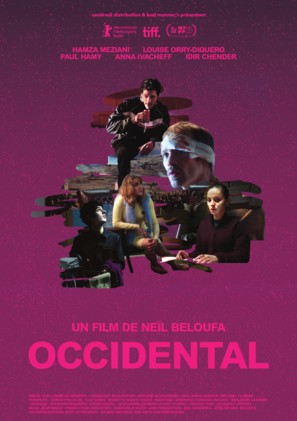
From https://cdn.cinematerial.com/p/297x/gorqtsym/
occidental-french-movie-poster-md.jpg


Director: Neïl Beloufa
Screenplay: Neïl Beloufa
Cast: Anna Ivacheff as Diana; Idir Chender as Antonio; Paul Hamy as Giorgio; Louise Orry-Diquéro as Romy; Hamza Meziani as Khaled; Brahim Tekfa as Karim; Françoise Cousin as Sophie; Pierre Rousselet as Christophe; Brune Renault as Vanessa; Geoffrey Carey as M. Dubreuil

Synopsis: At the Hotel Occidental, in the midst of a riot in the streets, two men claiming to be Italian (Paul Hamy and Idir Chender) book a room only to be held with suspicion by the hotel manager Diana (Anna Ivacheff). A series of turns, questions of perceptions and secrets are found.

Under eighty minutes, Neïl Beloufa's Occidental is nonetheless a dense production, whose entire form is a constant shifting form where everything changes. Fittingly it's set in the midst of a night time riot, France's history from the French Revolution to the 2018-19 yellow vests movement with constant conflict, aptly used as the exterior to a film where perceptions are constantly being broken and remade. Two men who enter a hotel are viewed as immediately suspicious; they may be gay, though Giorgio (Paul Hamy) has already wooed the female desk clerk Romy (Louise Orry-Diquéro), whilst there are secrets about why his partner Antonio (Idir Chender) has already made hotel manager Diane (Anna Ivacheff) even more nervous around him than to the pair of them together. Perceptions of racism and culpability play out as, barring the exterior shots, it is entirely within the neon drenched hotel building.

From there, there are a few main characters, including male desk clerk Khaled (Hamza Meziani), prone to fainting in tense situations, alongside a group of drunken British men on a stag party and an older man with a younger woman. Throw in the police briefly, and it's a conference of divided opinions and sides crossing all around little details. Where a pink handbag is, why someone is drinking a two cokes when they have a full bottle in their room, absurd to write on paper but in context played with humour and a game of little tensions. On a second viewing (seen twice for the review), it does work as a series of characters in mind games with each other.

From https://frieze.com/sites/default/files/landscapeoccidental.jpg

It helps the acting is good, the script with each character clearly defined. Romy 's immediately on the two guests' side, lovingly preparing cheese between slices of cooked bread when food is refused to them, Giorgio in his yellow coat wooing her at the beginning only to be left beaten up  by Diane in the midst of the tensions and her undercover investigations among the rooms. Even the language itself is played with, thankfully picked up in the subtitles I had but probably even better if the viewer was bilingual in the languages involved, between bad incomprehensible Italian and when it's perfectly spoken in an emotional scene. The only one constant, where even the old man and the woman (his daughter? A lover?) vary, are the drunk, boorish British guests, which as a British viewer I can accept as a good swipe at a poor side of ourselves. The rest of the cast in comparison move and change until it leads to the literal burning of their environment, only the slightly jarring CGI explosion involved a flaw in the film's production.

Against the dialogue-heavy drama is a distinct aesthetic from Beloufa with the help of cinematographer Guillaume le Grontec and the composers of the score Grégoire Bourdeil and Alexandre Geindre. At the end of the 2010s, the eighties throwback aesthetic has finally become tiresome for me, but only because of when it's been used as a cheap aesthetic, where here in Occidental instead I am reminded why these tropes of neon colours and synthesizer scores are still vibrant and still worth using, it's brightly coloured (but subtle) look even including how the costumes like Romy's canary yellow jumper add to the characters' personalities. The score is pulsating without being over-the-top, whilst the distinct typeface of the credits, whilst a slight detail, adds to its distinct personality too. The result ultimately succeeds to adding oomph to the material which is also with depth; when it finishes, the rioting crowd in a series of Chinese whispers over elaborating the incidents inside the hotel, the theme of misdirection Occidental plays with becomes precise, witty and ultimately clever.


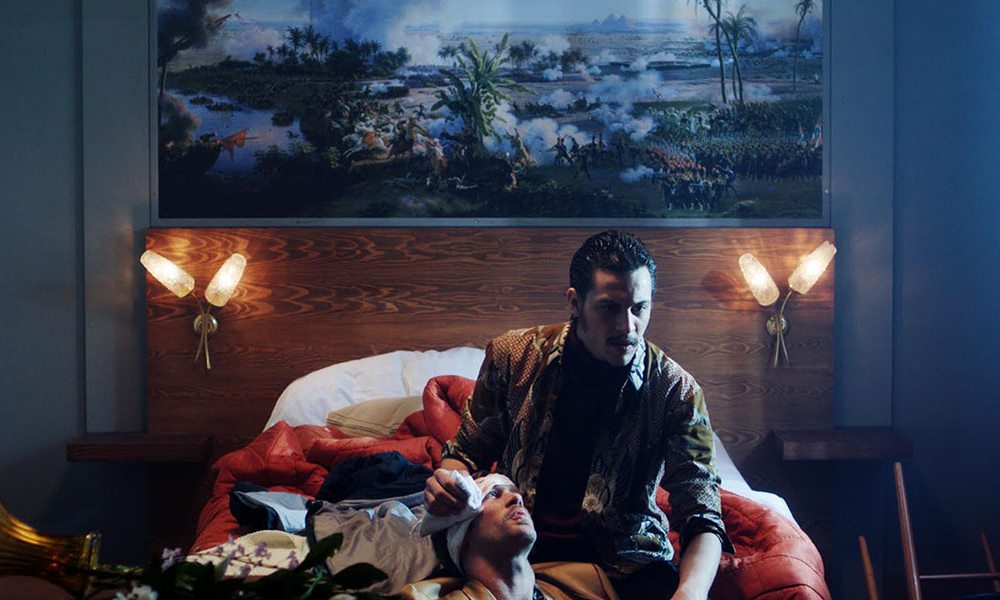
From https://cine-vue.com/wp-content/uploads/2017/
09/948ed-_0001_occidental_01.jpg