Showing posts with label 1000 Anime crossover. Show all posts

Sunday, 27 October 2024

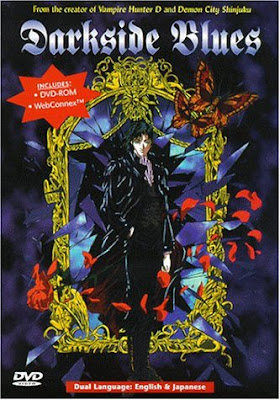
Darkside Blues (1994)


Director: Nobuyasu Furukawa

Screenplay: Mayori Sekijima

Based on the manga by Hideyuki Kikuchi and Yuho Ashibe

(Voice) Cast: Akio Ohtsuka as Kenzou; Hideyuki Hori as Gren; Kotono Mitsuishi as Mai; Kouichi Yamadera as Enji; Masako Katsuki as Tamaki; Maya Okamoto as Selia; Natsuki Sakan as Darkside; Nozomu Sasaki as Katari; Shinichiro Miki as Chris; Yasunori Matsumoto as Tatsuyairector: Viðar Víkingsson

A Night of a Thousand Horror (Movies)/A 1000 Anime Crossover


Darkside Blues isn’t really horror, though it has plenty of supernatural and Gothic touches worthy of the season, and I am glad to have revisited this, as this is a fascinating genre hybrid between dystopian sci-fi about corrupt corporations, which is still salient as a theme, that however has magic exist as well as a titular figure who rides around on a horse drawn carriage which can fly. It is fascinating, even with less than ninety minutes to try to depict this world, and a source manga which did not last long enough either to expand it further, to see what interesting things this depicts, be it a titular figure who acts more like a supernaturally powered advisor for freedom fighters to the sight of someone being tortured by being turned to gold whilst alive with alchemy. From the same author of Vampire Hunter D, and the infamous Wicked City as per its own animated adaptation, you see the threads for those here too, but in this melancholic and fascinating one-off.


For the full review, follow the link HERE.


Thursday, 17 October 2024

Theatre of Darkness: Yamishibai Season 1 (2013)


a.k.a. Yamishibai: Japanese Ghost Stories

Director: Tomoya Takashima

Screenplay: Hiromu Kumamoto

Voice Cast: Kanji Tsuda as the Story teller

A Night of a Thousand Horror (Shows)/A 1000 Anime Crossover


The review linked to below comes with knowledge that, starting in 2013 and with more series being produced up to 2024 itself, Yamishibai may still continue into 2025 onwards. Taking the tradition of kamishibai, a form of paper play storytelling and theatre, and amalgamating it in a "micro-series" with urban legends, ghost tales and moments of general spooky misanthropy, it won me over. tIn mind that future series will even tie into cult cinema, with Noboru Iguchi (The Machine Girl (2008)) and Takashi Shimizu (the Ju-On/the Grudge franchise) getting involved from the second series onwards, and I cannot wait to get to the future series.


For the full review, follow the blog link HERE.

Thursday, 10 October 2024

Vampire Princess Miyu (1988-89)


Director: Toshiki Hirano

Screenplay: Shō Aikawa

Based on the manga by Toshiki Hirano and Narumi Kakinouchi

(Voice) Cast: Naoko Watanabe/Anne Marie Zola (Manga UK dub)/Pamela Weidner as Miyu; Mami Koyama/Stephanie Griffin as Himiko Se; Kaneto Shiozawa/Zach Hanner as Larva

A Night of a Thousand Horror (Series)/A 1000 Anime Crossover

The personal project of its director Toshiki Hirano, as he is one of the co-creators of the source manga alongside his wife Narumi Kakinouchi, this definitely wins you over with its style and in terms of its melancholic tone. For the OVA anime period, it stands out for this, if with the issue like a lot of them that this feels slight for a premise which could have been taken further. This is emphasised when you know the original manga, not including the spin-offs, lasted from the year this anime was created to 2002.

Tellingly he would return to this in the late nineties for a full animated television series, but for what we got here, including the episode following the students being turned into marionettes which turned into the most successful story for its tone and emotional turns, I was glad to finally get around to this.

For the full review, follow the link HERE.

Thursday, 3 October 2024

Hellsing (2001–2002)


A Night of a Thousand Horror (Series)/A 1000 Anime Crossover

For a tangent, I return back to an anime series I had not seen until the 2000s when I got into the medium. Naturally, there was nostalgia in this one case, as the likes of the original Hellsing come from a specific period of anime which I got into by the mid-2000s and no longer exists. ADV Films, who released this in the United Kingdom, no longer existed by the end of the decade due to financial problems, and Gainax, the divisive anime studio who produced this, were a prolific studio whose titles came out at the time I was getting into anime, and also suffered from severe financial problems by the end of the decade too. They still exist, but they are not the same big budget studio who divided people in terms of the quality of their work. This was also the era, for whatever bizarre reason, someone thought releasing three to four episodes a DVD disc, at full price as separate releases, was a good idea until sanity prevailed and we just got box sets.

Hellsing is an action horror about a secret group of vampire hunters in England, with the really cool choice to cast actual British voice actors (or try for proper regional accents) in a rare moment of English dub acting where, even notoriously as with certain Manga Entertainment dubs, even British recording productions pretended to have American accents. The issue comes with the knowledge this was the "original" adaptation of the source manga. Gainax, as the review gets into, were seemingly cursed with an inability get stories properly finished, and this one was struggled worse because said manga had barely started with material yet to reach when the show was in production. It tries its hardest with wrapping together the plot threads already there into a new story and having to bring in new series only content. Sadly, one of the most interesting inclusions in terms a new villain, for a 2000s production, touches on problematic stereotypes in horror fiction of African mysticism, and it still struggles by its end. Now it also has been entirely wiped from the slate due to Hellsing Ultimate, a more faithful adaption for straight to video which had a high budget, the manga fully to work from, and didn't need to censor the gore whatsoever for television.

The virtues are here, least in style, and I learnt a long time ago, I can find things to appreciate even in really bad anime, but this is exactly the reason, for all the things I think are great, I don't believe in having nostalgia. I would rather return to these productions of my memories as new again, strike that nostalgia dead, and find virtues even in a work like this I admit has huge crippling flaws.

For the full review, follow the blog link here.

Saturday, 28 October 2023

Le Portrait de Petit Cossette (2004)


Director: Akiyuki Simbo

Screenplay: Mayori Sekijima

Voice Cast: Marina Inoue as Cossette d'Auvergne; Mitsuki Saiga as Eiri Kurahashi; Kumiko Yokote as Hatsumi Mataki; Megumi Toyoguchi as Shouko Mataki; Rei Igarashi as Zenshinni of Shakado; Ikumi Fujiwara as Michiru Yajiri; Isao Yamagishi as Hiroshi Hakuta; Junpei Morita as Yukata Enokido; Mamiko Noto as Yuu Saiga; Masashi Ebara as Marchello Orlando; Shinnosuke Furumoto as Michio Hisamoto; Susumu Chiba as Naoki Katou; Yukari Tamura as Kaori Nishimoto

A Night of a Thousand Horror (Shows)/A 1000 Anime Crossover


As covered in the review linked to below, view Le Portrait de Petit Cossette as an interpretation of a troupe of Gothic horror, of a figure obsessed with a figure they are romantically linked to from beyond the dead, if interpreted through a hyper stylised three-part anime from a director with a career before and especially after with an elaborate eye for stylisation. Think of this as the pulpier, more bombastic take on Rebecca (1940) with genre tropes of Japanese animation and interpreting horror through action beats.


For the full review, follow the link HERE.

Saturday, 21 October 2023

The World YAMIZUKAN (2017)


Director: Noboru Iguchi

Screenplay: Noboru Iguchi, Oolongta Yoshida, Takashi Iizuka and Uuronta Yoshida

Voice Cast: Takumi Saitou as the Storyteller

A Night of a Thousand Horror (Shows)/A 1000 Anime Crossover


The really obvious aspect, if surprising thing to learn of, that needs to be brought up is that the director is that Noboru Iguchi behind The Machine Girl (2008), who has been a collaborator with the studio behind this micro-series a few times, studio ILCA. The Yamishibai: Japanese Ghost Stories franchise is one of their longest (and ongoing) works, over multi series adapting short horror stories told in a way based on the kamishibai method of story-telling, street storytellers who used illustrated miniature stages, with YAMIZUKAN being very much the more explicitly inspired by Western (especially American) horror tropes. The best way to approach this series too, for the best experience, is to not try to take it all  seriously, as some of the plot twists in this work are clearly ridiculous on purpose. Still gleefully macabre, there are however times where this feels like a send-up on the genre, and to those who can appreciate even the plot twists that come out of nowhere, this will be a worthwhile experience just in terms of the experimentation in the varying animation and illustration styles brought in too. Even live action to really catch viewers off guard.


For the full review, follow the blog link HERE.

Sunday, 15 October 2023

Demon Prince Enma (2006-7)


Director: Mamoru Kanbe

Screenplay: Takao Yoshioka

Based on the manga by Go Nagai

Voice Cast: Yukitoshi Tokumoto as Enma; Saeko Chiba as Yukihime; Setsuji Satoh as Kapaeru; Yūichi Nagashima as Grandpa Chapeauji

A Night of a Thousand Horror (Shows)/A 1000 Crossover


I will admit I was a little disappointed by Demon Prince Enma, but because there was a lot of promise here still worth seeing. This is an adaptation of a Go Nagai work which has varied in tone over the decades, from morbid but family friendly kids show to lewd reinterpretations, taken seriously in a favourite trope of mine, supernatural figures having to deal with cases of the week, which has the interesting take that these figures baring the kappa are mostly clueless to the modern world. It also helps this has Mamoru Kanbe in the director's seat, an unsung figure for horror anime where, even if you do not like them all, he has made interesting work from the best of this to Elfen Lied (2004) in the genre for anime, and this has enough to further that opinion of mine. My disappointment comes, ironically, from when this tries in a short time scale to be a complete narrative. For the full review, follow the blog link HERE.

Saturday, 7 October 2023

Pet Shop of Horrors (1999)


Director: Toshio Hirata

Screenplay: Yasuhiro Imagawa

Based on the manga by Matsuri Akino

(Voice) Cast: Masaya Onosaka as Leon Orcot; Toshihiko Seki as Count D; Hiroshi Yanaka as Mr. Hayward; Kouji Tsujitani as Robin Hendrix; Miho Yamada as Q-Chan; Miki Itō as Louise; Mitsuaki Madono as Roger Stanford; Mitsuru Miyamoto as Kelly Vincent; Narumi Hidaka as Nancy; Ryūzaburō Ōtomo as the Kirin; Satsuki Yukino as Jill; Sayuri Yoshida as Alice; Sho Hayami as Jason Grey

A Night of a Thousand Horror (Shows)/A 1000 Anime Crossover


Among the many anime adaptations of horror manga I wish had lasted longer, as a one off four episode television production, Pet Shop of Horrors is a good example. An anthology series all centered around a supernatural pet shop, these four tales of “be careful what you wish for” fully commit to bleak endings and introspection as the choices made by the customers with their pets, always breaking the contracts, cause pause for thought as much as means Count D, our ethereal (and cake loving) androgynous anti-hero, is technically not culpable if anyone dies for breaking the rules that Gremlins also warned of in not feeding the mogwai after midnight. This original manga still continued over multiple series, but sadly the anime did not, in real need of another adaptation down the line to expand these tales.

For the full review, follow the link here.

Tuesday, 3 October 2023

Doomed Megalopolis (1991-2)


Director: Rintaro

Screenplay: Akinori Endō, Masayuki and Rintaro

Based on the novel Teito Monogatari by Hiroshi Aramata

Voice Cast: Masaaki Okabe as the Narrator, Kouichi Yamadera as Jun'ichi Narutaki, Kyuusaku Shimada as Yasunori Kato, Gorou Naya as Yasumasa Hirai, Kan Tokumaru as Dr. Makoto Nishimura, Kaneto Shiozawa as Youichirou Tatsumiya, Keiko Han as Yukari Tatsumiya, Ken Yamaguchi as Kamo, Kenichi Ogata as Shigemaru Kuroda, Kouichi Kitamura as Junkichi Amano, Naoki Tatsuta as Torahiko Terada, Osamu Saka as Viscount Eiichi Shibusawa, Takaya Hashi as Noritsugu Hayakawa, Youko Asagami as Keiko Tatsumiya, Yuusaku Yara as Shigeyuki "Rohan Kouda" Kouda

A 1000 Anime Crossover/A Night of a Thousand Horror (Shows)


Starting a series of Teito Monogatari reviews over this season, Doomed Megalopolis is the animated adaptation, one of the most explicit in the supernatural and adult content, and a fest for the eyes in terms of anime's phantasmagorical content. For all the years I had only heard of this as infamous for its content, rather than its virtues, it was a huge surprise to watch.


For the full review, follow the blog link HERE.


Sunday, 30 October 2022

Ghost Talker's Daydream (2004)


Director: Osamu Sekita

Screenplay: Katsumasa Kanazawa and Kenichi Kanemaki

Based on the manga by Saki Okuse and illustrated by Sankichi Meguro

(Voice) Cast: Masumi Asano as Misaki Saiki; Tomokazu Sugita as Souichiro Kadotake; Yukari Tamura as Ai Kunugi; Daisuke Kishio as Mitsuru Fujiwara

A Night of a Thousand Horror (Shows) / A 1000 Anime Crossover


"This anime adaptation had always been one of interest for me because I was a fan of the source manga. Found discounted in a British bookstore, the source manga by Saki Okuse and illustrated by Sankichi Meguro, whose work was adapted into Twilight of the Dark Master (1997), an obscure Akiyuki Shinbo helmed horror OVA. It is also lurid, about an albino dominatrix named Saiki Misaki who, in-between her sex worker career which also includes writing for a porno magazine, is using her ability to see and communicate with ghosts to help a branch of the local government exorcise buildings and environments. The source manga is violent, sexually explicit and sleazy, and tackles subjects like sexual violence. It was also however a work which looked exceptional, with the illustrations by Meguro, and had managed to be the right side of lurid by being smarter, building a world whose images could be ghoulish as much as it played to sex comedy. Sadly, published by Dark Horse, they only got to volume six before the series was cancelled for English language release, never continued up past through the remaining four volumes, and managing to end on the worse cliff-hanger as well to emphasis this fact involving a haunted apartment complex..."

The anime, as the review gets into, does not sell the manga well. It is lurid, very lurid, and suffers from the fact it scrapes the surface of the material, not the most interesting content, and struggles from its clear lower budget next to the source material's art. It is also, however, an adaptation I had always been curious of, and as a fan of what little of the source material got an English translation, I have to admit there was enough here to appreciate. It is absolutely a manga, not only one I wish had its entire run available, which needed a better adaptation if you could snap your fingers and unleash it.

For the full review, follow the link HERE.

Tuesday, 25 October 2022

Hell Teacher Nube: Summer Holiday of Fear! Legend of the Sea of Suspicion (1997)


Director: Junji Shimizu

Screenplay: Yoshiyuki Suga

Based on the manga by Shō Makura and illustrated by Takeshi Okano

(Voice) Cast: Emi Uwagawa as Shizuka; Kazunari Tanaka as Katsuya; Machiko Toyoshima as Noriko; Masaya Takahashi as Kisaki; Maya Okamoto as Nagisa; Megumi Urawa as Makoto; Michiko Neya as Ritsuko-sensei; Miina Tominaga as Miki Hosokawa; Rumi Kasahara as Kyoko Inaba; Ryotaro Okiayu as Nube; Takayuki Inoue as Kiyoshi Horie; Toshiko Fujita as Hiroshi Tachino; Yoshiyuki Kouno as Kainanhoushi; Yuri Shiratori as Yukime

A Night of a Thousand Horror (Movies) / An 1000 Anime Crossover


From a series I had never heard of, this theatrical special comes from a franchise which, if this had been released into the 2000s as more "Shonen" titles were available in the West, could have been jostling with Naruto and the like as this is a Shonen Jump publication work from an earlier period in the nineties. To think this series is from the same publication My Hero Academia is published in, a huge work you may know of even if you do not dabble in anime, is good evidence that anime has had a long time to get more and more pop culture cache in the West, as nowadays Shonen Jump titles get traction in the West as much as in their home land of Japan. From just this special, an occult horror tale of a male school teacher who just happens to have a demon hand and protects his class from spider demons here, it appeals to me to want to track down this franchise however possible. Something about a comedic toned yet also macabre franchise with this premise already won me over just from this later production.

For the full review getting into this in more detail, follow the blog link HERE.

Tuesday, 18 October 2022

Nightwalker: The Midnight Detective (1998)


Director: Kiyotoshi Sasano and Yutaka Kagawa

Screenplay: Genki Yoshimura, Ryota Yamaguchi and Toji Gobu

(Voice) Cast: Takumi Yamazaki as Shido Tatsuhiko; Emi Shinohara as Yayoi Matsunaga; Maaya Sakamoto as Riho Yamazaki; Ai Uchikawa as Asami Akiba; Akira Ishida as Shunichi; Ayumi Kida as Miharu; Chiemi Chiba as Yuki; Eiji Maruyama as Shuzo Akiba; Hideyuki Tanaka as Cain

A Night of a Thousand Horror (Shows) / An 1000 Anime Crossover


"Always a title I wished to get to, Nightwalker is especially a case of my tastes winning over some clear flaws with this thirteen episode horror show. It is also a curious chimera as, for four episodes, it is visibly clear this could have been a straight-to-video production if there was no success getting a television deal, a literal line between when it could have been and that which became the series, both in the look in little details of the show and having two different directors[...]"


Certainly, a flawed title, this nonetheless scratches an itch for an anime niche I am a huge fan of - that of horror anime about supernatural figures, or those who specialise in the supernatural, who deal with episodic narratives where they can merely be a bystander who resolves the issues, whilst characters specific for those episodes either find or doom themselves in how they act or fall into in the tales. Nightwalker has touches beyond this, and it's schism between the first four episodes to the last seven does offer a lot of potential, and some disappointment, but for a piece of late nineties anime, the mood is there in spades. And when this works, in those first four episodes as an increasingly more adult horror tale, and the best episodes of the latter half, like a family plotting to murder the patriarch only for his body to start wandering the streets, this can shine.


For the full review, follow the blog link HERE.

Sunday, 16 October 2022

Darkness of the Sea, Shadow of the Moon (1989)


Director: Tetsu Dezaki

Screenplay: Koichi Mizuide and Sōji Yoshikawa

Voice Cast: Mayumi Shō as Lumi Kobayakawa; Rei Sakuma as Luka Kobayakawa; Toshihiko Seki as Katsuyuki Tohma; Ryusei Nakao as Mr. Kobayakawa; Seiko Nakano as Mrs. Kobayakawa; Tesshō Genda as Doctor Kaibara

A Night of a Thousand Horror (Shows) / An 1000 Anime Crossover

"I had never heard of Darkness of the Sea... until searching for horror anime, but this three part OVA is tantalising when you begin it. It is a shoujo story, a story of young women which combines romance against horror and over-the-top melodrama, all directed by Tetsu Dezaki, Osamu Dezaki's brother who can be credited for helming They Were Eleven (1986), a great sci-fi story from a legendary female manga author Moto Hagio, but also Mad Bull 34 (1990-2), the infamous and at times difficult to watch Kazuo Koike tale about New York City cops with all the ridiculous clichés and distortions you could imagine. Darkness of the Sea... starts off over the top in its own way when twin sisters Rumi and Ruki, already in a romantic triangle over Touma, the popular boy at school, go on an all-girl's trip to the coast with their school. Tragically, during a storm, they find a secret grave mass in the caves, and with everyone baring the sisters being killed by a strange air to the underground environment..."

This was a fascinating discovery - a horror work for a female audience which however does not shy away from being lurid and has an additional melodramatic edge to its premise, of one twin sister now wishing to kill the other with her unnatural abilities, which is compelling. Tragically obscure to even see, and with fair warning, tragically without a proper ending, I would hope, if unlikely, a version of Darkness of the Sea, Shadow of the Moon can be preserved. Also, if I could snap my fingers and make a work being readapted, Darkness of the Sea... is a perfect candidate for a modern anime re-adaptation with a full ending, even if an original one, and allowing the virtues this straight-to-video production still had shine further.

For the full review, follow the blog link HERE.


Tuesday, 11 October 2022

Blood Reign: Curse of the Yoma (1989)


Director: Takashi Anno

Screenplay: Shou Aikawa

Based on the manga by Kei Kusunoki

(Voice) Cast: Kenyuu Horiuchi as Hikage; Hiromi Tsuru as Aya #1; Kaneto Shiozawa as Marou; Miina Tominaga as Aya #2; Banjou Ginga as Brawny Koga; Eiji Maruyama as Old Bonze; Hideyuki Tanaka as Kazami; Jūrōta Kosugi as Majuumi no Miko / Shiranui; Kazumi Tanaka as Chain-Wielding Koga; Kōzō Shioya as Shiratsuyu

Viewed in Japanese with English Subtitles

A Night of a Thousand Horror (Movies) / An 1000 Anime Crossover


Digging into obscurer anime horror, this is a samurai horror tale adapted from a female author, one which is moody yet is appropriately macabre. For the full review, follow the blog link HERE.

Sunday, 9 October 2022

Boogiepop and Others (2000)


Director: Ryu Kaneda

Screenplay: Sadayuki Murai

Based on the light novel series by Kouhei Kadono

Cast: Sayaka Yoshino as Tôka Miyashita / Boogiepop; Maya Kurosu as Nagi Kirima; Daijirô Kawaoka as Keiji Takeda; Ayana Sakai as Minako Yurihara / Manticore; Asumi Miwa as Naoko Kamikishiro; Mami Shimizu as Kazuko Suema; Kai Hirohashi as Kei Shinkoku; Tetsu Sawaki as Akio Kimura; Hassei Takano as Saotome Masami; Hideyuki Kasahara as Shirô Tanaka

A Night of a Thousand Horror (Movies) / An 1000 Anime Adaptation.


As a fan of Boogiepop Phantom (2000), one of the most unconventional anime series from the 2000s let alone in the horror genre, I was always intrigued by the existence of this. Released the same year, a lot of anime get live action adaptations, and so did Boogiepop, only with the hindsight being that Boogiepop Phantom, in one of the reasons why it structurally unconventional, is adapting a sequel light novel whilst this adapts the first. In 2019, an anime series covering the story of this live action movie, and others from that first source book, but this was a fascinating piece in itself to see the film attempt to adapt very unconventional material in a very unconventional manner.

For the full review, follow the blog link here.

Tuesday, 4 October 2022

Gregory Horror Show (1999-2000)


Director: Kazumi Minagawa

Screenplay: Naomi Iwata

Based on an original premise by Naomi Iwata

A Night of a Thousand Horror (Shows) / An 1000 Anime Crossover


Today, returning to the 1000 Anime blog, is a real curiosity, especially as most will likely know this franchise, is anyone, from a videogame tie-in for the Sony Playstation 2 which became a cult hit if only ever released in Europe and Japan. Many, as I once did, were not aware it was a tie-in, as this review covers all three of the micro-series and the final spin-off. Think of this as a Japanese CGI anime television series whose veneer looks cute, of little box humanoids, if (mostly) depicted in a hotel for those in purgatory. With very adult themes and a sick sense of humour, including a lot of existentialism about adult work life, this work's source create Naomi Iwata befittingly worked on a 2010s adaptation of Pingu, the beloved claymation penguin some British readers (and others around the world) grew up with.


Blog Link


Sunday, 2 October 2022

Ayakashi: Samurai Horror Tales (2006)


Studio: Toei Animation

Directors: Hidehiko Kadota and Kouzou Nagayama (Tenshu Monogatari); Tetsuo Imazawa (Yotsuya Kaidan); Kenji Nakamura (Bakeneko)

Screenplays: Yuuji Sakamoto (Tenshu Monogatari); Chiaki J. Konaka (Yotsuya Kaidan); Michiko Yokote (Bakeneko)

Tenshu Monogatari adapted from the drama by Kyōka Izumi; Yotsuya Kaidan adapted from the play by Nanboku Tsuruya IV

A Night of a Thousand Horror (Shows) / An 1000 Anime Crossover


"Commissioned for Fuji TV's Noitamina block, highly regarded for its artistically and narratively different anime shows - where Masaaki Yuasa's The Tatami Galaxy (2010) or Princess Jellyfish (2010) came from - Ayakashi: Samurai Horror Tales befits the slot early in its existence, as it is three different horror tales between three to four episodes, of period set folktales and yōkai I am fascinated by. Two of the three are adapting classic authors for their tales too, adding to this an air of artistry, and even when the Noitamina started over the decades, from their 2005 inception to step away from a stereotypical young male target audience, to have more action and pulpier productions, this was not a bad thing either. This has led to shows like Samurai Flamenco (2013-14), and  with well regarded productions like The Promised Neverland (2019-2020) getting popular, the block can still claim respect for producing some of the best and most interesting in animated television series. My interest in Samurai Horror Tales beyond just horror anime would have been cemented by its connection to Mononoke (2007), another Noitamina block member and one of the most unique looking series of any genre, having been a spin-off from of the Ayakashi stories itself not based on a classic tale...."

For the full review, follow the link below to my 1000 Anime blog, though alongside a spoiler warning, I must include a trigger warning as well as. Whilst the best of the three stories, one of them by the name of Bakeneko, if anyone wishes to track down this animated series, does tackle incredibly bleak and uncomfortable subject matter which I may not recommend to everyone. Those who are prepared however will find in just that story a great production, whilst I will also argue the other two have their virtues as well.

Blog Link


Thursday, 14 July 2022

Guyver: Dark Hero (1994)


Director: Steve Wang

Screenplay: Nathan Long and Steve Wang

Based on the manga by Yoshiki Takaya

Cast: David Hayter as Sean Barker; Kathy Christopherson as Cori; Bruno Patrick as Crane; Christopher Michael as Atkins; Stuart Weiss as Marcus

Ephemeral Waves/A 1000 Anime Crossover


Next up, more Elvis sightings.

Guyver: Dark Hero is a vast contrast to the original 1991 adaptation of the Guyver. Aki Komine and horror legend Brian Yuzna are gone as producers; notable, and needing a paragraph to begin this review as this sequel, are the producers which took over, showing this from the get-go was where things got serious. Ken Iyadomi was Executive Vice President of Bandai Entertainment at its inception in 1996 to 2006, and VHS anime publishers LA Hero and Manga Entertainment beforehand, and from 2018 at Sunrise Inc., the legendary animation studio; he was involved as a producer for the likes of Ninja Scroll (1993), Ghost in the Shell (1995) and The Visions of Escaflowne (1996), just in three random choices three significant anime titles, Escaflowne a series, from that era, and he even involved as a producer for an episode of the 2021 live action Cowboy Bebop series. Hirohiko Sueyoshi, producer on Wings of Honneamise (1987), Nobuhiko Ôbayashi's adaptation of the Kazuo Umezu manga The Drifting Classroom (1987), and Macross Plus (1994), alongside being involved with Guyver: Out of Control (1986), the first attempt to adapt the original manga, as an executive producer. Yutaka Wada, with this one of his last productions as a producer, can at least credit in his small filmography being a producer on Mamoru Oshii's Angel Egg (1985), one of the most experimental theatrical anime ever made and a holy grail for Western fans to have, and being on the production committee for Nausicaä of the Valley of the Wind (1984), one of the first films Hayao Miyazaki made alongside The Castle of Cagliostro (1979) as the director, rather than in the animation department or directing animated television series.

Vivian Wu is gone, the romance between her and the lead character completely ignored, with Kathy Christopherson in the equivalent position here, an actress who would return in Steve Wang's Western interpretation of Kamen Rider, Kamen Rider: Dragon Knight (2008-9), and in terms of tone, this sequel changes a lot. Having watched this film multiple times before, having never seen the 1991 adaptation until much later, Guyver: Dark Hero is a b-movie but as a curious attempt to meld an older American monster movie with Japanese tokusatsu action sequences, one which wanted to get the tone of the source material right. Even with strange touches like the monsters having cat noises mixed into their grunts, this was a more successful production in terms of the premise.

It is still attached to the prequel, nodding to this existing after the end of the prequel but with the life of Sean Barker, now played by David Hayter, a troubled one afterwards. Having been able to watch this film without needing to know about the prequel, this feels severed entirely in that Sean is a figure possessed by an alien bio-armour called the Guyver, part of his form permanently, which now pushes him to stalk criminals randomly at night as the opening sequence has. When a television report, for a show devoted to fringe Elvis sightings and UFOs, brings up an apparent werewolf attack in Utah, Sean to his surprise sees images involved with this news report, near an archaeological dig, which are close to his experiences with the Chronos Corporation in the prequel and dreams from co-existing with alien armour in his body.  

David Hayter is now the Guyver, going on a journey to Utah where an archaeological excavation has found symbols on the wall similar to those found in his notebooks recording his dreams. The result is far more a no-nonsense sci-fi plot, ditching most of the comedy of the prequel as the archaeologists are working for a deeply suspicious company, with something in the woods killing any locals bumbling near the excavation site. Hayter, continuing the 1991 Guyver having a fascinating cavalcade of pop culture figures, is inexplicably linked from this to the future of American box office blockbusters as. Alongside his legacy as the voice actor playing Solid Snake in the Metal Gear Solid video game franchise, he wrote the screenplays X-Men (2000) and X-Men 2 (2003), arguably among the first films before the wave in the Millennium, before the Marvel Cinematic Universe came to be and Batman was revived with Batman Begins (2005), when superheroes dominated pop culture. Even at this time, Hayter was more a voice actor, from the 1996-7 Spider-Man animated series I grew up with, playing Captain America, to anime English dubbing for the likes of Fushigi Yûgi (1995), so it is befitting his legacy as Solid Snake in an iconic series is also one of his most important roles in pop culture, as important to the Hideo Kojima developed franchise as the gameplay in the West.

Baring badly dated computer effects, and some compromise for losing Screaming Mad George and the higher practical effects budget, there is however such a bizarre irony to be found in how Dark Hero was probably a lower budget production next to the prequel, but has such a drastically improved sense of production value and ambition in its smaller scale. Noticeable is Steve Wang's collaboration with Koichi Sakamoto and his Alpha Stunt Team, Sakamoto the fight coordinator, which is a huge virtue for Dark Hero. This film will recycle Michael Berryman's monster costume from the prequel for a random goon, to show some penny pinching, but this production ups the scale drastically in ambition and to fight scenes which are utterly exhilarating. Considering he has worked in a variety of roles after this film on Power Rangers, Kamen Rider, Ultraman and Japanese tokusatsu productions, the Tokyo born Koichi Sakamoto brought a huge weight to the film, and that is not ignoring others on the crew. Among those credited with stunts with Sakamoto - Ken Goodman, Tatsuro Koike and Akihiro Noguchi - you can connect dots before and after this film to Jackie Chan film from his early Hong Kong superstar era, Hollywood box office films to even stunt coordination for videogames like Sega's Yakuza series. You can argue the plot's a little flimsy, but seeing a man, even with the padding of a giant rubber monster costume, get propelled into metal scaffolding is still painful and striking to witness, rough but efficient fight scenes that replace the grace of Hong Kong martial arts for a more visceral nature of Japanese combat movies.

The result, mentioning that cross between the American monster movie and a martial arts film, does stand out more from its forest setting and exterior cave sets too, a sense of atmosphere in general the original adaptation of Guyver never had. For every line reading slightly under the mark or the clichéd plotting sticking out, I cannot help but admire the clear love put on display to make a great film, more so as the woodlands have a significant positive effect on the mood and that, even if the transformations are cut down and simplified, the production value is actually superior everywhere else in the film against the prequel. Even in mind that, yes, this is a low budget film where actors in rubber suits are fighting in the middle of the Angeles National Forest in California, posing as Utah, that in itself has a pleasure in itself that is simple, more so as this is a significantly more serious film in tone even with a few moments of weird humour. The gore, when there, is in its nastiest form, whilst the plot becomes the back-story of the Guyver's origins, leading to the film going as far as having an elaborate living interior of a spaceship for a set with multiple rooms. There is even an elaborate flashback to primitive times with stage bound sets, model work and almost psychedelic colours as cavemen dance around a bonfire and turn into monsters to explain the origins of the Zoanoids.

In the perfect world, the Screaming Mad George effects and David Gale would have been used in a film like Dark Hero rather than the 1991 Guyver film, making one better film, but in the real world this is still a superior work even if one sadly less easy to access. That is also unfair to Bruno Patrick, an actor who barely has a filmography with this the most well known of his films, as Crane, effectively the main villain though he serves a figurehead of the Chronos Corporation. One scene, a monologue even as an outright villain, has an unexpected choice of words to it, almost coming off as subtext in he and Hayter's Sean Barker being people with secrets that force them to be shunned from the world, wishing to be normal again. You can as a viewer indeed read a variety of different contexts in that sequence, even a queer one, despite this very much being a monster fighting film where Crane then turns into a monster a moment afterwards. Even how this deals with the idea of an evil Guyver, least taking the idea of what happens when a Zoanoid gets hold of a Guyver unit, is at least an escalation.

This is a film which stands by its technical qualities in the areas the production wished to focus on and improve from the prequel, and they stand out well. With these virtues, the foundations are prevented from collapsing like so many examples in the same areas do so easily, with a lot of these type of genre films of this ilk not being this well made. I say this in mind to the 1991 The Guyver, which is not a good film but I have nothing by sympathy for those on and behind the camera for trying; the problem with it was how it did not clearly has a consistency with the tone and material. If more films were like The Guyver: Dark Hero in genre cinema, despite its flaws in story and composition, the ideas and their recreation are beautiful to see by themselves, their macabre physicality evoking far more than a rush job, either with practical or CGI effects, would. Steve Wang's career is sadly smaller than it should be, though he worked over the decades, but he went on after this to Drive (1997), that production vaulting this film in terms of quality. Among comic adaptations like this, The Guyver: Dark Hero can climb out the pit of bodies, with its head held high and a severed spinal column of a weaker film of a higher budget, in its bloodied claws, managing to be more impressive to me for having to work with less and still getting so much right in the process.

Wednesday, 13 July 2022

The Guyver (1991)


Director(s): Steve Wang and Screaming Mad George

Screenplay: Jon Purdy

Based on the manga by Yoshiki Takaya

Cast: Jack Armstrong as Sean Barker/The Guyver; Vivian Wu as Mizky Segawa; Mark Hamill as Max Reed; David Gale as Fulton Balcus; Michael Berryman as Lisker; Jimmie Walker as Striker

Ephemeral Waves/A 1000 Anime Tie-In


Note: The version of The Guyver (1991) watched is the director's cut, which involved a flashy editing technique added to cut between scenes, but also visibly removing shots of violence which is brought up in the review.

This review will also be re-posted at my other blog 1000 Anime for a little cross-promotion between them. Please take a look at a wide selection of reviews I do there as well.


Yoshiki Takaya's manga The Guyver was at one point one of the first Japanese manga and anime franchises to transition over to the West, and one of my earliest memories as a child to the idea of "manga" or "anime" involved the 1991 film itself, a small news article about The Guyver with the exceptionally deceiving poster of co-star Mark Hamill's face against one-half of the iconic Guyver helmet. In Japan itself, Yoshiki Takaya's manga started in 1985 and is still going thirty plus years on through multiple magazines, with two anime adaptations for straight-to-video, 1986 and 1989, and one I grew up with getting into anime, a television series between 2005 to 2006 which was an attempt rejuvenate the franchise. The OVAs, specifically the 1989 multi-episode one, gained an infamy when released in the West for its violence, whilst the TV series was undermined by not having ultra-violence that made the anime notorious, despite the late anime distributor ADV Films selling the series off this infamy, and that it does not have an actual ending. In the West, two live action films were made, one produced by Brian Yuzna with Steve Wang and Screaming Mad George making their directorial debuts, the sequel three years later with Steve Wang on his own in the director's chair and taking a drastically different direction in tone. Together they are curiosities.

Made as a Japanese co-production, Yuzna himself is a man I admire. Connected to Stuart Gordon, the director famous for Re-Animator (1985), Yuzna himself as a filmmaker has a fascinating series of strange and imaginative horror films, some involving Screaming Mad George, birth name Joji Tani, a practical effects designer from Japan whose reputation when he moved to the United States and worked in cinema have had a lasting legacy. Steve Wang, a Taiwanese makeup artist and creature designer who emigrated to the USA as a child, would comes into the directorial chair in his small filmography here as a co-director, and especially with a film called Drive (1997), gained himself cult recognition.

The Guyver, as the 1991 film, is however a strange mess. The plot is from the source - an evil corporation called Chronos are after an alien bio-armour, the titular Guyver. Set in the United States, a young man named Sean Barker (Jack Armstrong) finds the Guyver and is infected by it, creating living armour which grows from his body when he needs it. The Guyver is a tokusatsu influenced production, like an ultra-violent Power Rangers in the image most have of it, as Chronos has its members and test victims used in experiments where they turn into horrifying monsters. This is contrasted by the weapons the Guyver has, with its arm blades to a chest laser beam, designed to slice them the pieces.

Yuzna's Japan-US co-production decided not to follow his wheelhouse of gore and elaborate special effects in films like Society (1989) or Bride of Re-Animator (1990), but only have the special effects...at least at times. The director's cut, the more readily available version, has scenes of gore cut, but even the film without these missing fragments is incredibly goofy at times, creating a contradiction of a film you could not give to a child without causing potential nightmares, at least its most lasting moments, but other times has incredibly silly humour. The first Guyver film, the more easy to find, is a peculiar thing with its tendrils connected to Stuart Gordon and Yuzna, with the evil Chronos Corporation headed by leader Fulton Balcus, played by David Gale who is famous for Re-Animator. Balcus wants the Guyver bio-armour and sends "Zoanoids", humans who can turn into humanoid monsters, after Sean Barker.

The one success, the only success, in terms of consistency is the practical effects. Screaming Mad George is legendary and notorious for his work, from the human cockroach sequence from A Nightmare on Elm Street 4: The Dream Master (1988) to the "Shunting" scene from Society, visceral body horror which even if you can see the seams is so nightmarish and gooey that it borders surrealism. Moments show this in The Guyver, seeing him and everyone in the practical effect department having a field day with the premise. Whether it is horror film veteran Michael Berryman and various actors turning into various humanoid beasts or the spectacular Guyver armour itself, a warrior with cyberpunk and insect-like traits, they are all applaudable. It is, however, a film struggling with a premise, possible in anime and manga, which has an apocalyptic tone on a large scale, and also requires martial arts to pull off even fights between men in rubber suits. Guyver: Dark Hero will try to overcome this, to greater success, but this prequel struggles.

It is a really strange film, not in surrealism, but how it ended up as it did. Mark Hamill, the legendary Star Wars actor a year before he took on the voice of The Joker in Batman: The Animated Series, creating for him a career flourish as iconic as Luke Skywalker, does stand out, playing a cop on the edge trying to get the scope on the Chronos Corporation, with a sense of grandeur to his appearance. The late David Gale steals scenes with his bizarre intonations and wall chewing, even enraged by burning toast as he is by the incompetence of his minion. Vivian Wu, as the female love interest, is visibly struggling with her dialogue and not helped in the slightest by a wet, one dimensional female character she has. Alongside the fact she is cast as a Japanese character, which is dubious for her as it is as casting, she is a really strange inclusion as between Bernardo Bertolucci's The Last Emperor (1987), a huge film in his later career which was her onscreen debut, and Peter Greenaway's The Pillow Book (1996), Wu, a Chinese actress whose career is mostly in dramas in the West and China, found herself in this film sandwiched between a Bernardo Bertolucci film and Greenaway which is a curious tangent. Even her appearance in Teenage Mutant Ninja Turtles III (1993) at least makes sense as a second sequel to a franchise which was huge at the time and whose first feature film was a box office success.

Jack Armstrong as the hero sadly struggles out of the whole cast, in a role that, to be brutally honest, was made an a absolute charisma vacuum even by the standards of a pulp story that emphasises practical effects first, which does not help him out at all. These stories, and this is something I think of in terms of the Guyver television anime, is structured around protagonists, male leads, who are usually bland, especially in many ultra-violent anime too where the worlds and context around them are more meaningful. More so as he is put against Hamill, the advertising cynically suggesting a key Star Wars figure as the lead in some posters, as well as against Michael Berryman as the main henchmen, one of the most visually striking figure in cult cinema. Even Spice Williams, a prominent stunt actress who stands out physically here with Berryman as a physically imposing female henchwoman, gets to play out a more memorable and playful romance with Berryman in one of the few jokes of the film which do work.

Despite Steve Wang's later work such as with the Guyver sequel and Drive (1997), with fight choreography from the tokusatsu school, and of an incredibly high quality in terms of fighting and stunt work, the fights here look stilted and suffocated by the presentation, lacking what the sequel did. In sacrificing some of the practical effects in terms of beast designs in favour of men in rubber monster suits, likely injuring themselves in painful stunts but bringing an exhilarating air of chaos to the proceedings, that sequel as we get to found a kineticism which works. The result beforehand in the prequel is as stiff. More surprising is the lack of scale even by the standards of a small budget genre film, feeling like only a couple of rooms and some exterior shots were used, the script as swift in getting to its end without any sense of dramatic conflict being found.

The final issue, ultimately the creative decision which maims the film fatally at many times throughout itself, is deciding to play most of the film as a comedy, coming clearer to me now as a result of having to work around the limitations. Even if it worked on other Brian Yuzna productions like Re-Animator, the humour in those cases was incredibly grim even if there was slapstick. This has more broad, goofier with characters being buffoons, and one of the more contentious running gags being the character of Striker. Jimmie Walker, playing him, is a prolific comedian and actor especially in television, all the way back into the seventies with shows like Good Times (1974–1979), a spin-off of a series called Maude which is significant in terms of an American sitcom from that time period about an African-American family. I can see Walker's completely natural charisma here, though when he suddenly indulgences in some early nineties cheesy rap, you realise with The Guyver how tonally this is not an adaptation of Yoshiki Takaya's manga. His fish-monster character is a memorable costume, and he has one good gag of accidentally wandering on a cheap horror film scene with a Linnea Quigley cameo, but his character in general has mostly cringe inducing humour from Striker as a gag character, more an issue as his character in general and especially how his monster version looks has uncomfortable stereotyping that cannot be ignored.

This version of the concept does not really work with its material at all, and it is telling that, with a Director's Cut cutting out violence, there is a misinterpretation of the source material that undercuts it. There are moments you could not show children, and yet they are actually some of the most striking moments. Taken from the source, and recreated in the TV- series, is that the giant orb in the centre of the Guyver's head is its weakness, leading to the death of the lead and an absolutely memorable sequence of body-horror resurrection. Even if it is played for goofiness, with a knock-off Jaws theme riff, that sequence has a morbid grace, and has some humour which actually works beforehand, mainly the fact that Yuzna alumni Jeffrey Combs, of Re-Animator, makes a cameo chewing the scenery and is involved as a weird goat creature by that point. Famously [Spoiler Warning] this is the film where Luke Skywalker gets painfully turned, with Hamill submerged in practical effects latex, into a cockroach-locust hybrid, a moment that if it had been in another production would haveve been up there in Yuzna and Screaming Mad George's filmographies as being iconic. Here, the film around it does not live up to what, in between both films, is the best sequence of these American adaptations, a scene which is actually horrifying, actually tragic and adult, and is one of Screaming Mad George and the prosthetic team's best moments on this film. It is a scene which has clearly stayed with George as, alongside the woman turning into a cockroach in an Elm Street sequel, he is referring to this idea with Paranoiascape (1998), an experimental pinball game he worked on exclusively for the Japanese Playstation One market that explicitly references this as much as Society in some of the grotesque sights within it. [Spoilers End]

The Guyver is a film so painfully bad in its humour at times that it both makes little sense tonally but loses its power in context. It feels like a cheesy American action film from this era, not in terms of when they are fun, but just the clichés, whether it is the moment with a multi-ethnic gang of clumsy hoodlums, or the humour being at the expense of Michael Berryman, rather than embracing his comic timing and imposing nature more, or that no one is taken seriously even as comic characters. Jimmie Walker is even paired up with an actor named Peter Spellos as bumbling henchmen, with Spellos having a vague Eastern European accent, in scenes that undercut the actors themselves. Peter Spellos, who can go from Jim Wynorski films like Sorority House Massacre II (1990), sometimes playing the same character of Orville Ketchum, to a career in anime voice acting for work like Naruto to Cowboy Bebop (1998), is someone with clearly a lot of charisma to try to make this material work, but The Guyver is a case of a cast of fascinating individuals, from a variety of idiosyncratic areas of pop culture, not being helped by the script and tone. From anime voice acting to Star Wars to Peter Greenaway art films to prolific American sitcoms, everyone in and behind the film camera is a fascinating figure who could bring a lot to the table, but the work onscreen from the production really does not connect together.

Ultimately, it is the emphasis on the humour especially, against the paltry production, which makes The Guyver insufferable at times even when it can be charming at other times. A Jeffrey Combs goat demon, or Vivian Wu and Mark Hamill running away from what apparently is a flea monster, like characters in a one-reel silent film comedy, are charming to see, but in mind that this is The Guyver, a tokusatsu work at heart, whether you kept the gore or not, this feels like a project which grabbed at the wrong point. This is stranger considering Brian Yuzna, even if he might have not had a taste for martial arts, had a taste for horror films which got the tone for humour and the monstrous perfectly, or his fellow producer Aki Komine, who produced a series of films with Yuzna or by himself which did attempt manga adaptations with heavier leanings on action, by it Christoph Gans' Crying Freeman adaptation from 1995, or the Fist of the North Star film from 1995 which, whether good as an adaptation or not, was an attempt to get the original violent post-apocalyptic narrative to the screen1Komine, with Steve Wang, would also work on Kamen Rider: Dragon Knight (2008-9), Wang's attempt to bring the legendary Kamen Rider series from Japan to American children's television, so there was a sense of Komine being interesting in the type of storytelling The Guyver did not turn into inexplicably. With these curious names involved within its production, it feels instead a sense that, together, The Guyver whilst fascinating just did not gel at all in terms of creativity.

In contrast, Guyver: Dark Hero even with its own flaws managed to be more successful, but that is a review for another day....

To Be Continued...


=====

1) That and this Fist of the North Star adaptation has the curious mix of action star Gary Daniels, Malcolm McDowell, professional wrestler Leon "Vader" White,  Costas Mandylor, Downtown Julie Brown, Chris Penn, and African-American cinema pioneer Melvin Van Peebles involved, which is a strange cast to ever get in an adaptation of a Japanese manga.