Showing posts with label Director: Lars von Trier. Show all posts

Saturday, 25 July 2020

The Kingdom I & II (1994-7)


Directors: Lars von Trier and Morten Arnfred

Screenplay: Tómas Gislason, Niels Vørsel and Lars von Trier

Cast: Ernst-Hugo Järegård as Stig Helmer; Kirsten Rolffes as Sigrid Drusse; Holger Juul Hansen as Einar Moesgaard; Søren Pilmark as Jørgen 'Hook' Krogshøj; Ghita Nørby as Rigmor Mortensen; Jens Okking as Bulder Harly Drusse; Otto Brandenburg as Hansen; Annevig Schelde Ebbe as Mary Krüger; Baard Owe as Palle Bondo; Birgitte Raaberg as Judith Petersen; Peter Mygind as Morten 'Mogge' Moesgaard; Vita Jensen as Female dishwasher; Morten Rotne Leffers as Male dishwasher; Solbjørg Højfeldt – Camilla; Udo Kier as Åge Krüger

Abstract Spectrum/A Night of a Thousand Horror (Shows) #32


It's going to be a busy night.

It is so strange that I grew up with Kingdom Hospital (2004), the Stephen King Americanised version of The Kingdom, a Danish two season mini-series co-created by Lars von Trier. If there ever was a great way to show cultural differences, comparing Kingdom Hospital to The Kingdom is the marathon to try to see this in action. As well as not being able to imagine the American version of characters like Dr. Hook as they are played here by Søren Pilmark next to his American version, sympathetic but even before turning into a darker figure of Season 2 distributing cocaine to the staff made from distilled left over eye drops, I cannot imagine how King would have reinterpreted the second season even if he himself, as an author, has covered very dark material in his literature and might have been game to.

Both versions have flaws. Kingdom Hospital, originally a mini-series but then shifted into being a first season which never got a follow-on, deviates way too much at times, to the point of rushing its conclusion. The Kingdom is tragically flawed entirely out of its hand, an exceptional piece of work over two seasons but with the knowledge that it needed a third season to actually finish the narrative. One which it never get as Ernst-Hugo Järegård, who played Stig Helmer the egotistic Swedish doctor who hates "Danish scum", passed and left the production without a key character and a lot of loose threads as a result.

In context, when the first series came to be in 1994, this was after Europa (1991), von Trier's ambitiously stylised World War II drama, and before his drastic shift to the Dogme 95 manifesto, championing a radical alternative of stripping away artifice, with Breaking the Waves (1996) coming in between the two series with a notable change in his style and tone. Von Trier's really divisive reputation even separate to his films does not have to be considered with The Kingdom, even when he walks out at the end credits of every episode to make thoughtful comments on the programme, instead here a pure genre hybrid where he can still sneak in satire. Namely, that this is a medical soap opera interlaced with supernatural drama that eventually turns into pure horror by season two.

Truthfully, I prefer Season Two. The original season is more highly regarded, and with a few loose threads notwithstanding, it can work as one giant story with a great twist ending. Truthfully, it is a very generic supernatural story of a ghost girl haunting the elevator at the hospital, the plot recreated by Kingdom Hospital with a far more elaborate scope including time travel and a talking anteater. What elevates The Kingdom's first season is that, looped around this, is the medical show and its idiosyncratic characters. In one of the best openings of a TV show, The Kingdom always starts with the point that the past of the hospital, when it was once bleaching pools and the supernatural, will break through the foundations rather than scepticism. It also immediately cuts to television show opening credits, suggesting a regular medical soap opera, with also one of the best TV themes, an evocative choral chant over nineties synth.

A large portion of the series is also comedy, which is some of the best material, one of the best aspects that was transported to the American remake and became its best aspect, and one of the underappreciated aspects of Lars von Trier. Whilst something his attempts at jokes have even lead to him being kicked out of film festivals, it is a reminder that for all his bleak and confrontational work he has a sense of humour, which is outstanding here. Certainly, he came to this with a lot of satire on medical science, everything not stable in this hospital before you ever have to deal with the supernatural. Your head of the hospital is more interesting in his "Good Morning Air" project than running an actual hospital; medical malpractice has transpired, as Stig has left a young girl brain damaged; the Masonic group of doctors who secretly run everything is a boy's club who are against occultism, but still indulge in it (including the blasphemy of drinking camomile tea) and are a frat house who use an initiation ceremony that can led to your nose being cut open; even characters who are sympathetic like Dr. Hook has his secret network of trade, and using blackmail even if for noble circumstances, more ethically shaky than how it is depicted for the character in the American version.

This is before the second season where characters nearly die, and end up crueller as a result, or when you discover a secret cabal of Satan worshippers in the staff roster. Or are an actual demon revealed due to a game of word association. The first series, in its best virtue, builds as a very black humoured comedy. A lot of the better aspects came from this for the American version but becoming more openly wackier - such as the Good Morning Air project, or how a young staff member (son of the head), in his attraction to an older nurse, steals a corpse's head for a sick prank. There are aspects which are much better here. In both versions, a Greek chorus of two kitchen staff, played by actors with Down's Syndrome, are there but in von Trier's their dialogue is even more meaningful despite never interacting with the cast, a poetry to their speech of greater meaning then their remake versions. The other is that, whilst Bruce Davison was great as "Dr. Stegman", Järegård's performance as Stig is exceptional. His character is utterly detestable, but he is strangely admirable because of Järegård's acting, making his passing a worse blow for producing season three.

The production's other distinction is a potentially divisive one, but not alien to von Trier's habit of very radical aesthetic choices. The visual look is deliberately grimy, one that could put people off, even with night shots occasionally having a murkiness with streaks from the light sources; there is also a saturated brown aesthetic to the first series, followed by an emphasis on green when series two introduced a Satanic evil eye looming over the hospital. If you can accept this, the aesthetic works, as paradoxically even when he stripped away all artifice, or said to have done with an actual manifesto created for this change in attitude, von Trier has always had distinct aesthetics even when he claims to have removed them. Certainly, he was perfect for a project like this, co directed and designed for Danish television, in which he was prepared to take a huge leap away from his trademarks from before and work on a TV budget. Baring Epidemic (1987), which felt like a prototype for von Trier's minimalistic era, this was a considerable step in a different direction even if it is pure pulp with supernatural elements.

The strength of the mini-series is really from the performances and the scripts by von Trier and his collaborators. For me, the plot of the first Kingdom is more of an introduction to a greater narrative, where you learn of all the characters over four hour long episodes. The Kingdom II is where the show ramps up for me, in the absurdity and horror, and the strengths grow. It takes a lot more risks, a dangerous tightrope between the more serious content and some deeply silly jokes, where a thread from the last season of Stig wanting to use Haitian zombification techniques to stop Hook blackmailing him contrasts against the serious implications found after Season One, that the ghosts of the hospital are worst things to worry about with demons involved.

As the characters have been established, they can now have more plots, such as the head's existential crisis leading him to a New Age therapist working in the under passages of the hospital, or even a minor character, a student doctor, getting involved with illegal bets with staff driving headlong into traffic in an ambulance, both to woo a female colleague he is in love with but also from remorse when a previous drive lead to a bystander being injured and on death's door. The second series eventually gained my love for it due to how it can have two diametrically different sides hit crescendos. On one side is the humour - when you have a dream scenario involving an inexplicable cameo by a penguin, or the slowest chase possible in the medical archive, a security camera and one of the characters, due to circumstances, being in a wheelchair, showing von Trier's legitimate light side without cynicism.  The other is how much heart he could have for all the darkness he has depicted, the subplot with cult star Udo Kier.

Kier's role in season one is both a figure from the hospital's dark past, and probably the most famous moment of the first season, a shocking final birthing sequence that is as ridiculous as it is startling. In season two, having to follow this, Kier has two roles, the figure of the past now openly demonic, the other a pure innocent, noble but left in a monstrously deformed body, Cronenbergian in its elaborateness. The scenes between Kier and another character, [Major Spoiler] his mother [Spoiler Ends], are bittersweet and haunting, a reminder that Trier for all his horrors and nihilism sometimes has touches of the humane which appears from under the surface. For him especially, the "innocent", wise or pure hearted, who appear a lot in his work are people to admire, be it Kier's character here to even Emma Watson's in Breaking the Waves, making the fact they are still hurt (or here suffering to show virtue rather than succumb to evil) more tragic. The tragedy that we never got a third series was felt harder for me as a result. The show already escalates to an entirely different plain when demons are introduced and a priest is killed, but when we get to the final episode, Pandæmonium, all the plot threads build to an even greater crescendo from Season One. One which is grim and unsettling, the kind that leads to the darkest of third series, even Death making an appearance as an onlooker as he had a busy night on his hands. It would have lead to a season that, alas, never came. Thankfully, the show ends on Stig staring down at a toilet cam showing his usual hatred to everyone else, a playful reminder of the emotional gymnastics which both series took a risk on and, in spite of being unfinished, make them still gems.

Abstract Spectrum: Dark/Eccentric

Abstract Rating (High/Medium/Low/None): None


Thursday, 26 December 2019

Epidemic (1987)


Director: Lars von Trier
Screenplay: Lars von Trier and Niels Vørsel
Cast: Lars von Trier, Niels Vørsel, Allan De Waal, Ole Ernst, Michael Gelting, Colin Gilder, Svend Ali Hamann, Claes Kastholm Hansen, Udo Kier

After his debut The Element of Crime (1984), Lars von Trier made a film in Epidemic that's a drastic shift in production. Far from a glib result, Epidemic is an important work even though it's held as a minor creation - it didn't even get a UK premiere on home media until Tartan Video released the whole E Trilogy (alongside Europa (1991)) in the 2000s. It is a moment where Lars von Trier first embraced his obsession with self set restrictions, upon himself and even filmmaker Jorgen Leth in The Five Obstructions (2003). The restriction is in budget, rawer in appearance and as a meta film starring Lars von Trier and co-writer Niels Vørsel as themselves, and proved he could leap into new genres and ballparks very quickly into his career.

Interestingly, if The Element of Crime was subconsciously a post-apocalypse film, in a future Europe where everything's collapsed and struggling along in the aftermath in the midst of a detective story, than Epidemic is a prologue to one. Von Trier and Vørsel, when their original script is lost due to the issues one always has with new technology and need to still provide a story to sell to a producer, hastily begin researching a tale about a disease epidemic which leaves humankind obliterated, with recreations of their script staring von Trier himself as a noble doctor who however is an unwitting Typhoid Mary, taking the disease with him when he leaves the quarantined remaining city into the wasteland. A narrator also explicitly states that, far from a comedic and mainly improvised drama, this is all a prelude before an actual epidemic wipes everything in civilised society away.

The film drastically changes in aesthetic away from The Element of Crime, von Trier's debut indebted to his love of Andrei Tarkovsky. The production is far less precise - abrupt editing cuts, a heavier grain to the images, monochrome and with a bit of stolen footage of environments, especially when there's a brief jaunt to Germany. Whether it's largely improvised or not I cannot fully tell, but Epidemic does feel well thought out baring the Germany segment which feels like a separate section in itself. Much of the film becomes a documentary on the life of filmmakers if fictionalised, going about trying to organise and research their subject in such a short space of time. One segment I cannot help but wonder about mind, and whether he was okay to have it in, is the small cameo of actor Udo Kier as himself in the Germany segment. His segment, where he describes a memory passed on by his dying mother about his birth and his subsequent break into tears, is uncomfortable in whether it should be in Epidemic, as it stands out considerably in tone, but is nonetheless a moment that startles.


The fictional scenes in vast contrast are significantly more stylised, a sense even on this lower budget the director can compose very eye catching scenes, taking locations as they are and using them to his advantage. He doesn't hide the artificial either and uses it to affect, a scene of a person in a coffin from the side, underground probably one of the most striking and evocative of the whole film. These scenes do however have the one sour point of Epidemic - a really crass piece of dialogue for a black character, an interesting figure who (with the actor initially introduced as a taxi driver in one scene in the real world) is in the apocalyptic world foisted into becoming a Catholic priest with only a few days training and unable to read Latin, in his death throes due to the epidemic speaking the really cringe worthy piece in question. It's sadly the sign of one of Lars von Trier's greatest vices appearing this early in his career, really misguided attempts at provocative which can lead sometimes to convoluted defences of free speech, where his least rewarding work appears from, and how he kept sticking his foot in his mouth especially at Q&As decades from this film.

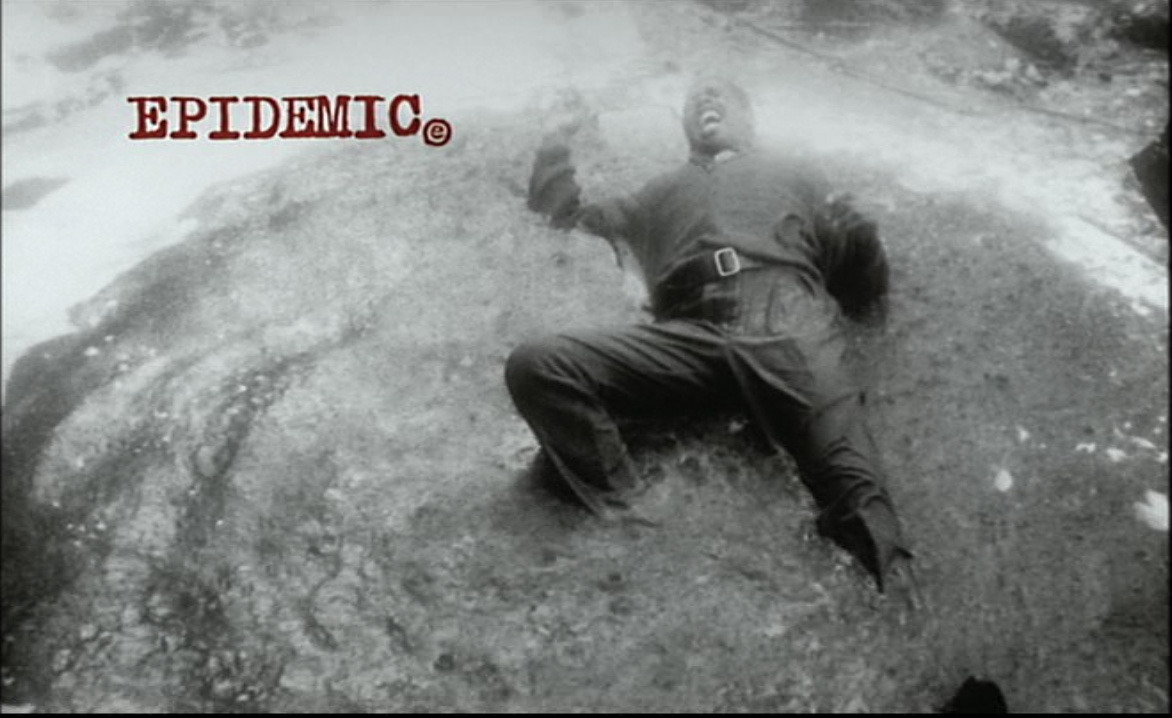
You could also argue the eighties pop song at the end credits with heavy handed lyrics co written by von Trier is also a sour note, but it comes off as strangely endearing in a curious film. Epidemic is, despite its few flaws, actually a really unique gem which defies genres in its structure. Part of it is a lo-fi drama; some of it is a post-apocalyptic film in a minimalist style. Aspects like Udo Kier's scenes blur fiction and reality, and I haven't even mentioned the film's title is permanently etched on the top left corner of shots like a watermark, a curious creative choice some might find distracting but has a personality to it as a creative decision. The film, if it has a theme, is the power of creativity as ultimately the fake epidemic becomes real. Whilst over-the-top, the finale involves a woman brought into a hypnotic state to see the world of Epidemic with her own eyes, turning the film into a horror film as a result which gets hysterical in tone and certainly ends the story in a memorable way at a dinner party.

In terms of idiosyncratic filmmaking, it is an achievement in how unconventional it is. Lars von Trier, for his flaws, has thankfully never had a film which he made just for money or is truly dreadful, even a lesser known work like The Boss of It All (2006), a comedy, being a lo-fi production where the camera was programmed to hot how it liked in a form of controlled visual indeterminacy. Epidemic, from the challenge of its own low budget, became a story of two creators (played by the actual figures) trying to hastily create a work. A question to how accurate it is to themselves is to debate - I hope so for Niels Vørsel its exaggerated for this version as, whilst it has a sick humour to it, the tangent where he posed as a teen pen writer to American teen girls, whilst never played for sexual connotations but Vørsel having to play a teen in his thirties, has aged in a way where such scenes might not be funny to many anymore.

But, hey, if there ever was a director who was a critic of himself before there was a line for his detractors, it's Lars von Trier. There's a sense, credible, when Epidemic does become a horror film that its narrative is how these two men, von Trier and Vørsel, are complacent to the horrifying power of their craft. Its telling, probably in the most poignant scene in the film that even though he eventually accepts the offer, when von Trier has the chance to see an autopsy at a hospital for "research", he looks on at a male human body without excitement. Not distressed, but distant. Blurring genres, the film's narrator warned us the world here would end in an epidemic. Befittingly von Trier made his self referential film about film making one where that means little when a super disease takes central stage, growing boils and all, naturally becoming a greater concern that a movie deal with a Danish film producer.

Abstract Spectrum: Lo-Fi/Meta
Abstract Spectrum (High/Medium/Low/None): None


Saturday, 21 December 2019

Nocturne (1980)

From https://a.ltrbxd.com/resized/film-poster/8/7/8/7
/6/87876-nocturne-0-230-0-345-crop.jpg?k=1005b08286


Director: Lars von Trier
Screenplay: Tom Elling and Lars von Trier
Cast: Yvette as The Woman; Solbjørg Højfeldt as The Telephone Voice

A little review, for a ten minute student project of the notorious Danish director I do love even if von Trier can be his own worst enemy. Most people reading this, if not all, will know Lars von Trier and at least a film of his, even one of his infamous non-cinematic events especially at Cannes Film Festivals. Nocturne, if the audio commentary from von Trier and Nocturne's editor Tomas Gislason for Tartan Video is right1, was where "von" even comes from, not his actual name but apparently added when asked by those as the film school to obscure his name.

Nocturne is a curious and imaginative experiment, non-narrative based but you can create a semblance of a plot. Of a woman who now lives at night and as a result finds the sunlight painful, going to fly on an airplane in an act with someone else's involvement that might change her life. The opening, where a masked man leaps through a glass window at her, an ambitious moment executed perfectly, suggests a trauma which has left her psychologically scared, and as we see her nocturnal apartment, she lives in an isolated and claustrophobic place. Her weakened and nervous mood, played by "Yvette", suggests a shell-shocked and emotionally damaged woman.

In knowledge of its roots, it's a credible sight of von Trier's ambitions, creating atmosphere heavily indebted to the likes of Andrei Tarkovsky. Von Trier also wanted to make Nocturne with the idea of extreme symmetry with lines in the images onscreen drawing the viewer's eyes. The slates of windows, straight lines of the bed and objects on furniture, an extreme symmetry even where the actress had to contort herself to his request to follow the layout of the world around her, a clear picture of that even when he co-created the Dogma 95 movement to remove his artifice, von Trier has always been obsessed with rules and constructing his films' forms as much as the content. This short not surprisingly fits the world that his E Trilogy had - Elements of a Crime (1985) and Europa (1991) rather than Epidemic (1987) - of incredible, precise artistic production which came after this short film.

It's as a result felt like an actual nocturnal dream, a haze of recollection arguably helped by the stuttering of the images as, whilst preserved, a cleaned up negative of the film never existed, only one where lines occasionally appear on the images or they themselves stutter as pictures rather than moving sequences. The flaws of the production as much as the deliberate ones, be it matching a watch being matched to a church dome to a superimposed background image of birds behind the actress, all creation a lucid potent creation.

And undeniably, early on in his career Lars von Trier shows he is a great director even though he can dig himself into holes in the content he has in his later years. He takes risks, always has admirably but I am aware with the likes of Nymphomaniac (2013) (the split two halves, not the five hour plus director's cut) that he's taken to shock value and unintentional silly ideas in the desire to prod human behaviour, a factor that whilst he's capable of incredible dramas and genre films is something that could always undermine him. Its why explicitly a work like The Kingdom series (1994-7) is one of his best productions, needing to be remembered as his intelligence is match by more emphasis on his incredible style then stumbling into poor arguments. And the thing is, despite his notoriety he can be self critical and humble, so he might not be that offended by this review if he ever learnt of it; he'd probably have a few more things about this short that anyone would've like to heard about.

Abstract Spectrum: Atmospheric/Psychodrama
Abstract Rating (High/Medium/Low/None): Low

From https://d13ezvd6yrslxm.cloudfront.net/wp/
wp-content/images/nocturne-lvt.jpg

=============
1) Nocturne was an Easter Egg for Tartan Video's release of the E Trilogy, one of two I only learnt of in 2019 and is something I'm blessed to have learnt as, alongside Images of Liberation (1982), they're additional films and worthwhile discoveries.