Showing posts with label Director: Ken Russell. Show all posts

Sunday, 17 January 2021

The Lair of the White Worm (1988)


Director: Ken Russell

Screenplay: Ken Russell

Cast: Hugh Grant as Lord James D'Ampton; Amanda Donohoe as Lady Sylvia Marsh; Catherine Oxenberg as Eve Trent; Peter Capaldi as Angus Flint; Sammi Davis as Mary Trent; Stratford Johns as Peters; Paul Brooke as Ernie; Imogen Claire as Dorothy Trent

A Night of a Thousand Horror (Movies) #210/An Abstract Film Candidate


If we begin with the source of this film, The Lair of the White Worm was Irish author Bram Stoker's last novel. Whilst it has the original template of that novel, based off the legend of the Lambton Worm whose evil (and followers) terrorise the locals in this story, this adaptation alongside modernising it also greatly deviates greatly. Stoker' novel is weird, bearing in mind it was released in a truncated form as well, including significantly more dead mongoose than the sole one you get in the film, and a whole bizarre subplot where a character becomes obsessed with floating a kite outside his house, which is important to the novel's finale. It is also unfortunately racist, entirely because the character Arabella March, the antagonist, has an African manservant named Oolanga who, by characters and the author, is called racist terms for description and is a completely gross caricature of evil from a racial bias. Thankfully, in his modernisation, Russell scrapped that character and effectively made a Hammer horror film is he perverted one.

He is colouring carefully between the lines, under the watchful eye of Vestron Pictures (who would later fund his D.W. Lawrence adaptation The Rainbow (1989)), but he finds ways to get away with material within these confines, his adaptation repurposing the main concept of the Lambton worm. The "worm" (i.e. dragon) is real folklore, involving a worm-like dragon which was eventually slain by a figure named John Lambton, a folk song by C. M. Leumane re-told and played in character by a band in the beginning of the film to set up the context. Here, a young Peter Capaldi is Angus Flint, a budding archaeologist from Scotland who finds a strange skull in the land. A young Hugh Grant early in his career is Lord James D'Ampton, an ancestor of the figure who originally slain the worm.

Of note is that Russell, who felt the source material was a disappointment from Stoker1, really deviates from the source completely, including how it comes to the female villainess, here now interpreted into Lady Sylvia Marsh (Amanda Donohoe). Marsh is the mysterious figure who, with intent on the sisters Eve Trent (Catherine Oxenberg) and Mary Trent (Sammi Davis), who run a bed and breakfast, is very early on established as both the villainess and half-snake, an immortal figure who allows Donohoe to seductively and gleefully chew scenery between seducing boy scouts and spitting poison on crucifixes with hallucinogenic properties. The film is Donohoe's by a country mile, making the idea that they had originally considered a young Tilda Swinton for the role, who declined it, even more surreal in hindsight2.

An intrinsic sense of the absurd is found here, and the crude intermingles with it in a full embrace. For the most part, this is a straight forward horror film, one you could easily have had Hammer make in the sixties with Peter Cushing and not a lot of it would have to be changed, even that this revolves around a cult of snake people who can add more to their side through "snake vamperism" and their bites. Russell, the notorious scallywag of films as strange as Lisztomania (1975) when he had carte blanche, had always been absurd or with his serious work being transgressively exaggerated, even here with a wink and a nod with all the snake and phallic symbolism, from hosepipe to Donohoe playing snakes n ladders with a victim.

Even in this film as well, you witness some bizarre moments befitting the director. Wishing to evoke The Devils (1971) and having discovered green screen technology, you get video effect freak outs to tell the back-story of the LambtonWorm in hallucinations, including spiked fake phallus, and a scene of a giant white worm wrapping around Christ as Roman soldiers terrorise and rape nuns in front of video toaster imposed fire and Donohoe cavorting around nude or a snake woman. Or the dream on an airplane as Hugh Grant watches Donohoe and Catherine Oxenberg as stewardesses wrestling each other and a phallic use of a red marker pen.

This is not a film from the mad, ambitious seventies or early eighties of Russell, as in spite of all I have described this is still restrained compared to other work. Not long after this, excluding Whore (1991), he would move on to television but also a lot of ultra obscure projects, on Uri Geller film, an appearance on Celebrity Big Brother and films shot in his own garage. So, in his attempt at a mainstream horror film, you see as much one of his last hurrahs too, taking this template and giving it a nice shot in the arm with his eccentricities.

Abstract Spectrum: Exaggerated/Weird

Abstract Rating (High/Medium/Low/None): None


=======

1) Bless the people making old copies of Fangoria available until collections are publically available.

2) Based on information from the Trailers from Hell commentary by Vestron executive Dan Ireland.

Wednesday, 28 October 2015

Halloween 31 For 31: Trapped Ashes (2006)

From http://www.creepercast.com/wp-content/
uploads/2014/03/trappedashesposter.jpg?b76ae6
Directors: Joe Dante, Ken Russell, Sean S. Cunningham, Monte Hellman, John Gaeta
Screenplay: Dennis Bartok
Cast: John Saxon (as Leo); Jayce Bartok (as Andy); Henry Gibson (as Tour Guide); Lara Harris (as Julia); Scott Lowell (as Henry); Michèle-Barbara Pelletier (as Natalie)

Another anthology but unlike The ABCs of Death (2012), there's only five segments including a wraparound tale to tie it all up. This is closer to the template of the anthology genre, closer to camp fire tales or a short story collection in paperback form where short films are connected together by the already mentioned wraparound, usually designed to both bookend the stories and have a plot within it that splits off into each one. The anthology, if multiple directors and/or writers are involved, can allow them to experiment or take a shot at a high profile piece. If its from one set of creators only, it can either be a way to use good ideas that may not necessarily work for a whole ninety minutes or as productions which can bring in a variety of actors and talents. You can go as far back to Waxworks (1924) for an early example, but the heyday for these films were the sixties and seventies, where there were even non-horror anthologies where directors like Jean-Luc Godard and Federico Fellini were hired to create a segment.

Trapped Ashes is an oddity though - shelved for a long time, it's a Japanese co-production I suspect was as much for a Japanese audience considering the amount of Japanese producers and technical crew on the project, including music from Kenji Kawai, most well known in the West for his acclaimed scores for anime like Ghost In The Shell (1995). Three of the directors are cult figures, Sean S. Cunningham a smaller cult figure with immense importance for what he produced as well as that he directed, and John Gaeta was known for the visual effects for films like The Matrix (1999), making his filmic debut here. The film was co-produced and had its stories written by Dennis Bartok, former Head of Programming for the American Cinematheque in Los Angeles

From http://www.deadchannels.com/images/Trapped-Ashes-Wraparound_-_.jpg
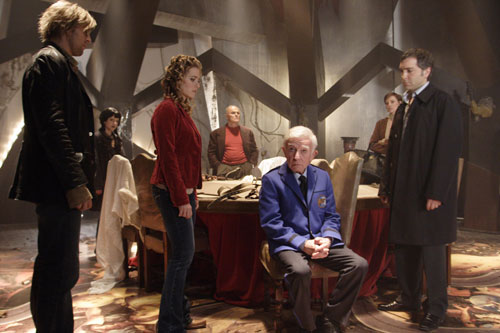
"Wraparound" (Dir. Joe Dante)
Trapped Ashes is set up by a group of visitors to a film studio being trapped in a haunted house stage set from an old horror movie. Their guide (Gibson) recommends they replicate the story of the film by recounting their real life horror stories to each other, each playing themselves or having a representative in the tales. Dante's segment in all its pieces is really just set up, which is disappointing considering his reputation. I've still not watched a lot of his work - though Gremlin 2: The New Batch (1990) is a magnificent thing to behold - so all I can say is that he was stuck with a perfunctory and practical aspect of the anthology only lifted up by the impressive set design and John Saxon being amongst the cast.

From http://1.bp.blogspot.com/-4G7XqtPa_QY/UuDmnYoEhmI
/AAAAAAAAAeU/5EQwL8EuWzw/s1600/Trapped+Ashes.png
The Girl With Golden Breasts (Dir. Ken Russell)
Actress (Rachel Veltri) recounts how, desiring more roles in films, she got breast implant surgery only to find that the innovative and natural implants she opted for had a vampiric tendency to them. Russell is an unsung gem in himself, his excesses as rewarding and at least as entertaining as his best work like The Devils (1971). That many of his films are mishandled still today or are unavailable makes my passion for his work more stronger. That said, I realise that after the late eighties is an unchartered territory I may be baffled by, reminded of my experience with The Fall of the Louse of Usher (2002), one of his last films, shot in his garage, which only the most hardcore Russell fans would like. I'll be honest in saying The Girl With Golden Breasts, one of Russell's last ever works, is cheesy and for the sake of tastelessness than anything substantial. Vampiric breasts, a plastic surgeon's building that's a shrine to the mammary gland, and photos of botched implants, all of which amongst the many things meant to be crass on purpose. That the short ends with Russell himself in a cameo wearing a wig and having a pair of falsies pretty much states what to expect. The short exposes a problem with the entirety of Trapped Ashes in that the cinematography is very bland, and while I hate blaming a single person, I cannot help but wonder what the decisions of cinematographer Zoran Popovic were as all the directors involved, including one making his debut, would have had very different styles. Because of this, the short suffers further in being merely an exceptionally silly story.
Abstract Spectrum: Psychotronic
Abstract Rating (High/Medium/Low/None): None

From http://drunkenzombie.com/blog/wp-content/uploads/
2013/07/trapped-ashes-toon.jpg
Jibaku (Dir. Sean S. Cunningham)
Cunningham, director of the first Friday the 13th (1980) and producer of Wes Craven's The Last House On The Left (1972), gets the segment in this Japanese backed anthology set in Japan itself. A married woman Julia (Harris) recounts a vacation to the country where a student monk hangs himself in a graveyard. He comes back from the bed, seducing her with the intention of dragging her into the Jibaku, Buddhist hell which for anyone who's seen Jigoku (1960) should evoke many gristly things. Sadly the flat visual look makes the segment feel like it's been filmed in the US instead with Japanese actors brought in, but this does try quite hard at something interesting in its story. It also manages to the most transgressive segment of them all; I did not expect to speak about necrophilia again in this season after Nekromatik (1987) but it gets depicted in Jibaku with suitably gristly eroticism. The short also uses animation, from a Japanese studio, to depict things that might've been too expensive to attempt and to add some additional luridness to the material. In fact, while no way near as explicit, this animation does evokes Urotsukidoji: The Legend of the Overfiend (1989) only with a gender swap.  Because of this sort of content, trying to stand out, this is one of the stronger shorts of the whole film.
Abstract Spectrum: Grotesque
Abstract Rating (High/Medium/Low/None): None

From http://www.festival-cannes.fr/thumb.php?sourceDirectory=/assets/
Image/Direct/&sourceFile=015469.jpg&predefinedSize=fiche_film_header
Stanley's Girlfriend (Dir. Monte Hellman)
Hellman has his own cult by himself, more known for other types of genre cinema, like Two Lane Blacktop (1971), westerns and the infamous Cockfighter (1974). Stanley's Girl itself, while again blighted by the flatness of its look at times, is the strongest segment and the least expected. Saxon's character Leo, a film director, recounts how his younger self (Tahmoh Penikett) had a friendship with a fellow filmmaker Stanley Kubrick (Tygh Runyan), Kubrick at this point has made films like Killer's Kiss (1955) and The Killing (1956), and just before he would go into exile in England, he met and fell in love with a young woman (Amelia Cook) who may be more sinister that her confident, erotic personality may suggest. The idea of a character drama based upon a legendary film director is a bold one. There's a danger in films referencing films where it becomes trite and egotistical for me, as it feels like in other parts of Trapped Ashes, but Stanley's Girlfriend was a pleasant surprise, something very different to find within a horror anthology and rewarding for this reason.
Abstract Spectrum: None
Abstract Rating (High/Medium/Low/None): None

From http://images4.fanpop.com/image/photos/18800000/
Luke-in-Trapped-Ashes-luke-macfarlane-18831480-700-377.jpg
My Twin, The Worm (Dir. John Gaeta)
The cocky, opinionated Natalie (Pelletier) tells of when she was conceived, a tapeworm growing in her mother's body at the same time of the pregnancy that couldn't be removed whilst the child was in the womb. As a result, Natalie grows up in her infancy and childhood thinking of the parasite as a twin sibling, desiring to call upon it when, after his father leaves her mother, she finds herself bullied by his new girlfriend. It's an interesting, dark fairy tale which with a few tweaks would've stood out further. It does suffer from lacksure CGI in depicting the daughter growing in the womb as well, and the flatness of the cinematography is a shame when, partially set in an American winery ran by French immigrants, this story could've done even on a low budget with a more evocative and idyllic sheen to it to mix with the grimness of its later content.
Abstract Spectrum: None
Abstract Rating (High/Medium/Low/None): None

Personal Opinion:
The finale of the wraparound and the film itself turns into a twist from the page of a certain Amicus anthology movie I've seen, very reminiscent and sudden which changes all the stories. Trapped Ashes however in general, like this twist, is a little disappointing in how it suffers from a lot of unused potential. Hellman's segment is a fascinating curiosity, and the others have plenty of interest, but it does feel impoverished at points to a negative point. Ending on an unexpectedly evocative and great end credit music by Kawai, this track suggests this could've been even better rather than flawed ridden if entertaining feature it turned out to be.