Showing posts with label Director: Carmelo Bene. Show all posts

Friday, 23 April 2021

One Hamlet Less (1973)


Director: Carmelo Bene

Screenplay: Carmelo Bene

Based on a play by William Shakespeare

Cast: Carmelo Bene as Hamlet; Luciana Cante as Gertrude; Sergio Di Giulio as William; Franco Leo as Horatio; Lydia Mancinelli as Kate; Luigi Mezzanotte as Laertes; Isabella Russo as Ophelia; Giuseppe Tuminelli as Polonius; Alfiero Vincenti as Claudius

An Abstract Candidate


For his last theatrical film, Carmelo Bene after the likes of Oscar Wilde and Jules-Amédée Barbey d'Aurevilly came to William Shakespeare. Starting as he means to go on, the Italian theatrical director/actor and filmmaker begins with father's ghost floating by at the moment a murder transpires, during a scene of sex on the beach at night for the first scene, with poison poured into the ear of the soon slain king post coitus as Claudius takes the crown in grainy black-and-white photography. Bene is sadly a figure whose work has not been as well known outside his homeland of Italy. As much of this, with One Hamlet Less a prime example, because his films are alien beyond the late sixties and seventies period of world cinema where experimentalism was rife and their types of experiment, to be frank, are from the period. However in terms of grandstanding, distinct and unique voices, Bene's should be more readily heard as, already audible if you can catch him, his is a compelling one as he completely dissects and breaks the Danish tragedy into pieces of his own. 

The world he depicts is over the top. It is of multicoloured costumes with big shoulders, big hats and cornettes on women, glasses which cause one actress to have eyes which are big and bug out, and where the sets, excluding the use of an actual beach, are usually white theatrical spaces with giant walls of stacked books usually the main set decoration. All his films have unique aesthetic looks, given them all character. The one aspect which may put people off, openly admitting this now, is that most of the female cast are nude, with the camera emphasising this at times, and this is the one thing which, for a film I am going to lavish praise on, is going to cause me to roll my eyes too. He has had nudity in other films, but the others have had their distinctions, whilst here it does come off as ridiculous, mainly because it does come off as emphasised rather than for the purposes in his other workl. Aside from this, the world of a Carmelo Bene film is something spectacular. He is not really the same as Ken Russell, nor Federico Fellini, and even his acting for Pier Paolo Pasolini contrasts two very different filmmakers. Even his films have unique looks to each other though they all embrace the artificial and theatrical, as this world's white sets contrasts the proto-neon hues of Salome (1972), a film even with its female nudity was more profoundly classical as it was almost eighties no wave homoerotic camp in hindsight.

Whether you need to have read Hamlet or get the basics will help, but suffice to say, the key is that this follows the basics and deviates considerably after which. That Hamlet is a Danish prince whose father was slain by Claudius, the uncle taking the throne and remarrying his mother. Hamlet, becoming mentally unstable or acting it out, bides his time in the court until he can progress in his plans, but here the film drops a lot beyond this, including the eventual plan for revenge. The result, then, is Hamlet if you know the text but not even then as you would know it, going as far as having Sigmund Freud, the famous psychologist, in a role as an unseen narrator who whispers his theories on the Oedipus complex (the son murdering the father, sleeping with the mother) over scenes. Or at least his stand-in, as it is actually Polonius as Freud who torments Hamlet so, as much here Hamlet is a man just wishing to stage plays as he is the Danish prince of the Shakespearean narrative. Hamlet has to play the part of the origin figure too, go insane and have his erotic desires blurred between Ophelia, his potential love interest, and his mother Gertrude.  As much of this version is a joke, a parody, as it is taken seriously, even with the conclusion for Hamlet himself an anti-climax in a graveyard.

Ridiculously gaudy, One Hamlet Less however has a deliberate gaudiness, theatrical costuming which is as much artificial with over pronounced shoulders on costumes and, for female cast members, not even anything barring headdresses and skirts as it is the heightened acting. There is a noticeable homo-eroticism, Rosencrantz and Guildenstern in their cameo very youthful and attractive men with pronounced red lips and make-up, to the point it comes apparent they have been actresses in fact or swapped mid-film on purpose1. Moments of this eroticism at least showing more than the moments where the camera pans on the bodies of women which causes you to cringe, particularly as in the era of codpieces this is more internalized through the fabric.

There are scenes in the real world, particularly a beach where a graveyard has been dug into the sand, where the skeletons are brought up by the sea waves, but it is mostly staged bound sets with economic but vividly distinct sets, a huge factor to Bene's style. It is, like the other films, a dense kaleidoscope work that with patience grows in weight, Bene liking dialogue which is not natural, heavy in intellectualism, and at times shouted or practically belted out of actors like mad people. Alongside the frantic editing, his work is as much to cut and match between shots, to blind the viewer in the madness of his kitsch take on the Kingdom of Denmark, where even origin source text in this particular film in his career fits his world.

Kitsch it not an insult as, far from a surface irony, Bene's take is serious and sincere, appropriate that in Shakespeare's tale, of a nobleman who plans to take vengeance of the betrayal and murder of his father, a chaotic mass of backstabbing and politics is depicted with this hyper-coloured delirium. Hamlet whilst set in a location became its own realm outside of reality to place various meanings on, so as Hamlet here pretending to be mad wanders sets that vary between late sixties pop art and a medieval film about to kick into disco. It befits the depth of darkness is portrayed here in bright illustrious colour, and in terms of the many adaptations of Hamlet, stranger exist even in mainstream pop culture when Arnold Schwarzenegger played a version of the Danish prince for a one scene joke2. The abrupt tangent to Arthurian legend, whilst the most difficult thing to grasp, even fits the tone and Bene for me as an actor is exceptional, the centre piece who keeps this working. He can go for the fence with his delirium but, as his first film Our Lady of the Turks (1968) attest too, even that is a fine art. It is telling, in the most sobering scene, he acts out one of Hamlet's most famous sequences and dialogue, the "alas poor Yorick" lines with the court jester's skull, with utmost quiet sadness and then escalates his voice louder when his Hamlet laments his place and death.

Just screenshots would be enough to show how interesting the film it. Women, laid on a white seat with dresses who hoop skirts make them look this living Christmas tree decorations, or with giant balls as improvised skirts to sit behind; anachronistic luggage cases everywhere; night scenes full of rows of candles (touches?) burning in the open air; a happy, cheery brawl to the death with a morning star spilling blood, played out like a game of tag over and around multi-coloured spheres in a white set; and enough textures to saturate the eyes, mind and thoughts. Naturally like Bene himself, it is beautiful and at times insane looking, striding through scenes agonizing on their existential existence as the film itself darts between the various figures of this weird world. Contextually, even as the shortest and in many ways least erratic of the films I have seen, this is arguably the one you try afterwards when you are accustomed to Carmelo Bene's work. It is still a brilliant piece of the whole body of work.

Abstract Spectrum: Heightened/Kitsch/Weird

Abstract Rating (High/Medium/Low/None): Medium


=======

1) Rosencrantz and Guildenstern also go with a bang, liberally changing the source text, before you ask.

2) Last Action Hero (1993).

Wednesday, 13 May 2020

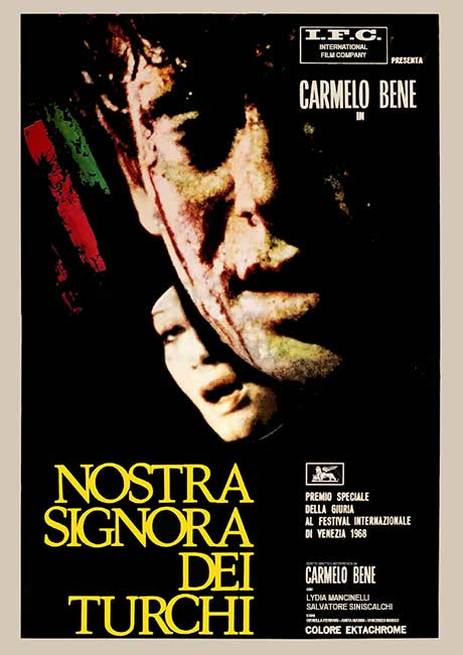
Our Lady of the Turks (1968)


Director: Carmelo Bene
Screenplay: Carmelo Bene
Cast: Carmelo Bene as The Man / Narrator; Lydia Mancinelli as Saint Margareth; Salvatore Siniscalchi as The Publisher; Anita Masini as Holy Mary / The Woman

[Plot Details and Spoilers]

All careers begin somewhere, and the cinematic debut of Carmelo Bene as director was here. I had thought to my surprise, in lieu to his future trademark of hyper-exaggerated acting and artificially rich environments, of how subdued the prologue is. This will change, but Our Lady of the Turks for a large portion of its length is a calmer production, beginning with the narrator (Bene himself) elaborating the tale of the Martyrs of Otranto, inhabitants of the Salentine city of Otranto in southern Italy who were killed on 14th August 1480 by an invading Ottoman force who took the city, described here as being massacred as they refused to convert from their Christianity to Islam. From here, Bene builds to a delirium very common to his other work but with a different tact.

In this context provided by his voice over, Bene plays a nameless man, a personification of a figure whose bones are part of their surviving form, the Cathedral of Otranto having the bones of the martyrs built into an alter of skulls in their memory, Bene a man who prayed to the Madonna during the Ottoman force's attack. In this form however, said man is now a figure who wanders both the landscape and between time, in the modern day region of Apulia, Italy and in the past including as a knight. Bene has used real locations later, but it is a jolt to see him use far more naturally decorated locations, including the startling sight of the Alter of Otranto housing those skulls, and environments whose natural lightning and form are a vast contrast to the sensitory overloading stages of films into the seventies like Salome (1972).

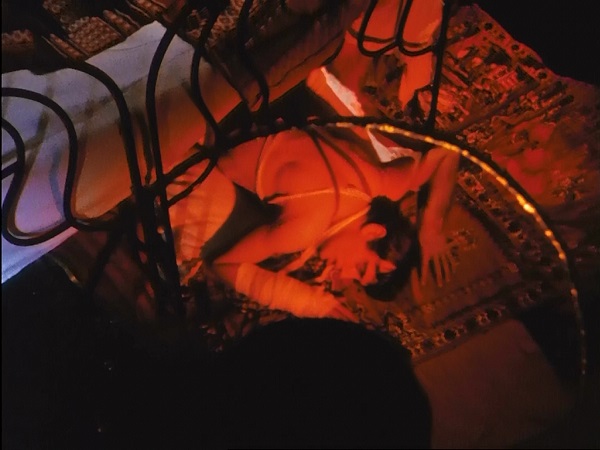
The pace is also more subdued for a long time, taking its time to escalate as, in the midst of his aimlessness, the Man has rejected his initial faith and is even trying to flee the Madonna he once beckoned to, something which is proven difficult for him as he manages to court the influence of the of the female saint Santa Margherita (Lydia Mancinelli), who is there under the presumption that under her (wire) wings and halo he can become a noble figure. Plot wise, it is a film of tangents, including a period of trying to publish the writings he made of her to a publisher and being stricken by an illness which proves a hindrance to Margherita's desire (and romantic interest) in this lowly mortal and his holiness. Eventually, finding a way with her influence to effectively get his leg over with a woman, proves the breaking point for her in this relationship.

It is a difficult film eventually to grasp, at least within one viewing, as it shudders into tangents and extremes. Our Lady of the Turks even passes into territory with Bene playing Carmelo Bene, at least evoking the real man as audio of an interview is eventually heard about his relationship with cinema and desire to break from Italian neo-realists like Roberto Rossellini. Reality is disrupted anywhere between his sleep being intruded upon when his bed is unexpectedly near pedestrians and a passing car, or when (using a very grotty stove) he looks like he is injecting heroin (or something) into a buttock in the middle of the outdoor area at a cafe. He even hunts down and shoots himself in one of the first scenes of the film after the prologue, imagery which can be interpreted many ways but could be seen the fragments of this figure, clearly a soul lost in purgatory as his remains are in the Altar of Otranto, stuck in the scenario of not wanting Santa Margherita to follow him but that, if she leaves, he will die fully and she will not be allowed by up-above to resurrect him.

If there is any coherent through line to what any of this means, one monologue does grow in hindsight, where Bene in voiceover talks of how rarely people see the Madonna, that "idiots" who see the Madonna become her, a madness which brings them to a saintliness inside themselves, whilst those "idiots" who do not wander from alter to alter, to people and women, trying to find her, possible to get to Heaven but (as perfectly used as a metaphor) like dragging oneself to the gates with one's feet amputated, the onlookers looking on at the blood trail behind oneself and realising that will eventually prevent a person from getting there. Religious faith is, truthfully, a subjective thing and, if one believes in Gods, a very unpredictable thing which does not come to one's disposal at a beck and call at a moment's notice, not even needing to be more than a subtle change of mood anyway and not requiring a burning bush unless to get the message across in very significant situations. 


In his character's rejection of Catholicism and his roots, and knowing the director-writer-star is Italian, a Roman Catholic country, I cannot help but see the one clear plot thread in this having a greater weight, the utter difficulty of raising oneself to a holistic good or a holistic virtue an issue, even if he was not rejecting it, found in how the Man succumbs to temptations and dicking about to a Saint's frustrations. Ironically, at the moment when he rejects her, the Man finds the Madonna, and she is not a vague figure constructed from puritanical objectification either. She is not perfect, hinting that she was not a perfect person even in Heaven but getting sainthood still means she at least earned it, a sympathetic and beautiful figure with her homemade (theatrical stage) prop halo and wings who is disappointed that her knight figure. Whilst it might have been a blasphemous scene on purpose, the moment she first appears it is very much implied Santa Margherita sleeps with him, the next morning undressed in his bed baring her halo reading a fashion magazine and smoking. It also offers something sweet in itself, a Saint who is still human, still has desires and is depressed when he is eyeing another woman instead, but still earned the halo.

It is to the point she has decided to tow along with this shambolic "jerk", even taking a boat and rowing it for him as they travel over the sea, only to have the Man find an excuse to merely shag a woman, a homely earthy figure with infant who is just an innocent bystander in his madness and not villainized either. In fact, the earthy description is more than apt, she is literally shot bare breasted as a figure of Mother Nature at one point in a disorientation close up from inside the soil upwards, a figure of beauty too. Literally, at one point he is the knight, his soul trapped in the bones preserved as decorations in the Altar of Otranto, just wanting that same woman to release him, to bury his bones, but that is just a ploy to seduce her.

The sequence that shows the breaking point for this character of the Man, and how far he has gone, capable of some humanity but also lost permanently, is also evidence of how good Carmelo Bene in terms of his performance and sustaining such a hyper intense acting style, when he eventually becomes two people briefly, an older monk and a younger one, not depicted in duplication technique but Bene acting out both by himself, occasionally with a fake beard to differentiate the two. Acting like this is not giving as much deserved respect as it should be, as to even perform at this level of intensity regardless of the type of film would be difficult and a strain physically. It is a frenzy onscreen here, this character reduced to a gibbering idiot, between a cruel and older figure who lashes out at the other and that younger monk who squeals in pain between the pair trying to eat. By this point, the aesthetic from its naturalistic locations has aspects that are utterly grotesque and grim, the least sanitary cooking stove in any film at least witnessed here, whilst Bene shows both an incredible way of cracking an egg on his own head, without looking the yolk, only to start eating it raw when his monk character is meant to be making an omelette. It is a cacophonous sequence, played by only one man who sparks with a thunderous, scary energy.

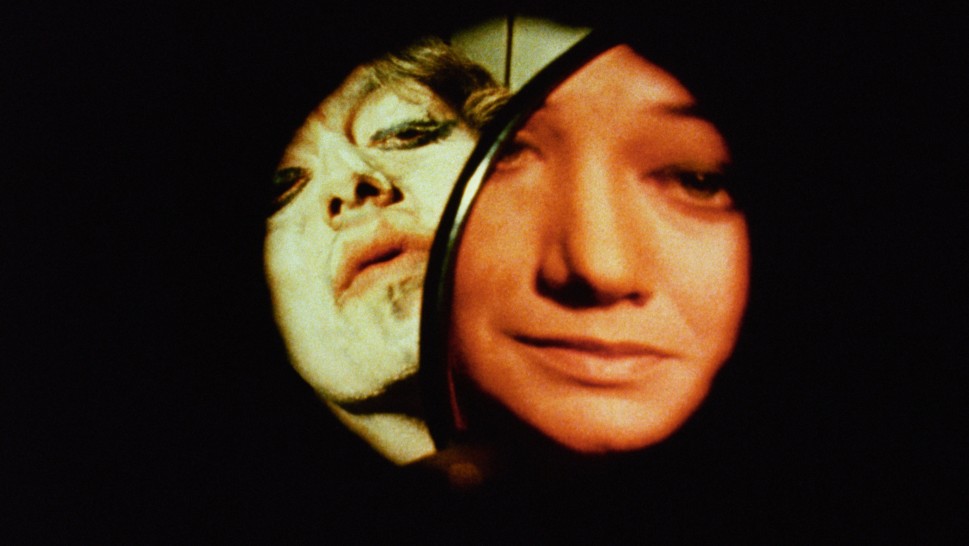
The production has a heavier reliance on real life locations - in the middle of the day in idyllic locations no less too - which changes Our Lady of the Turks from Carmelo Bene's later films. Those later productions had a tremendous visual palette but an artificial one, the aforementioned Salome even predating eighties underground films like Dr. Caligari (1989) for neon colours, or One Hamlet Less (1973) being a work of elaborate costume and visual work. The greater emphasis here on naturalistic and ornate set design is a striking change, especially as Bene eventually shifts the tone to a far more grimier and gothic tone, even himself transforming at one point in a revenant like figure with eyes rolled back into the head and affecting a cavernous voice. It lives up to his intensity still, and you will eventually find one lost in the delirium, but the change in aesthetic allows this film to have uniqueness among his filmography.

Out of all of them, Bene's debut was successful in terms of that, at the 1968 Venice Film Festival, Our Lady of the Turks won the Special Jury Prize, sharing it with the Robert Lapoujade film Le Socrate (1968). The Special Jury Prize is just below the main Golden Lion that was won by another director not easily available as he probably should be, West German figure Alexander Kluge for a collage structured film about circus performers Artists Under the Big Top: Perplexed (1968), which I openly confess to have never have heard of before researching this. Considering the competition had Pier Paolo Pasolini's Teorema (1968), who Bene would be cast in his 1967 adaptation of Oedipus Rex, and John Cassavetes' Faces (1968), that was a pretty big success for Bene to have accomplished1.

It's worth mentioned Amos Vogel's Film as Subversive Art (1974), as if anything is partially responsible for these reviews, that and all the podcasts and tomes championing cult cinema made an impact for myself in combination with Vogel's championing of subversive and unique productions. Seeing the image of Bene in the book, as that almost undead figure with the pupil-less eyes, I did not realised that, in a bizarre future, I would be watching this unique film on Amazon Prime streaming, but the aura around this film has thankfully become even stronger as a result of actually seeing this. It lives up to that initial discovery, the text review of the book I found in the university library, and a reminder of this very different era of cinema of the sixties and seventies that Carmelo Bene existed in. He could be able to create an almost improvised, stream-of-consciousness like tale like this with this level of theatricality. It is apt to talk of his career from the first film as, by the late seventies to the end of his life, he would be mostly filming TV movies and documentaries after a fever dream of films to 19732. He started here perfectly, with Our Lady of the Turks, and Bene would not disappoint after his initial success either.

Abstract Spectrum: Avant-Garde/Delirious/Intense/Surreal
Abstract Rating (High/Medium/Low/None): Medium


===
1) Whilst IMDB is not always reliable, their source as of 10th May 2020 [HERE] also had Maurice Pialat's first theatrical film L'Enfance Nue (1968), D.A. Pennebaker's concert film Monterey Pop (1968), and films by Miklós Jancsó and Juraj Jakubisko among those screening. Time has made other films more acclaimed since the decades have passed, but it's fascinating in itself to see such idiosyncratic productions jostled together like this, causing one to wonder how in the future Cannes and Venice Film Festival premieres of the 2000s and 2010s will be seen.

2) All, having yet to see Capricci (1970), deserving a box set that both art house and cult cinema fans would by enraptured by.