Showing posts with label Letter: V. Show all posts

Tuesday, 25 March 2025

Venus in Eros (2012)


Watched Saturday 15th March

Director: Takako Imai

Screenplay: Takako Imai

Cast: Miyavi Matsunoi as Venus (as Saori Hara), Alan Vincent as David, Martin Collins as Eros, Michael Barnes as Forest Lover Michael, Kavana Crossley as Angel Kakabel, Darren Ellis as the Sculptor, Daniel Fontannaz as Angel Gabriel, Carl Harrison as Forest Lover Carl, Freddie Ingles as Angel Michael, Alex Kovas as Venus Maniac Alex, Stefan Leadbeater as Angel Sariel


"A hundred years ago, in a deep forest" opens a film about a status of Venus, which is also one of the obscurest films I've wanted to track down and see at least once, being a nightmare to do so despite being a British-Japanese co-production which would have made it least have a slither of availability somewhere. Honestly, probably the thing that didn't help the film is that it feels like a low budget artistically minded production which is fully committed to its niche concept, something which contrary to suggestions in image of a softcore film is very artistically minded instead.

The story begins with its director, Takako Imai, which immediately presents a layer to the production as the vision of a female artist, born in Japan and moving to London, who worked as a music journalist but would go on to make a couple of films. This theatrical length film is the last of two, the shorter production Recordare: Days of Remembrance (2009) the first, which is a prelude to Venus in Eros as a collaboration with dancers in acting roles, depicting a romance between two men involving dancers from the Matthew Bourne Company1. Hers is absolutely a set of films belonging to this era, especially in the 2000s, of fascinating melding of cinema and other art forms, installation artists to dancer choreographers who took advantage of both the film making industry of the 2000s and, in other cases, the DVD medium when that was a popular way to make these projects available. Venus in Eros, far from an erotic film, is closest to the films on DVD I was lucky enough to see through my university library, be it the sole official release of Mathew Barney's Cremaster films, a segment of the 2003 Cremaster III dubbed The Order - Cremaster 3, and the work of Wim Vandekeybus. For the later I'm pulling from a really obscure figure from my memory, and old notes of what I've watched over the decades I've no shame I collect, especially he's the perfect comparison for Venus in Eros.

Vandekeybus, a Belgium choreographer, director and photographer made a series of dance based films over the years my university kept in a luxurious box set they acquired, and the difficulty with tracking down Venus in Eros comes with the realisation this belongs to that era of cinema, the art gallery and art installation area of moving images which, particularly in the 2000s and continuing in the early 2010s, was taking advantage of limited edition runs of DVD-only releases. The British Film Institute, even releasing a few in their early years of the DVD boom only to be more picky in the later years, have had these as well in their stores too, and whilst Venus in Eros is more sexually explicit, it fully fits into this type of artistically minded lower budget production if more likely to be lost in the cracks of cinema for the worst. Considering its initial tone, driven by its opening classical piano music over country woodlands in winter, the production from its poster and some screenshots online will jar for those expecting (or wanting) something salacious.


The most explicit thing comes from its central premise of living statues, particular a depiction of what will become the Venus de Milo, a legendary statue created in Hellenistic period which is iconic in having lost its arms in time. Because of the obscurity of this film, this review will be full spoilers to give you at least an abridged form of what Takako Imai's film is, a fantasy romance using dance to tell its tale, where Venus has her statue erected in the woodlands, there through all the seasons back to the next winter. Soon into the story having a statue of David one side to her, likely inspired by Michelangelo's legendary creation, the other of Eros the other side, the Roman counterpart of Cupid, both played by male actors body painted and erected as statues played by real people. The most explicit aspect, which makes the female titular lead a braver role, is that like many statues, their depictions of the likes of Goddesses to nymphs to leaders never shied away from natural nudity, and having seen statues in their real marble form, they are an incredible art form even from sculptors who are unknowns in their painstaking craft of human anatomy, something which this also plays too in turning real people into these living statues, blurring these lines.

The more lurid aspect of what this done, a casual eroticism but like a form of naturalism for the female lead, is the actress comfortable enough to take this lead, even if meaning being nude in full stone-grey body paint and standing still on a podium, being German-Japanese actress Miyavi Matsunoi. That is neither a criticism of her, nor her career choices in her career before this production, but central to images you find online, the immediate thing you would learn of her career before this makes this film a fascinating contrast to her previous work, when you learn of her career and that this became effectively a retirement from said turn in her early career. Miyavi Matsunoi, real name Saori Hara, whilst she would expand her career out into the live action tokusatsu, like the film Garo the Movie: Red Requiem (2010) as a villainess, and a later Garo franchise television series, started her career as a pornographic actress and model before moving into more mainstream films with the likes of Yuriko's Aroma (2010). Probably the most widely known film of this era would be Hara's role in 3D Sex and Zen: Extreme Ecstasy (2011), a remake of the notorious 1991 film Sex and Zen but now in 3D, which marks the moment where she fully leaves the adult industry in Japan entirely for the rest of her acting career. She is the central figure of this, and this marks a fascinating conclusion as an adult film actress and erotic model. With a film that premiered at the Cannes Film Festival in its market2 and, through a female director's camera, her natural sensuality is used in a very humane and matter-of-fact way for its love story. Certainly, considering there are points where she has to stand still in the full statue makeup in real snow and very cold temperatures, I have to admire Saori Hara going through this shoot before leaving anything erotic in her career for good for more mainstream productions for the rest of her career.

The film, bilingual in least the form I saw it, with written English text onscreen initially for Venus' thoughts, English dialogue and Japanese text onscreen to translate said dialogue, is a simple depiction of a romance that suffers through angst before it can reach a happy ending. It involves as well a male and female caretaker for the statues as, from winter to the next one, Venus and David out of their statue forms in scenes in their own reality start to fall in love, whilst Eros the archer looks on lovesick for Venus himself but not of interesting for her at all. The film, which has some of the performances struggle a little, and long moments of contemplation of these statues and the natural landscape, got a particularly damning review back when it premiered at the 2011 Cannes festival, from Hollywood Reporter's Duane Byrge, who described that the "best venues might be side rooms in under-funded museums" and that the natural shots could be "cut and re-marketed as screensavers"2. Those who could actually see the film may admittedly think the same thing, if his comments come off with cheap snark in that review, particularly as the cheap jab at museums does admittedly evoke what the film's tone clearly was as well as feels like an elitism against an area of moving images, whether good or bad, which is badly maligned in access or reporting.
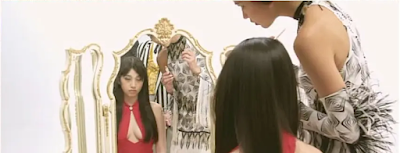

The contemplative attitude of a few museum and art film DVD productions from that era I've seen if felt with this, those shot on the cameras of the era, with simple stories which are tent poles to place their contemplative moods, as it builds over the romance between Venus and David as Eros the archer looks on with a broken heart. The statues themselves are interacted with as if living people - there's a playful humour, especially in the spring section, where you've a young boy trying to get the statue of Venus to eat a vanilla ice cream cone, played off as a living statue without any sleaze involved whatsoever. There are also scenes outside of time which turn the statues in living people, alongside the caretakers, where the dance sequences come in. They are not elaborate musical number dances but symbolic choreography for the emotions of the moment, the most prominent in the summer section. Showing a more explicit version of Venus, Saori Hara plays a version closer to Sandro Botticelli's The Birth of Venus, without the giant clam and having veils instead of the longer hair in the painting. The scene involves her being dressed and helped to become human by the rest of the cast, from having make up applied to her face to being helped in learning to walk in high heels, all with the others on a white stage dressed in period costumes.

The film depicts most of the romance in choreographed dance, like the performance on a black stage between Venus and David, and applies to the conflicts too. Eros, eventually snapping unable to have Venus as she falls for another, eventually takes it out on the male caretaker, and this is the one sequence which requires a trigger warning, as this caretaker with an arrow in his back takes it out on Venus herself. The removal of her arms, with intercuts of her struggling under him as a person, in a dance choreography as a person, explicitly nods to the act as a sexual assault. The film could be criticised for how this concludes - the caretaker's cruelty, including drawing a blue tear on her cheek out of pure spite afterwards, becoming immediate remorse - but in knowledge of its female creator - Takako Imai, who is entirely on Venus' side, the depiction of her transformation into the Venus de Milo is entirely depicted with the weight of a horrible transgression of her as a being, which is treated as seriously as that should.

Some of the performances, as said, waver in quality in the line readings but suspecting the focus on casting actual dancers in these roles, it feels less meaningful to criticise and appreciate what the point was behind the choices. For me, Venus in Eros does succeed by its end, which makes Takako Imai's vanishing from filmmaking a disappointment. She had a project BBoy in a Dream, which was meant to be a documentary about breakdancing, a fascinating turn in her clear interest in dance as an art if it had ever come out. The film started shooting in 2014, but there's hope, doing an interview in closer or within 2024 about her career so far1, one where she talks of how breakdance was added to the Paris Olympics for 20241, giving hope that this ten plus year project finally comes to light and Imai herself wasn't put off as a creator in the moving images field. By the time winter to winter passes in Venus in Eros, where we even get a Christmas tree, Venus in a Santa top, and a boys choir in the snow saying Merry Christmas to her, we get a small story of love, conflict around love, and its eventual success which in its scrappiness as an unconventional art piece won me over. Lightning and a downed burning tree may knock over and leave Venus a lifeless statue, but as her male lover takes her somewhere safe in the woods as spirits, a happy ending is found in the end as the credits (in Japanese) are over the tranquil landscape.


=====

1) The Very Personal Reason Behind Takako Imai’s Breakdancing Documentary BBOY IN A DREAM, written for The Fan Carpet.com, and marks itself as posted in 2024 was references to the 2024 Paris Olympics.

2) Venus in Eros: Cannes 2011 Review, written by Diane Byrge for the Hollywood Reporter, and published May 31st 2011.

Wednesday, 16 October 2024

Visible Secret (2001)


Director: Ann Hui

Screenplay: Abe Kwong

Cast: Eason Chan as Peter Wong Choi, Man Kin-fung as young Peter, Shu Qi as June / Wong Siu-kam, Kelly Moo as young June, Anthony Wong as Wong-lin, Sam Lee as Simon, James Wong as Lo Kit, Wayne Lai as Peter's brother, Kara Hui as Siu-kam's mother

A Night of a Thousand Horror (Movies)


As a young girl, June (Shu Qi) saw a man is decapitated on rail lines, played by Anthony Wong, and whilst everyone was horrified by the body briefly wandering about headless, she learnt she could see ghosts when she found his head. Just because you can see ghosts however does not mean June has other problems to deal with, like ex-boyfriends, let alone when the karaoke room she wishes to use is haunted. A horror comedy, but with an emotional edge, it is noticeably by Ann Hui, an acclaimed female director whose career was sadly not that wildly available in the United Kingdom considering how well regarded she already was by this film in her long career. Behind such films like Boat People (1982), a sombre drama part of her acclaimed set of films about displaced Vietnamese refugees, she is also evidence of how Hong Kong filmmakers have developed the ability to switch genres with ease. Some legends found niches - John Woo with the heroic bloodshed genre, Wong Kar-Wai with doomed romances - but even those two examples changed tact and even genres occasionally in their careers too. In the case of Visible Secret, Hui is behind the camera for many dramas in her career, but has also made action films, comedies, and already had a film about people being able to see ghosts decades before called The Spooky Bunch (1980). By itself, it is noticeable how Visible Secret feels of its own in terms of mood and tone within a new decade.

You can see that, for a comedy, it plays with a sense of quiet emotion only to puncture it with moments of slapstick, ghoulish humour and bleak humour, where soon-to-be-fired hairdresser Peter (Eason Chan) encounters June during a one night stand together and find them entangled in each others' lives. Emotions are interrupted by how he lost his job, though the boy finds it cool to see blood even if it is his own, or the likes of one's uncle, meant to be in an old folk's home, appearing covered in red paint claiming to be attacked by ghosts and trying to bite someone's nose off. The possession of a single mother by two ghosts, arguing over the body within a spectacle of physical comedy for one of the film's stand out sequences, is contrasted by the sad final discovery after that sequence, and that tonal shifting by screenwriter Abe Kwong plays a huge part to the entire production. The drama is there, and many scenes this absurd humour is contrasted with sudden emotion, as Peter finds himself encountering the world of the supernatural, both learning too late people he has crossed paths with are already dead, or struggling through those many possessions and hauntings he encounters with June by his side. As the pair of slowly falling in love, June herself is not exactly as comfortable with her gift either, able to see the dead through one eye. Shu Qi stands out just in terms of her gothic appearance as the character, and the playfully flighty attitude June has at her happiest, but she also plays a young woman struggling with the sights in general, and is very captivating as the awkward co-lead with Eason Chan.


The world they exist in is also very distinct in terms of aesthetic. Of the early 2000s, with its digital effects and visual look, the film has an appropriately washed out mood to its urban landscapes. Colour is here, vibrant still, but within a Hong Kong city that feels stepped in melancholia and alienated young adults, it feels apt that among its docks and markets there are all the ghosts wandering about with all their stories. Random possession by a female ghost in a toilet, who committed suicide due to being jilted by a lover, makes sense with matter-of-factness in context to this world. Even when it has the least excepted reference to a Toblerone I was expecting to see, which would be unintentionally funny in another context as a Swiss chocolate popular in my home land, that is brought up in a deeply emotional meeting between son and his father that, seen twice in two different ways, is one of the scenes with the most heart in both versions. The comedic tone at times throughout Visible Secrets is clearly being used to emphasis the dramatic weight of its themes of loss and mourning.

In a world of muted green and blue lighting, the obvious theme for a story like this, with the ghosts when they possess people, is all the emotions and rage they dealt with in their lives they cannot get rid of. This is especially in mind to two of them being women spurned by men and heartbroken, and Antony Wong's character, whilst not returning in the full flesh, being a prologue figure important to the latter act but whose gruesome demise is entirely a bad luck of the draw in how it transpired. There is even a charlatan exorcist who finds himself embraced in June's case despite his open scepticism to his work, which just emphasises the tone and mood perfectly of the entire film, where the supernatural passe
s the weird lives of the living like ships passing in the night.

There is the one aspect of the film which may divide viewers thought, and that is the twist ending. To spoil two films at once - [Huge Spoilers] this is the same twist The Sixth Sense (1999) by M. Night Shyamalan had [Spoilers End]. It is on one hand a huge emotional gut punch, if one which has the potential to a) add a greater weight to scenes when revisited in terms of how characters interact, or b) just cause a tangled and confusing mess to rationalise it all. Taking it for what it is, then worry about this, it is the last dose of melancholia, emphasising the humour in Visible Secrets, even its scares, were always taking the backseat to the emotional drive of the film. It is for that reason, if with a caveat depending on the individual viewer's reaction to that twist, mine to the entire production was an admiration of Ann Hui's film in its entirety.  


Thursday, 10 October 2024

Vampire Princess Miyu (1988-89)


Director: Toshiki Hirano

Screenplay: Shō Aikawa

Based on the manga by Toshiki Hirano and Narumi Kakinouchi

(Voice) Cast: Naoko Watanabe/Anne Marie Zola (Manga UK dub)/Pamela Weidner as Miyu; Mami Koyama/Stephanie Griffin as Himiko Se; Kaneto Shiozawa/Zach Hanner as Larva

A Night of a Thousand Horror (Series)/A 1000 Anime Crossover

The personal project of its director Toshiki Hirano, as he is one of the co-creators of the source manga alongside his wife Narumi Kakinouchi, this definitely wins you over with its style and in terms of its melancholic tone. For the OVA anime period, it stands out for this, if with the issue like a lot of them that this feels slight for a premise which could have been taken further. This is emphasised when you know the original manga, not including the spin-offs, lasted from the year this anime was created to 2002.

Tellingly he would return to this in the late nineties for a full animated television series, but for what we got here, including the episode following the students being turned into marionettes which turned into the most successful story for its tone and emotional turns, I was glad to finally get around to this.

For the full review, follow the link HERE.

Thursday, 8 August 2024

Versus (2000)


Director: Ryuhei Kitamura

Screenplay: Ryuhei Kitamura and Yūdai Yamaguchi

Cast: Tak Sakaguchi as Prisoner KSC2-303, Hideo Sakaki as The Man, Chieko Misaka as The Girl, Kenji Matsuda as Yakuza Leader with butterfly knife, Yuichiro Arai as Motorcycle-riding yakuza with revolver, Minoru Matsumoto as Crazy yakuza with amulet, Kazuhito Ohba as Yakuza with glasses, Takehiro Katayama as Red-haired assassin, Ayumi Yoshihara as Long-haired female assassin, Shōichirō Masumoto as One-handed cop, Toshiro Kamiaka as Samurai warrior, Yukihito Tanikado as Cop with Barrett

A Night of a Thousand Horror (Movies)


Why did I hate a film once made with hard work and independent grit, a two hour epic combining martial arts, splatter horror and post-Matrix cool? Apparently, because a younger self could not appreciate such good aspects, thus providing evidence youth does not mean good taste. There is unfortunately details I came to learn in regards to this production, which is not the fault of Versus but the inherent problem with any work with people involved who can reveal through themselves the ugly side of human beings, that I had to begin this review with and will have to talk of, as these came like sudden thunderbolts to learn at the worse time, when coming finally around the Versus as a film. As a film itself, this tragic detail is a shame as I can at least appreciate now that Ryuhei Kitamura put his time and effort into this project, one which was a difficult production just from the decision to make it an outdoor shot in the woodlands, liable to constant issues of weather conditions and practicality in getting through the shots with expected strain. Based on a mid-length film before, a lower budgeted project Down to Hell (1997), he took the idea from that of woodlands where those killed within its unholy grounds immediately return undead, and expanded upon it in a film which spun away from a sequel to its own concept. One evoking Lucio Fulci's The Beyond (1981), and its lore of gates directly to Hell, but specifying that there are 666 of them confirmed in Kitamura's world, and at the Forest of Resurrection where this film is set, this has the 444th.

The premise is very simple, and with hindsight, one can envision Versus, as a true independent production, as being the equivalent of a lot of micro-budgeted films from the West, usually shot in VHS in the past, which showed its creators wanting to make the films they grew up watching. The only difference with this was how it was able to put together production to create something very elaborate, one which managed to breakout to a wider audience through film festivals and distributors, in the case of the United Kingdom riding the wave of interest in Asian cinema into the 2000s that distributor Tartan Films made a huge part of their DVD era, with the Tartan Asian Extreme line this belonged to. Like a micro-budget film, the premise is simple, that two convicts have escaped the law, one of our lead and the closest with an actual name as Prisoner KSC2-303, played by future actor star Tak Sakaguchi in a breakout role. The set up is that these two convicts where to met a group of yakuza, only for this to immediately go south when they argue and the leader of the yakuza is killed, immediately bringing to their concern the forest they have chosen to meet at having rejuvenating properties. They have a woman they have kidnapped, played by Chieko Misaka, in tow, and there will be more goons, and two cops, one not impressed his severed hand was still connected to KSC2-303 by handcuffs, the other a braggart who yet has access to a cannon masquerading a long distance rifle. A big bad, set up in a chambara period prologue, is pulling the strings with intentions to unlock the powers of Hell's 444th gate for himself. Neither helping anyone but this villain is that this forest was where the yakuza were dumping their victims quietly in, leading now to there being undead who still had their firearms on them when buried and attempt to still use them.

Sadly this is where what was a celebratory review, with a sense of humour, has to nose dive into reality. It can sadly be confirmed that said villain is played by Hideo Sakaki, a prolific actor and director after this for film and television, who was arrested for accusations of sexual assault in 2024, part of a series of accusations Shukan Bunshun weekly magazine reported in March 2022 about him coercing actresses in sexual situations under the pretence of helping their careers1. Sadly lead Tak Sakaguchi is connected to another scandal, all connected to a huge MeToo movement which began in the Japanese cinema industry in the late 2010s, where he was directly connected to allegations connected to Sion Sono. Unfortunately, this is a director I had immense fascination in for films like Love Exposure (2008), Sono having allegations of sexual harassment published by a Shukan Josei PRIME article from April 4th, Tak Sakaguchi apologising for his part in luring a woman to Sono in one incident2. Details like this unfortunately make it difficult to engage with any production, worse in this case as this is your two lead actors, but this is sadly what happens with hindsight, a film left stranded in the past in knowledge that those involved can be alleged, or in the case of Hideo Sakaki arrested, for undefendable crimes, squandering artistic creativity in favour of absolutely indefensible actions if proven true. I could not consciously ignore this, even if this leaves a bitter taste to the review from onwards, which is a shame as everything else in context to this film is fun and entertaining, and do deserve their place in the sun as someone originally not a fan of Versus, only with this happy ending having a bitter undercurrent too running side-by-side.

Versus itself, back to the film itself and its virtues, was made with overt interest in international cinema as Ryuhei Kitamura, trained in filmmaking whilst living in Australia, wanted to make the films he liked, not only the older action films from Japan itself which he felt had died out, but also with proud influence from international cinema. This is from action films from the West, martial arts films from other countries, and also the splatter horror of the likes of Peter Jackson's early work like Bad Taste (1987), another homemade low budget breakout hit, to Sam Raimi's Evil Dead films. You can see this was a work of love having to deal with what resources they could access - they had a limited time with certain camera equipment at one point, hence why there are abrupt moments of spinning the camera around with close-ups in style - but this was thankfully the case where the crew and cast were committed to the project. This is not surprising considering the individuals involved in this project that would go on to shape a lot of pop culture into the 2000s. Thankfully, there are individuals in this production without accusations published who have contributed a lot to Japanese pop culture, especially its face in international fandoms. Co-writer Yūdai Yamaguchi is among that trend, that the likes of Sushi Typhoon started to lean into, of unconventional genre mash-ups which were more focused for Western audiences, becoming a director in his own right with the likes of Meatball Machine (2005). Composer Nobuhiko Morino, bring some nineties drum n bass to the proceedings, became a frequent collaborator with Yamaguchi and Ryuhei Kitamura. There is also the figure of Yûji Shimomura, the action director, someone who would become a huge name not necessarily in cinema, but in terms of video games, as the director the cinematic and action scenes for the likes of the Devil May Cry and Bayonetta franchises, a figure in that field who brought a level of spectacle into cut scenes and helped pave their cult statuses for memorable sequences as much as the acclaim of their gameplay.

The slightness of the film in plot, a simple tale of someone who wishes to open the door to the realm beyond death, is contrasted by the sense of personality to the film. The influences are seen, between a sword being held in the air like the Highlander films, to a Peter Jackson Brain Dead (1992) era joke of someone having their head punched through, with the camera showing us the shot between the elaborately designed (and impressive) special effect. But the sense of humour and playfulness is the film's, even when making jokes of that era of cinema when the first Matrix film was a huge global hit and this is making jokes about the lead not finding any of the sunglasses he finds being cool enough to wear, or that he needs to steal the leather jacket among other clothes of a dead man who stayed so. Versus arguably has a virtue that, even if tragically marked by the sins of those who made it, so many people were involved, and everyone onscreen, even if they do not even have proper names for the characters, has a personality and can heal with issues of watching the film with hindsight to real life. This can vary from the short yakuza, the runt, who constantly has additional firearms on his person even one piece is stolen, and is going full method in acting like a caffeinated ferret, to the cops, one with the issue his primary hand for punching was taken, and the "Expert" who claims to have trained with the FBI, and learnt to be an expert of woodland tracking living in Yellowstone Park in the USA. A personal favourite of mine in the cast, actor Kenji Matsuda, thankfully got a career in the likes of Kamen Rider series and other tokusatsu work, the flamboyant figure as vivid in his performance as the character's suave dress sense, eventually turning into a literal cat-goblin when characters join the necromancer heavy's side. Even what was something I was not a fan of in my youth, the ongoing joke the lead has to knock the female lead out to keep her safe, is contrasted with hindsight with two women in the cast who get to play as tough as the male cast and take part in the fight scenes. These characters may not have as much screen time as hoped, but they all get a scene to stand out in.

 It is a spectacle film, the logical conclusion to every film fan who wanted to make a film in the woods, where everything is based on what is cool. It is not enough to punch a man's heart out, you need to take a bite from the freshly produced object. Swords can have laser sights regardless of their practical use, and everyone manages to find new armaments regardless of how and where they are stored. Even in terms of an actual plot, it is ambitious to cut to a chambara setting for the back-story, and the ending, which is more of a twist for the sake of it, does feel unpredictable. [Huge Spoilers] Considering how it is built up KSC2-303 is not exactly a true pure hero, but an amoral figure with some virtues, it is built up that one day he could just become an amoral figure in another reincarnation who wants to destroy everything, and the villain was at least moral evil. [Spoilers End] Like a few micro budget films, there was an alternative cut, an Ultimate Cut, where Ryuhei Kitamura wanted to improve aspects with some new footage. There is nothing drastic thankfully barring CGI planets in space in the opening with an emphasis over the lead as more amoral than presumed; instead, this version adds some additional scenes which do not jar explicitly new content, some improvements in the practical effects and just a general tweak in places. It is telling though I am happy, now on the film's wavelength, that I am happy with the original theatrical version as is, even if you do get a blood spurt for a decapitation in the original version that is a mere trickle among moments changed.

It also was a happy conclusion as, whilst sadly spoilt be the horrible tales in real life beyond films, it did lead to Ryuhei Kitamura becoming a director for a Godzilla sequel, and even getting to work in Hollywood, the same journey that Peter Jackson would have. That is enough to place a better opinion on Versus, even without the entertainment I found from this with a fresh perspective, as this was the case of one of these home spun films which became a true calling card, and because of this, I cannot hold anything but a positive bias for this film.


=====

1) Japanese film director arrested over sexual assault allegations, published by Kyodo News on February 21st 2024.

2) Sono Sion Accused of Sexual Harassment, published by Arama Japan in 2023.

Monday, 1 April 2024

The Voice of the Moon (1990)


Director: Federico Fellini

Screenplay: Federico Fellini

Based on the novel Il poema dei lunatici (The Lunatics' Poem) by Ermanno Cavazzoni

Cast: Roberto Benigni as Ivo Salvini, Paolo Villaggio as Gonnella, Nadia Ottaviani as Aldina, Marisa Tomasi as Marisa, Angelo Orlando as Nestore, Susy Blady as Susy

An Abstract Candidate


It seems my whole life is just this night.

Federico Fellini's last film, premiered outside the Cannes Film Festival competition in 1990, was tragically dismissed. It never got distribution in the UK until Arrow Video made it their task to release it in the late 2010s finally.

It begins introducing us to Roberto Benigni's Ivo Salvini, released from a mental hospital, starting from one night going on a journey through vignettes. Whilst it begins with a sense of humour, Ivo accidentally wandering into a nephew letting people pay to see his aunt undress, The Voice of the Moon feel streaked in melancholia of a different time. Based freely on a novel by Ermanno Cavazzoni, where Cavazzoni was taking his influence from the writings of real mental health patients, this film comes with the knowledge Benigni's character is a Holy Fool, with a fixation on wells which may pose a danger to him as others watch over him in fear of this, and with all the voices in his head. All we see is entirely subjective from his perspective. He is an outsider who will be ignored, and whilst his journey is brimming in life and vivescent, he is cast off in society alongside others. The first person he encounters demonstrates this: a musician living in a graveyard who found a man randomly eating everything in his kitchen, following by more appearing in his room when he rehearsed forbidden cords.

Ivo is blissful even when thinking of those he knew of who have died, but the world continues around him regardless of his presence, the modern changes to Italy visible in the background as tourists have collected together around the streets in the day, TV aerials are on all the roofs, and washing machines and refrigerators of pure manufactured white are especially everywhere. Against this, the film feels melancholic and eerie, even when Ivo is speaking tenderly of life, realities bleeding into each other especially when it comes to memories of his grandmother, Roberto Benigni playing the role whilst meant to be a child and a young actress is cast as the grandmother.  


The tentative plot is his love for a woman named Aldina (Nadia Ottaviani), as pale with blonde hair as the Moon she will be positioned as later on, trying to return a shoe back to her after an ill advised incident her sister helped with, clutching onto throughout without any true insidious (or unintentionally insidious) aspect to his love for her, almost childlike instead as a crush. The closest thing to another prominent figure, among those displaced like he and seen throughout in reoccurring roles, is a prefect named Gonnella (Paolo Villaggio), shown initially fearing his neighbours will infect him with their old age as an older man himself, made to retire due to his mental health and believe everyone is a spy out to get him, even thinking his own son is a fake pretending to be a son. There is still a light humour, and it is still bawdy, one of the stories is that of the wife whose libido is so strong it lead to an amicable divorce from her husband, who adored the hairdresser's manicurist but could not keep up with someone so passionate the sofa starts steaming up with their embrace and hurdles on literal train lines in one of their many frequent love making rituals. Honestly, where the film was probably dismissed is how gentle it is, following characters and scenarios Ivo encounters without a sense of plot driven melodrama. Considering early in his career Fellini jettisoned plot driven stories for this template which help bring his acclaim, such as with the likes of Amarcord (1973), it does raise the sense Fellini sadly was out of time for cinema in 1990 then the film being flawed in pace or meaning.

The film looks beautiful, Fellini's trademark a baroque maximalism where depicting entire aspects of Italian culture, even its ancient past, were depicted with every detail and every extra having interest to examining them. This was all with a dream logic that explored the "texture" of his worlds whether the internal subconscious of a lead, the environment itself, or both, the gnoccata festival is a good example here. Without the loaded satire of Roma (1972) of the fashion show of priest uniforms covered in neon or riding bicycles on a catwalk, it is still over-the-top in taking the real tradition of a festival based on the food item gnocca, with a crowned gnocca Queen and even mascot costumes of gnocca royalty, done in this case as a loving nod to tradition whilst having a sense of humour.

The film does dangerously get close to Fellini looking at the modern day dismissively whilst lamenting the past, which is righteous when mocking the obsession with fancy new electronic appliances, but with music would veer into closed mindedness of an old man. Thankfully, the sequence when this comes in clearly embraced the spectacle and feels less dismissive, more the lament of everyone charging ahead in the new world without pause for the past from the perspective of those lost from before. That is the discotheque sequence, an awesome scene for Fellini's swansong, of a giant warehouse with towering reflective panelled walls that move on rails, and crowds decked in late eighties fashion. The biggest surprise, which clearly was not a musical licensing issue at all when the film was instead "lost" to lack of interest, is how he managed to get Michael Jackson's The Way You Make Me Feel, off the Bad (1987) album, a huge album and one of its singles which also happens to work perfectly for the sequence itself. The scene, where Gonnella laments the music lost in the past, thankfully does not quash the beauty of this moment, actually evoking what David Lynch does in a set piece for Wild at Heart (1990). The irony is not last as, at that Cannes Film Festival where Fellini's film was dismissed it was Lynch, who admired the filmmaker and would even befriend him, who won their most important award the Palme D'Or for that year with Wild At Heart. Both films have scenes juxtaposing wildly alien fans of a different genre of music, in Lynch's a heavy metal concept, suddenly stop and become an audience for an entirely different reality, time stopping for everything as these youths circle around a beautiful slow dance with an older woman who loved Gonnella despite he being so gone in his conspiracy theories, getting to rekindle that love over a classical piece.

And thankfully, Fellini ends his last film, before his 1993 passing, with the satirical touch he streaked his career with, as whilst politics do not necessarily appear in his films, he did prod follies in humanity continually. Two brothers, set up early on wanting to accomplish this, end up literally capturing the Moon herself at one point, and as crowds gather, priests and politicians intermingle on TV, and it is a world changing event of spiritual profoundness. What happens is that this monumental event is to be ruined by bickering, the Moon getting abuse hurled at it for no reason, and a gun being fired spoiling a profound moment. Fellini still loves humanity but gets a humour in humans being distracted by their own pettiness, rather than enjoy the things in life Ivo as many characters before him had throughout the director's other films, a fitting end to a magnificent career.

Abstract Spectrum: Dreamlike/Eerie/Whimsical

Abstract Rating (High/Medium/Low/None): Low

Monday, 7 August 2023

Vertigo (1958)


Director: Alfred Hitchcock

Screenplay: Alec Coppel and Samuel Taylor

Based on the novel D'entre les morts by Pierre Boileau and Thomas Narcejac

Cast: James Stewart as John "Scottie" Ferguson; Kim Novak as Madeleine Elster; Tom Helmore as Gavin Elster; Barbara Bel Geddes as Marjorie "Midge" Wood


Vertigo was once a critically maligned film from Alfred Hitchcock only to grow into one of his most critically lauded, so much so it knocked off Orson Welles' Citizen Kane (1941) from the top spot of the Sight & Sound magazine poll for greatest film ever made in 2012. That was not exactly an easy achievement to have completed when Citizen Kane was number one before it for five plus decade, and the fact Vertigo has gained this stature is both an achievement but also strange for me when viewing the film. Vertigo is a true one-off deserving to have done this, but it is a difficult film to digest, one which is possible to criticise for being too languid, too obvious and at times too stripped of Hitchcock's precise, expert filmmaking, even having something the director himself considered a plot flaw in how reliant the protagonist’s acrophobia would be for the plot the succeed1. It is also justifiable to champion, even if it involves digging into his own psyche at the same time as a filmmaker, for how alien, disquieting and hypnotic as a film it is. The premise is one perfect for a Hitchcock thriller: when he develops acrophobia and vertigo at heights, San Francisco detective John "Scottie" Ferguson (James Stewart) is forced to retire from his career, but is asked by an old friend to follow his wife Madeleine Elster (Kim Novak) under the belief she has been possessed by one of her late ancestors. The results of taking this job lead to Scotty becoming detached from reality chasing after a woman he falls in love with, one who might not be all she seems. This however leads to a very different result, an unnerving melodrama with vaguely Gothic tinges.

You have to accept a lot of poetic license. That Scotty's vertigo is a MacGuffin. That a major plot twist is shown earlier than it would in any other film, and very obvious if you are attuned to these types of plots, turning the rest of the movie into a type of psycho-dramatic character piece that roots itself into a direction detached from the rational. If you "get" Vertigo's tone and appreciate its crafted elegance, however, it is an unnerving film about psychological breakdown and neurosis, the plot crux more to do with the emotions of two characters, Scottie and Madeleine, who become more emotionally disconnected from reality and pull the rest of the film with them into their heightened worlds. For the moments of lightness that take place, screwball comedy with Scottie's friend and ex-fiancée Midge Wood (Barbara Bel Geddes), who still loves him, most of the film is connected to Scottie almost entirely, onscreen for most of the film in the centre during his descent into dark obsession.  When the film shifts to its second half, the already mentioned plot twist which would usually happen at the end of another thriller is suddenly revealed halfway through with half the film left, leaving Vertigo in uncharted waters where one is disturbed by Scottie's increasingly erratic behaviour after he is briefly hospitalised.

Passages of Hitchcock's career have this film's tone, an odd supernatural or psychological murkiness. Rebecca (1940) is an obvious cornerstone of supernatural melodrama, even Under Capricorn (1949) expressing his interest into slow burn dramas based on hidden neurosis. However even the dream sequence in Spellbound (1945) is safeguarded by the fact, despite being designed by Salvador Dali, that it is a dream whilst Vertigo, despite also having a dream sequence, is entirely in the vague and mysterious. In Vertigo the characters are drawn along narratively by emotions and unseen forces, not elaborate plots of other Hitchcock films, locations such as flower shops, woodlands and a mission called Mission San Juan Bautista all becoming imbued with ghosts of many forms, literally in an image at the ending in the bell tower of the mission. The use of striking colour especially adds to this. Made in the height of Hollywood's Technicolor era, the film is striking in its aesthetic and use of San Francisco locations, but it is especially when you get to the interiors this stands out. Those scenes emphasises the ghostly air from the red walls of a restaurant that is repeatedly entered by the characters and the reoccurrence of the colour green in the second half which purges the world into a sickly obsessive form. It is a deeply perverse film in its themes, carefully dictated by Stewart and Novak, between them managing to keep the film's tone in the right groove, despite the visible age difference, Stewart able to switch himself from the stereotypically jovial and charming man he is seen as in cinema to someone almost shell shocked or a walking comatose, while Novak also has to juggle a complicated role when the film pans out in the end.

Shot in said lush Technicolor by director of photography Robert Burks, a regular collaborator with Hitchcock into the early sixties, Vertigo is as much able to work because the aesthetic of classic Hollywood that the story is depicted through, especially when this takes the studio system style of Hollywood, always evoking for me the sense of the elaborate and stylish, literally the "Dream Factory" creating dreamy films even when shot on location, and undercut it with this tale of obsession. The rear-screen projection for actors driving cars to the colour palettes now become unintentional tools for creating heightened dreams, here becoming more and more unsettling as this narrative of a love for a construct continues. The San Francisco locations, especially the gorgeous panoramas of the sprawling metropolis, add a sense of scale, keeping a Gothic tone for the plot but setting it in a modernist urban environment. Another big contribution to the film is Bernard Hermann's orchestral score, the drama contained in it solidifying the characters' emotions as a lush but far-from-generic score, adding further to the mysterious air surrounding all Scottie encounters and does. That it can switch from the legitimately romantic to the disturbed, and you can pick up the difference in the orchestral instruments and the notes they play, is evidence of its success as a score.


The most openly unconventional aspects of Vertigo are specially created animated sequences. The first is the opening credits by Saul Bass, the title emerging from a woman's eye in extreme close-up, the very modern design of Bass' work for Hitchcock still to this day incredible for their craft but also unique compared to modern title designs still, the use of colour and shape. They become almost avant-garde especially as the credits do not portray anything that takes place in the movie but sets up an unnerving mood it has. The other is the mid-film dream sequence designed by abstract artist John Ferren that takes the same route, flower petals spiralling outward and a figure falling into the void, one of the most iconic images of Hitchcock's career being James Steward's disembodied head staring straight at the viewer which comes from this sequence. It is an iconic image as he is sucked into a mental abyss of his own psyche that he is chained to for the rest of the narrative. It aptly sets up the emotional shock, in the series of events that set up the second half, which will turn Scottie drastically.

Barring its style, including the innovative depiction of Scottie's vertigo, a distortion of our perception as well as his as it is always in first person, cinematic space growing in size without any seemingly actual movement, the rest of the film's unconventional tone is internal. Alfred Hitchcock was a Hollywood director who made commercial films, his auteurism coming from how clear and involved in their craft he was from the get-go of each production, but Vertigo does reach its tendrils into the expressionistic, with its languid pace, in that it is all induced and affected by its characters' minds. When it gets to the second half as Scottie meets another woman similar to Madeleine, the ghosts of the first half change from historical ones to psychological baggage of sexual and gender issues. About a man's memory and view of others becoming distorted and affected as he tries to control and groom this second woman to be Madeleine, Hitchcock was completely blunt about the sexual meaning of this in his interviews with Francois Truffaut, even going as far as say that Scottie was “indulging in a form of necrophilia2, but there is as well the notion of idealism and how it can become poisoned is noticeable. It also cannot be denied that, to an uncomfortable degree after this with his problematic history with Tippi Hedren, Hitchcock himself had blatantly obvious fixations on the idealised woman, and whether he can be defended as an artist for this or not, Vertigo becomes a text unintentionally, but with greater weight, in seeing obsession as a concept for the perfect woman be dissected by its plot.

[Spoiler warning. Skip italicized text if you do not want the film to be spoilt for you]

Adding to this is knowing the woman Scottie is obsessed with is a mere image, a fake stand-in for his friend's real wife in a twist Italian giallo filmmakers would have ran with. The woman he loves manages to die twice in fact, his love only existing for the form of Madeleine, wearing a certain flower, a certain way to their blonde hair style tied up in the back, a certain grey suit dress designed for the film by Edith Head, and an image created based on the real wife, the individual Kim Novak's character actually is and Carlotta Valdes, the ancestor Madeleine is said to be possessed by, amalgamated together. The image of femininity he adored is a mere picture, while the stand-in who promises to love him is rejected for admitting how she is not the Madeleine he wanted and that she was used to trick him into a murder scheme. The "abstract" I am obsessed with in cinema, how I use the word, is as much about the questioning of subjective reality, and the theme of Vertigo of an idealised image, a beautiful woman, being both impossible to be reach and not even existing is a good example of this type of questioning, when the symbols of femininity for Scottie not the woman herself is what he desires. As an entertainment film, this makes the film a cautious tale of this obsession, and that the film is as languid as it is befits this.

[Spoiler ends]

Whilst there would be a film later on which is stranger than this in tone - The Birds (1963) even as a monster film is more stranger and chilling in the baggage it evokes - Vertigo is haunting as an entertainment feature, and as art, because its conceit is about the image one has overtaking reality as Scotty is chasing after a phantom in many a sense. This comes with mind as I have had to gradually warm to Vertigo over the times I have seen it. It does meander significantly halfway through, noticeably slower in pace to other Hitchcock films, and that makes it a film whose acclaim is fascinating in that it shows visible flaws in plotting and pacing that cannot be denied. It possesses something which overcomes this, even if it is unnerving, even before the Sight & Sound polls, back when the film was not readily available to see, causing someone like Brian De Palma to openly riff on the same theme of perception in Obsession (1976), the title spelling out the themes openly. Film critics dug into this film when it was more readily available to see, and what virtues the film has - its performances, the music, the aesthetic style - make what would be a hammy melodrama at points in another's hands enticing as it is disconcerting.


Abstract Spectrum: Expressionist / Mind Bender/ Weird

Abstract Rating (High/Medium/Low/None): Low


====

1) Truffaut, François (1985). Hitchcock/Truffant, Revised Edition. First Touchstone Book Edition. Pg. 247.

2) Truffaut, François (1985). Hitchcock/Truffant, Revised Edition. First Touchstone Book Edition. Pg. 244.

Tuesday, 30 August 2022

Violent Delights (2020)


Director: Edin Martinez

Screenplay: Edin Martinez

Cast: Ana Paulina Martinez as Alani; Guillermo Zapata as Gabriel; Ernesto Salinas as Javier; Jitzel Galicia as Lizbeth; Paola Hernandez as Claudia; Olivia Adriana Pérez as Vania

A Night of a Thousand Horror (Movies)


This was a disappointment. A Mexican made erotic vampire film which plays out as a melodrama in plot, it sounds absolutely to my tastes, and with respect to those involved, shows this at times only to have lost this particular viewer, whilst others may have appreciated its wavelength further. Alani (Ana Paulina Martinez) is a red headed vampire who hooks up and bites on patrons in bars and clubs, connected to another vampire named Gabriel (Guillermo Zapata) she is romantically tied to. He is an older balding lover who has an air of a Satanist even if he was not a vampire, and makes one night stands with younger men potentially more uncomfortable for appearing in the room with nothing below the belt, even when wearing an opened dressing gown, and bringing other women into the room to feed off the blood of.

Alani has her hooks into a young man Javier (Ernesto Salinas) who is an expecting father with his girlfriend Lizbeth (Jitzel Galicia), but it becomes clear Javier and Alani are falling in love much to the anger of their significant others. This is where the melodrama is there, and a thing that I wished had been more prominent through Violent Delights in the end, as whilst Gabriel is a traditional anti-God vampire, he also does not want kids. Even as an immortal vampire, this is something Alani wants. Gabriel instead prefers his theatrical side hobby to children, of an onstage feeding on victims which leaves a lot to be imagined, unless you like languid erotic pawing and reminiscences of Club Silencio from Mulholland Drive (2001), even down to wondering where the singing is coming from.

In a position, of the modern day genre film, of digital filmmaking and its own idiosyncratic chances to be distinct, Violent Delight does at least have its own distinct personality just in its huge emphasis on garish neon colours, but honestly, a lot of my issue with this is that, as a horror drama as Javier is being seduced by Alani, but will lead to a grotesque tragedy, it feels conventional and too serious at times from what the tone would ask for. And it does get grotesque, including a scene which requires a warning involving a foetus being brought to the night's air which is extreme. But barring that this does have a vampire ripping his own skin off, involving a lot of goo and Vaseline, this feel conventional even in terms of its desire to be shocking and upsetting in the final act.

It did feel like by the halfway point, I had drifted off, in mind to this being entirely subjective opinion. There is in the film something distinct to it, even in terms of its enclosed, even claustrophobic settings swallowed in the colour lighting scheme, from apartments to bars, and as an erotic vampire film, which equal opportunity nudity, that in itself even if pure titillation has its own mood setting whatever the type of film and from what era. This is a film whose most prominent scene, and the one which catches you off-guard in a good way, and sets the profane tone off in a way that should have been continued, is when Gabriel is trying to seduce and corrupt Lizbeth 's two female friends. It is not that one is turned into a vampire, wishing to feed off the other, but the joke which comes out of nowhere beforehand involving a clitoris cake of all things. It looks as delicious as it is anatomically accurate, truthfully, and that alongside a vampire ripping his own skin off should have set the tone of the film fully.

Maybe this was the case of being in the wrong mood, but there was a sense that, even when Violent Delights was being transgressive with its finale, in its death and blasphemy and the foetus scene, it was doing something obvious rather than escalating this to a tone I would have liked. The tone comes closer to the 2000s into the 2010s transgressive horror film, in its tone, than the histrionics melodrama this did hint at early on. That type of "edgy" film is not as interesting to me, this production's seriousness to its detriment as embracing a campier side as colourful as the lighting scheme would have won me over.

Friday, 3 December 2021

The Violent Years (1956)


Director: William Morgan

Screenplay: Ed Wood Jr.

Cast: Jean Moorhead as Paula Parkins; Barbara Weeks as Jane Parkins; Arthur Millan as Carl Parkins; Theresa Hancock as Georgia; Glen Corbett as Barney Stetson; Joanne Cangi as Geraldine; Gloria Farr as Phyllis; Lee Constant as Sheila; I. Stanford Jolley as Judge Clara; Timothy Farrell as Lt. Holmes

Ephemeral Waves


Something from a different era - when teenagers were a new concept, drive-in films exploited trends like this, and or an entire sub-genre based on juvenile delinquency existed. In this particular example, from this point, you have Ed Wood Jr., the notorious director/writer of Plan 9 From Outer Space (1957), with his own take on the JD genre, but he is not the director. That would be William Morgan, a veteran of the likes of westerns and crime films though predominantly an editor in his career. As a result, whilst the resulting film is a lot of dialogue in static shots, not only are the flourishes of its screenwriter still there, but this is instead a pulpy story told by a director which strips away some of the touches Wood was notorious for as a director, his improvisations and on-screen mistakes, providing an interesting result. Its lack of Wood's more over-the-top flourishes is not to be complained about when the film is still this entertaining combining Wood and Morgan, with the added touch your lead Jean Moorhead was an early era Playboy centerfold.

More so as this is interesting is that, not tackling male teen delinquency as was common in this genre, even by Hollywood itself as an influence with Marlon Brando and The Wild One (1953), this is about young hoodlum women. Their stylish hairdos and skirts belay how dangerous they are as, led by thrill seeker Paula Parkins (Moorhead), the girl gang will gladly dress as men to rob a petrol (gas) station and nearly kill the gas attendant with a harsh thump to the head with a pistol barrel. Whilst the film does not have a lot of time to work with, it is rewarding in how, as a film recovered by Something Weird Video, this is as entertainment but a short, sharp shock to take in, as very much an artefact of its era, but an interesting one as a Ed Wood film not quite an Ed Wood film.

It is obvious, but well addressing, that this is from the type of exploitation film which sold themselves as moral tales to inform the audience, but was sell the lurid content at the same time. Here, the film in a book end structure in a court room in the aftermath of the narrative, you get a long monologue for a need for more family values, returning to the Church in belief, and taking kids to the woodshed more often, i.e. the punishments banned over the decades after as child cruelty. This is ironic knowing who the screenwriter was, Ed Wood Jr. an outsider let alone in mind to his pleasure in dressing in women's clothing contrasting the fifties values this film ends on a sermon of. Exploitation films themselves as a premise, especially this older type, were as much with morals to avoid getting into trouble for their salacious content, which this could be the case of too.

Here especially, there is something subversive about three female teens being degenerates, even with their perfect fashion and cars of the era, more so as whilst the film condemns teenage hedonism, it really hates bad and neglectful parenting. Lead Paula is frankly sympathetic, despite the film and her behaviour, the daughter of a male newspaper man and a socialite mother whose parents will not even clear their schedules for her birthday. The weird thing with Ed Wood is that, goofy as he was with his dialogue, he did try to be serious, and sometimes it hit in poignant ways as here. With one scene at a "sleepover" with men, he gets one of his best pulpy moments just with Paula admitting she is a person with everything, always a new car on her birthday, but lonely and attention seeking in a destructive way as a result.

At unless an hour, it cuts the fat off everything, but it is in itself full of idiosyncrasies, such as the plan for cash that leads to the gang's downfall, to trash their school, being hinted at as being anti-Americans or likely communists having contrasted them through another. And even today, there is the guttural shock, in spite of admitting sympathy for the lead gang leader, that this has a scene explicitly hinting at them deciding to rape a man off-camera. As they hold up a heterosexual couple, and tie the girlfriend in the car, stealing her fleece whilst they are at it, it is unexpectedly dark for this type of film to have that implied, as it a lot of the content still being about delinquents nearly killing gas station attendants or them even getting into a shoot out near the end with cops. More so as women as, even decades later, perceived gender biases of this era make this image of these women being aggressive and armed more striking. It is both the sort of film John Waters should have remade in terms of its inherently transgressive camp, but also, even in terms of moments like Paula getting intelligence on the police from a father all too willing to dish out confidential info, is the kind of film of its era of pulp, exploitation and Woodian curiosities. It is a movie which even as an okay film in terms of a narrative movie, but with unexpected levels of contextual baggage to consider.

Even how bleak the ending is, where life and death are literally exchanged but with no one redeemed in the eyes of the law, is something easy to forget for a film from this era. This is in mind of being one of many exploitation films like this, based on old tropes like the crime genre, likely made by people such as director William Morgan who worked in these genres decades before, which continued into the fifties in spite of there being other genres like sci-fi films, and still adding their fingerprints in the newer types of films which had new types of content and tones within them. Certainly, in terms of Ed Wood, this is honestly a minor work from his canon, in terms of not being the full experience of his idiosyncrasies as a director too, being restrained for him even as a script writer. In terms of being Wood being more straightforward as a result, this is however with its content something fascinating to see for a nice contrast.