Showing posts with label Dance Film/Musical. Show all posts

Tuesday, 25 March 2025

Venus in Eros (2012)


Watched Saturday 15th March

Director: Takako Imai

Screenplay: Takako Imai

Cast: Miyavi Matsunoi as Venus (as Saori Hara), Alan Vincent as David, Martin Collins as Eros, Michael Barnes as Forest Lover Michael, Kavana Crossley as Angel Kakabel, Darren Ellis as the Sculptor, Daniel Fontannaz as Angel Gabriel, Carl Harrison as Forest Lover Carl, Freddie Ingles as Angel Michael, Alex Kovas as Venus Maniac Alex, Stefan Leadbeater as Angel Sariel


"A hundred years ago, in a deep forest" opens a film about a status of Venus, which is also one of the obscurest films I've wanted to track down and see at least once, being a nightmare to do so despite being a British-Japanese co-production which would have made it least have a slither of availability somewhere. Honestly, probably the thing that didn't help the film is that it feels like a low budget artistically minded production which is fully committed to its niche concept, something which contrary to suggestions in image of a softcore film is very artistically minded instead.

The story begins with its director, Takako Imai, which immediately presents a layer to the production as the vision of a female artist, born in Japan and moving to London, who worked as a music journalist but would go on to make a couple of films. This theatrical length film is the last of two, the shorter production Recordare: Days of Remembrance (2009) the first, which is a prelude to Venus in Eros as a collaboration with dancers in acting roles, depicting a romance between two men involving dancers from the Matthew Bourne Company1. Hers is absolutely a set of films belonging to this era, especially in the 2000s, of fascinating melding of cinema and other art forms, installation artists to dancer choreographers who took advantage of both the film making industry of the 2000s and, in other cases, the DVD medium when that was a popular way to make these projects available. Venus in Eros, far from an erotic film, is closest to the films on DVD I was lucky enough to see through my university library, be it the sole official release of Mathew Barney's Cremaster films, a segment of the 2003 Cremaster III dubbed The Order - Cremaster 3, and the work of Wim Vandekeybus. For the later I'm pulling from a really obscure figure from my memory, and old notes of what I've watched over the decades I've no shame I collect, especially he's the perfect comparison for Venus in Eros.

Vandekeybus, a Belgium choreographer, director and photographer made a series of dance based films over the years my university kept in a luxurious box set they acquired, and the difficulty with tracking down Venus in Eros comes with the realisation this belongs to that era of cinema, the art gallery and art installation area of moving images which, particularly in the 2000s and continuing in the early 2010s, was taking advantage of limited edition runs of DVD-only releases. The British Film Institute, even releasing a few in their early years of the DVD boom only to be more picky in the later years, have had these as well in their stores too, and whilst Venus in Eros is more sexually explicit, it fully fits into this type of artistically minded lower budget production if more likely to be lost in the cracks of cinema for the worst. Considering its initial tone, driven by its opening classical piano music over country woodlands in winter, the production from its poster and some screenshots online will jar for those expecting (or wanting) something salacious.


The most explicit thing comes from its central premise of living statues, particular a depiction of what will become the Venus de Milo, a legendary statue created in Hellenistic period which is iconic in having lost its arms in time. Because of the obscurity of this film, this review will be full spoilers to give you at least an abridged form of what Takako Imai's film is, a fantasy romance using dance to tell its tale, where Venus has her statue erected in the woodlands, there through all the seasons back to the next winter. Soon into the story having a statue of David one side to her, likely inspired by Michelangelo's legendary creation, the other of Eros the other side, the Roman counterpart of Cupid, both played by male actors body painted and erected as statues played by real people. The most explicit aspect, which makes the female titular lead a braver role, is that like many statues, their depictions of the likes of Goddesses to nymphs to leaders never shied away from natural nudity, and having seen statues in their real marble form, they are an incredible art form even from sculptors who are unknowns in their painstaking craft of human anatomy, something which this also plays too in turning real people into these living statues, blurring these lines.

The more lurid aspect of what this done, a casual eroticism but like a form of naturalism for the female lead, is the actress comfortable enough to take this lead, even if meaning being nude in full stone-grey body paint and standing still on a podium, being German-Japanese actress Miyavi Matsunoi. That is neither a criticism of her, nor her career choices in her career before this production, but central to images you find online, the immediate thing you would learn of her career before this makes this film a fascinating contrast to her previous work, when you learn of her career and that this became effectively a retirement from said turn in her early career. Miyavi Matsunoi, real name Saori Hara, whilst she would expand her career out into the live action tokusatsu, like the film Garo the Movie: Red Requiem (2010) as a villainess, and a later Garo franchise television series, started her career as a pornographic actress and model before moving into more mainstream films with the likes of Yuriko's Aroma (2010). Probably the most widely known film of this era would be Hara's role in 3D Sex and Zen: Extreme Ecstasy (2011), a remake of the notorious 1991 film Sex and Zen but now in 3D, which marks the moment where she fully leaves the adult industry in Japan entirely for the rest of her acting career. She is the central figure of this, and this marks a fascinating conclusion as an adult film actress and erotic model. With a film that premiered at the Cannes Film Festival in its market2 and, through a female director's camera, her natural sensuality is used in a very humane and matter-of-fact way for its love story. Certainly, considering there are points where she has to stand still in the full statue makeup in real snow and very cold temperatures, I have to admire Saori Hara going through this shoot before leaving anything erotic in her career for good for more mainstream productions for the rest of her career.

The film, bilingual in least the form I saw it, with written English text onscreen initially for Venus' thoughts, English dialogue and Japanese text onscreen to translate said dialogue, is a simple depiction of a romance that suffers through angst before it can reach a happy ending. It involves as well a male and female caretaker for the statues as, from winter to the next one, Venus and David out of their statue forms in scenes in their own reality start to fall in love, whilst Eros the archer looks on lovesick for Venus himself but not of interesting for her at all. The film, which has some of the performances struggle a little, and long moments of contemplation of these statues and the natural landscape, got a particularly damning review back when it premiered at the 2011 Cannes festival, from Hollywood Reporter's Duane Byrge, who described that the "best venues might be side rooms in under-funded museums" and that the natural shots could be "cut and re-marketed as screensavers"2. Those who could actually see the film may admittedly think the same thing, if his comments come off with cheap snark in that review, particularly as the cheap jab at museums does admittedly evoke what the film's tone clearly was as well as feels like an elitism against an area of moving images, whether good or bad, which is badly maligned in access or reporting.
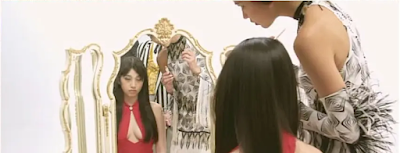

The contemplative attitude of a few museum and art film DVD productions from that era I've seen if felt with this, those shot on the cameras of the era, with simple stories which are tent poles to place their contemplative moods, as it builds over the romance between Venus and David as Eros the archer looks on with a broken heart. The statues themselves are interacted with as if living people - there's a playful humour, especially in the spring section, where you've a young boy trying to get the statue of Venus to eat a vanilla ice cream cone, played off as a living statue without any sleaze involved whatsoever. There are also scenes outside of time which turn the statues in living people, alongside the caretakers, where the dance sequences come in. They are not elaborate musical number dances but symbolic choreography for the emotions of the moment, the most prominent in the summer section. Showing a more explicit version of Venus, Saori Hara plays a version closer to Sandro Botticelli's The Birth of Venus, without the giant clam and having veils instead of the longer hair in the painting. The scene involves her being dressed and helped to become human by the rest of the cast, from having make up applied to her face to being helped in learning to walk in high heels, all with the others on a white stage dressed in period costumes.

The film depicts most of the romance in choreographed dance, like the performance on a black stage between Venus and David, and applies to the conflicts too. Eros, eventually snapping unable to have Venus as she falls for another, eventually takes it out on the male caretaker, and this is the one sequence which requires a trigger warning, as this caretaker with an arrow in his back takes it out on Venus herself. The removal of her arms, with intercuts of her struggling under him as a person, in a dance choreography as a person, explicitly nods to the act as a sexual assault. The film could be criticised for how this concludes - the caretaker's cruelty, including drawing a blue tear on her cheek out of pure spite afterwards, becoming immediate remorse - but in knowledge of its female creator - Takako Imai, who is entirely on Venus' side, the depiction of her transformation into the Venus de Milo is entirely depicted with the weight of a horrible transgression of her as a being, which is treated as seriously as that should.

Some of the performances, as said, waver in quality in the line readings but suspecting the focus on casting actual dancers in these roles, it feels less meaningful to criticise and appreciate what the point was behind the choices. For me, Venus in Eros does succeed by its end, which makes Takako Imai's vanishing from filmmaking a disappointment. She had a project BBoy in a Dream, which was meant to be a documentary about breakdancing, a fascinating turn in her clear interest in dance as an art if it had ever come out. The film started shooting in 2014, but there's hope, doing an interview in closer or within 2024 about her career so far1, one where she talks of how breakdance was added to the Paris Olympics for 20241, giving hope that this ten plus year project finally comes to light and Imai herself wasn't put off as a creator in the moving images field. By the time winter to winter passes in Venus in Eros, where we even get a Christmas tree, Venus in a Santa top, and a boys choir in the snow saying Merry Christmas to her, we get a small story of love, conflict around love, and its eventual success which in its scrappiness as an unconventional art piece won me over. Lightning and a downed burning tree may knock over and leave Venus a lifeless statue, but as her male lover takes her somewhere safe in the woods as spirits, a happy ending is found in the end as the credits (in Japanese) are over the tranquil landscape.


=====

1) The Very Personal Reason Behind Takako Imai’s Breakdancing Documentary BBOY IN A DREAM, written for The Fan Carpet.com, and marks itself as posted in 2024 was references to the 2024 Paris Olympics.

2) Venus in Eros: Cannes 2011 Review, written by Diane Byrge for the Hollywood Reporter, and published May 31st 2011.

Friday, 25 October 2024

The Lure (2015)


Director: Agnieszka Smoczyńska

Screenplay: Robert Bolesto

Cast: Marta Mazurek as Silver, Michalina Olszańska as Golden, Kinga Preis as the nightclub singer, Andrzej Konopka as the drummer, Jakub Gierszał as the bass player, Zygmunt Malanowicz as the house manager, Magdalena Cielecka as Divine Furs, Marcin Kowalczyk as Triton / Daedalus

A Night of a Thousand Horror (Stories)


With animated illustrated opening credits, we are introduced to The Lure, a Polish horror musical which caught a lot of interest, more so as it gained distribution through Janus Films/Criterion as a rare new release from some of the biggest names in distributing and releasing classics of cinema. It opens with two mermaids, Silver (Marta Mazurek) and Gold (Michalina Olszańska), taking interest in humans singing and dancing one night on the beach, joining in the singing and catching all off guard. Obvious, in folklore, mermaids in certain forms lured men with their beautiful singing to their demises, which is something director Agnieszka Smoczyńska and screenwriter Robert Bolesto are going to subvert in terms of the gender stereotypes. We will sympathise with these ones even if they are literal man eaters, but at this point, the trio of an older female singer, her musician husband, and the young male bassist instead decide to bring them on land to work at the restaurant bar they perform at as strippers and backup singers.

Set in Poland by way of an alternative eighties, where seventies disco did not die out, the world is grounded in reality in spite of the fantastical plot, clearly reflecting a fondness to this type of world of nightclubs from the director if not hiding the environments' moments grunginess and seediness, with a place where the older man running the club has no qualms with the mermaids working for him as long as he gets them to strip first to demonstrate they are mermaids. In this world, no one bats an eye to their clear unnaturalness, the two sisters able to grow human legs and wander the land as long as they do not stay too long from water. Even if they have Barbie doll anatomy, they look identical to everyone else if seemingly more naive from the off-set, and they re-grow their tales when in contact with water, which does well for business as spectacle. It emphasised a corporal fleshy scaly take on these folklore entities which does not hide from the sexual aspects at all in their desires and humans' desires for them. It is definitely horror too as these mermaids eat people, specially Gold who will eat men, even having a tryst with an older female police officer who finds the giant tail arousing.


The Lure is absolutely a musical too, with full songs and occasional dance numbers, such as one with a full dance chorus in a shopping mall as Gold and Silver are brought into the world of showbiz. This is all in mind that, whilst also depicting these two mermaids as outsiders being exploited and trying to figure themselves out in this world on-land, the film is explicitly a reinterpretation of Hans Christian Anderson's Little Mermaid, the story recreated as Silver falls for the young male musician. It takes a more adult dimension in that the equivalent for full proper legs, as in Anderson's tale, is to have full human anatomy beneath the waist to be as physically loved let alone romantically, but the biggest lesson to learn from the film is never to trust men who ask you to drastically change yourself for their sake, as between his place as the lover of their female manager, or how he has a wandering eye anyway, Silver's story is going to be tragic especially as this follows the story of Anderson's tale that she will lose her voice. As proclaimed by the one merman Gold has a friendship with, Triton (Marcin Kowalczyk), a punk rock singer who literally bites the heads off animals on stage, he wanrs as well that, if Gold's love is unrequited, she will turn to foam and dissipate after a certain time after the heartbreak.

The difference with The Little Mermaid to this is that you do not expect the legs to be acquired through a back alley doctor who switches lower halves between two women to complete a tail/lower waist transplant surgery in musical song. Moments like this are why The Lure does stand out, with its wayward tone in shifting along with these strange and idiosyncratic characters even among the humans in the cast. In another film, it may seem abrupt for the mermaids to just be briefly disposed off midway through, in carpets into a body of water, when they are leaving a body count, only to be brushed under the carpet and everyone getting together, by way of a cold turkey musical number where the three human characters are emotional messes. Here however, it works within the logic of the film fully. All of it works as its own idiosyncratic form, tonally able to sustain itself with its combination of seemingly out of place parts, where the musical numbers work, with the music good, where the gore when it arrives fits especially with the sick humoured tone, and that it does have an emotional finale, even if it leads to the natural idea that guys who cheat on their girlfriends should be eaten instead.

Fugue (2018) caught people off-guard including myself, as a film less easy to sell for its cult appeal, a fitting title in atmosphere where we follow a woman who lost her memory reconnecting to her old environment, whilst The Silent Twins brought Agnieszka Smoczyńska to the United Kingdom in a drama co-produced with Poland based on the lives of a real pair of female twins. This is still a filmmaker who started theatrical length films in the 2010s, with The Lure as her debut, so the question of whether Smoczyńska will ever return to the tone of this debut is to be left on the table as a what-if. Suffice to say, having taken time to digest the film over multiple watching, I finally came to appreciate this interesting and idiosyncratic production which felt like all the best parts of a first theatrical film firing with ambition.

Wednesday, 3 July 2024

Eldorado (2012)


Director: Richard Driscoll

Screenplay: Richard Driscoll

Cast: Darren Morgan as Stan Rosenblum, Richard Driscoll as Ollie Rosenblum, Daryl Hannah as The Stranger, David Carradine as The Spirit Guide, Peter O'Toole as The Narrator, Jeff Fahey as "Doc" Martin, Michael Madsen as Ted, Patrick Bergin as Roy, Brigitte Nielsen as Angel, Steve Guttenberg as J.J., Kerry Washington as Tamara, Rik Mayall as Chef Mario, Sylvester McCoy as General Zwick, Caroline Munro as Lilly, Robin Askwith as Mick, Tyrese Gibson as David, Bill Moseley as Lemma, Robert Llewellyn as "Meat", Buster Bloodvessel as the Sheriff

Ephemeral Waves


Opening Eldorado, the late Peter O'Toole literally has to appear onscreen, as the narrator, to explain that he is hired to clarify the events of the film we will be seeing, which will be a first for me to witness in any production. Eldorado is not very well known, and my prior knowledge of British filmmaker Richard Driscoll is entirely based on The Comic (1985), his very odd little debut which got dug up by Arrow Films for Blu Ray restoration and release, the kind of cool trait of theirs to rediscover some oddball films like that particular one. His career at some point beyond this transformed into what Eldorado became, the curious results of when known actors from Hollywood and British television, when older and stepped out of the limelight, are offered some work, the era of 2010s cinema where production design like computer effects are more freely available, and a true sense of this particular film entirely existing because this is what Richard Driscoll wanted to make for himself, with absolutely not a wink of cutting any of the tangents out of this. It is also, infamously, one of his films used as evidence for his arrest and jail sentence for a £1.5m VAT fraud, when investigators from HM Revenue and Customs (HMRC) investigated the production and found he had falsified invoices1. This included how a purported production and promotion budget of £12 million was around about £750,000 instead2, or the fees for the stars in this film, including late comedian Rik Mayall's supposed £44,350 for four days’ filming was revealed as 6,000 for two days2.

He is definitely one of those one-offs in cinema, whatever you think of the films, certainly a man gifted with the gab as, not including other films before and after, only here is where you can get a credit list including O'Toole, Daryl Hannah, Mayall, Michael Madsen, Brigitte Nielsen, Steve Guttenberg, former Doctor Who Sylvester McCoy and others, including David Carradine even if likely here in outtakes. He also really wanted to remake The Blues Brothers (1980), which ultimate sets up why I really could not even appreciate the film in terms of a piece of delirium, that being for all its parts, its tantalising strange juxtaposing of actors from American cinema against British pop culture, its desire to indulge in areas I find not that interesting to see as a viewer instead transpired. There are aspects to the film which raise uncomfortable parts of Driscoll himself, but most of my experience of this comes from the one viewer who would have defended this for all the cheapest of CGI, the most random of tangents and the sense of self-indulgence, only to feel instead it did not progress to anything even if really an interesting form of self-indulgence. Remaking the John Landis film and paying tribute to others, in his own curious way, dragged Richard Driscoll's film down when one was envisioning stranger and more interesting ways to connect the disparate pieces altogether. This managed to get an article, written by Chris Bell and published in The Telegraph called Eldorado: the bizarre story of the worst movie ever made3, but I cannot even say my disinterest in the film is a vehement hate, but a long period of attrition where it loses me.

The set up is The Blue Brothers, only now following the Jews Brothers (director-writer Driscoll  and Darren Morgan), two Jewish musicians who are introduced having made the ill advised decision to perform for Neo-Nazis, leading to a tribute to the car chase from the John Landis movie with former Dr. Who Sylvester McCoy as a substitute Henry Gibson. Their name is an obvious if tasteless joke, but a pastiche to the original Saturday Night Live characters by way of musical numbers dubbed over the actors would have least been something, especially if this played to the lo-fi remake energy or even touched upon Yiddish music by way of local pub karaoke night. Their manager J.J. (Steve Guttenberg), in a room full of CGI flies in one of his only scenes, sets them up with a new gig, unfortunately this time for cannibals, explicitly getting into the premise of Two Thousand Maniacs by Herschell Gordon Lewis, of a group of people accidentally setting forth in a group of Southern Confederate ghosts. I suspect, rather than the original 1964, the version of the story nodded to is the 2005 remake as cult actor Bill Moseley is among these ones too as a cannibal southerner. It also shows how disquietingly easy it was, even in the early 2010s, to find Southern Confederate flags in the United Kingdom, as portions of the film were shot in Cornwall3, but cinema as well as other medium has referenced and even crossed paths with other productions and works from the past. The most obvious example to me, whilst not one of Wim Wenders' widely praised works in the slightest, is Palermo Shooting (2008), in which an acclaimed German director of highly regarded films effectively paid tribute to the filmmakers Ingmar Bergman and Michelangelo Antonioni, when they passed away, by crossing Blow-Up (1966) with The Seventh Seal (1957), and if an art house director as Wenders will pay tribute like this whilst creating new stories, there is nothing wrong in a lurid genre film here for Driscoll to do the same. Quentin Tarantino, he who is paid tribute to and recreated in Eldorado a lot, has done this himself so many times, but notable, even when overtly referencing images and dialogue from other films, he placed them in different contexts, which begins a concern with Eldorado itself.

This begins remaking the Blues Brothers with same songs used and lip synched by the cast throughout, as this is also a musical. This is then bolted onto 2001 Maniacs, as a horror-musical pastiche which is blasphemous to the former film but tantalising as a perverse crossover within itself, alongside the fact this was originally supposed to be seen in 3D as well at a time when the format returned in mainstream cinema into the early 2010s. Then there are all the other tributes which instead come off as if they are meant to be laughed at for getting the references, but not sewn into the context so they work without this in-joke. The opening of Reservoir Dogs (1992), with the George Baker Selection song Little Green Bag, is recreated with southern cannibals, there is a briefcase with glowing contents like Pulp Fiction (1994), and the Jew Brothers are confused as the Soggy Bottom Boys in reference to O, Brother Where Art Thou (2000). There is even an actor cast to play Johnny Depp's Captain Jack Sparrow from the Pirates of the Caribbean franchise, just to have an actor who clearly plays Captain Jack Sparrow in his regular career as an impersonator there, in a random back story involving a lower budget CGI kraken. It all amounts to the film focuses on referencing and recreating other films other than its own ideas. Or, if to continue this, to subvert them as one would presume.

It is also very English, attempting to hide itself as an American set film despite actors who are wavering in accents, and literally a Las Vegas set diner scene which is shot in someone's kitchen. The later however offered something beautiful as a film, a remake or tribute to these films with this literal homemade look, with the waitress having the exact accent for an American diner, and the kind of ornaments I would find in a Hollywood themed cafe for a seaside. This idea of recreating the US films in English rooms and kitchens on a low budget is something I could get into for a surreal spin on proceedings, imagining the way this could go in pastiching films in a curious hybrid and allowing the odd crossovers this has. Where I find myself as a film viewer feeling exhausted and disinterested one hour into a two hour film is that the things that interest Richard Driscoll do not match anything of this in context, as we get the Aretha Franklin scene from Blues Brothers in that cafe among others recreated with no sense of interesting for this particular viewer, only bemusement as they feel not properly tethered into the world. You can be pretentious and/or random in your films, but as long as they feel they match the beats of the moment, they least make sense even if it is up to the individual viewer to either appreciate or hate the moments as a whole, but Eldorado's biggest problem is that the scenes are fragments which do not seem to even connect together in their own logic.

There is also an uncomfortable streak of violence, in language and gore, against female characters which cannot be ignored, one of the moments where the indulgences of the film do reveal something negative in the director-writer. The risk of any personal creation is that it reveals your worse side if you yourself are guilty of anything in your thoughts that should be rightly damned, which is more prominent as a danger both in auteurs and even in micro-to-lower budget genre cinema where the creators have more leeway to create how they want, but can shoot themselves in the foot metaphorically by opening up their worldviews far more to the public in letting them see their neuroses, obsessions and/or their worse sides. Here, if by accident or an uncomfortable axe to grind, Richard Driscoll does end up with horror scenes having this misogynistic streak, or even dialogue between male characters arguing that they should date strippers but never marry them, and other such moments which feel pointedly spiteful for no reason. This is content which should be warned of for any viewer who is still morbidly curious about the film. Everything else beyond this, where these moments jut out with distaste, is entirely tame with their issues. Even when they involve prurient nudity and blood, the issue becomes that, even in terms of unconventional cinema, it really does not qualify in terms of "weird" accept for me in terms of awkward. For me a film like this should be the world where Robert Llewellyn, the actor I grew up with as Kryten in the cult sci-fi comedy TV series Red Dwarf, should have crossed paths onscreen with Moseley from The Texas Chainsaw Massacre 2 (1986) even if Driscoll had only a day's time with one of them, just to see how two actors from wildly different spectrums could have interacted and contrasted in performances, something sadly though we were never going to get in the presentation of the film we got.

This is where Daryl Hannah, even if she is still playing the ancillary angelic figure reciting Edgar Allen Poe poetry, where the Eldorado reference comes from, intervenes in a story which brings us Moseley and Jeff Fahey attempting to recreate the trailer battle she herself was in for Kill Bill Vol. 2 (2004). What we get is like when the bean eating scene from Blazing Saddles (1974) is recreated in this film; what in the original context was undercutting a classical Western shot with fart gags, this nods to it without the set up to the punch line, which is felt with a lot of the moments here, punch lines without the set up to really make the film something which, on paper, should have been one of the most gleefully strange and ambitious genre films to exist even just in terms of cast.

David Carradine is in footage recorded at another time in a random ghost fight with a woman with no context to the story, with no ties to the entire production as an actor who passed at the time it was being made, and one actress, a stripper accidentally sent the Bar Mitzvah the musical brothers were meant to in the opening, is immediately never seen again despite being established in a long topless conversation scene over the phone with Steve Guttenberg, an entire segment lost because the actress never returned. The director was even dating the main female lead, Rebecca Linley, only to break up mid-production and force him to re-cut the entire film3, which is a case of unfortunate bad luck out of his hands, but there are times where this neither works as a full story, as pieces are undercutting into each other, or even as a symbolic and/or random piece of filmic brain fever because it still wants to try to be regularly plotted film. It has the cannibals and the musical leads, but also the cheated-on wife of a strip club owner stealing a glowing briefcase, prompting him and Michael Madsen after her, yet it undercuts itself by having characters quietly disposed of messily or off-screen, and even the ending is abruptly ended, not with an ironic middle finger against expectations but a sense the film just hastily ended without thinking how to.

Within this, you find yourself stumbling over moments that, in another context, would be memorable for whether emotional response, an abrupt scene of Brigitte Nielsen in a sing-along of the song Respect with strippers, or Jeff Fahey's random Vietnam War flashback with green screen. Sometimes there were moments which did actually win me over, showing how the film could have been special, Rik Mayall as Chef Mario, as a cannibal cook, briefly appearing lip-synching gamely to a rock guitar version of Verdi’s La Traviata, or Fahey himself as a dentist without a license working on teeth in his trailer to a reggae version of Groove Me. However, most of the film does not stick in the mind, or is drowning in all the material this has over nearly two hours length. For all this film's odd cameos, luridness, and unexpected musical choices (like a cover of Born to Be Wild by Steppenwolf), nothing here ever reaches anything I myself as a viewer would find intentionally or unintentionally memorable. It feels not even with a real sense of the dreamlike or strange in the surreal sense. Despite everything about its production being shot between Cornwall and the United States, including the Wild West tourist attraction near Padstow The Spirit of the West for the cannibal's hometown of Eldorado, which could have really played this homemade tone to its advantage, it never wants this either. Even when it presents the bizarre sight of Michael Madsen lip-synching So Glad We Made It by Steve Winwood next to pole dancers, naked expect for Mexican lucha libre masks, it slipped out of the mind in the time after because the film continues on and on aimlessly. By the time of Fahey's Vietnam flashback, that was the moment too I learnt it had been fifty one minutes into Eldorado, and it already felt like I had wondered on for far too long. Eventually the film literally ends, without closure, with Daryl Hannah having her one single direct interaction with the main story, and even when Heaven is involved, which always symbolises a grand conclusion even if merely depicted with clouds here, there is not even the sense of a real conclusion. I write this review with no sense I am out to get Richard Driscoll but merely shrugging my shoulders wanting to know why the film, with all its interesting pieces, never got anywhere. All it feels like we got was, unfortunately, a group of what-ifs and jail time.

=======

1) Film producer Richard Driscoll jailed for three years for VAT fraud, written for BBC News and published on July 1st 2013.

2) How the ‘worst film-maker in the UK’ used Hollywood stars in huge Cornwall tax fraud, written by Lee Trewhela and published for the Cornwall Live on February 3rd 2019.

3) Eldorado: the bizarre story of the worst movie ever made, written by Chris Bell and published by The Telegraph on January 23rd 2017.

Friday, 10 February 2023

True Stories (1986)


Director: David Bryne

Screenplay: Stephen Tobolowsky, Beth Henley and David Byrne

Cast: David Byrne as The Narrator; John Goodman as Louis Fyne; Spalding Gray as Earl Culver; Annie McEnroe as Kay Culver; Swoosie Kurtz as Miss Rollings, The Lazy Woman; Pops Staples as Mr. Tucker; John Ingle as The Preacher; Tito Larriva as Ramon; Jo Harvey Allen as The Lying Woman

An Abstract Candidate


I'm a dancing bear!

David Bryne's celebration of Virgil, Texas, which begins with the tumultous history over centuries of Texas becoming to be, from the founding of the United States to microchip factories, was a cult title lost from wide access. Some idiosyncratic projects were financed in the eighties, and musicians were among those who got chances during the era. Prince was able to direct Under the Cherry Moon (1986), after the success of Purple Rain (1984), with mind that the soundtrack LP for the film is likely one of Prince's best records. Neil Young co-directed, with Dean Stockwell of all people, Human Highway (1982), which starred members of Devo, Dennis Hopper and Stockwell himself, a film which few probably even know exist. David Bryne had already had been on screen, with the Jonathan Demme helmed Stop Making Sense (1984), held as one of the best concert films ever made involving Bryne and the band Talking Heads, but with True Stories, as with the musicians already mentioned, Bryne got to sit in the directors' chair. It would be his only theatrical feature and is a curiosity to actually watch, especially now it has been made available in the best condition from Criterion, which is a significant boost in terms of them pushing the film, and a fascinating as this would be approached by those even fans of Talking Heads as a work from under the radar.  

Neither fish nor fowl, True Stories is a series of vignettes all tied around Virgil, a small Texas town. Beyond Bryne himself as the Narrator, an outsider in a cowboy hat looking around, the closest thing to a lead among an ensemble would be John Goodman as Louis Fyne; the ever reliable actor here is a lovable man who just wants to find a woman to fall in love with and marry. The film is certainly quirky, but Bryne (born in Dumbarton, Scotland originally but moved to the United States at a very young age) however is also taking a loving eye for quaint and eccentric Americana, from the tabloids obsessed with UFO and Elvis sightings, to Shriners in their tiny cars and fez headgear. It feels such an alien film when, in the modern day, cynicism would have tainted some of these subjects seen wide eyed here, especially its look at industry and corporations here which see them with a whimsy. Even in mind there is a person here who does raise the concern of too much power in corporate hands, from a Church minister of all people, the archetype of the preacher who would be a potentially scornful figure in a more modern film too, the film still finds an optimism that feels out of reach and surprising to see. One of the huge virtues to this tone still working is that Bryne also, with the help of the production team and cinematographer Ed Lachman, has a visual eye, which is really an advantage in fleshing out this world of distinct images.

True Stories is strange when it wishes to - a reoccurring character, an older woman (Jo Harvey Allen) whose pathological lying is a series of comically tall tales would make Baron Munchausen proud, allows this film to evoke the image of your mother keeping your removed tail from birth in a fruit jar. It is however more gracious as a film, open and kind to Middle America in its quirks, without anyone being dismissed. There is mild satire, or at least an eye to the world at the time, most connected to the theme of connectivity in all its quirks. Even content like television, which would be criticised as demonic in another film at the time, is seen with a playful curiosity even if with an extended parody of commercials as a music video at one point. Bryne's nameless narrator learns of this place with characters as we see snapshots of Virgil, merely an eye looking at the likes of television and modernity as eccentric. Even characters who would be depicted as grotesque or to be criticised, such as a well off woman so comfortable in wealth she can live her her life in bed with robot and human help, watching television, is treated with warmed. It is a film which even when showing some strange imagery and having fun with this on purpose, such as an elephant using an iron in one of the commercials on her television, True Stories is immensely sympathetic to all the characters onscreen. Even the businessman played by Spalding Gray, the highly regarded creative figure, gains Gray's prescience here in a small role, too humble and affable to make his corporate man, who laments that people now want to work all the time, hateable.  

The production design is exceptional; evoking this quirky world, it is all again without cynicism even when there is an intentional sense of humour there. A lobster on a bed of cucumber looks beautiful, part of a larger metaphor of a business-technological future that is completely alien to the more suspicious examples from tech giants in the days decades after, actually wholesome with utopian ideals than raising alarm bells. Seeing people dancing, secretly at night in their offices, and have lives in and out of the work place is itself more hopeful even in the modern day, that human beings (even in their eccentricities) can lead interesting lives. That in itself shows the distinction here in tone, a film that is both sweet and strange, to see a film without an ounce of darkness to its veins, all of humble town life where even business advances is not from heartlessness but a naive sense of American personality, not even getting into the anti-Reaganomics other films from this era touched on. The film's visual eye, and its lovable cast with Goodman always strong, is matched by the music, by the Talking Heads but sung by others too, with music videos and vignettes as striking to match. Early on, a fashion show with green Astroturf clothes among others, one of the songs sung by others, really emphasises the playfulness of the film alongside its qualities. Even the one piece explicitly with the Talking Heads is that TV advertisement parody, an incredible piece of work in itself, in splicing the band with ads, even having chocolate moulded versions of David Bryne and others for the confectionary section.

It is easy to see why True Stories was a maligned production at first, something very unconventional, and not a critique or satirical comedy either, too loving and quiet for that, and too loose and unconventional for the mainstream. Alongside this being where Radiohead got their band name from however, True Stories did clearly have enough traction until its eventual 2018 Criterion release, from a certain point of view a true cult film that took a while to get recognition but won it in the end. Even when proudly odd, having duelling cattle merchants contrasted by a male yodeller in the middle of them for a Virgil town celebration, it is contrasted unlike other films which would have found this ridiculous with a legitimate sense of admiration for this world onscreen.

Abstract Spectrum: Eccentric

Abstract Rating (High/Medium/Low/None): None

Friday, 15 April 2022

Dracula: Pages from a Virgin's Diary (2002)


Director: Guy Maddin

Screenplay: Bram Stoker (Original novel); Mark Godden (Ballet)

Cast: Zhang Wei-Qiang as Dracula; Tara Birtwhistle as Lucy Westenra; David Moroni as Dr. Van Helsing; CindyMarie Small as Mina; Johnny Wright as Jonathan Harker; Stephane Leonard as Arthur Holmwood; Matthew Johnson as Jack Seward; Keir Knight as Quincy Morris; Brent Neale as Renfield; Stephanie Ballard as Mrs. Westernra

A Night of a Thousand Horror (Movies)


[Intertitle] Betrothed by a scream...

I vividly remember Dracula: Pages from a Virgin's Diary screening on Sky Arts, a satellite channel in the United Kingdom for "cultural" programming. Alongside John Cassavetes films I was sadly too young to appreciate, unless I have made up the memory, I swear to this was a broadcasting choice too. I would not be surprised if it was true too, as this is the one film, alongside its old DVD release from Tartan Films that many have likely seen this film Maddin and few others until his later productions after. Sadly, now, this does reflect an unfortunate realisation, that Maddin when being "artful" was easier to sell than pure, unadulterated films from his career. Dracula: Pages from a Virgin's Diary is still a good film, undoubtedly, and I will not dismiss it at all with that comment. Instead, it does present the fact that, originally produced by the Canadian Broadcasting Corporation (CBC), this ironically managed what Twilight of the Ice Nymphs (1997) was supposed to be, a more mainstream version of the auteur's style, only for both to be with their quirks. Twilight of the Ice Nymphs felt the more mainstream of his style, one which both felt a weird and distinct film, but trapped with trying to restrict his visual down to something more digestible. This is contrasted in Dracula, adapting Bram Stoker's novel with the Royal Winnipeg Ballet, a more appreciated film that, continuing the style of stylisation from his tribute the silent cinema instead, did succeed.

Maddin is still here, not hiding for example that this is a metaphor for xenophobia and fear of immigrants in England, as this skips directly to when Dracula (as played by Zhang Wei-Qiang) travels across the sea to England in a casket full of burial earth. The quirks of Maddin are here, depicting this in his monochrome fantasia, be it Lucy Westenra's mother living in a glass box or when, as Dracula has bitten her and started feeding from her blood close to her death, Van Helsing literally rests her on an entire bed of garlic. Jonathan Hawker and his wife Mina do eventually appear in the narrative, and Jonathan's trip to Dracula's castle in Europe is eventually depicted as flashback, but this is fascinating for devoting its first half entirely on Lucy, a figure who is a minor if important one within Stoker's novel. Having Lucy centre of place, though her narrative becomes tragic and gruesome as in other adaptations, does really stand out as a distinction for this adaptation; more so in that with Mina Hawker, especially in versions by Francis Ford Coppola and Werner Herzog (even F.W. Murnau's Nosferatu (1922)) taking centre stage in a few prominent adaptations. Mina here does too, but arguably to lesser extent.

The decision to tell the tale through ballet is distinct. I will be brutally honest in saying some of Maddin's style, wonderfully on display with intertitles and fast editing, does not work simply because he cuts around the choreography too much at times. It is clearly intentional, but it feels out of place when the pair could have coordinated together perfectly. Other times, however, it works a treat. At one point, with Dracula trying to get into Lucy's bedroom, with pirouetting demons bounding around the bed, even pole dancing on the bed frame for a lack of term, feels like Benjamin Christensen's Häxan (1922) if adapted for ballet. Using the style he fully embraced by this point with films like The Heart of the World (2000), juxtaposed with uses as a monochrome film with striking colour (usually blood) painted on the images for effect, Maddin's take on Dracula is still a good version. Using the dance performances to retell the story adds its own logic too. For even those meant to represent fight scenes, having scenes which are depicted in the dancers' emotions in movement, with intertitles helping for context, makes sense for the director to have done. Considering how unconventional his storytelling aspects are in other films, to have his most conventional narrative told in this distinct way is an apt contrast.

It is a version told with fascination of the material even if it subverts it. It parts it is faithful to the tone. This proves you cannot cast a bad Renfield unless you really screw the pooch, and likewise here Brent Neale does a great deal just by gurning and looking as appropriately mad. Zhang Wei-Qiang as the silent but dashing Dracula really does a great deal, when Dracula can and has been cast badly, such as Lon Chaney Jr., try as he might, not really working even back in the Universal Horror days of Son of Dracula (1943). Maddin's sense of the macabre is found here eventually, where Renfield experiences interrogating by trepanning, and in mind to the sexual metaphors the vampire can have, with Mina just flat out trying to seduce her husband only for his experience within Dracula's castle to be unabashedly homoerotic. Only knowing Francis Ford Coppola managed to get away with a high budget Hollywood film with explicit nudity and gore undercuts what this has returning to the film; that this is still a more accessible film from Guy Maddin, a gateway production, but is a more subtly grittier take on the source until you start getting into the more exploitation adaptations; this is quaint next to Maddin's other work, but the tone is there.

Maddin's take on Bram Stoker's famous story, retold in ballet and silent film storytelling, is still an incredibly unique film. It is for me not one of his best, but it is certainly a little gem in itself, ironically one that would the perfect way to sell Maddin's other films, the gateway film. It is, with what it does, a jumping off point as rightly would champion this work's great virtues and lead to the others.

Monday, 30 August 2021

The Haunted World of El Superbeasto (2009)


Director: Rob Zombie

Screenplay: Tom Papa and Rob Zombie

Based on a comic by Rob Zombie

Cast: Tom Papa as El Superbeasto; Sheri Moon Zombie as Suzi-X; Paul Giamatti as Dr. Satan; Rosario Dawson as Velvet Von Black; Tom Kenny as Otto / Rover/ Old Man / Herbie; Brian Posehn as Murray the Robot; Dee Wallace as Trixie; Ken Foree as Luke St. Luke; Geoffrey Lewis as Lenny Crumpski / Roy Sullivan

Lew Temple as Adam Banjo

A Night of a Thousand Horror (Movies) #234


There's no cable in the jungle.

Opening with a thirties cartoon aesthetic, with black and white animation, and even orchestral music, I came to one of the more curious titles within Rob Zombie's career with no idea what to expect. El Superbeasto is an animated film, one which was originally started in 2006, a production which really cuts against the image even I had of him, as he lets his hair down and is effectively goofing off here. Even when our titular lead runs over Michael Myers of the Halloween films in his low-rider for a one scene joke, it is not a extreme as what he did in Halloween 2 (2009).

El Superbeasto, a farcical tale set in a horror world metropolis, follows an egotistical luchador-slash-actor in a very tentative narrative, one with a large cast including his far more likable eye patch wearing stepsister and spy Suzi-X (Sherri Moon Zombie), and a plot of a figure named Dr. Satan (Paul Giamatti) wishing to marry a woman with a 666 birthmark to gain great power. This in context of his film making career, Rob Zombie doing comedy is really strange especially when he was a divisive director of very violent horror films of an acquired taste, one I openly admit barring The Lords of Salem (2012) and Halloween 2 I have not caught the same wavelength with. This adds the weird touch, for what is a film I find a lot of problems because it was trying too hard, is how the figure of such work like The Devil's Rejects (2005) is proudly a pop culture geek of material some of his fan base probably did not know of and, unlike including Urotsukidôji sound clip in a White Zombie song, is probably very uncool to them. For example, it is a hardcore reference, of something no one who may have been the target audience of his films at the time would have known, to have a visual cameo of Korla Pandit, an African-American musician who posed as an Indian composer of exotica music, making a cameo as the piano player at the marriage from Hell.

It is also of its era, as with carte blanche, El Superbeasto asks the question whether you can be ironic with having so many animated bare breasts onscreen, even to the point the song composers Hard 'n Phirm, who come from the Black Dynamite (2009) school of explaining what's onscreen, have a song telling viewers it is okay to masturbate to cartoons and feel like true Americans, even if the film was produced with a South Korean studio. And credit where it is due, for a film whose production was a case of a frolic for its creator which expanded in scope and production, this does look good. It does admittedly evoke The Ren & Stimpy Show, a show I grew up with which is a cursed thing nowadays to make comparisons to, not even because of its creator John Kricfalusi being accused of sexual misconduct and grooming of teenagers, but that he infamously rebooted the series as an adult show with Ren & Stimpy "Adult Party Cartoon" (2003), a cursed item for many that even a voice actor for the original (Billy West) refused to work on the project1. That reference, bearing in mind childhood memories are useless to work with, also brings up the issue that El Superbeasto is far more interested in shock value and being silly than actually taking advantage of its tone and world for better jokes.

El Superbeasto is a very crude work, when our lead, a completely unlikable figure prat, is introduced working on a film-within-a-film where, parodying porn, he turns a woman into a living pizza or, really evoking Ren & Stimpy, has another woman erotically sucking one of his rotten, horrible looking toes. At times, the film comes from a time where many people were trying to get away with stereotypes or deliberately shocking comments which, long before "Social Justice Warrior" was considered an insult, was always just low hanging fruit in terms of humour. Rosario Dawson, as Velvet Von Black, a stripper able to inflate her body on command and even mould a breast into a balloon animal, skirts a line of just having Dawson playing all the vulgar and cuss filled stereotypes of a poverty class figure that speaks and farts her mind as much as imagine an unrepentant figure inexplicably finding herself in the plans of marrying Dr. Satan, he himself literally a nerd bullied at school who even without that context was an annoying sex pest. It is also a film which is knowingly being ridiculous and throwing the kitchen sink in with a couple of zombie Nazis, and that too raises the issue that, even without some of the more questionable jokes, this sinks under just wanting to be over-the-top without taking a breath or really embracing the virtues, sunk within itself, which would have been funnier, still incredibly lurid but also even deeply weird in the best ways.

The result is an acquired taste, one which even for Rob Zombie fans would be a great indulgence. This indulgence is what put me off. Moments in this are funny, legitimately so, and some aspects are fascinating to have seen if it was not trying so hard, which makes this more of a strange thing to have to unpick through. Beneath the music by Hard 'n Phirm, whose over explaining for a joke is overbearing, and the over-the-top nature of crude humour and drawn nudity, there is something compelling of being in Rob Zombie's brain, being in a world where the strip club has legendary horror character cameos and monster women dancers, where the most obscure characters he has referenced in lyrics live, not surprising for a man who, whilst reaching trendiness when the likes of Dragula was a track in The Matrix (1999), was referencing The Munsters, an old sitcom from the past even in the nineties when Zombie had Dragula as a popular song.

One of the huge virtues is just Dr. Satan and his assistant Otto, an intelligent ape with a British accent who hates crude things, living in the corpse of King Kong underground with a creator he hates but is stuck with due to Satan being able to twist the screw on his head to turn him into a beast again. Casting Paul Giamatti as Dr. Satan is eyebrow rising but also a beautiful surprise, as Giamatti also happens to steals the film alongside Tom Kenny as Otto, who is a veteran of voice acting famous for playing Spongebob Squarepants. The pair of them and how the characters are written, Satan a dweeb and Otto the figure who has to put up with him, alongside the running gag of Otto's friendship with their elderly elevator operator in very slow conversations, is the sort of thing where you get the perfect mix of humour that is funny in the children's show for grownups tone, and also to funny crude humour when Otto catches Satan wanking and the viewer realises those are dog squeaky toy sounds on the soundtrack to represent it2.

Also having clearly gotten the tone right is Sherri Moon Zombie as Suzi X, with Brian Posehn as Murray the Robot. Yes, her character is a hyper-sexualised cheerleader, ahard-as-nails stereotype of all the sexy action women of nineties pop culture who you can have naked all the time, but alongside the delight in Sherri Moon putting on that high pitched voice for the role, there is the knowledge, regardless of what you think of Zombie having all the nudity and sex humour in the film, which is sweet of always having his wife in his films, always presenting her with admiration, even here in this insanely sexualised figure still feeling it was given to someone who would have been game for the role and knew exactly was going to be animated. More so as, since mocking Nazis is a crude joke that is completely defendable, she even gets to steal Hitler's brain (or his head) and mow down an entire mass of incompetent zombie soldiers with her sexually frustrated robot friend, whose relationship shared is a very kinky and passionate one which shows how you could have had your cake and eat it throughout in having the adult humour.

This does ultimately, sadly, become a barrage of jokes with a knowing wink, an irony that does become more a concern than being consistent or actually be engaging rather than too much to digest. As much of this is not appreciating this type of tone at all in truth - that it would have been better to instead be sincere and try to create a world where everything is weird - and that eventually you are also with a film which is just improvising in the end. When it, alongside cameos by regular collaborators with Zombie like the late Sid Haig, it will end on a parody on old southern music television for the last scenes, it feels crow barred in like a lot of the gags do. It is fascinating to be inside Zombie's head, and see how cheesy it is, and that in itself a worthwhile advantage of witnessing films like this, but as I have found in some of his straight faced horror films, there is here too, for all my interest and like in him, or someone who if he focused or embraced the more esoterically weird touches of his work would have won me over more easily.  


====

1) Referred to in the following interview, though bear in mind of the more "curious" comments within the brief section on that title, including the context that the new version of Ren & Stimpy played up the characters being bisexual for humour. I think we can all agree even the 2000s was a different time even if I do not immediately jump on titles like other amateur reviewers may, with stuff that in hindsight was questionable back then let alone now. Strange as it is too, whilst it would have to come with a warning of John Kricfalusi's problematic accusations for good reason, looking back at the original series and even suffering through Ren & Stimpy "Adult Party Cartoon" would be fascinating, even if the latter especially sounds like stapling your testicles repeatedly.

2) And for less crude jokes, casting Ken Foree as a talking cat, if you are in on the joke by knowing who he is, is the kind of winking joke that does win you over.

Monday, 24 May 2021

Michael Jackson's Ghosts (1996)


Director: Stan Winston

Screenplay: Stephen King, Stan Winston, Mick Garris and Michael Jackson

Cast: Michael Jackson as the Maestro / the Mayor; Pat Dade as Pat; Amy Smallman as Amy; Edwina Moore as Edwina; Yasiin Bey as Dante; Seth Smith as Seth; Kendall Cunningham as Kendall; Loren Randolph as Loren; Heather Ehlers as Heather

A Night of a Thousand Horror (Movies) #224


You're weird. You're strange. I don't like you.

I will start this review by saying, since this is covering a Michael Jackson related project, if any reader wishes to skip the piece, go ahead. Jackson is a complicated figure, frankly a paradox. His allegations of sexual misconduct with minors has made him a much more difficult figure to think of in the public eye, but for myself that aspect of Jackson is not the focus of today. It has to be kept in the back of the mind, it cannot be ignored, but it is still not the focus of this obscure entity in his career, a short extended music video which does admittedly have some unfortunate turn of phrases that evoke the reality. The last thing you want through the power of hindsight, in which the parents of a couple of boys and the mayor of a small town enter the gothic home of the Maestro (Michael Jackson), demanding him to leave as an unwanted outsider, is some of the dialogue having unfortunate innuendo, including his secrets with the boys. For what is in fact an attempt to outdo Thriller, the legendary 1983 music video shot by John Landis which became one of the most iconic things of Jackson's career, the last probably wanted is obscurity and unfortunate mirroring to real life.

Jackson was not only one of the most successful musicians of his time, but also a cultural phenomenon, which means that we are stuck in a scenario where his music still plays on the radio but the real man has been challenged by the likes of the documentary Leaving Neverland (2019). It says a lot about Jackson as well that, if one was to step back from the uncomfortable subject of whether you think he is guilty or not, his superstar success beyond just music is a strange thing in itself. Starring in Disney theme park attractions helmed by Francis Ford Coppola, videogame tie-ins, collaborating with Sega, even getting Jarvis Cocker to storm your performance, Jackson's career like many big mainstream figures when considered has a lot of strange tie-ins and work to capitalise on his success. Some of it is entirely his, like Ghosts, where he attempted to push his passions or ambitions in such a project with direct involvement. Others like Moonwalker (1988), a strange mainstream theatrical, a drama mixed with music videos and live footage which eventually involves Jackson even having to transform into a car to rescue children from evil Joe Pesci. Even before you get to fan culture, or work and documentaries made after his death, even the ones condemning him in honestly still riding on his star status whether their moral purpose, Michael Jackson just like an Elvis Presley or a non-musical star like Bruce Lee exists in a place where crossover success or legendary status means stuff can appear for television or the cinema in your name which is peculiar in the future to look at1.

Ghosts is the same, though it has never been re-released on DVD, as elusive as Captain EO (the Coppola theme park film) but without an obvious factor to its absence from available, nothing as obvious as a Disney Theme Park ride project being a roadblock to licensing. Ghosts, in its background, is marked by being around the time some of the first accusations of indecency with children began in the early nineties, an uncomfortable parallel with a plot where he plays an isolated count beloved by children but about to be chased out of town by the locals, one of which who is the Major played by Michael Jackson himself. His doppelganger in elaborate makeup who calls himself a freak and loathes him is probably the strangest aspect, as much because of the makeup effects, and for the unintentional psychodrama with the real Michael Jackson you cannot ignore even if the viewer places it on themselves. The psychology behind this casting choice is strange even without the context, either way a bit too real for what was meant as a sequel to Thriller. Even without this darker real life history too, this was around the time Jackson's plastic surgery and its physical results became an issue, and infamously the time Jarvis Cocker invaded the stage during his live performances of the Earth Song at the 1996 Brit Awards and literally waved his arse in protest to him, a sense of the King of Pop becoming a far more easier target of derision.

Against this, an elaborate music video with large scale dance choreography and special effects, also had to follow from Thriller, the song a legendary piece of his career but the video as iconic as you could get. Ghosts, stemming further from Jackson's love of horror cinema, is amazingly obscure considering that, to top what came before, legendary special effects creator Stan Winston is helming the film, with the narrative and screenplay gestating from Jackson himself, Winston, Mick Garris, famously a go-to director for Stephen King adaptations at this period, and the legendary author Stephen King himself. Said final result however, barring being released in front of theatrical screenings of Thinner (1996), a very weird and misanthropic adaptation of one of King's novels from his "Richard Bachman" days, is likely to be unknown by many who even know about Moonwalker.

Ghosts in itself, whilst never going to top the Thriller music video and is shackled to the innovative digital technology that has dated, is nonetheless a spooky and fun experience. Between Stan Winston and Stephen King of all people being collaborators on the project, it would have been difficult to fail miserably at the project, and between Jackson turning into a dancing CGI skeleton and the elaborateness of the dance sequences, it adds to the fever dream mentality that has arguably been found in all his work. He never lost the power, despite everything, to make the most expensive music video in Scream at one point in this era, never lost the power to even have Ghosts made, or fill such work with strange idiosyncratic detail. With history, many of which were could be summed up from a musician who always stayed a child by all accounts, the same mentality of just including various things because he thought it would be awesome for fans as it was for him. Even that idea of him as the child-man is however one which should be questioned

Despite having had a theme park called Neverland built and a Peter Pan persona put on him, other accounts also suggest Jackson as a very adult man, one who was also a ladies' man too, one who especially when it came to the content of his music vastly contrasted the persona placed onto him in how adult the lyrics were. Ghosts also shows the schism between the innocent persona, including all the problematic baggage, and the very adult themes his pop music had. The album this mostly promotes, Blood on the Dance Floor: HIStory in the Mix (1997), is a great album, if bearing in mind (as with HIStory: Past, Present and Future, Book I (1995)) he inexplicably included remixes and greater hit compilations as part of the albums alongside original material, Blood on the Dance Floor a case where the first five songs, the original works, are the real concern for anyone to listen to the LP. They are used in this film for its jaunty haunted house spectacle, and the New Jack Swing trend that influenced them is of the era, but actually hearing the lyrics of Ghosts and Is It Scary make them very dark songs. Even in mind to the later being originally for Addams Family Values (1993), Is It Scary's refrain of "And if you wanna see eccentrialities / I'll be grotesque before your eyes" is very ominous in terms of the derision Jackson was getting at the time, and the controversies with accusations. Ghosts, which plays horror metaphors to someone tormenting Jackson and terrorising him, is for me arguably one of the best songs in his output but also a really twisted exposure of his psyche, provocative and likely so on purpose at a vulnerable point of being dogged in his real life.

It really contrasts a film of a heightened spooky play, where all the horror tropes, like Jackson stripping his skin off to dance as a skeleton to the ghoul backing dancers climbing on the ceiling, is for fun. That and having himself mirrored by the Mayor, and all the times both call each other freaks throughout the short film, really expose too much by accident of a psychological profile. Within a film where an uncredited Dave Chappelle with his over-the-top scared villager acting should be of attention for how absurd it is, instead most people with some context of the musician's history, unless you watch the film as a fan for fun, are going to be unpicking some much psychodrama intentionally there and accidentally exaggerated.

The added factor to bear in mind is that Jackson was always incredible as a dancer and as a musician, making the controversies and debate around him more difficult, but also making sure even Ghosts is even more striking. Whilst they have got horror allusions, the songs here are all effectively fuck-youds to all the accusations and criticisms he got which, contrasting a man with a childlike wonder who built a literal Neverland with almost a split personality, a grown man who spits out stinging lyrics whilst dancing better like anyone could. Like Prince, who was going through his the Artist Formerly Known as Prince era at this time, they were both very eccentric individuals who however backed up these decisive personalities by having music few were good enough to produce and stage magnetism few ever possessed. Jackson's story is difficult to deal with, even in mind to the fact his childhood was also terrible, but it is fascinating to watch a man whose psychological makeup and his output, but in quality of the work and the psychological underbelly, were equals in their density.

Whether its defendable in Jackson's case is entirely up to you, but hoping one day Ghosts can be watched in a better quality, it itself was a fascinating piece of the man's career and worth the experience. It is also, with an example like Moonwalker, just one of many of these titles of his in existence. Ghosts, in spite of its obscurity, was meant to be a mainstream release, premiering at the Cannes Film Festival2 even, a rare case of a mainstream production entirely fed by a voice's singular obsessions and the curiosities as a result. Whether the truth of the man behind this film,  digging into this stuff even for amateur armchair psychology will be compelling.

========

1) Moonwalker, which was unavailable in the US but was released on DVD in Britain, is a completely indulgent project at the height of his fame. Where Jackson inexplicably demanded he turned into a car at one point to fight Joe Pesci, worth mentioning twice because that dramatic segment also has the incredible Smooth Criminal dance sequence, perfectly summing up an example of weird celebrity ephemera at its best and peculiar at the same time.

2) Linked to HERE.