Showing posts with label Mockumentary. Show all posts

Saturday, 19 October 2024

Garth Marenghi's Darkplace (2004)


Director: Richard Ayoade

Screenplay: Richard Ayoade and Matthew Holness

Cast: Matthew Holness as Garth Marenghi/Dr. Rick Dagless, M.D; Richard Ayoade as Dean Learner/Thornton Reed; Matt Berry as Todd Rivers/Dr. Lucien Sanchez; Alice Lowe as Madeleine Wool/Dr. Liz Asher

A Night of a Thousand Horror (Series)/ An Abstract Candidate


I have never exploded. But I know what it would be like. Don't ask me how. I just know.

Garth Marenghi - author, visionary, dream weaver - is a prolific horror author, and in the eighties, he worked on a TV series which was never broadcast except for in Peru. That was until Channel 4 in 2004, desperate for content, asked him to resurrect the project, with new interviews with cast members who have not disappeared in the decades after. Breaking kayfabe, with the premise even sustained with the DVD released, is that Matthew Holness created Garth Marenghi originally in 2000, as part of a Richard Ayoade co-written horror parody stage show Garth Marenghi's Fright Knight performed at the Edinburgh Festival Fringe. Brought to this series, he is a parody of the likes of Stephen King, who had his real Marenghi moment when he directed Maximum Overdrive (1986), and also the likes of Dean Koontz or James Herbert1, fellow prolific horror authors. Marenghi is an egotist, a sexist, and has an episode of these six where he exposes his racism against the Scottish, the definition of a man with his head up his arse, thinking of himself as the messiah of horror who can even have profound insights to help humanity but is a tawdry author of terrible ideas and dialogue.

Darkplace itself is a disaster in terms of wooden acting, cheesy props and using slow motion to pad out episodes. A meta-textual work, the actual show is Marenghi directing himself and starring in the main role, as the former warlock Dr. Rick Dagless M.D at Darkplace Hospital, who with side characters encounter increasingly weird and horrifying events. Marenghi in the series-within-the-series was allowed to shoot interviews, mainly with his publisher Dean Learner (Richard Ayoade) who starred as Darkplace Hospital's administrator Thornton Reed too, and later on Todd Rivers (Matt Berry), an actor on the show that visibly became the stereotype of the older star reduced to drinking a lot. When I first saw Garth Marenghi's Darkplace, I found it disappointing after all the build up. The episodes came off as slightly amusing but average altogether as I marathoned the entire series. A lot of the humour is the absurdity and ridiculousness of this set up, both Marenghi's ego, and the pastiche of a badly made horror series where he let his ego run wild, where he is shown as always cool and virtuous to the children in the wards, sexier than even Todd Rivers' heartthrob character, and always right. This time, I appreciated the show on its own terms, when the first scene introduces female lead Dr. Liz Asher (as played by Alice Lowe), who when starting at Darkplace Hospital is introduced to a cat, visibly placed on the hospital set by hands, telling her to "just leave!" in a dubbed over voice.

The show's structure could be a paradoxical one to work with; to create a technically awful programme could lead to making a dreadful show because it is too accurate to the dreariest of this type of programming. My initial issues with the show was that it was too deliberately broad, which leads to an ironic tone I found tedious at the time, growing when this became more common as a form of parody and becoming unbareable at the time onwards for a good few decades in cinema and television. With hindsight, I was too harsh on this, now that common trait has not become as prevalent. Though a version of this which fully depicted some of the strange programming coming from the likes of the BBC to ITV from the eighties would have been just as interesting for me, I just have remind myself I have seen some ridiculous special effects and incidents even in that type of programming which has won me over for their sincerely good parts. Then there are things, admittedly not a Dr. Who viewer but aware of this and seeing it with my own eyes, where you can have Bertie Bassett, the mascot of a British confectionary company, terrorised Dr. Who actor Sylvester McCoy in his sci-fi candy lab2 and think that is the kind of insane moment you could have had in a hypothetical second series of Darkplace, if on a deliberately lower budget, and not bat an eye in standing out as too weird.

The central joke is established around how Garth Marenghi is clueless to how bad he is, and the six episodes we get are entirely focused on this, the first episode contrasting the madness of a man exploding into tiny pieces but Dagless still asking if he is all right afterwards. There are the scenes hastily put in to show Thornton Reed with a shotgun out-of-nowhere, in an entirely different field, when this man, the result of having tried practicing a demonic ritual with Dagless in the lunch hall, refuses to stay in his casket at the funeral, or how Reed himself is so wooden, to the point they have to shoot his scenes usually by himself even in two person conversations. A lot of my growing warmth to the series came from that initial negative reaction, developing a fondness for the production as time went on to its goofy tone as I thought about the series for a good few years, suddenly growing into a person who got the humour entirely. A lot of this is in mind that this is not trying in the premise to be a pitch-perfect parody of this type of television horror, which was the issue initially, but that this is exaggerated around Garth Marenghi's qualities as a creator being central to the joke. The one exception is where the final episode feels like Nigel Kneale's Quatermass mini-series if someone turned into alien broccoli rather than a blob. Instead, it is a very broad mash-up of medical soap opera and horror story where people being attacked by floating staplers, on noticeable strings, as in the second episode are so bad on purpose. The barebones nature of most of the episodes means you cannot really have a plot trajectory, so the humour has to come from the silliness. Also the interviews as integral to this punch line where the actors we have show their bad or misguided sides, such as how the cat somehow died on set or how two technicians died on the Scottish Mist episode, or how Dean Learner even hit a child for criticising how bad his dialogue is.


Cast wise, it is mainly the core four members who dominate the series barring a few surprise cameos, like Stephen Merchant or Julian Barratt as the hospital priest, emphasising that even before his role in Peter Strickland's bizarre horror film In Fabric (2018) Barratt could add gravitas even to the silliest of material, or add a much needed sense of absurdity to even serious material. Matthew Holness as Garth Marenghi, both the writer and star, is interesting, and there are times he is lovably charming as he is actually indefensible, which makes the comedy work especially when it can lead to the abrupt reveal that they added comical amounts of slow motion to the second episode, where Liz goes on a rampage with her powers, or the Scottish Mist episode being about Dagless learning to overcome his intolerance to the Scottish only to expose, as he dodges the accusations of racism in his interview footage, that Marenghi shoot both feet off with his depictions of said Scottish. Richard Ayoade as his publicist hits the right tone and is a highlight - off the show he is a sleaze but in a subtle way that is funnier, whilst as the administrator of the Darkplace hospital, Ayoade inflects perfectly a man who cannot act. Matt Berry likewise hits to the right one too, as a hammy actor who adds w-e-i-g-h-t to his vocals in a way that's memorable, sounding like it is dubbed.

Sadly Alice Lowe as the sole female character is undercut by one of the major running gags, and is one of the moments where the show has flaws, in a show that does try for some social commentary in its humour, such as the final episode explicitly is a parody of terrible programming trying to metaphor AIDs is tasteless ways. The second episode especially, but throughout in her character's depiction, reflects how its author Marenghi has incredibly sexist dialogue and views of Dr. Liz Asher, playing her off as the simplistic female staff member, or in episode 2 going full-Carrie to the point people are menaced by furniture on string. It presents an issue especially as Lowe's character is later revealed to have disappeared, likely dead and buried in a random place in Eastern Europe. It is to the show's credit, whilst arguably the weakest episode, it was deflecting this sense of biting too hard at a difficult subject, sexism in older horror storytelling, with Marenghi coming off ridiculous from the get-go to get around this, as he is a dolt with very stupid ideas, and that we have Matt Berry in this episode having to fight off a homicidal egg whisk. My views on Darkplace have aged well due to seeing another parody of horror pulp, Dr. Terrible's House of Horrible (2001), which is likely to one Steve Coogan project people may have forgotten even exists, where you had the issue of it parodying problematic issues of pulp fiction like Sax Rohmer's Fu Manchu, done with earnestness to still point out this was all racist as a joke but still having an actor in yellow face playing a Manchu pastiche to get the joke over. Episode two here is in the same issue of dealing with gender politics by having the sexism be so over-the-top, which may put people off or even just cause them to roll their eyes at the broadness of the pastiche, not actually dealing with the subject with enough to justify the satire and be comedy at the same time, so this does count as one of the weakest episodes if thankfully with a defter hand than Dr. Terrible.

Episode three clears the palette with probably the most eyebrow raising moment, a male patient being impregnated by an eye creature (with pixelated out genitals to the annoyance of Dean Learner) and immediately dying in childbirth conceiving an eyeball child. Here the humour of both the interviews and the story itself works, as Marenghi's obsession with never having male child but only four daughters, and a eulogy to a dead pet dog, are contrasted by Dagless' past trauma of losing his half-man half-grasshopper son which leaves him trying to protect a potentially dangerous eyeball child. Episode 4 imagines contaminated water turning the hospital into primordial ape people, effectively Planet of the Apes if with a bicycle chase final with an "apeazoid" that briefly turns into an episode of The Krypton Factor, a 1977-2010 game show which emphasises legitimate Mensa-like brain teasers, puzzles, and as the reference became evoked, an obstacle course with rope pulls as here.

By Episode 5, we get to the Scotch Mist, which is John Carpenter's The Fog (1980) if with kilter Scotsmen instead of pirate ghosts, who leave Scottish oats by their victims. Alongside the tangent about using high street bought batteries over cheap ones from markets, it is a story about overcoming prejudice but so prejudiced in the depiction, even subtitling the Scottish ghosts, it undercuts itself, Marenghi thinking Daglass can earn the name of true Scotsman by just apologising and appeasing the ghosts with shortbread. Episode 6 is the other time the series takes a risk in terms of more serious nods, being a tone deaf metaphor for the AIDs scare, which is explicitly talked of and is the one other time Darkplace is in danger of stumbling. Thankfully, it is also the story to contrast this which has the right balance of almost taking itself serious whilst being ridiculous to prevent this undercutting itself with the metatextual commentary taking too broad a scope on this subject. The humour found in Lucien Sanchez falling in love with a female patient slowly turning into alien broccoli due to a highly contagious mutation, that does feel like soap opera, Nigel Kneale and a healthy dose of sex humour in a blender prevents this issue of tackling a risky subject for satire because it is one of the stronger stories in its jokes. It allows Matt Berry more material to work with, which is for the better; it also has the one actual surprise where the episode abruptly turns into a synthpop music video for the character, and does one of the superior metatextual jokes in which a fight scene that breaks out, to save Lucien's life, was lost and had to be reconstructed from photos shot on the film set.

The first time I saw Garth Marenghi's Darkplace, I thought it was a case of acquired taste, because I had always taken an issue to ironic humour at that point. Nowadays, this is not the case, and instead I wished there had been another series to just stretch this premise from that initial set-up, forcing it to have to take risks with the construct. Garth Marenghi never came back barring a cameo in Man to Man with Dean Learner (2006), an in-world talk show hosted by the Learner character which had Marenghi on as the first episode guest, and it would have been interesting to witness how the second series of Darkplace, having established the set-up, could have forced this broad parody into his own discomfort or stranger humour as we could elaborate on the premise of the Darkplace show, or in the interviews. Any more series beyond this might have capsized the premise and become that ironic-for-the-sake of irony I thought this show had, and even with its flaws as is, you would have lost the magic I finally appreciated after time to soak myself in Marenghi's dream weavings.

Abstract Spectrum: Absurd/Ironic

Abstract Rating (High/Medium/Low/None): None


==========

1) Not in the slightest a knock against either man, but they are the apt comparison points for authors who commonly appearing second hand book stores in the United Kingdom, least in my neck of the woods, and how Herbert's blunt titles and covers does really evoke the absurd, crasser ones Marenghi's has as seen in the series.

2) Kandyman befittingly comes from the 1988 era of Dr. Who, emphasising how actual eighties television, though Darkplace is meant to be the early eighties, could really be as ridiculous as the parodies of that era.

Tuesday, 31 August 2021

Vertical Features Remake (1978)


Director: Peter Greenaway

Screenplay: Peter Greenaway

Cast: Colin Cantlie as the Narrator

An Abstract List Candidate


For me, one of the most rewarding films in the career of Peter Greenaway is Vertical Features Remake, an early short film which I will argue is one of the most perfectly executed in his career, hidden away at a period before making feature films which leaves it easy to malign next to many great titles more know. Presented as a public information documentary, in which a fictional group known as the Institute of Reclamation and Restoration attempt to recreate a lost film by the figure Tulse Luper, it also has importance to Greenaway's career. Tulse Luper, a character created as a journeyman and polymath, would have one of his most ambitious projects based around him, The Tulse Luper Suitcases trilogy (2003-4), one which despite being a trilogy including meta-narrative additions is among one of Greenaway's obscurest productions to see. Even among those you can find with greater ease, even little details like a specific water tower film archive used in image will be returned to for Drowning by Numbers (1988).

Set to library music synth, composed by Brian Eno, in its opening credits, Vertical Features Remake looks like an actual documentary from this era were it not for the production having to correct itself constantly. It is the driest of dry humours you will need to appreciate this, effectively a structuralist avant-garde film which however has a meta textual sense of the self-referential, but if you can get past the main content of the film, it is compelling. The main content is "Vertical Features", a project by Tulse Luper which, reinterpreted over multiple tries as new theories and archival documents are found, consists of 121 shots of vertical objects in English countryside towns being shown in order in a varying time per shot and sometimes set to music. This is the aspect which is still a dense and obtuse avant-garde film to experience. Viewed in the right light, as the later adaptations get said music and vary in shot length in more varying ways, it is actually peaceful to sit through the segments like one could an installation work, but it is the one thing you have to bear in mind as they are experienced as whole short films within one forty plus minute experimental production.

The humour is entirely how many jostling voices come into this project, predating Greenaway's The Falls (1980) and his experience at the Central Office of Information (COI) suggesting to him the farce of trying to create comprehensive archives. Told entirely with narrator Colin Cantlie, and still images representing everyone outside the Vertical Feature remakes, the arguments for and against the project, and having to remake this project over-and-over, does have an intellectual concept of how one struggles with attempting to recreate the past based on merely preserved notes and artefacts. It also gets to the point one figure will even question if Tulse Luper even exists, an excuse for the Institute of Reclamation and Restoration to get funding for this self indulgent technical editing exercise, which is where the dry farcical air comes in. Combined with Michael Nyman crafting most of the score, at the beginning of his work with the filmmaker, and this is as esoteric as you can get, crossing Greenaway parodying a documentary from the time but also sincerely, in many ways, creating an experimental structuralist film, its creation of a fake history as unconventional as you can get in terms of filmmaking.

And it predates The Falls' entire structure among other shorts he was make beforehand, his debut a three plus hour film parodying attempting to catalogue the world in a more elaborate and bizarre structure with this same template. The Falls is less avant-garde film reconstruction but more science fiction narrative of a world after an unknown incident turn people into bird people, with all the use of pre-existing photos and just more actual actors to push this further. It definitely shows, right from the get-go, Peter Greenaway would have easily continued into this experimental world but found himself moving towards dramatic narratives with the experimentation in their structures and themes, finding a way to go forwards. Here, subversively, even if still difficult he may have also figured out a way to make explicitly avant-garde material much easier to digest.

The beauty of the English countryside against very rigid experimental art is a fascinating juxtaposition to have, unlike other real experimental films which have pure coloured shapes and sound only, and the set-up as effectively a piss-take on the subject also makes the content have a greater depth. An argument is made by the end Tulse Luper's project, for a group known as Session Three to develop a "dynamic landscape", was actually a condemnation of his own group's plans by showing the potency of the landscape already, alongside hints at colleagues being likely to have destroyed or altered his work through their own goals. It is still, by parody and making an avant-garde film within a film, Peter Greenaway tackling subjects that will appear in his narrative works, where a lot of protagonists struggle in terms of making pure art or life goals fighting against individuals who wish for purely political, financial or emotional victories. It is, know to me for a long time, a secret masterpiece in Greenaway's career even for the simple fact that, effectively a short film, it is the right length, has no chaff even with four "remakes", and is artistically perfect as it is.

Abstract Spectrum: Avant-Garde/Meditative/Playful

Abstract Rating (High/Medium/Low/None): High

Monday, 28 June 2021

Freakstars 3000 (2004)


Director: Christoph Schlingensief

Screenplay: Christoph Schlingensief

Cast: Werner Brecht, Susanne Bredehöft, Ilse Garzaner, Mario Garzaner, Horst Gelonneck, Kerstin Graßmann, Irm Hermann, Brigitte Kausch, Christoph Schlingensief, Helga Stöwhase and Achim von Paczensky

Ephemeral Waves


But first, "How does the bath tub lift work?"

After his cinematic career, Christoph Schlingensief would transition to public events and live performances in his desire to provoke the German populous. In a review of United Trash (1996), I mentioned the infamous “Please Love Austria – First Austrian Coalition Week” stunt, involving allowing members of the public to vote asylum seekers out in a Big Brother scenario, all in mind to a far right group gaining political traction in the Austrian government at the time of that stunt. Whilst not the most provocative of these, especially in mind to the one just mentioned, Freakstars 3000 on the surface is definitely a work that could become tasteless even if in itself a provocative concept.

Freakstars, originally a television series immediately sets itself up as a curious film, neither documentary nor fictional film, begin both with a tribute with one of its participants Werner Brecht but also commenting that it had actors abused and made to act as disabled. Then an animated credit sequence appear with light hearted music, and thus begins a talent competition pastiching the likes of American Idol, which would have been in their first boom in popularity, only with the participants cast with disabled people. The project from Schlingensief was clearly meant as a provocation in terms of forcing people to think of people with disabilities (mental or physical) outside an alienating comfort zone of patronisation, like Danish filmmaker Lars von Trier's The Idiots (1998). There are added provocations in this film, least this compiled production I watched, which would have been deliberately targeting the German audience; one such example, which I would not be surprised Christoph Schlingensief choose on purpose, is the iconography of a clamp for people's names and in the animated title sequence, which caused me to wonder if that was a reference to eugenics and measuring skulls.

The actual project, in terms of auditions and working with people with disabilities, is carefully done and ultimately more soft hearted than that initial concept and references suggest. Schlingensief does not look down on the people involved, all the audition sequences jovial and with applause as we see the first rounds a group gathering together in a playful singing or talent competition. The challenge is the presentation - rough early digital and TV aesthetic around the taboo of physical or tangible disability, jamming it into a middle class German viewer's eye. Truthfully, Freakstars 3000 is a failure because even the production felt this was not really enough, and that the film even less than eighty minutes goes onto tangents most of the time away from the premise. Previewing its later content, you briefly wonder if that is actually Angela Merkel on one of Freakstar's spin-offs, the future chancellor of Germany from 2005 in a mock political show, looking deeply uncomfortable as a disabled older man chews on the cud of political rot. Instead they are two of the participants of the show, one of them Horst one of the MVPs as an older man, playing a figure next to Kerstin, an older woman with schizophrenia playing Merkel, reducing German politics down to shouting figures whilst Horst thankfully points out the phrase "Hitler is a Nazi pig!" is one we need to say, or shout as he does, to remind outselves of that fact more often.

The film has tangents, from political shows to parodies of those old television advertisements that used to sell CD compilations, something I gained nostalgia for, as well as amusement that Germany had these ads too and that the fictional releases here have an exaggerated amount of discs per set, Horst's getting 555 discs for his music. It is, truthfully, somewhat of a fangless production in terms of what it is meant to be getting at. Ultimately, it's nice amused air to itself is sweet, as the denizens involved with this talent competition never seem mocked and insulted, even getting into fictitious scenarios such an abrupt (and frankly pointless) hostage sequence. There is however also a sense of the project in its entirety, if this footage compiled is the best of it, never really got to something meaningful, beyond the initial provocation of forcing the viewer to view people with disabilities. There are eventually quite a few tangents, and for everyone that is amusing, such as a home shopping spin-off, where a hand cranked mixed is proved useless, by the final act it starts to dwindle. When you get to the final candidates and a band, the talent show aesthetic is dropped in favour of a fictitious narrative, including one of the members Werner Brecht having a health scare, and a final performance with them as a free jazz band which never really gets to a point.

It evoked Young@Heart (2007), a quasi-documentary of a group of singers all over seventy, which was attempting to deal with issues of mortality and has vaguely clung to me, least for enforcing a fascinating with Talking Heads with a specific cover of Road to Nowhere, but was ultimately soon-to-be-forgotten work which never really stood out, wanting to warm fuzzy feeling of pleasantness which is always nice, but dissipates like a puddle in the sun quickly without substantial meaning added to it.. The only time the work gets mean to the competitors is the rejection of those who failed to get through to the next round, taken from the likes of American Idol, and even that here is softened considerably, even in one case with one competitor playfully wrestling the director Schlingensief on the ground restaged as a confrontation.  There is nearly a nod to the point presumed for this show, a jab at reality television and talent shows' cruelty as much as tackling disability, when a gong is used in a round to start the performances, evoking the immensely popular American show The Gong Show, but that never goes anywhere. Likely, with clear emotional sweetness, Schlingensief himself likely never wanted to be cruel to anyone who participated.

And they stand out, between Horst and Mario, the scene stealer with his singing voice and a surprising talent behind the drum kit, or Andrea a the AC/DC fan unlikely to work within a free jazz band, an entire cast of real people here full of charisma and energy. There is also something, even if obvious, pointed to reducing political parties, whether nationalist and anti-Semitic, or even a figure like Angela Merkel, into shouting caricatures, and it is poignant, especially to the references to Nazis, that it is disabled people playing them, an emphasis knowing that tragically the Nazis' view of disability were inhumane. Thankfully, they became the source for said disabled people long after they are gone to be taken the piss out of.

Sadly, Freakstars 3000 eventually loses momentum, losing focus among its various tangents and the emphasis on fake drama, even if the latter is a point to jab at reality television. Speaking as someone with autism, a learning disability, I say ahead of time I cannot speak with everyone who has a disability when it comes to gauging the film, but it definitely becomes a lighter hearted work which really never goes into true provocation. Von Trier's The Idiots, for example, was a fictional black comedy of people faking disability as a band of outsiders, likely to become offensive were it not, for me, a sense of it still being entirely on the side of disabled people. That film, part of von Trier's Dogma 95 era, really hit powerful points, especially when real people with disabilities are brought in, and those in these outsiders are forced to show either their empathy or their biases, and that it was a provocation of forcing one to think of severe disability and as a subversive nature to this within "normalised" society. Contrary, if this was considered in poor taste, it says a lot to how complacent German culture was at the time that Freakstars 3000 was mad. Milder forms of transgression, whilst useful to help built conversation, can however be much more focus than this, among many of this time for the director including a parody of the game show Who Wants to Be a Millionaire?. It does feel tame, which could both be a sad state of myself to react this way, or truthfully that talking of disability requires more than a warm blanket sensation that this ultimately becomes, especially as coming from United Trash (1996), this is tonally a huge softening of the image of Christoph Schlingensief but also far less ambitious in terms of production and imagination in transgression.

Monday, 13 January 2020

A Paper Tiger (2008)


a.k.a Un Tigre De Papel
Director: Luis Ospina
Screenplay: Luis Ospina

Luis Ospina is a director I have no knowledge, one of the many introduced to me through MUBI's streaming service and gives them their wings, because even if they are temporary their retrospectives of directors especially those difficult to see the work of are usually fascinating. Colombia for cinema is also a marginalised country in spite of its history of films, not easily accessible for whatever questionable reason; one of the few prominent works to get a lot more Western film publications on being Embrace of the Serpent (2015), and not a lot many else before. A Paper Tiger is a film from Ospina, a director in his homeland who is prolific without many sadly knowing of his existence outside that country, this particular film a peculiar creation regardless of its country of origins and an ambitious project for anyone to create.

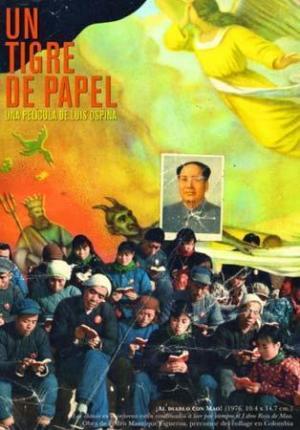
It's a documentary about artist Pedro Manrique Figueroa, whose main work was paper collage but over the decades, during Colombia's tumultuous political eras and Figueroa's involvement in Communism, bore witness to the rise of Communist China, to conflict with his comrades over the purpose of art, to getting into trouble with the FBI by stamping American dollar bills with "Fake" to undermine their use.

Figueroa also doesn't exist. He's managed to get a textless credit on the Museum of Modern Arts' website, but Figueroa is a mere creation of Luis Ospina for a mockumentary. It's a testament to A Paper Tiger, however, that it's pulled off with genius. Even a slightly ridiculous tangent, that he had a cameo in Ruggero Deodato's Cannibal Holocaust (1980) as a member of the cannibal tribe, is built on context which makes sense, that Figueroa was kicked out of a Mormon group for experimenting with psychedelics in the middle of the jungle, half mad and a mass of hair, all with the director going as far as hiring (amateur?) actors from the region of the jungle the film is said to be shot in to play translators, talking about the film was utterly lying about the tribal community and building on Figueroa getting the Amazon native cast to distrust the Italian production crew.

This is where the film succeeded for me - a) there's an underlying intelligent complexity, and b) Luis Ospina acquired the resources to actually pull it off, arguably more complex than some well known mockumentries as he has an international cast of talking heads to play fake figures. It does look like a nineties documentary, despite being made in the late 2000s, but I won't complain as it's a film made to look perfectly like an actual documentary. He also cast well in mind that Pedro Manrique Figueroa, as a guy who travelled around the world, has a list of interesting interviewees to talk about him, from an Indian colleague he studied with who recounts the paranoia he had in protecting a sack of potatoes, only for them to be for a recipe, a son of a Chinese colleague and friend who found subversions of Maoist work in paper collage hidden among his father's possessions after his death, or an English woman our elusive protagonist had a brief romance with who is outspoken and charming, only willing to speak of the more scintilating details of the romance to her dog only. Figueroa even though he is a missing enigma, a hollow form in the centre of this only seen vaguely in some materials, becomes a powerful spectre as a result of this structure.

Production wise, it looks the part. I admit I'm not a fan of talking head documentaries baring some cases as unless they are great tools of research, they are cinematically bland. Here however with a project that's openly fictional and using the style as an artistic format, it does the talking head interviews and archive footage choices so well I come to appreciate the art form of having to create even a fictional biopic, wishing only documentaries on art were as detailed and with multiple chapters as this fake one does. It helps as well as the art of Figueroa's paper collage is also accomplished perfectly, to the point it could be hung in galleries in its pop art sights that involve religion to communism, being a nun with Che Guevara tattooed to her bared chest to purgatory being having to read Chairman Mao's Little Red Book among the fiery coals.

Many questions, not all about Figueroa, are found and where A Paper Tiger gets interesting, as to what it is all supposed to mean. A Zelig figure, Zelig a 1983 Woody Allen film where he created a chameleonic character who was there in various historically significant moments blending in everywhere, Pedro Manrique Figueroa is there for a considerable part of Columbian culture and the world from the forties to the end of the eighties. He is eye view to Columbia's left and right wing changes, is the older man covered in hair when psychedelics alongside rock and nudity became popular in the country, and is part alongside the talking heads of the influences that took over, from both a Communist perspective to landscape changing events across the world like the Vietnam War. Communism has a sordid underbelly that makes the film's high view of it problematic and uncomfortable for me when the mockumentry takes on pro views - Pol Pot, Stalinist purges, Mao's purges - but where it deals with the fractures the film doesn't take punches either.

You get to Chinese communism and the original Communist fracture, to the point of the subversive distortions of Maoist imagery that the interviewee brought up, and by the late quarter A Paper Tiger's narrative arch becomes an existential crisis for Pedro Manrique Figueroa. The issue that plagued real life artist, that Communism eventually became that art should serve merely the state and "Social realism", eventually leads Figueroa to break away, leading to the absurd lost eighties of stumbling onto the Cannibal Holocaust set, or an actor playing an FBI agent with features blurred showing one of Figueroa's tampered dollar bills he was caught working on.

The film does, of course, leave the mystery of what happened to Pedro Manrique Figueroa in the open. Maybe he willingly encased himself in a museum and became a mummy, as one interviewee suggests, or is still alive? Whatever the idea, Luis Ospina intended our unseen protagonist to represent the virtues in his views, the political shitraker whose art became entirely individualistic to want to improve society around him by tearing it up. It's an idealised view, even here Figueroa with a sense that he'd be a nightmare at times (like the bag of potatoes anecdote) but ultimately a good heart. This is a film which from Luis Ospina clearly showed what he beleived in, the director passing in 2019, with passion following individual freedom against giant groups and governments. Unlike Zelig who was so ordinary he transformed, fitting to Woody Allen's stage persona of neurosis and feeling small, Luis Ospina's fictional mirror is always focused and creative, just thrown between events like a working Ping-Pong ball. His creator's mockumentary on him is inspired as a result.

Abstract Spectrum: Playful
Abstract Rating (High/Medium/Low/None): None


Saturday, 8 September 2018

The Clowns (1970)


Director: Federico Fellini
Screenplay: Federico Fellini and Bernardino Zapponi
Cast: Federico Fellini as Himself and a cast of real life clowns

Synopsis: In his childhood, recreated for this TV movie that is a hybrid between fiction and documentary, the legendary director Federico Fellini recounts being taken to the circus as a child only to be frightened by the clowns. Having a lasting effect, he with his motley production crew tour around Italy and France exploring the history of some of the greatest professional clowns to have ever existed, intermixing their histories with recreations by the newest generations of clowns.

In the midst of his golden period of filmmaking Fellini made The Clowns. He'd become a recognisable name even in the USA by this point, having already become a legend with films like La Dolce Vita (1960) and entering his hyper surreal and dream influenced era with Juliet of the Spirits (1965). By the point of The Clowns, he was moving on to be the Italian maestro whose name would be put in the title of his productions (Satyricon (1969) and Roma (1972)). Here, able to make this television movie, he recreates an incident where clowns traumatised him as a child and, coming as an adult with a longing to fully appreciate and admire their craft, creates a document dealing with their history. After the elaborate prologue, which feels like a prelude to the likes of Amarcord (1973), which shows child Fellini seeing a circus tent being erected outside his window, and the trauma he'd have with said clowns, what you get is an unconventional hybrid.

Whilst it's not as unconventional as Orson Welles' F For Fake (1973), it's the perfect comparison as the tag of "documentary" comes off as a joke itself when The Clowns defies and flaunts being an actual document, with the crew characters themselves, cameos from the likes of Anita Ekberg, and culminating into countless recreations and performances in a circus ring by clowns. It gleefully undercuts the border between truth and recreation fully, Fellini the director and the character within his own film grabbing together a crew, including the comically underappreciated female assistant, to begin an escapade to learn of the history of clowning in Italy and France. "Escapade" is perfect as the level of mirth on display if infectious, the film artificial and Fellini playing as jokes with real former clowns as characters playing themselves, and yet discussing their lives and craft even in the midst of this. Willing, as the symbolic moment of the entire film itself, to have a bucket land over his mid-speech for a one shot joke. If it's all true, and hasn't been lying like Orson Welles was in F For Fake, it's a fascinating take at a dying art, going into the past with clown archetypes of yore examined. Tipping the hat to legends, it's a noble task, cutting to recreations of these clowns by new disciples of face paint and slapstick who stand out as well.

From https://theleastpictureshow.files.wordpress.com/2014/10/clowns-1.jpg

Fellini
at this point was exceptionally indulgent, the discovery of Carl Jung and the esoteric permanently changing his cinema after 1965. Even when fantasy appeared in the likes of 8½ (1963), and overblown spectacle matched by his stand-in Marcello Mastroianni getting a space rocket launch built for his next feature, it tipped over the edge further mid-sixties onwards. I was once not a huge fan as a younger and dumber viewer to these later spectacles, though I still sympathise with those who'd agree with my younger self arguing his later work leaves one with cinematic indigestion, especially if one is not used to Fellini's style. For me now, older and smarter, and able to digest said style fully, I now adore it and am amazed he was able to get away with some of the sights you see in these films. Even on a TV budget, Fellini gets away with a lot even in the "normal" scenes for The Clowns, deliberately staged. Anita Ekberg playing herself can cameo to pose around big cat cages at the circus whilst legendary French actor/director/former clown Pierre Étaix, obscurer in English speaking worlds but a significant figure in his homeland, has a segment as himself where his recorded film from his own clowning family's past sadly burns up in the projector. In neither case, as with any appearance, is the film trying to be real document in the slightest which deliberately undermines the viewer's sense of reality. Even if real facts are on display, it's a very interesting viewing experience when the film's presentation gleefully undercuts the notion of documented verisimilitude.

All playful, entirely irrelevant. Utterly unconventional as it still maintains absolute respect for the clowns themselves, a sadness felt as a circus which had its own building became a beer hall after the decades past. The sense that clowning will become lesser appreciated, more so nowadays, is more enforced as even on the cusp of the seventies The Clowns talks of it being forgotten. In the modern era the likes of Stephen King's It, coulrophobia is a more known idea and the bizarre phenomena that was the 2016 evil clown sightings, really cruel jokes that got out of hand in multiple countries with people dressing as clowns and frightening members of the public, didn't help in the slightest. But it really makes a startling reminder, even in this humorous tribute, that by the seventies clowning was seen as antiquated by this film's viewpoint. That a lot of its figures, the archetypes of clowns and those who donned their face paint in real life, vary from before the 20th century to before the 1950s really does emphasise how old a profession it is. In The Clown's testament, it makes itself a real document by just talking about the subject matter in detail.

From http://images3.static-bluray.com/reviews/5065_1.jpg

The clowns here are not creepy Its either, not even the mainstream examples like Ronald McDonald, but an old profession with a real, tangible history to it untainted at this point by crass commercialisation. To those of the clowning profession reading this review, or if you the reader know any as friends or relatives, The Clowns is absolutely rewarding just for the clowning sequences themselves, which become the most unconventional aspect of the entire film. Farces in a circus ring where all manner of surreal gags involving their exaggerated movements and props, on and off themselves, entertain us the viewer. Some assistance are helped by the power of cinema, but most of what is seen is likely what would be performed on stage, and they are bizarre. Fellini, in one of the odder moment very early on, has a montage of various types of public figures drawn very likely from his own childhood, from gossipers to members of the fascistic Italian office, portrayed as pure caricatures to show that the clowns themselves usually took inspiration from the manners of real people, their exaggerations given context in a very inspired and clever inclusion on his part. Taken to its most extreme is when, lamenting the tragedy of clowning's failing fortunes, the film ends on a literal clown funeral. It is arguably one of the standout sequences in any Fellini film, a mad scenario between clowns lamenting the loss of their friend and also prating around or the carriage driver arguing with one of his own horses. Eventually it goes on so long clowns start to have to bow out in exhaustion, a feverish end for a high note. Certainly a  stand out as a big sequence within the director's career.

Abstract Spectrum: Delirious/Eccentric/Expressionist
Abstract Rating (High/Medium/Low/None): Low

Personal Opinion:
An obscure but rewarding entry in Fellini's career. Certainly a film I have immense interest in for him and my ongoing obsession with anything involving circuses and carnivals. Also in term of his career, The Clowns is not only a great film by itself but a very interesting prelude to his later work. I can see when he jumped away from conventional narrative structure with this film, and the breaking down of features into vignettes and segments interlinked is certainly see here more than the work of the sixties. So it's also a good film to find to bridge to the likes of Amarcord too.


From http://www.emiliodoc.it/wp-content/uploads/2017/08/clowns8.jpg