Sunday, 27 May 2018

Psyched by the 4D Witch (A Tale of Demonology) (1973)

From https://4.bp.blogspot.com/-m2LVnt8J0CI/WPo4vDcnzuI/
AAAAAAAAMeE/mOSJxQVZJ18HWlIDQR-1U0mXpMiUo68zACLcB/s1600/Psyched%
2Bby%2B4D%2BWitch%2BAd.jpg


Director: Victor Luminera (a.k.a. Lawrence Milton Boren)
Screenplay: Victor Luminera
Cast: Margo as Cindy; Esoterica as Abigail; Tom Yerian as Mark; Kelly Guthrie as Mr. Jones; Tracy Handfuss as Jan Kleinmetz; Keith Erickson (as Dr. Ambrose Kleinmetz)
[USA]

Synopsis: Dabbling in the sinister world of the occult, naive college student Cindy (Margo) is contacted by a 17th century ancestor from the 4D realm, a witch named Abigail (Esoterica) who promises the virginal girl orgasmic joys without any consequences of physical sex. Secretly however she wants to pervert her out of revenge. Even if it means turning her older brother Mark (Tom Yerian) into a sexual vampire.

Since seeing a clip from Something Weird Video's back catalogue, I have been curious about Psyched by the 4D Witch. That and the fake legend of a print of the film being found where the Manson Family camped, all despite this film existing long after their infamy. Well, that's depending on if it actually was released in 1973, or if it was shot in the late sixties and sputtered out in the early seventies. If any film was late the psychedelic boom Psyched by the 4D Witch was one such example, and this is definitely one of the extreme examples of American cinema's exploitation production. It comes from the melting pot of independent American genre films, sandwiched between the two decades and feels like it. A sexploitation film which has more puritanical stains of the sixties, but released in the early seventies (if the case) and needing more bite. All shot in "Transetheric Vision", which feels like a fifties marketing gimmick.
From https://78.media.tumblr.com/944989de6fe3d52ebab668ee9e718d0b/
tumblr_mwn2r4Q9HT1saghvlo5_500.png

It is with a fair warning that this review will become crass just having to explain the film in depth, because sexploitation even when it was chaste was entirely about selling sex, even if how and what the stories were about are tasteless or just weird. What actual story to some is as much their DNA and also to be warned about, as you don't try to enter some of these films unless you have the tolerance for very different strain of filmmaking, be it technically inadequate or just on the fringe of culture. The warning, due to this, this is only for a select audience to try to get through. And this is bearing in mind you barely see a lot in Psyched by the 4D Witch. That's the irony with this film, the most sexless of sexploitation films which yet still has a lot that'd embarrass some people to be caught seeing. Inexplicably appearing on Amazon Prime, obscure even for a 4K Blu-Ray restoration, the version matching its haphazard tone cultivates various colonies of grain and age just on the print used for the digitalization, adding to the experience the television was spiked with bad hallucinogens.

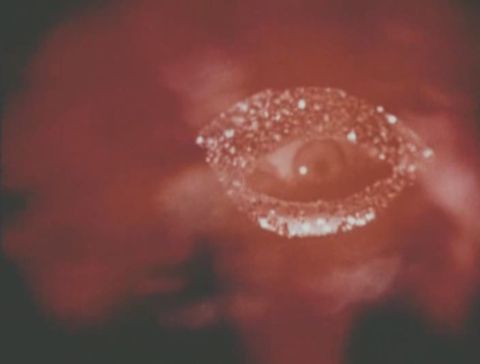
The film's split personality is perplexing. On one hand its sixties tinged psychedelic, which was popular in exploitation cinema, reeking of the cautionary films from the same time. Stay for the titillation, but condemn the "perversions" onscreen. Yet this is also a seventies movie and tries to be more scuzzy in connection to its occult plot line. Cindy's friend Jan (Tracy Handfuss), when brainwashed into the occult rituals, writhes with a rubber snake as if in a burlesque nudie loop. Until its claimed in the voiceover she inserted the snake into herself before the ritual in one of the many  bizarre lines. The snake used inappropriately is just hinted at in dialogue, alongside mention of necrophilia and such. Attempts to clearly go further which the structure of the movie is compromised in being caught between both sides.
From http://www.thespinningimage.co.uk/cultfilms/images/8569.jpg

Scenes which seem to cut away from the sex as if they were actual porn sequences, purely softcore of the sixties cut to ribbons until its barely comprehensible at times. These perverse lines merely hinted at in the voiceover when what is onscreen, if viewed mute, wouldn't be perceived in that context. Plenty of nudity, but with sexual words bleeped inexplicably from the soundtrack nonetheless. A sense of the quainter sixties films but reeking of filth just in the plot and the atmosphere of the production. It makes it a confused film in terms of its existence, as its meant to be softcore yet if stuck between the sixties caution and seventies sleaze, all whilst not showing a lot actually onscreen. Especially as actual hardcore pornography briefly became chic in the mainstream, with the likes of Deep Throat (1972), a film like this missed the boat for its audience completely and flounders.

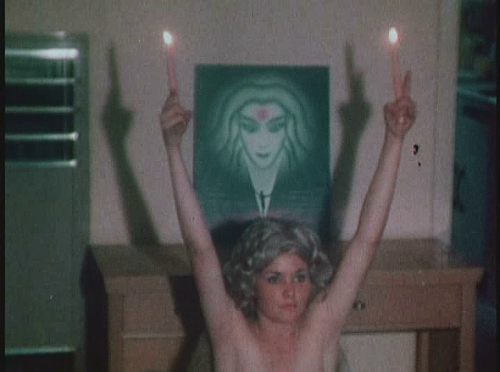
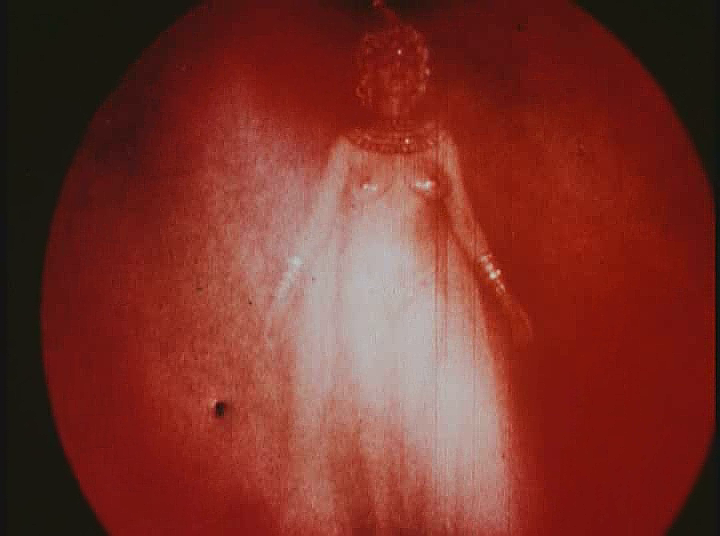
The experience is instead like Kenneth Anger, the legendary occult practitioner and avant-garde filmmaker, if Inauguration of the Pleasure Dome (1954) with its coloured gels covering the screen and actresses in quasi-ancient garb was instead made by people on a bad day using horse tranquilisers. A sense this was put together with various pieces of footage, even home movie material, as Psyched by the 4D Witch is all post-dubbed with narration and various scenes. Whilst there is a lot of nudity of both genders, you have a patchwork so extreme it becomes confusing. A scene between Cindy and her aunt - which demonises lesbianism by making it incestuous, but still lusts over an "exhausting three-way lesbian climax" with them and the ancestor Abigail - is so chopped up in structure I had no idea what was going on. A lot of shots are reminiscent of being inside a lava lamp. Superimposition. Quasi-Eastern costuming, which again evokes Kenneth Anger but also Jack Smith. So much pink and purple, due to the print seen as well as the aesthetic, to the point the scenes of the ordinary 3D world are heavily tinted in these colours. Eventually until pink is soaked into your eyes. Events from later in the film are even cut into the structure early on as if premonitions, such as the older brother mid-sex vampire role devouring a victim, all without context until you get to that plot point properly.
From https://78.media.tumblr.com/50cdb8cfe9d849e549c279ad31f75d58/
tumblr_mwn2r4Q9HT1saghvlo1_1280.png

There's little sense of the occultism being anything than just an excuse for the weird titillation. It neither helps how slapdash the film is in being put together. The strangest moment is not the sex. Or when it abruptly switches from Cindy as our narrator to her older brother, unaware despite being reflective of these events having past that he's about to be turned into a cannibalistic sex vampire. Nor the perversity attempted at. No, it's the unexplained and lengthy scenes that feel like home movie footage. In particular the one of a beach, just panning over the local environment and its tourists, which goes one for at least five minutes or so, that is incongruous to the extreme.

Now considering how many times I've said the film is bad, is Psyched by the 4D Witch to just be avoided? For those with an intolerance of the barrel of American exploitation, you stay away as far as possible. For someone like myself, with a tolerance for this type of film, it was something I'm glad to witness. Slithers of very memorable things that made it compelling, and all that was an aghast failure still idiosyncratic. Its luridness coupled yet with a chaste innocence. The gay neighbour who someone is convinced by Cindy to participate in her sexual exploration. That, technically, what she experiences is mystical rather than physical, extended fantasies Abigail is absorbing the energy from for her nefarious ways. That Mark's experience becoming a vampire is slowly built up with using travelogue footage of a seventies games arcade only to never be fully resolved, left to wander in his new life as an inexplicable plot point. Or that the solution to the drama, provided by Dr. Ambrose Kleinmetz (Keith Erickson), which also involves sex but at a significant cost. That even a film this misbegotten has a hummable psych rock title song.

From http://4.bp.blogspot.com/-62CQzOhIzzY/UDmYSAZOOZI/
AAAAAAAAPhE/f1jYnQ_Gghg/s1600/psyched14.JPG

And if anything, looking at any screenshots of the film makes you aware how utterly perplexing the film must be as moving images. Many will find this painful, but the mix of extreme colour saturation, avant-garde experimentation, and exceptionally low budget sexploitation is a peculiar aesthetic cocktail.  Trying to make sense of Psyched by the 4D Witch is arbitrary. It's simple on paper - an innocence young woman corrupted by an evil ancestor from beyond the grave - but the structure and tone is what causes one to feel in a stupor. Of course since this is sexploitation, one has to ask whether it is actually erotic, which it isn't. It isn't titillating in the slightest. And that in itself, because it's too rambling and unconventional to be, adds to the strangeness as, even without the sexual perversions angle, the film is so fragmented it would undermine any of its original purpose.

Abstract Spectrum: Grotesque/Psychedelic/Psychotronic/Weird
Abstract Rating (High/Medium/Low/None): Medium

Personal Opinion:
One of the strangest things I've seen in a while. One of the queerest at least. The film will be unbearable for many to suffer through, but for myself witnessing its hot pink tinted mass spew onscreen both made me feel dirty but was also oddly compelling.

Tuesday, 22 May 2018

Heroic Purgatory (1970)

From https://i.pinimg.com/originals/10/09/31/
100931e6ce48ecc1bfa542296d1a686f.jpg

Director: Yoshishige Yoshida
Screenplay: Masahiro Yamada
Cast: Mariko Okada as Nanako; Naho Kimura as Jyoko; Yoshiaki Makita as Shu; Kaneko Iwasaki as Atsuko; Tôru Takeuchi as Kiyoshi; Kazumi Tsutsui as Ayu

Synopsis: When Kanako (Mariko Okada) encounters a young woman named Ayu (Kazumi Tsutsui), who survives a lengthy and direct fall onto concrete, she brings her back home to live with her and her husband Shoda (Kaizo Kamoda), who works for the Atomic Agency. A man claims to be Ayu's father, and from there the film switches back and forth in time as Shoda is involved with a communist cell planning an assassination, whilst Kanako and Ayu interweave through the eventual destruction of said cell.

Quite soon into Heroic Purgatory we are unstuck in time, to paraphrase Kurt Vonnegut, transitioning back and forth between 1952 and 1960, where the renewal of the Mutual Security Act ensured the continuing presence in Japan of the U.S. Army, and beyond to the 1980s and the unforeseen future. In-between a paranoid psychodrama takes place where reality is subjective, the slow dissipation of a communist group as a spy is sabotaging them from the inside, one which might not even exist in the first place. As the communist group plan to kill an ambassador, they fall to pieces over time as compromise and paranoia take over, the only ones who stand being Kanako herself and Ayu, who Kanako adopts as a quasi daughter figure despite being close in age.

Whilst it travels far from her and includes various other figures, ultimately Kanako is our closest thing to a protagonist. Even if the film lavishes time over the naked female body in the one aspect that may date the film - obsessed with its beauty in contrast to the ennui inducing environments - the female characters are the ones who drive the narrative. Kanako, staying out of the chaos that dooms her cell eventually , is more concerned her newly adopted daughter is missing at points whilst the communists, constantly charging her husband for being the spy, ignore her or say they cannot see Ayu. Who Ayu is - with her incredibly thin figure and strange manner, such as her desire to kill all potential father figures - is unknown, be she real or a living metaphysical entity. Whatever the case, its significant she bookmarks the film. That even if she's sexualised at points, including a reoccurring film within the film of Shoda touching her nude body in an isolated warehouse, she feels like a silent but dominant figure.

From http://static.imovies.ge/m_posters/1280/142684098837.jpg

The only actions of the men in Heroic Purgatory is mindless violence. Shootings. A gang rape of a female member of the communist group, never seen baring the aftermath and with the character yet reappearing to explain her death to her fellow communists. What appears to be death by strangulation in another scene is either botched or a mere act, the woman meant to be the victim nonchalantly dismissing the action as if nothing. Even the nudity, whilst the one thing which could detract from the film is more complicated due to the look and structure of the film. There was a potentially crass edge to older art films made by men from this era which intercut politics and philosophy with distanced titillation, but it drastically stands out here as, within the angular and cold environments, it drastically contrasts with the natural, curved and living figures of the female characters. The contrast is so strong, as the mechanical world around them seems more alien in contrast, especially as these female characters are those who ultimately stand out. They turn out significantly more stronger than their male peers doomed to paranoia and their codes.

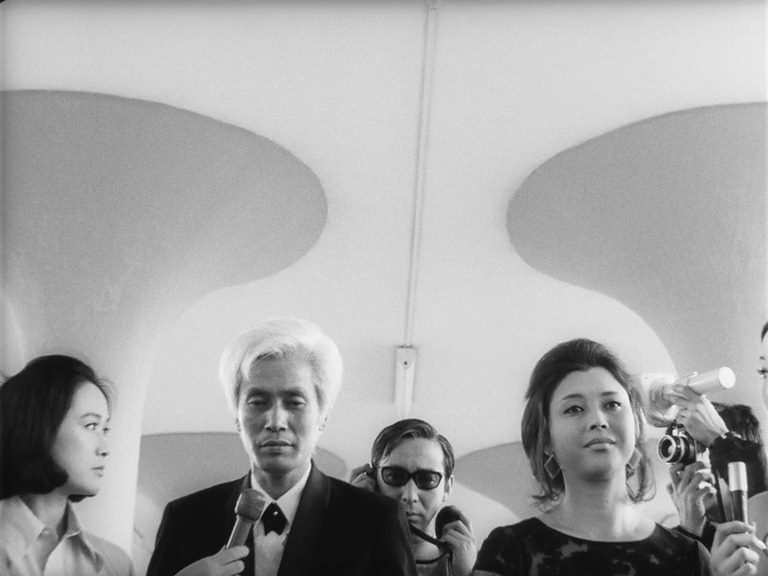
The film belongs from the deep well of the Japanese New Wave, experimental and/or idiosyncratic films which fully fleshed out in the sixties into the seventies. Heroic Purgatory was produced by the Art Theatre Guild, formerly importers and distributors  of foreign films who came in this time to represent independent films as their mantra when they produced films like this. Like a lot of these films, they were made with incredible prowess. Director Yoshishige Yoshida is obsessed with the extremes of blacks and whites in the monochrome of the film. Michelangelo Antonioni is felt in his used of manmade locations (warehouses, modernist buildings) which dwarf the cast, but the extreme use of white to the point it drowns the images out is entirely Yoshida's own. These are the whitest of whites, to the point it disrupts the image but bleeding shape away through the blinding use of white light against black.

From http://4.bp.blogspot.com/-O7HTSZZuh5A/UYcL-gJHSnI/
AAAAAAAAAKg/8KslLIbna5U/s1600/hp1.jpg

Even for a bleak film in tone, the aesthetic is beautiful even if it's meant to show a phantom world in and out of time, characters dead appearing with the living to explain their deaths or conferences with the press playing out in an empty tennis court like an avant-garde theatre performance. The film's dislodging from time evokes author/director Alain Robbe-Grillet, who specialised in this fragmentation out of chronology, especially as characters can suddenly be transported from one environment to another with the same movement (i.e. lay on a bed, only to be transported outside laying somewhere else). The characters are our anchors for events as their world and behaviour change, fluctuates, painting a complex picture between them if the pieces are rearranged.

A dream logic which is yet incredibly precise and, like Robbe-Grillet, structured onscreen with an obsession with composition close to painting and the positioning of figures and environments within them. (This means a lot both for when sexuality does appear, like figures of life drawing figures having entered modernist architecture, or how surrealism manages to slip into the grounded realism of these industrial environments with ease). Like Robbe-Grillet, who liked to play with genre structure, there's a sense even if Yoshida made this film with greater concern for political concerns that he's lapping at the edge, like the sea on a beach, on the paranoia thriller as guns are fired and there is a spy who may not exist, as poignant as when Seijun Suzuki had the mysterious No. 1 assassin in both Branded to Kill (1967) and Pistol Opera (2001) - not quite the type of films to compare to Heroic Purgatory but, with the former from the Japanese New Wave, both obsessed with the idea of a threat which may be a mere fabrication but is still destructive, evoking God knows what subconscious moods of Japanese society at this period thinking of how politically volitile the era was with the likes of the Japanese Red Army eventually coming to be a year after Heroic Purgatory's release.

From http://www.thenerdmentality.com/wp-content/uploads/
2017/06/Yoshida-Heroic-Purgatory-03.png

The meaning of Heroic Purgatory as a whole is more than likely through mood - the centre of three films by Yoshida about ideologies. Eros + Massacre (1969), his most famous film, was about anarchism through free love advocate and anarchise Sakae Osugi. The last Coup d’Etat (1973) was about nationalism through real life ultranationalist Ikki Kita. Heroic Purgatory is about communism, and whilst not about real life figures it uses real like context to depict such a group eat itself alive. That its English title is "Heroic Purgatory" feels pertinent, these figures doomed in their belief to change the world for the better only to have wandered into these various time frames, dying or afraid of being killed because of spies within their own.

The film ends with Kanako and Ayu at a literal dead end on a train station platform, and whether you fully grasp what happens, it feels like both women walk off having to find new purpose. The film throughout strips away what was presumed before. Where religious beliefs are questioned, science and Shoda's goal to innovate in technology useless and made obsolete the moment its born, and in whatever time frame the film takes place in the communists self destruct. It's both a bleak ending, yet considering how surprisingly dominant the female figures are within this tale, the two most distinct figures are the ones who start the film and end it, making something if not hopeful at least with the concept that new goals are to be found for the mother and adopted daughter beyond the film.

From https://oneperfectshot.files.wordpress.com/
2014/07/heroic-purgatory.jpg?w=700

Abstract Spectrum: Avant-Garde/Expressionist/Introspective/Mindbender
Abstract Rating (High/Medium/Low/None): High

Personal Opinion:
Difficult but with purpose, Heroic Purgatory having been made not so long after the Sixties feels like the dissection of what took place to communism as a principle within that time. A compelling one, one which I openly admit qualifies for the term "pretentious" were it not for the fact that it actually has an incredible sense of intelligence to it. Artistically alone, it's a work of art but also as an entirely constructed work which plays with narrative and logic, the craft's flawless and to be of awe with.

From http://rarefilm.net/wp-content/uploads/2017/03/
Rengoku-eroica-AKA-Heroic-Purgatory-1970-1.jpg

Tuesday, 15 May 2018

The Ninth Configuration (1980)

From https://ia.media-imdb.com/images/M/MV5BNGUyMjVhZjctNWEyNC00MzBiLThmN
GItMmU1MDE0NzQyOWZmXkEyXkFqcGdeQXVyMjI4MjA5MzA@._V1_.jpg


Director: William Peter Blatty
Screenplay: William Peter Blatty
Based on the novel Twinkle, Twinkle, "Killer" Kane by William Peter Blatty
Cast: Stacy Keach as Colonel Vincent Kane; Scott Wilson as Captain Billy Cutshaw; Jason Miller as Lieutenant Frankie Reno; Ed Flanders as Colonel Fell; Neville Brand as Major Groper; George DiCenzo as Captain Fairbanks; Moses Gunn as Major Nammack; Robert Loggia as Lieutenant Bennish; Joe Spinell as Lieutenant Spinell; Alejandro Rey as Lieutenant Gomez; Tom Atkins as Sergeant Krebs

Synopsis: In a Gothic castle in the United States, various military personal with severe mental disorders and psychosis are housed together within its walls under care. members of the military or high profile careers who suffer from severe mental disorders and psychosis are placed together under watch of the US military. A new psychologist Colonel Vincent Kane (Stacy Keach) arrives at the facility, offering new and very unconventional methods of dealing with their treatment. He is however troubled by memories of his brother, who become psychotic during the Vietnam War murdering any bystander in his path, feeling the weight of the world on his shoulders as he broods. His goal for salvation is focused entirely on one patient by the name of Captain Billy Cutshaw (Scott Wilson), a former astronaut and Catholic who has begun to doubt the existence of God and couldn't complete a rocket launch to the moon, Kane deciding that he can help Cutshaw is he can prove that good exists innately in the world.

The Ninth Configuration starts off deceptively. A country ballad plays over a panoramic shot of a Gothic castle, meant to be on US soil but clearly the European location the film was shot at in real life. With William Peter Blatty's pedigree - the author of The Exorcist's source novel and the 1973 film's screenwriter, director/writer of The Exorcist III (1990) - you expect immediately a rich, incredibly well written tale with memorable dialogue. One with a very idiosyncratic take, from his Catholic beliefs, of hope even in the most dire of circumstances. What you get with The Ninth Configuration is this, but also what happens when this first time director/writer, who partially funded the film as its main producer, has to wrangle an already complex premise into a feature. A premise even in the seventies, when very unconventional films were made in Hollywood, which was deemed unsellable and he had to fund himself, grappling with complex ideas in a dense script but also with his own novice position at play. One which plays three-quarters of itself as a bizarre comedy that crashes into deeply serious material later on.

From https://4.bp.blogspot.com/-ToDwszq--oA/Wh8MM72hnSI/AAAAAAAAAGs/CZTzHQaSw44Cyb79fUU
QmR8WPTKrIetowCLcBGAs/s1600/DPvmhQpUEAApKqN.jpg

The moment you get the parade of inmates at the beginning, you are aware that Blatty took the absurd comedy to its fullest. It's not an accurate depiction of mental illness, just a premise which becomes as mad as a box of frogs. How, as a first time director who had full control, he constructed the film is as much why The Ninth Configuration is as good as it is but also why it is difficult, potentially frustration and potentially divisive for many. A layered and frankly messy sound design is the first issue. Fascinating as dialogue is heard of characters off-screen before they even appear, but it is also dense due to how the film was made, especially with the naturalistic acting styles of the cast that means you can easily miss details with ease, distracted or because dialogue is too quiet in the sound mixing. The script itself is as complex, having to juggle elaborate and sometimes incredible artistic dialogue alongside moments of serious humane and theological ideas. It does succeed but I will not understate how much of a challenge it is on a first viewing. That's before the weirdness begins to pile up as well.

It terms of what The Ninth Configuration is, Blatty offered it as the official sequel to The Exorcist. Rather than what we actually got - John Boorman's utterly ridiculous Exorcist II: The Heretic (1977) - if The Exorcist was about evil existing in the modern world, The Ninth Configuration is about good in the modern world, especially as Captain Billy Cutshaw is meant to be the same astronaut Regan in the first film confronts when she is first demonically possessed. If The Exorcist is about the Devil existing, The Ninth Configuration is about God existing. How Blatty goes about this is not what one expects, playing at first in pure absurdity at its most extreme with flickers of suddenly moments of introspection with Colonel Kane, a troubled man whose existence is revealed to be a nightmare for himself, literally disconnected from himself.

From http://images4.static-bluray.com/reviews/10864_5.jpg

Whilst the presentation is coarse and jagged, with a plot structure which will put many off, it does make an interesting choice in depicting the modern world, post Vietnam War, as a literal madhouse of chaos. As Cutshaw denies the existence of God, he yet lingers over Him as a Catholic, Kane ultimately a saint trapped within his own horrifying crimes against humanity, his own redemption (depending on the version of The Ninth Configuration you see) forced by martyrdom or self sacrifice. Whether the theological arguments work for the viewer, or they see them as flimsy, altruism ultimately is the idea central to the film. It still asks in this idea whether mankind is capable of self sacrifice without a need to do so except for good, the kind of material that you cannot help but be impacted by. Even the final scene, where a fully irrational moment happens to Cutshaw, a tiny but profound one, views existence as a complex beast the human species barely grasps on. Even if you find the film an utter indefinable mess, this is the kind of material many film viewers desire to see in their cinema whether your opinion is hopeful or nihilistic of these characters.

To get to this material though, you also have the truly bizarre, evoking Joseph Keller's Catch-22 as taking the absurd to metaphorical delirium tremens. It happens to be acted out by a who's-who of great character actors - Stacey Keach, Robert Loggia, Neville Brand, Jason Miller from The Exorcist - but the density of this writing alongside the tonal shifts keeps you on your toes as a viewing. When Dr. Kane decides to let the inmates indulge in their desires the film reaches its zenith of madness. This was already a film where Loggia's first appearance is in black face, the future star of Innocent Blood (1992) and Lost Highway (1997) imitating an Al Jolson number whilst a black member of  the inmates Major Nammack (Moses Gunn) looks on with bafflement, but when Kane lets them all act out their fantasies it gets weirder from there.

From https://cdn-images-1.medium.com/max/
1600/1*Ip_jh_dIWYgQungGrRiRuw.jpeg

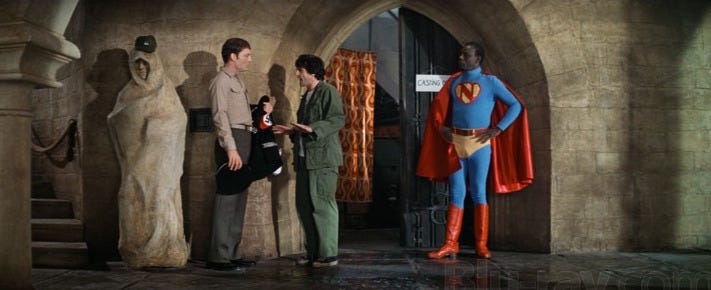
Whether The Ninth Configuration works entirely or not, you have to admire a film this ambitious. Especially when it includes so much to love and admire. Jason Miller relishing his role as Lieutenant Frankie Reno, not the sombre and lost priest of The Exorcist but an inmate obsessed with re-enacting the complete works of Shakespeare with dogs as the actors, getting most of the best lines from the role. Moses Gunn wearing a Superman costume and even arguing with Miller that Superman should appear in one of the latter's plays to rescue a character. The least expected appearance of a jet pack possible. Ed Flanders' Colonel Fell, who becomes a more tragic and emotionally complex figure played by Flanders incredibly, but begins as a hilarious figure who deals with inmates stealing his trousers and has to relieve himself by combining whiskey with Alka-Seltzer. Dialogue, from suicide pills with laxative qualities to even a shout-out to Alfred Hitchcock's Spellbound (1945), so ripe and so hilarious at times I will gladly rewatch the film to soak it all up. And then there's the dramatic bar sequence near the end of the film which is the denouement of the film. Strange in itself as Steve Sandor as a bike gang leader is dressed as a glam rock lead singer, (or Gerrit Graham's Beef from Phantom of the Paradise (1974)), with character actor Richard Lynch of all people adding to the cast as his right hand man, but ultimately an important moment for the tragedy that takes place when a certain character snaps. Whilst the film feels of its incredible flaws in structure, so much so there have been many cuts of the film from Blatty before his death, there is still a pertinent and powerful drama in the midst of all its oddness to go with. So much that stands out that it has to be admired.

Abstract Spectrum: Introspective/Surreal/Weird
Abstract Rating (High/Medium/Low/None): Medium

Personal Opinion:
Ambitious, ramshackle at points, but ultimately admirable. The Ninth Configuration has stayed with me since seeing it, and I cannot help but think of so much that works within the film and also having gained so much even from the challenge of watching the movie.

From https://ia.media-imdb.com/images/M/MV5BZDg4MzUwYTUtN2MwZi00NThhL
WJjYjMtYTlhYWE1YmQ1YTc3XkEyXk
FqcGdeQXVyMjUyNDk2ODc@._V1_SX1777_CR0,0,1777,736_AL_.jpg

Sunday, 6 May 2018

Wild Palms (1993)

From https://images-na.ssl-images-amazon.com/
images/I/71UGPKASQtL._SY445_.jpg


Directors: Peter Hewitt, Keith Gordon, Kathryn Bigelow and Phil Joanou
Screenplay: Bruce Wagner
Based on the comic strip by Bruce Wagner
Cast: James Belushi as Harry Wyckoff, Dana Delany as Grace Wyckoff, Ben Savage as Coty Wyckoff, Robert Loggia as Senator Tony Kreutzer, Angie Dickinson as Josie Ito, David Warner as Eli Levitt, Kim Cattrall as Paige Katz, Ernie Hudson as Tommy Laszlo, Nick Mancuso as Tully Woiwode, Bebe Neuwirth as Tabba Schwartzkopf, Aaron Michael Metchik as Peter Katz, Brad Dourif as Chickie Levitt

Synopsis: In 2007, patent attorney Harry Wyckoff (James Belushi) finds a new career path under senator Tony Kreutzer (Robert Loggia), found of the religion Synthiotics and founder of the Wild Palms group, who are developing both virtual reality television and mimizine, a synthetic drug with allows one to interact with the holograms. Wyckoff's life however becomes a complex spiral not soon after. Caught between the war between The Fathers and The Friends. Discovering that his son Coty (Ben Savage) may not be his own. That Kreutzer is a corrupt wannabe demigod, and his wife Grace (Dana Delany) is suffering from her connections to the Wild Palms group, not least because her mother Josie Ito (Angie Dickinson) is a vindictive, violent person and Kreutzer's sister. And that an old flame Paige Katz (Kim Cattrall), connected to Kreutzer, has re-entered his life and stoked a flame that is eating away at both of them.

Beginning with the first scene - a dream sequence with the older brother of Jim Belushi, James, enters his suburban kitchen only to find a rhinoceros there - one is immediately primed for one of the strangest mini-series made for American television. (Fittingly, the second to last episode screened on May 18th 1993, which would've been my fourth birthday, thus another bizarre project which orbits my life among very curious films). Riding the zeitgeist wave Twin Peaks (1990-1991) created, broadcast on the same station ABC and co-produced by Oliver Stone, the result's a peculiar beast. One where Stone's cameo as himself, being interviewed about secret JFK conspiracy documents proving his theories, is the thing that barely bats an eyelid about what is going on throughout the narrative . That a phone line was set up to explain plot points per episode is a sign of where Wild Palms goes.

From http://www.criticalcommons.org/Members/ccManager/clips/
wildpalmsmimezinecybersex.mp4/thumbnailImage

The plot of Wild Palms is not that difficult when set out. But there are so many plot points to juggle, alongside the tone the series took, which brings things to a heightened head. The perils of virtual reality. Child kidnapping. The conflict between the fascist Fathers and the heroic Friends who are nonetheless capable of shady tactics to win. Wild Palms has a lot of ambition, struggling at times to tell it. Significantly this is piece of nineties paranoia of the future. It's an area of cinema and television which can be silly - as Wild Palms exists in an alternative 2007 between realities as a time capsule. But it's also touching upon still relevant topics, a fitting landmark among others of peoples' fears at the time. Using the growing craze in VR, back then it was still disconnected from the reality of basic effects and having to wear one of Daft Punk's helmets, it however touches upon pertinent ideas of reality and our growing addictions to fantasies even into the modern day. Whilst we're not yet at holograms, that we are with both virtual reality again and the dangers of technology like the internet blinding us with artificial simulacra, it still stands strong.

However I will also confess that my love for Wild Palms is for its flawed but distinct weirdness. The cast certainly helps, certain performances an acquired taste and yet appropriate for what turned into a melodrama in sci-fi dystopia costume. For James Belushi, it's the least expected role he could have as he is known for comedies and family films (until, in a nice piece of synchronicity, being cast in the 2017 series of Twin Peaks). As our cipher into this world, an everyman who realise his life is more entrenched in conspiracy than believes, he's the actor playing the most muted role which means he's easy to dismiss, but someone appreciated by me nonetheless. Especially as he's the sane cog in the midst of everyone else, with only the sadness of Dana Delany as his wife, in her tragic plot trajectory, a grounded emotional current.

From https://ia.media-imdb.com/images/M/MV5BNmJhYzMyMDUtZjkwZS00NThlLW
ExZGYtZWUzODNlMmVhZGUwX
kEyXkFqcGdeQXVyMzQyMTA5Mjg@._V1_SY1000_CR0,0,1332,1000_AL_.jpg

Robert Loggia
, who described his role as Tony Kreutzer in the context of ancient Greek plays when interviewed about the miniseries, chews scenery appropriate for a character who has had people killed and also starts randomly bursting into song in the final episodes, as if an acid flashback to his Al Johnson impersonation in The Ninth Configuration (1980), obsessed with a McGuffin known as the Go Chip which will give him digital immortality. Angie Dickinson, from the likes of Dressed to Kill (1980), however manages to outdo even Loggia as his sister Josie, channelling both Bettie Davis and Joan Crawford from Whatever Happened to Baby Jane? (1962) with her pronounced makeup and heightened performance; appropriate for a character with an obsession with kidnapping her former husband and Friends leader Eli Levitt (David Warner), and gouging peoples' eyes out. Among these figures also includes Coty Wyckoff (Ben Savage), Harry's son who is both a new TV star and a child sociopath, Ernie Hudson from the Ghostbusters films as a Friends member who becomes addicted to mimizine and can hear church bells as a result, and even Brad Dourif in a small role. Another smaller role by director Kathryn Bigelow, who also directed one of the episodes, has additional pertinence as this feels like a dry run for Strange Days (1995), her dystopian sci-fi epic which also deals with the dangers of technology through artificial memories.

The script itself is clogged with countless references to keep up with, original author of the comic strip and series creator Bruce Wagner actually having to tone down his original version of Wild Palms for television but still creating a dense narrative. When a glib reference here is calling a cafe in the background "Eros plus Massacre", a tip to the hat to a three and a half hour Japanese experimental film by Yoshishige Yoshida, we're in different territory to most television at the time. Then it proceeds to juggle spirituality, references to anything from films to Walt Whitman, and Wagner's own quirks like his obsession, spoken by the characters, of rhinos being fallen unicorns. I could absorb this plot, but I know I missed details, and am aware alongside its melodramatic, heightened tone why a phone line was put in place to keep viewers up to speed as it zooms along. For television, it's like Thomas Pynchon's Gravity's Rainbow at points.

From https://ia.media-imdb.com/images/M/MV5BZDU5ZTY4ZDktZTBkNS00Mzg0LWJjNTgt
NDk3ODgzYjE2OGEzXkEyXkFqcGdeQXVyNTgzMTg5Ng@@._V1_.jpg

If there are problems with Wild Palms, it's that its mad ambition is too much for its presentation. It has the length a work like Strange Days could never have but doesn't have the budget. That wouldn't be a problem if it wasn't for Wild Palms not following the idiom "show, don't tell", especially when instead it descends into talking for the last episodes.  Even if it doesn't have the production of a Hollywood film, it was a major TV production and should've taken more time to elaborate on the plot points. To actually depict them. I admire Wild Palms but I'll confess the final episode squanders dynamic weight with important events, like Loggia's failed attempt with the Go Chip or a revolution against the Fathers and the entire political system, being off-screen or barely shown barring a few extras waving signs. For a series with ambition, even scoring a major skirmish with The Animals' cover of House of the Rising Sun, even having The Rolling Stones' Gimme Shelter twice in the score, the final episode feels chintzy to an extreme.

In spite of this, and the silliness of some of the material, Wild Palms to me was like catnip. The early nineties aesthetic, coupled with a Japanese influence is distinct despite the Japanese economy bubble having already burst by this point, making the paranoia of Japan being an ambitious global influence out-of-date like it was in films like RoboCop 3 (1993). In lieu of this, I also adore Ryuichi Sakamoto's score. Sakamoto, of Yellow Magic Orchestra and a major film composer, seems at first to have made an overtly cheesy and dated score just in the opening credits theme, only for it to fill out with depth that, for this production, is worthy as cinematic in depiction.

From http://1.bp.blogspot.com/-LpiqIg82jfI/TWxVNXIVHuI/
AAAAAAAAKUE/rl7XHA6GxpU/s400/screenshot7591.jpg

There is also the general madness on display. In spite of its limitations, Wild Palms is weird in an admirable way. Where swimming pools have secret doors at the bottoms, lairs to the Friends' hideouts. That, as in all dystopian sci-fi of the time, there is a slum district which law enforcement stays out of, a Casablanca of rebels and bootleg holograms. The dichotomy between advanced tech, like virtual reality, against issues like the complete lack of internet, living in a subconscious realm outside of our past or future off the television screen. Something deliriously weird that, even if it came after Twin Peaks' popularity, somehow was bankrolled and exists despite the sense it was never going to succeed even as a miniseries. An instant cult work, not contrived but too weird to live.

Abstract Spectrum: Psychotronic/Weird
Abstract Rating (High/Medium/Low/None): Low

Personal Opinion:
Merely a slither of Wild Palms creates many questions which, even when answered, opens up so many new questions of where they came from. Even as the TV presentation sabotages its virtues at times, Wild Palms gets by as a bizarre TV melodrama, a product of its time which thankfully exists.

From https://ia.media-imdb.com/images/M/MV5BNzUxNjFj
NTgtMDliNS00MDgzLTk4OGMtYjExZjBj
MjExNjEzXkEyXkFqcGdeQXVyNTgzMTg5Ng@@._V1_.jpg

Tuesday, 24 April 2018

Lemonade Joe (1964)

From http://1.fwcdn.pl/po/18/07/
31807/7487141.3.jpg


Director: Oldřich Lipský
Screenplay: Jiří Brdečka
Based on the novel and stage play by Jiří Brdečka
Cast: Karel Fiala as Lemonade Joe; Rudolf Deyl, Jr. as Doug Badman; Miloš Kopecký as Horace Badman/"Hogofogo"; Květa Fialová as Tornado Lou, the Arizona Warbler; Olga Schoberová as Winnifred Goodman; Bohuš Záhorský as Ezra Goodman

[Spoilers Throughout]

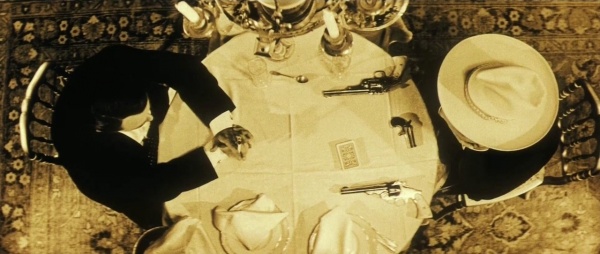
Synopsis: In the western town of Stetson City, Arizona, whiskey pours much to the sadness of teetotaller and Evangelist Ezra Goodman (Bohuš Záhorský) and his daughter Winnifred Goodman (Olga Schoberová), their religious abstinence campaign failing miserably. To their rescue, with his trademark Kolaloka lemonade his desired drink and perfect pistol aim, is Lemonade Joe who soon cleans the town up. Owner of the Trigger Whisky Saloon Doug Badman (Rudolf Deyl, Jr.) is not impressed by this, hiring the legendary outlaw Hogofogo, alias of his brother Horace Badman (Miloš Kopecký) to off Lemonade Joe.

With Czechoslovakian cinema - Czech and Slovakian alike - you will find the alchemist's stone of cinematic invention. Where even the genre films had the same craft as important dramatic works. Their history of stop motion both in stop motion and collage, is impeccable, and even the general style of their films from historical drama to science fiction is utterly unique. Cinema that is entirely unique and, even if more sporadic in release after the country split into the Czech Republic and Slovakia, still produces such films. Theirs, before and after becoming separate countries, is barely scratched upon in terms of availability, allowing one to uncover hidden gems easily to the point of practically falling over them by accident. Take Lemonade Joe director Oldřich Lipský for example. You have, in one filmography, a Jules Verne adaptation (The Mysterious Castle in the Carpathians (1981)), Lemonade Joe, the comedy sci-fi film I Killed Einstein, Gentlemen (1969), and the truly bizarre Happy End (1966), a film told entirely backwards where a man goes from his execution for murder to birth as an utterly unreliable narrator.

Lemonade Joe itself if not the only western made behind the Iron Curtain. Not the only musical made behind it either. A comedy western musical influenced by silent cinema techniques however is a one-off. Its desire to both mock American capitalism, as Lemonade Joe is actually in the hands of the Kolaloka Lemonade he drinks as a spokesperson, is yet tempered by it being openly influenced by older American cinema. Singing cowboys were actually a subgenre at one-point in Hollywood, particularly with Gene Autry, a singer-songwriter/film star/television and radio star/business entrepreneur/rodeo performer. (Aptly too as Autry starred in the twelve chapter film serial The Phantom Empire (1935), a western/scif-fi hybrid where he ends up in a secret underground world of robots and subterranean people trying to invade the world above, which is as bizarre as it sounds). Before Canadian film maker Guy Maddin starting using silent film technqiues in stylised ways, and uncovering old genres to use for his own ends, Lemonade Joe takes an era of westerns even older than the fifties classics starring the likes of John Wayne few talk of. The colour tints are from all genres of silent cinema too. Blues usually for dark environments, yellow for outside or lit rooms. Speeding up the film. Images superimposed onto scenes, such as the Egyptian pyramids in the western mountains.

The artistry of older cinema - built having to use its resources in mind of limitations - fits the style of Czech cinema immensely, which has always had a craftwork above even some of the best of industries like Hollywood. Used in a sound film, this style is incredible idiosyncratic and allows for carte blanche in terms of what can be done. If there's a contradiction between paying tribute to this type of cinema and its jabs at America, think of it as admiration for the art turned into a custard pie to the face. Apt as Lemonade Joe is a living breathing cartoon right down to Joe and Hogofogo having a Tom and Jerry like relationship when the latter's introduced. The greyness to this satire, if there is any morality, is actually to the film's advantage, Lemonade Joe becoming as much a true hero as he is a parody. Eventually the heroes and villains become farcical targets as Kolaloka can even resurrect to dead, undermining the antagonism completely.

The performances are as energised and help in Lemonade Joe actually working, characters who are as broad as cartoons but with a tangibility to them so they are not hollow caricatures. Karel Fiala makes a great Lemonade Joe, the perfect blonde and even naive gunfighter with a violent aversion to alcohol and prone to bursting into song in accented English, helped by the fact he was a real life operatic tenor as well as an actor. His could've merely been a mockable character, but its testament to the film and Fiala's performance that the satire to do with his wholesome personality doesn't stop him being a lovable figure you want with Winnifred Goodman, even with showgirl Tornado Lou, the raven haired femme fatale whose lusty demeanour is actually melted by Joe's existence is her life.

From http://3.bp.blogspot.com/-F2Nh68GetKk/T6i8vjHpitI/
AAAAAAAAKdk/2pAtkohW5S8/s1600/
Lemonade.Joe.1964_snapshot_00.10.42_%5B2012.05.07_23.13.00%5D.jpg

His mirror, played by a strong figure in Miloš Kopecký, is Hogofogo. A figure so evil he's charismatic and even gets his own songs, all of which are the best in the film. One lusting over how he loves to kill, but the other probably Lemonade Joe's best scene, an inexplicably serious and potent number which intercuts into an imagined version of Hogofogo's funeral, a full New Orleans mourner's parade with blues instrumentation. That its whilst dressed as an old man to kidnap Winnifred Goodman doesn't undercut the moment. The only sour point, and the only one in the whole film, is when Hogofogo abruptly appears in blackface, a pretty grotesque look as with black makeup on Kopecký does look like a horrible caricature, but it does feel less problematic than the film referencing old Hollywood films even if its troublesome to witness.

The music alongside the production design is where Lemonade Joe in its oddness. Breaking expectations of a stereotypical western where the heroic gunslinger can hit a fly out of the air than (in English) sing a love song rocking on a bar piano. The general absurdity manages to come off as wholesome even when it still has characters die, someone getting a corkscrew in the back, and is ultimately still a piss take on American culture. The fact that this is film made in a communist country emphasising that its American references are to be viewed as parodies of the country the other side of the Iron Curtain. That it is sweet and playful is, yet, also for the better. Cartoonish with exaggeration. Its silliness, taking the production seriously, allows it stand out more.

Abstract Spectrum: Surreal
Abstract Rating (High/Medium/Low/None): Medium

Personal Opinion:
An undiscovered gem in Czechoslovakian cinema. Again, how many musical cowboy films involving silent film techniques actually exist? That it feels like a fully gestated, fully accomplished production means that this enticing premise is even better as a result.

From http://www.imfdb.org/images/thumb/a/ad/
LemonadeJoe-06.jpg/600px-LemonadeJoe-06.jpg

Friday, 20 April 2018

Skullduggery (1983)

From http://horrornews.net/wp-content/uploads
/2016/04/Skullduggery-1983-movie-Ota-Richter-11.jpg
Director: Ota Richter
Screenplay: Ota Richter and Peter Wittman
Cast: David Calderisi as the Sorcerer / Dr. Evel; Wendy Crewson as Barbara / Dorigen; Thom Haverstock as Adam; Pamela Boyd as the Queen; Jack Anthony as Mr. Sluszarczuk

[Spoilers Throughout]

Synopsis: In medieval times, an evil sorcerer curses an entire family tree. The latest descendant of that tree, Adam (Thom Haverstock), becomes a violent killer when a fantasy dungeon game awakens the curse within him. After that is entirely subjective to each viewer's opinion...

Out of the obscurest corner of the slasher film subgenre, Skullduggery boggles. What begins as a Dungeons and Dragons fear mongering ends with police officers taking pot shots at a living suit of armour, but that seems logical to what happens in-between. One of the worst amateur dramatic plays shown in cinema takes place in a lengthy talent show that goes on and on. A magician, never explained and merely the magician, appears and makes a woman's top flutter only to begin the curse proper in our lead Adam afterwards/ A man claims he can such through a bus exhaust pipe to chat up a woman, without realising the homoerotic qualities of that line. Details, after the medieval prologue done in two sets and period costumes, which are jarring in tone. The beginning of  Skullduggery's ability to pile on further strange details afterwards.

Like the man with a noughts and crosses game on his back. He appears near the beginning and throughout the film at various points, the game slowly being played by unseen forces offscreen. His constant appearance seems too precise to be accidental but why he is there is unknown. The players of the game are unknown and it feels vaguely Attack of the Killer Tomatoes (1978) in tone, broad humour so upfront it drops on the floor flat. Its surrealism is in the tone of the Zucker Brothers but played at such a sluggish tone the presentation is off. If it's funny weird, it's definitely weird. Inexplicable things appear too. During a scene of the killer chasing a woman cutting to a length, it cuts to a minute long panning shot of mourners at a funeral who never appear again. Or Liberace's stand-in in the church flailing away at organ through stained glass.

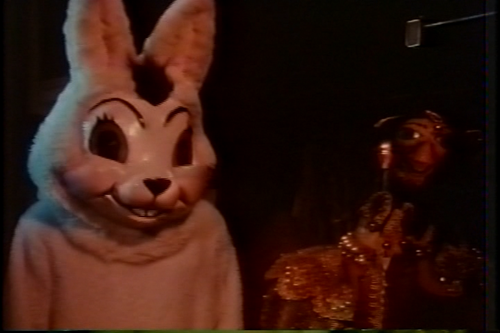
Is it even a comedy? Well Wacko (1982) came around this time, so already the slasher was mocking itself as the glut came to be into the early eighties. But the tone is sabotaged by its non-sequiturs. Unless its ingenious and subtle in a way I cannot understand, but that's part of the inexplicable nature of Skullduggery. When a hospital murder sequence includes a smoking gorilla doctor who has just had sex with a human nurse, God only knows where we are stil going. Where has this film even been? The reason behind the entire Canuxploitation moment of Canadian genre films can only offer of a slither of this film's existence; that as the economic benefits to produce countless movies in the region, director/co-writer Ota Richter was one of many allowed to depict whatever he wanted onscreen as long as he completed a film that could be released. Even to the point its questionable if this is technically a slasher in the first place. There are elaborate deaths, but when they are all illusions for psychic heart attacks, all with an evil harlequin puppet controlling Alex, we are lost further in the general barking madness between the large couple who suddenly appear in rabbit costumes and a woman being wrapped around in a large python.

From http://horrornews.net/wp-content/uploads/2016
/04/Skullduggery-1983-movie-Ota-Richter-2.jpg

Takings its Dungeons and Dragons paranoia into mind is as much part of the strange stew. Its misguided on both ends of the argument about the Satanic panic hysteria of the eighties. To merely mock the conservative Christians who got caught up within it as, considering secularists forget that if they believe Satan is real, it's a terrifying idea that he'd corrupt your children if given the chance. To merely dismiss it as silly and ironically watch their numerous scare videos on the subject as, trying to attack heavy metal and D&D fans amongst others, they took Mary Whitehouse stupefaction and old/new generation divide into problematic territory by suppressing individuals' rights. Mazes and Monsters (1982), where young Tom Hanks went insane without a basketball named Wilson and because of fantasy role-playing, is the nadir (height?) of D&D paranoia in film. Here it's worth mentioning as it barely plays a part, which just adds to the perplexing nature of this creation. Tapping into the zeitgeist but except that Alex targets people based on the missions in the game. It adds to the inexplicable nature of Skullduggery where an evil harlequin doll is truly more evil than the fantasy game but the game is still bookending the plot, whatever it is, feeling like the template to disguise the excuse for general madness.

In general the structure is like that of many slasher films. Fundamentally and technically adequate. Basic with varying, wonky scales for acting quality. The dialogue, because of the nature of this beast, is a stand out for sucking through bus exhaust qualities or squirrels down peoples' trousers. The deaths are closer to A Nightmare on Elm Street but no way near as creative, merely supernatural. It doesn't even have any real gore or any actual nudity, going against the lurid strains of this subgenre. The film has, by its ending, Alex going to a Satanic party with the camera intercutting between two male dorks, a very busty woman between them ogled by the camera for a long time, inexplicable melting down to a skull, and a mysterious doorway that never is explained, alongside two cops named Holmes and Watson who are useless in a cringe worthy attempt at humour, just adding to the strangeness. It can be compared to Jackie Kong's Blood Diner (1987) is that wasn't an insult to Blood Diner. That's not to say Skullduggery was compelling entertainment, but this is the queerest of weird horrors to experience.

Abstract Spectrum: Psychotronic/Weird
Abstract Rating (High/Medium/Low/None): Low

Personal Opinion:
From the bowls of slasher cinema, rewarding just for how compellingly weird it is. You don't come here unless you expect this weirdness, and you'd be sorely disappointed if you came for another Canadian slasher to put near those like My Bloody Valentine (1981).

From http://www.juhanapettersson.com/wp-content/
uploads/2014/07/skull3_thumb2.png

Monday, 2 April 2018

Container (2006)


Director: Lukas Moodysson
Screenplay: Lukas Moodysson
Cast: Jena Malone as The Voice; Peter Lorentzon as the Man; Mariha Åberg as the Woman

Synopsis: With voiceover by Jena Malone, Container follows a transgender man (Peter Lorentzon) whose life is a debris filled apartment ripped apart by his own thoughts. From the death of porn star Savannah to fear of the nuclear bomb, Container is an existential stream-of-consciousness where the voiceover, both his and separate as Malone's, connects together the images into a whole.

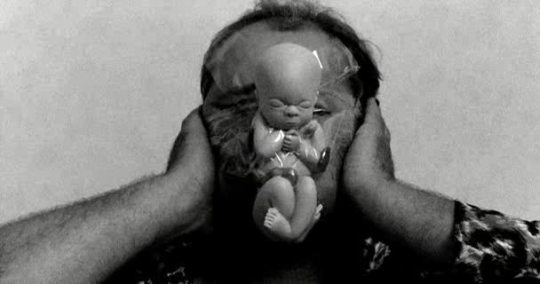
Container for the unprepared is an extreme film in structure. Difficult and liable to frustrate. In context of Lukas Moodysson's career it makes sense how his filmography got here however. His debut Show Me Love (1998) was an immense hit, a tale of adolescent love between two girls causing a wave of critical acclaim. Add Together (2000) and Moodysson even won the acclaim of his country's greater auteur Ingmar Bergman. For whatever reason however, this wave of acclaim was clearly a cause of an existential crisis. Lilya 4-ever (2002), whilst also acclaimed, also gained a lot of backlash for its perceived heavy-handedness, and thus the existential crisis began properly. Leading to the transgressive A Hole in My Heart (2004) and Container. Both of which gained negative reactions between them. With hindsight Container proved to be a necessity, Mammoth (2009) his small step back towards the mainstream, We Are the Best! (2013) about three young girls starting a punk band winning hearts all over again. And Container itself has a lot to say, deliberately the work of a filmmaker who is using it to dissect his own state of mind as much as its central character played by Peter Lorentzon. It says a lot that, within the documentary footage included with the DVD release, Moodysson has a psychiatrist, a Church of England vicar and a psychic see the film and/or the exhibition that came with it initially in England, and allowed them scrutinise his subconscious.

From https://blackiswhiteblog.files.wordpress.com/2013/06/
container-2006-dvd-lukas-moodysson.jpg?w=540&h=284

I was aware  that this was never going to be easy to digest, which helped me be the perfect person to view the production as I was prepared for its notoriety. Container, with patience, is actually a good film. It will need repeat viewings. And particularly, whilst the monochromes images are important, it's the script and how Jena Malone reads them which stands out the most in terms of the production's virtues. A stream-of-consciousness, this structure is always difficult at first. A stream-of-consciousness eliminates the pauses and punctuation that allow one to ingest information in spoken and written speak clearly. It removes divides between one subject to another, allowing them to bleed into each other. Read aloud, whilst helping with the flow, also means you do not have the ability to re-read passages again for clarity unless you rewound the film back. The result, like William S. Burroughs at his most extreme in Naked Lunch, takes work at first to fully understand.

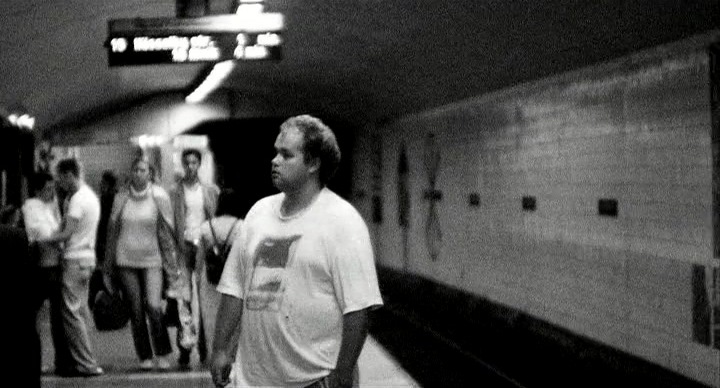
Whilst Malone at one point even explains herself as her real self, an actress merely reading lines despite playing actor Lorentzon's character, what you actually get is what can be viewed as the beginning of a 21st century existential fear. There is for myself the increasing thought that, when the Millennium took place and the world did not end, we as a society at least in the Western world entered this new century without purpose. Our narrator portrays both the transgendered man as much as a form of herself, the kind of twenty something Millennial who shifts onwards in the current state confused. Someone who fears their mortality constantly, yet feels they are God at other times. Considers God outside of themselves, yet are fixated on celebrities and topics Kylie Minogue cancer scare. Letters of Holocaust concentration camp victims are collected alongside porn star Savannah's boots, at first potentially tasteless unless viewed in the context of chaos of this century, that so much is to be digested these objects collect, clash and meld as one and the other. It varies between pathetic first world problems to real, sad moments of brevity, all of which I suspect is Moodysson himself bleeding out God knows what demons he had to purge at this period in his career.

From http://rarefilm.net/wp-content/uploads/2016/01/
Container-Lukas-Moodysson-2006-2.jpg

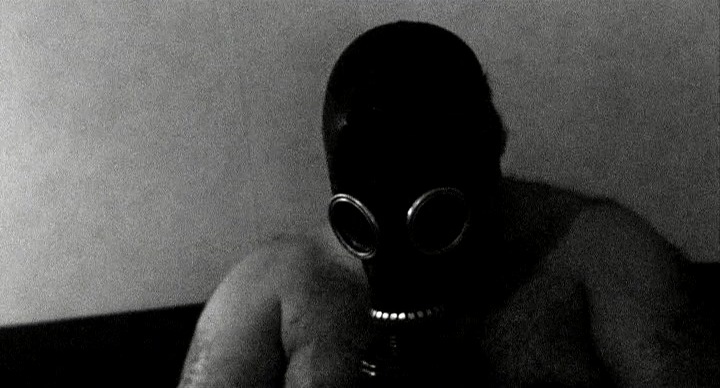
The visuals are as important. Squalor but never poverty pornography. Nudity, mass orgies and cramped apartments. Even that which could come off as weird and pretentious art performances in another film, such as anything with the dolls' heads and wearing objects as inappropriate dress, make sense in Container's logic, which is as much addressing this material world and scrutinising it as the words spoken by Malone's voiceover do. All the objects, from a Bing Cosby memorial plate to a dank mattress, become a psycho dramatic view of a life, which was enforced by that exhibition Moodysson created using the real props from the film that allowed people to scrutinise the objects in closer detail. The monochrome, rich and detailed like a Nobuyoshi Araki photograph, allows the film to exist out of conventional chronology but still keep a viewer within the world inside with some semblance of logic, between fiction and documentary but felt fully. What one should feel Container is the psychological state of its main character which it succeeds in.

Abstract Spectrum: Avant-Garde/Expressionist
Abstract Rating (High/Medium/Low/None): Medium

Personal Opinion:
Not a film to compare to Moodysson's dramas. One which sadly become obscure but understandably when it presents a sharp and drastic change in pace from the likes of Show Me Love. On its own however its absolutely admirable and worthy of re-evaluation.

From http://rarefilm.net/wp-content/uploads/2016/01/
Container-Lukas-Moodysson-2006-3.jpg