Saturday, 22 October 2022

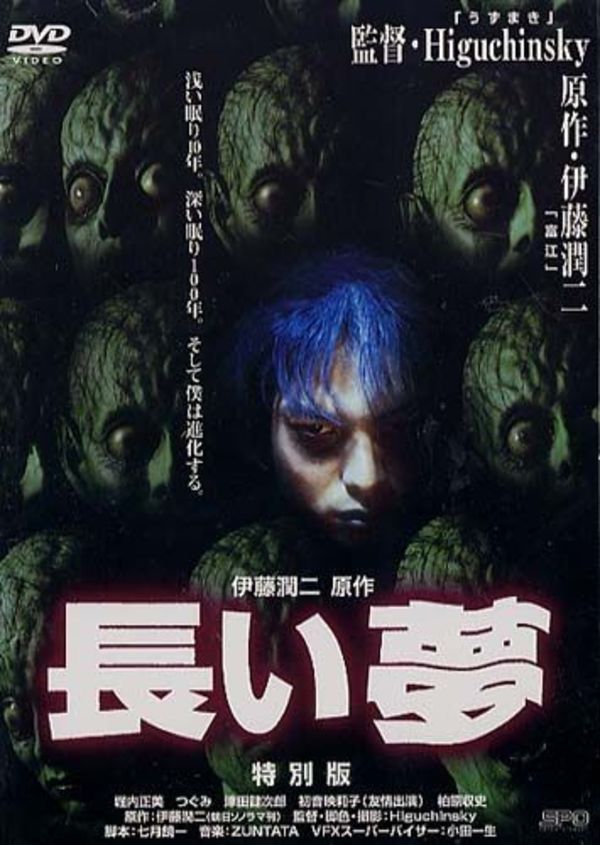
Long Dream (2000)


Director: Higuchinsky

Screenplay: Higuchinsky and Kyoichi Nanatsuki

Based on the short manga by Junji Ito

Cast: Kenjirô Tsuda as Doctor Yamauchi; Tsugumi as Takeshima Mami; Eriko Hatsune as Kana Sakurai; Masami Horiuchi as Kuroda; Shûji Kashiwabara as Mukoda Tetsurou

A Night of a Thousand Horror (Shows)


Once I searched for a restroom for eight years. It was agony.

Adapting Junji Ito, a seventeen year old girl with a benign tumour named Mami (Tsugumi) is in hospital, a person in a constant state of panic fearing her impending death. To review this adaptation of Long Dream, an obscure title from Higuchinsky, the Ukraine born Japanese director who adapted Uzumaki for a 2000 film, I will have to spoil the source manga as this elaborates beyond the whole story into its own narrative, starting with that she is terrified by another patient who is physically changed and evokes the Grim Reaper to her. This male patient named Tetsurou (Shûji Kashiwabara), who is being treated by an older male doctor, was afraid of sleeping, suffering from "Long Dreams", lucid ones that can feel two days long and full of nightmares, increasing in their length of time to months and centuries.

They are strange dreams of being a soldier, forced to eat his own feet, or cramming for an exam for a year and a half. The longer dreams however, as they continue, lead to full body mutation, a transcendental transformation into an almost alien entity. Where Long Dream the film changes, actually from the source, is that its halfway point is the final twist of the manga. That, when Tetsurou passes his body into the endless dream, it dissolves to dust and leaves a substance which may be responsible for the dreams, leading to medical malpractice as, with memories of a young woman in his life, another patient with a benign tumour named Kana (Eriko Hatsune), the older doctor "treats" Mani by injecting her with this substance, starting her into having long dreams.  


The work, only under an hour and premiered as a TV movie for TV Asahi, feels like a segment from a live action Junji Ito television anthology we never got, which includes its aesthetic touches. For those unaware of Ito, starting as a comic book author in the late eighties, he became a legendary figure in his homeland for horror comics, to the point of even adapting Mary Shelley's Frankenstein and Osamu Dazai's No Longer Human into his own takes, whilst taking into the 2010s to be a figure we fully embraced in the West, becoming his own man in the world of graphic novels and Japanese manga as a result, admired as he is as much a meme too. In terms of trying to adapt his work though, there is not as much as you would think, Long Dream one of the first. Most of it is stripped down drama, in a muted looking hospital environment, barring that Tetsurou when he is transformed brings in a monster from a b-movie, trying to replicate in its own virtues the idiosyncrasies of Junji Ito's work. Ito's has been incredibly difficult to recreate as, not only has he access to unbridled imagination with his talents, but because one of Ito's more difficult to depict trademarks is fine detail, in the designs of the horrific sights but even the faces of characters in terror or menace. This evokes Uzumaki, Higuchinsky's more well known adaptation, which had to openly embrace its obvious CGI, in accepting how ridiculous its more macabre content looks. Ito embraces the ridiculous as he does legitimately horrifying content - as Uzumaki has spirals the source of terror and people turning into snail people - but his craft is a nightmare to adapt even in animation well, and especially for live action even with prosthetics effects. Long Dream was a tale you could, barring some creepy monster makeup, make in limitations.

Where Long Dream though fumbles, even if of note, are Higuchinsky and co-writer Kyoichi Nanatsuki's inclusions after the original story ends. It becomes about the older doctor, as Mami has dreams which cause her, when awake, to kill someone and fall into a realm between dreams, all whilst he is fixated on trying to reach Kana, the deceased woman he loved, in the endless dreams. It leads to the obvious cliché in the end that he finds himself in a dream where he does not know where he is awake or not, which for some will be an immediate cop-out. The film has a gleefully pulpy tone, where it undercuts the dramatic monologue of not being able to get into the world of dreams by bashing someone's head in, but this ending will be full cheese, certainly being an unnecessary touch when, actually, the premise of stretching the source's final twist works enough by itself. That of medical malpractice is fascinating, when it should lead, with the doctor experimenting on himself, to his downfall as much as Mani's transformation being a clear signpost to happen. Long Dream, which is an obscure work which is difficult to see, is slight, another curious, worth a rediscovery now Junji Ito is a huge figure nowadays in the West as much as in Japan, but that ending will frustrate some.

Friday, 21 October 2022

Junk (2000)


Director: Atsushi Muroga

Screenplay: Atsushi Muroga

Cast: Kaori Shimamura as Saki; Miwa as Kyôko; Yûji Kishimoto as Nakada; Shû Ehara as Akira; Tate Gouta as Ramon; Nobuyuki Asano as Jun; Koutarou Tanaka as Toraji; Kôtarô Tanaka as Toraji

A Night of a Thousand Horror (Movies)


An American scientist in Japan is experimenting with DNX, not to be confused with DMX as I had written, a North American rapper, but a green chemical, like the reanimation fluid from Re-Animator (1985), which can resurrect the dead. The female corpse he was working on, however, bites him when she is resurrected with DNX, showing this was an inherently bad idea.

Zombies are a Western import to Japan, and released in 2000, this feels like the beginnings of when, even if films were made in the eighties and nineties in the sub-genre, the influence of this version of the undead spun from George A. Romero's seminal zombies films  lead a pop culture phenomenon even beyond horror cinema. Junk is not that far from Resident Evil (1996), the first of that video game franchise which was, arguably, a huge push for the zombie as a pop cultural figure. This is not an unconventional zombie film either, pretty much following the tropes that would be built up from many films which would come. The difference is in how a jewel robbery is transpiring at the same moment this DNX mishap happens, a former nurse named Saki (Kaori Shimamura) the female getaway driver who wishes to get a car and a new life from this. Getting a call from the car dealership mid-robbery is just the start to the robbery souring, as is that the meeting with a crime boss is in the old factory where the zombie outbreak is transpiring, let alone that the boss was going to backstab the robbers anyway. Even the US army, or at least the branch involved with DNX experiments, get involved wishing to cover it up from everyone else, dragging in a Japanese scientist Nakada (Yûji Kishimoto) who was involved in the creation of the reanimation serum. Whilst there is a lot of Japanese subtitled English dialogue, it does present an obvious burying of US history on Japanese soil inherently in their prescience.

The actual film is conventional, a low budget zombie film mostly set in its factory location, one which as a result, when many more zombie films were made in the 2000s onwards, has become more conventional as a result. The director Atsushi Muroga would go onto the crime film series Gun Crazy (2002-3), and it feels like, in this mental space, he made Junk more of an action film with zombies within it, also a troupe of blurring the genres which would continue over the Millennium onwards. Truthfully, it felt very generic to a detriment to watch, but reflecting on it, there was a charm to even this, and I admit it is a bias for these low budget Japanese horror films which have their own moods to them. Out of them though, this one does not have a lot of the unpredictability that I prefer, making one of the weakest in this era, pretty much the "ArtsMagic" type of Japanese horror, a DVD distributor in the early 2000s who, before they left and went into specialist documentary releases in the modern day, released titles like Junk and Uzumaki (2000) in the boom of interest in films like Ring (1998) and Audition (1999) that Tartan Films acquired1.

One of its biggest detriments is a universal cliché of zombies caused by how much of a trend they became in the Millennium after this film, the movies never trying to work around them in wacky, unpredictable or interesting ways, barring the one time shooting one in the head, the female zombie Kyoko (Miwa), just makes her mad and gives her a white wig.  Kyoko the zombie is one of the film's quirks, even if it is one of the few lurid aspects. In the drama, she is connected to Nakada, the reason that DNX was created, [Spoiler Warning] to resurrect her after a tragic car crash [Spoilers End], but onscreen, until she finds a leather coat long enough to be a dress, and inexplicably leather matching boots never explained, actress Miwa was clearly hired as she was comfortable being naked onscreen as a member of the undead. It is a clear selling point for the film even if it must have been uncomfortable for Miwa in terms of how she, mixing the morbid and the sensual as most of the film has her without prosthetic decay effects, and bare skinned, is spending the time in the dankest factory setting possible, which looks dirty and cold.  

The ending also changes the tone closer to an early Peter Jackson splatstick film, which is a positive, when the white wig leads to also being able to attack even without having legs, which is a nice change of pace for the better, and what I had wished Junk had went more with alongside the melodrama in it touching on. The action aspects are clearly inspired by Hong Kong cinema, two gun firing at zombies and wasting bullets into their chests, which feel just as cliché when they were replicated and lost the lustre of the likes of John Woo's films, which does undercut the film further.  Time has arguably undercut Junk as much weirder films from this period have stood out for their creativity - Wild Zero (1999), another zombie film ArtsMagic released with the band Guitar Wolf, deserves a personal re-evaluation as an openly silly zombie action film, involving men in golden right thongs firing rocket launchers, does not try to hide its low budget CGI, yet also managed to proceed progressive transgender politics by decades. Next to these films which have stood out for their creativity, Junk is still interesting to watch, entertaining in the right mood, but suffers from how much the tropes have aged.

=======

1) Whether it is the same ArtsMagic or not, this is the modern company's site.

Thursday, 20 October 2022

Games of the Abstract: D (1995)


Developer: Warp

Publisher: Panasonic / Acclaim

One Player

Sega Saturn / 3DO Interactive Multiplayer/ Sony Playstation / MS-DOS


D is another horror game of the past whose age is visible, though released the same year as Phantasmagoria (1995), in the world of cutting edge polygonal games and the genres which managed to struggle on at this time, I will argue D's legacy is importance and has a structure, if not already used by a modern game, which could be evolved further into the modern day.

D's legacy is as tied to Warp, its developer, and their founder Kenji Eno, coming to video games in the nineteen eighties and become a true one-off. As we will get to, the legacy of Warp is not as well preserved as it should be except, which is sad as, even out of morbid curiosity let alone the innovations Warp had, the story of Kenji Eno is that of both an auteur and an absolute miscreant who would have been fascinating to talk to in the flesh, let alone an entire independent developer team who worked on games like this. He was certainly a shit stirrer at times, the legacy of D even marking the future trajectory of Warp as, as a result of Sony not realising D was a huge hit on multiple consoles and under printing the Playsation One release, they undersold it. Kenji Eno's own testament talks of how Sony had only manufactured around 28,000 units despite there being 100,000 pre-orders from retailers confirmed which understandably annoyed him1. Eno was not pleased and thus, at a Sony show where he was allowed to be a guest speaker, he presented that their next game would be for Sega, switching the Sony Playstation logo for the Sega Saturn one in a middle finger salute. Warp once included a condom for Short Warp (1996)1, a mini-game collection made for the 3DO, but Warp also created Real Sound: Kaze no Regret (1997), a Japanese only Saturn game (later published for the Sega Dreamcast) designed for blind players. Alongside the deal Eno made to donate a thousand games along with Saturns to blind people with Sega1, to make the game exclusive for the console, this is still ahead of its time. Even in the 2020s games are slowly starting to adapt to disabilities for players, one of the only of games similar to this I am aware of being A Blind Legend (2015), a fantasy game about a knight which is a hack n slash game entirely built not on sight but by binaural 3D sounds, together making a fascinating pair of experiments as much as virtuous in their goals.

D itself, which obviously has the issue of being able to search on it online unless you include its year of release and/or either Warp or Kenji Eno's name, was not Warp's first project. We must thank Trip Hawkins, the founder of Electronic Arts and arguably another man ahead of his time as, when he decided to bring forth the 3DO Interactive Multiplayer console, a machine whose preservation in catalogue only really exists in emulation and its fan base, his console despite being a failure of the fifth generation was ahead of its time in so much. No region lock for games, no censorship for games even if it led to Vivid Interactive full motion video softcore, and because of its unique model of creation, the hardware being more expensive but the games not, the licenses for developers to be able to create software was cheaper. With a market in Japan and even South Korea, Warp and Kenji Eno were able to exist due to this cheaper gateway, and sadly again with the lack of official preservation, the games they made before D (only one getting a Western release) sound fascinating. Around the time D was made there was Trip'd (1995), a bizarre puzzle game which got the Western release, and Oyaji Hunter Mahjong (1995), which sounds the most compelling as a story of a male superhero who fights older men who perv young women through games of mahjong, with the additional surprise of having animated cut scenes directed by Ichiro Itano, a legendary animator for the likes of the Macross anime franchise if also a notorious figure when he does helm the anime director's seat.

D was a push for the company. A three dimensional FMV game, the Saturn version I played for this review requiring two discs, the restrictions in fully animated scenes noticed in how it streamlines the game down into an interactive movie with puzzles. The technology at this time was to the point that games which went further and used live action video would struggle further, to which Phantasmagoria, as already mentioned, was a point n click game which took seven discs when it was first released (eight for the Saturn port exclusive to Japan). D in context was really idiosyncratic and an inspired challenge, especially as Warp embraced the restrictions as part of the gameplay. You only have a maximum of two hours to beat the game, or its game over without a proper ending, and you cannot pause either, which is a unique concept still to have had. It also streamlines the point and click genre by way of first person, as Myst (1993), in which whilst it could struggle for replay value for some in the current day, it nonetheless jettisons aspects of these games I myself have struggled with. The filler you can find in point and click games are mostly gone and any time I lost in my first attempt, by time out, came from wandering the limited directions you can go and not figuring out the few mechanics there, something I learnt from in terms of mistakes for attempts after.

I will not damn the game's limitations, as this was a game which did not try to hide its restrictions, the two hour play time as a maximum as much to work around the task rendering this game's animation fully for Warp as an small company. If that seems short for a game which would have been sold for £39.992 in the United Kingdom for the Sega Saturn, this was a curious era of games that experimented with the formats they came with, and new technology, and managed to be huge hits despite restrictions in terms of their content or scale. Phantasmagoria was one such example, becoming a hit in 1995, and previously Myst, as also has been mentioned, was a game built by Rand and Robyn Miller on HyperCard, a Apple Macintosh and Apple IIGS computers software which was for organisation, even for organising cooking recipes3, but became a cultural juggernaut, one which for the PC had the advantage of being a way to sell CD player technology with.

Thankfully, some radical games are still being made today, even with the advantage of huger budgets than Kenji Eno could have ever imagined, but there was a fascinating period here in the mid-nineties where early pioneers managed to have successes even with aesthetics and content which would have been considered "dated" decades later. At this time, D would have pushed a Sega Saturn let alone a PC, where there is one route you need to get to, but you must face the puzzles in the way of Laura, the "virtual actress" who would star as different characters in an unofficial trilogy, with Enemy Zero (1996) for the Saturn, and D2 (1999) for the Sega Dreamcast.

The story can be argued to be the weakest point of the fame, though it has charm for me, especially in mind that it was not even fleshed out with cut scenes, the main thrust of the game, and its title, involving the legacy of Dracula on Laura's family not involved until after the game play itself was already being fleshed out1b. Abruptly, at the Los Angeles National Hospital, its director Dr. Richter Harris has gone on a shooting spree. Managing to get through the police barrier is his daughter Laura, who upon entering is taken into another realm in a gothic manor, a mental prison where Laura will have to complete the puzzles to reach her father, able to project himself to her and warning her of the dire consequences of trying to reach him. To get to this plot's conclusion, with one of two endings, you will need to figure out those puzzles, part of the game logic that there will be doors which require swords to open them but all able to be figured out without drawing any long bows. The puzzles for the most part are simple, and in hindsight to the limitations of the game, this has less of the irritance I struggle with from point and click games. There is no object to examine for no reason, unless it is one of the few designed for a scare like a room full of spikes with a dead body within it. This means you have to figure the game out from a series of spots and sights which all have to be interacted with to continue, only with how the question. If you, as I did, lose because you wasted time trying to find everything, or working around that you have single paths to get around the rooms, the game is short as an experience you can replay and fix your mistakes.

The controls are very simple, be it on a Saturn controller or keyboard, where you need only one up button to go forwards, left and right to turn around, one button to interact, and one button for the inventory, which alongside the items you collect has a pocket watch to show you how much time you have, and a pocket mirror which provides hints three times before it breaks. The puzzles are not obscure, barring one where if you have no knowledge of astrological signs, you will have to learn them or hope pure luck is one your side. Again, it has its weird logic, the first puzzle of the game involving having to get around a spike wall trap, by placing a piece of paper into a bowl of water for a right combination, to get a needed tool to disarm the trap, but the game is helped by the lack of pointless tangents, not forcing you to wander aimlessly.

At three points, you could argue the game has some frustrating moments, but they could be so much worse. First is one around a safe, where surrounding a cool image, of a chained up corpse whose hand is sealed through a wall into the safe the other side, you have the issue of timing the number combination wheel to get the right combination, but it has a logic and you can figure out the timing mechanism through sound. The second is probably the most likely the frustrate as, when you get to the second disc, switching mid game in an older copy, the main location is a revolving chamber where you need to activate a switch to get to the locations for the next puzzles, including dead ends, which could be a huge time waster. It seems not as random for me, and if you help yourself in being able to get through the first disc quickly or well, you have more time to go with. It is this section where replays come to mind, as you now have to figure out, in multiple locations, where everything goes rather than just rooms you can wander between with ease. The third, eating through time for me at one point, is a prototype of quick time events involving a suit of armour, but I suspect this got me, far from a cruel inclusion of pushing the buttons in a simple series, for pressing them more than required. Only because of this mistake was I forced into a Myth of Sisyphus situation involving falling into a pit over and over, as the armour threatened a sword at me every time I climbed back up.

There are other puzzles which are inspired, and structurally, nothing is amiss for me for the game. Even its aesthetic, which has aged into obsolescence, still looks unique, eeriness to the entire production in its stilted form. The atmosphere is found for a horror game, including in terms of the music when it does appear, both from the Moscow Festival Orchestra, and by Kenji Eno himself. It pulled me in as an interactive experience, even as its premise has a cheesy vampire related plot. That barring one aspect connected to another of Kenji Eno's notorious stories, where when you find any of the four beetles in the game, the closest to a bonus goal to collect them, they cause flashbacks for Laura of a traumatising memory she had forgotten. [Major Spoiler] Namely, that she killed her mother as a child and cannibalised her body. [Spoilers End] The flashbacks, though they have aged, have an unnerving quality in their lack of realism now, especially as aesthetic touches, like rapid cuts including of the word "D" in red, have a menace to them still. It is far less gory than games that were already made at the time, nor a title released a year later like Harvester (1996), but notoriously, Eno with the original 3DO version delayed submitting the master until the last moment, for when it is to be printed into CD form, submitting a censored version but bringing to the United States, on the plane, the original uncensored version1c. He was not reprimanded at all, and in terms of any plot here, his action, and how all the other versions for other formats kept this back-story, it proves the most compelling aspect of a b-movie plot for the additional macabre nature of it.

For me personally, D is of its time, but in context, it is an exceptional piece in terms of what it could achieve. That and this both has an attitude to a puzzle video game superior to others I have seen, where I have found myself with point and click games where I am stuck in circles with puzzles which make no sense, or the potential of "dead man walking" scenarios where you prevent yourself from progressing on and have to start again. Neither does this require you to have to complete everything in order, as it is possible, if you know the answers from before, to skip segments without breaking the game. It is a game template whose form should be replicated, as far as the limit of time to complete it, and in its simplicity. The phenomenon in the 2010s of the "escape room"4, real life but also virtual equivalents, in which for the live productions a group of people pay to escape a room which has puzzles that need to be figured out, is what should be the video game equivalent of D's legacy, and it is noticeable that, as with Myst being about having to manoeuvre alien equipment and props in the environment themselves as the puzzles, they present an inspired pair for puzzle games of the decades after. Even a modern day blockbuster in the horror genre like Resident Evil Village (2021), whilst having dynamics like monsters to avoid at the same time, has puzzle sections as much as it is a first person shooter, which causes one to speculate how these earlier games paved the way of the likes of this future hit.  

Warp after this, with the game a huge success, continued the unofficial "Laura" trilogy with Enemy Zero and D2. Tragically, after this Warp did not really make a great deal, and with multiple name changes and one WiiWare game, You, Me, and the Cubes (2009) under the developer name From Yellow to Orange Inc., Kenji Eno also died tragically young at forty three in 2013. The bitterest aspect is that the company's legacy is not preserved, with the exception of D, which has the advantage, as having a PC conversion, of being acquired and resurrected by Nightdive Studios in 20165. Whilst a huge hit in the day, this like a few of these titles from this fascinating transitionary period, of FMV crazes and things like a CD drive for PCs as new things, D is likely to be seen as an aged curiosity for many. For me, coming to this, D in its achievements is perfect.


=====

1) Japan's Wayward Son, an interview with Kenji Eno, written by Shane Bettenhausen and James Mielke for 1up.com, published originally on August 7th 2008. [Preserved by Archive.com on December 8th 2012.]

1b) Also taken from Japan's Wayward Son, the interview with Kenji Eno, but the paragraph in the interview is worth quoting:

1UP: When you were first starting and you didn't have a storyline, did you know that the guy at the end was Dracula? Did you know that even when there was no storyline? 

KE [Kenji Eno]: Right in the beginning, it was just a plain adventure game, and I didn't know that I would make the twist ending about Dracula.


1c) Also taken from the Japan's Wayward Son interview:

1UP: D was the game that made Warp famous. Were you trying to push the boundaries and preconceptions of game storylines with its cannibalism theme?

KE [Kenji Eno]: There's a crazy story behind this. When I was first making D, it had no story. The game was already almost completed, so to put a story in the game, I had to insert it as flashbacks. While I was doing that, I wanted to do some kind of a trick. Back in those days, you weren't allowed to make any violent games -- like, stabbing people inside the game was taboo -- so you weren't allowed to do that. D has cannibalism, which was a total taboo back in the day!

But I wanted to put this in the game, so what I did was I didn't show anyone else in the company those scenes; I was hiding them until the very end. You submit the master, and they check the master and approve the master and put a sticker on it, and this gets sent to the U.S. to get printed. There was a penalty you had to pay if you're late in submitting the master, but you'd also have to deliver it by hand. So, knowing this, I submitted it late on purpose. I submitted a clean one and got it approved. Then I had to bring it to America. So on the plane, I switched the discs and submitted it to 3DO, and it got manufactured like that.


2) Computer & Video Games magazine, "March 1996" (UK; 1996-02-09), page 30

3) The Retronauts podcast and Episode 126: A deep dive into HyperCard and Myst is worth listening for this connection.

4) The unbelievably lucrative business of escape rooms, written by Sally French and Jessica Marmor Shaw, published for MarketWatch on July 21st 2015.

5) Cult 3DO horror D makes its way to PC, written by Tom Sykes for PC Gamer and published on June 5th 2016.

Wednesday, 19 October 2022

Ghosts of Fear Street (1998)


Director: Ken Kwapis

Screenplay: Karl Schaefer

Based on the book series by R.L. Stein

Cast: Christopher Rich as PJ Murphy; Talia Balsam as Anne Murphy; Vincent Berry as Joe Murphy; Alexandra Breckenridge as Kit Murphy; Azura Skye as Cricket; Cameron Finley as Mickey; Red Buttons   as Grandpa; Alan Wilder as Safety Czar; Rick Overton as Fred the Bugman

A Night of a Thousand Horror (Shows)


Metamorphosis must be a rush!

Whilst Fear Street is a book series for young teens I had never heard of, I am fully aware of R.L. Stein, whose Goosebumps series was one I grew up on. Arguably, the first tastes of horror I got into as a small boy, and meaningful for all that means, I have nothing but admiration for him, alongside the vague recollections of the Goosebumps television series, screened in the United Kingdom, and the Goosebumps board game which, whilst with so many mechanical parts to it, I wished I still had and would have been something someone would have relicensed as a niche product for my age group. Prolific, Stein's book series Fear Street returned in 2021, when director/co-writer Leigh Janiak was able to put together a trilogy shot side-by-side and set in three different time periods, made over a period of multiple years beforehand. The films - Fear Street Part One: 1994, Fear Street Part Two: 1978 and Fear Street Part Three: 1666 - ended up being a Netflix streaming exclusive in 2021. This review is not those films, but a fragment which, as a twenty minute television pilot, barely shows what it would have been, which does present a potential challenge in reviewing, but is worth talking of.

It also presents the most mid-nineties thing from the get-go, for the opening credits, imagining the famous Dancing Baby meme, a piece of early animation from that era, re-imagined by very crude CGI dancing skeletons over the opening credits. I found it amusing, but it is definitely an acquired taste. More likely to interest is that, not wasting time, a young boy discovers his friend has turned into a spider creature due to a science project going wrong. With web shooters now under his arm pits, as he has already petrified his family and others, even a group in the middle of a game of Twister, threatening to suck out his friend's juices with a bendy drinking straw.

This is of course the story being written by PJ Murphy (Christopher Rich), a horror author for teens, an R.L. Stein stand-in, who has a family. This is where there not being any other pieces to this version of Fear Street, or a longer pilot, does become an issue, as you are left with questions to where this would this have gone. This sets up a wacky horror sit-com where Fear Street, which exists in this world, is a real place the family intends to go to so the wife's father can be moved, closing down the ghoulish bed and breakfast he was running with his late wife. The place is clearly haunted, where PJ was clearly basing his tales with some exaggeration on real things there, the snippets here offering a silly but potential rewarding work. Sadly as mentioned, you barely scrape the surface of the premise due to the quick pace of this short pilot.

There is the legacy of an uncle who just one day, out of curiosity as grandpa tells the kids, stuck a lightning bolt into his heart one day. In the background, someone has clearly antagonised the God of Crows for a one scene joke. There are the moments of seriousness too. Of the wife coming here initially wishing to close the bed and breakfast out of fear her children will be bullied as she was for living in Fear Street, the show that never was one which could have ran with her coming to terms with this place when she changes her mind, or that one of the sons, able to see ghosts, not only finds them an invisible ghost dog named Spooky, but can see her recently passed mother. There are also the characters I wished would have had a sitcom. They are namely Kristina, who prefers "Cricket" (Azura Skye), the cool Goth girl who names her spiders after Gigantor and Rodan who the older daughter of the family immediately finds is the best friend forever, even a possible sudden crush, in her cobweb and insect collection filled bedroom. Or there is her father Fred (Rick Overton), the bug man who PJ grew up with whose panic attacks cause him to turn into a bug.

The show, including some very crude CGI, could have been something I watched on Fox Kids or Nickelodeon, the potential Sabrina the Teenage Witch substitute, another show I openly was binging as a kid, in combining the supernatural with comedy. This was shown on television unlike pilots which never did, but never got to be successful however. Instead, it feels like an obscure marker for people involved who would progress in long careers before and after. Fear Street itself would resurface through Leigh Janiak's project as a director, and a co-writer, in the three films, but the director Ken Kwapis would be prolific in television and film, a man you may know for License to Wed (2007) with Robin Williams, one of the divisive Williams film, or The Sisterhood of the Travelling Pants (2005), or Follow That Bird (1985), a Sesame Street film, a journeyman if in the type of programming I openly I do not pay attention to. Everyone here was already in careers, and so ahead, in television, and if you were among the teenager/kid cast here, you could have been Alexandra Breckenridge as the eldest daughter who started here, who would go on in the lives of The Walking Dead and American Horror Story. The one exception, but showing how footnotes like this weave a variety of different media together, is that the grandfather is Red Buttons, a comedian/television and film star, and Oscar winner, who would still be working close to his 2006 passing, connecting this to classic Hollywood and the early forties/fifties era of American television in his presence.

Even the writer Karl Schaefer, who created the cult favourite Eerie, Indiana (1991-2), and was probably looking for an equivalent horror show for kids here, was producing and writing shows decades later, leaving this the alternative time line piece where, if it had been picked up, it would have been interesting what the show had become but also what it would have done for people beyond a potential audience with nostalgia for it decades later. All these figures' lives would have had this be prominent in their careers, and you could speculate how many other people we could tie to its legacy even if it had gotten only a single series. Sadly, it never got that series, and the content onscreen is not enough to really judge the virtues, only offer a tempting taste, a fun and breezy comedy horror production that would have likely been a sitcom in tone. The better world would have had at least one season or a feature length TV pilot, if anything, come to be, but that sadly was not meant to be.  

Tuesday, 18 October 2022

Nightwalker: The Midnight Detective (1998)


Director: Kiyotoshi Sasano and Yutaka Kagawa

Screenplay: Genki Yoshimura, Ryota Yamaguchi and Toji Gobu

(Voice) Cast: Takumi Yamazaki as Shido Tatsuhiko; Emi Shinohara as Yayoi Matsunaga; Maaya Sakamoto as Riho Yamazaki; Ai Uchikawa as Asami Akiba; Akira Ishida as Shunichi; Ayumi Kida as Miharu; Chiemi Chiba as Yuki; Eiji Maruyama as Shuzo Akiba; Hideyuki Tanaka as Cain

A Night of a Thousand Horror (Shows) / An 1000 Anime Crossover


"Always a title I wished to get to, Nightwalker is especially a case of my tastes winning over some clear flaws with this thirteen episode horror show. It is also a curious chimera as, for four episodes, it is visibly clear this could have been a straight-to-video production if there was no success getting a television deal, a literal line between when it could have been and that which became the series, both in the look in little details of the show and having two different directors[...]"


Certainly, a flawed title, this nonetheless scratches an itch for an anime niche I am a huge fan of - that of horror anime about supernatural figures, or those who specialise in the supernatural, who deal with episodic narratives where they can merely be a bystander who resolves the issues, whilst characters specific for those episodes either find or doom themselves in how they act or fall into in the tales. Nightwalker has touches beyond this, and it's schism between the first four episodes to the last seven does offer a lot of potential, and some disappointment, but for a piece of late nineties anime, the mood is there in spades. And when this works, in those first four episodes as an increasingly more adult horror tale, and the best episodes of the latter half, like a family plotting to murder the patriarch only for his body to start wandering the streets, this can shine.


For the full review, follow the blog link HERE.

Monday, 17 October 2022

Suddenly in the Dark (1981)


Director: Young Nam Ko

Screenplay: Sam-yuk Yoon

Cast: Kim Young-ae as Seon-hee; Lee Ki-seon as Mi-ok; Yun Il-bong as Yu-jin

A Night of a Thousand Horror (Movies) / An Abstract Candidate


After a photo of a Sharman shrine doll inexplicably appears in the butterfly slides of Professor Yu-jin (Yun Il-bong), his wife Seon-hee (Kim Young-ae) becomes increasingly paranoid when he returns home from a trip with a nineteen year old young woman named Mi-ok (Lee Ki-seon). Brought into their lives as a live-in maid, with no surviving family, Seon-hee becomes wary of a potential affair between her husband and Mi-ok that she starts to believe is transpiring. It is real, it is a psychological breakdown or of the supernatural, especially as Mi-ok's only possession is a shrine doll exactly like the one in the slides? This story, in its various storytelling parts, is one heard of many times before and after, though for its director Young Nam Ko, a studio director, this story was the only horror film he ever made.

He has over a hundred films in his filmography, a number only matched by the likes of Takashi Miike and Jesus Franco in the length of his career. Melodrama, comedy, action and yet only one horror film exists he desired to make, completed and never got another chance at repeating, making Suddenly in the Dark a curiosity. Peel the layers of this one entry into the horror genre from him, one which at first may be (understandably) questioned for its plot logic and gender politics, and it has a lot more going on as well as becoming a more macabre melodrama as a result, far more progressive even if entirely with unintentional hindsight to the ideas it wished to play with as a pure genre story. It is a Repulsion-like tale in which nothing, even when it is openly supernatural by the end, is spelt out for viewers as actually happening or not. The world of middle class South Korea is seen here, all lavish chairs and wooden furniture, modern supermarkets for the seventies, yet the paranoia is timeless, that Seon-hee is a woman in her late twenties, viewed as a married woman, as her female friend remarks, to be no different to old women in the world, least enforced onto their views as middle class women and housewives.

Already with a young daughter, this film is of its own country, but I cannot help but think of Betty Friedan's The Feminine Mystique, a famous feminist non-fiction work where, documenting the obsession with the idealised housewife in fifties Americana, the grim onslaught of teaching women to want to be housewives and have kids very early from that time in the culture, still in their teens, had a variety of detrimental effects psychologically, as much for men but for women especially, including the need to want to be sexually appealing to the husband, with all the potential neurosis from this ideal being contrived, and the endless monotony of their lives once they got their dream told to them to have. Seon-hee, whose romantic life with her husband Yu-jin is ordinary, is clearly having a breakdown which is not helped when a youthful woman is brought into the house, her youth as much the feared attraction as her physical beauty, someone dismissed by her female friend as not being attractive in the face but vibrant physically. Aptly, whilst an adult actress, Lee Ki-seon's Mi-ok uncomfortable evokes a teenage nymphet in appearance and manner, her naïveté and scenes of nudity a more pointed issue for Seon-hee to be anxious about.

Never was there a film about the perils of domestic life, if the various times Kim Ki-young remade his seminal The Housemaid (1960) over the years attested to just from South Korean cinema, Mi-ok becoming the maid to their home and a perceived threat to Seon-hee just to connect to the two films in this concept of the live-in maid having a neurosis to it as well. In the slew of various films about the supernatural invading homes, this one stands out with the sense that, even if there is an outside influence that eventually takes violent action, it is revealed to be vengeance for the transgressions a person does, all tangled in this theme which feels more striking now for me to see in the film. Within itself is that such actions that happen, between reality and the imagined, comes from material that is very real, which is heavy handed in depiction, a little green light of jealousy at points, but in itself is far more complex and making things more interesting.

The layer of patriarchal sexism, or the sense of Seon-hee's fears being ingrained from her environment adds a great depth, the fear a woman nearing her thirties is viewed as practically sixty, a streak throughout of confinement of these women in their middleclass lives. Whilst aesthetically, there is something pleasurable about the later seventies decor crossing into the eighties, there is also a sense of suffocation felt for Seon-hee in its immaculateness. A sense, like the really interesting psychodramas (i.e. most if not all of them), the modernity of their settings is as much complicit in the events, and that the reoccurring choice of female leads, even if it could be seen as sexist stereotyping and almost all of them directed by men, is subconsciously an awareness that these modern lives are life draining even if pleasant to look at.

Without giving away too much, Seon-hee will commit a crime believing in the old cliché of an evil force, Mi-ok the daughter of a shaman, has invaded her home and threatens her nuclear family, [Spoiler Warning] committing deliberate manslaughter presuming to fight this evil [Spoilers End], all in the presumption she is defending her home but filtered in a questionable sense, alongside the slippery form of her worldview, of whether this middle class world of hers was worth defending. That the "other" is shamanism, Korean's old customs, is pretty much without need for an elaborate reasoning on it, as this old culture of the past against the stifled modernity, where Professor Yu-jin's attempts to rationalise his wife's psychological state backfires poorly, does not need to be seen as a metaphor but  meaning in itself. The daughter of a female shaman versus as housewife needing to take tranquilizers to fell at ease, who does not even do the housework as the maid is there for this, itself is a comparison loaded in symbolism itself.

Like any good psychodrama, it is entirely about being placed in the protagonist's state of reality as everything around our lead is suspect. This includes as much its characters behaviour, as likely to be reflecting Seon-hee's distortions of her reality as there is the potential danger of heavy-handedness in the material. It also does so by a lot of visual trickery to depict this. Never subtle, including segmenting the screen into fragments as if through a kaleidoscope, or what appears to be the camera shooting through the bottom of a beer glass, to depict her mental state. Heavy handed but it is effective in its crudeness; in another film it would not work at all, but here the context and general energy elevates the flourishes. Especially when simple things, like where exactly her husband is in the house, or not, raise her suspicions and paranoia, adds to these flourishes being worthy as creative choices, as they are aptly visual tricks which distort her vision as for us.

Also of interest is to see a Korean horror film from before the late nineties, in general a rare sight for a Western viewing to see a Korean production from their studio system era. Many will be aware of the South Korean New Wave that came in the 2000s, films like Oldboy (2003) and The Host (2006) and their directors, which has grown over the decades to even Best Picture Oscars being won, and arguably with a horror film, Whispering Corridors (1998), was one of the first to make their prescience in a variety of genres known, meaning horror whilst not as prolific as for Hong Kong and Japan is still with importance in South Korea. Sadly, growing up with this wave, the older era films were never taken into considering by the likes of Tartan Video's Tartan Extreme sub label, the rush for the new shining gems of South Korean cinema never fully leading to their older films getting proper retrospection. Were it not for the Korean Film Archive's hard labour and admirable zeal to preserve their country's cinema, including restoring Suddenly in the Dark itself, these films would still not be known outside the nation barring cineastes on website forums, as with the likes of Mondo Macabro, who brought the film to the West from this restoration in the late 2010s.

So to see Suddenly in the Dark is interesting, a production which shows the efficiency of a film crew that has worked over many films, even if this was a one-off genre hop for its director. Like Japan, they gladly made a lot of horror films, even in the case of Suddenly in the Dark if they had their eyes off to the side during South Korea's political climate, and whether censorship was relaxing by the point of this production or not. Like 1965's A Devilish Murder, or Whispering Corridors and its themed sequels, it is interesting to note how their horror cinema (whilst not suggesting all films made within the country are alike) was nonetheless filled with psychological tales where the ghosts haunt people with already troubling neurosis and ordinary human anxieties. Your appreciation of Suddenly in the Dark is as much for a fresh take on the material. That it does have a distinct artistic style is fascinating, as is how Korean shamanism plays a part, even if is not elaborated greatly upon, an aspect of South Korean culture not depicted at least for the West outside of films like this or The Wailing (2016) having a meaning here in the subtexts and blatant texts here. It also depends on whether you find the central anxieties of the protagonist too over-the-top or not, whether it comes off as crass or if you can appreciate its melodramatic streak as I did. Melodrama feels appropriate as, whilst not a perfect, Suddenly in the Dark does intrigue for tackling the themes it does this way as a psychodrama, one whose finale at least does live up to the horror genre by becoming gothic, even more over-the-top, and leading to an entire house being wrecked, thus being a film which will win people over for its great virtues, and a great horror film just that finale and its finale punch of a last shot.

Abstract Spectrum: Psychodrama/Psychotronic

Abstract Rating (High/Medium/Low/None): None

Sunday, 16 October 2022

Darkness of the Sea, Shadow of the Moon (1989)


Director: Tetsu Dezaki

Screenplay: Koichi Mizuide and Sōji Yoshikawa

Voice Cast: Mayumi Shō as Lumi Kobayakawa; Rei Sakuma as Luka Kobayakawa; Toshihiko Seki as Katsuyuki Tohma; Ryusei Nakao as Mr. Kobayakawa; Seiko Nakano as Mrs. Kobayakawa; Tesshō Genda as Doctor Kaibara

A Night of a Thousand Horror (Shows) / An 1000 Anime Crossover

"I had never heard of Darkness of the Sea... until searching for horror anime, but this three part OVA is tantalising when you begin it. It is a shoujo story, a story of young women which combines romance against horror and over-the-top melodrama, all directed by Tetsu Dezaki, Osamu Dezaki's brother who can be credited for helming They Were Eleven (1986), a great sci-fi story from a legendary female manga author Moto Hagio, but also Mad Bull 34 (1990-2), the infamous and at times difficult to watch Kazuo Koike tale about New York City cops with all the ridiculous clichés and distortions you could imagine. Darkness of the Sea... starts off over the top in its own way when twin sisters Rumi and Ruki, already in a romantic triangle over Touma, the popular boy at school, go on an all-girl's trip to the coast with their school. Tragically, during a storm, they find a secret grave mass in the caves, and with everyone baring the sisters being killed by a strange air to the underground environment..."

This was a fascinating discovery - a horror work for a female audience which however does not shy away from being lurid and has an additional melodramatic edge to its premise, of one twin sister now wishing to kill the other with her unnatural abilities, which is compelling. Tragically obscure to even see, and with fair warning, tragically without a proper ending, I would hope, if unlikely, a version of Darkness of the Sea, Shadow of the Moon can be preserved. Also, if I could snap my fingers and make a work being readapted, Darkness of the Sea... is a perfect candidate for a modern anime re-adaptation with a full ending, even if an original one, and allowing the virtues this straight-to-video production still had shine further.

For the full review, follow the blog link HERE.