Wednesday, 14 June 2023

Games of the Abstract: Captain Tomaday (1999)


Developer: Visco

Publisher: Visco

One to Two Players

Arcade [Neo Geo MVS] / Sega Dreamcast


It is amazing Captain Tomaday was a 1999 release, as whilst vertical shooters from the likes of CAVE came into the Millennium as cult titles, and "cute-em-ups" were still being made into the late nineties, where you realise cute aesthetics in Japanese videogames can be for adults and still be tough to beat, Tomaday feels like an early nineties game out of time. Maybe this is just me, but particularly with an art style which is close to a child's drawing at times, a really good one and said as a compliment, it does not have the elaborate art style particularly in shading and detail for what is a very odd little world onscreen, looking even older than even some of the later Parodius sequels from Konami which were insanely ambitious with their art styles.

What this also is was a Neo Geo MVS release, Visco a regular collaborator who developed a lot of games for SNK's system, a ROM cartridge based machine which was an arcade machine you could change the game within with ease, and later the Advanced Entertainment System (AES), which was available to buy as one of the most expensive consoles ever released in 1991, able to actually buy similar ROM cartridges as for the arcade machines and play them in the console itself. One of the later games for the MVS, it was likely damned for how far in the history of the hardware it was and, for obvious reasons, because SNK's own work dominated their own machinery. A shame as, in the midst of their titles like King of Fighters, Captain Tomaday brings a quainter form of cuteness, envisioning Earth being attacked by eggplant aliens, with the one hero to save us being a tomato accidentally dropped into an experiment and off to fly into space to fight them.

Captain Tomaday is literally about a sentient tomato, as cute as that sounds, and from here you have a vertical shoot-em-up where with a lot of robot enemies, and some stranger folks like floating skulls or sentient toast with faces welding knives and forks, all of which you will go through in what is still a challenging game. With a career that did go into console games but were focused on the arcades especially, Visco with this to their fighting games come to this where they clearly let themselves indulge for fun but without losing the challenge, where having to gun through a weird menagerie of characters even the cherubs are likely to own you if you cannot dodge their bullets. With the tropes standard to countless genres, from going underwater, Captain Tomaday is less "weird" than quirky, and its charm comes from this whilst never really going for anything eyebrow raising or bizarre like Parodius did. This does not really change up the game play style either in terms of the level designs or challenges, barring the short level designed for yourself to hover up as many bonus items on masses as a short change of pace.

The bonuses are traditional points or weapon upgrades, the latter where Tomday's more idiosyncratic touches do appear instead. Our cute little tomato, who has goofy animated segments in-between levels such as fighting an octopus, is a tougher protagonist as they do not need a gun, only to fly in space and use their fists to punch things. That is some pretty tough grocery produce, but it means you use two fire buttons, one for the left fist and the other for the right, which is one of Tomaday's biggest differences as a shoot-em-up as a result. It can be a frustration if you are used to the growing habit in later "bullet hell" games of continuous rapid fire, as the fists need to return back to you when thrown out, but with the ability to vary your shots or double punch at once, it is still inventive. The power ups turn you into a smaller nippy flyweight, or a beefy tank with roundhouses a Super Heavyweight would be proud of, but this comes with another eccentricity in that, depending on the combination, when you are hit with certain power ups, rather than losing a life, you get another chance but are turned into something else. This can vary from a baby, which is pretty useless as you have a slow normal fire of toys and objects being thrown ahead, but also can have really useful results if, say, you become a lizard, with an extending tongue of death which clears through the screen. Add to this the duplication power up, if you get it, to have two Tomadays, which is effectively a shield to that the shot too if hit, and Captain Tomaday has a strategy even if the screen can be too chaotic to get to them without risks, only helped by the fact you can punch any bonus or power up back up screen to try to catch it again.

It is an obscure game, and tragically Visco themselves focusing on the likes of slot machines and horse racing betting games1, and away from their more genre based arcade games when they worked with SNK, which is a shame but really evident to what the industry must have been that forced them into this direction to survive. To their credit however, their games have been made available even if a Captain Tomaday is probably more known for MAME emulation, be it their Breaker 2D fighters being relicensed in the West for Steam release, or that Tomaday itself managed to get a Sega Dreamcast release in 2019 as a retro limited edition release2. Visco were a steady hand for SNK's Neo Geo MVS with their career, even if they deal in some console work, very much an arcade developer whose venture here with Captain Tomady was a whim they wished to entertain and with credibility making something fun.


====

1) Visco's website. [Japanese only]

2) The Captain Tomaday Dreamcast release, with a confirmation of its date of release.

Monday, 12 June 2023

The Sword and the Claw (1975)


a.k.a. Lionman

Director: Natuk Baytan

Screenplay: Natuk Baytan and Duygu Sagiroglu             

Cast: Cüneyt Arkin as Süleyman Sah / Kiliçaslan; Bahar Erdeniz as Ayla; Yildirim Gencer as Kumandan Antuan; Cemil Sahbaz as Altar; Reha Yurdakul as Rüstem Bey; Anuska as Sabbah; Tarik Simsek as Komutan; Ekrem Gökkaya as Papaz Basaryos; Necdet Kökes as Zipzip; Aynur Aydan as Prenses Maria; Yusuf Sezer as Demirpençe  

Ephemeral Waves


You can't even open a door for me - idiots!

The medieval Byzantine empire: forced to unite after a war, one man with his group rebel against the Emperor Soloman in a coup d'état, but not without the Emperor’s lineage surviving after the assassination. Both a princess married to the rebel leader Anton, but who loved the Emperor instead, and the Emperor’s wife, bore sons. The empress lets her son be saved, as she passes during child birth fleeing, said son Süleyman Sah (our lead Cüneyt Arkin) being raised by lions, whilst the other is raised by the evil Anton as his own whilst his mother is thrown in the dungeon.

From Turkey, there is its own distinct style to these films.  Lacking the unpredictability of 3 Dev Adam (1973) - the infamous film where Spiderman is the villain, so villainous the Turkish government needs to hire Mexican wrestler Santo and Captain American to take him down - what you get here, with its very quiet and matter-of-fact English dub, is one of the more elaborate productions next to those infamous “Turksploitation” films with its bright colourful interiors and costumes. When I first saw The Sword and the Claw, I was disappointed with how more subdued it was next to a film like 3 Dev Adam, a double edged sword for a work which still has its own energy you can appreciate, but was unfairly being propped against some of the most infamous films to come from Turkey’s cinematic output, the kind of one-offs you do not watch but let soak into your eyes. What this instead evokes us old Asian kung fu films from the seventies onwards, not just the Hong Kong films but Korean and Taiwanese films I have seen on old second hand DVDs,  with less than stellar prints, and English dubs with a tendency to add egregious cussing and a lot of odd flections in the voicing. This comparison is apt because the narrative to The Sword and the Claw is one you have seen before, and the entertainment regardless of cultural differences between them in meat-and-potatoes pulpy action with an emphasis on its quirks radiating the more you can appreciate the film.

This film images a Jungle Book scenario (a young boy raised by lions after his king father and mother are slain by a warring leader) with a Medieval sword epic and pulp action, which mixed with the tone of a lesser known martial arts film does present a curious concoction, more so as, whilst Cüneyt Arkin was a trained martial artist, when it comes with the other participants in the cast there is a greater emphasis on punches in the fight scenes, alongside the excessive use of trampolines in having the characters bound around, clearly a troupe of this country’s cinema or something Arkin really liked doing.

There is still some unpredictability here but it is things you could miss or not reflect on fully, such as the fact that Cüneyt Arkin is filmed with real lions, as Soloman’s son develops claw attacks like his lion siblings, the right strength to take on Anton’s evil, tax raising sadists. Certainly in context to another of lead Arkin’s films, the infamous Dünyayı Kurtaran Adam (1982), or Turkish Star Wars as most know it as, this is a more subdued production. It really becomes his film, and there is praise to be had that he became a star even known in the West, bouncing on off-screen trampolines for jumps to tiger clawing extras to death here, even if by way of infamy. Cüneyt Arkin before his 2022 became a beloved figure in his homeland, but he can be appreciated for the fact that even Turkish Star Wars, for all its notoriety, managed to get a fanbase in the West for the madness of it, with The Sword and the Claw allowing one to appreciate him as an action actor clearly having a blast as a fighting lead. Certainly, Cüneyt Arkin is a striking lead who does not even have to talk for the most part, whose main trademark is mostly jumping on his opponents and pawing at them, leading to a lot of red paint gore being smeared on extras' faces, which anyone can appreciate.

This one as one of the few Turkish genre films from this era that have been more preserved, from the American Genre Film Archive, and you can see the colourful spectacle of the film, which I appreciate now more because the higher expectation was lost and its idiosyncrasies were found in their place. You see, able to appreciate the film in contrast to those in muddy forms online like other “Turksploitation” movies, its tone more cohesive than Turkish Star Wars and yet still feeling like an old film compared to others from decades later which I came to appreciate. Certainly, I can get behind this type of obvious pulpy genre cinema, and it does have a sequel called Lionman II: The Witchqueen (1979), which could have elaborated on this world but is sadly a film lost in time or would need a lot of searching for. By itself, now able to appreciate the production for what it actually was, this tale of men with steel lion claws scaling whole castle walls in real time and throwing soldiers around like ragdolls has won me over. Even if it does not have the manic energy of the films impossible to release legally without the copyright being a nightmare, without the whiplash editing and abrupt use of Star Wars music, this was a fun lark to see.

Saturday, 10 June 2023

The Brawl Busters (1978)


Director: Kim Jeong-Yong

Screenplay: Richard Hung

Cast: Il-shik Jang, Yong-seok Kang, Yeong-ran Seo, Moo-Wung Choe, Mu-Seong Kwak, Debbie Ling, Chung-Il Nam, In-Ha Yoon

Ephemeral Waves


Starring "Black Jack Chan", the more notable detail for myself in the credits is Joseph Lai (and to a lesser extent Tomas Tang), a delightful appearance to witness in the credits alongside the familiar type of English dub voice acting here which I have only found with Godfrey Ho films. It was a pleasing surprise to return to this world of Joseph Lai, even if this is clearly a South Korean martial arts film he has taken and re-appropriated for an English speaking audience, as much an influence on Ho's infamous cut-and-paste ninja films and a sharp reminder that both, before the likes of Ninja Terminator (1985), had their names on a glut of martial arts films, in this particular case a South Korean entry from director Kim Jeong-Yong. Rather than a film about a 'Jack Chan', likely in mind to Jackie Chan's growing success, this is a film from a prolific filmmaker who spent a great deal of time in martial arts cinema as much as producing one-off curiosities like War Of The God Monsters (1985), a Korean kaiju movie that now immediately stands out as an enticing film to witness.

This like many of any country of origin has a very familiar premise - an evil leader, very good at martial arts, had a family slain over a priceless sword their patriarch won but he felt was rightly his, the only survivor a female baby who, rescued by a Buddhist monk, is out for revenge as the head of an all-female assassination group. A mysterious male martial artist, who makes his entrance catching darts in the air holes of his flute, is tagging along behind her as an ally. It is like many of these films, not just other Joseph Lai productions, so this film's level of unpredictability is a habit of martial arts cinema I am glad exists. This, even with the casual swearing per the Lai production formula of their English dubs, has its own energy, which does also help with the few things which do feel less well in terms of telling a simple story. It is a bit convoluted at first, causing confusion unnecessarily when our female lead, is pictured as a villain contrasted by a son willing to avenge a slain father of one of her targets, despite the later having been a baddie and his son a minor henchman in the end. Our lead does as well, sadly, gets maligned in n her own film to the male lead, so it is to Brawl Buster's virtues that it has a frenzied energy to make up for its imperfections. It even pulls off the "it was all a dream" segment for the lead villain, dreaming of killing the female assassin with his bedroom trap mechanisms, including one of a few times a net confounds a person, which is among its gleefully creative moments for what is a story and plot seen many times before. Especially for something not as perfectly explained as it is should be, factoring in that this English dub from the Joseph Lai group probably took liberties with the source material, this is a huge virtue.

You can see this in even the minor henchmen having their idiosyncratic special moves, a trope which has carried through martial arts from Shaw Brothers to a South Korean production like this thankfully. Tornado feet and extending sleeve attacks, razor male ponytail whips, steel claws (which look like oven mitts with foil claws to be honest), and even crushing spike trap set pieces are among the cavalcade of idiosyncratic pieces to this, to the point I see these martial arts films and realise video games were clearly inspired by these types of films. Even beyond the likes of Kung Fu Master (1984) by Irem just being martial arts stories adapted into a new medium, it is with how bosses in arcade games were clearly following the concept of escalation of each villain has their own idiosyncratic abilities. Hell, even the habit found just in Joseph Lai films like this, but other martial arts movies, of two heroes needing to team together to fight one main villain, which could be seen as unfair and is contrasted by Western films having one-on-one brawls, evokes how multiplayer co-operative games, like scrolling beat-em-ups, cane have players teaming together to actually get to the end of the game.

This comparison is apt as, baring the disappointment that our female lead, and her bevy of four female assassin assistants as the leads as promised in the beginning, a lot of the appeal of The Brawl Busters is that same cathartic unpredictability. The martial arts is solid, and our female protagonist still gets to be a strong character in terms of fighting skill, so a film like this is worthwhile if you have a taste for these type of productions. That is important as being able to split these obscurer martial arts films from each other, and able to appreciate them for their quirks, is different from watching some of the most acclaimed of this genre who have their own auras. As someone who went beyond those ninja films to binging multiple films in succession from this earlier Godfrey Ho-Joseph Lai martial arts films, I can attested to both how one should not try to do that, but also that even lower tier cheesy films like this can show their moments and personalities that, even if it is a scene or something silly, make them rewarding. The Brawl Busters you can appreciate for its bugnuts imagination and the level of creativity to any work like this even if not one of the acclaimed ones.

Wednesday, 7 June 2023

Kekko Kamen (1991-2)


Directors: Kinji Yoshimoto, Koji Morimoto, Nobuhiro Kondo and Shunichi Tokunaga

Screenplay: Masashi Sogo

Based on a manga by Go Nagai

(Voice) Cast: Emi Shinohara as Kekko Kamen; Arisa Andou as Takahashi Mayumi; Jouji Yanami as Principal Toenail of Satan; Kazue Komiya as Gestapoko; Kikuko Inoue as Yuka Chigusa; Kiyoyuki Yanada as Mizutamari Tsuyokarou; Mika Kanai as Tanaka Hanako; Mitsuaki Hoshino as Teacher Ben Kyoshi; Tesshō Genda as Shuwarutsu Negataro


My designer is a pervert.

At Sparta Academy, a strict system of punishment is carried out by the head master, a masked jester known as Principal Toenail of Satan. Openly uninterested in any of the male students succeeding in life, and a pervert alongside his sidekick and teacher Ben, he employs bizarre punishment teachers to sexually humiliate female students who fall behind in their studies. One by the name of Mayumi Takahashi is a specific target for them, taking the constant brunt of the staff's interest. However, there is always a mysterious female figure there to protect Mayumi named Kekko Kamen, who wears a mask, a scarf, gloves and boots... and completely nothing else. As the synopsis describes, and images of either the anime, the manga or the live action films show, this is one of those franchises which could be embarrassing to talk about, and has not aged well. Go Nagai himself from the 2010s has had a renaissance around him in the West, especially since an adaptation of one of his manga Devilman Crybaby (2018), distributed by Netflix, took the world by storm. His work has gained admiration even before then, whether his giant robot anime, or characters like Cutey Honey who, even if she has had version playing into her transformations in a sexual way, is a magical girl character many love and even had adaptations made for different audiences. Here though we are reminder that, even if his work has been celebrated as subversive he has his whims and some of them are like Kekko Kamen.

It also needs to be stressed to how Kekko Kamen was actually a joke Go Nagai created to send to his manga editor at the time thinking it was be immediately be rejected1. A parody of Gekkō Kamen, a legendary superhero figure and one of the first of Japanese superhero characters, it was meant to only get a reaction out of said editor only for that person to actually want to publish it as a continuing series. Nagai is not one to have shied away from the perverse in his work too. Between becoming a legendary figure in manga and anime, including his significance in giant robot stories, his first successful manga, Shameless School (1968-1972), was a sex comedy which made him a pariah of moral standards groups. However the fact that Kekko Kamen, this joke he created, managed to last for five volumes, had a 1991-2 anime for the video market, and eleven live action films, is probably something he is baffled about to this day as some viewers might too.

The premise, even if crass, makes sense for a sexy anime if with the notable concern in how this surrounds "punishment" and sexual humiliation, which is a contentious thing to deal with for this anime when experiencing it. There is an obsession in anime with the shame of public nudity, which is played for a joke in many cases and is still argued to be problematic, but is fascinating to scrutinise in terms of imaging anime high school being a melting pot of neurosis, hormones and these types of fears; here it is taken further than this. It is also an anime, whilst only four episodes long, under two hours altogether, which is a chore to sit through and is the worst thing to introduce as anime to someone who has never seen any, even if you were to choose one with sexually explicit content as the first. The fatal combination of how icky the premise is and how utterly lame it all becomes its downfall, as it tries to parody itself with four wall breaking gags and comedy that cannot overcome its icky subject. All four episodes follow the same template exactly. A new punishment teacher is introduced, they always torment the main female character Mayumi, and Kekko Kamen eventually steps in to save the day, usually with her nunchucks and with a finishing attack that cannot be described any more politely as nude spread legged suffocation.

Even with the Barbie Doll nudity, it is a fetish anime full of ripped underwear and titillation that is off putting because it is all at the expense of the female characters without their consent. This show was once cut for release by the British Board of Film Classification in fact because of this, only to be finally be released uncut on my shores in 2007 by ADV Films2, a company that no longer exists which, even with their less edgy anime releases, definitely feel of the era with stuff that has not aged well or is cheesy to consider just in their promo trailers. The Kekko Kamen anime in its original form is not a work, even if trying for cheek and a sense of humour, you can defend, particularly as the first punishment teacher would immediately put people off the show. She is Miss Gestapoko, a BDSM queen from (sic) Auschwitz Academy and ranked by fully uniformed Nazis, as offensive as you can get but quietly buried afterwards, something which comes from the point of deliberately going for the most tasteless idea but in the modern day making the worse introduction to the premise as people will find this material even more problematic than before. After that, a bodybuilder whose muscles are the heroine's kryptonite, a female android and a stereotypical ronin samurai seem normal, but you still have to work around its modus operandi being non-consensual. There are moments which can be fished out of virtue, but this will be a huge struggling point for many, especially as the humorous tone can make this more an issue than if the show took itself seriously. Considering the lightness of the end credit songs, with lyrics penned by Go Nagai himself and sung in earnestness by the female singer, it feels disingenuous to what from the song's tone should have been a more light hearted and cheekier sex comedy about a female heroine.

Production wise, it is a cheap show. As much as I reveal in this type of crackerjack, cheap anime from this period, with Kekko Kamen it has also the villain of the week structure which presents a huge issue to for anything to progress. The tone, in another production, would work but is at odds with the subject matter, be it the composer Keiju Ishikawa's score, of its time and low budgeted but still more interesting and diverse, or that the only progressive aspect is how Mayumi crushes over the girls around her, including Kekko Kamen herself. Jokes about Kekko Kamen's nudity and voluptuousness aside, this part of Mayumi's character, crushing over multiple female characters and the whole gimmick of the show could be subversive in another tale. That in itself becomes a thing to consider for this show, how even if with a gaze over young women, this sex comedy could have actually succeeded if one of its key aspects, the sexual humiliation, was removed, a trait that is clearly something more acceptable from a different time period which we look even more damningly on nowadays. A more light hearted and openly erotic tale, still about an evil school full of punishment, but where one girl's relief from it all is an older girl who is a literal superhero, who kindles your romantic longings even when she is brazenly nude all the time, would have worked. Arguably one of the punishment teachers without the content, the robot, would have worked in this tone too; the beautiful girl, the best in class, willing to help you study, only to suddenly start insulting you one night because your grades are still struggling can be one of the few serious and nightmarish aspects which could have been retained. Even the really crass joke that an off-switch is one of her breasts, because her creators were perverts, could stay, but it is when the show has to linger on a female character being restrained against her will and tormented, even if no way near as extreme as a Urotsukidôji title, where the work loses credibility. Controversially, even Urotsukidôji was meant to depict the horrors of demonic entities, and its problems were an undefendable bias to titillation than being proper ero-guro transgression, whilst Kekko Kamen should have been fluffy and silly, causes one to feel gross, and is arguably less defendable because of this attitude.

The origin of this premise does explain this adaptation's lack of legs, already burnt out by its halfway point, even though there is enough here which could have been salvaged. It is telling how Go Nagai views school for example, even with mind how he specifically named it Sparta Academy; even if you only known of the ancient city-state of Sparta through Frank Miller and Lynn Varley's 1998 graphic novel 300, or the 2006 film adaptation, it is damning even as a joke premise how the Japanese school system is viewed by Nagai as like a militaristic civilisation, where the weak perish and only warriors of education may survive. Aspects like this which make the work a little bearable and could have been good can be found, be it the parody of Gekko Kamen itself, that Toenail of Satan has nightmares of Kamen entering his bedroom while he is sleeping to give him permanent testicular pain, despite also having masochistic tendencies wishing for Kekko to be his dom, or the fourth wall breaking jokes which work, like the villains complain how Kekko is not using her theme music (which can be heard in this world), or how Mayumi's friend Chigusa Yuka can break the fourth wall, aware of the viewer and able to talk to the screen away from the rest of the cast.

The show even without its problematic centre can also be viewed as very sexist, such as the premise of Kekko being weak against a bodybuilder's physic, and that it takes her the whole episode to realise she can close her eyes to fight him, which would need to be factored in for this premise to ever work. It is juvenile, even if it was not a premise meant as a joke, and there is a sense that a lot of this comes off far more problematic nowadays than it already was as we have rightly reassessed how problematic content like this is. Coming from someone who believes that almost any idea, no matter how bad or tasteless it is, can work if the tone or point of the premise is exactly right, Kekko Kamen is completely misguided in presentation and point. It should be, even if an embarrassing anime to show others, a light hearted comedy. One without the Nazis, without the uncomfortable harassment fetish, without the awful jokey nature and something which, even if the idea of a super heroine who parades herself completely naked barring a mask and accessories is still juvenile, was fluffy and silly. A sex comedy with a farcical edge to it, even one which bordered into the pornographic area of anime, could have worked, everything that this anime never was sadly. Considering its origins as a gag, the chance of sustaining it was virtually slim from the beginning and the anime proves it, even in how that the final episode teases how, if the tapes sold well in Japan, more than what was released would be produced, something which never came to be. It is a bad work to consider Go Nagai from, but sadly for a time, this might have been one of the few adaptations, least in the United Kingdom, that existed from someone like him who is a huge name in the manga and anime mediums. Whilst examples like this in his career show his flaws, his well regarded reputation for when he created characters that could be emotionally attached to and be reinterpreted in so many ways is a far more interesting side to look at than something which is just tasteless and off-putting.


========

1) Conférence public de Gô Nagai à Japan Expo 2008 ! (in French). Written by Gemini and published by Review Channel on July 8th 2008. Archived from the original on August 22, 2008.

2) The Melon Famers page of Kekko Kamen for BBFC Cuts K: Kb-Km

Saturday, 3 June 2023

The Adventure of Denchu-Kozo (1987)


Director: Shinya Tsukamoto

Screenplay: Shinya Tsukamoto

Cast: Nariaki Senba as Denchu Kozo; Nobu Kanaoka as Sariba Sensei; Kei Fujiwara as Future Eve; Shinya Tsukamoto as Kondo; Tomorô Taguchi as Hijikata; Mitsuru Saga as Okita; Kenji Nasa as Ryoma Sakamoto

Canon Fodder


Before Tetsuo: The Iron Man (1989), Shinji Tsukamoto was part of Kaijyu Theatre, the future film production company of his originally a tent where Tsukamoto, wanting to act more, performed plays of his and collaborators in what looked like a sex monster as a tent, hence “kaijyu” after the Japanese for “sea monster”. The Adventure of Denchu-Kozo, or The Adventures of Electric Rod Boy, was one of the first micro-features as a director Tsukamoto helmed based on plays of theirs, following the aforementioned teen boy born with a giant electrical pylon growing out of his back. Bullied, he is however protected by Momoko, a female friend who out of gratitude he offers a homemade time machine to her only to be sucked into a time wormhole himself.

This takes him into a future where vampires have turned civilization into a post-apocalypse where they rule the world, showing the ingenuity which would be found throughout Tetsuo here already. It is, for a forty minute plot, a delirious production in itself, where the vampires created “Adam Junior”, which allowed them to envelop the sky in darkness twenty five years from where our lead was taken from. Now they need to develop Adam Special for more power, before the sunlight returns, and it allows collaborator Kei Fujiwara to act as the virginal "Future Eve", reaching puberty, part of Adam Special who they are waiting to mature and allow her to become an encompassing and powerful force on their side. A female teacher there will help Denchu-Kozo, as well as another time travelling rod boy, in what is a delirious work which is proudly over-the-top in tone. I think how there is a child choir at one point, like a Japanese animated series from the seventies, emphasizes the more playful tone to this to later Tsukamoto films which is its own virtue, still with its foot in a type of storytelling that would not really be found in his later work. Humour can still be found, but he became serious in a great way, leaving this a rare work with a more absurd tone.


Even more a low budget indie production next to Tetstuo, with a young Tsukamoto looking like a Visual Kei band member alongside regular lead actor Tomorô Taguchi, this however presents already the fascinating creativity in terms of visuals and sounds he explored. The use of manipulating the screen, where actors are “moved” in stop motion outside to show rapid speed, is used here for the chase sequences, whilst the home made quality of the props is found, especially with Adam Special as a strange melding of sexuality and body horror which feels like a prototype to later Tsukamoto. This, absolutely, has tonal choices which left his filmography, but are admirable in the vast contrast to before, such as the abrupt use of Japanese punk music, or how the end credits is animated illustration of electric rod people which feels like a weird experimental anime made by one person in its presence.

It also still tells a story, which a dramatic conclusion with pathos, which does feel closer to his later work, including the surprising changes that came where drama became more important to Tsukamoto as well as the prominence of female characters as important (and even central) figures in his work, already present here. It is an early work,  in the sense that his style would become more refined even in the later film, less likely to have the eccentricities here such as having the vampires living in an apartment (for budgetary reasons) covered on the walls in softcore erotic photos. It does however like the best early work, even the best ultra low budget work, have the creativity and unpredictability I have to admire immensely even if I did not appreciate the director already.

Monday, 29 May 2023

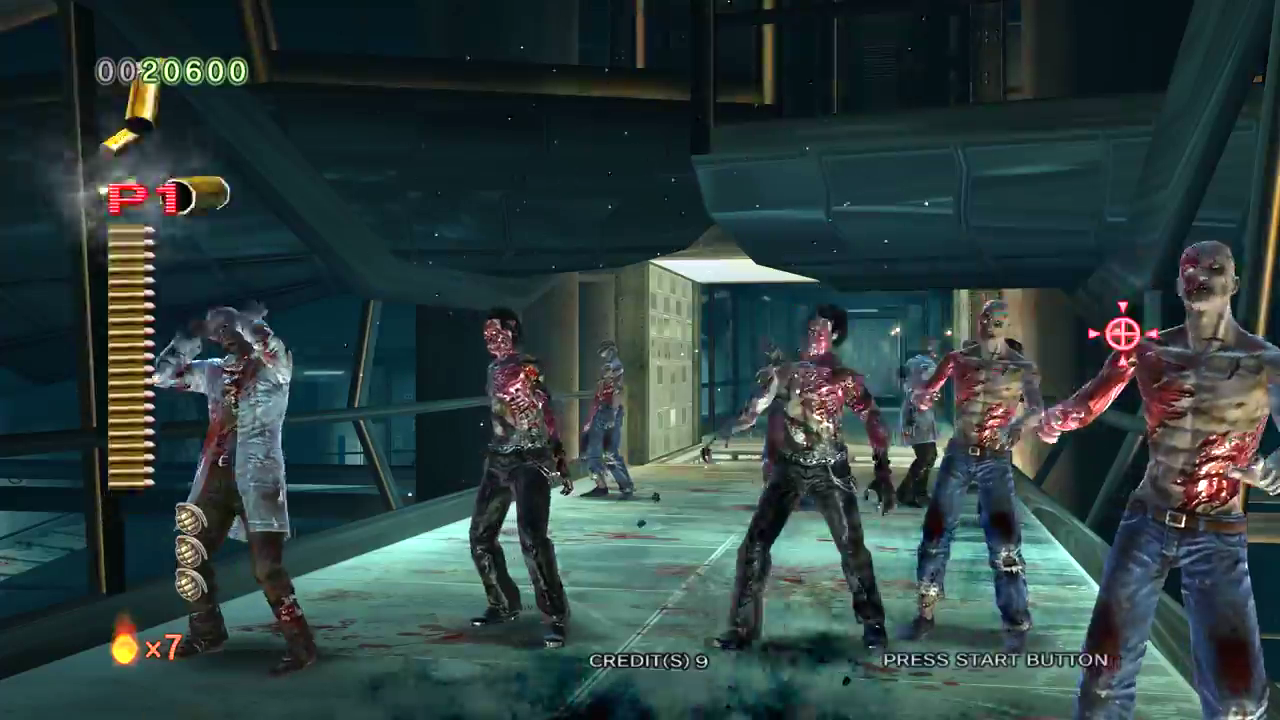
Games of the Abstract: The House of the Dead 4 (2005)


Developer: WOW Entertainment

Publisher: Sega

One to Two Players

Arcade / Playstation


Among Sega’s franchises which have found themselves in stasis, though I will tip my hat to Polish developer MegaPixel Studio getting the rights to remake the original game in a 2021 update, House of the Dead is among them and has its fans. The first arcade machine, from 1996, tackled zombies at a time before they became a pop culture phenomenon, knee deep into their growth in popularity by the time of part four here. Over console ports, a neo-grindhouse inspired spin-off, and even typing education games where you blast zombies’ heads off by typing on dangerous keyboards, and it is a franchise people like even if it also led to that infamous Uwe Boll film adaptation from 2003. It is a franchise which took a simple premise, light guns with zombies, and was made by a company for all their misguided business decisions that were good at making games.

This feels like the game wanted to close off this franchise with a last hurrah for those who kept up with its actual plot, even existing in-between the chronology of The House of the Dead 2 (1998), the most famous of the games, and The House of the Dead III (2002), bringing in the importance of part two in the franchise. That game is significant for this one in back story, in how this leads to a full blown zombie apocalypse which is going to stick for society, following a lead from the second game James Taylor returning with a new character, fellow agent Lisa Green, to deal with the legacy of his former enemy, former CEO of the now-defunct DBR Corporation Caleb Goldman, returning from part two too. Goldman, seemingly behind this cataclysmic reattempt which worked, now has nuclear missiles in play, and thus with Uzis in this game and grenades, James and Lisa need to save what is left of humanity.


Beyond this, there is not that much to add as this is a solid arcade machine showing Sega’s commitment to closing out this part of the story for the fourth game, though they did tease in alternative endings the possibility of a follow up which was a long time coming. There were differences from before – gone are the civilians to rescue for bonus lives/items, gone are the shotguns from part three – but this is a work which is made by people who worked on these games for a long time and knew what they were doing, in this case WOW Entertainment, who were originally named Sega AM1, and returning back to said name as one of Sega's development departments. At a time where arcades would have been fighting for interest when consoles fully held dominance, this feels like a loving finale for these games from the time, only with the irony that the seventh generation of game consoles, with the Nintendo Wii and Playstation 3, brought the possibility for lightgun games to return. Personality is really what counts here with House of the Dead 4, and it is beautifully cheesy.

Even if this presents a grim tone, where after a few levels underground you find yourself in a destroyed metropolis with one protagonist too old for this, you still find yourself in a subway train against a boss (named after a Tarot card as they all are in the franchise) armed with a dual chainsaw staff, or blasting your way through a shopping mall full of punk zombies. Even in mind this, like all these pulpy genre works, touches on serious subjects, that this follows Goldman (in-between levels) talking of how humanity has overpopulated and damaged the Earth, there is the contrast to these serious repeated themes in pop culture being interpreted in this pulpy ways, in this case a carnival ride between muck men and a giant spider boss to deal with. The only idiosyncratic touches which present differences to other fun light gun games are how there are some multiple choices in levels to choose, for which direction you wish to go, or how in certain circumstances you need to shake the plastic Uzi controller at certain events repeatedly to complete events, but this is a game which works even if the style and content is seen before. Even the potential risk this took in having a large part of its levels underground in bleak industrial areas, or a desolated metropolis painted mostly in browns, is thankfully contrasted in the little touches, like the goofy responses in the level rankings from your leads to how, for one level, you have to gun it in the best luxury car you can find, with only an hour before the nukes are set off, with zombies in cars a specific hazard to worry about.

Even in terms of an ending, fighting an ice based boss with an almost God-like and weirdly supernatural ting to them, with a bombastic tragic conclusion with multiple possible outcomes, this would have worked as a good last game for many, even if it returns to House of the Dead III for the proper finale. A game, House of the Dead: Scarlet Dawn (2018), was released continuing the story but only in Japan and the USA for the arcades, emphasizing the sad sense that, for a genre which still gets immense interest in arcades which have not just embraced ticket winning machines, these games have found themselves in a limbo. Until we figure out the hardware that would allow them to re-release the lot of them, just like in the Wii and Playstation 3 era where motion controls made this possible, this genre has unfairly been maligned. Alongside a spin-off, the neo-grindhouse parody as talked about, exclusively for consoles named The House of the Dead: Overkill (2009), and Playstation 3 getting House of the Dead 4, these games can still be re-released, something which needs to be encouraged as, whilst thankfully House of the Dead 4 cabinets can still be found, as I can attest to, this genre really deserves more appreciation when even a later stage entry like this can provide so much fun.

Wednesday, 24 May 2023

9 Lives of a Wet Pussy (1976)


Director: Abel Ferrara

Screenplay: Nicholas George

Cast: Pauline LaMonde as Pauline; Dominique Santos as Gyspy; Joy Silver as Nacala

Canon Fodder


Yes, that title is an eyebrow raiser. Just as this hardcore film starts, there is real oral sex with a man and a woman set to pure seventies porn groove music. And this is how Abel Ferrara, the legendary and controversial director of films like Bad Lieutenant (1992), actually began his career rather than with The Driller Killer (1979). Until the work of Vinegar Syndrome, an American restoration and distribution company who alongside genre films also have persevered the Golden Age of hardcore pornography, 9 Lives... was one of the more difficult films to see in Ferrara's career, a title now for a period of films in the 2000s (Mary (2005)) caught in rights issues. This is not an absurd film to have in his career mind, as even his "respectable" films have dealt with desire and the human, body and soul, in condition, so a pornographic film about desire makes pure sense in context especially with the earlier films in his career, written by Nicholas George, were mostly genre films which had an edge to them even in purely their moods. The problem up front with 9 Lives of a Wet Pussy comes from the compromise, along one problematic sequence, that undercut this one of being a film sold as pornography, that this era allowed these film to be interesting and creative, but that they could have easily been films prioritising the sex than adding interesting touches to it.

9 Lives... at seventy one minutes with these extended scenes of sex struggles to flesh out enough of the "what-if" with its ideas. The little fragment is fascinating and, in mind to Ferrara's films having themes of Catholicism for a key period of time, it is as much because this is also a mystical New Age occult film as well. Gypsy (Dominique Santos) is receiving letters from a former lover named Paulette (Pauline LaMonde), a free spirits whose recounting in them of all her sexual partners is the only solace for Gypsy beyond opium fantasies of this former love. Eventually, in the little plot we get, as Gypsy narrates and explains to the viewer from her sanctum home, we learn she has supernatural powers and intends to find a way to return Paulette to her. It is a compelling idea for a film, softcore or hardcore, ennui to be found here as Paulette casually wanders through relationships, be it the perfect male sex machine who is cold elsewhere, to an attended at a gas station bathroom whilst with the former, to a Nigerian princess.

It is structured around the sex scenes, but the idea of a figure who is purely of desires, and the other woman who still thinks of her, plotting as her guardian witch, is a fascinating idea especially from Abel Ferrara, whose films evoke a certain aesthetic even with his later work, suggesting tantalising ideas of how he would deal with this subject matter. Bluntly, the film is not profound and struggles for its slightness. It could have worked, especially as this is still a time of porn cinema where, unlike the emphasis on scenes in the modern PornHub era and some films, there was an emphasis on theatrical films which had surprising amount of production design to them nonetheless. The soundtrack alone is strong too, even if one song does suggest it is going to turn into a Status Quo track, tonally inappropriate in terms of this review, and the most British reference to bring in, but impossible for me to ignore. In terms of its subject, the concept of the film as a series of erotic segments including reinterpreting a Biblical tale from the Old Testament offers a lot that is not out of place for Ferrara to tackle.

And moments do show that something very interesting was here. Even the un- Ferrara choice of jazz fusion does not undercut one scene when the film is focused, Gypsy's sexual desires for Pauline depicting envisioning the later in a space entirely nude in a blinding white light as a reality. Even a scene which would be understandably seen as unacceptable now suggests what this film could have been, which is the reinterpretation of the Old Testament, that of Lot's daughters, which is retold with Paulette's grandmother, whose she shared her face and soul with, and her sister with their father. Containing Ferrara in an onscreen role, through with a stung body double and clearly not a Swedish old man just from his accent, the segment will be uncomfortable because it is non-consensual sex and incest, but is fascinating in literalising a real Bible passage which is contentious in itself, that it is Lot's daughters getting their older father drunk and conceiving children with him, the later never explicitly talked about in this version. Due to how the film feels threadbare in content, there is no ability to make this type of scene have any meaning, with one of the more transgressive aspects being that the film has real sex for all the scene including this one, even if the film is of actors choreographing scenes which just invoke real sexual contact at the end of the day. At least with that scene, shot lacksidasical which undercuts the discomfort, the idea it is tackling dealing with Paulette's heritage, and tapping into taboo sexuality which is found even in the Bible and is a tale of rape even in that context, makes it something that, in another film, would have still been a challenging and problematic work but still to consider with pause for thought.

Not defendable in the slightest, uncomfortable and even padded out, is the rape scene of the Nigerian princess which exists only for the disquieting idea of being erotic, something which back than would have been an easy red target for an anti-porn feminist like Andrea Dworkin to show if she had been aware of this. It is part of the uncomfortable schism in seventies erotica of trying to be serious, even with this type of controversial content, but clearly made with titillation, a schism where you get films which, even if uncomfortable, were intentionally aiming for something truly challenging, and then films like this where the scene here is lacksidasical in depiction, last a while and most would not even be interesting in debating, quick to dismiss it. Baise-Moi (2001), a controversial film from two female directors, was a rape-revenge film where the sex, consensual and not, was depicted with the actors actually have real sexual contact, which can be debated in terms of whether it was justifiable for that film, but was part of a film that was meant to shock and make people uncomfortable for a reason. With 9 Lives..., I cannot really defend the film at all for this scene, because its purpose, especially as there is not a lot to the film around it in actual material that can undercut and/or change how one is meant to interpret it, especially as the character barring some relationship with Paulette leaves the film soon after never to be seen again.

Moments like this undercut the fascination 9 Lives of a Wet Pussy can have, as even his scuzzier work from later one had deeper thoughts, or were a film like Fear City (1984), which was so brazenly ridiculous (and sincere) you had to admire it. This film instead suffers from having to tick boxes for being a porn film, which alongside the moral concerns with some of the content, also reveals how much of this is really a first attempt at making a film that found it not fully becoming its creators' own take on the genre. Even The Driller Killer for all its luridness as a Video Nasty fits Abel Ferrara as an auteur in his obsessions like a glove.  A slither of interest in here, the mysticism, becomes the most enticing idea of the film, ending with Gypsy turning into a man to have sex with Paulette, in the middle of a twilight reality with a protracted shot of the moon like the pinpoint camera hole in a black screen. This idea, even if the film had been longer and had more sex scenes, offers at least the idea of something very unconventional yet befitting the type of films its creator would go on to do.

This instead is still however porn in the dismissible way for large parts of it, not one of the creative ones which managed to possess something special, or just suit the point of the genre of titillation in a way which was actually admirable in a pro-sex good way. An older Ferrara film would have tackled this subject, even in softcore, with something truly compelling, and it is with praise knowing his next film, The Driller Killer, fully cemented his trajectory fully. This feels like the first attempt, and if it had been without the rape scene, and had more time to flesh itself out, literally in content and in its ideas, I would look to 9 Lives of a Wet Pussy with more than curiosity. Even the title feels absolutely inappropriate for an Abel Ferrara directed porn film, the clumsy first film which has its intrigue undercut by the context of what the film turned out to be.