Sunday, 19 June 2022

White of the Eye (1986)


Director: Donald Cammell

Screenplay: China Kong and Donald Cammell

Based on Mrs. White by Margaret Tracy (a.k.a. Andrew Klavan and Laurence Klavan)

Cast: David Keith as Paul White; Cathy Moriarty as Joan White; Alan Rosenberg as Mike Desantos; Art Evans as Detective Charles Mendoza; Michael Greene as Phil Ross; Danielle Smith as Danielle White; Alberta Watson as Anne Mason; William G. Schilling as Harold Gideon; David Chow as Fred Hoy

An Abstract Candidate


Because you can't change a channel, man. Future or past.

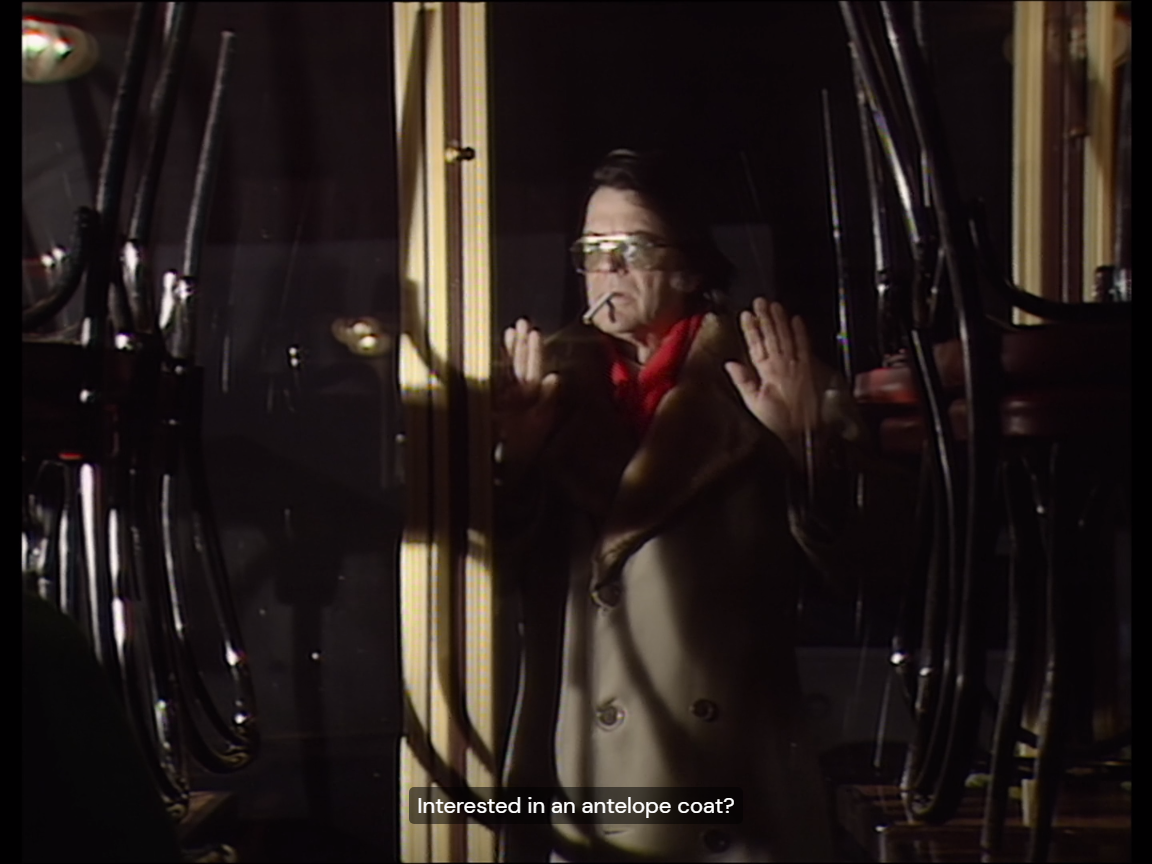
Your introduction to White of the Eye, a serial killer drama with a mystical and unsettled edge, is a series of shots within its setting of Tucson, Arizona, which alongside the soundtrack by Rick Fenn and Nick Mason, forces the viewer to experience the atmosphere of the environment, abstract in tone. The shock of the film soon after also sums up how unprepared you will be, even if the plot on paper is a traditional thriller, as the first murder scene of a suburban upper class woman continues the disconcerting rhythms and choices for shots. In a perfect white kitchen, among the glamour of the eighties in the cutlery and equipment within it, blood intermingles with the meat dish a goldfish is placed into, and wine and blood mixes against white walls and counters, all in a series of edits and cuts dismantling the imagery.

The films I have found myself obsessing over are those that cannot be easily defined - by genre and tone - and Donald Cammell's White of the Eye has clear things to its plot but undercuts it with a significant tonal choices. Margaret Tracy, the author of the source material, befitting a story about secrets is actually two men, Andrew Klavan and Laurence Klavan, Andrew Klavan of note as a crime and mystery author, one whose work has also been adapted into films like Don't Say a Word (2001). Irony is not lost that, Klavan the proud "unwoke" American conservative, ended up with his novel adapted by Donald Cammell, the complete and utter antithesis in persona in his tragically short life, but likewise, White of the Eye as with the other films, only four, in the director's career undermines the source material for a greater weight. Follow a person who is killing women, interconnected with the life of Joan White (Cathy Moriarty) and her happy marriage to her husband Paul White (David Keith), a supernaturally talented audio equipment specialist, you would find this plot in a paperback thriller and even a TV movie, not dismissive as comments from me but how graspable these plot points and the obvious plot twists you read into can be. White of the Eye, as with the few other films in Cammell's filmography, is a deliberately peculiar film, at odds with its standardised serial killer plot - someone killing women and performing gristly rituals in the aftermath - even in how only having two murder scenes are shown, in fragments and aftermath.

Instead, it concerns itself with Paul and Joan White, Paul a potential suspect for the police, and Joan's romantic view of him slowly turning along the running time. Considering this was made by the Cannon Group, a company that brought legitimately great contributions but also contrasted them with pulpy films like the American Ninja films, this feels appropriately one of their productions, feeling like the two sides of their work bleeding into each other like some of their best productions did. It is a film, mostly in truth, about a family unit falling to pieces, which however is placed within a gristly psychodrama of the most elliptical and unsettling of ways. Even that the breaking point is when Joan suspects her husband is having an affair feels appropriate for even a made-for-TV weepy, but the tone sets the film out greatly alongside how the story, slowly, itself is told with far more disconcerting aspects, quirks and nuances. His co-writer and widow, China Cammell, deserves as much praise as the co-author, adapting a novel which has touches in general which, when a character starts talking about the television in his head, are strange but fit the tone. It has a lived in reality, with side characters like a cafe owner, allowed moments to breath, alongside moments which take one back on purpose, asking why the shots were there on the first viewing, like abruptly cutting a side character, a police officer, flossing his teeth for no seemingly necessary reason in extreme close-up.

Cammell, co-director of Performance (1970) with Nicolas Roeg, became more potent an author for that film, even if Roeg became a unique figure in his own right. The sense of unpredictability with the tone there is as much found here. One key detail to how this film is told is in the flashbacks with Jean's first lover Mike Desantos (Alan Rosenberg), complicated when Desantos appears again in the main narrative. A daughter is between them all who could be harmed by this is also the obvious dramatic tension, whether this was the film it came to be or "more conventional", but likewise emphasises the tragedy of what presents the idyll life - happiness, a home in the Arizona countryside, the pet dog and tranquilly - only it has been built on a psychosis.

What the film does however around this content is more ill-at-ease, more gradually paced. Filmed in the eighties - prosperity, ridiculous perms on both genders' heads, slasher films and the Italian giallo murder mysteries of the sixties and seventies at their most lurid when the eighties came - it misses the real meat to merely say it is a critique on American ideology. The location of Arizona feels like an outside world only connected by the fashion and trends of the era, and the country music in the soundtrack, sung or playing on the soundtrack, is far too clearly sincere, for a genre that can be mocked but is also a sincere and emotionally strong part of Americana, itself adding the ill-ease with a lot of the music about heartbreak and despair, it itself aptly a genre like the blues about the tragedy apparently found in tranquil life. This film is set in a place here instead abstract with expensive audio systems, cars and kitchens which is more general, that in this apparent bliss, regardless of era and nationality, regardless of how much the kitchens cost, people can be both wonderful human beings on the outside but psychologically psychopathic. The abrupt explanation to why the killer does what they do is simplistic; the monologue appears a really ridiculous giallo or another Cannon Group production, but it befits the shift into the strange already here. From the cut to the flossed teeth to a goldfish in a Pyrex dish, this film from the get-go is uncomfortable and is much so because it is weird as it is nasty. Here you can literally find the worse nightmare just in a certain part of the bath, in a scene that would not leave many viewers' minds involving a mere thread. The landscape outside is wonderful, from dunes to vast plains, but it is isolated, the drama between the co-authors warping a novel into a world where the worst in human beings can exist in the apparent complacency of public, commercial life.

Early on, you could have read a cheap dig at the author of Andrew Klaven which could reveal this author's politic beliefs, but honestly, with little knowledge of him up to creating this review, it is instead, for a vague figure now in my knowledge I may never met or have fleshed out at all, an apt jumping off point to talk about these type of serial killer films with White of the Eye. In the grand scheme, thrillers could easily be a cheap excuse to explain the world through a conservative, black-and-white morality of good and bad, the idea that Dirty Harry is the hero for shooting a serial killer when, even if the 1971 original film has its cake and eat it, it came from a muddy ground where, unfortunately, the only person that could fight a monster is a monster himself in his attitude. Giallo are inherently exaggerated, the id onscreen for good and bad in aesthetics, style and transgressions, whilst the idea of the mystery thriller about a serial killer could be argued as being far less defendable than the Italian cousins. Many, for film or television, feel like they happily placate a vicarious desire for morbid death and mutilation, with the clean cut notion a cop or detective being able solve it the escape pad to not feel you are just ingesting in delight over dead bodies.

It would take more weight to deal with a serial killer, in real life or on a page, and many giallo murder mysteries are about corrupt people, usually middle class, bumping each other and a poor person finding themselves within as the improvised detective in the middle of it. Alongside how here the police are actually down-to-earth and alien to the trumped up notion of the arm of the law, ordinary Joes trying to work around these gristly murders, even butting heads with outside law enforcement, White of the Eye is compelling as it is entirely focused on a family disintegrating. The plot twist - [Huge Spoiler] that Paul is the killer [Spoiler Ends] - is incredibly obvious from the get-go, but that reveal is the start of the ultimate tragedy.   

Very little violence is shown. The most gore shed, reminiscent of Dario Agrento's Tenebrae (1982) and his fixation for pale white walls and blood, is a tomato sauce being splattered in the opening, the change still vile in suggestion of the brutality shown. A reminder of Peeping Tom (1960) that horrifies appears later on, with a mirror being shown to the victim of another sequence. Everything is ready to break into said violence without explicit mutilation. Paul White is not what he is expected to be, his wife showing her rage openly when it feels he has betrayed her, and Mike Desantos is someone who was violent before, released from jail and with apparent mental illness, comes as the wisest figure even when talking about a TV in his head. Summing up the reveal of the worse in a person, even if an absurd take on misogyny, as being stuck with reruns in the head TV if perfect, as flashbacks to the original relationships between the three bleeds into the current day, slowly complicating and showing the grim reality of the situation.

And then the film goes insane on purpose. The tone, even with its violence, before the final act was calmer, eerie with its score by 10cc's Rick Fenn and Pink Floyd's Nick Mason, but even their score starts to become tense, bringing a sense of growing horror to the situation in the narrative. That this even has a sense of humour, if a bleak one, is apt, where you find yourself briefly wondering if a character actually strapped hotdogs to themselves, something the daughter as a child presumes, only to consider the fact that it is dynamite inherently bizarre still in itself. The delirious tone by this point may be seen as out-of-place, except for the fact throughout the film there has been weird humour, strange touches, alongside the fact that Donald Cammell's tiny career has these strange and divisive touches for many - Performance where it cuts to Mick Jagger's song Memo from Turner and turns into a music video; Demon Seed (1977) and its premise as general, about a computer that ultimate wants to conceive a child with Julie Christie; Wild Life (1995) having an extended scene of Christopher Walken, as a crime boss, threatening to literally bugger one of his henchmen. The organised chaos of the tone that White of the Eye develops into still conveys the most animalist in people, even if the content is silly on paper. The acting has a rawness throughout, worth praising especially from Moriarty, turning into a madden frenzy when that finale takes place. When logical reality is replaced with the notion of heightened emotions affecting that reality, it has an immensely powerful effect. The result, far from ridiculous in an undermining way, is adding to the disturbing nature of what takes place.

The film switches through time periods with fluidity, blurring them together. The editing, a trademark in Cammell's small filmography, breaks scenes and moments to lingering pieces when needed. Cammell, in both scenes of violence and out of them, examines objects in extreme close-ups, adding a layer that makes them new. That the film looks like a glossy eighties Cannon Group film, going against the content inside, befits this. Night scenes are intentionally grainy and vague, creating a tone to even love scenes by the fire where it is all not it seems. The flashback tale is intentionally washed out in tone. The music by Rick Fenn and Pink Floyd's Nick Mason adds as well to the film, atmospheric and adding a ghostly edge. The result, on paper, feels like a film anyone could make. The result, onscreen, called White of the Eye is not, which leaves with the aftershock of what has happened. As an expression of the failures of the family unit, it uses its distortion to startle.

Abstract Spectrum: Abstract/Disturbing/Weird

Abstract Rating (High/Medium/Low/None): Medium

Saturday, 18 June 2022

Demons 6: De Profundis (1989)


a.k.a The Black Cat

Director:  Luigi Cozzi

Screenplay: Luigi Cozzi (with an unaccredited Daria Nicolodi)

Cast: Florence Guérin as Anne Ravenna; Urbano Barberini as Marc Ravenna; Caroline Munro as Nora; Brett Halsey as Leonard Levin; Luisa Maneri as Sara; Karina Huff as Esther Semerani; Alessandra Acciai as Nadine; Giada Cozzi as Sybil

An Abstract Candidate / A Night of a Thousand Horror (Movies)


I came to this film with a fondness for Luigi Cozzi, a more obscure figure in terms of the Italian genre film directors' canon. He won me over for the likes of Starcrash (1978), likely his most well known and an infamous film in the post-Star Wars craze. This film in context to when it is made, with the end of the golden age of the Italian genre film industry in sight, really adds a strange touch to the proceedings. The production history adds a stranger turn, as there are multiple versions of this film in existence even, and was said to have had its archival materials lost in terms of preservation. Cozzi ended up being hired by the Cannon Group, which was not created by Israeli cousins Menahem Golan and Yoram Globus, but became famous (and notorious) from them. He was signed to film Hercules (1983) with Lou Ferrigno, another candidate for his most well known film and also a bizarre experience. Golan and Globus would have a significant breakup in 1989, during the last period of Cannon before its end, with Menahem Golan leaving to run the 21st Century Film Corporation, who financed Demons 6 with Luigi Cozzi.

We are going to have a lot to mention, and one is that, in the English title, this is The Black Cat after Edgar Allen Poe's famous story. Barring a black cat and the idea witches can turn into said cats, this has nothing to do with that Poe narrative at all despite some references. Demons 6 as a title is more maddening to consider - Dario Argento, a friend and colleague with Cozzi, produced Demons (1985) and Demons 2 (1986) with Lamberto Bava as the director, films which are seen, least the first, as last hurrahs for this era, and it managed to get "sequels" in bunny ears to cash in on its successs. To give you an idea, the same year as Demons 6, Lamberto Bava's TV film The Ogre (1989) got renamed Demons III: The Ogre in some territories. Umberto Lenzi's Black Demons (1991) and Michele Soavi's The Church (1989) were also christened Demons 3 in some circles.

This era of late eighties Italian cinema, with Demons 6 as I will call it, was one even as a fan of these territory I took a huge time to appreciate, where once I would cruelly (in written form no less) viewed this as a reminder that even directors you like, great auteurs or workmen, can fail hideously. Another example of this from this era was Zombie 3 (1988), a.k.a. the second Zombi film by Lucio Fulci that had to be finished by Bruno Mattei when he became ill, complete and utter cheese to the highest degree even next to the older films of the industry that, for even great ones, could be cheesy.

This era is strange, and none stranger than Demons 6. After its set up of a director husband Marc Ravenna (Urbano Barberini) and his actress wife Anna (Florence Guérin), where we see a giallo being shot on a film set with Anna and another director, this predates Dario Argento's Mother of Tears (2007) by decades. Also a divisive film, Dario Argento’s official third film in his Three Mothers Trilogy, based on passages in Thomas de Quincey's Suspiria de Profundis, was pipped to the post by this obscure third film which, in this world, the characters openly talk about Argento's Suspiria (1977) and Inferno (1980) exist within it. Marc and his scriptwriter friend decide to use material from the same source Argento’s films came from, planning to make a film about an evil with called Levana, the last of the original three mothers of witches from de Quincey's writings, if a famous producer is willing to fund the production. Anna, planned to play Levana, is beset by troubling hallucinations however, with threats to herself and her young child by Levana coming to be.


Cozzi, his own script, effectively beat Wes Craven too with this. Before New Nightmare (1994) became a meta-film with actress Heather Langenkamp playing Heather Langenkamp, being beset by Freddy Krueger, this film like Craven's too, surprisingly, is presents as it could all by psychosis within the female lead's mind. The difference is that this being Italian, they are more pulpier, have more glam metal in the soundtrack (including from Bango Tango and White Lion), and Anna having Levana jump her out a mirror, through the reflection, and drool green goo on her as a warning. The script has an origin from Daria Nicolodi, which adds to this film's curious history, the ex-wife of Dario Argento and actress arguably the inspiration for Suspiria, as a key tenant to the script she co-wrote came from the story of her grandmother having to an academy where black magic was taking place1. She is important for that legendary film, and was originally on this production meant to be a proper Three Mothers sequel than never come to be.

Instead, Demons 6 if it was this basic plotline would annoy many people, as never was there a film where the "it was all a dream" or "dreams-within-dreams" clichés exploited to a comical degree.The film's history, including the 21st Century Film Corporation changing the original work print cut of the film Luigi Cozzi had, only for that version managing to be released on Japanese VHS, is strange and befitting a film which has this dreamy, irrational tone. That what sounds like a meta-horror film from an industry already becoming meta (Argento's Tenebre (1982)), only to become a sci-fi conclusion that just screams the truly bizarre The Visitor (1979), emphasises this. I can appreciate this film now, though even for casual fans of Italian genre cinema, I would not be surprised this would baffle and irritate people as a mess, before you even consider the name The Black Cat, and the Poe references, are only there because 21st Century Film Corporation was releasing Poe inspired horror movies between 1989 and 1990, like Gérard Kikoïne's Buried Alive (1990), and wanted to sell a film with that title.

Thirty minutes into this, the film is still going through introductionary exposition, as a ninety plus feature, and befitting a film soaked in so much colour gels and lighting to rival Inferno and Suspiria, this feels like an irrational head-trip. It is different from those films, trashier, and the sense of dream logic is closer to the strangeness of this country's genre films which exist in their own logic, than the focused surrealism of the Argento Three Mother films, excluding Mother of Tears which is its own creation in tone and presentation. Seen in a good form, Demons 6 regardless of its cheese does have some striking moments. Yes, this is a film where for a scare, Anna finds herself talking to a repair man fixing her fridge, only for him not to have existed at all and vanished into thin air, but there are shots within this which are gorgeous to see even if the dialogue and tone is deeply silly. Her later wandering through a mansion suddenly overcome in cobwebs and decay in pure red lighting, at the straddle point between wondering if she is hallucinating whilst talking to a wheelchair bound figure who is undead, has a legitimate air of the irrational for a director, honestly, who is more goofier in tone, or is famous for a film like Contamination (1980) in his less adventure-toned productions, whose atmosphere came more from its incredible score by Goblin.

The quirks are their own charm too, such as its fixation on that refrigerator in the first place, even if playing a possible gas-lighting narrative with twists involving Nora (Caroline Munro), another actress envious for the Levana role. Or that there is also a fairy named Sybil who talks to Anna through her television late at night, or the cuts to a demon foetus in red. Or the shots of outer space and planets, which become more and more common as, for a film meant to originally conclude the Three Mothers trilogy, becomes stranger in a different way. Or that, whilst Mother of Tears was lurid and gory, and the originally two films had violence, none go over-the-top as here where someone's heart is literally made to explode and burst a giant cavity out their chest. The other jarring touch for some and a quirk for other, which is still one I admit does not quite work, is the decision to cut to cheesy hair metal riffs. I can appreciate this, and this music, but there was a reason one ago why only Demons and Demons 2 made heavy metal work in Italian horror films for me, as a fan of both. It is something Dario Argento was fixated on, from Phenomena (1985) at least on for a short while, and the Demons films he produced were balls balls-out splat fests rather than spine chilling. Alongside cheekily exploiting Goblin's main theme for Suspiria, it does add a humour here when, in Opera you got Saxon or Motorhead, this dates when in the nineteen eighties it was made, like Cannon Group productions had licensed soundtracks before, in that this is full blown hair metal. The guitar licks are appropriate abrupt in when they appear as they are appropriate, but this is not even Motley Crue, but the bands that grunge and Kurt Cobain were said to have killed off.

Cozzi's films have a vibrant imagination, even in spite of the silliness of the material, but this is different even to his other films. Unlike a Starcrash, where the unexpected tangents felt like a celebration of pulpy storytelling or how a child adds more and more to a story they are telling as they go along, this abruptly introduces its plot aspect, including full blown science fiction, with complete unawareness of it being set-up earlier on. Demons 6, right from the first images of outer space and a cosmic foetus, depending on the version you are watching, does feel like two or more different movies were bolted together, and it cannot be denied it does have exposition at times that is panicked and gibbering in desperately trying to make it sound. Even if now as I am older, and I find that utterly entertaining, there is madness here that I forgot transpired which is ridiculous, [Spoiler Warnings] where nothing really prepares you, for what originally existed as a proper ending to the Three Mothers trilogy, for the ending to suddenly reveal, with a car having plowed through Anna's living room earlier, that this is about telepathic illusions, an evil psychic mutant, and the fate of the Earth being jostled for between forces of good and evil that concludes with a baby having an evil voiceover plotting revenge. [Spoilers End] If a reader is someone who is going to find these twists off-putting, even a very silly film like Cozzi's Hercules film is more focused and a wiser choice to appreciate his idiosyncrasies as an Italian genre filmmaker. Even in mind to that film's weird tone, with its Ray Harryhausen tributes and colour gel lighting, this is a fever dream that, with fresh perspective, I found incredibly entertaining, but will flummox people.


Abstract Spectrum: Abruptly Paced/Dreamlike/Weird

Abstract Rating (High/Medium/Low/None): Medium


======

1) Mental Floss' 14 Unforgettable Facts About Dario Argento's Suspiria, written by Matthew Jackson and published on October 25th 2018. It is specifically the first fact which is of any importance for this:


"1. IT IS PARTIALLY INSPIRED BY A TRUE STORY.

Though the phrase “fairy tale” is often thrown out to describe Suspiria’s unique Technicolor horrors, the original seed of the story apparently emerged from something quite real. According to co-writer Daria Nicolodi, her grandmother Yvonne Müller Loeb was once sent away as a young girl to a prestigious boarding school, only to find that Black Magic was actually being practiced there. When Nicolodi heard the story, she filed it away in her head, until she and Argento took a trip through various European cities with a history of witchcraft. She was reminded of the story, told Argento about it, and Suspiria was born."


Tuesday, 14 June 2022

Games of the Abstract: Silent Scope (1999)


Developer: Konami

Publisher: Konami

One Player

Arcade Version


Considering the type of firearms replicated in plastic arcade cabinet form - pistol, shotgun, rifle, Uzi, big machine guns with enough recoil built in for potential strain on the hands - a sniper rifle is not a surprise. This game and most of its franchise were released for the Playstation 2, the Dreamcast and the original Xbox, with even a Game Boy Advance version of the first game inexplicably existing for the handheld console. This review will stick however entirely with the arcade version, as there is a huge difference, whilst I am glad someone converted it for the consoles, in having to hold a plastic sniper rifle, thankfully something foreign to most English people. Having accidentally eaten the hand grip constantly trying to focus, breath in, and take shots as an amateur for an arcade cabinet is a curious experience in itself even next to other light gun shooters.

Silent Scope also follows the fascinating trope of Japanese video game developers clearly watching a lot of American action films and, in depicting North America, exaggerating the films and the iconography to an extreme. The broadness of Hollywood's films, filtered by another culture, has a lot to answer for in how broad and over-the-top these games could be, here with the President of the United States, alongside the First Lady and First Daughter, being kidnapped by terrorists. Here, one sniper is a bad enough dude to rescue the president. The sniper rifle on the cabinet itself, for obvious reasons, is the biggest touch of the game, how onscreen you have the target move when you position to rifle fixed on the cabinet, with the potential to be able to snipe dots in the distance. The true point of the game though, and idiosyncratic touch the console ports had to work a method around, is that like an actual sniper rifle, you have a viewfinder which stays at a fixed distance allows you to see the targets as far away on a skyscraper in the distance.

Not wishing to turn this review into a grim point we cannot take this out from, for what is a review of a silly and fun arcade game, I admit there were moments of weirdness in even latching onto a plastic replica of what would be a very powerful weapon in real life, something which is telling in how, in Germany, Silent Scope is on the list of games not allowed to be sold to minors by the Federal Review Board for Media Harmful to Minors (the Bundesprüfstelle für jugendgefährdende Medien or BPjM)1. Admittedly, many games are on this list, such as F.E.A.R. (2005), or the original Doom, alongside many light gun games, so the list is not really one which suggests this is transgressive. That merely emphasises, just in an entire list of games in Germany, of how violence in games is perceived in that country in general, nestled in a list that lasts into the 2020s with entries added. Silent Scope, for the brief uncomfortable moments I admit to feeling, is also very cartoonish, as broad and over-the-top as you can be.

Whilst Silent Scope offers a challenge eventually that goes against the practical uses of a sniper rifle in real life, it does, even for a cartoonish representation, push you to something more realistic than a plastic handgun in just the emphasis on focusing on targets in little time to act. It presents a fascinating dynamic of how, especially as this as the first game quickly gets into moving targets, you still have to position shots. The game's mechanics are even found in how, for a huge risk for a game originally designed to ingest player's coins, you can barring one boss, take out bosses with multiple health chunks with just a single head shot even on the first attempt. You can also snipe a helicopter boss with one shot to the rotor, emphasising the cheese on display, but this even in itself was a risk in how, for a game which you will be thrown into scenarios with many enemies to take out, this could cut swathes through large set pieces. It also, with credit with the developers, ends up showing respect to the player however to get better; even after just a second attempt at the game, an amateur like myself could figure out this trick, and improve my coordination. The goons in general fall just from clipping their hands, and the challenge is instead between the time limit to clear each section or that, if the enemies have you in their sights or become aware of you, they will shoot back. That the game, with a secret code even for the arcade version, allowed you to even remove the target you use emphasises this being developed to get the challenge to grow each time a player returned to it.

You will have your work cut out, especially as having to target enemies in the far distance does require hasty focus, the last major stage involving fighting in a mansion in the dark, having to use the scope for night vision unless you notice a shiny light or jacket in a glimmer. One additional aspect which has aged, but comes off far less problematic than other games from the time, is how if you catch a beautiful woman in the scope, you get a life back. This is pure cheesecake, as they do not even have to be in a bikini or in skimpy clothing, and is more of an aspect of a different time. Obviously, with this a method to help the player, bystanders and hostages, whilst they cannot die (barring one stage's exception) proves an obstacle you lose a life on if you clip one.

The exception I mentioned, and where this will prove a task, is if you select to go to the sports stadium. Silent Scope has three major moments where you can choose how the narrative plays out, even if they all go to the same final stage. The third, selecting elevators in the mansion, is less an issue than the first two. They change the difficulty, how the second either allows you to trek through the woods in the dark, or the really hellish challenge of parachuting into enemy territory. The first is the most dynamic of choices. You can fight a fighter plane, or you can rescue the First Lady on the roof of skyscraper, circling it in a helicopter and firing at a rocket launcher welding grunt, or you can see the ridiculous if hard challenge in the stadium. The last is probably one of the more memorable moments in spite of the challenge, as early into Silent Scope the games introduces moving targets, here where a villain has the First Daughter over his shoulder, running around the pitch during an American football game with players chasing after him. If you cannot hit him in the head, or enough time, it moves onto a boss chase with that villain you can access in other modes, and also leads to rescuing the First Lady in an alternative boss battle in a hotel, but the stadium is funny as a concept. Yes, sadly hitting the football players does actually leave casualties that are more permanent, so this challenge has an additional edge alongside grunts firing back if you spot you.

The sense of absurdity, an American action film which is more openly cartoonish, is found throughout the game such as having to fire at a man attempting to drive a truck at you, thankfully contrasting that aforementioned ill-ease with having held and used a plastic sniper rifle even as an arcade peripheral. The game's cartoonish tone contrasts its violence by portraying it with an absurdity, particularly as the challenge of the game, trying to play as a light gun game with a rifle not designed for rapid fire, is over-the-top. Arguably the hardest moment in the game, the actual final boss, cements the lack of reality as well as feel frankly a mean difficulty curve in itself, where you find yourself fighting Marina, a metal armour BDSM woman with razor claws in a dock warehouse. She, with a headshot only possible after three hits, and only the bared breast bone which can be hit, is from a harder game, Marina feeling a mean challenge even after having to hit search lights on a parachute or following a running target weave about on a football pitch. Her first round is trying to catch a twirling, skipping and frolicking sadist who takes lives like a kinky Wolverine. This is the one moment Silent Scope does feel like the coin devourer it was designed for. Thankfully, the second half of the boss fight is easier and more amusingly over-the-top, where she fits the bill in seductively stroking the tied-up president, even cavorting around him like a stripper pole whilst firing at you.

The actual "final" boss begins a troupe of Silent Scope as a franchise of one bullet, one shot challenges, explicitly in this case one headshot and nothing else being acceptable. In this case, [Huge Spoiler] hitting a random white suit wearing megalomaniac on his yacht far away before he sets off a bomb, whilst he just monologues too long, [Spoiler Ends] felt befitting the tone of the game. The franchise would continue on for three sequels, including the console conversations, leading to a long gap from Silent Scope 3 (2002) to Silent Scope: Bone-Eater (2014), the only Silent Scope game never taken to consoles. This took a significant step into a different aesthetic, when Silent Scope as a 1999 game is realistic for the time, by having an anime aesthetic. Set in a sci-fi future, aspects definitely show of appealing to a certain audience, with its female cast in very heightened and fetishishtic outfits, but considering the male lead is also a youthful lead who proves sci-fi body armour is sexy regardless of your orientation, Konami placed their hopes on multiple audiences being attracted to the arcade cabinet. Whilst developed by tri-Ace, as a 2010s game you always have the reservations that the decade was when Konami became villains for many, or at least messed up their franchises in misguided directions, such as cancelling a Silent Hill sequel involving Hideo Kojima, but commissioning a pachinko machine instead. The original Silent Scope, from far before this, is a fun game. The conversions would be fascinating to witness, but for those lucky enough to locate an arcade cabinet, it is unique.

====

1) Rather than just one link, here are two, one here for a Web Archive page for a Cybercafe Software list; the other Moby Game's list of BPJM indexed games from the time Silent Scope was added.

Saturday, 11 June 2022

Rise And Fall Of A Small Film Company (1986)


Director: Jean-Luc Godard

Screenplay: Jean-Luc Godard

Meant to be based on the novel The Soft Centre by James Hadley Chase

Cast: Jean-Pierre Léaud as Gaspard Bazin; Jean-Pierre Mocky as Jean Almereyda; Marie Valera as Eurydice

An Abstract Candidate Re-Review


ALBATROSS

FILMS


For Jean-Luc Godard, the state of cinema is assessed by way of an adaptation of a James Hadley Chase crime novel, or what should have been one, originally produced for the crime story series Série noire (1984–1991) in France. In this episode of the series, we are introduced to producer Jean Almereyda (Jean-Pierre Mocky), once a matinee idol and major producer explicitly referenced later on in this world to having funded Georges Franju's Head Against the Wall (1959), and lost his career from the failure of Sergei Parajanov's The Colour of Pomegranates (1969), now reduced to TV movies. He is also now dogged by a case of stolen money, all whilst his main director Gaspard Bazin (Jean-Pierre Léaud), once an acclaimed figure, spends his time in an obsessive ritual for casting extras that eats up the funds they do have. Almereyda's wife Eurydice (Marie Valera), feeling herself a caged bird, crosses paths with Bazin, becoming a potential creative source when she desires to be an actress.

This, in that premise, befits the time period of theatrical films Godard made, but as mentioned, this was for television, clearly shot with video. It is strange we can uncover lost films by Jean-Luc Godard, one of the biggest names in all cinema, but we can forget that even after ten years, obscurer films in a director's filmography can be neglected absentmindedly, especially when Godard's career for many was the sixties French New Wave era, or his Film Socialisme (2010) period onwards, not even considering his work in television or short film creations. That even a great American director can have material not available means that the Swiss director, even if he is a legend in cinema, can have probably more unavailable, as both being a director who worked in a foreign language to English, and has experiments in television and short work more rife than many in his career. Rise and Fall..., taking place when he returned with his second "debut" Every Man For Himself (1980) after his experimental and Dziga-Vertov Group era, comes a year before his infamous Cannon Films production King Lear (1987), but even here, as a big name to bring in to his assignment with Série noire, he did not do as likely intended.

At one point, Godard does buries the book through Jean-Pierre Léaud's Bazin, and Rise and Fall..., rather than the adaptation of a crime novel as like intended, is a meeting place between his return to narrative cinema in the eighties, and the video experiments that would lead him to his career in the current day, the video and use of clips here a prototype for Histoire(s) du Cinema (1988-1998). The noticeable limitations - the TV screen ration, the limited aesthetic, the video sheen and digital text captions - are things that would undermine another director, but are like providing Godard with new tools to work with here. He is someone, known to use VHS rips of old films on purpose still to this day, completely polymorphous when it comes to technology, already working on television productions in the seventies and, in the 2010s in his older statesman position, having his own 3D camera built by scratch and making a 3D feature in Goodbye to Language (2014). Still working with a plot, he uses this context around one which contrary to his famous quote does have a beginning, middle and end in that order, the struggles of a TV movie company mid adaptation of James Hadley Chase's The Soft Centre, the novel Godard is meant to adapt, in which he weaves his state of unrest, looking at cultural critiques in the midst of the tired producer Jean Almereyda, and the deranged genius Gaspard Bazin.

Léaud, meeting back with Godard and thus evoking his many moments in the latter's work, could if you cheated a little be the exact character he would later play in Olivier Assayas' Irma Vep (1996). The same director hired to remake Les Vampires (1915-16) in that film, he here as Bazin rather than that film's character is stuck in a wilderness era in the late eighties, his obsessive ritual with the extras of having them move through rooms in a conveyor belt his fixation. Having them quoting at one point the same passage contracted together between them, the ritual is much him attempting to find his creative sanity as madness. He is less irritated by being stuck making television work, but more that, (with the film biting the hand financing this feature), he wished he was adapting Dashiell Hammett instead, alongside the sense of the world being entirely alien to him, someone in his back story having been as broken mentally as his producer Almereyda in status by the industry.

In a world where he and his producer sit in front of a television showing a fire, rather than a real one, to stay warm, the world has become stranger than the sixties they made their fames in, that strange and very funny moment pretty much the best statement from Godard of what he is aiming at, in the all pervasive air of a television, all within telling a really good narrative in his unconventional way. The film making world is so different from France's before, where Bazin's arcane ritual with the casting chews up money for a company who cannot even get a TV movie off the ground and shown. That Jean Almereyda has stolen German marks, an act that will doom him, to run the company, is as much caused by the struggle of his own career as it is because Bazin is not helping.

Admittedly, Godard's criticisms of the state of cinema and life, as he has been doing them since the sixties, could dangerously fall into shouting into the wind, worse a man trying to joust windmills thinking they are dragons. I view the Film Socialisme Godard, onwards to this day, as cinema's Prospero now, in his magical tower in Switzerland creating his cinematic incantations, or like his character Professor Pluggy in King Lear with patch-cord dreadlocks in his hair, isolated from the world entirely but still incanting on the state of it with a world weariness to his voice. Bazin's test to people, which Eurydice actually succeeds in, of being able to see the true number of characters within classic art, not the exact number but those who are the most important, feels like Godard himself. We must realise in hindsight, for the innovations he brought to cinema with his peers with Breathless (1960) onwards, his career has morphed from the innovator to the figure looking even beyond art to culture in general. Going into literature, classical art, older films, and with this having a crow's murder of soundtrack choices - Leonard Cohen, Bob Dylan, Janice Joplin's Mercedes Benz perfectly used for an intertitle - Godard became someone who is not just the cineaste but the curator of art, a man who can appreciate Jerry Lewis in his youth, but by this point in his career brought in classical music and even Scott Walker into his scores.

His philosophical concerns here are not only enlightening but constantly evolving over time, the ones of yore still relevant to the current day or time capsules to new problems per era, especially as like many of the films from this eighties period, he returned to narrative, and the narratives are interesting even if unconventional. Here, ironically when he was asked to make this TV film, he is practically spiting at the producers by having the pair of Bazin and Almereyda as doomed figures of the past, floundering even in commercial television, but that is still a compelling little noir tale in itself. Calling the female lead Eurydice is a loaded choice too, but like the women and femme fatales of noir, she is also the focal point here for the drama, as the female heroine also dragged down in tropes of those films of corrupt and the underbelly of life, here the figure kept in an unhappy marriage as a trophy wife to an older husband. She is ultimately not the person that leads someone to doom unlike other noirs, instead the one who, from an unhappy marriage, actually finds happiness in the end here.

Their lives are small scale, the television budget and style of Rise and Fall... helping this. It is too rye to be an out-and-out comedy, but humour is to be found especially in side characters like the accountant, who in deadpan handing out paltry earnings to the extras discounting their social security. Or Léaud playing up his character's out-of-control behaviour, be it interrupting a phone call between a potential actress with acute abruptness, brought to she suspiciously suspected to be erotic shot, when asked to bring a bikini alongside her, or breaking into a Woody Woodpecker impression. Godard's also one of the few directors able to get away with casting himself as the wise sage as well. Much of it, by this time, is because Godard was such an iconic name it was impossible to get around this, common in narrating his own films since the sixties and having a reputation as a figure outside of cinema, making his work (usually dialectic anyway) completely attached to him. Rise and Fall... offers him playing himself, amusingly (as I want to picture it) visiting Reykjavik in Iceland because he had to witness the greatest chess game being played there, but here appearing to find a deal back in France, his scene turns into something else with his talk about Romy Schneider.

Schneider's reference is also one of the most important, and bitterly sweetest, of this film, as thus his scene turns to an appropriate melancholic air about the period, of Schneider, in real life, passing in 1982 in only her early forties. An actress of considerable talent, starting in the fifties and connected to the multi-continental era of European cinema, from France to Italy, the scene in general as well as the clear empathy for her in the dialogue becomes one of the film's most meaningful scene, with Godard with his fictional creation Jean Almereyda, of two old professionals lamenting their careers in cinema being affected by the change in tide, left adrift within it, with Schneider's death for Godard marking a symbolic change in the industry. Even if Godard would become more and more a legendary filmmaker who made films to the current day, he eventually drifted far from narrative cinema again into the nineties, into experimental features entirely, all bolstered by the reputation he developed allowing him to leave mainstream cinema behind whilst French cinema would evolve again into the Millennium into its own form.

His critiques are matched by a willingness to play with the form of film a way few would. The limitations, the flaws, of this television work are devices for him to exploit, superimposition to the hair-raising use of slow motion on a female extra's emotions mid-performance all his hand with collaborators constructing the images and audio. He even deliberately has the sound abruptly halted as if the film has failed, followed by a technical difficulties screen, for a joke about how that would have likely happened in television in that era. The marriage between the two sides is like a much underrated theatrical feature Godard made within this era, Detective (1985) with Johnny Hallyday and Nathalie Baye, a small scale crime narrative confined to one hotel, perfect for Godard's experimentation as well as providing an actual story. Rise and Fall... still tells an interesting tale - for Jean-Pierre Léaud's Bazin, a spark of life is found in Eurydice, who he compares to actress Dita Parlo known for films like Jean Renoir's Grand Illusion (1937); for Almereyda, an embarrassing conclusion to his life, made more embarrassing trying to flee in the silliest costume possible for an escape. Bazin's connection to Eurydice is also not a romantic or sexual relationship either, instead Bazin finding artistic clarity, Eurydice her independence and freedom, finding business in the end to work as head of. Even when the tables turn, and Bazin is now an extra by the ending, he finds happiness nonetheless.

Restored and premiering at the 2017 Locarno Film Festival, sadly the reappearance of Rise and Fall of a Small Film Company is not as readily available as one would hope. However if Godard's Dziga Vertov years can be accessed, insanely difficult to appreciate (and even defend) films, and high definition versions no less, than one day one hopes Rise and Fall... would join those available. It is a title absolutely worthy of availability, like many of Jean-Luc Godard's eighties and early nineties work a hidden part of his career which is compelling and virtuous.


Abstract Spectrum: Avant-Garde/Diegetic

Abstract Rating (High/Medium/Low/None): Low

Tuesday, 7 June 2022

The Ultimate Ninja (1986)


Director: Godfrey Ho

Screenplay: Godfrey Ho and AAV Creative Unit

Cast: Stuart Smith; Bruce Baron; Sorapong Chatree; Anne Aswatep; Pedro Massobrio; Timothy Nugent; Rick Jenkins; Naiyana Shewanan

Canon Fodder


Be a good ninja...

I am back on Planet Godfrey Ho, and there is a fondness already to witnessing a man in a store bought ninja costume, a scratch which needed to be itched again. This film however feels different from others, to the point it surprises that its release date is 1986, around the same time as the truly infamous cut-and-paste ninja films like Ninja Terminator (1985) made by Ho and producer Joseph Lai at the time. This feels like a very early title from them, rather from that time period, before they figured out the presentation of these films, infamous in capitalising on the popularity of ninjas in the eighties by taking pre-existing films, some even unfinished, and splicing in an additional plot with new footage involving ninja. Usually leading to white men (likely bystanders floating around Hong Kong) in said costumes with obvious stunt doubles, this template created an infamous series of films, which this is still connected to if more tentatively. The Ultimate Ninja still has the Golden Ninja Warrior of Ninja Terminator, which can provide "supreme ninja power", but this feels older than the mid-eighties, not just from the film used, but in tone. Richard Harrison is also not here, the American actor synonymous with these films, and the absence is felt.

The film is a case where the ninja footage really does feel incongruous to the original film used, even if this also includes another ninja figure you could win for four hundred tickets at a seaside arcade prize counter. This still exemplifies the absurdity of the spliced-in ninja footage, before Ho got to his most compellingly weird content in this field, but the threading of the footage was more frequent in other well known films. Here, barring wondering what the "supreme ninja power" actually is, you still get some of the idiosyncrasies there. Especially with the evil ninja leader, the English dubbing for these films, in their unique inflections and ejaculations of words, is unmistakably of these movies, but this feels its primordial form. Even if this was actually made after Ninja Terminator, and those more well known films, it feels befitting this strange world of accidentally going backwards in logic, like a project which never got as much attention, for a lack of a better phrase, than those which were stranger then this.

It is a shame the ninja footage is unnecessary. With ninjas hiding under piles of leaves, and that they have an unlimited number of shurikens that can be used to swat stray ninja away like wasps at a picnic, and this has the sense of unintentional humour of the other films. It does however feel like, onscreen within itself, The Ultimate Ninja was still figuring out how to use ninja, before getting a named actor and abusing the footage you got, of trying to figure out how to make them interesting. With the good ninja indicated by having "ninja" on their headbands, skulls on those for the villains, or practicing on picnic benches, this does have a charming homemade quality yet combined by the fact that most of The Ultimate Ninja is the pre-existing film. As a result, the ninja footage becomes arbitrary, despite the production hired doubles who could do back flips and some homemade creativity, like editing around throwing swords at each other, feeling like padding.

It is perfunctory, even in mind these Godfrey Ho films are an acquired taste. This is before the likes of a Garfield novelty phone provided easier ways to intercut a ninja plot to the original film, and more use of splicing the two stories in general with these productions, with the only time they are linked properly being a single scene, with close-ups of faces from two different sources in indiscriminate tree covered grassland. The film that this originally way, also all told in just a new dubbed narrative, is a traditional martial arts film and is surprisingly complicated by itself, in which the leader of the village was killed, leaving his two sons and daughter to be rescued by the uncle, and then split off separately. One son becomes Jimmy is trained to get revenge. The daughter Sarah is with the uncle, named Eagle, who was left stuck training the men of the boss who had his brother killed, whilst Sarah fights behind his back to protect the village from their protection racket. The last son, John, is the klutz working at the noodle shop who wants to learn kung fu.

There is some fun with the source film where you prove you are the evil boss by perfecting your throwing axe technique, or that Jimmy's training for martial arts power involving the excessive breaking of mirrors with a staff, hoping to compromise for many seven years of bad luck by developing martial arts prowess. Truthfully though, with The Ultimate Ninja's source having a lot of characters and plot, a long winded plot at that, means that nothing, even if material was cut out, really required more than Godfrey Ho to have dubbed the film. Even if this was an unfinished film he worked on and completed, it felt enough for itself unless there was a mandate for a running time. Even the source material has aspects which feel underutilised too, if you just wanted a silly martial arts film, such as a bald fighter in a pink tank top who keeps tapping his head and looks like a beat 'em up character, one that could have been included in more prominently than he was. There are arguably, in fact, too many characters, as Jimmy is pointless, especially as a far more obvious plot is how Sarah, with her uncle Eagle forced to work for the enemy, should be the protagonist, capable of fighting to protect the village without anyone else blundering as a protagonist. Godfrey Ho films are messy affairs in narratives anyway, but this definitely was a mess among them improvised on. My love of the Godfrey Ho films does redeem what, even for a director who is an acquired taste, a film I once considered a slog, and should not be the film you dare try to introduce these films to someone for even for ironic viewing. It is still sluggish nowadays despite my fun with the movie. It is, for those curious about these artefacts, the fun oddity among them as a result.

Sunday, 5 June 2022

Games of the Abstract: Panic Park (1997)


Developer: Namco

Publisher: Namco

One or Two Player

Arcade


Something a little obscure and rare here today, though Namco are an established name. Their arcade division, especially when titles were converted to the original Playstation onwards, helped them stand out, but the arcade games show the company trying to experiments. Something like the Time Crisis games, one of their most well known arcade franchises, did something as simple as have a duck function which moved over to the console ports, that for on-rail light gun games, they had players be able to take cover behind barriers, which with a time limit to clear paths that did force you to make yourself vulnerable to shot. That game, even as later on as Time Crisis 4 (2006), found an innovation in just adding a foot pedal for this duck mechanic. Some of their more unconventional work sadly never moved to consoles, with the issue of how to transfer them over for retro collections when they were made to exploit the arcade as a place for large cabinets which could have specialist gimmicks. Lucky & Wild (1993), developed by Yutaka Kounoe, was a fascinating combination of a light gun game and a driving game, inspired by American buddy cop movies of the eighties, which was designed for two players in co-operation, one driving and/or holding a gun, the other taking a gun or both firearms.

Panic Park could have been transferred to a console, if a very slight game which would have needed an expansion even back for the PSX era. The game's simplicity is however matched by its unique gimmick, distinct for the arcades but being simpler than even a foot pedal. For one or two players, Red or Blue, you have, barring a start button that can also be used for jump in a mini-game or two, is two handles on a horizontal slot that is moulded rigid, only able to be moved from left to right only in a curving movement on a sliding fixed frame. Two players, the second stick is built in the same horizontal slot, and naturally, this is designed to have players literally jostling, clashing the handles physically as well as the characters onscreen. Panic Park as a mini-game challenge is set at a theme park designed by two psychotic robo-scientists, one blue and one red. Like an even more dangerous version of Takeshi's Castle (1986-1990), the show starring actor/director/comedian Takeshi Kitano that, translated and successful in the west in broadcasts in the 2000s, was already with games for real life participants that already looked painful when failed on.

This is more deadly just for the fact that, whoever loses or fails, they are dropped down into a pit, and soon after with their freshly cleaned skull spat out afterwards. As a result, Panic Park the game has a twisted sense of humour to contrast its whimsical tone. To survive, Panic Park gives you a selection of randomised games to complete in one or two player. The last game chosen is the most important because if you win, least in one player, you get the prize regardless of your success or failure in the two of three games single player chooses, the congratulation screen better than being dropped into a pit. Alongside the fact that, were it not for an invisible block, preventing smashing each others' figures and knuckles into each other, Panic Park exists to be experienced fully as a very short but fun arcade game. This is sadly a game, in its original version, more difficult to preserve, but as someone lucky enough to play the game as intended at my nearest arcade, the fun is found in using this very simple controller which has a surprising amount of nuance to use as mostly as jostling between players. Particularly with some of the mini-games, like having to run into the distance whilst avoiding cactus, or jostling for coins whilst avoiding moles/trees/penguins, the fighting among each player is encouraged.

Point Blank, the Namco light gun game mentioned, is apt to compare to as this has a cool wacky tone, alongside it also being a mini-game compilation.  The difficulty can be altered - in the prologue, you can collect the same number of coins before you enter the titular park, which I suspect having tried not collecting them alters the difficulty, as does the difficulty level being affected by how well or bad you are doing. The humour is also there, especially in surprises, in how very simple challenges are chaotic, prone (if done in real life) to have likely killed or maimed someone who attempted them, or are just silly. One involving baby chicks, Chick Panic, is a great example where the joke is not spoilt by the punch line revelled; it suggests having to collect cute yellow chicks, not a twist on a mini-game, set in a valley, of dodging bulls if replaced by giant rampaging chicks in nappies heading for you.

There are so many games, if you play over and over, so you cannot catch all twenty five unless you constantly played the cabinet. The last challenge is always a certain set. The difficulty at its highest includes, in outer space on a tower just above the Earth, trying to stay on a giant tower, bumped by shuttles and satellites as it loses space, forcing you like many of the games to figure out how to carefully move your sole controller, more deceptive to move then you would presume in response. Quick reflexes are also needed, be it going through doors of burning walls, or with one of the final challenges, a drop from a height that, thankfully, has a crash mat at the goal at the bottom, but is populated on the descent by electric barriers and, even if you dodge them, the sick humour of your character bouncing off inert pegs like a ragdoll. One challenge just fires you out of a giant cannon at a quick speed, trying to dodge pillars, another avoiding giant mallets trying to crush you.

Panic Park is fun. Even if you had lost a huge virtue of the arcade cabinet, one simple mechanical touch, this premise could have followed on into the console world in an extended form, more so as, to adapt this, Sony for the original Playstation would introduce the Dual Shock controller in 1997, presenting gamers with two directional sticks as the likes of the Nintendo 64 had an analogue stick inherently built into their console, creating blisters on children's hands for the likes of the mini-game franchise Mario Party.  Especially as this became a time, where console video gaming was slowly dominating over the arcades, where multiplayer games and multiplayer options, in peripherals or the Nintendo 64 having four controller ports built into the system, a game like Panic Park if fleshed out could have worked in the home.

Even in one player mode, this was a nice and snappy coin-op whose wacky amusement park of doom setting perfectly set-up the tone of the games I had to try. Its obscurity is a shame, as a game from Namco, like the Pac-Man franchise, which was not a pop cultural phenomenon, nor like Time Crisis which got sequels and console ports. One arcade cabinet, which is entirely in Japanese, managed to find its way to where I was able to play it, and means I played this as intended then emulation. Preserving these machines as they are, when so many exist, is an issue, a tragedy when Panic Park, as a short jaunt, really gains a lot as an idiosyncratic title, from its jaunty score to how, yes, it contrasts the whimsical tone with its gleefully violent sense of humour. Even that I had not even explored its greater idiosyncrasies - such as "Panic King", an expert mode where you can rank highest scores on each mini-game - does not detract from how, in the little time I had with the game, Panic Park was rewarding.

Thursday, 2 June 2022

Games of the Abstract: Kyuin (1996)


Developer: Media Entertainment

Publisher: Media Entertainment

One to Two Player

Playstation One


Among the many obscure original Playstation games, and sadly one that never left Japan, Kyuin interests in how, for a console that was sold on polygons and pushing different genres in this new graphical shift, this is (with some new bells and whistles) what would be an old type of game then. In this transitional period, of the fifth generation of videogame consoles, still came the likes of this, a scrolling cute 'em up shooter, one that is largely 2D. Beginning with an animated FMV sequence, more for the new CD technology of the time, two children, a young boy and a girl, with their sentient vacuum cleaner are busy tidying their home only to take a book of fairy tales off a shelf afterwards. Inside, a fairy comes out of the pages, asking for assistance as an evil sorcerer (in a game which never got an English translation) has taken over and transformed the denizens of fairytale into monsters. His appearance as the final boss suggests he is even taking over the realm of storytelling in general, so these two children are called upon as much to save fairytales in general let alone this one book.  

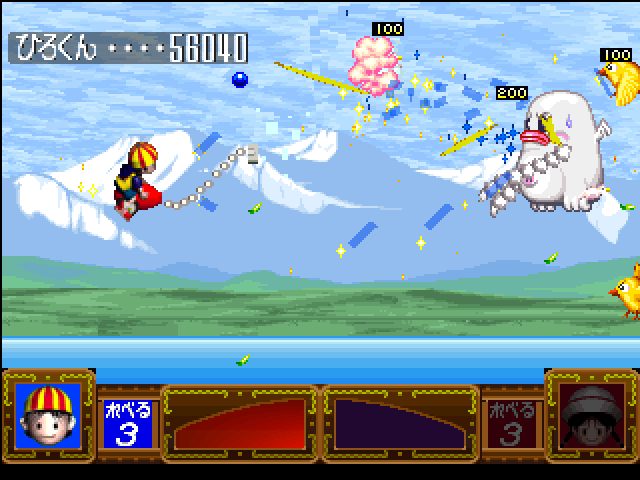
Yes, you fly on the vacuum cleaner, getting that out of the way, and for a horizontal shooter that has 3D polygonal sprites for the leads, but is 2D for most of its aesthetic, the traditional shooter mechanics have a unique turn because of this quirk. You have multi-fire power collectables, but as well as acting as part of a two part life bar, which you can recover it you collect an icon when it appears, the vacuum cleaner can absorb objects in front of it automatically. Whether playing the boy or girl, whilst not everything can be sucked up and avoided, you can without pressing a button, just moving close to them, absorb not only projectiles but even enemies, all from stars being fired at you to cherubs from the second level, all kept in the cleaner's bag. There is an infinite bag for the contents, but the power up bar you grow by doing this has a limit of three levels. Activating this creates an invincible projectile blast emptying the bag's contents too. It is a cool idea, and a skill to fill up as it is something which will prove a huge help for later challenges.

If anything, it shows a virtue to shooters of any direction in how they can take a simple structure, one you could make back on an early eighties Atari arcade cabinet with only a few sprites possible, and that the personalities and the unique mechanics of each game are what give them their distinctions. The world onscreen too is distinct, a cute 'em up where you find yourself against many denizens of fairytales, mostly with the bosses showing this. This can be the wolf from Red Riding Hood who can extend his limbs and neck in Dhalsim martial arts blows, or a giant Snow White who has cracked open the roof of a winter cabin, there watching on as the seven dwarves are sent out at you as a squadron of shooters and brawlers. Barring the polygon touches, it has also aged well visually.

It also gets harder and more challenging. Cute 'em ups, what if you made a shooter with penguins (Parodius games among other characters) or tea and sweet obsessed witches (the Cotton series), did not have to be easy or even to sell to kids. Instead, arguably in mind that in Japan, cuteness appeals as an aesthetic for adults as much as for children, there was a Japanese audience who loved cuteness to but want to cut their teeth on a challenge, something you get into the modern day, even if with sexier anime girls, in even the modern tributes in the genre. Among the many games for the original Playstation we sadly did not get into the West, one which has greater cult recognition Harmful Park (1997) feels more easier than how this turns, whilst here, you will be grateful regardless of your skill with these games that this has infinite continues and, in a sit-down session, has invisible checkpoints in each level you can reach. This is something which is a life saving function I am surprised and happy to see here, when games did not necessarily have this, in any genre, back then.

The challenges do amount, where even one involving having to move between hazards like an obstacle course, of giant sharpened snowflakes on a winter wonderland stage, has the grace to briefly show the actual hit box your character has onscreen that has to avoid hazard going into, the developers deciding to both help the player out, and also teaching someone new to these games how the invisible hit box works for shooters. The game, and I legitimately believe the develops Media Entertainment knew of the work of Treasure, even has a parody of Gunstar Heroes (1993), the legendary Mega Drive / Genesis run-and-gun game, in how there is a boss here which feels like a parody of Seven Force, one of the most iconic bosses (and moments) from that famous Treasure developed game, in which in normal difficulty you had to face seven different forms of an entity one after the other. Imagine that here but with sentient tomatoes together creating a multi-form boss.

It is one of the hardest moments, as you have to start each time you lose all your lives, but between scissors that fire more tomatoes at you to a literal bullet hell boss form, it is an inspired parody, and I refuse to belief it was not with mind to Treasure, as fans, from Media Entertainment to parody Gunstar Heroes. That it is not even the final boss of the penultimate level adds the cherry to the cake, leading to a far easier and bizarre boss, still to be careful with, of sentient animals playing musical instruments and singing, with their racket firing giant musical notes of death. Based on an obscure Brothers Grimm tale, of the Town Musicians of Bremen, based on older tales, this touch of including a story even I did not know of, of an aging quartet of animals - a donkey, a dog, a cat, and a rooster - who are ignored by their human owners, and deciding the leave and live better lives as musicians, was a very funny breath of fresh air after the harder mini-boss with even a sweet nod to classical literature. The final boss, the big bad who takes up most of the finale, is naturally the most difficult. Its sense of challenge as a game in general though, not even taking into consideration its two player co-op option, is balanced, where even the nightmare of that conclusion, with a life bar in numerical form life an intimidating JRPG final boss, feels least like the epic conclusion the game needs. This is more so, as with the tomato boss, the game in fairness will occasionally even give you power-ups to try to make it easier if you keep hitting a brick wall.

It is a surprise Kyuin is as obscure as it is, never having heard of this until I searched for obscure PSX shooters. Sadly, despite the Playstation 2 having backward compatibility with PSX games, and the PS3 with PS2 and PSX games, Sony's preservation of their back catalogue became an albatross rightly hung around their necks. That in 2022, Sony have set up their own in-house preservation group was poignant in mind to this problem1, more so when a quote by Sony Interactive Entertainment CEO Jim Ryan about seeing Gran Turismo titles of the past looking old graphically helped make the albatross around their necks around preservation of their catalogue heavier1 whether misquoted or not. Whatever the case, being quoted in saying "The PS1 and the PS2 games, they looked ancient, like why would anybody play this?" did not help them at all, and helps no one, regardless of context1.

The original Playstation, alongside the Sega Saturn, when you get into the Japanese exclusives is fascinating for how many curiosities exists, more so as Media Entertainment, probably not helped by their generic name, are an obscurer publisher/developer from Japan. They have made distinct sounding games - Maze Heroes: Meikyuu Densetsu (2002) is a Japanese only PSX board game/rpg hybrid which sounds absolutely fascinating if handicapped if you cannot read/speak Japanese - but most of their catalogue cuts off by 20032. The Playstation was a beast in success, so just in terms of Japanese exclusives it had a huge back catalogue that is sadly undiscovered and, in many cases, unpreserved even in terms of misguided and fascinating oddities. With Kyuin, this is however a gem worthy of a cult following, and I literally fell over it.

======

1) Sony is building a game preservation team, published by Engadget.com on April 27th 2022, written by K. Holt.

2) The GameFAQs page for Media Entertainment.