Friday, 18 February 2022

Games of the Abstract: Super Mario Galaxy (2007)


Developer: Nintendo EAD Tokyo

Publisher: Nintendo

One Player

Nintendo Wii / Nintendo Switch


Reviewing a Mario game seems ridiculous - by this point, one character, an Italian plumber in blue and red, was already a mascot for a legendary videogame company, Nintendo, so any attempt to paint anything new in opinion is comical. That is before you consider this is a big game, highly well regarded, with a budget visibly onscreen and a games console (the Wii) to sell by making the 3D platformer stretch its prowess and game play technology fully. You could argue that one, amateur or professional, should question a game's legacy especially if the franchise is one that is considered a sacred cow, with a lot of money behind it, but honestly that feels less an issue with a company like Nintendo, when the issue has always been when the publisher and hardware manufacturer refuses to make games available, even bad ones or from consoles like the Virtual Boy, and get angry people pirate them.

If there is anything new to this review, it is entirely from someone who never grew up with Nintendo's catalogue and consoles. If I am to be blasphemous, to be a man who buys a Wii second hand when some games now second hand cost more than the actual console, I will say right now my admiration for Super Mario Galaxy in its style and game play will not mean I will suddenly start playing Nintendo games now over obscurer work, and any I do take a fancy to will be whims more than the passionate interest I have even for the misbegotten doomed to perish for lack of sales. As much of this is a contrarian nature, to want to root for the underdogs and the miscreants of art, even if that can lead to questionable ideas and more questionable game mechanics, but as much of is innately that usually, for me, something that is widely popular can arguably be more conventional to appeal to the masses. A console like the Wii is more fascinating now, whilst only some of the games of ridiculously prized on the resell market, for the curiosities than Mario or Zelda, and if I take interest in Nintendo games, they are the curiosities and the strange experiments. As much of this is that, like many sacred cows like the Star Wars franchise or arguing with people on Twitter, I never submerged myself in these institutions, never growing up with Nintendo work in my childhood because I had a Sega Saturn and Playstations one to two in my house. The only time I have played a Mario game before this one is the Gameboy game Super Mario Land 2: 6 Golden Coins (1992) as a child, and we have come a long way from that title to Super Mario Galaxy.

With the Switch in 2022 became even more a huge seller than even the Wii, which shows just how exceptional Nintendo have been in getting two generation defying gaming platforms released, these characters and their newest innovations are still going to compel people to their work and hardware. In this case, like if I was to buy a Switch eventually, it seems as if it was at least mandatory to have a Nintendo game if I was to acquire an old black cased Wii for my collection, like a passport you have to acquire. Admittedly, despite the popularity of the Wii, it is surprising that, when acquiring it from a second hand store, there were very few games there of personal interest, almost enforcing that I would be playing Super Mario Galaxy as fate even if I ignored the others. Thankfully you see here why Nintendo, when they get things right, are a behemoth as they are, and even a contrarian like myself admires the hard work they bother to put into their mascot's work.

By this point, the franchise had been a long one existing since the eighties.  The reference to Mario being their mascot, and to push the hardware's capabilities, was emphasised when Super Mario 64 (1996) opened the door for 3D platformers on the Nintendo 64, a console made for the game down to its controller. Three dimensional platformers came before and just after, and I played a few, the Jumping Flash! (1995) to the infamous Bubsy 3D (1996), but Mario 64 became the game everyone wanted to hitch a trailer onto after its breakout success. By this point to, this presents the obvious problem, when franchises are institutions, of constant sequels. Not because of their existence, but that by this point, a character like Mario and his Nintendo band mates are ageless cartoon characters and you can either a) alienate the fan base with a drastic change, or b) continue the same story and tropes and figure out how to keep things fresh. This is not an insult at all, especially as Super Mario Galaxy managed the second successfully, but in mind that, at this point with Princess Peach being kidnapped by the turtle-like giant Bowser again, attempting to bring a continuity to the games is going to either involve Stockholm Syndrome, or the kind of not-safe-for-work fan theories (and art) Nintendo are never pleased with existing. Even in game, whilst kidnapped with her castle taken into the galaxy far away, she managed to get letters still to Mario with five bonus lives continually, suggesting this is not as much as a struggle as before but a constructed fantasy between the three characters of Peach, Mario and Bowser to entertain themselves. Only the actual peril the plumber has, and Bowser's decision to harness the power of the cosmos and black holes adds severity. The later is a really dumb thing to do, especially as with full spoilers, if not many, the ending literally suggests the Mario world was destroyed and rebuilt in a new dimensional plane.

Made with director Yoshiaki Koizumi in the seat, having had his trial by fire before as a director on Super Mario Sunshine (2002) as his first directorial work, a heavily promoted game in 2000s game magazines for the Gamecube that became more divisive for fans as time passed, Galaxy is literally my first proper 3D platformer since I was a child. This is insane to consider but in mind, to my exile from videogames, also a huge advantage to seeing how far games in this genre have evolved. The camera here is still a pain at moments, but the mushroom consuming plumber has the advantage that Nintendo have had a lot of time to hone these games, with the legitimately curious touch that this has to sell a console specific controller which is surreal to consider nowadays as mainstream. Wiis were so commonplace that you could even find one gathering dust on a sell in a hospital, as I have seen, managing the rare achievement of even winning over non-gamers to them. It led to a lot of shovelware, and zumba games second-hand in charity stores in Britain, but it comes with the peculiar aspect, in danger of causing interesting games to not be preserved, that Nintendo put their resources entirely onto full motion control play even if a "classic controller" was made available too. Super Mario Galaxy, in its original version, had to be played with that controller and a "nunchuck" attachment, a controller which is full motion control to aim onscreen, the nunchuck providing the movement stick and jump.

The additional aspect, which is a huge virtue aesthetically and in gameplay, is that with its American cartoon plot, with Bowser carrying Princess Peach to the centre of the universe, Mario finds himself interacting with a figure named Rosalina and her space station full of cute Lumas, star-like creatures who became planets and other intergalactic forms, needing to help repower her station to reach his arch nemesis by travelling around tiny weird planets. The game from the get-go has a playfulness that is its biggest virtue, its sense of colour and pop fell in how everything is already pleasing aesthetically, and that the game's modus operandi was clearly for the staff to come up with every idea for a game play mechanic, or level design, that they could. There were enough rejected concepts to fill out a Super Mario Galaxy 2 (2010), literally the add-on sequel of all the other ideas after this prequel's incredible success.

The Wii's motion controls, even lucking into a later MotionPlus controller for my black plastic box, and specifically the motion sensor bar is a finicky little creature, with Mario attempting to roll on a giant ball a nightmare for the worse example of how, in attempting to set the console up, it was a machine betrayed by one's living quarters rather than the technology being at fault. That said, there are moments where the game does occasional fail, as whoever came up with the giant spring power up that turns Mario into a perpetual bouncing spring, where the bounce button is unpredictable and a greater problem than Mario hoping about in all-directions, should have had a stern talking to about figuring out ideas first on the drawing board. I am admittedly late to the part for that example, as many gamers who bought this brand new in the day lament that power-up's existence, and aside from little decisions like this, ninety percent of this game is innovation backed by Nintendo forcing everyone to make the game to their best. Even these flaws (and the camera's occasional misposition due to a dynamic shot angle) feel closer to the mistakes made by people trying to create than sloppiness, something that sums up the console as much as the game meant to sell the Wii.

A lot here is stuff which gaming really needed more of from the earlier days, how it is designed for anyone to play, right down to bosses having very obviously designed ways shown to find their weaknesses, for the better, but that this will ramp the difficulty up in the end for a challenge at the right time too. The final boss battle was practically a breeze when, to even get to the fire breathing dino-turtle once played by Dennis Hopper, you have a literal assault course of homing bullets with eyes in a vast nightmarish obstacle course before you. The game finds a right balance between its playfulness with its steadily increasing challenge, more so as (in the moments of grimness to a brightly coloured game) falling off the planets in this game leads to Mario being sucked into black holes or into the molten cores of satellites, let alone any of the challenges if you stay on the platforms. Everything has a playability that, once you grasp the instructions, is precise and well made. You start in a main hub with Rosalina's space station, with its mass of platforms and secrets, with both the stars you need to acquire per level to complete the story mode, including multiple versions of levels for variety of a setting, alongside there being a lot of content here even after the story mode is completed. You have collectables, but the star bits, are practically both as a way to feed Lumas, even mid-level, to create new bonus stages, and also for firepower, as using the Wii remote like a gun allows you to fire them at enemies to stun them. Coins are collectable, but also you use them to replenish life, with the risk that you only get them for stomping on enemies then spinning into them.

This is before you even get into the imagination in the game. You will run upside down in a dome slowly shrinking in space to escape, in one of the most inspired levels I have played, one of the many moments where the intergalactic aspect of the game is used for Mario having to move in various different gravities and even walking sideways or upside down in moments. As someone who always found 3D platformers inherently surreal, with their floating platforms inexplicably in the air since childhood, this really took that further in how you will even wander sideways on a giant robot arm as platforms, or on tiny little planets you can run or ice skate around shaped like holed doughnuts to giant wooden Yoshi heads. Even the swimming mechanics, whilst awkward for me, grew on me especially when you can ride shells underwater and eventually fight a giant skeleton fish later on in a riveting moment.

Moments are also surprisingly adult. Beyond the ways Mario can buy the farm, or that I am curb stomping giant caterpillar creatures, this surprisingly becomes cosmic, as the ending literally has an ode to the cosmos nature of life continually in cycles and regeneration as Bowser is playing with material that can absorb the entirely galaxy if he fell into it. It also leads to the real story of Super Mario Galaxy, an emotional core of Rosalina, introduced in this game and to the franchise. Unlocking chapters of a fairy tale that is her own story, told as pastel drawings, she is a girl who became lost in space with a Lumaand become a mother to them all, a tale with is legitimately sweet and profound. As Bowser and Mario continue their usual combative narrative, Super Mario Galaxy's real story is hers, warmly welcomed into the canon even if, sadly, Galaxy's sequel ditched the hub world for level select, and Rosalina herself joins the team for Smash Brothers games and karting races. The later is not an insult to those as, getting even in the Wii, it is inevitable I will explore them, merely a joke that bares in mind that, at the beginning, her creators created someone in this franchise you cared for this late in its cycle when the gameplay would have been enough.

The game's entire aesthetic won me over, even as the contrarian more inclined to the weirder games now opened on a Wii. Entirely based around replacing floating platforms with full tiny little planets to hop on in most level, its playful nature as a game won me over; even with moments of fiddliness with the game, the carte blanche to try anything leads to a very inventive production where the planets can be anything, from a kingdom of bees fending off moles to toy lands, and even gravity can be toyed with you can open up upon so many enticing ideas. Platformers, especially 3D ones from my childhood memory, had that innate surrealism to them, but here with Mario even having to fly through space to get to levels and new areas, you have a cavalcade of videogame aesthetic and tightly produced gaming that Nintendo deserve praise for.

It was obviously the game they had to sell the Wii, if it had not been sold to the public before, and the higher ups let the design decisions be a white board filled in every corner with ideas to accomplish this goal. Once you adapt to the platformer being warped in this game's premise, remembering controls will be different when you are upside down on a round satellite in space, you have so much to work with and that is not even bringing in the powerups and level specific gimmicks, excluding that one spring, which work. Being able to turn into a bee and fly temporarily; turning into a ghost Boo and, in an unintentional adult moment, realising now the other Boos rather than hurting you find you very attractive, and still float towards you; or turning to ice and freezing water under your feet among examples. Nintendo's desire to make sure their mascot has a great game meant bringing in their A-level work, feeling like they had to work here with greater care, even if taking a huge risk with working around a very idiosyncratic gaming controller. From the look of the game to the music by Mahito Yokota and Koji Kondo, orchestral at its sweetest and other times playful depending on the level, I cannot lie and say Super Mario Galaxy does not set a high bar for great game development even in terms of still having a personality and whit to it, even if there are more awkward playing games I will fall in love with and place higher than this inevitably. It says a lot that, barely scraping the barrel's bottom in terms of content, as you have many levels to complete and challenges still to beat, I still got my fair share for a game bought second hand long after its success. It was still, even in the context of choosing this or a piece of shovelware from little choice in the moment, a damn good introduction to the Wii's idiosyncrasies with Nintendo's own altogether.

Wednesday, 16 February 2022

Stump the Guesser (2020)


Director: Guy Maddin, Evan Johnson and Galen Johnson

Screenplay: Guy Maddin, Evan Johnson and Galen Johnson

Cast: Adam Brooks as The Guesser; Brent Neale as Trofim; Stephanie Berrington as Y / Other Sister; Thaller as Z

An Abstract Candidate


A short from Guy Maddin, these films from his career despite their length, this one created with Evan and Galen Johnson, are always as distinct as his longer work even in just twenty minutes here. Certainly you cannot escape the premise's allure, where in this nocturnal world there are carnival guessers, figures played by Adam Brooks, who can almost psychically guess how many fish a man has hidden on his persons or which chambers of a pistol have bullets in them for improvised Russian Roulette, all for prizes of various kinds given out if anyone was to manage to stump the guesser. A registered job requiring a license, with the actual skill tested to be 99% accurate or have the license revoked, even if you use "guessing milk" to assist the power you can loss this work, which is what happens when the Guesser of this ends up losing his. Happening as with so many Guy Maddin male protagonists, it all begins when he lusts over a woman and his libido controls him, a constant narrative touch which is never condemning the women in his work in a misogynistic slant at all, but always condemning men to be driven by his lusts. The woman he loves (Stephanie Berrington) also happens to be his long lost sister, which causes issues as incest is a no-no and gets you red marks of shame on your record.

Befitting a Maddin film, even the sexual desire has a transgressive aspect as, when he loses his job, the carnival guesser is fixated on overcoming this legal law against incest, even if it means taking a role helping a scientist in disproving genetic family trees. By this point, Maddin's ability to create compelling, even perversely witty realities of any length is unparallel. Little things grow beyond this too enriching the work for me as a long time fan, such as the encroaching clarity of how much Socialism and its iconography has influenced his films as an obsession, when one of the prizes in this guessing game for a one shot joke is a Trotsky-bear, which is literally what it sounds like with a plush toy with the face of the noted Marxist revolutionary Leon Trotsky that includes his trademark beard.

The one trait which became a permanent fixture over time is how Evan and Galen Johnson have been permanent co-directors since The Forbidden Room (2015), and it is clear their involvement come with Maddin's greater use of computer effects. Whilst it may disappoint how a director like Maddin, who once shot a lost film in a garage with sets (Love-Chaunt in the Chimney), has decided to build his worlds now digitally, but it is also clear that, never the purist of cinema in the slightest from the beginning, his tributes to silent cinema also toyed with and re-used in different new aesthetic ways, with this new stage in his career that one where he revels in the artificiality of the digital look. This could be a perverse comparison, as the later is a director who is not screened on streaming sites like MUBI or at art festivals, but I cannot help but think of practical effects creator and low budget horror film director Joe Castro, who suddenly in the 2010s changed to a similar type of filmmaking based around heavy green screen use and deliberately artificial aesthetics. His work, with all its CGI gore, I compliment with this comparison as imagining Hieronymus Bosch if he binged on internet meme aesthetic, original goregrind era Carcass album covers and splatter films with a sense of horror vacui to Castro's work after the 2010s of not wanting to leave the amount of empty space he had in his earlier 2000s films. Maddin is the same in his own way, even close to horror vacui too at times with the look of his newer films, always having the grain and damaged film look even when the films are clearly digitally made, or how from The Forbidden Room on, he eventually depicts mental collapse or tension with a little blitz of the visuals. When the Guesser is forced to make a final guess for happiness, a level of visual barrage greets the viewer which is pushing what he accomplished with acclaim for the short The Heart of the World (2000).

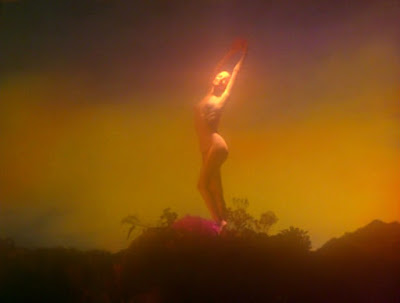
The world here has a heightened mood entirely different to his earlier work but still refining what he did before with new collaborators, such as tiny touches as using colour against monochrome, like having to guess the eye colour of a woman who turns out to be your sister). Far from feeling like a compromise, all I would ever regret with Maddin teaming up with Evan and Galen Johnson is if he entirely jettisoned the stage bound sets of earlier films, and that side to his career as a result. Thankfully, even if it means melding the two more than he has done in the 2010s on for a wonderful hybrid, that is still being felt with films like this.  Stump the Guesser as it stands is another fascinating work and, as just twenty minutes long, is rich enough in what is told in its little narrative even in the little storytelling touches you can miss out on - that the Guesser, as a master when we meet him, even wanders his living quarters with others blindfolded, with a side of his sleeping blanket marked for heads and feet he cannot see and is meant to get the right way up, something which goes amiss when he starts to fail in this work and obsesses over his sister. This has enough richness in narrative, including its final punch line, left with a metal bird toy, to be a worthy part of Guy Maddin's work even among the feature length titles.

Abstract Spectrum: Avant-Garde/Eccentric

Abstract Rating (High/Medium/Low/None): Low


Sunday, 13 February 2022

Twilight of the Ice Nymphs (1997)


Director: Guy Maddin

Screenplay: George Toles

Inspired by the novel Pan by Knut Hamsun

Cast: Nigel Whitmey as Peter Glahn; Pascale Bussières as Juliana Kossel; Shelley Duvall as Amelia Glahn; Frank Gorshin as Cain Ball; Alice Krige as Zephyr Eccles; R.H. Thomson as Dr. Issac Solti

An Abstract Candidate


Returning to Twilight of the Ice Nymphs, I see where this would have been a dead end for Canadian filmmaker Guy Maddin as much as I am going to say it is incredibly underrated. I am not surprised of how this came to be a frustrating production for Maddin, who was recording for the documentary Guy Maddin: Waiting for Twilight (1997) from this film's set looking miserable. It is the closest thing to his mainstream film, the moment in any filmmaker with an auteurist's career where, like a non-American and non-English language director making their first Hollywood, their film can either lead to them going into the Hollywood filmmaker or led to their most contentious work. This has recognisable names like Shelley Duvall and Frank Gorshin, and was shot in 35mm film, where Maddin's usually visual aesthetic was toned down. This is still a film, as we will get into, where the idea of this being his tame film is absurd, as one piece of dialogue talks of Gorshin, who famously played the Riddler in the nineteen sixties Batman television series, having had his penis torn off on a chair nail in his past. Where the film's frustrations for Maddin clearly are, and why for one film this is a fascinating gem for him, is entirely how Twilight of the Ice Nymphs tells its story, setting up iots elegant yet eerie mood with the title card among red dirt and bodies of broken statues in the ground.

This is definitely more a drama for him, where former political prisoner Peter Glahn (Nigel Whitmey) returns back to his home of Mandragora and his sister Amelia Glahn (Shelley Duvall), who is running an ostrich farm in a contentious relationship with Cain Ball (Gorshin), an older handyman promised the deeds to the farm and kicking a stink when this comes under threat. This is also another film where Maddin tackles his obsession with heterosexual desire and the folly of the male libido, caught between two women. One is Zephyr Eccles (Alice Krige), a woman baring child who devotes herself to the woodland; the other he is obsessed with Juliana Kossel (Pascale Bussières), a woman he meets on his boat trip home, the likely mistress of Dr. Issac Solti (R.H. Thomson), a figure left disabled on a walking cane as a result of a statue of the goddess Venus he has managed to uncover in the land, one which may possess actual connection to the goddess when Zephyr gives herself to Venus for Peter. The immediately thing to bear in mind is how more dialogue heavy this is, and whilst it is definitely a Maddin film in his quirks and dark sense of humour, the huge elephant in the room is that, whilst aesthetically gorgeous, this is Maddin's most restrained film aesthetically, with long dialogue scenes and none of his editing techniques to tell story, which is a drastic change of pace for him.

Onscreen, this slowly builds to the kind of whims and perversity of Guy Maddin's other work in its dialogue, still transgressive when Zephyr has a monologue of the erotic fears of seeing girl help a bull insert itself in a cow. This leads to morbid tales of two sisters, their skulls still refusing to face each other after death, whose hatred become so bad one drove a nail into the other's skull, to be reflected back again when it is used as inspiration for a spat resolver. That this has known actors neither undercuts this, merely the psychosexual content and anxieties are thankfully given to an actor like Shelley Duvall, someone who has always been underappreciated and here fits the mood. The film is one, like other Maddin work, with their complicated anxieties, where the male lead is frankly irredeemable, with a clear psychotic side, and where everyone adds to the film alongside Maddin's compelling dialogue. The plot itself - with Alice Krige as a woman who escaped her marriage with assistance of a poisonous snake filled "Bad Night Bog", a love rivalry between her Zephyr and Juliana over Peter, and Peter and his own sister's growing dark sides - fully conforms to Maddin's other work in how things get weird, escalate and (as usually happens) someone gets gravely injured.

The film also looks beautiful. After its initial mood, feeling its low budget artificiality, the film starts to take this to its advantage with an almost plastic-like dreamy tone, pagan at times with its many woodland and beach scenes. The colour aesthetic eventually becomes the hugest influencer on this film for the better, such as when the scenes take place in Dr. Issac Solti's home, here emphasising that for a director know for his silent film aesthetics, including many black and white productions, Maddin here and with films like Careful (1992) when he uses colour is exceptional alongside his collaborators in using it. You can even make the true compliment with Twilight of the Ice Nymphs that he is almost touching Raul Ruiz's best examples of extreme colour lighting in his own most delirious films.

Any film where Frank Gorshin, drunk, burps at an actual ostrich cannot be ditched into obscurity. The problem is clearly that, even if he did not have the stress of working on this film to sully it, Maddin if he had succeeded with this film could have suffocated his career. It is clear where the film feels a dead end even if one I find a great deal to admire. Here for a one-off, Twilight of the Ice Nymphs is an underrated film from his career, and it is fascinating to see his hands tied for his aesthetic tricks, showing his dialogue and storytelling skills. But it suits a one-off only - never was there a man, whilst his dialogue is proven to be quirky and memorable, who if he had his style restricted would have lost half of his talents onscreen. Whilst a virtuous film in content, Twilight of the Ice Nymphs also does emphasis his talents in his other films tenfold.


Abstract Spectrum: Dreamlike/Whimsical

Abstract Rating (High/Medium/Low/None): None

Saturday, 12 February 2022

Games of the Abstract: Mischief Makers (1997)


Developer: Treasure

Publisher: Enix (Japan)/Nintendo (USA/Europe)

One Player

Nintendo 64


Sadly, with the esteemed developer Treasure, who I have come to now with interest, is a Japanese company who does not make a lot of games nowadays. Key titles too, despite their acclaim and even their re-releases on the Xbox 360 in the 2000s, are scarcer to find. This is a surprise knowing their status, an acclaimed company of video games, to which you can pluck out among them for an example Mischief Makers, one of their Nintendo 64 games, one I half suspect is either caught in legal paperwork, as an Enix published title which Nintendo released outside of Japan, or Nintendo is inexplicably sleeping on it. I wonder if it is the former, as with Treasure's last Nintendo 64 game, Sin and Punishment (2000), Nintendo would eventually release it in the West digitally in the 2000s (and 2020s), and was a game they clearly held with admiration enough to even reference in a Super Smash Brothers game and commission a sequel for the Wii console.

Mischief Makers is definitely a game with a cult audience, existing surprisingly cheap in unboxed cartridges over years for a rare moment of luck, and turned out to be such an inventive and delightful piece of platforming. It's back-story in creation does bring up how much an underdog it has been in general in that, when Treasure started developing the game for Nintendo, as when they started in 1995 on the project, they did not even had access to the N64's chipset and focused entirely on a 2D platformer1. Unfortunately, whilst a cult hit, Mischief Maker's concerns as a product were confounded by the fact that, by its release in 1997, Nintendo's intentions with the new console was, as was the huge issues in the fifth generation of consoles, to embrace the polygons arms race of the era of three dimensional graphics. With the Nintendo 64 almost exclusively with polygon based games, including its legacy of 3D platformers, Treasure's game is one of the only real exceptions, which has 3D flourishes including in the bosses to make this a 2D.5 game. This is not a big issue for me personally, but definitely adds to its distinct appearance.

The game is unconventional anyway, for the better, apt in how Treasure take genres - shooters, platformers, beat-em-ups - and add their own distinct styles to them even in terms of their mechanics. Treasure is also usually known for hard games, but Mischief Makers instead follows more the line of literally stretching and shaking its game mechanics in a very quirky way. Someone here had the ingenious idea to base a game premise on whether you could hold anything, even enemy projectiles, and shake them. Baring in mind possible liberties in the English translation of the text, that this even references the sixties Batman television series with "same Nintendo channel" at one point, this is still structured like a short anime series, a series of miniature stories which connect together the larger narrative. You play android maid Ultra-InterGalactic-Cybot G Marina Liteyears, who most just called Marina, who in the game has to constantly rescue her elderly male creator, Professor Theo, throughout the narrative from kidnapping. Admittedly it hints, in its 2D animated sections, that he is likely a sex pest, as he sinisterly moves up behind her when rescued only for her to judo throw him into orbit, but we can guess she still cares for him deeply enough that, as he keeps getting kidnapped, she will go to rescue him.

All transpiring on Planet Clancer, the plot is slight but includes the populous, the titular Clancers, being caught between a war between a sinister emperor and his brainwashed army of them and the Clancers helping Marina as much to save their planet. There is also a trio of intergalactic space heroes, animal men, having been tricked by the Emperor to attack Marina, under the presumption of a doppelganger that she is a really evil person, and one unexpected reveal of a sibling to a cast member on the villains' side.  Consider as well you will eventually ride an alien cat in a boss battle, riding on him riding on missiles if you time your jump well enough, surfing it as you throw other missiles back. You will also have to compete in a series of track based athletic mini-games like 100 meter dash and long jump, which inexplicably also involves a math quiz for one, because someone kidnapped Professor Theo to have a first prize despite no one wanting him. Mischief Makers is a deeply silly game, but also from the surfing missile sentence alone completely awesome at the same time.

Mischief Maker's controls in the midst of this are as idiosyncratic. They can be difficult to grasp at first, but once you get used to them, this is where the game becomes even more inventive. You have your standard platforming mechanics, barring that using standard direction to move, Marina also has jet boosts, following her to float in the air or move faster on foot. The key mechanic is that, yes, almost everything can be caught or held, even projectiles where, if you catch them with perfect timing, you sometimes convert glowing rays and balls of death into gems, red ones common through the game to collect to have continues, or advise from a pink ball with a face and a bow called Miss Advice, or blue gems that heals/increases the health bar. You can grab enemies, shake them in case they hold gems, and throw them. You can even throw good NPCs on your side, and shake them for gems, with the advantage that they will get up whilst the enemies disappear with their ghosts floating off with halos, with a dark humour especially as one level has you exorcising a cave full of ghosts at one point. In one boss battle, you are literally shaking negative thoughts, negative words, into their positive opposite, whilst access to a shaking pot allows you to capture objects and combine them for tools. You can even pick up flowers and throw them. You can even be a dick and shake a ball, in an early training level based around a theme park, with a child Clancer on them at the same time, and cause them to fall off and cry. And yes, I admit to doing the later once and feel guilty about it still.

This also means the game, alongside platforming, plays to a lot of obstacle course puzzles, with the challenges involving manipulating and tugging objects, and here as well, whilst limited by the technology of the Nintendo 64, talking of how the game looks actually intersects with the gameplay. The story is set on the aforementioned Planet Clancer, where the populous, good and bad, are figures who, possibly inspired by ancient Japanese burial statues called Haniwa, also look like if you took the central figure of Edvard Munch's painting The Scream (1893), and made them cute chirping figures. Everything has faces, even floating orbs and cubes which are on the ground or floating in the air, obstacles or objects to interact with to figure out where to get to or, if after the yellow gems which are the one 100% goal, as they unlock more of the final cut scene, figuring out where they are. You will shake a lot of items, leading to the catchphrase "Shake, shake!" a lot, pull and pull in wheels of orbs to negotiate around environments, use springs to propel yourself further, and generally negotiate around the environments with nothing onscreen not designed for manipulation. This is where, alongside Mischief Makers requiring a re-release, a sequel would have been fascinating as, for a short game which manages to do so much, seeing the ideas this has stretched further and challenging the jumping/shaking mechanics would have been compelling to see.

Again, this was an outsider when it was released, including how its short length contrasts a time when significantly longer games were being produced. Considering how eclectic this manages to be however, Mischief Maker really does make every second count, which is a common occurrence for Treasure games. Here you can be negotiating upwards, working a time reverse mechanic in a confined environment for one stage, later on trying to flee lava on a tricycle. The stages are almost all short, little tasters where you never find yourself stuck in a cruel overlong level at all, where one of the longest, the only long one in fact, is a late stage rush between enemies which is a frenzy of throwing people at others, throwing people's spinning blades back, stealing machine guns which seemingly fire eggs of death from cat robots, and just charging through a ridiculous amount of the evil Clancers army. And the entertainment is there consistently high throughout. Alongside its charm, even in the English dub, there are many of the personal touches which are exceptional, such as Norio Hanzawa's music which is diverse and moody, and the energy through the game is rich. When this gets harder, the goals once figured out are clear, only having one little flaw that there is never a clear signal for some bosses for how many times you need to hit them. Considering, however, how over-the-top and varied these boss battles are, even that is not a complaint that can stain every virtue this game has. Here you will encounter some of the most dynamic boss battles with some inventive and very unconventional directions to take - from getting the first proper boss you encounter to punch itself in the face, to tripping one's robot over and quickly squashing it onto its head on the ground. Throughout you will find so much to appreciate and, for me, it was a pure joy to play Mischief Makers. This was the kind of game I wanted to uncover, and yes, it is an unsung gem for its console of origin.


=====

1) This is documented in an interview by IGN Staff, from the year of the game's release on the 15 April 1997, with the president and CEO of Treasure, Masato Maegawa.

Monday, 7 February 2022

Games of the Abstract: Battle Garegga (1996)


Developer: Raizing

Publisher: Eighting Co., Ltd.

Two Player

Arcade / Sega Saturn / Playstation 4


Author's Note: There are multiple versions of Battle Garegga. Depending on which version you play, that can be the intended version created by developer Raizing, the compromised Western release, the modified versions from Raizing themselves when acquiring feedback to the game, and the more modern releases worked on by M2 which reflect the changes to one key trait of the game's structure. Bare this in mind with what you play.

Battle Garegga is the hardcore of the hardcore. Between the multiple versions which exist, Battle Garegga is held both as a well regarded title from the shoot-em-up catalogue, especially the nineties games. It is also, due to a certain intricate mechanic is one which could cause debate from players of these games regardless of skill, one which has influenced opinion on the game including its developer modifying on multiple versions of Battle Garegga over the decades.  Regardless of the version played, and I say this with as much admiration even someone who is way out of his depth with this genre, a bad player who yet is growing to love their aesthetics and craft, Battle Garegga in any form is a punishing little bastard. Even a compromised version can introduce you, as it will, to missiles and beams hitting you from everywhere, which reminds one that, with "bullet hell" games born from the likes of this these games are as much how you learn to dodge attacks, like an obstacle course for twitch game play. As these games pushed the newer hardware of the time with more death bullets to hit you, more so did this become a spectacle of keeping on your toes moving as it was shooting the enemies back.

Naturally I come to this as the player, with no shame, that would rather play these sorts of games with infinite continues, allowing me to appreciate their artistry even if my ship blows up many times. Instead, the gameplay is the learning curve of how, in one play and in all future ones, you eventually learn to "improve" and have your ship blow up less. Frankly, from a controversial perspective, infinite continues should have been a common part of countless games, even if this reflects as much Battle Garegga being an arcade machine you needed to feed coins into for continuous playing; a game like this, even if very short, at a disadvantage in the modern day in terms of value of money, has one advantage that it was always designed to replay and replay until you get good. Even that this has no rapid fire as other games in the genre means that, mechanically depending on which version you play, this was a game you hone and learn to ultimately get a higher score and hopefully keep it without dying.

For a plot, this is set in an alternative nineteen forties, where two brothers called Brian and Jason Wayne make the ill-advised decision, after running a very productive automobile factory, to be paid by a shady organisation called the Federation to switch to manufacturing weapons, which are used by the group to begin a world conquest. The Wayne brothers quickly figure out that they had made an extremely poor decision and use four experimental aircraft to fight against The Federation and destroy the machines they made for them. Set in a "dieselpunk" world of elaborate aerial battle ships and planes, if you boot the game up, this back-story does not appear in the game itself. Battle Garegga becomes just the tale of one of four planes1 trying to survive an entire army of on land and aerial death machines, a period plane and mechanical nerd's wet dream in sprite form, whose aesthetic beyond that evokes, if anything profounder, a horrifying image of the 20th century as mere mechanisation, where your tiny plane, no matter how powerful, is always outmatched and outgunned by mass of opponents or industrial behemoths, trying to survive as a faceless machine against actually terrifying machines. Truthfully, you could find yourself not getting on with the game as it is entirely a mechanical world of planes and war machines without characters or any of the more fantastical/whimsical touches of other shooters of the time. This is not even cosmic sci-fi or biomechanical, entirely pure diesel-industrial machinery and war mayhem in how you obliterate turrets/planes/tanks, which can still be appreciated by the lovingly detailed and hardcore aesthetic. Even if the bosses are merely warships, the final boss merely a red warplane, you can find a pleasure in this game in its intensity on an aesthetical level before you even get to the game play.

Even as someone who prefers his games to have weird elaborate bosses and aesthetically elaborate designs, I admire this for this aesthetic and how well it is presented. Raizing did admittedly make the decision, one they would revise on improved versions of Battle Garegga, that some of the bullets fired at you are drawn more realistically, not necessarily an issue barring that, as I can attest, they can catch you out of nowhere having not seen them, a necessary thing to amend on the later versions as it goes against how you can at least, even in a bullet hell wall of glowing death, see your impending doom and see if you can twitch quick enough out of their way. Admittedly, there is a far more contentious mechanic, one which is Battle Garegga's biggest assets, one which was compromised in certain ports of the original arcade game, and in the future updates from Raizing would be modified. It is their elusive ranking system in how, depending how well you are in the game in skill, the difficulty can ramp on so much that a tactic has been for players to even self sacrifice a life, all so they can clear the dangers of there being so many bullets and hostiles onscreen after them. Obviously if I was a better player, this mechanic would be a greater concern as, with the influence it has elusive in the earliest versions of the game, it eventually makes the game more and more harder to an extreme. It is also fascinating to know however that just for the Japanese only Sega Saturn release, Raizing improved on the game, in how they made bullets more distinct but even in how they added options to modify the game in the options available. The mechanic's original existence is fascinating as artificial intelligence, but in mind to when CAVE eventually made their games as accessible as they did comes to mind, including hardcore difficulty levels for their shooters for the ultra hardcore players but also easier options being available. This is apt to bring up as Shinobu Yagawa, as a member of Raizing who helped programmed Battle Garegga, would move to CAVE and develop games for the company like Muchi Muchi Pork! (2007).

For me, Battle Garegga regardless of my skill level was a pleasure. Whilst my taste is more fantastical, the distinct artistic virtues are significant, and it would be blasphemy not to mention the score by Manabu Namiki, who would eventually move to CAVE too, whose work here is arguably the best aspect of the game. Detroit techno in the least likely of game settings and tones, it nonetheless works beautifully, melding with the intensity of the combat, fighting proto-stealth planes to giant multi-sectioned warships with numerous guns, with the contrast of the atmospheric techno music by Namiki. Tracks like Subversive Awareness have a timely marker of when they were composed but they are timeless in their moodiness. The energy of the game, its darker mechanical setting, with no human beings and pure mechanised destruction, becomes compelling even if you keep dying. The slowdown which was common in these games, when they had to keep up with the number of bullets and explosions onscreen, happened for me mid-play, usually because the plane I preferred using as a special bomb, with collectable missiles to stock up, fired all its stock of homing missiles off everywhere on mass, even if there were thirty plus onscreen. This accidental aspect, alongside the aesthetic virtues of the game from its appearance to the music, compensate for how crushingly difficult it is, let alone if you tried limited deaths down to credits. Less difficult for the sake of difficult, these games benefit how now they are not designed as arcade machines meant to chomp coins anymore, but can be replayed over and over, as you improve and get the skills of the genre slowly. To just try to play even if on infinite continues leads to a symphony of visuals and sound, where I feel no sense of cheating for unlimited credits because the thrill was there nonetheless, one that would lead someone to want to improve to fully appreciate the game.


=========

1) There are secret planes, from the Raizing game Sorcer Striker (1993), you can access by a password, which brings characters from a fantasy sci-fi setting including a dragon man in for some idiosyncratic contrast.

Sunday, 6 February 2022

Labyrinth of Dreams (1997)


Director: Gakuryû "Sogo" Ishii

Screenplay: Gakuryû "Sogo" Ishii

Cast: Tadanobu Asano as Tatsuo Niitaka; Kotomi Kyôno as Chieko Yamashita; Tomoka Kurotani as Tsuyako Tukikawa; Kirina Mano as Aiko; Reiko Matsuo as Mineko Matsuura; Kyûsaku Shimada as Kuro-Tonbi no kyaku; Takeshi Ikeda as Tsuwaomote

An Abstract Candidate


The change Sogo Ishii made, the trajectory, to becoming Gakuryû Ishii means more and more when you start to see the films made during the decades from the transition. Slowly, but surely, his work is being made available, but even in little pieces, you can suddenly see an abrupt transition from Burst City (1982), his punk dystopian film with abrasive editing and a punk soundtrack, and how alien it is by the time you get to Labyrinth of Dreams, a sombre period based drama set in yet its own dream world. Yet the transformation is compelling for an auteur that clearly evolved, realising after his initial films he wanted to step in other directions and managed to succeed fully. Ishii found, here as with Angel Dust (1994), a drastic change in direction, building from the eighties, that lead to him finding his own distinct eeriness which he constructed for these films.

Labyrinth of Dreams is set in the past, a comparison apt to another Japanese film hard to see appropriate, that being Mikio Naruse's Hideko, the Bus Conductor (1941). A quiet drama, set in the era it was made into the forties, both films tackle the concept of the "bus girls” (basu gâru), of a tradition from between the early 1920s to the mid-1960s when buses would have only a driver, male in both films, and a female bus girl to assist him1. In Hideko..., it is a lighter drama where a duo attempt to salvage their bus service, in danger of being lost in a rural town with their boss more interested in money, by adding a tourist side of explaining the historical locations of their routes for the bus conductor Okoma, played by Hideko Takamine, so popular her name rather than her character's gets the film title billing. Labyrinth of Dreams, clearly set in the thirties to forties, is a much ominous narrative where a mysterious male bus driver has been seducing the bus girls he has worked with, only for him to, like an unmarried Bluebeard, dispose of them in faked bus accidents. For Tomiko (Rena Komine), working at one company and still dealing with the death of someone dear to her was a victim, she believes her company's new hire Tatsuo (Tadanobu Asano) is that man. Tatsuo immediately tries to get close to her, with Tomiko deliberately trying to stay her distance as much to catch him. His aura however proves a wear-and-tear which may seal her fate, drawn to him more with the danger itself part of the aura.

The premise is one, even in its historically specific context, that you could adapt in any aesthetic, a romantic thriller in premise which you could sell easily, but Gakuryû Ishii makes a film from material that is unconventional but not from any deliberately aesthetic choice. Beyond the fact, as a late nineties films, he made the film in black-and-white this film takes it time to draw you in. Like Angel Dust, Ishii manages the mercurial trick of taking these premises, slowing them down to an eerie and intense mood which crawls under the skin. This is different to that film because it is almost timeless despite its clear history context. You see this as a time with Western influences and modernity influencing the rural town setting, Tatsuo introduces himself on his first day with Western sweets for the female co-workers and Western cigars for the male ones, but with the bus travelling through the countryside, including isolated environments, stillness can be felt throughout.

Until later on it is entirely a gently paced drama, taking its time until only when Tomiko starts to fall for Tatsuo to change, falling into his trap as the film around her drifts to being more dreamlike without the need for surrealism or unconventional editing techniques. The acting helps considerably, alongside being a poignant reminder, virtually ageless, of how Tadanobu Asano became one of my favorite actors, instantly the cool actor of cult Japanese cinema for many by the 2000s, but someone who always picked great roles, always did great performances even in ultraviolent work like Ichi the Killer (2001). That the film is also reliant on a very idiosyncratic aspect too, as the deaths are caused by staged bus accidents, adding the one perverse side of the drama. One of the bus girls' main jobs in this world, as for Tomiko, is to step outside the bus and help the drivers be aware of crossing rural train lines when no trains are moving nearby. Used to considerable effect in the climax, a film sweltering in dreamy unease, the resulting film in its glacial tone is compelling.

Abstract Spectrum: Dreamlike/Eerie

Abstract Rating (High/Medium/Low/None): None

=======

1) This information barely details the "bus girl" with any knowledge. Yet the knowledge of the likes of Modern Girls on the Go: Gender, Mobility, and Labor in Japan, a 2013 non-fiction text by Alisa Freedman, Laura Miller and Christine Yano exists out there for people like me to desperately want to read on subjects like this.

Wednesday, 2 February 2022

Lady Street Fighter (1981)


Director: James Bryan

Screenplay: Renee Harmon

Cast: Jody McCrea as Rick Pollard; Renee Harmon as Linda Allen

Ephemeral Waves

Includes a review for Revenge of Lady Street Fighter (1990)


I like knives. I can do all sorts of exciting and interesting things with them.

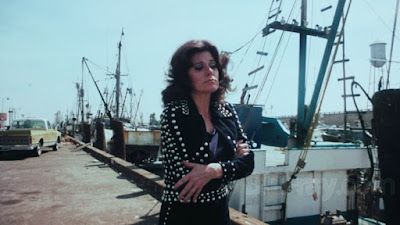
Approaching Lady Street Fighter, be aware of what this is, an ultra low budget film clearly wanting to follow, least in name, the wave of action films of the seventies, the title clearly evoking the likes of The Street Fighter (1974) with Sonny Chiba. The acting wavers in style, the martial arts is performed not by trained fighters, and the film's lead is Renee Harmon, an older woman whose presence as the ultimate badass and sex object is sometimes accidentally challenged by the plot itself she wrote. Sometimes it is unintentionally humorous or weird that, yes, Harmon does lick a yellow telephone receiver to denote her horniness for the male lead over the phone.

The story of Lady Street Fighter off-camera is compelling and adds to the narrative, of a German war bride who encountered director James Bryan, whose most well known film is the video nasty slasher Don't Go In the Woods (1981), and as her own one woman producer-director-creator worked with Bryan over multiple films, her Bryan her muse as much as the other way around who together made low budget genre films. That she made herself central in them would, if she was a male creator, be dismissed as hubris, though here there is a delight in Harmon as a woman doing so for herself whilst creating films this curious like Lady Street Fighter. The MacGuffin of this film, whose narrative becomes vague at times, is a master file on microfilm of all the members of an assassin's guild, possibly hidden in a plush stuffed dog. Harmon as Linda is caught between Assassins Incorporated and a member of the FBI uncover between their midst who she falls for, with the added tension that her sister was killed and she wants to find the cause of this. In centre stage, Harmon is idiosyncratic with her distinct accent and acting style, and this is a rare case, as the producer, you cheer her on as selling herself as the action star and the most beautiful woman on the Earth because this is a woman, who worked and worked over multiple films, and at least committed to these films on and off-camera. Honestly, considering the many men who did so in straight-to-video and exploitation era cinema, someone like Harmon deserves even mild vanity, especially as between her and Bryan, this is a film clearly built from duck tape and dreams that managed to be inspiring and entertaining.

Certainly as an exploitation film, they threw the kitchen sink in. There is a verisimilitude for how everything feels real even if they have to work around their limitations - that real cars are used even if fast cranking is clearly used in a couple of car chases, that these are still shot in real locations and that even the orgy sequence has numerous extras who stand out. That the film even has personality in its set dressing and locations is a delight, even in some of its more idiosyncratic decisions like locations and decor which evoke religious iconography, filming in what feels like a rundown church or the inexplicable but distinct aesthetic of French magazines in picture frames on the wall of one bedroom. The time period, clearly made in the cusp of the seventies even if into the eighties, is captured as much as a time capsule as this is an entertaining romp, between witnessing a go-go strip club where Liz Renay manages to cameo1, to the sight of a Van Halen t-shirt (of their first album). Even that little detail leads is worn from one of the most entertaining extras I have seen in cinema for a while - part of a trio of a guy with the t-shirt and his possible girlfriend, the later a dog collar on to be walked on as a submissive, who meet a nerdy guy; after the bespectacled guy is nervous after being passed the lease, he finds himself almost chummy with the pair in a silent little narrative, the trio sat together happily even when the murder mystery game at the orgy they rocked up at turns into an actual murder.

There is absurdity mixed with scenes which are awesome in their own way, the absurdity intentionally and not really unsurprising when James Bryan's infamous Don't Go In the Woods, a more acquired taste of slasher film, had a lot of ridiculous moments which sometimes felt intentional, such the film continually cutting to a man pushing himself up a giant woodland hill in a wheelchair only to be decapitated when he gets to the top. Here Harmon also gets to be awesome and does so in a way, as the creative voice, which is inspired at least, when she knocks a car off a cliff with hers, than drops a lit cigarette down on the male assailant's petrol strewn wreck, when he screams like an Austin Powers henchman that he cannot move his legs and there being gas all around off-screen, with the cherry on top the middle finger he presents in his dying breath which is on fire back at her. Awesome and funny moments like this contrast a film which thankfully has few dated aspects, the only one of real note being the adult daughter of Max Diamond, a businessman who has assassin connections, being depicted in terms of a person with severe learning difficulties, like a five year old, with a complete lack of grace. Most of the film is thankfully sillier than tasteless.

Even in mind of how much female nudity this has, it always comes in mind the most distinct artistic influence alongside Bryan is Renee Harmon herself. Her character, varying between confidence but occasionally the character being lost in (accidental) weakness at moments, is meant to be the most gorgeous person on Earth and, whilst she hides her figure, she is still doing nudity herself even if not from the front, whilst still proudly cavorting in an almost white knitwear whole body stocking on a bed in erotic ecstasy for one scene. It does not feel she is being told to, but that Harmon throughout, even with the leering creepy villains lusting over her, is pushing for this erotic aura around herself, and honestly a little vanity here is completely acceptable with utmost charm. That it comes with unintentional aspects, such as Ramon constantly sucking on celery seductively, always coming with her drinks, adds an absurdity which contrasts the purely exploitative aspects, such as the death of her sister involving an actress topless in an opening torture sequence.

Lady Street Fighter's sense of cheek and fun is found even in touches like casting Trace Carradine, the most elusive of the Carradine family tree, from the lineage from John Carradine to David Carradine, in that he may not actually exist and the actor who plays him is only in this one film. It is a movies that plays to the tropes that were being used to sell films at this point in cinem,a - sex, action, car chases - and in context for the ultra cult fan it succeeds just as an idea of anyone making a film like it. The quirks are there too, even in the aspects you would not find in another film such as a gratuitous scene of feet licking or the seductive stroking of champagne for blatant symbolism. The lacksidasical attitude to event too, where the plot itself is the vaguest of MacGuffin, and an orgy can inexplicably have a trio of men in their own toga party edited in, adds to this when, if you are not put off by the presentation of the film, a viewer can feel greater emotional connection, and joy from this for its absurdities.

This type of movie is of course an acquired taste. The "sequel" Revenge of Lady Street Fighter would in another context by indefensible. Whilst it has some new footage, with the initial set up being of an older Linda targeted for trying to delivery her memoires to a younger woman (Ruth Peebles), the moment Peebles is kidnapped leads to the sequel playing all the footage from the prequel, some in opposite order but 90% in its original order only intercut between Peebles being tied to a chair in a room as a procession of men read of the original film in documents to her. It is a really weird attempt to sell the original film again, but it was not that rare at times for a viewer to be trapped in such a scenario if they bought a film, sequels which turn out to just replay the original film's footage. The Silent Night, Deadly Night franchise infamously did this, and this is something I can attest to from experience when, rather than the original Boogeyman II (1983), the most common version of Ulli Lommel's sequel to his 1980 horror film on second hand DVD was inexplicably a re-cut, with him talking directly to the screen in new footage, as a character recounting the first film as footage of the first Boogeyman film played. I never finished that version back when I go to the second hand DVD and was tricked like this, never knowing if footage from the original sequel was on there.

Renee Harmon and James Bryan did this a bit, but whilst Run, Coyote Run (1987) is beheld as truly surreal, crow barring in new footage with her acting students in roles with footage, spliced mid-scene, from any film of hers before, Revenge of Lady Street Fighter would be an irritant. I do not look down on it, merely a curious remix which I cannot hate; instead, I merely find it the curious and amusingly weird cherry to a film I like. It befits a work from this history of cinema that, despite their budgets, they push themselves to provide more bang for their buck, whose limitations are compensated by someone like you trying. Renee Harmon even sacrificing her husband's car, without telling him, to be pushed down a cliff for one shot, and whilst I wished to have been a fly on a wall for that marriage conversation afterwards, it compensates for any sequel made after which just repeats the footage from the scene and the entire prequel entirely. This is a film build from devotion and sheer passion, even if a little eccentric in the best ways.  


======

1) In a really interesting crossing of paths, a person like Liz Renay with such a fascinating story to look into makes a cameo happily stripping on camera here. At this point, the former Las Vegas showgirl had been the girlfriend of mobster Mickey Cohen, starring in sexploitation films in the sixties, starred in John Water's Desperate Living (1977), and in 1974 was arrested after running naked down Hollywood Boulevard only to be acquitted by a jury at the trial. It is truly in these little moments, and little cameos, where you can find really fun and fascinating real life figures, and she lived and made films/wrote memoirs until her 2007 passing.