Thursday, 18 June 2020

Antigone (1992)

Directors: Danièle Huillet and Jean-Marie Straub

Based on the adaptation of the Sophocles play by Bertolt Brecht

Cast: Astrid Ofner as Antigone; Ursula Ofner as Ismene; Werner Rehm as Kreon; Lars Studer as Wächter; Stephan Wolf-Schönburg as Hämon; Albert Hetterle as Tiresias; Mario di Mattia as Knabe; Michael König as Bote;     Libgart Schwarz  as Botin; Hans Diehl, Kurt Radeke, Michael Maassen and Rainer Philippi as Die Alten

Cannon Fodder

Are you posing me riddles you transparent fool?

[Cannon Fodder: Films or productions by individuals already on the Abstract Canon, or figures/genres/movements I hold in high regard, that would never get on the Canon itself.]

Adapted from Sophocles by way of Bertolt Brecht, Antigone follows a side of Jean-Marie Straub and Danièle Huillet's they had been perfecting over the decades beforehand. That for work like this, rather than their documentaries and other experiments, they were recording "performances". Minimal to an extreme and restricted to one or a handful of locations, they eventually had actors mostly standing still and speaking their lines. Nothing could be accused in such films as artifice that distracted from the words and their meaning.

They are difficult films in the directors' career, which is saying something. One for example, The Death of Empedocles (1987), stripped everything away to such an extreme that, far from clearing the words and adding clarity to them, actually made the film (as others) more challenging. Maybe I have finally come to Antigone fully used to the directors' attitude - it is still a production where actors in Ancient Greek costume (speaking in German) act out the work almost entirely stood in place - but there is something special with this particular example. There is something about Antigone arguably more accessible and that, in context of these works in their career and their work in general I have seen, it is also exceptional.

They play follows Creon, an old patriarch and current ruler of Thebes, who has mercilessly had Polynices, a song of Oedipus and brother of Antigone, slain during a conflict with Argos, proclaiming his body will not be buried but instead left for the birds and the beasts to devour. Antigone, a strong willed young woman, refuses this official decree and will try to get the body buried. Even though she is meant to marry Haemon, his youngest son, reacts violently to her transgression, punishing her by being entombed in a cave alive. He will banish said youngest when he challenges him, and he will proclaim victory in conflict and the treasures of Argos, even if the war is actually yet to be won and it is pointed out by blind prophet Tiresias, here an old man, that even if he does not have powers of precognition, he can still proclaim likely disaster is imminent as he still knows that spears are being made and shipped over to Thebes' solders for battle.

In the modern day, it would be understandable that Creon was just a delusional, egotistic patriarch and see his punishment is deserved. For me, this is true but it is also a tragedy whenever any character, patriarch or not, falls and destroys themselves, in this case of deeply ignorant behaviour (greed, wrath), delusion of grandeur and a willingness to lash out at even those tied to him by bloodline that will eventually lead to Thebes' destruction. It is not just politicians we can make comparisons to Creon about, but any man who falls in hubris and is lead to eventually losing it all as a result. An ominous quote also makes this universal as well, from Bertolt Brecht1, stating of how the wars of the past, over centuries, were merely practice for far worse, all scored to the sound of helicopter blades heard on the soundtrack.

In mind to the creators, you can see this as an adapt conveying the corruptive nature of power too. The strong, legitimately feminist figure of Antigone, played by Astrid Ofner, stands her ground, calling out the war with Argos a disgrace and challenging Creon rightly because her brother deserves a proper burial. Sadly Ofner did not act as much as she should, as in this is her only onscreen work in cinema; Ursula Ofner, playing her sister, in an amusing twist of cinema would have a slightly longer career including Beach Bikini Party (1999), a Canadian-American-German co-production.

Here in this film however, even if he is a villain, Creon deserves a form of empathy from the perspective that his delusion is one all can succumb to, especially as Werner Rehm (who had a longer career in acting) is allowed to play him with incredible dramatic pathos. The reason why I can even connect to his villain is that, unlike some of the others films in this style from Straub-Huillet, these performances are legitimately great here. A Greek tragedy of hubris like this can be seen from all angles as, alongside its text, everyone is allowed to have emotions, and unlike the toned down minimalistic acting of before from the directors, they have let the cast here stand out without it having clearly undermined their philosophical reasons to strip the artifice away. None of the performances are arch or exaggerated, which was probably a concern for the directors as much in their decision to even cast non-actors and have them read out text on paper in some of their productions, and here they instead have the gravitas to engage with whilst being able to convey the meaning of the work.  

Even for this type of minimalism, Straub and Huillet by all accounts were also exceptionally precise. They precisely choose their locations, Antigone all acted in an amphitheatre on a mountain cliff, the lingering remains of the ancient structure marked of the rock foundations still in the ground. Each "act", divided between by the Greek chorus of old wise men following Creon, usually cuts to the ground to switch between them as the chorus monologues for a few minutes each time. This is the most alienating aspect of the film except it leads to an effect in itself, when seeing a newly dead messenger on the ground in the background, or when the camera at the end finally pans out to the horizons beyond the mountain for the final monologue, effecting a viewer with a greater weight of impact to what is being heard through this simple repetitive structure. Likewise, it is a fascinating that, for all their preciseness, the directors still let the unpredictable and natural world have an effect especially in these ultra-minimalist films of their career, as whilst everything acted is heard perfectly, the wind is a strong prescience in scenes (as in other productions) and even they would not attempt to, say, prevent stray butterflies from wandering in shot, in fact feeling like a touch of the actuality films of the beginning of cinema in attitude. These films, where cinema was brand new, could barely muster more than a minute's length of reel and starting in the late 19th century, shot with minimal camera movements and had to take into account they shot what they could see unless it was Georges Méliès. I have found Straub-Huillet in their films, even when they were not making documentaries or didactic work, have let the naturalism of their environments be seen and heard without trying to manipulate and edit it out.

As a result, their extreme minimalism here, unlike before, feels more fluid, as the passions and emotions of the words are heard and sounded, with the added aspect that the subtitles, unlike others put together upon Daniele Huillet's request to not be entirely detailed, are full and efficient here. Any further detail would stepping on the creators' toes, as they have stripped what they have deemed the unnecessary, and the film is the barest of content but to the maximum of its intellectual concerns and emotional demonstration of them. The different is found that, even having become admirers of theirs, times before did show admirable experiments which did however have creative flaws or, if I am to later grow fond of them, were very obtuse to the common viewer, requiring more context or patience to delve into and fully understand.  Here, you could easily introduce Antigone to an outsider to their world, if they were able to engage with the work, winning a new viewer interested in their work as this manages the right balance between their filmmaking ideals and adapting material that is still relevant in its universal nature.


========

1) The memory of humanity for sufferings borne is astonishingly short. Its gift of imagination for coming sufferings is almost even less. It is this callousness that we must combat. For humanity is threatened by wars compared to which those past are like poor attempts and they will come, without any doubt, if the hands of those who prepare them in all openness are not broken.

—Bertolt Brecht, 1952

Monday, 15 June 2020

Horse Money (2014)


Director: Pedro Costa

Screenplay: Pedro Costa

Cast: Ventura, Vitalina Varela, Tito Furtado, Benvindo Tavares, Antonio Santos as the Living statue, Alberto 'Lento' Barros, Pedro Tavares, Isabel Cardoso, António Semedo Moreno, Luiz Mendonça, Arlindo Pina, José António Veiga, João Gomes, Maurício Fernandes, Joel Santos


We'll keep on being sliced by machines.


By the end of Horse Money, I had presumed that the desolate world that Ventura (playing a representation of him) has wandered through was purgatory. Arguably that is the right way to tackle this film on one level, though on further viewing it is a danger that Pedro Costa avoids that he never leaves his cast victimised, instead figures who survive and get on in life in spite of illness, injury, death and isolation. Also, if this be purgatory or the Asphodel Meadows, this one is specifically for the poverty class, as immigrants from the Cape Verde like Ventura's character here wander unstuck through time.  

At moments he claims he is nineteen and three months old, in the middle of March 11th 1975, and at others is he a retired bricklayer and labourer suffering from permanent injuries from a knife attack and possible a form of dementia or symptoms causing his memories to blur together. Whatever the case, he was a man who came to Portugal, gained and lost a job in bricklayer, and is both haunted by memories of a fight he had with another immigrant where he was stabbed, and that he was barely involved with the Carnation Revolution1, a seismic event when he was there, jabbed about it eventually by a literal personification of it that he did not do enough.

Pedro Costa by the 2010s had fully cemented his reputation in the United Kingdom, because by the time of Vitalina Varela (1990), his follow up, his work (almost entirely through distributor Second Run in the United Kingdom, and more access in the United States) was available finally. Let it be known, his is a unique and "difficult" example of meditative cinema at first, a trajectory that morphed from Blood (1989), a more conventionally created if subtle and still great film, to something entirely alien. It was the second film in his career Casa de Lava (1994), which was meant to be a remake of I Walked With a Zombie (1943), as Costa has openly talked about his love of old American cinema including b-movies, only to have a drastic change of heart mid-production. What happened with Costa was that, getting to Costa Rica to film his remake, he saw the environment, felt a superior film was to be made documenting the environment, and in communicating to the locals, it led to him their migrated families in Fontaínhas, a community back home in Portugal in Lisbon.

Fontaínhas has long disappeared from the form he found it, yet he has kept the place long after its vanishing alive in a form of cinematic spiritualism. Fontaínhas was a slum and whilst there is an inherent danger of a white filmmaker tackling a subject about poverty especially for its black migrant community, a form of poverty pornography, his interactions as been documented led to him actually being challenged for making fabricated stories and changing his work onwards, to singnificantly smaller crews filming the productions and a more intimate collaboration with his casts of non-actors. From Ossos (1997) onwards, the fact he has been in this world for the decades onwards shows this is no longer accusable as a glib vacation for him but a real empathetic art, transcribing a world in work here and elsewhere that is dictated from figures within the community onwards like Ventura, the star of this film, or Vitalina Varela, who plays the female character (her namesake) found for the film and would get her own film in the lead in Vitalina Varela.

Costa is a chronicler of these peoples' lives, this set up with incredibly old monochrome photographs, of people not in Fontaínhas or Portugal but born in turn-of-the-century New York City, images taken by Jacob Riis, a Danish-American social reformer, journalist and social documentary photographer whose work shown here presents the exact tone of the film the viewer will see. Of tenements and shacks with people of various ethnicities together, tiny cramped worlds of labourers with filthy stripped walls and ruffled clothes, even one image of a body cover and being taken away on a stretcher.

Costa's eye to the world is large, by using these images, where poverty is still there in Portugal a century later, where menial work whose payment varies is everywhere, and an unavoidable amount of discrimination is, unfortunately, still in existence of centuries. Here is the thing though, Costa has no interest in stepping on a soap box and grandstanding about the inhumanity of this as is usually the case in one note political films which succeed in no change. Instead, with figures like Ventura and the others here, they are allowed to blur the lines between their lives and this imagined world, telling of the lives of these figures with greater meaning once you discern what is being spoken of, as Ventura of the protagonist wanders between nocturnal urban environments and septic white hospital environments, coming across the ghosts of his life and even having to finally confront the man he was nearly stabbed to death by and he left unable to work, personified in a red shirt that stands out in this mostly nocturnal and white world. This is not "political" in that it reduces these people to mere examples for rhetoric, but a pluralistic attitude of one's everyday life being examined and learning empathy for those figures and their plights as individual human beings, including all the times when society also plays unfair and loose to people just trying to survive.

A plot thread does not make sense to elaborate on Horse Money, instead a work a series of interconnecting events. That of these migrant workers one man, the lead's godson, is found still waiting in the office of a long gone business, waiting just for his salary and having been there for over twenty years, or of the man in the red shirt who looms over Ventura through until the final scene, where with his arm in a cast, they finally confide and mend their past as Ventura feds the other man soup in a gesture of pure kindness in a hospital dining hall so vast yet entirely empty in the darkness baring those two. And so much where their world is involves merely surviving, as a song briefly heard over tableaux of apartment complexes and peoples' lives talks of people selling their land to go to Lisbon, and working in the rain and wind as cheap labour. A scene of Venture's character and another black African being pursued by two white soldiers in the woodland has uncomfortable connotations as well

Yet again, Costa is not interested in just rhetoric or making an unsubtle comment that this is wrong, when sane people should already realise this. Instead these figures have nobility as the film itself shows an almost monotony of these evils, as these human beings, not just perceived as victims, have to get on with their lives with their own complexities in emotions and how they live. Vitalina Varela's introduction, not an actress either when she was found and cast in the film, is a perfect and sobering example of this. For her monologue, explaining her having to travel to Portugal to attend her husband's funeral, she is not played as a one dimensional victim, but a woman like the viewer, only in the position of needing a Visa to be able to stay in Portugal, and being shoved on an airplane sedated and to the point of soiling herself, all in the context of extreme emotional stress. The monologue, one of the most poignant sequences in the room, does not demean the real life Varela or her character by merely playing her as a victim. She is a human being, but the monologue is even more painful seeing her, this noble figure, express an anecdote of the worst that any person could experience.

The most distinct change to Pedro Costa's career was when he met cinematographer Leonardo Simões, something I will learn the more I see Costa's cinematograpry. I am amazed, whilst it is noticible when you learn this, that the film looks the way it does due to celluloid or a HD digital camera but through a DVX100, a digital camera made available in 2002 and more known for being used by independent filmmakers for work like the documentary Murderball (2005). It works but it feels like the collaborating duo pushes their chosen format to its furthest here. "Chiaroscuro" has been the phrase used to describe Costa's films, an atmospheric look where shadows are deep, and the few scenes in light are stark in how septic they are. Probably the most idiosyncratic touch to realise is that, as already mentioned, Costa is influenced by classic Hollywood cinema.

Whilst Costa's cinema is the utter antithesis of most classic Hollywood productions, closer to Japanese filmmakers like Yasujirō Ozu in keeping his camera still, and that the moguls behind those American films probably had polar opposite ideologies, you can feel however both the same sense of grandeur in the aesthetic and also the mood. Just in how Ventura and the cast is depicted, never weak even when his career is bedridden or just wandering the streets at night in underwear and socks, but a striking wanderer and our eyes to the world, seen in how striking the use of minimal light is and how shadows like in old Hollywood movies were used. Likewise, Costa's interest in b-movies has a practical aspiration, as like those films needing to create worlds that sucked their viewers in with minimal budgets, likewise Horse Money feels meticulously crafted from the lights and camera but with mind to being a small budgeted production itself, something he deliberately went to with ideological concerns and he is clearly comfortable with.

It is not necessarily a bleak film either. It feels too relaxed to feel oppressive, closer to melancholy with the world and its suffering. The film also fully embraces the surreal in the scene which won me over, when Ventura finds himself stuck in a lift with a talking statue. It existed in some form before as a separate short, part of an anthology film Centro Histórico (2012), the sequence following an endless moving elevator which feels closer to a nightmare than anything before whilst the statue, a male actor in army fatigues and painted head to toe, is like Legion in that he is many voices speaking from one body. Between talk of fighting for the people, to Ventura keeping behind him as the soldier can still move and has a loaded rifle. Like the title in that short version's form "Sweet Exorcism", this figure forms the ultimate ghost for Venture's character to deal with, having to vanish it from mind to move onwards. Far from a thing of joy, the Carnation Revolution as represented here comes off as an event which would have no assistance for someone like Ventura in real life in the slightest once it has ended in terms of a better life for him, as for all the other black immigrants in the country at the time in the seventies when suddenly the status quo was abruptly overthrown and suddenly work for one day is halted due to a revolution...and life still has to go on, probably still in poverty and isolated still into the modern day. The entire film, which begins with underground medical environments closer to a gothic horror story to leaving them once again at the ending, is to be imagined as a stream-of-consciousness experience and, once embraced for this, is utterly compelling and with meaning as a result, something which desires not a thesis but an analysis of ideas which build emotions instead with greater meaning.

Abstract Spectrum: Atmospheric/Dreamlike/Methodical

Abstract Rating (High/Medium/Low/None): Medium


========

1) A 25 April 1974 military coup against the authoritarian Estado Novo regime by a civil resistance campaign, one which was almost entirely bloodless (as the name stems from carnation flowers being placed in soldiers' guns), and had significance in its impact on Portugal losing its African colonies completely and the independence of those countries.

Friday, 12 June 2020

Ticket of No Return (1979)

Director: Ulrike Ottinger

Screenplay: Ulrike Ottinger

Cast: Tabea Blumenschein as Sie; Lutze as Trinkerin vom Zoo; Magdalena Montezuma asSoziale Frage; Orpha Termin as Exakte Statistik; Monika von Cube as Gesunder Menschenverstand; Paul Glauer as Zwerg; Nina Hagen as Sängerin in Taxifahrerkneipe; Günter Meisner as Direktor Willi

No net and drunk as well.

Note: This film was viewed as part of the virtual film festival We Are One, an admirable project between May 29th and June 7th 2020 where in the midst of the COVID-19 pandemic, major film festivals such as the Berlin International Film Festival here for Ticket of No Return came together to screen films for free internationally on YouTube. Hopefully these films will be easy to locate in the time afterwards. Hopefully this type of festival will also be more common.

Ticket of No Return begins with our almost mute protagonist, only called "She" (Tabea Blumenschein), arriving as a foreigner to Berlin. Her sole intention is to drink as much as possible, deliberately planning her tourism to go around as many places that sell alcohol as possible. Ticket of No Return is a transgressive feminist film as it is entirely about a woman making herself an outsider by self destructive alcoholism. Alcoholism in cinema is usually, as it is depicted with male characters, a downward spiral like The Long Weekend (1945), Billy Wilder's film having Ray Milland eventually in a nightmarish alcohol rehabilitation ward hallucinating about bats. Ticket of No Return also depicts the protagonist's journey as being as self destructive and tragic but, with the gender of the characters a significant change, it reveals the wanton and unruly drunken woman as a middle finger to conventional gendered values.

Immediately we are also set up with a strange depiction of Berlin, where card trick playing bellboys try to sell you nude female playing cards and how a man wanders into a bar with a coat with bread loaves attached to it, a mass of them which he and any one can lean onto and take a bite of any. "She" herself, in vast contrast to the drab and naturalist urban Berlin environments, dresses in striking and vivid costumes that belong in her own world, changing them in each scene. Also revealing the film's hand is three women, giving unconventional names like "Common Sense", who are a wandering Greek chorus of conservative values, on the information and perception of alcoholism, as they are meant to be speakers at anti-alcoholism conventions. They as well are the traditional view of women which scoffs at "She" being so unbecoming in her public drunkenness. On the other hand, "She" does acquire a friend, a homeless woman who she invites into a cafe and acquires a drinking buddy who becomes close to her, a ruckus and catching the attention of random photographers before going on their journey together.

The film saddles the line  between being a series of vignettes and existing in its own dream logic, which is befitting as there is an entire segment which can be boiled down to "She" daydreaming an entire passage of the film whilst sat down in the park. The journey for "She" is a journey deliberately undermining stereotypes of femininity; baring her discomfort at seeing her own face, which probes at a psychology underneath, Blumenschein's figure is a woman who is entirely driven by the Bacchanalian act of drunkenness, wondering to and fro anywhere where she can drink. Be it a lesbian bar, which manages to shown one of the Greek chorus is more sympathetic as she accepts a dance, or even barging into a meal of the most stereotypical German iconography you could put together - lederhosen, sauerkraut in a giant mountain on a big plate with sausages buried into its side, and even a man yodelling as the background music.


Having seen Freak Orlando (1981), this film follows a similar structure of vignettes which feel connected in their own logic. It is fascinating that, as her career went on, Ottinger became entrenched in documentaries, all of immense for me and having a fascination with the unique cultures of the world, be it a lengthy depiction of yak and reindeer nomads in the northern land of the Mongols (Taiga (1992)) or Prater (2007), a documentary about the world's oldest amusement park. She is here definitely in the realm of a cult, experimental movie but you can still see, in the midst of the weirdness, her fascination with subject matter that would befit a future documentarian. This for her is clearly her document on alcoholism, filled with passages talking about the subject, facts about alcoholism, and by the end a book being passed between random characters about an alcoholic's proclamations, ("Drinkers are travellers, who are moved without moving..."), all part of an ode to the marginalised and especially women.

As in Freak Orlando, she clearly has a love for circus folk, turning to them here during the day dream, alongside the inspired tangent of Blumenschein participating in drunken stunt work, being intoxicated whilst riding the front of a car as it runs through a burning wall of beer bottle crates. There is even a musical sequence, and a musical nature to the film at points, where scenes can have sounds like metal spiral staircases became percussion. Then Nina Hagen appears and everything is even more awesome. Hagen, a legendary East German post punk singer, is a figure who even in her older age still has an aura, all because she was always an unique individual who stood out and subverted expectations before you even hear her sing. Even her cameo here perfectly sets up themes of the film - that she sings a cabaret song at a bar where she both relishes being drunk on a night's bender, but also narrates being raped and being ignored by the police when she tried to inform them, one song really getting to a sincere feminist idea of "unfeminine" behaviour, the other hand also how society cruelly tends to treat women like garbage at times, especially if they do not act in social manners.

Aside from this, Ticket of No Return is a mood piece, one where the inevitability of "She's" journey is sad. It is a relish to see the drinking, but collapsing on a stone stairway where she is walked over by people, alcoholism is still self destructive to the body and the liver, alongside even drinking benders being liable to leave one useless if indulged in. But it sees the burning passion of it first, as you sympathise with these women. Even if they later fracture in their relationship, the initial bond between "She" and the homeless woman where the former shows random kindness to the later is sweet in itself. That the film never reaches a dramatic crescendo fits too; it never goes for a trite ending, with "She" collapsed soused on the staircases enough of a conclusion for her, whilst the Greek chorus leaves Berlin, hypocritically talking about the next convention but also its wine selection as they leaves, the day-to-day world from the beginning to the end just going on whilst we have been seeing outsiders move around within it. It is a sad film, but the rush of the experience is still exciting and meaningful.

Abstract Spectrum: Surreal

Abstract Rating (High/Medium/Low/None): Low


Wednesday, 10 June 2020

Blood (1989)

Director: Pedro Costa

Screenplay: Pedro Costa

Cast: Pedro Hestnes as Vicente; Nuno Ferreira as Nino; Inês de Medeiros as Clara; Luís Miguel Cintra as the Uncle; Canto e Castro as the Father; Isabel de Castro as the Woman; Henrique Viana as the 1st Creditor; Luís Santos as the 2nd Creditor; Manuel João Vieira as Zeca; Sara Breia as Rosa

Cannon Fodder

[Cannon Fodder: Covering the work from directors/stars/movements that have appeared on the Abstract Canon list, will eventually will, or are personal favourites, or all three at once. Those works which would not qualify for said list.]

You're growing up too fast.

Pedro Costa's debut is completely alien to his later work. A lot changed in his filmmaking attitude, Blood still structured as a narratively paced production which instead shows the subtle little concepts that would eventually transfer to his non-narrative, abstract films like Horse Money (2014). Following two brothers, one a young adult/older teen Vincente (Pedro Hestnes) and his younger brother Nine (Nuno Ferreira), still a kid, the plot is conventionally structured but Costa does not signpost key plot points even with his debut. What is told subtly is that, living just with their father who is slowly succumbing to disease; this reaches a breaking point where it is very much implied Vincente has killed him, having to ask a close friend and potential love interest Clara (Inês de Medeiros) to help him bury the body in the middle of the night. Once the paternal figure is lost, the only possible income being assisting in a shady team of people shifting boxed goods, they with Clara have to fend for themselves. There is, however, the issue of two creditors appear after their late father's debts, and that their uncle appears, feeling the younger brother is not being cared for.

Blood is fascinating in the sense that, before he would evolve to a unique voice, he started on a project that is traditionally structured and created, but that a lot is here already that I was in danger of dismissing by forgetting details. Such as the fact, when watched, that even at his beginning, Costa was obsessed with saturation and shadows in his cinema. Shot in black and white, it is sumptuous to look at and Blood also exhibits the obsession Costa has talked of with classic Hollywood and American b-pictures, their aesthetic proving influence even decades later on the more experimental films. The influence clearly comes from their sense of environment, pulling a viewer into their worlds which would comes further in a film like Horse Money when cinematographer Leonardo Simões               started working on Costa's productions. Costa clearly, undeniably, is fascinated with Charles Laughton's The Night of the Hunter (1955). Any body of water seen in the film, at night on a river, or involving a boat, is indebted to that film, and whilst his influences may seem paradoxical to his ideals in thought, the aesthetic richness is consistent to a later film like Horse Money, arguably becoming more atmospheric when he got to the later film and jettisoned the necessity of a narrative template.

Blood is a good debut - a drama which would be good in another person's career, but in mind to his career gains greater meaning knowing this was a debut he would build from greatly. There are quirks, such as the moments of levity, a God eye's view camera shot as those lovable if shifty merchandise sellers have to flee with boxes into vans and drive off, or that you even get instrumental synth pop in the soundtrack. It is still undeniably a bleak film at times though, where technically since it is set at Christmas it is a Christmas film, with even Santa Claus is Comin to Town in instrumental form sounding depressed. But, and this is a huge point to his work, he is still concerned for these characters, and neither is any of the trio of leads viewed with sympathy because they are poor or merely outsiders. In mind of how he would change, the changes in his films entirely comes from his introduction to the community of Fontainhas, in the mid nineties, where he was challenged for his storytelling and started working directly with the occupants of this community even long after it had vanished.

Even here with a more "commercial" film, the air quotes still needed, there is still the desire here to have a far more empathetic and deeper view of these characters. The two gangsters after money are revealed to be of a much complicated narrative, at least in terms of who they are with, the other major female figure that is as sympathetic as Clara, and even the uncle wants to do something meaningful in providing for the younger brother a better home. The probably with the later is that, even as someone who we should emphasis with for caring for a disabled infant son, he shows an obvious class bias, middle class to the lower class, in feeling he can make Nino "his son", to dine in restaurants now and watch cartoons on television when he was happier with a cheap pocket calculator for a Christmas gift. It does not help he kidnaps Nino too, nor shows contempt to Vicente and especially Clara, making cruel presumptions including calling her, a person who see work with and care for young children, a whore after money. The complexity offers sympathy for him, but also has this character's flaws are shown and very naturally.

In context, even if you had not seen many films by Costa, Blood is a minor film in his career even as someone who has so much more of his worlds to learn from. On his follow up Casa de Lava (1994), he reconsidered his work mid production and, between scrapping the original premise for a more unconventional structure, and eventually encountering the people of the Fontainhas on his return back to Portugal from Cape Verde, he would change to the future filmmaker he became.  I can already tell, compared to one later film, that this film still had to struggle against its own plotting when its creator will find a greater depth later. But that is not to dismiss the film entirely, as Blood still is admirable. Instead, view it that merely he showed a capability to make a sincere film of great worth but that he evolved drastically to something of a unique voice. Here, making for himself a conventional film, he showed his talent and it would flourish.


Monday, 8 June 2020

Crazy World (2014)


Director: Nabwana I.G.G.

Screenplay: Nabwana I.G.G.

Cast: Isaac Newton Kizito as Kido; Kirabo Beatrice as Diana; Nattembo Racheal Monica as Liz; Kayibaare Fausitah as Annet; Lubega Jojo as Frank; Kyazze Phillo as Cute; Mukiibi Alex as Mumpi Awunya Takka (Mr. Big); Kabuye John as Omusawo; Nakabiiri Tisha as Muky. Wo'Musawo; Kasigwa Diana as Maama Diana; Wephukulu Anthony as Taata Kido; Nabaggala Phionah as Maama Liz; Bisaso Dauda as Omulalu; Kagolo Francis as Rasta Frank

Spider-mando!

Note: This film was viewed as part of the virtual film festival We Are One, an admirable project between May 29th and June 7th 2020 where in the midst of the COVID-19 pandemic, major film festivals such as the Toronto International Film Festival here for Crazy World came together to screen films for free internationally on YouTube. Hopefully these films will be easy to locate in the time afterwards. Hopefully this type of festival will also be more common.

Another film from Wakaliwood, home of the greatest action films ever, from a small community of Wakaliga, in Uganda's capital of Kampala, which has become a real life fairy tale, director/founder Nabwana I.G.G. having gotten to this point, with Crazy World premiering at the 2019 Toronto International Film Festival, from nothing. The transition to Crazy World is not as drastic as witnessing how you get from Who Killed Captain Alex (2010), their international smash hit, and Bad Black (2016), two films released on physical media as a double bill as part of the growing interest in Wakaliwood from the American Genre Film Archive. That transition was big, still having to build your prop guns from pipes and wood but progressing from a film that, despite its huge online popularity, only exists in a standard DVD transfer because Nabwana I.G.G. had to delete the original files to make another film on a computer.

Crazy World instead is their shift to the "best children's films", which is hilarious considering how violent this is as usual with its fake blood. With Wakaliwood however, this is not a concern as, in tone, these are films from an impoverished community who found a way to bring everyone together for a positive and ongoing activity, all clearly made with love and with playfulness to the productions. The distinction though, in this tale of the Tiger Mafia (returning from Captain Alex) kidnapping children, is this is the film meant to showcase their child stars, children in the community including I.G.G's. own son Isaac). Looking no older than ten between them, these child stars have learnt martial arts, and whilst they do not have the whole film, the martial arts kicks and level of athleticism they show in context is admirable. Threaded through as another plot line, for contrast, is a man whose son who has been kidnapped who meets a "crazy" man, who lives in a garbage pile and claims to have sat next to Saddam Hussein. That this man is a commando who also had his child kidnapped, and lost his wife who was killed during the kidnapping, it is likely he is sane, only biding his time to catch the perpetrators.

In general, Crazy World is a continuation of action films which are about spectacle, rather than necessarily any fully elaborate tales, but with the knowledge that I.G.G, with each film he makes, always intends that the movies improve, and that the community finds the work hilarious and reveal in this too. It is noticeable, but could easily be missed as I nearly did, that whilst this film has had its premiere in 2019, it is technically a 2014 film, which means that this film has been in gestation for a while and, in comparison to Bad Black which had a more elaborate narrative, feels not as complex in places. That is not necessarily an issue mind. Following a plot where, later on, it is revealed the children are needed for sacrifices, actual blood sacrifices, so to put wards on buildings for a construction company sp they do not fall down, Crazy World is absurd, as is the main villain being a literal Mr. Big, a diminutive man of stature who bosses taller man around with threats to slap them, and does pretend to be a child to escape the police. The film plays to its own sense of being exaggerated and, whilst it does have heroes shooting and beating up the villains, it thankfully does not have any problematic political message within itself.

Instead, however, contextually, even the film's playful nature is a reminder of how these Wakaliwood films originated from an environment of hardship, the paradox of the influence of American action films being a necessary escapism, but slithers of reality still being included. This has varied over the films I have seen and even the promotional video from very dark jokes, such as references to Ebola or open sewer drains, or that this film like Bad Black depict in their own way probably how miserable life could be for children in Uganda, even with a denouncement for the villain referencing that child kidnapping at least in this fabricated version of Uganda exists and is a danger. Even VJ Emmie in his voice over, for all his jokes, chimes in on the message of protecting kids within the context of the film, a message found even in this film's madness.

We should not ignore Emmie, arguably the breakout start of Who Killed Captain Alex as the "video joker" narrator, though he has stepped away from the meaner and darker jokes of that film, at the expense of characters or the references to cannibalism. He has softened instead into a lovable envoy to this world, a cultural detail from Ugandan of film viewing of video hall commentary, of having a narrator translate and improvise over a film, now a trademark for Wakaliwood films. He still references cultural figures when characters get involved in action scenes (usually action heroes, even Hulk Hogan), whilst I will admit delight that he has started slowing down his trademark catchphrase "Movie, movie, movie!" to tease viewers who have come to expect it from him.

Crazy World as a result is entirely playful, a group or personal viewing experience where the enjoyment of the viewing is as much part of the watch. Even when seen themselves without an audience, these films are a giddy experience due to how their DIY energy can intoxicate one with glee. Never making films that are too long, as this is only sixty nine minutes, this film's entire joyfulness as much comes from the experience of a Wakaliwood production as well as the ingenuity and fun onscreen that led to the final results, something which is felt just in terms of the wider fan base that has grown for this little community, be it the international fans to even being commissioned to do a music video for melodic death metal band Heaven Shall Burn.

Beyond this, the Wakaliwood films do raise a light on a more egalitarian view of cinema. Cinema, from the top down, was meant to be held by the most technically accomplished, the most bombastic, or if you view from film critics the most symbolically profound. Cinema has become more complex in how we are to view, when anyone can now make a film, and the goodwill and joy in seeing their work can overcome any technically limitations a viewer may have. I am sure Nabwana I.G.G.is aware he has to work with limitations, just to be able to make a film in his position, whilst he is striving with each production to improve and strengthen his talent roster and skills on each production. The result is that, alongside the entertainment from his work, people such as me also cheer him on because he has managed to pick up a camera and strived on regardless of any obstacles in his way.

The egalitarian attitude to his cinema, as I am part of, is admiration. Baring the guy who lands on a motorbike on the way down for a stunt, everyone is clearly game, everyone is having fun, and the kids in their high kicks above their heads and dexterity will make their parents proud. It is, morally, also contributed more to the world than some "important" films probably have, as it has led to a community being closer, people finding purpose to being part of Wakaliwood, and attention for the Ugandan film industry and the country itself from the world around them. It is, in it is way, a form of spectacle film and one I can get behind, as it is a local production in the truest sense. It also has developed enough international love that Crazy World can refer to the earlier films, referring to actors from before, or even plug a new production planned for the 2021 Cannes Film Festival, a structural tangent that few films would be allowed to indulge in but this one can because it is of its personality.

Likewise, this is the case with the tangents about the "Pirate Hunters", which would be an indulgence that other films could not get away with but here, alongside piracy likely being an issue for these, is part of the fun as well. Beyond one serious moment, where a musician we never see again confront someone in the street selling pirate discs of his work, we have an entire sequence helped by fans around the world where these pirate hunters, punishing people by sending a gas masked wearing figure to get people who watch pirated movies. It is a fun segment, an abrupt and strange tangent involving fans from around the world contributing scenes from their homes, which even allows a director cameo as Nabwana I.G.G. himself is targeted for watching one of his own films.

Undeniably, for me, Crazy World was such an entertaining experience even in mind I had a bias of excitement to see this film. Even in context of when it was shown for We Are One, a virtual film festival set up during May-June 2020 during the COVID-19 pandemic, you see the heart of how Nabwana I.G.G. was happy to show his film for a meaningful festival. He even has tributes to those who have passed at the start of the credits, and the film does wear its heart on its sleeve. For all the mad, sometimes A.D.D edited carnage you will witness, the aspect which has gained Wakaliwood its reputation, steadily growing, is that it is earnest and sweet.  This was seen even in the introduction shown beforehand, where at Wakaliwood itself they had lost a building part of their studio during severe floods, the only surviving wall which they guarded with their lives being their "Hall of Fame", signatures of everyone from around the world who has participated, starred in and/or died onscreen in one of their films.  That concisely, in this community's heart, its determination to keep going, and the kindness, is why many of us are watching their films still.


Abstract Spectrum: Delirious/Manic/Self-Referential

Abstract Rating (High/Medium/Low/None): None


Saturday, 6 June 2020

Blubberella (2011)

Director: Uwe Boll

Screenplay: Willam Belli, Uwe Boll, Michael Christopher and Lindsay Hollister

Cast: Lindsay Hollister as Blubberella; Brendan Fletcher as Nathaniel Gregor; Michael Paré as the Commandant; Willam Belli as Vadge; Annett Culp as Magda Markovic; Clint Howard as Doctor Mangler; Uwe Boll as Hitler

Ephemeral Waves

Smells like pubes and cheese here.

Well, inevitably the conversation would move to Uwe Boll. He would have to be talked about in terms of unconventional filmmakers, or those will outsider reputations, and fully forming my interest in cinema during the mid-to-late 2000s, Boll was a notorious cult of personality at the time. He has vanished, making an official retirement in 2016 due to difficulties to fund his films. He is evidence of cinema's curious nature that, for every auteur who struggled to get films made of their ambitions, figures as long as they worked in the medium as a business (or just made them off their own backs, medium to micro budget) could have long filmographies.

Blubberella (sic) and its production narrative could have been something legendary producer/director Roger Corman might have done himself to cut costs, namely that Uwe Boll whilst he was making BloodRayne: The Third Reich (2011), the third in a series based on a videogame franchise he made the trilogy of, decided to make a shot-by-shot parody with almost the same actors and the same resources. Considering that the film was set in World War II, with period accurate designs and sets, Corman might have been proud of someone else not letting the production go to waste.

Like the original, this follows a half human half vampire, only know she is Blubberella (sic), switching original actress Natassia Malthe for Lindsay Hollister, who in the middle of ninety forties Europe is found in a modern colourful bedroom with an internet connection, angry her dating life on "HebrewHookup.net" is being undermined by the Nazis. As much as the film is made on ingenuity, it was for me also a terrible viewing experience. It seems pat to have a review of a film by a director who kept having to fight off negative reviews become a negative review, but we are stuck in position especially with how he treats the material, and how sadly this is, rather than an excuse to mock his work, this is a film that clearly came in with an idea, only to stumble immediately into an ill coordinated mess.

Humour is subjective, which proves an issue whenever one is attempting to critique of at any level of scholarship on the subject. Uwe Boll's attempt at a parody, which was co written with cast members like Lindsay Hollister herself, can be split into three divisive categories - 1) that it has a lot of pop culture references from this time period including an extended parody of Lee Daniel's Precious (2009), a film I wonder if it still has any cultural memory of after the acclaim it had back then; 2) some absurdist humour, mainly a lot of anachronistic details or details like placing Hollister's face on old vampire film posters in her bedroom; and 3) and the most divisive content, a lot of deliberately offensive humour for bad taste. The last can be described in how, in a scene where Blubberella (sic) and a group of resistance fighters find a Nazi train, only to find onboard who are explicitly Jews are being shipped off rather than the weapons they were expecting. They all at first consider helping them, reconsider it as the stereotypical gay character in the resistance argues their fashion sense is dreadful, then reclose and lock the train cart door.

Yeah, Uwe Boll is playing a deadly game of irony throughout Blubberella (sic) that has not aged well. His comedy here is as deliberately broad as possible and very much signposted all the way through, takes Bloodrayne 3 and very much leaves the barest of structures to throw jokes at, that when the heroine accidentally leaves a Nazi victim alive, the Commandant (Michael Paré), with vampire abilities he hopes to exploit this with the help of mad scientist Dr Mangler (Clint Howard), but never progresses this beyond the jokes.

The resistance is only presented by two figures - their leader Nathaniel Gregor (Brendan Fletcher), who starts to fall in love with Blubberella (sic) only to have the sexual performance of an awkward teenager, and Vadge (Willam Belli), who minces, is explicitly gay, and whose entire stereotyping is softened when I learnt Willam Belli is a drag performer, brought in by Lindsay Hollister when Boll wanted her to come up with jokes for this parody2. This does however leave me in a worst, more conflicted pace as the humour in the film did not work for me and strays into some eye brow raising territory. It is not even out of political correctness - but instead rolling my eyes at this all.

Here is the thing with Uwe Boll: I never considered him "the worst director ever", as subjectively that is a nonsensical title to bestow on anyone, as it takes one person to admit they liked House of the Dead (2003), his first notorious film, even as a guilty pleasure to undermine his candidacy. Even by this time, with Blubberella (sic), the likes of Birdemic: Shock and Terror (2010) were lowering the bar further in technical and production quality beyond him. Boll reminds me instead of his fellow countryman Roland Emmerich. Two German filmmakers who clearly wanted to make Hollywood films, Emmerich getting the blockbuster budgets whilst Boll had to be resourceful, both wanting to do spectacle, both wanting to innovate1, both wanting to also make serious films, Emmerich among his even tackling the Stonewall riots to divisive attitudes as Boll among his did a film inspired by the Columbine High School shootings. Both have been dogged by negative critical opinion. Emmerich however has never challenged film critics to boxing fights as Boll did, with some accepting and footage recorded in a documentary.

Boll for me also, and I am fully aware of the dangers of armchair psychology especially when it will anger the creators of a film, has also been someone clearly rattled by those film critics, hence he buries them in dialogue here by a comparison to a vampire. Boll has by this point juggled between anger at his critics, making a film like Seed (2007) meant to unsettle, and playing up to his reputation with deliberate bad taste and irony, be it the comical reinterpretation of House of the Dead for DVD release, or Postal (2007), where adapting a notorious PC game franchise3, he also played himself as a bastard who funded films with Nazi gold. Blubberella (sic) is neither as subtle, clearly with the attempt at not necessarily provocative, but the same attitude of eating with one's mouth open to deliberately put someone off. He also continues this self mocking nature, or is willing to be a sport, but playing Adolf Hitler. Blubberella (sic) tries to convince him to not be evil, becoming friends, only for him to still show himself as a little dictator when he is losing at the board game Risk. It would be a funny scene, baring the fact he also has actor Brendan Fletcher in full blackface, to the point it could have been applied with burnt cork as minstrels used to use for the makeup, playing the stereotype in "urban" speak, which as a phrase to have to use to describe this already makes me uncomfortable to use.  

Boll will shoot himself in the foot for a film like this, his reputation to be effects by the fact that, in a time irony was considered a free pass, he has not one but two blackface performances alongside various other deliberately offensive jokes which are exceptionally broad and, in those two cases, never making any sense anyway to why they are there. The first makes even less sense, closer to the school of parody filmmaking of Jason Friedberg and Aaron Seltzer, behind films like Disaster Movie (2008) which were critically drubbed and they themselves falling out of the limelight as Boll did by the late 2010s, a parody of the Oscar nominee film Precious. Change the lead character for Blubberella (sic), and her abusive mother Willam Belli in blackface playing to a stereotyped voice whilst hurling abuse at the protagonist, and you get...well, something that recounting in memory a part of me thinks of wanting to sink my head into my hands, wondering why no one reconsidered this before putting it to film . Even as part of dream sequences, alongside the Adolf Hitler one, they do not really stand out aside from two really poorly considered attempts at humour.

Aside from this, which has never been flagged up since the film's release in 2011, also likely to haunt the production is the gay humour, which even in context of them likely to have been penned by Willam Belli, come off as a subtle blow with a sledgehammer to the back of the head, the jokes about the lead being fat and eating, Hollister which are worse knowing Hollister, trying her best, took this role because of the stigma against larger women, and the issue that, even beyond this, that Blubberella (sic) feels lacksidasical, as the umpteenth pop culture reference appears and hits like a snowball with a rock inside.

The production is striking for a comedy as, borrowing sets from another production, it was a very realistically depicted form of World War II Europe, probably one of Uwe Boll's highest budgeted films in terms of appearance. With the accurate costumes and props, the one joke I had initially rolled my eyes at but, in hindsight, I find funny shows what the film should have been. It is when, with the resistance fighters are introduced, walking through snow covered countryside as a unit, you notice that one of the grunts is an actor in a cumbersome yellow-orange fish costume. Maybe the soldier wanted to stand out, or there is a bipedal walking fish fighting Nazis, but they are encumbered on land as they flop over in the snow and are ignored as they lay there on manoeuvres. That - contrasting a serious war film with this surreal farce - was what Boll could do and clearly could. Instead, he is not subtle and more interested in provocation to a detriment.

Or give Clint Howard more scenes. Most of his lines are terrible, but the other Howard brother, even over director Ron Howard, is practically bullet proof when it comes to all the good will he gets as a figure. Whilst Boll himself awkwardly, and uncomfortably, adapts himself to this comedy and creates something miserable, Clint Howard as a mad German scientist can overcome even an onscreen caption, which everyone gets and are usually terrible alongside the chapter cards, that he was Michael Jackson's doctor by being so gleefully evil as he dissects a vampire whilst he is still alive. Whilst Michael Paré, as the main Nazi villain, is maniac and even turn to Marlon Brando mushmouth levels of acting, probably on purpose, Clint Howard has always been providing this type of role and becoming beloved regardless of the quality of the films he has been in. Everything in the film is, personally, terrible, with actors like Lindsay Hollister sadly left hanging, and myself being left with a bad taste so bad that, when the film ends earlier than I presumed and that the last fifteen to ten minutes are outtakes, I had to abandon it and run even as someone who has been a mad completist of endurance cinema.

It may seem an odd way to end this review, but aptly Clint Howard himself has the right way to describe Uwe Boll and the entire problem with this production. ”[I’ve] said, ‘Uwe, spend more time on the material...Certainly I wish he was a little better filmmaker. I wish I could hit a ball a little straighter. Life’s not perfect, but I like Uwe.”2 I do not mind Uwe either, having even found in the past that when he made a film like Rampage (2009) he suddenly surprised people with a film many actually liked including me. Unfortunately, when there was such an apt opportunity for a funny World War II parody, and a way to have a very positive role for an actress of a larger weight, that faltered because Boll did not think through the material, made some egregious and offensive choices, and lost a good opportunity when it was for the taking.

In fact, reading upon the way the film was being made, as well as the fact Boll was planning a third film with the same sets, the completely serious and dark drama Auschwitz (2011) which dealt with a study of the concentration camp, there is a wonder if a lot of the film's haphazard and ill thought-out pacing was due to the ambition hitting a roadblock that shock it from being properly produced. The result instead proved, tragically, unbearable for me.


=========

1) House of the Dead, for its notoriety, had Boll use a turn-table rig that spun a camera around his cast as if they were rotating characters in a video game select screen. It was never seen after as, spinning at a high speed, such a rig would be too dangerous.

2) A fascinating article on the production here.

3) Specifically Postal 2 (2003) - where you had the ability to urinate on people, fight the former child actor Gary Coleman, and could place cats anus first onto one's guns as improvised silencers.

Wednesday, 3 June 2020

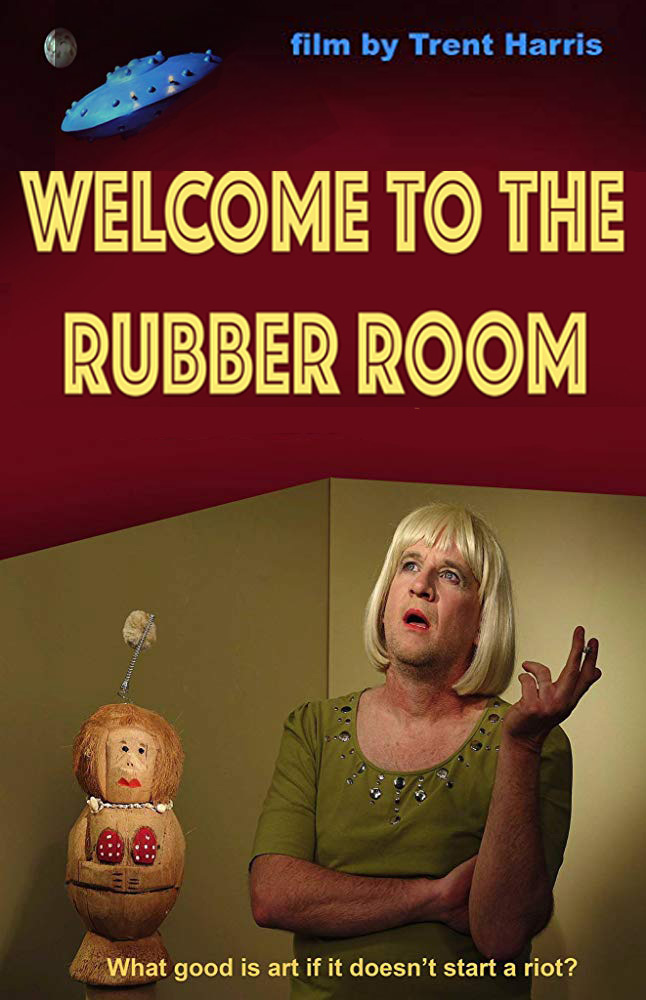
Welcome to the Rubber Room (2017)


Director: Trent Harris
Screenplay: Trent Harris
Cast: Natalie Keezer as Fatima; Dan Morley as Gary Guy; Davey Morrison as Alexis Thrill

"You gave money to a duck?"

Another Trent Harris production and the most poignant detail about this film is that, whilst an openly silly film, it has as a reoccurring reference Marcel Duchamp's "Fountain" (1917), a urinal that was upturned, signed and presented an exhibition of the Society of Independent Artists in New York. In art, Duchamp was connected to the Dada movement, the urinal in itself creating a hypothesis whether his intention that any object could be art, causing an inherent provocation from an object that was both manufactured, and thus not unique, and usually urinated in being held on a pedestal. Whilst it is played for humour, such as a video artist having the misguided historical theory that the Nazis already existed by World War I and started it to steal the urinal, despite the "fountain" itself only coming to existence when World War I had long already started, it is poignant how much it is referenced. It is viewed in Welcome to the Rubber Room as a world shattering creation in art, with characters here trying to find the newest piece as radical in its influence as Duchamp's readymade was, all whilst having to worry that even the art gallery they might show their work in is about to be replaced with a Bed, Bath and Beyond store.

Rubber Room is structured as if three episodes of a micro budgeted television comedy, which if Trent Harris ever wanted to elaborate upon I would be more than welcome to see as, here, he hits upon a premise where he can show his best traits. That he has allowed himself to write memorable characters and dialogue and, notably, not be structured around a plot based around a mystery narrative as the other work I have seen have been, allowing him to try something different for me. Set initially at the titular Rubber Room, it is a beatnik place outside of time in the various idiosyncratic figures within it and their jive talk; that club however is not immortal as it is having its last night before being replaced with a Pottery Barn. Everyone is a stereotype of artistic minded people but you come to love them, be it Alexis Thrill, the neurotic poet whose broken relationship with a Fatima or informing bubble obsessed aliens he has no love to give is among his deeply personal work, or Small Lily, a cat obsessed artist who hangs around the guy whose literature does not use commas. There is even a bongo player - Beat Bob - who speaks as a fifties groovy cat and is in love with an artist Clover Dover who is obsessed with painting horses. I initially presumed Clover was a male actor playing a female character, or was trans, but in character has a very elaborate sexuality when Beat Bob finally pushes her to be straight forward with him the more he tries to woo her.

None of the jokes in Rubber Room are mean to art itself, but play to absurd touches and that a lot of the art feels out of time already, the "modern" Tracey Emin era of installation art going as far back as the nineteen nineties or earlier, or video art with an artist trying to sell Beat Bob a video loop of buttocks, possibly his own, to have as art in his house. Also, if anyone is going to have the piss taken out of them, Harris does it to himself, a brief tangent for a 1972 avant-garde film by a Trent Harris, involving a man's romance with a female mannequin in black and white, which no one is impressed with.
Episode One does show the absurdity that I have seen in his other work, as it is revealed Earth has been acquired by a very drunk alien (voiced by Harris himself), who intends to turn it into a tourist attraction for other aliens. The film is working on a minimal budget, so that interior is thankfully as home made as possible, with coloured cloths hanging everywhere, the floor wet in bubbling pools and bubbles floating everywhere. A lot more emphasis, even to the other films I have seen, is laid on his dialogue and comedy, and I will say now Trent Harris has a gift for it. By Episode Two, where Beat Bob has managed to gain a lot of money and decides to search for a piece of art to decorate his wall, Harris has this material down perfectly, and barring acquiring a few rooms and having some jazz on the soundtrack, he can instead rely on this dialogue and the cast instead.


Baring the abrupt cuts to the cast dancing, Rubber Room is structured as a sitcom envisioning this group of artists and beatniks, lovable figures who over presume their talent or joke about modern art. Whilst the jokes can be obvious, some are drawing from the reality of art, such as the artist who paints a canvas in just one colour with nothing else, not only evoking Yves Klein who became fixated on the colour blue, but that he did paint a (hugely tactile) canvas of one colour called Untitled Blue Monochrome (1955), going as far with his work to create his own trademarked shade of blue called International Klein Blue. Even the audio video installation of the buttocks I mentioned earlier just evokes the fact Andy Warhol made a film called Taylor Mead's Ass (1964), because he rightly realised a film had to be made of Factory star Taylor Mead's butt.

It helps that, whatever the necessary acting quality, everyone is interesting and memorable, a spark between them to stand out in a large cast of figures, be it artists trying to placate Beat Bob for a competition for prize money or the final Episode being Alexis trying to make a film against the evil corporate "crab people", literal or not, in spite of a lack of focus and the only background prop he requests being a miniature homemade volcano.

There is also a heart here. The references to places of art and culture being bought out and replaced with stores selling consumer goods is both a joke but a comment, clearly, for Trent Harris of the dangers of losing these interesting people and art. He loves them all, the characters ways of expressing themselves earnest whilst their gripes of this encroaching culture is evident and felt; it is a film from 2017 which felt it was worth even joking that there was a danger of losing this world even if, even in my neck of the woods in England going to my nearest city, there is some semblence of culture still but always a sense of this being marginalised by an encroaching store, or when a free gallery was being considered being changed into a building for wedding receptions. There is even a line mocking social workers who think painting butterflies on children's' faces qualify as an art festival which is a darker, scathing joke from Trent Harris, one that we can dilute art and culture from its raw, startling form. Remember, the film is practically worshiping Marcel Duchamp and his "Fountain", so clearly Trent Harris in his own odd way has raised the flag for the real subversives.

The result is a charmingly silly work, a further piece where I have come to really admire Trent Harris. Particularly as a film like Delightful Water Universe, whilst fun, can be seen as indulgent and too freewheeling in tone, this however is from that same position where an older outsider makes digitally shot films with full creative control, but also makes something entirely from this period which is also continually funny. Constantly hilarious and imaginative for the better.

Abstract Spectrum: Eccentric
Abstract Rating (High/Medium/Low/None): None