Showing posts with label Stop Motion Animation. Show all posts

Tuesday, 29 October 2024

Little Otik (2000)


Director: Jan Švankmajer

Screenplay: Jan Švankmajer

Cast: Veronika Žilková as Božena Horáková, Jan Hartl as Karel Horák, Kristina Adamcová as Alžbětka, Jaroslava Kretschmerová as Alžbětka's Mother, Pavel Nový as Alžbětka's Father, Dagmar Stríbrná as Pani spravcova (the caretaker), Zdenek Kozák as Mr. Žlábek

A Night of a Thousand Horror (Movies)/Canon Fodder


Jan Švankmajer’s tale of a couple who merely wanted a child, but cannot, opens with such strange images like the husband envisioning a fishmonger wrapping a baby up in newspaper outside the pregnancy clinic. Unable to have children due to medical sterility, the couple’s life takes a drastic turn when, as a sweet joke, the husband Karel Horák (Jan Hartl) finds a tree stump that looks like a child vaguely and dresses it up as one, only for Božena Horáková (Veronika Žilková) to literally take the carved and varnished stump as a literal child to his horror. After a contrived nine month pregnancy they fake, a be-careful-for-what-you-wish-for tale transpires when after this pregnancy the tree stump now christened Otik comes to life.

Švankmajer had nearly three decades as a stop motion animator before this film, working on shorts and even one music video for Hugh Cornwell named Another Kind of Love (1988), before he made his first theatrical film with Alice (1988), an Alice in Wonderland interpretation which is whimsical, if surreal and embraces macabre horror tropes, more so as he used real taxidermy animal and bones to create some of the denizens of his Wonderland. Švankmajer made his craft from his native Czechoslovakia/Czech Republic literally animating anything from paper furniture to paper, his later films after Little Otik going onto real cow tongues (Lunacy (2005)) to photo cutouts in Surviving Life (2010), and his work here embraces a macabre humour contrasting the tragedy that will transpire.

For the Horáks, children are what are important for their community in the apartment complex as much as they sincerely want kids, not just take the cat out on a leash for walkies. Whether a good thing or not, it is turned into an obsession that is not just that of Alžbětka (Kristina Adamcová), the one child in the complex lamenting the lack of other children, and overenthusiastic to the point of reading medical texts about sterility and “slow semen”. The set up is from a fairy tale, of the Otesánek by Karel Jaromír Erben which is retold in fairy tale illustrations animated onscreen, but it is streaked by Švankmajer as a card carrying surrealist skewering the weird ritual of proud parents and those around the Horaks who celebrate their consummation of parenthood. Alžbětka’s obsession is as an over inquisitive child, but her mother celebration of the fake pregnancy cycle in the first act is as odd when viewed from afar, as is Mr. Horák being congratulated at work with drinks. Children are a positive thing in the right context, an important moment for any parent even with adopted sons and daughters to undertake, but the ritual is seen as having existed for its own sake. With Mr. Horak’ early hallucinations of babies being everywhere before the tree stump is literally dug out, their wish for parenthood is arguably one as much pressured and forced onto people even when they wish and feel lost without this in their lives.


Švankmajer uses his career to prod at human behavior in its curiosities in the theatrical and short length films. Virile Games (1988) mocked the sport of soccer as a television event as much for an excuse for significant food consumption as much as violence, whilst Conspirators of Pleasure (1996), the theatrical film before this one, whilst sympathetic to its anthology cast was about sexual fetishes, done with the least conventional ones where his own hand crafted pieces for the film, like kitchen utensils like rolling pins fashioned to give pleasurable massages with artificial tongues, matched how all the pieces within itself showed these men and women painstakingly crafting the items and costumes needed for their elaborate sexual fantasies, even the man who dresses up as a papier-mâché bird creature to swoop on a woman who has a stand in he also built.  With Alžbětka’s father always watching adverts on TV and getting drunk constantly, or the really twisted joke you normally would never get, that the old man in the complex is a pervert eyeing up Alžbětka, you see Švankmajer turning ordinary Czech lives into his creations to scrutinize them, as he did literary sources. His obsession with food, the destructive act of eating and its strangeness, is the most prominent example of this from his entire filmography and perfect to see here, as Otik when he comes alive is very hungry and, as he grows, even the post man isn’t safe. Food has been one of Švankmajer’s obsessions for his whole career, continuing it even in one-off surreal moments here like nails being seen in a broth or a sentient breathing pancake.

This is one of his most robust narratives too, where the first act fully sets up the sick humored turn to Otik’s parents having to hide his consumed victims. Little Otik at that point definitely belongs to the horror genre among others as, stripping his food down to freshly bloodied bones by his crib, or guts and blood split on the glass of his bedroom’s windowed door, we will see Otik move from an incredible piece of stop motion magic to a giant practical suit and off-camera implications. Otik himself, let alone the rest of the animation in the film, is visibly the craft of a veteran animator (and all his collaborators on this production) who had four decades before the film to hone his skills, let alone is an acclaimed artist in his own right in various forms of materials shown in galleries over the decades after. Just Otik himself in his initial living version is the result of having to find and put together real pieces of wood visible for all the titular child’s mannerisms and facial expressions in his initial form. All the stop motion in general, whilst at this point in his theatrical career fully focused on making sure his human actors and their performances also suit, had to be painstakingly put together even for pure gags, with the knowledge Švankmajer’s trait of not using conventional items for the motion would have added new challenges for him and an animation team to work with. Even if giant Otik becomes an entity not shown fully onscreen when his parents finally lock him down in the coal cellar of the apartment complex, I see they depict his hands with real twigs that had to be painstakingly collected and likely led to multiple hands needed to accomplish the whole film.

Švankmajer is truly an artist but, whilst Alice is a masterpiece in its own right, the real turn by Conspirators of Pleasure and this film is that he fully embraced these longer films for being dramas too. Whilst Alice focused on one young girl in the lead and his stop motion, here he has a full cast and it feels he felt completely comfortable there too. Actors did exist in his short films, and one The Garden (1968) is entirely around people without animation its central focus, but you see here he found a new side to filmmaking he embraced as he made more theatrical length films which had longer stories. A corpse humour, even pure silliness, is found in the performances too to be as dynamic as the animation, the tragedy matched with the farce. He finds humour in, say, a man pretending to be the postman your child ate and post his mail deliveries at night, even if it leads to questions from far away onlookers of why the postman is late posting his mail. Or the nonchalant conversation that, if forced horrifically to cut your tree child to pieces, you can just ask your soused neighbor for his chainsaw with no questions asked.

Because of this, the story is as good, with its own twisted turns as, with the naivety of a child but her innocence causing as much harm, Alžbětka in the second half befriends Otik in his cellar confinement. Feeding the local pedophile to him is one thing the viewers will applaud, but when she has no qualms in debating to feed anyone including her family members to him, when she cannot get any food for him anymore, you see a nasty little parable about how childhood for all its innocence has a naivety which does not process the consequences of life and death. This can be revealed in as a subversion of proper etiquette but it also shows that, like with Otik himself, our perceived notion of the beautiful innocence of children is just as strange and deserves to be subverted as seen in both children we follow here, all needing to be resolved by the elderly female neighbor in the end. Tellingly the film ends before this inevitable finale to stop all this is seen onscreen, as Švankmajer has already told his parable in its fullest with the fairy tale sequences telling Karel Jaromír Erben’s original story. The parable is this strange tale of wanting a child regardless of the cost, and its sickly humored morals close us out before the unfortunately meeting of an Otik with a garden hoe because that was always inevitable, whilst the journey itself is the delirious and impressive ride we had just experienced over two hours.

Monday, 10 April 2023

Surviving Life (Theory and Practice) (2010)


Director: Jan Švankmajer

Screenplay: Jan Švankmajer

Cast: Václav Helšus as Evžen and Milan; Klára Issová as Evženie; Zuzana Kronerová as Milada; Emília Došeková as Super-Ego; Daniela Bakerová as Dr. Holubová

An Abstract Candidate


I am the Chinese melon!

Ever since I discovered the short films of the Czeck filmmaker Jan Švankmajer in college, borrowed from the private stash of DVDs in the office of the Film Studies tutors, I can say he is one of my cherished filmmakers.  Having seen most of his career’s work too, the through line from the famous short works to long form movies is a fascinating progression. One of the best living animation directors, his knowledge of traditional techniques (puppetry, stop motion etc) is matched by a distinct use of everyday objects – toys, wood, metal, animal bones, even pieces of meat – that are moved and crafted in ways that pushes the films into the areas of texture as well as sight and sound, allowing the viewer to ‘feel’ them by their nature and the grain and details you can see. This trademark, through decades of shorts, was combined with various types of ideas, from adaptations of Edgar Allen Poe and fairytales to satire, and his idiosyncratic obsessions such as childhood to food and the act of eating. The later is one of his most idiosyncratic trademarks, and going into a Švankmajer work, you will both witness food as a beautiful substance and utterly vile, which Surviving Life continues with the new addition of projectile vomit.

With his first feature film Alice (1988), Švankmajer would incorporate live action, but not in just having actors in front of the screen but having them being as much figures for the director to animate as well as actual people. Švankmajer incorporated this in short films, 1983’s Down To the Cellar a predecessor of his debut Alice, but after he started to concentrate on feature films, this has become a central part of his work. With Lunacy (2005), the film before Surviving Life, the live action would have completely taken over were it not for the continuous scenes of animated cow tongues that are intercut between plot points. With Surviving Life, Švankmajer's fan base met with an experimental tangent even from his previous films, his bitterly humorous opening monologue to the camera introducing the film as a result of a lack of money for production, though with the advantage that, since they only needed to shot with the actors in a shorter span of time, they did not need to pay for catering because “photographs don’t eat".

Created using cut-and-paste photographic images, ‘like old children’s cartoons’ as the director compares it to in the opening introduction, Surviving Life follows an older man Evžen (Václav Helšus) whose life is punctuated by dreams of a beautiful, red dressed woman whose name continually changes and exists in a dream reality which continually fluxes out of his hands. Becoming a patient for a psychoanalytic doctor, and delving into other methods of guiding his dreams, he tries to understand the images he sees every time he sleeps. The plot sounds quite common and paradoxically, this is the closest for me yet Švankmajer has gotten to a ‘conventional’ story - including the layer of clues and images you discover on a second viewing - but is one of his least conventional works in a filmography that would be viewed as abstract against traditional views of animation. The cut-up images that make up the entire film, spliced with live action moments (usually close ups of intricate actions or gestures), is incredibly different from what I have encountered in cinema. If anyone, like I did as a child, used to cut out images from magazines or comics and either moved them about like toys, or spliced pieces of them together to create new ones, this is what the entirety of Surviving Life feels like, only taking to it to an entire feature length film, from the backgrounds to most of the moments, being created from two dimension images cut out and finished digitally on computers.  Just from the initial set up in one of Evžen's dreams – where giant female heads blow out watermelons from between their lips, and buildings switch sides on human feet, where teddy bears have long furry phalluses and chicken headed nude women run around – I am reminded of what an actual surrealist artist is as Švankmajer shows his skill with the craft.

This style of animation has been used by Švankmajer previously, including outside his film work, but here it is allowed to breathe out into this entire construction. The results are surreal, human beings and their photographic copies alive and mixed with a story where dreams are in the centre of the narrative. Švankmajer has played with the concept of dreams in his filmography, but this is the first one where they are the central subject as well, which is another distinct part of the production. With this, expect Freudian images of everything from eggs to flowers, giant hands coming out of windows to drag bystanders up to their doom, a dog with a suited office worker’s body, and an entire film where reality and the dreams, while separated, still bleed into each other, continuing Svankmajer’s message at the start of the film, through quotation, of how only by combining the both of them together can a human being be full.

The result is unconventional even for animation, incredibly creative with its imagination and technical production, and with a wonderful sense of disgracefulness in Švankmajer's old age as a veteran, an acquired sense of vulgarity that did not even come out in Conspirators of Pleasure (1996), his take on sexual fetishes, but erupts in this wonderfully in its sex obsessed, puke filled, poodle fucking mentality filtered through the obsessions with childhood, food and the fantastical. This may have started in Lunacy, with its combination with the Marquis de Sade with stories by Edgar Allen Poe, but while that film was serious in its takes of blasphemy and of the concepts of freedom, the self proclaimed follower of Surrealist Art Švankmajer properly added a sliver of crudity to his repertoire with Surviving Life and uses it perfectly. The film is also abstract in that, it does not only look at dreams but incorporates psychology. The plot is incredibly idiosyncratic if graspable already, as Evžen fixated on this Eva/Eliza figure in his dreams, trying to dream more to fall in love with her, but by invoking the ideas of Sigmund Freud and Carl Jung. Alongside having to literally fight a father personification who looks like himself and a variety of various neurosis to unpack, Freud and Jung are paid with respect if personifying their real life combative and disagreeing views of psychology through living portraits which fight each other; Surviving Life introduces layers that, while very easy to grasp, cause the scenes you see to take on new and peculiar lights to them. Touches taken from psychology can add entire memorable side characters, the old woman in Evžen's dreams who is his superego, who collects all and is God/Brahma/Karl Marx/whatever is a symbol of all-knowing. There is also an entire layer of how depressing the real world is, both in the relationships in the real world, such as Evžen's wife thinking he is having an affair, to the reoccurring plot point of lottery tickets being the false hope for the better in real life and the dreams.

I am biased for Jan Švankmajer, but it is through his skill of an animator and as a creative figure, still able to create such imaginative and stimulating work after fifty years or so since his first projects, that you see within Surviving Life. It is a film that came and sadly went without enough praise for it as it deserved, and wished his career gained more praise for how distinct productions like this were. To step into a Švankmajer film, while part of a rich culture of animation (especially European animation), is to encounter a truly unique voice, driven as much by ideas behind the images as by the creations on screen. Surviving Life combines a full narrative with this, as seen in his other features, and gets the best of both worlds. That it is also humorous and, by its ending, deeply poignant also adds to its quality. Surviving Life is, far from a work compromised by its budget as Švankmajer self decapitating says, but a masterpiece in a career already full of them.


Abstract Spectrum: Surrealist/Weird

Abstract Rating (High/Medium/Low) – High

Sunday, 17 October 2021

Violence Voyager (2018)


Director: Ujicha

Screenplay: Ujicha

(Voice) Cast: Aoi Yûki as Bobby; Shigeo Takahashi as Akkun/Yakkun; Naoki Tanaka as George; Nao Hanai as Kyoko; Daisuke Ono as Takaaki; Hitoshi Matsumoto as the Narrator; Tomorowo Taguchi as Koike; Saki Fujita as Yoshiko/Sayaka

A Night of a Thousand Horror (Movies) #251 / A 1000 Anime Crossover


A film I had anticipated since I first heard about it, and leading to my introducing to the idiosyncratic figure of Ujicha, this is not traditional "anime". You can argue it is not even "anime", as it is categorised as an entirely different animation type the director-creator has christened "geki-mation", paper cut-out animation drawn and cut out by himself, moved with his own hands, and with liquids and even real fire if need be used per scene. Contrasting already a unique production type, Violence Voyager is a pretty twisted and perverse film, of horrifying secrets in an amusement park in the mountains, which is not for the weak of heart even if just told with paper models. In fact even that does not prepare you for how odd this is. It is, however, a compelling work I am glad to have finally seen.


For the full review, follow the link HERE.

Sunday, 11 October 2020

One Night in One City (2007)


Director: Jan Balej

Screenplay: Ivan Arsenyev and Jan Balej

A Night of a Thousand Horror (Movies) #178 / An Abstract List Candidate


With pieces that are horror, others incredibly dark humoured, and aspects entirely of the unconventional, Jan Balej's stop motion film is in mind to its forbearers like Jan Švankmajer, with even visual and symbolic nods to the older statesman's work. As a film, One Night in One City is a series of vignettes involving human characters, non-human ones and a lovable duo of a fish and a tree man we will get to later, some segments sweet and others incredibly dark.

Like Švankmajer, the truly surreal offers the most humane aspects of ordinary life, the stop motion here absolutely is at its peak. Immediately Balej's style is very distinct of cramped apartments, timeless of an era before when there was modern technology, when this was made in 2007 with the likes of the internet and mobile phones. The human cast are far more stranger than anything else, figures who look distorted, pallid grey skin and peculiar features; the closest to two stereotypical beauties, two twin sisters who a man hires to watch him parade around in skimpies with a phallic taxidermied bird's head on his crown, look like E.T.'s sisters.

Their lives are compelling yet also peculiar, beginning with a man who in his spare time plays with a miniature circus set on his dining table, not wrong in the slightest though he does manipulate dead insects within it rather than figures, angered a live ant inspects the tiny cannon with fascination. Then there is another man who lines up the ant infestation in the apartment on his desk with sugar than snorts them up his nose. It is not dissimilar, though his was about extreme sexual fetishes, to Švankmajer's Conspirators of Pleasure (1996), to the point of that man wearing the bird head on top of his own feeling like an explicit reference to the most iconic scenes of the older film.

It does not feel like it is in the shadow of Švankmajer though, nor the Quay Brothers, with its own distinct nature due to those character designs and his tone. In terms of Balej's ideas, there is no sense of an actual genre barring the tangential one of being animation. Aspects definitely qualify as horror or at least the supernatural. One is of a bad musician who finds a severed ear that turns out to be able to grant artistic craft ([Major Spoilers] which in a great twist is actually Vincent Van Gogh's [Spoilers End]). Another explicitly is about a man entering a cafe where the ghosts of yore occasionally appear is still potent. It is weird that One Night... is tagged under the "horror" genre at all, barring those few justifiably suitable segments, but this sequence in particular is a stand out as an almost tranquil ghost tale entirely about mood.

Much of the production is a scrutinisation of humanity. This sounds pretentious, I know, but like comic strips, animation in its exaggeration can arguably tell more about human beings and their quirks in their sense of the absurd, be it Tales from the Far Side to something like this, one of the best moments perfectly showing this. A married woman, whose husband locks himself away in a room designed to play out his fantasies of being a hunter waiting in the woods, with their pet pug dog in role-play (in costume) as a bear, being wooed by an undertaker for dead pet dogs in his apartment. It is for me one of the stand out segments - funny, incredibly black humoured as that poor dog is put through a mock funeral, casket and even he playing the priest, and without any dialogue as all the film just has its human characters making noises, still possessing whit.

Thankfully, as well, in this film's shorter length, Balej's point as a snapshot of humanity never overindulgences and manages to have many segments in the short running time. His darkest material is contrasted also by the purest of joy. Namely, that one of the best story threads, the longest, is probably one of the best male BBFs you could find depicted in cinema. The only thing to bear in mind is that one of the friends is a fish, with fins and a tail he has to hop about on, and the other being a tree, feeling like a very explicit reference to the Jan Švankmajer film Little Otik (2001), where a childless couple pretended to have a log be their child, inexplicably coming to life but unfortunately also liking the taste of anything that moves. Thankfully, this tree is a gentler one; not much happening baring a snapshot of their lives as friends over the four seasons, where the fish man likes games like cards and the tree man in spring has to wait in the mornings for birds to briefly hatch an egg on his head, but it is beautiful. The fact these characters are anthropomorphic figures than people feels loaded in meaning - before, odd people with odd behaviours, not dismissed but still with foibles, contrasted with a segment you could actually show children of figures who are utterly un-human but having a true friendship. Particularly when one of them can decorate himself in Christmas tree lights or just decides to rock out in front of his window with an imaginary air guitar, the one moment that is an abrupt jump into the modern day, especially as that same scene has the tree man looking on the internet the production of guitars.

The only real exceptions among the human characters are two drunken vagabonds who find a genie able to grant their wishes for one night. Some of their decisions are grotesque - desiring women they get an amusement park ride, riding big tea cups, that goes between real erotic photos and has the exit door a gynaecological area they pass through - but it comes with a matter-of-fact humanity, between this and their immediately wishes being drink to appear in glasses in their hands. Jan Balej as a director unfortunately slowed down to a hault when it came to following One Night in One City. Little from the Fish Shop (2015), an adaptation of The Little Mermaid, was his follow up, which used extensive computer effects too, but tragically when we really need more animation to contrast the mainstream, i.e. the CGI animated ones common in cinema, a figure we can turn to in Balej has been absent. I suspect, even if he was still making animation, stop motion does take a long time to production, something to attest to in how long it took Jan Švankmajer to make feature length films into the modern day, especially with the issues of whether the funding is plentiful or not. That this particular film is obscure in itself is sad as, honestly, it was a surprise in a positive way and deserves more attention.

Abstract Spectrum: Eerie/Joyful/Surreal

Abstract Rating (High/Medium/Low/None): None

Monday, 13 April 2020

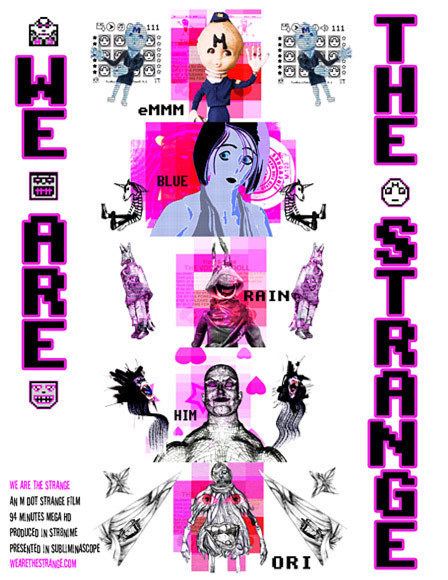
We Are The Strange (2007)


Director: M dot Strange
Screenplay: M dot Strange
(Voice) Cast: David Choe as Rain; Halleh Seddighzadeh as Blue / Prologue Narrator; M dot Strange as HIM; Stuart Mahoney as Ori / The Pastor; Chaylon Blancett as The Wooo Monster; Benjamin Joel Caron as Member of the Cult of the Strange; John Doremus as Sinistar; Luis Mendoza as Red Arm; Lari Teräs as Member of the Cult of the Strange

What do we get from internet created work? I am not talking about work from major companies either, but ordinary people in public who spend their time painstakingly putting together a parody video, let alone a fully animated feature length film like We Are The Strange which premiered at the Sundance Film Festival and whose existence online is as much to do with its creator M dot Strange wanting to retain the rights to his work. Secretly a lot of us probably appreciate the productions who strain against restrictions more than some films praised by film critics; internet culture and their access means there are probably more people who have seen We Are the Strange than major canonical films. Whilst this paragraph is completely with wild guesses and conjecture which cannot be proven unless we ask every person who has seen the film, it does have to be considered whether the internet and YouTube is now a major driving force of entertainment, even with a project like this which is from the very early days of this type of production being in existence. Certainly, the content and style of the film is ahead of its time in what it is obsessed with.

We Are the Strange is a visual creation. Set up as a story within a video game with a character select menu, it has a stereotypical evil character whose only goal in life is to be evil and dominate everything, a female character named Blue who has an ailment which worsens when she talks or smiles, a child-like doll who is supposed to be the savoir, and a mysterious stranger and his paper clown sidekick as heroes. Truthfully, when these characters talk, We Are the Strange slips in quality. It is not the vocal performances, which I come to accept as M dot Strange's first film and made with collaborators over the internet doing their hardest, but entirely because whenever characters talk, it is usually generic clichéd dialogue and exposition. This is clearly a film that tells a story with its visuals, which is where the film is compelling, so when dialogue does appears it usually ends up betrays the creator's own best gifts.

This is more so the case as this is not a very complicated plot to follow either as it involves a stereotypical (frankly one dimensional) villain and characters trying to stop him. Video games have also been more complex at times, especially now but even in the past, with their plots and complexity, but this story fits the type of aesthetic of games which were entirely about the thrill of playing them, carried as much by the rich and energised music through the film. This is also significant as the real fascinating with We Are The Strange is that it is a kinetic collage of action and images, where the dialogue (over shaky at times) is interesting when it is part of the texture, not the exposition to tell what the images themselves do a better job at.


The aesthetic was of immediate interest in the first scenes. At first the independent quality stands out, intentionally evoking games from just the immediate past in the mid to late nineties to early 2000s, down to the motif of Sinistar from the 1983 video game being an evil sign of warning continually in the background, and arcade cabinets being a prop for part of the story. In knowledge that this is a micro-budget animated film, which looks already antiquated at the time, the hard work put into We Are the Strange should not be dismissed considering that even if some of the character animation is jerky at times, it also has an aesthetic which I personally love and gets more elaborate. Any unconventional aesthetic to animation inherently has a dream-like nature to it, and in this case the ambition is there to use various forms as well, including stop motion.

It is rewarding and if We Are the Strange does over complicated and confuse itself over a simplistic plot, the visual material is rewarding. Bleak and desolate video game streets are contrasted with the added strangeness in its motifs of aforementioned arcade cabinets being everywhere or the obsession with ice cream. When the film rests on mood or the weird, M dot Strange gets his best work, like an ice cream parlour that is full of human devouring monsters, the idiosyncrasies of the creator the most interesting parts. One example, whilst the character is a bit underused, is the paper clown, originally a kidnapping victim by the stereotypical gruff man with no name who either went through Stockhausen Syndrome or changed allegiances, a figure that being an "origami actor" is made of paper and can transform himself into various shapes. These kinds of touches are those you pluck out and see for being interesting even if skimmed over in the midst of all the other ideas.

Beyond this, the film is pulp which eventually leads to giant robots fighting and secret superpowers. There are probably too many characters and ideas even for this plot, as Blue whilst the secret heroine does not get a lot to do baring being sad, and even the plot point that the doll child was taught from birth to pilot giant robots is one that could have gone on longer. Nonetheless, even with this flaw and a few others, I did find the film a reward. The dew of what would become common on YouTube, let alone video games, is here in one film, a fascinating if sometimes difficult to follow work. The craft of the content does have to be admired, and that M dot Strange went on to make more films to the current day is of immense interest, suggesting what potential progression took place.

Abstract Spectrum: Kinetic/Psychotronic/Weird
Abstract Rating (High/Medium/Low/None): None


Sunday, 16 December 2018

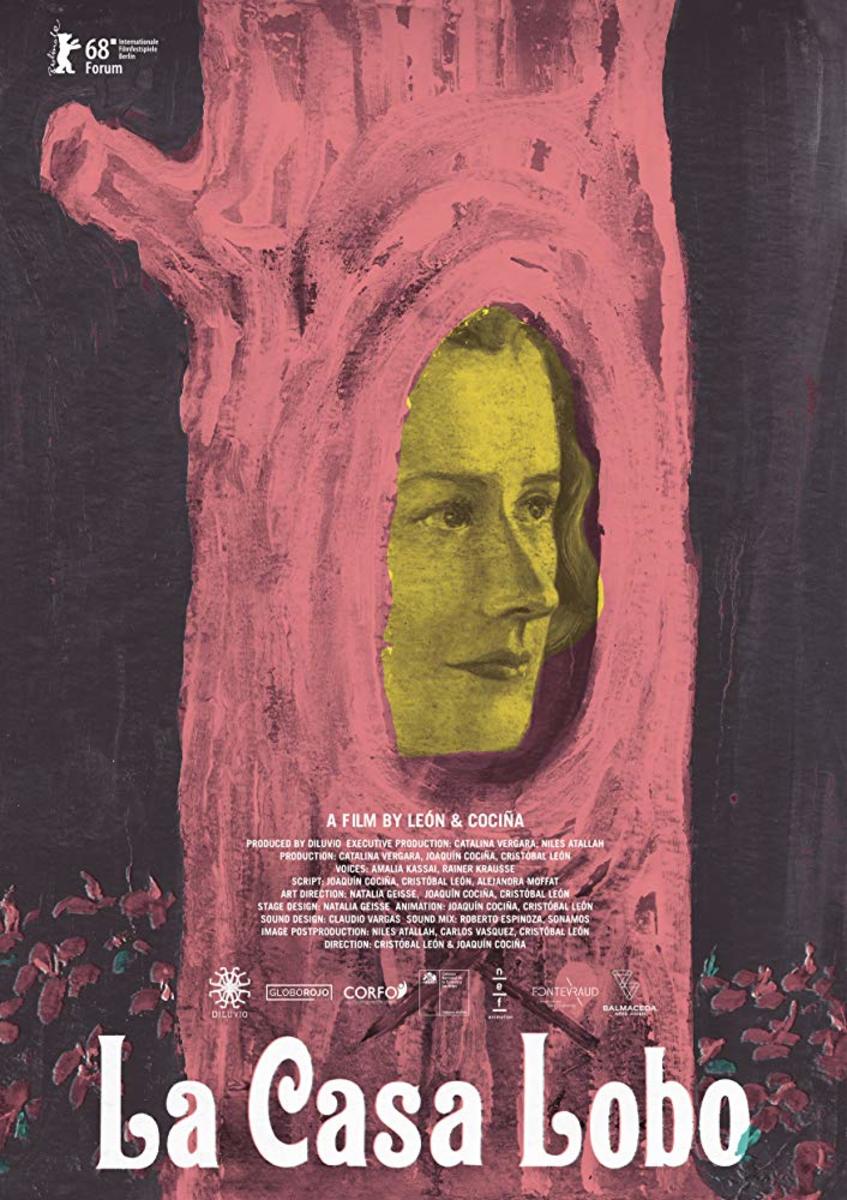
The Wolf House (2018)

From https://usercontent1.hubstatic.com/
14226322_f520.jpg


Directors: Joaquín Cociña and Cristóbal León
Screenplay: Alejandra Moffat, Joaquín Cociña and Cristóbal León
Cast: Amalia Kassai as María; Rainer Krause as the Wolf

Synopsis: Presented as a propaganda film of "the Colony", this stop motion story presents a fairy tale of a girl who flees the commune only for her to learn of the error of her ways when, is closing herself in an abandoned house and helping two pigs become human, they start to turn on her.

[Major Spoiler Warnings]
[Trigger Warnings]

The Wolf House, the co-creation of Joaquín Cociña and Cristóbal León with script collaboration by Alejandra Moffat, does have a historical context which might be missed if only established in the presentation. Many Nazis, after World War II, fled to South America, the discomforting parallels in symbolism found through the film's world. The Wolf House also evokes another historical context that is Colonia Dignidad, an infamous real life commune in Chile that, under the figure of German exile Paul Schäfer, was not only tied to the rise of the Pinochet dictatorship within the country and Nazi war criminals but was a place of abuse, child molestation and various horrifying actions that Schäfer was only arrested for 2005 after fleeing authorities in 1997.

From https://d2u3kfwd92fzu7.cloudfront.net/
catalog/artwork/gallery/2859/casalobo10.jpg

Even without this full context, The Wolf House's prologue immediately puts you on edge, the directors' willingly playing along as fictional collaborators on a restoration of one of the "Colony's" propaganda films as the voice over (the film juggling German and Spanish) is entirely bias to the commune and against any slander to its reputation, a disarmingly creepy children's chorus in the score like the ghosts of the dead.

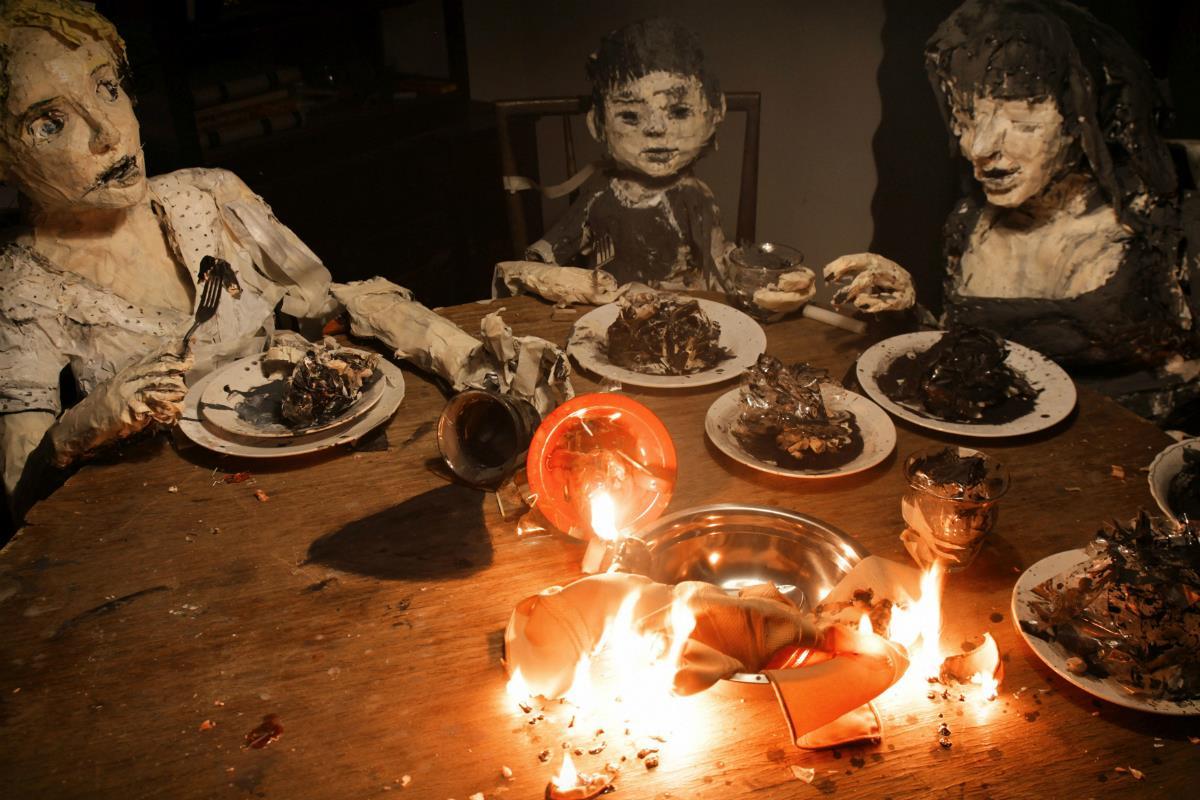
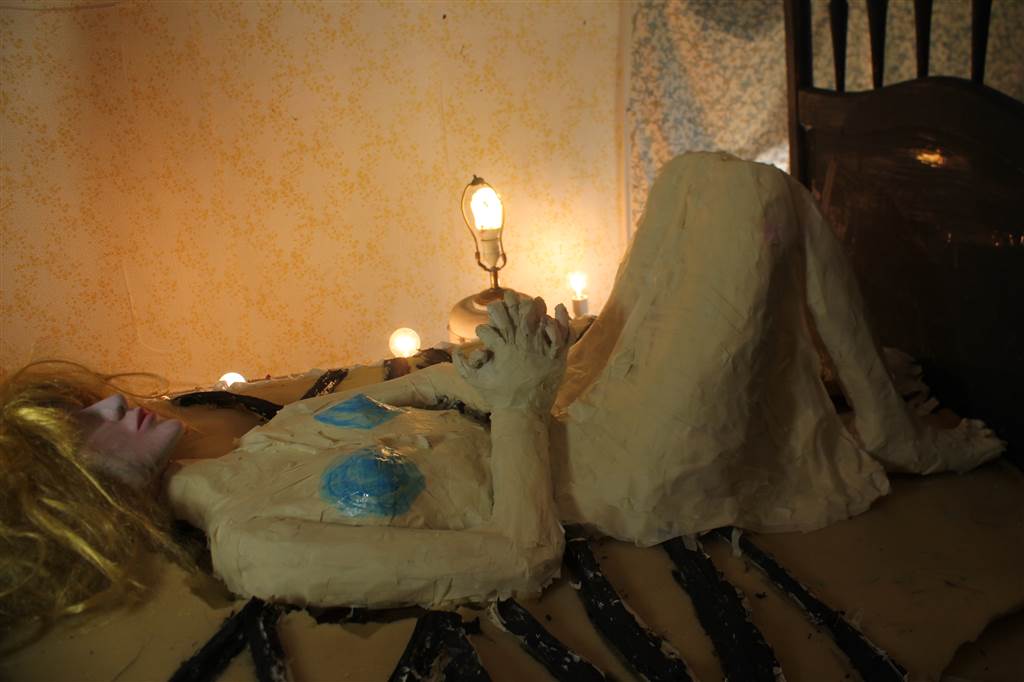
Even without the real, horrifying history context the exploration of this dark and potentially unknown history to the outside world from Chile means the creators already set up, using archive footage of idyllic country life with blond haired children and honey as the images, the perfect tone to set up a dank underbelly that presides over all the images without become overbearing. And The Wolf House, part of a tradition of stop motion animation, can proudly stand out among the likes of Jan Svankmajer and the Quay Brothers as a truly radical, painstakingly executed animation with hard earned artistry, in which Cociña and León to best describe the style starts in bookends with chalk drawn animation when the protagonist Maria (voiced by Amalia Kassai) flees the Colony and enters the titular house, only for the place to be a living and breathing animation itself. As a wolf stalks outside (speaking in German) becomes the sinister menace of the Colony in his sense of superiority and an underlying sexual nature to his comments of his beloved "little bird", the animation inside the home takes place in one giant set which is constantly built and deconstructed, the tape used to keep paper-mâché figures up and in poses sometimes visible, all whilst the film openly records as much the work to construct and tear down each sequence as part of scene transitions as it is the story. Some of the animation as well is painted on the walls and floors, to be erased after in such a way. The jerky motion of all is something that adds to the sense of ill-ease alongside the uncanny nature of the entire artificiality living world.

From https://d1nslcd7m2225b.cloudfront.net/Pictures/2000x2000fit/
9%2F8%2F2%2F1279982_thewolfhouse_199817.jpg

It is the equivalent of taken an abandoned building, and using the content of its garage and second hand furniture to make a film, a lot of paper-mâché and paint used for the production. I view all cinema, with this in mind, as hard work worth praising, even if it can be utterly wasted on bad films, but animation or work that visibly looked like hard work is to be more admired for its laborious, difficult craft especially as it has an innate tactility that is inherently (yet ignored) in the medium of cinema especially now in the digital camera age. It fits the material in terms of story here too as Maria finds two pigs and encourages them to transform into human beings, the characters both existing as figures but also painted only the walls and floors, sometimes using props like picture frames to depict them in extreme close-up. It's inherently skittish and fragmented as a film scene per scene, the animation as mentioned already creepy before you see it move in this fragmented movement.

Following Svankmajer's skill of animating life in an everyday objects, whilst The Wolf House doesn't follow the Czech animator's transgressive details like animating actual meat does have the same nightmarish quality to the material which plays into the story they are used for. The film reaches a moment of idealism for Maria and her pig children, briefly reaching a respite, but even before the Wolf's mocking affection is unnerving and one witnesses sights like pigs with human hands for feet or a papier-mâché boy on a toilet being terrorised and covered in bugs. After, as food is becoming scare and the pig children decide to eat Maria, the film without any direct transgression, aside when the children are accidentally burned by a candle falling on the table cloth and having to recover from their injuries, is riddled in a darkened fairytale mood.

From https://fantasticfest-site.s3.amazonaws.com/films/42331/
wolf_house_15_4web__large.jpg

The back story of what The Wolf House is eluding, if known, makes it more unsettling. The children, beginning as pigs, become children with dark features only for honey, the produce famous from the Colony, turns them into angelic children with blonde hair and blue eyes. The wolf, symbolically evokes Nationalist use of pagan symbols, and its entire bias to the wolf saving Maria in the end after she regrets rebelling against the Colony whilst in lieu to the film being a fake propaganda work is even more disturbing when her monologues clearly evoke hints of abuse, even sexually, and being forced into a collective beforehand. The animation's beauty doesn't stop its coarse and textual style from adding to all of this subtext and, with this in mind, I will be cautious in terms of recommending the film due to how disturbing it is to see. Nonetheless, it's an incredible piece of art that, if you are prepared for that challenging nature, is worthy to witness.

Abstract Spectrum: Handmade/Insidious/Lo-Fi/Nightmarish
Abstract Rating (High/Medium/Low/None): High

Personal Opinion
As a film premiering in 2018, The Wolf House deserves to be seen as an incredible cinematic achievement, more worthy of attention than more publicised films. Whether, baring temporary screening on MUBI, a film this important can avoid being lost in the film festival circuit may be as much entirely helped by a tiny little blog like this bring attention to this fascinating, artistically rewarding animation as much as a proper film critic. In terms of animation as a medium, Joaquín Cociña and Cristóbal León have already shown a unique style in-between them that deserves to be explored further in short and long form filmmaking.


From http://etiudaandanima.pl/wp-content/uploads/2018/11/Dom-wilka.jpg

Tuesday, 18 September 2018

A 1000 Anime Marathon

A huge amount to cover from my other blog 1000 Anime, a frenzied month or more covering all of the following alongside Cinema of the Abstract reviews. So lets not dither about shall we?

Bubblegum Crash!
From https://www.midnightpulp.com/wp-content/
uploads/2017/02/07YlWL72-320.jpg

The first admittedly wasn't a great experience to revisit, Bubblegum Crash! (1991) an attempt to capture the lightning in a bottle of its more successful predecessor which failed considerable. As someone with a morbid fascination with old Manga Entertainment licenses, it was worthy of revisiting but as you will read in the review HERE, it managed to be worse than some of the more technically and dramatically incompetent anime I've covered on that blog.

A Branch of a Pine is Tied Up
From http://www.shortshorts.org/2018/tmb/2216.jpg

Taking a different direction came A Branch of a Pine is Tied Up (2017). Sadly Tomoyasu Murata's short, probably the first stop motion work I have covered, was a short only made available through MUBI's streaming side, so I felt guilty even reviewing the short, praising it as an emotionally affecting take on Japan's history of natural disasters and loss by magical realism and stop motion, but aware how difficult now it will be for many to see. Nonetheless the review is HERE  and in the perfect world, such reviews and potential interest could help make Murata's work more easily available.

Dragon Half
From https://somewhereinthemidstofnowhere.files.wordpress.com/
2014/01/super-deformed-mink.png

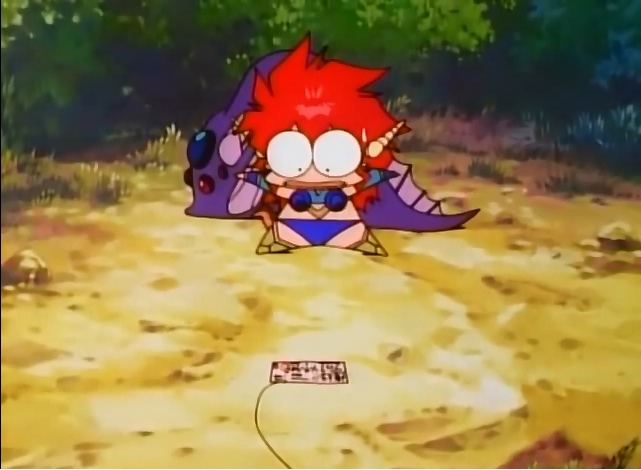
Thankfully Dragon Half (1993), be it by the American release by Discotek or various old releases, is more readily available, sadly an OVA which barely got out of the gate before it was officially cancelled but in its two short episodes managing to have a lasting impact still. Especially for those who cannot stand most high fantasy, like myself, this is a perfect antidote and you can read of the absurd comedy HERE.

Armitage III: Poly-Matrix
From https://conceptionclearinghouse.files.wordpress.com/
2013/03/vlcsnap-2013-02-28-18h38m05s254.png

Somewhat more divisive for myself, though a fascinating curiosity from the past is Armitage III: Poly-Matrix (1997), a theatrical length re-edit of a larger OVA which brought in name stars for the English dub. Not a perfect production, definitely the weakest of all the works one of my favourite screenwriters, Chiaki J. Konaka, has ever had his hands in but, especially next to Bubblegum Crash!, a better example of the nineties sci-fi anime about robots and their interactions with human beings. The review can be found HERE.

Princess Tutu
From https://ibhuluimcom-a.akamaihd.net/ib.huluim.com/
video/50081816?size=1024x576

A significantly better production Chiaki J. Konaka had involvement in was the brainchild of female screenwriter Michiko Yokote, a two season production that is arguably one of the few anime I have covered appropriate for all the family. Its also arguably one of the most unique and best so far covered on the entire blog too, the meta-tribute to fairy tales and ballet named Princess Tutu (2002-3). Sadly not a series with named recognition in the British Isles, and a cult one only in the USA, a tragedy as this is one of the those rare cases of something so sweet but so clever at the same time. Out of all these reviews in this post, this is the one you should follow the review link for, found HERE, first as a priority than go back to the others.

Batman: Gotham Knight
From https://i.ytimg.com/vi/Ok0WAzAUZYg/maxresdefault.jpg

Tonally completely at odds, this ginormous bundle of reviews almost included the US-Japan co-production of Batman: Gotham Knight (2008), which should've been a triumphant anthology of Japanese animators tackling probably the best and most well known superhero characters ever. It wasn't to be but, as always when covering anthologies which take longer to detail for each segment, the results even if a disappointment in production still has moments of inspiration. Find the link HERE.

Thunderbolt Fantasy
From https://myanimelist.cdn-dena.com/s/common/uploaded_files/
1472670840-8bd87069a8c7cf3af00c0b5ba2ded010.jpeg

Finally, and again stepping outside of conventional anime, is the Taiwanese-Japanese glove puppet series Thunderbolt Fantasy (2016). Openly, my review which you can find HERE is probably not a common one in opinion, but if anything is to be gained from the series (planned for a second series in 2018) its that it at least encourages more puppetry based productions like it in the future. I just wish the screenplays were better in this particular case...

Back here in Cinema of the Abstract land, hopefully more reviews in the future. Prioritizing 1000 Anime is as much the maddening number of anime I have watched over the last month or so, but for this blog there are some choice entries to cover, so keep your eyes glued here.

Sunday, 9 October 2016

Halloween 31 For 31: Bobby Yeah (2011)

From http://www.strangekidsclub.com/wp-content/
uploads/2012/10/bobby-yeah-poster.jpeg
Director: Robert Morgan
Screenplay:  Robert Morgan
A Night of a Thousand Horror (Movies) #34

My first and only experience with animator Robert Morgan beforehand was with his entry for The ABCs of Death 2 (2014). Called D is for Deloused, it's one of the best of the entire film with its nightmarish qualities. Indebted clearly to directors and follow animators such as the Quay Brothers, Bobby Yeah nonetheless has its own aesthetic style that here in managed to be even more disturbing and absolutely revolting at times. Animation that I love are about the senses of the viewer being brought up front and centre, whether it's the style and aesthetic of two or three dimensional animation, or the tactile nature of stop motion; whether they have elaborate narratives or not, are realistic in their character designs or the exact opposite, the best (and usually underappreciated) examples are in tune to a highly rich and carefully crafted production. Bobby Yeah follows a simple narrative journey - the titular Yeah, a humanoid with what only can be described as flesh bunny ears, steals a pet from another figure only for his curiosity to press a button that appears on its back to lead to a series of grotesque events, freakish monstrosities at his door and more buttons he cannot help to push.

The result, a three dimensional series of rooms in which the action takes place in, is the horrible cross breeding of a textiles class project with Cronenberg body horror at a meat counter of a butchers. Utter monsters populate the screen mixing doll-like figure, pure pounds of flesh or pink clay and human anatomy in their DNA, the most disturbing of the lot (and the most disturbing thing in horror for me for a long time) being a full sized and exceptionally realistic human face that writhes about with a tail like body. What adds to this horror as a counterbalance, making it more unsettling, is both the stop motion nature of the figures, made by hand and shakily moving about in spasms, and the inclusion of textiles that evoke innocence in a deeply inappropriate way, the cloth clothing of Bobby Yeah or the bubblegum pink felt fur lined walls of the figure - a cross between an angel beanie baby and a flesh freak - the pet was stolen from. The disturbing nature is to go as far as add explicit sexual aspects to the creatures, of giant sperm with red string tails, the birthing of an egg, and a literal tripod with a bird's head plonked on top of a mass of armless gangly sausage. The content is, despite the apparent horror of it all, of a very English take on what fellow animator Jan Svankmajer did with found objects, re-use and emphasise their traits in age and look in the characters he made from them, the Englishness from the specific objects used - this manages (just for me) to get away with having a head of a golliwog doll being used because, originally a bird's on the tripod, its stripped from its racist symbology and is amongst a menagerie of disturbing figures, and it wouldn't be surprising if Morgan knew the inherent issue of this when he made to decision to use, even use this fact to add to the disturbing use of the head for that particular character.

It's surprising how much explicit content it gets away with as a BAFTA nominated animated short, compared to how a live action version of this material would get a strong reaction in reviews, unrealistic figures appearing to still have life and a tangibility to them that makes the material still disturbing to witness, but there's a lot of sick humour and deliberate weirdness to the proceedings as well. A sudden sprint through live action countryside, brief, is disarming yet strangely hilarious whilst Yeah's obsession with pushing buttons, his fatal flaw which leads to the plot happening in the first place, skewers fairy tale morality. As a result, the film clearly defines, as the project of his that's the longest in length, a distinct style for Robert Morgan as an animator and director.

From http://fantasticfest-site.s3.amazonaws.com/films/24976
/1-bobby_yeah_1_robert_morgan__large.jpg
Abstract Spectrum: Grotesque/Surreal/Weird
Abstract Rating (High/Medium/Low/None): Medium
Like many animated shorts - Svankmajer's, the Quays, even Looney Tunes and directors like Chuck Jones - their plastic realities are inherently abstract where, even in realistic looking films which use real locations, one is forced to adapt to the reality shown. Especially with stop motion, the process of creating figures and having to move them inch-by-inch to create life in them, there's an inherent artificial bubble from the disconnected movement and hand-made qualities that force you to re-assess their reality immediately. The figures and world of Bobby Yeah beyond this also have a distinct visceral nature to them, which slither and crawl along the ground, adding to this disconcerting nature. Also there's the psychedelic tone of the short beyond the animation, its music by ZnO almost atonal at points and even a kaleidoscope series of colours being used a few times including in a freak-out transformation sequence, their inclusion with the use of textiles disarming in how they seen inappropriate on the surface to such scenes but fitting perfectly after this is registered.

Abstract Tropes: Gender Subversion; Inappropriately Shaped Genitalia; Animal-Human Hybrids; Psychedelic Visuals; Use of Ordinary and Antique Store Objects in Inappropriate Ways; Stop Motion; Full Body Mutation; Malformed Entities; Birthing; Machine-Creature Hybrids

Personal Opinion:
Absolutely squirm inducing in all the right ways. Whether Robert Morgan can be able to extend a project of his in the future into feature length is unknown, but four years worth of hard work on Bobby Yeah is visible and incredibly accomplished.

From http://4.bp.blogspot.com/-iQ_tM9TxneM/Uchk-fuZ2QI/
AAAAAAAADL4/liL1-peySNs/s1600/BobbyYeah3.jpg

Saturday, 30 April 2016

Alice (1988)

From http://lehu.pt/attachments/thumb600/tmdb/tt0095715
/poster/xxmkOc9kypgin1sMttV5mgQDXl6.jpg?w=400&h=594
Director: Jan Švankmajer
Screenplay: Jan Švankmajer
Based on the original story by Lewis Carroll
Cast: Kristýna Kohoutová (as Alice)

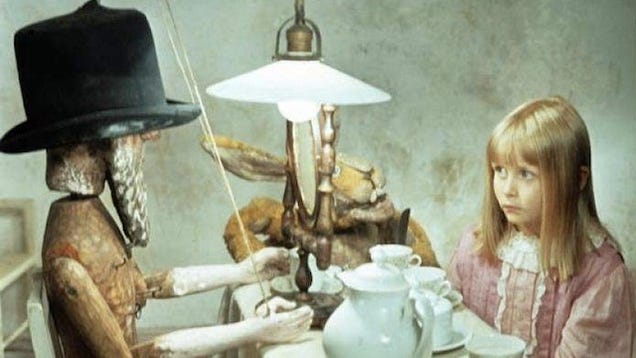
Synopsis: Bored, Alice (Kohoutová) notices that the taxidermy rabbit in the room she is in starts to move in its glass case, putting on a jacket and hat, and then dashing off with his eye continually on the pocket watch he keeps in his sawdust filled chest. The journey that takes place, following him, leads Alice on a strange trip through corridors, rooms and various outdoor environments, encountering a sock puppet caterpillar, a tea party with a Mad Hatter and March Hare, a malicious and decapitation obsessed Queen of Hearts, and various objects not found in the normal world such as nails growing out of breads and drinking ink that shrinks a person.

As a card carrying, self proclaimed surrealist, it isn't a surprise that animator/director/puppeteer Jan Švankmajer eventually adapted Alice's Adventures in Wonderland (1865) - a proto-surrealist work, Lewis Carroll's tale of a young girl named Alice is a series of absurd anecdotes, strange sights conjured in the mind, and limericks and verses where there is complete unpredictability in the world of Wonderland. Common objects are reinterpreted, puns are made and there's a logic of Wonderland's own that has entered common folklore. What's testament to Carroll's writing style is that when his work is toned down from the original text, a mainstream adaptation like the 1972 version with Peter Sellers as the March Hare is still incredibly strange to watch because of how Wonderland has to depicted in most adaptations. What's significant with Švankmajer's adaptation however - while very faithful to the text, down to little touches, barring some minor changes and pieces like the Mock Turtle segment being removed - is that it removes the tone of whimsy that is prevalent in the original story. The story's on the cusp of being mischievous, Alice quite a sarcastic if lovable and smart figure, a lot of whit in the extensive amount of dialogue and Alice's internal thoughts she has; Švankmajer strips most of the dialogue out and almost everything, including other characters' voices, is spoken by Alice herself in narration.   

From http://www.whitechapelgallery.org/wp-content/uploads/
2015/08/alice-jan-svankmajer.jpg
The other factor is that Švankmajer is paradoxically a legitimate surrealist who yet depicts his worlds through a grounded reality using everyday objects and locations. He wanted to make what he felt was a far more accurate depiction of the story, not a fairy tale as others had but a dream, and this is both why this is one of the most faithful adaptations in existence and yet it is entirely his own take at the same time. He is the most tactile filmmaker ever to exist baring Stan Brakhage and a few others; even in his last film Surviving Life (Theory and Practice) (2010), with paper cut-outs, he sculpts his films with his own hands alongside other animators and technicians, using any object he could easily have acquired from a tool shed or an antique shop and bringing their own textures and history with them into his work to create lived in, unique environments.

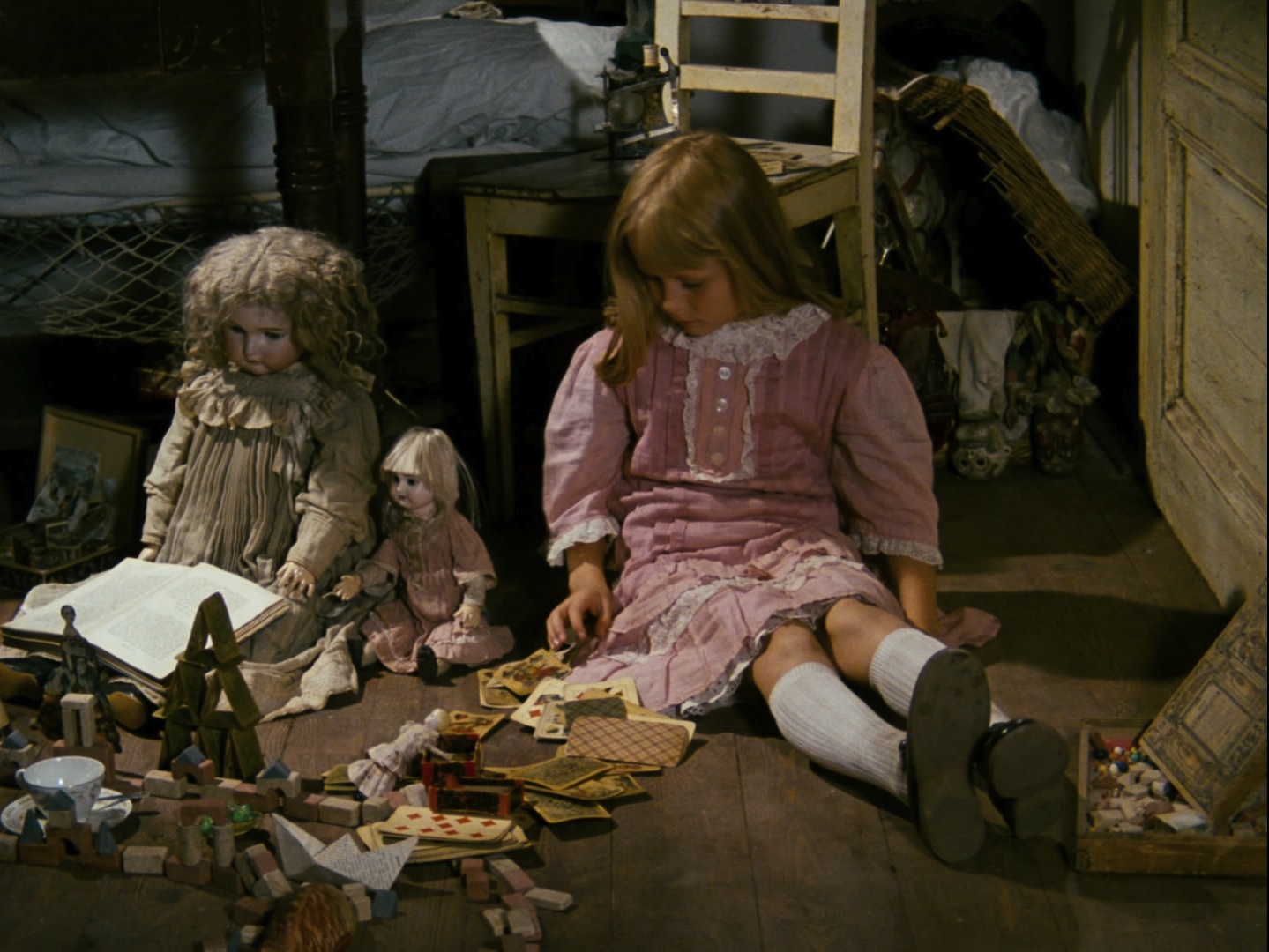
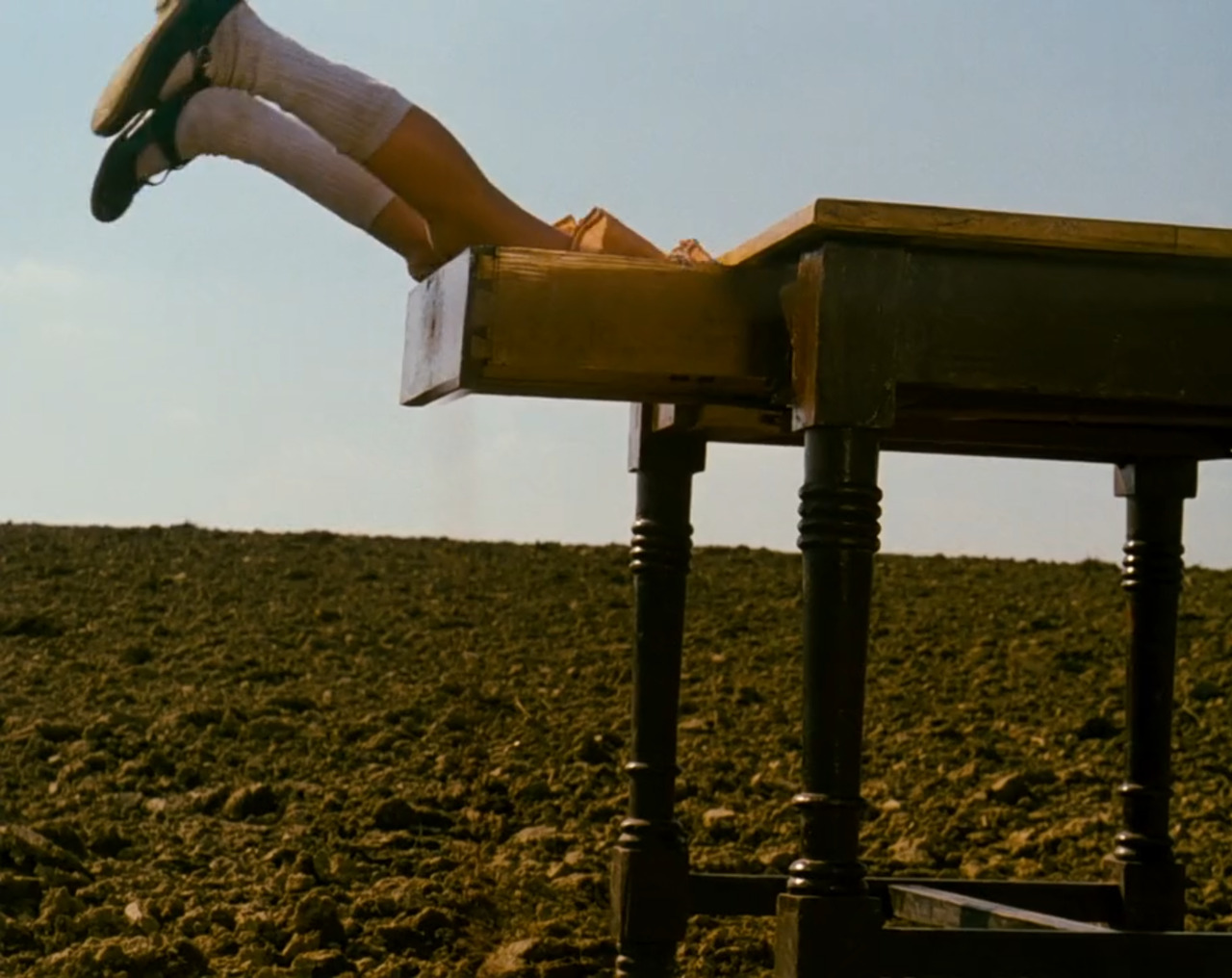
As a result of this, the adaptation is not the fantastical Wonderland of most adaptations, that which is usually multicoloured and require elaborate costumes and painted sets. Instead Švankmajer's Wonderland is the cellars, corridors and gardens of everyday life, dust ridden cluttered, old wooden chairs and drawers given a new life as Alice enters Wonderland not through a rabbit hole but a study desk drawer lined with rulers and drawing utensils. Every figure Alice encounters has been built by objects remoulded by Švankmajer, many of which become far more grotesque as a result; the caterpillar is an actual sock with denture teeth and big glass eyes, the white rabbit spilling sawdust from his open chest cavity, and his friends who try to get an overgrown Alice out of his home a bizarre menagerie of constructions from animal bones and googly eyes. Ordinary objects in Švankmajer's world are inherently made new and alien even when they're un-tampered with physically - scissors in bulk collection in a drawer, the rabbit's home built from wooden blocks with a rabbit hutch interior of wire fencing, Švankmajer's obsession with eating and food depicted in elaborate detail  - creating a very tactile cinematic environment.

From http://38.media.tumblr.com/tumblr_mcb45ou6mC1qaxxv7o1_1280.png


Technical Detail:
The animation - having spent two or so decades in his career making short films, including a take on the Carroll poem Jabberwocky (1971), before he decided to transition into making feature films - is exceptional from Švankmajer, but an important factor to his work is that not only are you sometimes asking how certain scenes were pulled off, amazed by the skill involved, but that anything obviously faked is part of the aesthetic choices. The obvious handcraft down to the animation's flaws is as much part of his films' worlds, such as the novel interpretation of Alice's constant growing and shrinking being depicted by her smaller self being a stop motion moved Victorian doll. The fragility of many of his creations, broken and remade, add to their life; that which evokes the possibilities of imagination when given only the long forgotten objects of an attic or an antique shop to work from.

Sound is also important to Švankmajer and easy to neglect with his films. The narration, thus making it easier for the English dub to exist and be added to the visuals, has an innately ghostly tone to it as well, particularly as repetition in dialogue alongside certain Wonderland behaviour is common. Sound effects in general are also as audio textual as the materials being sewn, chewed, broken or generally manipulated. Rather than the March Hare merely smearing "the best butter" on the cogs of a pocket watch, you hear the squelch of butter meeting clockwork in full detail. The awkward sounds of these stop motion creations as they come to life is neither ignored in the soundtrack, an entirely constructed world of each twitch or attempted movement of these beings is as important for an entirely constructed Wonderland; this as much as the intentionally weird moments such as a piglet going down a flight of stairs crying like a human baby are important to the film alongside its visual content.

From http://s3.amazonaws.com/auteurs_production/images/
film/alice-1988/w1280/alice-1988.jpg
Abstract Rating (High/Medium/Low/None): High
Lewis Carroll's two Alice novels - Alice's Adventures In Wonderland and the neglected Through the Looking-Glass, and What Alice Found There (1871) - are canonical works of literary abstraction and absurdity, easy to understand and originally written by Carroll to amuse the real Alice Liddell, a young girl, but majestic in how strange they are, relishing bizarre verbal pins and digressions, arguments over insignificant details and incompetence in official figures alongside a heartfelt ode to childhood imagination. There are so many adaptations - from the silent era to Disney, Hollywood adaptations to seventies porn, an anime adaptation to a BBC adaptation where the creatures of Wonderland are depicted by actors without any costumes - that it's going to be a drastically sliding and varied scale of what each one will be like in terms of abstraction.

Jan Švankmajer's Alice is likely the most abstract adaptation and will be difficult to knock off the top of the list in this area. Not only is there faithfulness to the tone of the story, but the drastic change in terms of tone that counteracts this, that which is Švankmajer's own influence, adds to its odd mood perfectly and becomes, in being extremely different, a more faithful attitude to the material. In comparison to the Quay Brothers, who idolise him, Švankmajer does not share their dreamlike mood, entirely grounded in a reality even if it's strange to witness. In contrast to Walerian Borowczyk, who touched upon the same style of animation in his early career and kept the same fixation for objects and textures in his later live action films, they took on different ideological ideals even in how they used and sculpted objects even if they were both subversives; Borowczyk makes a biscuit box in the shape of a Bible in one film, Švankmajer would animate the biscuit box into a sentient creature or have it become a trap door to a whole manner of strange occupants, whilst Borowczyk was obsessed with performances from actors in contrast to Švankmajer turning his actors, including himself in cut-out form in the prologue of his last film, into objects as much as people to manipulate.

There is also a misanthropic vibe to Švankmajer's work, fitting a surrealist whose other literary adaptations have included Edgar Allen Poe and the Marquis de Sade, a more critical view of the world even next to someone like Borowczyk where anything can be twisted - like the jar of fruit jam which Alice discovers has drawing pins in it. With Alice, even though its suitable for children, it's intentionally jarring in look and tone to the innocent fantasy nature of most interpretations, where you can linger over screenshots and imagine every splinter in a chair leg or the loose threads of garments, the brittleness that undercuts the fantasy. His completely unhesitant attitude to depicting the original story's more black humoured material - the Queen of Heart's obsession with execution is made more grim because objects don't bleed when they're decapitated - adds a morbid humour even when not directly tackling obsessions like his like the repulsive, destructive nature of the act of eating.

From http://4.bp.blogspot.com/-FwkSDroHT1g/Taxs-k2nZMI/
AAAAAAAABFE/-X_zzz-i7oE/s1600/tumblr_laz3a2nZcj1qdaig4o1_500.png


Abstract Spectrum: Grotesque/Surreal/Weird
Abstract Traits: Object being brought to life; Stop Motion; Decapitation and Unexpected Violence; References to Alice's Adventures in Wonderland (or Straight Up Adaptation of); Juxtapositions of Objects that are Strange Bedfellows; Verbal Puns; Taxidermy Animals; Animal Bones; Grotesque Depictions of Eating and Food;  

From http://3.bp.blogspot.com/-q9NX7Z1Zu7U/Un65IylVJ9I/
AAAAAAAAMas/9MSZSkdBPHM/s1600/a9.png
Personal Opinion:
As someone who only read Alice's Adventures in Wonderland only a few years ago, and instantly fell in love with it and its sequel story, my growing admiration of the story means that I've also developed an obsession with any other works which directly adapt it or reference it. Already a huge fan of Švankmajer's films before this, his take has grown to be even greater knowing its source material very well, to the point it is one of his best feature films if not the best work of his alongside a short like Dimensions of Dialogue (1982). It cannot be stressed enough how it manages to be Švankmajer's own creation yet the most faithful in terms of attitude to the material, only lacking the whimsy and replacing it with a world entire built from objects and textures that drags the viewer as much into Wonderland as Alice herself. 

From https://i.kinja-img.com/gawker-media/image/upload/s--MG4JJHtn--/c_fill,fl_progressive,g_north,h_358,q_80,w_636/17z8tci2o56oujpg.jpg